Quote of the Last 17 Days: Hope

“Hope is one scary emotion.”

This quote comes not from someone famous—at least, not famous yet—but from my friend Alex. She is ten years younger than I am, trim, fit, beautiful, and because of a muscular affliction, often seated in a wheelchair. At the same time that Adrian and I are fighting to recover Martin, Alex is undergoing a costly experimental therapy aimed at regaining her mobility. “Hope is one scary emotion,” she told me in an e-mail and then continued:

I’ve been thinking a lot about hope lately, and my total fear of that particular feeling. Call me emotionally conservative or a cautious optimist (really cautious), but there is nothing more devastating (down on the floor crying with your coat over your head while you’re alone in the office) than feeling like you’ve put your hope in something that has failed. Imagining that your life can be different and then ending up in the same position that you were in before. I find that more times than not, feeling let down after I’ve dared to hope is what puts me in a near-catatonic state. . . . It’s been a long time since I even thought that I could be fixed.

With those words, Alex was speaking for both of us.

I have a conflicted relationship with hope. When Martin is doing well, hope creeps in, and invariably I wind up disappointed. Invariably, because when I’m hopeful, anything not perfect feels like a nasty, swollen raincloud hovering over my picnic table.

Take yesterday, for example. At the breakfast table Martin was drinking his apple-cider-vinegar beverage, and I noticed that he held the stainless-steel straw in the middle of his mouth, his little lips puckered around it. A big deal? A huge deal. Through his HANDLE therapy we’ve realized that Martin has midline issues. He does not like to reach his left hand to his right side, or vice-versa; he turns his head to watch action from the corner of his eyes; and he clenches straws with his molars, dangling them from the edge of his mouth. For months I have maneuvered his straw to his mouth’s middle and held it there while he slurped. Each time I released the straw, his tongue kicked it back to the molars.

Now here he was, unprompted, unassisted, puckering his lips around the straw.

I felt so hopeful. I seized Martin’s notebook—the one we use to communicate with his school—and wrote, “We’ve seen a lot of improvement in Martin lately.” Then I sent him off to the school bus.

I meant, of course, to prompt a similarly upbeat response from Martin’s teacher, something along the lines of, “So have we! He’s concentrating much better.” The moment Martin arrived home from school I pulled the notebook from his backpack and checked. Nothing. His teacher failed to take the bait, and that failure, unreasonably, crushed me. I assumed that she had seen my note, realized its purpose, and made a conscious decision not to respond, because she had observed no recent progress or improvement.

Martin’s teacher does not respond to everything I write in his notebook, especially when I give non-specific information (as opposed to, say, “Please note that Martin will be absent tomorrow for a doctor appointment”). Nor does she generally address his progress in the notebook; for that, we hold frequent in-person conferences. I can only imagine, also, that the daily grind in a classroom of special-needs pre-schoolers allows limited time for musing extensively, in writing, on “improvement.”

None of that mattered when I saw the empty notebook page yesterday. I had spent the day feeling hopeful, and my hope is so fragile that it just waits to be shattered.

So for the most part, I try to avoid hope. When I sense hope fluttering through my chest, I try to diminish it, by focusing on Martin’s shortcomings and areas without recent improvement.

And therein lies the conflict. I dodge hope because it invites an unbearable parade of emotional highs and lows. On the other hand, I can’t continue this path without hope in Martin’s recovery. Hope is sustenance, even if I partake only when Martin’s progress is undeniable.

Today, unlike yesterday, and even though that straw again was in the middle of Martin’s mouth at breakfast, I will not allow myself to feel hopeful about Martin’s recovery in any present or immediate sense. Instead, I will hope for my friend Alex, and allow her to hope for us.

When hope becomes an enemy, at least we have our friends.
Martin’s Bundle: This Symptom, and Not That Symptom

After church services this morning, a younger member of the congregation approached me with a question. His psychology class is covering a unit on autism. They’ve learned about autism-related behaviors like not wanting to be touched, making no eye contact, and lacking affection. If Martin has autism, then why is it that, every time this young man sees us, Martin is snuggling on my lap or hugging me or smiling at people he knows?

I gave him the explanation, as far as I understand autism (which, I admit, is not very far). Autism is defined not by a root cause, but by symptoms, and the disorder can encompass myriad symptoms. Not wanting to be touched is one such symptom. So are, for example, taste and texture issues with food, or self-stimulating behaviors arising from sensory overload. A child on the spectrum may exhibit all these symptoms, or any group of them—what I like to call any “bundle” of symptoms.

Martin’s primary symptoms, I explained, are insufficient joint attention—he isn’t always interested in what others around him are doing, even if the others around him are Mommy and Daddy, and they’re pointing to pictures in front of his face—, language delay, inconstant eye contact, and mild self-stimulation.

Does Martin get upset if things are not the same every time he encounters them? the young congregant asked.

He does, in weird ways, I responded. If we drive to Brooklyn, he insists on taking the Brooklyn Bridge. The Manhattan Bridge and Brooklyn-Battery Tunnel upset him. And altering our plans sometimes prompts a tantrum. Adrian and I put a lot of effort into making sure Martin understands our schedule for any given day (or even hour), and that we stick to whatever we describe. Also, when Martin finds himself in an unfamiliar situation, or overwhelmed, he tries to make order with whatever he has at hand; on our trip to South America last week, in the garden of a busy household with cousins scampering left and right, Martin sat beneath a blooming tree, gathered strobiles, and stacked them side-by-side, into a toy speedboat, repeatedly. Order.

Even as I described those symptoms, the after-church conversation reminded me of a topic Adrian and I discuss often, namely, just how lucky we are in terms of Martin’s particular bundle. Martin eats more or less anything I serve him, facilitating his ultra-restricted diet. He wears any fabric. He displays strong affection for me, Adrian, Samara, his babysitters, his grandparents, even our friends and neighbors and extended families. Honestly, I think I would have great difficulty parenting a child who did not demonstrate his love. I am plenty tested by our cats, with their stand-off-ish nature, and that I can chalk up to their not being human. (In the event that you, amazing reader, parent a child who does not reciprocate affection, please add that to the list of many reasons why I salute you.)

The after-church conversation also made me consider this reality: Martin stands out less than he used to. Today, for the first time, he remained in his seat for the entire church service. Eight months ago he would have gone crawling under the chairs, seeking a snug and secure spot. One month ago he would at least have flopped onto the floor, or wandered away. Any person who is acquainted with children must perceive Martin’s language delay, or wonder about his tendency to ignore his name. Of course they must. But more and more I wonder whether the label autism still comes to mind when strangers meet Martin.

I left church today feeling fortunate.

Fortunate based on Martin’s particular “bundle,” and fortunate because we have seen even that bundle begin to splinter.

ASD Recovery Cooking: Butternut Squash

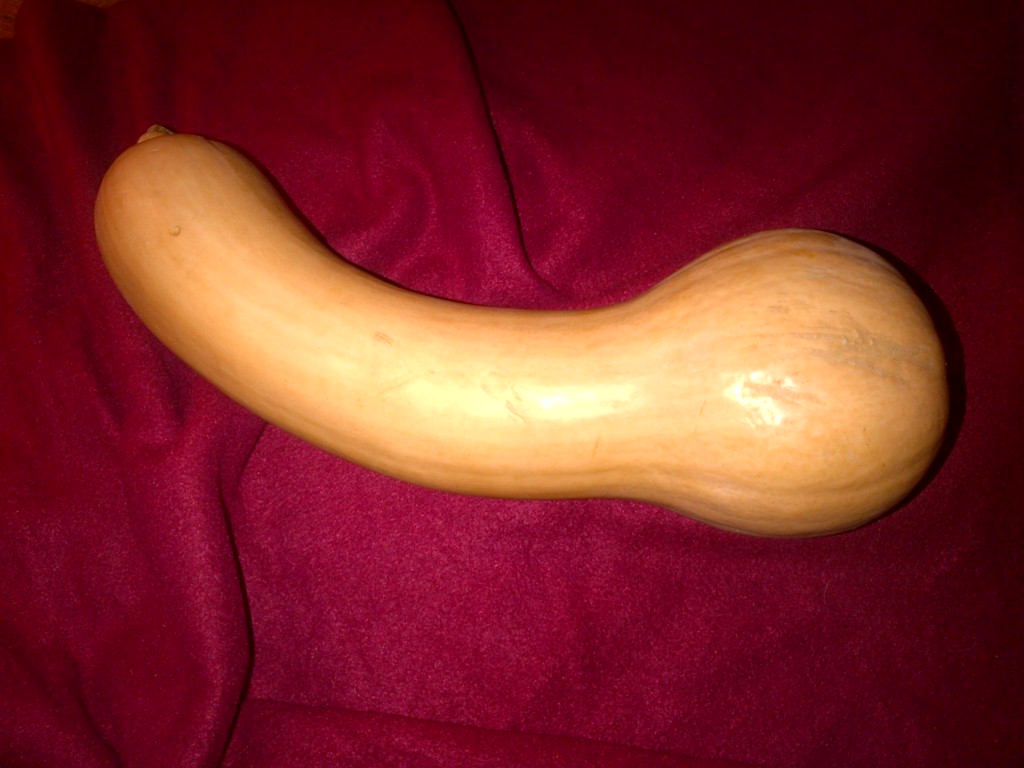
I bought this organic butternut squash of, almost, embarrassing size. It’s a two-weeker.

Winter squash is hardly a nutritional powerhouse, but it is non-starchy, and Martin can eat as much of it as he wants. Thus, when dealing with standard, non-gargantuan vegetables, I process about one butternut squash per week. My gourd friends meet their fate like this:

First, I peel the entire squash and discard the rind. For three or four seconds I gaze upon the rind strips lying atop my garbage, sigh, and long for a compost bin.

Second, I cut the neck from the bulbous seeded section, which I set aside. I slice the solid flesh of the neck lengthwise into French-fry shape, about 1/8″ • 1/8″ • 4″. I store the sliced French fries, raw, in a lead-free glass container in the refrigerator. (No need to cover them with water; they keep well.) Martin frequently enjoys these French fries with breakfast. Those mornings, I spray a stainless-steel cookie sheet lightly with olive oil; spread the fries in a single layer; mist them with more olive oil; sprinkle with kelp or dulse granules, or salt; and bake at 450º for about 10 minutes, or until browned and slightly crunchy. (Uniformly sized fries are key. Otherwise, some will remain soggy whilst others start to burn.)

Third, I halve the bulbous section previously set aside and scoop the seeds and their fibrous coating—which I usually call by its technical name, “stringy stuff”—from each part. I separate the seeds from the stringy stuff; discard the stringy stuff, with another corresponding longing for a compost bin; rinse the seeds, as best is possible; and spread them on a sheet in my dehydrator. (I don’t start the dehydrator yet.) Once the seeds are dehydrated, they make crunchy little toppers for veggie dishes, or mix-ins for the occasions when Martin eats quinoa or rice.

Fourth, I cube the flesh that surrounds the seed pocket. This part of the squash does not make very good French fries, because it is rounded and hard to cut into the right shape. Instead, I juice the cubes with my high-powered juicer. What, you might ask, does one do with squash juice? One uses it in recipes, as a replacement for tomato juice, and to moisten vegetable dishes flavorfully.

Fifth, the juicing process leaves behind pulp in the juicer, which I remove and spread on another sheet in the dehydrator. Then I start the dehydrator, with seeds and pulp inside. Because juicing the flesh has removed most of the moisture (and nutrition, and taste) already, this pulp comprises almost only fiber, and desiccates rapidly. Once it is completely dry, I use a coffee/spice grinder to break it down to a fine powder. I use the powder in place of arrowroot or tapioca (which are starchier) as a thickener in stews and sauces.

The end. From my butternut squash I extract French fries, seeds, juice, and thickening powder.

From the squash pictured above I extracted three containers full of French fries, ¼ cup of seeds (post-drying), about 10 ounces of juice, and a spice bottle full of thickener.

So we’re good for a while.