Afterward

It’s 3:25 a.m. Obviously, I’m awake. Jet lag. Adrian and I are on vacation in Turkey (far from Ankara, where the horrific suicide bombings occurred Saturday), celebrating our anniversary. Martin is home with my parents.

As I lie awake, my mind wanders to this question: What will I do with myself when Martin is recovered enough to be close to typical? This autism journey has consumed my life. What will be my next act?

These types thoughts tend to happen on vacation, when for a change I’m seeing the forest, not focused on the trees like dinner tonight, ordering supplements, planning travel to doctors, trying to keep current on science. Twelve months ago, in a post started on vacation in Germany, then finished back home, I wrote about finding the “me” in Martin’s recovery, about trying to have some life of my own. I have been improving at that, writing more (non-blog) and working 20 hours per week. Still, bio-med life feels like a treadmill. Pauses are rarely allowed.

I don’t know what my next act will be.

But I’m looking forward to it.

Istanbul. This scenery, giving me pause.

Istanbul. This scenery, giving me pause.

Why Can’t We Cross the Finish Line, the Nonexistent Finish Line, Together?

Bobby [a pseudonym] is eight years old and, according to Martin, his best friend. Bobby and Martin met in special-needs preschool four years ago, when Bobby was four years old and Martin was three. That’s also when I met Bobby’s mom, my friend Stacey [a pseudonym]. Bobby also has autism, and Stacey started biomed with him the following year, when Bobby was five.

When we all met, Bobby and Martin were superficially alike, with corresponding language limitations, emotional dysregulation, and lack of joint attention. They both had been classified “mild-to-moderate” on the autism spectrum. Beneath the surface, however, Martin and Bobby have entirely different health issues. Martin, simplified, has gut dysbiosis, mitochondrial processing issues, recurrent candida overgrowth, and suspected viruses hiding in biofilm. His immune system used to exist in overdrive, so that he was “never sick.” Bobby, simplified, has persistent mycoplasma pneumonia, environmental allergies, parasites, and PANS. His immune system is so depressed that he is “always sick.”

Stacey is given to panic. That is, she remains more susceptible than I am to the rollercoaster ride that is autism recovery. It is therefore possible that I did not completely, wholly, 100% believe her when, during the past few months, she’s said that Bobby isn’t doing as well as Martin, and that she’s not even sure they are still making progress in resolving his health issues.

Two weeks ago, Martin and I had a rare opportunity to hang out with just Stacey and Bobby. After a few hours together, and with regrets, I had to agree with Stacey that Bobby is not doing as well as Martin. At the restaurant, Bobby impulsively put his hands in others’ food and bolted from the table. When we walked in town, he disappeared into store after store and cried about having to go to school the next day. On the playground, he couldn’t swing by himself, aggressively hugged strangers, and melted down when it was time to leave. Martin, meanwhile, was perseverating a lot but otherwise looking pretty typical.

Know that I discussed all this with Stacey, and she gave me permission to write this post. I would not blindside a friend on-line, pseudonyms or no.

The afternoon’s low point, for me, came when Bobby was sitting on the sidewalk biting his own arm and I asked myself, “Is Bobby still the right best friend for Martin? Should Martin spend time with friends who challenge him more?” I would never want a mother to question whether Martin is the right friend for her child. I want Martin to be accepted by all kids, typically developing or otherwise. I was shortsighted and cruel to consider, even for a moment, directing Martin toward a higher-functioning friend. I recognized immediately that I was wrong and tried to turn the situation positive by asking Martin, “Your friend is having a difficult time. How can you help?” Still, there was no denying what I’d felt.

There are plenty reasons why, even though Stacey works just as hard as I do, Bobby’s recovery might be lagging behind Martin’s. I had the advantage of starting biomed when Martin was just two-and-a-half; by the time he met Bobby six months later, they were developmentally akin, even though Bobby is a full year older. Stacey didn’t get to start biomed until Bobby was five years old. The boys’ underlying issues are so different. Not all kids respond well to biomed, and Bobby may be one who doesn’t.

Three years ago, I wrote on this blog:

When I hear about other ASD kids making more progress, or faster progress, than Martin, it gives me hope. It also makes me angry and resentful. Why not our turn? Why not yet? What more do I have to do?

I ask myself, Is that still true? Do I still feel angry and resentful when other kids make more progress?

No. I don’t think so. Consider my friend Lakshmi and her son, Partha. I’ve written about Lakshmi before. Partha suffered a regression (lost all language) following a vaccination. We first met a few years ago when Lakshmi contacted me through this blog, and Partha was developmentally at about Martin’s level. Partha is recovered now, except for minor quirks; his mainstream classmates don’t know he had autism. That is much further along than Martin. When I see Partha and the progress he’s made, I feel happy for Lakshmi and inspired by what she’s accomplished. No resentment. No anger. Only the desire to continue sharing ideas over a cup of coffee. The same goes for my feelings about the other three recovered boys I know, as well as the kids I “know” through on-line chatter but have not met.

I’ve reached my current sanguinity, likely, because Martin has made clear, significant, and undeniable progress toward neurotypicality. In the same post as the “angry and resentful” admission, I mentioned that I became frustrated with Martin for spectrum behaviors like skipping, chewing on a straw in the corner of his mouth, and letting himself fall slack. In a later post, I wrote about Martin whining continuously oh mommy oh mommy oh mommy for 30 minutes, and screaming all the way from our apartment to JFK because Adrian suggested that he change jackets. We are nowhere near that place anymore. The spectrum behaviors that frustrate me today are more like talking too loud in church, laughing at the wrong time, and taking too long to finish breakfast. Almost every day, my confidence increases that we will achieve something like recovery.

I asked Stacey how she feels when she sees Martin or Bobby together, or when she sees Partha. (She knows Lakshmi and Partha too. We biomed moms all end up pals.) Stacey said that children who are recovering faster than Bobby make her depressed and anxious. She worries that she isn’t exploring the right treatments, and asks herself what more she can do (as I once asked myself, and sometimes still do). She fears that a mythical window will slide closed, separating Bobby forever from recovery.

And how does she feel when she sees a child who’s made no progress, who hasn’t taken any steps toward recovery, whose behaviors are more pronounced than Bobby’s, who lacks all language? She said, “I try not to assume the emotional burdens of others’ journeys. I want the best for them. I focus on Bobby.”

I admire Stacey for being hopeful for other kids while not letting their condition tint her outlook. I still tie myself to others’ children. Bobby’s performance at our play date has upset me terribly. I can’t feel as good about Martin’s recovery when I know not everyone is doing as well.

Kind of a funny shot of Martin, acting pretty typical while enjoying calamari in a restaurant.

Kind of a funny shot of Martin, acting pretty typical while enjoying calamari in a restaurant.

Once upon a time, it was more difficult for me to witness biomed kids passing Martin. Today, I think, it has become more difficult to see the ones who lag.

Pulse Admission

“Admit it,” said my friend Kevin, gesturing as if a grand proposition were forthcoming. “Admit that you like listening to The Pulse.” He was referring to SiriusXM Radio’s channel 15, The Pulse, playing “hits from the 2000s and today.”

I hedged. “Well—”

“Admit that when you’re flipping through your favorite channels, your Bridge and 70s on 7 and 80s on 8 and Classic Rewind, you also check to see what’s on The Pulse. Admit that you do it when Martin isn’t even in the car. Admit it!”

Kevin phrased the accusation exactly right. I had no grounds for denial.

“Fine,” I said. “It’s true. I check what’s on The Pulse. I like some of the songs on The Pulse. Leave me alone.”

I was out to dinner with Kevin and his wife, Stacey. We were in Baltimore attending Natural Products Expo East, a tradeshow and conference for organic and natural foods and beverages. Kevin and Stacey also have a son recovering from autism. I was telling them (1) the good news that Martin is finally taking an interest in pop culture, and (2) the bad news that this new interest means he insists on listening to The Pulse in my car, when he used to be perfectly happy with The Bridge, “mellow classic rock and ’70s folk rock.”

Ah, pity the child of older parents. Martin’s cousin Mandy was born two-and-a-half months after he was. Mandy’s mother, my sister, is 14 years younger than I am. When it comes to pop culture, I’m thinking Mandy has it a lot better than poor Martin.

Over the past year, Martin has started noticing what his peers are doing, and wanting to do the same. In the spring, when the weather warmed, I tried sending him to school without a jacket. Despite the sunshine, he insisted on wearing a jacket. Why? “Because my friends are still wearing their jackets to school.” I wrote about when Martin wanted to carry a backpack to the JCC because the kids who came from school without parents had backpacks. Martin has never seen Despicable Me, but he collects toy Minions. He’s never played Angry Birds, but he loves anything with an Angry Bird decoration.

One weekend over the summer, Martin’s classmate Jack stayed at our home. Jack, evidently, was much better versed in current music and television than Martin. Friday afternoon, as we drove from school, Jack started requesting artists and songs. Taylor Swift. Maroon 5. Duran Duran, in time-warp. At a loss, I searched the satellite stations until I found The Pulse. When we arrived home, Jack asked to watch the Disney Channel and knew just which programs he liked. Martin, whose previous television experience ranged from Rangers games to U.S. Open tennis to continuous loops of the BBC’s Pride and Prejudice, eagerly watched Disney Channel too. Monday morning, I drove both boys back to school. From the backseat resounded not one but two voices: “Taylor Swift! We want Taylor Swift!” Since Jack’s sojourn in neustra casa, Martin has become a connoisseur of all things Pulse and Disney Junior.

Which means that I—who previously resided happily ensconced in the 1970s and ’80s—have listened to a lot of Pulse music, too. And fine, I admit it. I have encountered songs I like. Nick Fradiani’s “Beautiful Life.” Imagine Dragons‘ “I Bet My Life.” Andrew McMahon in the Wilderness’s “Cecilia and the Satellite.” I’ve even heard a few lyrics that resound with our autism journey. In “Uma Thurman,” Fall Out Boy’s frontman Patrick Stump sings, “I slept in last night’s clothes and tomorrow’s dreams // But they’re not quite what they seem.” Heck, that’s me. That’s me every day.

I guess that’s part of having a kid: catching up on pop culture. It’s a totally typical thing.

Anyway, I have to go now. Martin is exhausted and grouchy. He was up late last night, because he wanted to watch Andy Grammer on Dancing With the Stars.

We blaze the night
With all we’ve been waiting for
All this time
Reaches such great heights
Gives us just one perfect night
To say oh what a beautiful life

Oh what a beautiful life.

Nick Fradiani

Leave It. Not the Yes Song That I Love. A Different Kind of “Leave It”

I am compelled to write again on the topic of guilt.

I’ve acknowledged before that I feel guilty for my son’s autism. I know I’m not alone. The Thinking Moms’ Revolution ran a post on this topic last year, titled “How I Gave My Son Autism.” That post exposed a reality: Many mothers, when they find out the health conditions that underlie autism and the environmental factors that may trigger them, feel guilty for not knowing more, for not doing more to prevent autism from invading their children’s lives. I am one of those mothers.

I am also tired of defending my right to feel guilty. Here’s a simplified version of a conversation I had this week:

Friend:

“Why don’t you weigh in publicly on some of these debates, like vaccine safety or antibiotic use?”

Me:

“They are tough issues, and I feel like everyone is so polarized and aggressive. I need my strength to recover my son and don’t want to spend it on defending myself.”

Friend:

“You’ve learned a lot, though. Why not share it?”

Me:

“Someday I will, when Martin doesn’t need me as much. Now is not the time. Understand also—all that I know now figures into the guilt that I feel for what I didn’t know when Martin was a baby. It’s painful for me to share that.”

Friend:

“Wait! You know you shouldn’t feel guilty, right? You know it’s not your fault that Martin has autism? Tell me that you know that.”

This issue arises constantly with well-meaning persons who are not biomed parents. They hear that I experience guilt, and they rush to reassure me that I have nothing to feel guilty about.

While I can’t fault anyone for wanting to make me “feel better,” random reassurances that I bear no guilt don’t make me feel better. They upset me. I know things. These things make me feel guilty. I have this feeling. I have a right to feel it. The emotion is mine to resolve (or not) on my own terms.

Biomed parents get it. When I speak with another biomed parent about feelings of guilt, the response is usually something much closer to, “I get that. How are you coping? Want to brainstorm ways to channel that into positive action?”

We don’t get to walk around telling people what emotions they should or shouldn’t feel. I, personally, become uncomfortable when a mother says that her child’s autism is a “gift.” But I don’t respond, “Wait! You know autism isn’t a gift, right? You know you shouldn’t feel like your child is lucky?” I respond, “Tell me more, if you want to.” And then, if she wants to talk, I listen. If she doesn’t, I leave it alone.

The guilt that I feel is not harmful to my relationship with Martin. To the contrary, it prompts me to do my best for him, however I can.

So, please, leave it alone. That’s a good way to help.

It Used to Be Fear

Over Labor Day weekend we visited Dr. Zelinsky, near Chicago. It was an easy day trip. Martin and I caught a 10:30 a.m. flight from LaGuardia to O’Hare. My friend Chris picked us up at O’Hare, we had a delicious brunch at Prairie Grass Café, Chris worked nearby while Martin and I were in Dr. Zelinsky’s office, and then we stopped at a playground on our way back to O’Hare.

Dr. Zelinsky had many perceptive observations about Martin’s development and brain functioning; she always does. Enough said. This post isn’t about Dr. Zelinsky. It’s about the playground.

The playground was random, selected by me and Chris from Google Maps as we drove. It turned out to be lovely, tucked in a wooded suburban acre. While Chris looked for the parking area, Martin and I walked a path to the swings and slides. He asked whether other kids would be at the playground.

“I don’t know,” I replied. “Maybe.”

Martin has long avoided kids he doesn’t know, especially in contexts like the playground, which can be overwhelming. Playground kids clump and run together, and Martin can’t keep up. I assumed he was worried and wanted the playground to himself.

One girl, it turned out, was there, sitting on a swing.

Martin investigated some climbing equipment. After just a moment, he walked over and sat on the swing next to the girl.

“Hi there,” he said. “I’m Martin and I’m seven years old. How old are you?”

The girl was seven too. She asked Martin where he goes to school. He responded—she didn’t recognize the name, of course, since we were in Chicago and Martin goes to school in New York—and then he asked where she goes to school.

That’s right. A reciprocal question.

“The Ryan School,” the girl answered. Or something like that. It was hard to hear her.

“Where?” Martin asked, then, when she repeated and he still didn’t get it, “Where?

The girl’s dad, who was seated on a bench near the swings, turned to me and said, “She’s got a bit of a lisp that makes her hard to understand. We’re working on it.”

It’s not you kid. It’s mine. First time anyone’s said that to me.

“He’s not going to know the school anyway,” I said. “We’re just visiting from New York.”

We shared a laugh. The kids said a few more kid things, and then some sort of who-can-swing-higher competition ensued. Or at least Martin treated it as a competition.

Around that point, I realized something: Martin hadn’t asked whether any kids would be at the playground because he wanted to avoid them. He’d asked because he wanted to play with them.

The realization was confirmed the following week, when I took Martin to an indoor playscape near our home and he said, “I’m going to look for some kids to make my friends.”

The girl in Chicago eventually lost interest in Martin, and he didn’t succeed in finding any kids to make his friend at the playscape.

Nevertheless, he was seeking kids out, instead of avoiding them. That’s progress.

Progress.

Martin at the playscape, looking for friends.

Martin at the playscape, looking for friends.


Okay, this wasn't taken at any location described in this post. But I couldn't resist! It's Martin and a buddy at an amusement park.

Okay, this wasn’t taken at any location described in this post. But I couldn’t resist! It’s Martin and a buddy at an amusement park.

Money

I call myself a fiscal conservative and social libertarian. I support capitalism. I think that, ultimately, the self-interest that capitalism engenders moves “the group whole” forward. Capitalism isn’t an ideal system, but we don’t live in an ideal world. Altruism, community spirit, and a peaceful life unfortunately don’t provide sufficient motivation. Instead, we—we humans—like to compete. A properly regulated and administrated capitalist system should enable workers to choose how they want to profit: financially, with free time, through notoriety or renown, in job satisfaction or altruism, &c. A properly regulated and administrated capitalist system, I think, functions best on the shoulders of an educated populace, and a profit engine that responds to its demands.

I’ve said before: I’m wildly simplifying. A blog post allows only so much depth.

One particularly American notion that I like is the marketplace of ideas. An arena for vigorous debate enables participants to consider and reject, to separate the (non-glyphosate, organic) wheat from the chaff, to ponder what makes stupidity stupid.

Congress shall make no law . . . abridging the freedom of speech, or of the press; or the right of the people peaceably to assemble, and to petition the government for a redress of grievances. Boo-yah.

I also believe that what’s happening to our health, to the immune systems of our children, to the neural functioning of our elderly, results from profit motivation. From greed. Glyphosate, genetically modified organisms, inadequately scrutinized vaccines, a world blanketed in electromagnetic radiation—some part of these developments might arise from a desire to feed the world or protect health or push us forward, but the greater instigator is financial advantage. (Don’t go all frenetic on my implicating this partial list of immunity bandits. I’ve admitted that I don’t science. I’m figuring out what I can, from the resources I have. I’m working on a blog post that lays out my own understanding of glyphosate and its role in autism rates.) Profit-seeking is running amok and trampling the vulnerable. Not the traditional vulnerable, like the poor and migrants. The newly vulnerable victims of our own success.

Run Away from Autism Recovery! It’s Like the Plague!

Last month I invested ten minutes reading a blog post titled “Autism: Whom to Trust, and Whom to Run from Like the Plague.” The author’s thesis is that autism is not treatable biomedically, and that any organization that supports treatment of autism is suspect. More than suspect, actually. TACA, AutismOne, Generation Rescue, they are all really, really bad. Like, plague bad.

The blogger implicates even Autism Speaks, which is a gigantic and wealthy organization that does not advocate biomedical treatment of autism. Autism Speaks concerns itself with raising money and “awareness,” as if, with ASD rates what they are, we need “awareness” more than research. The blogger’s beef with Autism Speaks is that “Only recently, Autism Speaks reversed its stated position on vaccines. For two years prior, they claimed that there was a connection between vaccines and autism.” In a move that marks the blogger as a likely outsider to the autism community, she mis-cites the slogan “Autism Speaks doesn’t speak for me.” She apparently attributes that slogan to (1) “actual autism advocates” who are angry that Autism Speaks, once, mildly, gently, suggested that vaccines may play a role in the development of ASD symptoms, or (2) persons on the spectrum who self-advocate against treatment. Quite the contrary: “Autism Speaks doesn’t speak for me” comes from families like mine, the ones who are angry that Autism Speaks raises the lion’s share of resources but doesn’t address health or cure.

The blog I’m talking about is called Dawn’s Brain and written by “Dawn Pedersen,” who describes herself as “a science advocate, web designer, educator, artist, and mommy.” Her qualifications are “a BA in fine art, an MA in education,” and “an AS in biology” that she will “complete . . . this fall.” As you know, I’m not a medical professional or an autism authority. Still, I (Martin’s mom) am, um, a “science advocate” (when it comes to the science behind immune disorders that manifest as autism), an “educator” (when it comes to addressing the immune disorders that manifest as autism), a lawyer (no asterisk; I just am), and a mommy. I have several impressive-sounding, albeit functionally limited, degrees: a B.A. in religion, magazine writing, and German literature; a master’s in religious studies; an M.F.A. in writing. I have a somewhat-more-useful juris doctorate, and have passed more than one bar exam. Plus, even though I don’t science well, I am smack in the middle of a Ph.D. in autism recovery studies from the University of Martin and His Doctors. I therefore declare myself even more qualified than Dawn Pedersen to talk about autism.

We Are Polarized

Given that Dawn Pedersen seems to be an outsider to the autism community, whose major qualification for assessing that state of autism research is working toward an associate’s degree in biology, it is fair to ask what’s motivating her to deride promoters of biomedical recovery.

I read through the comments to the “Avoid Like the Plague” post. Consider—

Comment from a Reader Named Carmen:

I’m sorry, whoever in the world does not think that gluten/dairy are inflammatory foods that in turn have a negative neurological effect on humans in general but even more so on Autistic people [is] in denial and not looking at the evidence. . . . My 3 year old is autistic and I have seen [LEAPS] and bounds improvement with his overall happiness with these diet changes. . . . Maybe it doesn’t work for every kid/person and it certainly doesn’t “cure” autism but it absolutely eases some of the undesirable (for my son) symptoms. I could go on and on. I guess you’re also saying that refined sugar, chemicals in our food, dyes and gmos don’t make things worse[—]asinine!

Reply from Dawn Pedersen:

All our foods are made of chemicals. Refined sugar breaks down into glucose in our digestive system like any other carbohydrate. There is nothing wrong and everything right about genetically modified foods.

Do you have a plausible explanation for how nutrients can travel backwards in time, to reverse differences in cognitive development in the womb?

You are promoting the very nonscientific explanations I am decrying. You’re promoting ideas that are victim-blaming, and without evidentiary merit or plausible mechanism.

More comments pile on, criticizing Dawn Pedersen for dismissing the experience of an actual autism parent, asking Dawn Pedersen if she’s heard of the CDC’s William Thompson, thanking Dawn Pedersen for her list of organizations to avoid like the plague because it actually provides a handy chart of good resources. To these comments, Dawn Pedersen doesn’t respond.

Her blog, it seems to be, represents a trend: polarization through outright dismissal of any view that isn’t our own.

Polarization: No Open Exchange, No Transparency

Polarization is the opposite of transparency and open exchange of information and ideas. I heard a commentary on NPR opining that it is dangerous and unnecessary even to present vaccine-safety concerns, because the CDC’s vaccine views have no valid counterpoint. NPR is wading into paternalistic reporting, discerning what Americans need to hear and disregarding the rest. (Sorry to pick on NPR. Every mainstream outlet does an abysmal job covering vaccine safety. Investigative journalism? Not. There is even a TED talk arguing, in part, that parents with vaccine concerns should not be heard.) According to recent polling, 52% of American adults are unsure whether vaccines can result in autism, and another 6% say that vaccines can result in autism. If 58% of Americans believed that or were unsure whether the earth was flat, I would want to hear their views. I’m pretty sure they wouldn’t win me over, but I would listen. Today, any journalist who dares mention that Gardasil seems to be leading to injuries and deaths, or that unvaccinated children might enjoy better health overall, or that the Vaccine Injury Compensation Program does compensate children who develop autism faces public excoriation. We’ve left open exchange in the dust.

What about transparency? What motivates Dawn Pedersen? Is she just really, really fired up about quashing any hope of autism recovery, even though she doesn’t seem to have a child on the spectrum? A SeaWorld employee was recently found to be posing, for years, as an animal-rights activist and trying to incite violence within peaceful protests, to make the activists seem dangerous. Monsanto evidently has a behind-the-scenes department devoted to “debunking” science that suggests glyphosate or GMOs are harmful. With all the subterfuge in our world, I wonder what is guiding Dawn Pedersen.

Is it just advertising revenue? The advertisements that popped up when I visited Dawn’s Brain included OceanSpray, Fairmont Hotels, Walks of New York, WayFair.com, intuit QuickBooks, Lexus, University of Phoenix, Hedwig and the Angry Inch on Broadway, and RoyalCarribean International. That’s an impressive list. Dawn Pedersen must be able to show plenty of hits to Dawn’s Brain for ad revenue like that. (And here I come with my little post, stirring even more traffic. Sigh.) Dawn Pedersen, “science advocate,” also has other sites like Kids Busy Book and Draw to Learn, which she promotes on Dawn’s Brain. So she has the motivation to draw visitors to those sites, too.

It’s apparent, at least, that Dawn Pedersen gets a lot of web traffic by promoting the mainstream. By insulting those who peek beneath the surface. She has her sights set on easy targets, like parents trying to recover their children or fighting for healthier foods. Because why? Views are mainstream when most people accept them. People like to hear their views confirmed. People reassure themselves by insulting those disagree with them. People enjoy reading blogs that promote their own opinions. (If you stick with Finding My Kid, it’s a fair bet you think autism recovery is a good idea.) There is much to be gained through dismissing alternative ideas, and I wager Dawn Pedersen is happy to be profiting by doing so.

Always Figure in the Profit Motivation

Don’t get me wrong. I’m no Pollyanna. Dawn Pedersen not the only one profiting off, in this instance, autism. Autism recovery, while achievable in many cases, is so complicated to navigate, and autism can be so devastating for families, that desperation is running rampant. Desperation invites charlatans. One walk through the sponsor corridor of an autism-recovery conference shows as much. Remember what I posted about AutismOne? The guy with magic salts and vibrating machines? He’s not the only one. Vendors hawk antioxidant sweeteners, nutritional shakes, bracelets and amulets to block electromagnetic fields, CD’s of brain-calming sounds, pressure-point stimulators, you name it. Conference sponsors pay for their spot on the floor, and they want to recoup that investment. Parents who’ve found nothing that helps will buy anything.

It is easy to see why some families choose to write off the field of autism recovery altogether.

Beyond the snake-oil salesmen are practitioners making money off what actually works. Take hyperbaric oxygen therapy (HbOT), for example. I believe (despite lack of mainstream confirmation) that it can improve cognition and neural function in children with autism. But it is very expensive, and the gains sometimes don’t seem to stick after the child stops using the HbOT chamber. Thus, although HbOT “works,” it may not justify the tremendous expense (up to $10,000 for a series of 40 dives). Likewise are the controversial ionic footbaths, said to help detoxify the body. They really do seem to help, a little. But they can cost thousands of dollars, and similar results might be achievable through clay or Epsom-salt-and-baking-soda baths. Rest assured, we have no shortage of entrepreneurs ready to sell you an expensive footbath or HbOT therapy. Autism families will pay dearly for any help: vitamin B12 shots, signaling devises to find children who bolt, special combinations of vitamin supplements.

How can you ever be sure? You can’t. Here I will wade into controversy (ha! as if I usually don’t): I never trusted the late Dr. Jeff Bradstreet. He is such a big name in the autism-recovery movement, and many parents insist that Dr. Bradstreet was everything to their children’s healing. Still, Dr. Bradstreet rubbed me the wrong way. At an AutismOne talk this spring, he said that parents “owe it to their kids” to try MRT for at least a week, because it’s “not much money”—only $1,000 in MRT fees, several hundred dollars for a consult with him, travel expenses to Atlanta, and a week’s worth of hotel lodging and eating out, all for a treatment that, by his own (optimistic, it seems to me) prediction, might help 50% of kids. He said “not much money” to a roomful of autism caregivers, many of whom had probably blown their families’ vacation budgets for the year on getting to the AutismOne conference. I wanted to raise my hand and say, “Thank you for your work and research, Dr. Bradstreet, but please don’t advise these parents to give you their last dime on a wing and a prayer, and don’t tell them they ‘owe’ that to their kids.”

I am, however, and of course, grieving that Dr. Bradsteet is among the many alternative health practitioners (many rumored to be proponents of GcMAF) who’ve recently gone missing or died under questionable circumstances. I haven’t looked into this issue much. I’m suspicious about Dr. Bradstreet committing suicide. I mean, who wades into a river to shoot himself in the chest?

For me, any high-profile doctor presents a dilemma. On the one hand, I don’t want to penalize anyone for his/her success. If a doctor is helping children recover and earning plenty, good for him/her. On the other hand, becoming high-profile often requires more self-promotion than attention to individual patients, and sometimes involves selling miracles, like Dr. Bradstreet with his Bravo yogurt or Dr. Zach Bush with his Restore supplement. For me, for my own peace of mind, I prefer lesser-known doctors and practitioners to treat Martin. Otherwise it’s too easy to get lost in hype and lose perspective when it comes to evaluating results. As a biomed parent, I already feel like I have to take a stand against the mainstream world every day. If every other biomed parent says Dr. X or Dr. Y is the super-best, and I end up in disagreement, do I trust myself enough to stand against the biomed world, too?

I Say: Let Everyone Speak, and Prod Them to Reveal Their True Motivations

My husband’s employer has a generous foundation that matches charitable donations. The foundation recently announced a new policy: It will no longer match contributions to organizations that oppose marriage equality or full rights for LGBTQ persons. I, personally, would not donate to any organization that opposes marriage equality or full rights for LGBTQ persons. I, personally, support marriage equality and full rights for LGBTQ persons. Let’s face it—I’ve got bigger concerns in life than your gender or whom you love. Nevertheless, I can’t say that I approve of the foundation’s new policy. The policy quashes debate. It says, “This issue is so settled that we won’t listen to the other side.” When it comes to LGBTQ rights, I think the issue should be settled. I think. Others disagree. I wouldn’t silence their voices.

Decades ago, when I was deciding where to attend law school, I visited Yale Law School and asked about its Career Options Assistance Program. COAP repays the student loans of graduates who choose lower-paying jobs; the law school is expensive and doesn’t offer scholarships, so unless they get some help, its graduates are likely to funnel into big law firms or other high-paying jobs. At the time of my visit, I was smarting from being told, by another school, that I didn’t qualify for a public-interest scholarship because I wanted to work in animal protection, and animal protection isn’t “public interest.” At the Yale roundtable, I asked a dean whether availability of COAP funds depended on the type of work a graduate performed, as opposed to just the amount of money s/he earned.

“No,” the dean answered. “COAP is based strictly on income. We have no interest in dictating which fields our graduates enter.”

That’s the way it should be. We should encourage advocates to get out there and fight for their viewpoint, regardless of whether we agree. There is no value in not bothering even to engage minority positions. There is no value in browbeating others into silence. There is no value in hiding who is (or what funds are) really behind that browbeating. I shouldn’t have to wonder what motivates Dawn Pedersen to decry autism recovery, whether she is just driving traffic to her site, or whether some sponsor is buying her keystrokes.

I have no issue with money used to promote a viewpoint, especially when the source of the funds is acknowledged. I take issue with money used to pretend there is no counter-viewpoint, especially when the source of the funds is not acknowledged.

Does Progress End?

I launched this overblown post by stating, “I think that, ultimately, the self-interest that capitalism motivates moves everyone forward.” In the alternative universe of autism recovery, I find myself rethinking whether we’re still moving forward. We made it to a pretty good place here in these United States. The standard of living is high, chronic hunger affects few (though still too many), the stores are stocked, most everyone can read. We have labor laws to protect our children and zoning to neaten our urban spaces. We have choices.

But we’re chronically sick. Our marketplace demands cheap food, so we skimp on production. Our fertilization methods deplete the soil biome. As a result, the crops are less nutrient-varied. Then we compound the problem by processing the food. We meet the demand for over-consumption of meat by abusing animals on an industrial scale, in ways even our bear-baiting ancestors couldn’t have envisioned. Intensive confinement of animals requires such reliance on antibiotics that many are losing their value.

Even by official statistics, rates of asthma and allergies are increasing. That’s on top of the skyrocketing rates of autism, ADD, ADHD, and other childhood health problems that result in behavioral challenges. We’re raising the first American generation expected die younger than their parents do.

Dawn Pedersen, “science advocate,” might believe, or might profit from asserting, that we’re headed the right direction. As for me, the direction that we are heading is enough to make this capitalist wonder if she’d prefer to move off the grid.

No sponsors were involved in the creation of this post. None of my many degrees includes the art of self-promotion to advertisers. Of course, if you’d like to send me a check, whoever you are, I’ll take it! Party on, autism warriors.

Of Snot and Spots

Overcoming autism is like trying to escape an octopus’s clutch: Just when you feel free from one tentacle, another swoops in to take hold.

Martin had a terrific spring, and his digestion and health seem better than ever. Yeast has been under control for a year. Bowel movements are formed and firm. He sleeps. His height and weight are right where they’re supposed to be. His once-distended belly lies flat. We’ve wrested him from several tentacles.

Enter—allergies. At least, I think “allergies.”

Until recently, Martin has never had overt trouble with allergies. The first sign of a change was a few months ago, at a diner. (Martin ordered an Angus beef patty, no bun, and steamed broccoli. The catsup he ate was not organic. It was full of crap.) Midway through the meal, Martin started sneezing and rubbing his eyes. His face became red, his nose ran, his eyes puffed and watered. I had no idea what was going on. I did my best to dab at his eyes with a damp napkin and make him comfortable. The reaction faded as we drove home, 20 minutes later.

A couple months passed without another incident. Then, in July, he had three such reactions in one week: two when he got home after school (Martin attends summer school), and one over breakfast. I don’t know if something in our house might be bothering him, something that coincidentally was also at the diner. I did notice that, with all three reactions at home, he was drinking camel milk when the trouble started. Accordingly, I’ve suspended camel milk until we figure this out. No more reactions of that type—runny nose, puffy eyes—have occurred.

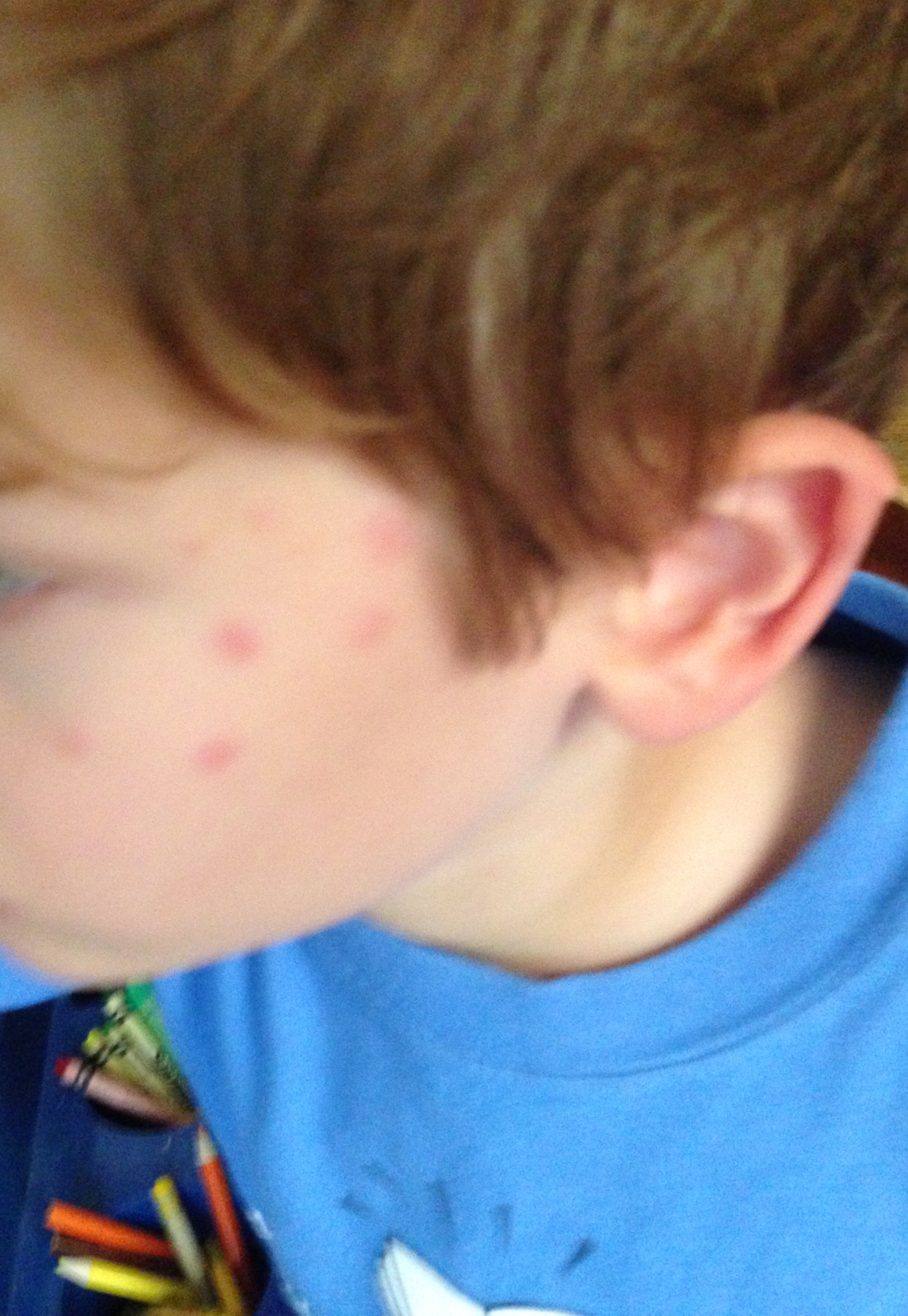
Meanwhile, however, red spots have appeared on Martin’s left temple. They showed up two or three weeks ago, faded, and reappeared more prominently this weekend. And they’re breeding: When the spots emerged a few weeks ago, they were four. This past weekend, they were seven on his face and one on the back of his neck. The spots are neither raised nor itchy. They are not bug bites.

Terrible photography. Sorry. He didn't want to be still.

Terrible photography. Sorry. He didn’t want to be still.

So what the hell are they? Allergies? To what? Are they the result of a Heilkunst clear? Our last clear was PCV7. The skin is the body’s largest drainage organ. Or are the spots from clearing something else? We’re working on Martin’s biofilm now, plus the possibility (awaiting test results) of chronic Lyme, both of which involve antimicrobial drops. Is his body responding with spotty face?

Also happening nowadays: Martin’s ears hurt, and he’s coughing at night. His emotional regulation is terrible. He seems out of it. Where do those facts fit in the puzzle?

I’ve scheduled new allergy testing with Martin’s pediatrician, and I’m corresponding with our other practitioners, trying to figure this out, which leads to the biggest mystery of all: When exactly did I become qualified to make sense of such things?

I’ve never wanted to fight an octopus.

Falling Near

Parents enjoy identifying ways their children are like them, right? That’s why we have expressions such as “the apple doesn’t fall far from the tree” and “chip off the old block.” When I was growing up, I knew a boy so like his father that everyone just called him “Chip.” I don’t even remember his given name. Daniel, I think.

When your child happens to have autism, the process gets reversed. You start looking for ways in which you are like the child. Autism has a genetic component and, like other immune disorders, tends to run in families. Hey, I find myself thinking, do I have autism? Maybe just a little? Is there a reason I’ve always liked to be by myself, a reason I was an awkward child? (Okay, fine. I’m still awkward.) Does everyone trace patterns on wallpaper? Does everyone count the number of steps she takes on each sidewalk square or section of parking lot? Does everyone need to locate all three cats before she can start the washing machine, just in case the 14 times she checked to make sure no cat was in the washing machine were inadequate? Does everyone inspect her front bumper upon arrival home to confirm she didn’t run anyone over, even though she surely would have noticed if she’d run someone over? Or is that only me?

I see so much of myself in Martin’s behaviors, the same behaviors we blame on autism.

Martin dawdles. I dawdle. I seem incapable of moving efficiently from task to task, or focusing on one task. As a corollary, I run late. Virtually always. When I absolutely need to be on time (say, to a deposition or hearing), I comically overshoot the mark and end up half an hour early, hanging out in a random hallway.

Martin remembers numbers and dates precisely, but his episodic and short-term memory are subpar, along with his desire to pay attention. He knows every train station between our home and Midtown Manhattan, the number of moons Jupiter has versus Saturn, the order of his classmates by height, and exactly what we did on November 17. Yet he has no inkling where he left his socks, or what I said we are having for dinner.

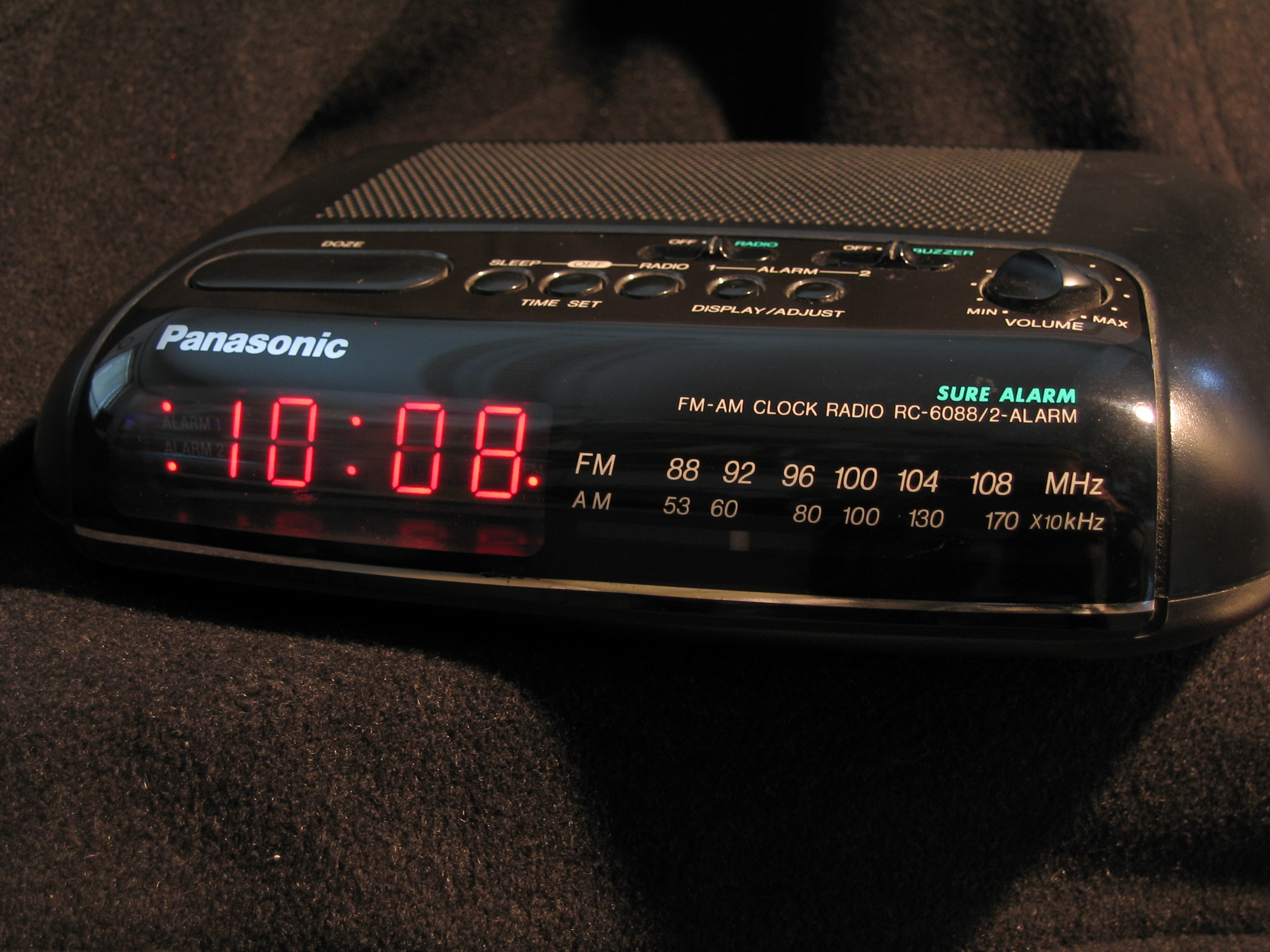
Martin has favorite times on the digital clock. They are 1:11, 2:22, 3:33, 4:44, and so forth. If he happens to see one of these times, he makes a special sound, a delighted “haaaw!”

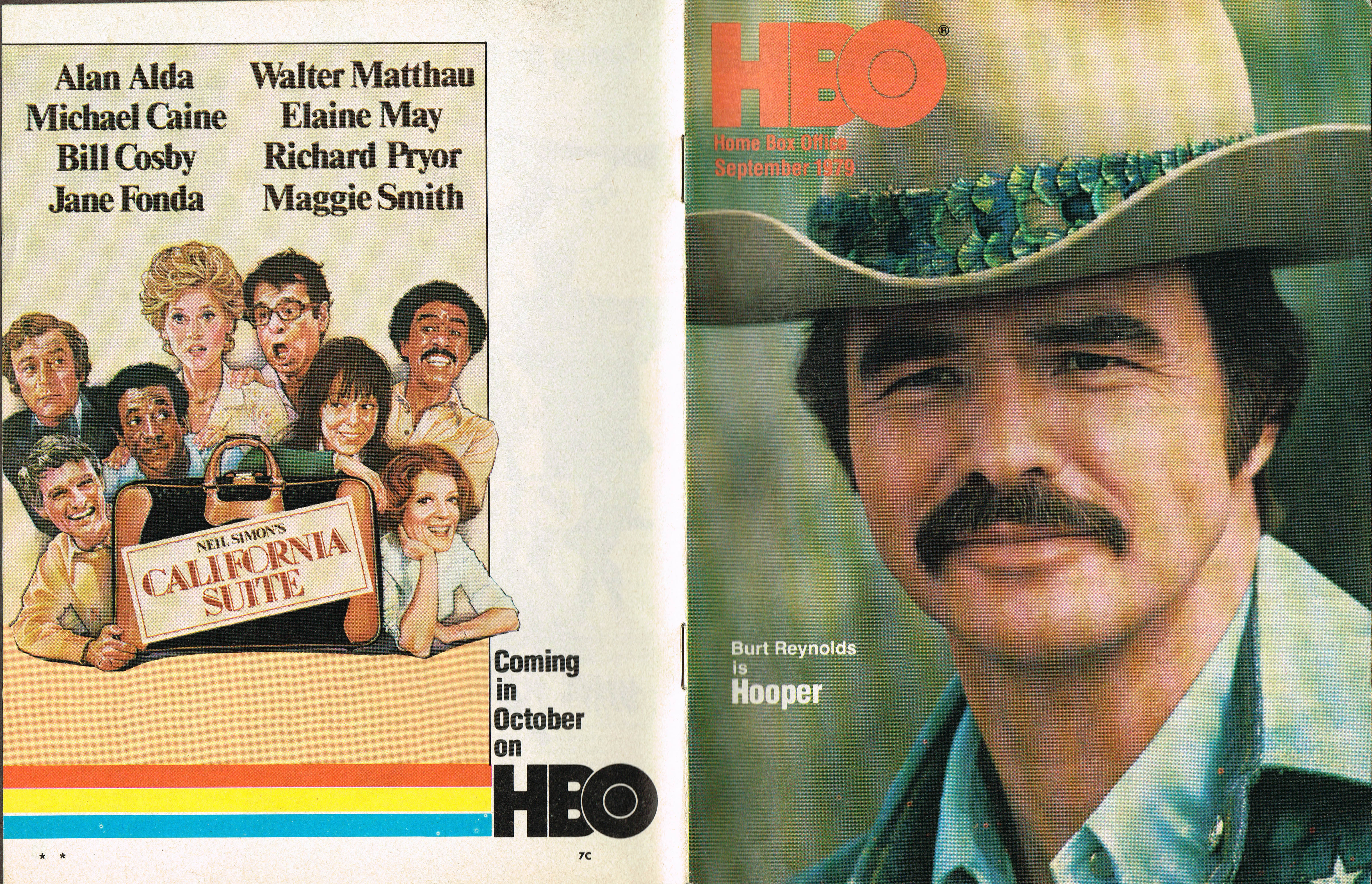
I recall a conversation once, when I was eight or nine, about the length of movies. I said that Superman (referring to the original 1978 version with Christopher Reeve) was two hours and 22 minutes long. My mother became chastised me, saying I was making that up and could not know the length of Superman off the top of my head. But I did. As part of our subscription to HBO, my family received a booklet each month with the program line-up and a description of each movie. A year or two earlier, Superman was a full-page write-up in the booklet, followed by “(2:22).” The same number, three times. I wouldn’t forget such a thing.

Martin has informed me that, on the digital clock, 4 has four lines, 5 has five lines, and 6 has six lines. I already knew all that. I knew that because I count line segments on the digital clock, have for as long as I remember. 1:11 has the fewest total segments, six. 10:08 has the most, 21. Digital 6 minus one line makes 5. Digital 6 plus one line makes 8. Digital 6 with one line moved makes 0 or 9.

digitalclock   AlarmClockPic

In November 2014 Martin informed me that first Saturday and final Sunday stood alone. He told me this from his bathtub, and although no calendar was nearby, I didn’t need to ask him what he meant. On the paper calendar, November 1 (a Saturday) and November 30 (a Sunday) were each the only date in their respective rows. In February 2015 Martin told me one week was empty. Again, no explanation needed: The last calendar row contained no dates.

november   february

I get frustrated with Martin when he doesn’t pay attention. That’s so unfair of me. When I was in first grade, I took dance class. I never knew any of the steps, because I didn’t pay attention to learn them. I didn’t pay attention in baton, either. I faked the moves and occasionally got caught. Once, at an assembly for baton, a special drawing was held, with much fanfare. I was present but didn’t listen at all. When my name was picked for a prize, I had no idea what I’d won, or what to do. Until someone poked me, I didn’t even realize my name had been called. Did I have autism? Do I now? Maybe just a little?

Should I be treating myself with diet and supplements?

Will I be satisfied if Martin grows up to be like I am now? Or do I want him to be better?

Maybe just a little?

The prize I won, all those years ago, was a fancy new baton, which I was supposed to report to a table to retrieve. I carried it proudly but still never learned the moves.

And you probably will have guessed this already: I just went on imdb.com to check what that website says about the length of the 1978 version of Superman. According to IMDB, the movie was 2:23 long. Wikipedia says the same thing. Ha. That’s what they say. The HBO guide listed Superman at “(2:22).” I can’t find that guide on-line, but I still can see the numbers in my head.

Remember these things? I searched on-line but couldn't find an image of the one featuring Superman. Any collectors out there?

Remember these things? I searched on-line but couldn’t find an image of the one featuring Superman. Any collectors out there?

Fledgling Attempts

Berkeley, California, last month. We have a couple hours free, so I bring Martin to Codornices Park to play. After a few trips down the 40-foot concrete slide, which he abandons when a rowdy group of unsupervised boys arrives, Martin wanders to the swings. I’m sitting on a nearby bench, kind of zoning out in the pleasant Pacific breeze. When I look up, Martin is talking to a boy on the swing next to him. I hear Martin say he’ll be seven in three days and ask the other boy’s age. The boy says he is already seven and asks Martin where he lives. Martin looks for me, waves, and yells, “Mommy, I’m making this boy my friend!”, and then tells the boy that he’s from New York. The boy asks what Martin is doing in California.

Martin replies, “We are going to visit my mommy’s client. She has one daughter and two sons.”

We are indeed going to visit one of my legal clients. The woman, however, has only one child, a daughter. Martin added the part about two sons because he thinks it is funny to lie.

The boy on the next swing starts to ask another question. Martin interrupts and says, “No, she doesn’t have any sons!”, and then starts laughing.

The other boys asks, “Why did you say she had two sons?”

Martin continues laughing, and doesn’t answer. The other boy gets off his swing and walks away, watching Martin over his shoulder as he goes.

Laguna Beach, California, last month. My brother Rudy is working, so Martin and I have time to kill. I take him to the main beach playground. Two other boys are there. I would guess them to be about six and eight years old—chronologically speaking, one on either side of Martin—and they appear to be brothers. They are supervised by an older woman, maybe their grandmother. I hear the brothers speaking English to each other; the grandmother calls to them in a Slavic-sounding language.

The younger brother begins to follow Martin, trying to engage him. At first, Martin pays him no mind and goes about climbing alone. The boy is persistent. He wants to play with Martin. He even ignores his older brother, who keeps tagging him and running away while yelling, “There’s no way you can catch me!”

Eventually Martin accepts the younger brother’s overtures, and they start playing together. At least, they’re engaging in the same activities: trying to climb over each other on the rope bridge, balancing on the logs. I don’t hear them speaking. The older brother continues trying to get the younger brother to chase him instead, to no avail. The younger brother is hooked on Martin.

Martin waves to me and yells, “Mommy, I’m making this boy my friend!”

I half-ignore the inappropriate declaration and whip out my iPhone to snap a picture, which I text to Adrian with the caption, “We are at a playground, and I think Martin has made a friend!!!”

The iPhone rings. It’s Adrian. “Tell me more,” he demands. I tell him that Martin is engaging in cooperative play with another boy. I promise more pictures as available.

When I get off the phone, I see that the older brother has given up trying to steal the younger brother from Martin, and all three boys are together in the playground’s covered structure. Better yet, I hear them talking. Names are exchanged. The older brother says something I don’t catch. Because Martin still lacks voice modulation, I hear his answer clearly: “My dad comes from South America!” That’s true. I hope it’s relevant. I hope Martin has asked what language the boys’ grandmother is speaking, and that one of the boys has told him that their mom or dad comes from somewhere, and that Martin has responded by saying where Adrian comes from. I hope.

The grandmother calls the brothers, and they leave without saying goodbye. If Martin is disappointed, he doesn’t show it. He returns to playing alone.

The last time we visited Laguna Beach’s main beach playground, two years ago, Martin ignored everyone and had a potty accident. Progress!

Laguna Beach again, two days later (the intervening day having been the Disney trip). I take Martin to a newer playground, at Aliso Beach. We’ve never been to this one before. It starts weird: Martin removes his shoes and runs onto the sizzling sand, which burns his feet. Instead of running off the sand, climbing on something, or dancing, Martin stays put and screams for me while his feet continue to roast. I get some Crocs on him, and the weirdness passes.

Two little girls show up together. Martin tries to engage them. He says hello and follows their lead, climbing where they climb. The girls acknowledge Martin but don’t return his interest. They continue playing together. Martin hovers nearby, plainly looking to be included.

More kids show up, until seven or eight total are playing. The bigger kids, the ones around Martin’s size, start running as a pack, chasing each other, kicking a ball, shouting instructions and comments. Martin gets left behind. He goes instead to a swing. Although he is capable of pumping his legs to propel himself, as high as he wants, he calls me to come push him.

When Martin is rejected, Mommy is his safe place.

Slide at Codornices Park. Martin is the top kid on the stairs, carrying cardboard in his left hand.

Slide at Codornices Park. Martin is the top kid on the stairs, carrying cardboard in his left hand.

Poor photo quality, because I had to zoom in from afar. Main beach park, Laguna Beach. Martin is on the right. His new friend is behind him.

Poor photo quality, because I had to zoom in from afar. Main beach park, Laguna Beach. Martin is on the right. His new friend is behind him.

In the Quiet Times

When Martin and I traveled to California a couple weeks ago, even though we had various engagements and appointments, we ended up with a lot of unhustled time. Martin and I always have a lot of time together, but usually we’re up to something. We’re trying to get breakfast accomplished so he can board the school bus, or he’s doing homework, or we’re driving, or the bath needs to happen because it’s really late and he should be in bed. In California, we had stretches sitting outside Whole Foods Market munching, visiting new playgrounds, hanging out in a coffee shop because we had an hour to fill, relaxing in the hotel, riding the Laguna Beach trolley. Time.

Martin aboard the trolley, taking in the sights. I think we could've ridden the trolley all day.

Martin aboard the trolley, taking in the sights. I think we could’ve ridden the trolley all day.

It was almost like a renaissance in knowing my son as a person. Martin still perseverates: He talks repeatedly about what interests him, like whether a waiter brought him a new fork when his appetizer was finished. Apart from the perseveration, however, Martin has become conversational. I can ask him a question and reasonably expect an answer, and he frequently adds a new question, or some tidbit of related information. We filled those California times, for the most part, by chatting. Imagine that—we were chatting.

Martin, I found out, prefers Southern California to Northern California. He would like to return to Southern California as often as possible. He’s nervous about the ski vacation we’re planning for December. He does not ever plan to become a vegetarian, because he enjoys eating animals. He thinks Taylor Swift is pretty. He will love George, our cat who moved to California, forever. He would rather swim in a pool than in the ocean. He might like broccoli even more than Uncle Eddie does. He misses Adrian when we travel. He considers Will his best friend.

Who knew? And who ever thought he’d be able to tell me?

Sorry for the poor photo quality. I snapped this shot of Adrian and Martin when we returned to JFK and Martin wanted to help by pulling the big suitcase himself.

Sorry for the poor photo quality. I snapped this shot of Adrian and Martin when we returned to JFK and Martin wanted to help by pulling the big suitcase himself.