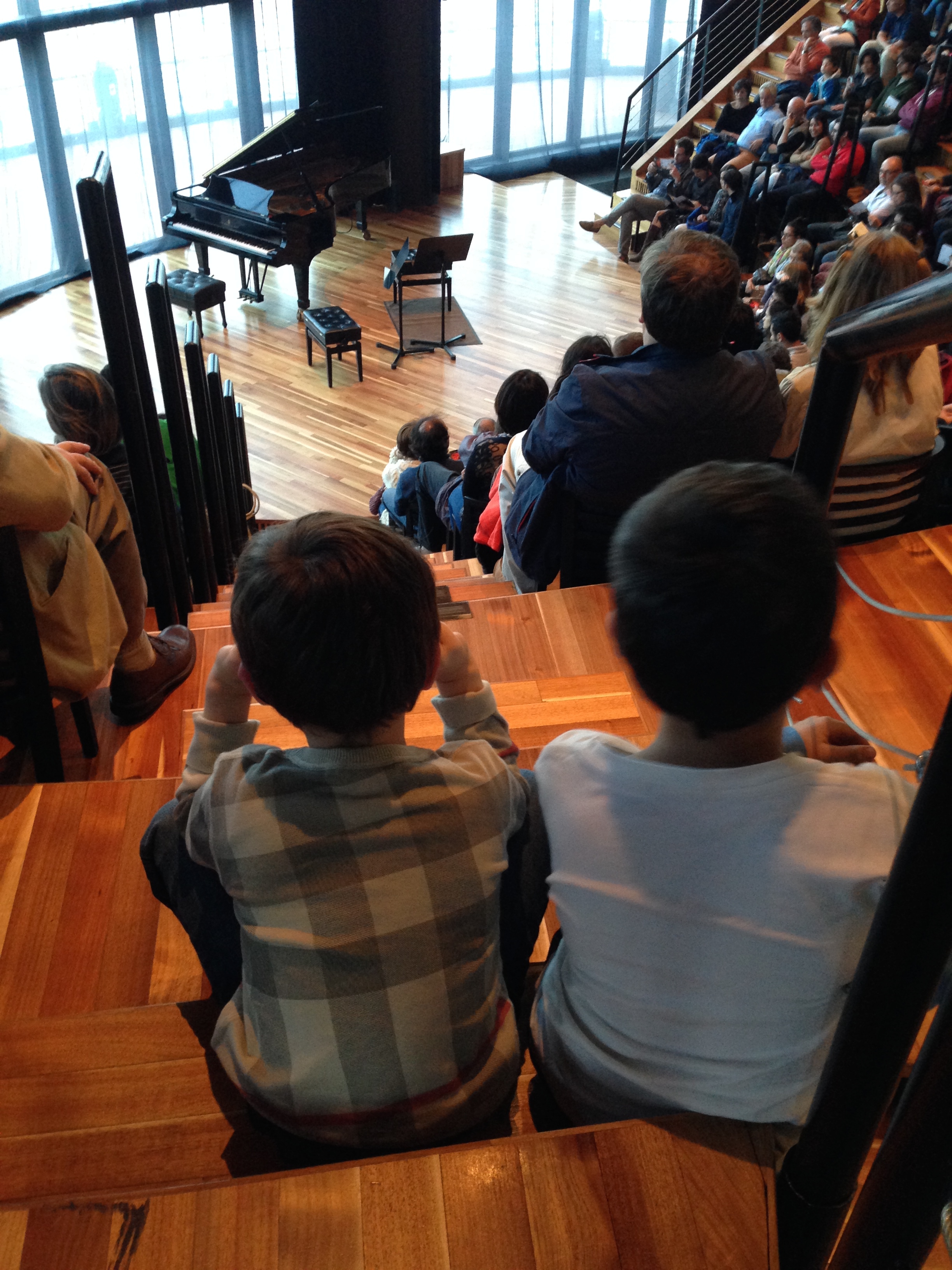
It Used to Be Fear

Over Labor Day weekend we visited Dr. Zelinsky, near Chicago. It was an easy day trip. Martin and I caught a 10:30 a.m. flight from LaGuardia to O’Hare. My friend Chris picked us up at O’Hare, we had a delicious brunch at Prairie Grass Café, Chris worked nearby while Martin and I were in Dr. Zelinsky’s office, and then we stopped at a playground on our way back to O’Hare.

Dr. Zelinsky had many perceptive observations about Martin’s development and brain functioning; she always does. Enough said. This post isn’t about Dr. Zelinsky. It’s about the playground.

The playground was random, selected by me and Chris from Google Maps as we drove. It turned out to be lovely, tucked in a wooded suburban acre. While Chris looked for the parking area, Martin and I walked a path to the swings and slides. He asked whether other kids would be at the playground.

“I don’t know,” I replied. “Maybe.”

Martin has long avoided kids he doesn’t know, especially in contexts like the playground, which can be overwhelming. Playground kids clump and run together, and Martin can’t keep up. I assumed he was worried and wanted the playground to himself.

One girl, it turned out, was there, sitting on a swing.

Martin investigated some climbing equipment. After just a moment, he walked over and sat on the swing next to the girl.

“Hi there,” he said. “I’m Martin and I’m seven years old. How old are you?”

The girl was seven too. She asked Martin where he goes to school. He responded—she didn’t recognize the name, of course, since we were in Chicago and Martin goes to school in New York—and then he asked where she goes to school.

That’s right. A reciprocal question.

“The Ryan School,” the girl answered. Or something like that. It was hard to hear her.

“Where?” Martin asked, then, when she repeated and he still didn’t get it, “Where?

The girl’s dad, who was seated on a bench near the swings, turned to me and said, “She’s got a bit of a lisp that makes her hard to understand. We’re working on it.”

It’s not you kid. It’s mine. First time anyone’s said that to me.

“He’s not going to know the school anyway,” I said. “We’re just visiting from New York.”

We shared a laugh. The kids said a few more kid things, and then some sort of who-can-swing-higher competition ensued. Or at least Martin treated it as a competition.

Around that point, I realized something: Martin hadn’t asked whether any kids would be at the playground because he wanted to avoid them. He’d asked because he wanted to play with them.

The realization was confirmed the following week, when I took Martin to an indoor playscape near our home and he said, “I’m going to look for some kids to make my friends.”

The girl in Chicago eventually lost interest in Martin, and he didn’t succeed in finding any kids to make his friend at the playscape.

Nevertheless, he was seeking kids out, instead of avoiding them. That’s progress.

Progress.

Martin at the playscape, looking for friends.

Martin at the playscape, looking for friends.


Okay, this wasn't taken at any location described in this post. But I couldn't resist! It's Martin and a buddy at an amusement park.

Okay, this wasn’t taken at any location described in this post. But I couldn’t resist! It’s Martin and a buddy at an amusement park.

Money

I call myself a fiscal conservative and social libertarian. I support capitalism. I think that, ultimately, the self-interest that capitalism engenders moves “the group whole” forward. Capitalism isn’t an ideal system, but we don’t live in an ideal world. Altruism, community spirit, and a peaceful life unfortunately don’t provide sufficient motivation. Instead, we—we humans—like to compete. A properly regulated and administrated capitalist system should enable workers to choose how they want to profit: financially, with free time, through notoriety or renown, in job satisfaction or altruism, &c. A properly regulated and administrated capitalist system, I think, functions best on the shoulders of an educated populace, and a profit engine that responds to its demands.

I’ve said before: I’m wildly simplifying. A blog post allows only so much depth.

One particularly American notion that I like is the marketplace of ideas. An arena for vigorous debate enables participants to consider and reject, to separate the (non-glyphosate, organic) wheat from the chaff, to ponder what makes stupidity stupid.

Congress shall make no law . . . abridging the freedom of speech, or of the press; or the right of the people peaceably to assemble, and to petition the government for a redress of grievances. Boo-yah.

I also believe that what’s happening to our health, to the immune systems of our children, to the neural functioning of our elderly, results from profit motivation. From greed. Glyphosate, genetically modified organisms, inadequately scrutinized vaccines, a world blanketed in electromagnetic radiation—some part of these developments might arise from a desire to feed the world or protect health or push us forward, but the greater instigator is financial advantage. (Don’t go all frenetic on my implicating this partial list of immunity bandits. I’ve admitted that I don’t science. I’m figuring out what I can, from the resources I have. I’m working on a blog post that lays out my own understanding of glyphosate and its role in autism rates.) Profit-seeking is running amok and trampling the vulnerable. Not the traditional vulnerable, like the poor and migrants. The newly vulnerable victims of our own success.

Run Away from Autism Recovery! It’s Like the Plague!

Last month I invested ten minutes reading a blog post titled “Autism: Whom to Trust, and Whom to Run from Like the Plague.” The author’s thesis is that autism is not treatable biomedically, and that any organization that supports treatment of autism is suspect. More than suspect, actually. TACA, AutismOne, Generation Rescue, they are all really, really bad. Like, plague bad.

The blogger implicates even Autism Speaks, which is a gigantic and wealthy organization that does not advocate biomedical treatment of autism. Autism Speaks concerns itself with raising money and “awareness,” as if, with ASD rates what they are, we need “awareness” more than research. The blogger’s beef with Autism Speaks is that “Only recently, Autism Speaks reversed its stated position on vaccines. For two years prior, they claimed that there was a connection between vaccines and autism.” In a move that marks the blogger as a likely outsider to the autism community, she mis-cites the slogan “Autism Speaks doesn’t speak for me.” She apparently attributes that slogan to (1) “actual autism advocates” who are angry that Autism Speaks, once, mildly, gently, suggested that vaccines may play a role in the development of ASD symptoms, or (2) persons on the spectrum who self-advocate against treatment. Quite the contrary: “Autism Speaks doesn’t speak for me” comes from families like mine, the ones who are angry that Autism Speaks raises the lion’s share of resources but doesn’t address health or cure.

The blog I’m talking about is called Dawn’s Brain and written by “Dawn Pedersen,” who describes herself as “a science advocate, web designer, educator, artist, and mommy.” Her qualifications are “a BA in fine art, an MA in education,” and “an AS in biology” that she will “complete . . . this fall.” As you know, I’m not a medical professional or an autism authority. Still, I (Martin’s mom) am, um, a “science advocate” (when it comes to the science behind immune disorders that manifest as autism), an “educator” (when it comes to addressing the immune disorders that manifest as autism), a lawyer (no asterisk; I just am), and a mommy. I have several impressive-sounding, albeit functionally limited, degrees: a B.A. in religion, magazine writing, and German literature; a master’s in religious studies; an M.F.A. in writing. I have a somewhat-more-useful juris doctorate, and have passed more than one bar exam. Plus, even though I don’t science well, I am smack in the middle of a Ph.D. in autism recovery studies from the University of Martin and His Doctors. I therefore declare myself even more qualified than Dawn Pedersen to talk about autism.

We Are Polarized

Given that Dawn Pedersen seems to be an outsider to the autism community, whose major qualification for assessing that state of autism research is working toward an associate’s degree in biology, it is fair to ask what’s motivating her to deride promoters of biomedical recovery.

I read through the comments to the “Avoid Like the Plague” post. Consider—

Comment from a Reader Named Carmen:

I’m sorry, whoever in the world does not think that gluten/dairy are inflammatory foods that in turn have a negative neurological effect on humans in general but even more so on Autistic people [is] in denial and not looking at the evidence. . . . My 3 year old is autistic and I have seen [LEAPS] and bounds improvement with his overall happiness with these diet changes. . . . Maybe it doesn’t work for every kid/person and it certainly doesn’t “cure” autism but it absolutely eases some of the undesirable (for my son) symptoms. I could go on and on. I guess you’re also saying that refined sugar, chemicals in our food, dyes and gmos don’t make things worse[—]asinine!

Reply from Dawn Pedersen:

All our foods are made of chemicals. Refined sugar breaks down into glucose in our digestive system like any other carbohydrate. There is nothing wrong and everything right about genetically modified foods.

Do you have a plausible explanation for how nutrients can travel backwards in time, to reverse differences in cognitive development in the womb?

You are promoting the very nonscientific explanations I am decrying. You’re promoting ideas that are victim-blaming, and without evidentiary merit or plausible mechanism.

More comments pile on, criticizing Dawn Pedersen for dismissing the experience of an actual autism parent, asking Dawn Pedersen if she’s heard of the CDC’s William Thompson, thanking Dawn Pedersen for her list of organizations to avoid like the plague because it actually provides a handy chart of good resources. To these comments, Dawn Pedersen doesn’t respond.

Her blog, it seems to be, represents a trend: polarization through outright dismissal of any view that isn’t our own.

Polarization: No Open Exchange, No Transparency

Polarization is the opposite of transparency and open exchange of information and ideas. I heard a commentary on NPR opining that it is dangerous and unnecessary even to present vaccine-safety concerns, because the CDC’s vaccine views have no valid counterpoint. NPR is wading into paternalistic reporting, discerning what Americans need to hear and disregarding the rest. (Sorry to pick on NPR. Every mainstream outlet does an abysmal job covering vaccine safety. Investigative journalism? Not. There is even a TED talk arguing, in part, that parents with vaccine concerns should not be heard.) According to recent polling, 52% of American adults are unsure whether vaccines can result in autism, and another 6% say that vaccines can result in autism. If 58% of Americans believed that or were unsure whether the earth was flat, I would want to hear their views. I’m pretty sure they wouldn’t win me over, but I would listen. Today, any journalist who dares mention that Gardasil seems to be leading to injuries and deaths, or that unvaccinated children might enjoy better health overall, or that the Vaccine Injury Compensation Program does compensate children who develop autism faces public excoriation. We’ve left open exchange in the dust.

What about transparency? What motivates Dawn Pedersen? Is she just really, really fired up about quashing any hope of autism recovery, even though she doesn’t seem to have a child on the spectrum? A SeaWorld employee was recently found to be posing, for years, as an animal-rights activist and trying to incite violence within peaceful protests, to make the activists seem dangerous. Monsanto evidently has a behind-the-scenes department devoted to “debunking” science that suggests glyphosate or GMOs are harmful. With all the subterfuge in our world, I wonder what is guiding Dawn Pedersen.

Is it just advertising revenue? The advertisements that popped up when I visited Dawn’s Brain included OceanSpray, Fairmont Hotels, Walks of New York, WayFair.com, intuit QuickBooks, Lexus, University of Phoenix, Hedwig and the Angry Inch on Broadway, and RoyalCarribean International. That’s an impressive list. Dawn Pedersen must be able to show plenty of hits to Dawn’s Brain for ad revenue like that. (And here I come with my little post, stirring even more traffic. Sigh.) Dawn Pedersen, “science advocate,” also has other sites like Kids Busy Book and Draw to Learn, which she promotes on Dawn’s Brain. So she has the motivation to draw visitors to those sites, too.

It’s apparent, at least, that Dawn Pedersen gets a lot of web traffic by promoting the mainstream. By insulting those who peek beneath the surface. She has her sights set on easy targets, like parents trying to recover their children or fighting for healthier foods. Because why? Views are mainstream when most people accept them. People like to hear their views confirmed. People reassure themselves by insulting those disagree with them. People enjoy reading blogs that promote their own opinions. (If you stick with Finding My Kid, it’s a fair bet you think autism recovery is a good idea.) There is much to be gained through dismissing alternative ideas, and I wager Dawn Pedersen is happy to be profiting by doing so.

Always Figure in the Profit Motivation

Don’t get me wrong. I’m no Pollyanna. Dawn Pedersen not the only one profiting off, in this instance, autism. Autism recovery, while achievable in many cases, is so complicated to navigate, and autism can be so devastating for families, that desperation is running rampant. Desperation invites charlatans. One walk through the sponsor corridor of an autism-recovery conference shows as much. Remember what I posted about AutismOne? The guy with magic salts and vibrating machines? He’s not the only one. Vendors hawk antioxidant sweeteners, nutritional shakes, bracelets and amulets to block electromagnetic fields, CD’s of brain-calming sounds, pressure-point stimulators, you name it. Conference sponsors pay for their spot on the floor, and they want to recoup that investment. Parents who’ve found nothing that helps will buy anything.

It is easy to see why some families choose to write off the field of autism recovery altogether.

Beyond the snake-oil salesmen are practitioners making money off what actually works. Take hyperbaric oxygen therapy (HbOT), for example. I believe (despite lack of mainstream confirmation) that it can improve cognition and neural function in children with autism. But it is very expensive, and the gains sometimes don’t seem to stick after the child stops using the HbOT chamber. Thus, although HbOT “works,” it may not justify the tremendous expense (up to $10,000 for a series of 40 dives). Likewise are the controversial ionic footbaths, said to help detoxify the body. They really do seem to help, a little. But they can cost thousands of dollars, and similar results might be achievable through clay or Epsom-salt-and-baking-soda baths. Rest assured, we have no shortage of entrepreneurs ready to sell you an expensive footbath or HbOT therapy. Autism families will pay dearly for any help: vitamin B12 shots, signaling devises to find children who bolt, special combinations of vitamin supplements.

How can you ever be sure? You can’t. Here I will wade into controversy (ha! as if I usually don’t): I never trusted the late Dr. Jeff Bradstreet. He is such a big name in the autism-recovery movement, and many parents insist that Dr. Bradstreet was everything to their children’s healing. Still, Dr. Bradstreet rubbed me the wrong way. At an AutismOne talk this spring, he said that parents “owe it to their kids” to try MRT for at least a week, because it’s “not much money”—only $1,000 in MRT fees, several hundred dollars for a consult with him, travel expenses to Atlanta, and a week’s worth of hotel lodging and eating out, all for a treatment that, by his own (optimistic, it seems to me) prediction, might help 50% of kids. He said “not much money” to a roomful of autism caregivers, many of whom had probably blown their families’ vacation budgets for the year on getting to the AutismOne conference. I wanted to raise my hand and say, “Thank you for your work and research, Dr. Bradstreet, but please don’t advise these parents to give you their last dime on a wing and a prayer, and don’t tell them they ‘owe’ that to their kids.”

I am, however, and of course, grieving that Dr. Bradsteet is among the many alternative health practitioners (many rumored to be proponents of GcMAF) who’ve recently gone missing or died under questionable circumstances. I haven’t looked into this issue much. I’m suspicious about Dr. Bradstreet committing suicide. I mean, who wades into a river to shoot himself in the chest?

For me, any high-profile doctor presents a dilemma. On the one hand, I don’t want to penalize anyone for his/her success. If a doctor is helping children recover and earning plenty, good for him/her. On the other hand, becoming high-profile often requires more self-promotion than attention to individual patients, and sometimes involves selling miracles, like Dr. Bradstreet with his Bravo yogurt or Dr. Zach Bush with his Restore supplement. For me, for my own peace of mind, I prefer lesser-known doctors and practitioners to treat Martin. Otherwise it’s too easy to get lost in hype and lose perspective when it comes to evaluating results. As a biomed parent, I already feel like I have to take a stand against the mainstream world every day. If every other biomed parent says Dr. X or Dr. Y is the super-best, and I end up in disagreement, do I trust myself enough to stand against the biomed world, too?

I Say: Let Everyone Speak, and Prod Them to Reveal Their True Motivations

My husband’s employer has a generous foundation that matches charitable donations. The foundation recently announced a new policy: It will no longer match contributions to organizations that oppose marriage equality or full rights for LGBTQ persons. I, personally, would not donate to any organization that opposes marriage equality or full rights for LGBTQ persons. I, personally, support marriage equality and full rights for LGBTQ persons. Let’s face it—I’ve got bigger concerns in life than your gender or whom you love. Nevertheless, I can’t say that I approve of the foundation’s new policy. The policy quashes debate. It says, “This issue is so settled that we won’t listen to the other side.” When it comes to LGBTQ rights, I think the issue should be settled. I think. Others disagree. I wouldn’t silence their voices.

Decades ago, when I was deciding where to attend law school, I visited Yale Law School and asked about its Career Options Assistance Program. COAP repays the student loans of graduates who choose lower-paying jobs; the law school is expensive and doesn’t offer scholarships, so unless they get some help, its graduates are likely to funnel into big law firms or other high-paying jobs. At the time of my visit, I was smarting from being told, by another school, that I didn’t qualify for a public-interest scholarship because I wanted to work in animal protection, and animal protection isn’t “public interest.” At the Yale roundtable, I asked a dean whether availability of COAP funds depended on the type of work a graduate performed, as opposed to just the amount of money s/he earned.

“No,” the dean answered. “COAP is based strictly on income. We have no interest in dictating which fields our graduates enter.”

That’s the way it should be. We should encourage advocates to get out there and fight for their viewpoint, regardless of whether we agree. There is no value in not bothering even to engage minority positions. There is no value in browbeating others into silence. There is no value in hiding who is (or what funds are) really behind that browbeating. I shouldn’t have to wonder what motivates Dawn Pedersen to decry autism recovery, whether she is just driving traffic to her site, or whether some sponsor is buying her keystrokes.

I have no issue with money used to promote a viewpoint, especially when the source of the funds is acknowledged. I take issue with money used to pretend there is no counter-viewpoint, especially when the source of the funds is not acknowledged.

Does Progress End?

I launched this overblown post by stating, “I think that, ultimately, the self-interest that capitalism motivates moves everyone forward.” In the alternative universe of autism recovery, I find myself rethinking whether we’re still moving forward. We made it to a pretty good place here in these United States. The standard of living is high, chronic hunger affects few (though still too many), the stores are stocked, most everyone can read. We have labor laws to protect our children and zoning to neaten our urban spaces. We have choices.

But we’re chronically sick. Our marketplace demands cheap food, so we skimp on production. Our fertilization methods deplete the soil biome. As a result, the crops are less nutrient-varied. Then we compound the problem by processing the food. We meet the demand for over-consumption of meat by abusing animals on an industrial scale, in ways even our bear-baiting ancestors couldn’t have envisioned. Intensive confinement of animals requires such reliance on antibiotics that many are losing their value.

Even by official statistics, rates of asthma and allergies are increasing. That’s on top of the skyrocketing rates of autism, ADD, ADHD, and other childhood health problems that result in behavioral challenges. We’re raising the first American generation expected die younger than their parents do.

Dawn Pedersen, “science advocate,” might believe, or might profit from asserting, that we’re headed the right direction. As for me, the direction that we are heading is enough to make this capitalist wonder if she’d prefer to move off the grid.

No sponsors were involved in the creation of this post. None of my many degrees includes the art of self-promotion to advertisers. Of course, if you’d like to send me a check, whoever you are, I’ll take it! Party on, autism warriors.

Fledgling Attempts

Berkeley, California, last month. We have a couple hours free, so I bring Martin to Codornices Park to play. After a few trips down the 40-foot concrete slide, which he abandons when a rowdy group of unsupervised boys arrives, Martin wanders to the swings. I’m sitting on a nearby bench, kind of zoning out in the pleasant Pacific breeze. When I look up, Martin is talking to a boy on the swing next to him. I hear Martin say he’ll be seven in three days and ask the other boy’s age. The boy says he is already seven and asks Martin where he lives. Martin looks for me, waves, and yells, “Mommy, I’m making this boy my friend!”, and then tells the boy that he’s from New York. The boy asks what Martin is doing in California.

Martin replies, “We are going to visit my mommy’s client. She has one daughter and two sons.”

We are indeed going to visit one of my legal clients. The woman, however, has only one child, a daughter. Martin added the part about two sons because he thinks it is funny to lie.

The boy on the next swing starts to ask another question. Martin interrupts and says, “No, she doesn’t have any sons!”, and then starts laughing.

The other boys asks, “Why did you say she had two sons?”

Martin continues laughing, and doesn’t answer. The other boy gets off his swing and walks away, watching Martin over his shoulder as he goes.

Laguna Beach, California, last month. My brother Rudy is working, so Martin and I have time to kill. I take him to the main beach playground. Two other boys are there. I would guess them to be about six and eight years old—chronologically speaking, one on either side of Martin—and they appear to be brothers. They are supervised by an older woman, maybe their grandmother. I hear the brothers speaking English to each other; the grandmother calls to them in a Slavic-sounding language.

The younger brother begins to follow Martin, trying to engage him. At first, Martin pays him no mind and goes about climbing alone. The boy is persistent. He wants to play with Martin. He even ignores his older brother, who keeps tagging him and running away while yelling, “There’s no way you can catch me!”

Eventually Martin accepts the younger brother’s overtures, and they start playing together. At least, they’re engaging in the same activities: trying to climb over each other on the rope bridge, balancing on the logs. I don’t hear them speaking. The older brother continues trying to get the younger brother to chase him instead, to no avail. The younger brother is hooked on Martin.

Martin waves to me and yells, “Mommy, I’m making this boy my friend!”

I half-ignore the inappropriate declaration and whip out my iPhone to snap a picture, which I text to Adrian with the caption, “We are at a playground, and I think Martin has made a friend!!!”

The iPhone rings. It’s Adrian. “Tell me more,” he demands. I tell him that Martin is engaging in cooperative play with another boy. I promise more pictures as available.

When I get off the phone, I see that the older brother has given up trying to steal the younger brother from Martin, and all three boys are together in the playground’s covered structure. Better yet, I hear them talking. Names are exchanged. The older brother says something I don’t catch. Because Martin still lacks voice modulation, I hear his answer clearly: “My dad comes from South America!” That’s true. I hope it’s relevant. I hope Martin has asked what language the boys’ grandmother is speaking, and that one of the boys has told him that their mom or dad comes from somewhere, and that Martin has responded by saying where Adrian comes from. I hope.

The grandmother calls the brothers, and they leave without saying goodbye. If Martin is disappointed, he doesn’t show it. He returns to playing alone.

The last time we visited Laguna Beach’s main beach playground, two years ago, Martin ignored everyone and had a potty accident. Progress!

Laguna Beach again, two days later (the intervening day having been the Disney trip). I take Martin to a newer playground, at Aliso Beach. We’ve never been to this one before. It starts weird: Martin removes his shoes and runs onto the sizzling sand, which burns his feet. Instead of running off the sand, climbing on something, or dancing, Martin stays put and screams for me while his feet continue to roast. I get some Crocs on him, and the weirdness passes.

Two little girls show up together. Martin tries to engage them. He says hello and follows their lead, climbing where they climb. The girls acknowledge Martin but don’t return his interest. They continue playing together. Martin hovers nearby, plainly looking to be included.

More kids show up, until seven or eight total are playing. The bigger kids, the ones around Martin’s size, start running as a pack, chasing each other, kicking a ball, shouting instructions and comments. Martin gets left behind. He goes instead to a swing. Although he is capable of pumping his legs to propel himself, as high as he wants, he calls me to come push him.

When Martin is rejected, Mommy is his safe place.

Slide at Codornices Park. Martin is the top kid on the stairs, carrying cardboard in his left hand.

Slide at Codornices Park. Martin is the top kid on the stairs, carrying cardboard in his left hand.

Poor photo quality, because I had to zoom in from afar. Main beach park, Laguna Beach. Martin is on the right. His new friend is behind him.

Poor photo quality, because I had to zoom in from afar. Main beach park, Laguna Beach. Martin is on the right. His new friend is behind him.

Closer?

Time for another dispatch about church. I write a lot of dispatches about church, because (1) we’re there once a week (or so), giving me a convenient, less-than-daily forum to mark progress; (2) I see Martin with other children, and with adults; and (3) Martin always seems to be engaging in adorable antics at church.

The scene: Pastor has called the children to the chancel for their sermonette before they head to Sunday school. The dialogue: I wasn’t recording, so I’m going to do my faithful best to recreate:

Pastor:            “Good morning, children.”

Children:        “Good morning, Pastor!”

I distinctly hear Martin’s voice amidst the half dozen children. He calls out clearly, “Good morning, Pastor!”

Pastor:            “Today’s lesson was about a mustard seed, a tiny mustard seed. Do you know how some people always think bigger is better?”

Martin:           “No, bigger isn’t better!”

The same clear voice, calling out. The entire church can hear him, I’m sure.

Pastor:            “You don’t think so, Martin?”

Martin:           “No, I don’t like bigger.”

Pastor:            “I suppose when I was your age, I also liked smaller better.”

Martin:           “I’m six years old, but I’m almost seven.”

Now he’s monopolizing children’s time, still clear as a bell.

Pastor:            “When is your birthday?”

Martin:           “It’s this month! It’s the last Tuesday of this month.”

Pastor:            “So you’ll be getting bigger, like this mustard seed.”

Martin:           “Um, look at my new shoes!”

Whoops. Nonsequitur. I suppose Martin wanted to keep the floor but didn’t know how to follow the mustard-seed thought. By now members of the congregation are tittering good-naturedly.

Pastor:            “Where did you get those?”

Martin:           “At the store.”

Pastor:            “It must have been Stride-Rite. Your shoes say ‘Stride-Rite’ on them.”

Martin:           “Yes, of course it was Stride-Rite!”

The congregation laughs. The pastor manages to squeeze in another sentence or two about the mustard seed, then dismisses the children to Sunday school. As their little procession passes down the aisle, Martin looks at me, waves, and calls out, “’Bye, Mommy! I’m going downstairs now,” to the ooohs and aahs of those around me.

After the service, as the pews are emptying and then during coffee hour, I am approached by four different parishioners, each calling Martin “adorable” or “cute.” Even better, one woman who knows Martin has autism comments on how much he’s coming out of his shell. Best of all, an older woman with whom I’ve never shared the diagnosis says, “Your son is so articulate!”

Wait. She doesn’t just say that Martin is articulate. She swoons.

Martin, articulate? My son? Glad I happen to be standing in church, because I’m doing a lot of praising God.

Last month at the AutismOne conference, I met this amazing Supermom from Minnesota, who is working to recover her not-yet-verbal 12-year-old son. At lunch one day with other moms, we started sharing pictures and videos of our kiddos. I called up out a particularly strong performance—a video Adrian and Martin taped from bed that morning, telling me what they planned to do with the day—and handed the Minnesota mom my iPhone.

She watched the video, handed back the phone, and said, “I don’t want to diminish the struggles I know you have, but if I watched that video without knowing more, I would think your son was typically developing.”

Right there, at Maria’s Mexican Restaurant behind the Loews Chicago O’Hare Hotel, I started to cry.

Bringing Out His Best: Another Post of Subheading Length

Playing Down

We used to have Martin in “adaptive” (special-needs) soccer and karate.

The soccer group comprised six kids, ages six (Martin) through 12, and even more coaches and volunteers. Basically, each kid had a dedicated volunteer, and on top of that were a coach and an assistant coach. The coaches were energetic special-needs professionals who’ve obviously been doing this work a long time. The volunteer assigned to Martin was a patient high-school kid willing to work hard to get Martin moving. The lessons took place in a well-equipped indoor sports facility, on a Saturday morning, which is an ideal time because Martin is not exhausted from school.

The whole soccer thing was a disaster.

Martin was not the highest-functioning—that’s a stupid, despicable term, and I’m sorry I can’t find a better choice—soccer player. The group had a super-competitive Aspergery kid who sprinted every sprint fastest, shot every shot farthest, and even knew how to dribble. After each maneuver he ran to the sideline and asked, “Dad, did you see me? I was first!” There also were two kids whose attention spans were even shorter than Martin’s, and who needed hands-on physical assistance for every exercise: a wrist held while running, a foot guided to meet the ball.

I wish that Martin, in a situation like that, would rise to the occasion. I wish he would chase the Aspergery kid and try to kick just as accurately. I wish he would perform to the best of what surrounds him.

Alas.

Martin, instead, assumed every behavior we’re worked to alleviate. He ignored directions and ran where he wanted. He flopped to the ground and refused to move. The ball, he picked up and carried to the goal. The field cones, he kicked. When asked to participate properly, he whined, “No, no, no.”

It was painful to watch, and when the same scene replayed weekly, I grew to detest taking Martin to adaptive soccer.

Karate was worse still. That group was larger, probably a dozen kids, and met in a regular martial-arts center, with mirrors on the walls and a waiting area right next to the performance mats. Karate entails more instructions than soccer, which means more sitting and listening. Can Martin sit and listen? No, he can’t. And those stupid mirrors! He spent his time admiring his handsome mug while making faces. Many of the karate kids were fully engaged, executing the obstacle courses and jabs and punches. Martin used every distraction to divert himself from karate, and when he didn’t have a specific distraction, he rediscovered me in the waiting area and scampered to the edge of the mats to say, “Mommy, am I doing a good job? What am I doing? Am I doing karate?”

I started asking Adrian to take Martin to karate. Or my brother or parents to take him, whenever they were visiting.

Those were our experiences with adaptive sports.

Adjusting Upwards

For the past two years, Martin has attended our church’s “Kids’ Klub” on Tuesday afternoons. (I use quotes around “Kids’ Klub” because of Club being intentionally misspelled. Ugh. Ugly.) The “Kids’ Klub” is for all kids; in practice, Martin is the only participant with autism, and we send a special-education professional along to assist him as a sort of one-on-one aide.

During the same time that Martin was running amok on the soccer pitch and ignoring his karate lessons, we were getting updates from his Tuesday-afternoon facilitator that sounded like this: “He’s participating more every week,” or, “He really doesn’t even like me helping him anymore. I just step back and let him do his thing,” or, “During the art project, he asked one of the older boys to help him with the scissors. He said I could go do something else.”

Two different portraits of Martin were emerging: The Martin in adaptive sports, whose performance matched the lowest expectations, and the Martin in a regular church class, who was doing his best to match the typical kids. Was it a fluke?

Adrian and I decided to find out. On Saturdays, Martin attends a three-hour fun program for kids with special needs at the Jewish Community Center near our home. The JCC also has a variety of after-school activities that are open to all children, but geared toward the typically developing. Last month, I met with the director of special-needs programs (who knows Martin well), and then with the director of after-school activities (who didn’t know Martin at all), to discuss whether Martin might try attending, alone, a program geared toward typically developing kids. The director of special-needs programs said she thinks Martin is in a kind of “middle space,” still with challenges but not necessarily needing the attention of an adaptive program. The director of after-school activities said she was willing to let Martin give it a shot, though she wanted us to consider sending a one-on-one para along if the instructor decided Martin needed that help.

Finally, we all agreed on a good choice: an after-school gymnastics class for five- and six-year-olds. The group is small and well-organized, it entails almost constant movement, and Martin would be one of the older participants.

Whence My Anxiety?

I have had many painful moments in the journey we have taken since I first understood that my only child has autism. The moment I usually count as most painful came more than four years ago, late 2010, after Martin was diagnosed but before we started biomed. Martin had been attending a “Twos Club,” two afternoons a week, at the Manhattan-based, for-profit “City Kids Club” (not the real name). We enrolled Martin in the Twos Club, originally, before his autism diagnosis. Even then, we had noticed that he had trouble following directions, and didn’t seem to pay attention like other kids his age, and we were worried that he would perform poorly on his preschool admission interviews. My word, we’ve come a million miles since our days of high-pressure, well-off New York City parenting. When we signed Martin up with City Kids Club, they said they could help. They wouldn’t coddle him. They’d teach him to listen and to follow directions. In no time, he’d be in shape to get into a top-notch preschool.

It didn’t work out that way, of course. When the Twos Club let out, Tuesday and Thursday afternoons, half a dozen toddlers would sprint from the classroom and into their parents’ arms, showing off the art projects they’d made. Martin would wander out last, appearing not to notice me, shuffling under the direction of a staff member who carried his incomplete art project. The differences were becoming more apparent. And then we realized, y’know, autism.

Martin was still participating in the Twos Club when we were in the process of procuring Early Intervention services. I met with a director of our City Kids Club location. Would the services include a SEIT or a behaviorist? she asked. Maybe we could ask that person to accompany Martin to the Twos Club and help him participate? Okay, I said. I’ll see if that’s possible.

We aren’t getting a person who can accompany Martin here, I told her at a subsequent meeting. We’re going to receive center-based ABA services instead, so we’ll keep this the way we’ve been—

“Actually, we really need someone like that to come,” the City Kids Club director said. “Keeping Martin in the Twos Club without an assistant is becoming impossible. We have to assign an extra instructor to the Twos Club just to deal with Martin, and we don’t have the staff to do that for every class.”

The director and I stared at each other.

Come again? Were we being kicked out of the City Kids Club Twos Club? Holy cow. My son was about to be kicked out of an open-admission toddler program.

We had paid for the entire semester. The lawyer in me wanted to shout, “You’re kidding me, right? You’re kidding me? Because you are not going to remove my son from your program. You will allow him to participate.”

The shell-shocked autism newbie in me panicked and decided not to give the director that chance. I lied, “Martin’s Early Intervention class is going to overlap with this time, so he won’t be able to do both. Next Thursday will be his last day in the Twos Club.” The director did not offer me a refund for the remaining weeks, and I never requested one.

The following Tuesday, Martin’s second-to-last session, Samara, who had picked him up, brought me a disturbing report. At the session’s end, the Twos Club proceeded into the gymnasium area, adjoining the lobby where Samara waited, and the instructors blew bubbles for the kids to chase. The “extra instructor” assigned to Martin had clamped her hand tightly around Martin’s wrist and not allowed him to chase bubbles. She held him just to the side, where he could see the other kids having fun but could not participate. According to Samara, Martin had struggled against her and tried to reach the other kids and the bubbles. The extra instructor had responded by looking annoyed. She released him only when the bubbles were done.

My two-year-old son, deliberately withheld from participation. Made to watch. Punished. For what? For autism? My word, who would do such a thing? To what kind of program had I submitted my child?

I let Martin attend his last session that Thursday, because I had told him he was going and did not want him to perceive further rejection. I took the afternoon off work and picked him up early, before the other parents. The head instructor emerged with Martin. She handed over the day’s art project, and a City Kids Club t-shirt, and a “certificate of completion” for the program he had not completed, and all the while she smiled and told me how they would miss Martin. In my head, I pictured Martin held to the side, made to watch bubble fun and not allowed to join. As the instructor talked, I busied myself buckling Martin into his stroller. Then, because I knew I would not be able to speak without crying, I nodded dumbly and turned away.

Somehow—and I made a point of this—as I pushed Martin out of the City Kids Club for the last time, I managed to walk tall and dignified, despite the tears dripping from my cheeks. Forget you, City Kids Club. I’m proud to be the mother of the kid you don’t want. Once on the sidewalk, I knelt and told Martin that he was the best boy in the world and that I never imagined that I could love anyone as much as I love him. He stared past me, to the city traffic, and didn’t respond.

I’m crying as I write this. Seriously. I’m sitting in a Chipotle with my laptop and crying.

“It’s called ‘The City Kids Club’,” I lamented the next week to an old friend, “not ‘The City Club for Typical Kids’.” My first life-lesson in inclusion, in exclusion, had come and gone.

A New Martin, a New Me

Much has happened in the years since the City Kids Club did not want Martin. I have had better experiences with general (non-adaptive) programs, such as the aforementioned church Kids’ Klub, and the variety of one-afternoon events sponsored by our local park and preserve. (I’ve noticed that not-for-profit and volunteer-run activities tend to be more receptive to kids with differences than for-profit establishments are. I’m generalizing wildly. And eagerly so.) I’ve had time to meditate on Martin’s (current) limitations, and to ponder the economics of inclusion. That’s a fancy way of saying I’m marginally more forgiving of the City Kids Club. Yet however much wisdom I’ve acquired these last several years, what happened there still stings, and I fear putting us into a place where such rejection in possible.

… Which brings us back to gymnastics. Martin has been attending non-adaptive gymnastics at the JCC, weekly, for a month. The first class, Martin’s behaviorist accompanied him. She reported that he followed directions well, and that she physically assisted him only on the balance beam. (Martin, Mr. Mitochondrial Disorder, who sometimes falls out of chairs, on a balance beam!) Beginning with the second class, Martin attended alone. That class, and every week since, Samara or I have made, to the head coach, some version of this speech: “We want Martin to do everything himself, and to be included as much as possible. That being said, we know you have a class to run. Please don’t hesitate to tell us if Martin needs extra help, and one of us will come help him.” And so far, the response consistently has been, “Martin is doing fine. He does not need one-on-one help.”

Major. Victory.

The third week, I lurked around the gymnasium, observing while trying to stay out of Martin’s sight. The class has about a dozen kids, three of them boys. One of the boys seems to be apraxic and in fact does come with a one-on-one aide. The other boy has some behavior problems, diagnosed or undiagnosed. While I was watching, he disrupted the class several times and had to be asked to return to his spot, wait in line, and so forth. Martin, for his part, needed more assistance than other kids on coordination tasks, such as somersaults. He didn’t complete the obstacle course with the same urgency. Twice he cut a line, once he invaded the personal space of the boy with behavior problems (hugged him), and he required a few “refreshers” on directions. But overall he did well. He did not disrupt the class. He participated. More importantly still, he wanted and tried to participate.

Sometimes, Kids Suck

Almost at the end of the hour that I observed, Martin was waiting in line to use the balance beam when he turned and spoke to a girl he doesn’t know. Wow! I thought. Martin is addressing a new child. Great! What he said, I don’t know. But when he turned away, the girl caught the eye of another little gymnast, pointed to Martin, and then twirled her finger around her ear, making the classic “he’s crazy” gesture.

Martin didn’t see her, thank goodness.

But I did.

Kids will be kids. A six-year-old girl’s cruelty is not equivalent to an adult’s indifference. I hatched a plan: If one day I happen to see that girl with her mother, I will introduce myself, explain in the kindest terms possible what happened when my son spoke to her daughter, and ask if they might like to do a play date sometime, so the kids can get to know each other. I hope I do see the girl with her mother. The situation could turn positive for everyone.

The End of the Post and, Like, the Middle of the Story

Nine times out of ten, I know how I will conclude a blog post almost as soon as I draft the first lines. This post is different. I’ve written it over many days. (The Stanley Cup Play-Offs are happening. I’ve had a lot of hockey to watch.) I’ve not yet come up with the ending, so indulge me a microcosm/analogy:

Gymnastics is going great. Not perfect. Not without bumps. I’m not even sure where this “typical” class will end up, but all signs point to Martin’s full, independent participation. Eventually.

Our autism-recovery journey is going great. Not perfect. Not without bumps. I’m not even sure where this life will end up, but all signs point to Martin’s full, independent participation. Eventually.

IMG_7631

Not on This Continent

We had a substitute pastor this weekend at church. During children’s time, as the kids in fifth grade and younger surrounded her, she asked whether anyone had ever picked wild blackberries. Several kids raised their hands, Martin among them. I wasn’t sure whether Martin was following this pastor, with her monotone voice and faded manner, or whether he was just raising his hand because other kids were.

Turns out, the former. As the substitute pastor started to move on, Martin interrupted by calling out, “I picked wild blackberries in a country that is not on this continent!” In fact, that was true. In February, when we visited South America, Martin joined his older cousins picking blackberries along a highway. (Was I terrified of this? I was. When in Rome, let your children roam free and close to speeding trucks, I reckoned.) Then the cousins set up a stand and yelled, “¡Moras! Se venden moras,” at every passing vehicle until they ran out of blackberries and had a few pesos in their little pockets. Martin found this all very exciting.

Most kids would have said, “I picked blackberries in [whatever country],” or, “I picked blackberries on vacation” —if they had interrupted at all, which is another story. Martin, however, said “picking blackberries in a country that is not on this continent.” He’s fixated on geography. Apparently he assumed that “in a country not on this continent” was specific and informative enough to make his point.

I was impressed that Martin was following the substitute pastor, and that he correctly related his experience, and that he had the courage to talk in front of a stranger. On the other hand, what he said was quirky. Eyebrow-raising. We remain in flux. Martin can say things now. He doesn’t yet say them the way most people would. Again we return to this question: As Martin continues to recover, will he become ever more “normal”? Will he lose his specialness?

I regretted that our usual pastor was not present. In the two years since we started attending our new suburban church, the pastor has got to know Martin pretty well. He would have taken a moment to follow up and ask Martin what country he meant, and Martin would have felt proud of participating at children’s time. The substitute pastor ignored Martin’s comment, however, probably because Martin was speaking out of turn. It’s not the first time that has happened when the regular pastor isn’t around.

Martin is becoming more “normal,” of course. I’m glad that means that he will face fewer instances of being ignored, fewer occasions on which an adult takes him for simply an undisciplined child. And I feel certain of this: This kid of mine will become more normal, but he will never lose his specialness.

Segregation

I am at the music school, waiting for Martin to emerge from his piano lesson. He gets a private lesson, with a patient instructor who lets Martin move at his own speed, which pretty much amounts to lazy Martin doing not much at all. This waiting room is full of children, coming out of lessons, going in to lessons. The children are noisy. They are chasing each other and playing. Some girls are standing in a little group talking so no one else can hear. And the parents, mostly moms, are talking, too. They’re talking about the music lessons, but also about the elementary school, an upcoming birthday party, and some dispute about electric lines here in town.

As you can tell, I’m not joining in. I’m writing. I enjoy talking to other people, but what do I have in common with these moms? Martin doesn’t go the elementary school here. He doesn’t run with these typically developing kids, isn’t invited to their birthday parties. (Don’t feel bad; Martin goes to plenty of birthday parties. He has two this weekend.) When Martin is done with his lesson, he won’t show interest in these kids. He’ll come only to me. We’ll be the two of us, the Martin-and-Mommy unit.

How much time to I spend self-segregating? I’ve never been a “social” person, never felt like I fit right in. Not anywhere. So I have to ask myself: To what extent does having a child with autism give me an excuse not even to try, an excuse to say, gosh, it would be easy to have a typical child? Then I would talk to the other mothers and make plans. Then I would integrate myself. Then I would be a completely different person from who I actually am, and pretty much always have been.

When Martin was a baby, or a pre-diagnosis toddler, I disliked taking him to the playground. In my experience, the playground had two distinct groups: the mommy group, and the nanny group. Even the children split into these groups: The children who came with their mothers played together while their mothers chatted, and the children who came with their nannies played together while their nannies chatted. And I sat alone, while Martin played alone. I didn’t fit with the nannies. I felt like I didn’t fit with the mommies because they were full-time parents who all seemed to know each other so well. How ever would I break into that group? With one child, many work hours, and a nanny on the payroll, I hardly even felt, at the time, like a mom. I couldn’t sidle into a group of mom pros.

To that extent, my parenting life has constituted a continuous stream of self-segregation. I’ve looked for excuses not to fit in, and I’ve found them.

These days, there is an exception to that trend: among fellow special-needs parents. At Martin’s school, or his play group, at Autism One, during meetings of the special-education association, in on-line recovery discussion groups, I do okay. I feel like a mom, like the other moms, and I’m comfortable. I even introduce myself to strangers and, occasionally, make plans.

Martin’s autism has a dual effect. First, it’s the latest of my reasons I’m not like other moms (which follow my reasons I’m not like other lawyers, and not like other writers, and not like other students, all of which add up to the fact that I’ve never enjoyed going to parties). Second, it’s allowed me to let down my defenses for a change and be just like everyone else.

At least, everyone else who happens to have a special-needs child and involve herself in the same activities I do.

Martin and friend, checking out an art exhibit. He does have friends. Maybe he's better at it than I am.

Martin and friend, checking out an art exhibit. He does have friends. Maybe he’s better at it than I am.

Adjusting My Attitude

Yesterday morning, I accompanied Martin to the church basement for Sunday school. Sometimes, even still, I do that, if he finishes children’s time at the chancel and looks for me while the kids shuffle together down the aisle. I take his hand, walk with him down the stairs, watch him get settled.

There were extra attendees yesterday, so the Sunday school teacher and another parent added a second low table and asked the older kids to bring chairs. In that commotion, the younger kids, the kids Martin’s age, began filling the chairs as they arrived. Seven-year-old Kara plopped down, grabbed the chair next to her, and called to six-year-old Kasey, “Here! Kasey, sit here!” As a chair arrived to Kara’s other side, she clapped her hands and said, “Derek! Take this one!” Kasey, now seated, joined in and summoned two more friends: “Come sit at this table! Here! Here!” And so it went. The friends rushed for the best seats.

At the original table, which had eight or ten chairs, Martin sat by himself, silent.

I stood in the door for another minute. Eventually, Martin’s table filled, too. The older children, done moving chairs, sat there. Younger children, similarly un-summoned, maybe visiting for the first time, sat there. The leftovers. The left out. Like Martin, they were silent.

Autism is a series of heartbreaks.

Hidden in the heartbreaks are victories. Victories like these: No one had been directly unkind to Martin; no one had said, no, don’t sit with me, I don’t want you here. He hadn’t been included. Nor had he been rejected. (Compare with South America, when the bratty Valentín shouted ¡Cállate! whenever Martin tried to play.) Martin, also, was doing exactly what was expected of him. He had entered the common room, found a chair, and waited for Sunday school to begin. (Compare with months past, when he might have bolted for the piano in the corner, or tried to enter the toy-filled nursery, or insisted that I stay.) Best of all, Martin chose a blue chair, seemingly oblivious to the empty yellow chair right next to him. (Compare to the days when Martin had to sit on a yellow chair, when if all yellow chairs already were occupied, I had to fetch one from another table, when the lack of a yellow seat in the subway meant an ear-shattering meltdown.)

Hey, this my boy. We’ll get there, and we’ll bring the rest of the world along with us.

This Vacation Brought to You by Autism Recovery

I’ve posted sporadically the last few weeks because Martin and I were abroad. Martin had the week off school for Presidents’ Day, so I packed him up for a visit to Adrian’s country of origin, in South America. We flew overnight, Friday to Saturday. We spent Saturday at my mother-in-law’s apartment in the nation’s capital. Sunday morning my mother-in-law, my father-in-law, Martin, and I flew a couple hours farther south, to the small town where my sister-in-law Cecilia lives with her children, Luke and Rosie. You may remember Luke and Rosie from an earlier post; they vacationed with us in Florida after Christmas. Adrian’s other sister, Claudia, also came south, from her summer home, with her three children.

Martin plays in the sunny capital, before we headed farther south.

Martin plays in the sunny capital, before we headed farther south.

Confused? Here’s the cast of vacation characters: me, Martin, my mother-in-law, my father-in-law, my sister-in-law Cecilia, Cecilia’s children (ages 13 and 11), my sister-in-law Claudia, and Claudia’s children (ages 9, 7, and 1).

My mother-in-law, Martin, and I rented a lovely apartment with a well-equipped kitchen where I could prepare stock and breakfasts. Half a mile away, Cecilia allowed everyone else to stay in her three-bedroom home: my father-in-law, Claudia, and five children, including the two who usually reside there. Why did they all go for that arrangement? No idea.

Martin and two Curious George sock puppets check the view from our vacation apartment.

Martin and two Curious George sock puppets check the view from our vacation apartment.

I anticipated challenges on this vacation, and my anticipation was not disappointed. Adrian’s parents know that Martin has autism, but his sisters and their children do not. Adrian has opted not to tell them. He explains that we don’t see his sisters often, and if Martin is going to recover from autism, as we expect he will, then there is no good reason to affix a label that, especially outside the United States, might haunt him long after its applicability. Although I don’t agree with Adrian’s logic or decision, I respect his right to handle his own family. Ergo, mum’s the word.

I could explain away Martin’s ultra-restricted diet with the catch-all “food allergies.” How could I explain his awkward attempts to play? (“Um, he’s nervous because he doesn’t speak much Spanish at home.”) How could I explain his tendency to hide his face when adults speak to him, and in response to any questions only wave backwards? (“He’s so shy! Just wait till he gets used to you.”) What about his appearing, sometimes, out of it? (“Can you imagine? He’s still so tired from the travel.”) How about the fact that he couldn’t spend the night with his cousins, as he wanted to, because I have to carry him, asleep, to the bathroom during the night to make sure he doesn’t wet the bed? I was happy that none of Martin’s South American cousins is exactly his age; the fewer bases for comparison, the better.

If Adrian’s sisters noticed Martin’s challenges—and I assume they did—they kept silent, except once: Cecilia said, “You have so much to do, with Martin.” I responded, “You mean with his food and all the time it takes?” She said, “His food, of course, and also his attention, how you need to watch him all the time.” We were in a crowd, when she said that, and when someone else came by, that conversation fell fallow. I was left wondering whether Martin’s autism will be a fact that everyone knows and no one mentions. Families have those facts.

Martin didn’t “fit right in” with his South American cousins, unfortunately. How could he? For starters, the other cousins live in the same country and see each other often. Martin’s the youngest, save for the one-year-old who doesn’t yet run with the pack in any event. Martin speaks Spanish, but without as much confidence as English, and even his English, while now conversant, remains awkward. And then there’s the autism elephant lurking. I wished I could have told at least Luke and Rosie, the oldest cousins, that Martin has autism. I wanted to see them take ownership of Martin, count him as one of their own and defend him against, for example, the 10-year-old named Valentín who hung around our group and treated Martin poorly. (¡Cállate, cállate!, he complained, pushing Martin away whenever Martin tried to share.) If Luke and Rosie knew why their little cousin is different, I reasoned, they would be more likely to look out for him. We might even have obviated the moment when Martin, in frustration, shut a door on his baby cousin because his seven-year-old cousin said everyone could come into the bedroom except Martin.

Forget all that. Let’s talk about what went right. Over a week-long vacation, Martin had virtually no meltdowns. Not when the horse-riding instructor brought sandwiches for everyone and, because I hadn’t realized we’d be eating, I had nothing for Martin. Not when a neighbor barbecued sausages for the children and, because I couldn’t verify the source or ingredients, Martin had to have a steak instead. Not when we rented bicycle-carts and Martin, as the youngest, had to ride in the front basket seat instead of pedaling. Not when he didn’t get a sleep-over with his cousins. Not even when my mother-in-law was late so I made him walk with me the dusty half-mile to Cecilia’s house.

Totally unrelated to autism. Just a chicken that I saw in someone's yard on my way to my sister-in-law's house and really liked.

Totally unrelated to autism. Just a chicken that I saw in someone’s yard on my way to my sister-in-law’s house and really liked.

I attended a concert, a German trio, with my sisters-in-law and mother-in-law. Of the cousins, only Martin and nine-year-old Matías opted to come. Martin took his cue from Matías. He mimicked everything Matías did. When Matías rose from his chair and sat on an aisle step instead, so did Martin. When Matías moved back a step, so did Martin. When Matías played with the cable barrier, so did Martin. When Matías inexplicably made a fist and shoved it in his mouth (I’m serious), so did Martin. At intermission, when Matías decided to leave and go find the other cousins in the theatre café, so did Martin. Admittedly, that terrified me. Martin, for an hour, in a food establishment with a dark, railing-less outdoor deck on a lake, attended only by one-to-13-year-old cousins, none of whom knows Martin has autism and might need extra supervision? What could have gone wrong? Everything could have gone wrong, and nothing did. After the concert we reclaimed all kids and went to an Italian restaurant, where Martin ate GAPS-compatible fish with capers, showed off how he could cut the meal himself, and didn’t complain that the other cousins had pizza. That night Martin chatted by phone with Adrian—read that again: Martin chatted by phone with Adrian—and renewed my fears by saying, “In the café, Luke gave me a bar to eat.” A bar? A what? Crap! The next day, however, I learned from my sister-in-law Claudia that she’d slipped Luke a pre-approved fruit-and-nut bar in case Martin wanted something. Good, thoughtful in-laws.

Martin and his cousin Matías prepare to enjoy a concert.

Martin and his cousin Matías prepare to enjoy a concert.

Martin went horseback riding with his cousins. The seven-year-old cousin was able to ride by herself. For Martin, the instructor had to tether Martin’s horse to his; Martin was too distracted to hold the reins and guide his horse. Still, Martin went, and happily. The first expedition, I was looking for some exercise and hiked alongside the riders. The second expedition, I had a massage scheduled and left Martin and the other cousins to ride on their own with the instructor. A couple hours later, in post-massage haze, I was at a café, sipping coffee with Cecilia and my mother-in-law and musing about whether we should go find the children, when the whole gaggle of them entered, with Luke holding Martin’s hand. They’d finished up riding, surmised that we were probably at the café, and come to find us. Martin took no issue with the uncertainty and evolving plans.

Martin riding with cousins and friends. Happy trails.

Martin riding with cousins and friends. Happy trails.

Our vacation site was two hours’ time difference ahead of New York, and South Americans keep late summer hours. We rarely ate dinner before 9:00 or 10:00. Martin hit the sack at midnight or so, and slept peacefully until 10:00 or 11:00 am. He tried new foods. (Among them was horse jerky. My bad. I should have read the label more closely.) When I forgot his swimsuit, he swam in his underwear. He watched television, which we don’t really do at home. He relished drinking fresh juice from a hippie-van-cum-juice-stand parked on the beach. He had a good time. Not an autism-accommodated good time. Just a good time. The kind of good time that might not have been possible if we still dealt with sleeplessness, limited language, meltdowns, and the absence of social interaction.

I’ve been bugging Adrian to ask his sisters, or at least one of them, for impressions on how the week went, and how Martin did. So far, no luck getting him to do so.

The last day, before we started the 16 hours of flights home, I asked Martin what had been his favorite part of vacation. He didn’t even hesitate:

“When I rode horses with my cousins the second time and you didn’t come.”

He wanted to be with his cousins instead of me. One cool thing about being an autism parent is that you can find an achievement in any insult.

P.S. As to Valentín, the 10-year-old who didn’t like Martin and showed it, eventually, when no one else was listening, I told him off. “Valentín, Martin is only six years old. He’s a guest in this country, and he doesn’t speak Spanish well. All he wants is to play with you and his cousins. So enough with the ¡Cállate!, got it?” He got it. Even if Martin’s cousins don’t defend him yet, I can.

Praise Him in the Morning

I have to tell you about church this weekend. I’ve got to tell you about church this weekend.

The children were scheduled to sing “Praise Him in the Morning” during the service. When the children sing, so does Martin. He attends the church’s Tuesday-afternoon Kids’ Klub each week, where the children practice with their music minister. This weekend was already the third or fourth time Martin has sang at church since December. Even in that short space of time, I’ve seen the level of assistance he needs decrease rapidly. Initially, he stood in the nave with the other children but really didn’t sing, and sort of wandered. Now—

Actually, let me start with something else. The children were asked to arrive 20 minutes before the service, for a final rehearsal. We were late and made it to the narthex only five minutes before the service. I told Martin to hurry and shooed him toward the rehearsal room downstairs. He turned back and started to ask me to come. Just at that moment, one of the women who helps with Sunday school was passing. She said, “Oh, are you going to rehearse? Come on. You can come with me.” Martin hesitated only a second before heading downstairs with her. Until recently, Martin never would have done that. He would have insisted that I come, or staged a meltdown if I didn’t.

I entered the sanctuary with my father, who was visiting for the weekend, and chose two seats on the aisle near the back.* Soon the children, about 20 in total, appeared and headed together down the aisle. Martin left the group and came to me with a happy “Mommy!”

“Hi, Sweetie,” I said. “Do you want to sit with me, or with the other children?”

I don’t think Martin had realized the children would be sitting together near the pulpit (they do that only on “performance” Sundays), because when he saw them filling the front pews, he scampered up the aisle to join them. By then most spaces were filled, and I feared Martin might get frustrated and return to me. He didn’t. He bopped around a little and finally made space for himself amongst the older boys.

The service began. I watched Martin, fearful that, out of my reach, he might do something disruptive. Not my Martin! I can’t say he paid any attention to the service—let’s reiterate: he’s six—but he did sit quietly. Only once did he start talking, whereupon the fifth-grader next to him promptly and effectively shushed him. And once he quasi-snuggled the boy to his other side. (We’re having some issues right now with respecting personal space.) That boy was patient, and the incident passed. Through the opening hymn, the prayer, the Kyrie, the first reading, the responsive psalm, the second reading, and the Gospel, Martin behaved.

Finally the children shuffled onto the chancel. First they sat and heard a three-minute lesson from the director of the mission committee. Then they stood to sing. Martin knocked it out of the park. Not only did he stand almost still; for at least 80% of “Praise Him in the Morning,” he sang along.

(Yes, I recorded the performance on my iPhone. Yes, even before the sermon ended, I had sent the file to relatives and friends.)

After their big performance, the children sang a short goodbye song and headed off to Sunday school. There was a substitute teacher, which in the past might have worried Martin. Not this week. He participated fine. When I reclaimed him for the Eucharist, he was wearing his art project around his neck, a medallion on which he’d written, “I am a child of God.”

After the Eucharist, the pastor asked everyone to sit down, because he had many announcements and business matters to review. By then Martin was antsy, so I let him take his snacks from my purse and walk to the gymnasium, where coffee hour is held. That exercise makes me nervous, because coffee hour invariably includes an open table offering goodies not allowed on Martin’s restricted diet. Furthermore, the pastor really did have a lot to talk about, so ten minutes or more passed before I left the sanctuary and found Martin in the gymnasium.

He was sitting at a small table for children, eating a bowl of fruit. We had this conversation:

“Mommy! I went to the food and got myself a bowl and filled it with fruit.”

“You did? All by yourself?”

“Yes, and then I got this spoon and this napkin, and now I’m eating. I did it all by myself.”

“Martin, that’s terrific. And where are the snacks that we brought from home?”

“Here, look! I made my almond bar into a ball and put it with the fruit!”

I was absolutely tickled by Martin’s independence, and by his wise choice: With the food was a cream-filled chocolate cake, which Martin had walked right by to serve himself fresh fruit. I decided to celebrate by offering him a little orange juice. “Sure!” he exclaimed, and then asked if he could pour it by himself, which he did, without spilling a drop.

Who is this boy? Who is this kid who sits with the other children instead of with me, who sings with the chorus, who makes good choices and takes initiative to serve himself? He’s Mr. Independence.

He capped the performance Sunday evening, when we went out to eat. At the particular restaurant, Martin can eat the burger (grass-fed beef, with no additives) or the fish cooked in olive oil. He refused to reveal his choice until the waitress came. After I ordered, Martin asked me, “Is it my turn?” Then he looked directly at the waitress and said, “Um, I would like to order a burger, please.” I was about to begin reciting the additional directions when Martin stopped me and said, by himself, “No bread, no bun, please.” The waitress asked, “Would you like cheese?” Martin replied, “No. I can’t have that.” My job was limited to whispering, to the waitress, “Could you substitute steamed broccoli for the French fries?” And we were done.

I don’t use this term much: It was one heck of an FUA day.

*Informative note: In the suburban church we attend (new since we moved), the younger kids don’t stay for the sermon. After the Gospel reading and a short children’s lesson with the pastor, they proceed to the basement for Sunday school and don’t return until the Eucharist. Until last December, I didn’t stay for the sermon, either. I accompanied Martin to Sunday school, to help him participate and make sure he didn’t monopolize attention. One Sunday in December, the Sunday-school teacher, whose own son is recovered from autism, told me, “You don’t need to be down here anymore. We’re fine.” I expressed skepticism, and she said, “Really. Go upstairs. Sit near the back. I’ll send one of the older kids up if we need you.” I made it about ten minutes before I snuck back down and peeked in the door. They were fine. Martin was playing. No chaos.

Since that Sunday, I walk downstairs with Martin if he wants me to—which happens less and less—and then I return to the sermon. Still, I choose a seat on an aisle, near the back, in case the teacher needs me. Once, an older child came upstairs to ask me whether Martin could eat the gummy snacks they were having. He couldn’t, so I whipped a GAPS-compatible brownie out of my purse. That’s the only time I’ve been needed.