Breaking Dawn, or ASD Detox Drunkenness

I’m on the iPad again. I’ve been exhausted since our trip to Chicago and was trying hard for a good night’s sleep tonight, but it was not meant to be. It’s just after 5:00 a.m. I’ve been in Martin’s room since 2:15.

Martin is detoxing. In the big picture, that’s a grand thing. In the middle of the night, it’s darn easy to lose the forest for the trees, the trees being sleep deprivation and annoyance. When Martin is detoxing, as I understand the process, pathogens—or yeast overgrowth, or viruses, or whatever we’re fighting at the moment—are dying off within him, and the little buggers don’t go without a fight. They flare up, causing mayhem in Martin’s system.

The result is that my three-year-old gets something like drunk. He thrashes around in his bed. He cries randomly. His sleep quality suffers. And he exhibits symptom that has freaked out me and Adrian ever since we first encountered it with yeast die-off: Martin laughs. Doesn’t sound so bad? Well, it’s not his pleasant, little-boy, tickle-me-some-more giggle. It’s a roaring, maniacal guffaw wholly inappropriate for a toddler. He cracks himself up singing song lyrics or repeating random phrases that, during the day, would produce no effect. At this moment he’s singsonging “Sorry about that!” interspersed with whoops of laughter that could suck the oxygen out of a whale.

As always, it could be worse. At least Martin’s not an angry drunk. To the contrary, he’s having the time of his life.

If I were to leave the room, the situation would change quickly. He would likely stay in bed (we’ve trained him in that), but his jolliness would turn to anguish. He hates to be alone during nighttime detox. So I stay, or I tag-team with Adrian so that one of us is here until Martin sleeps again.

My consolation prize for these all-nighters is two-fold. First, as I said, overall, detoxing is highly desirable, exactly what we’re trying to achieve these days. It is so directly consequential that Adrian and I often notice that interminable nights are followed by daytime breakthroughs like better speech and focus. Second, sleeplessness from detoxification is relatively infrequent compared to what we experienced before we radicalized Martin’s treatment. Martin used to be unable to sleep simply because he lacked the self-control to settle and/or the world overwhelmed his senses. We spent anywhere from 90 to 120 minutes just getting him to fall asleep (we had to restrain his legs physically, to help him lie still) and then expected that, most nights, he would be awake for several hours between 11:00 p.m. and 6:00 a.m., doing nothing other than verbally self-stimming and rhythmically kicking the wall or marching in place. The memory of those days and nights makes the occasional drunken midnight fiesta quite tolerable.

So now it’s 6:00 a.m. and the dawn is breaking. One hour to finger-peck this post on the iPad. At least I’ve put part of my night to good use.

The Dreaded Comparisons: My ASD Son When the Neurotypicals Come to Town

Adrian has taken Martin to a birthday party, for two girls Martin knows from the neighborhood playgrounds. I stayed home because I had to work. Honestly, though, I’m glad I had to work. I have not yet arrived at the place where I’m comfortable with Martin around other children.

Of course I don’t mean that I don’t like Martin playing with other children. Quite the opposite: Since he turned the corner a couple months ago from parallel play to interactive, we’ve delighted in watching him discover his friends in new ways.

What I dread is watching adults realize that Martin is not quite like the other kids. We have chosen to reveal Martin’s condition only to family and to friends who have cause to interact regularly with him. So I’m not out there shouting the word autism to strangers, or even to acquaintances not really within our inner circle.

Which means that ofttimes I’m uncomfortable and/or making excuses.

Example: Last weekend Adrian, Martin, and I attended a housewarming party for friends in Westchester. The first couple hours, Martin was the lone child present, apart from a lovely 11-year-old who—whether from boredom or geniality—was willing to chase and chum around with our toddler. During those hours, none of the adults gave Martin a second glance, other than to comment on his being cute.

Toward the end of our visit, however, another family showed up with a five-year-old and a three-year-old daughter in tow. A basis for comparison. Within minutes it was evident that their three-year-old had better self-control and was far more advanced in language than ours. And so, because I don’t like anyone thinking my son is unintelligent, or even developmentally behind, I started covering for him. When Martin spun in circles, I smiled knowingly and said he was tired and over-stimulated from a long week. When he used only simple declarative and imperative sentences, I said that he is bilingual, and that his English is playing catch-up to his second language.

Perhaps I was just imagining that the other Westchester guests were wondering what’s wrong with Martin. (Now is a good time to note that, some months ago, Martin would attract the curiosity of even non-parents, who seemed to register that he was “off.” We’ve made enough progress that few now seem to notice without parental perception, or another child for comparison.) Moreover, apart from the hosts, we knew hardly a soul at the party. I had no reason to cover for Martin the way I did. It’s an instinct, I suppose. It’s also a reaction to watching how my child still lags behind.

Adrian confessed to being nervous about today’s birthday party, too. He was shaken last week by a playground visit during which he and Martin ran into an acquaintance and his son, who is half a year younger than Martin. That boy and his father were playing “pretend baseball,” imitating throwing and catching and running the bases. Adrian has been working hard with Martin on pretending skills, which is one of Martin’s toughest areas. Adrian expressed sorrow that Martin lacked the skills to join the pretend baseball game.

I have this to go on: With persistence, we may just resolve Martin’s ASD before he is old enough himself to make these dreaded comparisons.

ASD Recovery Recipe: Basic Cookies

This recipe I can’t credit to any particular source, because by now I’ve made it so many times and changed it around so much that it’s an amalgam of different recipes and my own kitchen needs. This is our most basic recipe for baked cookies. Let me forewarn that, without eggs or anything that should not be eaten raw, the dough is edible. That’s a danger.

3 cups nut flour (usually, I use 2 cups almond and 1 cup hazelnut)
1 ripe pear, puréed
1/4 cup honey
1/3 cup coconut oil
3 tsps vanilla extract
1/4-1/2 tsp salt
1/4 tsp baking soda

Combine all ingredients and mix well. Form into little balls, place on an oiled (my choice is usually coconut, almond, or macademia oil) cookie sheet, and flatten into cookie discs. Bake 10-15 minutes at 300° until the cookies are golden but not yet brown.

I made these cookies this morning, for Martin to take to a birthday party this afternoon. For an added kick a whisked I quail egg and used it to glaze the cookies before baking. This had a two-fold benefit. First, it gave the finished cookies a shiny professional appearance. Second, because I don’t eat eggs, it will keep me from stealing the delicious morsels from Martin.

Something’s Fishy

In my recent post describing Martin’s diet, I mentioned that we had added three non-vegan products: eggs (now, duck and quail eggs), ghee, and honey.

I neglected to mention fish oil. I suppose it didn’t make the cut because, in my mind, it falls more on the “supplement” side, and less on “diet.” Fish oil is the most recent non-vegan addition to Martin’s diet. For me, it was also the most difficult to come to terms with, as it is not only non-vegan, but non-vegetarian. I’m certainly hoping that Martin will not be swallowing it for long.

If you think in vegetarian terms, you might be wondering why I decided to allow fish oil. What happened was that Martin’s excellent Track Two doctor wants Martin to have 1,000 mg (in any combination) of eicosapentaenoic acid (EPA) and docosahexaenoic acid (DHA) daily. There are good sources of DHA that are vegetarian, usually under the brand name life’s DHA. I searched and found the highest-DHA vegetarian oils I could. Those oils have plenty of these omega fatty acids for the general population. With Martin needing so much DHA and EPA, however, I was having to give him several tablespoons of the vegetarian oils in order to hit the 1,000 mg mark.

Martin, you may remember from the diet post, was previously showing some signs of ketosis. I want to keep healthy fats in his diet, but not to overdo it. Since Martin already takes MCT oils twice daily, and his diet encompasses plenty other oils, I felt that several additional tablespoons of vegetarian oil with DHA was, indeed, overdoing it.

So I bit the bullet, so to speak—I’m trying to work this into some metaphor about shooting the fish or something, and I’m failing—and got Martin some fish oil, with which I am able to clear 1,000 mg EPA/DHA with only one teaspoon. I was worried about the possibility of an allergic reaction, as one of my brothers is terribly allergic to all seafood. No signs of that so far.

The whole decision reminded me of when Adrian and I thought the hardest thing we would be doing for Martin, diet-wise, was trying to keep him vegan. Then, after Martin’s ASD diagnosis but before we radicalized his treatment, we wondered how we would ever be able to go gluten-free with him. Those days seem so bygone, almost quaint.

A Foretaste of the Feast

We flew home from Chicago last night. Martin was fantastic on the plane. His behavior trounced that of the other toddlers aboard.

When we got on Martin held my hand and marched down the narrow aisle. He kept his free hand almost completely to himself. He walked in a straight line. He climbed into his seat and occupied himself looking out the window.

Upon taxiing he allowed me to fasten his cookie belt. (That’s like a seatbelt in all respects, except that wearing it entitles one to treats, like almond-flour cookies or a pear.) He used to be terrified of take-off and need to climb on my lap and cling to me, with the windowshade lowered. We’ve slowly been easing out of that. This was the best yet; he clutched my arm and pulled it close to him but othewise remained upright in his seat and even commented on going up in the air and seeing clouds.

Around the time we were allowed to move about the cabin (thanking my lucky stars for that one) I could see that Martin was straining, so I took him to the miniscule airplane bathroom. I expected to find one of his usual horrid diapers—pardon the scatology on this one—and when I didn’t, I sat him down on the airplane potty, where he promptly deposited all poopies. He even flushed.

We returned to our seats, and I felt confident enough to leave Martin eating a pear while I chased down the drink cart and demanded a glass of wine. (You caught me! Mother’s little helper in action.) I enjoyed the wine. Martin finished his pear. It was late evening, and at some point Martin asked for John Paul—that’s his elephant-shaped clutch blanket; how it came to be called John Paul, I have forgot—and lay down with his head in my lap. He didn’t sleep but lounged prostrate, chatting about objects to be seen, or singing lightly to himself, until I sat him back up and buckled his cookie belt for landing. During the plane’s descent into Newark, Martin and I looked out the window and had this conversation:

Me: “I see a bridge.”
Martin: “It’s the Queensboro Bridge!”
Me: “Hmm. I don’t think so.”
Martin: “It’s the Triboro!”
Me: “I don’t know what it is, Martin. I think we’re somewhere over New Jersey.”
Martin, triumphantly: “It’s the New Jersey bridge!”

After landing we were stuck for some minutes on the tarmac. Although it was by then two-and-a-half hours past his bedtime, Martin waited patiently. We looked at FedEx planes and talked about Adrian and his brother meeting us in the airport. Finally, as the passengers streamed out, Martin tromped unassisted to the front of the plane, thanked the flight personnel (okay, that one required my prompting), and stepped carefully into the jetbridge. He topped off this performance by running, with my blessing and me right behind him, through the lonely airport and into his father’s arms. Heck, he even glanced behind him as he ran, to make sure I was still following. That’s a big deal. The biggest.

I know we’re not “there yet” in Martin’s recovery, or even close. For example, it’s after 10:00 p.m., and I’m writing this blog post on an iPad in Martin’s bedroom because he can’t settle enough to sleep. But episodes like yesterday’s flight feel like—borrowing from church terminology—a foretaste of the feast to come. They steel my resolve, these moments that transport me beyond the difficulties of these times, forward to a day when I will sit beside my child and observe and converse and enjoy this world as any two neurotypical persons might.

In fairness to Martin I will conclude this post by admitting that he was right. It was the Queensboro Bridge. We were flying SSE along the northern end of Manhatten into Newark, but the plane hadn’t turned enough for me to see the skyline and get my bearings. Score one for Martin.

Drum Roll, Please … The Diet!

We’re still in Chicagoland. Martin is asleep in our hotel room, tended by his grandmother, and I’m in the hotel common area. I brought my laptop down here so as not to zap Martin with unnecessary EMF’s from the wireless internet and computer battery; EMF’s demand hyper-vigilance this week, owing to the LED treatment (which has gone swimmingly, as I will explain once we’re back on our home turf). With these few minutes of peace, I think I’ve found a good time to post what Martin’s diet looks like these days.

I’ll start by saying that I am vegan and have been for all of my adult life. (Don’t worry—I’m not judgmental. It just happens to be the choice that works for me.) Adrian is “pescatarian,” so he eats eggs, dairy, and fish. Martin, until this February, was vegan.

When we first radicalized Martin’s diet, he was entirely grain-free. No wheat, rice, buckwheat, quinoa (not technically a grain, but…), amaranth, millet, oats, anything. He also ate no soy or corn. No fruit except coconut, avocado, lemon, lime, and about one pear and one tomato per week. No starchy or sugary vegetables, so potatoes, sweet potatoes, carrots, peas, and the like were out. No casein (milk protein), so no milk, cheese, or yogurt. (That category was not a problem for a tiny vegan.) No legumes except lima beans, navy beans, and occasional lentils or split peas. No peanuts. No preservatives or refined sugars. No sweeteners except very limited green stevia extract, raw agave nectar (never heated above 118º), cooked and puréed pear, or coconut crystals. Everything must be organic, and nothing is canned.

I suspect that most families who embark on an autism-fighting diet rely heavily on meats, but that wasn’t an option for us. Martin’s was a diet based primarily upon pre-soaked nuts and pre-soaked seeds, dark greens, and oils. In the beginning I was having trouble finding enough protein for Martin, I wanted at least one more sweetener, and his excellent Track Two doctor wanted some dietary cholesterol. So Adrian and I made strategic decisions to add a few non-vegan products that I could get comfortable with:

>>> eggs (I found a farm I like in Trumansburg that supplies eggs to my favorite natural-foods store—Perelandra, over in Brooklyn—and Adrian really liked that I started cooking him weekend brunch eggs at home);

>>> ghee (clarified butter, which has the casein removed); and

>>> raw wildflower honey (either from the farmers’ market or the commercially available Really Raw brand).

We’ve had some changes over the past six months, both adding ingredients and taking away. The biggest change is that Martin now gets to eat limited gluten-free grains. This came about because Martin was showing some signs of ketosis, which is an issue often associated with low-carb diets. Martin’s doctor opined that ketosis was not a healing state for him. So now I serve Martin’s Indian-style dishes with brown basmati rice; he gets occasional gluten-free oatmeal-squash breakfasts; my mother makes him crackers with quinoa flour and other gluten-free grain flours; and I generally look for opportunities to slip about 1/4 cup of grain into him daily.

We also got to add in sweet potatoes, which are starchy but nutrient-rich. And just recently brown bananas entered the fray, as a sweetener for green smoothies and such.

But we’ve lost some foods, too, based on testing for phenol sensitivities. For at least the next few months, Martin will not be tasting any chicken eggs (we’re resorting to duck and quail eggs), garlic, onion, or nightshades (for example, eggplant, or peppers other than black pepper).

Cooking for Martin is a continual struggle, but by this point I don’t mind it as much, and my confidence has grown. It has helped a lot that my mother stepped in with baking and other assistance she can offer from her home. I also like to challenge myself (1) to make sure that Martin’s diet does not mean he does not get desirable and well-prepared meals; and (2) to try to come up with at least one new recipe per week to add to our ever-changing smorgasbord. I am extremely lucky that Martin has never been a picky eater. He’s as happy with a cumin-infused cashew-cream broccoli-spinach purée as many kids are with chicken nuggets and French fries.

I should also point out that I have consulted with two certified nutritionists to make sure that Martin is getting all the nutrition he needs, despite his dietary limitations. That was a comfort to me, especially during the early how-am-I-ever-going-to-make-this-work? days.

Microwaving Goodbye

NPR, via Facebook, recently ran a question along the lines of, “I must have missed that day,” or something similar. The idea was for people to write in with some terribly obvious facts/ideas that they did not realize until adulthood. Thousands of people posted.

I’m going to add this obvious fact to my “I must have missed that day” pile: Apparently I should not be using the microwave around Martin, and certainly not for his food. Despite all I’ve learned, I managed to miss that, and I’ve been microwaving left and right, even microwaving the water to “cook” Martin’s homotoxicology drops.

My bad, again!

I still have a lot of environmental changes to make in our apartment, mostly having to do with electromagnetic fields. The cordless phones are already gone, and the flat-screen television and entertainment center are unplugged unless in use. But there are still the wireless router, the wireless printer, the 24/7 Blackberries, and, of course, the microwave.

I’m overwhelmed again. As usual.

What Are You in For?

This week Adrian and I attended orientation at Martin’s new school. Martin is identified as a “preschooler with a disability,” so he has a placement through the Committee on Special Preschool Education (CPSE), which is a public program. The school itself, however, is largely privately funded, part of a national network serving learning-disabled people. It is a magnificent facility for three-to-five-year-olds, well staffed and boasting amenities like sensory gymnasiums and a music room. Adrian and I feel so grateful that Martin has been offered a spot there, starting September 7.

The parents at the orientation seemed, almost stereotypically, Manhattan-ish. Expensively dressed. Talking a lot and coming off as pushy, in a positive, I’m-going-to-bat-for-my-kid kind of way. I glanced around the room and saw dozens of couples who looked—how can I put this?—like Adrian and I.

But as soon as they started asking questions, it was evident that these parents are in a different situation than the playground moms I know from my neighborhood. “My son can’t chew. He can only swallow purées,” one parent said. “What measures do you have in place to prevent him from grabbing another child’s food as a choking hazard?” Another said, “My daughter is just learning to walk. Who will help her to the front of the bus?” Twice during the orientation I felt myself near tears. Maybe the cause was despair that Martin is classified with such children. Or relief that his condition is mild by comparison. Or being confronted by the reality that no matter how much we polish our image, imperfection finds us. I’m still not sure.

Afterward, Adrian and I walked to a nearby diner. I recognized another couple who had been at the orientation, now seated at a booth across from ours. They recognized us, likewise, so we introduced ourselves and said our son, Martin, would be starting this fall as a three-year-old. Their son, too! they said. His name is Warren, and they are happy to have found such a wonderful program for him.

With that information out, we all stopped talking and smiled at each other.

I wanted to ask, What’s wrong with Warren? What are you in for? I didn’t, of course.

Warren’s dad broke the silence with a joke about needing pancakes to decompress from all the information we’d received at orientation. We laughed and returned to our own booth.

I don’t yet know the social code of this realm we have entered, don’t know what I can and cannot ask, what details are mine to gather or which of Martin’s secrets are mine to give. In fact, other than over the internet or by phone, I know almost no one whose child is disabled (learning or otherwise). I may be avoiding too much.

Laser Energetic Detox

Martin and I are in a hotel outside Chicago. We flew here, only slightly delayed by an angry, lingering rain at LaGuardia. Tomorrow afternoon we begin two days of laser energetic detoxification (LED) treatments, which involve applying customized vibrations to help pathogens exit through Martin’s meridians—something like a souped-up, high-tech version of his cranio-sacral therapy. Adrian had to be elsewhere for business, so my mother has flown in from the Southwest for support. The LED procedure sounds more “out there” than Adrian and I are used to, so we’ve been researching on-line and discussing with each other. We’ve found relatively little evidence of potential side effects, so it’s a go. I will post later this week about what happens.

Adrian said, “We’re doing all this work to detox. How do we know he won’t, you know, ‘re-tox’?” I need to do make more inquiries so that I can answer his question.

Meanwhile, Martin is a little off, still. His language is strong, and his behavior is good, with no trouble transitioning and only mini-tantrums that fade fast. But his attention span is zero, his eye contact is sporadic, and he’s engaging in more self-stimming. Understandable, I suppose. We’ve just put a weighty week behind us, with the allergist, new HANDLE exercises, a visit to Martin’s homotoxicologist, a party marking the last day at his old school, and a housewarming for friends in Westchester. And then I hauled him onto an airplane to Chicago.

Martin’s getting better is a lot of work for me and Adrian. It’s easy to forget that it’s a lot of work for Martin, too.

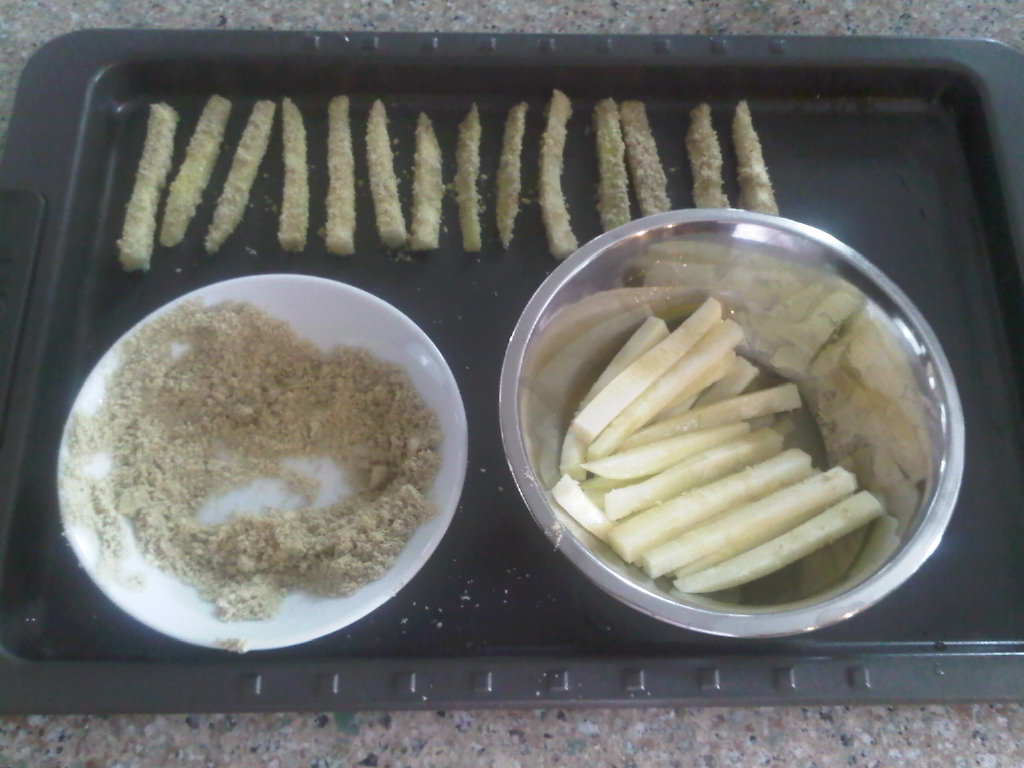
Recovery Recipe: Zucchini Seed Fries

When Martin eats egg for breakfast (this morning: duck egg cooked with broccoli sprouts in hemp oil, sheesh), he likes to have “French fries,” too. Martin cannot eat white or red potatoes, and his sweet potato intake is limited. So his French fries are usually butternut or acorn squash, cut into fry shapes, misted with olive oil and sprinkled with salt or seaweed flakes, and baked at 450°.

This morning I had no winter squash. I improvised. The result was a big hit with both Martin and Adrian. Henceforth these will be known in our home as “zucchini seed fries.”

½ of a large zucchini, peeled and cut into “French fry” shapes about 1/8” thick
sunflower (or another) oil
sunflour
sea salt

Place the zucchini fries in a bowl and drizzle them with oil until they are more or less coated, stirring as necessary. Put a small amount of sunflour into a shallow dish. Use one hand to pull a fry from the oil, shake off any excess oil, and transfer to the other hand to coat in sunflour from the shallow dish. (This helps to prevent the sunflour from getting too caked with oil, although I still needed to change it midway for a fresh dish.) Place on a baking sheet and salt to taste. (No need to oil the sheet.) Bake at 400° until browned and sizzling.

The resulting fries have a pleasant nutty flavor and are quite substantial. Note that they tend to break easily and so are better eaten with a fork than as a finger food.