Symptom Check, 26 November 2011

Autism is defined by symptoms, and I observe Martin’s daily, so it seems reasonable to share regular updates on where Martin’s symptoms stand. Here is the status check, for Saturday, 26 November 2011.

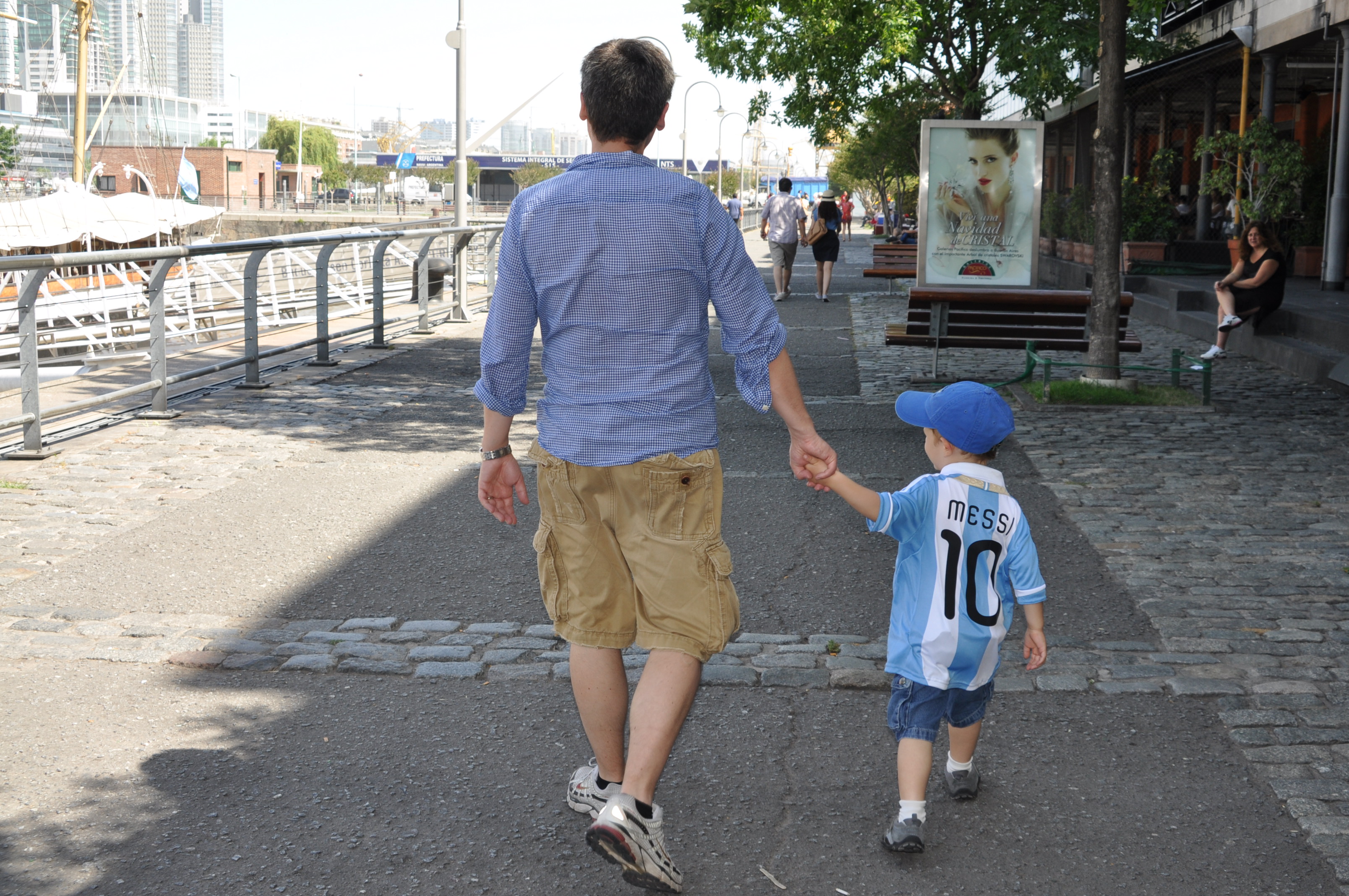
Sleeping: No issues. We’ve been traveling more than a week. Martin has taken advantage of every hour of rest we’ve afforded him. A couple nights, when we were on a plane or rising early to catch a plane, he did not get nearly enough sleep. Our fault. Other than that, he’s been going down for twelve hours. He has appeared tired/fatigued during the day, which may be attributable to heat (it must be 87 degrees in Buenos Aires today), pollen (falling like raindrops from the blooming trees), or general over-excitement.

Attention: Not great. Name responsiveness is low. It’s been tough to get him to focus, or even to look at the camera for pictures. Granted, he’s been photographed eight million times in the last week and may be growing tired of it, but he usually does better.

Mood: Also not great. Cranky. Clingy. Doing a lot of complaining that he wants to “go back to the hotel” or “go back to New York.” I don’t blame him; traveling makes me cranky, too. And the appeals for hotel or home seem to be obvious responses to unfamiliar situations, and what Martin must perceive as chaos around him. Plus, his bad mood has resulted in some solid sentences, like, “I want to get in the airplane and go back to New York.”

Language: So-so. On the one hand, pronouns continue to be an issue. Lots of echolalia and its corollary, using “you” instead of “I”—such as “You want more water” when he means “I want more water.” On the other hand, we’ve been getting some unexpectedly original sentences. In addition to the aforementioned pleas to go home, there were “I see mountains through the window”; “There’s a flag on the boat”; and “That’s one sailboat. That’s two sailboats.”

Self-stimming: Today he’s been thrusting his jaw forward, some. Also he’s been tilting his head back to stare at the ceiling and tensing his facial features. But overall we’ve seen relatively little self-stimming this week.

Physicality: Of late, I think we’ve made the most progress in physicality. Martin appears more aware of his body. He’s now telling us when he’s hungry (although he doesn’t generally use the word “hungry”; in its place he says, “You [I] want to eat”). He’s doing a little better at keeping his “toddler training pant” dry, so long as we remember to sit him on the potty often. He’s steady on his feet and pacing himself well when holding hands with me or Adrian. When he walks or runs alone, there is some disorganization, but less than previously; in terms of movement, he looks more like a neurotypical kid.

Breakthroughs: Two points to note. First, for months, we’ve been working with Martin on learning to pucker and blow. He can blow a pinwheel now, though only in short bursts, and not a deep, extended exhale. This morning he discovered blowing bubbles with his straw in his beverage. Hurray for Martin! And what a pain for me and Adrian! All he’s wanted to do today is blow bubbles; I’m not sure he’s actually drunk an ounce.

Second (caution! graphic scatological content to follow:), after lunch today I sat Martin on the potty, where he “did his poopies.” When he had concluded (or so I thought), we had this exchange:

Me: “Are you all done?”
Martin: “No.”
Me: “Do you have more poopies?”
Martin: “Yes.”
Me: “Well, go ahead.”

Indeed, we had this exchange six consecutive times, and each time Martin in fact did have another bowel movement. We must have been in the bathroom fifteen minutes. Finally I asked again, “Are you all done?”, and he said, “Yes,” and climbed down from the potty. This may not sound like anything worth writing home about—or in my case, worth subjecting my blog readers to—but it really speaks to the improving body awareness. Good work, Martin.
¡Hola! I’m Doing Well

As I mentioned, we’re vacationing in Adrian’s country of origin. Martin performed at the top of his game our first day here: fully attentive, interacting with his cousins, chatting with adults. Since then, I think, the change in routine, air thick with pollen (to which Martin appears sensitive), and general chaos of travel have taken their toll, and he’s faded a bit. So I was particularly pleased with this interaction at a museum today. I’ve highlighted the best parts in italics:

Adrian, who has been carrying Martin on his shoulders, plops him onto a bench, next to another boy, perhaps four years old.

The boy greets the three of us: “¡Hola!”

“Hola,” Adrian responds. “¿Cómo estás tú?”

“Bien,” says the boy.

“Martín,” Adrian prompts, “¿le puedes decir ‘hola’ al niño?”

Martin looks at the boy and says, “¡Hola!”

“¿Qué es eso?” the boy asks, motioning toward a toy in Martin’s hand.

Martin comprehends the question immediately and responds correctly, “Un avión.”

“¡Mira!” the boy says, turning toward a video screen showing footage of a military exercise. “Son soldados.”

Martin makes no verbal response but likewise directs his attention to the video screen. They watch together for a few seconds, and then the boy wanders back to his parents.

Adrian and I are left beaming.

Score: one more near-typical interaction.

Three Highlights Bringing Joy

When things are not going well—and I have admitted that they’re not, at this time—I tend to overlook everyday successes that I otherwise might highlight. Martin has brought joy to me and Adrian in these recent incidents:

Hangin’ with the pastor’s son. My church pastor has an 11-year-old son named Joey. Martin clearly admires the older boy (which is a little victory in itself). When we spend time with their family socially, Martin tags after Joey, in a Martin sort of way: like a cat, acknowledging the subject only occasionally, yet appearing constantly in his vicinity. And Joey returns the affection, mussing Martin’s hair to say hi, paying at least middle-school-level attention to not clocking Martin with a soccer ball.

Last Sunday in church Joey sat three seats away from us, in the same row, separated from Martin by only a young woman, a school teacher with a pleasingly high tolerance for boyishness. Throughout the service I noticed Martin sneaking glances at Joey. During the passing of the peace Joey hugged Martin, then high-fived him, which involved grasping Martin’s wrist and physically bringing the younger boy’s hand to his own. Joey must have considered it a teaching moment, since Martin failed to catch the cue when Joey merely raised his own hand in the air.

The closing hymn, to Martin’s disappointment, was not “This Little Light of Mine.” (Earlier in the service, he had insisted, “We’re going to sing, ‘I’m gonna let it shine’!”) I wanted to give him some treat in its stead, so I asked, “Would you like to go stand with Joey?” Although I had phrased my permission as a question, Martin understood. He pushed past the schoolteacher and planted himself next to Joey, who was signing. As soon as he noticed Martin, Joey rested his hand on the shoulder of his admirer. Martin wrapped his toddler arm around Joey’s waist, and together they swayed to the music. Despite the age difference and Martin’s limitations (which Joey hardly seems to notice), they looked like any couple of boyhood friends.

When the pastoral procession retreated and the congregation turned to face the door, I saw that Adrian, who does not attend church, had slipped into the back row to wait for us. He, too, was observing Martin and Joey. After another moment Adrian caught my eye with a look that said, “This is good.”

Expressing a preference. Martin’s expresses opinions, of course: “want” and “don’t want,” “yes” and “no,” “more” and “done.” He doesn’t do much choosing among non-binary options, however, unless a questioner enumerates a list. That is, he can answer, “Shall we go to the park, the carousel, or the wine bar?”, but walking out the front door, destination unknown, he won’t say, “I’d like to go to the carousel.”

Tuesday morning Adrian was dressing Martin for school. When he pulled Martin’s Bert-and-Ernie t-shirt from its hanger, he and Martin had a conversation along these lines:

Martin: “No!”

Adrian: “You don’t want to wear Bert and Ernie?”

Martin: “I want guitars.”

Martin’s t-shirt with guitars was not visible. Adrian sorted the hangers and pulled it out.

“Was this the one you wanted?”

“Yes.”

We had not even known Martin realizes he has choices when getting dressed. Moreover, (1) Adrian did not present Martin with options; (2) the guitar shirt was hidden, meaning that Martin remembered and decided he wanted to wear it; and (3) Martin instigated the conversation and made a meaningful selection beyond I don’t like what you’re doing.

Martin has not yet repeated this feat. Wednesday he wore Bert and Ernie without complaint. Still, it’s another first.

The wrong idea, well expressed. We have four cats. Only one, George, will give Martin the time of day; the other three scatter like he’s lobbing grenades. (I don’t blame them. By the end of this anecdote, you won’t either.) George craves attention so much that he seeks even Martin’s rough touch.

One afternoon this week Martin and George were playing on the living room floor. The interaction went well, at first: Martin dragged his fist neck-to-tail along George’s arching back. George tipped to the side, purring, and let Martin manhandle his ribs. Then Martin switched from petting to hitting—George, God love him, refrained from scratching or nipping—and I reminded him, “Martin, be gentle with George. Remember: Gentle.” I covered Martin’s hand with mine and stroked George’s soft fur.

Martin perked up, the way he does when he has a new idea. He tugged his hand from mind, sprang to his feet, and said, “I want to sit on George!

Before I could catch him, Martin plopped atop George, who promptly wriggled free and fled.

“Martin, sweetie, we do not sit on George.” I held Martin’s chin and guided his face toward mine, as I do when his attention is vital. “No sit on George. No.

I paused and awaited a response while Martin processed.

“No sit on George,” he replied at last. I let him go.

I was concerned for George. Not that concerned. He’s sturdy, and swift, and has claws.

More than that, I was pleased. “I want to sit on George.” Such a properly articulated notion, and appropriate—well, appropriate to the situation, if not for the well-being of our household companion animals.

It’s Like a Cruise Ship, But This Ain’t No Pleasure Cruise

I’ve expressed some frustration at feeling stalled lately. I’m looking for the leaps of progress we saw early in Martin’s recovery, when we sped from not sleeping to sleeping, from low muscle tone to good muscle tone, from lethargy to energy. Nothing so monumental has happened for a few months. Since before I started blogging, in fact.

For my own sanity, I need to talk about what’s heading in the right direction. We’ve got the answers to open-ended questions, as I posted yesterday. At Martin’s bedtime this evening, he and I exchanged a few words in a manner that mildly resembled a “How was your day?” conversation. His joint attention is flourishing; frequently he checks my face to see if I’m listening. (When he wants me to be listening, that is. Often enough he chats for his own amusement, no audience desired.) His relationship-understanding may have improved lately. He’s taking better notice—I won’t claim obedience—when I speak sternly (“No! No going in Mommy’s office.”). And earlier today, I took advantage of the Muppet Honkers performing “Honk Around the Clock” to make up a silly dance. Martin diverted his gaze away from Sesame Street (victory!) to me (victory!), understood that I was joking (victory!) and laughed (victory!).

Amidst these tiny successes, what bothers me is the big deal: the lack of general attention. Name responsiveness remains low for the moment, and Martin is rarely “with you” unless it’s a one-on-one situation. His teachers say he needs constant monitoring to stay focused in class. When he and I are playing, I find him about half the time talking to me, and about half the time just talking.

Over the past couple days I’ve sensed some inkling that the attention might be changing direction, maneuvering ever so slowly. It’s too soon, though, to get my hopes up, so I’ll just leave that notion on the table and follow up in a later post.

Remember the movie Titanic? Bill Paxton’s character Brock Lovett says something like, “The ship’s too big with too small a rudder. It doesn’t corner worth a damn.” We’re caught these days in oceanic currents of environmental toxins, EMF’s, chemicals, induced labor, processed mush disguised as food. And here come Adrian and I, trying to divert all that with our little toolbox of therapies, supplements, and organic foods.

It feels like steering a cruise ship with a rowboat paddle.

Got Questions? Martin Has Answers

Adrian reported yesterday that Martin has been giving substantive answers to questions. That’s not a skill I know Martin to have. Martin can repeat questions. He can respond yes or no to a yes-or-no inquiry. (That’s a recent development; Martin added “yes” to his vocabulary only this year.) He can express a preference when presented with two alternatives, such as, “Do you want to watch Ernie, or Big Bird?” And he can provide a concrete, expected response when presented with a known scenario—What song is this? Which instrument is this? But he cannot yet answer an open-ended question with various possible responses.

At least, I didn’t think he can. I was suspicious when Adrian said otherwise. According to Adrian, he had asked Martin, “What’s the name of a teacher at school who plays the guitar?” and got a name. He also had asked Martin, “What did you do today with Miss Jenny [a babysitter]?” and got a response that involved the playground and a merry-go-round.

Lucky shots, I thought.

Still, I decided to test the claims. Samara was sick today, so I picked Martin up from school and took him for a walk. After suitable time had passed, I knelt to catch his attention.

“Martin! What did you do in school?”

Martin made eye contact and responded, “What did you do in school?”

“That’s right. Can you tell me what you did?”

“Gym.”

“Gym? You had gym? You went to the gym?” Gym. That’s a real answer. I was giddy.

Thus egged on, Martin expanded his answer: “Class—gym class.”

Gym class! Although I had no idea whether in fact Martin did have gym class today, those two words provided sufficient proof for my standards. Martin can answer questions. I wonder how long this has been going on.

I’m going to keep pushing the skill. Martin had better get himself ready for plenty of open-ended questions.

Heck, maybe by Christmas we can achieve something as advanced as nodding his head for yes.

The Uncertain Footing of Doubts

Before Martin was diagnosed, when we had a hunch something was wrong, we consulted a good friend who works in EI. Our friend visited Martin, and, with her professional insight, discerned immediately what Adrian and I, first-time parents lacking any significant experience with toddlers, could not identify: that Martin likely had autism. She patiently answered our questions and pointed out signs such as Martin’s sporadic eye contact, lack of functional language, and tendency to drift instead of moving with direction and purpose.

She mentioned also Martin’s difficulty descending stairs, which resulted not only from underdeveloped muscles and coordination, but from limited awareness of his surroundings. When Martin walked down stairs, he never looked at his feet to find the next stair; he stepped down and assumed the stair was there. As a result, his footing was unsure and he risked stumbling.

Once we became aware of the stair problem, we started taking notice. It’s been a constant issue in the year since our friend visited.

Martin woke nearly an hour earlier than usual this morning. He’s been doing that these past few days, since he’s been perhaps a bit ill. Waking so early leaves him tired throughout the day, and when he’s tired, he’s not at his best. (We can’t let Martin nap; doing so ruins his sleep for at least one and as many as three or four nights.) We had a bad morning. Martin cried about everything. At one point he sat at the kitchen counter flipping through a board book, oblivious to me five feet away calling, “Martin. Martin? Martin. Martin! Martin,” to no avail, until in desperation I turned to Adrian and begged, “Where is he?”

It was the kind of morning that gives me doubts—doubts about whether we’re advancing and, especially, doubts about whether we’ll ever reach our goal of making Martin indistinguishable from his neurotypical peers. On a rational level, I know how far we’ve come in the past seven months. (Last month I laid the progress out, perhaps more painstakingly than interested anyone but me, in my series of “ASD Recovery Six-Month Review” posts.) On an emotional level, at any given moment when I’m not witnessing Martin perform a new and fabulous feat, the doubts come knocking. Tenacious little suckers, those doubts.

When Martin, Adrian, and I left for church at 10:00 a.m. Martin and I had been awake four hours already, ample time for me to sink into a psychological dumpster. That’s pretty much where I was floundering as I trudged after Martin and Adrian, down the winding flights of stairs from our walk-up apartment.

Halfway down Adrian gave a psst! and motioned to Martin. Below me I saw Martin barely touching the handrail, looking steadily at his feet as he descended, finding each stair before stepping. It was the first time I’d seen him do so for a sustained period. The action wasn’t accidental. Martin was doing what people are supposed to do when they walk down stairs, what happens instinctively for the neurotypical.

Suddenly I was fine again, lifted from the psychological dumpster. I was hopeful. I was satisfied.

It’s a glorious irony, this role reversal. Martin, literally, walks with steady footing now. And I, figuratively, step with trepidation and falter often.

The Most Beautiful Words, Ever

Yesterday evening I was doing a new HANDLE exercise with Martin called “Airplane Flagger.” Martin lay on his back on the floor, and I manipulated his arms: from his chest outward, from flat at his sides to over his head. At some point Martin mistook Airplane Flagger for “prelude to tickles,” which is not a HANDLE exercise but a fun game when I pin his hands above his head in order to tickle his underarms.

I figured, What the hay. Let’s make it tickle time, and set to tickling. I just love the joy of his unadulterated little-boy laughter.

A few seconds later I released his arms and let him catch his breath. I waited, poised above him, fingers pressed together in tickle-threat formation, holding Martin’s expectant gaze as RDI suggests. Martin could hardly contain his anticipation. “Again,” he said between gasps. “Again.”

So steady was Martin’s eye contact, I had to draw the moment out. I leaned closer and asked, “What? Whaaaaaat?”

And he produced the most beautiful words, ever.

He focused his eyes on my face, deliberately. He paused and considered. Finally, he said without bewilderment or guess, with the self-assurance of an accomplished orator:

“I want you to do that again.”

The sentence nearly overcame me. Instantly I analyzed it. An original thought, not heard and repeated. Subject. Object. Infinitive phrase. Adverb modifier. Perfection.

Martin’s previous best sentence, to my knowledge, came six or seven weeks ago, before he tumbled into the distraction that characterized last month. Dinner had just concluded. Adrian gathered Martin and announced bedtime. Martin became mildly distressed and protested, “I want to do sleepytime with Mommy.” That was a good, solid sentence—also included an infinitive phrase, and threw in a preposition—but “I want you to do that again” exceeds it in complexity, and requires proper use of both “I” and “you.” Prepositions are sand traps for an echolalic boy; he repeats what we call him (“you”), instead of registering the interconnectedness (the speaker is “I”). Perhaps we are approaching a milestone in his understanding.

Once my shock faded, as you can well imagine, I acceded to his wish and tickled. Again.

My son is a miracle.

Defiance

The post titled “Guilt” was about me—my guilt. This post concerns Martin. Specifically, his unrelenting, unabashed defiance.

It has come to my attention that a child recovering from autism passes through phases of childhood on a delayed basis. For example, he might suddenly, at three years old, become fascinated with toys designed for an 18-month-old, either because that’s the point his development now has reached, or because he needs to return to some stage he missed.

Martin’s homotoxicologist, at the same time, has warned me that we need to expect some emotions during different phases of recovery, as toxins pass out of Martin’s system. Those emotions include anger, anxiety, vivacity, and—defiance.

I’m a first-time parent. I have no inkling at what age a neurotypical child hits a defiance period. I have, by contrast, pinpointed exactly when Martin does: now.

For the last five days or so (indeed, since right about when he started to emerge from the last month’s foggy funk), Martin has resisted everything. He won’t sit on the potty, which is usually his No. 1 pastime. If I suggest the shark pajamas, he wants the dinosaur pajamas, or the skateboarding-monkey pajamas, or the dogs-in-cars pajamas, or anything except the shark pajamas. He rebels against wearing pants. Pants! This morning he metamorphosed into a rabid hyena when I suggested that he have a bite of his favorite muffin.

The instant I managed to wedge a morsel into his mouth, the hyena fled and Martin returned, eager to inhale the rest of the muffin. Thanks, kiddo.

Martin’s therapists find this defiance development most exciting. “He’s really showing a greater sense of self!” “So encouraging, how he’s trying to assert individuality and parental separation.”

We live in a neighborhood with several private preparatory schools. (I’m not worried about giving too much identifying information, because “several private preparatory schools” describes 92.47% of neighborhoods in the five boroughs.) Earlier this year I found it hard to see teenagers from these schools hanging out in the deli, tossing a football, gallivanting the sidewalks, doing whatever teenagers do. “Oh,” I would think, “you think you’re sooooo special, just because you’re neurotypical. Big deal.” I was misplacing anger on kids who never had to struggle the way mine does.

Witnessing Martin’s nascent recovery brought me to a different place. The anger dissipated into something more like anticipation. Ten years from now, when Martin has become a hostile 13-year-old who rejects his parents in favor of friends, I’ll be able to relish the moment. I’ll think how close we came to never having a self-centered little jerk around the house, and how relieved I am that we managed to create one.

So it also shall be now with defiance. When Martin is tearing, pants-less, through the living room shouting No! No! No! at full volume—even though I haven’t asked him to do anything—I shall wallow in joy that we have reached a “greater sense of self” marked by “individuality and parental separation.” I shall celebrate reaching this milestone, belated or no.

I shall, I shall. I … promise … I … shall.

Martin Shoves a Book Into My Nose But Then Takes It Away. Hurray for Martin!

Church went well this morning. Martin had two toy trucks—with soft plastic wheels, which are quiet on the sanctuary’s stone floor—a board book, and a sippy-cup to keep him amused. I carried my mother’s ASD-recovery-compliant coconut macaroons, and deposited one into Martin’s mouth whenever he got too chatty. Martin was a vending machine of sorts: for payment of a macaroon, he dispensed several minutes’ silence.

During the hymn of the day I stood and held Martin in my arms. Martin, in turn, shoved his board book into my nose, blocking half my face and forcing me to bend backwards at the neck. It was terribly uncomfortable. I met Martin’s eyes and shook my head at him. Actually, I rolled my head slowly side-to-side, as best I could with my nose compressed against the book. In any event, I meant, No. Don’t do that.

My hopes were dim that such a simple gesture could stop the behavior.

To my surprise, Martin obeyed. He removed the book, glanced at my face, and turned his attention instead to the parishioners around us.

Thirty seconds later, we repeated the same sequence. Book into nose. Head-shake no. Martin understanding and complying.

This was nice, very nice. I checked off what Martin had achieved. He’d correctly interpreted a non-verbal gesture, even recognized that I was serious. (Most shakes of my head are greeted with his laughter.) He’d obeyed. I knew he wanted to continue shoving the book into my nose, because he’d done it again. But then he’d obeyed again. Hurray for Martin.

The closing hymn, appropriate for 9/11, was This Little Light of Mine. The congregation sang slowly at first, then gained speed until everyone fired up and clapping. Martin stood in front of me. I held his arms above his head, helped him sway and dance. He was ecstatic. He looked around himself and up at me (joint attention!), his face contorted in smile. He shouted, “I’m gonna let it shine, let it shine, let it shine!”

We were on top of the world.

Of course, you can’t live in the real world and also be on top of it. At least not for very long. After church we needed to drive to Brooklyn. Fearing 9/11 street closures, we opted to take the Manhattan Bridge instead of the Brooklyn Bridge. This slight deviation from routine sent Martin into a frenzied tantrum, worse than we’d seen in months. I tried distracting him, making stern faces, ignoring, placating, hugging, to no avail. Martin was hanging out in that ASD place where every journey admits but one route.

When the tantrum was done, Martin returned to top form. We drove home and he accompanied Adrian to the park, charming and obedient. I resolved not to let a single blemish taint a magnificent day.

This little light of his, we’re gonna let it shine.

ASD Recovery Six-Month Review: Behavior

Last year around this time, I thought I was a bad parent.

I have limited experience with young children, so I had only an inkling of how difficult managing a two-year-old should be. I just knew that watching Martin utterly exasperated me. He would not respond when I called him; he failed to follow the simplest directions; my anger, or annoyance, only amused him; time-outs produced no effects; the simplest task (putting on shoes, getting out the door) blossomed into a twenty-minute test of nerves.

I am not a loud person. Nor am I aggressive toward my child. Still, I found myself yelling, struggling to command, if not his obedience, then at least his attention.

The evening hours, when Samara had gone home and I needed to prepare dinner, hurt the most. Unable to occupy himself for more than a few seconds, Martin whined continuously, ran circles around our staircase, caused injury to himself or our possessions. These evening hours were my primary time with Martin, and I should have relished them. Instead, I sometimes dreaded Samara’s departure. That’s hard to admit. But it’s true.

Martin’s ASD diagnosis helped little. For the first time I understood why we struggled, and my empathy for Martin grew. Understanding and empathy, however, did not translate into increased ability to control his behavior. I was lost.

Six months into biomedical treatment of Martin’s autism, he does not behave perfectly, or even as a three-year-old with typical self-control might. For example, if I’m not next to him, reminding him to stay and eat, Martin wanders away from the breakfast table. He can be hyperactive. Although we’ve taught him the meaning of “clean up,” he has a narrow appreciation for order. When he’s done with a toy or object, he drops it and walks away. By dinnertime, chaos overtakes the apartment.

And the toughest part is that, with limited exceptions, Martin remains unable to read facial expressions or comprehend displeasure. He still considers almost any display of emotion humorous. Last night, as he was falling asleep, Martin repeated, dozens of times, “Martin, I am angry with you. Martin, Mommy is angry,” and laughed. That pretty much encapsulated my attempts at discipline.

Nevertheless, we’ve seen improvement in Martin’s ability to play and mastery of his own actions—skills that enable me to look forward to our time together. (Now that his new school has started, our time has shifted to the early-morning hours, with a bedtime addendum.) Simply because he does not need to keep constantly in motion, Martin finds less trouble to get into. The improvements in his attention and play skills mean that I might find him quietly building a chain of trains or looking through a book while I prepare a meal. With better receptive language, he understands more and more what I want him to do, and he often goes along with minimal cajoling. He also seems to know that eventually Mommy will get her way; when he’s in an amenable mood, he’s fine with Mommy prevailing sooner rather than later.

I haven’t raised my voice in weeks, except for the occasion when Martin slipped his hand from my grasp and ran into an active parking lot.

Of course, this isn’t all from the biomedical intervention. I’ve learned how better to handle Martin’s needs, such as transitioning him away from an object of obsession (like a guitar). A dedicated team of behavioral therapists also has helped. Finally, Martin is maturing.

Even ASD kids mature, right?