Why, Hello Again

How does one restart blogging?

I’ve been thinking about that. Mostly while lying awake at night and also wondering why the [redacted] I’m not blogging. But still.

And ta-da!: The plan I’ve conjured, the blogging redux after seasons of silence:

An update.

I’ll offer my readers—in the event I retain any—tidbits about where we stand now, and then, my blog restarted, I’ll pretend like I never was away.

1. We’ve left the City for the suburbs. New York, New York, no more. We moved June 4 to a ranch house, situated on 1.15 acres in a town where many of our neighbors prefer another NHL team to the New York Rangers. An autism diagnosis was one thing. This kind of upheaval—it’s disconcerting, to say the least.

2. Martin attends kindergarten at a private school for children with learning differences. His class has twelve pupils and multiple instructors. Adrian and I feel extremely lucky that Martin has the chance to attend such a school, never more so than this past weekend, when we attended one classmate’s birthday party and watched Martin frolic with his new best friends.

3. Martin receives traditional occupational, physical, and speech therapy at his school. Saturday mornings I drive him into the City for two sessions of Anat Baniel Method (ABM) therapy. We continue working with a HANDLE therapist, and doing home-based exercises activities on the RDI approach. One evening per week Martin takes piano and drum lessons (the latter by his own initiative) with a certified music therapist.

4. We have not yet recovered Martin. We have, however, made progress, and a good deal of it:

•            Though he retains some patterns, Martin’s speech is rarely rote anymore. He has some quirks, such as substituting “but because” for “because” and adding “for” where it doesn’t belong, as in, “Can I have a piece of paper for to draw a picture on it?” Nonetheless, he can express his wishes, wants, and needs verbally, and well.

•            Martin can engage in conversation of six or more exchanges, so long as he is answering the questions (not asking them, which is a level higher). Here is an exemplar talk, which we had when he arrived home one day last week:

“How was school today?”

“It was good.”

“Did anything special happen?”

“We had a surprise reader!”

“Oh, yeah! Who was the surprise reader?”

“It was Quinn’s family.”

“Quinn’s family? His whole family came, not just his mommy or daddy?”

“His whole family came.”

“Wow! What was the book about?”

“It was about snowmen.”

“Did you like it?”

“Yes. I liked it. We made snowmen!”

Note that Martin, who once just “said things,” was speaking accurately. I confirmed later that Quinn’s mother, father, and older sister had all come to do the surprise reading, that they’d read a book about snowmen, and that they’d helped the class with a snowman-making craft project.

•            Lethargy is a thing of the past, and Martin’s “floppiness”—his tendency to fall onto anything within reach—diminishes every day. His core strength has improved, insofar as he is as likely to sit up as to slouch. His manual dexterity is such that he grips a pen appropriately for writing and drawing, he can manipulate small items like pills, and he uses his hands independently for drumming. (That last achievement might not pertain to dexterity per se.)

•            Martin takes a keen interest in his peers: what they eat, how they play, the structure of their families, where they live. He requests play dates. What he still lacks is a solid understanding of how to interact with friends. We’re working on that.

We vacationed recently at a resort area. When Martin was having trouble engaging any other child there, I would approach the child’s parent and say something like, “I think my son would like to play with yours. My son has Asperger’s, and he’s never quite sure how to go about making new friends.” “Aperger’s” sounds much less scary than that other A word, I think it’s pretty accurate for where Martin is now, and the parents I approached responded uniformly positively. Martin made a couple of “vacation friends” that way.

5. Martin still exhibits “autism” behaviors. He perseverates. A lot. This has been an issue forever. Right now he prattles endlessly about traffic lights, hair length, the time, and the moon. He also has three prominent stims (self-stimulatory behaviors), which become more pronounced when he’s tired or detoxing. The stims are running back and forth, making a slurp! sound by sucking air through his lips, and carrying or playing musical instruments. And of course, Martin can be rigid. He wants to wear his blue vest every day, drive one particular route home, read Pete the Cat or Knuffle Bunny books every night.

6. I now understand “the long haul.” I think that, when I started the process of recovering my son, I didn’t really comprehend what how long one might need to haul. The mother who introduced me to biomedical intervention had largely recovered her son within two years, and was done with the process entirely within three years. I failed to grasp that her family’s timing was exceptional. I thought that by kindergarten we’d be done.

My family has been at this three years now, chipping away at the underlying health issues that exhibit themselves as “autism” in Martin. My son has made staggering process. If we never achieve anything more, I will know that our time and money have been well spent. Still, he is not recovered, and much work remains. Fortunately, I no longer fear that some mythical window will close while Martin is five (he’s five now), or seven, or any age. A mother of a recovered 14-year-old told me recently, “Our best year was when he was 12. Twelve years old is when he made the most progress.” Twelve years old is a long, long way off for Martin. If that turns out to be our best year, so be it. We’ll get there.

7. This year, 2014, is going to be extraordinary. Don’t ask me how I know. I can say this: I woke on January 1 with that feeling, and it has not left me. Martin will hit new milestones, and so will I. This past weekend I met with an old friend from law school. My friend used to work in venture capital but for the last year or two has been searching for a new path, something more creative. I told him that I haven’t been doing much writing, or much of anything else, because I’ve been so focused on Martin’s needs. Without warning, he turned to me and vocalized something I already knew: “2014 is going to be a banner year. For you, for your son, for me. I think this is our year.”

See you soon.

My Rainbow

Martin and I were riding the subway Saturday morning. We had with us a rainbow that he had made in school out of construction paper and Froot Loops. (Ugh.) The following conversation ensued:

Me: “Martin, do you remember where you got this rainbow?”

Martin: “I made it in school.”

Me: “You know, Martin, rainbows make people happy—which kind of means that you’re my rainbow, because you make me so very happy.”

Martin: “I’m your rainbow.”

Me: “I think you are.”

Martin: “My name is Rainbow.”

Me: “Your name is Rainbow? Really?”

Martin: “No.” [Laughs.] “My name is Martin. I’m being a rainbow.”

Martin said those things, in that order. My kid said those things.

In professional ice hockey there exists an unofficial (and unsanctioned and probably unadvisable; check out The Last Gladiators) player role, known as an enforcer. An enforcer’s job is to keep the opposing team from playing too rough. For example, if an enforcer sees an opponent intentionally late-check a star player, the enforcer might respond by grabbing that opponent by the jersey and punching him several times, as a warning to leave the star player alone.

(Don’t be put off. If you’re not already an ice hockey fan, do please start watching. The combination of grace, strategy, and grit that carries a hockey team to victory resembles the traits needed to recover a child from autism. Honestly.)

Have you heard of the crazy Fred Phelps family from Topeka, Kansas? These are the people who—despite lacking affiliation with any Baptist denomination, and as far as I can tell, despite following none of Jesus’ major teachings—call themselves the “Westboro Baptist Church” and protest at high-profile or military funerals because, they claim, God opposes homosexuality. (I realize that sentence lacks substantive logical foundation. That’s intentional.)

Apparently these Phelps people threatened to show up at the funerals for victims of the recent Boston Marathon bombings. I saw something circulating on Facebook that I should have downloaded, because I can’t find it now. It was a picture of a Boston Bruins enforcer, during a game, on his knees, straddling an opposing player whose back was on the ice. The enforcer had his gloves off, which is dangerous because punches fall softer when the fist is padded by a hockey glove, and he was plainly beating the daylights out of the opposing player, whom he’d rendered defenseless. The caption under the picture said something along the lines of, “This is what we do to hockey teams we don’t like in Boston. Please, come protest a funeral.

When Martin was diagnosed with autism, at 27 months, he could label objects and people and colors, and he could speak in echolalia, but he had no functional language. At 36 months, he had begun developing functional language but could not grasp concepts like first and second person; he said “I” when he meant “you,” and “you” when he meant “I.” By 48 months, he could respond to questions but could not engage in dialogue, i.e., carry a conversation beyond one response.

On Saturday, Martin sustained that rainbow discussion. He maintained consistent eye contact throughout. He ended by drawing a distinction between being called Rainbow and being a rainbow.

Please, come tell me recovery from autism is not possible.

High Score

Monday evening Samara babysits Martin. It’s my big night on the town.

As I was leaving yesterday, around 5:30 pm, Samara was heating dinner and Martin was playing in the loft space above our entry hall.

Playing alone. Score for Martin.

From the living room, I yelled, “Martin! Where are you?”

Martin appeared in the loft door.

Understanding that I needed to see him. Score for Martin.

“I’m leaving now,” I said. “I love you very much.”

“I love you too, Mommy.”

An appropriate response, including the use of “too” and addressed directly to me. Score for Martin.

I asked, “Can you blow me a kiss?”

Martin placed his hand to his lips, then waved it toward me.

Direction, albeit simple direction, followed. Score for Martin.

I tossed a kiss at him and departed.

Later, after drinks with parents from Martin’s school, I met a church friend for dinner. This friend knows that Martin has autism. At some point during dinner, he said, “I hope it’s okay to say this and it doesn’t make you mad or anything: When I see Martin at church, he looks just like all the other kids.”

A friend doesn’t want to offend me when he says Martin looks like any other kid. Score for everyone involved.

No Yeast?

Poor yeast, gets all the blame.

I posted yesterday that Martin is in Symptomatic Itchy-ville, and that a yeast imbalance is to blame.

We made it to the doctor appointment (an hour late, with that “patchy fog” to thank), and the doctor thinks Martin’s sandpaper skin looks more like massive detox than yeast overgrowth. To the credit of this theory, we entered Symptomatic Itchy-ville right around the time last month when we reached full dose of takuna, a detoxifying agent.

That’s Martin’s way: His digestive tract isn’t as good as it should be at spitting out bad stuff, so his skin overcompensates. One thing good, one thing bad.

Isn’t that just like our life right now? Martin skips and perseverates and self-stimulates by running laps. He’s grouchy; everything is a tantrum. He was up, in our shared hotel room, from 2:00 am-5:00 am, laughing hysterically in detox mode. (I know he wasn’t actually drunk. I made him carry a jug of drinking water into the hotel last night, a Herculean effort that left no little hands free for smuggling alcohol.)

Those challenging aspects make it easy to overlook the good that’s happening. In the doctor’s office yesterday, Martin jumped on the trampoline higher and with more coordination than ever. He jumped in circles and announced, “I’m jumping in circles.” When he was trying to fall asleep last night—late last night—he called from the bedroom of our hotel “suite”:

“Mommy!”

Parked on a sofa in front of the ChiefsSteelers game, I responded: “I’m eating dinner, Martin. Go to sleep.”

“Maybe later you’ll come to bed and shut the bedroom door.”

I’d left the door between the bedroom and main room ajar, so Martin wouldn’t be scared. I called, “Do you want me to shut the door now?”

“No. Maybe later.”

It might not sound like much, but that’s a conversation, or the beginning of one, in any event.

We’re surviving the not-so-good because there is also good.

And maybe because it’s not yeast. I’m not sure I have the strength for another full-out war on yeast.

The Bad Nights Aren’t So Bad

Martin’s had two nighttime disturbance in the past two weeks.

Last Tuesday I heard him crying at 10:40 p.m. Crying usually signals a nightmare or some other fright, and such was the case. He had fallen out of bed. He was plopped on the hardwood floor, clutching his stuffed elephant, confused. I lifted him back into bed, checked for damage, reassured him while rubbing his back, then returned to the kitchen as he dozed back off.

This Tuesday he woke me by calling “Mommy! Mommy!” at 1:10 a.m., from his bed. That’s a worse sign; calling for me indicates that Martin is fully awake, and going to be up for a while. I went to his room and said, “Martin! It’s still nighttime. Go back to sleep until morning.”

“I want you to get in my bed,” Martin replied.

“No. I’m going to sit outside your door. You go back to sleep.”

“I want you to sit in the rocking chair,” Martin said. The rocking chair is in his room.

“No. But I’ll be right out here,” I said and exited his room, leaving the door ajar. I stepped into my and Adrian’s room—our door is only four feet from Martin’s, across a small landing—to retrieve my iPad.

Martin started to cry. “Mommy! Mommy! I want you to come inside.”

“Martin!” I said from just outside his door as I powered up the iPad. “You’re fine. I’m right here. Go back to sleep.”

He cried a little more, called, “Mommy! Mommy!”, and fell silent.

I sat down and scrolled through my friends’ Facebook statuses. Since I’d also done that right before I fell asleep 90 minutes earlier, there wasn’t much to read.

Martin started up again. “Ah, Mommy! Ah, Mommy!”

“Martin! Don’t be silly. It’s sleepy-time. Sleep.” I closed Facebook and called up a Scrabble game I had in progress against “CPU.” CPU was beating me by 95 points.

Ten minutes passed. I shut off the iPad, to gauge whether Martin would react when the glow disappeared from outside his door. Nothing. I waited another couple minutes, then quietly rose and returned to bed. It was around 1:30 a.m. I fell asleep.

“Mommy! Mommy!”

2:02 a.m. He was at it again. I stayed in bed and called, “Martin, it’s sleepy-time. Sleepy-time!” Next to me Adrian groaned and flipped onto his stomach.

“Ah, Mommy!”

“Martin, stop it! Go to sleep.”

Silence, then sudden crying. Martin was going to push the point. I got back up, grabbed the iPad again, and returned to my perch outside Martin’s still-ajar door. “I’m sitting right here,” I said. “Sleepy-time.”

Martin stopped crying and started chatting to himself: “You’re right there. Mommy is sitting right there. Mommy is right there.”

No new Facebook status updates. More Scrabble for me. Big defeat to CPU. I’ve got to stop setting the Scrabble difficulty level to hard, at least when I’m playing half-asleep. I shut the iPad off and listened for a reaction from Martin. Nothing. I snuck back to bed and dozed off.

“Mommy! Ah, Mommy!”

2:54 a.m. Martin was still awake. I called to him from my bed, eliciting more rumblings from Adrian. This time Martin didn’t push the point. Without crying, he said, “You’re right there.”

“Yes. I’m right here.” I didn’t leave my bed. I fell back to sleep.

Martin woke me at least twice more; the last time I recall was around 3:40 a.m. Each time I was able to quiet him without getting up again. Finally I heard no more from Martin, and I slept until my 6:00 a.m. alarm.

I estimate that, in total, Martin was probably awake for three hours. I entered his room just once. About 40 minutes of the three hours I spent crouched outside his door with my iPad. The remainder of the period I slept, albeit with interruptions.

I would not describe this as a good night. Not by any means. But it is progress. We aren’t so far from the time when Martin routinely woke for three-, four-, and even five-hour stretches during the night, and either Adrian or I had to be in his room every minute until he returned to sleep. Sure, he was up this Tuesday night, but (1) it was an unusual occurrence, (2) for the most part he stayed alone, and (3) eventually he got himself back to sleep.

Sure, I had to be up, too, and my calling out from our bed bothered Adrian. But for the most part, I remained horizontal, in my own bed. Anyone who suffers chronic lack of sleep will tell you—horizontal rocks.

Go to sleep, little man. Seriously. Sleep. Please.

Hard Truths

Where have I been, these two months?

Let’s talk hard truths.

I’ve been dealing with Martin, who’s been nowhere near where I’ve wanted him.

Over this summer, something went awry, and his progress hit a plateau. I did not see significant improvement.

Honestly, I don’t really recall seeing any improvement. We had some firsts, like supermarket walking and approaching a stranger. At the end of July, a friend sent me an email stating that her husband, upon interacting with Martin for the first time in several months, “thought he seemed great—real improvement since last time!” But the jagged ascent to which I’ve become accustomed—progress, little setback, progress, little setback—evaporated. At times the summer felt more like uneven descent: no progress, little setback, no progress, little setback.

Finding My Kid is “a parent’s real-time blog of autism recovery.” It’s hard to post reports when no recovery is evident. It really is. It’s even harder when the author descends into hopelessness, into questioning whether she’s abandoned her career, her church work and activism, and large chunks of her social life in pursuit of a goal that never will be reached.

Then, two weeks ago, Martin tanked. I mean, tanked. One day I felt like, though progress had leveled off, at least I had a child without perceptible autism, and the next day I had a child with myriad classic signs of the disorder. In our apartment Martin ran compulsively to and fro, chanting “d-d-d-d-d-dah, d-d-d-d-d-dah.” He lost eye contact and name responsiveness. He threw tantrums when not allowed to watch one video repeatedly. Echolalia resurfaced. It was as if a year of progress disappeared overnight.

I consulted with his doctors and therapists. The prognosis was unanimous: stress. Adrenal stress, systemic stress from doing too much. Martin’s delicate system cannot keep up with the amount of detoxification we’re imposing.

We pulled back immediately. I took him off almost every agent meant for detoxification, whether heavy metals, parasites, viruses, or otherwise, and I kept him on only supplements and agents meant to support his adrenals.

With those changes, Martin shows signs of improving again. The repetitive behaviors, though still present, are diminishing. He’s making eye contact, albeit unsustained. Adrian and I are subjected to near-constant whining (hey, Martin is a four-year-old, after all) but fewer tantrums. I’m not going to say Martin’s recovery is back on track. I’m not even going to say we are where we were a month ago, when I already was unhappy with his progress.

I will say that, I hope, the ship is turning again.

So why recommence blogging now?

Because I have no excuse not to. Finding My Kid comes with an honesty pledge. Posting reports only when recovery is proceeding apace—well, that’s just not honest.

See you soon.

[Addendum: If you’re taking the time to read Finding My Kid, you probably already saw the piece in this morning’s New York Times about the the links between autism and immune disorders. I’m always happy when the mainstream press edges toward acknowledging that autism is medical and should be treated as such.]

Something Is Different

Sorry that this post comes so late. I started writing it ten days ago, then got delayed because Martin has been home sick from school. (A common childhood virus got him—for a change, nothing to worry about.) I return now to the blog with an enthusiastic update:

We’re in one of those “something is different” times, when Martin seems to be achieving some new skill every day.

I love the “something is different” times.

Here are some participants in the ongoing parade of firsts:

Blowing bubbles. After more than a year of trying—grabbing the bubble wand and sticking it in his mouth, yelling “phew!” but barely aspirating, and so forth—Martin has mastered the art of blowing soap bubbles. Doesn’t sound like much? A year ago Martin couldn’t pucker; his “kisses” consisted of bumping his wide-open mouth into my cheek. As of last week, he’s combining a solid pucker, ocular focus, and breath control in one task. He even unscrews the bubble container top and holds the wand himself, steady. This is huge.

Stepping off the escalator. This relates to our old foe, proprioceptive awareness. As City denizens, we’re on escalators constantly, most often in subway stations. The end of an escalator used to involve me yelling, “Okay, Martin! Now! Now! Step now!”, then holding him up by the arm when he inevitably stumbled. I’m down to chanting softly, “And. Here. We. Go!” as Martin lifts his foot and we step off together.

Imitating. Martin’s imitation skills are in full swing. We traveled recently, for a visit to Martin’s doctor. Martin likes to flush the toilet in the airport bathroom, and until now he did so with his hand. This time, at LaGuardia, I watched him trying to hoist his little leg high enough to flush with his foot, just like Mommy does. I hadn’t told him to use his foot; he was just imitating what he’d seen me do. Later, as we waited for our ride home (“Adrian”), Martin picked up a pay phone and asked, “Hello? Hello?”

Imagining/associating. For a while now, Martin has been creating a musical instrument out of anything he can get his hands on. “I’m playing the suitcase like a bass!” “I’m playing my shoelace like a flute!” “I’m playing George’s tail like a saxophone!” (May God bless George the cat.) Even an actual musical instrument can have multiple functions; a toy piano turned sideways is an accordian, and a guitar under the chin makes a violin. Now he’s categorizing less and free-associating more. In the doctor’s office was an air purifier, about 18 inches tall, which blows air through an angled top. Martin tried to sit his behind onto the angled top and said, “I’m using the tushy-dryer!” He also told me, when he saw some rain, that the clouds were “going potty.”

Finding humor. Once upon a time, Martin was upset by anything unexpected. Last week he flipped open the top of his drinking Thermos. Because I had mixed “naturally effervescent” kombucha with the filtered water inside, the beverage rushed up the pop-up straw and squirted Martin’s face. Startled, he looked at me for my reaction. (That’s an achievement in itself.) I laughed; I couldn’t help myself. To my surprise, Martin started laughing, too. Later, on the airplane when we were traveling, Martin asked for an ice cube from the club soda I was drinking. (That’s a no-no for Martin, of course; who knows what kind of water is in an airplane ice cube, which was floating in my aluminum-canned drink. Ugh, and double-ugh. But we live in the real world, and do the best we can with what’s on hand, so he got an ice cube.) I tried to deposit the ice cube into Martin’s mouth but missed and somehow rubbed melting ice all over his face. No tears. More laughter. I capitalized on the ice-cube moment and reminded Martin, “Remember when the kombucha squirted you? Squirt!” The kombucha memory kept the giggles coming. We two managed to crack ourselves up for a good five minutes.

Drawing inferences. Because his babysitters are taking summer classes of their own, I’ve been picking Martin up at school more often. In the lobby of his school last week he watched me read his teacher-correspondence notebook and peek inside his lunch container. He said, “I ate all my lunch.” Which means: He got it. Martin inferred that I was opening the lunch container to check for leftovers, he recalled his own lunchtime performance, and he provided me relevant information.

Expressing emotion. This is just, just starting to happen. Martin talks a lot about falling in a pool, which refers to an event that occurred some months ago at my parents’ home. I’ve heard the story a million times, but last week Martin added a new detail: “When I fell in the pool, I was scared.” Two weeks ago Martin visited Adrian’s office. He ran from conference room to conference room, peering through windows at the tops of skyscrapers, then declared, “I am happy.” Finally, we had a guest musician at church, who played guitar and sang an original song. Martin told me afterwards, “I liked the guitar player at church.” These were the first times I’ve heard Martin make original expressions of emotion.

Yes, something is different. And I am happy.

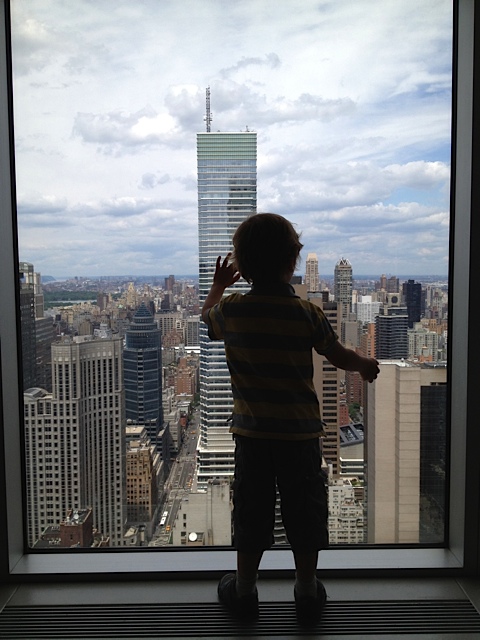
Martin takes in the City.

The Ineffable

Sleeplessness visited Martin again last night, the third time in a week. He was up from 1:00 until 4:30 am.

I’m tired.

Yet I’m not freaking out. To the contrary, I sense that Martin is doing well, that he’s back on the upswing.

I “sense” that he’s back on the upswing. That’s my way of saying I can point to nothing major. Martin has not ceased all echolalia, or started maintaining extended eye contact, or become graceful. In some respects, major signs point downward. Sleeping, for example. I can’t pretend that’s going well. Or keeping things out of his mouth. Objects are still finding his way into Martin’s mouth at an alarming rate. Fingers. Shoelaces. Lotion bottles. George the cat’s ears.

On the other hand, dozens of micro-signs point to improvement. I’ve witnessed the following:

•      Martin ran from the parking lot next to our building to his school bus without turning his head from side-to-side. I cannot remember seeing him run an extended distance looking straight ahead.

•      Martin was tired, so I let him ride to the store in his stroller instead of walking. We stopped at the organic restaurant for green juice. Martin climbed purposefully out of the stroller and mounted the stairs to the restaurant without pause. No dawdling, no tripping, no fussing. He looked like a neurotypical preschooler.

•      Adrian has been traveling this week. Out of the blue, not immediately related to any discussion of Adrian, Martin said, “I want Daddy to come home.” He was not repeating. He was expressing a wish about an absent person.

•      Two weeks ago we visited Martin’s friend Walter at his apartment. Martin observed that Walter still sits in a booster chair. Martin, who for months has ignored his own booster chair, has decided to imitate Walter. Now he’s sitting every home meal in the old booster chair. (He also runs and jumps in every available rain puddle. Thanks, Walter.)

•      Martin has taught himself to buckle the T-formation “seat belt” on that booster chair. That’s initiative and manual dexterity.

These types of developments can be easy to miss. Indeed, they’re nearly ineffable. But they add up.

They add up to a sense that I need not freak out.

Potty Sayer

“I need to sit on the potty,” Martin said.

This was Saturday afternoon. We were just spreading our picnic blanket on a stony beach at Montauk Point State Park, at least a quarter-mile of precarious terrain from the nearest restroom—and we know from past experience that Martin would rather have a potty accident than pee outside.

So if we were the parents of a neurotypical almost-four-year-old, we might have dreaded the words. But we aren’t, and we didn’t. Instead, I told Adrian, “I got this one,” grabbed Martin, and headed around the bluff toward the lighthouse restrooms, scuttling as swiftly as I could over a pile of rocks with a 45-pound preschooler in my arms. I spoke into Martin’s ear: “No pee pees yet! Hold them in. You can make it. Wait for the potty. No pee pees in your pants.” Martin, in return, poked his fingers into my nose and giggled.

We arrived at the restroom to find a line waiting. I raised my voice from a private whisper to a stage whisper—“Hang in there, buddy. Hold it in till we get to the potty”—hoping one of the queued women might take the hint and offer us her place. None did. We waited another several minutes.

Finally I lifted Martin onto a toilet seat, where he deposited his peepees into the bowl and then said, “I’m all done.”

Martin has been potty-trained, more or less, for several months now, with two exceptions. First, he still wears an overnight diaper to bed. That’s for security purposes; most mornings the diaper is dry when Martin wakes. Second, Martin has had trouble learning to tell us when he needs to go. Instead, he says something like, “I’m doing peepees,” or, “I need new pants,” three seconds too late. Up until now we’ve just been sitting him on the potty as often as possible, and he’s done his part by, usually, holding his business until a potty break.

So you may imagine our joy those occasions when Martin not only recognizes in advance that he needs to go but also thinks to inform us. That happened five times this weekend: once at the beach, twice at church, once at home, and—the biggest victory—once in the car, when we were stuck in Sunday-afternoon City traffic and unable to pull over, whereupon we asked him to please “hold it” until we got home and he did, an entire half-hour.

The round-trip from the Montauk beach to the potty and back again took me and Martin at least 20 minutes, delaying our lunch. No matter. When we returned to the picnic blanket, Martin in the same still-dry pants, no accident, Adrian lifted our big boy into the air and shouted,

“Ha ha! Way to go, Martin!”

Failure to Grieve

This week I attended an excellent presentation by Sarah Birnbaum of New York Special Needs Support. The topic was navigating the “Turning Five” process, i.e., getting a child into New York City special education for kindergarten.

It was a tough evening for me, emotionally.

There was a time when I thought that Martin might be ready to join a mainstream classroom as early as kindergarten. (Martin is not yet four years old; he is scheduled to begin kindergarten in autumn 2013.) Although we have made much progress, particularly in healing Martin’s gut and easing atypical movement and behavior, we still have a long way to go in language development and attention. We won’t try to place Martin in any classroom more advanced than his current skill level; because we are committed to lifetime success, we’d rather coddle him for an extra year or two than see him flounder because we shot too high.

So we’re looking at special-education primary schools. And so I related when Sarah said something like (I’m paraphrasing), “You may find it upsetting to visit these schools and fill out applications, because it’s not something you ever envisioned yourself doing, not a place you ever expected your child to be.”

But did I relate in the same way that the other assembled parents did?

I think Sarah meant that it can be hard to accept that your child is not suited for a mainstream classroom. And she is right—perhaps particularly so in the context of parents who do things like attend presentations on kindergarten admissions sixteen months before their children are due to start kindergarten. No one really wants to admit that his or her child has special needs, right?

Therein lies my thought for the day. I’ve read, in multiple sources, that the parent of a child with autism should grieve, i.e., should mourn the loss of the child who was expected, in order to better accept the child who is.

Adrian and I expected a high-achieving child, no doubt about it. From his earliest days, Martin was photographed wearing onesies and caps with the logos of our alma maters. We as parents debated topics like whether to speak to Martin in two languages or three, at what age he should begin music lessons, and whether the risk of concussions meant he should not play hockey. If we had a great fear, it was whether a spot would be available for him at the mainstream private school of our choice.

It’s been two years since we first began to notice signs of autism, and more than eighteen months since the diagnosis. Yet I have not allowed myself to mourn the loss of the child we expected, because I do not believe we’ve lost him. Martin is recovering, however slowly. I refuse to accept that he will face limitations based on autism. I admit that Martin has special needs now, but I do not admit that he’ll have them for long.

I do not grieve.

Nonetheless, as I sat in a presentation on finding the best alternative classroom, I found myself hiding the fact that I wanted to cry, and I wondered:

Can this hope actually make things harder?

My little superstar getting some exercise.