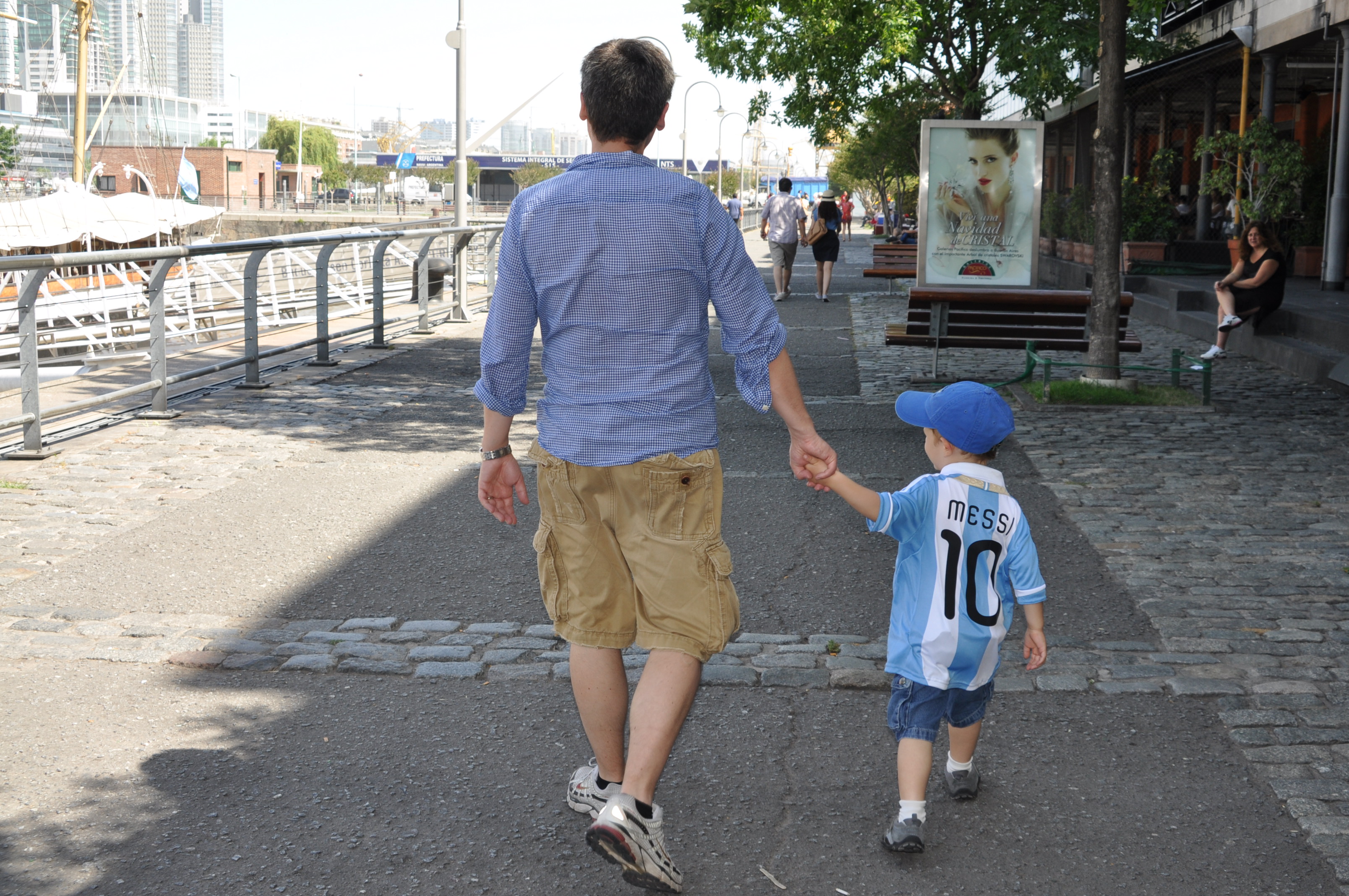
Without Martin

Readers, it’s been a week. For the first time since I started this blog, I let more than three days pass without a post.

I apologize.

I blame Christmas preparations—I didn’t accomplish even half a standard Christmas, but that’s a subject for a later post—, forging through dense briefing schedules in two separate litigations, sitting up at night as Martin’s had trouble sleeping, and preparing for the trip.

Yes! The trip! This is the big one, Adrian’s sixth-anniversary gift to me, and eight days without my Martin. My mother is staying in our apartment with Martin. We’ve gone backwards and forwards over his daily supplementation schedule, dietary restrictions, wants, and needs. I’ve filled the freezer with pre-prepared meals and organic meats. With the approval of Martin’s HANDLE therapist, he gets these eight days off from HANDLE exercises. And all week Samara’s been helping Martin learn this mantra: “Mommy and Daddy are coming back. Mommy and Daddy always come back.” As a result, he was okay when we left this afternoon. I said, “Daddy and I are going on an airplane and will come back next week. You’re staying with Grandma.” Martin replied, “Mommy is coming back another day. Mommy always comes back.”

I’m worried, of course. Not that my mother won’t accomplish Martin’s diet and supplements to the T. Not that my mother and Samara and even my visiting brother won’t be doting on him. I’m worried that he will be distressed without us, and more especially, that we could lose recovery momentum. These past few weeks have brought so much progress. I’ll have a hard time forgiving myself if our absence interrupts that, or prompts a set-back.

(“I’m not worried about permanent damage,” Adrian assured me yesterday. “I’m really not.”)

It didn’t help that, just before Adrian and I headed out, Martin seemed, as my mother put it, “a little spacey today.”

Nevertheless, I made it out the door, teary-eyed. I’m typing this on the airplane. We’re bound for Israel, landing in Tel Aviv and continuing by car to Eilat, then to Jerusalem, sandwiching a day trip to Petra in Jordan. This was all supposed to be a surprise, but some weeks ago I forced Adrian to reveal the itinerary. Not knowing our destination was just shoveling anxiety onto my already gigantic pile of hesitation about leaving Martin. It’s only the second time, since we radicalized his treatment, that I’ve been away more than a night. The first was a four-day trip to Germany for a family emergency, during which Samara moved into the apartment and helped Adrian manage the routine.

So there you have it. This blogger is on her way to the Holy Land and will have a week to contemplate the course we’re on with Martin. I’m determined to post daily, both to take advantage of the time away and to make amends for the recent posting dearth.

An eight-day travel journey, meant as a break from a years-long recovery journey.

Here we go.

Raw Narrative

I wanted to write about something that happened this morning. Then I realized that I had already written the event, in a (maybe) more authentic voice than I would employ for blogging. Let’s call this earlier version the “raw narrative.”

Adrian has been out of town on business since Sunday. (Which leads me to another opportunity to express my unrestrained admiration for single parents, and particular single parents of special-needs children. After a few days of handling Martin’s schedule alone, I’m toast. You amaze me.) When Adrian is traveling, I have a habit of sending him morning and nighttime updates via Blackberry.

Here, unedited except to change the names, is this morning’s update for Adrian:

Good morning, Sweetie! Martin and I are looking forward to having you back. It is drizzling here but so far not too bad.

Sweetie, I started crying this morning, in the street. I was standing with Martin, watching for the school bus to come. He was holding my hand, waiting patiently, not fidgeting, not flopping to the sidewalk or hanging on my arm, and he was making spontaneous sentences about some things he saw (“The fire truck is red,” “The man is running”), and then it hit me that he is getting better, that we’re managing this struggle, that every day I see more and more of the person emerge who our son was meant to be before this god-awful disorder took hold. I looked pretty foolish, I think, crying on _____ Street. But there I was.

In other news, I sent the first brief off at 4:00 a.m. and haven’t received comments yet, so I took advantage of the lull to jog over to the Union Square greenmarket for duck eggs, cow bones, and ostrich filet, to make sure the fridge and freezer are stocked for when my mother is here. My word, what have I become? Also got some of that buttery “Two Guys from Woodbridge” basil that we had last week. Come home so I can feed you.

Kisses.

Let me begin by saying that I’m not usually a crier. At least, not an in-the-street crier. As the penultimate paragraph indicates, I had worked until 4:00 a.m., which left me two hours for sleep before I had to rise at 6:00 a.m., which is the breakfast-and-school-prep time I need when Adrian is away. To that I will add that our senior-advisor cat, Philly, who inexplicably screeches during the night—not to be confused with our junior-advisor cat, Freddie, who pees everywhere—launched his half-hour hyena routine at 5:06 a.m., ultimately leaving me about 86 minutes for sleep. So I was tired, and emotions were heightened.

That disclaimer notwithstanding, the crying was entirely justified. Remember the three crap months we endured from August to November, when Martin’s yeast kicked up again and all the gains we’d made over the summer seemed to disappear? Gone. A memory. Martin is better than ever right now. His eye contact is so consistent that I rarely think about it; I assume that if I say his name, I will see his eyes, for as long as I’m talking. Joint attention is rising again. And Monday afternoon Samara noticed Martin casually taking the initiative to hold a friend’s hand.

We went through three months bad enough that I doubted the entire recovery process, and doubted whether I could endure. I know there may be down times to come, as well. But this day, here, now, I am so glad we’ve hung in there.

I will conclude by advising that I am in no way affiliated with or compensated by the “Two Guys from Woodbridge” company. I really did write that in the email to Adrian, and they really do grow magnificent buttery organic basil.

Adrian

Adrian and I were getting into bed one night last week when Adrian said, unprompted and unheralded, “He is getting better. He really is.”

Adrian neither prefaced his statement nor provided supporting detail. He did not even specify “Martin.” He just said, “He is getting better. He really is,” and then opened his iPad to read.

End of story.

Airport Fun, Part One: The Bathroom Miracle

We traveled yesterday, Martin and I, to visit his excellent Track Two doctor. I intend to post the doctor’s comments (at least, my interpretation thereof) once I’ve had a chance to ponder all she said. For now, I want to discuss the trip, and more specifically, positive and negative experiences we had underway. It will be another two-part post, starting tonight with the positive.

Going to visit Martin’s Track Two doctor means a schedule something like this: We rise early and eat breakfast and take morning supplements at home. Adrian drives me and Martin to the airport, where the two of us clear security and fly a couple hours. Upon landing we take a quick bus ride to a car-rental office. Then, in what I consider the most challenging part of the day, I make Martin wait inside the rental car—there’s just no way I could keep him safe in a rental-car lot with my attention diverted—while I install the toddler seat. Whatever the season, it invariably seems to be either sleeting, pouring rain, or freezing while I spend 20 minutes with my backside hanging out the passenger door, installing that damn toddler seat.

(I am yet to find a car-rental company that will install a toddler seat for me. If you know one, please send the information to findingmykid@yahoo.com.)

Next I drive us 40 minutes to the doctor’s office for a two-hour (give or take) appointment. After that we head back to the airport, surrender the rental car, ride the bus, clear security, wait around, and fly back to New York, where Adrian meets us at the airport, usually between 10:00 and 11:00 p.m. During this whole process I feed Martin food that I’ve cooked at home. For myself, I drink a lot of coffee and pick up what I can, here or there.

It’s an exhausting day. A lot of moving from place to place. A lot of walking hand-in-hand.

And, of course, a lot of visiting strange potties.

Yesterday we hit four airport bathrooms. Don’t worry: For a change, I will not address any, ahem, bodily functions in this post. The topic du jour is what happened outside the stalls.

Bathroom No. 1. No paper towels! The bathroom had only hot-air hand dryers. Martin loves paper towels and fears hot-air dryers. (Oddly, he likes hair dryers. When I dry my hair, he waits for me to whoosh his bangs back with the hot air, scampers away, then returns repeatedly for another whoosh.) In the past, a paper-towel dearth might have caused a meltdown. Yesterday when we finished washing our hands, I said to Martin, “Oh! No paper towels. But you don’t have to use the electric dryer. Let’s go see if we can find paper towels anywhere else.” He accepted that, and we exited the bathroom peacefully. I planned, if Martin persisted in seeking paper towels, to grab some Starbucks or Auntie Anne’s napkins. (The paper-towel supply in my backpack was too precious to surrender, meant instead for in-fight snacks, spilled drinks, runny noses, training-pants accidents, and whatever else the day had waiting.) The napkins proved unnecessary. We strolled wet-handed to the gate, and Martin let go of his paper-towel dreams.

Bathroom No. 2. We were in a hurry. While he was throwing away his paper towel, Martin glanced up and saw that I was already leaving. In such a situation, Martin’s typical reaction has been to dawdle, maybe turn on a faucet or play with a stall door, and generally ignore me until I return to retrieve him and drag him out by the hand. Not yesterday. When he saw me leaving, Martin dumped his paper towel, ran across the bathroom, and took my hand. Paying attention to my cues? Picking up his pace to meet mine? Glory be, whose child was this?

Bathroom No. 3. I was so inspired by the Bathroom No. 2 breakthrough that I designed a little experiment to see whether I could replicate the success. After hand washing, I directed Martin to a wastebasket at the far end of the bathroom to discard his paper towel. While he was thus engaged, I moved to the exit area—it was one of those set-ups with no door, where you instead exit by maneuvering through a U-shaped passageway—and called, “C’mon, Martin, let’s get out of here.” Then I ducked behind the first part of the U-shape. As an unanticipated bonus, a full-length mirror on the bathroom’s near wall enabled me to watch Martin’s reaction. He looked up, realized that I had left, appeared briefly startled, and again came running. It’s not that long since I had to worry about Martin wandering away without so much as checking my location before he took off. To have him hustling and mildly panicked when he knows I’ve left a bathroom—well, that’s a plain miracle.

Bathroom No. 4. We were in a hurry again. The plane was actually boarding. I threw away the paper towel for Martin, grabbed him, and ran. So nothing to report, except maybe, Hey, did I tell you about Bathroom No. 3?

Coming attraction: The security-line tantrum.

Martin’s Bundle: This Symptom, and Not That Symptom

After church services this morning, a younger member of the congregation approached me with a question. His psychology class is covering a unit on autism. They’ve learned about autism-related behaviors like not wanting to be touched, making no eye contact, and lacking affection. If Martin has autism, then why is it that, every time this young man sees us, Martin is snuggling on my lap or hugging me or smiling at people he knows?

I gave him the explanation, as far as I understand autism (which, I admit, is not very far). Autism is defined not by a root cause, but by symptoms, and the disorder can encompass myriad symptoms. Not wanting to be touched is one such symptom. So are, for example, taste and texture issues with food, or self-stimulating behaviors arising from sensory overload. A child on the spectrum may exhibit all these symptoms, or any group of them—what I like to call any “bundle” of symptoms.

Martin’s primary symptoms, I explained, are insufficient joint attention—he isn’t always interested in what others around him are doing, even if the others around him are Mommy and Daddy, and they’re pointing to pictures in front of his face—, language delay, inconstant eye contact, and mild self-stimulation.

Does Martin get upset if things are not the same every time he encounters them? the young congregant asked.

He does, in weird ways, I responded. If we drive to Brooklyn, he insists on taking the Brooklyn Bridge. The Manhattan Bridge and Brooklyn-Battery Tunnel upset him. And altering our plans sometimes prompts a tantrum. Adrian and I put a lot of effort into making sure Martin understands our schedule for any given day (or even hour), and that we stick to whatever we describe. Also, when Martin finds himself in an unfamiliar situation, or overwhelmed, he tries to make order with whatever he has at hand; on our trip to South America last week, in the garden of a busy household with cousins scampering left and right, Martin sat beneath a blooming tree, gathered strobiles, and stacked them side-by-side, into a toy speedboat, repeatedly. Order.

Even as I described those symptoms, the after-church conversation reminded me of a topic Adrian and I discuss often, namely, just how lucky we are in terms of Martin’s particular bundle. Martin eats more or less anything I serve him, facilitating his ultra-restricted diet. He wears any fabric. He displays strong affection for me, Adrian, Samara, his babysitters, his grandparents, even our friends and neighbors and extended families. Honestly, I think I would have great difficulty parenting a child who did not demonstrate his love. I am plenty tested by our cats, with their stand-off-ish nature, and that I can chalk up to their not being human. (In the event that you, amazing reader, parent a child who does not reciprocate affection, please add that to the list of many reasons why I salute you.)

The after-church conversation also made me consider this reality: Martin stands out less than he used to. Today, for the first time, he remained in his seat for the entire church service. Eight months ago he would have gone crawling under the chairs, seeking a snug and secure spot. One month ago he would at least have flopped onto the floor, or wandered away. Any person who is acquainted with children must perceive Martin’s language delay, or wonder about his tendency to ignore his name. Of course they must. But more and more I wonder whether the label autism still comes to mind when strangers meet Martin.

I left church today feeling fortunate.

Fortunate based on Martin’s particular “bundle,” and fortunate because we have seen even that bundle begin to splinter.

Interactive Play. Interactive Play That I Didn’t See

I did not witness the event described herein. Samara did. And I was so excited that, when she finished telling me, I made her narrate the entire tale, again, to my mother and Adrian, via speaker-phone. The hearsay version follows—

The setting was a 67-degree New York City afternoon, yesterday. Samara took Martin—he was exhausted from the overnight flight home, yet alert and adventurous—to play at a park with a substantial sandbox. Martin managed to get hold of the only on-site bucket and shovel. He had filled the bucket with sand and was using the shovel to scoop it out when another boy, perhaps four years old, approached and wanted the bucket.

Martin’s usual response to such a situation has been to abandon the toy to the child who demands it, and perhaps to start crying. Yesterday, instead, Martin engaged in some sort of wordless negotiation with the older boy, which resulted in the two of them sitting down, the bucket between them. The older boy cupped his hands to dump sand into the bucket; Martin used the shovel to scoop it out the other side. According to Samara, the two preschoolers cooperated this way for some ten minutes.

Non-verbal communication.

Interactive play.

Joint attention.

That’s my boy.

Symptom Check, 26 November 2011

Autism is defined by symptoms, and I observe Martin’s daily, so it seems reasonable to share regular updates on where Martin’s symptoms stand. Here is the status check, for Saturday, 26 November 2011.

Sleeping: No issues. We’ve been traveling more than a week. Martin has taken advantage of every hour of rest we’ve afforded him. A couple nights, when we were on a plane or rising early to catch a plane, he did not get nearly enough sleep. Our fault. Other than that, he’s been going down for twelve hours. He has appeared tired/fatigued during the day, which may be attributable to heat (it must be 87 degrees in Buenos Aires today), pollen (falling like raindrops from the blooming trees), or general over-excitement.

Attention: Not great. Name responsiveness is low. It’s been tough to get him to focus, or even to look at the camera for pictures. Granted, he’s been photographed eight million times in the last week and may be growing tired of it, but he usually does better.

Mood: Also not great. Cranky. Clingy. Doing a lot of complaining that he wants to “go back to the hotel” or “go back to New York.” I don’t blame him; traveling makes me cranky, too. And the appeals for hotel or home seem to be obvious responses to unfamiliar situations, and what Martin must perceive as chaos around him. Plus, his bad mood has resulted in some solid sentences, like, “I want to get in the airplane and go back to New York.”

Language: So-so. On the one hand, pronouns continue to be an issue. Lots of echolalia and its corollary, using “you” instead of “I”—such as “You want more water” when he means “I want more water.” On the other hand, we’ve been getting some unexpectedly original sentences. In addition to the aforementioned pleas to go home, there were “I see mountains through the window”; “There’s a flag on the boat”; and “That’s one sailboat. That’s two sailboats.”

Self-stimming: Today he’s been thrusting his jaw forward, some. Also he’s been tilting his head back to stare at the ceiling and tensing his facial features. But overall we’ve seen relatively little self-stimming this week.

Physicality: Of late, I think we’ve made the most progress in physicality. Martin appears more aware of his body. He’s now telling us when he’s hungry (although he doesn’t generally use the word “hungry”; in its place he says, “You [I] want to eat”). He’s doing a little better at keeping his “toddler training pant” dry, so long as we remember to sit him on the potty often. He’s steady on his feet and pacing himself well when holding hands with me or Adrian. When he walks or runs alone, there is some disorganization, but less than previously; in terms of movement, he looks more like a neurotypical kid.

Breakthroughs: Two points to note. First, for months, we’ve been working with Martin on learning to pucker and blow. He can blow a pinwheel now, though only in short bursts, and not a deep, extended exhale. This morning he discovered blowing bubbles with his straw in his beverage. Hurray for Martin! And what a pain for me and Adrian! All he’s wanted to do today is blow bubbles; I’m not sure he’s actually drunk an ounce.

Second (caution! graphic scatological content to follow:), after lunch today I sat Martin on the potty, where he “did his poopies.” When he had concluded (or so I thought), we had this exchange:

Me: “Are you all done?”
Martin: “No.”
Me: “Do you have more poopies?”
Martin: “Yes.”
Me: “Well, go ahead.”

Indeed, we had this exchange six consecutive times, and each time Martin in fact did have another bowel movement. We must have been in the bathroom fifteen minutes. Finally I asked again, “Are you all done?”, and he said, “Yes,” and climbed down from the potty. This may not sound like anything worth writing home about—or in my case, worth subjecting my blog readers to—but it really speaks to the improving body awareness. Good work, Martin.

¡Hola! I’m Doing Well

As I mentioned, we’re vacationing in Adrian’s country of origin. Martin performed at the top of his game our first day here: fully attentive, interacting with his cousins, chatting with adults. Since then, I think, the change in routine, air thick with pollen (to which Martin appears sensitive), and general chaos of travel have taken their toll, and he’s faded a bit. So I was particularly pleased with this interaction at a museum today. I’ve highlighted the best parts in italics:

Adrian, who has been carrying Martin on his shoulders, plops him onto a bench, next to another boy, perhaps four years old.

The boy greets the three of us: “¡Hola!”

“Hola,” Adrian responds. “¿Cómo estás tú?”

“Bien,” says the boy.

“Martín,” Adrian prompts, “¿le puedes decir ‘hola’ al niño?”

Martin looks at the boy and says, “¡Hola!”

“¿Qué es eso?” the boy asks, motioning toward a toy in Martin’s hand.

Martin comprehends the question immediately and responds correctly, “Un avión.”

“¡Mira!” the boy says, turning toward a video screen showing footage of a military exercise. “Son soldados.”

Martin makes no verbal response but likewise directs his attention to the video screen. They watch together for a few seconds, and then the boy wanders back to his parents.

Adrian and I are left beaming.

Score: one more near-typical interaction.

Developments in the Physical World

Saturday morning, 2:00 a.m. Or 4:00 a.m.? Depends on the time zone we’re traversing, I suppose. I’m up all night again—this time for no reason worse than my own inability to sleep on an airplane. We’re flying for a nine-day visit to South America, including Adrian’s country of origin. I can barely see the laptop screen; it is tilted down because the seat in front of me is reclined, and it is set askance to point to glow away from Martin’s face. He’s slumbering with his head rested against my hip, his feet two seats away in Adrian’s lap.

It’s very uncomfortable, typing this way. I’m leaned so far into the aisle that anyone shuffling toward the bathroom knocks my shoulder.

Seems as good a time as any for a blog post.

The last few days have brought Martin some improvements, physically speaking.

Most prominently, he has stopped scratching. For several weeks he was clawing at his skin like a madman. His preschool sent notes about visits to the nurse for “self-inflicted scratches.” I’m not sure what caused him to feel so itchy. Most likely the yeast overgrowth, or secreting some toxins through the skin. I trimmed his fingernails extra-short, tucked in his shirt when possible. It was ugly. But as of yesterday we were down to only the occasional light scratch, the kind to be expected as the New York air turns winter-dry. The scabby welts crisscrossing his belly and thighs are healing.

The lethargy has faded, too. Martin’s lethargy is distinguishable from simple end-of-day tiredness (i.e., crabbiness) or had-a-bad-night exhaustion (also crabbiness, combined with hyperactivity and self-stimming). When Martin is lethargic, he shows interest in playing or interacting, then ends up lying on the floor or even atop our coffee table, fiddling with a toy. He also sits in W formation, as if he were sitting on his knees, except with feet and ankles splayed to his sides. I’ve tried sitting that way, as compared to on my knees or legs outstretched. The W takes less energy. It’s laziest. I guess that’s why it’s Martin’s go-to sitting position in times of lethargy.  I’ve witnessed only one W since Wednesday.

He’s thrusting his lower jaw forward less. That’s a habit that comes and goes. Possible sources include adrenal stress, self-stimming, or inflammation, either systemic or specific to the TMJ. Whatever the cause was, the behavior has disappeared again. Scrunching his features and squinting his eyes appears to be on the way out, as well. And he’s “big-boy walking,” heel-to-toe instead of tippy-toe.

I’m pleased with these developments. At the same time, I don’t want to sound the bugle too loudly, because Martin’s attention and language are still lagging where they were this summer. My hope is that the physical changes herald other, non-physical changes to come, that they signify a nascent shift back toward where we were—and then onto new achievements beyond.

Three Highlights Bringing Joy

When things are not going well—and I have admitted that they’re not, at this time—I tend to overlook everyday successes that I otherwise might highlight. Martin has brought joy to me and Adrian in these recent incidents:

Hangin’ with the pastor’s son. My church pastor has an 11-year-old son named Joey. Martin clearly admires the older boy (which is a little victory in itself). When we spend time with their family socially, Martin tags after Joey, in a Martin sort of way: like a cat, acknowledging the subject only occasionally, yet appearing constantly in his vicinity. And Joey returns the affection, mussing Martin’s hair to say hi, paying at least middle-school-level attention to not clocking Martin with a soccer ball.

Last Sunday in church Joey sat three seats away from us, in the same row, separated from Martin by only a young woman, a school teacher with a pleasingly high tolerance for boyishness. Throughout the service I noticed Martin sneaking glances at Joey. During the passing of the peace Joey hugged Martin, then high-fived him, which involved grasping Martin’s wrist and physically bringing the younger boy’s hand to his own. Joey must have considered it a teaching moment, since Martin failed to catch the cue when Joey merely raised his own hand in the air.

The closing hymn, to Martin’s disappointment, was not “This Little Light of Mine.” (Earlier in the service, he had insisted, “We’re going to sing, ‘I’m gonna let it shine’!”) I wanted to give him some treat in its stead, so I asked, “Would you like to go stand with Joey?” Although I had phrased my permission as a question, Martin understood. He pushed past the schoolteacher and planted himself next to Joey, who was signing. As soon as he noticed Martin, Joey rested his hand on the shoulder of his admirer. Martin wrapped his toddler arm around Joey’s waist, and together they swayed to the music. Despite the age difference and Martin’s limitations (which Joey hardly seems to notice), they looked like any couple of boyhood friends.

When the pastoral procession retreated and the congregation turned to face the door, I saw that Adrian, who does not attend church, had slipped into the back row to wait for us. He, too, was observing Martin and Joey. After another moment Adrian caught my eye with a look that said, “This is good.”

Expressing a preference. Martin’s expresses opinions, of course: “want” and “don’t want,” “yes” and “no,” “more” and “done.” He doesn’t do much choosing among non-binary options, however, unless a questioner enumerates a list. That is, he can answer, “Shall we go to the park, the carousel, or the wine bar?”, but walking out the front door, destination unknown, he won’t say, “I’d like to go to the carousel.”

Tuesday morning Adrian was dressing Martin for school. When he pulled Martin’s Bert-and-Ernie t-shirt from its hanger, he and Martin had a conversation along these lines:

Martin: “No!”

Adrian: “You don’t want to wear Bert and Ernie?”

Martin: “I want guitars.”

Martin’s t-shirt with guitars was not visible. Adrian sorted the hangers and pulled it out.

“Was this the one you wanted?”

“Yes.”

We had not even known Martin realizes he has choices when getting dressed. Moreover, (1) Adrian did not present Martin with options; (2) the guitar shirt was hidden, meaning that Martin remembered and decided he wanted to wear it; and (3) Martin instigated the conversation and made a meaningful selection beyond I don’t like what you’re doing.

Martin has not yet repeated this feat. Wednesday he wore Bert and Ernie without complaint. Still, it’s another first.

The wrong idea, well expressed. We have four cats. Only one, George, will give Martin the time of day; the other three scatter like he’s lobbing grenades. (I don’t blame them. By the end of this anecdote, you won’t either.) George craves attention so much that he seeks even Martin’s rough touch.

One afternoon this week Martin and George were playing on the living room floor. The interaction went well, at first: Martin dragged his fist neck-to-tail along George’s arching back. George tipped to the side, purring, and let Martin manhandle his ribs. Then Martin switched from petting to hitting—George, God love him, refrained from scratching or nipping—and I reminded him, “Martin, be gentle with George. Remember: Gentle.” I covered Martin’s hand with mine and stroked George’s soft fur.

Martin perked up, the way he does when he has a new idea. He tugged his hand from mind, sprang to his feet, and said, “I want to sit on George!

Before I could catch him, Martin plopped atop George, who promptly wriggled free and fled.

“Martin, sweetie, we do not sit on George.” I held Martin’s chin and guided his face toward mine, as I do when his attention is vital. “No sit on George. No.

I paused and awaited a response while Martin processed.

“No sit on George,” he replied at last. I let him go.

I was concerned for George. Not that concerned. He’s sturdy, and swift, and has claws.

More than that, I was pleased. “I want to sit on George.” Such a properly articulated notion, and appropriate—well, appropriate to the situation, if not for the well-being of our household companion animals.