The S Word

Recently it has been suggested to us—and I’m not going to name any names here, not going to disclose who could have made such a detestable suggestion—that Martin might heal better if we were to move to the suburbs.

We are not suburban people. We are a city family. We pay top dollar for overcrowding, grime, shouting, car horns, and traffic. In exchange, we enjoy multi-ethnic and multi-generational neighbors, quality restaurants, every life necessity within a five-minute walk, the Met, museums, theaters, and a ZIP code where Wal-Mart is not welcome.

It’s not that I look down on my friends in the suburbs. They have vegetable gardens and swing sets and garages. Entire garages all to themselves! It’s like they own weekend houses for every day of the week. But it’s not for us.

Right now I do wish we owned a weekend house, some retreat somewhere. That might put an end to this “move to the suburbs” talk.

Alas, we don’t. We’ve never wanted anything more than our apartment, never felt we would even consider leaving the city.

Will we consider it now? Yes.

Would we actually move? That’s another question.

My initial reaction to the suburbs suggestion was no.  That’s it. That’s the line I will not cross. That’s the thing I will not do.

Yet haven’t I always said there is nothing I would not do to recover my son?

My second reaction to the suburbs suggestion was skepticism. How could that be necessary? Is the urban jungle so bad? I feel fine. Adrian feels fine. The parks are full of healthy kids.

Yet I am not blind. I’ve had my suspicions. I saw how well Martin did when we rented an isolated house in Maine this summer. Autism is now widely regarded as linked to an underlying immune disorder, and persons on the spectrum react poorly to radio frequencies, air pollution, electromagnetic fields, excessive stimuli. We have noisy, dirty construction sites on three sides of our building. Let’s face it: In a city-suburb face-off to produce the most air pollution and radio frequencies, the city would kick some suburb butt.

My third reaction to the suburbs suggestion was trepidation. What if we tried moving, and it helped? What if we had to stay in the suburbs? What if we—liked it?

That’s about when my angry, cynical side chimed in. The suburbs, with their chemical-laden golf courses and manicured lawns? The suburbs, where home lots abut power plants and electric lines? That will help Martin heal?

Adrian and I are wrestling now with the whole suburbs idea. Autism-warrior-me is wrestling with angry-cynical-me. We’re all exploring alternatives. A short-term relocation or other trial run. Making our apartment as safe as possible.

In some ways it comes down to identity. I identify myself as a city person. We’ve changed so much already. I’ve quit my job and given up most of my volunteer work to focus on Martin instead.

But I didn’t work my way through college and law school to become a suburban housewife.

Or did I?

A future in the suburbs for Martin?

Pinpointing

When people ask me what treatment “helps Martin most,” I shrug and say, “Dunno. Some combination of what we’re doing, I guess.”

We’ve dragged ourselves through a rough couple months lately. Symptomatic, crabby, stagnated months. Regression. Over the last eight days Martin has improved, and I am praying the road is becoming firm again.

I ask myself, and others have asked me, what provoked this latest months-long slog. My first thought is, “Dunno,” followed by, “Viruses seem to be an issue. Also chronic internal inflammation. Unavoidable radio waves. Adrenal stress. Something environmental? The construction happening directly north, east, and south of our apartment right now? Our own bathroom renovations? Parasites, maybe. Or electromagnetic fields. Or an issue at school,” followed by, “Oh, hell. I dunno.”

Nevertheless, I have two recent incidents that either (1) put the lie to unmitigated “I dunnos,” or (2) demonstrate that I retain an active imagination.

Incident One: Evil Metal Detector?

Two weeks ago we traveled to Chicago for doctor appointments. Over the course of the three-day trip Martin’s symptoms ameliorated, somewhat, and by the time we arrived at O’Hare for an evening flight home, he was able to hold my hand and wait in the security line—without dancing, skipping, wresting his little wrist from my grip, wandering away, or staging a meltdown. He was doing well.

When we arrived at the front of the line, I asked the TSA agent on duty whether I could request that my son be hand-searched, or at least scanned with a security wand, instead of walking through the metal detector. He has a neurological condition, I explained, and I prefer not to expose him to the magnetic field.

The agent seemed bemused by my request but responded helpfully. Because they aren’t allowed to touch children under age 12, she said, my request would require calling a supervisor from another part of the airport. Fifteen or 20 minutes might elapse before he arrived. Should she summon him?

I hesitated. We had half an hour until boarding time, but who knows what “15 or 20 minutes” really means, and I still had to clear security myself (Martin’s drops and pills being hand-searched while I argue/bargain with agents, flashing prescriptions for special foods and liquids in larger-than-three-ounce containers), then move Martin a quarter-mile to the gate.

“It’s okay,” I said. “He can pass the metal detector.”

But it was not okay. Immediately after walking though the metal detector, Martin became unmanageable. He refused to sit while I completed the security check, ran away from the security area despite admonishments, and whined nonstop. When we tried walking to the gate, he could not hold my hand or focus enough to progress more than 20 feet without crying. The flight was delayed (and why would it not be, at a moment like that?), so I took Martin to the Admirals’ Club family lounge, where he spent 90 minutes alternately running circles around the room and collapsing on the floor. After half an hour I retreated into my own world, drinking wine and texting friends for support. Quality parenting, I know. I should mention that the family lounge has glass walls, so dozens of business travelers in the next room witnessed our mother-and-son performance, albeit without sound.

Why did Martin’s behavior change so radically when he passed through the metal detector? Did the magnetic field affect him, or was the decline coincidental, triggered instead to the onset of travel exhaustion or some other factor? The Health Physics Society’s webpage on security-screening safety concludes, “[B]ecause of its nonionizing properties, the magnetic field generated in a metal detector will not cause harm to persons even with routine and/or repeated scanning.” A post on the BabyCenter website states, “Anything that generates or uses electricity, such as power lines or household appliances, produces an electromagnetic field. At the low levels a metal detector emits, this exposure is considered safe for everyone, including pregnant women.”

I will never know for sure whether the metal detector provoked Martin’s symptoms that evening. But something happened around the time he passed through. That much I witnessed.

Incident Two: Precarious Home Library?

Some weeks ago a nice fellow from Healthy Dwellings came over and completed a “healthy home evaluation” for our apartment. He spent several hours taking meter readings, testing water, checking air quality, and so forth. The resulting report showed that we’re doing pretty well, in most aspects.

One exception was radio frequency (RF), those electromagnetic waves that send data wirelessly. Ideally, RF levels should hover below 10 mW/m2. The lowest reading in our home—in Martin’s bedroom, thank goodness for small favors—was 137 mW/m2. In our living room, the level was 540 mW/m2, and in the library, the level topped out at a whopping 3,600 mW/m2. Our home library is an alcove set within the rafters (we live on the top floor) with a large skylight absorbing all that New York City has to offer (windows are the most common entry point for external RF waves). Our home library, because it is farthest away from any other apartment, is also where we keep Martin’s drum set.

As averred, Martin’s behavior improved last week. One particularly unsymptomatic afternoon Samara (babysitter) picked Martin up from school and brought him home, where I was cooking. When they arrived I completed several HANDLE exercises with Martin, watched him play with Thomas trains, and discussed with Samara how calm Martin appeared, steady on his feet and content to play alone. Samara agreed.

Martin then declared his intent to play drums and headed upstairs to the library alcove. Samara followed him. I returned to the kitchen. By virtue of an open floor plan, the library is visible from our kitchen. That helps me keep an eye on Martin and, in this instance, let me observe that, within five minutes of his going upstairs, Martin transformed into a different kid: running back and forth, flailing his limbs, unfocused. I called for Martin and Samara to come back downstairs.

It was another metal-detector moment. What caused Martin’s behavior to change from “with it” to “restless and in his own world”? Part of me wants to blame the library and its RF hurricane—because RF levels, at least to some degree, are fixable. Part of me thinks that I’m blaming the RF levels because I just discovered they are high in the library, and I’m prone to grabbing hold of any factor I can blame when Martin tanks. All of me admits, “I dunno.”

Pinpointing

These incidents raise a few possibilities.

First, I may actually have pinpointed some factors that affect Martin more than others. Brain-scrambling magnetic fields and RF waves!

Second, I may have seen connections that, in reality, don’t exist, and I may therefore explore yet more dead-end routes, like refusing to let Martin through metal detectors or blocking RF waves.

Third, the truth lies in some combination.

Doesn’t it always?

Dark Days, Wise Counsel, and the Revenge of a Dead Duck

Martin’s symptoms have not alleviated much since my August 26 confession. They improved while we were on vacation in the middle of nowhere, but since our return to New York City, it’s more of the same. He’s still engaging in self-stimming, repetitive behaviors, mostly skipping, as from the sofa to the dining room and back, and to, and back. His attention span, unless he’s watching a video—preferably Sesame Street, and most preferably an episode he’s seen enough to memorize—is 4.6902 seconds, give or take. He seldom responds to his name until I’ve said it politely four times, then barked it, twice, while jumping in the air and waving my arms.

There is some piece to the Martin puzzle that we are missing right now, some key that we haven’t found.

Have I given up hope? No. Not by a long shot. Adrian and I will recover our son.

And when we have recovered Martin, I will look back on this time—summer 2012, beginning of fall, and not too much more, I hope—as the dark, difficult days.

Throughout these dark days, I’m searching, and not only for the solution to Martin’s puzzle. I’m searching for a more peaceful approach: a way to explore every avenue to recovery, without also fretting that most avenues are too cluttered to lead anywhere.

Yesterday, after church, I discussed my pervasive anxiety about Martin with my awesome pastor. This morning I received an email from him that states, in part:

The pivotal moments we seek in life to change us and those around us are always laid on top of another quieter, grander story that has been unfolding on our behalf since the very beginning.

Martin’s recovery is happening. Even when we are plagued with symptoms, like now, Martin’s physical health is sound, he verbalizes new observations, and he’s happy. He’s a happy boy. My job is to continue struggling for his recovery with the comfortable resolution that, however long the path, the direction is right.

My right arm (see picture, below) is speckled. From the base of my thumb to the crook of my elbow extends a splatter of burns. They’re superficial, for the most part, and healing, though some still open painfully if rubbed. I had a vegan-cooks-meat accident. The tongs were in the dishwasher, so I decided, in my inexperience, to flip a duck breast with a spatula into the crackling, liquid fat, which, it turns out, splashes.

Adrian, an American-history buff, is forever prattling about George Washington’s failures as a general before he led the Colonies to independence, and about the number of elections Abraham Lincoln lost before the victory that counted.

I’m rather enjoying the burns on my arm. They mark me as an autism warrior, which reminds me of a helpful adage:

I can lose many battles and still win this war.

My battle-scarred arm, photographed spontaneously on a bus.

The Good Kind of Sleeplessness

I’m drafting only a short post this evening.

I’m tired, you see.

I’m tired because I didn’t sleep well last night. I lay in bed awake for several hours, until 2:00 a.m. I woke when Martin clambered into my and Adrian’s bed, around 8:00 a.m.

Here’s the thing: Martin didn’t keep me up until 2:00 a.m. He didn’t wake at midnight and rustle for hours while I hovered nearby, iPad in hand. Nor was I anxious, thinking that he’d be up as soon as I closed my eyes, or pondering his future.

Incredibly, I wasn’t able to doze off because I wasn’t tired. Each of the previous several nights, I enjoyed eight or more hours’ sleep. My body, apparently, felt sprightly enough to play a few additional games of on-line Scrabble and then gaze two hours at a near-full moon.

Since Martin’s ASD diagnosis almost two years ago, and even before that (from age 14 months on, he had sleep troubles), and even on vacation (I worry a lot), I cannot recall a single night when sleep eluded me because I wasn’t tired. Between 16-hour days managing Martin’s recovery process, and worrying about whether we’ll succeed, and sitting up with him, I function in a state of permanent exhaustion, punctuated only by degrees. Most nights, I lose consciousness before I finish a 30-second prayer. The remaining nights, anxiety so clogs my mind that I give up trying to sleep and wander the apartment “getting things done” throughout the night.

We’re on vacation this week, in a rented seaside house that compels relaxation. Martin has been sleeping well. My mother-in-law is traveling with us; she wakes with Martin each morning and washes and dresses him before releasing him to me and Adrian. Despite the crap summer we’ve been having, I am sleeping.

I’m off to sleep more now.

Blogospheric Rebound

Whenever I’ve posted as I did Sunday—that is, when I’ve complained—I’ve wanted achieve the blogosphere equivalent of a rebound. I’ve wanted, at least for my poor readers’ sake, to enumerate what’s going well, even if Martin’s progress is scant. Because, really, who will keep reading when I spew self-pity?

And so it is this evening: time to share some highlights.

•            He sleeps. We’ve had more than three weeks’ of uninterrupted nights. At 7:30 pm, Martin takes his final pills of the day, brushes his teeth (I assist), and reads a book with me. Then I deposit him in his bed, kiss him, declare my love, remind him to “sleep until morning,” leave the bedside light burning, exit, and expect not to see him again until 7:00 am, give or take. The reminder to sleep until morning is probably more superstition than effective guidance, but why mess with a working formula?

•            He tells me when it’s time to go. I can trust Martin to alert me when he requires a bathroom visit. True, he often gives me only 12 seconds’ notice, while simultaneously doing a jiggly dance and yelling, “I need potty! I need potty!” Nevertheless, I no longer have to drag him into every restroom we pass, which I used to do fear that he wouldn’t tell me if he actually had to go. I cannot recall his last daytime potty accident.

•            He interacts. We’re on vacation, and one of Martin’s neurotypical cousins, who is just three months younger than he, has joined us. They’ve been playing together. The cousin brings more focus and determination to the effort; she’ll turn to an adult and ask, “Why does Martin say ‘no’ so much?”, or, “Why doesn’t Martin want to do this?” But Martin participates, too. He chases his cousin and waits for her to chase him, and he drifts into her vicinity to check out what she’s up to. Eventually most of their play comes to resemble physical comedy. That’s what three- and four-year-olds do, right?

•            He checks my face. I credit our RDI work for this. When Martin and I are reading together, he looks to me for a cue of when he can turn the page. When Martin is tempted to enter unknown territory (to venture behind potted plants at the airport, for example, or to go upstairs in the vacation home we’ve rented), he seeks visual acknowledgment of whether the idea is a good one. (When I shake my head no, he ignores me and enters the unknown territory anyway. Again, that’s what three- and four-year-olds do, right?)

There you have it, poor readers. Four things that are going well.

And do you know, poor readers, that I don’t write a post like this only for you?

I write it for me, to remind (to reconvince?) myself that I believe in biomedical treatment for autism, that I have confidence in this path we’ve chosen, and that no matter how long the struggle, I will never give up trying to recover Martin.

Hard Truths

Where have I been, these two months?

Let’s talk hard truths.

I’ve been dealing with Martin, who’s been nowhere near where I’ve wanted him.

Over this summer, something went awry, and his progress hit a plateau. I did not see significant improvement.

Honestly, I don’t really recall seeing any improvement. We had some firsts, like supermarket walking and approaching a stranger. At the end of July, a friend sent me an email stating that her husband, upon interacting with Martin for the first time in several months, “thought he seemed great—real improvement since last time!” But the jagged ascent to which I’ve become accustomed—progress, little setback, progress, little setback—evaporated. At times the summer felt more like uneven descent: no progress, little setback, no progress, little setback.

Finding My Kid is “a parent’s real-time blog of autism recovery.” It’s hard to post reports when no recovery is evident. It really is. It’s even harder when the author descends into hopelessness, into questioning whether she’s abandoned her career, her church work and activism, and large chunks of her social life in pursuit of a goal that never will be reached.

Then, two weeks ago, Martin tanked. I mean, tanked. One day I felt like, though progress had leveled off, at least I had a child without perceptible autism, and the next day I had a child with myriad classic signs of the disorder. In our apartment Martin ran compulsively to and fro, chanting “d-d-d-d-d-dah, d-d-d-d-d-dah.” He lost eye contact and name responsiveness. He threw tantrums when not allowed to watch one video repeatedly. Echolalia resurfaced. It was as if a year of progress disappeared overnight.

I consulted with his doctors and therapists. The prognosis was unanimous: stress. Adrenal stress, systemic stress from doing too much. Martin’s delicate system cannot keep up with the amount of detoxification we’re imposing.

We pulled back immediately. I took him off almost every agent meant for detoxification, whether heavy metals, parasites, viruses, or otherwise, and I kept him on only supplements and agents meant to support his adrenals.

With those changes, Martin shows signs of improving again. The repetitive behaviors, though still present, are diminishing. He’s making eye contact, albeit unsustained. Adrian and I are subjected to near-constant whining (hey, Martin is a four-year-old, after all) but fewer tantrums. I’m not going to say Martin’s recovery is back on track. I’m not even going to say we are where we were a month ago, when I already was unhappy with his progress.

I will say that, I hope, the ship is turning again.

So why recommence blogging now?

Because I have no excuse not to. Finding My Kid comes with an honesty pledge. Posting reports only when recovery is proceeding apace—well, that’s just not honest.

See you soon.

[Addendum: If you’re taking the time to read Finding My Kid, you probably already saw the piece in this morning’s New York Times about the the links between autism and immune disorders. I’m always happy when the mainstream press edges toward acknowledging that autism is medical and should be treated as such.]

Supermarket Superwalking

Last week Martin and I stopped by a Whole Foods Market. Our shopping list had only a few items. I expected a short visit.

On the way into the store I asked Martin whether he’d rather ride in the cart or walk. I offer this alternative every time we enter a supermarket, and invariably Martin replies that he prefers to ride. He is not inclined to exert himself for activities that lack excitement or flair.

Except, apparently, for yesterday, when he replied: “I want to walk.”

“You do? You’re sure? You want to walk?” I said. Martin’s wanting to try something new is always cause for celebration, but I was not without trepidation. Martin dawdles. He wanders. He begs to be picked up when I’m trying to get groceries in the cart. He surreptitiously grabs colorful packages off shelves, and I find the packages still clutched in his little fist two aisles later, or after we’ve left the store.

“Yes.” Martin stayed firm. He wanted to walk.

Every day a new adventure.

I pushed the cart to the beverage cooler. Martin strolled beside me, even set his right hand on the cart. I selected kombucha and coconut water. Martin remarked, “That’s kombucha,” as I loaded the bottles.

I pushed the cart to the cheese counter. Martin followed, no more than a few feet behind me. I selected brie and Roquefort. (Adrian eats cheese.) Martin looked over the selections and said, “I want something to eat.”

The request seemed reasonable. We were, after all, surrounded by food. So I headed to the olive bar for a small container of pitted olives, showed them to Martin, and said he could eat them in the café area after we finished shopping. He clapped his hands.

From there we perused the options for a birthday cake, selected crackers for Adrian’s cheeses, and checked the Whole Body section for organic socks. Martin stayed within five feet of me and didn’t try any shenanigans. We even faced an extraordinary test: When I couldn’t find the bakery counter (it wasn’t my usual Whole Foods), I asked an employee, who said, “Follow me,” and headed off. I was worried that I would not be able to follow him while also keeping Martin with me, because pushing the grocery cart meant I couldn’t hold Martin’s hand. Martin, however, was up for the test. He trotted right behind me, even picked up his pace to match mine.

Even if it was only a short visit to the supermarket, Martin walked, and that’s another first. After check-out we sat together in the café area.

I said, “That was really good, Martin, the way you stayed so close to me while we were shopping.”

Martin giggled and popped an olive in his mouth. That was all the response he gave, but I think he got my drift. I think he was with me.

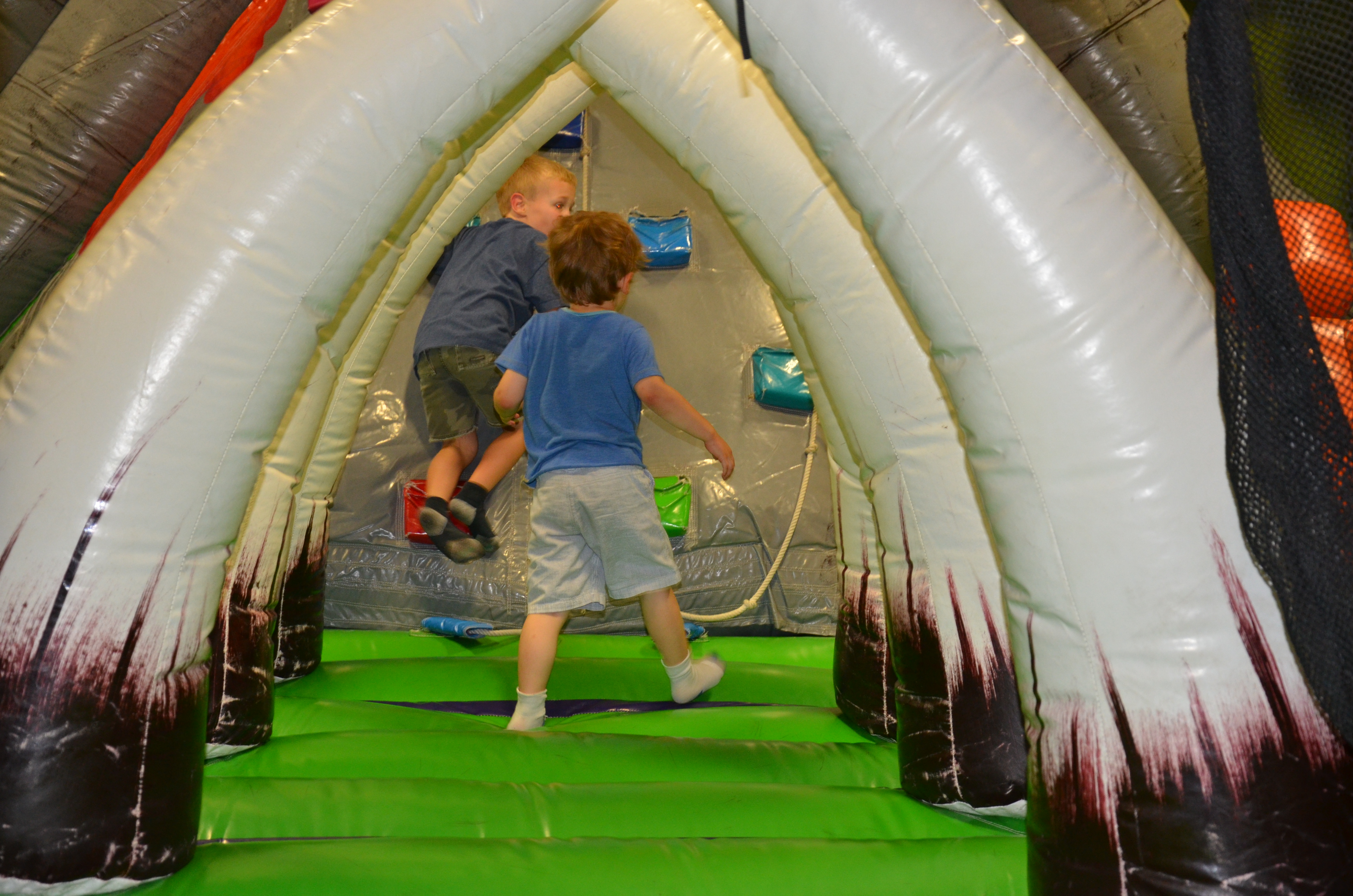
Martin exploring some bouncy-house territory.

Martin taking a climb. That´s the type of big boy he is.

Developmental Delays

Martin and I are in Texas, visiting my parents. Previous visits here brought Martin unmitigated happiness, as he basked in Grandma and Grandpa’s attention and enjoyed school-free all-day playtime. This trip has been different. Almost as soon as we arrived he became moody and crabby—and asked to go home.

After a few days I realized that Martin has matured, socially. He misses his little friends and interacting with other kids.

I decided to take him to a toddler playgroup sponsored by the church I attend when in Texas.

I didn’t know any of the families attending, so I faced the usual question: What explanation do I give?

I’ve admitted already that I hide Martin’s autism, constantly. My blog is anonymous, and Adrian and I choose not to share Martin’s condition.

The playgroup presented more challenge than usual. We were there specifically to spend time with other toddlers, all of whom were neurotypical (at least as far as I could tell). We were strangers asking to be welcomed. And the differences were bound to show.

What to do, what to do?

Martin, who is about to turn four, was the oldest child there. The next-oldest was a boy almost three, the son of the playgroup’s coordinator. After some brief introductions, I approached that boy’s mother and said:

“Thanks so much for having us. My son has some speech and language delays, so socially, I guess, he is probably right about where your son is.”

That was it.

No hiding, no blaming Martin’s quirks on tiredness, or on speaking Spanish better than English, or on being shy. And no reference to the A-word. I said he has “some speech and language delays” and left it at that.

We spent 90 minutes at the playgroup, and Martin did nothing to indicate that his issues went beyond “some speech and language delays.” He was recalcitrant, to be sure, but neither oblivious to the other kids nor obviously ASD symptomatic. He made eye contact, tried a variety of activities, and spoke to the adults. No tantrums erupted. When I had to leave to visit the restroom, I asked Martin whether he needed to join me. He considered, then responded, “No. I want to stay here.”

Martin’s conduct at the playgroup, along with my choice of introductions, got me pondering a conversation I had weeks ago with his Track Two doctor. The topic was whether the A-word still applies to Martin. Autism, as I understand the condition, is defined by symptoms, not by causes. If a person displays enough of the symptoms, to enough of an extent, then s/he is classified as on the spectrum.

If Martin no longer displays many symptoms, and the ones still present (like repeating words and questions) are infrequent, does he still have autism? Was my statement—“some speech and language delays”—accurate, even if we are still battling the underlying causes of autism?

I don’t know the answer, of course.

But I’m over the moon just to be asking the question.

Crying Under Control. Discipline, Not So Much

When Martin launches a crying fit—usually because he doesn’t want to do whatever we’re about to do, like eat dinner, or put on clothes—I kneel, hold his hands in my left hand, raise my right index finger a few inches from his face, assume a stern expression, and look directly into his eyes, even if he avoids mine.

The desired effect of this is that, after a few seconds, Martin will say, “No crying,” sniffle, and regain control. The method succeeds in about 60% of tantrums.

If sternly raising my finger fails, then I direct Martin to the “crying spot.” At home, the crying spot is one end of our sofa. Anywhere else, the crying spot is wherever I indicate. (“That bench is a crying spot. Do you need to sit in the crying spot?”) Either the threat of the crying stop suffices to stanch the tears, or Martin sits (remarkably, he stays put) until he’s calmed down.

This method has tamed Martin’s tantrums. So yay! Yay for me and Martin.

Then there is discipline, which is a decided boo! Boo for me and Martin.

I have yet to find an effective way to discipline Martin. I use time-outs, of course, and they accomplish nada. (Of course?) Martin perches on the stair landing, our designated time-out spot, until the kitchen timer sounds, then leaps up, yells “Sorry!”, and goes about his business—his business being, often, to repeat whatever behavior just got him in time-out.

Of particular frustration is that Martin still lacks strong ability to read faces and emotions. I have trouble conveying genuine anger to him.

On our latest trip to Chicago, Martin and I pulled into a Whole Foods Market to buy food supplies. (We stay in a hotel “suite,” which offers a kitchenette where I prepare simple meals.) Martin, who was tired, rode in the cart. He asked to hold the ghee I selected.

“Be careful to hold on tight,” I said as I handed him the ghee. “That jar is glass. It will break if it falls.”

Martin needed a few reminders on that point. Nevertheless, we finished shopping and paid without incident. Back at the hotel, I unloaded the groceries onto the counter and informed Martin that we would head to his doctor’s as soon as I went potty.

I was doing just that when I heard a smash from the kitchenette.

Martin materialized in the bathroom doorway, smiling. “It fell,” he said.

What ‘fell’?”

He giggled and scampered away. I finished up and within seconds was yelling—

No! No way. Get away from there. Now!

—as I seized Martin under the arms and yanked his stocking feet from a pile of ghee-slicked glass shards. The evidence was indisputable: Martin had taken the ghee jar from the center of the counter and dropped it onto the tile floor. At the least. More likely still, Martin had thrown the jar.

I was furious. I marched Martin directly to the sofa for a time out. He lolled merrily there whilst I tried to use paper towels gather glass and ghee, and then he accompanied me to the front desk, where I sheepishly requested that our freshly cleaned kitchenette be re-cleaned. He evinced no remorse. To the contrary, notwithstanding my scolding, he appeared downright gleeful.

Readers, if you have suggestions, on how I might get Maritn to understand when he’s in trouble—please, send them.

For my part, I’ll try to keep perspective and focus on Martin’s testing limits, which I understand is a positive and natural developmental stage (unlike, say, misreading emotions). The next day I recounted the ghee incident to a good friend, also mother to a toddler.

My friend laughed at me.

“Well,” she said, “you’re the one who wanted neurotypicality.”

Hi!

Not a very happy post yesterday, “Bad Day. My Bad.” Sorry about that. Indulge me to add that it’s Sunday again, and today has not been much better than what I described in that post, although I’m pleased to report that at least I managed the behaviors more skillfully. I’m noticing a weekend pattern—bad night Friday, drowsy yet agreeable Saturday, killer Sunday—that may be linked to a new therapy we’re doing.

More on that later. This evening, let’s celebrate.

Wednesday this week I strolled a sidewalk with Martin and his friend, en route to a neighborhood playground. Martin’s friend, despite some behavioral issues, is verbally much more advanced than Martin. He and I were engaged in conversation, which momentarily diverted my attention from Martin.

How did Martin use the freedom? He approached a girl stopped on a bicycle and called out “Hi!”

Let’s break that down. Martin observed his surroundings, was aware enough to spot a child, decided to engage that child, and spoke in a clear and appropriate manner. He even paused a bit and waited for a response.

Another first, this whole activity package. Only this one time have I seen Martin, unprompted, initiate such interaction with a stranger.

Perhaps he won’t do so again for months to come.

But he will do so again sometime. And then again. And again and again. And then another novelty will become commonplace, and we’ll be one step closer to typicality.

And the girl stopped on the bicycle? Alas, she did not provide the response Martin had sought. She was older, perhaps seven. She turned up her nose and pedaled away, ignoring Martin’s overture.

I suppose we can’t expect the whole world to join us on our recovery journey.

Sorry for the poor picture quality; I couldn’t resist this mobile-phone photo of Martin “helping” his grandmother with the gardening.