Defiance

The post titled “Guilt” was about me—my guilt. This post concerns Martin. Specifically, his unrelenting, unabashed defiance.

It has come to my attention that a child recovering from autism passes through phases of childhood on a delayed basis. For example, he might suddenly, at three years old, become fascinated with toys designed for an 18-month-old, either because that’s the point his development now has reached, or because he needs to return to some stage he missed.

Martin’s homotoxicologist, at the same time, has warned me that we need to expect some emotions during different phases of recovery, as toxins pass out of Martin’s system. Those emotions include anger, anxiety, vivacity, and—defiance.

I’m a first-time parent. I have no inkling at what age a neurotypical child hits a defiance period. I have, by contrast, pinpointed exactly when Martin does: now.

For the last five days or so (indeed, since right about when he started to emerge from the last month’s foggy funk), Martin has resisted everything. He won’t sit on the potty, which is usually his No. 1 pastime. If I suggest the shark pajamas, he wants the dinosaur pajamas, or the skateboarding-monkey pajamas, or the dogs-in-cars pajamas, or anything except the shark pajamas. He rebels against wearing pants. Pants! This morning he metamorphosed into a rabid hyena when I suggested that he have a bite of his favorite muffin.

The instant I managed to wedge a morsel into his mouth, the hyena fled and Martin returned, eager to inhale the rest of the muffin. Thanks, kiddo.

Martin’s therapists find this defiance development most exciting. “He’s really showing a greater sense of self!” “So encouraging, how he’s trying to assert individuality and parental separation.”

We live in a neighborhood with several private preparatory schools. (I’m not worried about giving too much identifying information, because “several private preparatory schools” describes 92.47% of neighborhoods in the five boroughs.) Earlier this year I found it hard to see teenagers from these schools hanging out in the deli, tossing a football, gallivanting the sidewalks, doing whatever teenagers do. “Oh,” I would think, “you think you’re sooooo special, just because you’re neurotypical. Big deal.” I was misplacing anger on kids who never had to struggle the way mine does.

Witnessing Martin’s nascent recovery brought me to a different place. The anger dissipated into something more like anticipation. Ten years from now, when Martin has become a hostile 13-year-old who rejects his parents in favor of friends, I’ll be able to relish the moment. I’ll think how close we came to never having a self-centered little jerk around the house, and how relieved I am that we managed to create one.

So it also shall be now with defiance. When Martin is tearing, pants-less, through the living room shouting No! No! No! at full volume—even though I haven’t asked him to do anything—I shall wallow in joy that we have reached a “greater sense of self” marked by “individuality and parental separation.” I shall celebrate reaching this milestone, belated or no.

I shall, I shall. I … promise … I … shall.

Saturday. Doctor, Therapist, Farm

Until August, Martin attended school just for two hours per weekday. His new school runs more than five hours per weekday, with a decent commute on either end, to boot. Participating in CPSE also carries family responsibilities. We can’t willy-nilly yank Martin out of school, or decide that he’ll skip a day.

As a result, we now concentrate doctor visits and private therapies, when possible, on the weekends. We try to make family fun out of shuttling from one appointment to the next.

Today Martin woke around 7:45 a.m. (an extra 45 minutes’ sleep from school days). He and Adrian completed some RDI exercises while I assembled their weekend breakfast. Martin got squash “French fries” with kelp flakes and one duck egg fried in hemp oil with minced cilantro. Adrian got the same, but substituting a chicken egg and adding a slice of whole-wheat toast.

It was a lazy morning, and despite the early start we managed to leave late for our 10:30 a.m. meeting with Dr. Ingels, the allergist, near Union Square. Because we were setting out for the day, we took the car, which of course made us even later, our route blocked by firemen using their truck and ladder to remove their stationhouse’s window-unit air conditioners, and then by a moving crew marching across 23rd Street with mattresses. A bunch of mattresses. Dr. Ingels pardoned the untimely arrival, and we enjoyed a routine visit. Martin’s tolerance for malverine, piperine, and candida has increased.

From Dr. Ingels’s we headed north, to Pleasantville, for a 12:30 p.m. session with Martin’s HANDLE therapist, Katie. She is the chief proponent of accomplishing Martin’s recovery as gently as possible. We discussed ways to soften the process even more. I talked about Martin’s attention and language lagging this past month. Katie asked about Martin’s sleeping and body control, which actually (I realized) have during the same period been quite good. Attention and language are advanced functions, she reminded me. Sleep and control are building blocks.

We grabbed lunch at the Pony Express in Pleasantville and ate in the plaza by the train station. Martin had rice crackers and homemade white-bean hummus. He investigated some trees, ran to the fence to watch a train pass below, peered with interest at (but did not speak to) another little boy. Overall, he seemed better. I’m beginning so sense a return of his attention, since we reduced the Biosode from 1x dilution to 2x.

From there we moved on, even further north, to the highlight of the day (for Martin, and perhaps Adrian) and an onerous task (for me). We drove to Hemlock Hill Farm in Cortlandt. We had researched farms on the internet in search of one that was organic and came close to meeting my ethical standards. We need some meat.

Yes. Meat. We’ve decided to feed Martin limited amounts of meet, and see if it augments his recovery. The choice has been weighing heavily on me these two weeks or so, and I needed to have it over with.

So off we went to Hemlock Hill Farm. Adrian took Martin to wander among the chickens and geese. I entered the little shop the farm maintains, more or less a concrete room with refrigerated glass display counter, freezer, shelving unit, and a few display bins. A man behind the counter asked if he could help me.

“I need—some meat.”

“What kind of meat?”

I decided honesty would be the best approach and ’fessed up that I had no idea what kind of meat. I’m a vegetarian, I explained. My son has a medical condition, and I’m going to try preparing him some meat.

The fellow was friendly and patient. He showed me packaged goat parts and which beef cuts have bone in them. (I’m supposed to put bone in the crockpot for making broth.) He explained how I could differentiate meat of animals killed on-site from that of animals killed at a USDA-certified facility in Pennsylvania. (I didn’t want any flesh from animals who were transported before slaughter. Too cruel.) I read information on what the animals eat—primarily, grass and grain also produced in Westchester County, at another farm. I asked about quail eggs. The farm has had them in the past but did not have any now.

Finally I purchased two frozen shank cuts, bone in. Cow meat. I took a dozen duck eggs, too, saving myself a trip to the farmer’s market.

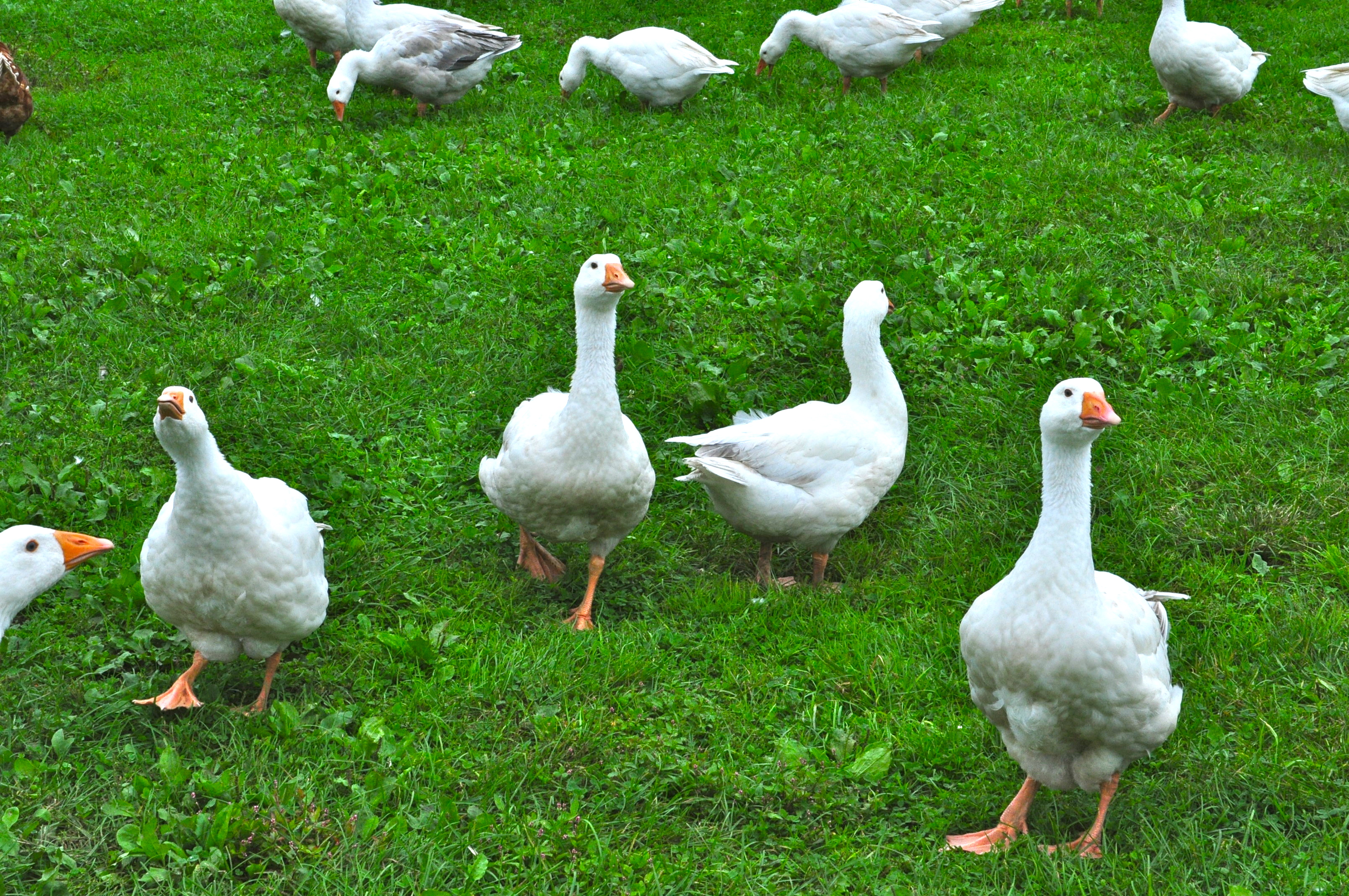
Then I went out to greet the animals. The ones still alive, anyway. The birds seemed happy and unafraid. Other than wire fences delineating the fields—ducks over there, chicken and geese this way—they have freedom to move about as they please and peck at the ground. The recent rains had left the area muddy, but I could imagine some serious dust bathing when our prodigal sun reemerges. The cows were grazing in a pasture some distance up the road, so I declined the farmer’s invitation to go meet them. She also invited me to hang around until the cows came home from pasture around 5:30 p.m. The day had already stretched long, however, and we needed to be getting back to the City.

Martin knocked off early this evening, exhausted from new HANDLE exercises and playing amongst the fowl.

My mind remains fixated on the cow meat now in my freezer. Tomorrow evening I will try to make a beef broth. I hope that I don’t fail and waste the flesh.

This new chapter will be complicated.

An Indulgent Post About Feeling Sorry for Myself

A few years ago, when Martin was still a baby and before I had any inkling that autism would strike our family, I attended a New York-area church-wide assembly. The church’s governing body stood in session. Under consideration was a resolution stating that member congregations welcome children affected by ASD and affirm their right to attend worship.

The delegates debated the resolution’s precise language. Would it say “autistic children,” or “children affected by autism spectrum disorders”? Should that be “persons” instead of “children”? Why limit it to ASD, instead of including all physical and mental challenges? Finally the nitpicking concluded, and the resolution passed overwhelmingly.

At the time, I found myself thinking, We need a resolution stating that children with autism are welcome in church services? Is that in dispute? Not self-evident?

Now that I’m parenting a child with autism, I may understand better.

Martin and I attend a cozy downtown church that reflects Manhattan sensibilities. The congregation is economically, ethnically, and socially diverse. During the week the building transforms into a soup kitchen and food pantry. It’s a boisterous place. Sunday mornings there, Martin is a rock star. Everyone greets him by name. Older children play with him; teenagers hug and squeeze him; adults engage him in whatever conversation he can handle. If Martin waits patiently after service for the pianist to finish performing, he gets to sit on the bench and strike the ivory keys himself.

During the service I try to position us surrounded by worship regulars—the people who know us. Then I can let my breath out, give Martin leeway. The regulars don’t mind when Martin comes crawling under their seats, grabbing ankles. They smile and pat his head. The regulars steer Martin gently back toward me when he wanders away. They ignore his sing-song chatting and the sound of his toy trains. They beam when he remembers their names, even if he shouts them in the middle of communion. They laugh when the pastor improvises: “I hear ya, Martin. This sermon’s been long, and I’m about to wrap it up.”

What’s much tougher is when we arrive late and end up seated with newcomers or guests, especially the kind who expect church to be solemn and silent. Martin and I enter the sanctuary with clamor approximating a blitzkrieg. We need five minutes just to settle and unpack: toys, books, napkins, containers of nut-and-seed crackers. I get self-conscious about this, if strangers are present. One week Martin’s sippy cup sprayed a couple ounces of seltzer water onto a woman we’d never seen before. She turned bright red, removed the offended blazer, and sat stiffly upright for the next hour, refusing even to look in our direction. Another week an older woman watched Martin scoot himself a few feet along the aisle floor during the sermon. Then she fixed a stern Please control your child stare on me, as if I were going to let him scoot right onto the alter. Which I considered doing. To spite her.

In times like those I see the wisdom of the resolution welcoming kids on the spectrum. Our pastor assures me unflaggingly that he wants Martin attending services, and buttresses the words with actions like finding ways to include Martin. (Martin was the little lamb in the Yuletide nativity scene. The little lamb who sobbed and tried to make off with the Baby Jesus.) But the pastor can’t be in every corner of the church at once; there will always be those who make it their business to express displeasure.

For them, I dream of carrying a copy of the assembly resolution. Of whipping it out of my purse and asking, “Have you seen this? It says that this denomination in this city welcomes children with autism, behavioral shortcomings and all. That means you will accept my son.”

And from there I imagine a magic piece of paper resolving that all of New York welcomes children with ASD. For the commuters who huff in annoyance when Martin moves too slowly on the subway stairs. For the baristas who give my spot at the coffee counter to someone else because I’ve had to chase Martin for a second. For the kids’ club that would rather refund our tuition than deal with Martin in class. Voila! A city made better.

The post really is not about ASD recovery, I suppose. It’s more about feeling sorry for myself. Forgive me the indulgence in exchange for this assurance: I really, really want to stop feeling sorry for myself. Some parents might accomplish that through emotional willpower. I, however, have the emotional willpower of a bacon-addicted puppy. Consequently, the likeliest way for me to stop feeling sorry for myself is to remove the sentimentality’s cause—to give the jerks fewer reasons to complain.

To zap the autism.

The Railroad, the Weight of the World: Meat in ASD Recovery

In last week’s post titled “Guilt,” I described a chain of events surrounding Martin’s birth: Pitocin, epidurally administered drugs, stuck baby, C-section, NICU. I alluded also to my regret over having allowed the doctors to induce labor, which I believe triggered that chain.

With several years’ hindsight, I feel that I was railroaded into allowing the induced labor. (And I did allow it; I own my decision.) I was 42 weeks pregnant. From my perspective, Martin being two weeks late raised no red flags. Thirty-five years earlier, I myself spent an extra few weeks in the womb, and my instinct now said Martin was not ready to be born. But my doctor asserted, and a second doctor confirmed, that letting the pregnancy continue could only endanger Martin, with no potential upside. Plus, my doctor said, by inducing labor we could schedule the birth, for her once-weekly hospital duty.

It should not require explanation that a woman 42 weeks pregnant, who is being told that she’s risking her baby’s health, is vulnerable. I was vulnerable, and I made a decision that I believed, even at the time, to be wrong.

The mother of a young child with autism, who believes that recovery is possible and is struggling to effect that recovery, also is vulnerable. I am vulnerable, again.

And I am being faced with a choice I wish I did not have to make.

I’m a vegan. Until February, so was Martin. I’ve posted here about some of the tough decisions Adrian and I have made for Martin, regarding animal products in his diet. Since we radicalized his diet, he has started consuming fish oil, honey, ghee, and eggs (at the moment, duck and quail eggs).

Now I am being advised that, given his particular gut and digestion issues, eating meat might benefit Martin. Meat! Cows and pigs and chickens and—whatever other animals people eat, I suppose. I haven’t touched meat in more than 22 years. By this time the whole idea just strikes me as strange. I don’t want to do it, to feed flesh to Martin. At the same time, Adrian and I decided when we started this journey that we will do anything in our power to recover our son. Anything. (“If Martin needs to drink the blood of the Dalai Lama to get better,” I told Adrian one night, “we’re catching the next flight to India, knife in hand.”) Which means that if cows and pigs and chickens may help Martin, I can’t rule them out.

Let me be clear about this: I am not being railroaded into feeding Martin meat. The Track Two recovery team we work with is not the same as the doctors at Martin’s birth. These professionals take time, consider our family’s ethics and preferences, and facilitate our decisions, instead of strong-arming us into their decisions. No one has even framed the meat issue except with respect. Nevertheless, my own vulnerability when it comes to Martin’s recovery leads me to feel attacked. Feeding him meat means compromising a long-held stance. Denying him meat means bypassing a possible avenue to recovery.

Or does it? We’ve made no decision yet. Adrian and I are still investigating, asking questions. If a vegan diet is generally healthiest, what is it about Martin’s body that might make meat a better choice for him? Would it lead to more complete recovery, or faster recovery, or just easier recovery? (I suspect that most parents recovering their children don’t spend hours each week balancing proteins, as I do with Martin’s gluten- and soy- and casein– and meat- and most-other-things-free diet. Chicken breast every dinner would be a heckuva lot easier.) How much meat are we talking about, and what kinds? For how long? How would we know if it’s helping?

I hope to commit to a path soon, one way or the other. I’m way too worked up over this issue.

In the event we do decide to feed Martin meat, please don’t bother combing the blog for meat-based ASD recovery recipes. I’ve been a vegetarian all my adult life, which means I’ve never cooked animal flesh. Seriously, I have no idea how. When we added eggs to Martin’s diet, I had to ask a friend how to hard-boil one. Goodness only knows what will happen if I end up with a hunk of cow parts in my hands.

Back on the topic of Martin’s birth: By the end of the events that began with induced labor, even as I was being stitched up from the C-section, I had wits enough to comprehend that this was not the entry into the world my son needed.

When the doctors announced that, based on my fever and despite Martin’s Apgar score of 9, they were removing him to the NICU, I mustered my strength and called from the operating table, “No, no, that’s not necessary. He’s fine. Adrian, get him back!”

Adrian confronted the doctors, said we did not want our son taken away.

Their reply was as knee-jerk as it was decisive: In the event we refused to surrender Martin for the treatment they believed best, the Administration for Children’s Services would be contacted.

And my son was gone.

Which, I suppose, is another reason still why this blog is anonymous. I’d like to avoid any more authority figures ready to impose their will on my family.

On the other hand, deciding for myself can feel like the weight of the world.

ASD Recovery Recipe: Bean and Almond Soup

My quest for varied and nutritious recipes that meet Martin’s dietary requirements has led me to some cookbooks thick with dust on my kitchen shelves. I adapted this dish from The Vegetarian Resource Group‘s Vegan Handbook, a book I acquired a decade or so ago and hardly have cracked since. I made the soup for dinner tonight. It met the Martin approval test.

1/2 cup navy beans, soaked overnight
1 cup almond flour
2 parsnips, peeled and diced
1/4-1/2 cup minced cilantro
1 tsp cumin
1/2 tsp salt, kelp flakes, or dried celery
1/4 tsp white pepper
1/4 cup fresh lemon juice

Cook the beans for an hour in six cups water. (I also tossed in a kombu frond, which I removed at the end of the hour.) Then add the rest of the ingredients except for the lemon juice and cook another half-hour, until the beans are cooked thoroughly. Use an immersion blender or a food processor to purée the soup. Add the lemon juice right before serving.

With the beans and almonds, this is like a tasty protein blast. Adding plenty of cilantro boosts mitochondrial processing.

The Village Idiot Takes a Leap of Faith (and Some Track Two Practitioners Catch Her)

The past three weeks or so, Martin has not been at his best, as I’ve written here in the blog.

Last Thursday I spoke by phone with Martin’s excellent Track Two doctor, who decided to slenderize the supplementation routine, in case we are overloading Martin’s system. She also asked a number of spot-on questions. “Has he appeared unnecessarily anxious during this time? Any increase in the teeth grinding?” My answers suggested to her that we might be experiencing some adrenal stress.

Yesterday we visited Martin’s homotoxicologist. I explained his spacey-ness and temporary backslide. The homotoxicologist said it sounded like too much Biosode, which is a homeopathic support formula Martin uses. Did his newfound symptoms by any chance correspond with an increase in Biosode?

I pondered the timing. Why, yes. I think Martin did lose his attention around the time that I moved from 2x diluting his Biosode to just 1x diluting.

The homotoxicologist ran some tests on how Martin’s systems are functioning. She pointed to a graph on the computer screen. “Look at that—seems like he’s got some adrenal stress, too.”

Just what the Track Two doctor had divined.

When we got home I shuffled through Martin’s daily log. Sure enough, on the page marked August 28, about three weeks ago, I found this entry: “NO CONCENTRATION (just a few days since Biosode increase?)–>tired, lethargic.”

When you are a parent dealing with autism recovery, it can feel like there’s a lot of hocus-pocus and guesswork swirling around you. And there probably is guesswork; autism recovery is only emerging as a field, so some degree of hit-or-miss seems inevitable. (Actually, in my understanding, hit-or-miss constitutes a substantial component of all medical practice. The Big Imposing Hospital doctors’ buckshot approach to Martin’s issues confirms that understanding.) Plus, everything is complicated. When I sit with the homotoxicologist, I listen attentively and nod like I comprehend her explanations. Really, all I’m doing is trying (1) to grasp the bare bones, enough to tell the Track Two doctor what the homotoxicologist is up to and make sure we’re all on the same page; and (2) to remember key concepts that I want to research later, to ensure my own comfort level with the process.

In other words, there is a degree to which I have to put my trust in these persons. They are the ones building this new science of recovery, and their understanding of autism and biology outpaces mine by light years. (In college, I fulfilled my core requirement with a course titled “Chemistry for Non-Science Majors.”)

Yes, everyone who visits a doctor instead of treating himself at home takes a leap of faith. But the leap is maybe somewhat more difficult to take when the very demand to have your child treated stands to refute mainstream medicine. By choosing the biomedical approach, I—the idiot in the village of science—am saying, “That whole mountain of physicians has got it wrong, and I believe I have got it right.”

Which means I’m pretty darn happy when the members of Team Martin—Track Two show that they do, indeed, know whereof they speak.

The Gentle Approach to ASD Recovery

I referred on Friday to an email that Martin’s HANDLE practitioner sent me, on the topic of gentleness. Here’s part of what she wrote:

I got a little concerned about the September 5th blog entry.  Through all of this, Gentle Enhancement still remains a truth about recovery or healing. That’s the idea that a stressed system doesn’t get stronger. It’s not popular or common sense, but it’s still true and I have learned the truth of it over and over again in my work with clients. . . .

While I think you have mastered Gentle Enhancement when it comes to Martin’s HANDLE program, sometimes homotoxicologists and DAN Doctors need to hear from a parent who understands Gentle Enhancement. Less is more, even if it’s hard to swallow for them, or goes against their training. I encourage you to insist on it, whole-heartedly. He shouldn’t have days where he’s detoxing so much he’s foggy, sick, tired, or can’t sleep. He can’t afford to lose more days neuro-developmentally, and there’s plenty of time to detox as he becomes more relaxed and integrated.

Detoxification occurs naturally for the neurotypical person because we go into “rest and digest mode.” That’s the branch of the autonomic nervous system that’s opposite of “fight or flight” mode. If Martin’s treatments are causing him stress they are doing the opposite of what they are trying to accomplish. . . .  I’m suggesting that the process needs to happen so slowly that you barely notice.  That will truly be the fastest road to recovery.

Upon receiving that email, I decided I would like to post a few words about the gentle approach to treating autism, which reminded me also that I never revealed how Martin’s first round of laser energetic detox (LED) treatments went.

Katie, the HANDLE therapist, is right. Parents who have recovered their children have likewise warned me against moving too quickly, trying to do everything at once. I use the term “treating” autism. I could write more accurately. What we’re really talking about is healing. The goal of approaching Martin’s autism biomedically, as I understand the process, is to help his body heal. We’re healing his gut, driving out yeast and then viruses and pathogens. As his digestion and gut functioning improve, so too will his neuro-functioning, and we can try to guide him back to more typical development. For now, however, his gut troubles have weakened all his systems, and we seek to make them healthy again.

What Katie means is that if we are exasperating or otherwise overtaxing Martin’s systems along the way, his body will snap out of healing mode. I feel like Martin’s excellent Track Two doctor shares this understanding. We spoke by phone last week about Martin’s current “rut,” in which he’s been tired and echolalic, without much attention. The doctor reduced Martin’s supplements and decided to run some tests regarding adrenal stress, to make sure we are not doing too much at once.

The LED, which was the most “radical” of Martin’s treatments so far (Adrian and I did extra research before proceeding), was not harsh. It involved the use of mild lasers attuned to Martin’s vibrations in order to help him expel toxins. Martin enjoyed the process tremendously, because he got to jump on a mini-trampoline to get his blood flowing. We had the LED over two days, and when it was done and he was happy and feeling fine, I thought, “This is it? This is our most radical and controversial treatment?”

The Track One doctors warned me against a biomedical or DAN! approach to Martin’s autism. These same practitioners, however, never warned me against mainstream “treatments” meant to mask autism’s symptoms—treatments such as atypical antipsychotic medications.

I am bewildered by a medical industry that would sooner give brain-altering anti-psychotic medications to a child than encourage neuro-improvement through gut healing. I am bewildered by doctors who warn me against “vitamin overdoses” without once mentioning that a child whose autism remains unresolved may face a lifetime of gut pain, of sensory overload, of frustration.

Martin’s Track Two team has approached his healing slowly, concentrating on the whole child and his overall well-being. I cannot say the same for his Track One team.

On September 5 I referred to ASD recovery as “beat[ing] the daylights out of Martin.” We were doing too much. We’ve scaled back. That’s what gentleness is all about.

Track Two Versus Track One: Those Who Say They Can Help My Son, and Those Who Say There Is No Help for Him

I’ve received inquiries about my use of the terms “Track One” and “Track Two” regarding Martin’s treatment and, especially, his doctors.

As far as I can tell, mainstream medicine maintains an official position that no cure for autism exists. There are behavioral therapies that can help a child on the spectrum cope with his disorder, and there are medications that mask symptoms, but research has found no effective treatment for the root cause, it is said.

After we received Martin’s diagnosis, almost a year ago, Adrian and I took him to what I refer to in this blog as the Big Imposing Hospital, a formidable New York-area institution with a good reputation for treating ASD—although I’m no longer sure what “treating” means in this context; “diagnosing” might be the better word. In any event, we pursued every avenue that the Big Imposing Hospital requested. Under the auspices of the department of developmental neurology, Martin visited (at least once, and sometimes repeatedly) a geneticist; an endochrinologist; an ear, nose, and throat specialist; a gastroenterologist; a nutritionist; a dermatologist; and a child psychiatrist. This was the team I now call “Track One.” Before Martin was diagnosed with autism, when we were trying to get to the bottom of his inability to settle down and sleep, he also saw a specialist in pediatric sleep disorders at the Big Imposing Hospital, who misdiagnosed him with “restless leg syndrome” and prescribed iron supplements that stained his teeth.

As we began to investigate ASD recovery, we found ourselves faced with a choice. On the one hand, we had Track One, an expensive high-profile team at the Big Imposing Hospital telling us that, beyond referrals to behavioral therapy and information for us to understand ASD, they could offer nothing to help our son. On the other hand, we had Track Two, a single doctor and collection of other professionals saying, yes, we have helped children recover, and we’ll do what we can for Martin.

The choice was not as clear as it should have been. I was skeptical. As I’ve mentioned before, in this blog, it’s hard to believe that mainstream medicine could be suppressing the fact that a devastating (yes, devastating) and increasingly common condition is treatable. So I did what a skeptical person does. I asked for references. I talked to other parents. I read whatever articles I could find. And then I compromised between the two positions. Adrian and I decided to pursue Track Two, i.e., biomedical recovery, but not to abandon Track One, i.e., to continue following the recommendations of the Big Imposing Hospital—other than the recommendation not to go anywhere near a Track Two doctor.

Every Big Imposing Hospital doctor we asked told us that seeing a DAN! practitioner would be a waste of time, and potentially harmful to Martin. I took careful notes on what they said could be dangerous: vitamin B overdoses, intravenous ketology, hyperbaric chambers. Once we had started biomedical recovery (and started to see results), I gave the Track One doctors a stock response, along these lines: “My husband and I have spoken with enough families who have recovered their children that we now believe research being done in labs and studies simply has not kept up with what’s going on in the field. We would never expose our son to treatments we believe might harm him, and we research each treatment thoroughly and appropriately before proceeding.”

For the most part, once they saw I was determined, and informed, the Track One doctors stopped arguing against biomedical intervention. Some dropped the subject. Others changed their tone and spoke about “exciting possibilities” or “forging a common path” with DAN! practitioners. One doctor at the Big Imposing Hospital told me, “I’m a scientist. I require results. The results are not there to support autism recovery.” When I offered my position about studies lagging behind field work, this doctor rose from her chair, shut the door to her office, lowered her voice, and said, “Again, I’m a scientist. But I have had enough parents come through here whose children have improved with dietary changes and supplementation that I can no longer honestly say autism recovery is not possible.” Then she opened the door again.

From that moment, I’ve wondered what else mainstream practitioners are hiding, and why. As Martin has made more and more progress with his Track Two team, Track One has faded into the background for us. I’m just not sure what they can offer at this point.

(Moreover, Martin’s excellent Track Two doctor simply seems to care more about him than anyone we met at the Big Imposing Hospital. But that’s a topic for another post.)

On top of all the Track One and Track Two, Martin still sees his regular ol’ pediatrician, who’s been his doctor all along. When I told her that we were pursuing biomedical treatment of his autism (and provided all the details, supplements, and so forth), she said, “I don’t know much about it, only what I’ve heard at conferences, which is that it doesn’t work.”

I started to give my stock response. The pediatrician interrupted me with a smile. “I’ve heard that it doesn’t work,” she said. “But I’m happy to be educated otherwise.”

Quote of the Last Six Days, and an Associated Analogy to a Tree

Six days have passed since I began my occasional series of helpful quotes, so this post I shall declare neither the quote of the day nor the quote of the week, but the quote of the last six days.

These are lyrics from “Shaking the Tree,” which I believe first was released on Youssou N’Dour’s 1989 album The Lion and then became a sort of title track for Peter Gabriel’s 1990 compilation Shaking the Tree: Sixteen Golden Greats.

You had to be so strong
And you do nothing wrong
Nothing wrong at all
We’re gonna to break it down
We have to shake it down
Shake it all around.

If you know the song and Peter Gabriel’s music, you may be thinking, hey, that song is about women’s empowerment, not autism recovery. As far as I know, that’s correct. It’s about women’s empowerment, and the tree is male oppression. Nevertheless, I’m going to say it can be useful in the struggle against autism.

Allow me to confess that, although the sun has broken the clouds occasionally (church last weekend was a nice shine), this has been a crap few weeks. Really. I’m putting on a brave face, but things are not going well. Martin has no attention. His eye contact is off. He’s echolalic. He’s been shuffling his feet instead of heel-to-toe walking. And he’s exhausted all the time.

Several days ago, Martin’s HANDLE therapist, Katie, sent me an email responding to the September 5 post in which I described recovery as “beat[ing] the daylights out of Martin.” Katie said she was concerned that we may be trying too much at once with Martin, instead of approaching his recovery gently, which is the best path to healing. Her concern is valid; indeed, I plan to post later this weekend on the topic of gentleness. Fortunately, Martin’s excellent Track Two doctor also agrees that moving slowly is most effective. Just yesterday she and I consulted about the crap time we’re having, and she tweaked Martin’s supplementation/detoxification regimen—for the time being, doing less.

Which brings us to Peter Gabriel and the tree. “We’re gonna to break it down / We have to shake it down.” In this analogy, autism is the tree, and Martin is the garden that’s been invaded. I aspire to get rid of the tree. One cannot simply push over something so massive and entrenched as a tree. Hacking away with an axe creates problems, too: It leaves the stump and the roots, still sucking nutrients from the soil and hogging all the other plants’ space. No, to succeed we have to shake it down.

How does shaking down a tree work? By building momentum, offsetting the push to against the push fro and thereby moving with ever more power. Eventually the tree will topple, extracting its own roots from the ground. But, disrupt the side-to-side motion—by deviating from the straight path, for example, or failing to keep pushing at the right moment—and the process stops. The tree settles back into place, trunk vertical.

That may be what has happened these past few weeks. Something has disrupted the push-pull toward recovery. Perhaps we are doing too much, as Katie suggested, thrusting one direction without respecting the need to rock the tree. Or perhaps some supplement or exercise or change in routine doesn’t agree with Martin and has disrupted the motion. Whatever it is, autism seems to have settled back into place, plunk in the middle of the lush garden that is Martin.

It can feel, when this happens, like we’re starting from scratch. True, we do have to start anew, in terms of shaking that tree again. But although shaking it down may still take a while, it gets easier every time we start, because the roots have already been loosed.

Autism may think it’s settled back in, but it no longer has the same hold on Martin. I’ve seen the progress we’ve made. I’ve witnessed where we were before this slump. I know we’re getting to the core.

The tree is vulnerable.

So it’s been a crap few weeks. It’s time to muster my determination and start shaking again, steadily, persistently, yet gently. After all, the soil in which this tree grows is my son. I’d like to keep it as intact as possible.

ASD Recovery Recipe: Dehydrated Squash Chip Snack

This recipe comes, with very minor modification, from a book called Kristen Suzanne’s Easy Raw Vegan Dehydrating. The chips are easy to make and yummy. If you pack them up for school or to travel, include an unbleached paper towel in the container to help soak up any extra oil and keep them from getting soggy.

4 medium zucchini or yellow summer squash
1/4 cup oil (pumpkin seed oil gives a nice taste but also tints the chips slightly green!)
2 tbsps fresh lemon or lime juice
2 cloves garlic, pressed (right now, I substitute white pepper and dehydrated celery)
1/4 tsp cumin
1/2 tsp salt or kelp flakes
dash of cayenne (right now, I omit)
dash of paprika (right now, I omit)
1/2 cup finely minced herbs of choice

Mix all ingredients other than squash in a large bowl and set aside. Wash the outside of the squash well. Without peeling them, slice the squash into 1/8″ discs (a mandoline slicer works well). Stir the squash discs into the other ingredients, being sure to coat each piece well. Remove the discs one-by-one, shaking off any excess oil, and transfer to a dehydrator. Dehydrate on medium heat for 14-24 hours, to desired crispiness.

Keep away from adults. These are addictive.