In Praise of the Wonder Kid

Right around the time Adrian and I were considering a second child, Martin was diagnosed with autism, and we put off the decision in order to focus on getting Martin help. The years since diagnosis have been therapies and special diets and supplements and doctor visits and too little sleep. I was almost 36 years old when Martin was born. By the time Adrian and I cleared our heads enough to think again about a second child, we would have been looking at a 40+ pregnancy. That, combined with the increased risk of having a second child on the spectrum if you already have one, sealed the decision. Martin would remain an only child. All of our resources belong to Martin alone, for his recovery.

But alas, a typically developing sibling sure might help. A brother or sister could provide a full-time role model and, if we were lucky, a buddy to protect Martin from neighborhood cruelty, from slights and oversights and bullying.

With that in mind, allow me to sing the praises of Martin’s cousin, Mandy, who is also an only child. Mandy and Martin were born only ten weeks apart and, though they live four hours away from each other, have known each other since babyhood. They get three or four solid visits annually.

When Mandy came to our home last August—Martin had already turned five, and Mandy was about to—they were finally old enough that I thought Mandy might need some explanation of why Martin seems different. Immediately, I found an opportunity to address the issue: Mandy and her mother (my younger sister) arrived after Martin had gone to sleep for the night, Martin’s regular sitter was at the house, and Mandy was hungry, so I volunteered to take them out for pizza.

Ah, to have a kid who can go out for pizza!

“Hey Mandy,” I said. We were sitting in the pizzeria waiting for our order. “Do you know how to read?”

I knew she didn’t.

“Well, guess what?” I asked. I dragged my voice, to indicate that something amazing was coming. “Martin already knows how to read!” Indeed, Martin started reading young. He read fluently (comprehension is a separate issue) by age four-and-a-half.

Mandy opened her mouth in astonishment and gasped toward her mother.

Ah, to have a kid who gasps toward mom when surprised!

I went in for the kill. “But, Mandy, you know what? You are very good at talking”—she is—“and Martin is not good at talking at all. That’s how it is: Some kids are better at talking, and other kids are better at reading.”

I wasn’t sure this little speech would work.

It did.

Mandy and Martin’s visit that August was delightful. Mandy, who is naturally bossy, in the best way possible, forced Martin to interact constantly, and she decided to talk for both of them. Upon Mandy’s request, and Martin’s acquiescence, they both slept in the big bed in our guest room, and I knew when they woke up because I heard the giggling start. One morning as I stood in the kitchen, they walked through. Mandy had Martin’s arm over her shoulder and was pulling him along by the wrist as she announced, “We decided to go outside.” Martin didn’t mind Mandy’s commanding spirit. It brought out his best. He responded to her every whim, including when she thrust paper upon book in front of him and demanded, “Read this for me!”

The big test came when Mandy had been with us almost a week. Martin had a hippotherapy session, and I brought Mandy along. While Martin was riding, Mandy befriended the farm proprietor’s seven-year-old granddaughter. I could tell that Mandy was impressed to be playing with an older girl, and I thought, This is it. She’s not going to be so eager to hang around Martin when this big kid was in the picture. Maybe she’ll even be embarrassed by her awkward cousin.

Curse me for that lack of faith. As soon as she saw Martin dismount the horse, Mandy scampered over, grabbed his wrist, and ordered him to come play. Then she tugged Martin to the seven-year-old and said, “This is my cousin Martin!”

Mandy came to visit again this February, when my sister and I took the two kids to see The Lion King on Broadway. Saturday mornings Martin usually goes to the Equinox gym with Adrian and plays in the kids’ club there while Adrian works out. The Saturday morning of Mandy’s visit, Adrian volunteered to take both kids to the kids’ club.

After they returned, I asked Adrian whether Mandy had still wanted to play with Martin at the kids’ club, or whether, when in a crowd, she had gravitated to the typically developing children instead.

Adrian reported that when he came after his workout to pick the cousins up, Mandy was indeed playing with the typically developing children.

… And, Adrian said, Mandy was directing those typically developing children to make sure they let Martin play, too.

Thank you, Wonder Kid. Thank you for looking out for Martin.

Mandy and Martin on the beach, August 2013.
Mandy and Martin on the beach, August 2013.

What Comes Last

A couple years ago—hard to believe how long we’ve been at this—I lamented to Martin’s (then) biomed doctor that, while Martin’s behavior, sleep, and overall health had improved, I had not seen as much progress in his language. The doctor told me not to worry. “Language,” she said, “often comes last.”

I carried that mantra for a long time: Language comes last. When it took Martin so long to start asking questions, or to use the command form, or to pick up nuances and idioms, I thought, well, language is going to come last.

Or will it?

This year, Martin’s language is much improved. As I’ve written, his speech is not perfect. It often sounds scripted, or rote. Sometimes it seems like he’s exploring a foreign language: Unable to find the easiest or most direct way to express himself, he searches his capabilities and comes up with an unusual (original?) formulation. And his receptive language, his processing delays, still poses challenges; I might be explaining to Martin that we’re going out after lunch, only to have him melt down because he wants lunch, and the “going out” part has registered but not the “first, lunch” part. At his time, he still very much needs the intensive-language-based school program he attends.

That fact notwithstanding, Martin can speak. He speaks in sentences. He asks questions. He orders me around. When he’s not frustrated and mixing up his words, he can express himself, in a manner understood by most anyone who listens with care.

To that extent, language has come.

Language has come, and it did not come last.

Martin’s recovery has two additional, gigantic roadblocks that are not language, though language-related.

First, Martin still can’t “attend.” He doesn’t pay attention. He doesn’t listen. He talks when others are mid-sentence. Unless an activity is one he enjoys (music, eating, drawing), he shows little interest in what others are doing. And even when something does catch his attention, he doesn’t stay with it for long, except for example to stim by hitting one music key repeatedly, or to read his favorite book, The Philharmonic Gets Dressed, over and over.

Martin’s teachers have identified attending as his most significant challenge in the classroom; even with a 3:1 student-teacher ratio, he has trouble following. At home, the nanosecond attention span means it might take Martin 20 minutes to change clothes, because he gets distracted, or succumbs to boredom and starts complaining instead of dressing. It also keeps us from sharing experiences. If I say, “Oh, wow! Look at that bird!”, Martin might glance out the window, then jog away before I can comment on the bird’s color or size, or he might not look at all.

So language didn’t come last, because language has developed more than attention.

Second, Martin still has a lot of trouble socializing.

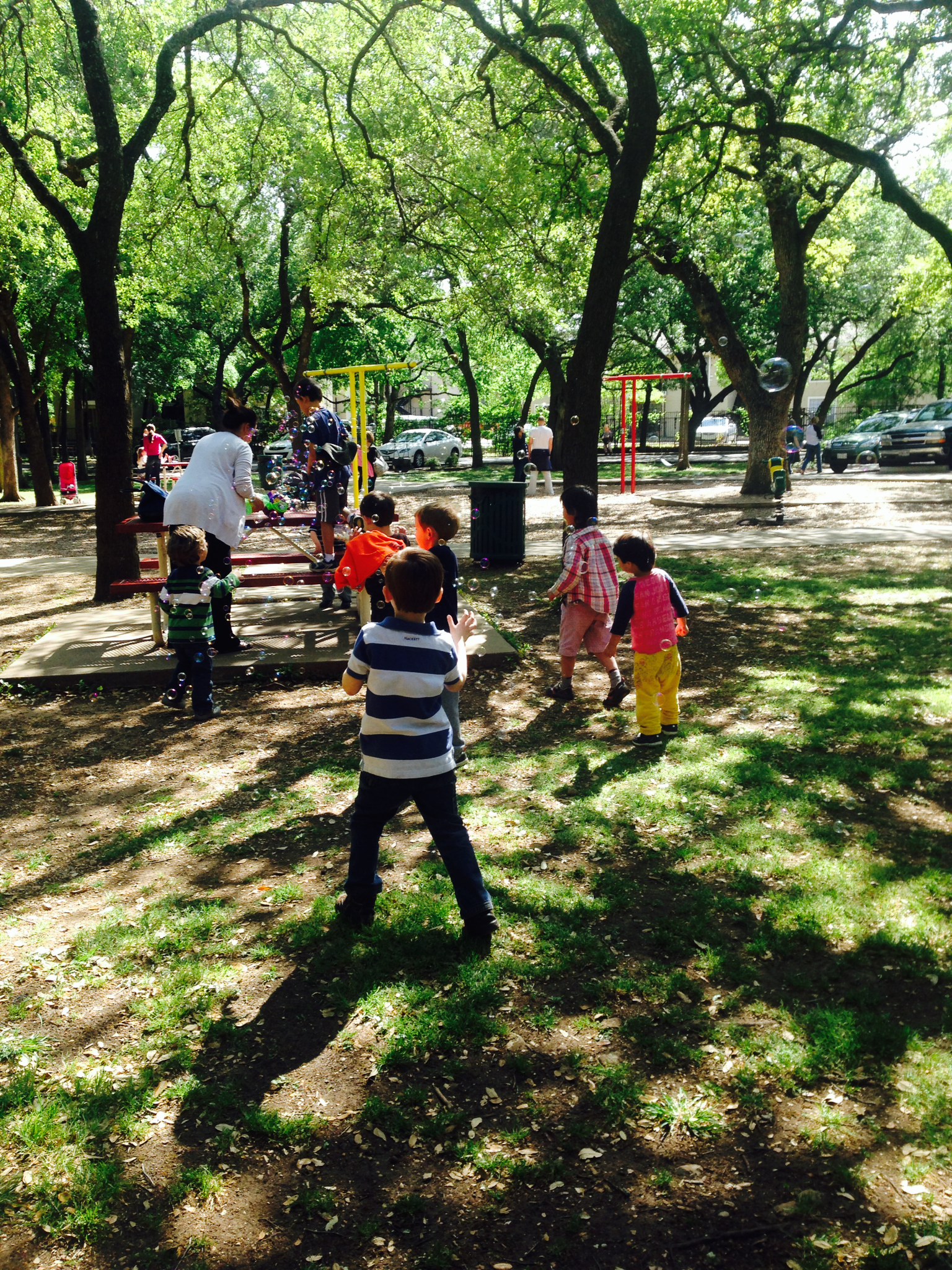
When we were in Austin around Easter, I arranged a playdate with “Stewie,” the six-year-old, typically developing son of a college friend. Martin and Stewie had never met, and Stewie was not informed in advance that Martin has challenges. We met at a crowded playground. The playdate went remarkably well. Although Martin was less interactive than an NT child would have been, he didn’t spend the playdate in his own world. Several times (some with prompting) he went to find and engage Stewie. He and Stewie stood together and gazed at an inchworm hanging on Stewie’s finger. When one family at the playground brought out a bubble pumper, Martin joined the other children, clapping his hands and chasing the bubbles. Stewie never even shot his mom that quizzical look that means, “Is there something different about this kid?”

The experience with Stewie gave me a sort of high. I texted Adrian: “Martin is having a playdate with a typically developing boy, and he’s doing FANTASTIC!”

But of course, in autism recovery, disappointments find a way to deflate any high, and four days after Martin played with Stewie, we had a much less successful playdate back in New York, with four classmates from Martin’s kindergarten. Martin attends a school for children with speech and language delays. About half the kids in his class also have autism or some other social impairment. By coincidence, none of the four boys other than Martin who attended this playdate had any social impairment. They are the social kids.

What happened was typical of what we experience when Martin attempts to play with more than one child at a time: Martin was left out. In a one-on-one situation, a playmate has few options other than to engage Martin. In a multi-kid situation, those without social impairments gravitate to each other, and away from the awkward boy.

Martin’s classmates, at the playground where we met, decided to fight dragons. They scampered about as a group, swinging imaginary axes, wielding nonexistent swords, screaming with excitement at the game they’d created.

Martin climbed on rocks and monkey bars. He went down the slide and wandered across the playground’s bridges. When I suggested that he join his classmates’ game, he approached the crowd and, using the social skills he’s been taught, ask shyly, “What are you doing?”

But the other boys were too boisterous and engaged to hear, and they ignored him.

Martin sat down, alone.

As he and I were walking to the car to return home, I asked, “How was the playdate? Did you have fun?”

My son responded, “No. I would like to do a playdate with only grown-ups.”

The next morning, Martin said he did not want to return to school. Thinking that he was experiencing end-of-spring-vacation blues, I tried cajoling him with his favorite subjects—“Do you think maybe you will have computer class today? What will you make in art class?”—and enumerating his classmates. “Do you think Christopher will be there? Are you looking forward to seeing Jack, and Quinn?”

When I finished my song-and-dance, Martin shook his head and said, “No. My friends at school don’t like me.”

Some defeats just crush your soul, don’t they?

So language didn’t come last, because language has developed more than socialization.

Which begs the question: What’s going to come last?

How will I know when we’ve reached our destination?

Martin, in the blue and white stripes, joins in bubble fun during his playdate with Stewie.

Martin, in the blue and white stripes, joins in bubble fun during his playdate with Stewie.

Support. The Supportive Kind

Friends who know I have a son with autism mean well, but sometimes, even in their effort to be supportive, they say the wrong thing.

Here is the statement I hate most:

“All kids do that.”

Now, if you’re a friend of mine, and you’ve ever said about Martin, “All kids do that,” please do not worry. I know your heart is in the right place. I know you want to help. And this post is not directed at you, or at anyone in particular. Believe me, I’ve heard, “All kids do that,” from almost everyone within the limited circle that knows about Martin’s diagnosis.

I know from reading other blogs that I’m not the only parent who detests “All kids do that.” When someone says, “All kids do that,” then regardless of what that person means to convey, I hear one of two things:

1.      “I know Martin has autism and all, but don’t you think you’re going overboard? Maybe you’re a little hysterical about the whole thing, or you like to complain?”

2.      “I have absolutely no inkling about the realities of your daily life with Martin.”

Yes, I know that even neurotypical kids “have a favorite color.” On the other hand, if you board a subway and find that all the yellow seats are taken, can you expect your neurotypical kid to panic and run out the closing subway doors, without a care whether you are following? If your kid says the moon on his pajama top is yellow, and you suggest it might look more blue, do you assume bedtime will be delayed an hour while he howls inconsolably? Have you ever had to purchase napkins in different colors so that your family could practice sharing the yellows without a meltdown?

And I know that even neurotypical kids “tend to repeat themselves.” On the other hand, unless you live with autism, I am guessing that your kid has never lost awareness and stared into the distance, uttering some combination of words scores of times. I am guessing that your kid does not continue repeating even when he’s alone in a room, his words like a proverbial tree falling in the woods, and then falling again, and then again, and again. I am guessing that your kid’s brain does not get stuck in a groove so deep that he becomes physically unable to cease perseverating. There are times when Martin’s need to repeat himself—“Our President’s name is Obama. O-B-A-M-A. The last letter is A. Obama is the President. Do you know how to spell that? The last letter is A. Our President’s name is Obama. Do you know what our President’s name is? It’s Obama.”—reaches such intensity that, if I were to duct-tape shut his mouth, his arm or leg would have to flail in compensation until he could speak again.

(Don’t panic, dear readers. I’ve never tried any such thing. I just know it’s true.)

“All kids” do a lot of things. But they don’t do them like a kid on the spectrum does.

So what does help? What should someone say, if not “All kids do that”?

A friend of mine (let’s call him Ted) once lost several family members in a house fire. Ted and I lived more than a thousand miles apart at the time, so I wasn’t present for the immediate aftermath or the funeral. A few weeks later, when it was time for me to call, I asked another friend, Deb, what I should say to Ted. Deb is a minister, she’s wise, and her own father had died recently. She counseled (I’m paraphrasing):

“Say you’re sorry about the loss, and then talk about anything else. Follow his lead. When you’re grieving, distraction is a blessing.”

I called Ted and said I was so sorry for his loss and wished we lived closer together. He responded by asking how I was doing, and the conversation moved naturally to catching up on each other’s latest activities. We talked jobs, law (two attorneys, boring!), mutual acquaintances. Once, after a pause in the conversation, Ted said, “You know, they were so close to the door when they collapsed. It was the smoke. They almost made it out,” and I knew that Deb had been right. Ted’s mind was so consumed with loss that the twenty minutes we’d just spent talking about other topics were like a vacation for him. And immediately after saying, “They almost made it out,” Ted asked if I’d seen some movie over the summer. The house fire did not come up again.

When you encounter me, know that for at least 23 of the preceding 24 hours, I have had almost nothing on my mind except autism and recovery. I’ve been giving pills, cooking special foods, corresponding with parents on-line, reading about the latest treatments, cleaning air purifiers, mixing clay baths, filtering water, completing HANDLE exercises and concocting RDI games, fighting for a special-education placement, juggling therapy appointments, navigating social-work bureaucracy, keeping Martin’s doctor up to date, and worrying about what vaccinations are doing to our children.

You can ask me how Martin is doing. I will respond, “We have our ups and downs,” maybe add one or two recent achievements, and then move on. Here are suggested topics I would probably rather discuss than Martin’s autism:

•            How are the Rangers play-off chances looking? Will Lundqvist win the Vezina a second time?

•            Why is it still winter at the end of April?

•            Is the new Jackie Robinson movie melodramatic? Does melodrama ruin a good story? Did it ruin Argo?

•            Who is going to be the next mayor of New York City?

•            WNYC reported that 70% of home sales in Brownstone Brooklyn are all-cash deals right now. Seriously, 70%?

•            Is it okay to put a cat on Prozac?

You get the idea. There are a million things to talk about that are not autism.

And if you really, really want to talk about autism, say you support us. Adrian’s mother once set the gold standard in that regard. Adrian was visiting his country of origin and staying in the family home. One evening he and his parents and siblings crowded around a computer to Skype with me and Martin back here in the States. As it happened, that day Martin was at his worst. He would not sit with me or look at the computer. He failed to respond to any questions, or even acknowledge his father and grandparents and aunts and uncle on the screen. After 30 seconds I gave up and released Martin, who jogged around the room, yelling gibberish.

It was a painful moment for me, and though he didn’t say anything, I could tell it was painful for Adrian, too.

Evidently, so could Adrian’s mother.

After we finished with Skype, Adrian went out to dinner with friends. When he returned to the family home that evening, everyone else was in bed. On the kitchen counter was a note from his mother. Loosely translated:

“Martin will get better. I believe in what you’re doing. Love from Mamá.”

Next to the note was a plate with a cookie.

That’s all we really want, any of us, right?

A little faith, and a cookie.

Because They Know

If you’ve been reading this blog for a while, you know about my love-hate relationship with social media. Something about operating on-line makes people thoughtless. Combine that with my hyper-sensitivity on autism and child issues—the result is potential meltdown every time I log on.

One particularly problematic area for me is constant Facebook updates about amazing children, written in some superficially deprecating fashion. “No other kid in Caleb’s figure-skating lessons can even axel. Can’t believe I can’t afford anything better for a kid who already lands a lutz!” Or: “I really love Woody’s new teacher. Look at this certificate she made him for getting the highest reading scores in the class.” Or: “Clementine is district chess champion. I feel a little less like I’m depriving her by not being a soccer mom.”

I get bitter.

Strangely, it is only the amazing-kid updates of distant friends that bother me. I like reading when my close friends—the kind of friends I visit, and telephone—post about their children.

I’ve come up with two reasons for the difference.

First: My close friends don’t do the superficially self-deprecating thing. They just brag. I’m not sure why that’s less offensive, but it is.

Second: They know about Martin.

When it comes to social media, I’m constrained, because we’ve chosen to keep Martin’s autism confidential. Adrian and I are careful not to post anything that makes our son appear atypically developing. We share the one picture in ten in which Martin actually looks at the camera. We write the cute things he says only when they sound like what any four-year-old might say, or else we edit to keep the gist while fixing the words. Of Martin’s true successes, I cannot boast on-line. “Martin chased a boy at the playground for, like, at least five seconds before he lost interest!” “Martin had a four-exchange conversation with his babysitter!” “In the midst of bolting down the sidewalk this afternoon, Martin turned around to see if I was following him!”

My close friends know about these successes, even if I can’t share them publicly, because they know about Martin. Last Memorial Day, as we do annually, Adrian and Martin and I got together with some of my closest girlfriends from high school. This year six families attended the gathering. The other children, all older than Martin and all typically developing, played with him as if he were their own little brother; they were patient, occasionally teasing, responsibly keeping him from trouble. From the parents I heard nothing but swooning. Martin was talking so much more than the previous year. Martin’s eye contact had improved. Martin had better command of his movement.

No strange looks to endure. Nothing to cover. Only compliments.

I felt like a million bucks.

When Martin and I visit his doctor in Chicago, we follow a two-day pattern. On day one, we fly from LaGuardia to O’Hare, rent a car, see the doctor, buy groceries at a Whole Foods Market, and check into a hotel “suite” with kitchenette, where I prepare Martin’s dinner. On day two, Martin and I eat breakfast at the hotel, return to the doctor’s office if any follow-up is necessary, then spend the afternoon at a friend’s home in Elmhurst, not far from the airport, and finally catch an evening flight back to LaGuardia. The Elmhurst friend is a high-school classmate, with a toddler of her own, and a most considerate hostess who prepares some fantastic vegan lunch for me while I co-opt half her kitchen to cook for Martin.

Several months ago, I awoke sick on day two of a Chicago trip. My head was pounding, and I was nauseated. A hot shower didn’t help. Nor coffee. Nor dry toast that I ate with my head resting in my palm. And poor Martin—I had no one to help out, and with no energy or patience, I was content just to get him and our things moved somehow to the rental car.

Almost the moment that I settled onto my friend’s sofa in Elmhurst, my situation began to change. My shoulders relaxed. The headache evaporated. It had been tension, of course. I’d gone to bed with a slight cramp in my neck, and made myself sick by worrying all night about what I would do if I got sick and had no one to help with Martin. Once we arrived in Elmhurst, I knew that if necessary I could say, “I need to crash in your bed for the rest of the day. Here are Martin’s pills and food. Good luck.” And my friend would have replied, “See you tonight. Yell if you need anything.” There was no longer any need to worry, and I felt better.

That’s the way it works, with friends who know about Martin’s autism. They’ve got my back. They procure food for Martin, cook for him, ask about his needs, encourage his friendships, celebrate his successes. And so I do the same for them. It’s like we’re one big family, sharing kids. I want to hear about their amazing kids, because those kids are mine, too.

I can’t take that feeling to social networking in general.

I suppose this blog is my brag book, instead. My anonymous brag book.

Sorry about that, readers.

Not the best-quality picture! Martin was so determined to flush this airport toilet with his foot that he climbed onto the fixture to manage it. I hardly had time to whip out my smart phone and capture the moment.

Not the best-quality picture! Martin was so determined to flush this airport toilet with his foot that he climbed onto the fixture to manage it. I hardly had time to whip out my smart phone and capture the moment.

More Praise of Friends

I have eleven close girlfriends from my high-school class. “The twelve,” we call ourselves. We’ve had bumps in the road, big ones, and yet 21 years after graduation, we’re more or less intact.

And when it comes to Martin, these friends have joined the struggle in ways I could have not imagined.

It was a high-school girlfriend, an EI practitioner, who first identified Martin’s disorder as autism and got us started in the road to intervention and recovery. It was another, a chef, who recently came to stay two weeks with us when Martin started eating meat, to prepare his special meals. It is others who read this blog, who offer listening ears, who email regularly just to ask how he’s doing.

Now comes yet another debt of gratitude. A high-school friend, who still resides in my hometown, sent a Facebook message, asking after Martin and what she could do to help. I hesitated, then reminded myself that I’ve decided to accept as much help as I can get, and made a request:

“I could use some venison.”

That must have sounded strange to my friend, who knows me as a long-time vegetarian. Probably it sounds strange also to anyone who doesn’t know that, in the semi-rural area where I grew up, people hunt. A lot. Before I became a vegetarian at age 16, I ate venison by the pound. It’s so lean and protein-dense, just what we’re seeking for Martin these days. It’s also difficult to procure, in Manhattan.

My friend responded that getting venison might be tough; the economic climate right now means most folks eat all of what they shoot.

I know, I said. No expectations.

Let me see what I can do, she wrote.

A couple weeks passed. I’d nearly forgotten the request when this friend’s chat box appeared on Facebook again, to say she had venison for me, stored in the freezer on her family’s farm.

As luck would have it, one of my brothers happened to be visiting our hometown last week, and then coming down to New York City on Monday to help my mother with Martin while we travel. I dispatched this brother to meet my friend and retrieve the venison, which now is snug and secure in my freezer.

“Hand-off was a success?” I texted my friend after she met my brother. “You rock so much. Thanks a million.”

“Yup…. No prob. Hope he enjoys. Mainly spiedie meat…hope that’s ok.”

Spiedies are a dish regional to the area where I grew up. They consist of intensely marinated meat skewered alongside vegetables and grilled. I panicked, briefly, my mind on the myriad non-Martin-friendly ingredients that might be in marinade. “Is that the cut, or has it been marinated?”

“Not marinated! I believe it is the cut but not cubed.”

“That is so ultra-perfect I can’t even say,” I texted, relieved and grateful to the point of effusion. “You are the bestest.”

“Nah…just a friend.”

Your blogger, headed from Israel into the Kingdom of Jordan.

Your blogger, descending to the ruins at Petra, Kingdom of Jordan. And thinking about Martin.