I Am That Person. I Am That Mom

Social media. Ah, social media.

I made my first post about my uneasy relationship with social media five years ago, explaining why I blog anonymously. Two years ago, I posted again, bemoaning the lack of civility on-line, even among acquaintances.

I love Facebook, for the connections to old friends and my autism recovery groups. I also recognize the wisdom of keeping my mouth shut on controversial topics: Social media rarely allow for productive and thought-provoking exchange; users prefer to post dumbed-down memes and wait for comments that support their opinion.

What I need to get past, these days, is feeling personally attacked by others’ posts. Take, for example, this sketch that appeared recently on my Facebook wall:

IMG_3702

The implication? That a mother whose child eats only organic, homemade food doesn’t “live[] in the real world.” But I live in the real world. And my child eats only organic, homemade food, except for a few commercial, raw snacks and occasional meals at pre-approved restaurants.

Or how about this post?:

FullSizeRender

Indeed! It’s me! I eat seedless (organic!) grapes and complain that GMOs are unnatural! I know the difference between selective breeding and genetic modification. Selective breeding is vertical genetic transmutation within a given species. Genetic modification is transmutation of genes horizontally, across species. Totally different.

I don’t respond. Why waste thoughtfulness?

I’m sure you can imagine how I felt when a friend posted a link to an article purportedly tying a measles outbreak to “anti-vaxx” parents and asked, “Who are these medieval people???”

Me again! Not only as the parent of an immune-compromised child, but also as an attorney, I have concerns about the current vaccination regime. We’ve exempted these potent pharmaceuticals from the usual liability schemaand the safety assessment protocol lends itself to manipulation as vaccine after vaccine after vaccine is pushed onto the recommended schedule. At the same time, legislatures are seeking to move these injections from “recommended” to mandatory, i.e., to restrict even exemptions that are based on valid health concerns. The whole pharma-driven plan invites rising vaccine injury rates, and I hope to witness more Constitutionally based challenges.


The list of Facebook zingers is long. I resist the urge to respond, “I’m glad you asked. I am that person.” I resist because I will end up only frustrated, and because fighting those virtual battles can sap energy from the real task at hand, Martin’s recovery.

But as usual, I am conflicted. Many of these types of Facebook “status updates” come from acquaintances who, I think, respect me and/or my professional competence. They come from law school classmates and from co-workers, from the siblings of childhood friends and from distant relatives. If I were to argue almost any valid opinion face-to-face, they would probably take note. I might even sway them.

If I am a person who may have influence over pro-vaccine, organic-bashing lovers of genetic modification, maybe I have a responsibility to speak. Or maybe—if I speak against pro-vaccine, organic-bashing lovers of genetic modification, I will lose whatever influence I have to command.

A conundrum.

A conundrum not limited to Facebook. An older relative, for no apparent reason other than knocking a chip from my shoulder, told me he was getting a Zostavax shot against shingles. I suggested that he might want to weigh the side effects, and that Zostavax is counter-indicated for people who’ve been treated for cancer (as he has). He blew off my concerns (which was likely his intent from the moment he brought up vaccination out of the blue). He said: “I believe in science.”

Science? What did you read before reaching this decision? I can show you the studies I’ve reviewed. I understand your concerns about shingles. On the other hand . . . wait. You haven’t done any research whatsoever? You saw a commercial that said a shot would protect you, so you’re going for it, no more information necessary? Good call.

Waste of breath.

When I started this blog years ago, Martin’s biomed doctor said, approvingly: “We have parents telling everyone they know that recovery is possible, and no one listens. You’re an Ivy-League-educated lawyer who can write, and a stickler for facts. Maybe they’ll listen to you.”

Maybe they won’t.

In my blog, I speak freely, When it comes to social medial, I’m better off trying to find points of agreement. Let’s go back to “Deborah,” who “loses her s**t daily & knows every honest mother does too”:

At least I can admit that I’m an “honest mother.”
Hubby Eats

Managing Martin’s recovery has taught me more than ever about nutrition.

I love my husband, Adrian, and would like to keep him healthy.

I’m kind of a control freak.

These facts were bound to collide at some point. That’s why, except when we go out for dinner or he has a business event, I now prepare every bite of food Adrian eats.

Years ago, Adrian skipped breakfast and, during the work week, bought whatever for lunch. When he decided to manage his diet better to lose a few pounds, he still skipped breakfast but I started sending lunch to the office with him. In the beginning, I sent a sandwich of cheese, fake meat (usually processed soy), greens, and mustard or vegan mayonnaise on whole-wheat bread; two fresh fruits; and two protein snacks like nuts, or veggies and hummus, or (more) cheese and crackers.

As time went on, the bread became sprouted-seed gluten-free, the fake meat became less processed and more lentil-mushroomy, and the cheese and hummus became organic.

Then the sandwiches and fake meat disappeared altogether. Then I insisted on adding breakfast at home. Then an insulated container of lentils snuck into every lunch, to make sure Adrian had enough to tide him over even when he works late (which he usually does). Then I tried to eliminate cheese snacks. That last effort, the cheese, was unsuccessful, although I did manage to switch him to raw-milk cheese, usually purchased directly from a local farm.

As of 2016, Adrian’s weekday menu is as follows:

Breakfast. Smoothie made from plant-based protein powder, nut milk, peanut butter, and frozen berries.

Lunch and snacks. Two bento-style boxes (I use LunchBots) containing avocado (South American by origin, Adrian craves avocado daily), fruits, nuts, cheese, olives, and/or raw veggies, accompanied by a hummus cup or baggie of rice crackers and a container of lentils or legumes.

Dinner: Whatever Martin is eating. Last night, dinner was white beans with home-grown-basil pesto and arugula salad from my garden. Tonight, Samara is preparing her special lentils with onion, garlic, and carrots; Adrian never minds lentils twice in one day. Tomorrow evening, Adrian and Martin will eat fish and fermented kale. In the event Adrian, a pescatarian, cannot eat what Martin is having (say, meatballs), I make him a “hearty salad,” which comprises fresh greens, berries, nuts, and seeds, dressed with olive oil and chickpea miso.

All the food is organic, except the nut milk, because sometimes I buy a brand that is only GMO-free, and the fish, which is wild-caught. Weekends, I make a full breakfast for Adrian and Martin, and we often eat dinner at a restaurant.

Adrian is a corporate attorney at a white-shoe law firm in Manhattan. Last month a visiting friend was ribbing Adrian, asking if he is the only firm partner who brings homemade lunch every day. Adrian laughed and said he didn’t care. “I like my lunch. My lunch is tasty.”

Now, if I could only get my own diet into such good shape.

IMG_3689

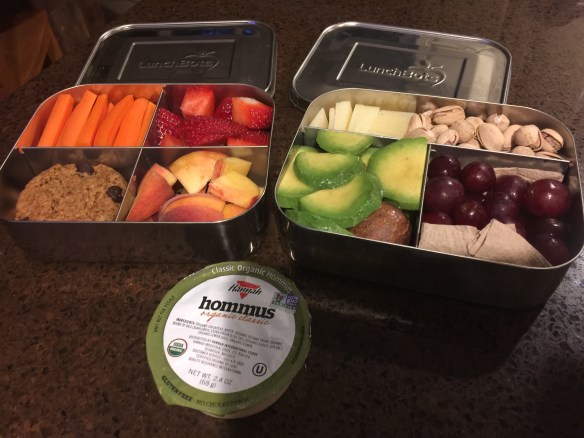
Lunch and snacks for Adrian’s day: carrots, strawberries, TigerNut flour cookies, peaches, cheese, pistachios, avocado (coated with lemon juice), grapes, hummus.

IMG_3177

Lentils, heated, being loaded into an insulated container to accompany Adrian’s lunch and snacks.

IMG_3176

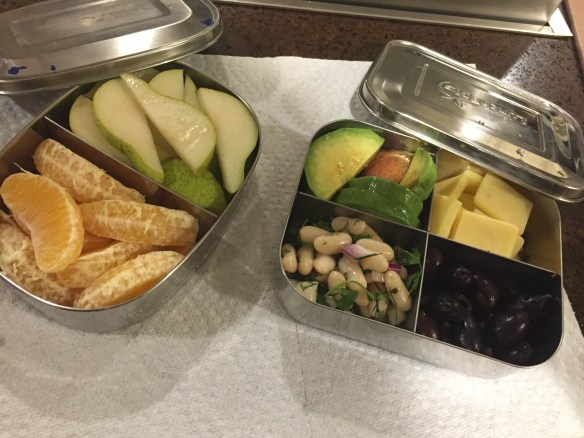
More bento boxes, with oranges, pears, avocado, cheese, cold bean salad, and olives.

And “Better” Means?

On our last trip to California, I was cuddling my friend Melanie’s three-month-old daughter (her first baby) when Melanie gestured toward Martin and asked, “What would you say has been your favorite age?”

Melanie knows Martin is recovering from autism, so I could answer: “It’s weird for me. My parenting journey hasn’t been traditional. Every day he can relate in ways he couldn’t before, and can communicate more, and can have more conversations, and play more games, so I would say each age he hits is my new favorite age.”

Later, reflecting, I questioned the implication of my response. If I enjoy parenting more—to be honest: if I enjoy our whole relationship more—as Martin inches toward recovery, does that mean that I value neurotypicality more than appreciating Martin wherever he is on the journey? Does my focus on his future take away from our today? If we had never discovered biomed, if Martin still lacked functional language and threw constant fits, would I resent parenting my own child?

Years ago, I described my own failure to “grieve.” Autism parents are often told to let go of the children they thought they had (i.e., the neurotypical children with standard futures) in order to embrace the child they do have (i.e., the children with autism and divergent futures). As soon as I realized that recovery is possible, I set aside the grieving process in favor of fighting. Throughout that fight, I’ve maintained that I’m not trying to change who my son is, only to dig his true nature out from under all that autism. I’ve also maintained that I love Martin fully and completely, with or without autism, whatever his future holds, however we have to parent him. All that is true.

But something else is also true, and I reckon it may be the most controversial declaration I’ve made on this blog. At least, judging from my impulse to go hide under a blanket and pretend no one will ever read this, it is my most controversial declaration. Here goes: I think it is better to have the chance to live without autism. Whatever unusual ways of seeing the world autism can bring, neurotypicality is generally preferable. We humans become fulfilled unto ourselves by relating to others, whether through physical affection, cyberspace communications, books, poems, common goals. Autism hindered Martin’s ability to relate to me, and mine to relate to him. That is why his life and mine, our common and intertwined life, is getting better as his autism fades.

To anyone living with autism and offended by this post, I apologize. This is my opinion, and based on my experience with my son. Any opinion is subject to change, and I freely admit that participating in a recovery journey may be usurping joy I would otherwise find day-to-day if I were to accept Martin’s autism as who he is, instead of what burdens him.

Maybe I’m saying I know why I’m Finding My Kid. I’m Finding My Kid to make life better.

I’ve built walls,

A fortress deep and mighty

That none may penetrate.

I have no need of friendship; friendship causes pain.

It’s laughter and it’s loving I disdain.

I am a rock,

I am an island.

—Paul Simon

Recognized, and Happy for It

My law school roommate lives an hour or two away. As the crow flies, her home is probably 40 miles or so from mine, but New York City lies between us, with all the convoluted traffic conjuring the metropolis requires. She and I meet occasionally for lunch, in Manhattan, but it’s rare that we bring our families together.

This Saturday she and her husband came over with their three kids, a girl about Martin’s age and two older boys. We barbecued and swam. The kids played. They stayed about five hours.

That evening, I received this email from my erstwhile roommate:

It has been a few years since I last saw Martin (or should I still call him Tin Tin?), so I didn’t know what to expect. I didn’t know if he would still be the little boy I remember from a few years back or if he would be completely different. Well, he is still the cute and sweet little boy I remember but he has also grown into a wonderful young man, so friendly, courteous, and fun! If I did not know from your blog posts that he has struggled with language and communication, I would not have guessed it. Martin was such a gracious host to my kids (who are not the most friendly outgoing type) and was actively engaging them. (He was asking Nathaniel if he preferred to be called “Nathaniel” or “Nate.” He was also calling to Mieko to come swim.) He was so expressive and easy-going and super nice to be around!

I know that today was just one day in his life and there must be other days when things are not so great. I can’t help but to think of all those sleepless nights, all the cooking and food shopping, traveling to doctors and therapists, and the worries and heartaches you endured. But I think you have soooo much to be proud of!!! Your unwavering faith in your child and your strength to guide him, even in the face of uncertainty, have made a world of difference.

Congratulations on achieving an important milestone! I am sure that the next chapter in his life will be an exciting and rewarding experience with new friends and new achievements.

The “important milestone” to which she refers is Martin’s upcoming switch from self-contained special education to general education.

I’m grateful and fortunate to report that I often receive compliments about Martin. This wasn’t even the first very cool email I’ve received from my law-school roommate.

The email quoted above, however, is different, and blog-worthy. In it, a parent of typically developing kids recognizes not only Martin’s growth but also the struggle it has taken to achieve that growth. This was so meaningful to me. Biomed parents know what happens behind the scenes. Biomed parents understand why I had to give up my former career, and they are sure I’ve cleaned poop smears, endured consecutive days without sleep, and snuck into bathrooms to cry. Parents of neurotypical kids, on the other hand, no matter how supportive, tend to overlook what autism recovery actually entails.

Before our guests left yesterday, my former roommate also said that I looked healthy. She said I seemed less exhausted and less burdened than I have since Martin was diagnosed.

When I asked later whether I could reproduce her email here, with the identifying information changed, she replied, “Sure, go ahead and use it on your blog. And you can remove any identifying information such as how beautiful and charming I am.”

Nice try. I will spite her by reporting to my entire (vast, vast) readership that my law-school roommate is beautiful and charming.

Which I suspect you already guessed.

IMG_3496

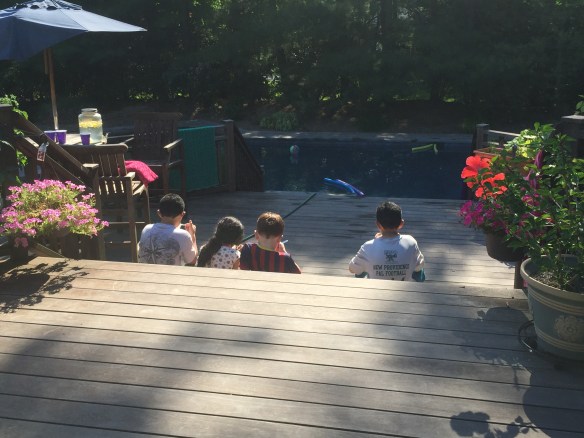
Martin enjoying homemade ice cream on our back deck, with the children of my law-school roommate.

He Doesn’t Seem to Know

Back to the topic of school.

We’ve been hoping to transfer Martin from his self-contained special-education school to a general-education classroom with an aide. Our local zoned school, at Martin’s grade level, had 26-to-28 kids per class, which is too many, so we looked at private schools. We found two church schools we thought would be good fits. Each school asked Martin to visit, for an entire day, without an aide. Each visit, Martin was at his worst; fighting his Lyme disease has been a rough ride. Combine “Martin is having a bad day” with “Martin is making a full-day visit to a general-ed classroom with no assistance.” The result was no private school placement for Martin.

At the same time, Adrian and I became increasingly convinced that the time has come for Martin to leave his current placement. Martin has started copying undesirable behaviors that he witnesses at school, like whining. Four other boys are leaving the class, including Martin’s two closest social peers. Martin has started self-advocating, telling us that he’d also like to go to a new school. He says he has too many teachers and that he’d like to be in a bigger class, and that he wishes he could go to a school close to home like his friends from play group do. Finally, Martin is finishing second grade, so these decisions concern possible third-grade placement. We’ve been told, by multiple sources, that the distance between second-grade curriculum and third-grade curriculum is the biggest jump in elementary school. Academics (except for reading comprehension and drawing inferences) are Martin’s strong point. Adrian and I worry that the longer we leave Martin in a slower-paced, modified learning environment, the less possible an eventual move to general education will become.

Just when it seemed that leaving Martin in his current school would be our only acceptable, available choice, two late entries arose. First, our district passed a new budget, part of which added additional sections to our zoned school. The class sizes dropped from 26-to-28 kids to 21 or 22 kids. Second, our local Catholic elementary school, which works closely with our district, invited Martin to visit—for a few hours, with an aide—and he happened to be doing well that day. Then the district offered Martin an IEP for general education, with a full-time, one-on-one teaching assistant, plus a consultant special-education teacher, plus resource room, plus regular visits from a behaviorist to the classroom, plus continued speech therapy and, if we wanted more services, occupational therapy, physical therapy, and counseling (services he has in his current placement). This panoply of benefits would be available to us at either our zoned school or the Catholic school.

The decision to pull Martin from his current placement was almost clear. Almost. We still faced this hesitation: Whatever our concerns with academics or behaviors, Martin is safe where he is now. His class is small, structured, and constantly supervised. He faces no playground bullying. He does not stand out because of his differences. His self-esteem is high, his confidence intact. The headmaster of one of the church schools that turned us down earlier this year is a former special-education administrator. Immediately after Martin’s full-day visit there, the headmaster kindly spent 20 minutes on the phone with me and Adrian. He enumerated the reasons why they wouldn’t accept Martin (including, apparently, the 11 times Martin stopped between the gymnasium and the classroom, because he wanted to examine a vase, to look at a photo of last year’s graduates, and so forth). The headmaster also said, in Martin’s favor, “I have to tell you that he made himself right at home. This is quite extraordinary—Martin doesn’t seem to perceive that he has any challenges at all.”

I’d like to keep it that way: that Martin doesn’t perceive that he has challenges. With continued hard work and a little luck, we just might be able to lose the ADHD diagnosis before Martin wonders too much about being different. If we toss him into a classroom of typically developing kids, how much of Martin’s own perception of himself will evolve?

Well, we’re about to find out. Last week, Adrian and I accepted the district’s proposed IEP, placing Martin into general education with an aide, in our zoned school, with one change in plans: At our request, Martin will repeat second grade. He’s changing schools, so the other kids won’t realize that he’s repeating. I hope that repeating second grade will give Martin a chance to adjust to the faster pace of general education before he is called upon to master new material.

Martin’s going to spread his wings. Here’s hoping he can fly.

IMG_3295

Martin, in orange, with friends.

Del Sur V: Manifesto

“Do you know?—maybe it’s possible that he never had autism?”

These words were spoken innocently, by a sympathetic party, and (I suspect) without forethought. It was late evening in South America. Martin was asleep. My mother-in-law and I sat in her kitchen, chatting, I with a glass of white wine, she with her pisco sour. We were discussing Martin and his progress; I mentioned that his official diagnosis had changed from ASD to ADHD with social/pragmatic language delay. My mother-in-law responded, “Do you know?—maybe it’s possible that he never had autism?”

My mother-in-law supports everything we do for Martin, and does her best to accommodate; we arrived from New York to find her fridge stocked with organic produce (still hard to procure in her area) and a cow knuckle and vegetables simmering on her stove, for Martin’s broth. That being said, I’m not sure she fully understands biomed, or our start point and desired endpoint. This is no criticism of my mother-in-law. I’m not convinced that anyone outside the thick of recovering a child understands autism or what healing requires. I’m not even convinced that I understand autism or what healing requires; I’m just a few paces farther down that road than others are.

Still, when my mother-in-law offhandedly suggested that maybe Martin never had autism, I bristled. I bristled because I think I will hear that suggestion a lot, as Martin continues to become more typical. Already I hear hints. A friend who has a mostly nonverbal seven-year-old and does not do biomed remarked recently about how “maturity” is resolving a lot of Martin’s issues. The friend meant no harm; in her mind, biomed doesn’t work, so she needs something else to explain Martin’s emergence from autism. (I didn’t pursue the issue further. I’m cautious, with other autism parents. We’re all doing what we think we can.) And remember the neurodevelopmental psychiatrist’s words? According to her, Martin developed functional language because he was “not destined to be a child with receptive or expressive language problems.” It’s not biomedical interventions. It’s destiny!

I know, from other blogs and on-line communities, that parents who manage to recover their kids from autism face skepticism that their children ever had autism. You may ask, why should they care? The opinion of naysayers doesn’t affect their children’s recovery. Why should I care if another autism parent wants to chalk Martin’s ongoing recovery up to “maturity,” or a doctor implicates destiny over hard work?

Well, I care, we care, everyone should care, because denying biomed has far greater implications than just adhering to ingrained misconceptions about autism.

It is possible to recover from autism. Not to learn to live with autism’s symptoms, which is what behavioral therapies teach, but to eradicate autism by treating the disorder’s underlying medical causes. I know this to be true, because my son is recovering from autism. I’m not deluded. I have the blood work and urinalysis evincing his medical issues. I have the series of neurodevelopmental psychiatric reports describing his detachment, his lack of language, his emotional instability. I witnessed too well his lethargy and physical discomfort. I endured his sleeplessness. I have watched, over five years, as his medical issues alleviated and the autism symptoms improved in tandem.

Every case of autism is different. Yet there are commonalities. The presence of autism points to an immune disorder rooted in the gut, where 70% of the immune system resides. A healthy gut biome has plenty of good bacteria to keep germs and infections at bay. When something depletes the good bacteria—say, antibiotics, or glyphosate—the bad guys start to party. Any further insult, like insufficient vaccine absorption or exposure to environmental toxins, can cause the whole immune system to jump its rails. When you’ve got no properly functioning immune system, you can find yourself with a host of secondary problems, like neuroinflammation, excess propionic acid, a struggling thyroid, glutathione depletion and methylation troubles, opportunistic infections, an inability to secrete heavy metals. And then? Neuron misfires. The endgame that manifests in autism.

Autism rates are on the rise. Stunningly. Think of those graphs that represent worldwide human population: Autism’s growth is similarly exponential, even according to conservative CDC figures. The epidemic is not the result of greater awareness, or expanded diagnoses; if it were, we would expect to see most cases clustered at the mild, almost debatable, end of the spectrum, where the merely “quirky” kids reside. Instead, new autism diagnoses litter the entire spectrum. Non-verbal, acutely affected autism is on the rise just like Asperger’s. Those who deny the rising autism rates are the willful ignoramuses and the irrational optimists. I am out of patience for either.

We don’t know, yet, what “causes” autism, though every day we learn more about factors that may contribute to the development of autism. I mentioned a few above: overuse of antibiotics, unsafe vaccinations, pesticides. Activists speculate about the role of pollution, about electromagnetic fields, about C-section births (or not) and the newborn’s chance to benefit from the vaginal biome. Genetics also play a role, such as the MTHFR mutation or UBE3A mutation.

(Note this: Accepting that genetics play a role in development of autism is not saying that we “can’t do anything about” the autism epidemic. The genetic predisposition to autism has probably been around many generations; only now do new environmental triggers spur the subsequent development of the disorder. Plus, more and more we have to speak not of genetics proper, but of epigenetics, mutations with the capacity to arise or dissipate between generations, or even within a single generation.)

Which brings me to many people’s resistance to accepting the notion of biomed. If we accept that we can reverse autism by resolving the factors that caused it in the first instance—then we admit that something is causing autism. Based on the exploding autism numbers, whatever is causing autism is getting worse. In an over-hygienic world devoted to unlimited consumption, exploitation of animals and the environment, a pill for every ailment, and the temple of convenience, we are doing something wrong. Disastrously wrong. In that regard, progress has stopped. Unless we change course, each successive generation will pay a higher bill for our abandonment of what is natural.

Unfortunately, almost no one seems to want to change course. So people deny that autism is on the rise, or that autism has causes, or that autism can be treated.

This is why I bristle to hear that maybe my son never had autism, or that he’s moving off the autism spectrum because of something other than biomed. It is also why I do not support the “neurodiversity” movement. Don’t get me wrong: I support the goal of inclusion and accommodation for persons living with autism. Did someone insult or exclude your family member with autism? Call me. I will gladly rush over and go Brooklyn on the jerk. But do not hand me acceptance of autism itself as a policy for dealing with skyrocketing autism rates. Do not tell me that autism is “just how some people are” and should not be addressed, because I will respond that schizophrenia and depression—other disorders with medical underpinnings—are also “just how some people are,” and give lie to how misguided neurodiversity is. People with autism should be accepted. Autism itself can, and should, be fought.

We can learn to live with just about anything. City dwellers learn to live with constant light and noise pollution. Our world may be on the verge of learning to live with catastrophic climate change. This ability to adapt does not mean that we should fail to recognize and correct our own mistakes.

My son had autism. My son still has ADHD. One day my son will be neurotypical. Treating his disorder biomedically has made this progress possible.

Full stop.

Del Sur IV: That Doesn’t Sound So Bad

Adrian’s two sisters, each a mother herself, don’t know about Martin’s autism, because Adrian refuses to tell them. Adrian’s official position is that, given the discrimination that still exists against disabilities and difference in his country of origin (where my in-laws reside), he would rather not see Martin “branded.” (Adrian’s parents and brother, Pancho, know the diagnosis. Adrian is closer to them.) I don’t begrudge Adrian’s choice. Even here in the States, we haven’t been public about Martin’s autism, or former autism.

On the other hand, the ignorance of my sisters-in-law leaves me in an awkward spot when Martin and I visit South America. For years I’ve avoided spending too much time for them, or covered when it came to Martin’s behavior, like I covered on our first day this visit. How many times can I say Martin is tired, jet-lagged, on a different schedule, shy, not feeling his best? Try me.

I decided this year I might be able to do something different. I approached Adrian with the idea of telling one sister—Claudia, who lives in the capital city we were visiting, and whom Adrian likes better—about Martin’s new diagnosis, ADHD. “Autism” strikes fear. “ADHD,” on the other hand, makes people wonder if your kid is taking the same drugs as their kids. Adrian agreed. ADHD doesn’t sound scary like autism sounds scary. We decided that I would share with Claudia “our challenges with ADHD.”

I didn’t really find a good opportunity to talk until our last evening in town, when Martin stayed with my mother-in-law while I went out to dinner with Pancho and Claudia. Then I fumbled, trying to come up with a way to initiate the conversation. An hour into dinner, Claudia said we should come down in July to go skiing during her children’s winter break.

“I wish we could! But Martin goes to school during the summer. Next year maybe we could come—he might change to a new school and have summers off.”

Awkward. Still, my comment moved the conversation in the desired direction. Claudia asked, “Martin is changing to a new school?”

“Yes,” I replied. “Right now he goes to a special school for kids with ADHD. But his attention has been getting better. We are thinking he can go to a regular school, with some extra help.”

If this fazed Claudia, she gave no hint. She said, “And then he would have the summer off? Do you think you could come here for the whole summer? We could do so much skiing!”

“I don’t know about the whole summer. We could probably come for a while,” I said. “It all depends on whether he gets to switch schools. We still have work to do on the attention span and all the issues that have to do with ADHD. We’re not sure he’s totally ready to leave his special school.”

Across from me, Pancho was nodding. He has known about Martin’s issues for years and could see what I was trying to do.

Claudia said, “This will be great. I’ll send you the schedule for my kids’ school vacation, so you’ll know when to come.”

Last try. I said, “I will have to let you know what happens. ADHD is very hard to accommodate properly in school. You can see Martin’s poor attention span.”

Claudia said, “I’ve heard it’s very common in America to change schools. Not here. My children will go to the same school until university, just like we did.”

There went my big talk with Claudia. At least, somewhere in her head is the notion that Martin has special challenges. I suppose that’s enough for now.

Final note: In the first paragraph of this post, I mentioned “the discrimination that still exists against disabilities and difference in [Adrian’s] county of origin.” I don’t know whether the culture of Adrian’s country of origin engenders unusual bias against disability. On my visits there, some 10 times and counting, I haven’t witnessed autism discrimination. But when it comes to Adrian’s own country of origin, I will let his opinion carry the day.


Del Sur, Interrumpido: Siempre Alguien Hace Leña del Árbol Caido

Monday, last week, was abysmal. Something—a supplement, or an allergen, or another environmental factor, or . . . still trying to figure out—was causing Martin to be anxious and contrarian. He argued every statement, contradicted every request, had trouble holding himself together. Mondays I pick him up from school, we go to the natural-foods market, and I take him to personal training. Last Monday we had to break that routine and replace the natural-foods market with visiting the optician to fit Martin’s new glasses. That was bad enough. Then we spent too long at the optician and ended up late for personal training. Oh. My. Huge. Anxiety.

When we pulled into the gym parking lot, Martin was perseverating on our tardiness, demanding to go home, and trying not to cry. I knew I had work to do before we could enter the gym.

Monday also happened to be windy. Very windy. As I began to open my door, a gust blew it into the Volkswagen Beetle next to me. Just a tap—my door’s plastic rim hit the Beetle’s side panel. I withdrew the door and checked the other car for damage. The Beetle had enough nicks and scrapes that I needed a second to confirm where my door made contact. At that spot, I saw no damage.

Just my luck: A woman was sitting in the Beetle’s driver seat, texting or something. She thrust her head through her open sunroof and, glaring at me, contorted her face into a grimace.

I said, “Sorry The wind got hold of my door. Thank goodness it didn’t leave a mark.”

My mind, at that moment, was occupied about 2% with my car door, and about 98% with Martin’s potential meltdown, so I started to exit in order to deal with Martin.

The other woman’s mind, by contrast, seemed 100% occupied by the fact that my door had tapped her Volkswagen. She scowled, and yelled, “You’ve got to be more careful!”

“Yeah, sorry,” I repeated as I walked around my car to retrieve Martin. I helped him down from his seat and walked him to the back of my SUV, where I had enough space to kneel and take his hands in mine while reassuring him. This position, me kneeling in front of Martin, holding his hands and available for a hug if necessary, is our best defense to a meltdown. Martin was alternating among might-cry face, a few tears, and deep belly breaths to gather his composure. After 15 or 20 seconds, we were starting to get the potential meltdown under control. I was able to use one hand to wipe tears from Martin’s quivering cheek.

And then—VW Beetle chick decided she had found an appropriate time to address the non-existent injury to her jalopy. (Pardon my attitude. I believe it justifiable.) She exited the driver seat, walked around to the side panel my door had tapped, which was also close to me and Martin, and commenced a conspicuous inspection. The inspection involved leaning very close to her car, flashing me an angry expression, slurping diet soda, waiting for a response from me, and upon receiving no such response, repeating the entire process. At any other time, the situation would have been laughable. At this moment, as I sit here writing, the situation is laughable. Last Monday, on the other hand, in the midst of Martin’s anxiety, I felt my blood begin to rise. Seriously, lady? Seriously? I am—literally—on my knees in a gym parking lot, imploring my angst-ridden seven-year-old to hold his s*&t together, and you’ve found the perfect time to confront me for accidentally bumping the side panel of your car? I perceived a change inside me. Country-raised, uniformly polite suburban mom spirit was leaving my body. In her stead came chip-on-the-shoulder city girl. I started to stand. I was about to get up in this woman’s face, and not a little bit. I was about to be inches from VW chick’s nose.

And then—Martin’s chest heaved, and tears came. Instantly, I knew that Martin knew that I was on the verge of getting into it with another adult. I returned to my knees, reclaimed his trembling hands, and told him softly not to worry. I smiled. I reassured him that I had texted the personal trainer that we were coming late, so it was no big deal. I said how cool his new glasses looked, and that we were having his favorite lentils for dinner later, and that I might even make rice.

I would rather report that the VW driver realized her timing was off, that she said something like, “I can see you’re busy. Would you mind finding me in the gym after your son calms down?”, and then departed with only a glance at my license plate to ensure honesty.

She didn’t. She started the Beetle inspection routine anew. When she reached the part about slurping diet soda and waiting for a response from me, I raised my left hand to block her from my view. I actually gestured, “Tell it to the hand, because the mama ain’t listening,” and concentrated instead on Martin’s needs. I held my hand aloft, ignored the idiotic car inspection, and comforted my son.

Finally, VW chick aspirated a noise somewhere between grunt and sigh, as if she just couldn’t believe my nerve, and stormed into the gym. Our confrontation skipped climax and proceeded directly to denouement. Here’s the denouement: I was shaken. I was shaken because this woman had been so oblivious to Martin’s plight. I was shaken because I’d let her get to me. I was shaken because, if there is one thing I try to impart to Martin, it’s that his mom is in control, and he’d just witnessed me almost lose control.

When Martin and I were ready to head into the gym, I took another look at the Beatle and noticed fresh flowers in the dashboard vase.

That driver didn’t deserve fresh flowers.

There are two more posts coming in the Del Sur series. I interrupted, again, to report that someone will always kick you when you’re down.

Del Sur III: Someone Has Got Him

My grandmother spent the last 45 years of her life in the United States, and yet some part of her never left Germany. Her kitchen represented Germany circa 1947, eternally enshrined in Southern Florida. She shunned modern appliances and scrubbed the bare counters spotless. An ode to beer, carved in the old German lettering, hung above the table where she sat to smoke, drink strong coffee, and work her crossword puzzles (in German, natch).

Allow me to add that my grandmother was also glamorous, and one of the worst cooks I’ve ever encountered. No dowdy Hausfrau here.

Adrian, my husband, moved to the United States in 1999 and nationalized in 2009, and he too keeps one foot in his country of origin. Throughout each day, WhatsApp messages zip among him and his schoolmates. I stock our pantry (and wine cabinet) with homeland products. He even likes to have his suits sewn by his hometown tailor and shoes made by his preferred cobbler. During my our recent visit to South America, my mother-in-law asked me to drive across the city with her to pick up Adrian’s new loafers and boots.

“I don’t know,” I replied. “Martin will be bored, spending that much time in the car.”

“Martin? He doesn’t have to come. He can go to the playground with his cousins.”

The cousins in town that week ranged from 10 to three years old. I asked, “Will someone go with them?”

“Of course,” my mother-in-law said. “Don’t worry about it. Someone’s got him.”

Soon three cousins appeared in the apartment with their mother (my sister-in-law Claudia), gathered Martin, and left. My mother-in-law and I headed to the cobbler, a trip that took more than 90 minutes with traffic. Then my mother-in-law wanted to stop at the supermarket, and we ended up shopping an hour as she showed me the newest organic and gluten-free options. Just as I began to worry about Martin, I received an email from Claudia titled, “There are five!”, with no more explanation than a photo of Martin, his three cousins, and another kid I didn’t recognize, whom evidently the crowd had picked up along the way. Okay. No rush. My mother-in-law and I sauntered home three hours after I’d watched Martin whisked out of the apartment. We found my brother-in-law (the beloved bachelor uncle, Pancho) waiting. Pancho reported that Claudia was summoning him to the park to help her haul five kids home. I went along and found Martin. All was well.

The next day, Pancho (remember the “beloved” reference) sent me to a spa for an aromatherapy massage. When I asked what Martin would do while I was gone, the answer was again, “Don’t worry about it. Someone’s got him.” A couple hours later, relaxed and aromatherapied, I walked to Claudia’s apartment. I found Martin coloring with a cousin and discovered that the “someone” watching the children was Anna, a young German musician. Claudia’s husband is the director of the capital city’s philharmonic orchestra, and musicians from around the world seem to move through their home. I’m never quite sure how these arrangements work. In any event, Martin was fine. Anna assured me there’d been no trouble, and that for a snack Martin had eaten the special bar my mother-in-law sent. Okay.

At home, my childcare is regimented, and paid. Tuesday afternoons, a special-education teacher helps Martin participate in church Kids’ Club, and I have a couple hours free. Wednesdays and Thursdays, when I work in the City, Samara meets Martin at his school bus, makes dinner, handles supplements and any after-school activities, and puts him to bed. All other times, unless by arrangement Adrian or a babysitter is on duty, Martin is my responsibility. Someone has not got him. I’ve got him.

The two instances described above were not the only two when, during our recent South American week, I did something other than supervise my son. I went out for Thai food with Pancho and Claudia; Martin slept, and my mother-in-law was around in case he woke. I shored up a fee agreement for work; Martin played video games at Chuck E. Cheese—yes, that monstrosity has expanded into South America—with my father-in-law and some cousins so distant I’m not sure I could correctly identify their parents. I lingered over brunch with the adults; Martin was somewhere, with someone.

For any parent, residing with no family in the area is challenging. For the parent of a child with autism, who almost by definition requires more attention than a typical child, and in some cases requires unremitting attention, independence from family is downright burdensome.

Then again, how many parents with ASD children cannot even take advantage of whatever support system they do possess? When Martin was a bolter, I could not have allowed a German musician to supervise him and three other children. When Martin lacked proprioceptive awareness, and had no perception of where the jungle gym ended, I could not have sent him to the playground without one-on-one surveillance. When Martin needed physical restraint to sleep, my 67-year-old mother-in-law being in the apartment would not have given me assurance that I could leave. Adrian and I, moreover, enjoy the advantage of both our families supporting our biomed approach; we do not need to worry about well-meaning relatives slipping Martin sugar-filled cupcakes or cotton candy so that he can “be like other kids.”

I have newfound respect for my grandmother’s lingering attachment to Mainz, her ancestral home, and for Adrian’s hybrid North/South American lifestyle. There exists a comfort zone within a known culture and extended family—something they both lost, and something even I lost when, at 17, I left forever the rural Upstate county where I was born. As the number of children with autism skyrockets, I can only imagine our collective Sehnsucht will expand in tandem.

Meanwhile, I’m trying to find a way to grow the “someone’s got him” model here at home, with the resources available. I’m typing this post on a commuter train, on my way home from work. I just texted Samara to check in. Samara replied that she’s making dinner and Martin is “over at his girlfriends’ house,” meaning the twin girls who live across the street. First I panicked: Is Martin being a bother to our neighbors? What if someone feeds him an off-diet snack? Should I ask Samara to stop making dinner and be with Martin? Then I reasoned: The girls have been inviting Martin to their house, and their mother told me how pleased she is that everyone is playing together. Their mother also knows that Martin can’t have gluten, dairy, or soy, and that we avoid refined sugar. Plus, Martin polices his own food these days. Martin is fine playing at our neighbors’ house.

This week we have friends from Germany staying with us, including a ten-year-old boy, Leo, and his aunt, Heike. Sunday evening, 6:00 pm, Leo was bored and asked Heike to take him and Martin to the playground. I hesitated; the playground is a 20-minute walk away, we hadn’t eaten dinner yet, and on school nights Martin usually goes to bed by 7:45 pm. But how often does Martin get a special evening trip to the playground? He dropped his iPad and ran for the door as soon as he heard Spielplatz—playground—the only German word he recognizes. I started to give directions. Martin proclaimed, “I know the way! I will lead them!”, and off they went, Heike on foot, Martin on scooter, Leo on Martin’s bicycle.

I poured myself a glass of wine, and handed a second glass to Adrian, and said dinner would be late.

“Why? Where’s Martin?”

“Don’t worry,” I said. “Heike’s got him.”

dekoschilder57

Del Sur II: ¿Asperger’s?

I read James Joyce for the first time when I was 17. It was A Portrait of the Artist as a Young Man, and it knocked my socks clean off. With the benefit of maturity, I’m pretty sure that most teenagers who read A Portrait of the Artist end up sockless, but 27 years ago, in high school, I felt singled out and special: James Joyce got me. He wrote the novel for himself and also for me. Stephen Dedalus was an alter ego for Joyce and me both. His stream of consciousness was also the wandering path of my own mind.

Martin speaks constantly nowadays. Constantly. It’s as if, those years when he lacked language to express himself, he built a bank of unsaid thoughts, and now the words gush, unfiltered. He alights the school bus yammering. Dinner is a series of, “Hang on, Martin. How about if the grown-ups get to talk for a minute?” He falls asleep holding court with his stuffed animals. Wednesday morning he materialized in our bedroom at 4:00 am and said something like, “I just woke up. My body woke me up. Maybe I’m not sleepy anymore? It’s still dark outside. Your clock says 3:54. Can I watch television? It’s Wednesday. I have school today. Why do you think I’m awake? Are you getting up now? My covers were tangled.” (I managed to convince him that his body woke him up because he needed to go to the bathroom. He went to the bathroom, I untangled his covers and tucked him back in, and blessed silence fell again.) I have become one with Stephen Dedalus. I’m living a stream-of-consciousness existence, and the consciousness is seven years old.

In South America, with few planned activities and much free time, I experienced just how very much Martin talks these days, and usually to me. He was a running soundtrack of our trip. “This morning I woke up at 7:37. Mommy, were you awake? Did you hear me get up? I looked at the clock, and it said 7:37. I wanted to get up at 7:00. I got up 37 minutes late. It was already light out. Tío was getting ready for work. I looked out the window and saw a balloon in the sky. Mommy, where were you? I found you in the kitchen. What time did you get up? What time did you eat breakfast? I played with my iPad while I was waiting for breakfast. Today my cousins are coming over. They are still in school. What should we do before they come over?” His cousins rang mute by comparison.

I am not complaining, not by any means. If you’ve had a child without functional language, if you once thought “I want you to do that again” was the linguistic apex of beauty and complexity, you understand: I, we, have fought for every sentence that Martin emits, and his chatter is our prize.

That’s what I remind myself when I’m hearing, for the 478th time, that there are three mommies and Martin needs to decide which is the real mommy. (Some episode of Mickey Mouse Clubhouse evidently had two Goofy characters, only one of which was real, or something like that, and Martin’s been running with the game for weeks.) He’s perseverating. The game is annoying. But the sentences are perfect, the syntax is solid, and every day he picks up new idioms.

So here is a question: Doesn’t this sound a lot like Martin has Asperger’s? Classic hallmarks of Asperger’s are a preference for the company of adults over children; long-winded discourse, regardless of whether anyone is listening; repeated return to one topic; speaking in a fast or “jerky” voice. Martin’s official diagnosis, now, is ADHD. The (mainstream) neurodevelopmental psychologist opined that Martin no longer meets the diagnostic criteria for autism. Asperger’s is a form of autism. What gives?

Good thing I’m not that into behaviorally based diagnoses. I followed Stephen Dedalus. I can follow this kid, wherever he’s taking us.