Autism One Take-Away I

I’m traveling home from three-and-a-half days at Autism One, the annual conference on all things recovery. This marked my fourth year in attendance at A1.

I go to A1 to learn about the latest treatments and studies, to check out vendors whose products might benefit Martin, to socialize, and to benefit from other parents’ experience. In those regards, I get a lot from A1. Every year I come home reenergized, and with new ideas and persepectives.

The downside of A1 is an overwhelming experience that also leaves me distrustful of many practitioners. Every doctor (or scientist, or therapist, or homeopath, or naturalist, or spiritual healer, or garden-variety snake-oil salesman) brings along a testimonial in the flesh, some family profoundly helped, or even fully recovered, by that one treatment that only this practitioner offers. Dr. Jeff Bradstreet and his team push the Bravo yogurt product with GcMAF to restore the immune system; Dr. Zach Bush and his team swear by Restore liquid, which will provide the nutrients missing from today’s food supply and which, by the way, should not be used alongside Bravo yogurt. Entrepreneurs display stickers and pendants for EMR protection, while authors lecture on why stickers and pendants can’t protect from EMR. One guy was at last year’s conference pushing acupressure devices and magic salt that he claimed “many doctors, at least two dozen” in attendance already were using. (When I pressed, he wasn’t able to name any of the many doctors.) That same guy was back this year, with the acupressure devices and magic salt, and now also with some sort of machine for shaking people. Shake those toxins right out! I could hardly keep myself from laughing when I passed his booth.

My strategy for maximizing A1 is to make note of treatments and therapies that sound most applicable to Martin, ask other parents what they know, and then take no action other than creating a list to discuss, at our next appointment, with our MAPS doctor. I include “take no action” because it is very, very tempting to leave A1 and immediately make appointments with every doctor (or scientist, or therapist, or homeopath, or naturalist, or spiritual healer) that I’ve just seen. A1 embodies hope, which floats through the conference and lands on me: That doctor’s research into mitochondrial processing disorder is so thorough, so cutting-edge. If I just take Martin to that doctor’s office in Arkansas, I’m sure we could finally solve his mito issues. And that other doctor’s clinical trials with subcranial laser therapy show so much promise. If I just take Martin to that doctor’s office in Atlanta, I’m sure we could bring his receptive language up to his expressive. And those homeopaths in Minneapolis are making their own remedies. And that chiropractor in Chicago can improve attention through posture. And that naturopath in Connecticut has a more sensitive test for allergens.

You get the idea. Our MAPS doctor is educated, up-to-date, and less bandwagon-y than I am. She can help me sort it all through.

So here I sit (on an airplane, again) reviewing through my notes to write this list, which I will email Martin’s doctor before our appointment next month. This list might give you an idea of what we’re yet to try, and why I think it might help:

Diet.

Martin’s diet remains more or less the GAPS diet, modified with sprouted quinoa, sprouted buckwheat groats, and on summer weekends when we’re grilling, occasional organic potatoes or sweet potatoes. Now I’m thinking more about salicylates, which in plants occur as natural compounds to ward off bugs and disease. Symptoms of salicylate sensitivity include meltdowns, red ears, bladder incontinence, and distractibility. I’ve never paid any attention to salicylate levels in Martin’s diet. Maybe his red ears, clustered meltdowns, ongoing struggles with bedwetting, and trouble attending mean I should start paying attention.

Thyroid.

Dr. Raphael Kellman presented on the importance of expanded-panel blood testing for thyroid regulation. I know that our environment today is rife with endocrine disruptors, and that Martin, many moons ago when we did more mainstream “Track One” testing, exhibited low T3 hormone. What caught my attention in Dr. Kellman’s lecture was his emphasis on the thyroid’s role in regulating mitochondrial activity, and his opinion that addressing hypothyroidism in conjunction with mitochondrial disfunction produces synergistic effects. That being said, I spoke with at least one doctor who opposes treating hypothyroidism (i.e., with drugs) instead of using non-pharmaceutical gut biome restoration to lead naturally to hormone rebalancing.

The aforementioned Restore liquid.

Dr. Zach Bush talked about the loss of soil biome and resulting nutrient void in our contemporary food chain. He discussed how this makes children vulnerable to tight-junction injury (at a time when tight-junction toxins are on the rise). Then he made the case for Restore, which apparently is based on the carbon “snowflakes” from older, unadulterated soil and can help restore the tight-junction connections. Sounds good. On the other hand, I find myself suspicious when a doctor gives a convincing lecture on what’s missing from everyone’s diet, and how its absence affects immune-compromised children, and then the remedy for that deficiency turns out to be a product that this very doctor developed and sells. Ah, c’est la vie. I suppose everyone has to earn a living.

The aforementioned Bravo yogurt.

Bravo yogurt seems to be in some way created, or at least championed—what do I know?—by Dr. Bradstreet and his colleagues, including Dr. Marco Ruggiero. Dr. Bradstreet, over two lectures, presented something he calls the “Bradstreet-ESSENCE Protocol,” which seems to be shorthand for an individualized approach to treating ASD and, in that regard, not so different from what many MAPS practitioners already do. (ESSENCE stands for Early Symptomatic Syndromes Eliciting Neurodevelopmental Clinical Exams and is the brainchild of Dr. Christopher Gillberg.) A key component of this Bradstreet-ESSENCE protocol is the consumption of Bravo yogurt with GcMAF. I think Dr. Bradstreet has some interest in Bravo yogurt, so see my comments above regarding Restore. I think maybe Dr. Ruggiero has some interest, as well, and Bravo also figures into what he calls his “Swiss Protocol” for treating ASD. Howsoever those interests come down, last year, when GcMAF was available in injectable form, I was interested, with trepidation. Yogurt seems more palatable. Is that a pun?

Writer Peter Greenlaw, who also presented at A1, on his book The TDOS Syndrome, attributes today’s obesity crisis to lack of nutrients in our food, noting for example that spinach today has something like 1/92 the iron of spinach from 50 years ago; we get all the calories with less of what actually fills and nourishes us. That sounded exactly like what Dr. Bush was saying, except instead of pitching Restore, Lawton advocated the Bravo yogurt. Lawton seemed to be good friends with Dr. Marco Ruggiero, who is Dr. Bradstreet’s collaborator. I wanted a map of who works with whom and who shills for what, like those handy charts of which conglomerate owns what food companies.

MRT.

Dr. Bradstreet pushes magnetic resonance therapy, hard. I took an interest in MRT last year, when he, along with Dr. Ruggiero and others, presented the results of a pilot study that seemed almost too good to be true. I remain interested still, but it needs extra-careful consideration based on the cost, which is $1,000 for a trial to determine whether Martin is a “responder” and $12,000 for a full course, plus the expense of traveling to and spending weeks near one of two Brain Treatment Centers where the therapy is performed. In addition, Martin has a 12-month IEP and placement in an outstanding private school. If we were to take him from school for 12 weeks for a full course of MRT, we would jeopardize his spot in that class.

Mitosynergy.

The creator of this product gave a technical presentation centered on hydroscopic, or as he called it, “proper” copper versus hydrophobic copper, and copper’s ability to donate or accept electrons as needed, a key factor in molecular electron nutrition. (He moved fast, and I didn’t understand all of what he said.) I’ve had Martin on MitoSpectra for more than a year and have been wondering whether it’s time for a change. I saw the Mitosynergy product last year but felt that it was too new to the market to try. Maybe now?

Wider allergy testing.

This doesn’t relate to a specific protocol, and my interest didn’t arise through any particular lecture or discussion. A lot of what I heard at A1 regarding autism phenotypes, and getting recovery to “stick,” got me wondering whether I really have an adequate handle on dietary and environmental allergens that might affect Martin. Years ago, we worked through a food desensitization course with a naturopath. We didn’t do IgG food-intolerance testing. Is it time?

We see Martin’s MAPS doctor, in California, in four weeks. Anyone want to guess how much of this list will remain after I talk to her?

Autism One side-note: Whoever schedules the lectures at A1 somehow knows precisely what will interest me, and packs those lectures together. As a result, some hours I’m picking from among four talks that I’m dying to hear, trying to convince friends to go into the three I don’t and then share their notes with me, and some hours I’m listening to a presentation on language software for children with Down Syndrome because I don’t have anything else to do. Shoot me an email if you need to know anything about language software for children with Down Syndrome.

In Hope, Acknowledging the Despair

Remember last week’s post so long it required subheadings? Remember the subheading “Whence My Anxiety?” and how I described the City Kids Club rejecting two-year-old Martin? Remember yesterday’s post, which was a follow-up to the post so long it required subheadings? Okay. This is another follow-up to the post so long it required subheadings, and specifically a follow-up to the “Whence My Anxiety?” section.

Done with introduction/explanation. Thanks for your patience.

It was summer 2010, around Martin’s second birthday, when Adrian and I realized something was “off” with Martin. If you read this blog, you probably don’t need details about autism’s warning signs: lack of attention, inability to follow simple directions, nighttime wakefulness, daytime exhaustion. In September 2010, an old friend of mine, an Early Intervention provider, traveled from my hometown to the City and helped us complete an M-CHAT (modified checklist for autism in toddlers) questionnaire, which she evaluated. (As it turned out, my friend didn’t really need the M-CHAT. After ten minutes just interacting with Martin, she knew that he almost certainly had autism.) By October 2010, we had begun the process of formal diagnosis and enrollment in EI.

I remember autumn 2010 as a time of Martin not really regressing, but slipping. The symptoms moved from “something off” to “obvious.” He lost all eye contact. He no longer responded to his name. His communication skills stopped developing. He drifted the perimeter of our apartment, dragging his fingertips along the wall as he hummed to himself. What we’d once called Martin’s “happy dance”—running circles around our open staircase when Samara arrived—became instead a self-stimulatory ritual beyond his control, ever more circles, ever longer, until finally he’d collapse into a lethargic slump and spend the next hour on the floor, pushing a toy back and forth.

We began changing Martin’s diet in January 2011, and started biomedical interventions in February. The initial progress was so swift that I thought we’d be done with autism within a year or two. Within months, Martin was sleeping through the night, and we the first seeds of functional, i.e., non-echolalic, language were sprouting.

For September 2011, seven months after we started biomed, we were able to secure a spot in one of the City’s preeminent special-needs preschools. Stop your giggling. It’s New York City. We compete for special-needs preschool placements, of which the City has far too few. Martin was placed into a bilingual (Spanish/English), 12-1-1 (12 students, one teacher, one assistant teacher) classroom. It was a stretch, we knew. The instructors from Martin’s EI center said he needed a smaller student-teacher ratio than 12-1-1. Adrian and I figured, however, that Martin was getting better, and that soon he would be able to function in the 12-student class, and that in any event, the only spots still available in preschool were in the bilingual, 12-1-1 setting. So we took the spot, with gratitude.

From the beginning, Martin’s classroom teacher reported problems. The other kids could follow one-step directions, at least, and already were learning to cut with safety scissors. Martin followed no directions and melted down when it was time to transition activities. The other kids were fully toilet-trained, or well underway toward that goal. The other kids could watch short films. The other kids could walk to the classroom by themselves. Martin—Martin was himself. Very soon we began to hear murmurs that Martin might need to change classes.

The hammer fell a few months later. Adrian and I were called to a meeting with the teacher and administrators. Martin could not handle a 12-1-1 classroom. Fortunately, the school now had a spot available in an English-language, 8-1-2 classroom (eight students, one teacher, two assistant teachers). Martin would be moved slowly, spending short periods of time in the new classroom, and then half days in the new classroom, and finally saying goodbye to his 12-1-1 friends.

Martin’s removal from the 12-1-1 classroom ranks second in the painful moments I’ve experienced on this journey, behind his rejection from the City Kids Club. To be sure, the 12-1-1-to-8-1-2 classroom move is a distant second. The preschool wasn’t kicking Martin out; they were thoughtfully placing him in a setting to meet his then-current needs. And I was more prepared. I’d had weeks to internalize this possibility, and didn’t even need to reach for the tissue box someone had put on the table at our meeting. Still, the decision forced me to acknowledge that Martin’s recovery was not going to happen as fast as I’d thought, and that after the rapid initial progress, his improvement had slowed. His needs were still great, more extensive even than the needs of most preschoolers in special education.

Also on the Top 10 Most Painful Moments List? Touring private special-education elementary schools, trying to find an appropriate kindergarten placement for Martin, and hearing repeatedly that while dyslexia, learning disabilities, dyspraxia, &c. were acceptable, children with “autism and other global delays” should not bother to apply. Let’s not go there, this post.

I was already blogging when Martin changed preschool classes. I didn’t write about the event, at the time, because it was too painful. Later, when autism’s grip had loosened a bit more and I was feeling better, I decided to write about it. I meant to write about it. But I didn’t. For whatever reason, I still couldn’t get there.

So what’s going on now? Why am I dragging these dark moments onto the internet for all to read?

It’s because of hope. Martin right now is living a bold season for recovery. Language, good. Sleep, good. Health, good. Attention, improving. Socialization, improving. Physical skills, improving. I am surfing an wave of hope. Full recovery seems more possible than it has in years. More possible, maybe, than since the 12-1-1-to-8-1-2 switch.

I might regret reviving, here on the blog, our journey’s lowest points. Wind, you can have my caution. I’m overjoyed for the confidence to share.

And Then, Martin Does the Rejecting

You know, from last week’s post, that Martin has started participating in mainstream gymnastics. His class meets Thursday afternoons at our local JCC.

I also mentioned, in that post, that Martin attends a three-hour special-needs program at the JCC on Saturday afternoons. The Saturday-afternoon affair is a mixed bag: The kids swim, cook, do arts and crafts, and play outside, and those in attendance have a wide variety of challenges, from autism to cognitive impairment to hyperactivity. Martin has participated for almost two years. He’s always seemed to enjoy himself.

Last month, on a Saturday, two days after his first Thursday gymnastics class, Martin said he didn’t want to go to his JCC program that afternoon. At first, I thought he didn’t want to go because Adrian and I were both home and the weather was nice. I was planting my organic greens while Martin played on his swing set and Adrian worked. Martin had seen me prepping vegetables and fish to grill, and he might have thought that he would miss a cookout if he left. (The food was for family dinner that evening.) “Don’t be silly,” I told Martin when he said he wanted to stay home. “You love going to the JCC.” Still he persisted. Still I thought that he was just reluctant to leave a lazy Saturday in our yard, and that he would be eager when we arrived at the JCC.

He wasn’t. He walked in with me, and even hugged his friend Will hello. Then he grabbed my waist and begged me to take him home. I try not to give in to Martin’s activity whims; if I did, we’d be forever paying for lessons that he doesn’t use, for classes that he wants one week and not the next. So I tried to leave the classroom. Martin, in very un-Martin-like fashion (these days, anyway), started to cry. I asked the instructor whether anything had happened to make Martin uncomfortable. No, she replied, not that she could recall. I thought back to the previous Saturday. Adrian had picked up Martin and brought home a cheerful boy. No apparent issues. Now Martin kept crying. Eventually I did leave, without him. I snuck back and peeked in his group’s room. He was sitting on the floor, playing with a toy intended for a baby, pouting. He looked as miserable as mysophobia in a dumpster.

I phoned Adrian from the car. Was it possible Martin had a bad experience at the JCC? Had someone hurt him? Was I wrong to leave him there?

No, Adrian opined. We’ve never seen any indication of that. Martin is always in a good mood when we pick him up. He’s never appeared frightened or abashed. Plus, there are so many staff members present that he’s never alone with anyone. He just didn’t feel like going. Stop worrying

Indeed. When we returned three hours later, Martin admitted he’d had a good time.

The next Saturday, two days after his second gymnastics class, Martin again said he didn’t want to go to the JCC. In this encore, the tears started earlier, before we left home, and Martin was more insistent still. He did not want to go to his special-needs program. Adrian and I got Martin calmed down, and asked why he wanted to stay home. The conversation went something like this:

Adrian:           Martin, listen. We know you don’t want to go. Can you tell us why? Did something happen at the JCC?

Martin:           Because I don’t like it there. I don’t want to go.

Me:                But, Sweetie, you’ve always loved going to the JCC. You have fun there.

Martin:           I want to go to the gymnastics class on Thursday.

Adrian:           You go to both. You don’t have to pick. You go on Saturday afternoon, and then again for gymnastics class on Thursday.

Martin:           I just want to go to gymnastics class. I don’t want to go on Saturday anymore.

Me:                Why not?

Martin:           Because I don’t like it.

You get the idea. It was a frustrating conversation. Nevertheless, two themes emerged: First, Martin had no problem with the JCC. To the contrary, he was anxious to go back on Thursday to his gymnastics class. For that, I was relieved. At least I could stop worrying that he’d had some negative experience or been accosted by a staff member or any of the other random horrors that float incessantly through my motherly head. Second, since he started the gymnastics class with typical kids, for whatever reason he did not want to return to the special-needs program.

As it was the second week in a row, and Martin was more determined than we’d ever seen him about anything, we agreed to let him stay home. Even after we affixed conditions to the deal—no iPad, no snacking before dinner—Martin accepted.

Adrian and I speculated what might be prompting the change of heart. Now that Martin was participating in a “typical” class, was he starting to understand the difference between mainstream and “adapted”? Did he want to identify himself more with the typically developing kids? Was he rejecting his special-needs peers? Or having experienced gymnastics, was he no longer so into the less-challenging fun program? Was he just spending too much time at the JCC?

By coincidence, the first Saturday that we let Martin stay home, Jenny was observing the JCC’s Saturday-afternoon fun program. Jenny is the facilitator who takes Martin to Tuesday-afternoon Kids’ Klub at our church, and also is a graduate student in special education, and the observation was an assignment for her course work. Later, after her observation, I asked Jenny for her thoughts on Martin’s wanting to stay home. Jenny said it might be a combination of factors. She noticed that the kids with more challenges in the Saturday-afternoon program kept the instructors busy, and so Martin and some of his higher-functioning (ugh! that expression again!) peers were left to their own devices. She also said that some of the kids had behaviors that might be agitating Martin, and that the room got busier and nosier than Martin is used to otherwise.

Jenny’s opinion, based on her experience at the JCC special-needs program and our church’s mainstream program: half and half. Half, the myriad special needs and activities on Saturday afternoon are not what Martin is into right now. Half, Martin wants to be more like the typically developing kids in the church club and the JCC’s gymnastics class.

My response? Half and half. Half, I am sorry if Martin has started rejecting the special-needs community of which he’s been a part for years. I want my son to be happy to play with any child, whatever his or her challenges. Half, I am bubbly-giddy if, in fact, Martin sees himself as typical and the mainstream kids as his peers.

Bringing Out His Best: Another Post of Subheading Length

Playing Down

We used to have Martin in “adaptive” (special-needs) soccer and karate.

The soccer group comprised six kids, ages six (Martin) through 12, and even more coaches and volunteers. Basically, each kid had a dedicated volunteer, and on top of that were a coach and an assistant coach. The coaches were energetic special-needs professionals who’ve obviously been doing this work a long time. The volunteer assigned to Martin was a patient high-school kid willing to work hard to get Martin moving. The lessons took place in a well-equipped indoor sports facility, on a Saturday morning, which is an ideal time because Martin is not exhausted from school.

The whole soccer thing was a disaster.

Martin was not the highest-functioning—that’s a stupid, despicable term, and I’m sorry I can’t find a better choice—soccer player. The group had a super-competitive Aspergery kid who sprinted every sprint fastest, shot every shot farthest, and even knew how to dribble. After each maneuver he ran to the sideline and asked, “Dad, did you see me? I was first!” There also were two kids whose attention spans were even shorter than Martin’s, and who needed hands-on physical assistance for every exercise: a wrist held while running, a foot guided to meet the ball.

I wish that Martin, in a situation like that, would rise to the occasion. I wish he would chase the Aspergery kid and try to kick just as accurately. I wish he would perform to the best of what surrounds him.

Alas.

Martin, instead, assumed every behavior we’re worked to alleviate. He ignored directions and ran where he wanted. He flopped to the ground and refused to move. The ball, he picked up and carried to the goal. The field cones, he kicked. When asked to participate properly, he whined, “No, no, no.”

It was painful to watch, and when the same scene replayed weekly, I grew to detest taking Martin to adaptive soccer.

Karate was worse still. That group was larger, probably a dozen kids, and met in a regular martial-arts center, with mirrors on the walls and a waiting area right next to the performance mats. Karate entails more instructions than soccer, which means more sitting and listening. Can Martin sit and listen? No, he can’t. And those stupid mirrors! He spent his time admiring his handsome mug while making faces. Many of the karate kids were fully engaged, executing the obstacle courses and jabs and punches. Martin used every distraction to divert himself from karate, and when he didn’t have a specific distraction, he rediscovered me in the waiting area and scampered to the edge of the mats to say, “Mommy, am I doing a good job? What am I doing? Am I doing karate?”

I started asking Adrian to take Martin to karate. Or my brother or parents to take him, whenever they were visiting.

Those were our experiences with adaptive sports.

Adjusting Upwards

For the past two years, Martin has attended our church’s “Kids’ Klub” on Tuesday afternoons. (I use quotes around “Kids’ Klub” because of Club being intentionally misspelled. Ugh. Ugly.) The “Kids’ Klub” is for all kids; in practice, Martin is the only participant with autism, and we send a special-education professional along to assist him as a sort of one-on-one aide.

During the same time that Martin was running amok on the soccer pitch and ignoring his karate lessons, we were getting updates from his Tuesday-afternoon facilitator that sounded like this: “He’s participating more every week,” or, “He really doesn’t even like me helping him anymore. I just step back and let him do his thing,” or, “During the art project, he asked one of the older boys to help him with the scissors. He said I could go do something else.”

Two different portraits of Martin were emerging: The Martin in adaptive sports, whose performance matched the lowest expectations, and the Martin in a regular church class, who was doing his best to match the typical kids. Was it a fluke?

Adrian and I decided to find out. On Saturdays, Martin attends a three-hour fun program for kids with special needs at the Jewish Community Center near our home. The JCC also has a variety of after-school activities that are open to all children, but geared toward the typically developing. Last month, I met with the director of special-needs programs (who knows Martin well), and then with the director of after-school activities (who didn’t know Martin at all), to discuss whether Martin might try attending, alone, a program geared toward typically developing kids. The director of special-needs programs said she thinks Martin is in a kind of “middle space,” still with challenges but not necessarily needing the attention of an adaptive program. The director of after-school activities said she was willing to let Martin give it a shot, though she wanted us to consider sending a one-on-one para along if the instructor decided Martin needed that help.

Finally, we all agreed on a good choice: an after-school gymnastics class for five- and six-year-olds. The group is small and well-organized, it entails almost constant movement, and Martin would be one of the older participants.

Whence My Anxiety?

I have had many painful moments in the journey we have taken since I first understood that my only child has autism. The moment I usually count as most painful came more than four years ago, late 2010, after Martin was diagnosed but before we started biomed. Martin had been attending a “Twos Club,” two afternoons a week, at the Manhattan-based, for-profit “City Kids Club” (not the real name). We enrolled Martin in the Twos Club, originally, before his autism diagnosis. Even then, we had noticed that he had trouble following directions, and didn’t seem to pay attention like other kids his age, and we were worried that he would perform poorly on his preschool admission interviews. My word, we’ve come a million miles since our days of high-pressure, well-off New York City parenting. When we signed Martin up with City Kids Club, they said they could help. They wouldn’t coddle him. They’d teach him to listen and to follow directions. In no time, he’d be in shape to get into a top-notch preschool.

It didn’t work out that way, of course. When the Twos Club let out, Tuesday and Thursday afternoons, half a dozen toddlers would sprint from the classroom and into their parents’ arms, showing off the art projects they’d made. Martin would wander out last, appearing not to notice me, shuffling under the direction of a staff member who carried his incomplete art project. The differences were becoming more apparent. And then we realized, y’know, autism.

Martin was still participating in the Twos Club when we were in the process of procuring Early Intervention services. I met with a director of our City Kids Club location. Would the services include a SEIT or a behaviorist? she asked. Maybe we could ask that person to accompany Martin to the Twos Club and help him participate? Okay, I said. I’ll see if that’s possible.

We aren’t getting a person who can accompany Martin here, I told her at a subsequent meeting. We’re going to receive center-based ABA services instead, so we’ll keep this the way we’ve been—

“Actually, we really need someone like that to come,” the City Kids Club director said. “Keeping Martin in the Twos Club without an assistant is becoming impossible. We have to assign an extra instructor to the Twos Club just to deal with Martin, and we don’t have the staff to do that for every class.”

The director and I stared at each other.

Come again? Were we being kicked out of the City Kids Club Twos Club? Holy cow. My son was about to be kicked out of an open-admission toddler program.

We had paid for the entire semester. The lawyer in me wanted to shout, “You’re kidding me, right? You’re kidding me? Because you are not going to remove my son from your program. You will allow him to participate.”

The shell-shocked autism newbie in me panicked and decided not to give the director that chance. I lied, “Martin’s Early Intervention class is going to overlap with this time, so he won’t be able to do both. Next Thursday will be his last day in the Twos Club.” The director did not offer me a refund for the remaining weeks, and I never requested one.

The following Tuesday, Martin’s second-to-last session, Samara, who had picked him up, brought me a disturbing report. At the session’s end, the Twos Club proceeded into the gymnasium area, adjoining the lobby where Samara waited, and the instructors blew bubbles for the kids to chase. The “extra instructor” assigned to Martin had clamped her hand tightly around Martin’s wrist and not allowed him to chase bubbles. She held him just to the side, where he could see the other kids having fun but could not participate. According to Samara, Martin had struggled against her and tried to reach the other kids and the bubbles. The extra instructor had responded by looking annoyed. She released him only when the bubbles were done.

My two-year-old son, deliberately withheld from participation. Made to watch. Punished. For what? For autism? My word, who would do such a thing? To what kind of program had I submitted my child?

I let Martin attend his last session that Thursday, because I had told him he was going and did not want him to perceive further rejection. I took the afternoon off work and picked him up early, before the other parents. The head instructor emerged with Martin. She handed over the day’s art project, and a City Kids Club t-shirt, and a “certificate of completion” for the program he had not completed, and all the while she smiled and told me how they would miss Martin. In my head, I pictured Martin held to the side, made to watch bubble fun and not allowed to join. As the instructor talked, I busied myself buckling Martin into his stroller. Then, because I knew I would not be able to speak without crying, I nodded dumbly and turned away.

Somehow—and I made a point of this—as I pushed Martin out of the City Kids Club for the last time, I managed to walk tall and dignified, despite the tears dripping from my cheeks. Forget you, City Kids Club. I’m proud to be the mother of the kid you don’t want. Once on the sidewalk, I knelt and told Martin that he was the best boy in the world and that I never imagined that I could love anyone as much as I love him. He stared past me, to the city traffic, and didn’t respond.

I’m crying as I write this. Seriously. I’m sitting in a Chipotle with my laptop and crying.

“It’s called ‘The City Kids Club’,” I lamented the next week to an old friend, “not ‘The City Club for Typical Kids’.” My first life-lesson in inclusion, in exclusion, had come and gone.

A New Martin, a New Me

Much has happened in the years since the City Kids Club did not want Martin. I have had better experiences with general (non-adaptive) programs, such as the aforementioned church Kids’ Klub, and the variety of one-afternoon events sponsored by our local park and preserve. (I’ve noticed that not-for-profit and volunteer-run activities tend to be more receptive to kids with differences than for-profit establishments are. I’m generalizing wildly. And eagerly so.) I’ve had time to meditate on Martin’s (current) limitations, and to ponder the economics of inclusion. That’s a fancy way of saying I’m marginally more forgiving of the City Kids Club. Yet however much wisdom I’ve acquired these last several years, what happened there still stings, and I fear putting us into a place where such rejection in possible.

… Which brings us back to gymnastics. Martin has been attending non-adaptive gymnastics at the JCC, weekly, for a month. The first class, Martin’s behaviorist accompanied him. She reported that he followed directions well, and that she physically assisted him only on the balance beam. (Martin, Mr. Mitochondrial Disorder, who sometimes falls out of chairs, on a balance beam!) Beginning with the second class, Martin attended alone. That class, and every week since, Samara or I have made, to the head coach, some version of this speech: “We want Martin to do everything himself, and to be included as much as possible. That being said, we know you have a class to run. Please don’t hesitate to tell us if Martin needs extra help, and one of us will come help him.” And so far, the response consistently has been, “Martin is doing fine. He does not need one-on-one help.”

Major. Victory.

The third week, I lurked around the gymnasium, observing while trying to stay out of Martin’s sight. The class has about a dozen kids, three of them boys. One of the boys seems to be apraxic and in fact does come with a one-on-one aide. The other boy has some behavior problems, diagnosed or undiagnosed. While I was watching, he disrupted the class several times and had to be asked to return to his spot, wait in line, and so forth. Martin, for his part, needed more assistance than other kids on coordination tasks, such as somersaults. He didn’t complete the obstacle course with the same urgency. Twice he cut a line, once he invaded the personal space of the boy with behavior problems (hugged him), and he required a few “refreshers” on directions. But overall he did well. He did not disrupt the class. He participated. More importantly still, he wanted and tried to participate.

Sometimes, Kids Suck

Almost at the end of the hour that I observed, Martin was waiting in line to use the balance beam when he turned and spoke to a girl he doesn’t know. Wow! I thought. Martin is addressing a new child. Great! What he said, I don’t know. But when he turned away, the girl caught the eye of another little gymnast, pointed to Martin, and then twirled her finger around her ear, making the classic “he’s crazy” gesture.

Martin didn’t see her, thank goodness.

But I did.

Kids will be kids. A six-year-old girl’s cruelty is not equivalent to an adult’s indifference. I hatched a plan: If one day I happen to see that girl with her mother, I will introduce myself, explain in the kindest terms possible what happened when my son spoke to her daughter, and ask if they might like to do a play date sometime, so the kids can get to know each other. I hope I do see the girl with her mother. The situation could turn positive for everyone.

The End of the Post and, Like, the Middle of the Story

Nine times out of ten, I know how I will conclude a blog post almost as soon as I draft the first lines. This post is different. I’ve written it over many days. (The Stanley Cup Play-Offs are happening. I’ve had a lot of hockey to watch.) I’ve not yet come up with the ending, so indulge me a microcosm/analogy:

Gymnastics is going great. Not perfect. Not without bumps. I’m not even sure where this “typical” class will end up, but all signs point to Martin’s full, independent participation. Eventually.

Our autism-recovery journey is going great. Not perfect. Not without bumps. I’m not even sure where this life will end up, but all signs point to Martin’s full, independent participation. Eventually.

IMG_7631

Not on This Continent

We had a substitute pastor this weekend at church. During children’s time, as the kids in fifth grade and younger surrounded her, she asked whether anyone had ever picked wild blackberries. Several kids raised their hands, Martin among them. I wasn’t sure whether Martin was following this pastor, with her monotone voice and faded manner, or whether he was just raising his hand because other kids were.

Turns out, the former. As the substitute pastor started to move on, Martin interrupted by calling out, “I picked wild blackberries in a country that is not on this continent!” In fact, that was true. In February, when we visited South America, Martin joined his older cousins picking blackberries along a highway. (Was I terrified of this? I was. When in Rome, let your children roam free and close to speeding trucks, I reckoned.) Then the cousins set up a stand and yelled, “¡Moras! Se venden moras,” at every passing vehicle until they ran out of blackberries and had a few pesos in their little pockets. Martin found this all very exciting.

Most kids would have said, “I picked blackberries in [whatever country],” or, “I picked blackberries on vacation” —if they had interrupted at all, which is another story. Martin, however, said “picking blackberries in a country that is not on this continent.” He’s fixated on geography. Apparently he assumed that “in a country not on this continent” was specific and informative enough to make his point.

I was impressed that Martin was following the substitute pastor, and that he correctly related his experience, and that he had the courage to talk in front of a stranger. On the other hand, what he said was quirky. Eyebrow-raising. We remain in flux. Martin can say things now. He doesn’t yet say them the way most people would. Again we return to this question: As Martin continues to recover, will he become ever more “normal”? Will he lose his specialness?

I regretted that our usual pastor was not present. In the two years since we started attending our new suburban church, the pastor has got to know Martin pretty well. He would have taken a moment to follow up and ask Martin what country he meant, and Martin would have felt proud of participating at children’s time. The substitute pastor ignored Martin’s comment, however, probably because Martin was speaking out of turn. It’s not the first time that has happened when the regular pastor isn’t around.

Martin is becoming more “normal,” of course. I’m glad that means that he will face fewer instances of being ignored, fewer occasions on which an adult takes him for simply an undisciplined child. And I feel certain of this: This kid of mine will become more normal, but he will never lose his specialness.

Back Again

Two-and-a-half years ago, we switched biomed doctors. Our first biomed doctor moved her practice from the Chicago area (where Martin and I had flown to visit her every two months or so) to Northern California, and the doctor and I decided, collaboratively, that Northern California was too far for Martin and I to travel from New York. The stress of regular cross-country flights, combined with the missed school days, meant that we would be better off with an East Coast physician instead. We started seeing a Connecticut doctor, less than two hours’ drive from home.

It went fine. With a new practitioner come new approaches. Martin made progress. Not as much progress as I wanted—but then, when does Martin ever make as much progress as I want, and fast enough?

We’ve been doing biomed since February 2011, more than four years. Martin has come a long way during that time, and I’ve come a long way, too. Some of the changes I’ve blogged: the way my perspective has expanded in terms of alternative treatments, for example, or how I finally understand recovery as a process that may never have an endpoint, or my feeling secure enough to admit we do biomed.

Some of the changes I haven’t blogged, at least not specifically. I judge less than I once did. I know—you find that hard to believe. It’s true. When we started Martin’s recovery, I paid lip service to the families who don’t address their ASD kids’ medical issues, while at the same time thinking, “Are you kidding me? Why wouldn’t you want to get your kids healthy?” I’ve become less cynical. I suppose my view of autism recovery has become more like my view of faith. When it comes to faith, I’m evangelical insofar as I’m tickled pink to talk about my being a Christian, and specifically a Protestant Christian. That being said, I believe the best way to make other folks want to be Christians is to go about my business with an honest air of gratitude and openness. The only way to do that is to accept others where they are, for whatever path they’re on, culminating whatever experiences they’ve had. If I thumb my nose at a nonbeliever (whether I do so physically, or psychically), I’ve lost my chance to connect. The same goes for biomed and autism recovery. If I’m condemning in my head, how can I connect, empathize, influence, or even learn anything about myself?

Hey! you’re saying, if you read this blog often. Didn’t I admit just recently that I still judge the parents who do nothing to address autism, who advocate “neurodiversity” and leave it at that? Touché. I did. I’m not perfect. I, too, am on a journey.

When we started biomed, I believed that medical interventions come first, and everything else—muscle and physical therapies, social-skills assistance, speech pathology—comes second. With regard to traditional physical therapy and occupational therapy and speech therapy, I suppose I still believe that. On the other hand, I’ve come to recognize that non-medical assistance with macular and muscular development, and even brain plasticity, have an equal place at the table. My current view, broadly stated, is that biomed and homeopathy heal, and non-medical interventions can help the recovering child “catch up,” for on this journey he has lost many years.

You know that I don’t science. I really don’t. I’ve never scienced. In the midst of an otherwise solid undergraduate education, I fulfilled my core science requirement with a course called “Chemistry for Non-Science Majors.” Nevertheless, in four years of dealing with doctors and trying to understand supplements and reading what I can, including participating in online biomed parenting groups, I’ve learned. Kicking and screaming, I’ve scienced. I stand in awe of the biomed moms who truly, truly understand methylation, glutathione, and the implications of MTHFR mutation. I don’t truly, truly understand. But I know a little. With every passing day, I know more, and I begin to trust my own instincts and to understand what’s going on with my son. I’ve become a more active participant in guiding his recovery—“PANDAS? No, I don’t think so. On the other hand, I’m concerned that his myto cocktail isn’t getting to the underlying causes of low muscle tone, and looking into some ways to address that. What do you think about…?”

Two-and-a-half years ago, we switched biomed doctors. This year, we switched back. That’s right. Martin and I, residing in the greater New York City area, fly all the way to Northern California to visit his biomed doctor. To be sure, there are many fine MAPS practitioners on the East Coast, including the doctor with whom we spent the last two years. But after four years of recovering my son through biomed, I pretty much know what I want. I approached Adrian with the idea of switching back, and argued these points:

  • Our first biomed doctor has something about her. Call it instinct, or call it preternatural Spidey-sense; she feels what’s going on with Martin. Our interim practitioner always asked me what I was seeing with Martin before any given appointment. Our first biomed doctor took one look at Martin and told me what I’d been seeing before any given appointment.
  • Our first biomedical doctor stays abreast the latest developments in autism recovery in a way that, as far as I can tell, almost no one else does. Our interim practitioner, sometimes, responded to my questions with, “I haven’t heard of that,” or, “In my experience, I don’t think that is effective.” Our first doctor doesn’t trust her own experience. By the time I ever asked about a treatment, she’d already attended a roundtable addressing that treatment, and collected the experiences of other luminaries;
  • Our first biomed doctor holds degrees from two Ivy League universities. That doesn’t mean everything, of course. Still, I’m a red-blooded American who believes in meritocracy, that making it to the top means something. (Adrian, though an immigrant, is probably yet more confident in meritocracy than I am.) I trust smarts. Combine those smarts with instinct, and well, I’m practically goggle-eyed; and
  • When our first biomed doctor and I decided, two-and-a-half years ago, that traveling to California for appointments would be too hard on Martin, it was under the assumption that we would continue to come every six-to-eight weeks. I’ve grown since then. Martin has grown. We don’t need to show up in person so often anymore. We could switch back on the assumption that he and I will travel to Northern California two or three times a year. That’s not so bad. We have plenty friends in Northern California. We can take a short journey to Orange County and spend a few days with my brother Rudy. It works.

Following my presentation, Adrian agreed that Martin and I would switch back to the first doctor. Of course he did. When it comes to Martin’s recovery, Adrian is a sanity-check, but one who realizes that I am the parent who’s researched the issues and who navigates the thick of the journey. If I say, “This is best,” he asks the pertinent questions, and unless a red flag smacks him in the face, he agrees.

We’ve been back with the first doctor three months now, including one visit in-person and some email traffic. The reversion has been everything I hoped. By the time we arrived for our visit in-person, the doctor had reviewed all of Martin’s records from the last two years. She said, “I’m looking at these test results and what you’re telling me, and I think there is a parasite issue here that you still haven’t addressed.” She put Martin on a parasite protocol, and he’s had an amazing spring. Amazing. The doctor and I have just decided to extend that protocol.

Is our first biomed doctor some kind of autism-recovery genius, or am I getting better at partnering with our medical professionals? Who knows? Who cares? The journey feels pretty good right now.

Epilogue: Guess who else is in Northern California? It’s George, our cat who needed to be rehomed when he became aggressive toward the other cats. Martin is so excited to visit George on our next trip to Northern California. “Even though he doesn’t live with us anymore,” Martin says, “we still love George!”

George, and you, my son. George, and you.

ROOS

ROOS! Doesn’t that sound like a European soccer star, or maybe an adorable cartoon character?

Yesterday sucked. Martin engaged in behaviors we haven’t seen in months, or even years. He was exhausted. He had been chatting incessantly in bed Tuesday night, and cracking himself up, and he didn’t get to sleep until after 10:00 pm, so yesterday morning I had to drag him from bed. (On a proper night, he’s asleep by 8:00 pm.) Getting breakfast into him was a struggle. When his head wasn’t half on his plate and half on his placemat, he still forewent eating in order to whine, “I have to throw up. I can’t go to school, because I’m so sick.” (He didn’t have to, and he wasn’t.)

After school, the situation only got worse. Every suggestion I made was met with, “No! No, no, no, no, no.” He had a meltdown when Neil Young came on the radio singing “Ohio.” I can’t really identify the genesis of the meltdown; it seemed to be some combination of the song being a live version, my insisting on listening to the whole thing, and Neil Young not being available for a concert this weekend in the New York City area. In any event, Martin subsequently said he didn’t want to hear “Jungle Boogie,” asked me to sample every station for a better choice, decided that actually “Jungle Boogie” was what he wanted to hear, and had a fresh meltdown because the song had ended while we were sampling the other stations.

His homework, which usually gets done in less than 10 minutes, took more than 45 minutes and still wasn’t complete when he went to bed. He cried. He said that he couldn’t do the addition problems and needed my help. (He could do them, and he didn’t need help.) He refused to eat dinner unless I spooned it into his mouth. And he talked. Holy cow, did he talk. He talked non-stop, perseverating on tableware and street signs. Once, I regret, I exclaimed, “Martin, please. Please just stop talking for a minute.” He shouted, “No talking? No talking! Mommy, no talking?” and started to cry again.

Adrian is traveling, so Martin and I were alone. Martin decided that he could not be more than a few feet from me, and that I had to respond to everything he said. Everything.

Sound like the kid I’ve been blogging about lately?

I didn’t think so.

ROOS is a term I’ve heard some parents toss around, since I started doing Heilkunst homeopathy with Martin. As I understand homeopathy (when it comes to Heilkunst, I’m still a newbie), we administer teeny-tiny doses of what injured the immune system, or even just teeny-tiny doses of the energy of what injured the immune system, in order to help the body rid itself of the insult. So if the particular insult to be addressed is a bout of coxsackie, we give the participant some of that energy, in the hopes that his immune system will say, “Hey, what is that? I want that out. I want all that out,” in a way that it couldn’t manage when overwhelmed by the original insult.

As part of this process, while the body is working to clear the original insult, some of the symptoms that accompanied that insult. Hence: ROOS, or Return Of Old Symptoms. For the past week or two, Martin has been working to clear the H1N1 vaccine. If the Heilkunst stuff is working—and I think it is—then that H1N1 injection Martin got in late 2009 had something to do with the development of perseveration and overall discomfort. Now let me add something amazing: This seems to be the most difficult clear we’ve had since starting Heilkunst, and the H1N1 vaccine is the only injection that I ever correlated directly with the development of Martin’s autism. Seriously. Almost immediately after he received the H1N1 shot, I noticed Martin, for the first time, start picking up little chairs and setting them in patterns. I didn’t know then that Martin had autism; six more months would pass before we began to realize, and so at the time I just thought, oh, that’s odd, and chalked it up to Martin having an engineer’s mind, an assumption bolstered when he soon developed a fascination with the upright vacuum cleaner. Fast-forward five-and-a-half years. Poor little guy is trying to purge that weird H1N1 injection, and whatever nastiness lurked within its ingredients.

I finally got Martin into bed around 7:40 last night. I tried to read him a book, about the importance of telling the truth (that’s been an issue lately), but it was slow-going. Every line I read sent Martin on a tangent. Bears in the story? “Mommy, are these my stuffed bears? Mommy, what are their names?” A soccer ball? “Mommy, do I play soccer? Mommy, at the JCC is there a sign that says, ‘Gymnasium’?” A store? “Mommy, at the store, do they have plates and forks and knives? Why?”

Fortunately, he fell asleep promptly. I decided to cut my losses on the day. I cancelled a 9:00 pm business call instead cleaned the kitchen—which I find relaxing; don’t judge!—while engaging in hockey-watching therapy. Tampa Bay and Detroit were playing Game 7 of their first-round series. I don’t care for either team, other than a preference for Detroit because it’s an Original Six team and located in a climate appropriate for playing ice hockey. On the other hand, Brian Boyle and Ryan Callahan, former Rangers whom I still love, both play for Tampa Bay now, and I was happy to see a victory for them.

I went to bed thinking about Rangers’ game coming up tonight, and imagining that ROOS indeed could be just an adorable cartoon character.

Other Stuff, Not Autism

I received another one of those emails. I’m talking about emails that come from someone who knows me and who, because of distance or busy schedules, keeps up with my life primarily through reading this blog. Such emails teach me that readers of this blog see me as a stressed-out, sleep-deprived robot obsessed with her son’s recovery. Maybe not quite that dramatic—but close. This email came from a family friend in Germany. I’m going to apologize now, in advance, to that friend about the poor state of my German-English translation skills, and then translate nonetheless. The email states, in part:

So now and then I read your blog about autism, what you write about yourself, how tired you are. I know the way your days go, and I ask myself how long you can endure this stress. You have taken very, very much upon yourself. “I do everything to make my child healthy.” I know, also, your perfectionism. I’m going to render a diagnosis from afar: burnout. You know I’m no psychiatrist, just a woman who knows what exhaustion feels like. In Germany you’d be sent off to mother-and-child Kur. I don’t want to give you advice, just the benefit of my experience: Let go of some of your perfectionism, and maybe loosen up some of the deadlines. Just do the best, not the absolute best.

[Sigh.]

Here’s the deal: This blog is all about autism, my son’s recovery, and the work entailed in that recovery, because… well, because this is a blog about my son’s recovery from autism. It is not a blog about my life. Martin’s recovery occupies a huge chunk of my time, as it has for the past four years. Martin’s recovery, however, is not my whole life. If I were to write a blog about my life (my fabulous, glamorous, ceaselessly fascinating life!), then my readers would know that, in the past seven days, I did the following:

  • Attended a wine-and-food-tasting fundraiser for Martin’s school, at which I fielded many, many text messages expressing anger that I was not watching Game 4 of the RangersPenguins series, texts like, “A fundraiser? Are you kidding? Write a check, get out of there, and find a television”;
  • Attended a fundraiser for ovarian cancer research, before which I discovered that the dress I wanted to wear, which I had purchased at a boutique located more than two hours from home, still had the security tag attached, meaning that I had to beg local stores, dress and receipt in hand, until I found a clerk with the correct machine to remove that particular tag;
  • Attended a fundraiser for our town’s parent resource center, and left early, accompanied by Adrian, to drive to our favorite bar and watch Game 5 of the Rangers-Penguins series;
  • Re-watched, the afternoon following the live event, Game 5 of the Rangers-Penguins series, while texting with my cousin, who was also re-watching Game 5, about what losers we are for re-watching a hockey game just to relive the glory of the Rangers’ win;
  • Planted the early green leafy vegetables, including kale and arugula and spinach, in my garden boxes, “assisted” by Martin, and repotted Easter lilies from church;
  • Had dinner with Adrian and Martin at a new restaurant, where the server complimented me and Adrian on our son’s excellent table manners (squee!);
  • Rode my bicycle eight miles, round-trip, to Weight Watchers to find out that I gained 1.7 pounds last week, whereupon I cursed all those fundraisers and devised a new motto, “Wine is for the weekends”;
  • Enjoyed a Monday-evening dinner with the other moms from Martin’s playgroup and completely disregarded my new motto; and
  • Worked, a lot, at my flex-time legal job.

Sure, I also spent hours upon hours in the kitchen, making cauliflower tortillas, walnut taco filling, veggie meatballs, bone broth, fermented coconut water, garlic fish marinade, almond-zucchini muffins, a new cookie concoction I devised from sprouted buckwheat and coconut. (You guessed it: Most cooking happened while hockey played on the television.) I escorted Martin to piano lesson and gymnastics, emailed with his biomed doctor, organized supplements, got him measured for new orthotics, and completed daily vision exercises.

I did the autism stuff, and I did other stuff. I had a life.

For the most part, I’m well-rested these days, along with optimistic for Martin’s recovery, content to be lawyering (a little) again, and—dare I say it?—happy.

I’d write more about my everyday non-autism-related life, but I’m not sure my readers could stand the excitement. So I’ll stick to writing about autism recovery, and hope you’ll trust that, indeed, there is more to me.

Beautiful, Terrifying

Here are two situations I’ve encountered recently:

At the music school again. I’m in the waiting area, with my laptop and four other adults, while Martin takes his piano lesson. A woman enters, accompanied by a teenager and a younger boy, maybe eight or nine years old. All three look alike; I assume these are a mother and her two sons. The mother approaches the front desk with questions about lessons and fees. As she talks to an employee, for a while, she turns her back to everyone else.

Immediately I see that her younger son is on the spectrum. He’s holding a small electronic device, a video game, close to his face as he paces urgent, long-stride circles, humming. He plops to the ground and focuses intensely on the video game, tapping the screen with his thumbs. He rises and recommences circling.

The teenage son, meanwhile, settles into a sofa and starts studying some sheet music. He appears comfortable with the situation, and not embarrassed by his brother. In fact, the teenager looks as if he could be a special-education professional. Magically, his eyes are on both his sheet music and his ASD brother. When the younger boy breaks his circle pattern and bolts down a hallway, the teenager follows him. They return seconds later, the teenager guiding and redirecting to the video game. When the ASD boy intensifies his pacing, then begins to disrupt objects in a sensory-seeking manner, the teenager calmly collects him in his arms and brings him to the sofa, cradling him in all-over pressure. Not once does the mother even have to divert her attention from the employee with whom she’s talking—although she, like any special-needs mom, must sense all that’s transpiring behind her.

After five minutes, the mom settles her business with the front desk, and the teenager’s music lesson is ready to begin. Before he heads off with the instructor, the teenager makes eye contact with his mother, so she knows he’s passing his younger brother’s safety to her.

It’s like watching a master-class in family ASD management.

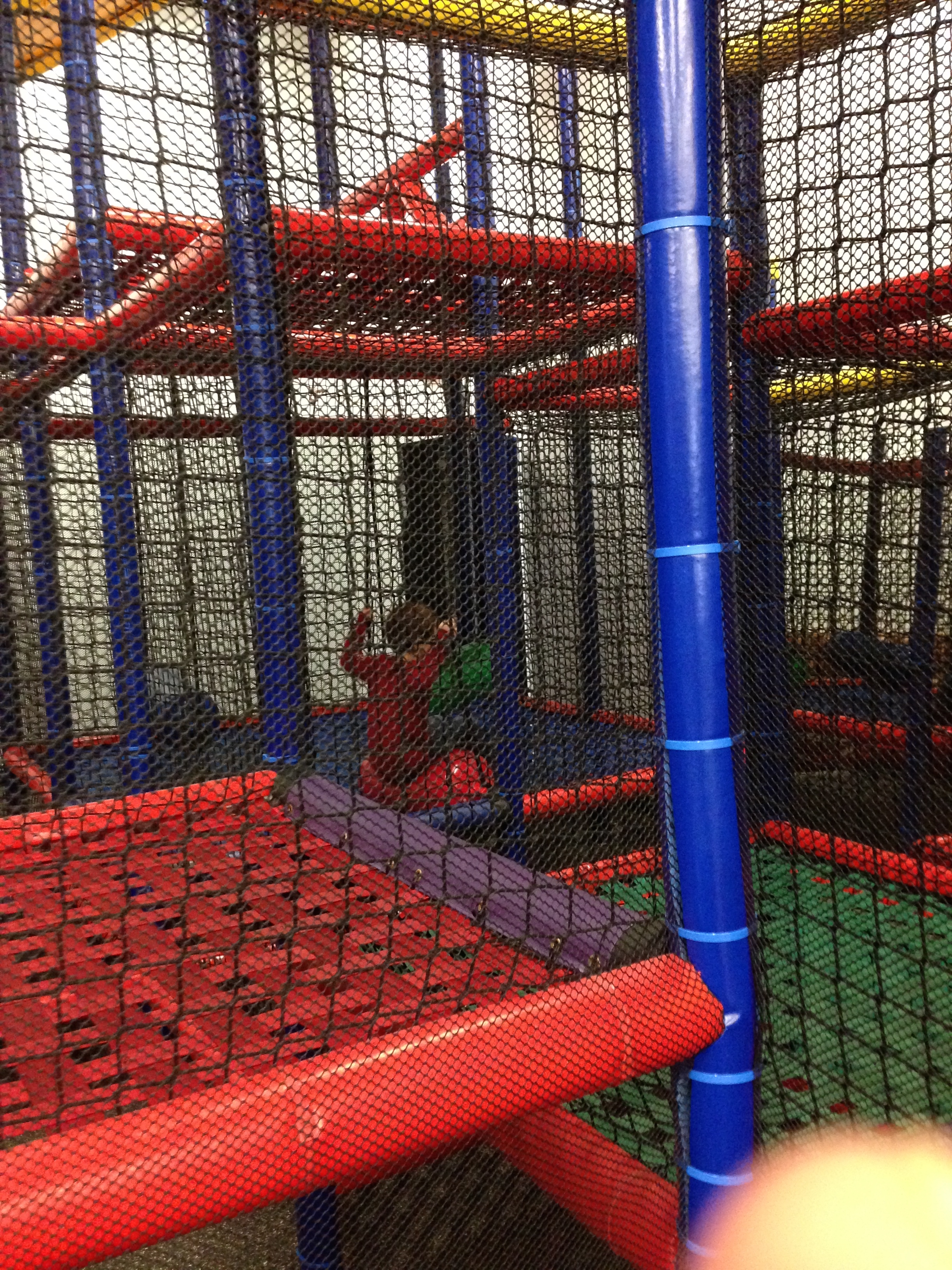
In Texas, at an indoor playground. It’s Easter Sunday afternoon and Martin is antsy, so my brothers and I bring him to an indoor playground. Martin removes his shoes and dashes into the climbing structure, a sort of gigantic, netted jungle gym. I sit with my brothers in an ample lounge surrounded on all sides by the jungle gym.

Two men enter. They look cool. Super-cool. Sunglasses. Ample, sculpted chests, pecs, and biceps, visible under fitted polo shirts. Nice jeans and shoes. Okay, I’ll say it. They’re handsome. They have four or five children with them. I’m not really sure how many, because my attention goes directly to the one with autism. From his face, I’d say he’s ten or eleven years old, but he’s almost adult-sized. He’s tall and, like many ASD kids, with their gut problems and food issues, he’s overweight. He’s not looking at anyone, or speaking. The other children store their sneakers in the plastic cabinets set up for that purpose. The ASD boy tugs off his sneakers and leaves them on the floor. The kids disappear into the climbing structure.

The taller of the two men, in a white shirt, seems to be the one in charge of the ASD boy. I guess that he’s the boy’s dad. Almost without a pause he scoops the abandoned sneakers and tucks them in a plastic cabinet. The two men take adjacent chairs and begin talking. They seem like good friends. I’m too far away to hear what they’re discussing.

I imagine it’s the New York Rangers, because really cool, handsome men everywhere, even in Texas, like to talk about the New York Rangers.

After some time the ASD boy emerges from the jungle gym. He seems confused until he spots the two men, then runs to them and climbs onto his dad’s lap. The boy is so big that he looks absurd perched on a lap, like a teenager or even a small man curling his body onto another’s. His dad, Mr. Super-Cool, Mr. If-We-Were-in-Any-Other-Setting-I-Would-Take-Him-for-a-Childless-Playboy, continues talking to his friend while wrapping one arm around his son and using the other hand to rub the boy’s scalp. He betrays no hint of feeling awkward about the 150 pounds of kid smooshing his quads. He continues rubbing his son’s head until the boy springs to his feet and scampers back to the jungle gym.

The super-cool guys and their charges leave before we do. (My brothers and I, in tandem, are lazy caregivers. While Martin plays, for more than two hours, we’re sipping coffee and teasing each other, destitute of other ideas for filling a holiday afternoon.) As the other kids get themselves ready, Mr. Super-Cool puts shoes on his son’s feet and ties them. They’re nearer us now, and I hear him ask, “You okay, buddy?” Then, probably because his son is not verbal, he answers for the boy: “You’re okay.” They walk out holding hands.

There is a beauty to scenes like this, to a teenage brother forced to mature into vigilance, to a dude with nothing but tenderness for the child who requires more attention than the rest combined. I want to wave my arms and shout, “Hey, us, too! Autism’s got us, too! I’m proud to be like you!” I want to be counted with those who rise so brilliantly to the challenges they face.

Yet I also regret these scenes. Autism is a monster of our own making. Its incidence is rising from some combination (I don’t know which; who does?) of the dangers we humans have unleashed. Chemical concoctions disguised as food. GMO’s. Antibiotics, overused. Electromagnetic fields. Mercury and other heavy metals. Radio waves. Injected toxins. Pollutants. Pesticides. Sure, I admire the caregivers who meet autism head-on. They’re making positive choices. Where is the choice for the children with autism, who need calming, who crave sensory stimulation, who cannot sleep, cannot relate, cannot adapt, cannot ensure their own safety?

And where will they be when the brave and patient caregivers are no longer available?

We’ve got to stop this.

Martin, in the indoor playground, somewhere.

Martin, in the indoor playground, somewhere.

The Case of the Missing Evenings

I have this memory from years ago, autumn 2011 (or so). We still live in the City. It’s late, maybe 11:30 pm, and I’m in bed, in our tight City-style sleeping quarters, propped on pillows as Adrian slumbers beside me. I have my computer on my lap. We are less than a year into biomed. Martin’s sleep has improved, but we still have bad nights. There is a chance that by 1:00 or 2:00 am Martin will be awake, and will stay awake until 5:00 am or later. I should be sleeping. I should be exploiting every moment in which my eyes can be shut.

I’m not. Instead, in this memory, I’m keeping myself awake to write a post for this blog. It’s not a lone memory, either. It’s an amalgam of moments, dates, times. In those early days of recovering Martin, I managed amazing feats of strength. I worked nearly full-time, I spent five or six hours a day creating menus and procuring and preparing food, I tended to Martin throughout the night, I got by on three or four hours’ sleep, I lost 39.8 pounds. (The 39.8 pounds I lost intentionally. Thank you, Weight Watchers.) And I blogged. What little rest wandered into my grasp, I forewent in order to write.

I’m not the only one. Every day, autism parents do what I’ve just described, and more. Every day, autism parents work, and wade through biomed with two, three, four kids, distant families, unsupportive co-parents, financial concerns that I’ve never faced. Every day, the community that I’ve come to know along this journey reminds me that my struggles, while monumental to me, are but stumbling blocks. I am so fortunate.

From that memory, of me, awake, pounding out blog posts on the near and far sides of midnight—from that memory, fast-forward to now. Martin, virtually without exception, sleeps through the night. I sleep, too. So much more than I used to. I’ve declared 2015 to be a year of taking care of me, and Proyecto Numero Uno is sleep. I’ve rearranged my schedule to make sure I sleep. I used to tuck Martin into bed and then begin chores: preparing Adrian’s and Martin’s lunches, straining broth, baking grain-free muffins, cleaning litter boxes. I’ve become hyper-vigilant about incorporating those chores into my day. Most weeknights I’m in bed by 9:30 pm, not long after Adrian gets home from the office, and asleep by 10:30, and not up until 5:45.

Yet I’m tired. Not bone-tired. Not like in the early days of Martin’s recovery, when I avoided sitting down during the day, because anytime I was off my feet I might fall asleep inadvertently. But tired. More tired that I should be (I think) when I’m getting between seven and eight hours’ sleep per night.

I have several theories on why I might be tired. I think it’s possible that, after years of laboring long hours for Martin’s recovery, and sleeping only when his restlessness allowed me to sleep, I’ve fatigued myself to the point that my own recovery will take more than a few months’ adequate rest. My body may still be readjusting to getting a full night’s sleep. I’ve read also about caregivers’ exhaustion. The situation with Martin is so much better, and easier, these days. Still, making sure his needs are met, completing the work that biomed and homeopathy and therapy require, and worrying about his future take their toll. On the other hand, maybe I’m more relaxed because I can see how well he’s doing. Maybe I’m no longer surfing adrenaline from 5:00 a.m. till midnight. And what if I just need more sleep than I once did? What if I need nine hours now? I was 38 when we started recovering Martin. Currently I’m pushing 43. Holy cow, 43! How much sleep do we middle-aged folks need?

Whatever the cause of my tiredness, here’s one effect: My evenings are gone. They’ve disappeared. Martin and I have been on vacation this week, at my parents’ home in Texas. I’m working, a few hours per day, at my new home-based legal job. Other than that, I’m not doing much. Taking Martin to the indoor playground. Lunching with girlfriends. Challenging my brothers (also visiting) to Scrabble. Losing to my mother at cribbage. Yet, my writing is stymied, because I get to writing in the evening, and then the desire is gone. I mean, the desire to do anything non-trivial is gone. I toy with a crossword puzzle, deal some cards, eat popcorn, search Texas cable fruitlessly for a New York Rangers game, go to bed.

It’s the same story back home in New York. Once Martin is in bed, I’m done. I don’t have any creativity or energy for writing. Even a simple leftover task like emptying the dishwasher seems to take twice as long as it once did.

Scheduling has become more important than ever, because what’s going to get done has to get done before Martin gets home from school. From the time he arrives until bedtime, we have afterschool activities (personal training, church kids’ club, piano lessons, gymnastics, playgroup), homework, detox bath or sauna, vision/integration exercises, and dinner. That means my day, for everything else, spans only from 8:00 am, when Martin boards the school bus, until 3:30 pm, when he arrives home (except Tuesdays, when I leave home at 2:00 pm to pick him up for church). Seven-and-a-half hours for gym, blogging, lawyering, household tasks, grocery shopping, and cooking. The one task I do try to manage at night is to jot down an outline for the next day, an attempt to make it all fit. Even if the outline doesn’t hold, at least I’ve got something to shoot for.

I miss the evenings, the productive evenings.

Epilogue: Of course, there are exceptions. Tuesdays and Thursdays I have help from a sitter. If the Rangers are playing in the Eastern or Central time zone, I don my #30 Henrik Lundqvist jersey, head to a local pub, set my laptop on the bar, and eat dinner while blogging and watching hockey. It’s kind of a tradition by now—“Ah, my sweetheart’s here,” says Jimmy the bartender, in brogue, when he sees me enter. “The Rangers play tonight, do they, love?” At the pub, with my Rangers, I’m in my blogging zone, disrupted only by the occasional drunk who just can’t accept that a chick alone in a bar watching hockey with a laptop actually wants to be left that way.