What’s Working Now

Are you familiar with miracle products?

I participate in various social media groups for parents with recovering children. Often, I see posts like this:

“We just started this [miracle enzyme, supplement, probiotic, oil, &c.] ten days ago, and I can’t believe the progress! My son is making consistent eye contact, he’s increased his vocabulary, and he finally potty trained! Today I got a note from his preschool teacher saying he is more ‘with it’ and making cognitive leaps. I’m kicking myself that we didn’t try this before now. Anyone having similar results?”

And then, comments like these:

Commenter 1: “Yes, yes, yes! [Miracle product] moved my son from babbling to words!”

Commenter 2: “We added [secondary product] to [miracle product], and the gains were even greater. We’ve been on them both for a month and will be continuing.”

Commenter 3: “This is all amazing! Where can I buy [miracle product]?”

Commenter 4: “[Miracle product] got my daughter into Princeton!”

Posts, and comments, touting a miracle product frustrate me.

Miracle-product proclamations frustrate me because autism varies from kid to kid. The health and immune challenges underlying autistic symptoms include, and exceed, neuroinflammation and other chronic swelling, mitochondrial disorder, genetic mutations, leaky gut, yeast overgrowth, oxidative stress, excess propionic acid. Autism exhibits disparate effects on cerebral function in girls versus boys. “Autism” is not a single malady and is never identical. That miracle product? Shoot a paint ball into a crowd. You’re bound to hit someone and splatter a few others. The rest will probably be left wondering what the fuss is.

I can understand that, if you’re thinking about trying a new product, you may want to post an inquiry about others’ experiences with the product. But given that the underlying disorders are child-specific, and that recovery means finding the right combination of many factors over time, why tout miracles? We parents of children with autism, we tread on hope. We’re easily led. When ten marvels in a row fail to help our kid, we end up embittered and broke.

Recovery from autoimmune disorder is a long, tedious slog without shortcuts. Sure, some families recover their children within a year, those lucky dogs. Most take much longer. Many children never get significantly better. The only miracle in autism is that, given our increasingly toxic world, we’re able to fight the spectrum at all. The amazing supplement, probiotic, or whatever, might indeed have given your kid the week of his life. That’s not a wonder. If you must tout a miracle product, don’t do it after a week, or a month. At least wait a year, then let us know if the developments continued, and speak in measured, child-specific terms.

Dear readers, are you wondering why I’m ranting? That was all an introduction to today’s post, which in comparison to its introduction, may seem brief. The topic is what interventions are working, right now, in combination, for my one kid, with his own particular combination of health challenges.

Following “Hard to Blog an Avalanche,” I received several inquiries about what I think has instigated Martin’s recent growth. Usually, when Martin improves and I’m asked why, I answer, “Don’t know. Obviously, something in the millions of things we’re doing is helping.” This year, I have a better inkling. I have seen five interventions correlate, almost certainly, with better health and/or increased speech:

1. Camel milk. Martin started drinking it this spring, and his language took off. Why? Too long for this post. Check back in a day or so to read “What’s the Deal with Camel Milk?”

2. The GAPS diet. I’ve written a lot about GAPS recently, and I’m also working on a post about how I don’t buy into everything that Dr. Campbell-McBride says. For now, it suffices to say that Martin’s digestion has improved.

3. Candex. We have battled yeast overgrowth, in one form or another, repeatedly since we began this journey. Going off just about every form of sugar helped, but only for a while. Nystatin did nothing positive. Earlier this year, poor Martin’s yeast was so bad that he clawed his skin raw. Finally, his biomed doctor said to try Candex, an enzymatic product. The same night he started Candex, Martin had a foul-smelling BM—yeast, I think, leaving his system. The next day, the skin rash began to clear. Since then, the candida has been under control, so much so that I’ve been able to add a little more fruit into Martin’s diet without worrying about the fructose feeding yeast.

4. Enhansa. Lee Silsby Compounding Pharmacy makes Enhansa, or curcumin, a derivative of turmeric. Martin suffers from chronic inflammation, which places undue pressure on his compromised immune system. Turmeric’s anti-inflammatory properties seem to be relieving that inflammation, even to the point that his face has lost its “puffy” appearance. (The puffiness was visible only to me and others to whom I pointed it out in photographs. Still, it was there, and a symptom of his systemic inflammation.)

5. MitoSpectra. This is a proprietary mitochondrial supplement blend of vitamin C (as ascorbic acid), vitamin E (as d-alpha tocopherol succinate), vitamin B5 (panthothenic acid), L-carnitine, and coenzyme Q10. We have used each of the component supplements before, alone and in combination, and indeed Martin still adds separate sources of vitamin C and L-carnatine. MitoSpectra, however, seems to combine the five supplements in a form and proportions that do well for him: He shows more coordination and energy, and less “floppiness.” At times I wonder whether those improvements are dependent on continued use of MitoSpectra; my hope is that, as his immune system overall continues to heal, his own mitochondria will be able to assume the work MitoSpectra is now doing.

Camel milk, GAPS, Candex, Curcuma, and MitoSpectra. Not a miracle, not any one of them.

Each a step in this tortuous recovery path.

Just maybe a longer stride than I’m used to.

Increased energy, coordination, and willingness to try new things. I'm so into these changes.

Increased energy, coordination, and willingness to try new things. I’m so into these changes.

Preferences

Martin has three rain jackets. The first raincoat he acquired when he was two years old. It is a yellow hand-me-down, big enough for a nine- or ten-year-old, from our then-neighbors. The second and third rain jackets are blue and red, and sized much more appropriately for a kindergartner. Samara bought them for Martin a couple years ago.

For a long time, Martin preferred the yellow raincoat, even refusing to wear the blue or the red. He didn’t seem to care that the yellow raincoat was so big that it bunched around his knees, got tangled between his legs, sometimes tripped him. Yellow is Martin’s favorite color. At the first sight of a raindrop, he wanted that yellow rain jacket.

We’ve had a lot of rain lately. To my surprise, Martin selected the blue rain jacket to wear, twice in a row, and then the red rain jacket.

This week it rained again. Five minutes before the school bus was due, Martin and I had the following conversation:

“Which rain jacket would you like to wear—the yellow one, the red one, or the blue one?”

“The red one.”

“The red one?”

“Yes. No! No, the blue one!”

“You want to wear the blue one?”

“Yes.”

“Martin, why don’t you like to wear the yellow rain jacket anymore?”

“But because the yellow one is too long.”

“You don’t like the yellow one because it’s too long? Thanks for letting me know that, Martin.”

Two biggies in that convo: First, Martin told me a plausible reason for his preference. And even though he made his “but because” mistake, he stated his reason plainly and appropriately. Second, Martin rationally chose not to select the yellow item. Kids on the spectrum like repetition. They like sameness. So does Martin, but perhaps his “stuck in a rut” mentality is beginning to loosen.

What’s next? Actually accepting an orange subway seat, if the yellow ones are all occupied?

I dare to dream.

Taking advantage of one of the sunny days. Learning to slide down a pole---to put both hands on, leap from the platform, and wrap his legs---has been a big achievement for Martin.

Taking advantage of one of the sunny days. Learning to slide down a pole—to put both hands on, leap from the platform, and wrap his legs—has been a big achievement for Martin.

What Comes Last

A couple years ago—hard to believe how long we’ve been at this—I lamented to Martin’s (then) biomed doctor that, while Martin’s behavior, sleep, and overall health had improved, I had not seen as much progress in his language. The doctor told me not to worry. “Language,” she said, “often comes last.”

I carried that mantra for a long time: Language comes last. When it took Martin so long to start asking questions, or to use the command form, or to pick up nuances and idioms, I thought, well, language is going to come last.

Or will it?

This year, Martin’s language is much improved. As I’ve written, his speech is not perfect. It often sounds scripted, or rote. Sometimes it seems like he’s exploring a foreign language: Unable to find the easiest or most direct way to express himself, he searches his capabilities and comes up with an unusual (original?) formulation. And his receptive language, his processing delays, still poses challenges; I might be explaining to Martin that we’re going out after lunch, only to have him melt down because he wants lunch, and the “going out” part has registered but not the “first, lunch” part. At his time, he still very much needs the intensive-language-based school program he attends.

That fact notwithstanding, Martin can speak. He speaks in sentences. He asks questions. He orders me around. When he’s not frustrated and mixing up his words, he can express himself, in a manner understood by most anyone who listens with care.

To that extent, language has come.

Language has come, and it did not come last.

Martin’s recovery has two additional, gigantic roadblocks that are not language, though language-related.

First, Martin still can’t “attend.” He doesn’t pay attention. He doesn’t listen. He talks when others are mid-sentence. Unless an activity is one he enjoys (music, eating, drawing), he shows little interest in what others are doing. And even when something does catch his attention, he doesn’t stay with it for long, except for example to stim by hitting one music key repeatedly, or to read his favorite book, The Philharmonic Gets Dressed, over and over.

Martin’s teachers have identified attending as his most significant challenge in the classroom; even with a 3:1 student-teacher ratio, he has trouble following. At home, the nanosecond attention span means it might take Martin 20 minutes to change clothes, because he gets distracted, or succumbs to boredom and starts complaining instead of dressing. It also keeps us from sharing experiences. If I say, “Oh, wow! Look at that bird!”, Martin might glance out the window, then jog away before I can comment on the bird’s color or size, or he might not look at all.

So language didn’t come last, because language has developed more than attention.

Second, Martin still has a lot of trouble socializing.

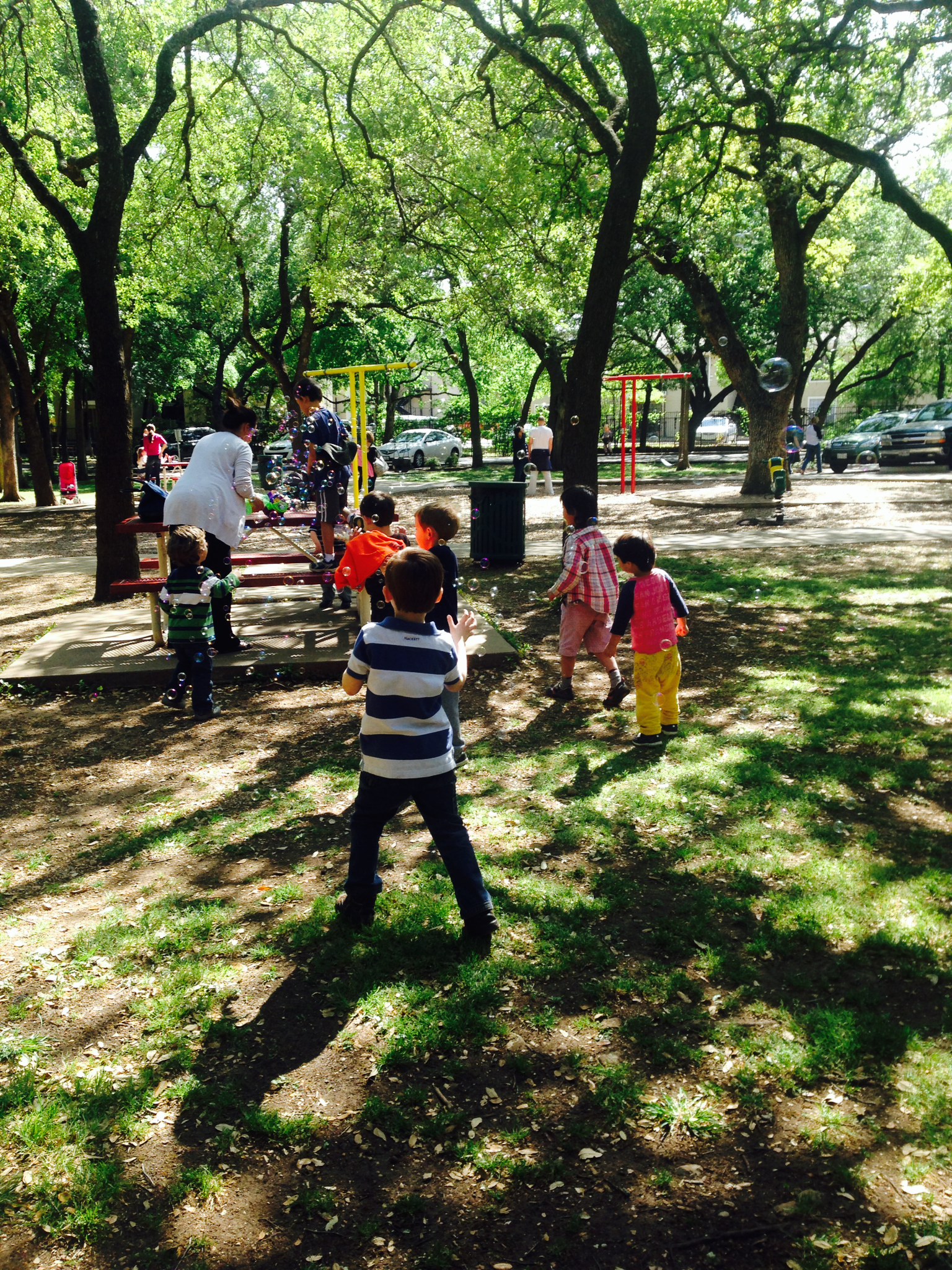
When we were in Austin around Easter, I arranged a playdate with “Stewie,” the six-year-old, typically developing son of a college friend. Martin and Stewie had never met, and Stewie was not informed in advance that Martin has challenges. We met at a crowded playground. The playdate went remarkably well. Although Martin was less interactive than an NT child would have been, he didn’t spend the playdate in his own world. Several times (some with prompting) he went to find and engage Stewie. He and Stewie stood together and gazed at an inchworm hanging on Stewie’s finger. When one family at the playground brought out a bubble pumper, Martin joined the other children, clapping his hands and chasing the bubbles. Stewie never even shot his mom that quizzical look that means, “Is there something different about this kid?”

The experience with Stewie gave me a sort of high. I texted Adrian: “Martin is having a playdate with a typically developing boy, and he’s doing FANTASTIC!”

But of course, in autism recovery, disappointments find a way to deflate any high, and four days after Martin played with Stewie, we had a much less successful playdate back in New York, with four classmates from Martin’s kindergarten. Martin attends a school for children with speech and language delays. About half the kids in his class also have autism or some other social impairment. By coincidence, none of the four boys other than Martin who attended this playdate had any social impairment. They are the social kids.

What happened was typical of what we experience when Martin attempts to play with more than one child at a time: Martin was left out. In a one-on-one situation, a playmate has few options other than to engage Martin. In a multi-kid situation, those without social impairments gravitate to each other, and away from the awkward boy.

Martin’s classmates, at the playground where we met, decided to fight dragons. They scampered about as a group, swinging imaginary axes, wielding nonexistent swords, screaming with excitement at the game they’d created.

Martin climbed on rocks and monkey bars. He went down the slide and wandered across the playground’s bridges. When I suggested that he join his classmates’ game, he approached the crowd and, using the social skills he’s been taught, ask shyly, “What are you doing?”

But the other boys were too boisterous and engaged to hear, and they ignored him.

Martin sat down, alone.

As he and I were walking to the car to return home, I asked, “How was the playdate? Did you have fun?”

My son responded, “No. I would like to do a playdate with only grown-ups.”

The next morning, Martin said he did not want to return to school. Thinking that he was experiencing end-of-spring-vacation blues, I tried cajoling him with his favorite subjects—“Do you think maybe you will have computer class today? What will you make in art class?”—and enumerating his classmates. “Do you think Christopher will be there? Are you looking forward to seeing Jack, and Quinn?”

When I finished my song-and-dance, Martin shook his head and said, “No. My friends at school don’t like me.”

Some defeats just crush your soul, don’t they?

So language didn’t come last, because language has developed more than socialization.

Which begs the question: What’s going to come last?

How will I know when we’ve reached our destination?

Martin, in the blue and white stripes, joins in bubble fun during his playdate with Stewie.

Martin, in the blue and white stripes, joins in bubble fun during his playdate with Stewie.
A Whole Different Animal

Adrian was supervising bath time this weekend when Martin, from the tub, started describing the stuffed animals in his bed: Curious George the monkey, Maisie the tiger, Mitt Romney the elephant, Boo the dog, Godiva the bear and—an aye-be’el.

“An aye-be’el?” Adrian asked. “You have an aye-be’el?”

“Yes,” Martin answered. “An aye-be’el.”

I happened to be passing through the bathroom. Adrian looked at me, as if I should know what Martin was talking about.

So I asked, “What’s an aye-be’el, Martin? Is that an animal?”

“Yes. An aye-be’el is a whole different animal.”

Martin’s kindergarten teachers have said that he often surprises them by being completely on top of a lesson even when he doesn’t seem to be paying attention. Where Martin appears to be directing his focus, in other words, can be deceptive.

The answer came to Adrian suddenly. “Martin, is that something you heard Daddy say? Did you hear Daddy say that an aye-be’el is a whole different animal?”

“Yes.”

“He means an ABL,” Adrian explained to me. “An ABL is a whole different animal. He was playing on the floor when I was making calls earlier.”

Aha! The puzzle came together. ABL stands for asset-based lending. It describes a specific type of credit agreement—a whole different animal when it comes to credit agreements. Adrian, who is a corporate lawyer, had been on the phone all afternoon, negotiating. Martin had entered periodically to stack his blocks on the big rug in Adrian’s home office. He’d probably heard his father say something like, “They want to talk about an ABL? Oh, no. An ABL is a whole different animal.”

Months ago, on a recovery site, I read a father’s post asking how much ASD children, before they recover, are “with it,” i.e., how much the children absorb and will later recall from the time before they are fully communicative. Martin may not be the best example on this, at least not anymore, because these days he’s reasonably far along in his communication skills. Nonetheless, think about the ABL, and then about this: Martin possesses astounding recall of events that transpired years ago. We sometimes have conversations along these lines:

Martin: “We were on this bridge before.”

Me: “I don’t think so, Martin. Maybe this bridge looks like another one we drive over?”

Martin: “We were on this bridge when we went to the lighthouse.”

Me: “Holy cow, you’re right. We went to the lighthouse where you were two years old. Do you remember that?”

Martin: “The lighthouse is red and white.”

We might have been to that lighthouse shortly after Martin’s diagnosis, before biomed, when he still drifted the perimeter of rooms and ignored his own name. But he remembers. It’s all in that head of his.

A close friend of mine was in an elevator with her five-year-old ASD son, who is making wonderful progress but still mostly pre-verbal. (I’ll call him Jason.) They’d had a horrible morning; because of a snowstorm, Jason’s school bus was delayed, they’d had to return to their apartment to call the bus company, Jason had become too warm in his jacket, and finally they were on their way back down to wait again for the bus. Frustrated, Jason acted out in the elevator.

Jason’s mom, my friend, immediately restrained him and prevented the situation from escalating.

The reaction of any decent person who saw this would have been, “Good catch, Jason’s mom! Way to anticipate and be on top of his behavior!”

The reaction of the one man who was in the elevator with them was to look my friend in the eyes, point to Jason, and say, “You need to get that thing under control.”

There are, of course, a thousand tidbits that gall me about what happened to my friend and her son in that elevator.

The most galling is this: Did the ignoramus who made that comment assume that, because Jason has limited speech, he can’t hear and comprehend? Did he think that an intelligent and creative boy doesn’t know what’s being said about him?

(“Ignoramus” was not the first word that came to my mind. You know that.)

Jason probably didn’t look like he was listening, or understanding. Martin probably didn’t look like he was eavesdropping on Adrian’s phone calls, either.

But they were. They always are.

Otherwise

Are you wondering what Martin said last night?

Last night Martin said, “Otherwise.” He came up with the word. He used it properly and in context.

You’re thrilled? You can’t believe it? Here’s what happened:

Adrian and I put Martin in bed at 8:00 p.m. Martin was all worked up, absolutely could not go to sleep. We are fighting yeast again (Martin versus yeast overgrowth, round IV, get your tickets now) and started nystatin on Friday. Martin’s doctor warned me that we might have a difficult week with yeast die-off; so far, our “difficult week” has entailed diminished attention and focus, fleeting eye contact, and unrelenting hyperactivity. Fabulous.

After an hour of bouncing on his mattress and (needlessly) visiting the potty, Martin started yelling the he wanted to go in “the big bed”—my and Adrian’s bed, where Martin is allowed only in the morning, to wake up. Adrian, exasperated, suggested that we let Martin fall asleep in our bed and then move him back to his room. I agreed but said it had to appear to be Adrian’s idea alone, so Martin wouldn’t start thinking he can bug me for big-bed access.

Adrian called Martin to the family room, where we were watching House of Cards. I hid behind the sofa (Adrian’s idea alone!) and listened. Adrian told Martin that he could take a stuffed animal and climb into our bed, on one condition: that he settle down and go to sleep. Did he understand?

“Yes,” answered Martin. “I will go to sleep. Otherwise I will have to go back to my bed.”

That was it! No prompts, no hearing anyone else say it first, nothing. Martin casually lobbed “otherwise” into the conversation, as if it were an everyday word.

As if he’d never once tested in the bottom third percentile for expressive language skills.

Now, if only he’d settled down and gone to sleep….

Idioms All His Own

We had to wait a few years, and now Martin’s speech skills are finally progressing. He has trouble with more complex formulations, such as asking and answering “why” questions, or narrating a string of events, or using “did” plus the infinitive instead of the past form (“He did went.”). Other than that, he can express almost anything.

On the other hand, when I say Martin can express almost anything, there’s a qualifier: “in his own way.”

Sometimes he’s making up words. I go with it and use the correct term in return:

“Martin, I don’t want you writing on these piano keys.”

“No writing?”

“No.”

“No marking?” (He means using a marker to write. That’s close.)

“No.”

“No pencing?”

“Nope, no using a pencil.”

“No craying?”

“Nope, no using a crayon, either.”

Sometimes his formulation leaves me wondering, “What led him to that way of saying it?”:

“Martin, would you stop playing with the telephone?”

He’s in the bedroom, messing around with the bedside phone.

“Okay.”

He keeps playing with the phone.

“Hey, get out of the bedroom.”

“Okay. I’m going to go to the room that’s written here.”

He points to the side of the phone, where “family room” is written on the extensions. Then he zooms away to the family room. Most people would have said, “I’m going to the family room,” right? Martin’s choice works just as well.

He likes to make comparisons. Some are natural and make a lot of sense, as when he asked me, “Am I going to have two [Anat Baniel Method] lessons with Miss Sharon today, just like I had two lessons yesterday with Miss Verena?” Or this morning, when he wanted to go to the basement and play the various musical instruments Adrian has relegated there: “I have many instruments in the basement, like a concert.”

Other comparisons—not so natural. Martin likes to drink a kombucha beverage with chia seeds. This morning I asked what he wanted to drink with his (neverending) breakfast. He responded, “I wanted kombucha with a group of seeds in it. Like a singing group.” Chia seeds like a singing group? Does he really think that, or is he experimenting with uses for the word “group”?

I suppose that, as his language continues to improve, Martin will speak more like other people. I’m trying to write down these little Martin-isms now, while we’ve still got them. They represent one more special mile in the recovery marathon.

Goodbye on His Own

Special education means special transportation. Martin does not have to wait at a bus stop. Instead, a bus (yes, it’s the short bus) picks him up at the end of our driveway and delivers him back after school.

(Hurray! We have a driveway, and we live on a dead-end lane. Waiting for the bus is so much easier than when we had neurotypical kids parading past.)

When Martin comes home, I walk to the end of the driveway to meet him, and once he’s off the bus we follow a little ritual. (According to the principles of RDI, I vary the ritual slightly each day, to facilitate Martin’s dynamic intelligence.) I ask him how his day went, take his heavy backpack—containing a lunch cooler with glass and/or stainless-steel containers, a stainless-steel drink holder, multiple notebooks for my communications with his classroom teachers and his therapists, and sometimes spare clothes—and hold his hand while we wait for the bus to turn around at the dead end. Then I remind Martin that we need to wave good-bye to the bus driver and the matron, and I count to three, and we wave together as the bus passes us and beeps.

Yesterday afternoon something new happened. As usual, Martin took his time to descend the three steps and land on the driveway; he still tends to look forward instead of at his feet, so big stairs can be challenging. He walked two steps toward me, as if to begin our ritual—

Then, instead of coming to me, he turned around by himself, waved through the still-open bus door, and called to the driver and matron, “Goodbye! Goodbye! See you tomorrow!”

This may be one of those occasions when I need to explain, for anyone not raising a child with autism, what the big deal is. The big deal is twofold: (1) Martin did something different, and (2) he displayed awareness of those around him and their needs. He realized that the driver and matron were leaving, and that people who are leaving expect goodbyes.

Martin says goodbye a lot. He does so after I say, “We’re going. Let’s say goodbye,” or, “What do we say now, Martin?” I cannot remember a previous occasion on which he wished someone goodbye unprompted. Will he do it again this afternoon? Maybe. Maybe not. Often a new skill emerges, disappears, and then at some later date shows up in regular use. I’m less worried about consistency right now. The key is that social awareness is within Martin. With every bit that his body heals, we unlock more of the intangible.

Why, Hello Again

How does one restart blogging?

I’ve been thinking about that. Mostly while lying awake at night and also wondering why the [redacted] I’m not blogging. But still.

And ta-da!: The plan I’ve conjured, the blogging redux after seasons of silence:

An update.

I’ll offer my readers—in the event I retain any—tidbits about where we stand now, and then, my blog restarted, I’ll pretend like I never was away.

1. We’ve left the City for the suburbs. New York, New York, no more. We moved June 4 to a ranch house, situated on 1.15 acres in a town where many of our neighbors prefer another NHL team to the New York Rangers. An autism diagnosis was one thing. This kind of upheaval—it’s disconcerting, to say the least.

2. Martin attends kindergarten at a private school for children with learning differences. His class has twelve pupils and multiple instructors. Adrian and I feel extremely lucky that Martin has the chance to attend such a school, never more so than this past weekend, when we attended one classmate’s birthday party and watched Martin frolic with his new best friends.

3. Martin receives traditional occupational, physical, and speech therapy at his school. Saturday mornings I drive him into the City for two sessions of Anat Baniel Method (ABM) therapy. We continue working with a HANDLE therapist, and doing home-based exercises activities on the RDI approach. One evening per week Martin takes piano and drum lessons (the latter by his own initiative) with a certified music therapist.

4. We have not yet recovered Martin. We have, however, made progress, and a good deal of it:

•            Though he retains some patterns, Martin’s speech is rarely rote anymore. He has some quirks, such as substituting “but because” for “because” and adding “for” where it doesn’t belong, as in, “Can I have a piece of paper for to draw a picture on it?” Nonetheless, he can express his wishes, wants, and needs verbally, and well.

•            Martin can engage in conversation of six or more exchanges, so long as he is answering the questions (not asking them, which is a level higher). Here is an exemplar talk, which we had when he arrived home one day last week:

“How was school today?”

“It was good.”

“Did anything special happen?”

“We had a surprise reader!”

“Oh, yeah! Who was the surprise reader?”

“It was Quinn’s family.”

“Quinn’s family? His whole family came, not just his mommy or daddy?”

“His whole family came.”

“Wow! What was the book about?”

“It was about snowmen.”

“Did you like it?”

“Yes. I liked it. We made snowmen!”

Note that Martin, who once just “said things,” was speaking accurately. I confirmed later that Quinn’s mother, father, and older sister had all come to do the surprise reading, that they’d read a book about snowmen, and that they’d helped the class with a snowman-making craft project.

•            Lethargy is a thing of the past, and Martin’s “floppiness”—his tendency to fall onto anything within reach—diminishes every day. His core strength has improved, insofar as he is as likely to sit up as to slouch. His manual dexterity is such that he grips a pen appropriately for writing and drawing, he can manipulate small items like pills, and he uses his hands independently for drumming. (That last achievement might not pertain to dexterity per se.)

•            Martin takes a keen interest in his peers: what they eat, how they play, the structure of their families, where they live. He requests play dates. What he still lacks is a solid understanding of how to interact with friends. We’re working on that.

We vacationed recently at a resort area. When Martin was having trouble engaging any other child there, I would approach the child’s parent and say something like, “I think my son would like to play with yours. My son has Asperger’s, and he’s never quite sure how to go about making new friends.” “Aperger’s” sounds much less scary than that other A word, I think it’s pretty accurate for where Martin is now, and the parents I approached responded uniformly positively. Martin made a couple of “vacation friends” that way.

5. Martin still exhibits “autism” behaviors. He perseverates. A lot. This has been an issue forever. Right now he prattles endlessly about traffic lights, hair length, the time, and the moon. He also has three prominent stims (self-stimulatory behaviors), which become more pronounced when he’s tired or detoxing. The stims are running back and forth, making a slurp! sound by sucking air through his lips, and carrying or playing musical instruments. And of course, Martin can be rigid. He wants to wear his blue vest every day, drive one particular route home, read Pete the Cat or Knuffle Bunny books every night.

6. I now understand “the long haul.” I think that, when I started the process of recovering my son, I didn’t really comprehend what how long one might need to haul. The mother who introduced me to biomedical intervention had largely recovered her son within two years, and was done with the process entirely within three years. I failed to grasp that her family’s timing was exceptional. I thought that by kindergarten we’d be done.

My family has been at this three years now, chipping away at the underlying health issues that exhibit themselves as “autism” in Martin. My son has made staggering process. If we never achieve anything more, I will know that our time and money have been well spent. Still, he is not recovered, and much work remains. Fortunately, I no longer fear that some mythical window will close while Martin is five (he’s five now), or seven, or any age. A mother of a recovered 14-year-old told me recently, “Our best year was when he was 12. Twelve years old is when he made the most progress.” Twelve years old is a long, long way off for Martin. If that turns out to be our best year, so be it. We’ll get there.

7. This year, 2014, is going to be extraordinary. Don’t ask me how I know. I can say this: I woke on January 1 with that feeling, and it has not left me. Martin will hit new milestones, and so will I. This past weekend I met with an old friend from law school. My friend used to work in venture capital but for the last year or two has been searching for a new path, something more creative. I told him that I haven’t been doing much writing, or much of anything else, because I’ve been so focused on Martin’s needs. Without warning, he turned to me and vocalized something I already knew: “2014 is going to be a banner year. For you, for your son, for me. I think this is our year.”

See you soon.

My Rainbow

Martin and I were riding the subway Saturday morning. We had with us a rainbow that he had made in school out of construction paper and Froot Loops. (Ugh.) The following conversation ensued:

Me: “Martin, do you remember where you got this rainbow?”

Martin: “I made it in school.”

Me: “You know, Martin, rainbows make people happy—which kind of means that you’re my rainbow, because you make me so very happy.”

Martin: “I’m your rainbow.”

Me: “I think you are.”

Martin: “My name is Rainbow.”

Me: “Your name is Rainbow? Really?”

Martin: “No.” [Laughs.] “My name is Martin. I’m being a rainbow.”

Martin said those things, in that order. My kid said those things.

In professional ice hockey there exists an unofficial (and unsanctioned and probably unadvisable; check out The Last Gladiators) player role, known as an enforcer. An enforcer’s job is to keep the opposing team from playing too rough. For example, if an enforcer sees an opponent intentionally late-check a star player, the enforcer might respond by grabbing that opponent by the jersey and punching him several times, as a warning to leave the star player alone.

(Don’t be put off. If you’re not already an ice hockey fan, do please start watching. The combination of grace, strategy, and grit that carries a hockey team to victory resembles the traits needed to recover a child from autism. Honestly.)

Have you heard of the crazy Fred Phelps family from Topeka, Kansas? These are the people who—despite lacking affiliation with any Baptist denomination, and as far as I can tell, despite following none of Jesus’ major teachings—call themselves the “Westboro Baptist Church” and protest at high-profile or military funerals because, they claim, God opposes homosexuality. (I realize that sentence lacks substantive logical foundation. That’s intentional.)

Apparently these Phelps people threatened to show up at the funerals for victims of the recent Boston Marathon bombings. I saw something circulating on Facebook that I should have downloaded, because I can’t find it now. It was a picture of a Boston Bruins enforcer, during a game, on his knees, straddling an opposing player whose back was on the ice. The enforcer had his gloves off, which is dangerous because punches fall softer when the fist is padded by a hockey glove, and he was plainly beating the daylights out of the opposing player, whom he’d rendered defenseless. The caption under the picture said something along the lines of, “This is what we do to hockey teams we don’t like in Boston. Please, come protest a funeral.

When Martin was diagnosed with autism, at 27 months, he could label objects and people and colors, and he could speak in echolalia, but he had no functional language. At 36 months, he had begun developing functional language but could not grasp concepts like first and second person; he said “I” when he meant “you,” and “you” when he meant “I.” By 48 months, he could respond to questions but could not engage in dialogue, i.e., carry a conversation beyond one response.

On Saturday, Martin sustained that rainbow discussion. He maintained consistent eye contact throughout. He ended by drawing a distinction between being called Rainbow and being a rainbow.

Please, come tell me recovery from autism is not possible.