Most Special Guest Post Ever

As you can (ahem!) probably tell, this blog doesn’t get much editing. As to most entries, I draft, read through once, add any links or photos, and post, sans quality check.

Occasionally, however, I request a second opinion before I post, because I’m writing about a friend or relative and want him/her to have the story before the world does, or in order to check whether my words will convey what I want them to. In the entry titled “For Diana,” I wrote to a fellow ASD parent who has commented thoughtfully on my blog over the past two years. The topic of “For Diana” was our disagreement about approaches to treating autism. In that instance, I asked Adrian to read the draft before I posted. I was looking for a gut-check: Was I respectful toward Diana’s position? Did I address her comments without extraneous points? Did I acknowledge my own biases? Adrian did a commendable job. He pointed out one paragraph where my words sounded “snide” (I edited that) and suggested one comment to which I could add more depth (I tried).

And then, to my surprise, he started to add his own thoughts to what I had written. Adrian listens, and responds, when I talk about Martin’s challenges, treatment, and achievements. The “big decisions”—should we try chelation? is HBOT worth the investment? where should we live? where should Martin go to school?—we make together, based on information I assemble for Adrian to review. Beyond those discussions, Adrian rarely volunteers his thoughts about autism, or recovery. Autism recovery is my department. Adrian’s departments are vacation planning, opera excursions, history lessons, and the family economy. Adrian enjoys a probative biography of Nixon; my desk is littered with articles about MTFR mutation. Indeed, if we decide to tell a friend or family member that Martin has autism (we’re guarded, in that regard), I am the one who sits the initiate down for that talk, without Adrian present.

Yet here he was, freely telling me why he thought Diana’s opinion was mistaken. His statements were original, and different, and not echoes of mine.

“You should write that down for my blog,” I said when Adrian finished. “Really. It would mean a lot to add your voice to Martin’s story as it evolves. Otherwise it’s always just me, speaking for both of us.”

“Maybe,” Adrian said. “I guess I could think about it.”

We left the topic at that. I didn’t want to push Adrian. In addition to his autism reluctance, Adrian doesn’t enjoy writing in English, other than technical finance and legal documents. English is not Adrian’s first language, or even his second, and despite his thorough fluency (better grammar than most native speakers, I tell him!), he’s never seemed to gain full confidence.

A month passed. And then almost another month. And then Adrian sent me an email with no re: line and no content other than an attachment titled “martin.docx.”

Here is what he wrote:

I am Martin’s father. My wife, Maria, asked me to write a note for her blog on Martin. The request was made in response to a reader advocating that our approach to Martin’s autism is not worth pursuing. The commentator argued, thoughtfully and politely, that trying to recover a child from autism is tantamount to wanting to “change” the child, while in fact the child was just fine but different. Being “different” would not merit trying to change the child, and could at some point be perceived by the child as a rejection of what he or she is. “I don’t want to return my son to full neurotypicality because I don’t see him as having been in a certain place and then having regressed or changed,” wrote the commentator. “I don’t understand how the language and idea of ‘cure’ and ‘recovery’ is consistent with teaching our kids to love and accept themselves as they are.

The commentator is not alone. Many people in the unwilling community bound by autism argue that there is nothing that requires addressing or treating autism. An autistic person is perfectly healthy and happy, just not neurotypical. It is up to us to accept autistic persons as they are.

Maria and I have a very different attitude towards autism.

To me, autism is a deeply uncomfortable topic. To my wife, it is a topic in which she has simply become an expert. I view autism as a topic that occupies too much space in our lives. Maria sees it more like an important, unavoidable part of our lives. I have been shaken by the existence of autism in our family. She has decided to confront it.

But we both share a commitment to doing everything we reasonably can to bring our son back to neurotypicality.

From my standpoint, this is not about accepting or rejecting one’s child. This has little to do with my personal relationship with my child. This is about the responsibility of a parent to prepare his or her child to live in the actual world.

One of the most critical things a parent has to do is to raise a human being who can, to the greatest extent possible, fend for himself in the real world. My job as a father is not only to love and nurture my child—and, as a result, to be accepting of him—but to prepare him for the world in which he will have to live. Martin will have to live in a world that I will not always be able to shape in a way that works best for him. I may or may not be able to help him and be there for him along the way, and there will certainly be a time when I am no longer going to be able to be there for him at all.

If autism does one thing, it makes a parent realize the thousands of social cues and communication skills that create a successful social interaction.

Martin, for example, insists on yelling “Go away!” to any person who wants to assist him if he happens to be dealing with something by himself. Even among expert professionals (like his teachers), a curt, impolite “Go away!” triggers a shock reaction. Martin is still prone to asking inappropriate questions (“Is that your husband?”, “What year were you born?”, “When did you get into your mommy’s belly?”) of any person he just happens to meet.

But it is not only this kind of obvious behavior that needs to be addressed; it is the more subtle rules of social interaction and communication that make people successful. Understanding, especially what is not being communicated verbally. Listening, to the nuanced messages that adults use all the time. Acting with emotional intelligence. Differencing when one is being attacked or mocked from when one is just being made fun of. Properly interacting with people in positions of superiority or inferiority, and with peers. All of these are the gifts of neurotypicality and of a good and loving education.

Looking at Martin, I see a child who is entitled to be raised in a way that maximizes his ability to navigate the world. That is my responsibility.

There you have it, readers. Adrian is real. He speaks. And you and I, together, have just learned more about his position on recovering Martin than I’ve known in four years—one more way in which keeping this blog has blessed my life.

Adrian messing around, with his niece and Martin on the back.

Adrian messing around, with his niece and Martin on the back.

Once and Twice

When we still lived in the City, I spent several months touring private schools for kids with special needs. Martin was going to be entering kindergarten. Our zoned elementary school had no special education other than an integrated co-taught class, in which a general-education teacher and a special-education teacher worked together to handle more than 25 kids. No way was Martin ready for that. Indeed, New York City’s Department of Education determined that Martin didn’t have sufficient attention-span even to enter its public ASD Nest program, which has integrated co-taught classes of just 12 students. The DOE also has an ASD Horizon program, self-contained (i.e., all-special-education) classes for kids who are deemed ineligible for Nest, but (1) none was taking place anywhere near us, and (2) Horizon utilizes Applied Behavioral Analysis, or ABA. When Martin underwent ABA therapy in Early Intervention, he became frustrated and resistant, and also seemed to think perseveration and repetition are positive habits.

So the public Nest and Horizon programs were ruled out, and the DOE school psychologist overseeing Martin’s case said he didn’t have another appropriate placement to offer. By then we had started looking at the private schools. New York City has dozens of special-education private schools to fill the gaps in what the DOE is able to offer. Most of them won’t accept a child’s application without a parental tour, a neuropsychological assessment of educational needs, a written submission including developmental history, and one or more visits by the child. Looking for the best fit for Martin, I toured 14 schools, with each tour taking between one and three hours. From that, I came up with a list of four schools I thought would be appropriate for Martin, and then I started the applications.

Is there another American city where even special education is hyper-competitive?

During this time, while touring private special-education schools, I was beset by a couple whom I (privately) called “the Twice-Exceptionals.” I suppose I actually saw the Twice-Exceptionals only four or five times. Yet it felt like they were everywhere. You’re about to find out more about me than I should probably reveal. Here goes: The Twice-Exceptionals annoyed me.

The first time we shared a tour, I introduced myself and said I’d seen them around the special-ed preschool that both our sons attended. What did they think of this kindergarten we were visiting?

“It seems nice,” the mother responded, “but we’re pretty sure it isn’t right for [their wonder kid].”

“Is Wonder Kid’s diagnosis not on their ‘accept’ list?” I asked. A lot of the private special-ed schools, especially those that are “state-approved,” have a list of diagnoses that they are authorized to accept. “Speech-language delay” and “learning disability” might be in, for example, while “cognitive impairment” and “emotional disturbance” are out.

Aside: I’ll admit to feeling down on the kindergarten-admissions process when school after school claimed they didn’t accept kids with “autism or other global delay.”

“His diagnosis isn’t the problem. It’s that Wonder Kid is twice-exceptional. We feel like this school wouldn’t be able to handle his academic potential.”

“What does it mean that mean, twice-exceptional?”

“Wonder Kid is on the autism spectrum and also gifted.”

“Oh. Wow! How can you tell something like that already? I feel like our boys are so young.”

“We knew very early,” replied Mrs. Twice-Exceptional. “Wonder Kid started reading before he turned three. He already does math in his head. This morning when he woke up, he said, ‘It’s only 6:34, and I don’t have to get up until 6:40. I’m going to stay in bed for six minutes’.”

“That’s amazing!”

Mr. Twice-Exceptional spoke up: “We’re most interested in the Quirky Genius School that opened last year. It serves twice-exceptional students.” (Obviously, or not so obviously, “Quirky Genius School” is a pseudonym.)

I marveled at the world in which we live. “They have a whole school just for kids who are gifted and also have autism?”

Back to Mrs. Twice-Exceptional: “Yes! We can’t wait to tour the Quirky Genius School next month. We are almost certain that’s going to be the right fit for Wonder Kid. Haven’t you considered the Quirky Genius School for Martin?”

“No. I mean, I’m pretty sure Martin is only once exceptional.” At the time, late 2012—I read back in this blog to confirm—Martin had just started using the command form, and I marveled when he once managed an “I don’t know.” He could read, some. He lacked the language facility to tell me much more about what he knew, and his hand wasn’t steady or strong enough for writing or drawing.

“You never know. He might surprise you,” Mrs. Twice-Exceptional assured me. “You should at least take a look at the Quirky Genius School.”

I’ve always hoped that Adrian and I would make a bright kid. It seems perfectly plausible. I finished first in my college and graduated from an Ivy League law school. Adrian was among the top five students in the best law school in his country of origin. Smart genes! But during the kindergarten tour process, we were still working on getting Martin to sleep through the night and ask questions. “Gifted” felt far off. (Don’t beat me up, readers. Don’t beat me up, Martin, if you read this sometime in the future. I think my kid has a better-than-average chance to be, ahem, “gifted.” It’s just that he’s a work-in-progress, and it’s too early to tell.) “Thanks,” I said to Mrs. Twice-Exceptional. “I will. I’ll look into the Quirky Genius School.”

“Let’s stay in touch!” she exclaimed. She rummaged in her handbag and extracted a business card.

“Oh! I’m sorry,” I said as she handed me the card. “I don’t have a card to give you. I’m not working right now.” Icky. First I had a son only once exceptional, and now I didn’t even have a job.

Mrs. Twice-Exceptional said, “That one’s not my business card. It’s my personal card.”

As that morning’s school tour began, I examined the card. It had big blocks of primary colors, Mrs. Twice-Exceptional’s name and email and phone number, and her title: Wonder Kid’s Mother. That was her title. Mother of a twice-exceptional wonder kid.

I sensed we probably wouldn’t be staying in touch.

But alas, they were unavoidable. At the next kindergarten tour, just a few days later, there they were. Mr. and Mrs. They did all the tours together, a unified front of exceptionalism doubled. Adrian, with his long work hours, toured the two schools Martin’s social worker identified as likely best fits. The other 12 I visited alone.

“Hello again!” Mrs. Twice-Exceptional greeted me. “Did you get a chance to look at the Quirky Genius School?”

“I did,” I said. “I checked the website. It looks like a terrific program. I’m not sure it would be right for Martin, but wow. Looks like exactly what you want for Wonder Kid.”

“It is,” Mr. Twice-Exceptional said. “It really is. We’re just sorry that we have the Quirky Genius School tour scheduled so late. It would be great to find the perfect fit early instead of visiting so many schools.”

Why did I resent this friendly couple? Was it the insistence on “twice-exceptionalism”? Was it their forcing me to declare my own son just once-exceptional? Was it the business card? Both of them showing up at every tour? The fact that the wife followed me throughout one tour to share details of her weight-loss journey? That she informed me that they would leave the City for a suburban district if only their hands weren’t tied by living in a beautiful rent-stabilized apartment?

All I know is that, on each of several kindergarten tours, Mr. and Mrs. Twice-Exceptional inquired with uncomfortable determination whether I was now considering the Quirky Genius School for Martin.

Last weekend Adrian and I saw The Imitation Game. Lovely movie. For the most part, well-scripted and –acted, and a meaningful story. The main character, Alan Turing, is a math and computer-science prodigy who may have been on the autism spectrum. I didn’t know that detail before watching the movie; afterward, I did some research and found conflicting reports on whether Turing was on the spectrum, or just awkward, and if the latter, how awkward. For this post, I’m going to take the Hollywood version and assume that Turing was “twice-exceptional.” As in, wickedly super-twice-exceptional, on brain-power shots.

As the film depicts, and as additional accounts seem to bear out, Alan Turing’s genius and work effort shaped history, shaving some years from World War II and sparing millions of lives. Turing also ended up profoundly unhappy. To be sure, spiteful laws enabling the persecution of homosexuals (as Turing was) contributed to the malaise. So, very possibly, did his social challenges.

Which brings me to consider a hypothetical: Would I rather raise a genius who makes extraordinary, positive gifts to history, yet who himself wallows in despair? Or would I rather raise a man whose contribution to society is limited to taking care of himself and his own, and yet whose existence is marked by love and contentment?

Easy question. For the sake of humanity, I’d rather raise the desperate genius. For the sake of my own son, I’d rather raise the happy, ordinary gent. And my own son trumps society. My family first, then my friends, then my closest neighbors, my society, and the rest. That’s the natural order of things. (I’ve touched on this theme before.) How could I sacrifice my own child’s happiness for anything, even in order to shorten a war?

I’m not faced with that choice, at least not that I know. If Martin is a genius of historical proportion, I haven’t seen it yet. On the other hand, even if Martin is not twice-exceptional, he does have an unusual worldview and some exceptional abilities. He categorizes memories by specific date. “Mommy, on Thursday, September 25, I had lasagna and green smoothie at a restaurant in Manhattan,” he told me, unprovoked, one recent afternoon. “I don’t think that’s quite right, Martin. You had those at PeaceFood Cafe after we went to the children’s museum with Jason and his mommy, so I think it must have been a Saturday or Sunday.” When he insisted on the date, I checked my calendar. Indeed. Thursday, September 25. Rosh Hashanah. Martin didn’t have school, so we made a playdate with Jason. Yesterday, when Martin said, “Mommy, on Tuesday, December 16, did Georgie [one of the cats] sleep on my bed?”, which he meant more as a statement than a question, I responded, “You know, I don’t remember dates that well, but I’m sure it’s possible that Georgie slept on your bed on Tuesday, December 16.”

When Martin turned six-and-a-half, Adrian and I wished him a happy half-birthday. Martin answered, “Oh! I’m 78 months old.” At first, I thought he’d computed the number—(12 x 6) + (12 ÷ 2) = 78—completely in his head. Probably not, though; some weeks earlier, he’d asked me a string of questions on months and years: “How many months are in one year? How many months are in two years?” I reckon he must’ve remembered (his memory is uncanny) that six years have 72 months, then added six, for half of one year’s months. In any event, what an odd response to “It’s your half-birthday! Happy half-birthday!”

Last summer, we were up in the Adirondacks with my sister and her daughter, Mandy, whom based on her initials we sometimes call MC, pronounced “Mick.” The cabin we rented had some basic supplies: paper towels, cooking oil, spices. One morning at breakfast, Martin started asking about the salt and pepper on the table. Would MC take the salt and pepper with her when we left? Did MC bring the salt and pepper from home? Were there salt and pepper for Martin?

“Martin, what do you mean?” I asked. “Why would MC take the salt and pepper home?”

“Because they’re hers,” he replied.

“No. We found them here. They belong to the cabin.”

“Why do they have ‘MC’ on them?”

Because they were McCormick brand salt and pepper, and the containers had little “Mc” logos on them. To an average six-year-old, that might not mean that the condiments belong to Cousin Mandy. The average six-year-old might not even think through the meaning of the salt logo. The average six-year-old is not Martin.

“Will he lose that, as he gets better?” asked my sister that night, tactfully, while we doused the evening campfire. “That different way of looking at things?”

“I don’t know, but I think so. I think he will start to think more typically,” I said. One mother I know told me that her son used to be able to determine, within seconds, the day of the week on which a person was born, just by knowing the year and date. As her son’s coping and social skills improved, his ability to figure birthdays-of-the-week evaporated. (In my goings about the autism community, I’ve met several boys with that skill.) Another mother told me that when various biomed interventions increased her four-year-old’s speaking skills, his precocious reading declined.

I once mentioned this subject to Adrian. I asked whether he thought Martin will lose his super memory or advanced spelling ability, or his compartmentalized way of thinking. I asked whether he thought Martin might, in recovery, become less amazing.

Adrian was silent for a few moments. As between the two of us, I think, Adrian had the higher “traditional” expectations for Martin. Adrian and I come from different socioeconomic backgrounds, indeed different cultures. When we decided to procreate, we weren’t one or the other of us more or less reasonable in our aspirations, but different. I hoped for a well-rounded child who enjoyed sports as well as reading, who made friends and enjoyed their company. Adrian thought more about long-term educational prospects and prestigious careers.

Eventually Adrian replied to my question about unusual thinking versus recovery. He said, “You know what? I’ll settle for happy. I really will.”

The last time I saw the Twice-Exceptionals, other than preschool graduation, was on a kindergarten tour after their much-anticipated visit to the Quirky Genius School. “So how was it?” I asked, feigning enthusiasm. “Are you done? Are you going to apply to other schools, or just Quirky Genius?”

Mrs. Twice-Exceptional said, “We hated it.”

Mr. Twice-Exceptional echoed, “Hated it.”

Mrs. Twice-Exceptional continued, “It was the most disorganized place ever. It’s too new. They have no idea what they’re doing.”

Mr. Twice-Exceptional repeated, “Hated it.”

Their twice-exceptional wonder kid, I heard later, ended up in a public-school ASD Nest program, the very program that had rejected my Martin.

I hope we all get to “happy.”

Martin visiting Stanford University. We are shooting for happy. That doesn't mean the sky isn't the limit.

Martin visiting Stanford University. We are shooting for happy. That doesn’t mean the sky isn’t the limit.


To Martin, on Christmas

Martin, my love, my bunny rabbit, happy Christmas.

It’s been nearly four years since we began biomedical interventions to help you regain your health. If you read this one day, I thought you might like to know how Christmas 2014 looked.

This was the first season that you took an interest in Santa. Daddy and I have never done much to talk up Santa at home, so I’m not sure where you caught the faith. But you did. Since mid-December you’ve implored me to text Santa your holiday wishes, continuously, as they sprang from your head. I had to change Daddy’s contact information in my iPhone to “Santa Claus,” because with each outgoing text you inspected the screen to confirm that Santa would receive the message:

Santa Claus, Martin wants me to tell you that he did very well and played games today.

He would like you to bring him a Knuffle Bunny for Christmas.

Santa, Martin would also like Rudolph.

And a golf club and a golf ball.

And a calendar for January.

Santa, Martin finished all his soup!

I may never erase those text messages.

You approved the idea of lighting a fire to warm up the chimney for Santa, and you agreed that we should leave him a snack. I have to apologize: I forgot to leave a snack last night. This morning, when I saw you headed toward the family room, I grabbed a clean plate and a couple orange rinds from the counter, beat you to the fireplace, and claimed they were evidence of a snack consumed by Santa. Forgive me that! Know that I tried to hum your Santa vibe 100%, until you asked, “Will Santa come into my bedroom and give me kisses?” That was creepy.

You received pretty standard kid-presents. A lot of books. That Knuffle Bunny you asked for, along with a stuffed Paddington. A solar-system wall chart for your bedroom. Daddy bought you a fancy sweater; he’s that way. A family friend gave you a telescope! We can’t wait to assemble that.

I was a disappointed that you didn’t show much enthusiasm opening presents, or for the Rudolf-the-red-nosed-reindeer breakfast I made you. That being said, it didn’t take long to track the pathology of your indifference. Halfway through breakfast, you asked to “take a break” on the couch. Soon after that, you developed a fever, and snot streamed over your mouth and chin. You were sick, sick, sick. You are sick, sick, sick, with a fever and everything. That might not excite all parents. For us, remember that we passed years wherein your body never managed the healing reaction of a fever. In 2014 we’ve welcomed three or four fevers.

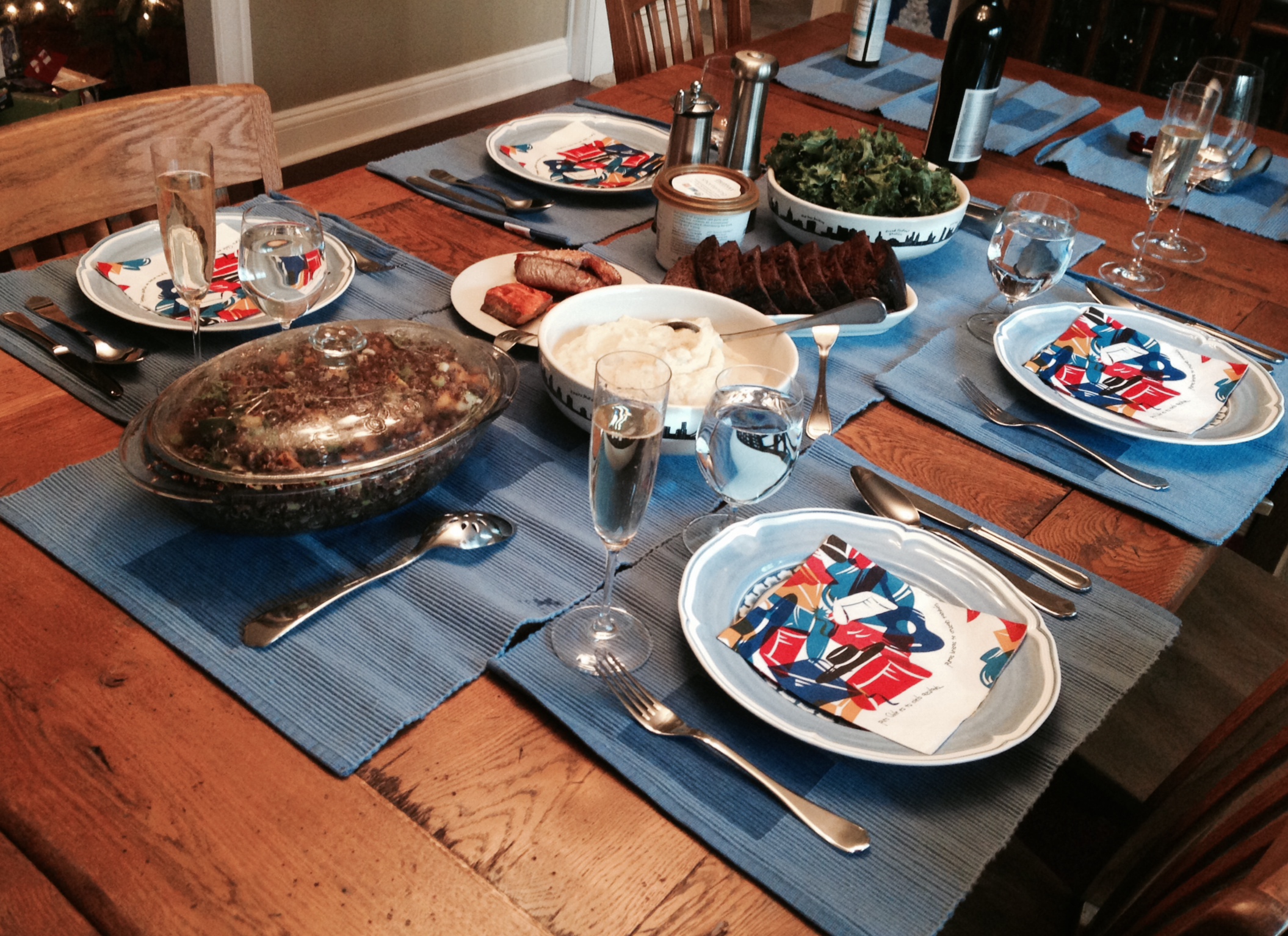
Our friend Edwina came for Christmas supper. I made everyone’s meal GAPS-compatible (with the addition of quinoa): deviled eggs and peanuts as hors d’oeuvres, then quinoa-vegetable stuffing, kale salad with cranberries and homemade dressing, salmon, mashed cauliflower, hazelnut-zucchini bread, and chocolate-avocado pudding, berries, chocolate chunks, and my own meringue cookies for dessert. A fat lot of good all that effort did: You weren’t well enough even to come to the table, let alone eat. At least Daddy and Edwina enjoyed the food.

The feast we had without you.

The feast we had without you.

We used “FaceTime” to talk with your family in South America and across the United States. Your sickly participation, though lethargic, was good-natured. Throughout the day I texted your U.S. grandparents and your uncles bulletins on your condition. I was worried that, having slept so much of the afternoon on the couch, you might not be able to fall asleep tonight. Your Uncle Rudy, from California, told the whole family that he was sure you would fall asleep fine. It’s nearly midnight now, and you’re still awake. Plainly, your Uncle Rudy is not a reliable predictor of these things.

You were supposed to go to the local Jewish Community Center tomorrow (Friday), for an all-day social program. That would have given me a lot of time to prepare to leave 7:00 am Saturday for Florida. Unless you make a miraculous recovery over the next eight hours, I’ll keep you home tomorrow; Saturday morning—please may you feel better by then—we’ll embark less than ready. Don’t feel bad. It’s not the first time I’ve scrambled to get it together for vacation. It won’t be the last.

Martin, my love, my bunny rabbit, may you cherish these days. Happy Christmas.

The breakfast I made you yesterday. You complained about eating eggs.

The breakfast I made you this morning. By then you weren't hungry because you were getting sick.

The breakfast I made you this morning. By then you weren’t hungry because you were getting sick.

Empowered Moms

These days I don’t feel so empowered, at least not on a macro-scale. I feel good about what I can do, what I am doing, for Martin. I am pleased to see other biomed moms banding together and trying to provoke change—see, e.g., The Thinking Moms Revolution or The Canary Party. I am grateful that other biomed moms create on-line forums and Facebook groups in which I can participate. As for me, my own engagement in collective action is on hold, not really in the realm of “what I think I can handle right now.” I need to recover Martin. Then I’ll change the world.

That all being said, recently I have joined together with two local special-needs moms (not biomed) to get something done. Actually get something done! Last summer, we were lamenting that our kids don’t have much way to make friends, and practice keeping them, here in our small town. When we make play dates for our kids, they engage in parallel play more than interactive play. There are professional resources available, like the play program that Martin attends (and adores) in the City. Unfortunately, those programs draw participants from a wide geographic swath, making after-school or casual get-togethers impracticable for the kids, and the cost excludes many families.

We three moms decided that what our town needs are facilitated social-skills playgroups for special-education students. And then we decided that, if the need is to be filled—we’re on deck. We formed a playgroup of six kids, grades kindergarten-through-second (ours kids plus three more, none in the same school class); hired a facilitator (a master’s student in elementary special education); found a time that works (late Friday afternoon); and got started, rotating each week among the participants’ homes. The facilitator comes prepared with games and exercises designed to foster social skills like sharing, taking turns, greeting, and getting to know each other.

By the fourth meeting Martin had fallen in love with his new playgroup. He calls his fellow participants “my friends from town.” All week he looks forward to Friday. He talks about whose home we’ll be visiting that week; one morning, he even created his own “Friday play date” schedule, listing out each child and checking off the retrospective house. He asks questions about what his “friends from town” do on the other afternoons. He wants to join them.

When the other moms reported similar enthusiasm from their kids, we knew we were onto something. We put together a formal proposal to bring the social-skills playgroup under the auspices of the local special-education parent-teacher association, which would both help defray the facilitator’s fees and also publicize to other parents who might be interested. Then we coordinated with a local Girl Scouts troop whose young women are interested in working with special-needs kids. As part of seeking their Silver Awards, several Scouts are going to come each week and assist our playgroup facilitator with keeping the kids focused.

Getting this project up and running, when so much else is on our shoulders, feels like a big achievement. We were correct that our town needs social-skills playgroups. As of this writing, enough parents have contacted us that we will be able to fill two additional six-member playgroups when we start our spring term next February.

Yay for moms, making stuff happen.

Good Medical Care

Without any real statistics to show, I am going to assert that most of us in the biomed community have MAPS doctors for our kids. “MAPS” stands for Medical Academy of Pediatric Special Needs and is the successor term to DAN!, or Defeat Autism Now! MAPS doctors are trained and certified in the treatment of chronic conditions like autism. They help our children with the process of recovering from autism/autoimmune disorder, and with associated issues like epilepsy or food allergies. They’re kind of like general practitioners for children affected by autism.

Then we have other doctors, the host of professionals who accompany childhood, plus (because autism is the symptoms of sickness) assorted specialists. Neurologists, geneticists, ophthalmologists, audiologists, endocrinologists, allergists.

One challenge prevalent for biomed families is finding “other doctors” who respect their MAPS doctors’ efforts. You can imagine the potential conflicts. When we first started biomed, for example, Martin had constant skin rashes, so itchy that he would scratch his legs bloody. We took him to a dermatologist, who diagnosed “sensitive skin” and suggested using Cetaphil “gentle” cleansing and moisturizing products. Our MAPS doctor, recognizing candida overgrowth, asked us to substitute natural products for Cetaphil and work on balancing gut flora to bring yeast under control. (We went with the MAPS suggestion, healing Martin from inside.)

The elephant in a room occupied by both MAPS and non-MAPS physicians is vaccines. MAPS doctors may urge caution when it comes to vaccinating, especially for kids with a history of reactions to vaccines, while non-MAPS doctors may push vaccinations “on schedule” for all kids. Some pediatricians won’t even accept patients whose families feel they cannot vaccinate.

So there are challenges, navigating the biomed path accompanied by non-MAPS healthcare professionals.

When we moved to the suburbs last year, I took the opportunity to find a Martin new pediatrician and dentist. Our practitioners in the City were adequate but traditional. The dentist made me sign forms stating that I had “refused” routine X-rays against her recommendations, and once she applied fluoride to Martin’s teeth even though I had stated at the beginning of our relationship that I didn’t want any fluoride, ever. Our pediatrician was perhaps more conscientious; I had a positive experience when one of her partners took an interest in our biomed approach, and the practice gave us a vaccination exemption of indefinite duration after Martin reacted poorly to the H1N1 shot. Despite those perks, however, the doctors weren’t worth venturing back to the City.

I found a new pediatrician through conversations with other biomed moms. This doctor, though not a MAPS doctor, is knowledgeable about autism recovery. She stocks her office with papers like “The Autism-Gut Connection” and “SIBO Symptoms and Treatments.” I believe she can be a second set of eyes on our biomed protocol, which is a good thing.

The dentist I found on-line. I searched for dentists who have experience working with special-needs kids, and then I followed up with phone calls about whether the doctor minds if we opt out of fluoride treatments. Martin’s first check-up there, six months ago, took place on a weekday morning, when few kids were present. The hygienist wasn’t great with him. When Martin became upset, she tried being noisy and distracting. I had to stop her and explain that, with Martin, the best approach is quiet explanation of what is happening. We were more successful with the rest of the visit. The dentist was able to get a good look at Martin’s teeth despite his protests, and no one gave me any trouble about fluoride.

Unfortunately, both the new pediatrician and the new dentist are far from our home. Last week, as I drove more than 45 minutes for Martin’s next check-up, I questioned whether the dentist was worth the fuss. As Martin’s appointment time passed, and we were still stuck in morning traffic, I thought, No more. This is the last visit to this dentist. Surely I can find someone in our own town who doesn’t push fluoride and is good with special needs.

When we finally arrived, the office was sleepy, with only one other patient waiting. This time I told the hygienist (a different one than last time) up front that Martin responds best to calm words. She understood immediately. When Martin declared that we would get a check-up but would not lie down, the hygienist responded, “Of course not. Here, I will just recline the chair a little bit so you can see the television on the ceiling, if you want.” Martin went for that.

We had a different dentist, too, a man. He began by remarking that he saw on our information card that Martin follows the GAPS diet, and asking how that was working for us. (A dentist! Asking how GAPS is working for us!) I told him, in general terms because Martin was in earshot, about our experience. The dentist responded, “It’s remarkable, isn’t it? My friend with MS made similar dietary changes, and his symptoms have really responded.” Then the hygienist said, “I know someone who has been able to stop taking fibromyalgia medication since she went on a diet like that.” Then both the dentist and the hygienist started discussing their own emphasis on fresh, whole, organic foods.

Martin, meanwhile, behaved like a champion. He let the dentist recline his chair a little more and complete a full examination plus cleaning. He interrupted the procedure only to point to the ceiling television and say, “That’s Nick Jr.!”

When the dentist was finished with Martin, he said, “Martin’s teeth look great. Not having refined sugar is obviously helpful, and you’re doing a solid job with brushing and flossing. As to the fluoride, substituting xylitol is a good choice. More and more of our parents are moving that direction.”

This dentist gives out balloons. Martin requested a yellow balloon.

I, now oblivious to the nearly hour-long drive that had aggravated me, reported to the front desk to schedule our next appointment.

I don’t mind questioning or challenges regarding Martin’s care, as long as the questioner/challenger acts with an open mind, has a stake in Martin’s well-being, and isn’t just playing Devil’s advocate.

But at the same time, it is hard to overstate the relief I feel when everyone is on the same page.

[Note: I know biomed families have mixed feelings about xylitol. I will blog about that at a later date.]

Not Slighted

If Martin and I were slighted last week at piano lesson, this Wednesday we definitely were not.

We arrived one minute late, at 5:31 pm. Jason was talking with the needy mother whose son’s lesson precedes Martin’s. As we entered the lobby, I heard that mother saying, “Yeah, well, okaaaaaay…,” as I know her to do when she wants to ask additional silly questions. Forgive my judgment on her questions; she wasted a significant chunk of Martin’s last lesson pursuing the topic of whether her son should wear earplugs in band practice, and pursuing it with a piano teacher who pretty much made clear, up front, that he has no idea whether her son should wear earplugs during band practice. This week, Jason was having none of that. Before Needy Mom even wrapped her “okaaaaaay,” Jason said, “Great! My next student just arrived, so I’ll see you next week.”

Needy Mom looked a little surprised. She said, “Oh! Okaaaaaay…,” which sounded kind of like, “You say that, but actually I’m not done with you yet,” at which point Jason said, “´Bye, then. Hey, Martin!” and took off after Martin, who was already headed toward the lesson space.

Hurray, I thought. Martin wins.

Thirty minutes later, Jason returned Martin to me. His report? “Martin was a little out of it this week”—that’s true! Martin was super-spacey yesterday!—“so we just worked some more on learning the names of the notes he already plays. Sooner or later, it will sink in.”

Yep. As long as we give Martin his share of every opportunity, eventually it will all sink in.

Slighted?

Wednesday evenings, for more than a year now, Martin has taken piano lessons at a local music school. He started with the school’s music therapist. When the music therapist left for another job, Martin switched to Jason, one of the regular instructors. Jason admitted that he had no experience with autism or teaching special-needs kids, but he agreed to give it his best shot, and Martin seemed to like Jason.

I think Martin likes Jason because Jason is in his young 20s, plays many instruments, and will let Martin experiment with drums and guitars when his piano time is done. Jason is like the cool older brother in whose basement lair the neighborhood kids gather. I guess that effect is not lost on Martin.

Jason has seemed to take to Martin, too. The first few weeks, Jason met me after each lesson with pearls of wisdom like, “Martin has some trouble paying attention,” or, “Martin has a little trouble getting his fingers to cooperate.” (Hey, ya think?) That being said, it wasn’t long before Jason started meeting me with new ideas: “I just figured out that if I stick letter stickers on the keys, he’ll use his fingers individually,” and, “It’s about incentive. I told him he has to play two complete songs before he gets to bang on the drums.” I was giddy when, after several months with Martin, Jason said, “Guess what? I got another student with autism! He’s a lot like Martin, and now I feel like I know how to teach him.”

At 5:30 pm yesterday I had Martin waiting in the lobby when Jason emerged with his 5:00 student, an apparently typically developing boy. I’ll start by saying, because it’s relevant, that this boy’s mother is a talker. She had a series of questions prepared for Jason. He’s started playing French horn in the school band. Is that going to be good, or bad, for piano? Some people say you should wear earplugs when you’re playing in a band. Should he wear earplugs? Do they sell earplugs here? Are they child-sized earplugs? Do you wear earplugs? I’m going to meet with the band leader. What questions should I ask him? Should I have him call you? How many of your students play in school bands?

Jason responded patiently. Too patiently. As the minutes ticked by, 5:34, 5:37, 5:38, I calculated that Martin was missing almost a third of his half-hour lesson while Jason discussed the previous student.

Around 5:35 I remembered that the same scene has played out the last three times I’ve brought Martin to music school. Jason escorts the typically developing boy to the lobby, spends eight or 10 minutes with that boy’s mother, and then takes Martin for 20 or 22 minutes of lesson time.

The past three weeks it hasn’t bothered me, much. I thought, well, she’s a talker, and Jason doesn’t want to be rude. Yesterday, however, as I sat there listening to Jason and the mother, and not-so-discreetly checking my watch, and soothing Martin’s eagerness to get to the piano, I had another feeling. A terrible burden of a feeling:

My son is being slighted in favor of a typically developing child.

Feelings, perceptions, are hard to settle, aren’t they? I don’t know why I felt, so suddenly, that Martin’s disability had anything to do with Jason spending an extra 10 minutes on the previous student. Between 5:35 and 5:39 pm yesterday (I’m guesstimating), the following ideas came into my head:

  • Martin is so difficult to teach that Jason is relieved to spend 20 minutes with him instead of 30;
  • The typically developing boy’s mother sees Martin each week, figures that he has special needs, and therefore doesn’t reckon that usurping his lesson time is any problem;
  • Even though we pay the same fees as every family, I am supposed to feel lucky that the music school accepts Martin as a student, and not expected to complain; and
  • Because Martin doesn’t make progress at the same rate as other pupils, Jason sees his lessons as an amusing diversion, more than a paid undertaking from which Adrian and I hope for results.

Underlying all those thoughts was one thread: No typically developing child would be made to lose 10 minutes of his half-hour lesson, week after week.

I am not a racial minority. Although our family—Adrian, Martin, and I—is Latino, I am of European descent. I have light skin and blonde hair. My first language is English, and I have no accent, not really even any American regional accent. I have no evident disability or physical challenge. I have never known what it is like to navigate the world while facing unequal treatment based on what passers-by (think they) see in me.

My experience with Martin is not comparable to persistent, day-to-day discrimination. Still, yesterday, for whatever reason, I had some inkling of what it must feel like to suspect that people slight you based on perceptions they’ve formed without ever knowing what kind of person you are. Maybe what happened was no such slight. Maybe the typical boy’s mother is always rude. Maybe Jason doesn’t know how to escape her inquisition comfortably. Maybe it was just one of those things that could happen to anyone.

To be sure, having a child with autism makes me sensitive and suspicious. I’ve even accused Adrian. Honestly, I have. Before Martin was born, we agreed that we would raise him bilingual. I would speak only English with him, and Adrian would speak only Spanish. For the first couple years, we stuck by that. When Martin was diagnosed, when he passed 26 months with still no functional language, we consulted several speech therapists, and each told us the same thing: Hearing two languages is not Martin’s problem. His language is delayed for other reasons, and as his brain allows, the English and Spanish will develop at the same rate as if he were monolingual.

Nevertheless, for whatever reason, Adrian stopped speaking Spanish with Martin. He switched to English, and only Samara, Martin’s nanny, keeps up the Spanish. In the darker times, I’ve told Adrian: “You stopped speaking Spanish with Martin because he has autism. You don’t think he’s worth the effort.” On one level, I know that’s not true. I know that Adrian has naturalized, that he’s North American now, that 99% of his life and business is conducted in English, that because he is a professional in an English-dominant field his mother tongue can be a burden, and that it is common for immigrants to assimilate by raising their children to speak English only. I know all that. But the mother of a child with autism has a chip on her shoulder. She just does.

Yesterday, it played out this way: When the typically developing boy’s mother finally shut up [ahem!] and left, and Jason turned to Martin, I said, “Getting a late start today? It’s almost 5:40 already.”

Jason checked his watch and said, “Oh, wow. I’m sorry.”

“It wouldn’t be a problem, but the same thing has happened four weeks now. He’s been missing eight or 10 minutes of every lesson.”

“I’m so sorry! That mom has a million questions every week.”

“I get that, but 5:30 till 6:00 is Martin’s lesson time.”

“Do you want me to keep him late today?”

“No, that’s not it. I just want him to get his whole lesson slot.”

“I’m so sorry. Won’t happen again. I promise.”

At that point, I exited, to walk to the drug store and pick up a few items while Martin had his lesson. In the parking lot, I walked past the other mother and her typically developing son. I considered confronting her, saying something like, “I know you have a lot of questions, but please respect the fact that your son’s allotted lesson time ends at 5:29. I want my son to have his full time.” By that point, however, I’d got myself worked up, too worked up. I feared the message would sound more like, “Listen, it is irrelevant that my son has autism! We pay the same fees you do, and my son is entitled to the same lesson time. I don’t know why you think your kid is so much better!” And so I kept my mouth shut, for which, with 24 hours’ hindsight, I am thankful.

What happened yesterday? Did the other mom figure my son is less worthy? Did Jason slight him? Has he been doing so for weeks?

I don’t know. I’ll see what happens next Wednesday, and I’ll go from there.

Terrified at the Philharmonic

In August, when we were vacationing in Austria and Germany, we took Martin to the Vienna Philharmonic. The Philharmonic was playing at the Salzburg Festival. We made a (loooong) day trip from Munich, where we were staying. The Venezuelan Gustavo Dudamel was conducting a program of Richard Strauss and René Staar, and Staar was even in attendance. Adrian, who is crazy about Dudamel, got himself into concert mood by looping Strauss’s “Also Sprach Zarathustra” endlessly in our vacation rental car. The Philharmonic adventure was the splurge of our vacation, a really big deal for us, and it meant the world to Adrian that he could bring Martin along.

We prepped Martin for days. In Martin’s presence I would say casually, “Hey, Daddy [Adrian], when we go to the symphony, can we talk during the music?” Adrian would answer, “Oh, no. Definitely not. During the music we have to be quiet.” Or Adrian would remark, “Hey, Mommy, did you know it is fine to clap at the symphony, but only when everyone else is clapping?” I would return, “I do know that! When Mr. Dudamel comes on stage, I will clap and then be completely quiet until the end of the music, when everyone claps.”

The morning of the performance, I helped Martin dress in a shirt, tie, and sweater vest packed especially for the occasion, and off we sped to Salzburg.

To be honest, I was terrified. We couldn’t have been the only ones who considered the day a splurge (the Salzburg Festival is expensive!), and judging from the number of fuddy-duddies in attendance, a Martin outburst would have made our family very unpopular in the Great Festival Hall. To boot, the performance was being recorded. I assume the sound engineers can edit out something like an autistic six-year-old blurting, “Can a viola play in a reggae band?” I mean, if you buy a live taping, you don’t hear the audience’s coughing or candy wrappers. Then again, we were seated in the second orchestra row, nearly under the tiny microphones suspended from the ceiling. Each time the music fell soft or paused, I tensed. Martin is not good at silence.

Thank goodness we were near the side aisle. In case of emergency, I was poised to scoop Martin into my arms, make for the exit, and keep his mouth covered until we reached the safety of the ladies’ restroom. I would grab my purse on the run, so that I could use my iPhone to keep him busy until the final applause. That was my fallback plan.

I didn’t need it. Martin did swell. Sure, he had trouble sitting still. He sat in his seat, then flopped to the side, then climbed onto Adrian’s lap, fussed, transferred to my lap, stood and bounced, ended the first half reclined with his feet on Adrian and head against my arm. During intermission we snapped photos and discussed the performance so far. Martin said, “When Mr. Dudamel came on the stage, I clapped!”

Minutes after Dudamel’s baton rose on the second half came Martin’s lone outburst. Throughout the concert, when Martin seemed like he might chatter, I’d been covering his mouth lightly with my palm. At once, he blurted, not too loud: “Mommy, if I talk, put your hand over my mouth!” (Which I did.) That was it. That was the worst.

I did not enjoy the concert as much as I would have if Martin had not been present. At no point did I close my eyes and relax into the music. Martin being next to me, on top of me, on top of Adrian, was Damocles’s sword; under those circumstances, how could I find Zarathustra’s wisdom in music? Nevertheless, I’m glad we brought Martin. What an experience! How joyous was I when, as we exited our seats, a older woman some rows behind us spotted Martin and said, “Oh my! Is the little boy still here? He was so quiet, I assumed maybe he’d left at intermission.”

No way! The concert was magnificent, and Martin deserved to hear it live.

The day we saw the Philharmonic was rainy. Martin got a new umbrella!

The day we saw the Philharmonic was rainy. Martin got a new umbrella!

Pull

In the post “What Comes Last,” I noted Martin’s continued difficulties with socializing, especially in group situations, when he just doesn’t seem able to find an entrance.

We were at yet another bouncy-house birthday party last month. Adrian and I were alternating between snapping iPhone pictures and chatting with parents. The kids were running wild. Some were interacting, such as throwing sport balls at each other, on the various apparatuses. Others were jumping and sliding alone. Martin, of course, fell into the latter category.

—Until he bounded up to me, exclaimed, “Mommy, come play with me!”, grabbed my hand, and pulled me toward one of the inflatables.

I went. It was the first time Martin had tried to pull me toward anything, ever.

To be clear: It was only me whom Martin tried to pull into a game, not another kid. Moreover, he hasn’t done so again since.

But it happened. As they say: It’s in there. Martin has the desire, and slowly the skill, to bring others to him. I that sometime in the next six months he will try the hand-pull move again, first with me and then, I hope, with other kids.

A blurry action shot: Adrian and Martin clowning at the birthday party. It's blurry because I was standing in the same bouncy house.

A blurry action shot: Adrian and Martin clowning at the birthday party. It’s blurry because I was standing in the same bouncy house.

In Praise of the Wonder Kid

Right around the time Adrian and I were considering a second child, Martin was diagnosed with autism, and we put off the decision in order to focus on getting Martin help. The years since diagnosis have been therapies and special diets and supplements and doctor visits and too little sleep. I was almost 36 years old when Martin was born. By the time Adrian and I cleared our heads enough to think again about a second child, we would have been looking at a 40+ pregnancy. That, combined with the increased risk of having a second child on the spectrum if you already have one, sealed the decision. Martin would remain an only child. All of our resources belong to Martin alone, for his recovery.

But alas, a typically developing sibling sure might help. A brother or sister could provide a full-time role model and, if we were lucky, a buddy to protect Martin from neighborhood cruelty, from slights and oversights and bullying.

With that in mind, allow me to sing the praises of Martin’s cousin, Mandy, who is also an only child. Mandy and Martin were born only ten weeks apart and, though they live four hours away from each other, have known each other since babyhood. They get three or four solid visits annually.

When Mandy came to our home last August—Martin had already turned five, and Mandy was about to—they were finally old enough that I thought Mandy might need some explanation of why Martin seems different. Immediately, I found an opportunity to address the issue: Mandy and her mother (my younger sister) arrived after Martin had gone to sleep for the night, Martin’s regular sitter was at the house, and Mandy was hungry, so I volunteered to take them out for pizza.

Ah, to have a kid who can go out for pizza!

“Hey Mandy,” I said. We were sitting in the pizzeria waiting for our order. “Do you know how to read?”

I knew she didn’t.

“Well, guess what?” I asked. I dragged my voice, to indicate that something amazing was coming. “Martin already knows how to read!” Indeed, Martin started reading young. He read fluently (comprehension is a separate issue) by age four-and-a-half.

Mandy opened her mouth in astonishment and gasped toward her mother.

Ah, to have a kid who gasps toward mom when surprised!

I went in for the kill. “But, Mandy, you know what? You are very good at talking”—she is—“and Martin is not good at talking at all. That’s how it is: Some kids are better at talking, and other kids are better at reading.”

I wasn’t sure this little speech would work.

It did.

Mandy and Martin’s visit that August was delightful. Mandy, who is naturally bossy, in the best way possible, forced Martin to interact constantly, and she decided to talk for both of them. Upon Mandy’s request, and Martin’s acquiescence, they both slept in the big bed in our guest room, and I knew when they woke up because I heard the giggling start. One morning as I stood in the kitchen, they walked through. Mandy had Martin’s arm over her shoulder and was pulling him along by the wrist as she announced, “We decided to go outside.” Martin didn’t mind Mandy’s commanding spirit. It brought out his best. He responded to her every whim, including when she thrust paper upon book in front of him and demanded, “Read this for me!”

The big test came when Mandy had been with us almost a week. Martin had a hippotherapy session, and I brought Mandy along. While Martin was riding, Mandy befriended the farm proprietor’s seven-year-old granddaughter. I could tell that Mandy was impressed to be playing with an older girl, and I thought, This is it. She’s not going to be so eager to hang around Martin when this big kid was in the picture. Maybe she’ll even be embarrassed by her awkward cousin.

Curse me for that lack of faith. As soon as she saw Martin dismount the horse, Mandy scampered over, grabbed his wrist, and ordered him to come play. Then she tugged Martin to the seven-year-old and said, “This is my cousin Martin!”

Mandy came to visit again this February, when my sister and I took the two kids to see The Lion King on Broadway. Saturday mornings Martin usually goes to the Equinox gym with Adrian and plays in the kids’ club there while Adrian works out. The Saturday morning of Mandy’s visit, Adrian volunteered to take both kids to the kids’ club.

After they returned, I asked Adrian whether Mandy had still wanted to play with Martin at the kids’ club, or whether, when in a crowd, she had gravitated to the typically developing children instead.

Adrian reported that when he came after his workout to pick the cousins up, Mandy was indeed playing with the typically developing children.

… And, Adrian said, Mandy was directing those typically developing children to make sure they let Martin play, too.

Thank you, Wonder Kid. Thank you for looking out for Martin.

Mandy and Martin on the beach, August 2013.

Mandy and Martin on the beach, August 2013.