What Comes Last

A couple years ago—hard to believe how long we’ve been at this—I lamented to Martin’s (then) biomed doctor that, while Martin’s behavior, sleep, and overall health had improved, I had not seen as much progress in his language. The doctor told me not to worry. “Language,” she said, “often comes last.”

I carried that mantra for a long time: Language comes last. When it took Martin so long to start asking questions, or to use the command form, or to pick up nuances and idioms, I thought, well, language is going to come last.

Or will it?

This year, Martin’s language is much improved. As I’ve written, his speech is not perfect. It often sounds scripted, or rote. Sometimes it seems like he’s exploring a foreign language: Unable to find the easiest or most direct way to express himself, he searches his capabilities and comes up with an unusual (original?) formulation. And his receptive language, his processing delays, still poses challenges; I might be explaining to Martin that we’re going out after lunch, only to have him melt down because he wants lunch, and the “going out” part has registered but not the “first, lunch” part. At his time, he still very much needs the intensive-language-based school program he attends.

That fact notwithstanding, Martin can speak. He speaks in sentences. He asks questions. He orders me around. When he’s not frustrated and mixing up his words, he can express himself, in a manner understood by most anyone who listens with care.

To that extent, language has come.

Language has come, and it did not come last.

Martin’s recovery has two additional, gigantic roadblocks that are not language, though language-related.

First, Martin still can’t “attend.” He doesn’t pay attention. He doesn’t listen. He talks when others are mid-sentence. Unless an activity is one he enjoys (music, eating, drawing), he shows little interest in what others are doing. And even when something does catch his attention, he doesn’t stay with it for long, except for example to stim by hitting one music key repeatedly, or to read his favorite book, The Philharmonic Gets Dressed, over and over.

Martin’s teachers have identified attending as his most significant challenge in the classroom; even with a 3:1 student-teacher ratio, he has trouble following. At home, the nanosecond attention span means it might take Martin 20 minutes to change clothes, because he gets distracted, or succumbs to boredom and starts complaining instead of dressing. It also keeps us from sharing experiences. If I say, “Oh, wow! Look at that bird!”, Martin might glance out the window, then jog away before I can comment on the bird’s color or size, or he might not look at all.

So language didn’t come last, because language has developed more than attention.

Second, Martin still has a lot of trouble socializing.

When we were in Austin around Easter, I arranged a playdate with “Stewie,” the six-year-old, typically developing son of a college friend. Martin and Stewie had never met, and Stewie was not informed in advance that Martin has challenges. We met at a crowded playground. The playdate went remarkably well. Although Martin was less interactive than an NT child would have been, he didn’t spend the playdate in his own world. Several times (some with prompting) he went to find and engage Stewie. He and Stewie stood together and gazed at an inchworm hanging on Stewie’s finger. When one family at the playground brought out a bubble pumper, Martin joined the other children, clapping his hands and chasing the bubbles. Stewie never even shot his mom that quizzical look that means, “Is there something different about this kid?”

The experience with Stewie gave me a sort of high. I texted Adrian: “Martin is having a playdate with a typically developing boy, and he’s doing FANTASTIC!”

But of course, in autism recovery, disappointments find a way to deflate any high, and four days after Martin played with Stewie, we had a much less successful playdate back in New York, with four classmates from Martin’s kindergarten. Martin attends a school for children with speech and language delays. About half the kids in his class also have autism or some other social impairment. By coincidence, none of the four boys other than Martin who attended this playdate had any social impairment. They are the social kids.

What happened was typical of what we experience when Martin attempts to play with more than one child at a time: Martin was left out. In a one-on-one situation, a playmate has few options other than to engage Martin. In a multi-kid situation, those without social impairments gravitate to each other, and away from the awkward boy.

Martin’s classmates, at the playground where we met, decided to fight dragons. They scampered about as a group, swinging imaginary axes, wielding nonexistent swords, screaming with excitement at the game they’d created.

Martin climbed on rocks and monkey bars. He went down the slide and wandered across the playground’s bridges. When I suggested that he join his classmates’ game, he approached the crowd and, using the social skills he’s been taught, ask shyly, “What are you doing?”

But the other boys were too boisterous and engaged to hear, and they ignored him.

Martin sat down, alone.

As he and I were walking to the car to return home, I asked, “How was the playdate? Did you have fun?”

My son responded, “No. I would like to do a playdate with only grown-ups.”

The next morning, Martin said he did not want to return to school. Thinking that he was experiencing end-of-spring-vacation blues, I tried cajoling him with his favorite subjects—“Do you think maybe you will have computer class today? What will you make in art class?”—and enumerating his classmates. “Do you think Christopher will be there? Are you looking forward to seeing Jack, and Quinn?”

When I finished my song-and-dance, Martin shook his head and said, “No. My friends at school don’t like me.”

Some defeats just crush your soul, don’t they?

So language didn’t come last, because language has developed more than socialization.

Which begs the question: What’s going to come last?

How will I know when we’ve reached our destination?
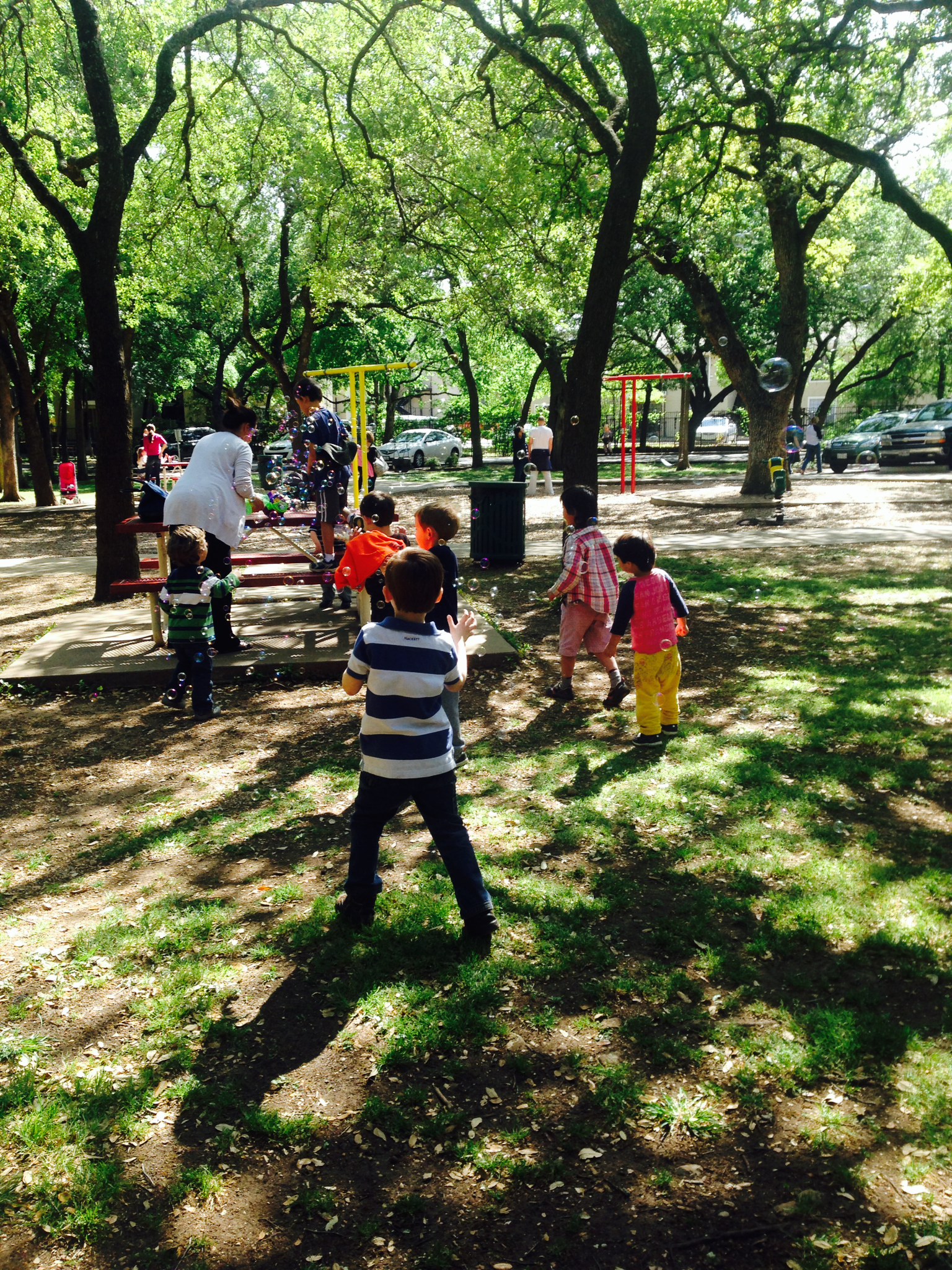
Martin, in the blue and white stripes, joins in bubble fun during his playdate with Stewie.

Martin, in the blue and white stripes, joins in bubble fun during his playdate with Stewie.

First of Three Firsts: The Babysitter

These past few weeks have brought a few firsts for Martin. Actually, for me, Martin, and Adrian. Here come three posts on firsts.

Since Martin’s diagnosis three-and-a-half years ago, we have not used any babysitters other than Samara, the nanny who’s cared for Martin since he was a baby; Janine, a special-education graduate student who worked with Martin through Early Intervention and whom we subsequently hired privately; and family members. Having a kid with autism made me skittish to rely on the neighborhood teenagers for babysitting. Having a kid recovering from autism only added complications. Who wants to explain food restrictions, homeopathic drops, and supplements?

Shortly after we moved to our new suburban home, a 14-year-old neighbor named Justin rang our doorbell, introduced himself, and volunteered that he would be happy to babysit anytime. He seemed a respectable and well-spoken young man.

Still, I didn’t go for it.

At least, not until nine months later, when circumstances intervened. Samara needed to return to her country of origin for six weeks. Adrian and I had a Friday evening dinner date in the City, scheduled months earlier, with old friends. Because of a calendar mix-up and (Adrian’s) work travel, we’d had to cancel two dates in a row with this couple, and I was determined not to miss a third. Janine works elsewhere on Fridays.

(Justin, coincidentally, stopped by a second time and offered his services.)

What to do, what to do?

I waited until a Tuesday afternoon when I knew Justin would be at school, then slipped next door to speak with his mother. I presented a brief outline of Martin’s challenges (“speech and language delays, and something like Asperger’s syndrome, depending on which highly paid expert we consult”) and asked whether she thought Justin would be up to the task.

Justin’s mother listened. She posed a few relevant questions. She said, “I think Justin can handle it. And he’s a pretty honest kid. If he’s in over his head, he’ll say something.” Then she asked where Martin goes to kindergarten. When I told her—Martin attends a private institution for children with speech and language delays—she responded, “I know that school. We considered at it for my younger son. He’s speech-delayed.” And what evening did we want Justin to babysit? Friday? Friday would work well. “My husband and I will both be home all night,” she said, “so if Justin needs help, we could come over.”

Oh? Oh? Justin has a younger brother with speech delays? Justin parents will be next door the entire time, ready to spring into action if problems arise?

Even I had to admit that, if we were ever going to use a neighborhood babysitter, this set-up was darn close to perfect.

Arrangements were made. Martin was informed that “Justin the teenager” would “come over to play with him” on Friday. Subsequently Martin was informed that Mommy and Daddy would go out to eat while Justin the teenager was here playing with him. Finally Martin was informed that Justin the teenager would be helping him with bedtime while Mommy and Daddy were out to eat.

To my surprise, Martin appeared unfazed by these revelations. Friday morning, he boarded the school bus with a smile, excited that a teenager was coming to play with him.

I spent all day Friday getting ready for Justin’s 5:00 pm arrival. The house was spotless. All laundry was washed and folded. Martin’s bed had fresh linens. The family room was ordered. (I couldn’t bear to have the neighbors think we’re slobs.) Martin’s dinner, dessert, and evening snack were prepared. Martin arrived home from school at 3:45 pm. Immediately I ushered him to the kitchen table for dinner. I reminded him that Justin was coming, that I was leaving to meet Daddy in the City, and that Justin would help him with bedtime. I added that, while Daddy and I were out, Justin would be in charge. Martin ate his dinner with no objection. By 4:45 pm, dinner, evening supplements, and the essential bedtime supplements—those that I consider non-essential, I decided to skip—were in Martin’s tummy.

Justin arrived. Martin ran away and hid his face, then showed up and waved hello, then fled again. I told Justin the following (note that supplements and recovery protocol never came up):

* Martin has “food allergies,” so please feed him only what I’ve specifically left for him. (Here, Justin conscientiously asked, “Does that extend to scent allergies? Will it be okay if I order dinner delivery?”)

 * Martin should go to bed around 7:30 pm, but it is not the end of the world if he doesn’t, or if he doesn’t go to sleep. (Here, Justin conscientiously asked, “Does he brush his own teeth? Will I need to help him? Does he like to hear a story?”)

* I expect Martin to become upset, maybe throw a tantrum, when I leave. Don’t worry. He’ll calm down.

* We will be home by 11:00, and if when we get home Martin is alive, then we’ll consider the evening a success. The rest is icing on the cake.

At this point, I asked Justin to make sure that he had both my phone number and Adrian’s, and Justin pulled out a mobile phone in a New York Rangers case. When I asked if he is a fan, Justin responded that he babysits because he’s saving up for his own New York Rangers mini-plan, i.e., quarter-season tickets.

Plainly I had selected the world’s best 14-year-old to watch Martin.

It was time for me to leave. I kissed Martin goodbye and waited for him to wage his protest.

Only—he didn’t. He said ’bye and wandered into the family room with Justin.

I headed to Manhattan. I drove, instead of taking the train, just in case some emergency arose and I had to return home quickly. I told our dinner companions that Martin was at home with a teenage babysitter. They asked if I wanted to text Justin to check the situation at home. Adrian saw that I was nervous, and asked if I wanted to text Justin to check on the situation at home.

No, I said. I’m good. I’m going to let this run and see what happens. I left my phone on the table, next to my plate.

Under the table, I fidgeted.

In my head, I prayed.

Superficially, I chatted. And dinner elapsed.

Adrian and I arrived home at 10:40 pm. I entered the house tentatively. Would Justin be crying? Would Martin be running amok? Perhaps something would be on fire? We came in through the garage. I tiptoed into the kitchen and peeked—I’m serious: I peeked, and not without trepidation—into the family room.

Justin was doing some schoolwork he’d brought. He had the Rangers game on the television.

The rest of the house was peaceful.

No screaming. No blood stains, ambulances, or fire trucks.

“It went fine,” Justin reported with a shrug. A shrug! “He’s been sleeping since about 8:30.”

Adrian and I looked at each other. Had it really been that easy?

Apparently it had. I asked Justin how much we owed him, paid, and watched him walk next door.

That was that.

With Samara the nanny still away, Justin has babysat Martin two more evenings. Each visit requires hours of preparation. Supplements and exercises done in advance. Martin pre-fed. The household perfected.

And each hour of preparation has been exquisitely worthwhile, for Adrian and I have finally been able to enjoy what parents of typically developing kids might take for granted: the neighborhood teenage babysitter.

No, that's not Martin. It's just that---well, I do so love the Rangers.

No, that’s not Martin. It’s just that—well, I do so love the Rangers.

More Civility

Last year I took Martin to a friend’s sixth-birthday party. I talked to the birthday boy’s mom in advance and knew they were serving pizza. For Martin I brought homemade GFCFSF pizza and cookies.

I thought Martin would be happy with those choices. With the pizza, he was. I heated it in the hostess’s oven and served it on a party plate, just like the other kids’ pizza. Unfortunately, the situation went south when cake time rolled around. Martin didn’t want just any treat. He wanted the cake. And when he didn’t get cake, he went into meltdown mode.

I might give in to something like a non-organic apple. But I don’t concede gluten-, dairy-, and sugar-laden cake. I picked up my screaming kid and moved to another room, where I held Martin on my lap and tried to calm him with promises of a special cupcake when we got home. (I would gladly have stopped at blessed Babycakes, which sells cupcakes that are free from gluten, dairy, corn, soy, and refined sugar.)

Martin was having none of my peacemaking. He cried and wheezed, inconsolable. At this point, another mother, whom I never had met, entered the room and asked, “What’s the problem?”

“My son is upset because it isn’t a cake he can eat,” I replied.

The stranger came closer and said, directly into my ear, “Just tell him you’re taking his piece home for him to eat there. By the time you get home, he’ll forget about it.”

I had a child on my lap near hyperventilation. This was not the time to explain that I don’t follow lie-now-and-hope-he-forgets approach to parenting. So I replied, “I wish I could, but he remembers everything.”

This woman was not to be deterred, neither by my blow-off attempt nor by Martin’s tears. “What is he, gluten-free?” she asked. “Why don’t you give him some of the ice cream?”

Her voice was loud so I could hear her over the racket, and her tone was sharp so I would know that she didn’t approve of a gluten-free diet.

“It’s harder than that,” I said, trying to sound sheepish so she would leave and let me return my attention to Martin. “He doesn’t eat gluten or dairy or refined sugar.”

I didn’t bother adding soy, corn, starches, most carbohydrates and fruits, non-organic or processed foods, or preservatives to the list of what Martin doesn’t eat. No matter. Apparently gluten, dairy, and refined sugar were enough to earn this stranger’s condemnation. She said, “Oh my God.” Then she rolled her eyes, turned her back to me, and walked away.

So I got what I wanted: She left us alone, letting me return to comforting Martin.

The rudeness I could have done without. Also, the particular phrase she chose, which is offensive to me.

Most of the children attending the birthday party had special needs. Later, after Martin calmed down, I saw this woman with her son. He wore ankle braces and hearing aids, and he engaged in atypical behaviors. Our conversation had been special-needs-parent-to-special-needs-parent, but it sure didn’t feel that way.

What went wrong at the birthday party? First, it was a terrible time to discuss anything. Martin was in full meltdown mode. The stranger could have said, “You have the most intriguing eyes I’ve ever seen, and I would kill for a figure like yours,” and still I probably would have tried to blow her off. Second, she was plainly unwilling to think outside her own box. Really, I don’t even think she wanted to help. She wanted to judge.

Let’s compare to a conversation in which I found myself a few weeks later. This one happened after a meeting of our district’s special-education PTA, when parents were hanging around to mingle. I ended up talking with a woman who introduced herself as the mother of an 11-year-old with Asperger’s. When she asked about Martin, I said that he has made enough progress that I’m not sure whether to say “autism,” “high-functioning autism,” “Asperger’s,” or something else. She asked about what therapies have helped the most. I replied that we do biomedical and homeopathic interventions, and that those, combined with a restricted diet, seem to have made the difference.

We talked some about Martin’s diet. Then the mother said, “I think a lot of so-called autism remedies are snake oil, people trading on hope and desperation.”

I replied that she has a point. Even after years on the biomedical path, I find it hard to distinguish between legitimate interventions and unsupported promises. I try not to let it get me down. I hire and rely on experienced doctors, and I do as much research as I can manage.

The mother asked, “Do you do the dangerous stuff, like chelation?”

I replied that we haven’t chelated yet but plan to; that from what I know, chelation is safe if done properly; and that, in terms of which interventions have relieved autistic symptoms, chelation rates highest in parental reports.

She said, “I hear what you’re saying. But people who say you can treat autism are the same people who say vaccines cause autism. Do you believe that?”

I replied that I think the strict cause-effect narrative has undermined legitimate debate about vaccines. Everyone knows that vaccines are dangerous for a child with a compromised immune system—that’s why parents are told not to bring a child for shots when she has, for example, a cold or an infection, and why a child undergoing chemotherapy cannot be vaccinated. Autism, I said, is the symptoms of an underlying immune disorder, often with a genetic component. The immune disorder may exist before the symptoms manifest. If a child is asymptomatic, his parents and doctors may not recognize the immuno-problems, and they may therefore go ahead and vaccinate. The vaccine, in turn, causes the already compromised immune system to go haywire, and then the symptoms manifest. In such a scenario, the vaccine didn’t “cause” the autism, but it did exacerbate the pre-existing immune disorder and cause the symptoms (i.e., the autism) to appear.

The Asperger’s mother listened to my entire monologue. When I finished, she boosted my ego a little by saying, “You know, you’re the first person who’s ever told me about a link between autism and vaccines without sounding insane.”

We talked for 20 or 30 minutes, this mother and I. Don’t worry! It wasn’t all me rambling on. She knew tons about navigating the special-education system, and I grilled her for tips. We ended up exchanging numbers and thanking each other for the shared insight.

Did I convince this mother to begin biomed with her 11-year-old? Probably not. Did we have a positive interaction? Definitely. Unlike at the birthday party, the special-education PTA event was the right time to discuss helping our children, and the mother I met was curious and open-minded.

Civility is out there.

Even if it doesn’t always seem that way.

Civility

I know that I should stay off social media, other than maybe the autism-recovery groups I enjoy.

I definitely know that I should refrain from taking the bait when people post uninformed opinions on topics about which I have, well, more informed opinions.

If you read this blog, you probably have thoughts about vaccines. I do. I’ve posted about the link that I think exists between vaccines and the symptoms of autoimmune disorders, symptoms like “autism.” It’s such a controversial topic. I try to read as much about vaccines, on both sides of the issue, as my schedule allows.

Which makes me ripe for a bad Facebook experience. I made the mistake of responding to a post by a guy I knew well in college and now know only through Facebook.

This Facebooker, the guy I know, posted an opinion piece deriding “anti-vaxx” celebrities. (“Anti-vaxx” was used in the posted piece. It’s not my term. I don’t think raising efficacy or complications concerns, or questioning ingredients, is necessarily “anti-” vaccinations). Beneath the link to the opinion piece, the Facebooker said something like, “It is a sad commentary on our society when people are willing to accept celebrity ‘opinion’ over scientific fact.” He then went on to compare “anti-vaxxers” to people who deny evolution or global climate change.

Within the comment thread under his post, the Facebooker asserted, without citation, that “any link between vaccines and autism has been scientifically disproven.”

Best course for me to take in such a situation: turn off Facebook and walk away.

Course I did take, this one time: I commented. I wrote:

“Can you point me to the study that you are referencing? I’m not advocating one way or the other. I am aware of studies suggesting the absence of a link, and of studies noting that vaccinations can cause neuro-disruptions. But I’m not aware of any study that compares autism rates in vaccinated versus unvaccinated populations.”

Then, lest anyone think I have a connection to autism (we’re not public about Martin’s diagnosis), I added:

“I am concerned about this topic because at age 12 I was very sick with measles, despite having been twice vaccinated against it.”

What did I want to achieve by commenting? I don’t know. I was frustrated. The Facebooker’s comment made no sense, empirically or otherwise. We cannot “scientifically disprove” a link between any two occurrences; the most we can do is, while attempting to control for other variables, demonstrate that the occurrences arise no more often in conjunction than they do independently. In the case of autism and vaccines, I know, that rigorous work has not been done. This Facebooker was carelessly spouting an untruth.

In seconds, without thought or ceremony, he responded: “There. Is. No. Fucking. LINK. NONE. STOP.”

And I, shocked, wrote: “Um, okay. That sounds scientific.”

Most of this is likely not verbatim. I recall, exactly, his comment, “There. Is. No. Fucking. LINK. NONE. STOP”—periods, explicative, and all. As for the rest, I am recreating the conversation. Immediately after I wrote, “Um, okay. That sounds scientific,” the Facebooker deleted the link and the comment thread, and replaced it with this status update:

“You’re not going to spoil my happy today. Period.”

Under that “spoil my happy” status came this comment thread:

Random commentator: “Oh, see now… someone’s going to try!”

Facebooker I know: “Already has. Why do you think I posted it? What it comes down to is this. To the world: As much as you are obviously in love with your own opinions, I DON’T CARE!!!!!! You may not care about my opinions either. That’s fine. No skin off my nose. BUT I DON’T CARE!!!!!!!!!”

Random commentator: “Ah, see, I almost had a sarcastic comment for your last post.”

Facebooker I know: “I swear to God, you could post that 1+1=2 and there’s going to be someone who argues with you. Not having it.”

Wow, right? This Facebooker, as I said, is a guy I knew in college. I’ve seen him once since college, when he was in New York a year or two ago, and we had a nice lunch to catch up. No prior animosity. Nothing. That explosive reaction resulted, as far as I know, 100% from my question about “scientific disproof” of a connection between vaccines and autism.

I commented no more. Instead, I took my boldest Facebook action ever. I stopped “following” the guy. I didn’t go so far as to unfriend him. Unfriending just isn’t in my nature. But now that I’ve stopped following him, his posts no longer appear in my news feed.

It’s justified. Around when Demi Moore was separating from Ashton Kutcher, this Facebooker posted a picture purporting to show cellulite on Demi’s legs and chastising her for not spending enough time on a treadmill. As if women don’t have enough trouble with body image! Demi Moore weighs, like, 70 pounds. Then, during the 2012 NFL referee lockout, when the league used less-experienced substitutes, this Facebooker complained about a game by posting something like, “These replacement refs are really ‘special,’ and I don’t mean that in a good way.” You see the problem there: He’s implying that the referees have special needs, which is “bad” and appropriate for ridicule. The way I see it, the vaccine incident was strike three, and this Facebooker is out. Or at least un-followed.

There’s a real shame in this story. In the original “anti-vaxxers” link and comments—the thread that the Facebooker deleted because he was “not having” any “argument”—there was a comment from a third-party who self-identified as a person with autism. She wrote something like, “Even if there were a link between vaccines and autism, people who abstain are suggesting that they would rather lose a child to preventable disease than have a child like me.” I would have appreciated the opportunity to follow up and engage that person further.

No such luck. Some topics, it seems, are just no longer available for discussion.

Judgments Redux

First an addendum, now a redux. Sorry.

In my defense, this was going to be part of Saturday’s “Judgments” post, but that post was getting way too long.

Judgments” ends this way:

“And so that’s it. I’m way, way beyond throwing stones at how anyone else treats autism.”

Which sounds pretty good, as if I’m all warm and fuzzy and “I’m okay, you’re okay.”

That last line, however, was carefully worded.

Here is a comment, written by an autism parent, in response to the CDC’s new estimate that one in 68 United States children is diagnosed with autism:

I’m kinda pleased…. When autism is more prevalent than ‘normalacy’ autism acceptance will be a whole lot easier! As you know, my son has high functioning autism and I don’t believe he needs to be changed or cured at all. Yeah, he sees the world differently, but different isn’t inherently wrong. I appreciate I can’t speak for all kids, but I love my very individual little boy just as he is 🙂

A mother in an on-line ASD-recovery group cross-posted that comment, from another group, with the identifying information removed.

Warning: I am about to be judgmental.

That “kinda pleased” comment is appalling.

I too “love my very individual little boy just as he is.” Indeed, I cannot conceive of anything Martin could do that would make me stop “loving him just has he is.” This extends even to moral culpability: If Martin recovers from autism, then grows up to be a serial killer, or a rapist, or a child abuser, I will be devastated, I will applaud when he is jailed for life, and I will seek help for his sociopathic tendencies. But I will still love him, even as he is.

Autism has no moral component, except perhaps insofar as manmade environmental factors are contributing to the rise in autism rates. In any event, Martin is not culpable. And if I am willing to get past intentional failings, how could autism ever make me reject “my very individual little boy just as he is”?

Loving a child is easy. Accepting a child is easy. As I have written time and again, there are days when I want to give up biomed, homeopathy, special diets, therapies, and everything else we do for Martin. At the lowest points, I want to say, “Martin has autism. I’m going to leave that as it is, and tell the world to accept autism.” I want to do so because that would be easy.

But I don’t. I don’t give up. My son does need to be cured. I would never say, “I don’t believe he needs to be changed or cured [of autism] at all,” any more than I would say, “We’re going to leave the multiple-personality disorder untreated. I love each of his personalities,” or, “Why eliminate psoriasis? I’m fighting for psoriasis acceptance instead.”

I’m way, way beyond throwing stones at how anyone else treats autism.

As for those who hide behind “acceptance” and “awareness,” who advocate “neurodiversity,” who stand by as autism takes over our children, who choose not to treat the condition at all—

For their approach, I have no patience.

I would never tell a parent who refuses to treat autism that she is selling her child short. Telling her that wouldn’t do anything to change her mind, and it might make her feel bad about herself. Instead, I try to lead by example. If asked, I respond that all kids are different, and that our family follows a special diet and biomedical protocol, and that Martin has made tremendous, if slow, improvement. I answer any questions honestly. I smile.

In my head, though, I’m thinking this:

I feel sorry for your child. Healing an immune system is hard work. Accepting autism is a lot more convenient. For you. Your child will have a more difficult life because you’ve chosen the passive path.

Stones be thrown.

A Whole Different Animal

Adrian was supervising bath time this weekend when Martin, from the tub, started describing the stuffed animals in his bed: Curious George the monkey, Maisie the tiger, Mitt Romney the elephant, Boo the dog, Godiva the bear and—an aye-be’el.

“An aye-be’el?” Adrian asked. “You have an aye-be’el?”

“Yes,” Martin answered. “An aye-be’el.”

I happened to be passing through the bathroom. Adrian looked at me, as if I should know what Martin was talking about.

So I asked, “What’s an aye-be’el, Martin? Is that an animal?”

“Yes. An aye-be’el is a whole different animal.”

Martin’s kindergarten teachers have said that he often surprises them by being completely on top of a lesson even when he doesn’t seem to be paying attention. Where Martin appears to be directing his focus, in other words, can be deceptive.

The answer came to Adrian suddenly. “Martin, is that something you heard Daddy say? Did you hear Daddy say that an aye-be’el is a whole different animal?”

“Yes.”

“He means an ABL,” Adrian explained to me. “An ABL is a whole different animal. He was playing on the floor when I was making calls earlier.”

Aha! The puzzle came together. ABL stands for asset-based lending. It describes a specific type of credit agreement—a whole different animal when it comes to credit agreements. Adrian, who is a corporate lawyer, had been on the phone all afternoon, negotiating. Martin had entered periodically to stack his blocks on the big rug in Adrian’s home office. He’d probably heard his father say something like, “They want to talk about an ABL? Oh, no. An ABL is a whole different animal.”

Months ago, on a recovery site, I read a father’s post asking how much ASD children, before they recover, are “with it,” i.e., how much the children absorb and will later recall from the time before they are fully communicative. Martin may not be the best example on this, at least not anymore, because these days he’s reasonably far along in his communication skills. Nonetheless, think about the ABL, and then about this: Martin possesses astounding recall of events that transpired years ago. We sometimes have conversations along these lines:

Martin: “We were on this bridge before.”

Me: “I don’t think so, Martin. Maybe this bridge looks like another one we drive over?”

Martin: “We were on this bridge when we went to the lighthouse.”

Me: “Holy cow, you’re right. We went to the lighthouse where you were two years old. Do you remember that?”

Martin: “The lighthouse is red and white.”

We might have been to that lighthouse shortly after Martin’s diagnosis, before biomed, when he still drifted the perimeter of rooms and ignored his own name. But he remembers. It’s all in that head of his.

A close friend of mine was in an elevator with her five-year-old ASD son, who is making wonderful progress but still mostly pre-verbal. (I’ll call him Jason.) They’d had a horrible morning; because of a snowstorm, Jason’s school bus was delayed, they’d had to return to their apartment to call the bus company, Jason had become too warm in his jacket, and finally they were on their way back down to wait again for the bus. Frustrated, Jason acted out in the elevator.

Jason’s mom, my friend, immediately restrained him and prevented the situation from escalating.

The reaction of any decent person who saw this would have been, “Good catch, Jason’s mom! Way to anticipate and be on top of his behavior!”

The reaction of the one man who was in the elevator with them was to look my friend in the eyes, point to Jason, and say, “You need to get that thing under control.”

There are, of course, a thousand tidbits that gall me about what happened to my friend and her son in that elevator.

The most galling is this: Did the ignoramus who made that comment assume that, because Jason has limited speech, he can’t hear and comprehend? Did he think that an intelligent and creative boy doesn’t know what’s being said about him?

(“Ignoramus” was not the first word that came to my mind. You know that.)

Jason probably didn’t look like he was listening, or understanding. Martin probably didn’t look like he was eavesdropping on Adrian’s phone calls, either.

But they were. They always are.

All Dressed Up

“Martin, why don’t you go get yourself dressed like a big boy? Want to pick out your own clothes and get dressed?” I asked at nine o’clock yesterday morning. We had all slept late, and Martin was running around the house in jungle-print pajamas.

I didn’t believe that he’d actually get himself dressed. Six months ago, I laid pajamas out on his bed and spent 20 minutes trying to get him to take off his clothes and put on the pajamas. I went away to let him concentrate, returned every two minutes to beg or threaten or cajole, even lost patience (not my finest parenting). Martin continually forgot his task. He rambled about nothing, jumped on the bed, played with Curious George. I absolutely could not get him to focus enough even to remove his clothes.

Not too much has changed since then, except that for the last two weeks Martin has responded to every suggestion, however benign, with a resolute “No!”

Nevertheless, this morning I mentioned getting dressed only once before Martin said, “Okay!” and scampered down the hall to his room.

I went to the kitchen, where Adrian was eating breakfast. “I told him to get dressed,” I said. “I’m not hopeful.”

Barely a minute had passed before I heard Martin running down the hall from the bedrooms, yelling, “Mommy! Mommmmm-meeee!

I found him standing in the living room, buck naked except for the blue socks he’d worn to bed. He looked straight at me (score!) and asked, “Mommy, am I still five years old?”

“Yes, you’re still five years old. Now don’t forget to change your socks.”

Martin ran back to his bedroom.

I returned to the kitchen. From afar, I heard a familiar sound. Martin’s bedroom dresser has thick metal handles attached to the drawers with leather loops, and when the handles are dropped, they clunk against the wood. The dresser is the last piece of a heavy German bedroom set that my older brothers once shared. As a kid, from my bed at night, I would hear that clunk and know Rudy and Eddie were getting ready to sleep. Now the sound ties Martin to his uncles.

“He opened the dresser,” I reported to Adrian. “I think he’s getting out clothes.”

After another minute Martin came running down the hall again. I met him in the living room. He was wearing clothes.

“You got dressed!” I exclaimed. “You got dressed! Good work! Go show your daddy!”

Martin went to the kitchen through the family room. I went through the dining room and got there first, which gave me a second to throw my fists in the air, jump up and down, and whisper to Adrian, “First time. First time dressed by himself without a reminder.”

Martin arrived. As Adrian picked him up for a hug, I surveyed Martin’s choices. Navy blue sweatpants with CHICAGO printed on one leg. A white sweatshirt with blue stripes. Adrian set Martin down, then snapped the sweatpants waistband to make a confirmation. “You’ve got underwear,” he said.

“Oh dear,” I added. “Martin, you’re doing so well. But you did forget to change the socks. Go change your socks?”

Back down the hall went Martin.

“Am I pushing my luck?” I asked Adrian.

Moments later Martin sauntered back into the kitchen and said, “Actually,”—that’s a favored word right now, the snarky actually—“I’ve decided to wear my sandals today.”

On his feet were Velcro beach sandals, without socks.

It was 34 degrees out.

“Sure, Martin,” I said, content. “Why don’t you wear those sandals until it’s time for church, and then you can put socks and shoes on at the same time.”

I was happy. Adrian was happy. Martin was happy.

Autism, of course, has its ways of changing any day. At church, after the service but still in the sanctuary, I told Martin that he had enough time to run around in the gymnasium but would have to eat his snack in the car. (We had to get to an Anat Baniel Method therapy appointment.) Martin responded by screaming, repeatedly, interrupting the postlude and eliciting annoyance from fellow parishioners. I picked him up and carried him outside. A complete meltdown ensued.

Last night Adrian tucked Martin into bed at 8:00 pm. Martin, who has recently discovered the joy of exiting his bed and running to the living room, went to sleep at 10:45 pm. Unlike Adrian, I cannot fall asleep while Martin is up and chatting. I got to bed after 11:00 pm and was one unhappy camper when 5:00 am rolled around.

Fortunately, as I may have mentioned, yesterday Martin dressed himself without prompts.

Which reinforces this truth: With every new morning comes fresh hope.

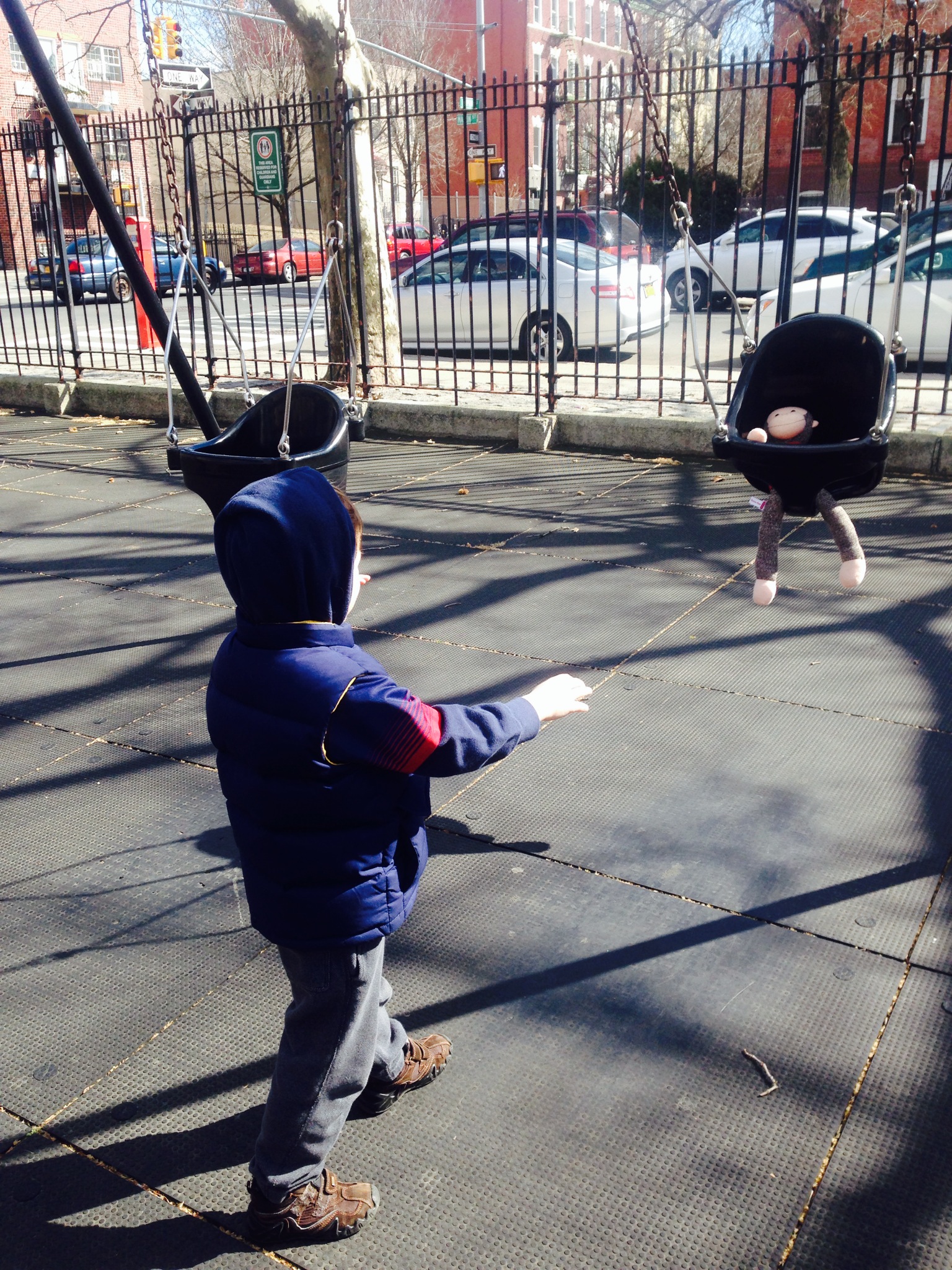
Martin plays this weekend in Bedford-Stuyvesent, Brooklyn. I told him he was too big for these baby swings. He responded by putting his "little brother Curious George" in for a ride.

Martin plays this weekend in Bedford-Stuyvesant, Brooklyn. I told him he was too big for these baby swings. He responded by putting his “little brother Curious George” in for a ride.

Feel Good

Feel-good stories fly around social media like air hockey pucks around the table. They go viral: click click click click clack clack click click clack kajing! Goal! All over the internet!

A disproportionate number of these feel-goodies, it seems to me, involve ASD, usually children with ASD. The waitress who brought a new hamburger when an autistic girl thought hers was broken. The garbage man who rewarded an autistic boy obsessed with watching the truck collect dumpsters. The young autistic adult who relates to the world through Disney movies. And so on. You’ve seen them, I’m sure.

A partner to the feel-good stories are the empowering badges, which often appear as Facebook statuses. “This is national autism awareness week. Post this for an hour so that everyone knows autism exists.” “I pledge never to bully anyone with autism. If I don’t see this as your status, I’ll assume you don’t care about bullying or autism.” (I’m exaggerating for effect, but not exaggerating that much.)

I have nothing against feel-goodies or empowerment. On the other hand, when these tidbits are shared by persons outside the ASD community, I feel patronized. Most adults have no inkling what it’s like to live with a person with autism, and cannot fathom how it feels to be responsible for the future of a person with autism. From their hideaways in neurotypicality, they have our token children to help them shed a few tears of gratitude. It’s a catharsis.

I would like to say, please, get your catharsis from fiction. Try Shakespeare, or a melodramatic movie. Or read history, long-ago victories and defeats.

Autism isn’t fiction. It isn’t feel-good. It’s our reality, a reality that’s spreading every day. If you want to feel good about an autistic child, forget the heartwarming videos and articles. Start advocating. Start questioning why autism rates are rocketing skyward and we’re not doing anything to stop the epidemic. Remember that the reason you smile at those feel-good stories is that you don’t have to deal with the non-feel-good moments that fill the rest of the time.

Thanks.

Autism-Blind

Martin was ignored yesterday.

The church that we attend now—much more traditional than the young, edgy congregation we left behind in Manhattan—includes a “children’s time” in the service. Children younger than age 10 are invited to gather near the chancel, where the pastor engages them with a few questions and tells a Bible-related story. Martin goes, too. The pastor, to his credit, usually calls Martin by name and addresses him once or twice, even if no response it forthcoming. I can’t say that Martin participates fully in the experience. I can say that he likes being included; he runs forward without hesitation.

Yesterday, the regular pastor was away, so children’s time was headed by a choir member who is also an elementary-school principal. Eight children participated. The principal began by greeting several (not all) of the children other than Martin by name. Then, without making eye contact with Martin or calling his attention in any way, she launched into her lesson. Martin, who is unfocussed and irritable this week (see the reference to nystatin in Saturday’s post), responded by fidgeting, lying on the floor, and turning away from the chancel to face the congregation, wearing a goofy smile. Finally, he stood up and drifted toward the organ, which fascinates him.

The principal probably could have halted 90% of Martin’s behavior by catching his attention and saying, “Martin, let’s sit and listen now,” or even just asking him a question about the Bible lesson.

Instead, she ignored him. Talked to the other children. Pretended like nothing was happening.

From being in the church choir, which sits only a few feet away from the chancel where the children gather, the principal must know that Martin sometimes needs extra help. I suppose that, once she was in charge of the group, she might have thought that I wouldn’t want Martin “called out.” In truth, I’d much rather have him called out briefly by an adult than allowed to call himself out with five minutes of inappropriate behavior. Or maybe she just didn’t know what to do, which would be disappointing in an elementary-school principal. In any event, children’s time was unproductive for Martin and uncomfortable for me.

Which brings me to one of those moments when I realize that Martin’s autism has taught me something without my noticing it.

A dozen years ago, a friend of mine mentioned (I have no recollection of how the subject matter arose) Dwayne “The Rock” Johnson being half-black.

“He is?” I asked. “What’s the other half?”

“Asian Pacific Islander. Why? What did you think he is?”

“I don’t know. A white guy, I guess,” I answered, honestly. “Maybe I never really thought about it.”

My friend, who is African-American, laughed. “I guess it’s good if you’re color-blind,” she said. “But I’m not sure thinking that everyone is ‘a white guy’ is the way to go.”

This morning at church brought that moment to mind. It is tempting to believe that the great equalizer is pretending that we are all the same. We are not the same. A person who is black, who practices Orthodox Judaism, who is male, who has a wife instead of a husband, who is single, who uses a wheelchair, whose English language skills are limited, who lacks formal education, or who [insert any of six billion variations here] does not have the same needs I have. It is not good to be color-blind, or physical-challenge-blind, or hyperactivity-blind, or autism-blind.

When your child has autism, you don’t get to ignore difference. Difference follows you around, speaking too loud and out of turn. It demands your attention. I am far more likely, today, to consider whether any trait, from intelligence to handicap to race, is influencing how an individual perceives his environment. I am far more likely, today, to ask myself what I can do to help.

I no longer act like the best course is pretending we’re all the same.

Lest it seem like church yesterday was a wholly disappointing experience, I am happy to report that other parents in the congregation get it. I was worried about Martin’s antics. As I glanced around I saw no disapprobation, only encouraging expressions ranging from, “Calm down. Martin’s with the other kids and he’s happy,” to, “He might be over there checking out the organ, but, hey, at least he isn’t playing it.”

The principal’s mistake notwithstanding, I think lots of us are marching toward embracing myriad needs.

Goodbye on His Own

Special education means special transportation. Martin does not have to wait at a bus stop. Instead, a bus (yes, it’s the short bus) picks him up at the end of our driveway and delivers him back after school.

(Hurray! We have a driveway, and we live on a dead-end lane. Waiting for the bus is so much easier than when we had neurotypical kids parading past.)

When Martin comes home, I walk to the end of the driveway to meet him, and once he’s off the bus we follow a little ritual. (According to the principles of RDI, I vary the ritual slightly each day, to facilitate Martin’s dynamic intelligence.) I ask him how his day went, take his heavy backpack—containing a lunch cooler with glass and/or stainless-steel containers, a stainless-steel drink holder, multiple notebooks for my communications with his classroom teachers and his therapists, and sometimes spare clothes—and hold his hand while we wait for the bus to turn around at the dead end. Then I remind Martin that we need to wave good-bye to the bus driver and the matron, and I count to three, and we wave together as the bus passes us and beeps.

Yesterday afternoon something new happened. As usual, Martin took his time to descend the three steps and land on the driveway; he still tends to look forward instead of at his feet, so big stairs can be challenging. He walked two steps toward me, as if to begin our ritual—

Then, instead of coming to me, he turned around by himself, waved through the still-open bus door, and called to the driver and matron, “Goodbye! Goodbye! See you tomorrow!”

This may be one of those occasions when I need to explain, for anyone not raising a child with autism, what the big deal is. The big deal is twofold: (1) Martin did something different, and (2) he displayed awareness of those around him and their needs. He realized that the driver and matron were leaving, and that people who are leaving expect goodbyes.

Martin says goodbye a lot. He does so after I say, “We’re going. Let’s say goodbye,” or, “What do we say now, Martin?” I cannot remember a previous occasion on which he wished someone goodbye unprompted. Will he do it again this afternoon? Maybe. Maybe not. Often a new skill emerges, disappears, and then at some later date shows up in regular use. I’m less worried about consistency right now. The key is that social awareness is within Martin. With every bit that his body heals, we unlock more of the intangible.