Smooth(ie)

Breakfast is challenging. Morning is challenging.

I know, I know: Most families with young children probably find it difficult to get them fed, groomed, and out to the school bus on time. Breakfast with Martin presents certain additional factors:

1. Martin doesn’t like his breakfast food options. I’ve given him as many choices as I can, subject to the parameters of what fits his current diet and what I can manage in a smaller window of time. His enthusiasm peaks at “meh.” Certainly nothing gets put in his mouth voluntarily.

2. Martin also needs to take supplements and medications and homeopathic drops (lots of them), which I assemble and administer during the meal, dividing my attention.

3. Mornings, for whatever reason, are Martin’s most distracted time. Often, despite the plate sitting in front of him, he seems to forget even that he’s supposed to be eating. I lob hints and suggestions. (“What’s 9+3, you ask? Try some turkey bacon and we can talk about it.” “Hey Martin, guess what you can use that fork for?”) Occasionally I resort to spooning the food into his mouth. Okay, fine. Often I resort to spooning the food into his mouth.

In order to be ready for the school bus on time, Martin needs to leave the breakfast table and go to the bathroom by 7:25 a.m. He knows this. While asking questions, drawing pictures, and dropping food on his school clothes instead of eating, he counts down the minutes until 7:25. The instant the clock turns, he springs from his chair, remaining food be damned.

If by some miracle Martin finishes his breakfast—or if he manages to bargain me down to some reduced food portion that he’s willing to cram into his mouth in order to escape the table—before 7:25, he’s allowed to go into the family room and play for whatever minutes remain.

One recent morning Martin was drinking a smoothie: coconut kefir, avocado, kiwi, papaya seeds, and strawberries. By 7:18 (the dance is precise) we had finished morning supplements. I headed to the bedrooms for my three minutes of “me time” (pull on jeans, straighten hair, add enough layers to hide pajama top so I can escort him to the school bus). Martin remained at the table, his smoothie glass still half-full.

Typically I would return to the kitchen at 7:21 and devote four minutes to cajoling him to finish breakfast. That morning, however, I returned to the kitchen to find the glass, empty, in the sink waiting to be washed.

“Martin!” I exclaimed. “What happened?”

“I finished my smoothie. I’m playing,” Martin responded from the family room.

I’m no Pollyanna. Quickly I scanned the sink and garbage for evidence that Martin had dumped the smoothie. Nothing. The kid was for real. He’d actually decided just to finish breakfast and go play. I swooned.

And lest you think that’s the only victory of recent days, allow me to say that, this very day, February 21, I asked Martin to get dressed “within five minutes.” After some debate about where he would agree to get dressed—he insisted on standing on my and Adrian’s bed, which apparently offers the best view of our digital clock—Martin completed the task in three minutes flat. Except for his socks. Socks are hard. Also, his underwear and shirt were on backwards, which I considered an improvement, because yesterday his pants were on backwards.

Victories are everywhere.

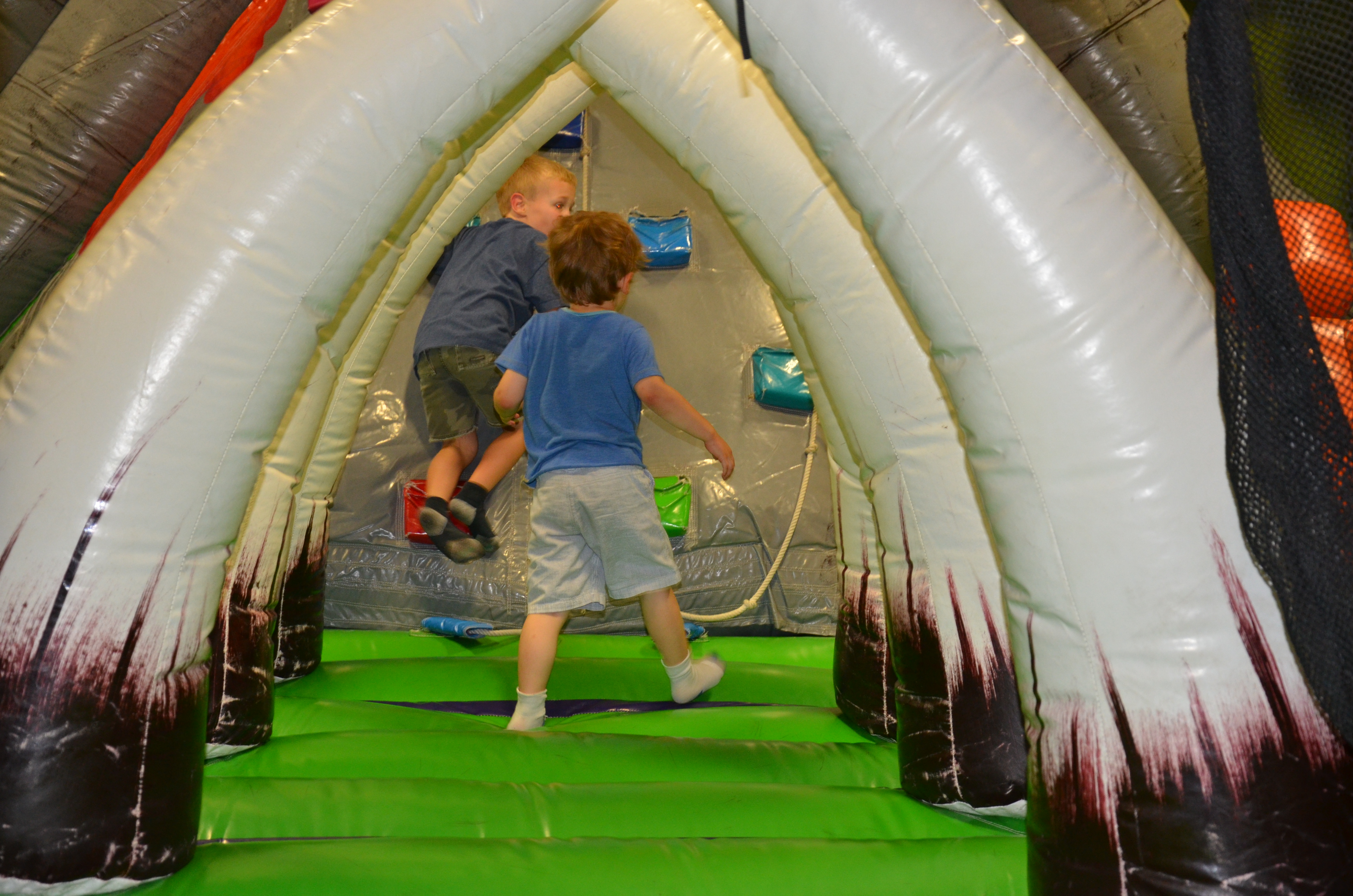
Martin, assisted by his partner-in-crime, George the Cat, plays in our family room.

Martin, assisted by his partner-in-crime, George the Cat, plays in our family room.

Why, Hello Again

How does one restart blogging?

I’ve been thinking about that. Mostly while lying awake at night and also wondering why the [redacted] I’m not blogging. But still.

And ta-da!: The plan I’ve conjured, the blogging redux after seasons of silence:

An update.

I’ll offer my readers—in the event I retain any—tidbits about where we stand now, and then, my blog restarted, I’ll pretend like I never was away.

1. We’ve left the City for the suburbs. New York, New York, no more. We moved June 4 to a ranch house, situated on 1.15 acres in a town where many of our neighbors prefer another NHL team to the New York Rangers. An autism diagnosis was one thing. This kind of upheaval—it’s disconcerting, to say the least.

2. Martin attends kindergarten at a private school for children with learning differences. His class has twelve pupils and multiple instructors. Adrian and I feel extremely lucky that Martin has the chance to attend such a school, never more so than this past weekend, when we attended one classmate’s birthday party and watched Martin frolic with his new best friends.

3. Martin receives traditional occupational, physical, and speech therapy at his school. Saturday mornings I drive him into the City for two sessions of Anat Baniel Method (ABM) therapy. We continue working with a HANDLE therapist, and doing home-based exercises activities on the RDI approach. One evening per week Martin takes piano and drum lessons (the latter by his own initiative) with a certified music therapist.

4. We have not yet recovered Martin. We have, however, made progress, and a good deal of it:

•            Though he retains some patterns, Martin’s speech is rarely rote anymore. He has some quirks, such as substituting “but because” for “because” and adding “for” where it doesn’t belong, as in, “Can I have a piece of paper for to draw a picture on it?” Nonetheless, he can express his wishes, wants, and needs verbally, and well.

•            Martin can engage in conversation of six or more exchanges, so long as he is answering the questions (not asking them, which is a level higher). Here is an exemplar talk, which we had when he arrived home one day last week:

“How was school today?”

“It was good.”

“Did anything special happen?”

“We had a surprise reader!”

“Oh, yeah! Who was the surprise reader?”

“It was Quinn’s family.”

“Quinn’s family? His whole family came, not just his mommy or daddy?”

“His whole family came.”

“Wow! What was the book about?”

“It was about snowmen.”

“Did you like it?”

“Yes. I liked it. We made snowmen!”

Note that Martin, who once just “said things,” was speaking accurately. I confirmed later that Quinn’s mother, father, and older sister had all come to do the surprise reading, that they’d read a book about snowmen, and that they’d helped the class with a snowman-making craft project.

•            Lethargy is a thing of the past, and Martin’s “floppiness”—his tendency to fall onto anything within reach—diminishes every day. His core strength has improved, insofar as he is as likely to sit up as to slouch. His manual dexterity is such that he grips a pen appropriately for writing and drawing, he can manipulate small items like pills, and he uses his hands independently for drumming. (That last achievement might not pertain to dexterity per se.)

•            Martin takes a keen interest in his peers: what they eat, how they play, the structure of their families, where they live. He requests play dates. What he still lacks is a solid understanding of how to interact with friends. We’re working on that.

We vacationed recently at a resort area. When Martin was having trouble engaging any other child there, I would approach the child’s parent and say something like, “I think my son would like to play with yours. My son has Asperger’s, and he’s never quite sure how to go about making new friends.” “Aperger’s” sounds much less scary than that other A word, I think it’s pretty accurate for where Martin is now, and the parents I approached responded uniformly positively. Martin made a couple of “vacation friends” that way.

5. Martin still exhibits “autism” behaviors. He perseverates. A lot. This has been an issue forever. Right now he prattles endlessly about traffic lights, hair length, the time, and the moon. He also has three prominent stims (self-stimulatory behaviors), which become more pronounced when he’s tired or detoxing. The stims are running back and forth, making a slurp! sound by sucking air through his lips, and carrying or playing musical instruments. And of course, Martin can be rigid. He wants to wear his blue vest every day, drive one particular route home, read Pete the Cat or Knuffle Bunny books every night.

6. I now understand “the long haul.” I think that, when I started the process of recovering my son, I didn’t really comprehend what how long one might need to haul. The mother who introduced me to biomedical intervention had largely recovered her son within two years, and was done with the process entirely within three years. I failed to grasp that her family’s timing was exceptional. I thought that by kindergarten we’d be done.

My family has been at this three years now, chipping away at the underlying health issues that exhibit themselves as “autism” in Martin. My son has made staggering process. If we never achieve anything more, I will know that our time and money have been well spent. Still, he is not recovered, and much work remains. Fortunately, I no longer fear that some mythical window will close while Martin is five (he’s five now), or seven, or any age. A mother of a recovered 14-year-old told me recently, “Our best year was when he was 12. Twelve years old is when he made the most progress.” Twelve years old is a long, long way off for Martin. If that turns out to be our best year, so be it. We’ll get there.

7. This year, 2014, is going to be extraordinary. Don’t ask me how I know. I can say this: I woke on January 1 with that feeling, and it has not left me. Martin will hit new milestones, and so will I. This past weekend I met with an old friend from law school. My friend used to work in venture capital but for the last year or two has been searching for a new path, something more creative. I told him that I haven’t been doing much writing, or much of anything else, because I’ve been so focused on Martin’s needs. Without warning, he turned to me and vocalized something I already knew: “2014 is going to be a banner year. For you, for your son, for me. I think this is our year.”

See you soon.

Madison Square [Expletive] Garden

When I found out I was pregnant, I began to dream about what my child and I would share.

Maybe he would be a vegan. Maybe he would attend my alma mater. Maybe he would learn German. Maybe he would suck at all things involving music.

Maybe he would learn to love what I love, and want to do what I do.

What I love is ice hockey, and what I do is watch the New York Rangers. I have a season subscription “mini-plan,” which entitles me and a companion to show up to approximately one-quarter of the Rangers’ home games, occupy two seats very near Henrik Lundqvist (first and third period), and whoop like a drunken sailor.

Martin has been doing so well lately that I decided that the time has arrived. On April 27, a Saturday, I brought Martin to Madison Square Garden to watch the Rangers play the New Jersey Devils. It seemed like the perfect starter experience: It was the last game of the regular season, it was a 3:00 pm matinee, and although the Rangers and Devils are usually a good rivalry, the Rangers had already made the play-offs and the Devils were already ruled out, leaving little at stake and perhaps a less-rowdy crowd.

Martin and I arrived by 2:00. I wanted to bring him in before the big crush of fans, and to acclimate him before the cheering.

The first thing he asked for was a bottle of water, which I bought him, totally forgetting that the Garden vendors take the bottle cap away and make the bottle a giant pain in the neck to carry without spilling.

Next we headed to a fan shop to buy Martin a new Rangers jersey. Martin was already wearing a blue toddler-sized #30 Henrik Lundqvist jersey, but that was too small because he’d owned it since—well, in any event, since he became old enough for me to swaddle him in a Henrik Lundqvist jersey, sometime around his birth. At the shop I displayed the available boy-sized jerseys. Martin’s choices were a classic navy-blue #61 Rick Nash (master of the goal-scoring universe), an away-game white #24 Ryan Callahan (Cap’n Cally! upstate power!), or a home-ice blue #30 Henrik Lundqvist (yes, Henrik Lundqvist). Martin waffled for ten minutes before settling on the #30 Lundqvist: a larger version of what he already was wearing. Outside the store, he refused to wear the new, larger jersey like I asked. Instead, he spilled half the capless bottle of water and cried because it made his pants wet.

Five minutes later we were in our seats. Both teams were skating around the rink, pre-game practicing. Immediately I realized that, when I attend games with other adults, I do not accurately perceive the level of noise and other stimulation inside the Garden. It is like a rock concert in there. Music blares, the announcer yells, fans scream, lights flash, sometimes the entire inner arena goes dark.

With Martin by my side, these usually exciting aspects became threatening. He sat cross-legged in his seat, motionless except for intermittently covering his ears. I lifted him to see over the fans standing in front of us. I showed him Rangers in their blue jerseys and Devils in their red jerseys, each team skating around its own half. I pointed out Lundqvist in goal, wearing #30 just like Martin.

Martin continued covering his ears, then wrapped his arms around my neck and squeezed.

We retreated to the concessions level. I purchased a Brooklyn Lager in a cup, with a straw, because I am cool, and sipped some while Martin gazed through floor-to-ceiling external windows. I suggested returning to our seats. He replied, “I don’t want to go back to our seats.” We waited a while longer.

Once the first puck had dropped and play was underway, I insisted on a second try at the inner arena. Martin came along, glumly. He sat cross-legged again, and sometimes slouched down or flopped onto me. I followed the game as best I could. Ryan Callahan, the Rangers’ captain, flipped the puck into the Devils’ net for the game’s first score. The noise level rose even higher. I picked Martin up and bounced him along to the Rangers fans’ chant: “Goooo-o-o-o-o-al! Goooo-o-o-o-o-al! Hey, HEY, hey hey hey hey! Hey, HEY, hey hey hey hey! Hey, HEY, hey hey hey hey!” He covered his ears.

I can’t say that Martin was enjoying himself. But he kept it together.

Near the end of the first period, Martin reached forward and took a water bottle from a drink holder, thinking it was his own. Instead, Martin’s bottle was one drink holder to the left, and the bottle he grabbed belonged to a boy about ten years old, in the seat next to Martin. That boy seized the bottle from Martin’s hands, forcefully. (I think he might have been wary of Martin because of the slouching and flopping.) I apologized to the boy and handed Martin the correct bottle, and I could see that being startled that way had pushed Martin toward his breaking point.

During first intermission I escorted Martin to the quietest area I could find and asked if he would like to go home. He said yes. I explained that if we left we would not be able to come back into the arena and asked whether, knowing that, he still wanted to go home. He said yes. And so we headed for the ground-floor exits, where I told a security guard, “My kid isn’t feeling well. We’re going to watch the rest of the game from home.”

In the subway, Martin had what I think was a delayed-reaction meltdown. He became fixated on dictating which passengers could get off at which stations, and threw a tantrum when, inevitably, the passengers got off at the stations of their own choosing. I took Martin on my lap, let him cry, and then successfully distracted him by asking him to name the stops between Madison Square Garden and our home.

If you are the parent of a neurotypical child, the afternoon I’ve just described might sound like a disaster. We saw only one period of hockey, and I had to abandon more than half a beer, its forlorn straw sprouting toward nowhere.

To me, it was no disaster. It was a darn good start:

•      Martin must have been overwhelmed by the noise, lights, and crowds. I can hardly imagine an environment with more external stimuli. Nevertheless, he held it together. He did not freak out.

•      Martin returned with me to the seats even when he didn’t want to. I didn’t have to force him or bargain. He acceded to my wishes.

•      With all that was going on, I wasn’t sure Martin would really comprehend what was happening around him. But he did. Ten minutes into the game, he had turned to me, in all the hubbub, and said, “Mommy, it’s just like when we watch hockey on television.” Ah-ha! We were experiencing hockey together!

This season, one period. Next season, two?

As Martin continues to recover, we will encounter more that he can share. Actually share, as in emotions exchanged. Adrian will take him to the opera. My brother Eddie will teach him to play backgammon. My stepfather will show him how to swing a golf club. My mother-in-law will make him sweat through Bikram Yoga.

The Rangers game was no unmitigated success.

Still, there was a time, not long after Martin’s diagnosis, when I wondered whether I would ever be able to take him to a restaurant in peace again.

I just took him to Madison Square Garden. Unassisted. If I were given to writing profanity, I would drop an F-bomb between Square and Garden, for emphasis, because that’s the kind of big deal I’m talking about.

Madison Square [Expletive] Garden.
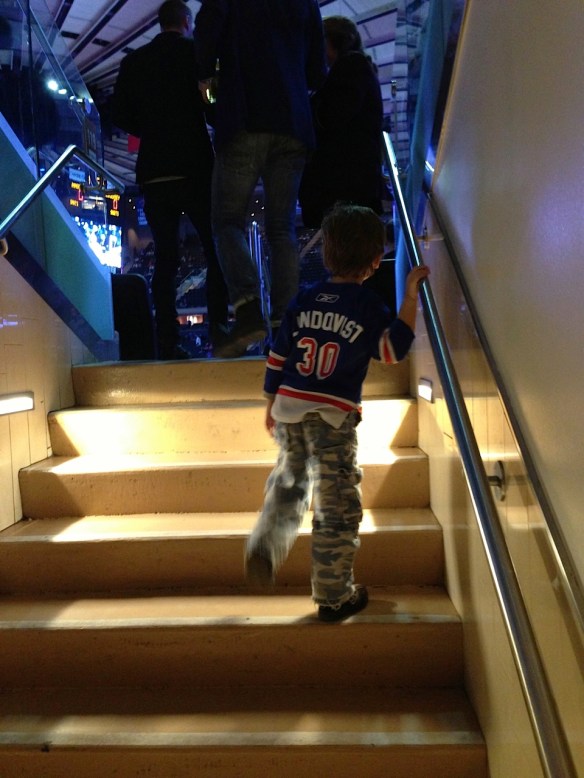
OMG! Is that Henrik Lundqvist? No, wait. It's my Martin, checking out the Garden.

OMGosh! Is that Henrik Lundqvist? No, wait. It’s my Martin, checking out the Garden.

Notes on a Wednesday

Wednesdays, of late, are exhausting days for me and Martin. He plays hooky from school. We start the morning by driving more than 50 miles to Wilton, Connecticut to visit Martin’s new homeopath and, if it’s an appointment week, his biomedical doctor.

(Note to careful readers: We switched biomedical doctors five months ago, because Martin’s former practitioner moved to the West Coast.)

From Wilton, when our appointments are through, we get back in the car and drive more than 60 miles, back into New York State, across Westchester County and across the Tappen Zee Bridge and Rockland County, at last dropping into New Jersey at Ringwood, where Martin participates in hippotherapy. We eat lunch in the car: a sandwich for me, and Dr. Cow tree nut cheese with rice crackers for Martin. Then, while Martin spends an hour riding horses, I hike to a tiny farm and buy eggs.

Around 3:15 pm Martin and I get back into the car to drive 45 miles home. (Are you keeping track of all these miles?) Although it is the shortest leg of our journey, this takes the longest, anywhere from 90 to 150 minutes, depending on traffic getting back into and through the City.

Last Wednesday, on the morning drive to Wilton, I spent 20 minutes on the phone—hands-free Bluetooth, of course! I respect all traffic laws—trying to negotiate a good deal on the purchase of an infrared sauna. (More on that in a future post.) Martin was supposed to be practicing “being quiet while Mommy’s on the phone.” Instead, he grew increasingly agitated until he was sobbing while repeating, “You’re going to get off the phone! No more phone! You’re done with the phone.” I apologized to the sauna representative and finally, when I could barely hear him over Martin’s shrieking, aborted the call. Meltdown.

So that sucked. But three very cool things that did not suck at all also happened last Wednesday:

The update for Daddy: At the office of the homeopath—“Miss Lauren,” as Martin calls her—is a pile of toys. I was talking with Lauren when Martin appeared with a toy mobile phone in this hand and said, “Mommy, I’ve got a phone.” I replied, “Oh? Would you please call Daddy and let him know we got here okay?” Without further prompting, Martin nodded, hit a few buttons on the toy phone, held it to his ear and said, “Hello, Adrian? But because we’re at Miss Lauren’s. Okay. ’Bye.” (Martin is in a phase wherein he calls Adrian by his first name instead of Daddy or Papá. “But because” is a verbal tic that Martin has.) Comprehending my request? Pretending? Following a direction? Yes, yes, and yes, thank you.

The hippotherapy superstar: Martin does hippotherapy with a speech-language pathologist. Hippotherapy requires body awareness, multisensory activity, and concentration. Martin’s performance varies widely from week to week. (Martin’s performance on just about anything can vary widely from week to week, day to day, or even hour to hour. That’s the nature of the biomedical beast.) Last Wednesday, when I came to claim Martin after his riding lesson, his speech pathologist said, “He was awesome today. Awesome. Can you bring this version of the kid every week?”

The gesture of support: Do you remember my post from last Tuesday, about the best ways to be supportive of a family wading through autism recovery? It ended with these lines:

That’s all we really want, any of us, right?

A little faith, and a cookie.

When Martin and I arrived home from our three-state extravaganza last Wednesday—one day after I posted about how to be supportive—I found a package waiting for me. Inside was a card quoting those two lines. Under them, handwritten by the friend who sent this card, were the words: “Some of us need a whole box of cookies. Prayers to you and your family. Always.” Enclosed with the card? Yep. A box of cookies.

I’ve been reading the Thinking Moms’ Revolution new book of essays. In one piece, the mother of a boy on the spectrum is asking, “Why did this happen to my baby? What did I do wrong? Is God mad at me?” Her mother, the boy’s grandmother, intervenes and points out that, if things had been different, she would not be asking, “Why did God give me a healthy child?”, so she doesn’t get to ask “Why?” now.

Sage advice, right? What happened to my son—the Pitocin, the C-section, the antibiotics, the vaccines, whatever combination caused this autism—happened. But it doesn’t mean my life doesn’t rock steady.

It doesn’t mean I don’t live in a world of blessings.

The Wanaque Resevoir in Ringwood, New Jersey, where I hike while Martin rides horses. I took this picture with my iPhone a couple weeks ago. Life is good.

The Monksville Resevoir in Ringwood, New Jersey, where I hike while Martin rides horses. I took this picture with my iPhone a couple weeks ago. Life is good.

Holy Cow, What a Week

This has been a week of outrageous swings: new development upon new development, meltdown upon meltdown.

Let me start with the good. Let me start with the incredible, because I am bursting with pride. Here, blog world, are the headlines—

Martin has managed new feats of attention. Sunday I asked Martin to put on his shoes. Martin walked to the front hall and put on his shoes, albeit on the wrong feet. That was an achievement in itself; seldom does Martin obey a command without additional prompting, especially not a command that requires multiple steps to fulfill. (Walk to front hall. Find shoes. Sit down. Put on first shoe. Velcro first shoe. Put on second shoe. Velcro second shoe. Usually I ask two or three times, and finally bark, “Martin! Shoes! Feet! Now!”) After the initial success Sunday, I said, “Oh, Martin, I think those shoes are on the wrong feet. Why don’t you switch them?”, and he did it without being asked twice. He looked at his feet, removed the shoes one at a time, reversed them, and Velcroed them closed again. He didn’t seem to notice that tears of happiness appeared in my eyes.

Martin is showing off. Tuesday on this blog I described how Martin jumped in circles on a trampoline at the doctor’s office and announced, “I’m jumping in circles.” It was a generalized observation, kind of informing the universe what was happening. Compare what happened the next day, Wednesday, at a Manhattan playground: After three tries, Martin managed to ascend a green spinning corkscrew and hoist himself onto a V-shaped joint at its top. Then, balancing himself, he checked to see if he had my attention and said, “Look how high I am!” That was no generalized news bulletin. That was a desire to show off to his mommy. He was proud of himself for climbing the corkscrew, and I was proud of him for wanting me to know it.

Martin is moving, at least sometimes. We live in a fourth-floor walk-up apartment. Because the apartments below us have high ceilings, it’s more like climbing five flights. There are 78 steps total. I know because I used to count them when I was eight- and nine-months pregnant. I thought getting up the stairs was tough in those days. It was nothing compared to the challenge of getting Martin up them. He dawdles. He fiddles with his bicycle, stored in the ground-floor foyer. (We have the kind of cool neighbors who allow that.) Especially when he’s lethargic, he sits down on the landings and talks to himself instead of continuing. If I take his hand and try to march him upwards, he bends his legs slack and suspends his body from my hand. The stair process can last ten, fifteen minutes. So imagine my surprise Wednesday evening when, as we entered the building, Martin said, “I want to hold your hand,” then took my hand in his and, next to me, ascended all 78 steps without interruption—a historic achievement in Martindom.

Martin wants what other kids have. Yesterday morning, Friday, I brought Martin to an Anat Baniel Method therapy appointment. As we were leaving, we encountered another boy, about Martin’s age, and his father. The boy made excellent eye contact and had far more verbal skills than Martin. He introduced himself by name. Then, obviously proud, he held up an MTA MetroCard and said, “My dad gave me this to hold, and it still has some money left on it.” Martin, who watched and heard this from a few feet away, immediately said, “I want to hold a card. I want to hold a card!” Unfortunately, I had just loaded $50.00 onto my MetroCard and therefore did not want to trust it in Martin’s hands. I said, “Let’s go back to the subway station and see if we can get you one.” I hoped that, in the ten-minute walk to the station, he might forget the incident. Instead, when I pulled out the MetroCard to enter the station, he demanded to hold it, which I allowed for a short time. Martin has taken an interest in other kids’ food before, but to my recollection he has not sought their playthings or special privileges, at least not so earnestly.

Martin is indicating the person to whom he’s speaking. This began when he started using the command form; to his dictates, he appended Mommy. “Come here, Mommy.” “Open the candy bar, Mommy!” (Martin doesn’t really eat candy bars, of course. We call Go Raw brand raw sprouted seed bars “candy bars” to make them sound as delicious as possible.) Within a few days, as we were driving in the car, Daddy became subject to our little dictator, too. “Close the roof, Daddy.” “Turn on the radio, Daddy.” Not too much later, we realized that even non-command comments were directed toward me or Adrian. “Mommy, I want something to eat.” “Daddy, I need some help.” Martin was no longer throwing words to the wind. He was giving them to his parents. Finally, just yesterday afternoon, I heard him specifically address someone other than me or Adrian. “No, Samara,” he responded to a question from his babysitter. Martin begins to understand that a conversation requires a partner.

Martin doesn’t always need the sound. Last night Samara was giving Martin a bath while I packed for our Thanksgiving trip to Texas. (I’m typing this entry on the airplane, while Martin watches Sesame Street on the iPad. We’ll be in Texas for a week.) From the bedroom, about ten feet away, I caught Martin’s eye. I put my hands over my heart and silently mouthed the words, “I love you.” Martin apparently read my lips. From the bathroom he called, “I love you, Mommy.” Can you imagine? A boy who once lacked appreciable receptive language read my lips.

So we had a week of singular advancements. Let me not, however, overstate where we are. As always, there’s more to the story.

•      On Sunday while Martin switched the shoes from foot to foot, although he maintained focus on the task, he also perseverated nonsense to no one while he worked. “I’m reading it on the computer. ¡Hola! The elephant’s name is Mitt. I’m not going to take a shower!”

•      The day Martin climbed the corkscrew, there were some four dozen kids scampering around the playground, chasing each other and playing games. Martin declined to interact with any of them. The activities to which he set his mind were his, and his alone.

•      After Martin seamlessly ascended 78 steps while holding my hand, he entered the apartment, removed his shoes and coat, and immediately began self-stimming, running back and forth with two pa-dap-BUMPs capping each lap.

•      While the boy with the MetroCard introduced himself, Martin turned around and thrust his face into a waiting-room sofa, with his butt in the air towards me, the boy, and the boy’s father. When I fished him from the sofa and asked him to say hello, Martin responded by muttering, “No, no!” and hiding behind my legs. It was from that position that he watched the other boy show off his metro card.

Moreover, Martin’s mood has been disastrous. Perhaps because of the itchy viral rash plaguing him, or perhaps because our travel has thrown off his sleep, or perhaps just as a counterpart to the rate of change in his neuro-processing, Martin has turned on the tears at any provocation this week, and sometimes at no provocation.

One sunny morning he said, “It’s cloudy outside.” When I said, “Look out the window, Martin. I think it’s sunny today,” Martin started crying and yelled repeatedly, “No, it’s cloudy outside. It’s cloudy outside.” For several minutes he was inconsolable. Another morning, following a poor night’s sleep, Martin whined continuously for 30 minutes. Oh mommy oh mommy oh mommy oh mommy oh mommy oh mommy on and on. And on and on. And on and on. His poor night’s sleep meant I was running on about three hours’ sleep that morning. The oh mommys did nothing good for my nerves.

This afternoon Adrian suggested that Martin consider wearing his green fleece coat to Texas instead of his bulky winter jacket. Martin responded by screaming from our apartment, screaming down 78 steps, screaming through the foyer and parking lot, and screaming halfway to JFK. I occupied the passenger seat and rubbed the back of Adrian’s neck as he drove. We pretended that no one was screaming in the back seat.

When the noise finally stopped, I said to Adrian, “It’s amazing, isn’t it, all the new things he’s managed this week?”

Wondering Where Recovery Lies

Martin and I are at LaGuardia, on a flight delay. Fog. We’ve survived a hurricane ripping through New York and an unseasonable Nor’Easter dumping snow onto our neighbors’ powerless, unheated homes. Here at LaGuardia, however, it’s “patchy fog” that ruins the day.

I just spoke with the staff at Martin’s doctor’s office. That’s where we’re trying to fly—to his doctor’s office. We’re lucky; they’re going to rearrange some scheduling to accommodate our 90-minute delay. Let us hope it’s 90 minutes only.

I want to make it to the appointment, because medically speaking, Martin is not doing well. (Again.) Since our last appointment, eight weeks ago, he evened out, then looked good, then slipped. For the last three weeks he’s been plagued by a yeast imbalance. (Again.) Since beginning biomedical intervention almost two years ago, we’ve got yeast under control three times, only to have it strike back three times. Right now Martin’s skin is leathery and covered with scratches. He itches. He can’t resist clawing at his arms and legs. And with yeast come symptoms: distraction, irritability, toe-walking, skipping. I dread the pa-dap-BUMP sound that means Martin has lost attention, jumped into the air, and is about to start running laps. I hear pa-dap-BUMP a dozen times a day.

Still, outside the biomedical realm, Martin is making some progress. Last month he began Anat Baniel Method (ABM) therapy. Within a week we saw verbal progress: He started using the command form. He said, “Mommy, come play with me,” at the playground. I thought that might be a fluke, until he called, “Mommy, come here,” from the bathroom and then said, “Turn it off please,” when I ran the Vitamix during breakfast. Previously Martin could not use the command form; he either used an affirmation (“You’re going to come here”) or expressed a desire (“I want you to come here”). I was on cloud nine with the new verbal ability, until Martin barked, “Make me a snack!”

We’ve made some RDI progress, too. We’ve been working on pacing and facial referencing. Two days ago Martin asked for his drumsticks. I said, “I think I saw them on the chair.” Martin walked to a chair in our living room, didn’t see the drumsticks, then turned back to me, looking for more information. (Ding! Ding! Ding! RDI success!) I said, “No, one of those chairs,” and thrust my chin toward the sitting room. Martin got the idea but missed the exact location; instead of the sitting room, he headed for the dining table. (Our loft has an open floor plan. These areas all sort of merge.) Then he turned back to me again. (Ka-BOOM!) I said, “The chair over there with the doll on it,” and there he headed, to find his drumsticks.

So it’s a mixed bag, these days. Since we started biomedical intervention, I’ve lived with the assumption that the key to Martin’s recovery lies in healing the immune issues that underlie the disorder. These days, when the biomedical aspects are getting us nowhere—unless “Symptomatic Itchy-ville” counts as a place—but behavioral and physical therapies are showing some results, I question my assumption.

I’ll post again after today’s medical appointment.

If we make it.

Stuck at LaGuardia. Not much to do.