Martin: The Only Cause That’s Got Me Doing

I’m kind of a nervous flyer. Whenever I fly, before take-off, I say a prayer along these lines: “I hope we get where we’re going. If we don’t, I trust that I’ll end up someplace even better. I trust that we’ll all end up someplace even better. But still I hope we fly safely, and I hope that the safe conveyance reminds me that life is limited and I ought to use it well.”

Tuesday night on the plane to Israel, I started to say that prayer, and I had an epiphany:

I don’t, at this moment, have fears for myself. I have fears only for Martin.

That’s not to say that I don’t worry about dying. Or, you know, a horrible disease or coma-inducing accident, or terrorist attack, home intruder, flesh-eating bacteria, mountain-lion bites, impalement. The usual.

I do worry about all those things. But my fears for myself have taken a backseat. A distant backseat. Way back, like at the swaying end of a double-length bus. As I recited my pre-take-off prayer last night, I had a feeling like, “If it’s my time to go, it’s my time.

But who will take care of Martin?

Martin is the only grandchild of my mother and stepfather. I know they would step in without hesitation and continue his biomedical recovery. And they’re not alone. My father, my siblings, my parents-in-law, my brother- and sisters-in-law. Any one of them, or all of them. They’d have a lot to learn, but they’d do it.

Then again, deep-down I wonder: How could anyone do what Adrian and I are doing for Martin? More accurately—and I’ve admitted: I’m a control-freak—: How could anyone do it to my exact specifications? The countless pills and liquids, the fifteen HANDLE exercises daily, the RDI, the Track Two doctor visits across the country. The faith and determination.

If something happened to me, would Martin still be able to reach his potential for recovery?

That’s it, then. In my whole life right now, the thing that matters most (maybe the only thing that matters?) is my son’s recovery. My pre-flight prayer now is simply that I stick around to see it through.

To own the truth, I’ve long been a person with a cause. Usually the cause involves animals, like ending the carriage-horse industry, regulating backyard breeding operations, or banning battery cages. But I’ve never been a person who took enough action for her cause. I give money. I speak out when asked. I hope and wish. I don’t do.

At least, not until now. My cause now is Martin, and I’m doing. Damn it, I’m doing.

Okay. The object is my son, and therefore this particular cause is just one step removed from pure selfishness. Moreover, it can (I trust) be accomplished entirely. I can recover my son. I can make him indistinguishable from his neurotypical peers. That fact alone separates Martin’s recovery from, say, world peace, or eradicating poverty and disease.

Still, it’s a cause, and for the first time ever, truly I’m stepping up.

Once Martin is recovered, what’s next? I have a sense that this episode could herald a new chapter in my life, one of doing instead of hoping and wishing. Maybe my cause will be promoting biomedical recovery, or defending practitioners like Dr. Usman who devote themselves to recovering children. Maybe I will stick to animal welfare, with the new perspective of having felt compelled to feed my son meat as part of his recovery.

Some years ago, when I was considering a career change, a friend told me to remember that a life is many decades long, meaning that what seems earth-shattering at one moment may in time reveal itself as only a bump in the road.

Not to be fatalistic (just contemplative), I’ve had four decades already. If I can recover my son, I will consider them well-used—even if, in time, this journey comes to seem only a bump in the road.

As for Martin, our efforts now will give him many decades in which to do whatever he wants, free from the grasp of autism.

Your blogger, hiking to the ruins at Avdat, southern Israel.

Without Martin

Readers, it’s been a week. For the first time since I started this blog, I let more than three days pass without a post.

I apologize.

I blame Christmas preparations—I didn’t accomplish even half a standard Christmas, but that’s a subject for a later post—, forging through dense briefing schedules in two separate litigations, sitting up at night as Martin’s had trouble sleeping, and preparing for the trip.

Yes! The trip! This is the big one, Adrian’s sixth-anniversary gift to me, and eight days without my Martin. My mother is staying in our apartment with Martin. We’ve gone backwards and forwards over his daily supplementation schedule, dietary restrictions, wants, and needs. I’ve filled the freezer with pre-prepared meals and organic meats. With the approval of Martin’s HANDLE therapist, he gets these eight days off from HANDLE exercises. And all week Samara’s been helping Martin learn this mantra: “Mommy and Daddy are coming back. Mommy and Daddy always come back.” As a result, he was okay when we left this afternoon. I said, “Daddy and I are going on an airplane and will come back next week. You’re staying with Grandma.” Martin replied, “Mommy is coming back another day. Mommy always comes back.”

I’m worried, of course. Not that my mother won’t accomplish Martin’s diet and supplements to the T. Not that my mother and Samara and even my visiting brother won’t be doting on him. I’m worried that he will be distressed without us, and more especially, that we could lose recovery momentum. These past few weeks have brought so much progress. I’ll have a hard time forgiving myself if our absence interrupts that, or prompts a set-back.

(“I’m not worried about permanent damage,” Adrian assured me yesterday. “I’m really not.”)

It didn’t help that, just before Adrian and I headed out, Martin seemed, as my mother put it, “a little spacey today.”

Nevertheless, I made it out the door, teary-eyed. I’m typing this on the airplane. We’re bound for Israel, landing in Tel Aviv and continuing by car to Eilat, then to Jerusalem, sandwiching a day trip to Petra in Jordan. This was all supposed to be a surprise, but some weeks ago I forced Adrian to reveal the itinerary. Not knowing our destination was just shoveling anxiety onto my already gigantic pile of hesitation about leaving Martin. It’s only the second time, since we radicalized his treatment, that I’ve been away more than a night. The first was a four-day trip to Germany for a family emergency, during which Samara moved into the apartment and helped Adrian manage the routine.

So there you have it. This blogger is on her way to the Holy Land and will have a week to contemplate the course we’re on with Martin. I’m determined to post daily, both to take advantage of the time away and to make amends for the recent posting dearth.

An eight-day travel journey, meant as a break from a years-long recovery journey.

Here we go.

Raw Narrative

I wanted to write about something that happened this morning. Then I realized that I had already written the event, in a (maybe) more authentic voice than I would employ for blogging. Let’s call this earlier version the “raw narrative.”

Adrian has been out of town on business since Sunday. (Which leads me to another opportunity to express my unrestrained admiration for single parents, and particular single parents of special-needs children. After a few days of handling Martin’s schedule alone, I’m toast. You amaze me.) When Adrian is traveling, I have a habit of sending him morning and nighttime updates via Blackberry.

Here, unedited except to change the names, is this morning’s update for Adrian:

Good morning, Sweetie! Martin and I are looking forward to having you back. It is drizzling here but so far not too bad.

Sweetie, I started crying this morning, in the street. I was standing with Martin, watching for the school bus to come. He was holding my hand, waiting patiently, not fidgeting, not flopping to the sidewalk or hanging on my arm, and he was making spontaneous sentences about some things he saw (“The fire truck is red,” “The man is running”), and then it hit me that he is getting better, that we’re managing this struggle, that every day I see more and more of the person emerge who our son was meant to be before this god-awful disorder took hold. I looked pretty foolish, I think, crying on _____ Street. But there I was.

In other news, I sent the first brief off at 4:00 a.m. and haven’t received comments yet, so I took advantage of the lull to jog over to the Union Square greenmarket for duck eggs, cow bones, and ostrich filet, to make sure the fridge and freezer are stocked for when my mother is here. My word, what have I become? Also got some of that buttery “Two Guys from Woodbridge” basil that we had last week. Come home so I can feed you.

Kisses.

Let me begin by saying that I’m not usually a crier. At least, not an in-the-street crier. As the penultimate paragraph indicates, I had worked until 4:00 a.m., which left me two hours for sleep before I had to rise at 6:00 a.m., which is the breakfast-and-school-prep time I need when Adrian is away. To that I will add that our senior-advisor cat, Philly, who inexplicably screeches during the night—not to be confused with our junior-advisor cat, Freddie, who pees everywhere—launched his half-hour hyena routine at 5:06 a.m., ultimately leaving me about 86 minutes for sleep. So I was tired, and emotions were heightened.

That disclaimer notwithstanding, the crying was entirely justified. Remember the three crap months we endured from August to November, when Martin’s yeast kicked up again and all the gains we’d made over the summer seemed to disappear? Gone. A memory. Martin is better than ever right now. His eye contact is so consistent that I rarely think about it; I assume that if I say his name, I will see his eyes, for as long as I’m talking. Joint attention is rising again. And Monday afternoon Samara noticed Martin casually taking the initiative to hold a friend’s hand.

We went through three months bad enough that I doubted the entire recovery process, and doubted whether I could endure. I know there may be down times to come, as well. But this day, here, now, I am so glad we’ve hung in there.

I will conclude by advising that I am in no way affiliated with or compensated by the “Two Guys from Woodbridge” company. I really did write that in the email to Adrian, and they really do grow magnificent buttery organic basil.

Adrian

Adrian and I were getting into bed one night last week when Adrian said, unprompted and unheralded, “He is getting better. He really is.”

Adrian neither prefaced his statement nor provided supporting detail. He did not even specify “Martin.” He just said, “He is getting better. He really is,” and then opened his iPad to read.

End of story.

Airport Fun, Part One: The Bathroom Miracle

We traveled yesterday, Martin and I, to visit his excellent Track Two doctor. I intend to post the doctor’s comments (at least, my interpretation thereof) once I’ve had a chance to ponder all she said. For now, I want to discuss the trip, and more specifically, positive and negative experiences we had underway. It will be another two-part post, starting tonight with the positive.

Going to visit Martin’s Track Two doctor means a schedule something like this: We rise early and eat breakfast and take morning supplements at home. Adrian drives me and Martin to the airport, where the two of us clear security and fly a couple hours. Upon landing we take a quick bus ride to a car-rental office. Then, in what I consider the most challenging part of the day, I make Martin wait inside the rental car—there’s just no way I could keep him safe in a rental-car lot with my attention diverted—while I install the toddler seat. Whatever the season, it invariably seems to be either sleeting, pouring rain, or freezing while I spend 20 minutes with my backside hanging out the passenger door, installing that damn toddler seat.

(I am yet to find a car-rental company that will install a toddler seat for me. If you know one, please send the information to findingmykid@yahoo.com.)

Next I drive us 40 minutes to the doctor’s office for a two-hour (give or take) appointment. After that we head back to the airport, surrender the rental car, ride the bus, clear security, wait around, and fly back to New York, where Adrian meets us at the airport, usually between 10:00 and 11:00 p.m. During this whole process I feed Martin food that I’ve cooked at home. For myself, I drink a lot of coffee and pick up what I can, here or there.

It’s an exhausting day. A lot of moving from place to place. A lot of walking hand-in-hand.

And, of course, a lot of visiting strange potties.

Yesterday we hit four airport bathrooms. Don’t worry: For a change, I will not address any, ahem, bodily functions in this post. The topic du jour is what happened outside the stalls.

Bathroom No. 1. No paper towels! The bathroom had only hot-air hand dryers. Martin loves paper towels and fears hot-air dryers. (Oddly, he likes hair dryers. When I dry my hair, he waits for me to whoosh his bangs back with the hot air, scampers away, then returns repeatedly for another whoosh.) In the past, a paper-towel dearth might have caused a meltdown. Yesterday when we finished washing our hands, I said to Martin, “Oh! No paper towels. But you don’t have to use the electric dryer. Let’s go see if we can find paper towels anywhere else.” He accepted that, and we exited the bathroom peacefully. I planned, if Martin persisted in seeking paper towels, to grab some Starbucks or Auntie Anne’s napkins. (The paper-towel supply in my backpack was too precious to surrender, meant instead for in-fight snacks, spilled drinks, runny noses, training-pants accidents, and whatever else the day had waiting.) The napkins proved unnecessary. We strolled wet-handed to the gate, and Martin let go of his paper-towel dreams.

Bathroom No. 2. We were in a hurry. While he was throwing away his paper towel, Martin glanced up and saw that I was already leaving. In such a situation, Martin’s typical reaction has been to dawdle, maybe turn on a faucet or play with a stall door, and generally ignore me until I return to retrieve him and drag him out by the hand. Not yesterday. When he saw me leaving, Martin dumped his paper towel, ran across the bathroom, and took my hand. Paying attention to my cues? Picking up his pace to meet mine? Glory be, whose child was this?

Bathroom No. 3. I was so inspired by the Bathroom No. 2 breakthrough that I designed a little experiment to see whether I could replicate the success. After hand washing, I directed Martin to a wastebasket at the far end of the bathroom to discard his paper towel. While he was thus engaged, I moved to the exit area—it was one of those set-ups with no door, where you instead exit by maneuvering through a U-shaped passageway—and called, “C’mon, Martin, let’s get out of here.” Then I ducked behind the first part of the U-shape. As an unanticipated bonus, a full-length mirror on the bathroom’s near wall enabled me to watch Martin’s reaction. He looked up, realized that I had left, appeared briefly startled, and again came running. It’s not that long since I had to worry about Martin wandering away without so much as checking my location before he took off. To have him hustling and mildly panicked when he knows I’ve left a bathroom—well, that’s a plain miracle.

Bathroom No. 4. We were in a hurry again. The plane was actually boarding. I threw away the paper towel for Martin, grabbed him, and ran. So nothing to report, except maybe, Hey, did I tell you about Bathroom No. 3?

Coming attraction: The security-line tantrum.

Quote of the Last 17 Days: Hope

“Hope is one scary emotion.”

This quote comes not from someone famous—at least, not famous yet—but from my friend Alex. She is ten years younger than I am, trim, fit, beautiful, and because of a muscular affliction, often seated in a wheelchair. At the same time that Adrian and I are fighting to recover Martin, Alex is undergoing a costly experimental therapy aimed at regaining her mobility. “Hope is one scary emotion,” she told me in an e-mail and then continued:

I’ve been thinking a lot about hope lately, and my total fear of that particular feeling. Call me emotionally conservative or a cautious optimist (really cautious), but there is nothing more devastating (down on the floor crying with your coat over your head while you’re alone in the office) than feeling like you’ve put your hope in something that has failed. Imagining that your life can be different and then ending up in the same position that you were in before. I find that more times than not, feeling let down after I’ve dared to hope is what puts me in a near-catatonic state. . . . It’s been a long time since I even thought that I could be fixed.

With those words, Alex was speaking for both of us.

I have a conflicted relationship with hope. When Martin is doing well, hope creeps in, and invariably I wind up disappointed. Invariably, because when I’m hopeful, anything not perfect feels like a nasty, swollen raincloud hovering over my picnic table.

Take yesterday, for example. At the breakfast table Martin was drinking his apple-cider-vinegar beverage, and I noticed that he held the stainless-steel straw in the middle of his mouth, his little lips puckered around it. A big deal? A huge deal. Through his HANDLE therapy we’ve realized that Martin has midline issues. He does not like to reach his left hand to his right side, or vice-versa; he turns his head to watch action from the corner of his eyes; and he clenches straws with his molars, dangling them from the edge of his mouth. For months I have maneuvered his straw to his mouth’s middle and held it there while he slurped. Each time I released the straw, his tongue kicked it back to the molars.

Now here he was, unprompted, unassisted, puckering his lips around the straw.

I felt so hopeful. I seized Martin’s notebook—the one we use to communicate with his school—and wrote, “We’ve seen a lot of improvement in Martin lately.” Then I sent him off to the school bus.

I meant, of course, to prompt a similarly upbeat response from Martin’s teacher, something along the lines of, “So have we! He’s concentrating much better.” The moment Martin arrived home from school I pulled the notebook from his backpack and checked. Nothing. His teacher failed to take the bait, and that failure, unreasonably, crushed me. I assumed that she had seen my note, realized its purpose, and made a conscious decision not to respond, because she had observed no recent progress or improvement.

Martin’s teacher does not respond to everything I write in his notebook, especially when I give non-specific information (as opposed to, say, “Please note that Martin will be absent tomorrow for a doctor appointment”). Nor does she generally address his progress in the notebook; for that, we hold frequent in-person conferences. I can only imagine, also, that the daily grind in a classroom of special-needs pre-schoolers allows limited time for musing extensively, in writing, on “improvement.”

None of that mattered when I saw the empty notebook page yesterday. I had spent the day feeling hopeful, and my hope is so fragile that it just waits to be shattered.

So for the most part, I try to avoid hope. When I sense hope fluttering through my chest, I try to diminish it, by focusing on Martin’s shortcomings and areas without recent improvement.

And therein lies the conflict. I dodge hope because it invites an unbearable parade of emotional highs and lows. On the other hand, I can’t continue this path without hope in Martin’s recovery. Hope is sustenance, even if I partake only when Martin’s progress is undeniable.

Today, unlike yesterday, and even though that straw again was in the middle of Martin’s mouth at breakfast, I will not allow myself to feel hopeful about Martin’s recovery in any present or immediate sense. Instead, I will hope for my friend Alex, and allow her to hope for us.

When hope becomes an enemy, at least we have our friends.

Interactive Play. Interactive Play That I Didn’t See

I did not witness the event described herein. Samara did. And I was so excited that, when she finished telling me, I made her narrate the entire tale, again, to my mother and Adrian, via speaker-phone. The hearsay version follows—

The setting was a 67-degree New York City afternoon, yesterday. Samara took Martin—he was exhausted from the overnight flight home, yet alert and adventurous—to play at a park with a substantial sandbox. Martin managed to get hold of the only on-site bucket and shovel. He had filled the bucket with sand and was using the shovel to scoop it out when another boy, perhaps four years old, approached and wanted the bucket.

Martin’s usual response to such a situation has been to abandon the toy to the child who demands it, and perhaps to start crying. Yesterday, instead, Martin engaged in some sort of wordless negotiation with the older boy, which resulted in the two of them sitting down, the bucket between them. The older boy cupped his hands to dump sand into the bucket; Martin used the shovel to scoop it out the other side. According to Samara, the two preschoolers cooperated this way for some ten minutes.

Non-verbal communication.

Interactive play.

Joint attention.

That’s my boy.

An Aimless Post, Most of Which I Wrote on an Airplane

Recovery requires a sea change, from autistic behavior to neurotypical, that as far as I can tell takes years under the best circumstances. There will be no single morning when Martin will wake up perceptibly different from the night before. True, we notice gradual alterations: moments when I remember some behavior Martin used to have that I haven’t witnessed in weeks; instances when Martin surprises us with a new skill, albeit one that won’t reappear again for months; once-daunting tasks, like clearing airport security, that Martin manages now with ease. And there are physical signs, such as sleeping and scratching.

But for the most part Adrian and I operate on vague notions, such as whether the day passed easily, or how Martin “seemed,” or whether he carried himself like other kids.

Three nights ago we left Martin with my mother-in-law, who was traveling with us, and had a dinner date. We talked about Martin, as usual, and we agreed that he does seem better. Neither of us had any precise reason. I mentioned that Martin appears steadier on his feet and more organized in his movement; Adrian brought up eye contact. No one denied that Martin has thrown some tantrums this week, or that his language remains so-so. Yet our notion was one of improvement. Indeed, Adrian called this “in terms of recovery, the best week [Adrian has] seen in months.”

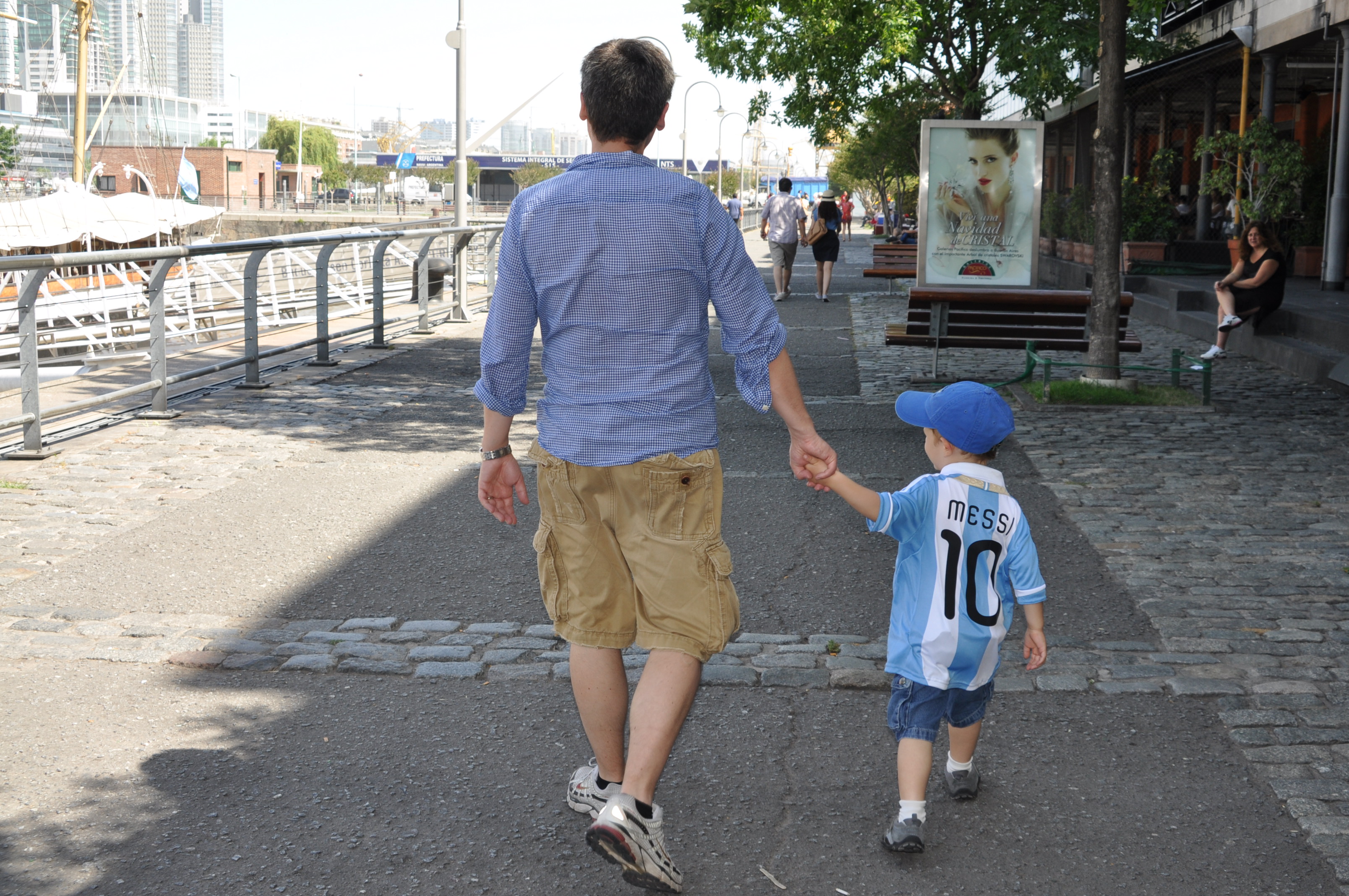
By yesterday Martin was exhausted, and sick of traveling, on our last in Argentina before the overnight flight back to New York. He was fussy and unreasonable. He insisted on being carried any distance longer than four feet. Still, he brought us joy. We had him dressed in a miniature Leo Messi jersey, which caused our lunchtime waiter to like him immediately. (The Messi-jersey trick, I’ve determined, works on nearly any Argentine. We’ve enjoyed repeated calls of “¡Qué precioso!” and “¡Hay viene el Lionelcito!”) The waiter doted on Martin, who smiled and ate with his fork like a big boy. After the check was settled, the waiter held out his hand to Martin and said, “¡Ciao, amigo!” Martin grasped the offered hand, made firm eye contact with the waiter, and replied solemnly, “Ciao.” It was another of those like-any-kid interactions.

Where am I going with this post? I don’t really know, as I don’t truly know where we’re headed with recovery. I guess I want to say that things are looking up.

But it never pays to get ahead of myself. That’s a recipe for heartache.

Symptom Check, 26 November 2011

Autism is defined by symptoms, and I observe Martin’s daily, so it seems reasonable to share regular updates on where Martin’s symptoms stand. Here is the status check, for Saturday, 26 November 2011.

Sleeping: No issues. We’ve been traveling more than a week. Martin has taken advantage of every hour of rest we’ve afforded him. A couple nights, when we were on a plane or rising early to catch a plane, he did not get nearly enough sleep. Our fault. Other than that, he’s been going down for twelve hours. He has appeared tired/fatigued during the day, which may be attributable to heat (it must be 87 degrees in Buenos Aires today), pollen (falling like raindrops from the blooming trees), or general over-excitement.

Attention: Not great. Name responsiveness is low. It’s been tough to get him to focus, or even to look at the camera for pictures. Granted, he’s been photographed eight million times in the last week and may be growing tired of it, but he usually does better.

Mood: Also not great. Cranky. Clingy. Doing a lot of complaining that he wants to “go back to the hotel” or “go back to New York.” I don’t blame him; traveling makes me cranky, too. And the appeals for hotel or home seem to be obvious responses to unfamiliar situations, and what Martin must perceive as chaos around him. Plus, his bad mood has resulted in some solid sentences, like, “I want to get in the airplane and go back to New York.”

Language: So-so. On the one hand, pronouns continue to be an issue. Lots of echolalia and its corollary, using “you” instead of “I”—such as “You want more water” when he means “I want more water.” On the other hand, we’ve been getting some unexpectedly original sentences. In addition to the aforementioned pleas to go home, there were “I see mountains through the window”; “There’s a flag on the boat”; and “That’s one sailboat. That’s two sailboats.”

Self-stimming: Today he’s been thrusting his jaw forward, some. Also he’s been tilting his head back to stare at the ceiling and tensing his facial features. But overall we’ve seen relatively little self-stimming this week.

Physicality: Of late, I think we’ve made the most progress in physicality. Martin appears more aware of his body. He’s now telling us when he’s hungry (although he doesn’t generally use the word “hungry”; in its place he says, “You [I] want to eat”). He’s doing a little better at keeping his “toddler training pant” dry, so long as we remember to sit him on the potty often. He’s steady on his feet and pacing himself well when holding hands with me or Adrian. When he walks or runs alone, there is some disorganization, but less than previously; in terms of movement, he looks more like a neurotypical kid.

Breakthroughs: Two points to note. First, for months, we’ve been working with Martin on learning to pucker and blow. He can blow a pinwheel now, though only in short bursts, and not a deep, extended exhale. This morning he discovered blowing bubbles with his straw in his beverage. Hurray for Martin! And what a pain for me and Adrian! All he’s wanted to do today is blow bubbles; I’m not sure he’s actually drunk an ounce.

Second (caution! graphic scatological content to follow:), after lunch today I sat Martin on the potty, where he “did his poopies.” When he had concluded (or so I thought), we had this exchange:

Me: “Are you all done?”
Martin: “No.”
Me: “Do you have more poopies?”
Martin: “Yes.”
Me: “Well, go ahead.”

Indeed, we had this exchange six consecutive times, and each time Martin in fact did have another bowel movement. We must have been in the bathroom fifteen minutes. Finally I asked again, “Are you all done?”, and he said, “Yes,” and climbed down from the potty. This may not sound like anything worth writing home about—or in my case, worth subjecting my blog readers to—but it really speaks to the improving body awareness. Good work, Martin.

Travelogue

Traveling is no good for Martin’s recovery. I have to admit that. In the seven days we’ve been traveling, I’ve not once managed to complete all 16 daily HANDLE exercises, and RDI has fallen by the wayside. I’m out of fiber powder and two of his supplements. I brought only one magnesium variety and realize now he should be taking two.

We have limited access to freshly prepared organic foods that meet Martin’s dietary requirements. We’re in Argentina now; Martin is lunching on barbequed grass-fed beef, which is superficially acceptable, but the chef cannot verify whether the cows were hormone-free, or the origin of the animal’s feed, such as whether it was grown with pesticides. These are inquiries to which, in New York, I could chase down answers.

And then Martin is overwhelmed. We’ve broken his routine, thrust him from one unfamiliar situation to the next, presented new face after new face and directed him to say hello.

We’re weathering the attendant minor freak-outs okay, but I’m not going to look for any progress from this week. We may even regress, a bit.

I’ve been contemplating what that means. I want to accomplish Martin’s recovery as quickly as possible, in a trajectory as straight as possible. Gallivanting around Latin America is hindering those aims.

On the other hand, my primary goal is and must remain Martin’s ultimate recovery, however long that takes and however jagged the process. What we do in these years—whether we’re talking 12 months, or 120—will affect the entire future course of Martin’s life. Recovery. Now, or later.

I’ve posted on the value of undertaking Martin-free activities. I believe that travel falls into this category. It is not reasonable to expect Adrian to pass X years without bringing his son back home to show him off. It is not reasonable for Martin to wait until he’s closer to neurotypical before he can play with his cousins. It’s not reasonable for our family to confine itself to the tri-state area when we want to head out and play.

So we’re managing diet and supplements and exercises as best we can, minimizing stress where feasible, and more or less writing off the week, recovery-wise.

Except for this: Enjoyment. Stamina. For me and Adrian, a little recovery of our own.

That also assists in the greater good.