RDI Fun

“Wow! The sun is really reflecting light off that building,” I remarked at breakfast last Thursday. I made a show of gawking through the kitchen window.

Martin, seated at the counter, fiddled another second with a toy, then turned to look out the window.

Score!

“It’s so bright it kind of hurts my eyes,” I said.

Martin shifted his gaze to me and replied, “It’s bright.”

Double score! I scrawled a few words in my countertop notebook and let several minutes pass while Martin ate breakfast.

“When the sun is still rising, it’s much lighter outside these windows”—I inclined my head to the kitchen window and other west-facing windows—“than it is outside those windows.” I finished with a dramatic point across the room to the east-facing windows.

Martin checked the kitchen window once more, then compared the east-facing windows.

Score! I made another note and let a few more minutes pass.

“It looks like it’s starting to get cloudy,” I said.

Pause.

Nothing.

I decided to add some “scaffolding.”

“I was looking out the window,” I said, “and I noticed that it looks like it’s starting to get cloudy.”

My words alerted Martin. He looked at me and then out the window. “It’s cloudy,” he said.

Score!

And so we went, through breakfast. Observation. Reaction. My gaze. Martin’s gaze.

This odd game is part of a behavioral therapy, Relationship Development Intervention, or RDI, that we do with Martin. Although I meet regularly with our RDI consultant, the program is intended to be family-based and driven through everyday interactions. It rests upon “guided participation,” wherein I serve as a mentor to Martin, helping him master the basics of social interaction. RDI for ASD covers approximately a gazillion milestones, and I have found it challenging to get my arms around the program.

Nevertheless, our consultant is patient, and on occasions like last Thursday’s breakfast, I see the logic behind the RDI strategy. Right now we’re working on Martin’s ability to read facial expressions. Ideally, Martin would show sustained interest in me during breakfast. He would check my face regularly, and if he noticed me staring in some direction, he’d also look there, for clues to what’s going on.

That’s what neurotypical persons generally do. For example, this afternoon I walked into my bank and saw several patrons and staff craning their necks to look at the high ceiling. So I looked, too. I just did. And before I had a son with ASD, I would never have thought twice about the moment. (A ceiling vent was emitting ash, it turned out.)

Martin, on the other hand, does not automatically make such observations, at least not yet. So I’m teaching him to do so. I look out the window. I give Martin a chance to notice and to look out the window, too. If he doesn’t, then I add some “scaffolding”—that’s RDI-speak for “extra help”—by making some verbal observation. I give Martin another chance to catch my clues. If he doesn’t, it’s time for more scaffolding. I might point, or make my comment more explicit, such as when I said, “I was looking out the window and ….”

At all costs, I avoid using the imperative. Martin, look out the window, is a no-no. So is an imperative hidden in a question, like, Can you look out the window? RDI sets a goal of 20% imperatives, and 80% “observations,” “emotion sharing,” and so forth. That’s probably the toughest component. When you have a child on the spectrum, the day can easily dissolve into 99% imperatives. Martin, eat your breakfast. Martin, chew. Hurry up! Martin, can you put your shoes on? Martin, come here and brush your teeth.

We’re also playing little games to work on facial observations. Over the weekend I placed three identical boxes upside down on the rug and hid Martin’s miniature guitar under one. With facial expression alone I indicated which box was harboring the guitar.

Martin showed no interest whatsoever.

I scaffolded. I removed one box, arranged the other two on either side of me, and nodded dramatically toward the correct box.

Martin started to get up.

I scaffolded some more. “I think the guitar is there,” I said while nodding.

Martin perked up and lifted the correct box.

Mini-score! Score with extra scaffolding!

I’ve got the mantra ingrained by now: ASD recovery is a marathon, not a sprint.

Even the little victories count.

(Careful readers might be wondering why the rising sun shines brighter through our western windows than our eastern windows, given the sun’s proclivity to rise in the east. The anomaly happens because a taller building blocks our eastern exposure, while our western exposure is open to, across an expanse, office towers whose windows throw the sunbeams back toward us. Ah, city life.)
What’s Disappeared

It’s accounting season. Adrian’s assistant has prepared a summary of what our family spent last year on recovering Martin. Supplements, therapies, unreimbursed doctor bills, plane tickets to see specialists, that sort of stuff. It does not include expenses associated with Martin’s restricted diet, like buying only organic or making weekend farm visits for meat. Nor does it include my kitchen make-over, continually purging plastics and aluminum in favor of glass or stainless steel.

Even without the foods and cookware, the total is a large number. Not astronomical. Not bank-breaking. But large.

“Did you think it would be this much?” Adrian asked me.

I replied, “I’m looking at it like this: If someone told us last January, ‘Give me this amount, and within a year Martin will respond to his name, will make eye contact consistently, will interact with friends, will move like a neurotypical child, and will speak in complete sentences,’ we would have written that check, right?”

“Of course,” Adrian said.

He seemed mildly offended that I’d asked the question. But I was on a roll.

“And if someone told us last January, ‘Give me this amount, and within a year Martin’s lethargy and toe-walking and aimless drifting and low muscle tone and sleep problems and clumsiness will be gone, and his echolalia will be nearly gone,’ we would have written that check, right? Because that’s where we are. That’s what’s disappeared.”

Adrian waved his arm in agreement, putting an end to my roll. “We would have paid ten times so much. You know that.”

“So let’s keep it going,” I said.

And we fist-bumped.

Friendships

When Martin has a good day, I allow myself some daydreaming about life once he recovers.

So far, today has not been great. But yesterday was pretty good, and I did some daydreaming. I asked myself this: What is my No. 1 goal? If I could pick one facet of recovery wherein we succeed without qualification, what would it be?

Easy answer: friendships.

In post after post, I’ve extolled my husband, Adrian. We are (quoting a pal) the Disturbingly Happy Couple, co-participants in a head-butting, growling, grappling marriage of equal parts challenge and laughter. Without Adrian, I would, no doubt, lack the strength to recover Martin.

But there is another achievement of my adult life that I value just as much as my marriage: the ability to build and maintain friendships.

I didn’t have close friends growing up. That is to say, until I was in my 20’s I kept myself apart from others. I can perceive now that I had too little self-esteem as a young person, and that I masked that shortcoming with too much self-confidence—meaning that I ignored the needs of my peers and expected them to care for mine, without reciprocity. I had acquaintances, and “friends” in the sense of people with whom I interacted socially, but I never opened up to anyone. And if anyone tried to open up to me, I shut down.

As an adult, fortunately, I got better at internalizing humility in a way that led to more genuine relationships. It was a painstaking process, learning to unlock feelings and to expose my own weaknesses, and especially, to empathize. Inviting others out “just to talk.” Listening. Returning phone calls, writing thank-you notes, keeping track of what was going on in homes besides my own.

Closer friendships—I realize that this probably isn’t news to anyone but me—improved my life immeasurably. Today I marvel at the bone-headedness of self-isolation.

Adrian and I do RDI therapy with Martin. Last spring we watched a five-hour video explaining how RDI works. The first couple hours made for pretty awful viewing; a doctor enumerated the neurological bases for autism, and how those behaviors manifest themselves behaviorally. Dismal statistics appeared on-screen, noting that even the highest-functioning ASD adults, traditionally treated, do not live independently or enjoy significant peer relationships. Then the doctor appeared and reiterated that, unless their course of development is altered, high-functioning children with autism will not learn to make and keep friends. They will never have significant peer relationships.

I was mortified.

Another parent once told me, about her eleven-year-old son on the spectrum, “He doesn’t have friends except for one. But if he doesn’t care, why should I?”

I think she must be wrong. I think her son must care.

Martin will care if he has friends. And so will I, always.

A Little Bit Here, a Little Bit There

Pretty good week, this last one. Pretty crap day, today. Martin unresponsive, lacking attention, and throwing tantrums instead of transitioning. Tired and not himself. Mildly ill, even. Yesterday he threw up in the car, a special surprise that may have been tied to his beginning to eat meat products. (Since we started with the beef broth Martin has, now and again, after meals, appeared nauseated.)

Still, even on this crap day, some skills shined. Martin’s language, when he chose to use it, was appropriate and expressive. Also, we went shopping around Union Square, and three times (that I remember) he intentionally caught the eye of a salesperson and said, “Hi!”

I think in those terms, now. What worked today? What didn’t? I scrawl my observations into the daily log I keep for Martin.

I’ve tried to apply the same thinking to Martin’s recovery, on a meta-level. Which treatment or therapy is working? Which is not as helpful? Those, however, are much tougher questions.

The truth is, I see Martin making progress (two steps forward, one step back, usually), but it can be tough to discern the individual catalyst of progress like saying hi or trying to catch a stranger’s eye. Most likely, I suppose, every such advance results from some combination of the treatments we undertake.

As I have described previously, we see Track One doctors, who as far as I can tell have evaluated Martin but done nothing to help him. Apart from Track One doctors, this is Team Martin:

Track Two doctor. Martin’s excellent Track Two physician is riding the edge of autism recovery. I like to call her “post-DAN!” because she is so on top of treatments beyond the standard DAN! protocol. She oversees every facet of Martin’s biomedical recovery.

Home consultant. I’m new to this world of autism recovery. Questions come up on a day-to-day basis. Kathleen Reily answers them. She also helps me, for example, plan Martin’s diet, find local practitioners, and research kitchen products (water filter, lead-free glass, cutting boards not treated chemically, &c.). If I’m the coach of Team Martin, Kathleen is the manager.

Homotoxicologist. A big part of recovery lies in driving toxins and pathogens from the body. Martin’s homotoxicologist, Mary Coyle, works that angle, in coordination with his Track Two doctor.

Cranio-sacral therapist. I drive Martin all the way to Pleasantville, in Westchester, to see Diane Diamond. She helps figure out what’s not functioning well in Martin’s body and makes appropriate adjustments. She once told me, based solely on putting her hands on Martin, “I’m sensing some bile blockage. He’s not processing all this fat in his diet.” A week later, a urinalysis confirmed her assessment medically.

HANDLE therapist. We visit Katie Penque every four-to-six weeks. She observes Martin, interviews me and Adrian, evaluates how Martin’s current HANDLE exercises are working, and suggests and helps us learn new exercises. Katie and Martin’s Track Two doctor are also the proponents-in-chief for the “less is more” approach to recovery.

RDI consultant. RDI incorporates a variety of games and routines, but really it is a therapy that becomes part of daily life. Allison Zevallos helps us make that happen. She makes a home visit every month or so. In between those visits, Adrian emails her videos of Martin in action, which she reviews for a weekly phone consultation with both of us.

CPSE preschool. Martin attends a top-notch preschool for children with learning delays and developmental disabilities. Adrian and I are profoundly grateful for this service, which is provided through the Department of Education’s Committee on Special Preschool Education. Martin spends more than five hours per weekday at his CPSE school.

Speech therapist. Martin’s preschool provides him a bilingual speech therapist, in accordance with his individualized education plan, or IEP. She works to unlock language skills like pronoun use and asking questions, which Martin’s ASD has hidden.

Physical therapist and occupational therapist. Martin also sees these two professionals at his preschool. Together they assist him with gross and fine motor skills, practical life lessons like watching where he’s walking and being aware of the world around him, and performing everyday tasks.

So what among all this is facilitating Martin’s progress? Adrian and I credit HANDLE therapy for helping Martin develop better control over his body and lose some of the jerkiness that characterized his earlier movement. His physical therapy likely augments HANDLE in that regard. We credit RDI with helping Martin (this is an emerging skill, coming about slowly) learn to read faces and expressions and to better pace himself with others, so that he can undertake activities like holding my hand as we walk together. His occupational therapy likely augments RDI in that regard. It’s all puzzle pieces, coming together.

I consider the biomedical process—the restricted diet, the supplements, the detoxification—to be the sticky backing that holds those puzzle pieces in place. It was the biomedical process that got Martin sleeping and rested, eased his gut pain, and reduced the lethargy that used to characterize his days. Without that foundation, the pieces would probably still jiggle around, unable to interlock fully. Without the stronger body biomedical recovery is giving us, the therapies could have less effect.

A little bit here, a little bit there. I don’t want to spend too much time figuring out what progress comes from where, so long as we’re moving in the right direction.

The Most Beautiful Words, Ever

Yesterday evening I was doing a new HANDLE exercise with Martin called “Airplane Flagger.” Martin lay on his back on the floor, and I manipulated his arms: from his chest outward, from flat at his sides to over his head. At some point Martin mistook Airplane Flagger for “prelude to tickles,” which is not a HANDLE exercise but a fun game when I pin his hands above his head in order to tickle his underarms.

I figured, What the hay. Let’s make it tickle time, and set to tickling. I just love the joy of his unadulterated little-boy laughter.

A few seconds later I released his arms and let him catch his breath. I waited, poised above him, fingers pressed together in tickle-threat formation, holding Martin’s expectant gaze as RDI suggests. Martin could hardly contain his anticipation. “Again,” he said between gasps. “Again.”

So steady was Martin’s eye contact, I had to draw the moment out. I leaned closer and asked, “What? Whaaaaaat?”

And he produced the most beautiful words, ever.

He focused his eyes on my face, deliberately. He paused and considered. Finally, he said without bewilderment or guess, with the self-assurance of an accomplished orator:

“I want you to do that again.”

The sentence nearly overcame me. Instantly I analyzed it. An original thought, not heard and repeated. Subject. Object. Infinitive phrase. Adverb modifier. Perfection.

Martin’s previous best sentence, to my knowledge, came six or seven weeks ago, before he tumbled into the distraction that characterized last month. Dinner had just concluded. Adrian gathered Martin and announced bedtime. Martin became mildly distressed and protested, “I want to do sleepytime with Mommy.” That was a good, solid sentence—also included an infinitive phrase, and threw in a preposition—but “I want you to do that again” exceeds it in complexity, and requires proper use of both “I” and “you.” Prepositions are sand traps for an echolalic boy; he repeats what we call him (“you”), instead of registering the interconnectedness (the speaker is “I”). Perhaps we are approaching a milestone in his understanding.

Once my shock faded, as you can well imagine, I acceded to his wish and tickled. Again.

My son is a miracle.

As of September 28, a Weekday. And Some Sunshine

On August 5 I posted about my typical weekday. One reader sent this comment, via email:

You are not only an afternoon sous-chef/lawyer, but you have incredible perseverance (re utilizing every minute of the day) and patience. Somehow you maintain confidence it will be okay in the long haul. I got tired just reading it, especially the activities even after Martin went to bed. Someday it will all be all right.

That sounds sad to me. Does it sound sad to you? As if I’m so overwhelmed that I survive only by clinging to confidence in a better future for Martin?

Okay. Fair point—sometimes I am so overwhelmed that I survive only by clinging to confidence in a better future for Martin. It happens.

But I’m determined to stop being such a downer on the blog. If you are a reader acquainted with me off-line, you know that, in person, I am not a walking bummer. To the contrary, I’m quite sunny. (Adrian, the only party besides Martin with 24-hour access to me, might disagree. Fortunately for me, I’ve not yet added a “Husband’s Page” to the blog.) The reason I’m quite sunny is that I have a stable family and a blessed life. What concerns me most is how close my son will come to neurotypicality, and whether we can cover the distance quickly enough to overcome a late start to social interaction. That concern weighs heavily, but it’s not poverty, or terminal illness, or homelessness, or hunger, or unemployment, or abuse. Mine is a concern that, overall, I feel I have the tools to conquer.

Today I am posting optimism and contentment. Martin’s attention is returning, after that bad month we had. Yesterday I phone-conferenced with Martin’s excellent Track Two doctor, who ran some tests regarding his adrenal stress and is preparing appropriate homeopathic relief. Although the “meat thing” has proved difficult for me, Martin seems to be taking to beef broth without issue. Two evenings ago I enjoyed myself thoroughly at a happy hour for parents from Martin’s new special-education preschool.

Furthermore, since Martin started his new school earlier in September, my days have improved, time-wise. A typical weekday now looks like this:

6:40-7:00 a.m. I rise. I feed the cats. I check email and respond to any urgent missives. I prepare Martin’s morning homotoxicology and other drops, which “cook” ten minutes in hot water, to burn off the alcohol in which the active ingredients are suspended. I start Martin’s breakfast, which these days alternates among duck egg with squash fries (weekend treat), muffins with Dr. Cow “cream cheese,” grain-free veggie pancakes, and the occasional bowl of buckwheat or quinoa cereal with nuts. My mother just sent a waffle maker and recipe for almond waffles, so I’m going to add those into the rotation.

7:00-8:10 a.m. Busy time. Adrian won the desirable job of waking Martin (he’s like a sleepy little bunny rabbit in the morning) and the less desirable job of getting Martin onto the potty and then dressed. While they are thus occupied, I finish making Martin’s breakfast. I’m also running up and down the stairs from kitchen to bedrooms, bringing some supplements and maybe doing a HANDLE exercise or two. Adrian brings Martin downstairs by 7:30. I help Martin with breakfast and remaining supplements and oils, while Adrian showers and gets ready for work. I also fix Martin’s lunch during this time, because I like it to be as fresh as possible. His typical school lunch comprises nut butter slathered on homemade crackers (which get soggy if I prepare them the night before), accompanied by a dish like sauerkraut, avocado, pear, or hard-boiled quail eggs. By 8:00 Martin is teeth-brushed and ready. He makes one final visit to the potty with Adrian. At 8:10 precisely they walk out the door together, Adrian wearing a laptop/document backpack and Martin wearing a zebra backpack stocked with school supplies, lunch, and toddler training pants. Adrian puts Martin on the school bus.

8:10-9:00 a.m. Kitchen and me time. I empty the dishwasher, load in any plates lying around, give the kitchen a once-over, and if necessary do basic prep work for dinner. Then I get myself washed and dressed, and walk to the corner coffee shop for a soy latté.

9:00 a.m.-3:15 p.m. Lawyer time. I spend as much of this time working (as a lawyer, my “real job”) as possible. I may also sneak out to the natural foods store or continue dinner prep. Occasionally, daringly, I start a blog post. Samara picks Martin up at school at 2:15. They dawdle, wander here and there, take the subway home, usually arriving around 3:15.

3:15-6:15 p.m. Flex time. I keep doing lawyer work, as necessary. I assist Samara with Martin’s afternoon and evening supplements. I finish preparing dinner. I do HANDLE exercises with Martin. Some days Samara takes Martin to the park or a play date. By the time Samara leaves at 6:15, she has Martin bathed, pajama-clad, and halfway through his dinner.

6:15-7:00 p.m. Sleepy time. Martin keeps a 6:30 bedtime these days. That’s when we head upstairs to read a book, brush teeth, and snuggle. While Martin dozes off I sit in the rocker and check Facebook, read, or play Scrabble on the iPad. Adrian, when he’s home for bedtime, doesn’t hang around while Martin goes to sleep. I can’t leave. I cherish seeing Martin off to rest at day’s end.

7:00-10:00 p.m. More flex time. Some days I need to head back to my desk for more lawyer work. Some days there is laundry accumulated, or a pressing household task. Always there is kitchen work, for Martin’s special diet or for Adrian’s snack when he comes home between 8:00 and 10:00 p.m. My favorite evenings are when Adrian comes early, and I go for a walk or out to meet a friend.

10:00 pm.-? Bedtime and blogging. Sometime after 10:00 I head upstairs to read, talk through the day with Adrian, and blog.

I can manage this schedule, much better than the chaos before Martin began full school days. In fact, Samara now takes one day off per week. I cut work at 1:30 then and pick Martin up at school myself, and the two of us hang out for a couple hours.

Here’s what I still cannot figure out, though: Despite this new schedule, help from my mother on Martin’s food, and what should be more time for me, still I rarely put away the computer or iPad before 1:00 a.m. Honestly, I can’t even tell you what I’m doing all that time. Playing Scrabble, emailing, writing, reading, who knows? My next project—lights out by 11:00 p.m.

Saturday. Doctor, Therapist, Farm

Until August, Martin attended school just for two hours per weekday. His new school runs more than five hours per weekday, with a decent commute on either end, to boot. Participating in CPSE also carries family responsibilities. We can’t willy-nilly yank Martin out of school, or decide that he’ll skip a day.

As a result, we now concentrate doctor visits and private therapies, when possible, on the weekends. We try to make family fun out of shuttling from one appointment to the next.

Today Martin woke around 7:45 a.m. (an extra 45 minutes’ sleep from school days). He and Adrian completed some RDI exercises while I assembled their weekend breakfast. Martin got squash “French fries” with kelp flakes and one duck egg fried in hemp oil with minced cilantro. Adrian got the same, but substituting a chicken egg and adding a slice of whole-wheat toast.

It was a lazy morning, and despite the early start we managed to leave late for our 10:30 a.m. meeting with Dr. Ingels, the allergist, near Union Square. Because we were setting out for the day, we took the car, which of course made us even later, our route blocked by firemen using their truck and ladder to remove their stationhouse’s window-unit air conditioners, and then by a moving crew marching across 23rd Street with mattresses. A bunch of mattresses. Dr. Ingels pardoned the untimely arrival, and we enjoyed a routine visit. Martin’s tolerance for malverine, piperine, and candida has increased.

From Dr. Ingels’s we headed north, to Pleasantville, for a 12:30 p.m. session with Martin’s HANDLE therapist, Katie. She is the chief proponent of accomplishing Martin’s recovery as gently as possible. We discussed ways to soften the process even more. I talked about Martin’s attention and language lagging this past month. Katie asked about Martin’s sleeping and body control, which actually (I realized) have during the same period been quite good. Attention and language are advanced functions, she reminded me. Sleep and control are building blocks.

We grabbed lunch at the Pony Express in Pleasantville and ate in the plaza by the train station. Martin had rice crackers and homemade white-bean hummus. He investigated some trees, ran to the fence to watch a train pass below, peered with interest at (but did not speak to) another little boy. Overall, he seemed better. I’m beginning so sense a return of his attention, since we reduced the Biosode from 1x dilution to 2x.

From there we moved on, even further north, to the highlight of the day (for Martin, and perhaps Adrian) and an onerous task (for me). We drove to Hemlock Hill Farm in Cortlandt. We had researched farms on the internet in search of one that was organic and came close to meeting my ethical standards. We need some meat.

Yes. Meat. We’ve decided to feed Martin limited amounts of meet, and see if it augments his recovery. The choice has been weighing heavily on me these two weeks or so, and I needed to have it over with.

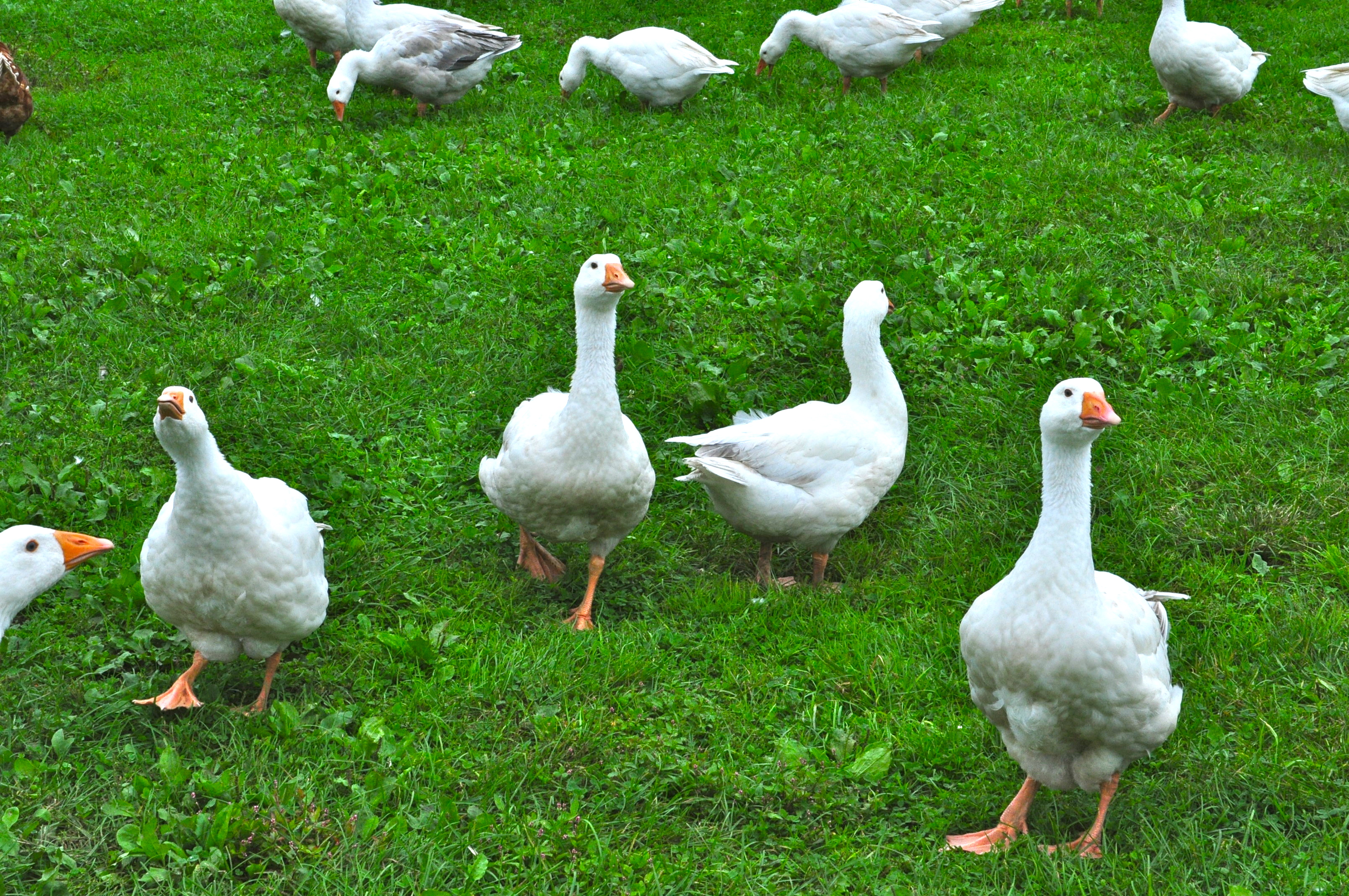
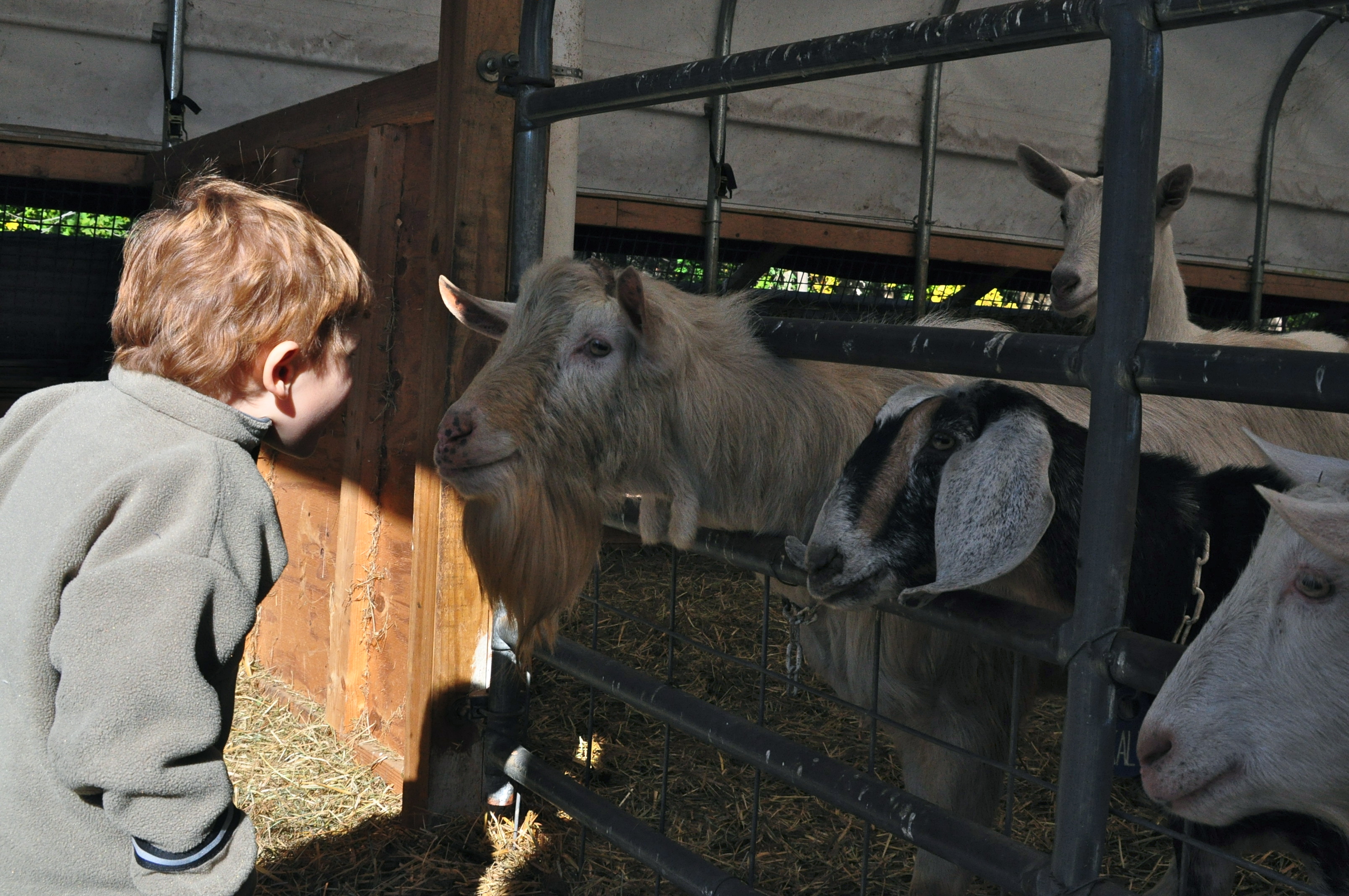
So off we went to Hemlock Hill Farm. Adrian took Martin to wander among the chickens and geese. I entered the little shop the farm maintains, more or less a concrete room with refrigerated glass display counter, freezer, shelving unit, and a few display bins. A man behind the counter asked if he could help me.

“I need—some meat.”

“What kind of meat?”

I decided honesty would be the best approach and ’fessed up that I had no idea what kind of meat. I’m a vegetarian, I explained. My son has a medical condition, and I’m going to try preparing him some meat.

The fellow was friendly and patient. He showed me packaged goat parts and which beef cuts have bone in them. (I’m supposed to put bone in the crockpot for making broth.) He explained how I could differentiate meat of animals killed on-site from that of animals killed at a USDA-certified facility in Pennsylvania. (I didn’t want any flesh from animals who were transported before slaughter. Too cruel.) I read information on what the animals eat—primarily, grass and grain also produced in Westchester County, at another farm. I asked about quail eggs. The farm has had them in the past but did not have any now.

Finally I purchased two frozen shank cuts, bone in. Cow meat. I took a dozen duck eggs, too, saving myself a trip to the farmer’s market.

Then I went out to greet the animals. The ones still alive, anyway. The birds seemed happy and unafraid. Other than wire fences delineating the fields—ducks over there, chicken and geese this way—they have freedom to move about as they please and peck at the ground. The recent rains had left the area muddy, but I could imagine some serious dust bathing when our prodigal sun reemerges. The cows were grazing in a pasture some distance up the road, so I declined the farmer’s invitation to go meet them. She also invited me to hang around until the cows came home from pasture around 5:30 p.m. The day had already stretched long, however, and we needed to be getting back to the City.

Martin knocked off early this evening, exhausted from new HANDLE exercises and playing amongst the fowl.

My mind remains fixated on the cow meat now in my freezer. Tomorrow evening I will try to make a beef broth. I hope that I don’t fail and waste the flesh.

This new chapter will be complicated.

The Gentle Approach to ASD Recovery

I referred on Friday to an email that Martin’s HANDLE practitioner sent me, on the topic of gentleness. Here’s part of what she wrote:

I got a little concerned about the September 5th blog entry.  Through all of this, Gentle Enhancement still remains a truth about recovery or healing. That’s the idea that a stressed system doesn’t get stronger. It’s not popular or common sense, but it’s still true and I have learned the truth of it over and over again in my work with clients. . . .

While I think you have mastered Gentle Enhancement when it comes to Martin’s HANDLE program, sometimes homotoxicologists and DAN Doctors need to hear from a parent who understands Gentle Enhancement. Less is more, even if it’s hard to swallow for them, or goes against their training. I encourage you to insist on it, whole-heartedly. He shouldn’t have days where he’s detoxing so much he’s foggy, sick, tired, or can’t sleep. He can’t afford to lose more days neuro-developmentally, and there’s plenty of time to detox as he becomes more relaxed and integrated.

Detoxification occurs naturally for the neurotypical person because we go into “rest and digest mode.” That’s the branch of the autonomic nervous system that’s opposite of “fight or flight” mode. If Martin’s treatments are causing him stress they are doing the opposite of what they are trying to accomplish. . . .  I’m suggesting that the process needs to happen so slowly that you barely notice.  That will truly be the fastest road to recovery.

Upon receiving that email, I decided I would like to post a few words about the gentle approach to treating autism, which reminded me also that I never revealed how Martin’s first round of laser energetic detox (LED) treatments went.

Katie, the HANDLE therapist, is right. Parents who have recovered their children have likewise warned me against moving too quickly, trying to do everything at once. I use the term “treating” autism. I could write more accurately. What we’re really talking about is healing. The goal of approaching Martin’s autism biomedically, as I understand the process, is to help his body heal. We’re healing his gut, driving out yeast and then viruses and pathogens. As his digestion and gut functioning improve, so too will his neuro-functioning, and we can try to guide him back to more typical development. For now, however, his gut troubles have weakened all his systems, and we seek to make them healthy again.

What Katie means is that if we are exasperating or otherwise overtaxing Martin’s systems along the way, his body will snap out of healing mode. I feel like Martin’s excellent Track Two doctor shares this understanding. We spoke by phone last week about Martin’s current “rut,” in which he’s been tired and echolalic, without much attention. The doctor reduced Martin’s supplements and decided to run some tests regarding adrenal stress, to make sure we are not doing too much at once.

The LED, which was the most “radical” of Martin’s treatments so far (Adrian and I did extra research before proceeding), was not harsh. It involved the use of mild lasers attuned to Martin’s vibrations in order to help him expel toxins. Martin enjoyed the process tremendously, because he got to jump on a mini-trampoline to get his blood flowing. We had the LED over two days, and when it was done and he was happy and feeling fine, I thought, “This is it? This is our most radical and controversial treatment?”

The Track One doctors warned me against a biomedical or DAN! approach to Martin’s autism. These same practitioners, however, never warned me against mainstream “treatments” meant to mask autism’s symptoms—treatments such as atypical antipsychotic medications.

I am bewildered by a medical industry that would sooner give brain-altering anti-psychotic medications to a child than encourage neuro-improvement through gut healing. I am bewildered by doctors who warn me against “vitamin overdoses” without once mentioning that a child whose autism remains unresolved may face a lifetime of gut pain, of sensory overload, of frustration.

Martin’s Track Two team has approached his healing slowly, concentrating on the whole child and his overall well-being. I cannot say the same for his Track One team.

On September 5 I referred to ASD recovery as “beat[ing] the daylights out of Martin.” We were doing too much. We’ve scaled back. That’s what gentleness is all about.

Laser Energetic Detox

Martin and I are in a hotel outside Chicago. We flew here, only slightly delayed by an angry, lingering rain at LaGuardia. Tomorrow afternoon we begin two days of laser energetic detoxification (LED) treatments, which involve applying customized vibrations to help pathogens exit through Martin’s meridians—something like a souped-up, high-tech version of his cranio-sacral therapy. Adrian had to be elsewhere for business, so my mother has flown in from the Southwest for support. The LED procedure sounds more “out there” than Adrian and I are used to, so we’ve been researching on-line and discussing with each other. We’ve found relatively little evidence of potential side effects, so it’s a go. I will post later this week about what happens.

Adrian said, “We’re doing all this work to detox. How do we know he won’t, you know, ‘re-tox’?” I need to do make more inquiries so that I can answer his question.

Meanwhile, Martin is a little off, still. His language is strong, and his behavior is good, with no trouble transitioning and only mini-tantrums that fade fast. But his attention span is zero, his eye contact is sporadic, and he’s engaging in more self-stimming. Understandable, I suppose. We’ve just put a weighty week behind us, with the allergist, new HANDLE exercises, a visit to Martin’s homotoxicologist, a party marking the last day at his old school, and a housewarming for friends in Westchester. And then I hauled him onto an airplane to Chicago.

Martin’s getting better is a lot of work for me and Adrian. It’s easy to forget that it’s a lot of work for Martin, too.

HANDLE this!

Martin has been a little off this week. Not in the same way as last week—his attention span is back up (thank goodness). Instead, he lacks coordination and balance, he’s restless at bedtime, and he’s had a couple difficult nights. (We used to have terrible troubles with Martin’s sleeping, which were misdiagnosed by the experts at the Big Imposing Hospital as Restless Leg Syndrome, or RLS; Martin’s sleeping was more or less the first thing that improved when we started treating his autism biomedically.) I attribute this week’s symptoms to the fact that, on Monday, we visited his HANDLE therapist, Katie Penque.

Of the various therapies in which Martin participates—RDI, PT, OT, speech therapy—HANDLE therapy has proved to be surprisingly powerful. Counter-intuitively so, even, as it relies on simple and gentle “organized movement activities,” like tilting Martin slowly backward and forward, or tapping my fingers across his skull in a particular pattern. The therapy is designed to help Martin gain better control over his physical self, his movements, his actions.

We noticed immediately after we began HANDLE therapy, three months ago, that Martin had a series of restless nights and seemed a little discombobulated during the day. Katie advised us to reduce the HANDLE exercises, then work back to full capacity. We did so. Even so, I sometimes have to skip a particular exercise because Martin seems to resist it. (In HANDLE language, this is called a “state change.”) But more or less, we got the hang of it and proceeded accordingly.

Now we see restless nights after a visit like Monday, when Katie evaluates his progress and recommends new, more advanced exercises. This week we added “hoop elevator,” in which Martin stands still whilst I slowly lower a hoop around him, from his head to the floor and back up again. We also added “joint tapping,” which is about what it sounds like, i.e., me tapping Martin in a bouncy motion at various joints. Doesn’t seem like much, right? But even Katie doing the exercises with him on Monday, to show me how, set Martin on a course of nighttime restlessness and diminished coordination. It was Thursday before I could complete any HANDLE exercises at home without him resisting.

As Adrian and I see it, the HANDLE therapy is as successful with Martin as it is occasionally overwhelming. Martin truly is more in control of himself. He remains still for longer, and many of his movements have lost the clumsy jerkiness sometimes associated with ASD. The improvements are evident even when he sleeps. Martin used to circulate the bed during the night. Head at the top of the bed. Head at the foot of the bed. Head hanging off the side of the bed. Feet up the wall. Blankets on the floor. He continues to toss and turn, like any toddler, but for the most part he has become able to keep his head on the pillow, and a light blanket approximately over his body, from sleepy-time till morning.

It’s Friday night, and he has evened out since Monday. This weekend I will introduce the more advanced HANDLE exercises and see where they take us. I enjoy that Martin no longer attracts curious glimpses from passers-by, who look as if they can’t put their finger on why he appears different from other kids. Day by day, he looks more and more like the others at the playground.