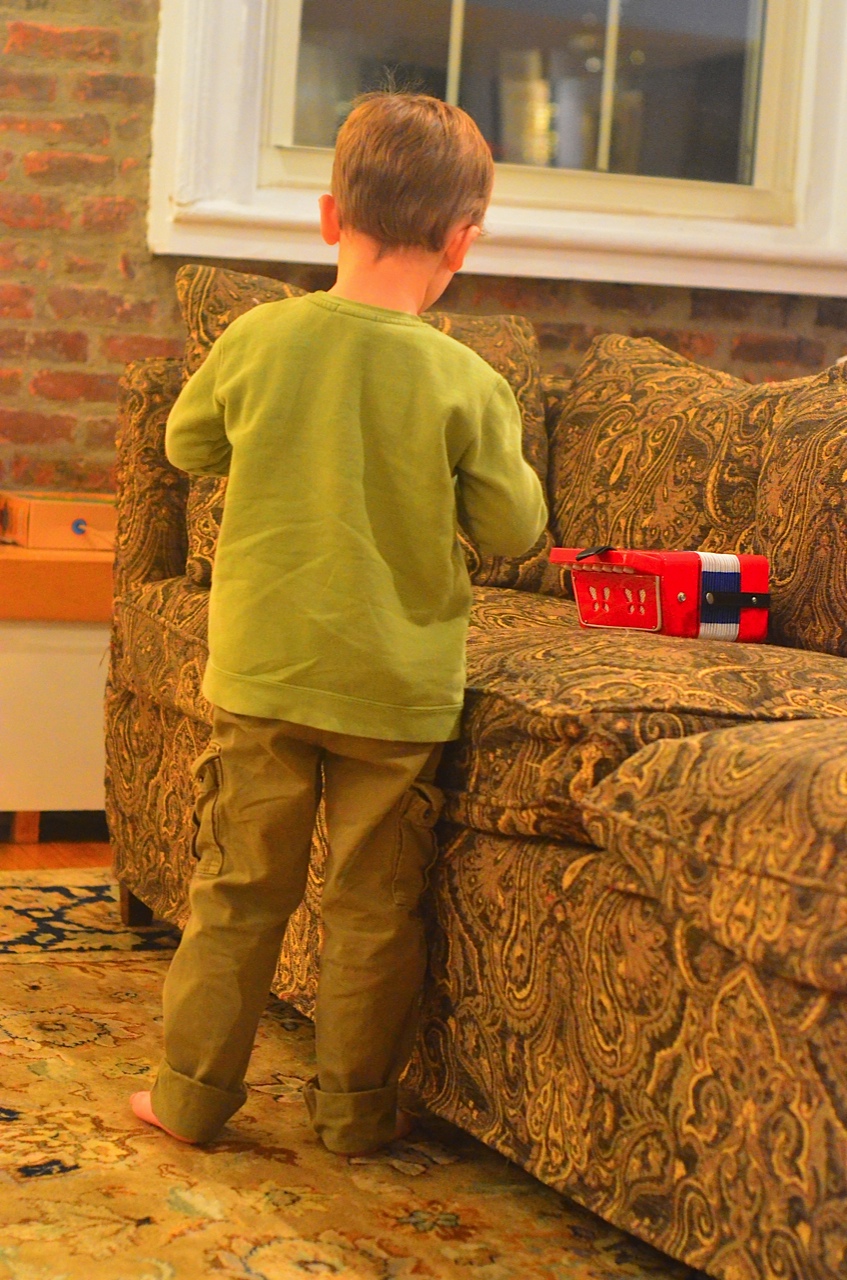
My Rainbow

Martin and I were riding the subway Saturday morning. We had with us a rainbow that he had made in school out of construction paper and Froot Loops. (Ugh.) The following conversation ensued:

Me: “Martin, do you remember where you got this rainbow?”

Martin: “I made it in school.”

Me: “You know, Martin, rainbows make people happy—which kind of means that you’re my rainbow, because you make me so very happy.”

Martin: “I’m your rainbow.”

Me: “I think you are.”

Martin: “My name is Rainbow.”

Me: “Your name is Rainbow? Really?”

Martin: “No.” [Laughs.] “My name is Martin. I’m being a rainbow.”

Martin said those things, in that order. My kid said those things.

In professional ice hockey there exists an unofficial (and unsanctioned and probably unadvisable; check out The Last Gladiators) player role, known as an enforcer. An enforcer’s job is to keep the opposing team from playing too rough. For example, if an enforcer sees an opponent intentionally late-check a star player, the enforcer might respond by grabbing that opponent by the jersey and punching him several times, as a warning to leave the star player alone.

(Don’t be put off. If you’re not already an ice hockey fan, do please start watching. The combination of grace, strategy, and grit that carries a hockey team to victory resembles the traits needed to recover a child from autism. Honestly.)

Have you heard of the crazy Fred Phelps family from Topeka, Kansas? These are the people who—despite lacking affiliation with any Baptist denomination, and as far as I can tell, despite following none of Jesus’ major teachings—call themselves the “Westboro Baptist Church” and protest at high-profile or military funerals because, they claim, God opposes homosexuality. (I realize that sentence lacks substantive logical foundation. That’s intentional.)

Apparently these Phelps people threatened to show up at the funerals for victims of the recent Boston Marathon bombings. I saw something circulating on Facebook that I should have downloaded, because I can’t find it now. It was a picture of a Boston Bruins enforcer, during a game, on his knees, straddling an opposing player whose back was on the ice. The enforcer had his gloves off, which is dangerous because punches fall softer when the fist is padded by a hockey glove, and he was plainly beating the daylights out of the opposing player, whom he’d rendered defenseless. The caption under the picture said something along the lines of, “This is what we do to hockey teams we don’t like in Boston. Please, come protest a funeral.

When Martin was diagnosed with autism, at 27 months, he could label objects and people and colors, and he could speak in echolalia, but he had no functional language. At 36 months, he had begun developing functional language but could not grasp concepts like first and second person; he said “I” when he meant “you,” and “you” when he meant “I.” By 48 months, he could respond to questions but could not engage in dialogue, i.e., carry a conversation beyond one response.

On Saturday, Martin sustained that rainbow discussion. He maintained consistent eye contact throughout. He ended by drawing a distinction between being called Rainbow and being a rainbow.

Please, come tell me recovery from autism is not possible.

Notes on a Wednesday

Wednesdays, of late, are exhausting days for me and Martin. He plays hooky from school. We start the morning by driving more than 50 miles to Wilton, Connecticut to visit Martin’s new homeopath and, if it’s an appointment week, his biomedical doctor.

(Note to careful readers: We switched biomedical doctors five months ago, because Martin’s former practitioner moved to the West Coast.)

From Wilton, when our appointments are through, we get back in the car and drive more than 60 miles, back into New York State, across Westchester County and across the Tappen Zee Bridge and Rockland County, at last dropping into New Jersey at Ringwood, where Martin participates in hippotherapy. We eat lunch in the car: a sandwich for me, and Dr. Cow tree nut cheese with rice crackers for Martin. Then, while Martin spends an hour riding horses, I hike to a tiny farm and buy eggs.

Around 3:15 pm Martin and I get back into the car to drive 45 miles home. (Are you keeping track of all these miles?) Although it is the shortest leg of our journey, this takes the longest, anywhere from 90 to 150 minutes, depending on traffic getting back into and through the City.

Last Wednesday, on the morning drive to Wilton, I spent 20 minutes on the phone—hands-free Bluetooth, of course! I respect all traffic laws—trying to negotiate a good deal on the purchase of an infrared sauna. (More on that in a future post.) Martin was supposed to be practicing “being quiet while Mommy’s on the phone.” Instead, he grew increasingly agitated until he was sobbing while repeating, “You’re going to get off the phone! No more phone! You’re done with the phone.” I apologized to the sauna representative and finally, when I could barely hear him over Martin’s shrieking, aborted the call. Meltdown.

So that sucked. But three very cool things that did not suck at all also happened last Wednesday:

The update for Daddy: At the office of the homeopath—“Miss Lauren,” as Martin calls her—is a pile of toys. I was talking with Lauren when Martin appeared with a toy mobile phone in this hand and said, “Mommy, I’ve got a phone.” I replied, “Oh? Would you please call Daddy and let him know we got here okay?” Without further prompting, Martin nodded, hit a few buttons on the toy phone, held it to his ear and said, “Hello, Adrian? But because we’re at Miss Lauren’s. Okay. ’Bye.” (Martin is in a phase wherein he calls Adrian by his first name instead of Daddy or Papá. “But because” is a verbal tic that Martin has.) Comprehending my request? Pretending? Following a direction? Yes, yes, and yes, thank you.

The hippotherapy superstar: Martin does hippotherapy with a speech-language pathologist. Hippotherapy requires body awareness, multisensory activity, and concentration. Martin’s performance varies widely from week to week. (Martin’s performance on just about anything can vary widely from week to week, day to day, or even hour to hour. That’s the nature of the biomedical beast.) Last Wednesday, when I came to claim Martin after his riding lesson, his speech pathologist said, “He was awesome today. Awesome. Can you bring this version of the kid every week?”

The gesture of support: Do you remember my post from last Tuesday, about the best ways to be supportive of a family wading through autism recovery? It ended with these lines:

That’s all we really want, any of us, right?

A little faith, and a cookie.

When Martin and I arrived home from our three-state extravaganza last Wednesday—one day after I posted about how to be supportive—I found a package waiting for me. Inside was a card quoting those two lines. Under them, handwritten by the friend who sent this card, were the words: “Some of us need a whole box of cookies. Prayers to you and your family. Always.” Enclosed with the card? Yep. A box of cookies.

I’ve been reading the Thinking Moms’ Revolution new book of essays. In one piece, the mother of a boy on the spectrum is asking, “Why did this happen to my baby? What did I do wrong? Is God mad at me?” Her mother, the boy’s grandmother, intervenes and points out that, if things had been different, she would not be asking, “Why did God give me a healthy child?”, so she doesn’t get to ask “Why?” now.

Sage advice, right? What happened to my son—the Pitocin, the C-section, the antibiotics, the vaccines, whatever combination caused this autism—happened. But it doesn’t mean my life doesn’t rock steady.

It doesn’t mean I don’t live in a world of blessings.

The Wanaque Resevoir in Ringwood, New Jersey, where I hike while Martin rides horses. I took this picture with my iPhone a couple weeks ago. Life is good.

The Monksville Resevoir in Ringwood, New Jersey, where I hike while Martin rides horses. I took this picture with my iPhone a couple weeks ago. Life is good.

Support. The Supportive Kind

Friends who know I have a son with autism mean well, but sometimes, even in their effort to be supportive, they say the wrong thing.

Here is the statement I hate most:

“All kids do that.”

Now, if you’re a friend of mine, and you’ve ever said about Martin, “All kids do that,” please do not worry. I know your heart is in the right place. I know you want to help. And this post is not directed at you, or at anyone in particular. Believe me, I’ve heard, “All kids do that,” from almost everyone within the limited circle that knows about Martin’s diagnosis.

I know from reading other blogs that I’m not the only parent who detests “All kids do that.” When someone says, “All kids do that,” then regardless of what that person means to convey, I hear one of two things:

1.      “I know Martin has autism and all, but don’t you think you’re going overboard? Maybe you’re a little hysterical about the whole thing, or you like to complain?”

2.      “I have absolutely no inkling about the realities of your daily life with Martin.”

Yes, I know that even neurotypical kids “have a favorite color.” On the other hand, if you board a subway and find that all the yellow seats are taken, can you expect your neurotypical kid to panic and run out the closing subway doors, without a care whether you are following? If your kid says the moon on his pajama top is yellow, and you suggest it might look more blue, do you assume bedtime will be delayed an hour while he howls inconsolably? Have you ever had to purchase napkins in different colors so that your family could practice sharing the yellows without a meltdown?

And I know that even neurotypical kids “tend to repeat themselves.” On the other hand, unless you live with autism, I am guessing that your kid has never lost awareness and stared into the distance, uttering some combination of words scores of times. I am guessing that your kid does not continue repeating even when he’s alone in a room, his words like a proverbial tree falling in the woods, and then falling again, and then again, and again. I am guessing that your kid’s brain does not get stuck in a groove so deep that he becomes physically unable to cease perseverating. There are times when Martin’s need to repeat himself—“Our President’s name is Obama. O-B-A-M-A. The last letter is A. Obama is the President. Do you know how to spell that? The last letter is A. Our President’s name is Obama. Do you know what our President’s name is? It’s Obama.”—reaches such intensity that, if I were to duct-tape shut his mouth, his arm or leg would have to flail in compensation until he could speak again.

(Don’t panic, dear readers. I’ve never tried any such thing. I just know it’s true.)

“All kids” do a lot of things. But they don’t do them like a kid on the spectrum does.

So what does help? What should someone say, if not “All kids do that”?

A friend of mine (let’s call him Ted) once lost several family members in a house fire. Ted and I lived more than a thousand miles apart at the time, so I wasn’t present for the immediate aftermath or the funeral. A few weeks later, when it was time for me to call, I asked another friend, Deb, what I should say to Ted. Deb is a minister, she’s wise, and her own father had died recently. She counseled (I’m paraphrasing):

“Say you’re sorry about the loss, and then talk about anything else. Follow his lead. When you’re grieving, distraction is a blessing.”

I called Ted and said I was so sorry for his loss and wished we lived closer together. He responded by asking how I was doing, and the conversation moved naturally to catching up on each other’s latest activities. We talked jobs, law (two attorneys, boring!), mutual acquaintances. Once, after a pause in the conversation, Ted said, “You know, they were so close to the door when they collapsed. It was the smoke. They almost made it out,” and I knew that Deb had been right. Ted’s mind was so consumed with loss that the twenty minutes we’d just spent talking about other topics were like a vacation for him. And immediately after saying, “They almost made it out,” Ted asked if I’d seen some movie over the summer. The house fire did not come up again.

When you encounter me, know that for at least 23 of the preceding 24 hours, I have had almost nothing on my mind except autism and recovery. I’ve been giving pills, cooking special foods, corresponding with parents on-line, reading about the latest treatments, cleaning air purifiers, mixing clay baths, filtering water, completing HANDLE exercises and concocting RDI games, fighting for a special-education placement, juggling therapy appointments, navigating social-work bureaucracy, keeping Martin’s doctor up to date, and worrying about what vaccinations are doing to our children.

You can ask me how Martin is doing. I will respond, “We have our ups and downs,” maybe add one or two recent achievements, and then move on. Here are suggested topics I would probably rather discuss than Martin’s autism:

•            How are the Rangers play-off chances looking? Will Lundqvist win the Vezina a second time?

•            Why is it still winter at the end of April?

•            Is the new Jackie Robinson movie melodramatic? Does melodrama ruin a good story? Did it ruin Argo?

•            Who is going to be the next mayor of New York City?

•            WNYC reported that 70% of home sales in Brownstone Brooklyn are all-cash deals right now. Seriously, 70%?

•            Is it okay to put a cat on Prozac?

You get the idea. There are a million things to talk about that are not autism.

And if you really, really want to talk about autism, say you support us. Adrian’s mother once set the gold standard in that regard. Adrian was visiting his country of origin and staying in the family home. One evening he and his parents and siblings crowded around a computer to Skype with me and Martin back here in the States. As it happened, that day Martin was at his worst. He would not sit with me or look at the computer. He failed to respond to any questions, or even acknowledge his father and grandparents and aunts and uncle on the screen. After 30 seconds I gave up and released Martin, who jogged around the room, yelling gibberish.

It was a painful moment for me, and though he didn’t say anything, I could tell it was painful for Adrian, too.

Evidently, so could Adrian’s mother.

After we finished with Skype, Adrian went out to dinner with friends. When he returned to the family home that evening, everyone else was in bed. On the kitchen counter was a note from his mother. Loosely translated:

“Martin will get better. I believe in what you’re doing. Love from Mamá.”

Next to the note was a plate with a cookie.

That’s all we really want, any of us, right?

A little faith, and a cookie.

Thinking Inside the Box

Earlier this week, Martin entered the apartment with me and discovered that I’d left a box on the kitchen counter. It was nothing special, just an Internet purchase I had not opened since it arrived that morning.

Martin poked the box, looked at me, and asked casually—note that I try to avoid adverbs, so if I’m using one, read it in emphatic italics: So help me, he asked it casually—“Mommy, what’s in this box?”

The question was spot-on. It was relevant, directed (including eye contact), and succinct. He even got the intonation right.

Not impressed? Get a kid with autism.

Martin’s verbal skills are outstanding these past couple weeks. Like any parent of a recovering child, I’m digging through my notes, supplementation charts, lists of interventions, and so forth, trying to pinpoint what underlies the improvement. As usual, I have no idea.

Still, I love it when something’s going right.

Disney

Two families we know with boys on the spectrum have made repeated trips to Disney World in Orlando. All four parents report hassle-free, autism-friendly vacations: luggage and organic groceries delivered directly to your villa (“Check a suitcase at LaGuardia. It shows up in your room!”); passes to skip the long lines for attractions; and a mix of exciting activities and, outside the main park, calmer spaces.

Adrian and I are considering taking Martin to Disneyworld. For me at least, I don’t want to go because I love Snow White or think Martin will be psyched for a magical castle. I want to do a Disney vacation with Martin because a Disney vacation is what American kids do. Right? Martin’s childhood, so far, has bypassed the standard markers. He attends a special school, he swallows a million pills and oils, he spends his afternoons in therapy, his friends have diagnoses, and he can’t eat—well, he’s not allowed to eat candy, or refined sugar, or McDonald’s, or processed food, or pizza, or anything much else I see in the hands of kids.

But he can go to Disney.

Despite the endorsement of other ASD families, we’ve been worried about whether Disneyworld really makes sense. It’s crowded. Noisy. Flashy. Crushing. Maybe the theme park would just overwhelm Martin.

Back in November, Superstorm Sandy led to an unplanned week without school here in New York City. In compensation, Martin’s school lost the scheduled February break but tacked two extra days onto the Easter break, and Martin ended up with eleven consecutive days without class. Martin and I utilized this vacation bonanza for his first-ever West Coast visit, to my brother Rudy and his wife in Laguna Beach.

Rudy came up with a great idea: As we were in Southern California anyway, why not take Martin to Disneyland? It could be like a trial run, a few hours at the original theme park that now seems like a junior version of the Orlando behemoth.

I jumped at the suggestion. On a Thursday morning Rudy and I collected Martin, his stuffed elephant, his afternoon supplements, and his special food and drove to Anaheim. We were headed, as we put it for Martin, to Mickey’s house.

I am pleased to report success.

The ticket agent gave me and Rudy and Martin big “I’m celebrating!” buttons; Martin insisted on pinning two buttons to his loose T-shirt, where they dangled all day. Inside the park he selected a fuzzy blue Sorcerer’s Apprentice hat (with mouse ears) to buy, and although it was 80 degrees and the thing was like a quilt wrapped around his head, he wore that all day, too. We stopped by guest relations. I explained that my son has autism and gave a little report on his strengths and weaknesses. The representative gave us an “accommodations” ticket allowing all three of us to use the special-entry lines, which are much shorter than the regular lines. And from there, we hit the rides.

With all the bustle, Martin was more distracted than usual as he wandered through the crowds. Nevertheless, he beamed. He rode “it’s a small world,” where he was scared to be in a boat but liked the children singing and the floating moon; flying Dumbo elephants, where Rudy showed him how to use the altitude lever; the Jungle Cruise, where the boat operator warned me before he fired a fake gun; and the carousel, which he handled like a professional based on weekends of carousel riding in Brooklyn. His favorite attractions were musical performances and the thrice-climbed Tarzan’s Treehouse.

Martin even survived the Roger Rabbit ride. Rudy and I assumed that because the Roger Rabbit thing was in Toontown, it would be mild. Holy cow, was that a mistake. It turned out to be a spinning car whipping us in circles through strobe lights, screaming, and demonic-looking animated characters. I was scared. Martin clung to me but didn’t cry.

We stayed in the park for seven hours. Seven hours! Martin got to bed late that night and slept well.

Two days later, on Saturday, Adrian surprised us all by flying into LAX. He’d ended up in Northern California on business and was able to sneak away for the weekend. Martin and I picked him up at the airport and then headed directly back to Disneyland for another seven-hour visit.

“Did you like Mickey’s house?” Adrian asked Saturday evening, back at my brother and sister-in-law’s house. “Was it fun?”

“Yes!” Martin said. He smiled.

“Would you like to go back to Mickey’s house again tomorrow?”

“No!” Martin said. He still smiled.

I think he was exhausted.

Everything in moderation. I’m sure that, by the time I manage to put together a family trip to Orlando, he’ll be ready again.

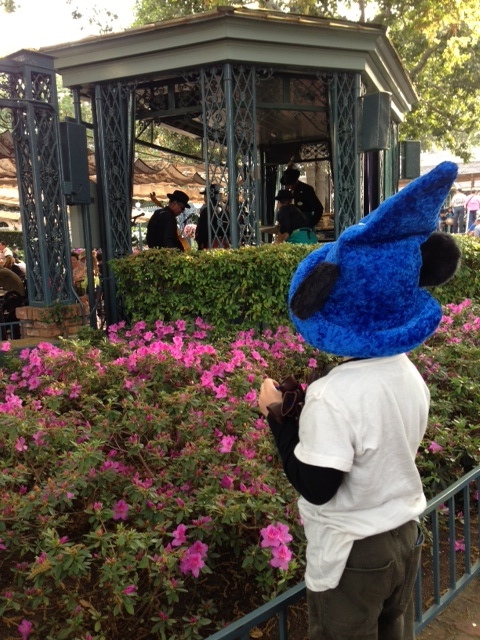
In his Sorcerer's Apprentice hat, Martin enjoys music from the "New Orleans" bandshell. The drummer threw Martin some beads.

In his Sorcerer’s Apprentice hat, Martin enjoys music from the “New Orleans” bandshell. The drummer threw Martin some beads.

During the Saturday (second) visit to Disneyland, Martin and I headed once again into Tarzan's Treehouse.

During the Saturday (second) visit to Disneyland, Martin and I headed once again into Tarzan’s Treehouse.

Back outside Disneyland, Martin and I strolled Balboa Island with Rudy and his wife (in front of us). I think we're imitating them.

Back outside Disneyland, Martin and I strolled Balboa Island with Rudy and his wife (in front of us). I think we’re imitating them.

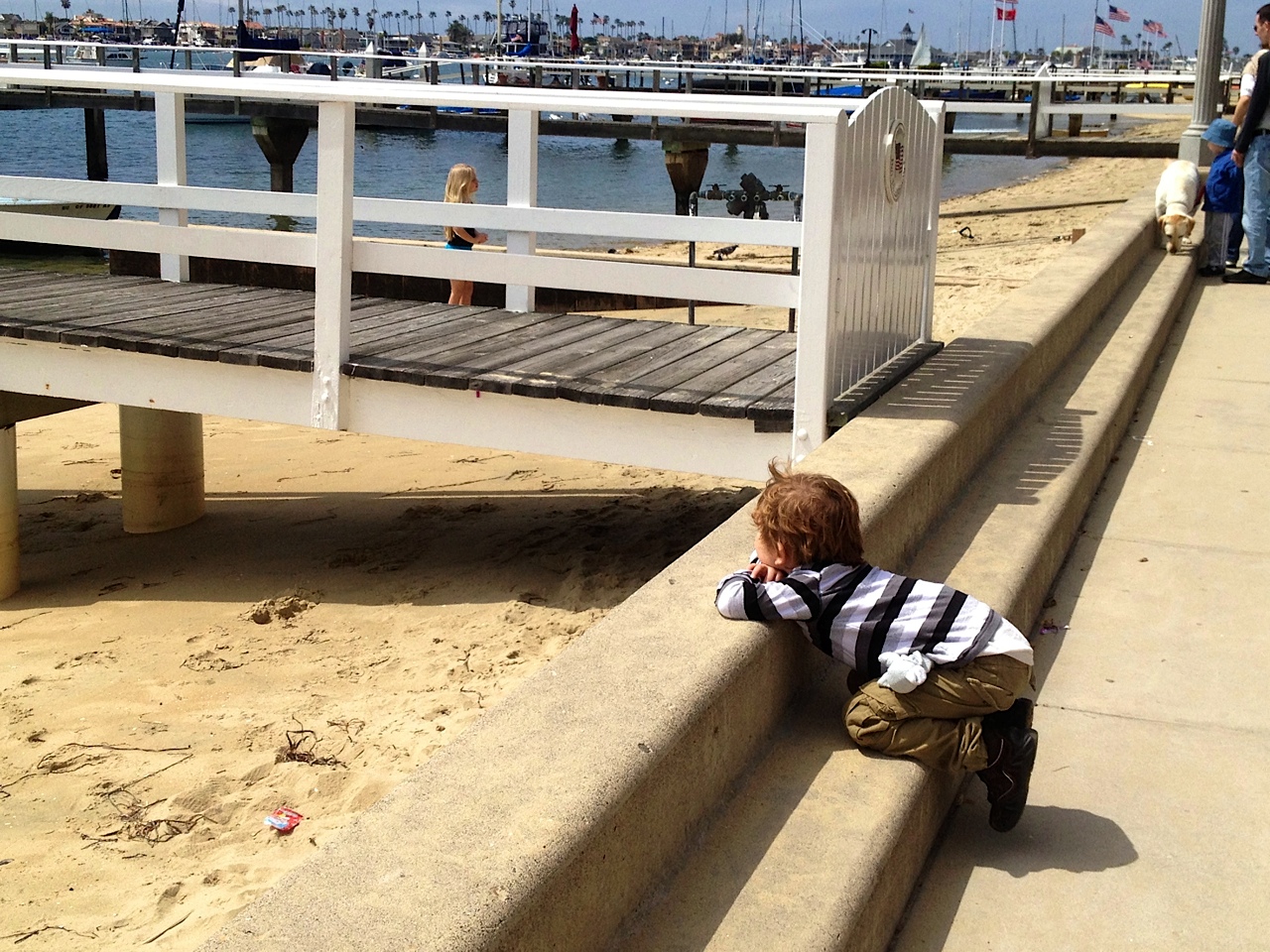
Martin enjoyed the views of Southern California. This shot was taken on Balboa Island also.

Martin enjoyed the views of Southern California. This shot was taken on Balboa Island also.

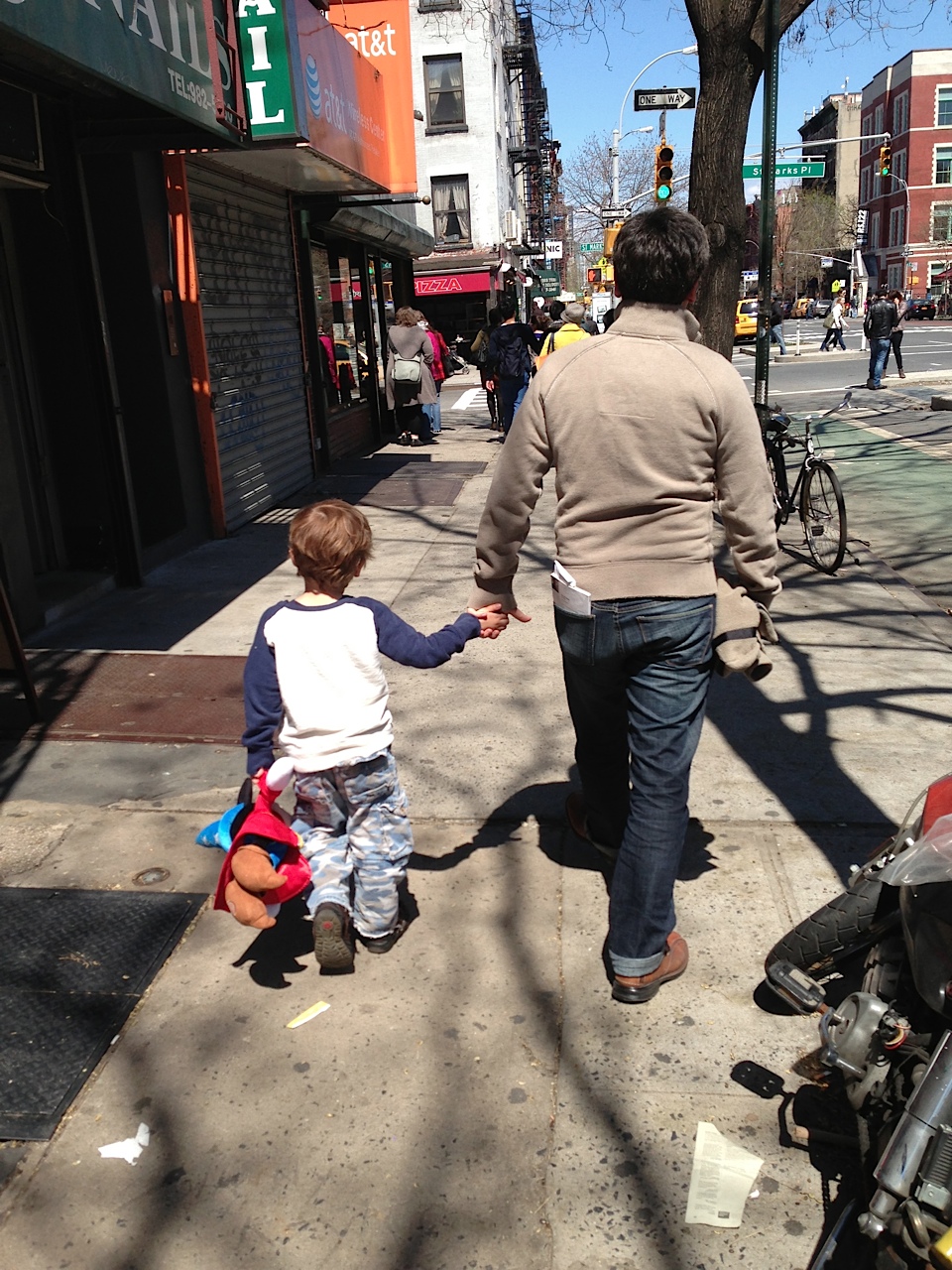
After we returned to New York, Martin enjoyed carrying his Mickey Mouse doll, as here on the Lower East Side with Adrian.

After we returned to New York, Martin enjoyed carrying his Mickey Mouse doll, as here on the Lower East Side with Adrian.


Perseveration. Perseveration. Perseveration. Perseveration.

Want to know what kills me?

Perseveration kills me.

Perseveration is verbal repetition. You might call it “harping on one subject” or “just not letting it go.”

Let’s start with a relatable situation: The C train inexplicably makes a 20-minute sojourn in Midtown—“Attention, passengers! We are being held momentarily by the train’s dispatcher. We expect to be moving shortly”—and you end up late to a lunch date. Then, even though you have a million things to discuss, the friend you are meeting wants to talk about your tardiness only. You might have a conversation like this:

“It’s not just today. You’re always late.”

“I know. I’m so sorry. Like I said, I did a great job getting out of the apartment today. Too bad the train got stuck. How is it going at work with your new boss?”

“The trains get stuck every day. You should build that expectation into your plans.”

“You’re so right. I have got to start doing that. Is the new boss a jerk like you thought?”

“They almost didn’t hold the table for us. They have a ten-minute policy on reservations at lunch.”

“I’m so glad they ended up holding it. This place is great. I ate here with my aunt last month. Oh my gosh, did I tell you what my aunt said on Sunday?”

“I looked like an idiot, sitting here alone. I kept saying, yeah, my friend is coming. It felt like forever.”

“I know how you hate sitting alone! Can’t believe I caused that. Did you at least get to do some people watching? I’ve heard a lot of actors eat here.”

“Next time you’re late I’m just going to leave. I swear.”

“I would totally understand if you did that. You look fabulous today, by the way. Is that the blouse you said you were going to splurge on?”

“You’re an old friend. That’s why I put up with you being late all the time.”

“Old friends are always the troublesome ones, aren’t they? It’s funny, isn’t it?: Remember how we used to get in trouble together?”

“Can you please just not be late next time?”

That would be a frustrating lunch, right? By this point you might want to yell, “Shut up! Shut up! I was late! You’ve got to move on!”

Now let’s consider autism perseveration. From the above example, remove (1) provocation (i.e., the late arrival); (2) verbal variation (i.e., the friend’s many different ways of saying the same thing); and (3) any hope of changing the subject (i.e., the reason you brought up the new boss, the blouse, and your aunt). Also, assume that the same topic will arise several times daily, and will last for hours. You might end up with something like the conversation Martin and I just had, which is also the conversation we had a few minutes ago, which is also the conversation we had dozens of times yesterday:

“Mommy, what’s your first name?”

“You know my first name, Martin. I don’t want to talk about names.”

“It’s Maria! Mommy, what’s your middle name?”

“You know my middle name, Martin.”

“And what’s your last name?”

“It’s the same as your last name. Let’s talk about something different.”

“Most people have a first name, a middle name, and a last name, Mommy.”

“That is true, Martin.”

“Mommy, what’s my first name?”

“Martin, look! There’s Uncle Rudy. Can you say hi?”

“What’s his middle name?”

“Hi, Rudy. Martin and I were just heading to the playground.”

[My brother Rudy:] “Hi, Martin! How are you doing?”

“What’s your first name? Mommy, what’s his first name?”

[Me:] “Martin, I think you need to say hi.”

“Hi! What’s your last name?”

Currently, names are Martin’s favorite topic of perseveration.  It doesn’t matter whether the object in question actually has a name. (“Mommy, what’s the name of this chair? What is Curious George’s last name? Mommy, that car doesn’t have a middle name?”) Other perseveration topics include bedtime (“Mommy, who am I doing sleepy-time with tonight? Who am I doing sleepy-time with tomorrow? Who am I doing sleepy-time with on Wednesday?”); residences (“Mommy, where do you live? Mommy, I live in New York. Mommy, where does that dog live? Mommy, he lives in New Jersey.”); and, especially, spelling. Martin is clever with the spelling. He draws me in by (I believe) intentionally substituting a different first letter:

“Martin, do you remember when we flew to California?”

“California starts with a K!”

“No. It starts with a C. You know that.”

“And what’s the next letter, Mommy?”

“A.”

“And what’s the next letter?”

You can imagine where that goes.

There is a bright side, of course. There always is. Before perseveration, Martin’s verbal tic was echolalia. He repeated the last word(s) he heard, regardless of whether it (they) made sense in context: “Martin, are you almost ready?” “Are you almost ready?” “It’s time to go.” “Time to go.” The echolalia is gone now. It’s in the “so far gone” category, even. In that sense, perseveration is progress. Martin’s babysitter reminded me of that a couple weeks ago. She and Martin had just returned from a play date with Harry, a nearly nonverbal classmate of Martin’s. Martin was perseverating on sleepy-time when his babysitter said, almost absentmindedly, “I bet Harry’s parents wish he could go on like this.”

More than two years into our recovery journey, Martin still engages in many frustrating behaviors. He loses attention, dawdles, wanders. His low muscle tone causes him to fall out of chairs and also to sit down anywhere—in a crowded grocery check-out lane, on the floor in the Starbucks bathroom, astride the playground rope ladder so other children cannot pass. When his mind works faster than his words, which happens often, he whines.

Of all the behaviors, perseveration is the worst for me. Martin repeats constantly. He talks when no one is listening. He chats merrily regardless of others trying to speak.

I admit this: There are times when I fantasize of yelling, “Shut up! Shut up! No one cares about middle names! You’ve got to move on!”

It’s only a fantasy, of course. If I go to lunch with a friend who can’t let tardiness go, I listen patiently until the discussion finally runs its course. When Martin carries on about nothing, I indulge him, or I say, “I don’t want to talk about that,” or I bite my tongue.

And then I kiss him, over and over and over again.

That’s my own game of repetition, to remind us both that Martin is my everything.

Gatekeeping

Because the New York City Department of Education classifies Martin as a “preschooler with a disability,” he receives yellow-bus transportation to his special-needs preschool, at no cost to us.

(I expect at least one email reminding me that Martin’s services are not “at no cost to us,” because those services are covered by taxes, which we pay. Okay.)

The school bus—it’s a “short bus,” and now I resent the “short bus” jokes I made as a child—stops between 8:15 and 8:30 a.m. Our apartment is a fourth-floor walk-up. It can take some time to get distracted Martin down those stairs, so instead of waiting in the apartment, we try to have him outside by 8:12. Or so. You know how it is. Most mornings Adrian brings Martin down and departs for his office after the bus comes. If Adrian is traveling or has to leave earlier, I bring Martin down.

There is a public elementary school on our block. It has two special-education classrooms but serves predominantly typically developing children. Between 8:00 and 9:00 a.m. those backpack-burdened pupils (who are not entitled to bus transportation; that’s different in New York City than elsewhere) walk past our building, alone or with their parents or guardians.

Picture the scene: Martin and I wait within the small fenced area in front of our vestibule, while typically developing kids stream down the sidewalk, just outside the fence. They are a few feet away from us, but separated.

Occasionally the metaphor overpowers me. I feel bad, with a physical symbol—a black wrought-iron fence, for crying out loud—demarcating our space from the path for typically developing kids and their parents.

My solution is to open the gate and stand or sit, with Martin, on the curb where the gate would be if closed.

The gate itself opens outward and therefore becomes an obstacle for the school children to circumvent. Tough. It’s hard enough to have a kid whose autism separates him from other kids. I don’t need an actual fence doing the same.

I wonder: Does this seem strange, that I have to open a fence gate to feel better about our situation?

It’s the little things, right?

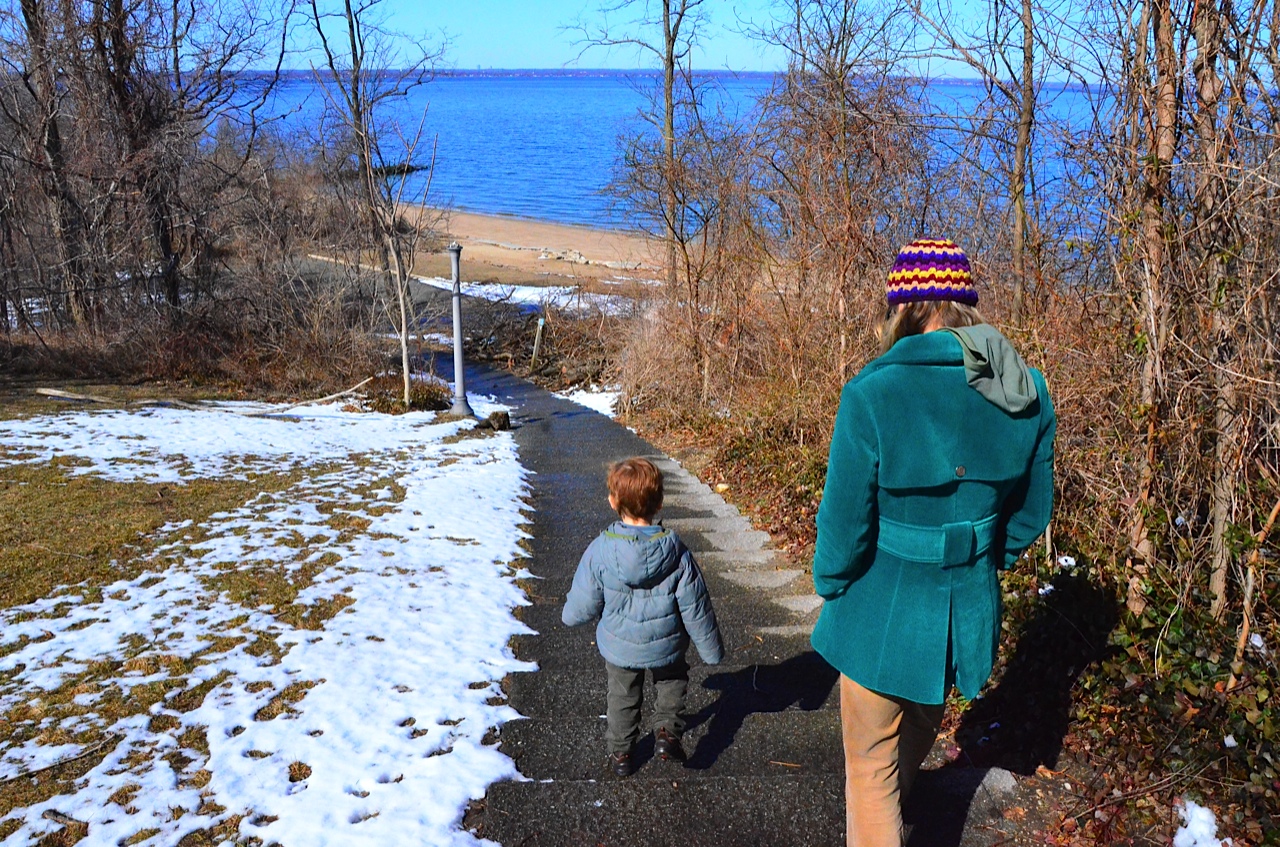
Martin and I head out into the open, looking for some fun as winter fades.

Martin and I head out into the open, looking for some fun as winter fades.

Martin shows Adrian how he can write letters in the sand.

Martin shows Adrian how he can write letters in the sand.

Why? Why? And While We’re at It, What the … ?

Adrian seldom comes home on weeknights before Martin has gone to bed. About a month ago, on an early-January evening, he surprised us by arriving at 5:45 pm, just as Martin was starting dinner.

Happy Martin.

The next afternoon, January 9, as Martin and I were returning from his hippotherapy session in New Jersey, I called Adrian from the car. We chatted for a few minutes by speakerphone. Martin (softly, almost inaudibly, as is his way) called Hi, Daddy! from the backseat.

After I hung up, Martin asked, “My daddy is where?”

“Daddy is at his office working.”

And then…

“My daddy, why he don’t come home?”

The words were jumbled, but the intent was clear: Martin asked his first-ever Why? question.

A week later, January 17, Martin had to have blood drawn at his doctor’s office. When it was over, as a reward, the doctor let Martin pick from a basket of toys. Martin selected a yellow—everything must be yellow right now, even his subway seat—“sticky foot,” a rubbery, goo-coated, miniature foot, with a tail, meant to be hurled at a wall so that it can creep vertically to the floor. (Yes, that description stinks. How to describe a sticky foot?) For the rest of the doctor visit, Martin played with the sticky foot, not hurling it at a wall but stretching it long, plucking the tail like a guitar string, rolling the stickiness betwixt his fingers.

The sticky foot was still in his hand when we left the office. In the parking lot, Martin asked:

“Mommy, what is this?”

Another first! Martin frequently asks, “What do you call this?” or, “Do you know how to call this?” or, “How do you say [whatever] in Spanish?” But he’s never before gone for the gold, i.e., asked what an object is, how it’s used or what purpose it possesses.

I responded: “It’s a sticky foot.”

If autism recovery were perfect, if every step forwarded heralded another step forward, Martin’s next question would have been, “What’s a sticky foot?”

Alas, it was not. But it was still pretty good. He yelled, “A sticky foot! A sticky foot!” and then asked, “Can I bring it on Saturday?”

Saturdays Martin participates in Ready, Set, Play!, a therapeutic playgroup. Every Ready, Set, Play! participant brings a show-and-tell item. Until the sticky-foot incident, I always chose Martin’s show-and-tell for him, packing whatever small toy or token seemed interesting that week. Now Martin was telling me that he wanted to select his own show-and-tell, and that this week it would be the sticky foot.

I didn’t know what he planned to “tell” about the sticky foot, as he evidently had no idea what the hell a sticky foot is for. Nevertheless, we were making progress.

So: “Why?” and “What is?” January 9 and January 17, respectively.

Martin does not yet answer Why? questions. Nor did he immediately pose any other Why? or What is? inquiry. That’s his way. Last Thanksgiving, Martin responded to a question with, “I don’t know.” More than a month passed before I heard “I don’t know” from him again, and then it stormed into common usage. Now he’s comfortable with “I don’t know” in all sorts of contexts.

Four weeks passed from January 9 until today, February 4, a Monday. On Monday evenings Samara stays with Martin while I go out. Monday is my night off. Most weeks I depart by 5:00 pm or so and have dinner with a girlfriend.

Tonight I’m hunkered in a local wine bar, exchanging goofy emails with Adrian and typing my blog, and that meant I left later.

Around 6:45 pm, I was helping Samara finish Martin’s evening supplements. Martin, his mouth full of pre-sprouted mushroom-garlic quinoa, turned to me (!) and asked, “Mommy, why you’re still here?”

Why? question No. 2. Rock and roll. I believe he’ll ask Why? more and more now, and maybe soon, with the understanding the question brings, Martin may even answer a Why? question.

Epilogue: Saturday, January 19, as we were leaving for Ready, Set, Play!, I produced the sticky foot and declared, “Here’s your show-and-tell.” Martin took one look, said no, and went to his toy chest for an accordion instead. It took exactly 44 hours for him to lose interest in the sticky foot and change his mind. I guess that’s being four years old.

Joyriding

A few weeks ago we enjoyed a vacation on Kiawah Island, and I spent three hours bicycling the streets with Martin and his stuffed panda bear in a cart attached to my bicycle.

Every fellow cyclist and pedestrian greeted us. “Good morning!” “Why, hello!” “Happy New Year!” “Some kind of fine weather today, isn’t it?” Even the drivers waved from the luxury cars that drifted by, obedient to the posted speed limits. I hardly bothered removing my smile between encounters.

This is the good life, I thought. The whole scene—planned community, bicycle paths, golf courses, herons, salt marshes, palmettos, beach, fine houses neatly kept—felt Disney, if not Stepford, and I devoured the insouciance. It’s invigorating, to be carefree once in a while.

“Well, look at this guy,” an older woman said, fawning over Martin when I stopped to check my map. “He’s got the best seat in the house.”

“He does,” I said. “He’s just zooming along while I do all the work.”

I mounted the bicycle again and pedaled away. I was happy that the woman had admired Martin.

In a moment, I wondered, Would she have acted the same if she knew the kid in my cart has autism?

And, Would any of this be different if the kid in my cart didn’t have autism? Does it always have to matter?

In 2008 I attended a fundraiser for Extraordinary Lutheran Ministries, a group that facilitates ministry calls for openly gay (including non-celibate) clergy. Under the ELCA’s policy at that time, gay and lesbian clergy could serve only if they practiced celibacy; like everyone else at the fundraiser, I opposed that policy and favored allowing non-celibate homosexual clergy to serve just like non-celibate heterosexual clergy.

The ELM representative who attended, I remember, said something like this (I’m paraphrasing wildly, on several years’ sketchy memory): “The church policy might seem like the biggest obstacle in the world, right now. But it isn’t. The policy is like this cell phone.” Here she held up her mobile phone, then balanced it unsteadily on its side atop an end-table. “We can just knock it down.” She tipped over the phone. “We can just knock over that policy and move on.”

That’s the way autism recovery feels. Some days, ASD is the biggest obstacle in the world, this lurking beast that colors even a halcyon Kiawah bike ride. Other days, especially when Martin is showing growth, ASD is that mobile phone teetering on an end-table. It’s changeable.

In 2009, the year after that fundraiser, a Churchwide Assembly amended the ELCA’s clergy guidelines to remove the requirement of homosexual celibacy. ELCA churches now can issue calls to gay and lesbian clergy in committed same-sex relationships.

Which is to say, we knocked it over and moved on. And maybe it really doesn’t matter if the kid in my bicycle cart has autism.

Newtown

Here are some things I’ve heard about Newtown—I guess we just say Newtown now—that may or may not be true. I heard that the shooter had autism, or some form of ASD. I heard that his mother tussled with the school district about his special education. I heard that she encouraged her son to “fit in.”

I thought, How terrible. How could the mother of a child with special needs tell him to do precisely that of which he is incapable—to fit in?

I thought, I would never do that to Martin. He is who he is. I will not chisel away his self-esteem by telling him to be like other kids, when he can’t.

As a child, I was boyish. There was no dress-up or experimentation with make-up for me. I had short hair; I preferred jeans to skirts or dresses or even slacks; I played sports and climbed trees; I didn’t mind when strangers mistook me for a boy, which they often did. Like other boyish girls, I faced persistent pressure to change, mostly from adult females, well meaning or otherwise. (“I can’t believe you’re not getting this right,” the art teacher chided, when used too little adhesive on my papier-mâché project. “You’re just always so messy.”) The effect was that I didn’t like myself. I believed that I should be girlish, but I wasn’t. That just wasn’t me. And so who I was—wasn’t right.

I’ve been determined not to tell Martin that he isn’t right. Martin should fit in with other kids only as much as he wants to or is ready for. That’s an easy call.

Still, Newtown and the rumors surrounding it got me thinking: Are there other instances when I tell Martin to do what he’s not (yet?) capable of?

There are. About fifty million per day.

“Martin, pay attention.”

“Martin, stop dawdling.”

“Martin, look at me.”

“Martin, no repeating. Say it only once.”

“Martin, eat.”

“Martin, hurry up.”

“Martin, walk like a big boy.”

“Martin, just go to the front hall and put the shoes on.”

The hard part is figuring out when Martin is just playing me. Example: Bedtime. Martin insists that I do his bedtime routine: potty, supplements, teeth brushing, reading, tuck-in. He’ll agree to take his bath for someone else (say, Adrian or Samara), but bedtime is all Mommy. In fact, Martin is so fixated on bedtime with me that perseverates on continual reassurance. Within five minutes of waking each morning, he has said, “Sleepy-time with Mommy!” at least once. He says it throughout breakfast and while he gets ready for school. It’s one of the first statements I hear when I pick him up from school: “Sleepy-time with you, Mommy!” Anytime that he senses I am about to leave, even if only to go to the bathroom, he becomes agitated and says, “Sleepy-time with you! Sleepy-time with you!”

On vacation last week, Adrian and I went out to dinner and left Martin with my parents. As soon as Martin realized that Adrian and I were leaving, he began to scream and cry. “I want to go to dinner, too. Sleepy-time with you, Mommy! Sleepy-time with Mommy!” He threw himself dramatically to the floor, grabbed Adrian’s foot with his right hand and my foot with his left hand. “You’re not going to go out! You’re going to stay here!”

We left.

Within five minutes I received a text message from my mother: “Everything fine here. Martin calm.” When we returned home later, I learned that Martin had done his entire bedtime routine and gone to sleep without complaint.

On the one hand, I know that Martin’s ASD and accompanying fixations make him cling to routines, and I need to indulge that. On the other hand, Martin wants me to indulge him, and he exploits my willingness to do so. When it comes to keeping pace and hurrying up, Martin is a heckuva lot more cooperative if he’s excited about where we’re going. Getting from our apartment to the school bus? It’s a ten-minute process. Getting from our apartment to the playground? He’s moving faster than I am. Am I wrong to tell him to hurry up and focus for the school bus? Same with meals. If the plate is beef bites with fermented cauliflower, I have to repeat some variation of, “Maybe you could take a bite?” at least two dozen times, or even just spoon it into him myself. A bowl of gluten-free oats with butternut squash and coconut oil goes down his throat like bathwater through the drain. Am I wrong to tell him to hurry up and focus on eating the beef?

One of my first reactions to Newtown was, “Thank God the shooter killed his mother first. It was an act of mercy; how could she have gone on?”

Looking back, I think that reaction—it was a gut reaction, and I am not saying that the Newtown shooter’s mother had anything to do with what happened on December 14; I know almost nothing about the circumstances—was my conscience expressing the responsibility I feel for Martin’s future. However far biomedical recovery takes us, I am the one who has to help Martin learn to live in the world and still love himself.

Holy crap.

Martin checking out a holiday train display.

Martin checking out a holiday train display.

securedownload