Go, Diva!

For the week between Christmas and New Year’s, we rented a condominium in a Florida Keys resort. (That’s the way our family rolls, with Martin’s dietary restrictions—vacationing only where we have a fully equipped kitchen to use and organic groceries nearby.) Martin was allowed to bring two stuffed animals. He chose (1) “Boo,” a preposterous Santa-hat-wearing dog he received for Christmas, and (2) a brown bear that had arrived in a lovely gift basket for the family.

“Martin,” I asked as we drove to LaGuardia, “what is the bear’s name?” Martin sat in his booster seat, clutching both stuffed animals. I figured he should get first crack at naming the bear.

To my surprise, Martin had an immediate response. “Goadie Va,” he said, or something similar. Goat Eva? Go, Diva? Was he talking to me? Am I a diva?

“Goadie Va?” Adrian asked, from the driver’s seat.

“Goadie Va,” Martin replied, with certainty. 

Adrian and I looked at each other. I made a who-the-hell-knows kind of shrug and said, “Okay, the bear’s name is Goadie Va.” No further discussion on the name was had, as our family, Boo and Goadie Va in tow, headed south. 

Behavioral therapy for autism often stresses acting neurotypical and giving a child the tools for participating, even marginally, in a neurotypical-dominant world. Certainly that was my experience with ABA, a technique that only frustrated Martin. Although Martin spent only a couple months in ABA—I found the therapy almost useless (for us), and we abandoned it for RDI—I may have internalized too much of the message that Martin should be instructed to act a certain way. To this day, I find myself saying, “Let’s try that again,” until Martin evinces a satisfactorily neurotypical effort.

“Martin, that man said hi to you. How should you respond? I’m sorry? Let’s try that again.”

“Martin, you walk through the doorway. You don’t flop through it. Let’s stand up and try that again.”

“Martin, you sit at the dinner table. No leaving your seat to jump up and down or touch the clock. Let’s try that again.”

There are approaches to treating ASD premised on the idea of joining an autistic child in his own worldview. The best-known among these approaches is probably The Son-Rise Program®. Son-Rise is not a therapy we’ve tried, so what I know comes from reading and from communicating with families who do participate in the program.

According to the Son-Rise website, “Joining in a child’s repetitive and ritualistic behaviors supplies the key to unlocking the mystery of these behaviors and facilitates eye contact, social development and the inclusion of others in play.” In the midst of my over-used “Let’s try that again” orders, I ponder the Son-Rise argument. Take, for instance, my telling Martin not to run from the family room to the front hall, touch the front door, run back to the family room, fall onto the sofa, and then start over again. Would Martin and I better enjoy our time together if, instead, I ran with him from the family room to the front hall, and touched the front door, and ran back to the family room, and fell onto the sofa, and then started over again, all by his side? Would he trust me more? Would I be more his ally, and less a monotonous dictator?

Martin hauled Boo and Goadie Va all over the Florida Keys, from the Hemingway House to parasailing in Islamorada. He slept with them every night, and provided regular updates on their preferences, such as, “Goadie Va wants to wait in the car. Boo will come in the store.” Never once did he call the bear anything other than Goadie Va. I chalked it up to Martin finding a quirky sound (“Goadie Va. Go, diva!”) and fixating on the sound.

Near the end of our trip, for the first time, I noticed Goadie Va’s right paw. Stitched on the paw pad, clearly and adorably, was the name “Godiva.” Of course, Godiva. Goadie Va had arrived in a Godiva gift basket at Christmas. Martin can read. If a bear has a name stitched on his paw, obviously—duh!—that’s the bear’s name.

I almost never spend time in Martin’s world, almost never try to adopt his black-and-white Weltanschauung. I wonder: In my relentless advocacy for neurotypical behavior, how much am I missing?

Opinion Piece: Crowdsourcing Your Child’s Medical Care Is Not a Good Plan

Before you read the “opinion” section of this post, please peruse these five statements:

1. The internet can be an excellent source of information, advice, and comfort. Most days, I spend several hours collecting ideas and cyber-talking with other parents across the web.

2. I am very, very fortunate that I have money available (including insurance reimbursement) to pay MD’s, ND’s, homeopathic practitioners, and therapists. I recognize, honor, and pray for families who want to treat their children biomedically and/or homeopathically but lack sufficient funding to do so; when we have recovered Martin, I will find some way to provide material assistance to those families.

3. I am not in the business of judging other parents’ choices. I do have an opinion about how to treat ASD in children, and I act upon that opinion by, in consultation and agreement with my husband, treating our son as I see fit. I expect other parents to do the same. Unless you are neglecting your child, or actively attempting to harm him, I respect your choices.

4. Recovery from ASD, asthma, allergies, ADD, and ADHD (et cetera!) remains an emerging science. Laboratory studies have not kept up with what’s going on in the field. Because of that, the trial-and-error and “experimentation” factors may be even more significant in these areas than elsewhere in medicine.

 5. I am not aiming to inject acrimony or discord into the on-line ASD recovery community. This post, like every post on FindingMyKid, is selfish. I’m discussing my son’s progress and expositing my thoughts, in hopes of (1) documenting the recovery process, and (2) fomenting ideas in readers. I think that’s what blogging is about, documenting and fomenting. I hope I don’t lose readers over this post.

End of disclaimers. Beginning of opinion section—

I belong to several Facebook groups dedicating to recovering children. Many parents (or grandparents and other caregivers) write posts among these lines:

•      “My son has this itchy rash over a quarter of his body.” [Insert picture here, usually something that I don’t want to see in my Facebook feed because I have an absurdly low gross-out tolerance. Seriously, if I think of something icky, I can’t eat for hours.] “What could this be? How should I treat it?”

•      “I just received the results of my daughter’s” [insert name of test here, such as 23andMe genetics, Great Plains Labs OAT, or Philippe Auguste toxicity] “results.” [Insert copy of lab results, (not always) with child’s name redacted.] “Can anyone help me interpret these and figure out what supplements to order?”

•      “This week we started” [insert names of supplements, oils, or medications] “, and suddenly my son is melting down every ten minutes, stimming like crazy, and pooping all over the house, even though he’s toilet-trained. What could it be?”

I think these types of posts are a bad idea. Not because the parents/caregivers are reaching out for others’ experiences, but because I suspect many of them are substituting internet wisdom for actual medical advice. Three weeks ago I saw a video post of a child in the throes of an obvious grand mal seizure. The accompanying paragraph stated that the seizures were new, continued that the child had begun experiencing multiple seizures every day, and sought advice on how to handle them. My horrified reaction was, “Are you kidding me? Get off Facebook and get that child to a doctor.” (I did not post my horrified reaction. Should I have?)

It is true that the “medical establishment,” in general, lags behind parental experience when it comes to treating autism. Indeed, if I may speak for the medical establishment, its position still appears to be that there is no treatment for autism. Martin’s former pediatrician, from before we moved, never understood what we were doing with Martin’s autism doctor. When I asked the pediatrician what she knew about biomedical intervention for autism, she replied, “Nothing. Just what I’ve heard secondhand, which is that it doesn’t work.” (Still, she never stood in the way of our biomedical journey. I respect that. Also, one of her practice partners was nothing but interested in what we are doing to recover Martin.)

Facebook parents are great. In some areas, they may know more than doctors. But they are not doctors. And some of them are also misinformed, or downright crazy. (Sorry, readers. Deep down, don’t you know it’s true?) I dedicate a lot of my time to reading books and scientific articles about autism, attending medical conferences, and researching on-line. None of this takes the place of spending four years in medical school, passing medical boards, and completing a residency. None of it gives me a comprehensive perspective on health, or the ability to make competent medical decisions for my child without the assistance of a doctor. Heck, to be honest, I don’t even understand some of what I study about autism. I’m more of a humanities type of gal, one who took “Chemistry for Non-Science Majors” to fulfill her college core requirement.

Which brings me to my point: If you can in any away avoid it, crowdsourcing your child’s medical care is not the best choice. The medical establishment does not represent all doctors. There are credible professionals who both (1) understand immune disorders like autism and how to overcome them, and (2) hold medical degrees. Use Facebook and your other contacts to find one of these professionals. Do your research, read a lot, and bore yourself with medical science with the aim of making sure that you find a professional you can trust. If you need to, try fundraising to cover the costs of the consultation. That can work—I know parents who’ve managed it. Seek a Generation Rescue grant. Go into debt. (It happens. We live in the real world.) Whatever you have to do, try to bring your child to a medical professional at least occasionally. Please.

The benefit of living in 2014 is that, at least in some small measure, and Martin’s former pediatrician notwithstanding, more doctors are starting to get a clue. Parents who recovered their children ten years ago, or even just five years ago, had far fewer choices than we have today. Let’s take advantage of that. We can rely on fellow parents for empathy, guidance, and encouragement. We probably should not count on them to be scientists.

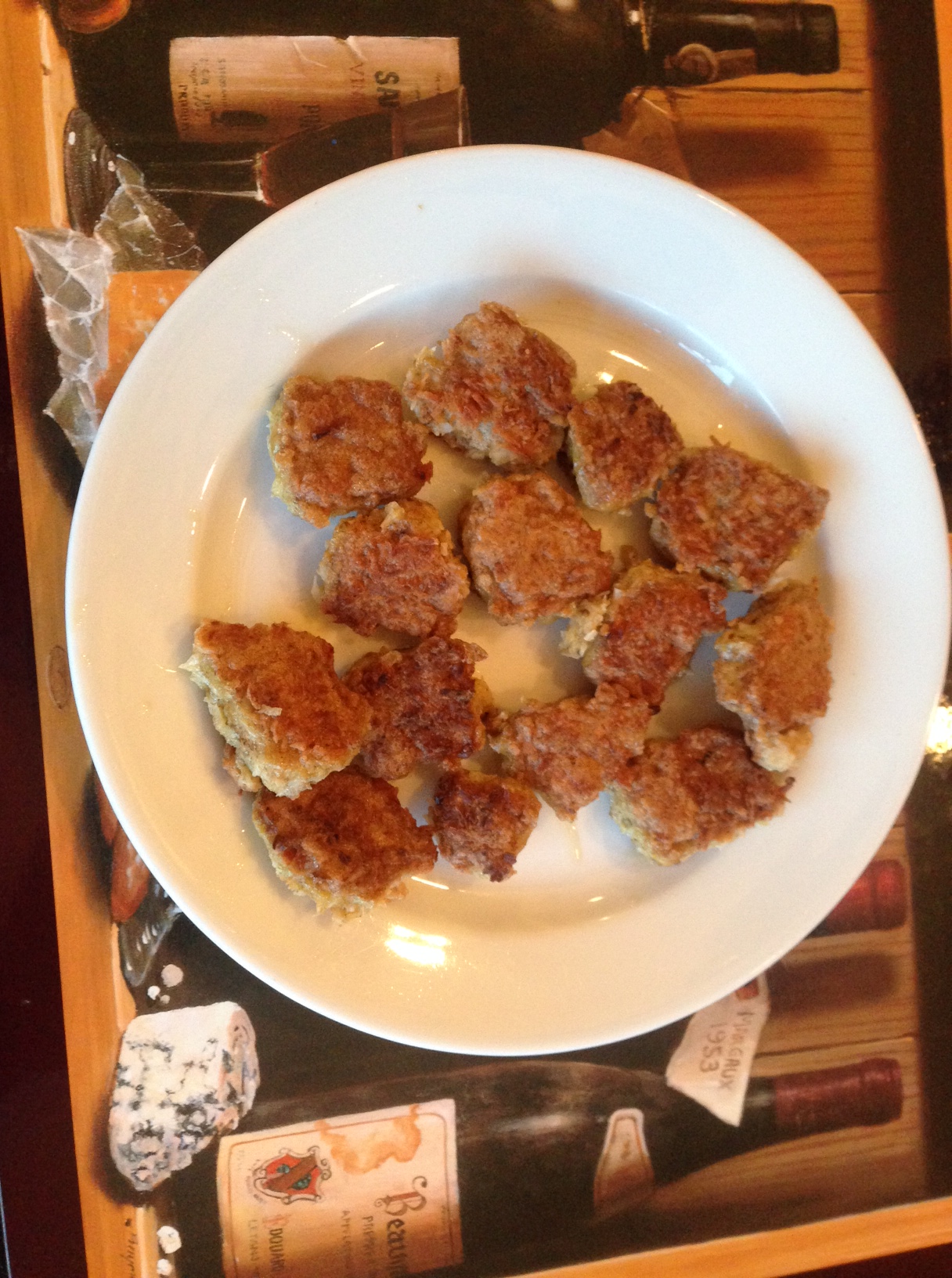
ASD Recovery Recipe: Coconut French Toast Bites

It’s been a while since I posted a recipe. I can’t take full credit for this one; my friend Stacey (she’s busy recovering her awesome six-year-old) gave me the idea of using Julian Bakery Paleo Bread (coconut) for French toast. I came up with the “coconut” and “bites” innovations, after Martin grew tired of regular French toast. (He hates all things breakfast. I think I’ve mentioned that.)

  • 1 slice Julian Bakery Paleo Bread (coconut), or other acceptable GFCF bread with a traditional texture
  • 1 egg
  • ground cinnamon
  • ground cloves
  • unsweetened shredded coconut
  • coconut oil

In a small bowl, whisk the egg until light and foamy. Add cinnamon and cloves to taste.

Cut the bread slice into squares, approximately ½” in length. Err on the small side when cutting, because the egg and coconut and oil will puff ’em up, and you don’t want “bite-size” to become “gag-size.”

Mix the bread squares into the egg. I let them saturate for a few minutes; this morning the bread soaked in egg while I prepared Adrian’s lunch.

photo 1

Meanwhile, heat coconut oil over medium heat.

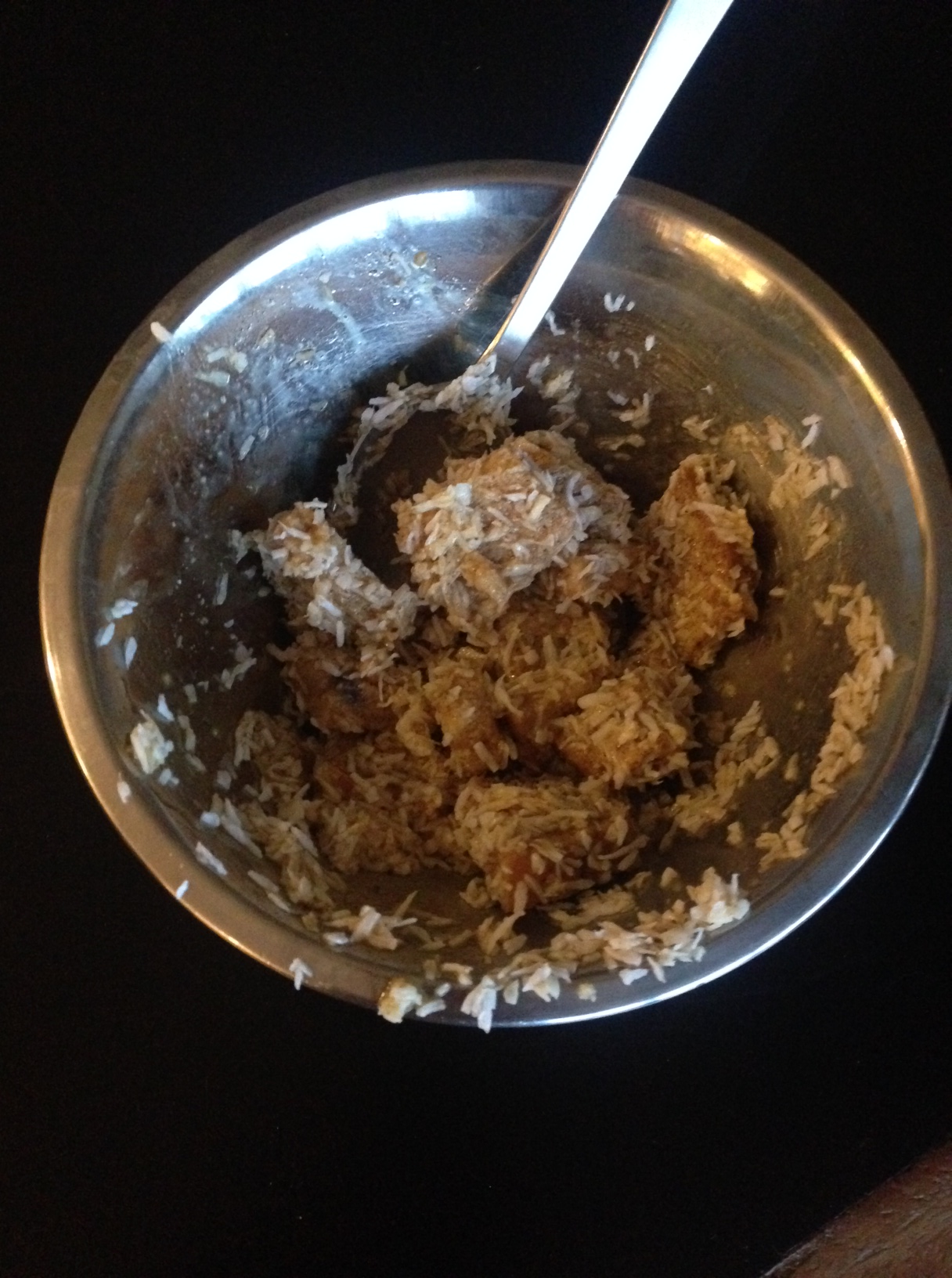
Once the bread is full of egg, add some shredded coconut to the bowl and stir gently until the squares are coated with coconut.

photo 2

Fry the bites in coconut oil, flipping once.

photo 4

If you need some extra incentive to sweeten these up, try a few drops of a low-glycemic sweetener like coconut nectar or warmed Manuka honey.

photo 5

Idioms All His Own

We had to wait a few years, and now Martin’s speech skills are finally progressing. He has trouble with more complex formulations, such as asking and answering “why” questions, or narrating a string of events, or using “did” plus the infinitive instead of the past form (“He did went.”). Other than that, he can express almost anything.

On the other hand, when I say Martin can express almost anything, there’s a qualifier: “in his own way.”

Sometimes he’s making up words. I go with it and use the correct term in return:

“Martin, I don’t want you writing on these piano keys.”

“No writing?”

“No.”

“No marking?” (He means using a marker to write. That’s close.)

“No.”

“No pencing?”

“Nope, no using a pencil.”

“No craying?”

“Nope, no using a crayon, either.”

Sometimes his formulation leaves me wondering, “What led him to that way of saying it?”:

“Martin, would you stop playing with the telephone?”

He’s in the bedroom, messing around with the bedside phone.

“Okay.”

He keeps playing with the phone.

“Hey, get out of the bedroom.”

“Okay. I’m going to go to the room that’s written here.”

He points to the side of the phone, where “family room” is written on the extensions. Then he zooms away to the family room. Most people would have said, “I’m going to the family room,” right? Martin’s choice works just as well.

He likes to make comparisons. Some are natural and make a lot of sense, as when he asked me, “Am I going to have two [Anat Baniel Method] lessons with Miss Sharon today, just like I had two lessons yesterday with Miss Verena?” Or this morning, when he wanted to go to the basement and play the various musical instruments Adrian has relegated there: “I have many instruments in the basement, like a concert.”

Other comparisons—not so natural. Martin likes to drink a kombucha beverage with chia seeds. This morning I asked what he wanted to drink with his (neverending) breakfast. He responded, “I wanted kombucha with a group of seeds in it. Like a singing group.” Chia seeds like a singing group? Does he really think that, or is he experimenting with uses for the word “group”?

I suppose that, as his language continues to improve, Martin will speak more like other people. I’m trying to write down these little Martin-isms now, while we’ve still got them. They represent one more special mile in the recovery marathon.

Smooth(ie)

Breakfast is challenging. Morning is challenging.

I know, I know: Most families with young children probably find it difficult to get them fed, groomed, and out to the school bus on time. Breakfast with Martin presents certain additional factors:

1. Martin doesn’t like his breakfast food options. I’ve given him as many choices as I can, subject to the parameters of what fits his current diet and what I can manage in a smaller window of time. His enthusiasm peaks at “meh.” Certainly nothing gets put in his mouth voluntarily.

2. Martin also needs to take supplements and medications and homeopathic drops (lots of them), which I assemble and administer during the meal, dividing my attention.

3. Mornings, for whatever reason, are Martin’s most distracted time. Often, despite the plate sitting in front of him, he seems to forget even that he’s supposed to be eating. I lob hints and suggestions. (“What’s 9+3, you ask? Try some turkey bacon and we can talk about it.” “Hey Martin, guess what you can use that fork for?”) Occasionally I resort to spooning the food into his mouth. Okay, fine. Often I resort to spooning the food into his mouth.

In order to be ready for the school bus on time, Martin needs to leave the breakfast table and go to the bathroom by 7:25 a.m. He knows this. While asking questions, drawing pictures, and dropping food on his school clothes instead of eating, he counts down the minutes until 7:25. The instant the clock turns, he springs from his chair, remaining food be damned.

If by some miracle Martin finishes his breakfast—or if he manages to bargain me down to some reduced food portion that he’s willing to cram into his mouth in order to escape the table—before 7:25, he’s allowed to go into the family room and play for whatever minutes remain.

One recent morning Martin was drinking a smoothie: coconut kefir, avocado, kiwi, papaya seeds, and strawberries. By 7:18 (the dance is precise) we had finished morning supplements. I headed to the bedrooms for my three minutes of “me time” (pull on jeans, straighten hair, add enough layers to hide pajama top so I can escort him to the school bus). Martin remained at the table, his smoothie glass still half-full.

Typically I would return to the kitchen at 7:21 and devote four minutes to cajoling him to finish breakfast. That morning, however, I returned to the kitchen to find the glass, empty, in the sink waiting to be washed.

“Martin!” I exclaimed. “What happened?”

“I finished my smoothie. I’m playing,” Martin responded from the family room.

I’m no Pollyanna. Quickly I scanned the sink and garbage for evidence that Martin had dumped the smoothie. Nothing. The kid was for real. He’d actually decided just to finish breakfast and go play. I swooned.

And lest you think that’s the only victory of recent days, allow me to say that, this very day, February 21, I asked Martin to get dressed “within five minutes.” After some debate about where he would agree to get dressed—he insisted on standing on my and Adrian’s bed, which apparently offers the best view of our digital clock—Martin completed the task in three minutes flat. Except for his socks. Socks are hard. Also, his underwear and shirt were on backwards, which I considered an improvement, because yesterday his pants were on backwards.

Victories are everywhere.

Martin, assisted by his partner-in-crime, George the Cat, plays in our family room.

Martin, assisted by his partner-in-crime, George the Cat, plays in our family room.

Avonte

By now we use only his first name: Avonte. Last Tuesday afternoon, a friend texted me to ask about the whether a snowstorm had hit us yet. I texted back that we had three or four inches on the ground already, that I was worried about Martin getting home from school, and that I could not stop crying. “They just confirmed that it’s Avonte,” I wrote, to explain. The friend and I had never discussed the matter before. Still, she knew what I meant.

If you live outside the New York area, maybe you don’t know. He was Avonte Oquendo, he was 14 years old, he had autism, and he was nonverbal. On October 4, 2013, around midday, he exited his public school in Queens’s Long Island City neighborhood, alone, and vanished.

More than three months later, on January 16, a human arm and legs and a sneaker were found in College Point, Queens, along the shore of the Whitestone Bay. Over the next few days, divers found a second arm, and teeth, and clothes that looked like Avonte’s, and finally a skull.

Last Tuesday, five days after the first remains were found, DNA confirmed what no one had wanted to admit. Avonte was never coming home.

Avonte’s special-education school “shared space” with both a mainstream high school and a mainstream middle school. This is a common practice in New York City, whereby entirely separate schools, each with its own administration and faculty and student body, operate within one building. The students intermingle in common spaces; an adult or fellow student who saw a teenage boy slip out of a building full of typically developing kids might have no reason to realize the gravity of what transpired.

None of the administrators or staff at Avonte’s school had passwords to access the security footage that showed him leaving through an unattended, unlocked side door. The school officials apparently believed for some time that Avonte, who was unaccompanied by any aide, was hiding somewhere in the multi-school building. An hour passed before anyone notified the police or Avonte’s family.

Once the police were notified, they began duly searching. Yet, as far as I can tell, there was no immediate, massive effort to put eight million New Yorkers on the lookout. I am a constant media consumer, listening to the radio and checking bulletins throughout the day. I found out from a Facebook post that Avonte had disappeared. I didn’t see it on the news until hours later. Days passed before “missing” posters were widespread. A week-and-a-half passed before the search expanded to New Jersey and Long Island, despite Avonte’s known fascination with trains.

A red tent in front of Avonte’s school served as headquarters for a volunteer search effort, led by Avonte’s family. At least one member of his family was in that tent 24 hours per day. Nothing helped. Their beautiful, vulnerable child was just gone.

For me, Avonte has become a symbol of the reality—and with every day, I believe more that it is a reality, not a notion or a possibility—that our society isn’t going to care about autism until it’s too late.

Avonte should never have been unsupervised in a building with unguarded doors. The instant he slipped outside, the police should have known. Everyone should have known. We have the AMBER Alert™ program to recover abducted children. We have no corresponding program for the safety of missing persons on the spectrum, despite the tendency of many to wander or bolt. Avonte is gone. We’re left slapping our foreheads and saying, “Gosh, we should have done more to prevent that.”

Autism rates are exploding. The increase isn’t due to “greater awareness and diagnosis”; there are more and more cases across the spectrum, not just on the high-functioning end where diagnosis might have been an issue in years past.

Some other numbers increasing concurrently are chemicals, antibiotics, GMO’s, environmental toxins, electromagnetic fields, radio waves, and the number of recommended childhood vaccinations. (Yes, I believe vaccinations are connected with autoimmune disorders like those underlying autism. Excoriate me.) Is any one of these increases causing the rise in autism rates? Are all of them together? I don’t know.

I would like to think that one day, I hope not too far in the future, we’re going to start getting some answers, but probably not. There doesn’t seem to be much funding available for studying topics like autism rates in vaccinated versus unvaccinated populations, or the effect of electromagnetic fields on synapses in developing brains, or whether pesticides harm beneficial bacteria in the gut.

We’ll wait until the autism rate is one in 10 boys, or one in five, or one in two, and then we’ll say, “Gosh, we should have done more to prevent that.”

I’m sorry, Avonte. I’m sorry, Avonte’s family. We let you down. Every one of us. We let you down.

Avonte Oquendo

The Club

Adrian and I attended the Metropolitan Opera last Friday, to hear Russian soprano Anna Netrebko perform Adina in Donizetti’s Elixir of Love.

Adrian was super-duper excited about this event, really quite out of his mind. He adores all things opera, Anna Netrebko is his favorite soprano, and we narrowly escaped disaster, insofar as Ms. Netrebko fell ill and had to cancel her January 9 and January 13 performances. We’d long had tickets for Friday’s performance, and that happened to be her return.

I was mildly excited about the opera, which is four degrees north of my usual reaction to opera. My usual reaction to opera can be summed up as, “Are the Rangers playing? No? Okay, I’ll go to the opera.” I was mildly excited Friday because Ms. Netrebko and her former partner, the Uruguayan bass-baritone Erwin Schrott, have a son named Tiago who is about Martin’s age and who also has autism.

I feel a kinship with parents who have children on the spectrum. The kinship extends as well to celebrities. Doug Flutie (just from a football perspective, the Bills should have kept him, not Rob Johnson!), Dan Marino, Toni Braxton, Sylvester Stallone, Aidan Quinn, that “real housewife” from New Jersey, of course Jenny McCarthy and Holly Robinson Peete—I know them all, even the stars who appear to have children with autism but don’t comment. (Not going to call out any celebrities here. My family also has chosen not to “go public” with Martin’s diagnosis.) I want to support all these celebrities and their careers, because in some way, they know what we’re going through. They know us. We’re friends, even if we’ve never met and this post makes them think I’m a stalker. The fact that Anna Netrebko’s son Tiago has autism means that I want to see Anna Netrebko perform. I want to cheer her on.

Adrian says he doesn’t feel the kinship. Without trying to speak for Adrian, I think he just wishes he weren’t a member of the families-affected-by-autism club. But we are. Regardless of whether, or how long, Martin remains on the spectrum, we’re in the club for life.

It isn’t that misery loves company. I’m not miserable, and I don’t think autism should make any family miserable.

It’s that hope and understanding multiply. It doesn’t matter whether other parents choose biomedical intervention, or homeopathy, or only traditional behavioral therapies. The point is that they want to help their children. We all want to help. What a cool club.

(One more thing about Friday evening: Mr. Schrott, Ms. Netrebko’s former partner and Tiago’s father, was also on stage, playing Dulcamara. He was fantastic. Apparently he and Ms. Netrebko broke up recently, so every time they sang together, I was thinking, “Oh, awkward!” Maybe I’m just a celebrity gossip-monger after all.)

(Okay, one more “one more thing” about Friday evening, this one for readers who’ve stuck by me for a while: Adrian and I were seated next to a retired schoolteacher from Berkeley, who said he flies to New York once or twice per season to catch a string of Met performances. We started talking about which productions he’s seen, and he mentioned Madame Butterfly. What did he think? I asked. “I liked it,” the schoolteacher replied, “except for the puppet. That ridiculous puppet ruined the show for me.” I could have high-fived him.)

Goodbye on His Own

Special education means special transportation. Martin does not have to wait at a bus stop. Instead, a bus (yes, it’s the short bus) picks him up at the end of our driveway and delivers him back after school.

(Hurray! We have a driveway, and we live on a dead-end lane. Waiting for the bus is so much easier than when we had neurotypical kids parading past.)

When Martin comes home, I walk to the end of the driveway to meet him, and once he’s off the bus we follow a little ritual. (According to the principles of RDI, I vary the ritual slightly each day, to facilitate Martin’s dynamic intelligence.) I ask him how his day went, take his heavy backpack—containing a lunch cooler with glass and/or stainless-steel containers, a stainless-steel drink holder, multiple notebooks for my communications with his classroom teachers and his therapists, and sometimes spare clothes—and hold his hand while we wait for the bus to turn around at the dead end. Then I remind Martin that we need to wave good-bye to the bus driver and the matron, and I count to three, and we wave together as the bus passes us and beeps.

Yesterday afternoon something new happened. As usual, Martin took his time to descend the three steps and land on the driveway; he still tends to look forward instead of at his feet, so big stairs can be challenging. He walked two steps toward me, as if to begin our ritual—

Then, instead of coming to me, he turned around by himself, waved through the still-open bus door, and called to the driver and matron, “Goodbye! Goodbye! See you tomorrow!”

This may be one of those occasions when I need to explain, for anyone not raising a child with autism, what the big deal is. The big deal is twofold: (1) Martin did something different, and (2) he displayed awareness of those around him and their needs. He realized that the driver and matron were leaving, and that people who are leaving expect goodbyes.

Martin says goodbye a lot. He does so after I say, “We’re going. Let’s say goodbye,” or, “What do we say now, Martin?” I cannot remember a previous occasion on which he wished someone goodbye unprompted. Will he do it again this afternoon? Maybe. Maybe not. Often a new skill emerges, disappears, and then at some later date shows up in regular use. I’m less worried about consistency right now. The key is that social awareness is within Martin. With every bit that his body heals, we unlock more of the intangible.

Why, Hello Again

How does one restart blogging?

I’ve been thinking about that. Mostly while lying awake at night and also wondering why the [redacted] I’m not blogging. But still.

And ta-da!: The plan I’ve conjured, the blogging redux after seasons of silence:

An update.

I’ll offer my readers—in the event I retain any—tidbits about where we stand now, and then, my blog restarted, I’ll pretend like I never was away.

1. We’ve left the City for the suburbs. New York, New York, no more. We moved June 4 to a ranch house, situated on 1.15 acres in a town where many of our neighbors prefer another NHL team to the New York Rangers. An autism diagnosis was one thing. This kind of upheaval—it’s disconcerting, to say the least.

2. Martin attends kindergarten at a private school for children with learning differences. His class has twelve pupils and multiple instructors. Adrian and I feel extremely lucky that Martin has the chance to attend such a school, never more so than this past weekend, when we attended one classmate’s birthday party and watched Martin frolic with his new best friends.

3. Martin receives traditional occupational, physical, and speech therapy at his school. Saturday mornings I drive him into the City for two sessions of Anat Baniel Method (ABM) therapy. We continue working with a HANDLE therapist, and doing home-based exercises activities on the RDI approach. One evening per week Martin takes piano and drum lessons (the latter by his own initiative) with a certified music therapist.

4. We have not yet recovered Martin. We have, however, made progress, and a good deal of it:

•            Though he retains some patterns, Martin’s speech is rarely rote anymore. He has some quirks, such as substituting “but because” for “because” and adding “for” where it doesn’t belong, as in, “Can I have a piece of paper for to draw a picture on it?” Nonetheless, he can express his wishes, wants, and needs verbally, and well.

•            Martin can engage in conversation of six or more exchanges, so long as he is answering the questions (not asking them, which is a level higher). Here is an exemplar talk, which we had when he arrived home one day last week:

“How was school today?”

“It was good.”

“Did anything special happen?”

“We had a surprise reader!”

“Oh, yeah! Who was the surprise reader?”

“It was Quinn’s family.”

“Quinn’s family? His whole family came, not just his mommy or daddy?”

“His whole family came.”

“Wow! What was the book about?”

“It was about snowmen.”

“Did you like it?”

“Yes. I liked it. We made snowmen!”

Note that Martin, who once just “said things,” was speaking accurately. I confirmed later that Quinn’s mother, father, and older sister had all come to do the surprise reading, that they’d read a book about snowmen, and that they’d helped the class with a snowman-making craft project.

•            Lethargy is a thing of the past, and Martin’s “floppiness”—his tendency to fall onto anything within reach—diminishes every day. His core strength has improved, insofar as he is as likely to sit up as to slouch. His manual dexterity is such that he grips a pen appropriately for writing and drawing, he can manipulate small items like pills, and he uses his hands independently for drumming. (That last achievement might not pertain to dexterity per se.)

•            Martin takes a keen interest in his peers: what they eat, how they play, the structure of their families, where they live. He requests play dates. What he still lacks is a solid understanding of how to interact with friends. We’re working on that.

We vacationed recently at a resort area. When Martin was having trouble engaging any other child there, I would approach the child’s parent and say something like, “I think my son would like to play with yours. My son has Asperger’s, and he’s never quite sure how to go about making new friends.” “Aperger’s” sounds much less scary than that other A word, I think it’s pretty accurate for where Martin is now, and the parents I approached responded uniformly positively. Martin made a couple of “vacation friends” that way.

5. Martin still exhibits “autism” behaviors. He perseverates. A lot. This has been an issue forever. Right now he prattles endlessly about traffic lights, hair length, the time, and the moon. He also has three prominent stims (self-stimulatory behaviors), which become more pronounced when he’s tired or detoxing. The stims are running back and forth, making a slurp! sound by sucking air through his lips, and carrying or playing musical instruments. And of course, Martin can be rigid. He wants to wear his blue vest every day, drive one particular route home, read Pete the Cat or Knuffle Bunny books every night.

6. I now understand “the long haul.” I think that, when I started the process of recovering my son, I didn’t really comprehend what how long one might need to haul. The mother who introduced me to biomedical intervention had largely recovered her son within two years, and was done with the process entirely within three years. I failed to grasp that her family’s timing was exceptional. I thought that by kindergarten we’d be done.

My family has been at this three years now, chipping away at the underlying health issues that exhibit themselves as “autism” in Martin. My son has made staggering process. If we never achieve anything more, I will know that our time and money have been well spent. Still, he is not recovered, and much work remains. Fortunately, I no longer fear that some mythical window will close while Martin is five (he’s five now), or seven, or any age. A mother of a recovered 14-year-old told me recently, “Our best year was when he was 12. Twelve years old is when he made the most progress.” Twelve years old is a long, long way off for Martin. If that turns out to be our best year, so be it. We’ll get there.

7. This year, 2014, is going to be extraordinary. Don’t ask me how I know. I can say this: I woke on January 1 with that feeling, and it has not left me. Martin will hit new milestones, and so will I. This past weekend I met with an old friend from law school. My friend used to work in venture capital but for the last year or two has been searching for a new path, something more creative. I told him that I haven’t been doing much writing, or much of anything else, because I’ve been so focused on Martin’s needs. Without warning, he turned to me and vocalized something I already knew: “2014 is going to be a banner year. For you, for your son, for me. I think this is our year.”

See you soon.

Madison Square [Expletive] Garden

When I found out I was pregnant, I began to dream about what my child and I would share.

Maybe he would be a vegan. Maybe he would attend my alma mater. Maybe he would learn German. Maybe he would suck at all things involving music.

Maybe he would learn to love what I love, and want to do what I do.

What I love is ice hockey, and what I do is watch the New York Rangers. I have a season subscription “mini-plan,” which entitles me and a companion to show up to approximately one-quarter of the Rangers’ home games, occupy two seats very near Henrik Lundqvist (first and third period), and whoop like a drunken sailor.

Martin has been doing so well lately that I decided that the time has arrived. On April 27, a Saturday, I brought Martin to Madison Square Garden to watch the Rangers play the New Jersey Devils. It seemed like the perfect starter experience: It was the last game of the regular season, it was a 3:00 pm matinee, and although the Rangers and Devils are usually a good rivalry, the Rangers had already made the play-offs and the Devils were already ruled out, leaving little at stake and perhaps a less-rowdy crowd.

Martin and I arrived by 2:00. I wanted to bring him in before the big crush of fans, and to acclimate him before the cheering.

The first thing he asked for was a bottle of water, which I bought him, totally forgetting that the Garden vendors take the bottle cap away and make the bottle a giant pain in the neck to carry without spilling.

Next we headed to a fan shop to buy Martin a new Rangers jersey. Martin was already wearing a blue toddler-sized #30 Henrik Lundqvist jersey, but that was too small because he’d owned it since—well, in any event, since he became old enough for me to swaddle him in a Henrik Lundqvist jersey, sometime around his birth. At the shop I displayed the available boy-sized jerseys. Martin’s choices were a classic navy-blue #61 Rick Nash (master of the goal-scoring universe), an away-game white #24 Ryan Callahan (Cap’n Cally! upstate power!), or a home-ice blue #30 Henrik Lundqvist (yes, Henrik Lundqvist). Martin waffled for ten minutes before settling on the #30 Lundqvist: a larger version of what he already was wearing. Outside the store, he refused to wear the new, larger jersey like I asked. Instead, he spilled half the capless bottle of water and cried because it made his pants wet.

Five minutes later we were in our seats. Both teams were skating around the rink, pre-game practicing. Immediately I realized that, when I attend games with other adults, I do not accurately perceive the level of noise and other stimulation inside the Garden. It is like a rock concert in there. Music blares, the announcer yells, fans scream, lights flash, sometimes the entire inner arena goes dark.

With Martin by my side, these usually exciting aspects became threatening. He sat cross-legged in his seat, motionless except for intermittently covering his ears. I lifted him to see over the fans standing in front of us. I showed him Rangers in their blue jerseys and Devils in their red jerseys, each team skating around its own half. I pointed out Lundqvist in goal, wearing #30 just like Martin.

Martin continued covering his ears, then wrapped his arms around my neck and squeezed.

We retreated to the concessions level. I purchased a Brooklyn Lager in a cup, with a straw, because I am cool, and sipped some while Martin gazed through floor-to-ceiling external windows. I suggested returning to our seats. He replied, “I don’t want to go back to our seats.” We waited a while longer.

Once the first puck had dropped and play was underway, I insisted on a second try at the inner arena. Martin came along, glumly. He sat cross-legged again, and sometimes slouched down or flopped onto me. I followed the game as best I could. Ryan Callahan, the Rangers’ captain, flipped the puck into the Devils’ net for the game’s first score. The noise level rose even higher. I picked Martin up and bounced him along to the Rangers fans’ chant: “Goooo-o-o-o-o-al! Goooo-o-o-o-o-al! Hey, HEY, hey hey hey hey! Hey, HEY, hey hey hey hey! Hey, HEY, hey hey hey hey!” He covered his ears.

I can’t say that Martin was enjoying himself. But he kept it together.

Near the end of the first period, Martin reached forward and took a water bottle from a drink holder, thinking it was his own. Instead, Martin’s bottle was one drink holder to the left, and the bottle he grabbed belonged to a boy about ten years old, in the seat next to Martin. That boy seized the bottle from Martin’s hands, forcefully. (I think he might have been wary of Martin because of the slouching and flopping.) I apologized to the boy and handed Martin the correct bottle, and I could see that being startled that way had pushed Martin toward his breaking point.

During first intermission I escorted Martin to the quietest area I could find and asked if he would like to go home. He said yes. I explained that if we left we would not be able to come back into the arena and asked whether, knowing that, he still wanted to go home. He said yes. And so we headed for the ground-floor exits, where I told a security guard, “My kid isn’t feeling well. We’re going to watch the rest of the game from home.”

In the subway, Martin had what I think was a delayed-reaction meltdown. He became fixated on dictating which passengers could get off at which stations, and threw a tantrum when, inevitably, the passengers got off at the stations of their own choosing. I took Martin on my lap, let him cry, and then successfully distracted him by asking him to name the stops between Madison Square Garden and our home.

If you are the parent of a neurotypical child, the afternoon I’ve just described might sound like a disaster. We saw only one period of hockey, and I had to abandon more than half a beer, its forlorn straw sprouting toward nowhere.

To me, it was no disaster. It was a darn good start:

•      Martin must have been overwhelmed by the noise, lights, and crowds. I can hardly imagine an environment with more external stimuli. Nevertheless, he held it together. He did not freak out.

•      Martin returned with me to the seats even when he didn’t want to. I didn’t have to force him or bargain. He acceded to my wishes.

•      With all that was going on, I wasn’t sure Martin would really comprehend what was happening around him. But he did. Ten minutes into the game, he had turned to me, in all the hubbub, and said, “Mommy, it’s just like when we watch hockey on television.” Ah-ha! We were experiencing hockey together!

This season, one period. Next season, two?

As Martin continues to recover, we will encounter more that he can share. Actually share, as in emotions exchanged. Adrian will take him to the opera. My brother Eddie will teach him to play backgammon. My stepfather will show him how to swing a golf club. My mother-in-law will make him sweat through Bikram Yoga.

The Rangers game was no unmitigated success.

Still, there was a time, not long after Martin’s diagnosis, when I wondered whether I would ever be able to take him to a restaurant in peace again.

I just took him to Madison Square Garden. Unassisted. If I were given to writing profanity, I would drop an F-bomb between Square and Garden, for emphasis, because that’s the kind of big deal I’m talking about.

Madison Square [Expletive] Garden.

OMG! Is that Henrik Lundqvist? No, wait. It's my Martin, checking out the Garden.

OMGosh! Is that Henrik Lundqvist? No, wait. It’s my Martin, checking out the Garden.