Without Martin

Readers, it’s been a week. For the first time since I started this blog, I let more than three days pass without a post.

I apologize.

I blame Christmas preparations—I didn’t accomplish even half a standard Christmas, but that’s a subject for a later post—, forging through dense briefing schedules in two separate litigations, sitting up at night as Martin’s had trouble sleeping, and preparing for the trip.

Yes! The trip! This is the big one, Adrian’s sixth-anniversary gift to me, and eight days without my Martin. My mother is staying in our apartment with Martin. We’ve gone backwards and forwards over his daily supplementation schedule, dietary restrictions, wants, and needs. I’ve filled the freezer with pre-prepared meals and organic meats. With the approval of Martin’s HANDLE therapist, he gets these eight days off from HANDLE exercises. And all week Samara’s been helping Martin learn this mantra: “Mommy and Daddy are coming back. Mommy and Daddy always come back.” As a result, he was okay when we left this afternoon. I said, “Daddy and I are going on an airplane and will come back next week. You’re staying with Grandma.” Martin replied, “Mommy is coming back another day. Mommy always comes back.”

I’m worried, of course. Not that my mother won’t accomplish Martin’s diet and supplements to the T. Not that my mother and Samara and even my visiting brother won’t be doting on him. I’m worried that he will be distressed without us, and more especially, that we could lose recovery momentum. These past few weeks have brought so much progress. I’ll have a hard time forgiving myself if our absence interrupts that, or prompts a set-back.

(“I’m not worried about permanent damage,” Adrian assured me yesterday. “I’m really not.”)

It didn’t help that, just before Adrian and I headed out, Martin seemed, as my mother put it, “a little spacey today.”

Nevertheless, I made it out the door, teary-eyed. I’m typing this on the airplane. We’re bound for Israel, landing in Tel Aviv and continuing by car to Eilat, then to Jerusalem, sandwiching a day trip to Petra in Jordan. This was all supposed to be a surprise, but some weeks ago I forced Adrian to reveal the itinerary. Not knowing our destination was just shoveling anxiety onto my already gigantic pile of hesitation about leaving Martin. It’s only the second time, since we radicalized his treatment, that I’ve been away more than a night. The first was a four-day trip to Germany for a family emergency, during which Samara moved into the apartment and helped Adrian manage the routine.

So there you have it. This blogger is on her way to the Holy Land and will have a week to contemplate the course we’re on with Martin. I’m determined to post daily, both to take advantage of the time away and to make amends for the recent posting dearth.

An eight-day travel journey, meant as a break from a years-long recovery journey.

Here we go.

Raw Narrative

I wanted to write about something that happened this morning. Then I realized that I had already written the event, in a (maybe) more authentic voice than I would employ for blogging. Let’s call this earlier version the “raw narrative.”

Adrian has been out of town on business since Sunday. (Which leads me to another opportunity to express my unrestrained admiration for single parents, and particular single parents of special-needs children. After a few days of handling Martin’s schedule alone, I’m toast. You amaze me.) When Adrian is traveling, I have a habit of sending him morning and nighttime updates via Blackberry.

Here, unedited except to change the names, is this morning’s update for Adrian:

Good morning, Sweetie! Martin and I are looking forward to having you back. It is drizzling here but so far not too bad.

Sweetie, I started crying this morning, in the street. I was standing with Martin, watching for the school bus to come. He was holding my hand, waiting patiently, not fidgeting, not flopping to the sidewalk or hanging on my arm, and he was making spontaneous sentences about some things he saw (“The fire truck is red,” “The man is running”), and then it hit me that he is getting better, that we’re managing this struggle, that every day I see more and more of the person emerge who our son was meant to be before this god-awful disorder took hold. I looked pretty foolish, I think, crying on _____ Street. But there I was.

In other news, I sent the first brief off at 4:00 a.m. and haven’t received comments yet, so I took advantage of the lull to jog over to the Union Square greenmarket for duck eggs, cow bones, and ostrich filet, to make sure the fridge and freezer are stocked for when my mother is here. My word, what have I become? Also got some of that buttery “Two Guys from Woodbridge” basil that we had last week. Come home so I can feed you.

Kisses.

Let me begin by saying that I’m not usually a crier. At least, not an in-the-street crier. As the penultimate paragraph indicates, I had worked until 4:00 a.m., which left me two hours for sleep before I had to rise at 6:00 a.m., which is the breakfast-and-school-prep time I need when Adrian is away. To that I will add that our senior-advisor cat, Philly, who inexplicably screeches during the night—not to be confused with our junior-advisor cat, Freddie, who pees everywhere—launched his half-hour hyena routine at 5:06 a.m., ultimately leaving me about 86 minutes for sleep. So I was tired, and emotions were heightened.

That disclaimer notwithstanding, the crying was entirely justified. Remember the three crap months we endured from August to November, when Martin’s yeast kicked up again and all the gains we’d made over the summer seemed to disappear? Gone. A memory. Martin is better than ever right now. His eye contact is so consistent that I rarely think about it; I assume that if I say his name, I will see his eyes, for as long as I’m talking. Joint attention is rising again. And Monday afternoon Samara noticed Martin casually taking the initiative to hold a friend’s hand.

We went through three months bad enough that I doubted the entire recovery process, and doubted whether I could endure. I know there may be down times to come, as well. But this day, here, now, I am so glad we’ve hung in there.

I will conclude by advising that I am in no way affiliated with or compensated by the “Two Guys from Woodbridge” company. I really did write that in the email to Adrian, and they really do grow magnificent buttery organic basil.

Adrian

Adrian and I were getting into bed one night last week when Adrian said, unprompted and unheralded, “He is getting better. He really is.”

Adrian neither prefaced his statement nor provided supporting detail. He did not even specify “Martin.” He just said, “He is getting better. He really is,” and then opened his iPad to read.

End of story.

Airport Fun, Part One: The Bathroom Miracle

We traveled yesterday, Martin and I, to visit his excellent Track Two doctor. I intend to post the doctor’s comments (at least, my interpretation thereof) once I’ve had a chance to ponder all she said. For now, I want to discuss the trip, and more specifically, positive and negative experiences we had underway. It will be another two-part post, starting tonight with the positive.

Going to visit Martin’s Track Two doctor means a schedule something like this: We rise early and eat breakfast and take morning supplements at home. Adrian drives me and Martin to the airport, where the two of us clear security and fly a couple hours. Upon landing we take a quick bus ride to a car-rental office. Then, in what I consider the most challenging part of the day, I make Martin wait inside the rental car—there’s just no way I could keep him safe in a rental-car lot with my attention diverted—while I install the toddler seat. Whatever the season, it invariably seems to be either sleeting, pouring rain, or freezing while I spend 20 minutes with my backside hanging out the passenger door, installing that damn toddler seat.

(I am yet to find a car-rental company that will install a toddler seat for me. If you know one, please send the information to findingmykid@yahoo.com.)

Next I drive us 40 minutes to the doctor’s office for a two-hour (give or take) appointment. After that we head back to the airport, surrender the rental car, ride the bus, clear security, wait around, and fly back to New York, where Adrian meets us at the airport, usually between 10:00 and 11:00 p.m. During this whole process I feed Martin food that I’ve cooked at home. For myself, I drink a lot of coffee and pick up what I can, here or there.

It’s an exhausting day. A lot of moving from place to place. A lot of walking hand-in-hand.

And, of course, a lot of visiting strange potties.

Yesterday we hit four airport bathrooms. Don’t worry: For a change, I will not address any, ahem, bodily functions in this post. The topic du jour is what happened outside the stalls.

Bathroom No. 1. No paper towels! The bathroom had only hot-air hand dryers. Martin loves paper towels and fears hot-air dryers. (Oddly, he likes hair dryers. When I dry my hair, he waits for me to whoosh his bangs back with the hot air, scampers away, then returns repeatedly for another whoosh.) In the past, a paper-towel dearth might have caused a meltdown. Yesterday when we finished washing our hands, I said to Martin, “Oh! No paper towels. But you don’t have to use the electric dryer. Let’s go see if we can find paper towels anywhere else.” He accepted that, and we exited the bathroom peacefully. I planned, if Martin persisted in seeking paper towels, to grab some Starbucks or Auntie Anne’s napkins. (The paper-towel supply in my backpack was too precious to surrender, meant instead for in-fight snacks, spilled drinks, runny noses, training-pants accidents, and whatever else the day had waiting.) The napkins proved unnecessary. We strolled wet-handed to the gate, and Martin let go of his paper-towel dreams.

Bathroom No. 2. We were in a hurry. While he was throwing away his paper towel, Martin glanced up and saw that I was already leaving. In such a situation, Martin’s typical reaction has been to dawdle, maybe turn on a faucet or play with a stall door, and generally ignore me until I return to retrieve him and drag him out by the hand. Not yesterday. When he saw me leaving, Martin dumped his paper towel, ran across the bathroom, and took my hand. Paying attention to my cues? Picking up his pace to meet mine? Glory be, whose child was this?

Bathroom No. 3. I was so inspired by the Bathroom No. 2 breakthrough that I designed a little experiment to see whether I could replicate the success. After hand washing, I directed Martin to a wastebasket at the far end of the bathroom to discard his paper towel. While he was thus engaged, I moved to the exit area—it was one of those set-ups with no door, where you instead exit by maneuvering through a U-shaped passageway—and called, “C’mon, Martin, let’s get out of here.” Then I ducked behind the first part of the U-shape. As an unanticipated bonus, a full-length mirror on the bathroom’s near wall enabled me to watch Martin’s reaction. He looked up, realized that I had left, appeared briefly startled, and again came running. It’s not that long since I had to worry about Martin wandering away without so much as checking my location before he took off. To have him hustling and mildly panicked when he knows I’ve left a bathroom—well, that’s a plain miracle.

Bathroom No. 4. We were in a hurry again. The plane was actually boarding. I threw away the paper towel for Martin, grabbed him, and ran. So nothing to report, except maybe, Hey, did I tell you about Bathroom No. 3?

Coming attraction: The security-line tantrum.

The Literary Crowd Weighs In

I’m a writer. Have I mentioned that? A writer of more than this blog, even. I’ve referred in various posts to my being a lawyer. I don’t think I’ve said that I also write. Essays. Fiction. Stuff.

I belong to a five-person writers’ collective. We meet monthly to discuss each other’s recent work. This month, for the first time, I told the other members about this blog and asked for their thoughts.

I made the request before last weekend’s “card-counting” incident. Since then, I’ve reconsidered whether I should have brought this exercise to the writers.

What the hay. What’s done is done, and I got some worthwhile editorial comments at our meeting last night. I’ve decided to diverge from my musings about Martin and share some of the suggestions, to give everyone an idea of where I might head with the posts. I’ve grouped the ideas into bullet-points. Lawyers love bullet-points. Sometimes it carries over into their other writing.

  • More in-scene action. I give a lot of space to pondering, analyzing, explaining, and (in the word I used above) musing. My collective does not disapprove of that, but finds the “scenes” most enjoyable, such as Martin interacting with the boy in the museum, or shaking a waiter’s hand. I’m also asked to provide more balance by describing events that do not necessarily evince progress, i.e., that illustrate the reality we live with today, pre-recovery. (“The positive parts are presented in-scene,” said Writer Paul, “but the bad parts are presented in more of a distant and diagnostic fashion.”) I suppose, if I strain my memory, I can come up with a few anecdotes about self-stimming or lack of joint attention.
  • More Adrian. I mention my husband often, but I’m not allowing him to be enough of a “character,” to occupy fully his own role in Martin’s story. For example, I should stop summarizing conversations I have with Adrian, and instead quote his voice. I should occasionally allow Adrian some blog space for reactions and commentary, too. I’m still contemplating these ideas, and whether I can further exploit Adrian as a character while maintaining his privacy as, well, a person.
  • A wider cast. We travel. We have friends. Martin goes to school and on playdates. We encounter a lot of people, and I should consider letting more of them color our adventures. I’m wondering whether that means I need to keep coming up with aliases. I’m starting to have trouble keeping them straight.
  • More about writing and lawyering. I can make myself more human, and perhaps appeal to a broader audience, if I lasso in aspects of my life beyond Martin’s recovery. (Strangely, my writers’ collective operates under the impression that I have a life beyond Martin’s recovery.) I’m still contemplating this idea, too. Months ago I read an article purporting to describe the top ten things bloggers do to lose readers, and one of them was going off-topic. This is “a parent’s real-time blog of autism recovery,” not “a parent’s real-time blog of whether she’s still going to turn that novel draft by 2012.” So we’ll see.
  • A glossary. I’m doing a decent job of keeping the autism science to a minimum, and thereby not alienating readers outside the ASD community. (I took credit and pretended this was intentional. Faithful readers know the truth: I don’t understand the autism science and will look foolish if I try to present it.) At the same time, I may throw around terms unfamiliar to a new reader, thereby forcing him/her to rummage older posts in search of a definition. I should consider a glossary page that collects ASD-insider terms.

I should say that my fellow writers are good for more than criticism. They also talk about what they like. Apparently this blog engages the reader because it is not clear where the journey will end, whether Martin will recover. The reader feels invested in the quest for more information about autism, its sources, and its defeat. In that vein, the pictures help. Seeing Martin in action, even if only from behind, lends an immediacy to the reflections.

I was happy to hear, also, that I come off as well-read, reasonable, and hardly kooky at all. Though perhaps my fellow writers just said that because I was sitting with them, in person?

Finally, the overall quality of the writing, wordsmith-wise, was deemed high. That was comforting. One of Martin’s service providers once said to me, “You probably aren’t that concerned with it for purposes of the blog, but you do write so well.” And I thought—not that concerned with it? Yeah, sure.

And One More Reason I Won’t Tell

I’ve posted about my and Adrian’s reluctance to share Martin’s condition with any circle wider than our closest friends and certain family members. We are private people. Adrian perhaps is more cautious than I am. Among other reasons for maintaining our privacy, he says that many people who learn that Martin has autism will see nothing else about him, even if he recovers.

I haven’t really believed that, until this weekend.

Adrian and I were in a neighborhood bar with Martin—who was not drinking, and in our further defense, was not the youngest child at the bar—when we encountered a couple we see casually. These are four-times-a-year family friends, and not the inner circle, but for reasons immaterial to this anecdote, they know that Martin has autism. (Not through me or Adrian; neither of us has ever discussed the subject matter to them.)

Adrian was relaying our recent trip to Rockland County, and how Martin had insisted that we drive home via the George Washington Bridge instead of the Tappen Zee Bridge. Martin recognizes all the major New York City-area bridges, Adrian said, from the Varrazano to the Whitestone. Even the Kosciuszko, and the Triboro that’s also called RFK.

It should have been a cute story about a three-year-old who spends a lot of time in cars and likes bridges.

It turned into something else.

One of the couple said, “That’s amazing. So he has like a real obsession?”

I answered, “Not so much an obsession. He’s good at the names.”

He responded, “Have you tried taking him to Vegas yet, like counting cards?”

Pardon me, what the hell was that? Adrian tells a story about Martin recognizing bridges, and what pops into your head is counting cards in Vegas?

I suppose there could have been numerous suitable responses, such as:

“You’ve just got way too personal on a topic I’ve never told you about, and you don’t know me well enough to discuss”;

“If all you know about ASD comes from Dustin Hoffman in Rain Man, that’s hardly conducive to in-depth discussion”;

“Funny that you thought instantly of counting cards. Do you have a gambling problem?”;

“You will never babysit my child”;

“I know we’re in a New York City bar, but the Vegas scene might still be a little intense for Martin”; or

“Yes. Yes, I have.”

Now, Martin’s recovery is far enough along that this man, had he never been informed that Martin is on the spectrum, likely would not have concluded as much from the limited time he spends with Martin. But since he has heard the word autism applied to Martin, that condition colors all that he sees in Martin. This man was looking at a bright, friendly child and seeing only the A word. Naming bridges = obsession = bizarre talents = Rain Man. Of course.

Unfortunately, I’m neither clever nor bold enough to have given any of the six responses above. I said to him, “Uh, no,” pretended to chuckle, and tried not to appear horrified.

Adrian is right. From here forward, before I reveal to anyone the journey that Martin is on, I will ask myself: Can I trust this person to view autism as one facet of a boy who’s so much more?

Vaccinations. I’m Ready for the Hate Mail

A couple weeks ago, a message came across my Twitter feed (@findingmykid) telling parents of kids with autism not to blame themselves, because there is no single contributor to autism—no specific action they should or should not have undertaken. I was grateful for the reminder. I do have a tendency to blame myself for Martin’s autism. We had our kitchen rebuilt, clouding the apartment with construction dust, while I was pregnant. I let myself be bullied into induced labor, leading to epidural anesthetic, Martin’s loss of oxygen, and a C-section birth. I fed Martin foods I now know to trigger digestive difficulties. When we had new window guards installed, I put him to bed thinking the paint had dried, only to open the door three hours later and find his bedroom filled with fumes.

And—I chose to have Martin vaccinated. I started out wary of vaccines, from personal experience: I myself was fully vaccinated as a child, including against the measles, and yet at age 12 I contracted measles. Even the health department visited to find out why I’d caught the contagious and life-threatening disease. That experience has always given me pause about the efficacy of vaccination. So when Martin came along, I tried to educate myself. I attended two seminars (these billed themselves as neutral but turned out to be very pro-vaccination), perused some articles, and read the Dr. Sears book. In the end, after talking with Martin’s pediatrician, I decided to vaccinate Martin, but on the Dr. Sears “alternative” schedule, which skips some shots and spreads others apart. I reviewed the ingredients of available vaccines—they were non-vegan and generally disgusting—and requested them by brand, paying especial attention to aluminum content and to the combination of vaccines (I never allowed more than two) given on a single visit.

Still, I had misgivings, long before Martin was diagnosed with autism. I was uneasy with the idea of injecting, into my son, foreign matter including metals, Guinea pig embryo cells, cow blood serum. Are human bodies really designed to deal with that kind of intrusion, particularly by injection instead of ingestion? Each time Martin received a vaccination I left the doctor’s office feeling vaguely unsettled, even if I was unsure why.

It was mother’s instinct, I now suspect.

In 1998, Andrew Wakefield published a paper in The Lancet linking the MMR vaccine to digestive disorders associated with autism. The Lancet subsequently retracted that paper, and last April the BMJ published an article aimed at discrediting Wakefield’s study. That BMJ article was widely reported, and I recall a Facebook friend—damn you, social media—posting a link to one such report, with a tagline something like, “GET OVER IT, MORONS! VACCINES DIDN’T GIVE YOUR KIDS AUTISM!!!”

Yes, it was written in all-caps, the hallmark of any thoughtful sentiment.

I try not to take umbrage to Facebook posts. This one got to me. I think it would have got to me even without Martin’s condition. Facebook does not represent the best platform for discussing controversial ideas. (For example, have Facebook snippets persuaded anyone, ever, to change a political position?) Worse, the words, written by a mother of several neurotypicals, were inconsiderately harsh for someone not facing the realities of parenting a child on the spectrum.

More than the inappropriate forum or lack of empathy, though, was my belief that this Facebook friend was too cavalier.

I’m not going to say that I think vaccines “cause” autism. I’m sure many readers are horrified enough that I acknowledge a possible link between vaccines and ASD, at all; when I told a college friend that we were undertaking autism recovery, her first question was, “Are you going to be like that actress who went crazy and said vaccines made her son get autism?”

I’m not going crazy (and neither was Jenny McCarthy), and I’m not using the word “cause.” But after reading more, and from a wider variety of sources, I think this: Children who are prone to ASD, for whatever reason, share a sensitivity to certain food triggers, to electro-magnetic fields, to chemicals and heavy metals, and in general to foreign substances. And those children, when their sensitive systems are invaded with the gunk that comprises vaccines, react with increased neuro-divergence. Vaccines, therefore, in my entirely un-scientific opinion, do more harm than good to children who already have, or may develop, autism. I also think that some of the highly touted successes of vaccines may stem, in part if not primarily, from general advances in hygiene and health care; that is, bell curves appear to show that some diseases we vaccinate against have decreased at rates similar to diseases we don’t vaccinate against, because we’ve got better at caring for ourselves.

Be warned—here comes the lawyer in me. I am not advising anyone not to vaccinate his or her child, on the spectrum or otherwise. I would never give that advice. I am not a scientist. I freely admit that I do not fully understand all of what I read on topics like the effects of vaccines, and that I do not have the background to discern among competing sources of information. Thinking more globally, I have no reason to assert that, say, malaria vaccinations in Africa or polio vaccinations in South Asian are not a good thing. I have only my own conclusions, for me, for my family.

My law-school roommate asked me if she should stop giving her (neurotypical) children the fluoride tablets their dentist recommended. I answered honestly: I don’t know. I filter Martin’s water for fluoride. I think fluoride is bad for his condition. That’s not definitive. I may not even have the best or newest information. But from what I’ve got, no fluoride for Martin.

I regret, now, that I allowed Martin to be vaccinated. I particularly regret falling prey to the 2009 H1N1 hysteria and getting Martin that vaccine, because it was so wholly unnecessary, and because that was the single instance that I can remember in which my son seemed different after the injection than before. (I don’t have any specifics for that last comment; I can only say that Martin, who was not yet diagnosed on the spectrum, seemed pretty kooky for a day or two afterwards.) After consulting with Martin’s Track Two doctor and Martin’s pediatrician’s practice, Adrian and I have decided to forego any further vaccinations, at least for the time being. I feel far less threatened by hepatitis B than by further neurological damage to our son.

Quote of the Last 17 Days: Hope

“Hope is one scary emotion.”

This quote comes not from someone famous—at least, not famous yet—but from my friend Alex. She is ten years younger than I am, trim, fit, beautiful, and because of a muscular affliction, often seated in a wheelchair. At the same time that Adrian and I are fighting to recover Martin, Alex is undergoing a costly experimental therapy aimed at regaining her mobility. “Hope is one scary emotion,” she told me in an e-mail and then continued:

I’ve been thinking a lot about hope lately, and my total fear of that particular feeling. Call me emotionally conservative or a cautious optimist (really cautious), but there is nothing more devastating (down on the floor crying with your coat over your head while you’re alone in the office) than feeling like you’ve put your hope in something that has failed. Imagining that your life can be different and then ending up in the same position that you were in before. I find that more times than not, feeling let down after I’ve dared to hope is what puts me in a near-catatonic state. . . . It’s been a long time since I even thought that I could be fixed.

With those words, Alex was speaking for both of us.

I have a conflicted relationship with hope. When Martin is doing well, hope creeps in, and invariably I wind up disappointed. Invariably, because when I’m hopeful, anything not perfect feels like a nasty, swollen raincloud hovering over my picnic table.

Take yesterday, for example. At the breakfast table Martin was drinking his apple-cider-vinegar beverage, and I noticed that he held the stainless-steel straw in the middle of his mouth, his little lips puckered around it. A big deal? A huge deal. Through his HANDLE therapy we’ve realized that Martin has midline issues. He does not like to reach his left hand to his right side, or vice-versa; he turns his head to watch action from the corner of his eyes; and he clenches straws with his molars, dangling them from the edge of his mouth. For months I have maneuvered his straw to his mouth’s middle and held it there while he slurped. Each time I released the straw, his tongue kicked it back to the molars.

Now here he was, unprompted, unassisted, puckering his lips around the straw.

I felt so hopeful. I seized Martin’s notebook—the one we use to communicate with his school—and wrote, “We’ve seen a lot of improvement in Martin lately.” Then I sent him off to the school bus.

I meant, of course, to prompt a similarly upbeat response from Martin’s teacher, something along the lines of, “So have we! He’s concentrating much better.” The moment Martin arrived home from school I pulled the notebook from his backpack and checked. Nothing. His teacher failed to take the bait, and that failure, unreasonably, crushed me. I assumed that she had seen my note, realized its purpose, and made a conscious decision not to respond, because she had observed no recent progress or improvement.

Martin’s teacher does not respond to everything I write in his notebook, especially when I give non-specific information (as opposed to, say, “Please note that Martin will be absent tomorrow for a doctor appointment”). Nor does she generally address his progress in the notebook; for that, we hold frequent in-person conferences. I can only imagine, also, that the daily grind in a classroom of special-needs pre-schoolers allows limited time for musing extensively, in writing, on “improvement.”

None of that mattered when I saw the empty notebook page yesterday. I had spent the day feeling hopeful, and my hope is so fragile that it just waits to be shattered.

So for the most part, I try to avoid hope. When I sense hope fluttering through my chest, I try to diminish it, by focusing on Martin’s shortcomings and areas without recent improvement.

And therein lies the conflict. I dodge hope because it invites an unbearable parade of emotional highs and lows. On the other hand, I can’t continue this path without hope in Martin’s recovery. Hope is sustenance, even if I partake only when Martin’s progress is undeniable.

Today, unlike yesterday, and even though that straw again was in the middle of Martin’s mouth at breakfast, I will not allow myself to feel hopeful about Martin’s recovery in any present or immediate sense. Instead, I will hope for my friend Alex, and allow her to hope for us.

When hope becomes an enemy, at least we have our friends.

Martin’s Bundle: This Symptom, and Not That Symptom

After church services this morning, a younger member of the congregation approached me with a question. His psychology class is covering a unit on autism. They’ve learned about autism-related behaviors like not wanting to be touched, making no eye contact, and lacking affection. If Martin has autism, then why is it that, every time this young man sees us, Martin is snuggling on my lap or hugging me or smiling at people he knows?

I gave him the explanation, as far as I understand autism (which, I admit, is not very far). Autism is defined not by a root cause, but by symptoms, and the disorder can encompass myriad symptoms. Not wanting to be touched is one such symptom. So are, for example, taste and texture issues with food, or self-stimulating behaviors arising from sensory overload. A child on the spectrum may exhibit all these symptoms, or any group of them—what I like to call any “bundle” of symptoms.

Martin’s primary symptoms, I explained, are insufficient joint attention—he isn’t always interested in what others around him are doing, even if the others around him are Mommy and Daddy, and they’re pointing to pictures in front of his face—, language delay, inconstant eye contact, and mild self-stimulation.

Does Martin get upset if things are not the same every time he encounters them? the young congregant asked.

He does, in weird ways, I responded. If we drive to Brooklyn, he insists on taking the Brooklyn Bridge. The Manhattan Bridge and Brooklyn-Battery Tunnel upset him. And altering our plans sometimes prompts a tantrum. Adrian and I put a lot of effort into making sure Martin understands our schedule for any given day (or even hour), and that we stick to whatever we describe. Also, when Martin finds himself in an unfamiliar situation, or overwhelmed, he tries to make order with whatever he has at hand; on our trip to South America last week, in the garden of a busy household with cousins scampering left and right, Martin sat beneath a blooming tree, gathered strobiles, and stacked them side-by-side, into a toy speedboat, repeatedly. Order.

Even as I described those symptoms, the after-church conversation reminded me of a topic Adrian and I discuss often, namely, just how lucky we are in terms of Martin’s particular bundle. Martin eats more or less anything I serve him, facilitating his ultra-restricted diet. He wears any fabric. He displays strong affection for me, Adrian, Samara, his babysitters, his grandparents, even our friends and neighbors and extended families. Honestly, I think I would have great difficulty parenting a child who did not demonstrate his love. I am plenty tested by our cats, with their stand-off-ish nature, and that I can chalk up to their not being human. (In the event that you, amazing reader, parent a child who does not reciprocate affection, please add that to the list of many reasons why I salute you.)

The after-church conversation also made me consider this reality: Martin stands out less than he used to. Today, for the first time, he remained in his seat for the entire church service. Eight months ago he would have gone crawling under the chairs, seeking a snug and secure spot. One month ago he would at least have flopped onto the floor, or wandered away. Any person who is acquainted with children must perceive Martin’s language delay, or wonder about his tendency to ignore his name. Of course they must. But more and more I wonder whether the label autism still comes to mind when strangers meet Martin.

I left church today feeling fortunate.

Fortunate based on Martin’s particular “bundle,” and fortunate because we have seen even that bundle begin to splinter.

ASD Recovery Cooking: Butternut Squash

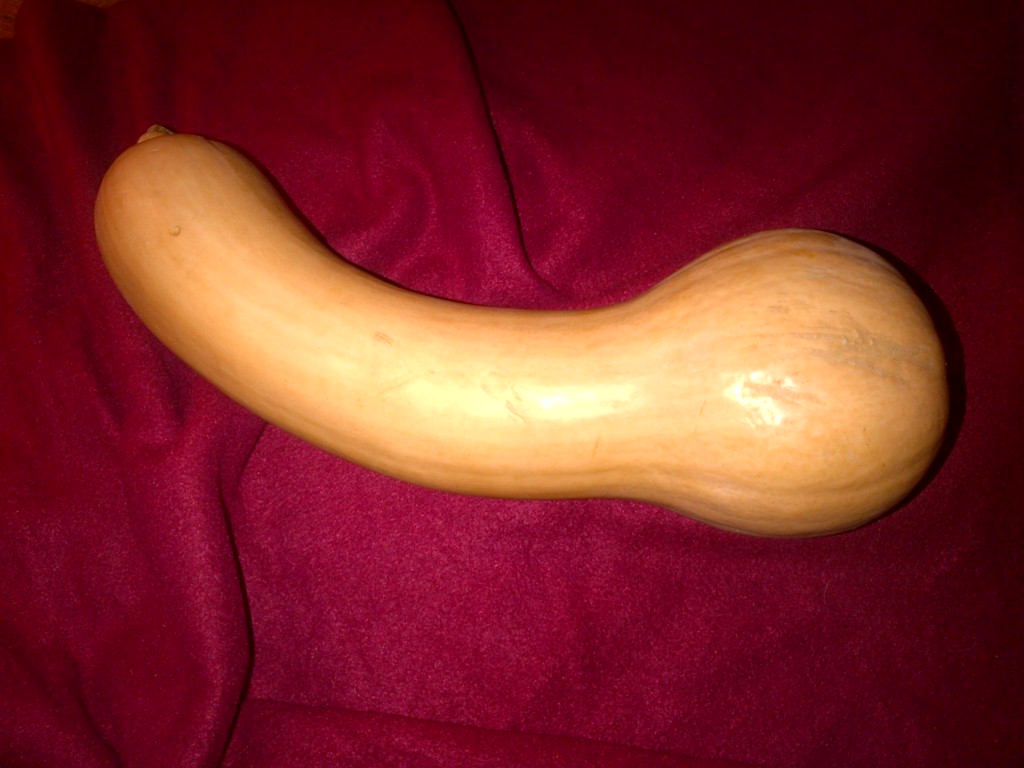
I bought this organic butternut squash of, almost, embarrassing size. It’s a two-weeker.

Winter squash is hardly a nutritional powerhouse, but it is non-starchy, and Martin can eat as much of it as he wants. Thus, when dealing with standard, non-gargantuan vegetables, I process about one butternut squash per week. My gourd friends meet their fate like this:

First, I peel the entire squash and discard the rind. For three or four seconds I gaze upon the rind strips lying atop my garbage, sigh, and long for a compost bin.

Second, I cut the neck from the bulbous seeded section, which I set aside. I slice the solid flesh of the neck lengthwise into French-fry shape, about 1/8″ • 1/8″ • 4″. I store the sliced French fries, raw, in a lead-free glass container in the refrigerator. (No need to cover them with water; they keep well.) Martin frequently enjoys these French fries with breakfast. Those mornings, I spray a stainless-steel cookie sheet lightly with olive oil; spread the fries in a single layer; mist them with more olive oil; sprinkle with kelp or dulse granules, or salt; and bake at 450º for about 10 minutes, or until browned and slightly crunchy. (Uniformly sized fries are key. Otherwise, some will remain soggy whilst others start to burn.)

Third, I halve the bulbous section previously set aside and scoop the seeds and their fibrous coating—which I usually call by its technical name, “stringy stuff”—from each part. I separate the seeds from the stringy stuff; discard the stringy stuff, with another corresponding longing for a compost bin; rinse the seeds, as best is possible; and spread them on a sheet in my dehydrator. (I don’t start the dehydrator yet.) Once the seeds are dehydrated, they make crunchy little toppers for veggie dishes, or mix-ins for the occasions when Martin eats quinoa or rice.

Fourth, I cube the flesh that surrounds the seed pocket. This part of the squash does not make very good French fries, because it is rounded and hard to cut into the right shape. Instead, I juice the cubes with my high-powered juicer. What, you might ask, does one do with squash juice? One uses it in recipes, as a replacement for tomato juice, and to moisten vegetable dishes flavorfully.

Fifth, the juicing process leaves behind pulp in the juicer, which I remove and spread on another sheet in the dehydrator. Then I start the dehydrator, with seeds and pulp inside. Because juicing the flesh has removed most of the moisture (and nutrition, and taste) already, this pulp comprises almost only fiber, and desiccates rapidly. Once it is completely dry, I use a coffee/spice grinder to break it down to a fine powder. I use the powder in place of arrowroot or tapioca (which are starchier) as a thickener in stews and sauces.

The end. From my butternut squash I extract French fries, seeds, juice, and thickening powder.

From the squash pictured above I extracted three containers full of French fries, ¼ cup of seeds (post-drying), about 10 ounces of juice, and a spice bottle full of thickener.

So we’re good for a while.