Joyriding

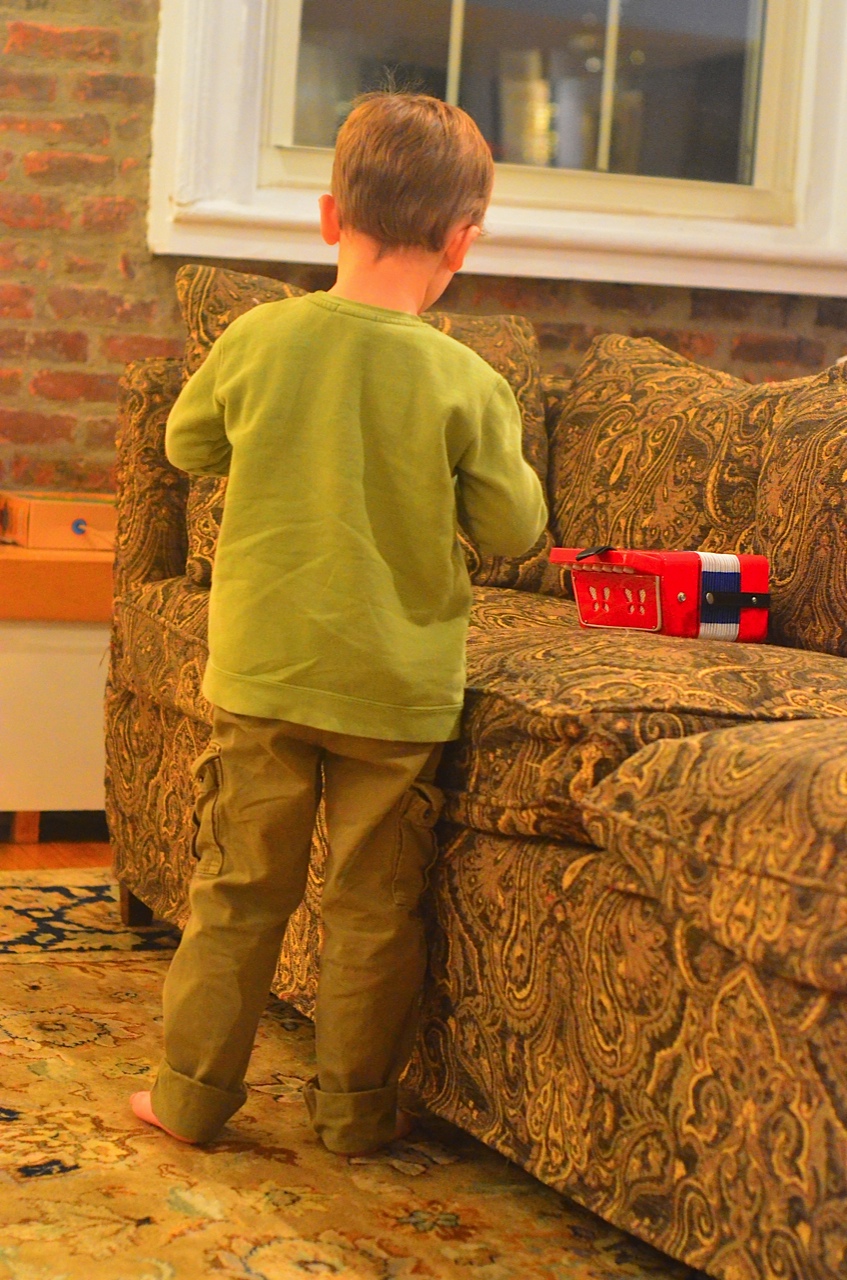
A few weeks ago we enjoyed a vacation on Kiawah Island, and I spent three hours bicycling the streets with Martin and his stuffed panda bear in a cart attached to my bicycle.

Every fellow cyclist and pedestrian greeted us. “Good morning!” “Why, hello!” “Happy New Year!” “Some kind of fine weather today, isn’t it?” Even the drivers waved from the luxury cars that drifted by, obedient to the posted speed limits. I hardly bothered removing my smile between encounters.

This is the good life, I thought. The whole scene—planned community, bicycle paths, golf courses, herons, salt marshes, palmettos, beach, fine houses neatly kept—felt Disney, if not Stepford, and I devoured the insouciance. It’s invigorating, to be carefree once in a while.

“Well, look at this guy,” an older woman said, fawning over Martin when I stopped to check my map. “He’s got the best seat in the house.”

“He does,” I said. “He’s just zooming along while I do all the work.”

I mounted the bicycle again and pedaled away. I was happy that the woman had admired Martin.

In a moment, I wondered, Would she have acted the same if she knew the kid in my cart has autism?

And, Would any of this be different if the kid in my cart didn’t have autism? Does it always have to matter?

In 2008 I attended a fundraiser for Extraordinary Lutheran Ministries, a group that facilitates ministry calls for openly gay (including non-celibate) clergy. Under the ELCA’s policy at that time, gay and lesbian clergy could serve only if they practiced celibacy; like everyone else at the fundraiser, I opposed that policy and favored allowing non-celibate homosexual clergy to serve just like non-celibate heterosexual clergy.

The ELM representative who attended, I remember, said something like this (I’m paraphrasing wildly, on several years’ sketchy memory): “The church policy might seem like the biggest obstacle in the world, right now. But it isn’t. The policy is like this cell phone.” Here she held up her mobile phone, then balanced it unsteadily on its side atop an end-table. “We can just knock it down.” She tipped over the phone. “We can just knock over that policy and move on.”

That’s the way autism recovery feels. Some days, ASD is the biggest obstacle in the world, this lurking beast that colors even a halcyon Kiawah bike ride. Other days, especially when Martin is showing growth, ASD is that mobile phone teetering on an end-table. It’s changeable.

In 2009, the year after that fundraiser, a Churchwide Assembly amended the ELCA’s clergy guidelines to remove the requirement of homosexual celibacy. ELCA churches now can issue calls to gay and lesbian clergy in committed same-sex relationships.

Which is to say, we knocked it over and moved on. And maybe it really doesn’t matter if the kid in my bicycle cart has autism.

Newtown

Here are some things I’ve heard about Newtown—I guess we just say Newtown now—that may or may not be true. I heard that the shooter had autism, or some form of ASD. I heard that his mother tussled with the school district about his special education. I heard that she encouraged her son to “fit in.”

I thought, How terrible. How could the mother of a child with special needs tell him to do precisely that of which he is incapable—to fit in?

I thought, I would never do that to Martin. He is who he is. I will not chisel away his self-esteem by telling him to be like other kids, when he can’t.

As a child, I was boyish. There was no dress-up or experimentation with make-up for me. I had short hair; I preferred jeans to skirts or dresses or even slacks; I played sports and climbed trees; I didn’t mind when strangers mistook me for a boy, which they often did. Like other boyish girls, I faced persistent pressure to change, mostly from adult females, well meaning or otherwise. (“I can’t believe you’re not getting this right,” the art teacher chided, when used too little adhesive on my papier-mâché project. “You’re just always so messy.”) The effect was that I didn’t like myself. I believed that I should be girlish, but I wasn’t. That just wasn’t me. And so who I was—wasn’t right.

I’ve been determined not to tell Martin that he isn’t right. Martin should fit in with other kids only as much as he wants to or is ready for. That’s an easy call.

Still, Newtown and the rumors surrounding it got me thinking: Are there other instances when I tell Martin to do what he’s not (yet?) capable of?

There are. About fifty million per day.

“Martin, pay attention.”

“Martin, stop dawdling.”

“Martin, look at me.”

“Martin, no repeating. Say it only once.”

“Martin, eat.”

“Martin, hurry up.”

“Martin, walk like a big boy.”

“Martin, just go to the front hall and put the shoes on.”

The hard part is figuring out when Martin is just playing me. Example: Bedtime. Martin insists that I do his bedtime routine: potty, supplements, teeth brushing, reading, tuck-in. He’ll agree to take his bath for someone else (say, Adrian or Samara), but bedtime is all Mommy. In fact, Martin is so fixated on bedtime with me that perseverates on continual reassurance. Within five minutes of waking each morning, he has said, “Sleepy-time with Mommy!” at least once. He says it throughout breakfast and while he gets ready for school. It’s one of the first statements I hear when I pick him up from school: “Sleepy-time with you, Mommy!” Anytime that he senses I am about to leave, even if only to go to the bathroom, he becomes agitated and says, “Sleepy-time with you! Sleepy-time with you!”

On vacation last week, Adrian and I went out to dinner and left Martin with my parents. As soon as Martin realized that Adrian and I were leaving, he began to scream and cry. “I want to go to dinner, too. Sleepy-time with you, Mommy! Sleepy-time with Mommy!” He threw himself dramatically to the floor, grabbed Adrian’s foot with his right hand and my foot with his left hand. “You’re not going to go out! You’re going to stay here!”

We left.

Within five minutes I received a text message from my mother: “Everything fine here. Martin calm.” When we returned home later, I learned that Martin had done his entire bedtime routine and gone to sleep without complaint.

On the one hand, I know that Martin’s ASD and accompanying fixations make him cling to routines, and I need to indulge that. On the other hand, Martin wants me to indulge him, and he exploits my willingness to do so. When it comes to keeping pace and hurrying up, Martin is a heckuva lot more cooperative if he’s excited about where we’re going. Getting from our apartment to the school bus? It’s a ten-minute process. Getting from our apartment to the playground? He’s moving faster than I am. Am I wrong to tell him to hurry up and focus for the school bus? Same with meals. If the plate is beef bites with fermented cauliflower, I have to repeat some variation of, “Maybe you could take a bite?” at least two dozen times, or even just spoon it into him myself. A bowl of gluten-free oats with butternut squash and coconut oil goes down his throat like bathwater through the drain. Am I wrong to tell him to hurry up and focus on eating the beef?

One of my first reactions to Newtown was, “Thank God the shooter killed his mother first. It was an act of mercy; how could she have gone on?”

Looking back, I think that reaction—it was a gut reaction, and I am not saying that the Newtown shooter’s mother had anything to do with what happened on December 14; I know almost nothing about the circumstances—was my conscience expressing the responsibility I feel for Martin’s future. However far biomedical recovery takes us, I am the one who has to help Martin learn to live in the world and still love himself.

Holy crap.

Martin checking out a holiday train display.

Martin checking out a holiday train display.

securedownload

Because They Know

If you’ve been reading this blog for a while, you know about my love-hate relationship with social media. Something about operating on-line makes people thoughtless. Combine that with my hyper-sensitivity on autism and child issues—the result is potential meltdown every time I log on.

One particularly problematic area for me is constant Facebook updates about amazing children, written in some superficially deprecating fashion. “No other kid in Caleb’s figure-skating lessons can even axel. Can’t believe I can’t afford anything better for a kid who already lands a lutz!” Or: “I really love Woody’s new teacher. Look at this certificate she made him for getting the highest reading scores in the class.” Or: “Clementine is district chess champion. I feel a little less like I’m depriving her by not being a soccer mom.”

I get bitter.

Strangely, it is only the amazing-kid updates of distant friends that bother me. I like reading when my close friends—the kind of friends I visit, and telephone—post about their children.

I’ve come up with two reasons for the difference.

First: My close friends don’t do the superficially self-deprecating thing. They just brag. I’m not sure why that’s less offensive, but it is.

Second: They know about Martin.

When it comes to social media, I’m constrained, because we’ve chosen to keep Martin’s autism confidential. Adrian and I are careful not to post anything that makes our son appear atypically developing. We share the one picture in ten in which Martin actually looks at the camera. We write the cute things he says only when they sound like what any four-year-old might say, or else we edit to keep the gist while fixing the words. Of Martin’s true successes, I cannot boast on-line. “Martin chased a boy at the playground for, like, at least five seconds before he lost interest!” “Martin had a four-exchange conversation with his babysitter!” “In the midst of bolting down the sidewalk this afternoon, Martin turned around to see if I was following him!”

My close friends know about these successes, even if I can’t share them publicly, because they know about Martin. Last Memorial Day, as we do annually, Adrian and Martin and I got together with some of my closest girlfriends from high school. This year six families attended the gathering. The other children, all older than Martin and all typically developing, played with him as if he were their own little brother; they were patient, occasionally teasing, responsibly keeping him from trouble. From the parents I heard nothing but swooning. Martin was talking so much more than the previous year. Martin’s eye contact had improved. Martin had better command of his movement.

No strange looks to endure. Nothing to cover. Only compliments.

I felt like a million bucks.

When Martin and I visit his doctor in Chicago, we follow a two-day pattern. On day one, we fly from LaGuardia to O’Hare, rent a car, see the doctor, buy groceries at a Whole Foods Market, and check into a hotel “suite” with kitchenette, where I prepare Martin’s dinner. On day two, Martin and I eat breakfast at the hotel, return to the doctor’s office if any follow-up is necessary, then spend the afternoon at a friend’s home in Elmhurst, not far from the airport, and finally catch an evening flight back to LaGuardia. The Elmhurst friend is a high-school classmate, with a toddler of her own, and a most considerate hostess who prepares some fantastic vegan lunch for me while I co-opt half her kitchen to cook for Martin.

Several months ago, I awoke sick on day two of a Chicago trip. My head was pounding, and I was nauseated. A hot shower didn’t help. Nor coffee. Nor dry toast that I ate with my head resting in my palm. And poor Martin—I had no one to help out, and with no energy or patience, I was content just to get him and our things moved somehow to the rental car.

Almost the moment that I settled onto my friend’s sofa in Elmhurst, my situation began to change. My shoulders relaxed. The headache evaporated. It had been tension, of course. I’d gone to bed with a slight cramp in my neck, and made myself sick by worrying all night about what I would do if I got sick and had no one to help with Martin. Once we arrived in Elmhurst, I knew that if necessary I could say, “I need to crash in your bed for the rest of the day. Here are Martin’s pills and food. Good luck.” And my friend would have replied, “See you tonight. Yell if you need anything.” There was no longer any need to worry, and I felt better.

That’s the way it works, with friends who know about Martin’s autism. They’ve got my back. They procure food for Martin, cook for him, ask about his needs, encourage his friendships, celebrate his successes. And so I do the same for them. It’s like we’re one big family, sharing kids. I want to hear about their amazing kids, because those kids are mine, too.

I can’t take that feeling to social networking in general.

I suppose this blog is my brag book, instead. My anonymous brag book.

Sorry about that, readers.

Not the best-quality picture! Martin was so determined to flush this airport toilet with his foot that he climbed onto the fixture to manage it. I hardly had time to whip out my smart phone and capture the moment.

Not the best-quality picture! Martin was so determined to flush this airport toilet with his foot that he climbed onto the fixture to manage it. I hardly had time to whip out my smart phone and capture the moment.

High Score

Monday evening Samara babysits Martin. It’s my big night on the town.

As I was leaving yesterday, around 5:30 pm, Samara was heating dinner and Martin was playing in the loft space above our entry hall.

Playing alone. Score for Martin.

From the living room, I yelled, “Martin! Where are you?”

Martin appeared in the loft door.

Understanding that I needed to see him. Score for Martin.

“I’m leaving now,” I said. “I love you very much.”

“I love you too, Mommy.”

An appropriate response, including the use of “too” and addressed directly to me. Score for Martin.

I asked, “Can you blow me a kiss?”

Martin placed his hand to his lips, then waved it toward me.

Direction, albeit simple direction, followed. Score for Martin.

I tossed a kiss at him and departed.

Later, after drinks with parents from Martin’s school, I met a church friend for dinner. This friend knows that Martin has autism. At some point during dinner, he said, “I hope it’s okay to say this and it doesn’t make you mad or anything: When I see Martin at church, he looks just like all the other kids.”

A friend doesn’t want to offend me when he says Martin looks like any other kid. Score for everyone involved.

Der Process

I’ve written before about my scrapes with the Transportation Security Administration.

I travel with Martin, a lot. When we fly, I carry his myriad pills and drops and liquids and compounded formulations in a heavy-duty black shoulder bag. (It’s repurposed. Once upon a time the bag held my breast pump.) Many of the supplements that aid Martin’s recovery are homeopathic and otherwise imprinted or finely calculated. I will not allow the supplements to pass through the security x-ray, because it can scramble their delicate properties.

Because of Martin’s special diet, I also have to carry food in my knapsack. In the past, my go-to has been nut butter with rice crackers. Now I like coconut butter with crackers. The TSA doesn’t like either.

The scene changes each time we pass security.

Regarding food, I’ve been told, at various times:

(1) nut butter is no problem and can come on the plane;

(2) nut butter is a problem unless it is in a sealed, unopened container;

(3) nut butter cannot be in a sealed, unopened container because all those containers are too big;

(4) nut butter is exempt from security if I’m carrying a doctor’s prescription for Martin’s restricted diet (I always am);

(5) our doctor’s prescription for Martin’s restricted diet makes no difference to what we can carry on the plane; and

(6) we can bring nut butter on the plane only if I leave the security line, take all of my belongings and Martin to the food court, request to-go containers from some restaurant, divide the nut butter into three-ounce portions among those allegedly available to-go containers, and return to security with the newly packaged servings. On the day that this food-court option was given, the TSA agent insisted that the repackaging could be accomplished in the ten minutes before our flight was to board. It became one of many flights on which Martin ended up without nut butter.

I never know which story we’ll get about the nut butter, or coconut butter, when we reach the front of the security line. And yet, traveling with Martin’s food is a piece of cake—sorry—compared to carrying supplements that should not be scanned.

We’ve been in Texas, on Thanksgiving vacation. Last week, when Martin and I flew from New York to Texas, we encountered a sympathetic TSA agent. I unloaded everything from the black bag into a gray security bin. The agent took the bin immediately, asked what it contained (“My son’s medications”), used one swab to check all bottles quickly, and called Martin a beautiful boy. I repacked the black bag, and we were on our way in less than five minutes.

This morning, preparing for our flight home from Texas, I requested a hand-search of the supplements. I unloaded the several dozen bottles from the black bag into a gray security bin. No one came to take the bin. A TSA agent had me stand in front of the metal detector holding it, as passenger after passenger walked by, each (it seemed) examining the contents of my bin as s/he entered the metal detector. I heard, “Hand-check on one!” called several times, but the agent in charge of hand-checking decided to restock the gray bins of three lines before showing up, so I stood in front of the metal detector a full five minutes with my bin. At length a female TSA agent approached and offered to set my bin aside while we waited for the elusive agent in charge of hand checking. Then I stood, bin-less, another two or three minutes until I was invited to pass, not through the metal detector, but through a full-body scanner, the next line over.

Adrian traveled with me and Martin today, thank goodness. While I stood there waiting, Adrian accompanied Martin through the regular metal detector (long-time readers of this blog know my misgivings about the metal detector) and collected my laptop, knapsack, boots, and jacket from the conveyor belt. On the other side of the full-body scanner, I was informed that, because I had requested a hand-search of Martin’s supplements, I would be subject to a full-body pat-down. I’ve received the pat-down treatment maybe twice before; its necessity appears randomized. A male agent ushered me into a glass-wall-demarcated waiting area and told me to await a female agent. I stood, on display in my glass-walled enclosure, until yet another agent moved me to a chair. Some twelve minutes had elapsed since I took off my boots for security.

The female agent materialized, donned latex gloves, and told me to stand with arms outstretched while she ran her hands over my body. Meanwhile, a male agent began swabbing each individual bottle of Martin’s supplements. He swished the swab cloths through a machine, which at one point sounded an alarm. He relayed the alarm news to the TSA supervisor, who alit from his perch behind us and asked which bottles were in the alarm group. Apparently 18 bottles were in the alarm group. The TSA supervisor instructed the agents to open each of those 18 bottles and retest with a sample stick.

Next the supervisor asked, “Are these all your belongings?”, indicating the black bag and assorted supplements.

I should have said yes. Instead, I answered honestly: My husband had the rest of my belongings.

And where was my husband?

Over there. I indicated where Adrian had taken Martin to sit on a bench.

The supervisor demanded Adrian’s return. Adrian complied, carrying his briefcase and my knapsack.

The supervisor ordered a hand search of my knapsack, which had already cleared the x-ray machine. Then, for reasons unclear to me, he told the agents to seize Adrian’s briefcase and search that, too. Adrian surrendered the briefcase and returned to the bench to occupy Martin. By now 20 minutes had elapsed since I removed my boots.

The female agent sat me in the chair again, to run her hands over the soles of my feet. With the pat-down thus concluded, she began opening bottles of supplements to sample.

“You can’t do that,” the male agent admonished. “Make her open each bottle.”

He meant me. I rose from my chair and picked up a bottle.

“You can’t do that,” the male agent admonished again, this time directed at me. “She has to hold the bottle while you open it.”

I gave the bottle to the female agent, who grasped it in a latexed hand while I unscrewed the top. Then she dangled a paper sample stick over the top of the bottle, dropped the paper stick into a magic container, and asked me to recap the bottle.

Then she picked up the next bottle. The next of 18 alarm-group bottles.

The male agent opened a small cooler containing Martin’s refrigerated supplements and an ice pack. He told the female agent she should sample the refrigerated items, too.

Bottle open, paper stick, magic container, bottle closed. Bottle open, paper stick, magic container, bottle closed. Bottle open, paper stick, magic container, bottle closed.

Beside us, the male agent emptied Adrian’s briefcase. Bond indentures, credit agreements, and a Longhorns t-shirt spread across the table. More than 30 minutes had elapsed since I removed my boots.

The female agent glanced at the supervisor, now atop his podium again, and whispered, “I’m sorry about all this.”

I have a son with autism who takes a million pills and drops a day. Everyone here is staring at us. I am all for airline security, but why do some TSA agents have to make this an extended production while others let us through with hardly a pause?

I said, “These are my son’s medications. I really don’t like them handled.”

She shook her head. “I know. I’m sorry.”

Bottle open, paper stick, magic container, bottle closed.

The male agent announced that he couldn’t fit Adrian’s laptop back in the briefcase. Adrian left Martin sitting on the bench and came to gather his documents and other belongings.

Bottle open, paper stick, magic container, bottle closed. Finally the agent finished, leaving me with an empty black bag and a table covered with bottles. I started returning everything to the bag, embarrassed by a few tears of frustration.

Some 40 minutes after removing my boots, I carried the black bag and my knapsack to the bench where Adrian had the boots waiting for me.

“Is it always this bad?” he asked.

“No,” I said. “Sometimes it’s better.”

We started walking toward our gate.

“And sometimes they do all that while I also have to keep track of Martin. And then it’s even worse.”

I Don’t Know

“Mommy, I don’t know.”

Martin said that this week, in a response to a question about a stuffed panda bear’s nose. The conversation ran like this:

“Martin, what color is Panda’s nose?”

“Yellow.”

“Silly! It doesn’t seem yellow to me. Look again?”

Martin hesitated, studying the panda’s nose, which had once been black but faded to some flecked gray that apparently defied description, at least for Martin. At last he said, “Mommy, I don’t know.”

Until now, when Martin didn’t have the answer to a question, he would resort to echolalia and repeat the question: “Martin, what are you doing?” “What are you doing?” “Martin, where are we going?” “Where are we going?” For weeks I’ve been trying to get him to say instead, “I don’t know.”

It’s advanced, when you think about it. To say, “I don’t know,” is to (1) comprehend what the question seeks; (2) realize that it is capable of being answered (e.g., the question is not, “What time is that tree?”); (3) understand that, although an answer exists, you do not possess it; and (4) roll those concepts into a response. Saying, “I don’t know,” is a manner of implying absence: Knowledge of this matter exists; it is absent from my body of knowledge.

This week, Martin made that implication. Just once, I’m afraid. Later the same day, he answered a question with, “I don’t know,” when prompted: “Martin, where are your shoes?” “Where are your shoes?” “It’s okay to say if you don’t know, buddy.” “I don’t know.” He has not again admitted unprompted that he doesn’t know an answer.

But he will. That’s the way these new skills come, sometimes. Once, not again, a few times, an avalanche. So he will.

When? Oh, I don’t know.

Holy Cow, What a Week

This has been a week of outrageous swings: new development upon new development, meltdown upon meltdown.

Let me start with the good. Let me start with the incredible, because I am bursting with pride. Here, blog world, are the headlines—

Martin has managed new feats of attention. Sunday I asked Martin to put on his shoes. Martin walked to the front hall and put on his shoes, albeit on the wrong feet. That was an achievement in itself; seldom does Martin obey a command without additional prompting, especially not a command that requires multiple steps to fulfill. (Walk to front hall. Find shoes. Sit down. Put on first shoe. Velcro first shoe. Put on second shoe. Velcro second shoe. Usually I ask two or three times, and finally bark, “Martin! Shoes! Feet! Now!”) After the initial success Sunday, I said, “Oh, Martin, I think those shoes are on the wrong feet. Why don’t you switch them?”, and he did it without being asked twice. He looked at his feet, removed the shoes one at a time, reversed them, and Velcroed them closed again. He didn’t seem to notice that tears of happiness appeared in my eyes.

Martin is showing off. Tuesday on this blog I described how Martin jumped in circles on a trampoline at the doctor’s office and announced, “I’m jumping in circles.” It was a generalized observation, kind of informing the universe what was happening. Compare what happened the next day, Wednesday, at a Manhattan playground: After three tries, Martin managed to ascend a green spinning corkscrew and hoist himself onto a V-shaped joint at its top. Then, balancing himself, he checked to see if he had my attention and said, “Look how high I am!” That was no generalized news bulletin. That was a desire to show off to his mommy. He was proud of himself for climbing the corkscrew, and I was proud of him for wanting me to know it.

Martin is moving, at least sometimes. We live in a fourth-floor walk-up apartment. Because the apartments below us have high ceilings, it’s more like climbing five flights. There are 78 steps total. I know because I used to count them when I was eight- and nine-months pregnant. I thought getting up the stairs was tough in those days. It was nothing compared to the challenge of getting Martin up them. He dawdles. He fiddles with his bicycle, stored in the ground-floor foyer. (We have the kind of cool neighbors who allow that.) Especially when he’s lethargic, he sits down on the landings and talks to himself instead of continuing. If I take his hand and try to march him upwards, he bends his legs slack and suspends his body from my hand. The stair process can last ten, fifteen minutes. So imagine my surprise Wednesday evening when, as we entered the building, Martin said, “I want to hold your hand,” then took my hand in his and, next to me, ascended all 78 steps without interruption—a historic achievement in Martindom.

Martin wants what other kids have. Yesterday morning, Friday, I brought Martin to an Anat Baniel Method therapy appointment. As we were leaving, we encountered another boy, about Martin’s age, and his father. The boy made excellent eye contact and had far more verbal skills than Martin. He introduced himself by name. Then, obviously proud, he held up an MTA MetroCard and said, “My dad gave me this to hold, and it still has some money left on it.” Martin, who watched and heard this from a few feet away, immediately said, “I want to hold a card. I want to hold a card!” Unfortunately, I had just loaded $50.00 onto my MetroCard and therefore did not want to trust it in Martin’s hands. I said, “Let’s go back to the subway station and see if we can get you one.” I hoped that, in the ten-minute walk to the station, he might forget the incident. Instead, when I pulled out the MetroCard to enter the station, he demanded to hold it, which I allowed for a short time. Martin has taken an interest in other kids’ food before, but to my recollection he has not sought their playthings or special privileges, at least not so earnestly.

Martin is indicating the person to whom he’s speaking. This began when he started using the command form; to his dictates, he appended Mommy. “Come here, Mommy.” “Open the candy bar, Mommy!” (Martin doesn’t really eat candy bars, of course. We call Go Raw brand raw sprouted seed bars “candy bars” to make them sound as delicious as possible.) Within a few days, as we were driving in the car, Daddy became subject to our little dictator, too. “Close the roof, Daddy.” “Turn on the radio, Daddy.” Not too much later, we realized that even non-command comments were directed toward me or Adrian. “Mommy, I want something to eat.” “Daddy, I need some help.” Martin was no longer throwing words to the wind. He was giving them to his parents. Finally, just yesterday afternoon, I heard him specifically address someone other than me or Adrian. “No, Samara,” he responded to a question from his babysitter. Martin begins to understand that a conversation requires a partner.

Martin doesn’t always need the sound. Last night Samara was giving Martin a bath while I packed for our Thanksgiving trip to Texas. (I’m typing this entry on the airplane, while Martin watches Sesame Street on the iPad. We’ll be in Texas for a week.) From the bedroom, about ten feet away, I caught Martin’s eye. I put my hands over my heart and silently mouthed the words, “I love you.” Martin apparently read my lips. From the bathroom he called, “I love you, Mommy.” Can you imagine? A boy who once lacked appreciable receptive language read my lips.

So we had a week of singular advancements. Let me not, however, overstate where we are. As always, there’s more to the story.

•      On Sunday while Martin switched the shoes from foot to foot, although he maintained focus on the task, he also perseverated nonsense to no one while he worked. “I’m reading it on the computer. ¡Hola! The elephant’s name is Mitt. I’m not going to take a shower!”

•      The day Martin climbed the corkscrew, there were some four dozen kids scampering around the playground, chasing each other and playing games. Martin declined to interact with any of them. The activities to which he set his mind were his, and his alone.

•      After Martin seamlessly ascended 78 steps while holding my hand, he entered the apartment, removed his shoes and coat, and immediately began self-stimming, running back and forth with two pa-dap-BUMPs capping each lap.

•      While the boy with the MetroCard introduced himself, Martin turned around and thrust his face into a waiting-room sofa, with his butt in the air towards me, the boy, and the boy’s father. When I fished him from the sofa and asked him to say hello, Martin responded by muttering, “No, no!” and hiding behind my legs. It was from that position that he watched the other boy show off his metro card.

Moreover, Martin’s mood has been disastrous. Perhaps because of the itchy viral rash plaguing him, or perhaps because our travel has thrown off his sleep, or perhaps just as a counterpart to the rate of change in his neuro-processing, Martin has turned on the tears at any provocation this week, and sometimes at no provocation.

One sunny morning he said, “It’s cloudy outside.” When I said, “Look out the window, Martin. I think it’s sunny today,” Martin started crying and yelled repeatedly, “No, it’s cloudy outside. It’s cloudy outside.” For several minutes he was inconsolable. Another morning, following a poor night’s sleep, Martin whined continuously for 30 minutes. Oh mommy oh mommy oh mommy oh mommy oh mommy oh mommy on and on. And on and on. And on and on. His poor night’s sleep meant I was running on about three hours’ sleep that morning. The oh mommys did nothing good for my nerves.

This afternoon Adrian suggested that Martin consider wearing his green fleece coat to Texas instead of his bulky winter jacket. Martin responded by screaming from our apartment, screaming down 78 steps, screaming through the foyer and parking lot, and screaming halfway to JFK. I occupied the passenger seat and rubbed the back of Adrian’s neck as he drove. We pretended that no one was screaming in the back seat.

When the noise finally stopped, I said to Adrian, “It’s amazing, isn’t it, all the new things he’s managed this week?”

No Yeast?

Poor yeast, gets all the blame.

I posted yesterday that Martin is in Symptomatic Itchy-ville, and that a yeast imbalance is to blame.

We made it to the doctor appointment (an hour late, with that “patchy fog” to thank), and the doctor thinks Martin’s sandpaper skin looks more like massive detox than yeast overgrowth. To the credit of this theory, we entered Symptomatic Itchy-ville right around the time last month when we reached full dose of takuna, a detoxifying agent.

That’s Martin’s way: His digestive tract isn’t as good as it should be at spitting out bad stuff, so his skin overcompensates. One thing good, one thing bad.

Isn’t that just like our life right now? Martin skips and perseverates and self-stimulates by running laps. He’s grouchy; everything is a tantrum. He was up, in our shared hotel room, from 2:00 am-5:00 am, laughing hysterically in detox mode. (I know he wasn’t actually drunk. I made him carry a jug of drinking water into the hotel last night, a Herculean effort that left no little hands free for smuggling alcohol.)

Those challenging aspects make it easy to overlook the good that’s happening. In the doctor’s office yesterday, Martin jumped on the trampoline higher and with more coordination than ever. He jumped in circles and announced, “I’m jumping in circles.” When he was trying to fall asleep last night—late last night—he called from the bedroom of our hotel “suite”:

“Mommy!”

Parked on a sofa in front of the ChiefsSteelers game, I responded: “I’m eating dinner, Martin. Go to sleep.”

“Maybe later you’ll come to bed and shut the bedroom door.”

I’d left the door between the bedroom and main room ajar, so Martin wouldn’t be scared. I called, “Do you want me to shut the door now?”

“No. Maybe later.”

It might not sound like much, but that’s a conversation, or the beginning of one, in any event.

We’re surviving the not-so-good because there is also good.

And maybe because it’s not yeast. I’m not sure I have the strength for another full-out war on yeast.

Wondering Where Recovery Lies

Martin and I are at LaGuardia, on a flight delay. Fog. We’ve survived a hurricane ripping through New York and an unseasonable Nor’Easter dumping snow onto our neighbors’ powerless, unheated homes. Here at LaGuardia, however, it’s “patchy fog” that ruins the day.

I just spoke with the staff at Martin’s doctor’s office. That’s where we’re trying to fly—to his doctor’s office. We’re lucky; they’re going to rearrange some scheduling to accommodate our 90-minute delay. Let us hope it’s 90 minutes only.

I want to make it to the appointment, because medically speaking, Martin is not doing well. (Again.) Since our last appointment, eight weeks ago, he evened out, then looked good, then slipped. For the last three weeks he’s been plagued by a yeast imbalance. (Again.) Since beginning biomedical intervention almost two years ago, we’ve got yeast under control three times, only to have it strike back three times. Right now Martin’s skin is leathery and covered with scratches. He itches. He can’t resist clawing at his arms and legs. And with yeast come symptoms: distraction, irritability, toe-walking, skipping. I dread the pa-dap-BUMP sound that means Martin has lost attention, jumped into the air, and is about to start running laps. I hear pa-dap-BUMP a dozen times a day.

Still, outside the biomedical realm, Martin is making some progress. Last month he began Anat Baniel Method (ABM) therapy. Within a week we saw verbal progress: He started using the command form. He said, “Mommy, come play with me,” at the playground. I thought that might be a fluke, until he called, “Mommy, come here,” from the bathroom and then said, “Turn it off please,” when I ran the Vitamix during breakfast. Previously Martin could not use the command form; he either used an affirmation (“You’re going to come here”) or expressed a desire (“I want you to come here”). I was on cloud nine with the new verbal ability, until Martin barked, “Make me a snack!”

We’ve made some RDI progress, too. We’ve been working on pacing and facial referencing. Two days ago Martin asked for his drumsticks. I said, “I think I saw them on the chair.” Martin walked to a chair in our living room, didn’t see the drumsticks, then turned back to me, looking for more information. (Ding! Ding! Ding! RDI success!) I said, “No, one of those chairs,” and thrust my chin toward the sitting room. Martin got the idea but missed the exact location; instead of the sitting room, he headed for the dining table. (Our loft has an open floor plan. These areas all sort of merge.) Then he turned back to me again. (Ka-BOOM!) I said, “The chair over there with the doll on it,” and there he headed, to find his drumsticks.

So it’s a mixed bag, these days. Since we started biomedical intervention, I’ve lived with the assumption that the key to Martin’s recovery lies in healing the immune issues that underlie the disorder. These days, when the biomedical aspects are getting us nowhere—unless “Symptomatic Itchy-ville” counts as a place—but behavioral and physical therapies are showing some results, I question my assumption.

I’ll post again after today’s medical appointment.

If we make it.

Stuck at LaGuardia. Not much to do.