All That Could Be

A former work colleague, now a friend, messaged me the piece on a Rhodes Scholar with autism. This friend has a brother with autism and a son with severe anxiety troubles, and she knows that Martin has autism. (She may or may not know that, really, Martin had autism.) About the Rhodes Scholar, she wrote simply: “Love this.”

I responded:

I love it, too. But I also don’t love it.

A story like this is terrific because it reminds people that ability does not depend upon behavioral factors, and that awkwardness or perseveration are often just covers for awesomeness! Also, it’s a powerful message to go out and achieve, without excuses.

On the other hand, celebratory and feel-good stories tend to normalize autism in a way that I find unproductive. This is what feeds the “neurodiversity” movement, the idea that neurological variations just happen, and we need to stop trying to “correct” neurodivergent behavior. It’s like, If you can be autistic and a Rhodes Scholar, why would you not want to be autistic?

I don’t support neurodiversity or the feel-good approach to autism. What’s also going on in this story is that a mother had to sacrifice her own career (in toto) and personal success in order to give her son this opportunity. And that this young man, an Oxford-bound college graduate, cannot live independently and perhaps never will. And that he needs a service dog to assist with interactions, and that it’s unclear whether he’ll achieve the depth of interpersonal relationships that lead to marriage and the sustenance of enduring friendships.

I guess that seems like a pretty bleak view. My view of persons on the autism spectrum is blindingly bright. They achieve so much despite struggling with issues that the neurotypical cannot, truly (I include myself), fathom. My view of autism itself, however, is negative. “Autism” is the symptoms of underlying health and immune disorders that can, and should, be treated. In terms of the young man profiled in this story, I would suppose that autism may have given him the (perseverative/obsessive) focus to acquire vast amounts of facts/knowledge. But that amazing brain of his would have been present and functional even without the autism—and perhaps he could have become an independent Rhodes Scholar who will miss his family and girlfriend and football buddies during his years in England. And perhaps his mother could be practicing medicine and available to help others, free from the monopoly of her son’s needs.

I am 100% sure this is more than you wanted to hear this morning! It’s a topic I feel so strongly about that sometimes I can’t help myself. The way I look at it is this: Autism was never an essential part of my son, and it’s not an essential part of anyone on the spectrum. It’s an imposed condition that can be alleviated or eradicated through the right biomedical treatment (though not always, not by a long shot). My son is witty and charming. He’s going to go to Princeton or maybe Yale, and he could well end up a Rhodesie, if he doesn’t decide the Marshall Scholarship or a Fulbright is a better fit. I’d prefer if he does all that without the burden of autism.

Does that make sense? Honestly, it’s hard for me to write about these things because I worry about offending others who are touched by autism, which as time goes by is more and more of us. I’ve got a “love the sinner, hate the sin” relationship with autism, albeit in foggier terms. I admire the person—and could do well enough without the autism.

I sent the message off with trepidation, almost chagrin. I like this friend. She’s never been anything but kind, and I feared insulting her. It is so tricky, to discuss recovery with an autism family member who’s not pursuing biomed. I would never want to suggest that anyone else is providing inadequately, or has to be doing biomed, or anything similar. We all do what we can.

I hope she responds well.

What Does a Beef Allergy Have to Do With Lyme Disease?

Although contrary opinions exist, it seems like a tick bite is not the only way to get Lyme disease. A pregnant woman can pass Lyme disease to her unborn child. Other forms of person-to-person transmission are possible, including even transmission sexually. Lyme disease can also be acquired from insects, or (non-tick arthropod) spiders, or theoretically from a blood transfusion.

A tick bite is, however, the most common way that Lyme disease is transmitted.

Something else a tick bite can cause is a red meat allergy.

Seriously?

Yes, seriously. From the American College of Allergy, Asthma, and Immunology (ACAAI):

“A bite from the Lone Star tick can cause people to develop an allergy to red meat, including beef and pork. The Lone Star tick has been implicated in initiating the red meat allergy in the US and this tick is found predominantly in the Southeast from Texas, to Iowa, into New England. A meat allergy can develop any time in life. If you are allergic to one type of meat, it is possible you also are allergic to other meats, as well as to poultry, such as chicken, turkey and duck.”

Fabulous! So far Martin has shown the allergy only to beef. On several occasions, eating beef has left him with red spots around his mouth and onto his chin.


img_4007-2

Along with my own empirical observations, traditional (patch) testing has pointed to beef allergy, along with milk allergy. I suppose that could be the real link; the same ACAAI website (linked above) says: “Studies have found that a very small percentage of children with milk allergy are also allergic to beef.”

But, if it is Lyme, look at that list—“other meats, as well as to poultry, such as chicken, turkey and duck.” Will we need to cut all those? I’d like to say that maybe Lyme disease will return Martin to veganism earlier than planned. I can’t say that, though. Martin loves seafood. When asked, recently, to name his five favorite foods, this is the list he came up with (in order):

  1. Octopus.
  2. Calamari.
  3. Fish.
  4. Lollipops.
  5. Shrimp.

Don’t even get me started about the fact that my son’s favorite food is an intelligent, advanced creature like the octopus.

The Lyme-beef link, best (?) evidence suggests, lies in “Alpha-Gal.” From PBS:

Though it hasn’t been scientifically proven, researchers think the Lone Star tick produces a sugar from its gut called galactose-alpha-1,3-galactose, or “Alpha-Gal.” In some cases, the human immune system develops an allergic response to that sugar. Because Alpha-Gal is also found in red meat, a bite by the Lone Star tick may translate to an allergic reaction to anything from beef hamburgers to bacon. Repeated tick bites can potentially cause the antibody level of Alpha-Gal to rise, worsening reactions.

That explanation would make sense for Martin, whose immune system has been presenting all sorts of new allergies, some that befuddle me still.

For now, no beef for Martin. Because he hasn’t (yet?) presented with allergic symptoms to other mammalian meats, I’ve substituted bison or elk in his meatballs. I also use turkey—but no chicken at this time, because according to naturopathic food-sensitivity testing, we should be avoiding chicken. The naturopathic testing seems like so much hocus-pocus, sometimes, but what the hey? I mean, if a tick can make my son allergic to cow, who am I to say what’s real anymore?

Juggling Enigmas

Last month we visited Dr. C, to talk about Martin’s recent slump. Major symptoms remain emotional instability and perseveration. He searches for reasons to melt down. One Sunday evening, he was sitting in the family room watching television with Adrian and started crying. The purported reason? Hours earlier, Adrian had tried to buy him a fresh orange juice but the gym café was out of fresh orange juice. The meltdown was bad enough. Worse still, Martin wasn’t able to bring himself back. He slipped into an anxiety rut, crying on and off, even screaming, until bedtime. He couldn’t even eat dinner. As to the perseveration, he’s over Mickey Mouse Clubhouse (hallelujah) but stuck on subway maps and New York City landmarks. He demands constant trips to the City, then tantrums when we can’t go every weekend day.

Aaaaaaaaargh.

I suspected that Lyme disease was playing its dirty tricks. Dr. C, based on seeing Martin, reviewing his latest blood work, and talking though recent history with me, had another idea: parasites. She made a pretty convincing case. For example, Martin had recently developed a tic of nose picking, and it really does seem to be a straight-up tic; he doesn’t take anything from his nose (thank heavens for small favors), just jams his finger into his nose, removes it, and puts it in his mouth. Repeatedly. Which is great for developing social skills with his classmates. Parasites are linked to tics. We’ve been concerned for years about Martin’s biofilm. Biofilm is a place parasites can hide. On and on.

So we have adjusted Martin’s protocol to address parasites and biofilm issues. Already this week, I am seeing some improvement in the tic and his emotional state.

Which is not so say Lyme doesn’t remain a problem. I notice immediate changes when Martin is on MC-BB-1 and MC-Bar-2, or other remedies designed to affect Lyme. Moreover, Martin has recently developed an allergy to beef. What does a beef allergy have to do with Lyme disease? I’m going to leave that as a teaser for my upcoming post, titled “What Does a Beef Allergy Have to Do With Lyme Disease?”

Parasites. Lyme disease. Biofilm. I’m back to feeling like I never really know what’s going on; autism recovery is a constant juggling of issues, and hoping they are the right issues. Sometimes I feel shocked that we’ve made any progress at all.

But clearly we have, so I keep juggling enigmas.

fullsizerender-4

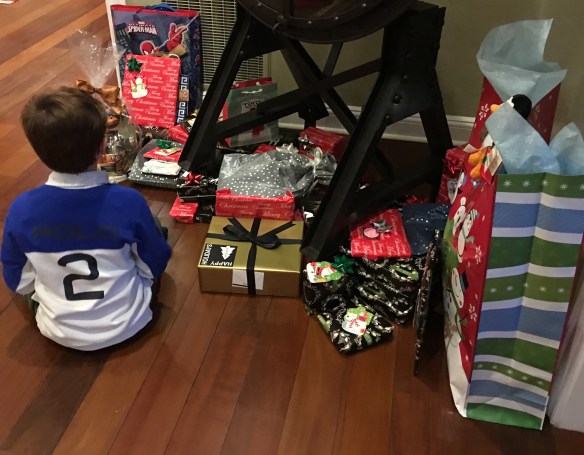
Christmas kid, examining the loot.

Daily Meatballs

Most school days, I pack meatballs for Martin’s lunch. Specifically, spicy buffalo meatballs, which I make by combining bison chorizo with minced vegetables. I send spicy buffalo meatballs for four reasons. First, Martin finishes them. I don’t have to worry about lunch coming home half-uneaten. Second, they are easy, insofar as one package bison chorizo, plus vegetables, makes a three-day supply, which I prepare in advance, leaving only the cooking for the morning before school. Third, they keep well and are not a food that becomes soggy or unattractive in the hours before lunch break. Fourth, they fit well within the cycle of Martin’s diet. He eats meat no more than once per day; tucking the meat meal into the school day frees me to prepare a vegan dinner for the whole family.

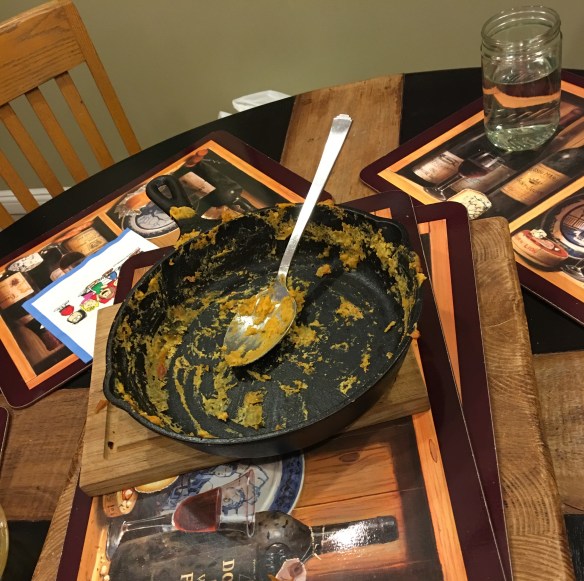
Yesterday evening, I made sweet-potato-and-lentil shepherd’s pie, which was a triumph, unlike last week’s disastrous attempt at vegetable-and-white-potato shepherd’s pie. The triumph went quickly:

fullsizerender-3

In sum: spicy buffalo meatballs. Lots of spicy buffalo meatballs.

Last night at dinner—the aforementioned shepherd’s pie—Martin said, “Mommy, would you stop sending meatballs to school all the time? Sometimes I want something different.”

Readers, what a moment! How much do I love that my son has the functional language to express his preferences and advocate for himself? How much do I love that he wants variation? Immediately I recalled a news piece I once about a young adult on the spectrum, living independently, who was anxious to date but impeded by, for example, the fact that he refused to eat anything but canned tuna for dinner.

“What would you like instead of meatballs?” I asked Martin.

“Rice,” he answered. Of course. I limit rice in Martin’s diet, and he schemes for any opportunity to get those little grains into his mouth.

I said, “Your point is well-taken. I’ll see what I can do.”

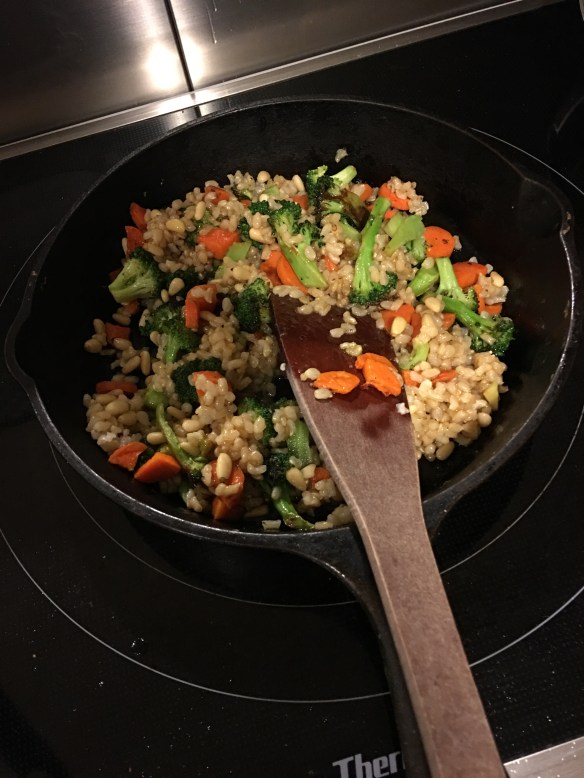
This morning we were late for the school bus. We were late because I needed some extra time to make Martin’s lunch:

img_5130

Addendum on the topic of last week’s disastrous attempt at vegetable-and-white-potato shepherd’s pie. That recipe didn’t work at all, turned out bland, and my last-minute efforts were insufficient to inject any pizzazz. Plus, the recipe made too little potato topping and too much inside filling. I was, however, able to salvage a small victory. I removed the extra filling and processed it into a paste. The next morning, I spiced the vegetable paste, combined it with an egg, and fried the batter into savory pancakes. Martin loved the makeshift breakfast.


img_5053

Alternative Medicine

In the post “Mid-Air Without a Net,” I wrote:

The taekwondo teacher wants to talk to you, [Samara] texted Saturday morning. He’s wondering if Martin is taking any drugs for his ADD.

 Oh no! I texted back. (More on that in a later post.)

It’s “later post” time.

When I received that text from Samara, I panicked. Mostly because I was in the middle of panicking about everything else, but still. I thought the Master Rob might tell us not to return Martin to class until we drugged him. I followed up the text and spoke with Samara, and the situation got worse (at least, in my head): When Master Rob asked her if Martin is taking any drugs for his ADD, Samara had responded that we do “alternative medicine.”

That’s a phrase I never use. To begin, I don’t consider treating Martin’s underlying health issues to be “alternative medicine.” We have chosen against trying to manipulate neuro-processing with drugs. We are pursuing non-pharmaceutical options. We are working with new discoveries in treating immune dysfunction. We have been lucky enough to find cutting-edge therapies. We are targeting overall health. We are following the path that, for our son, has garnered the best results. But alternative medicine—no.

At its most benign, I think, “alternative medicine” suggests that we’re a hippie-dippy family trying to cure a spectrum disorder with yoga. (No disrespect to yoga. Yoga is great for mindfulness. It does not, however, do much for the gut biome or neuro-receptors.) “Alternative medicine,” to some, suggests that we are treating our child as a laboratory experiment, or harming him, or failing to accept “proven” treatments that could benefit him. At its worst, I (like other biomed parents) fear that proclaiming “alternative medicine” could invite intervention by well-meaning individuals who think they know better for my son.

I met with Master Rob the next week. I explained that we aren’t pursuing pharmaceutical options at this time because we are trying to heal some gut and other health issues that affect Martin’s attention, and that using drugs would interfere with gaging our progress. I went on to say that we aren’t categorically against drugs but that we want to take this path as far as we can first. Master Rob said that he understood, and that he had resisted pharmaceuticals for his own son, who has ADD, until sixth grade, when he thought the transition to middle school had made them necessary. He said also that he was curious about Martin’s regimen in order to give him as much help and support at taekwondo as possible.

Good enough for me.

More… Inclusive

Three months ago, I reported that food is easy. Food became easy when I shifted from a “replicate what we used to eat” and “recipe” model to a minimalist model, like “(Brussels sprouts + oil + salt) + (lentils + paste[onion + ginger + garlic + turmeric+spices]) = meal.”

I’ve had another shift when it comes to ingredients. For years I’ve thought of cooking for Martin in terms of what I can’t use. I began with, “What would I like to make?” and proceeded to, “What are the ingredients I will have to substitute?” Example: “I’d like to make muffins,” followed by, “Grain flour. And right now, chicken eggs.”

We’re supposed to be avoiding eggs again.

Now, by contrast, I’m launching meals from a new spot. The ingredients come first. I begin with, “What foods will be healing and provide Martin with the particular nutrition he needs today?” and proceed to, “How can I combine those foods into a meal?” Example: Last night I checked the kitchen. Fresh food I had on hand that Martin could eat included peppers, onions, garlic, butternut squash, apples, romaine lettuce, cauliflower, celery, duck eggs, cashew cheese, bison chorizo, and bone broth. In the pantry I had a variety of nuts, along with rice crackers, LäraBars (Martin’s fave), and cookies I’d baked from almond flour, maple syrup, vanilla, baking powder, raisins, and almond chunks.

Today’s menu for Martin:

Breakfast: duck egg cups with peppers and onions; fresh juice made from romaine lettuce and apple.

School snack: Lära Bar.

School lunch: bison chorizo meatballs with added peppers; homemade cookies for dessert.

After-school snack: rice crackers with cashew cheese.

Dinner: cauliflower “fried rice” (no actual rice) with peanuts added for protein; bone broth. In the cauliflower rice recipe, I substituted celery and squash for peas and carrots (making do with what I had), and coconut aminos for soy sauce, since Martin can’t have soy.

So go the days, now. What do I have? What’s good for Martin? From those, what can I prepare?

Tomorrow’s breakfast forecast is nut butter between two almond-flour tortillas, fried in coconut oil and cut into six wedges. School lunch is shaping up to be vegetable lentils with quinoa. Salmon is defrosting for dinner, to be paired with cultured veggies. It’s a pretty good forecast.

img_4905

The cauliflower rice for dinner. Not too pretty, but Martin ate the whole bowl without pausing.

img_4903

This is not actually the breakfast I served that day, which I forgot to photograph. This is, however, pretty typical for breakfast: coconut-flour berry muffins with homemade veggie-fruit juice.

Mid-Air Without a Net

The past two months have been a struggle. I’ve alluded in the school-themed posts: disruptive silliness in class, lack of social enjoyment/awareness, moodiness. Most worrisome, Martin came off the school bus one day sad. I mean, he seemed really just sad. When I asked for details, he said he was “getting tired” of running at school and of riding the bus. He asked me to pick him up at school the next day. Out of concern for him, I rearranged my schedule and picked him up at school the next day, so he wouldn’t have to take the bus.

Steady, Up, Steady, Up, Steady, Down, Down, Down

The sequence of decline had unfolded this way: Martin has Lyme disease, most prominently, bartonella. Last spring, for Lyme, Martin was on MC-Bar 2™ and a Des-Bio Borrelia-Babesia kit, along with Microbojen™ ACV (subsequently substituted by Tangarana), gymnema, serrapeptase, Boluoke®, and Nose & Lung. He was tolerating that well. In June, after the Des-Bio Borrelia-Babesia kit was done, Dr. C and I decided to increase the Lyme-fighting measures. We stopped MC-Bar 2™ but added cumanda, houttuynia, DesBio Virus Plus, and Clovanol, along with additional supports like Magnolia Stress Aid and Lith-Oro™. The summer was tough, because Martin wasn’t sleeping well, and he exhibited defiance.

One benefit of keeping this blog, for me, is access to real-time impressions of Martin’s conduct. I checked my July and August posts to remember how he was doing.

In August, we ramped the anti-Lyme measures even more. Martin went on the comparatively powerful A-Bart™. Powerful. Not pharmaceutical. In the first weeks on A-Bart, we were in Costa Rica, and Martin flourished. Thereafter, his behavior started to slide. He started school a solid “decent,” whence he slipped to “distracted” and then “discombobulated.” His behavioral lapses looked like die-off-related ROOS. He had bathroom emergencies, i.e., sudden need to pee. I had to cut off his access to Disney Junior; he was so concerned with watching Mickey Mouse Clubhouse that he melted down if the channel guide listed an episode he hadn’t memorized, and he perseverated constantly on the show. (He’s eight. Mickey’s Damn Clubhouse is aimed at pre-schoolers.)

“Are you kidding me—is he on train lines again?” Adrian asked, when Martin, Mickey-less, switched to perseverating instead on New York City subway lines. “That’s like behavior we haven’t seen since kindergarten.”

Oh but you remember that behavior now, do you?

Sorting It Out

I scheduled a call with Dr. C.

Before the call, I held a sort of pre-game with my friend Stacey, another biomed parent. It looks like die-off, I told her, and I’ve got to find a way to right the ship. When Martin was in self-contained special education, I could weather these seasonal dips—two steps forward, one flop onto your backside, that’s the whipsaw of recovery—because his school specialized in addressing behaviors: Martin’s a little off his game. Deal with it. But now he’s in general education, in our local public school. They don’t want to deal with behavioral setbacks. They’ll kick him out. (I fear.) And then where will we be? We’ve already held him back in second grade to make the transition to general education. I can’t return him to second-grade special education, and he will have missed too much of this year to be in third grade.

“So what’s your plan?” Stacey asked.

I think I’m going to tell Dr. C that we need to come off all the bartonella remedies, I said, at least until our December visit to her office.

Stacey said: “Let me ask you this: What if you take him off everything, and he does better? What will you do, leave him off his remedies?”

I think he will do better off his bartonella remedies. That’s why I want to do it, to halt the die-off. I wouldn’t eliminate the remedies forever, though. Bartonella is still an issue, as the die-off shows. No more remedies might return him to “baseline,” but there probably wouldn’t be more progress.

That was my pre-game: to explore taking Martin off bartonella fighters, temporarily.

Dr. C agreed die-off was at issue, and took Martin off A-Bart and CXVRM3-Micro, increased his support remedies like enula, and added pau d’arco to help with stress.

Martin’s bathroom emergencies stopped overnight. His behavior, on the other hand, held steady for a few days then declined further still. He became anxious. “Mommy, are you angry?” he asked, constantly. That’s something I say to him occasionally, when he’s not grasping my cues: “I am angry,” as in, “Martin, bunny-hopping down the hall an hour after bedtime is not funny. I am angry.” Now my occasional anger morphed into a boogeyman lurking behind every interaction. “Martin, stop playing iPad and come to dinner.” “Are you angry? Mommy, are you angry at me?” “Get back in bed, Martin.” “Mommy, did you get angry? Are you still angry?” “How was school, Martin?” “Are you angry, Mommy?” Meanwhile, the perseveration rocketed to that level where Martin is physically unable to stop speaking. When we attended a weekend play date with his former classmates from self-contained special education, Martin didn’t look like the kid who’d transitioned to general education. He looked like the least engaged kid of the bunch.

I scheduled another call with Dr. C, on a Wednesday evening.

Nadir

That Wednesday, we hit a low point. Martin, who loves (but doesn’t always read) books, was excited for the book fair at school. Two days earlier, I’d helped set up the book fair and seen plenty that would catch Martin’s eye: colorful softcovers, cartoon-character pencils, big erasers, silly pointers. On Wednesday morning, I sent a signed, blank check and, to facilitate my own accounting, I scrawled “for books” on the check’s description line.

Apparently, whoever helped Martin at the book fair interpreted the “for books” descriptor to mean Martin could select only books—no pencils, erasers, bookmarks, pointers, gadgets, or toys. So while Martin’s classmates gleefully (I’m picturing this in my head) attacked the goodies, Martin was limited to books. According to the teacher’s later description, this circumstance sent Martin, who was already having a bad day, into a tailspin from which he was not able to recover.

The school has my mobile phone number. Would that someone had called me to ask whether Martin could buy only books. Argh.

Martin was with his nanny, Samara, after school that day, because Adrian was in South America and I had to work. I arrived home at 5:50 pm, to accommodate a 6:00 pm call with Dr. C. As soon as I entered the house, Martin began to cry. “Why did you say I could only buy books?” he asked, tears rolling. “Why wasn’t it okay for me to buy toys?” I needed a minute to surmise what had happened, and then realized it must have been what I wrote on the check. I brought Martin to the sofa, cuddled him on my lap, apologized, assured him I hadn’t meant to say he could buy only books, promised him a weekend trip to the toy store. I consoled him as best I could, then had to leave him, still sniffling, with Samara while I took the call with Dr. C.

That moment, Wednesday, 6:00 pm, was rock bottom.

“I can hear the frustration in your voice,” Dr. C said as I described the past two weeks: the perseveration, the constant questions about whether I was angry, the emotional instability.

I know we have ups and downs, I told her. I know that with progress come setbacks. But he’s in general education now. We have no safety net.

Dr. C was reassuring. Bartonella manifests in anxiety and compulsive behaviors. The A-Bart had been too strong a remedy, and Martin couldn’t handle the die-off. But plainly he needs something to keep the bartonella in check.

We agreed to add Active H2 and pantethine to help Martin’s current state, and to put him back on the MC-Bar II and Des-Bio bartonella kit that he’d tolerated well in the spring.

I felt better, like at least we knew what was going on.

After the call with Dr. C, Martin’s behaviorist came over. Darlene, the behaviorist, sees Martin at school and at home, and we had arranged this meeting the week before. I told her about Martin’s book-fair meltdown, about how poorly everything had been going, about the bartonella treatment, about my worries that he the school could seek his removal.

Like Dr. C, Darlene was reassuring. “You need to know,” she said, “that Martin is not the behavior problem in his classroom. There are kids with more behavior issues, and whose parents aren’t interested in doing anything about it.”

“Really?” I asked

“Yes.”

“What I need to hear is that the teacher and the aide like Martin—that they still want him in the class, and support him being there.”

“The teacher loves Martin. And the aide thanked me for recommending her to work with Martin.”

With that, I felt better still, like at least we weren’t on the verge of being kicked out of school. Darlene reviewed a new playground participation plan she’d been working on. She also recommended that I write a note to Martin’s teacher letting her know about the bartonella flare, and that we were taking action on that front.

Typically, I shy from discussing anything we do biomedically with a mainstream audience, lest we appear radical or weird. On this occasion, however, I felt that an explanation could buy some extra patience for Martin. As soon as Darlene left and Martin was asleep, I sat at the kitchen table and handwrote a two-page note to Martin’s teacher.

Reemergence, Nope

Meanwhile, I had to order the new remedies that Dr. C and I had agreed upon, and I hoped they would arrive on Friday. They didn’t. In an unfortunate coincidence, I had a concert to attend Friday night, and Saturday morning I left before dawn to retrieve a classmate from JFK airport and attend a luncheon at my law school. Adrian was still in South America, on family business, so Martin spent Thursday evening (when I work), Friday evening, and most of Saturday with Samara, whose text messages described abysmal behavior.

The taekwondo teacher wants to talk to you, she texted Saturday morning. He’s wondering if Martin is taking any drugs for his ADD.

Oh no! I texted back. (More on that in a later post.)

Sunday, after church—“He told me all about the presidents, like wow! He knows all about the presidents,” the Sunday school teacher reported—I took Martin to the City for a play date. He wanted to spend the afternoon riding subway after subway. His playmate, who is also currently fixated on train lines, was more than happy to oblige, so we rode subways all afternoon. On the way home, Martin had a meltdown. I don’t even remember why. I just remember the meltdown.

Monday evening, the new finally remedies arrived. I started Martin on the Active H2 and pantethine immediately, and Wednesday morning I added MC-Bar II, beginning with only two drops and working up from there. Wednesday, something went right. Around lunchtime, I received this email from his teacher:

Just wanted to write a quick email to say that Martin is having the BEST DAY! He is working cooperatively with his classmates on a math enrichment, took initiative to organize who was going to bring out the recess equipment, followed a web quest on the computer without any help, and followed every other direction given today with little or no prompting! We are very proud of him and wanted to let you know.

Was it a miraculous transformation? I wish. Thursday and Friday Martin was foggy again, and our weekend included another trip to ride MTA subways to and fro, and another meltdown. In fact, several meltdowns.

Breathing Deeply

By now a month has passed since we implemented the changes (have you noticed I haven’t been posting much?), and I regret to report that the situation has improved only marginally. The week before Thanksgiving, we had a pre-scheduled meeting with Martin’s school team, to discuss how his transition to a general-education classroom has been going. The teacher reported that Martin is having meltdowns about three times a week, whereas in September he had none.

Nevertheless, no one suggested that Martin doesn’t belong in the general-education classroom. Those present, in addition to the classroom teacher, included the speech therapist, OT, PT, resource room teacher, and school psychologist. The table was quite full.

At home, our family is being held hostage by Martin’s obsession with NYC trains/landmarks combined with his emotional fragility. His is constantly demanding to see my calendar and know whether we have any trips to the City planned, and if so, he wants to dictate which trains we will take and where. He becomes agitated and upset if his wishes aren’t met. Over Thanksgiving break, I planned a trip for us and four visiting relatives to a Manhattan Bierhall, to appease Martin. The logistics involved Martin traveling by train with one of my brothers, while I drove with another brother’s suitcases, because he was returning home that day. Martin got to eat a treat meal with potatoes and sausages. His response to our efforts? He melted down because he wanted to “ride subways and do something else in the City.”

I’ve been bouncing Martin’s enula and MC-Bar II doses, experimenting to see whether one of those remedies could be causing adverse effects. No luck.

This week I spoke again with Dr. C. I feel like I’ve morphed from the confident patient into the needy parent. We are not sure whether bartonella is at fault, or whether another culprit could be at work, such as mold in his new school. (Recall that much of the spiral has occurred, and intensified, upon his beginning school.) Dr. C advised that I try zeolite and CBD oil to control the situation until Martin’s appointment next week in her California office.

Readers, this is a trying time.

Still, I do have a silver lining: Martin is sleeping well. Which means I am sleeping well. Which means I can handle almost anything.


Cancellations, Delay, Need

Last Saturday, Adrian and I had plans with another couple, close friends, a minister and lay person. They have a teenage son, Jacob, whom they adopted years ago, after the boy had suffered neglect and horrible abuse in foster care. Predictably, their son has lasting behavioral and emotional challenges, which our friends have weathered with grace. The day before we were set to go out, I received an email from the minister half of this couple, offering regrets that he needed to stay home because their son was bolting again: running away when he sees the chance.

I wrote him this note, which seems appropriate to share here, with permission:

Friday, when I saw an email from you arrive, I knew before reading what it would say. I’ve written the same email so many times these past six years—“I was really looking forward to our lunch, but Martin’s having a tough day . . . ,” “I can still make dinner, but I have to miss the movie. So much anxiety, he won’t go to sleep unless I’m home . . . .” Your cancellation, not unexpected, got me reflecting on our children, and what they’ve meant to our paths and relationships.

I never expected parenting to be the burden that it has become. Burden, yes. I mean the word without the negative connotation, or at least without only the negative connotation. Burden the way completing an education is a burden, or getting up to go to work is a burden. We carry these burdens in order to build a life. Some are heavier than others. Upon Martin’s diagnosis, parenting became heavy. Too heavy, sometimes.

People tell me that God makes special children for special parents, or that one day I will understand why Adrian and I were “blessed” with a child with autism. No way. I will never believe that a loving God afflicts children in order to test or to uphold their parents. Instead, I think our kids suffer the sins of this world. In Martin’s case, we have corrupted the food supply, toyed with earth’s natural abundance, believed we can overcome sloth with science, and set aside worldly order until we triggered sick kids, lots of them. Jacob’s tormentors—addiction, abandonment, abuse, neglect—are less modern but no less man-made. Autism and PTSD didn’t “just happen”; in both cases, our sons are left to absorb the sins of others.

—Which of course means that we as their protectors and caregivers are left to clean others’ messes. We chose parenting. We did not choose this parenting. But that, I suppose, is the nature of sin: Once we engage (as we must) with the world around us, there lurks evil. The Christian’s job is to fight back, and for whatever reason, you and I have Jacob and Martin as both the incentive for and the locus of our struggle. I wish it weren’t that way. I hate autism. I wish sin would have left my son out of it. Alas. For now, I try to be grateful for the weapons I’ve been given for the battle.

I’m not saying much with this note, and certainly not preaching to the preacher. I just wanted to share these thoughts, and through them to share my unceasing appreciation for your friendship and example.

Needlessly Suspicious

Another post along the lines of “Terrified.” Sunday morning at church, during children’s time when the kids gather around the chancel for a few minutes, the pastor asked if anyone knew who Martin Luther King Jr. is. One girl answered but confused Martin Luther King Jr. with Martin Luther. (Understandable. We’ve already started commemorations for the 500th anniversary of the Magisterial Reformation, and that was where the pastor was heading, eventually, with the discussion.)

Next, Martin raised his hand. Raised his hand! Good work! When the pastor called on him, Martin launched a soliloquy on MLK’s birthdate, major accomplishments, “I Have a Dream” speech, assassination date, and the holiday honoring him. Indeed, Martin held court at some length, monopolizing children’s time and oblivious to the pastor’s attempts to segue from MLK Jr. to Martin Luther, Reformation Leader.

The congregation seemed to love Martin’s facts. They always do. As Martin was carrying on, and then when we passed the peace, and again after church, adults complimented me on Martin’s MLK Jr. fact base. No one mentioned him usurping half of children’s time from the hapless pastor.

During coffee hour, one parishioner asked me where Martin is in school. I replied that he’s in second grade at our local elementary. She said, “His teacher must be really good.”

Now, reader, what would you think she meant?

I went right for the worst: She must be asking where we found a teacher who can handle Martin’s interrupting and talking past his turn, habits that clearly flummox our pastor.

I asked, “What do you mean?”

She replied, “He knew about Martin Luther King when none of the other kids did. She must really be teaching well!”

Oh. Of course.

The following morning, Monday, Halloween, I brought Martin to the bus stop in his costume. (He was an astronaut.) After the kids got on the bus, as the parents were saying goodbye, one remarked, “See you at the parade!”

The parade? What parade? “The Halloween costume parade at school. You have to go—all the kids look for their parents, and Martin will be upset if he doesn’t see you.”

I had no idea.

“Didn’t you receive an email from your class parent?”

No. Come to think about it, I haven’t received any emails from our class parent all year, despite adding my name and email address to the class list at open house. No wonder I’ve been in the dark about different events, and occasionally blaming Martin for not telling me in advance.

Now, reader, why would you think I haven’t received any emails from the class parent?

I went right for the worst: The class parent knows that the high-need child is mine, thinks he usurps attention from other pupils, and is subtly excluding us from activities.

After the Halloween parade, it turns out, there was a classroom event with parent volunteers. Even though I wasn’t on any volunteer list (because, well, I had no idea . . .), I weaseled my way into the classroom event, where I spoke with the class parent. “Tell me your name again?” she asked. “Oh, yes! Yes, my emails to you keep bouncing back.” She pulled out her mobile phone and asked me to double-check my email address in her contact list.

My email address in her contact list had a typo. Although the error was obvious—@yahoo.com was written @yhaoo.com—it seemed unintentional error, not aimed at excluding the special-needs family. Still, I needed a little more confirmation.

As if on cue, the class parent around and asked, “So, which child is yours?”

Terrified

Martin is doing taekwondo now. He’s breaking my heart. He’s supposed to be playing ice hockey. We’ve invested more than a year in skating lessons and hundreds of dollars in hockey equipment. It’s no secret that I reproduced primarily to give the world another hockey player. Hockey, hockey, hockey.

Alas, apparently Martin has a will of his own. Weeks ago, we had a (parent-and-school-administrator-arranged) play date with Spencer, one of the cooler kids in Martin’s new class. Spencer is close to earning his taekwondo black belt. He showed me and Martin some of his moves, and a video of him breaking boards with kicks and punches. Spencer’s family also invited Martin to Spencer’s taekwondo-themed birthday party at the local dojang. You can guess what happened next: Martin announced that he no longer wanted hockey lessons. He wanted taekwondo.

The dojang’s introductory package comes with two private, one-on-one lessons, followed by two group classes to decide whether you want to sign up for good. Martin’s first lesson, with a teenaged black belt named Brian, was kind of a disaster; Martin preferred checking himself out in the mirror to following any actual instruction. (Just like two years ago when we tried karate.) The second lesson, also with Brian, went much better; Martin was more focused and worked with Brian on the kicks and punches. (One of the dojang masters remembered Martin from the birthday party and made a point to say hi and encourage him. I think that motivated Martin.)

So it was time to try Martin’s first group class. As the class was 11:00 a.m. on a Saturday, Adrian brought him, and I received this hearsay account:

The class had one master (the one who’d said hi to Martin) and three assistant instructors, probably teenage black belts like Brian. At first, Adrian thought an assistant was specially assigned to Martin. Subsequently he realized that the assistant instructors were for the whole class but, unsurprisingly, spending more time with Martin. As Adrian observed, he texted me that he thought taekwondo could be very good for Martin.

Twenty minutes into the class, the other dojang master asked if he could have a word with Adrian, in the office.

“I was terrified,” Adrian told me, later. “I thought for sure he was going to say, ‘No more,’ or, ‘Just not the right fit for Martin’.”

“And? What did he say?” I asked, not terrified, but not terrified only because Adrian was speaking calmly, indicating no reason to be terrified.

“He said he thought Martin is going to do well there. He said they have a lot of kids like Martin—he didn’t mention ADD or anything like that, but we both knew what he was talking about—and that martial arts help a lot with focus. He contrasted it with sports where kids can get away with just running around, like soccer.”

Or hockey, I thought, before shunning the thought.

Adrian continued, “The master guy said that his ‘day job’ is as a special-education teacher at [S—] School.” That’s one of the local elementary schools.

“This sounds wonderful,” I said.

“I think so.”

“I would have been terrified, too.”

“I know.”

Having a kid with autism, or ADD, or ADHD, or (I imagine) any range of challenges entails constant fear of rejection (and sometimes, rejection realized). Last Friday, I had arranged an evening play date with a boy in Martin’s new class (Lucas, whose mother I’d talked with at the open house). We planned to meet at a playground. Friday morning the boy’s mother texted me that it was supposed to rain and so we should reschedule. She didn’t suggest any particular time to reschedule. Instantly, I was terrified. Had the classmate found out his play date was with Martin and declared himself unwilling to attend? Did he not want to hang out with the weird kid? I texted back and suggested Tuesday afternoon instead. The mom responded sure, and that she would be in touch Tuesday morning.

I wondered whether she really would contact me Tuesday morning.

I hope she would.

I feared she wouldn’t.

She did. Tuesday morning, she texted asking what time we wanted to meet.

The play date was kind of a bust. The other boy (himself kind of immature, with some challenges, though not at Martin’s level) played mostly with a pre-schooler who happened to be at the playground. Martin wanted to swing, as he always does. The other mother and I made scattered attempts to facilitate interaction, fruitlessly.

Still, later she texted me, “Let’s do it again soon!”

Disaster averted. Nevertheless, we’ve suffered enough rejections and setbacks along the way to keep the terror real, and present.