Hiding It

Kenji Yoshino, a law professor, wrote a book called Covering. To “cover,” according to Yoshino, is “to downplay a disfavored trait so as to blend into the mainstream,” and the pressure to cover is universal, because everyone possesses some attributes that society stigmatizes. Subtle coercion to cover, the author argues, imperils even our civil rights, because society penalizes those who refuse to cover, who refuse to mask their otherness for the sake of fitting in.

I’ve been thinking a lot about Yoshino’s thesis, because I exert a lot of energy in “covering.” I hide the fact that I am an autism mom, and when it comes to Martin, I conceal his ASD—the condition that, arguably, influences his life more than any other right now.

As I’ve explained on this blog, Adrian and I have chosen not to be public about Martin’s having autism. Our closest friends and relatives know, as do our immediate neighbors, and Martin’s doctors and caregivers. Beyond that, we’re tight-lipped.

We withhold the information from more casual acquaintances—people who don’t know Martin well but will probably remain in our future social circle—because we believe that Martin will not always have autism. We don’t want anyone’s dealings with the recovered Martin to be prejudiced by his having once had autism. Indeed, we don’t want anyone’s current dealings with Martin to be prejudiced by his currently having autism.

We withhold the information from strangers so as not to suffer their pity. I don’t want Martin subjected to preconceived notions of autism, not even for a moment. And no matter how much I might want special treatment at in a given situation (waiting in a long line, for example, or chasing Martin down in a clothing store), I refuse to allow anyone to think we need special treatment.

So, yes, I cover. I pretend that Martin is tired, or shy, or unfamiliar with the topic at hand, or better at speaking Spanish than English, or better at speaking English than Spanish. (In later posts I’ll explain more about my techniques for concealing autism. I don’t want to make this post too long.) If pressed for an explanation, I use a euphemism. A TSA agent asked me why she needed to hand-search the dozens of pill and liquid bottles I refused to run through the X-ray machine; I said my son has a “neurological disorder” and that X-ray can change the composition of his medications. An acquaintance inquired why we hadn’t tried to place Martin in a private preschool in our neighborhood; I responded that Martin has “some minor attention issues” that we want to “take care of” before kindergarten.

Are we wrong to keep Martin’s diagnosis a secret? Possibly. Through our actions we may contribute to the isolation persons on the spectrum; if we’re hiding something, does that suggest we believe it’s something that should be hidden? We might also be failing to set an example. If we really believe in biomedical recovery from autism—we do—shouldn’t well tell the world to watch our son and bear witness to his progress?

It comes down to parenting. If I were making the choice for myself, maybe I would sacrifice my own privacy, and risk prejudice, in order to set the example. Many “Aspies” are very public about their way of being in order to combat discrimination (and have created at least one organization dedicated to opposing autism recovery). Our son is too young to make that choice, and as his parents we have to err on the side of protecting our own.

So that’s that. For Martin’s sake I am willing, in at least one thesis, to tear at the fabric of our civil rights.

Once upon a time, I was a teaching assistant for constitutional law. What would my professor think today?

Plan B

My poor blog. I’ve let her whither. Thank you to everyone who left comments or emailed (findingmykid@yahoo.com) to say you missed new posts. It is beyond gratifying, to know my words are being read.

By way of explanation, I few weeks ago I fell ill. Nothing life-threatening; I’m on the mend now, and going to be fine. Nevertheless, I required a blog vacation.

Vacation’s over.

Since I stopped working as a lawyer, back in January, Martin’s recovery has felt like less of a burden.

(I use that word—burden—conscientiously. Martin’s path is a burden, for our whole family. I don’t pretend otherwise, and I know that one day Martin may read these words and regret that his condition burdened us. For Martin I note that all parenthood, by its nature, is a burden. Adrian and I chose that path, we’re glad we did, we would not want any child other than Martin, and the effort that we expend is repaid a thousand-fold every today that Martin manages some feat he couldn’t do yesterday.)

(Cripes, that was sappy. Sorry, Martin.)

The first morning I became sick, I experienced the full burden again. I woke cramped and barely able to stand. I needed half an hour to believe I could do anything more than lie in bed and moan.

In the pre-autism-diagnosis days, I would have asked Adrian to take Martin to the diner for breakfast and leave me alone. In the ASD recovery world, Martin’s breakfast must be made fresh, at home, and his morning supplementation routine takes an hour to complete, and unless I’ve made advance arrangements, I’m the one who must complete those tasks.

So I did. I dragged myself to the kitchen and fried a duck egg in fat with broccoli. I counted pills, measured oils, stirred powders into tea. I alternated standing at the counter, sitting on a stool, crouching on the floor. Finally I scribbled a shopping list and sent Adrian and Martin to Fairway, to buy myself some peace.

That was Saturday. I muddled through until Tuesday, and then wound up in the hospital, whereupon Martin’s nanny Samara interrupted her own life to come take over my home. Together we made it work until I was steady on my feet again.

Here’s the point: I don’t have a Plan B. I am the one who knows Martin’s routine, to a speck. If I am incapacitated, Martin’s recovery stalls until alternative arrangements are made. That’s what feels most challenging these days—being on call every moment, not having emergency time-off. It makes me realize that I’ve really got to take care of myself, if I’m going to take care of Martin.

Okay. I got the kvetching out of my system. Lest my readers think I’ve returned to blogging only to complain, let me end with the following three points:

1. Lacking a Plan B is no more than what most single parents face, day-in and day-out, whether their children are neurotypical or not. Moreover, many families lack the resources to have a functioning Plan A in place. In so many ways, I am blessed.

2. I’ve returned to blogging! Taking a month off, and receiving so many comments and emails during that time, makes me realize just how therapeutic this writing process has become.

3. Last week Martin and I were having breakfast. Adrian had finished his breakfast and gone to prepare for work. Unprompted, Martin addressed me and remarked, “I hear Daddy blowing his nose upstairs.” Martin expressed neither a need nor a want; he formulated (perfectly) that sentence solely for the purpose of sharing an observation with me. At that moment I needed no break, no Plan B, no time off. Plan A is working. That will do.

Happy to be back.

Disturbing Operatic Puppetry

Friday evening Adrian and I went to see Madame Butterfly at the Met Opera. In this particular production, the role of Butterfly’s two-and-a-half-year-old son was performed by a puppet.

Yeah, a puppet. A faceless three-foot figure operated by three puppeteers in black. To my conservative artistic range, kind of an unsettling choice.

Five minutes after the puppet’s stage debut, Adrian whispered, “That puppet is weirding me out.”

I whispered back, “I effing hate that puppet.”

I know—totally gauche, right? Adrian and I are not opera-talkers. (Not even movie-talkers, I promise.) At least not usually. But slogging through autism makes parents do strange things.

During the second intermission we hustled to the Met bar to parse our feelings.

Adrian asked, “Why do you hate the puppet?”

I wanted a sanity check before answering, so I responded, “Why was the puppet weirding you out?”

Adrian said, “Tell me why you hate the puppet.”

An impasse. I took a chance and admitted, “I hate the puppet because the puppet is neurotypical.”

Now, wait. Don’t roll your eyes.

I’m not delusional. The puppet’s handlers had manipulated its eerie non-face in an impossibly neurotypical manner. The puppet checked its mother’s expression eight million times. Before walking across stage. Before approaching any actor. Before sitting down. Before gazing upon the harbor for Pinkerton’s arrival. And though its mannerisms were child-like—even too conscientiously so—the puppet shared adult emotions to a flaw. The puppet comprehended anticipation, resignation, desperation.

To an audience member who doesn’t spend her days striving to achieve “emotion-sharing” and “face reading,” or pondering the organization of movement, the puppet’s actions might not have stood out. I, on the other hand, thought, “What toddler does that? They’ve made that puppet the opposite of autism. Why would they do that?”

Okay. Maybe I’m a little delusional. At least let me point out, however, that although Adrian declined to elaborate on his own feelings, he did not disagree that the puppet was affrontingly neurotypical.

It’s possible that, on occasions like this, my emotions would be more manageable if I accepted that Martin has, and always will have, autism. Then I could tell myself, That’s the way some kids are. Martin is different.

But I don’t accept that Martin always will have autism. I accept my son. I do not accept anything holding him back. And so I tell myself, That’s the way some kids are already. That’s the way Martin will be.

I want it to happen now.

I long.

I get angry at puppets.

Home Again. Not Perfectly 100% Spot-On

We’re home, since Wednesday evening.

We were overjoyed to see Martin, who seemed to share the emotion. He spent Wednesday evening running excitedly around the apartment, pointing alternately to me and Adrian, exclaiming, “That’s Mommy! That’s Daddy!” He showed off some new skills, too. He’s riding a bicycle, an upright model with training wheels that my mother puchased while we were away. Martin pushes the pedals and steers and calls, “Help! Help!” when he gets himself stuck. He’s also taking pills without assistance. If I hand him a capsule and ask him to swallow it, he pops the thing into his mouth and obliges. Pretty cool stuff.

At the same time, I can’t deny that, in some areas, he’s “off.” I have to call his name several times to get a response. When he does finally answer, he maintains eye contact only briefly. He’s unfocused and difficult to control. He’s thrusting his lower jaw forward, grinding his teeth again. And he’s taken to wearing a too-small winter vest, even in the house. Even to bed. He started this while Adrian and I were in Israel. Samara speculates that he may have been associating the vest with us and therefore finding reassurance in it. I (being Debbie Downer, as I am prone to) suspect that its something more like the weighted vests often recommended for autistic kids, to help them feel secure when their senses are processing haphazardly. In any event, it’s a new behavior, and one with which we are not pleased. He just does not seem to be doing as well as before we left.

I’m asking myself what all this means.

Clearly, my mother did an outstanding job with Martin while Adrian and I were vacationing. She followed his supplement routine scrupulously, taught him to ride a bicycle, and generally loved the heck out of him. One of my brothers was here from Boston too, playing with Martin and—to needle me, his New Yorker sister—taking pictures of Martin in Red Sox apparel and posting them on Facebook. So inadequate care has nothing to do with Martin’s slight backslide. Other possibilities I’m considering are anxiety at not understanding when his parents would return; a stale supplementation routine (he’s due for some changes, which we were waiting to implement until after vacation); and the change in routine, i.e., lack of school for a week-and-a-half.

I’ve promised repeatedly not to let the day-to-day ups and downs of the process get to me. But I do, of course. Yesterday, with Martin’s attention AWOL, I tripped and stumbled into the doldrums. I blamed myself, for being gone. I felt hopeless, for losing some of our great recent progress. I … whatever. There is no sense re-hashing a bad day. Samara works late on Fridays, so Adrian and I went grabbed dinner and went to see The Iron Lady. I fell asleep half an hour into the movie and woke to the closing credits. I felt better.

Does this mean I’ll never go away again, until Martin is recovered? No, probably not. Adrian would never stand for that, anyway. He’s my sanity check. More likely it just means it will be a while.

Now is the time to figure out what’s going on with my little man. Head up. Done with feeling sorry for myself.


Missing Martin, Distressing Martin (?)

Adrian and I are ringing in the New Year in Jerusalem. It should be a great time, and it is a great time. Right now it’s also difficult, because of messages from home. Samara, who has been helping my mother with Martin while we’re away, sent this to my phone (portions translated):

Hi. How are you guys? Everything is fine at the house, but Martin misses you so much. Sometimes when he’s saying, “Mommy is coming back another day,” that’s when a tantrum starts.

Today he cried over a saxophone. He was playing with some stickers his grandma gave him as a present. There were pictures of instruments, and one of them was a saxophone. So he remembered that he has [a saxophone] and started to look for it in his toy chest and took all his toys out of the toy chest. I told him that [the saxophone] isn’t there anymore because it broke, and he started saying, “It’s coming later,” and so mistakenly I said that the saxophone is not coming later, that we need to get a new one at the store because yours is broken. He quickly responded that we should go to the store to buy a saxophone, “Vamos a la tienda a comprar un saxofón.”

I thought that was a very clever sentence. But he was really serious about it. Then he remembered that you aren’t here, either, and he related you to the saxophone and things got worse. He started to cry even more. So I took him to the toy store to look for something similar to the saxophone. Well, he saw a trumpet and got that into his head and didn’t want to think about anything else. I was going to buy it right at that moment, when I realized that I didn’t have my wallet in the backpack and—oh boy! He cried so much. He couldn’t understand that we were coming right back to pay for the trumpet. He cried all the way back to the house and until he saw my wallet, when he finally understood that I was not kidding.

Later he was the happiest boy with his trumpet, and then he got another present from your mother and he was more happy still.

Ugh. Martin has not obsessed about a musical instrument (he used to carry one everywhere) in months. Is emotional distress causing bygone habits to reemerge? Emotional distress because I am not there?

So there was that crap situation, which happened yesterday. Then this morning my mother texted: “Martin has started, ‘Mommy and Daddy always come back.’ [Your brother] leaving will be tough on Martin today.”

I’m craving my little man, craving his presence.

Me siento mal.

More Praise of Friends

I have eleven close girlfriends from my high-school class. “The twelve,” we call ourselves. We’ve had bumps in the road, big ones, and yet 21 years after graduation, we’re more or less intact.

And when it comes to Martin, these friends have joined the struggle in ways I could have not imagined.

It was a high-school girlfriend, an EI practitioner, who first identified Martin’s disorder as autism and got us started in the road to intervention and recovery. It was another, a chef, who recently came to stay two weeks with us when Martin started eating meat, to prepare his special meals. It is others who read this blog, who offer listening ears, who email regularly just to ask how he’s doing.

Now comes yet another debt of gratitude. A high-school friend, who still resides in my hometown, sent a Facebook message, asking after Martin and what she could do to help. I hesitated, then reminded myself that I’ve decided to accept as much help as I can get, and made a request:

“I could use some venison.”

That must have sounded strange to my friend, who knows me as a long-time vegetarian. Probably it sounds strange also to anyone who doesn’t know that, in the semi-rural area where I grew up, people hunt. A lot. Before I became a vegetarian at age 16, I ate venison by the pound. It’s so lean and protein-dense, just what we’re seeking for Martin these days. It’s also difficult to procure, in Manhattan.

My friend responded that getting venison might be tough; the economic climate right now means most folks eat all of what they shoot.

I know, I said. No expectations.

Let me see what I can do, she wrote.

A couple weeks passed. I’d nearly forgotten the request when this friend’s chat box appeared on Facebook again, to say she had venison for me, stored in the freezer on her family’s farm.

As luck would have it, one of my brothers happened to be visiting our hometown last week, and then coming down to New York City on Monday to help my mother with Martin while we travel. I dispatched this brother to meet my friend and retrieve the venison, which now is snug and secure in my freezer.

“Hand-off was a success?” I texted my friend after she met my brother. “You rock so much. Thanks a million.”

“Yup…. No prob. Hope he enjoys. Mainly spiedie meat…hope that’s ok.”

Spiedies are a dish regional to the area where I grew up. They consist of intensely marinated meat skewered alongside vegetables and grilled. I panicked, briefly, my mind on the myriad non-Martin-friendly ingredients that might be in marinade. “Is that the cut, or has it been marinated?”

“Not marinated! I believe it is the cut but not cubed.”

“That is so ultra-perfect I can’t even say,” I texted, relieved and grateful to the point of effusion. “You are the bestest.”

“Nah…just a friend.”

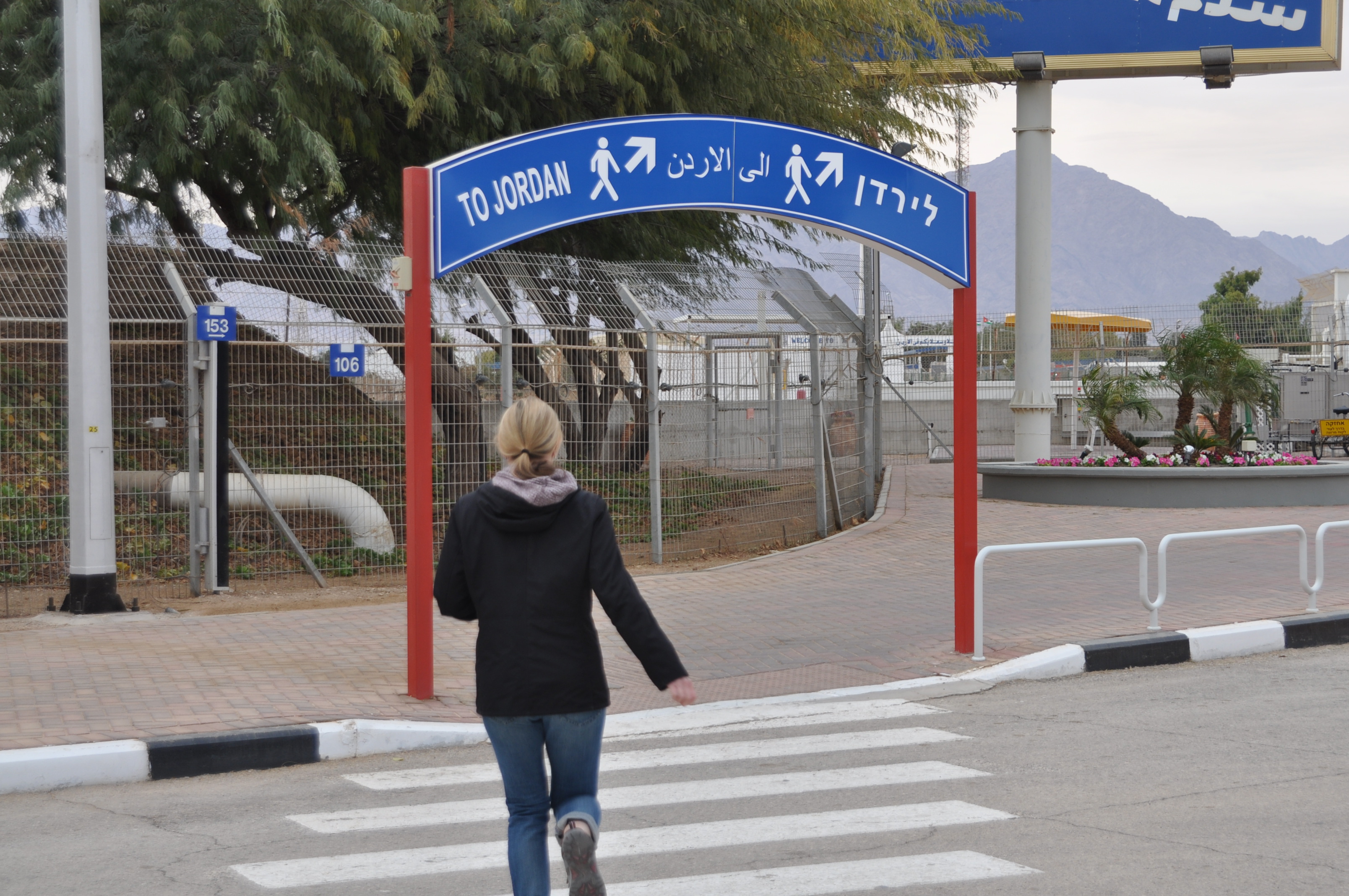
Your blogger, headed from Israel into the Kingdom of Jordan.

Your blogger, descending to the ruins at Petra, Kingdom of Jordan. And thinking about Martin.

Martin: The Only Cause That’s Got Me Doing

I’m kind of a nervous flyer. Whenever I fly, before take-off, I say a prayer along these lines: “I hope we get where we’re going. If we don’t, I trust that I’ll end up someplace even better. I trust that we’ll all end up someplace even better. But still I hope we fly safely, and I hope that the safe conveyance reminds me that life is limited and I ought to use it well.”

Tuesday night on the plane to Israel, I started to say that prayer, and I had an epiphany:

I don’t, at this moment, have fears for myself. I have fears only for Martin.

That’s not to say that I don’t worry about dying. Or, you know, a horrible disease or coma-inducing accident, or terrorist attack, home intruder, flesh-eating bacteria, mountain-lion bites, impalement. The usual.

I do worry about all those things. But my fears for myself have taken a backseat. A distant backseat. Way back, like at the swaying end of a double-length bus. As I recited my pre-take-off prayer last night, I had a feeling like, “If it’s my time to go, it’s my time.

But who will take care of Martin?

Martin is the only grandchild of my mother and stepfather. I know they would step in without hesitation and continue his biomedical recovery. And they’re not alone. My father, my siblings, my parents-in-law, my brother- and sisters-in-law. Any one of them, or all of them. They’d have a lot to learn, but they’d do it.

Then again, deep-down I wonder: How could anyone do what Adrian and I are doing for Martin? More accurately—and I’ve admitted: I’m a control-freak—: How could anyone do it to my exact specifications? The countless pills and liquids, the fifteen HANDLE exercises daily, the RDI, the Track Two doctor visits across the country. The faith and determination.

If something happened to me, would Martin still be able to reach his potential for recovery?

That’s it, then. In my whole life right now, the thing that matters most (maybe the only thing that matters?) is my son’s recovery. My pre-flight prayer now is simply that I stick around to see it through.

To own the truth, I’ve long been a person with a cause. Usually the cause involves animals, like ending the carriage-horse industry, regulating backyard breeding operations, or banning battery cages. But I’ve never been a person who took enough action for her cause. I give money. I speak out when asked. I hope and wish. I don’t do.

At least, not until now. My cause now is Martin, and I’m doing. Damn it, I’m doing.

Okay. The object is my son, and therefore this particular cause is just one step removed from pure selfishness. Moreover, it can (I trust) be accomplished entirely. I can recover my son. I can make him indistinguishable from his neurotypical peers. That fact alone separates Martin’s recovery from, say, world peace, or eradicating poverty and disease.

Still, it’s a cause, and for the first time ever, truly I’m stepping up.

Once Martin is recovered, what’s next? I have a sense that this episode could herald a new chapter in my life, one of doing instead of hoping and wishing. Maybe my cause will be promoting biomedical recovery, or defending practitioners like Dr. Usman who devote themselves to recovering children. Maybe I will stick to animal welfare, with the new perspective of having felt compelled to feed my son meat as part of his recovery.

Some years ago, when I was considering a career change, a friend told me to remember that a life is many decades long, meaning that what seems earth-shattering at one moment may in time reveal itself as only a bump in the road.

Not to be fatalistic (just contemplative), I’ve had four decades already. If I can recover my son, I will consider them well-used—even if, in time, this journey comes to seem only a bump in the road.

As for Martin, our efforts now will give him many decades in which to do whatever he wants, free from the grasp of autism.

Your blogger, hiking to the ruins at Avdat, southern Israel.

The Literary Crowd Weighs In

I’m a writer. Have I mentioned that? A writer of more than this blog, even. I’ve referred in various posts to my being a lawyer. I don’t think I’ve said that I also write. Essays. Fiction. Stuff.

I belong to a five-person writers’ collective. We meet monthly to discuss each other’s recent work. This month, for the first time, I told the other members about this blog and asked for their thoughts.

I made the request before last weekend’s “card-counting” incident. Since then, I’ve reconsidered whether I should have brought this exercise to the writers.

What the hay. What’s done is done, and I got some worthwhile editorial comments at our meeting last night. I’ve decided to diverge from my musings about Martin and share some of the suggestions, to give everyone an idea of where I might head with the posts. I’ve grouped the ideas into bullet-points. Lawyers love bullet-points. Sometimes it carries over into their other writing.

  • More in-scene action. I give a lot of space to pondering, analyzing, explaining, and (in the word I used above) musing. My collective does not disapprove of that, but finds the “scenes” most enjoyable, such as Martin interacting with the boy in the museum, or shaking a waiter’s hand. I’m also asked to provide more balance by describing events that do not necessarily evince progress, i.e., that illustrate the reality we live with today, pre-recovery. (“The positive parts are presented in-scene,” said Writer Paul, “but the bad parts are presented in more of a distant and diagnostic fashion.”) I suppose, if I strain my memory, I can come up with a few anecdotes about self-stimming or lack of joint attention.
  • More Adrian. I mention my husband often, but I’m not allowing him to be enough of a “character,” to occupy fully his own role in Martin’s story. For example, I should stop summarizing conversations I have with Adrian, and instead quote his voice. I should occasionally allow Adrian some blog space for reactions and commentary, too. I’m still contemplating these ideas, and whether I can further exploit Adrian as a character while maintaining his privacy as, well, a person.
  • A wider cast. We travel. We have friends. Martin goes to school and on playdates. We encounter a lot of people, and I should consider letting more of them color our adventures. I’m wondering whether that means I need to keep coming up with aliases. I’m starting to have trouble keeping them straight.
  • More about writing and lawyering. I can make myself more human, and perhaps appeal to a broader audience, if I lasso in aspects of my life beyond Martin’s recovery. (Strangely, my writers’ collective operates under the impression that I have a life beyond Martin’s recovery.) I’m still contemplating this idea, too. Months ago I read an article purporting to describe the top ten things bloggers do to lose readers, and one of them was going off-topic. This is “a parent’s real-time blog of autism recovery,” not “a parent’s real-time blog of whether she’s still going to turn that novel draft by 2012.” So we’ll see.
  • A glossary. I’m doing a decent job of keeping the autism science to a minimum, and thereby not alienating readers outside the ASD community. (I took credit and pretended this was intentional. Faithful readers know the truth: I don’t understand the autism science and will look foolish if I try to present it.) At the same time, I may throw around terms unfamiliar to a new reader, thereby forcing him/her to rummage older posts in search of a definition. I should consider a glossary page that collects ASD-insider terms.

I should say that my fellow writers are good for more than criticism. They also talk about what they like. Apparently this blog engages the reader because it is not clear where the journey will end, whether Martin will recover. The reader feels invested in the quest for more information about autism, its sources, and its defeat. In that vein, the pictures help. Seeing Martin in action, even if only from behind, lends an immediacy to the reflections.

I was happy to hear, also, that I come off as well-read, reasonable, and hardly kooky at all. Though perhaps my fellow writers just said that because I was sitting with them, in person?

Finally, the overall quality of the writing, wordsmith-wise, was deemed high. That was comforting. One of Martin’s service providers once said to me, “You probably aren’t that concerned with it for purposes of the blog, but you do write so well.” And I thought—not that concerned with it? Yeah, sure.

And One More Reason I Won’t Tell

I’ve posted about my and Adrian’s reluctance to share Martin’s condition with any circle wider than our closest friends and certain family members. We are private people. Adrian perhaps is more cautious than I am. Among other reasons for maintaining our privacy, he says that many people who learn that Martin has autism will see nothing else about him, even if he recovers.

I haven’t really believed that, until this weekend.

Adrian and I were in a neighborhood bar with Martin—who was not drinking, and in our further defense, was not the youngest child at the bar—when we encountered a couple we see casually. These are four-times-a-year family friends, and not the inner circle, but for reasons immaterial to this anecdote, they know that Martin has autism. (Not through me or Adrian; neither of us has ever discussed the subject matter to them.)

Adrian was relaying our recent trip to Rockland County, and how Martin had insisted that we drive home via the George Washington Bridge instead of the Tappen Zee Bridge. Martin recognizes all the major New York City-area bridges, Adrian said, from the Varrazano to the Whitestone. Even the Kosciuszko, and the Triboro that’s also called RFK.

It should have been a cute story about a three-year-old who spends a lot of time in cars and likes bridges.

It turned into something else.

One of the couple said, “That’s amazing. So he has like a real obsession?”

I answered, “Not so much an obsession. He’s good at the names.”

He responded, “Have you tried taking him to Vegas yet, like counting cards?”

Pardon me, what the hell was that? Adrian tells a story about Martin recognizing bridges, and what pops into your head is counting cards in Vegas?

I suppose there could have been numerous suitable responses, such as:

“You’ve just got way too personal on a topic I’ve never told you about, and you don’t know me well enough to discuss”;

“If all you know about ASD comes from Dustin Hoffman in Rain Man, that’s hardly conducive to in-depth discussion”;

“Funny that you thought instantly of counting cards. Do you have a gambling problem?”;

“You will never babysit my child”;

“I know we’re in a New York City bar, but the Vegas scene might still be a little intense for Martin”; or

“Yes. Yes, I have.”

Now, Martin’s recovery is far enough along that this man, had he never been informed that Martin is on the spectrum, likely would not have concluded as much from the limited time he spends with Martin. But since he has heard the word autism applied to Martin, that condition colors all that he sees in Martin. This man was looking at a bright, friendly child and seeing only the A word. Naming bridges = obsession = bizarre talents = Rain Man. Of course.

Unfortunately, I’m neither clever nor bold enough to have given any of the six responses above. I said to him, “Uh, no,” pretended to chuckle, and tried not to appear horrified.

Adrian is right. From here forward, before I reveal to anyone the journey that Martin is on, I will ask myself: Can I trust this person to view autism as one facet of a boy who’s so much more?