Who Gets to Join This Fancy Club?

Last night I had the pleasure of dining with an old friend from law school. Our discussion turned to Rachel Dolezal, the woman who resigned as president of Spokane’s NAACP chapter after it became known that she was born white, not black. My old friend is now a law professor; her research includes issues of race. She talked about three ways of identifying with a community (in Dolezal’s case, identifying with the African-American community): documentary, like checking the box that says “Asian-Pacific Islander” or “Hispanic” on a form; biologically, like asserting, “My grandparents came from Ukraine, so I am Ukrainian”; and aesthetically, like adopting traditions, tastes, customs, &c. commonly associated with the group. My friend opined that a person who chooses to claim a social identity, even if s/he does so only aesthetically (say, in hairstyle, language patterns, and manner of dress), should not be rejected if s/he also assumes the burdens associated with that identity: If Dolezal claims blackness, and willingly endures the discrimination that black women in the United States face, then her lack of biological identification does not disqualify her from the African-American community.

My friend the professor owns that theory: Any flaws in articulating it are mine alone.

We also spoke about Martin. I am sometimes asked why Martin—remember, that’s not my son’s real name—has a Spanish name. He is pale and blonde like I am and doesn’t otherwise “look” Latino; moreover, although Adrian, my husband, comes from South America and speaks English with an accent, he does not participate in “Latino culture” as we have (or imagine) it in the United States. (Excuse my sweeping generalizations; a blog post admits only so much depth.) My friend noted that Martin already identifies with the Latino community biologically and documentarily (we check both the “white/Caucasian” and “Hispanic” boxes), and to some extent aesthetically, because he is Spanish-English bilingual and has a Spanish name. Someday, my friend observed, Martin will have to decide for himself how much more he will identify aesthetically with United States Latino culture.

I enjoyed this conversation so much. It was personal, thought-provoking, and invigorating. Even better still, we were discussing Martin, and his future, and the topic was entirely unrelated to autism. I don’t know whether my friend is aware that Martin has autism. Martin was there, present, at my friend’s apartment. As we talked, Martin was playing, awkwardly but more or less appropriately, with my friend’s four-year-old daughter. Adrian and I are not public about Martin’s diagnosis, and I’ve never had occasion to tell this friend. Maybe she knows via the friends-in-common grapevine. Maybe not. Autism isn’t really the elephant in the room when I have Martin with me, not anymore. These days it’s sort of the toy elephant in the room. I can shove it in a pocket or tuck it behind a knickknack and hope no one notices.

That being said, as I sat with my friend and (especially) thereafter, my mind drew connections to autism. Martin has autism. I am part of the autism community. My family is part of the autism community. In terms of biological identification, we did not choose membership. Martin developed autism. It happened. Our entry tickets appeared. In terms of documentary identification, I suppose we do choose to join, out of necessity. If we want special education and other services, we have to check that (sometimes metaphorical) “autism” box.

Yes, I also check the metaphorical box to pre-board airplanes. Guilty.

Which leaves aesthetic identification. As an aesthetic matter, do I identify as a member of the autism community? Yes and no. No, insofar as we are not public about Martin’s diagnosis, insofar as we share on a mostly need-to-know basis. Our primary motivation for keeping Martin’s autism private is that he is getting better, and that one day he will recover, and then we don’t want him seen as “the kid who had autism.” In that regard, we refuse to assume one burden of the autism identity: We try to insulate Martin from the negative stereotypes associated with spectrum disorders.

Yes, however, insofar as autism has worked infiltrated the way I navigate the world, and any insult to the autism community feels like an insult to me personally, and by derivation to Martin. Remember when an ignoramus in an elevator called my friend Natasha’s pre-verbal son a thing? The offense hit me exactly as if he had called my son a thing. Two weeks ago, in a Brooklyn market, a minister—a minister by profession and not, I daresay, by vocation—yelled at my friend Stacey’s sensory-seeking son and then told Stacey to “get [her] son under control before he hurt[] someone.” Though I heard the story only afterward, from Stacey, I felt myself there present, as if the alleged minister had yelled at Martin and said those awful words to me. I identify with every report of a spectrum kid getting bullied, family who can’t afford biomed, or student whose school district denies appropriate special-education services. Regardless of whether we speak out or advocate, I am part of the autism community psychically.

I wonder what will happen when, for the most part, we lose Martin’s biological identification with autism, when he recovers? (I say “for the most part” because I envision him always having some level of immune sensitivity that requires special care.) I remember the episode of Curb Your Enthusiasm, when Larry David’s Los Angeles character, who’s always believed himself the son of Jewish parents, discovers he’s adopted and was born to Protestants. Immediately he begins doing stereotypical things like wearing a fanny pack, hunting, slamming beers. When we lose Martin’s biological connection to autism, will my aesthetic identification fade too? Will I ask, “Is autism bullying a problem?” or, “They have adequate social services for persons on the spectrum, don’t they?”

I won’t. I think once a person has experienced what it means to reside with autism, that feeling never goes away. Maybe it’s comparable to PTSD; I once saw a report indicating that mothers of adolescents and adults with autism experience chronic stress similar to combat soldiers. Martin is young still, his autism has never been “severe,” and shortly after we started biomed, he started sleeping regularly (other than stress, lack of sleep was the big threat to my own health), so maybe in my case the PTSD comparison is too dramatic.

Does Rachel Dolezel have a place in the black community? Not for me to say, because it’s not my community.

My old friend from law school has me thinking this: I’m really not interested in policing the membership of the autism community, either. If a person who is biologically and documentarily unconnected to autism wants to assume the burdens of autism, wants to internalize every insult the way I do now, then I welcome that person on board. We biomed parents are striving to reduce the biological autism community. Growing the aesthetic autism community can only help those who remain biologically connected to autism to fare better in this world.

Whatever Gets You Through the Night

I have coined a new syndrome: My Kid Is in Special Education But It’s Not the Same Way Your Kid Is in Special Education and Mine Isn’t Staying in Special Education So Why Bother Being Friends Syndrome, or MKISEBINSWYKISEAMISSESWBBF Syndrome. I know that’s a cumbersome, but I really think it could catch on.

I encountered MKISEBINSWYKISEAMISSESWBBF Syndrome four years ago, on Martin’s first day in a preschool for children with special needs. Half a dozen parents and caregivers were in the waiting area before school ended. Some seemed to know each other already. I saw a woman alone, as I was alone, so I introduced myself and said it was my son’s first day at the school.

The woman checked me out sideways, without facing me. She wore gigantic diamond-stud earrings, and honestly, her hair looked much better than mine. She was picking up her daughter, she said. Also first day here.

Did they live near the school? I asked. Was it a long trip like we had, coming from another borough?

The woman didn’t answer that question. Instead, maybe thinking that I wanted to follow up personally, instead of just make small-talk, she said that her daughter had spent the previous year in regular private preschool, and that really everything had been fine there and her daughter had no trouble socially or academically, and had many friends, and was now going to this school temporarily to help with some mild dyspraxia, and as she and her husband expected their daughter to return, by next year at the latest, to her regular private school, they were planning to keep her friends and social peers in that school, not this one.

Oh. Okay.

Yesterday, at Martin’s last day of gymnastics, MKISEBINSWYKISEAMISSESWBBF Syndrome struck again. Martin is one of the few kids who doesn’t participate in the JCC’s afterschool-busing program, because that program is offered only to the school district immediately surrounding the facility. He’s jealous of the kids who come directly from elementary school to the JCC by bus, with no mommies or daddies. This week he asked to bring his backpack to gymnastics class and put it with the other kids’ backpacks, I guess so he would look more like them.

“What district do you live in?” the assistant instructor asked when I explained why Martin had his backpack. We had arrived five minutes early, so we had time to chat. I told her our school district and that, right now, Martin has an out-of-district placement and attends a private school in another town. In another year or two, he might transition back to the district school, either to a self-contained special-education classroom or to a mainstream classroom with an aide.

“We’re in that district, too,” the assistant instructor replied. “Actually, my son, Andrew, is just changing schools. He went to first grade at D elementary school, but for next year they’ve just placed him into the self-contained second-grade class at G elementary school.”

This was quite a coincidence. Our district had been trying to convince us to place Martin next year into the self-contained second-grade class at G school—Adrian and I disagreed with the recommendation, thinking it is too early to pull Martin from his very successful current placement—but the district officials had abruptly stopped pushing us a couple weeks earlier, when the last spot in the G school class had been taken. Now I realized that the student who had filled that last spot was this assistant instructor’s son, Andrew.

I like the assistant instructor a lot, and she seems to have a good connection with Martin, knowing when to give him those bits of extra help that make possible his participation in a non-adapted class. I said, “Martin has friends in the self-contained class the year below him and the year ahead of him, and his mainstream friends attend S school and M school. I would love for him to know another student in the self-contained class for his year, so that he’ll have a friend if he moves into that class in third or fourth grade. Do you think Andrew would like to do a play date sometime?”

“Sure,” the assistant instructor said. “I mean, I guess. Actually, Andrew’s trouble is really just remembering what he’s been taught. Just an academic issue. He’s probably not going to be in the self-contained class for more than a year.”

Memory problems. Remembering what he’s been taught. Not like your kid. Not all that autism stuff.

I didn’t bother to get her number for a possible play date, and she didn’t ask for mine.

This post must sound like I’m judgmental toward those moms who suffer from MKISEBINSWYKISEAMISSESWBBF Syndrome. I’m not. Looking at the big picture, isn’t my approach to Martin’s autism a lot like MKISEBINSWYKISEAMISSESWBBF Syndrome? Even if I don’t say it to other parents, I’m constantly thinking, sure, Martin has autism now, but he won’t have it forever. Soon he’ll look more typical. Soon we won’t be in this spot.

And even if I couldn’t relate MKISEBINSWYKISEAMISSESWBBF Syndrome to my own actions, still I wouldn’t judge. As I recently wrote on a friend’s Facebook page, isn’t survival just the art of balancing what’s healthy against whatever gets you through the night? If another mom needs to think her kid isn’t the same kind of special-ed student as my kid, I’m willing to let that be her reality. Whatever gets her through this night.

Autism One Take-Away I

I’m traveling home from three-and-a-half days at Autism One, the annual conference on all things recovery. This marked my fourth year in attendance at A1.

I go to A1 to learn about the latest treatments and studies, to check out vendors whose products might benefit Martin, to socialize, and to benefit from other parents’ experience. In those regards, I get a lot from A1. Every year I come home reenergized, and with new ideas and persepectives.

The downside of A1 is an overwhelming experience that also leaves me distrustful of many practitioners. Every doctor (or scientist, or therapist, or homeopath, or naturalist, or spiritual healer, or garden-variety snake-oil salesman) brings along a testimonial in the flesh, some family profoundly helped, or even fully recovered, by that one treatment that only this practitioner offers. Dr. Jeff Bradstreet and his team push the Bravo yogurt product with GcMAF to restore the immune system; Dr. Zach Bush and his team swear by Restore liquid, which will provide the nutrients missing from today’s food supply and which, by the way, should not be used alongside Bravo yogurt. Entrepreneurs display stickers and pendants for EMR protection, while authors lecture on why stickers and pendants can’t protect from EMR. One guy was at last year’s conference pushing acupressure devices and magic salt that he claimed “many doctors, at least two dozen” in attendance already were using. (When I pressed, he wasn’t able to name any of the many doctors.) That same guy was back this year, with the acupressure devices and magic salt, and now also with some sort of machine for shaking people. Shake those toxins right out! I could hardly keep myself from laughing when I passed his booth.

My strategy for maximizing A1 is to make note of treatments and therapies that sound most applicable to Martin, ask other parents what they know, and then take no action other than creating a list to discuss, at our next appointment, with our MAPS doctor. I include “take no action” because it is very, very tempting to leave A1 and immediately make appointments with every doctor (or scientist, or therapist, or homeopath, or naturalist, or spiritual healer) that I’ve just seen. A1 embodies hope, which floats through the conference and lands on me: That doctor’s research into mitochondrial processing disorder is so thorough, so cutting-edge. If I just take Martin to that doctor’s office in Arkansas, I’m sure we could finally solve his mito issues. And that other doctor’s clinical trials with subcranial laser therapy show so much promise. If I just take Martin to that doctor’s office in Atlanta, I’m sure we could bring his receptive language up to his expressive. And those homeopaths in Minneapolis are making their own remedies. And that chiropractor in Chicago can improve attention through posture. And that naturopath in Connecticut has a more sensitive test for allergens.

You get the idea. Our MAPS doctor is educated, up-to-date, and less bandwagon-y than I am. She can help me sort it all through.

So here I sit (on an airplane, again) reviewing through my notes to write this list, which I will email Martin’s doctor before our appointment next month. This list might give you an idea of what we’re yet to try, and why I think it might help:

Diet.

Martin’s diet remains more or less the GAPS diet, modified with sprouted quinoa, sprouted buckwheat groats, and on summer weekends when we’re grilling, occasional organic potatoes or sweet potatoes. Now I’m thinking more about salicylates, which in plants occur as natural compounds to ward off bugs and disease. Symptoms of salicylate sensitivity include meltdowns, red ears, bladder incontinence, and distractibility. I’ve never paid any attention to salicylate levels in Martin’s diet. Maybe his red ears, clustered meltdowns, ongoing struggles with bedwetting, and trouble attending mean I should start paying attention.

Thyroid.

Dr. Raphael Kellman presented on the importance of expanded-panel blood testing for thyroid regulation. I know that our environment today is rife with endocrine disruptors, and that Martin, many moons ago when we did more mainstream “Track One” testing, exhibited low T3 hormone. What caught my attention in Dr. Kellman’s lecture was his emphasis on the thyroid’s role in regulating mitochondrial activity, and his opinion that addressing hypothyroidism in conjunction with mitochondrial disfunction produces synergistic effects. That being said, I spoke with at least one doctor who opposes treating hypothyroidism (i.e., with drugs) instead of using non-pharmaceutical gut biome restoration to lead naturally to hormone rebalancing.

The aforementioned Restore liquid.

Dr. Zach Bush talked about the loss of soil biome and resulting nutrient void in our contemporary food chain. He discussed how this makes children vulnerable to tight-junction injury (at a time when tight-junction toxins are on the rise). Then he made the case for Restore, which apparently is based on the carbon “snowflakes” from older, unadulterated soil and can help restore the tight-junction connections. Sounds good. On the other hand, I find myself suspicious when a doctor gives a convincing lecture on what’s missing from everyone’s diet, and how its absence affects immune-compromised children, and then the remedy for that deficiency turns out to be a product that this very doctor developed and sells. Ah, c’est la vie. I suppose everyone has to earn a living.

The aforementioned Bravo yogurt.

Bravo yogurt seems to be in some way created, or at least championed—what do I know?—by Dr. Bradstreet and his colleagues, including Dr. Marco Ruggiero. Dr. Bradstreet, over two lectures, presented something he calls the “Bradstreet-ESSENCE Protocol,” which seems to be shorthand for an individualized approach to treating ASD and, in that regard, not so different from what many MAPS practitioners already do. (ESSENCE stands for Early Symptomatic Syndromes Eliciting Neurodevelopmental Clinical Exams and is the brainchild of Dr. Christopher Gillberg.) A key component of this Bradstreet-ESSENCE protocol is the consumption of Bravo yogurt with GcMAF. I think Dr. Bradstreet has some interest in Bravo yogurt, so see my comments above regarding Restore. I think maybe Dr. Ruggiero has some interest, as well, and Bravo also figures into what he calls his “Swiss Protocol” for treating ASD. Howsoever those interests come down, last year, when GcMAF was available in injectable form, I was interested, with trepidation. Yogurt seems more palatable. Is that a pun?

Writer Peter Greenlaw, who also presented at A1, on his book The TDOS Syndrome, attributes today’s obesity crisis to lack of nutrients in our food, noting for example that spinach today has something like 1/92 the iron of spinach from 50 years ago; we get all the calories with less of what actually fills and nourishes us. That sounded exactly like what Dr. Bush was saying, except instead of pitching Restore, Lawton advocated the Bravo yogurt. Lawton seemed to be good friends with Dr. Marco Ruggiero, who is Dr. Bradstreet’s collaborator. I wanted a map of who works with whom and who shills for what, like those handy charts of which conglomerate owns what food companies.

MRT.

Dr. Bradstreet pushes magnetic resonance therapy, hard. I took an interest in MRT last year, when he, along with Dr. Ruggiero and others, presented the results of a pilot study that seemed almost too good to be true. I remain interested still, but it needs extra-careful consideration based on the cost, which is $1,000 for a trial to determine whether Martin is a “responder” and $12,000 for a full course, plus the expense of traveling to and spending weeks near one of two Brain Treatment Centers where the therapy is performed. In addition, Martin has a 12-month IEP and placement in an outstanding private school. If we were to take him from school for 12 weeks for a full course of MRT, we would jeopardize his spot in that class.

Mitosynergy.

The creator of this product gave a technical presentation centered on hydroscopic, or as he called it, “proper” copper versus hydrophobic copper, and copper’s ability to donate or accept electrons as needed, a key factor in molecular electron nutrition. (He moved fast, and I didn’t understand all of what he said.) I’ve had Martin on MitoSpectra for more than a year and have been wondering whether it’s time for a change. I saw the Mitosynergy product last year but felt that it was too new to the market to try. Maybe now?

Wider allergy testing.

This doesn’t relate to a specific protocol, and my interest didn’t arise through any particular lecture or discussion. A lot of what I heard at A1 regarding autism phenotypes, and getting recovery to “stick,” got me wondering whether I really have an adequate handle on dietary and environmental allergens that might affect Martin. Years ago, we worked through a food desensitization course with a naturopath. We didn’t do IgG food-intolerance testing. Is it time?

We see Martin’s MAPS doctor, in California, in four weeks. Anyone want to guess how much of this list will remain after I talk to her?

Autism One side-note: Whoever schedules the lectures at A1 somehow knows precisely what will interest me, and packs those lectures together. As a result, some hours I’m picking from among four talks that I’m dying to hear, trying to convince friends to go into the three I don’t and then share their notes with me, and some hours I’m listening to a presentation on language software for children with Down Syndrome because I don’t have anything else to do. Shoot me an email if you need to know anything about language software for children with Down Syndrome.

In Hope, Acknowledging the Despair

Remember last week’s post so long it required subheadings? Remember the subheading “Whence My Anxiety?” and how I described the City Kids Club rejecting two-year-old Martin? Remember yesterday’s post, which was a follow-up to the post so long it required subheadings? Okay. This is another follow-up to the post so long it required subheadings, and specifically a follow-up to the “Whence My Anxiety?” section.

Done with introduction/explanation. Thanks for your patience.

It was summer 2010, around Martin’s second birthday, when Adrian and I realized something was “off” with Martin. If you read this blog, you probably don’t need details about autism’s warning signs: lack of attention, inability to follow simple directions, nighttime wakefulness, daytime exhaustion. In September 2010, an old friend of mine, an Early Intervention provider, traveled from my hometown to the City and helped us complete an M-CHAT (modified checklist for autism in toddlers) questionnaire, which she evaluated. (As it turned out, my friend didn’t really need the M-CHAT. After ten minutes just interacting with Martin, she knew that he almost certainly had autism.) By October 2010, we had begun the process of formal diagnosis and enrollment in EI.

I remember autumn 2010 as a time of Martin not really regressing, but slipping. The symptoms moved from “something off” to “obvious.” He lost all eye contact. He no longer responded to his name. His communication skills stopped developing. He drifted the perimeter of our apartment, dragging his fingertips along the wall as he hummed to himself. What we’d once called Martin’s “happy dance”—running circles around our open staircase when Samara arrived—became instead a self-stimulatory ritual beyond his control, ever more circles, ever longer, until finally he’d collapse into a lethargic slump and spend the next hour on the floor, pushing a toy back and forth.

We began changing Martin’s diet in January 2011, and started biomedical interventions in February. The initial progress was so swift that I thought we’d be done with autism within a year or two. Within months, Martin was sleeping through the night, and we the first seeds of functional, i.e., non-echolalic, language were sprouting.

For September 2011, seven months after we started biomed, we were able to secure a spot in one of the City’s preeminent special-needs preschools. Stop your giggling. It’s New York City. We compete for special-needs preschool placements, of which the City has far too few. Martin was placed into a bilingual (Spanish/English), 12-1-1 (12 students, one teacher, one assistant teacher) classroom. It was a stretch, we knew. The instructors from Martin’s EI center said he needed a smaller student-teacher ratio than 12-1-1. Adrian and I figured, however, that Martin was getting better, and that soon he would be able to function in the 12-student class, and that in any event, the only spots still available in preschool were in the bilingual, 12-1-1 setting. So we took the spot, with gratitude.

From the beginning, Martin’s classroom teacher reported problems. The other kids could follow one-step directions, at least, and already were learning to cut with safety scissors. Martin followed no directions and melted down when it was time to transition activities. The other kids were fully toilet-trained, or well underway toward that goal. The other kids could watch short films. The other kids could walk to the classroom by themselves. Martin—Martin was himself. Very soon we began to hear murmurs that Martin might need to change classes.

The hammer fell a few months later. Adrian and I were called to a meeting with the teacher and administrators. Martin could not handle a 12-1-1 classroom. Fortunately, the school now had a spot available in an English-language, 8-1-2 classroom (eight students, one teacher, two assistant teachers). Martin would be moved slowly, spending short periods of time in the new classroom, and then half days in the new classroom, and finally saying goodbye to his 12-1-1 friends.

Martin’s removal from the 12-1-1 classroom ranks second in the painful moments I’ve experienced on this journey, behind his rejection from the City Kids Club. To be sure, the 12-1-1-to-8-1-2 classroom move is a distant second. The preschool wasn’t kicking Martin out; they were thoughtfully placing him in a setting to meet his then-current needs. And I was more prepared. I’d had weeks to internalize this possibility, and didn’t even need to reach for the tissue box someone had put on the table at our meeting. Still, the decision forced me to acknowledge that Martin’s recovery was not going to happen as fast as I’d thought, and that after the rapid initial progress, his improvement had slowed. His needs were still great, more extensive even than the needs of most preschoolers in special education.

Also on the Top 10 Most Painful Moments List? Touring private special-education elementary schools, trying to find an appropriate kindergarten placement for Martin, and hearing repeatedly that while dyslexia, learning disabilities, dyspraxia, &c. were acceptable, children with “autism and other global delays” should not bother to apply. Let’s not go there, this post.

I was already blogging when Martin changed preschool classes. I didn’t write about the event, at the time, because it was too painful. Later, when autism’s grip had loosened a bit more and I was feeling better, I decided to write about it. I meant to write about it. But I didn’t. For whatever reason, I still couldn’t get there.

So what’s going on now? Why am I dragging these dark moments onto the internet for all to read?

It’s because of hope. Martin right now is living a bold season for recovery. Language, good. Sleep, good. Health, good. Attention, improving. Socialization, improving. Physical skills, improving. I am surfing an wave of hope. Full recovery seems more possible than it has in years. More possible, maybe, than since the 12-1-1-to-8-1-2 switch.

I might regret reviving, here on the blog, our journey’s lowest points. Wind, you can have my caution. I’m overjoyed for the confidence to share.

Beautiful, Terrifying

Here are two situations I’ve encountered recently:

At the music school again. I’m in the waiting area, with my laptop and four other adults, while Martin takes his piano lesson. A woman enters, accompanied by a teenager and a younger boy, maybe eight or nine years old. All three look alike; I assume these are a mother and her two sons. The mother approaches the front desk with questions about lessons and fees. As she talks to an employee, for a while, she turns her back to everyone else.

Immediately I see that her younger son is on the spectrum. He’s holding a small electronic device, a video game, close to his face as he paces urgent, long-stride circles, humming. He plops to the ground and focuses intensely on the video game, tapping the screen with his thumbs. He rises and recommences circling.

The teenage son, meanwhile, settles into a sofa and starts studying some sheet music. He appears comfortable with the situation, and not embarrassed by his brother. In fact, the teenager looks as if he could be a special-education professional. Magically, his eyes are on both his sheet music and his ASD brother. When the younger boy breaks his circle pattern and bolts down a hallway, the teenager follows him. They return seconds later, the teenager guiding and redirecting to the video game. When the ASD boy intensifies his pacing, then begins to disrupt objects in a sensory-seeking manner, the teenager calmly collects him in his arms and brings him to the sofa, cradling him in all-over pressure. Not once does the mother even have to divert her attention from the employee with whom she’s talking—although she, like any special-needs mom, must sense all that’s transpiring behind her.

After five minutes, the mom settles her business with the front desk, and the teenager’s music lesson is ready to begin. Before he heads off with the instructor, the teenager makes eye contact with his mother, so she knows he’s passing his younger brother’s safety to her.

It’s like watching a master-class in family ASD management.

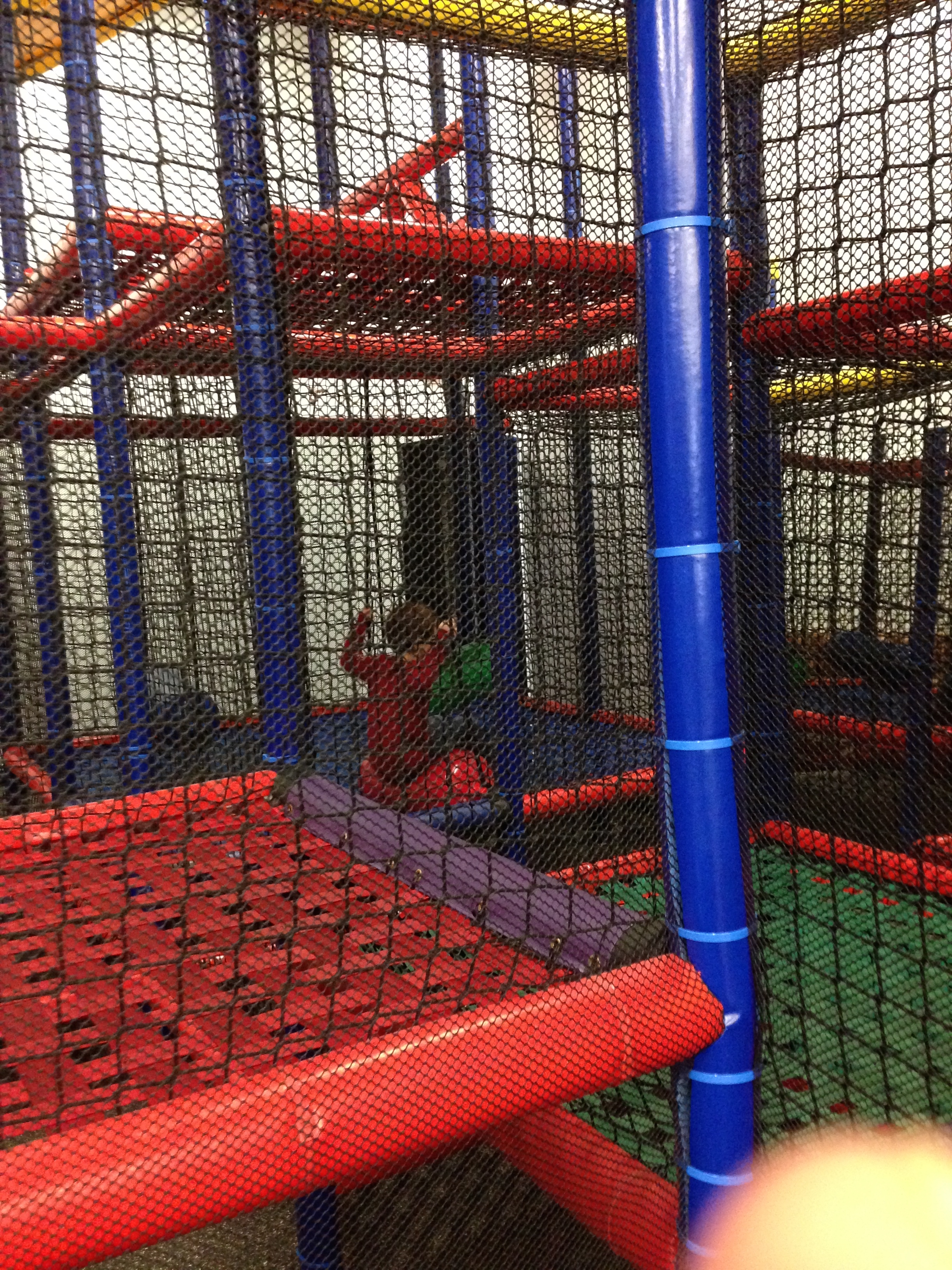
In Texas, at an indoor playground. It’s Easter Sunday afternoon and Martin is antsy, so my brothers and I bring him to an indoor playground. Martin removes his shoes and dashes into the climbing structure, a sort of gigantic, netted jungle gym. I sit with my brothers in an ample lounge surrounded on all sides by the jungle gym.

Two men enter. They look cool. Super-cool. Sunglasses. Ample, sculpted chests, pecs, and biceps, visible under fitted polo shirts. Nice jeans and shoes. Okay, I’ll say it. They’re handsome. They have four or five children with them. I’m not really sure how many, because my attention goes directly to the one with autism. From his face, I’d say he’s ten or eleven years old, but he’s almost adult-sized. He’s tall and, like many ASD kids, with their gut problems and food issues, he’s overweight. He’s not looking at anyone, or speaking. The other children store their sneakers in the plastic cabinets set up for that purpose. The ASD boy tugs off his sneakers and leaves them on the floor. The kids disappear into the climbing structure.

The taller of the two men, in a white shirt, seems to be the one in charge of the ASD boy. I guess that he’s the boy’s dad. Almost without a pause he scoops the abandoned sneakers and tucks them in a plastic cabinet. The two men take adjacent chairs and begin talking. They seem like good friends. I’m too far away to hear what they’re discussing.

I imagine it’s the New York Rangers, because really cool, handsome men everywhere, even in Texas, like to talk about the New York Rangers.

After some time the ASD boy emerges from the jungle gym. He seems confused until he spots the two men, then runs to them and climbs onto his dad’s lap. The boy is so big that he looks absurd perched on a lap, like a teenager or even a small man curling his body onto another’s. His dad, Mr. Super-Cool, Mr. If-We-Were-in-Any-Other-Setting-I-Would-Take-Him-for-a-Childless-Playboy, continues talking to his friend while wrapping one arm around his son and using the other hand to rub the boy’s scalp. He betrays no hint of feeling awkward about the 150 pounds of kid smooshing his quads. He continues rubbing his son’s head until the boy springs to his feet and scampers back to the jungle gym.

The super-cool guys and their charges leave before we do. (My brothers and I, in tandem, are lazy caregivers. While Martin plays, for more than two hours, we’re sipping coffee and teasing each other, destitute of other ideas for filling a holiday afternoon.) As the other kids get themselves ready, Mr. Super-Cool puts shoes on his son’s feet and ties them. They’re nearer us now, and I hear him ask, “You okay, buddy?” Then, probably because his son is not verbal, he answers for the boy: “You’re okay.” They walk out holding hands.

There is a beauty to scenes like this, to a teenage brother forced to mature into vigilance, to a dude with nothing but tenderness for the child who requires more attention than the rest combined. I want to wave my arms and shout, “Hey, us, too! Autism’s got us, too! I’m proud to be like you!” I want to be counted with those who rise so brilliantly to the challenges they face.

Yet I also regret these scenes. Autism is a monster of our own making. Its incidence is rising from some combination (I don’t know which; who does?) of the dangers we humans have unleashed. Chemical concoctions disguised as food. GMO’s. Antibiotics, overused. Electromagnetic fields. Mercury and other heavy metals. Radio waves. Injected toxins. Pollutants. Pesticides. Sure, I admire the caregivers who meet autism head-on. They’re making positive choices. Where is the choice for the children with autism, who need calming, who crave sensory stimulation, who cannot sleep, cannot relate, cannot adapt, cannot ensure their own safety?

And where will they be when the brave and patient caregivers are no longer available?

We’ve got to stop this.

Martin, in the indoor playground, somewhere.

Martin, in the indoor playground, somewhere.

Adjusting My Attitude

Yesterday morning, I accompanied Martin to the church basement for Sunday school. Sometimes, even still, I do that, if he finishes children’s time at the chancel and looks for me while the kids shuffle together down the aisle. I take his hand, walk with him down the stairs, watch him get settled.

There were extra attendees yesterday, so the Sunday school teacher and another parent added a second low table and asked the older kids to bring chairs. In that commotion, the younger kids, the kids Martin’s age, began filling the chairs as they arrived. Seven-year-old Kara plopped down, grabbed the chair next to her, and called to six-year-old Kasey, “Here! Kasey, sit here!” As a chair arrived to Kara’s other side, she clapped her hands and said, “Derek! Take this one!” Kasey, now seated, joined in and summoned two more friends: “Come sit at this table! Here! Here!” And so it went. The friends rushed for the best seats.

At the original table, which had eight or ten chairs, Martin sat by himself, silent.

I stood in the door for another minute. Eventually, Martin’s table filled, too. The older children, done moving chairs, sat there. Younger children, similarly un-summoned, maybe visiting for the first time, sat there. The leftovers. The left out. Like Martin, they were silent.

Autism is a series of heartbreaks.

Hidden in the heartbreaks are victories. Victories like these: No one had been directly unkind to Martin; no one had said, no, don’t sit with me, I don’t want you here. He hadn’t been included. Nor had he been rejected. (Compare with South America, when the bratty Valentín shouted ¡Cállate! whenever Martin tried to play.) Martin, also, was doing exactly what was expected of him. He had entered the common room, found a chair, and waited for Sunday school to begin. (Compare with months past, when he might have bolted for the piano in the corner, or tried to enter the toy-filled nursery, or insisted that I stay.) Best of all, Martin chose a blue chair, seemingly oblivious to the empty yellow chair right next to him. (Compare to the days when Martin had to sit on a yellow chair, when if all yellow chairs already were occupied, I had to fetch one from another table, when the lack of a yellow seat in the subway meant an ear-shattering meltdown.)

Hey, this my boy. We’ll get there, and we’ll bring the rest of the world along with us.

Re the Bed, and What I Wrote

In this blog, I am honest, and for the most part I am forthcoming. There are, however, exceptions. I withhold points that would identify our surroundings, or Martin’s friends, or people about whom I tell stories (unless I have their permission to divulge). I don’t discuss things like IEP meetings or school services, because I wouldn’t want to compromise our relationship with our school district or Martin’s school. Marriage and family life are off-limits except as they pertain directly to Martin’s autism and recovery.

Most importantly, I avoid writing details that I think unnecessarily violate Martin’s privacy. I expect that Martin will one day read these entries, and will know what the world knew about him during this time, and will hold me accountable for the occasions when I’ve said too much. And even if Martin never chooses to read this account of our journey, I know what appears here. Adrian knows what appears here. We have our own thoughts about what information should not be on the internet.

In Friday’s post, I mentioned having to carry Martin to the bathroom at night to prevent him from wetting the bed. I debated, with myself, whether to include that tidbit. It was relevant to the story, and mattered to our vacation: Martin wanted to sleep over at his aunt’s house with his cousins, and I found excuses not to let him, because I didn’t want him to have an accident, which might’ve caused his cousins to make fun of him. This dynamic lingered throughout our stay, as my sisters-in-law kept opining that Martin should sleep over with his cousins. Because my sisters-in-law don’t know that Martin has autism, I was hiding as many of our ongoing challenges as I could.

I’m still wondering whether I made the right choice, when I chose to include bedwetting among the vacation SNAFUs. According to the book I’m now reading about bedwetting, some 10-15% of kids Martin’s age still have trouble, so it’s not like we’re alone. In Martin’s case, there are physiological reasons that might keep him from overcoming the tendency; as I understand it, Martin’s brain stem, which coordinates basic body functions, mirrors his peripheral vision. Just as Martin shut down his overactive peripheral vision, his brain stem lost awareness of non-immediate sensations. Martin doesn’t ever “kind of” have to go to the bathroom. Either he doesn’t think he has to go, or he suddenly realizes that he has to go right now.

At this time, Martin doesn’t have a particularly developed sense of shame when it comes to what other kids might consider embarrassing. He might not even care that I mentioned bedwetting. Like I said, though, I’m not worried about Martin calling up this blog and reading it tonight. I’m worried about middle school, or high school, or college, when he’s farther on the recovery journey and I tell him about this record I’ve made.

Which brings me to the reason for this post:

Readers of the blogosphere, fellow autism parents, world at large—judge me if you want. With this blog, I try to inform, to record, to prove or disprove, maybe even to inspire, a bit. The relationship with you is reciprocal; because I’ve let you into our world, you get to judge me. If you must. I can take it.

But Future Martin is another story. Your judgment, Future Martin, I fear. This post is to tell you that I know I don’t always get this process right, and that I am trying my best.

Most Special Guest Post Ever

As you can (ahem!) probably tell, this blog doesn’t get much editing. As to most entries, I draft, read through once, add any links or photos, and post, sans quality check.

Occasionally, however, I request a second opinion before I post, because I’m writing about a friend or relative and want him/her to have the story before the world does, or in order to check whether my words will convey what I want them to. In the entry titled “For Diana,” I wrote to a fellow ASD parent who has commented thoughtfully on my blog over the past two years. The topic of “For Diana” was our disagreement about approaches to treating autism. In that instance, I asked Adrian to read the draft before I posted. I was looking for a gut-check: Was I respectful toward Diana’s position? Did I address her comments without extraneous points? Did I acknowledge my own biases? Adrian did a commendable job. He pointed out one paragraph where my words sounded “snide” (I edited that) and suggested one comment to which I could add more depth (I tried).

And then, to my surprise, he started to add his own thoughts to what I had written. Adrian listens, and responds, when I talk about Martin’s challenges, treatment, and achievements. The “big decisions”—should we try chelation? is HBOT worth the investment? where should we live? where should Martin go to school?—we make together, based on information I assemble for Adrian to review. Beyond those discussions, Adrian rarely volunteers his thoughts about autism, or recovery. Autism recovery is my department. Adrian’s departments are vacation planning, opera excursions, history lessons, and the family economy. Adrian enjoys a probative biography of Nixon; my desk is littered with articles about MTFR mutation. Indeed, if we decide to tell a friend or family member that Martin has autism (we’re guarded, in that regard), I am the one who sits the initiate down for that talk, without Adrian present.

Yet here he was, freely telling me why he thought Diana’s opinion was mistaken. His statements were original, and different, and not echoes of mine.

“You should write that down for my blog,” I said when Adrian finished. “Really. It would mean a lot to add your voice to Martin’s story as it evolves. Otherwise it’s always just me, speaking for both of us.”

“Maybe,” Adrian said. “I guess I could think about it.”

We left the topic at that. I didn’t want to push Adrian. In addition to his autism reluctance, Adrian doesn’t enjoy writing in English, other than technical finance and legal documents. English is not Adrian’s first language, or even his second, and despite his thorough fluency (better grammar than most native speakers, I tell him!), he’s never seemed to gain full confidence.

A month passed. And then almost another month. And then Adrian sent me an email with no re: line and no content other than an attachment titled “martin.docx.”

Here is what he wrote:

I am Martin’s father. My wife, Maria, asked me to write a note for her blog on Martin. The request was made in response to a reader advocating that our approach to Martin’s autism is not worth pursuing. The commentator argued, thoughtfully and politely, that trying to recover a child from autism is tantamount to wanting to “change” the child, while in fact the child was just fine but different. Being “different” would not merit trying to change the child, and could at some point be perceived by the child as a rejection of what he or she is. “I don’t want to return my son to full neurotypicality because I don’t see him as having been in a certain place and then having regressed or changed,” wrote the commentator. “I don’t understand how the language and idea of ‘cure’ and ‘recovery’ is consistent with teaching our kids to love and accept themselves as they are.

The commentator is not alone. Many people in the unwilling community bound by autism argue that there is nothing that requires addressing or treating autism. An autistic person is perfectly healthy and happy, just not neurotypical. It is up to us to accept autistic persons as they are.

Maria and I have a very different attitude towards autism.

To me, autism is a deeply uncomfortable topic. To my wife, it is a topic in which she has simply become an expert. I view autism as a topic that occupies too much space in our lives. Maria sees it more like an important, unavoidable part of our lives. I have been shaken by the existence of autism in our family. She has decided to confront it.

But we both share a commitment to doing everything we reasonably can to bring our son back to neurotypicality.

From my standpoint, this is not about accepting or rejecting one’s child. This has little to do with my personal relationship with my child. This is about the responsibility of a parent to prepare his or her child to live in the actual world.

One of the most critical things a parent has to do is to raise a human being who can, to the greatest extent possible, fend for himself in the real world. My job as a father is not only to love and nurture my child—and, as a result, to be accepting of him—but to prepare him for the world in which he will have to live. Martin will have to live in a world that I will not always be able to shape in a way that works best for him. I may or may not be able to help him and be there for him along the way, and there will certainly be a time when I am no longer going to be able to be there for him at all.

If autism does one thing, it makes a parent realize the thousands of social cues and communication skills that create a successful social interaction.

Martin, for example, insists on yelling “Go away!” to any person who wants to assist him if he happens to be dealing with something by himself. Even among expert professionals (like his teachers), a curt, impolite “Go away!” triggers a shock reaction. Martin is still prone to asking inappropriate questions (“Is that your husband?”, “What year were you born?”, “When did you get into your mommy’s belly?”) of any person he just happens to meet.

But it is not only this kind of obvious behavior that needs to be addressed; it is the more subtle rules of social interaction and communication that make people successful. Understanding, especially what is not being communicated verbally. Listening, to the nuanced messages that adults use all the time. Acting with emotional intelligence. Differencing when one is being attacked or mocked from when one is just being made fun of. Properly interacting with people in positions of superiority or inferiority, and with peers. All of these are the gifts of neurotypicality and of a good and loving education.

Looking at Martin, I see a child who is entitled to be raised in a way that maximizes his ability to navigate the world. That is my responsibility.

There you have it, readers. Adrian is real. He speaks. And you and I, together, have just learned more about his position on recovering Martin than I’ve known in four years—one more way in which keeping this blog has blessed my life.

Adrian messing around, with his niece and Martin on the back.

Adrian messing around, with his niece and Martin on the back.

Once and Twice

When we still lived in the City, I spent several months touring private schools for kids with special needs. Martin was going to be entering kindergarten. Our zoned elementary school had no special education other than an integrated co-taught class, in which a general-education teacher and a special-education teacher worked together to handle more than 25 kids. No way was Martin ready for that. Indeed, New York City’s Department of Education determined that Martin didn’t have sufficient attention-span even to enter its public ASD Nest program, which has integrated co-taught classes of just 12 students. The DOE also has an ASD Horizon program, self-contained (i.e., all-special-education) classes for kids who are deemed ineligible for Nest, but (1) none was taking place anywhere near us, and (2) Horizon utilizes Applied Behavioral Analysis, or ABA. When Martin underwent ABA therapy in Early Intervention, he became frustrated and resistant, and also seemed to think perseveration and repetition are positive habits.

So the public Nest and Horizon programs were ruled out, and the DOE school psychologist overseeing Martin’s case said he didn’t have another appropriate placement to offer. By then we had started looking at the private schools. New York City has dozens of special-education private schools to fill the gaps in what the DOE is able to offer. Most of them won’t accept a child’s application without a parental tour, a neuropsychological assessment of educational needs, a written submission including developmental history, and one or more visits by the child. Looking for the best fit for Martin, I toured 14 schools, with each tour taking between one and three hours. From that, I came up with a list of four schools I thought would be appropriate for Martin, and then I started the applications.

Is there another American city where even special education is hyper-competitive?

During this time, while touring private special-education schools, I was beset by a couple whom I (privately) called “the Twice-Exceptionals.” I suppose I actually saw the Twice-Exceptionals only four or five times. Yet it felt like they were everywhere. You’re about to find out more about me than I should probably reveal. Here goes: The Twice-Exceptionals annoyed me.

The first time we shared a tour, I introduced myself and said I’d seen them around the special-ed preschool that both our sons attended. What did they think of this kindergarten we were visiting?

“It seems nice,” the mother responded, “but we’re pretty sure it isn’t right for [their wonder kid].”

“Is Wonder Kid’s diagnosis not on their ‘accept’ list?” I asked. A lot of the private special-ed schools, especially those that are “state-approved,” have a list of diagnoses that they are authorized to accept. “Speech-language delay” and “learning disability” might be in, for example, while “cognitive impairment” and “emotional disturbance” are out.

Aside: I’ll admit to feeling down on the kindergarten-admissions process when school after school claimed they didn’t accept kids with “autism or other global delay.”

“His diagnosis isn’t the problem. It’s that Wonder Kid is twice-exceptional. We feel like this school wouldn’t be able to handle his academic potential.”

“What does it mean that mean, twice-exceptional?”

“Wonder Kid is on the autism spectrum and also gifted.”

“Oh. Wow! How can you tell something like that already? I feel like our boys are so young.”

“We knew very early,” replied Mrs. Twice-Exceptional. “Wonder Kid started reading before he turned three. He already does math in his head. This morning when he woke up, he said, ‘It’s only 6:34, and I don’t have to get up until 6:40. I’m going to stay in bed for six minutes’.”

“That’s amazing!”

Mr. Twice-Exceptional spoke up: “We’re most interested in the Quirky Genius School that opened last year. It serves twice-exceptional students.” (Obviously, or not so obviously, “Quirky Genius School” is a pseudonym.)

I marveled at the world in which we live. “They have a whole school just for kids who are gifted and also have autism?”

Back to Mrs. Twice-Exceptional: “Yes! We can’t wait to tour the Quirky Genius School next month. We are almost certain that’s going to be the right fit for Wonder Kid. Haven’t you considered the Quirky Genius School for Martin?”

“No. I mean, I’m pretty sure Martin is only once exceptional.” At the time, late 2012—I read back in this blog to confirm—Martin had just started using the command form, and I marveled when he once managed an “I don’t know.” He could read, some. He lacked the language facility to tell me much more about what he knew, and his hand wasn’t steady or strong enough for writing or drawing.

“You never know. He might surprise you,” Mrs. Twice-Exceptional assured me. “You should at least take a look at the Quirky Genius School.”

I’ve always hoped that Adrian and I would make a bright kid. It seems perfectly plausible. I finished first in my college and graduated from an Ivy League law school. Adrian was among the top five students in the best law school in his country of origin. Smart genes! But during the kindergarten tour process, we were still working on getting Martin to sleep through the night and ask questions. “Gifted” felt far off. (Don’t beat me up, readers. Don’t beat me up, Martin, if you read this sometime in the future. I think my kid has a better-than-average chance to be, ahem, “gifted.” It’s just that he’s a work-in-progress, and it’s too early to tell.) “Thanks,” I said to Mrs. Twice-Exceptional. “I will. I’ll look into the Quirky Genius School.”

“Let’s stay in touch!” she exclaimed. She rummaged in her handbag and extracted a business card.

“Oh! I’m sorry,” I said as she handed me the card. “I don’t have a card to give you. I’m not working right now.” Icky. First I had a son only once exceptional, and now I didn’t even have a job.

Mrs. Twice-Exceptional said, “That one’s not my business card. It’s my personal card.”

As that morning’s school tour began, I examined the card. It had big blocks of primary colors, Mrs. Twice-Exceptional’s name and email and phone number, and her title: Wonder Kid’s Mother. That was her title. Mother of a twice-exceptional wonder kid.

I sensed we probably wouldn’t be staying in touch.

But alas, they were unavoidable. At the next kindergarten tour, just a few days later, there they were. Mr. and Mrs. They did all the tours together, a unified front of exceptionalism doubled. Adrian, with his long work hours, toured the two schools Martin’s social worker identified as likely best fits. The other 12 I visited alone.

“Hello again!” Mrs. Twice-Exceptional greeted me. “Did you get a chance to look at the Quirky Genius School?”

“I did,” I said. “I checked the website. It looks like a terrific program. I’m not sure it would be right for Martin, but wow. Looks like exactly what you want for Wonder Kid.”

“It is,” Mr. Twice-Exceptional said. “It really is. We’re just sorry that we have the Quirky Genius School tour scheduled so late. It would be great to find the perfect fit early instead of visiting so many schools.”

Why did I resent this friendly couple? Was it the insistence on “twice-exceptionalism”? Was it their forcing me to declare my own son just once-exceptional? Was it the business card? Both of them showing up at every tour? The fact that the wife followed me throughout one tour to share details of her weight-loss journey? That she informed me that they would leave the City for a suburban district if only their hands weren’t tied by living in a beautiful rent-stabilized apartment?

All I know is that, on each of several kindergarten tours, Mr. and Mrs. Twice-Exceptional inquired with uncomfortable determination whether I was now considering the Quirky Genius School for Martin.

Last weekend Adrian and I saw The Imitation Game. Lovely movie. For the most part, well-scripted and –acted, and a meaningful story. The main character, Alan Turing, is a math and computer-science prodigy who may have been on the autism spectrum. I didn’t know that detail before watching the movie; afterward, I did some research and found conflicting reports on whether Turing was on the spectrum, or just awkward, and if the latter, how awkward. For this post, I’m going to take the Hollywood version and assume that Turing was “twice-exceptional.” As in, wickedly super-twice-exceptional, on brain-power shots.

As the film depicts, and as additional accounts seem to bear out, Alan Turing’s genius and work effort shaped history, shaving some years from World War II and sparing millions of lives. Turing also ended up profoundly unhappy. To be sure, spiteful laws enabling the persecution of homosexuals (as Turing was) contributed to the malaise. So, very possibly, did his social challenges.

Which brings me to consider a hypothetical: Would I rather raise a genius who makes extraordinary, positive gifts to history, yet who himself wallows in despair? Or would I rather raise a man whose contribution to society is limited to taking care of himself and his own, and yet whose existence is marked by love and contentment?

Easy question. For the sake of humanity, I’d rather raise the desperate genius. For the sake of my own son, I’d rather raise the happy, ordinary gent. And my own son trumps society. My family first, then my friends, then my closest neighbors, my society, and the rest. That’s the natural order of things. (I’ve touched on this theme before.) How could I sacrifice my own child’s happiness for anything, even in order to shorten a war?

I’m not faced with that choice, at least not that I know. If Martin is a genius of historical proportion, I haven’t seen it yet. On the other hand, even if Martin is not twice-exceptional, he does have an unusual worldview and some exceptional abilities. He categorizes memories by specific date. “Mommy, on Thursday, September 25, I had lasagna and green smoothie at a restaurant in Manhattan,” he told me, unprovoked, one recent afternoon. “I don’t think that’s quite right, Martin. You had those at PeaceFood Cafe after we went to the children’s museum with Jason and his mommy, so I think it must have been a Saturday or Sunday.” When he insisted on the date, I checked my calendar. Indeed. Thursday, September 25. Rosh Hashanah. Martin didn’t have school, so we made a playdate with Jason. Yesterday, when Martin said, “Mommy, on Tuesday, December 16, did Georgie [one of the cats] sleep on my bed?”, which he meant more as a statement than a question, I responded, “You know, I don’t remember dates that well, but I’m sure it’s possible that Georgie slept on your bed on Tuesday, December 16.”

When Martin turned six-and-a-half, Adrian and I wished him a happy half-birthday. Martin answered, “Oh! I’m 78 months old.” At first, I thought he’d computed the number—(12 x 6) + (12 ÷ 2) = 78—completely in his head. Probably not, though; some weeks earlier, he’d asked me a string of questions on months and years: “How many months are in one year? How many months are in two years?” I reckon he must’ve remembered (his memory is uncanny) that six years have 72 months, then added six, for half of one year’s months. In any event, what an odd response to “It’s your half-birthday! Happy half-birthday!”

Last summer, we were up in the Adirondacks with my sister and her daughter, Mandy, whom based on her initials we sometimes call MC, pronounced “Mick.” The cabin we rented had some basic supplies: paper towels, cooking oil, spices. One morning at breakfast, Martin started asking about the salt and pepper on the table. Would MC take the salt and pepper with her when we left? Did MC bring the salt and pepper from home? Were there salt and pepper for Martin?

“Martin, what do you mean?” I asked. “Why would MC take the salt and pepper home?”

“Because they’re hers,” he replied.

“No. We found them here. They belong to the cabin.”

“Why do they have ‘MC’ on them?”

Because they were McCormick brand salt and pepper, and the containers had little “Mc” logos on them. To an average six-year-old, that might not mean that the condiments belong to Cousin Mandy. The average six-year-old might not even think through the meaning of the salt logo. The average six-year-old is not Martin.

“Will he lose that, as he gets better?” asked my sister that night, tactfully, while we doused the evening campfire. “That different way of looking at things?”

“I don’t know, but I think so. I think he will start to think more typically,” I said. One mother I know told me that her son used to be able to determine, within seconds, the day of the week on which a person was born, just by knowing the year and date. As her son’s coping and social skills improved, his ability to figure birthdays-of-the-week evaporated. (In my goings about the autism community, I’ve met several boys with that skill.) Another mother told me that when various biomed interventions increased her four-year-old’s speaking skills, his precocious reading declined.

I once mentioned this subject to Adrian. I asked whether he thought Martin will lose his super memory or advanced spelling ability, or his compartmentalized way of thinking. I asked whether he thought Martin might, in recovery, become less amazing.

Adrian was silent for a few moments. As between the two of us, I think, Adrian had the higher “traditional” expectations for Martin. Adrian and I come from different socioeconomic backgrounds, indeed different cultures. When we decided to procreate, we weren’t one or the other of us more or less reasonable in our aspirations, but different. I hoped for a well-rounded child who enjoyed sports as well as reading, who made friends and enjoyed their company. Adrian thought more about long-term educational prospects and prestigious careers.

Eventually Adrian replied to my question about unusual thinking versus recovery. He said, “You know what? I’ll settle for happy. I really will.”

The last time I saw the Twice-Exceptionals, other than preschool graduation, was on a kindergarten tour after their much-anticipated visit to the Quirky Genius School. “So how was it?” I asked, feigning enthusiasm. “Are you done? Are you going to apply to other schools, or just Quirky Genius?”

Mrs. Twice-Exceptional said, “We hated it.”

Mr. Twice-Exceptional echoed, “Hated it.”

Mrs. Twice-Exceptional continued, “It was the most disorganized place ever. It’s too new. They have no idea what they’re doing.”

Mr. Twice-Exceptional repeated, “Hated it.”

Their twice-exceptional wonder kid, I heard later, ended up in a public-school ASD Nest program, the very program that had rejected my Martin.

I hope we all get to “happy.”

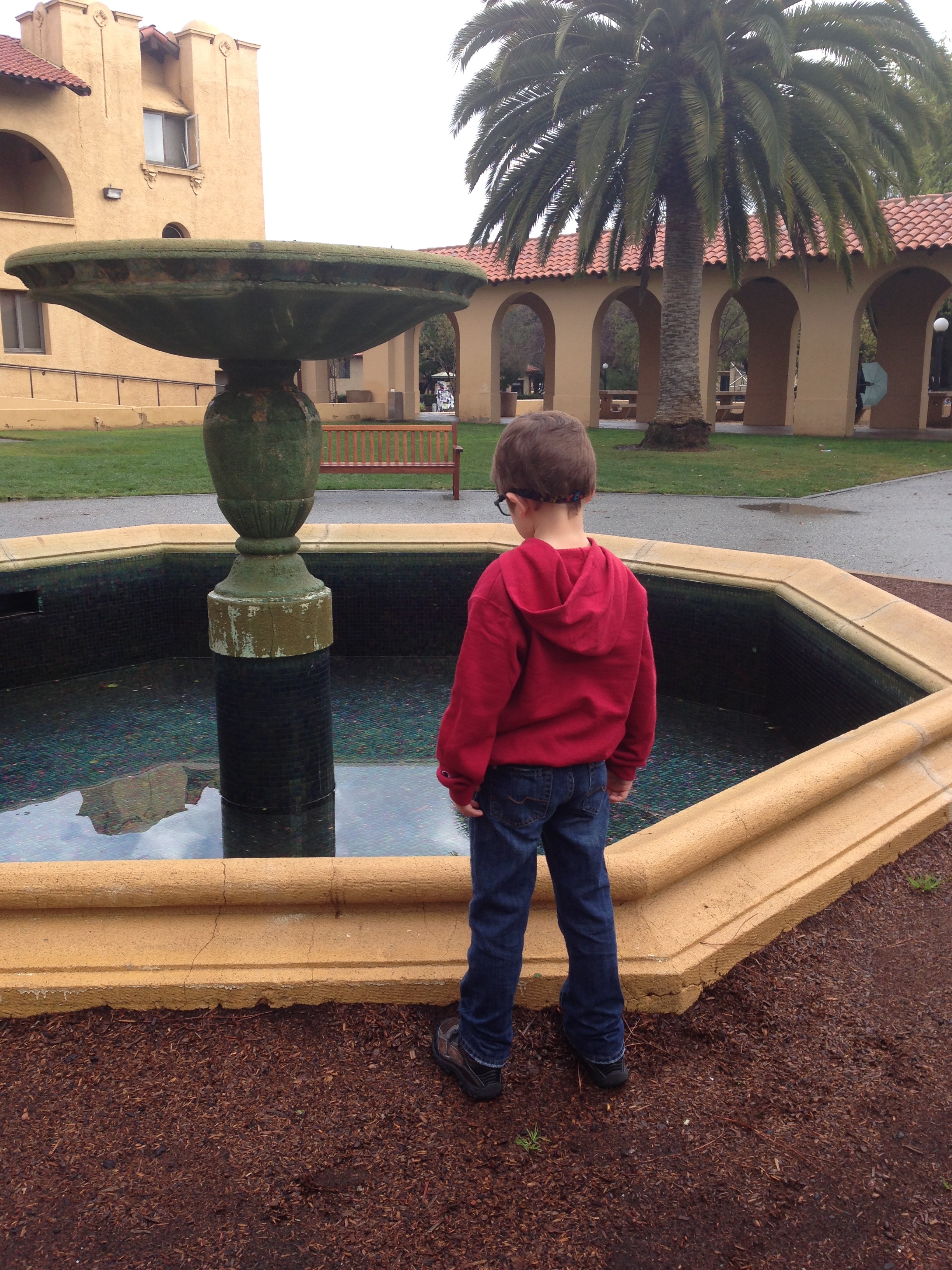
Martin visiting Stanford University. We are shooting for happy. That doesn't mean the sky isn't the limit.

Martin visiting Stanford University. We are shooting for happy. That doesn’t mean the sky isn’t the limit.

2015

My last post reviewed 2014, which got me thinking about 2015.

New interventions are coming down the path, as always. Sitting in my home right now, as yet unpacked, is an ionic foot bath. On their way to us are two Himalayan salt lamps, for air purification and EMF reduction. Are these items just so much hype and bunk? Time to find out. I also ordered an essential oils diffuser. I’ve been applying frankincense and eucalyptus oil to the soles of Martin’s feet and the base of his neck, and witnessing more sharpness when I do. I’d like to see what will result if near his bed I diffuse those two oils, and whatever other oils I find to target his attention span.

I am hoping that 2015 will bring MRT to the greater New York area. I think Martin would be a good candidate for MRT. Unfortunately, because he attends school year-round, i.e., without a summer break, I have not been able to commit to bringing him for the required twelve weeks to any center currently conducting trials of MRT for ASD.

We’re returning in 2015 to some practitioners who helped Martin but fell away for whatever reason. At the beginning of 2013, we switched to a Connecticut biomed doctor when our original doctor moved her practice from Chicago (not too bad to fly there from New York) to California (heckuva long way). In two weeks, I’m taking Martin to California to see the original doctor, distance be damned. I’m figuring that a talented and intuitive doctor who has not seen Martin in more than two years can give us a realistic picture of what progress we’ve made, and what direction we should consider now. I also plan to seek a few sessions with the craniosacral therapist who, in past years, was able to tell me details about Martin’s health and body. I can’t point to any particular reason why we stopped seeing her, other than “too much on the plate.” It’s time to return.

As to me, Martin’s primary care-giver, I have three resolutions. Or maybe not “resolutions.” Publicly resolving to take action brings too much pressure. Let’s say this: I have three notions, and hopes of addressing them.

First, I want to do more thorough research and reading. Unless you are a fellow ASD-recovery parent, you may find this hard to believe, but—I think I do a subpar job when it comes to understanding the science behind Martin’s recovery. I’ve never made sufficient use of his genetic information, or insisted that his doctors do so. I have books I bought, and articles I printed, that I’ve barely picked up. I get so caught up in the everyday mechanics of recovery, the cooking and appointments and supplement orders and logging his health and behavior, that I fail to put aside for making sure I understand it all. Which is another way of saying I’ve been lazy when it comes to doing what I find most challenging.

Second, I want to help Martin understand more about why we do what we do. He knows about foods that “hurt his belly” or “keep him up at night.” As he gets older and his language skills continue to develop, I’d like to explain his health, and how our biomed protocol improves his health. The tricks will be finding a way to bring the explanations to Martin’s level right now, and saying it all without mentioning “autism.” Martin doesn’t know that word, and I wouldn’t care to have him learn it.

Third, I want to put some effort into my own health. I cook GAPS food for Martin, prepare dairy/fish meals for Adrian, and then, for my vegan self, grab whatever I can on the run. I don’t sleep enough. I work out too intensely, or not at all. In 2014 I suffered four major illnesses, one requiring the hospital. That’s got to change.

If 2014 was a banner year, 2015 shall be a confident year. Many underlying challenges are virtually gone, or fading fast. Martin sleeps. He talks. His digestion functions. He has few repetitive behaviors. He still perseverates, but at least he varies the topic. The work we have left to do—primarily socializing and maintaining attention/focus—is more nebulous, and its milestones less pronounced. When it comes to sleep or language, I can measure progress easily. When it comes to how Martin engages other kids, and how they treat him, I have less to chart. So I will have to keep faith, and remain confident that change is occurring, even if I grasp it only in hindsight.

P.S. I have a special announcement for long-time readers. Remember the cat chaos in my home? The hissing and bullying, the senior cats living in the basement? On the advice of a cat behaviorist, we’ve found a new home for the troublemaker-in-chief, George. He’s going to live in Northern California, with the mother of a close (human) friend of mine. He’ll be the only cat in a big house on a big yard, the empire of his dreams. And Martin and I, on our trip to visit the California doctor, will personally deliver George to his new home. Wish all three of us luck.