Food Is Easy

When we first started biomed, I altered Martin’s diet to remove grains, fruits (except avocado and limited tomato), starchy vegetables, dairy, soy, corn, refined sugar (actually, at that time, almost all sugar), and additives. Like any biomed newbie, I had my moment of standing in a Whole Foods Market trying not to cry because I couldn’t find anything my son could eat. I muddled though with elaborate concoctions. Dehydrated flax-seed crackers. Green purée. Spinach pie. When Martin started eating meat, chicken-and-egg bread.

With hindsight I realize that feeding Martin felt so complicated because I was trapped by my prior notions of diet. How could I replace bread to make his sandwiches? What crackers would he use for snacks? Pizza? Pancakes? How could I create a mini-gourmand with few of the ingredients associated with gourmet cooking? Could I invite friends over and offer them a dish of flax seeds?

Labor Day weekend we had three houseguests: my father, my niece (Martin’s buddy, Mandy), and my mother-in-law. In addition, we entertained friends for lunch on Saturday afternoon and Sunday afternoon. In our early biomed days, this might have created a meltdown scenario. (Mine, not Martin’s.) Not so today. Not so with my new mentality: simple meals, few ingredients of high quality.

Saturday morning, Adrian took Martin and Mandy to the gym so that I could prepare. On the counter I had two bags of baby Brussels sprouts; teardrop tomatoes, basil, and two cucumbers from my patio garden; avocados; red onions; garlic; an orange; and three pounds of potatoes. (I don’t do much with potatoes, usually. Organic potatoes are a once-in-a-while treat that Martin loves.)

The Brussels sprouts I washed and trimmed, then stirred with olive oil and ginger-orange salt and placed in a glass pan. The potatoes I washed and quartered, then stirred with olive oil and rosemary salt and placed in a glass pan. Side dishes—done except for baking.

Next I halved the teardrop tomatoes, sliced one cucumber and the basil thinly, and combined them with red onions, olives, capers, fresh lemon juice, crushed garlic, and olive oil. Salad—done.

Before our friends arrived, I made guacamole, which I set on the patio table next to a tray of raw vegetables. I also filled a dish with peanuts (no peanut allergies present that day). Snacks—done. I also sliced an orange and the other cucumber and put them in a glass jug with filtered water and lots of ice. Non-alcoholic beverage—done. Then I turned on the oven and set the Brussels sprouts and potatoes to bake.

Later, while guests were present, I brushed a large piece of salmon with olive oil, then added salt and capers. Main course for non-vegetarians—ready to grill.

The day before I had prepared a quinoa chocolate cake. To compliment the cake, I put coconut milk, vanilla extract, a dash of sea salt, and coconut crystals into my ice cream maker and set it to churn. When the ice cream was almost firm, I added fresh raspberries. Dessert—done.

That was the food I served: peanuts, and veggies with guac; grilled salmon, Brussels sprouts, potatoes, and tomato salad; cake and ice cream.

Everything was homemade and permissible for Martin to eat. Apart from the cake, preparing the entire afternoon’s menu took about 90 minutes. If our Saturday guests realized they were eating “recovery” food, they made no mention.

For our Sunday guests, the main course comprised burgers and vegetable burgers (no buns), sweet potatoes with coconut oil and cinnamon, garlic green beans, and more salad (the garden won’t quit).

When the time is right, I still enjoy making more complicated dishes; yesterday for dinner I fashioned “nutty patties” out of cashews, walnuts, tahini, onion, parsley, flax seeds (in a yummy way, seriously), and spices. But I’ve realized that life is easier when most meals comprise few ingredients simply prepared. I don’t need “replacements” for bread, crackers, pretzels, and other processed foods. No one misses them, anyway.
Hubby Eats

Managing Martin’s recovery has taught me more than ever about nutrition.

I love my husband, Adrian, and would like to keep him healthy.

I’m kind of a control freak.

These facts were bound to collide at some point. That’s why, except when we go out for dinner or he has a business event, I now prepare every bite of food Adrian eats.

Years ago, Adrian skipped breakfast and, during the work week, bought whatever for lunch. When he decided to manage his diet better to lose a few pounds, he still skipped breakfast but I started sending lunch to the office with him. In the beginning, I sent a sandwich of cheese, fake meat (usually processed soy), greens, and mustard or vegan mayonnaise on whole-wheat bread; two fresh fruits; and two protein snacks like nuts, or veggies and hummus, or (more) cheese and crackers.

As time went on, the bread became sprouted-seed gluten-free, the fake meat became less processed and more lentil-mushroomy, and the cheese and hummus became organic.

Then the sandwiches and fake meat disappeared altogether. Then I insisted on adding breakfast at home. Then an insulated container of lentils snuck into every lunch, to make sure Adrian had enough to tide him over even when he works late (which he usually does). Then I tried to eliminate cheese snacks. That last effort, the cheese, was unsuccessful, although I did manage to switch him to raw-milk cheese, usually purchased directly from a local farm.

As of 2016, Adrian’s weekday menu is as follows:

Breakfast. Smoothie made from plant-based protein powder, nut milk, peanut butter, and frozen berries.

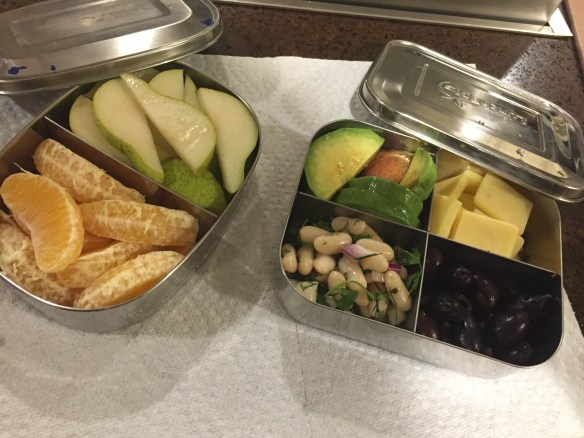
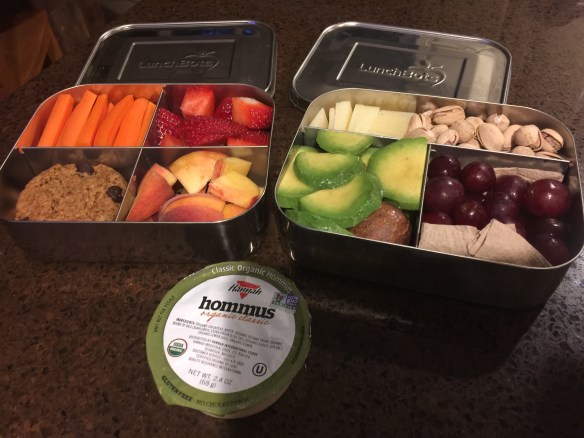
Lunch and snacks. Two bento-style boxes (I use LunchBots) containing avocado (South American by origin, Adrian craves avocado daily), fruits, nuts, cheese, olives, and/or raw veggies, accompanied by a hummus cup or baggie of rice crackers and a container of lentils or legumes.

Dinner: Whatever Martin is eating. Last night, dinner was white beans with home-grown-basil pesto and arugula salad from my garden. Tonight, Samara is preparing her special lentils with onion, garlic, and carrots; Adrian never minds lentils twice in one day. Tomorrow evening, Adrian and Martin will eat fish and fermented kale. In the event Adrian, a pescatarian, cannot eat what Martin is having (say, meatballs), I make him a “hearty salad,” which comprises fresh greens, berries, nuts, and seeds, dressed with olive oil and chickpea miso.

All the food is organic, except the nut milk, because sometimes I buy a brand that is only GMO-free, and the fish, which is wild-caught. Weekends, I make a full breakfast for Adrian and Martin, and we often eat dinner at a restaurant.

Adrian is a corporate attorney at a white-shoe law firm in Manhattan. Last month a visiting friend was ribbing Adrian, asking if he is the only firm partner who brings homemade lunch every day. Adrian laughed and said he didn’t care. “I like my lunch. My lunch is tasty.”

Now, if I could only get my own diet into such good shape.

IMG_3689

Lunch and snacks for Adrian’s day: carrots, strawberries, TigerNut flour cookies, peaches, cheese, pistachios, avocado (coated with lemon juice), grapes, hummus.

IMG_3177

Lentils, heated, being loaded into an insulated container to accompany Adrian’s lunch and snacks.

IMG_3176

More bento boxes, with oranges, pears, avocado, cheese, cold bean salad, and olives.

Food Porn, Mardi Gras Edition

Tomorrow is Ash Wednesday, so this must be Fat Tuesday, the culmination of Mardi Gras. Tuesday afternoons Martin attends the kids program at our church. Last week, our pastor announced that he planned to serve king cake today.

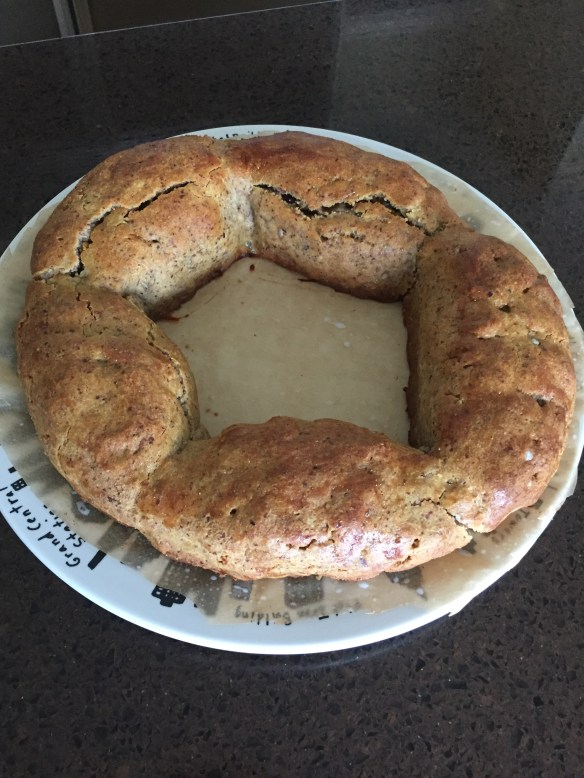
When Samara, who had taken Martin to the kids program, informed me of this king cake development, I was weirded out. This isn’t New Orleans, and my church isn’t Roman Catholic. We are stuffy Northeastern Protestants. The last time I ate a king cake, I was a 22-year-old graduate student dating a Louisianan whose mother FedExed us the delicacy. (I recall that a Jewish friend found the Baby Jesus trinket, which subsequently was stolen by PeeWee the cat, who batted poor Baby Jesus mercilessly about the parquet floor.) On the other hand, Samara—who is not only Roman Catholic and of Latin American origin, but unable to see Martin deprived of anything—jumped all over the king cake idea. By the time I returned home Wednesday evening, from a mediation I was attending in Los Angeles, Samara had downloaded a recipe for “Paleo” king cake, invented her own sweetened cashew cream filling, and spent four hours baking this:

IMG_1587

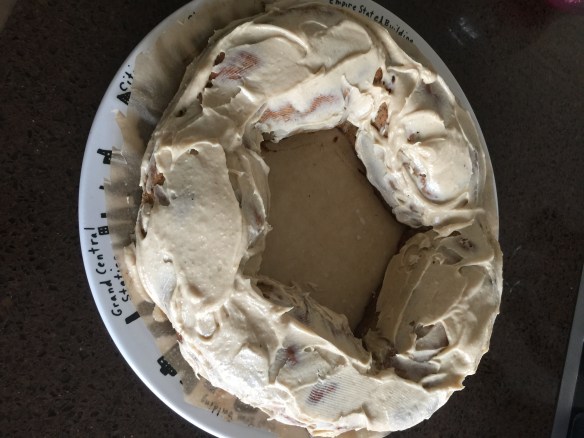
We popped that base in the freezer. Yesterday I moved it to the refrigerator to defrost. This afternoon I created a frosting/glaze. In the Vitamix, I blended 1/4 cup melted coconut oil, 1/4 cup coconut cream, 1/4 cup cashew butter, 1/4 teaspoon sea salt, and 3 tablespoons raw honey. I spread that on the defrosted king cake:

IMG_1590

Next, I used an India Tree decorating set to color four bowls of organic shredded coconut:

FullSizeRender

Finally, I sprinkled the dyed coconut onto the frosted king cake to replicate the traditional multi-colored appearance:

IMG_1591

Martin took the cake to church this afternoon and loved the treat. I’m not sure if I have Samara’s patience to make this every year, but a new tradition just might have been born.

Postscript: Apparently the pastor had trouble finding a local bakery in the business of assembling king cakes this year; by the weekend he had changed course and declared today’s kids program “pancake dinner”—the tradition much more associated with us uptight, Shrove Tuesday types. Of course, the pancakes were not Martin-approved, and the homemade king cake was already in my freezer. So while the rest of the kids had pancakes, Martin ate like a king.

At least he shared.

Instead of Making

To the outside observer, I gather, it seems like I do everything for Martin. Food-wise, at least. I prepare three meals a day from scratch. I buy eggs and meat from farms. In the summer I grow vegetables and herbs. I simmer broth, I pre-sprout beans, I soak and dehydrate nuts, I bake magical allergen-free snacks to send to school.

Let me assure my readers, however, that there are foody activities that I forego. That is, as a general rule, if I can buy a food from a source I trust, I do. I could save money—the grocery bill of a biomed family is out-of-control huge—by actually making everything at home, but there just aren’t enough hours in the day. Examples:

  • Kombucha. I brew my own kombucha. I have a countertop canister and a strong SCOBY, and each time I harvest, I feed the baby SCOBY to my compost bin. So what’s the problem? Well, I drink a lot of kombucha, Martin drinks kombucha, I don’t harvest my brew as often as I should, and what I make never tastes as good as GT’s or Health-Ade. So I brew kombucha and I also buy kombucha. Bottles and bottles of kombucha.
  • Nut cheese. Cultured cashew cheese isn’t hard to make. Here’s a recipe. And another. And another. You know what’s even easier than making cultured cashew cheese? Buying it. Here’s a good brand. And another. And another. (Don’t confuse cultured nut cheese, which is probiotic and healthy, with simple “non-dairy cheese,” which is often starchy junk food that, in my opinion, tastes awful.)
  • Fermented vegetables. I went through a phase of fermenting my own vegetables, in jars in my basement, especially because I wanted more choices than just cabbage sauerkraut. Now there are so many organic brands with non-sauerkraut ferments. BAO makes fermented kale and dandelion greens, beets, and mixed vegetables. Hawthorne Valley Farm, a local brand, has tasty ginger carrots. WildBrine makes smoky fermented kale and red beet sauerkraut, although not all its varieties are organic (I believe they follow the “dirty dozen” list and make those organic) and the Brussels sprout kraut contains soy, making it unacceptable for Martin.
  • Snacks. Martin prefers commercial snacks. He likes to open colorful wrappers, and he likes eating “store food” like his friends and classmates do. His favorite are Lärabars. I have a tortured relationship with Martin’s Lärabars. First, they are not organic, so I fear pesticide residue. Second, their GMO status is unclear. Third, they are high in sugar, even if the particular sugar is sucrose from dates. Fourth, they contain nuts, so I am not allowed to send them to Martin’s school. Still, Martin loves them, and these days it’s not easy to find a snack he loves. (He has long-since rejected previous choices like Go Raw! seed bars, raw macadamias, and jerky.) I would prefer that Martin pick Simple Squares over Lärabars. Martin picks Lärabars.
  • Pre-sprouted nuts and legumes. These can be found in the bulk aisles of health-food stores and Whole Foods Markets, and also packaged. My favorite brand is Living Intentions, which supplies a lot of those bulk aisles; I’ve had the opportunity to meet with representatives of the company, and they seem to be producing honest goods for the right reasons. Buying pre-sprouted saves me the trouble of soaking nut and legumes in FIJI Water and then drying them in my dehydrator. I wish more varieties would become commercially available, like navy and cannellini beans, or macadamia nuts and filberts.

As I said above, our grocery bill, for a family of three, is outrageous already; pounds of organic produce for juicing, meat from free-range animals, eggs laid in a yard, sustainably caught seafood, and raw-milk cheese (for when Adrian craves a bit) do not come cheap. Adding these commercial products feels like tacking a custom stereo to the cost of a luxury care—you stop and think, “Have I just gone overboard?” On the other hand, allowing myself the convenience of some prepared foods enables me to work outside the home, some, gets me more sleep, and helps preserve my sanity for the long, long haul that is autism recovery.

I would love to find more time to harvest my kombucha brew and to culture cashew cheese. I’d have to give something up to make that happen, and the thing I would give up would probably be—blogging.

And then what would we do?

Food Porn: Vaguely Asian Green-Bean Peanut Stuff

FullSizeRender-7

Three apologies.

First, I apologize that this is a peanut recipe; I know peanuts are trouble for a large portion of my readership. Miraculously, Martin has no peanut sensitivity. I reintroduced peanuts to his diet two years ago, with no indications of negative reaction. That being said, if peanuts are banned for your child but almonds are permissible, you can substitute almond butter for peanut butter in this recipe. I know, because I used to do that before I let Martin back on peanuts.

Second, sorry for the picture quality, and the fact that half the dish has been emptied. By the time I thought to snap a picture, Adrian and Martin had scooped servings into their bowls.

Third, I need to imply a vulgarity. Here it is: I serve rice once or twice a month, and when I do, Martin goes absolutely bat-s&*t berserk. He loves rice. I’m not sure whether he craves the carbs or the little sugar high or what, but Martin will do anything for rice.

(Tidbit: My law-school roommate, who is from Japan and ate white rice almost daily, once told me, “Just think of it as brown rice with the nutrition washed off.”)

By the standards of what I usually prepare for family dinner, this recipe is quick and easy. I made it this Monday evening. Martin and I get home late on Mondays, because he has personal training after school, so unless I’ve prepared an advance meal, I have to scramble. Some Mondays that means fermented cashew cheese on seed crackers. This week, however, a blizzard had bungled the roads and train lines, and Adrian decided to work from home in case the Monday commute was messy—which meant I needed a family dinner. I had a big bag of organic green beans from Costco, so I dug out an old peanut-sauce recipe from Smucker’s (from my pre-biomed days!) and adapted it to this:

  1. Set rice to cooked. I used Lundberg organic basmati, which needs only 15 minutes to cook, plus 10 minutes to set.
  1. Slice (I went with one-inch pieces) and steam green beans. I also tossed in three cloves fresh garlic, sliced.
  1. While the rice is cooking/setting and the beans are steaming, prepare the peanut sauce:

Ÿ         Ÿ1/3 cup peanut butter

          1 teaspoon garlic powder (or 2-3 teaspoons crushed fresh garlic)

Ÿ          juice of one small lemon

Ÿ          2 tablespoons coconut aminos

Ÿ          1 teaspoon coconut crystals (omit if you’re super-sugar-restricted)

Ÿ          1/3 cup water

Ÿ          dash of cayenne pepper (optional).

Heat the sauce ingredients over medium-low heat, whisking two or three times until well combined.

  1. In large mixing bowling, combine steamed beans (and garlic cloves, if using) with peanut sauce. I also added a handful of cashews, for extra protein. I wanted to add a handful of peanuts, which would have made the recipe even better, but the natural foods market where Martin and I stopped before his personal training inexplicably doesn’t carry peanuts.
  1. Scoop the rice into a serving bowl and top with green beans.

Quick, easy, and a big hit with both Adrian and Martin.

Food Porn: Weekend Breakfast

Depending on how much time I have, weekend breakfasts can be extravagant and, because on the volume of organic vegetables involved, expensive. I photographed my way through a recent weekend breakfast, prepared when we were all awake around 7:00 am but no one had to be anywhere before 11:00 am.

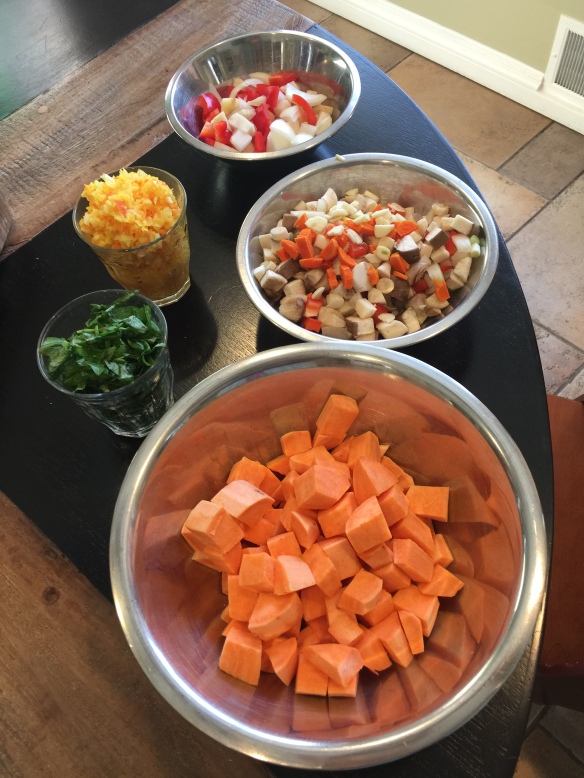
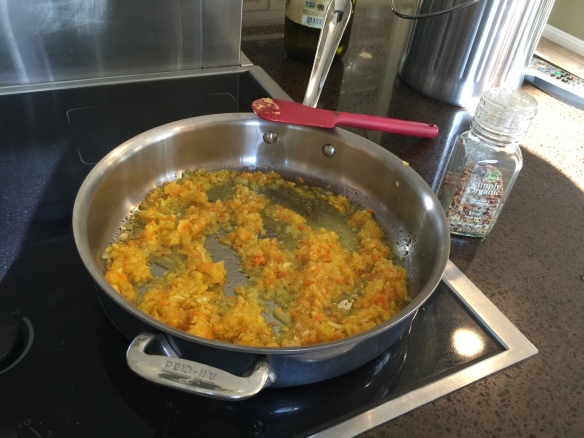
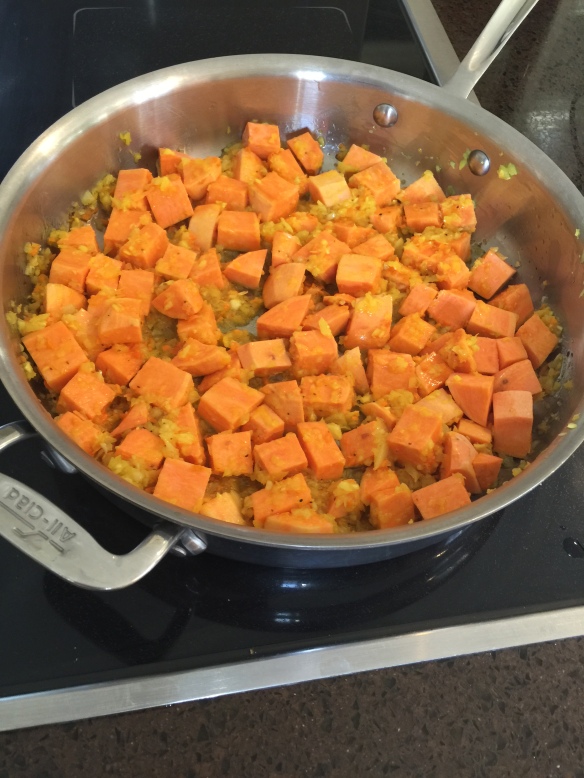
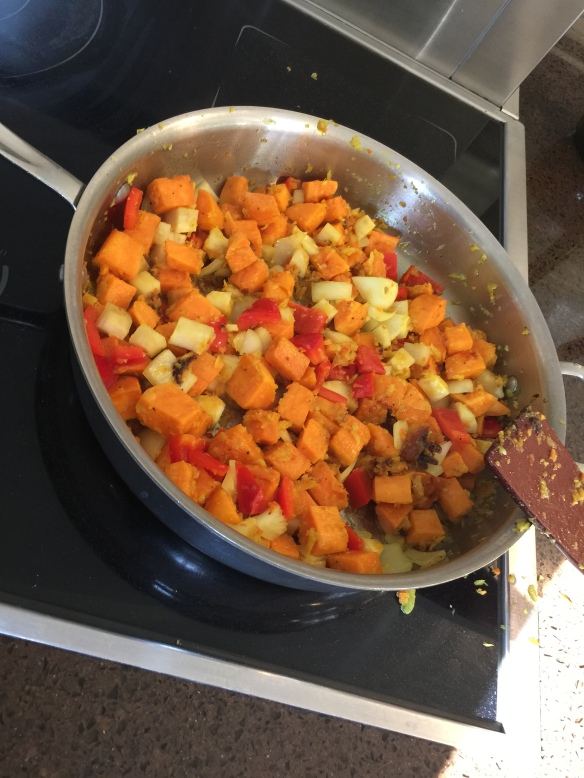
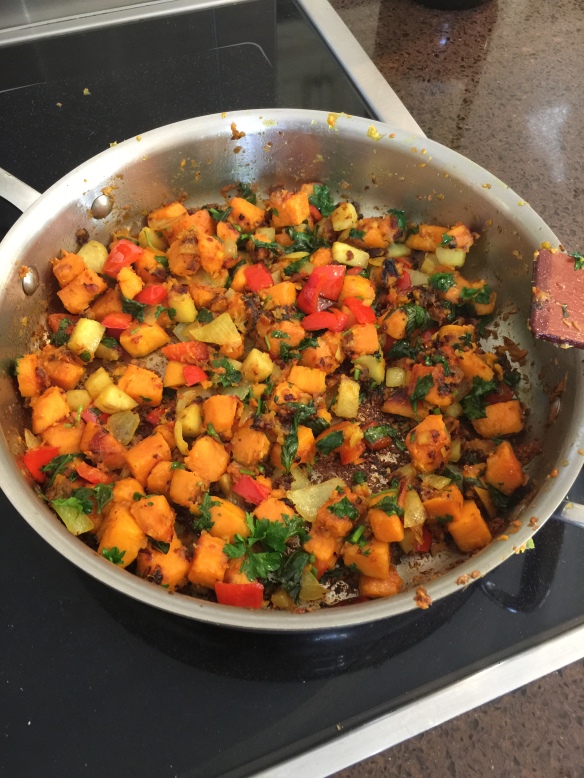
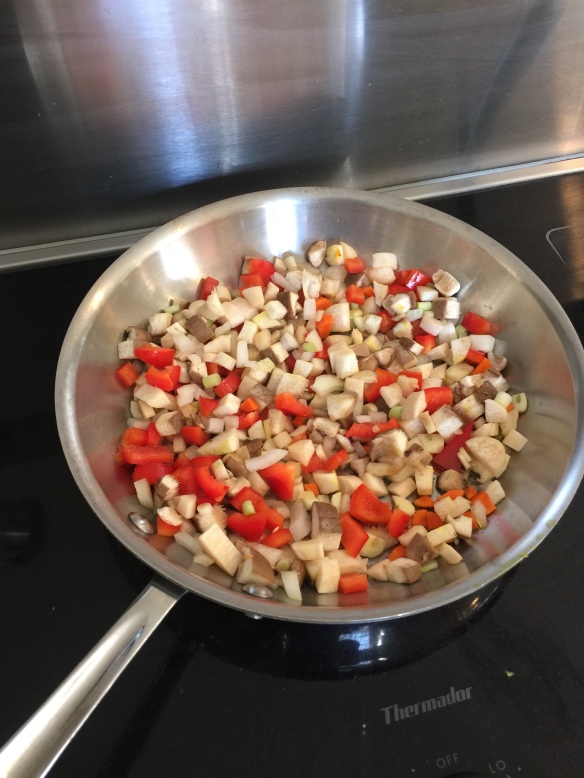
Dish No. 1 was sweet potato hash, and Dish No. 2 was vegetable scrambled eggs. First, I diced/processed my veggies and arranged them for those two dishes.

IMG_1196

In this photo, the middle mixing bowl contains the veggies for the scrambled eggs: carrots, garlic, red bell pepper, Jerusalem artichoke, and several sorts of mushrooms. Martin has declared that he doesn’t like mushrooms, so I sneak them in wherever I can; in this instance, the pre-cooked mushrooms will reduce enough that he doesn’t notice them in the scrambled eggs.

Also in the photo are—

a small glass of yellow “base,” which comprised onion, garlic, and turmeric root (there’s that turmeric again!), processed into a paste, which I put first into the pan, along with cooking oil (usually coconut);

IMG_1202

the diced sweet potatoes, which require the longest cooking time, so I added them as soon as the base became fragrant;

IMG_1203

onions and red bell pepper, which I add until well after the sweet potatoes, because they would have burnt before the sweet potatoes were cooked;

IMG_1204

and a glass of minced herbs, which on this occasion were parsley and sage, which went in last, just enough to heat them.

IMG_1211

When the sweet potato hash was about half done, I set the egg veggies to cook in coconut oil, separately.

IMG_1209

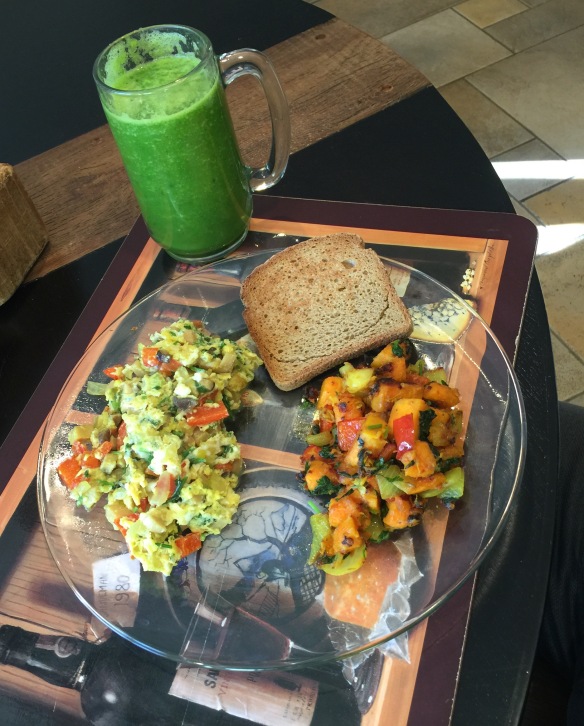
While both the sweet potato hash and the egg veggies were cooking, I prepped the vegetables for juice. I am very into juicing right now. Juice does have “all the sugar without the insoluble fiber,” which is not great vis-à-vis Martin’s yeast troubles. On the other hand, juicing is GAPS-approved and makes vitamins, minerals, and even enzymes rapidly available, which is terrific for those times when Martin is not so into eating vegetables. (Yes, even super-healthy-diet Martin behaves sometimes like an American seven-year-old.) On this morning, I made “green lemonade”: collard greens, celery, cucumber, kiwifruit, green and red apples, lemon, and turmeric. (Again with the turmeric!)

IMG_1208

Finally I juiced, added eggs and sea salt to the egg veggies, and served. For Adrian’s breakfast, I added a slice of toast, made from Canyon Bakehouse gluten-free bread.

FullSizeRender-5

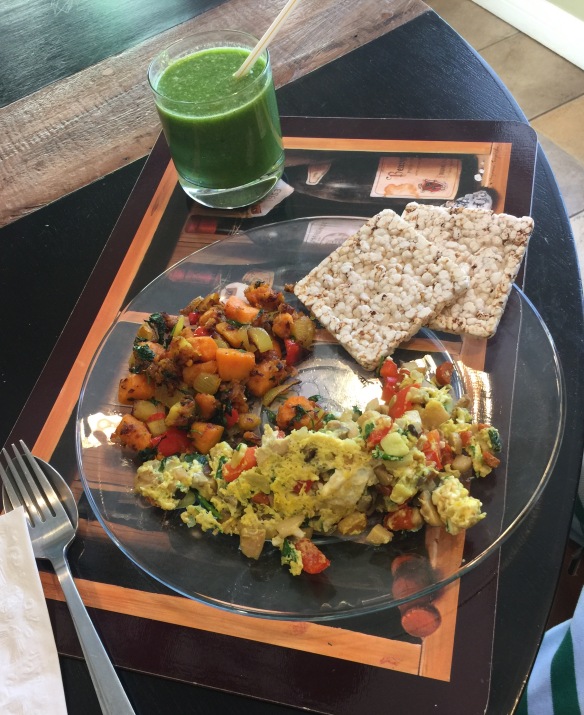
I think the Canyon Bakehouse product is good-quality, but it’s still too starchy and processed for Martin. So when Martin insisted that he too wanted toast, I substituted a couple Lundberg Family Farms Red Rice & Quinoa Stackers. Not perfect. Still a grain. Still processed to some degree. But these “toast crackers” made Martin happy and brought peace to breakfast.

FullSizeRender-6

I don’t eat eggs. For my breakfast, I ate the sweet potato hash and drank the juice, and substituted the eggs with Fakin’ Bacon, which is spiced organic tempeh. I try not to eat too much soy; when I do consume soy, organic and fermented is the best way to go.

And I almost forgot: There was one more item that brought peace, and for me and Adrian, a lot of joy, to the morning kitchen—

IMG_1210

Food Porn: Pasta and Broccoli With “Cheese” Sauce

I’ve been lax about posting recipes and cooking tips, which is strange because the No. 1 recovery-process question I get remains, “What does Martin eat?” Many people still find it hard to fathom, in this day, a diet of minimally processed foods; focused on fresh and organic; free from gluten, dairy, corn, soy, refined sugar, and most grains or starchy vegetables; that includes daily bone broth and probiotic/fermented foods; with meat (other than broth) limited to one serving daily; and that is prepared 90% from scratch. I don’t blame them. Before I started this journey, I wouldn’t have known how to manage it at all.

Time to post a few examples of how breakfast, lunch, and dinner look for Martin. Exhibit One shall be this relatively simple vegetarian dinner, which our whole family, including pescatarian Adrian and vegan me, can enjoy: pasta with broccoli and “cheese” sauce:

FullSizeRender-4

The “cheese” sauce—you won’t believe me until you try it—is delicious. The recipe does call for potato, which we generally try to avoid; fortunately, the overall potato content ends up being low, on a per-serving basis. I happened upon the “cheese” sauce recipe when a friend posted the link on her Facebook page.

Of course, I make alterations. I generally try to soak and dehydrate the cashews before I use them, though I may not always manage. I like to replace the garlic powder with a clove or two of raw garlic. I also usually add an inch or two of peeled, fresh turmeric, throwing that root into the cooking water at the same time as the potato. (If you read several of these posts, you’re going to uncover a sort of turmeric leitmotif. I add fresh turmeric to almost everything—including (some) desserts and snacks.)

The pasta is Tolerant brand penne, which lists, as its only ingredient, red lentils. I love the idea of one-ingredient pasta, especially when the ingredient is organic red lentils. That being said, I do have questions about Tolerant, especially how exactly the lentils are processed into pasta, i.e., what the lentils undergo and how they eventually stick together. My friend Stacey and I once found Tolerant’s representatives at a food trade show and peppered them with questions about their processing methods; citing trade secrets, they wouldn’t reveal anything, so I still have concerns. Sometimes the best you’ve got is the best you’ve got, and right now, for pasta, I think Tolerant is the best I’ve got.

(Monday afternoons, Martin and I visit the organic grocery. He loves to run to the Tolerant aisle and yell, “Mommy, do we have enough pasta?”, then dump four or five boxes of the penne into my cart.)

Sometimes I add slivered almonds or pine nuts to this dish. In the version pictured above, the final ingredient was steamed broccoli. I cooked the broccoli before the pasta, saved the leftover steaming water, which absorbs some broccoli nutrients, and cooked the pasta in that water, hope to transfer those nutrients to the pasta. Long shot? Probably.

A tasty entrée that paired well with salad? Definitely.

New Year!: We Zipped by a Whole Foods Market

There are times when I should trust my instincts.

Remember when I thought Martin was having a yeast flare, but went with the plan of his his doctor, who didn’t think yeast was the issue?

I was right. Yeast was the issue, and by not addressing yeast directly and immediately, I let it get worse. By four days into our Utah trip, Martin’s skin was a mess. That’s his “tell,” for candida. He gets a mild rash on his legs and belly, which spreads to his arms and backside as he scratches and scratches until he’s covered with bloody nicks. It’s awful. December 30, though we rubbed balm from head to toe, Martin could not stop scratching, and I was washing little spots of blood off his sheets and clothes.

I messaged his doctor, attaching photos. She agreed that we needed to take immediate anti-yeast measures and suggested Martin go back on Candex. This time, I supplemented her opinion with my own and decided to kickstart the new treatment with two weeks of Candidase.

. . . Which explains why, New Year’s Eve, after getting up late and skiing and meeting Adrian’s colleague for a drink, I insisted on driving to the Park City Whole Foods Market for Candidase and Candex.

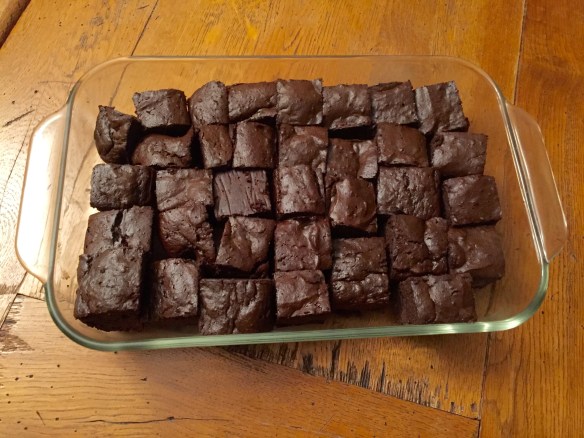
As I wrote this, one week after New Year’s Eve, the situation has improved dramatically. Candidase works best on an empty stomach, so each night after 10:00 pm, I slip into Martin’s room and give him two Candidase capsules, which he swallows without waking. I do the same thing before 6:00 am, and he takes a third dose immediately after school. For the time being, I’ve cut the already sparse grains from his diet, and tried to further limit natural sugars. Last Sunday, just after we returned to New York, I baked semisweet spinach brownies, which are nut-free (appropriate for school snacks) and better than they sound.

FullSizeRender-2

Whenever possible, I’ve been substituting those for the Lärabars Martin loves, which are healthy but, because of the dates, high-sugar, at least by my standards. Instead of a (grain-free but still sweet) baked good like banana bread, Martin has been eating vegetable omelets, sometimes with turkey bacon, for breakfast.

FullSizeRender-3

Martin still scratching, though much less. His belly looks good. His arms and legs are beginning to heal again. He is comfortable.

Honestly, I am disappointed that Martin has had yet another yeast flare. I had hoped that, by this time, his system would be healed enough to keep candida in check.

But who’s got time for wallowing? I’m in battle.


New Year!: We Met One of Adrian’s Colleagues for a Drink

New Year’s Eve, for our après ski, we met one of Adrian’s colleagues at a distillery. This particular colleague, like most, doesn’t know our son has autism, and whereas the colleague has typically developing children in the same age range, he would be able to spot any differences. We didn’t want Martin to “stand out.”

One way Martin still stands out is ordering food. When we are in a restaurant, he likes to order by himself. That’s fine, if we are in a restaurant whose menu we already know. When we are in a new restaurant, I have to ask eight million questions. The hamburger—is that just ground beef, or is the beef mixed with bread crumbs? The sweet potato fries—do they have any breading or coating? What kind of oil are they fried in? What else is fried in that oil? The grilled calamari—could we get that without the garlic butter? And the whole time I’m asking, Martin interrupts, usually to yell what he wants: No, no! I can get the calamari! Can I get the calamari? I don’t want salad! Occasionally he also has a mini-meltdown over what’s available (or not available) for him to eat, in which case I take his hand and lead him outside until he calms down.

So we were glad to arrive twenty minutes before Adrian’s colleague, have a chance to peruse the menu (the colleague suggested the location), and come up with the best option, both nutritionally and in terms of avoiding a meltdown. By the time the colleague joined us, Martin was occupied with my iPhone while happily downing a grass-fed steak and French fries cooked in canola oil.

Wait. Potatoes? Canola oil? Do we allow Martin to eat potatoes and canola oil?

Generally speaking, we do not. Potatoes are an occasional summertime treat, organic and roasted on our outdoor grill. Canola oil almost never works. Most canola oil comes from genetically modified crops, and even non-GMO “Canadian oil” is refined (hexane-processed?), bleached, degummed, deodorized rapeseed oil in which omega-3 fatty acids have been turned into trans fatty acids. Why would I let Martin ingest that?

Well, because we were traveling, and when we travel, and encounter new situations, and have to “perform,” some restrictions loosen. A bit.

Traveling, depending on where we go (for example, I can do more at my parents’ in Texas than I can in a suite in Chicago), alters:

  • Diet, to a modest extent. Martin’s diet is always free of gluten, dairy, soy, corn, and refined sugar. Beyond that, some specifics slip, including the aforementioned potatoes and canola. It can be hard to ensure organic food, or even non-GMO. He might also miss a day or two of broth. We traveled to Utah on a Saturday. He went without bone broth Saturday, Sunday, and Monday. By Monday afternoon I’d got my hands on a marrow bone and simmered a pot of broth.
  • Cookware. Even at home, my cookware isn’t perfect. Stainless steel remains puzzling, in terms of purity, and I’m never sure if my cast iron is seasoned properly or clean. In any event, at home I cook with All-Clad and cast iron, with mostly stainless-steel or wooden utensils. Whenever we travel, we rent accommodations with a kitchen, and unless we are staying long enough to justify a purchase—for example, when we were in Europe for ten days and I bought a fine strainer and a pot, both of which I brought home—I use what comes with the place. That might mean a plastic spatula, or even, egads!, nonstick pans.
  • Detox baths. At home, Martin takes two or three detox baths (two cups Epsom salt and one-half cup baking soda) a week, depending on whether he’s also used the sauna. Epsom salt is heavy to carry, and I don’t always trust other bathtubs. What product was used to cleaned it? Could I rinse it well enough? There is no point in trying to detox Martin in a tub with excessive chemical residue.
  • Exercises. Right now, we don’t have HANDLE exercises to do. Martin does, however, have four short exercises per day for his vision/neuroplasticity. At least, he has four short exercises when we are not on the road.

We do have absolutes, stuff that doesn’t change, regardless of where or when we travel. Martin takes his supplements, always. I’ve handed him pills in rental cars, measured drops at airport gates, mixed powder into restaurant beverages. I also find him fermented foods, daily, wherever we are. Martin no longer takes probiotics, so fermented foods are his probiotics. Plus, it’s easy enough to find sauerkraut or another cultured vegetable these days, if not kombucha.

The last absolutes? Love, and plenty of attention. Martin always gets those.

ASD Recovery Recipe: Smoothies

Alert: This isn’t really a recipe. But it is a food post that could be construed as instructional, and it includes a colorful photograph. That’s recipe enough, right?

When we were vacationing in South America a few weeks ago, Martin and I paid several visits to the hippie-van-cum-juice-stand parked on a beach. Although the fruit and vegetables weren’t organic (organics are hard to find, in Adrian’s country of origin), they were fresh, and the lovely couple running the place created sugar-free (not counting the naturally occurring fructose) smoothies that Martin loved. I was inspired to try making smoothies at home.

Until now, I’ve been discouraged in smoothie endeavors because I can’t figure out when I would give one to Martin. He already has so many liquids in his day. Breakfast always includes 12 ounces of bone broth. For school I send a LifeFactory bottle filled with Fiji water and a splash of organic juice, which he drinks throughout the day. After school he takes eight ounces of camel milk with cinnamon. Then with dinner he gets another 12 ounces of bone broth. Whenever he wants it, I give him filtered water. Where would a smoothie fit in all that? As it is, half the day he’s got a straw in his mouth.

I’ve also wondered if the amount of sugar (fructose) is worthwhile, in comparison to a smoothie’s total nutritional profile. I thought about adding protein powder to boost that nutritional profile, but for Martin I shy away from protein powders, because even the best-quality organic ones seem fractured, or processed, or otherwise not complete foods. The South American beach folks, I noticed, were adding cashews or walnuts into smoothies without compromising the fruit flavor. Nuts! That’s like natural protein powder ground into the drink. Inspiration.

When we got home to New York, I decided to go for it. I found a time: Saturday morning breakfast. True, Martin has soup to drink. But we have a lot more time than a weekday before-school breakfast. Weekends I cook a big breakfast for Adrian and Martin: vegetables, eggs, fruit, avocado, nuts. It seemed like a fine time to add a smoothie. Here’s the concoction I devised:

kombucha, as liquid base

fresh berries

pineapple chunks

pre-sprouted cashews

fresh basil leaves, for the exotic touch.

Big success! Adrian loved it. Martin felt special. Henceforth, weekend mornings are smoothie mornings.

My first smoothie, with the ingredients listed in this post.

My first smoothie, with the ingredients listed in this post.

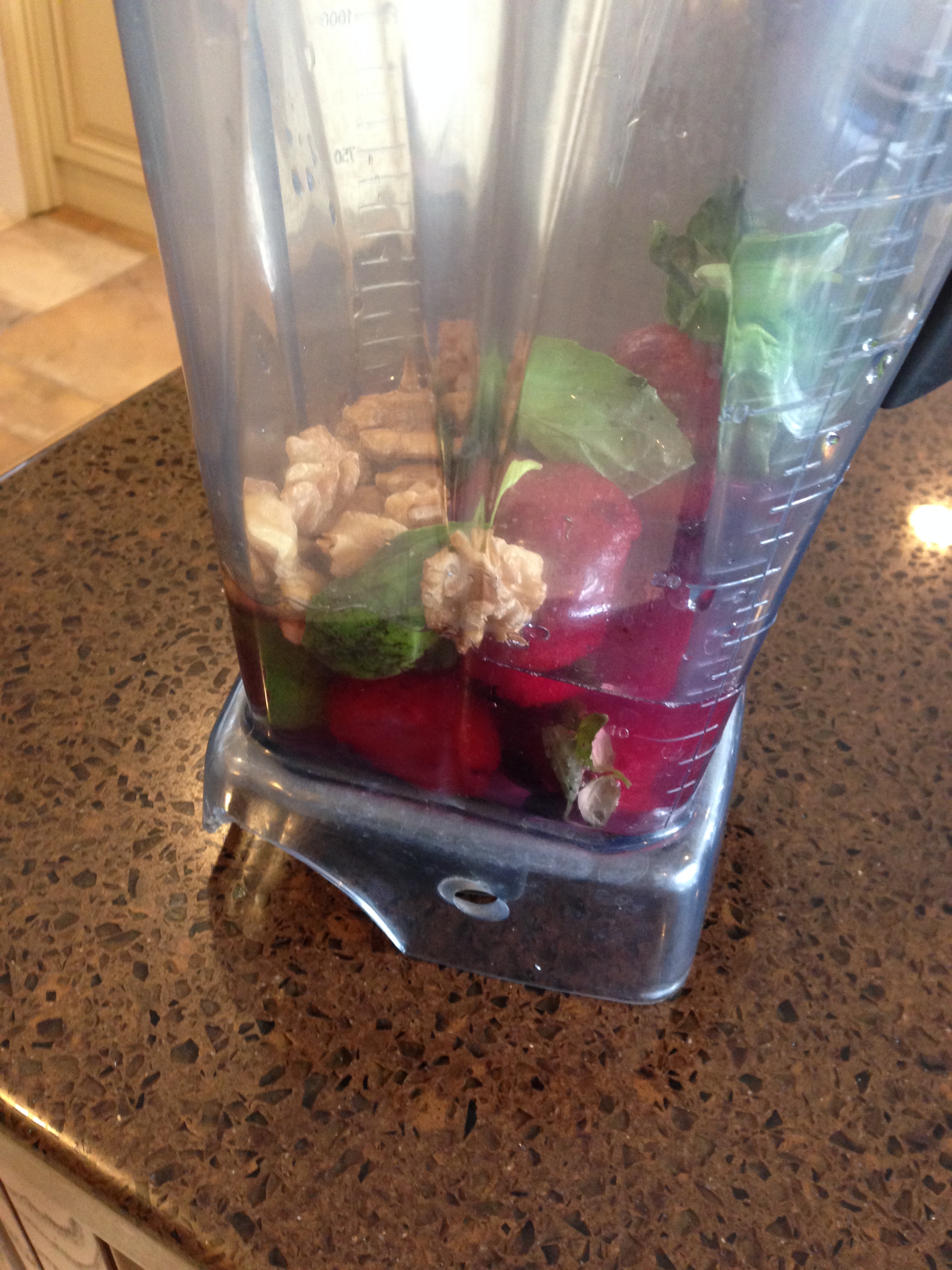
The second time I made a smoothie: Frozen organic berries, sprouted walnuts, basil, and water.

The second time I made a smoothie: Frozen organic berries, sprouted walnuts, basil, and water.