Plan B

My poor blog. I’ve let her whither. Thank you to everyone who left comments or emailed (findingmykid@yahoo.com) to say you missed new posts. It is beyond gratifying, to know my words are being read.

By way of explanation, I few weeks ago I fell ill. Nothing life-threatening; I’m on the mend now, and going to be fine. Nevertheless, I required a blog vacation.

Vacation’s over.

Since I stopped working as a lawyer, back in January, Martin’s recovery has felt like less of a burden.

(I use that word—burden—conscientiously. Martin’s path is a burden, for our whole family. I don’t pretend otherwise, and I know that one day Martin may read these words and regret that his condition burdened us. For Martin I note that all parenthood, by its nature, is a burden. Adrian and I chose that path, we’re glad we did, we would not want any child other than Martin, and the effort that we expend is repaid a thousand-fold every today that Martin manages some feat he couldn’t do yesterday.)

(Cripes, that was sappy. Sorry, Martin.)

The first morning I became sick, I experienced the full burden again. I woke cramped and barely able to stand. I needed half an hour to believe I could do anything more than lie in bed and moan.

In the pre-autism-diagnosis days, I would have asked Adrian to take Martin to the diner for breakfast and leave me alone. In the ASD recovery world, Martin’s breakfast must be made fresh, at home, and his morning supplementation routine takes an hour to complete, and unless I’ve made advance arrangements, I’m the one who must complete those tasks.

So I did. I dragged myself to the kitchen and fried a duck egg in fat with broccoli. I counted pills, measured oils, stirred powders into tea. I alternated standing at the counter, sitting on a stool, crouching on the floor. Finally I scribbled a shopping list and sent Adrian and Martin to Fairway, to buy myself some peace.

That was Saturday. I muddled through until Tuesday, and then wound up in the hospital, whereupon Martin’s nanny Samara interrupted her own life to come take over my home. Together we made it work until I was steady on my feet again.

Here’s the point: I don’t have a Plan B. I am the one who knows Martin’s routine, to a speck. If I am incapacitated, Martin’s recovery stalls until alternative arrangements are made. That’s what feels most challenging these days—being on call every moment, not having emergency time-off. It makes me realize that I’ve really got to take care of myself, if I’m going to take care of Martin.

Okay. I got the kvetching out of my system. Lest my readers think I’ve returned to blogging only to complain, let me end with the following three points:

1. Lacking a Plan B is no more than what most single parents face, day-in and day-out, whether their children are neurotypical or not. Moreover, many families lack the resources to have a functioning Plan A in place. In so many ways, I am blessed.

2. I’ve returned to blogging! Taking a month off, and receiving so many comments and emails during that time, makes me realize just how therapeutic this writing process has become.

3. Last week Martin and I were having breakfast. Adrian had finished his breakfast and gone to prepare for work. Unprompted, Martin addressed me and remarked, “I hear Daddy blowing his nose upstairs.” Martin expressed neither a need nor a want; he formulated (perfectly) that sentence solely for the purpose of sharing an observation with me. At that moment I needed no break, no Plan B, no time off. Plan A is working. That will do.

Happy to be back.
Update on Update on Questions

Remember last week’s update on questions? Specifically, my update on the fact that Martin doesn’t yet ask questions?

Time for an update on the update on questions. Martin has added to his repertoire three new requests for information.

The first two are rote questions. When we’re on the subway and stop at any station he doesn’t recognize, he says, “What street is this?” Our conversations shuffle along with the train:

Martin: “What street is this?”

Me: “Spring Street.”

Martin: “It’s Spring Street!”

Me: “Sure is.”

Martin, as the train leaves the station: “Bye-bye, Spring Street.”

Me: “That’s it for Spring Street.”

Martin: “What street is this?”

Me: “It’s Canal Street.”

Martin: “It’s Canal Street!”

Me: “Looks that way to me.”

You get the idea.

Also, Martin is routinely asking, “Where is _____?” This morning at breakfast he inquired, “Where is the flute?” Which would have been really great, if I’d had any idea where the &*$@ the toy flute was. As it was, I had only disappointment to offer.

The third type of request is meant to be a question, but Martin doesn’t have the form correct yet. When he wants to know the initial letter of a word, we have an exchange along these lines:

Martin: “Bowl starts with a . . . .” (His voice trails off. He doesn’t get the inflection correct for a question, neither the Spanish inflection nor the English.)

Me: “Oh! Do you mean to ask me, ‘What letter does bowl start with?’?”

Martin: “What letter starts with bowl?”

Me: “‘What letter does bowl start with?’ Bowl starts with a b.”

Martin: “Bowl starts with a b!”

In summary, we have experienced progress since my update on questions. Maybe all I need to do for progress is to post an update? In that case, more updates coming. Soon.

Update on Imagination

Yesterday’s post—the update on questions—begs a follow-up: an update on imagination.

Before Martin was diagnosed, when we were investigating local preschools, Adrian and I spent twenty minutes in a Montessori classroom for three-through-five-year-olds. There I observed one boy, probably a three-year-old, engaging in several minutes of independent pretend play. He found a cloth square and an empty bottle and employed both to “clean” a mirror, swishing back-and-forth, examining his work and checking (I assume) for smudges, then re-polishing the spots he’d “missed.” It impressed me, to see him working so hard at an imaginary task. I recall thinking, Gosh, Martin doesn’t play like that, and then telling myself, Give him time.

Almost 18 months have passed since we visited that Montessori classroom, and Martin still doesn’t play like that. (And now, of course, I believe that the answer lies with intervention, more so than with time.) Imaginative play, it seems to me, does not emerge spontaneously from the linear thinking of an ASD kid. At least, imaginative play in the traditional, “creative” sense does not emerge spontaneously; on the other hand, I’ve seen many examples of quasi-imagination in ASD kids and adults, in terms of viewing problems or issues in unexpected ways.

Martin may be turning a corner in this arena, too. Over the past four days, I have jotted down four instances of Martin apparently using his imagination.

1. At his cranio-sacral therapist’s office, Martin picked up a bunny toy that makes a bell-like sound when jostled. Martin shook the bunny repeatedly, heard the sound, and said, “The bunny is playing the xylophone.” Then he moved the bunny to another area, shook it again, and said, “The bunny is playing the xylophone outside.”

2.  Martin was playing with a favorite toy, a pirate ship that he calls a “sail boat.” He rearranged the positions of the wooden pirate figures, then told me, “The pirates are sleeping in the boat.”

3. Martin loves guitars and often has one in hand, anything from a three-inch Christmas tree ornament in the shape of a guitar to a near full-size instrument. Yesterday, walking around with a guitar, he encountered an old stuffed bunny. He paired the toys and announced, “The bunny is going to play the guitar.”

4. On his Thomas & Friends train set, sitting alongside Thomas and Molly and Henry and Rosie and the others, Martin keeps a couple of miniature NYC Transit subway cars. One from the 6 line and one from the C line, to be exact. I noticed him playing with those two cars and asked what he was doing. Martin responded, “The C train is holding hands.” (The C train, I assume, was holding hands with the 6 train. Martin did not specify.)

If someone had told me, two years ago, that I would grab a sheet of paper to make a note every time my son shows imagination, I would have scoffed.

No scoffing today. Neural repair happens brick by brick by brick by brick, and it’s important to keep track of what’s being laid where.

Or so I imagine.

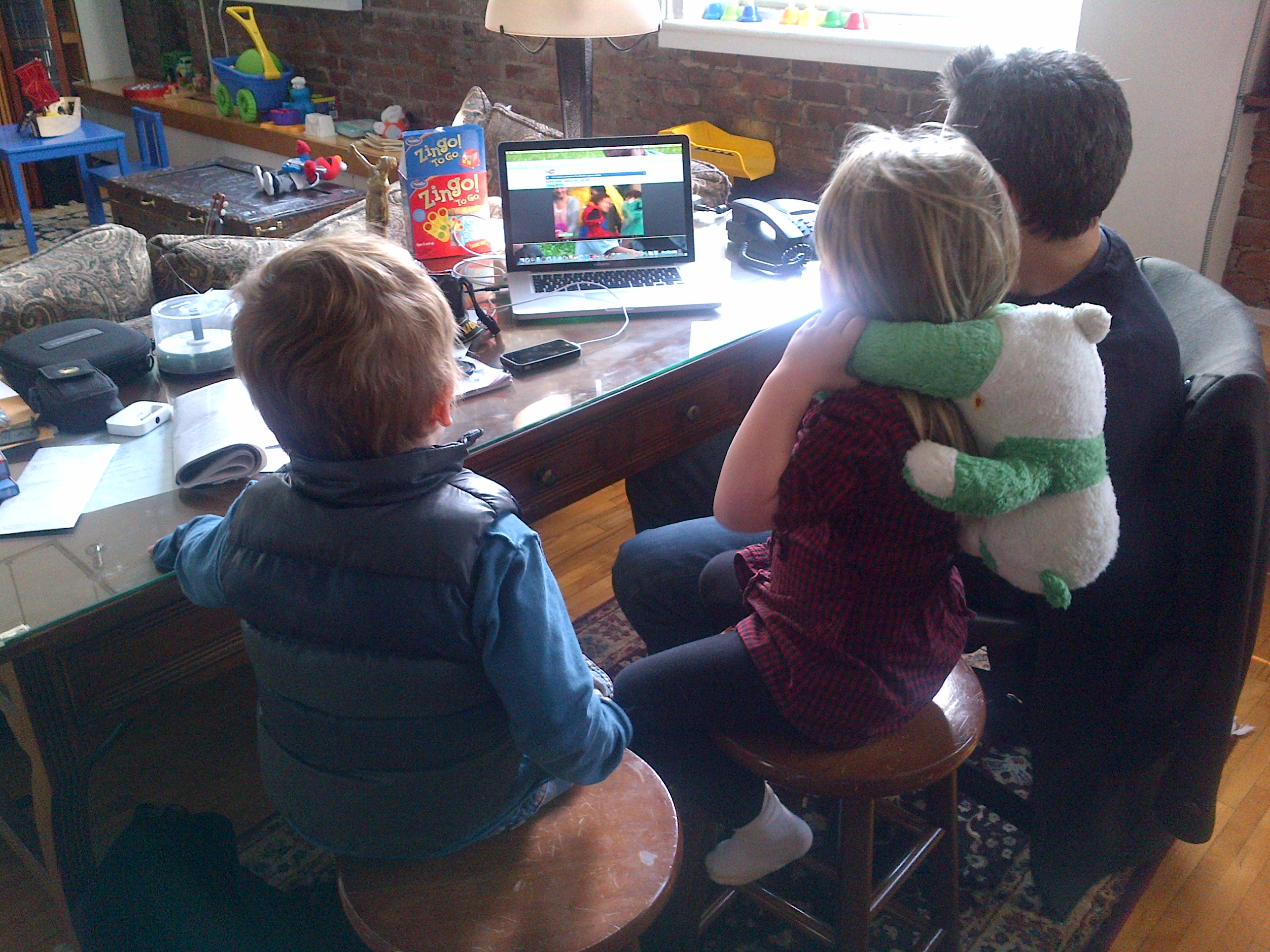
Martin, checking out some videos with his cousin and Adrian.

Special Guest Author: My Law-School Roommate on Jammin’ With Martin

Last weekend my law-school roommate, who lives in New Jersey, brought her daughter, Mieko, over to play with Martin. Mieko is five months older than Martin, and the most wonderfully bossy little girl, and one day she’s going to marry Martin. I’m quite confident of this; I’ve been planning the wedding since Martin was born.

(“‘The engagement between them is of a peculiar kind. From their infancy, they have been intended for each other. It was the favourite wish of his mother, as well as hers. While in their cradles, we planned the union . . . .'” Jane Austen, Pride and Prejudice.)

Those far-off nuptials, however, are not the topic du jour. Instead, the day after I dropped my erstwhile roommate and her daughter off at the New Jersey ferry, I received a message through Facebook, which I reprint here, unedited other than the pseudonyms:

It was great seeing you, Adrian, and Martin yesterday.

I wanted to tell you something in the car and didn’t get a chance to. I remember you told me a while ago that Martin could not participate in a kiddie gym class because he was not able to follow what the other kids were doing and would go off and do his own thing. Well, yesterday, I noticed that that was not an issue for Martin anymore. Remember when we were having our jam session? I was on acoustic guitar, Mieko was on electric guitar, you were on tambourine, and Martin was on harmonica. He was definitely aware that we were all playing music together. Not only was he aware that we were having a jam session, but he also noticed a certain someone (Adrian) who was off doing his own thing and was not participating in the group activity! He then proceeded to pull over Adrian to the piano so that everyone was participating together!

What was impressive was that we weren’t all doing the same activity, like everyone hopping on one foot or everyone clapping hands. All of us were each doing something different with different instruments, and yet Martin recognized it as a coordinated activity where each person, doing something different, was together working toward the same goal of creating music. So playing the piano was acceptable to him, but looking at the computer screen was not. I am no expert on child development, but doesn’t that require an awareness of others at a level that three-year-olds don’t always have?

Anyway, the jam session was very fun and very cool!

I take issue with only one part of this message: With twin seven-year-old sons at home, plus Mieko, my roommate by now is an expert on child development. And that makes what she wrote all the better.

A boy and his cat. Martin and George, tuckered out from a hard day of playing with friends.

RDI Fun

“Wow! The sun is really reflecting light off that building,” I remarked at breakfast last Thursday. I made a show of gawking through the kitchen window.

Martin, seated at the counter, fiddled another second with a toy, then turned to look out the window.

Score!

“It’s so bright it kind of hurts my eyes,” I said.

Martin shifted his gaze to me and replied, “It’s bright.”

Double score! I scrawled a few words in my countertop notebook and let several minutes pass while Martin ate breakfast.

“When the sun is still rising, it’s much lighter outside these windows”—I inclined my head to the kitchen window and other west-facing windows—“than it is outside those windows.” I finished with a dramatic point across the room to the east-facing windows.

Martin checked the kitchen window once more, then compared the east-facing windows.

Score! I made another note and let a few more minutes pass.

“It looks like it’s starting to get cloudy,” I said.

Pause.

Nothing.

I decided to add some “scaffolding.”

“I was looking out the window,” I said, “and I noticed that it looks like it’s starting to get cloudy.”

My words alerted Martin. He looked at me and then out the window. “It’s cloudy,” he said.

Score!

And so we went, through breakfast. Observation. Reaction. My gaze. Martin’s gaze.

This odd game is part of a behavioral therapy, Relationship Development Intervention, or RDI, that we do with Martin. Although I meet regularly with our RDI consultant, the program is intended to be family-based and driven through everyday interactions. It rests upon “guided participation,” wherein I serve as a mentor to Martin, helping him master the basics of social interaction. RDI for ASD covers approximately a gazillion milestones, and I have found it challenging to get my arms around the program.

Nevertheless, our consultant is patient, and on occasions like last Thursday’s breakfast, I see the logic behind the RDI strategy. Right now we’re working on Martin’s ability to read facial expressions. Ideally, Martin would show sustained interest in me during breakfast. He would check my face regularly, and if he noticed me staring in some direction, he’d also look there, for clues to what’s going on.

That’s what neurotypical persons generally do. For example, this afternoon I walked into my bank and saw several patrons and staff craning their necks to look at the high ceiling. So I looked, too. I just did. And before I had a son with ASD, I would never have thought twice about the moment. (A ceiling vent was emitting ash, it turned out.)

Martin, on the other hand, does not automatically make such observations, at least not yet. So I’m teaching him to do so. I look out the window. I give Martin a chance to notice and to look out the window, too. If he doesn’t, then I add some “scaffolding”—that’s RDI-speak for “extra help”—by making some verbal observation. I give Martin another chance to catch my clues. If he doesn’t, it’s time for more scaffolding. I might point, or make my comment more explicit, such as when I said, “I was looking out the window and ….”

At all costs, I avoid using the imperative. Martin, look out the window, is a no-no. So is an imperative hidden in a question, like, Can you look out the window? RDI sets a goal of 20% imperatives, and 80% “observations,” “emotion sharing,” and so forth. That’s probably the toughest component. When you have a child on the spectrum, the day can easily dissolve into 99% imperatives. Martin, eat your breakfast. Martin, chew. Hurry up! Martin, can you put your shoes on? Martin, come here and brush your teeth.

We’re also playing little games to work on facial observations. Over the weekend I placed three identical boxes upside down on the rug and hid Martin’s miniature guitar under one. With facial expression alone I indicated which box was harboring the guitar.

Martin showed no interest whatsoever.

I scaffolded. I removed one box, arranged the other two on either side of me, and nodded dramatically toward the correct box.

Martin started to get up.

I scaffolded some more. “I think the guitar is there,” I said while nodding.

Martin perked up and lifted the correct box.

Mini-score! Score with extra scaffolding!

I’ve got the mantra ingrained by now: ASD recovery is a marathon, not a sprint.

Even the little victories count.

(Careful readers might be wondering why the rising sun shines brighter through our western windows than our eastern windows, given the sun’s proclivity to rise in the east. The anomaly happens because a taller building blocks our eastern exposure, while our western exposure is open to, across an expanse, office towers whose windows throw the sunbeams back toward us. Ah, city life.)

Special Guest Author: My Mother on How Martin Learned to Ride a Bike

Martin is riding a bicycle. Though the weather has been mild, it’s still New York City winter, meaning that so far he rides only in our apartment. He zooms around the main room’s hardwood floors, daredevil skidding the curves, calling “I need help!” when he pedals himself into a jam—for example, when he manages to wedge his bicycle between the loveseat and the wine rack, a real hazard for the novice indoor cyclist.

I wanted to post about how Martin learned to ride the bicycle. But as it happens, I had no idea, because the event occurred while Adrian and I were in Israel. Martin stayed home that week with my mother (who appears frequently in this blog) and, for part of the time, with my brother Eddie, a bachelor with an endearing fondness for Martin. (You may recall me waking poor Eddie at midnight and dragging him halfway across Maine on a thermometer quest. He went willingly. Enough said.) So I asked my mother to describe Martin’s learning process. She wrote:

When I was watching Martin in December my youngest son Eddie joined us for five days. Eddie and I decided that it was time for Martin to learn the art of pedaling a tricycle, something that had eluded him up to that point. We drove to Toys “R” Us to buy one and were dismayed to find that tricycles these days all seem to be made of plastic, which was unsatisfactory. We settled instead on a small metal bicycle with training wheels and lots of eye-popping color.

Martin did not seem particularly interested in the bike, but we sat him on it for a few minutes at a time, every so often, with Eddie making Martin’s feet work the pedals (his feet kept slipping off) while I pushed and steered. On the second day Martin was able to keep his feet on the pedals long enough to propel himself two or three yards, but for some reason he would then pedal backwards, which applied the brakes. On the third day we put him on the bike and something seemed to click! Martin pedaled around the apartment effortlessly on his own! Also, to our surprise, steering did not seem to be an issue. It came naturally. Once Martin is able to ride his bike outside, I think it will be only a short time before the training wheels can come off.

I think my mother may be too optimistic—typical grandparent!—about the training wheels coming off, given Martin’s continuing issues with balance. Nevertheless, Martin has achieved something wonderful. First, pedaling a bicycle, especially in unison with steering, takes coordination, and no doubt also improves coordination over time. Second, I’m always looking for activities that build Martin’s strength, given ASD kids’ low muscle tone. It’s a double-blessing to find one that he enjoys so much.

Big thanks to my mother and Eddie for making Martin mobile on two wheels (plus two tinier wheels…).

So Far Gone

The week before last I posted about what’s disappeared: lethargy, toe-walking, aimless drifting, low muscle tone, sleep problems, clumsiness, and most of Martin’s echolalia. Those are all behaviors that Martin used to have, that he no longer has, and that popped immediately to mind when Adrian and I were discussing treatment costs.

Not long after publishing that post, I was walking home from Martin’s school, pondering his progress, when I remembered “transitioning.” It was a slap-my-own-forehead moment, like, Oh yeah! Transitioning! Until mid-summer 2011, transitioning—i.e., the ability to stop an activity and begin another—had been one of our biggest concerns. Martin’s teachers at his old school mentioned it constantly; moving from the gym back to the classroom prompted a tantrum, as did moving from circle time to table work, or music to snack. We experienced the challenges at home, too. I needed only mention bedtime or going out or a visitor’s arrival in order to upset Martin.

Martin (like most any toddler, I imagine) still has trouble leaving the playground or his best friend’s house. (A five-minute countdown helps. “Martin, in five minutes it’s time to walk home. Five minutes.” Sixty-second pause. “Martin, in four minutes it’s time to walk home. Four minutes.” And so forth.) It’s been months, however, since straightforward change of activity posed problems.

Transitioning is so far gone as an issue that I didn’t even happen upon it when making the case for what we’ve spent on treatment. And I’m not the only one who forgot. “Transitioning?” Adrian asked when I brought it up later. “That’s right. Geez, that was forever ago.”

With a little more consideration, I’ve come up with other issues so far gone that they didn’t make the initial list of what’s disappeared.

Bolting, for example. I can remember a time when I could not pause to greet a neighbor, because Martin would be half a block away within seconds, never once looking back to check his mother’s location. Now, unless he’s really engrossed in a sandbox or something, Martin makes eye contact even from across a playground, keeping tabs on me. Not quite as close tabs as I keep on him, but still.

The inability to sit. I went months without being able to listen to a sermon in church. I was too busy pulling Martin out from under the row in front of us, or chasing him down the aisle, or retrieving him from whoever’s personal space he’d invaded. Last Sunday I heard every word of the sermon, relaxing with my arm around the shoulders of Martin, who was flipping the pages of a book.

Injuring himself. For a time bruises appeared on Martin so constantly that I stopped trying to track their sources. He banged into furniture, fell because he wasn’t watching his step, shook his head so fiercely that he smacked it into walls, tipped chairs over while attempting to arch his back enough to see behind him. Today, if there’s a bruise, there’s an identifiable cause.

Adrian says sometimes that a day will come when this whole chapter will be a distant memory.

I’m working on sharing that dream.

Twenty years from now Martin will be playing U.S. Open tennis, or making his debut at the Met, or accepting a Rhodes Scholarship, and I’ll smack my own forehead and recall, Oh yeah! Autism!

The Tap

I’m middle-of-the-night posting again, via iPad from a chair in Martin’s room. He’s been up for three hours, since 1:00 a.m. I just fed him hazelnut butter on three-seed crackers (my mother makes these with her sunflour blend), in case he’s hungry, and also had him swallow a charcoal tablet, because he’s goofy and demonstrating detox symptoms.

Past middle-of-the-night posting events have sometimes reeked of aggravation and exhaustion. Not so much tonight. Sure I’m unhappy that I accomplished only 90 minutes’ sleep before Martin busted into our bedroom. Nevertheless, this marks the first bad night we’ve experienced since January 15, and only the second bad night since before the holidays. Because I’m not working anymore, I can deliver Martin to school whenever he wakes and has breakfast, then nap until I need to pick him up.

And there are two more mitigating factors. First, I think I can point to a cause of Martin’s nocturnal festivities: We just finished week two of a six-week herbal protocol designed to drive pathogens from his body, and it’s clearly working. His legs have a rash from secreting what his body does not need, and he is making daily progress in overcoming his ASD symptoms. Second—did I just mention this? —he’s doing really well. He is socializing regularly with his classmates and with a neighborhood friend; almost daily we get a report from his teacher detailing some new achievement; and even language (one of two great weaknesses remaining for Martin, along with joint attention in group settings) shows tiny movements in the right direction.

So instead of describing my aggravation or exhaustion (fascinating topics), I will middle-of-the-the-night post about our latest miracle.

Two nights ago, while Martin was eating dinner, I snuck up behind him and tapped his right shoulder.

Martin, in response, turned to look at me.

Ten minutes later, I tried the same exercise again. And Martin turned to look at me again.

Doesn’t sound monumental? Well, he’s never done it before. I suppose he just didn’t have the body awareness, or the consciousness of others and his surroundings, to sense a shoulder tap and realize that it had meaning. Now, apparently, he does.

I tapped his shoulder again at breakfast yesterday morning. No response. But at dinner tonight, I shifted from right shoulder to left and back again, tap-tap-tapping, and each time Martin craned his little neck to investigate. Good enough for me. Right now I don’t require absolute consistency, just evidence that Martin does possess the ability to engage in these neurotypical behaviors.

At Yale University, I’ve heard, undergraduates are invited to join exclusive secret societies via a “tap.” The chosen few are “tapped.”

I’m uncertain whether that means a literal tap on the shoulder. In any case, the events of these past couple days have made me confident that—should Martin choose to attend Yale, and then be selected for secret-society membership—he’ll be ready to respond to that tap.

What’s Disappeared

It’s accounting season. Adrian’s assistant has prepared a summary of what our family spent last year on recovering Martin. Supplements, therapies, unreimbursed doctor bills, plane tickets to see specialists, that sort of stuff. It does not include expenses associated with Martin’s restricted diet, like buying only organic or making weekend farm visits for meat. Nor does it include my kitchen make-over, continually purging plastics and aluminum in favor of glass or stainless steel.

Even without the foods and cookware, the total is a large number. Not astronomical. Not bank-breaking. But large.

“Did you think it would be this much?” Adrian asked me.

I replied, “I’m looking at it like this: If someone told us last January, ‘Give me this amount, and within a year Martin will respond to his name, will make eye contact consistently, will interact with friends, will move like a neurotypical child, and will speak in complete sentences,’ we would have written that check, right?”

“Of course,” Adrian said.

He seemed mildly offended that I’d asked the question. But I was on a roll.

“And if someone told us last January, ‘Give me this amount, and within a year Martin’s lethargy and toe-walking and aimless drifting and low muscle tone and sleep problems and clumsiness will be gone, and his echolalia will be nearly gone,’ we would have written that check, right? Because that’s where we are. That’s what’s disappeared.”

Adrian waved his arm in agreement, putting an end to my roll. “We would have paid ten times so much. You know that.”

“So let’s keep it going,” I said.

And we fist-bumped.

Martin’s Shoe

“I’m not happy with how he’s walking,” Samara said on Monday. She held Martin’s shoe upside down (his foot was absent) and ran her finger along the heel’s exterior tread. “See how it’s more worn here? He’s still landing too much on the outside of his foot when he steps. Shouldn’t his orthotics”—Martin wears custom shoe inserts—“correct that?”

I examined the shoe. I got excited.

“Samara, do you see this?” I asked.

“I do,” she replied. “He’s landing on the outside of his foot.”

“Forget that! Look at the whole shoe.” I pointed to the heel tip, the very end of the sole: “Deeply worn here, tread almost gone.” I pointed to the middle of the sole: “No wear here.” I pointed to the toe, where the tread curved upward: “Lightly worn here. Don’t you get it? That’s exactly the way a shoe gets worn when you walk heel-to-toe. Heel-to-toe, just like you’re supposed to. It got worn like this because Martin doesn’t toe-walk anymore.”

“Hey, that’s right,” Samara said. “He’s had these shoes for a while. It’s been months since any toe-walking.”

My mind jumped to the early days after Martin’s diagnosis, when he drifted on tiptoes despite our pleas for “big-boy walking.”

One more symptom of autism so far behind us that I don’t think about it anymore.

Samara seemed less impressed. “But what about Martin landing on the outside of his foot?” she asked.

“Oh, that.” I flipped over one of Adrian’s shoes and showed Samara the tread, deeply worn along the heel’s exterior. I shrugged. “Martin walks like a penguin, just like his father. There are worse traits to share.”