I Promised an Informative Post About Mitochondrial Support. Sigh

I tell myself often that I should be writing less about Martin’s breakthrough performances and more about the process of biomedical recovery and homeopathy: what his blood and urine test results show, which supplements we’re using, how antimicrobials are affecting chronic Lyme disease, how I’m tweaking his diet and why.

Recall the correspondence I had with Martin’s biomed doctor about the hyperactivity Martin was experiencing. I guessed that the culprit might be a yeast resurgence. The doctor thought we were too quickly increasing borrelogen and banderol—hose are antimicrobial herbs we use treat Lyme disease and bartonella, a common Lyme co-infection—without enough time for Martin’s body to adjust. She suggested that we go off banderol temporarily, and that we build the borrelogen more slowly. Relevant to this post, she also wrote, “Please start the other mitochondrial support as we discussed, as the supplements should help not only ‘floppiness’ but also his ability to handle the anti-microbial herbs.” (She was responding with my terminology. I’m pretty sure that “floppiness” is not a real medical term.)

At the time, Martin had been off target mitochondrial support for a few weeks; we use MitoSpectra, and I was unhappy that our supply of pills had gone bad. I looked into MitoSynergy but decided against it, because its components did not seem to be in bioavailable form, e.g., it has standard B6 instead of p-5-p, and folic acid instead of 5-methyl folate or folinic. I also thought about giving Martin the mito-support elements separately: levocarnatine, CoQ10, B-complex. On the other hand, Martin takes so many pills and drops already. Where possible, it reduces the protocol burden to use combined forms, even if the combined forms tend to be more expensive. And blah blah blah. Meanwhile, Martin was off mito support while I mulled all this.

MitoSpectra’s customer support offered to replace the spoiled pills and told me to keep the next batch refrigerated to prevent them from going bad. After speaking with the biomed doctor, I decided to put Martin back on MitoSpectra. I expected that the mito support would improve Martin’s “floppiness.” I was less certain why the doctor thought that it would help with hyperactivity and overload from the antimicrobials.

It did. Immediately after speaking with the doctor, I took Martin off banderol and reduced borrelogan to just one drop, to start building again from there. That helped. Slight hyperactivity lingered, as did trouble falling asleep, and I worried about starting to build borrelogan again, however slowly. Then the new MitoSpectra arrived, and within a day Martin’s behavior leveled off.

Why? Even after five years of biomed, during which I’ve known that Martin has mito processing issues, I still don’t fully understand how the mitochondria fit into all aspects of Martin’s health. I associate Martin’s mito issues with his lack of energy and low muscle tone; in the earliest days, before biomed, Martin spent continuous hours lying on the floor, usually on his side, usually pushing a toy back and forth or engaging in some other repetitive behavior. We’ve remedied that, and made progress on floppiness and exhaustion. Yet mito issues continue sprinkling their special mischief over Martin’s progress.

Mitochondria organelles are the power plants of human cells. Their job is to turn oxygen and sugar into adenosine triphosphate (ATP), the energy that powers the cells to do their assigned jobs. Mitochondrial disorders, as I understand them, can be extraordinarily serious and can result in complications ranging from undergrowth and developmental delays to seizures. Conventional medical wisdom holds that mitochondrial disease, in the true form, is genetic and incurable, though treatable in ways that may assuage its effects.

According to the CDC, “More research is needed to find out how common it is for people to have autism and a mitochondrial disorder. Right now, it seems rare.” The CDC’s page, I note, has relatively little information about mitochondrial disorder, and much of that limited space is devoted to autism (and, you guessed it, vaccines). The CDC’s need to deny an autism-mitochondria connection makes me suspect that the question is being asked often, and a link in fact is suspected. TACA calls the role of mitochondrial function “[o]ne of the most exciting areas of research in autism spectrum disorder.” Even Autism Speaks (hardly cutting-edge science, in my opinion) offers: “Over the last decade, there has been great interest in the possibility that mitochondrial disorders may underlie some of the symptoms of autism spectrum disorder (ASD). Currently we believe that around 5 to 10 percent of children with autism have mitochondrial dysfunction as the underlying cause of their symptoms.”

Martin has mito dysfunction. That is diagnosed. No question there. So what is the mito dysfunction doing? Why would it cause increased hyperactivity when he’s dealing with antimicrobial Lyme treatment? Maybe cells without a power supply can’t fight the antimicrobial effects like they should. Maybe mito dysfunction keeps the entire system in such precariousness that what should be a mole hill—launching the battle against Lyme—morphs into a mountain. Maybe Martin, even after he functionally recovers, will still need mito support. Maybe he won’t.

The reason I shy from writing about the process of recovering Martin, instead of the victories and setbacks, is fear of admitting how little I understand about that process. (Also, it hardly makes for exciting writing.) I am a humanities-type mom wading through science-y stuff. When I try to write the science, I perceive my own shortcomings.

As of today, Martin is off banderol and rebuilding borrelogen slowly. The hyperactivity has dropped, considerably. Emotional dysregulation, on the other hand, is substantial. Martin is anxious, and having meltdowns.

Despite the mitochondrial support.

Because—who knows?

Clapping. Whispering. Not Simultaneously

I planned to write an informative blog post about the role of mitochondrial support, and how going back on MitoSpectra has helped Martin since last week. But now I’m excited by events at church and want to write about them instead. That other, more informative post will just have to wait. Sorry not sorry.

At children’s time this Sunday—after the Gospel, before the choir anthem—the kids were invited to come sit in the front pew, which was empty, because, well, it’s church. Martin dawdled, of course, and by the time he arrived, the other kids had packed the pew. Martin exclaimed, “I don’t fit!” The congregation laughed. We got him seated. The substitute pastor gave a talk that was too long for little kids, and kind of boring. Still, other than making some funny noises with his mouth, which is a stim he has when his adrenals are stressed (I think), Martin did okay, looking around and enjoying the front pew. Then, after the too-long talk, the substitute pastor asked the kids to stay put for the choir anthem. I got worried; music excites Martin, and I thought he might call out.

He didn’t. He listened as the choir sang “Soon and Very Soon,” a song he knows. It was the Andraé Crouch version, in a setting by Jack Schrader, and in the last stanza the choir began a slow clap. For me (I was tragically born without a sense of rhythm), it wasn’t an intuitive clap: not every beat, hard to hit just right.

Martin began to clap. Not to clap randomly—he started to clap along with the choir, exactly right, exactly keeping time with their slow, challenging clap. I was blown away. It’s long been a challenge to get Martin to keep time with anyone, whether walking, or talking, or running, or playing. Evidently, not anymore. Only one or two other kids clapped, so Martin had to watch the choir and take their cues. He succeeded.

That was enough to make my day. Later in the service, however, Martin delivered even more. His next feat came after communion. He’d already gone downstairs to Sunday school and come back up, carrying a picture. He’d drawn a marching band (that’s a favorite motif) passing in front of the church, and he wanted to point out the details. “This is a trombone, and look, here is the pastor watching them.” The time that Martin picked for his exposition was also announcement time, when the substitute pastor was recognizing birthdays and reminding everyone about the men’s breakfast group and charity gift drive, so I put my index finger to my lips and shhh!ed Martin.

Martin kept talking (predictable) but switched to a whisper. Martin has never whispered unprompted before, and he’s never been able to sustain a whisper more than a few words. Now he switched to a whisper and kept it going, sentence after sentence. The drummer was carrying his drum set, he showed me, and there was a tuba player, and here were all the people standing on the sidewalk applauding. Whisper, whisper, whisper. I didn’t try to shush him again. I ignored the church announcements and whispered back. We whispered an entire conversation.

Before the final song, Martin asked to take his snack and go to the common room, where we have coffee hour. I let him. After a minute he jogged back into the sanctuary. The choir was exiting, down the center aisle. Martin stood just inside the doorway, across the sanctuary from where I was, and caught my eye. I motioned for him to come to me. In days past, Martin would have ignored that and called to me from across the sanctuary, regardless of what was going on. This week, instead of calling out, he came. He jogged, ducking around the choir robes, to my seat and asked quietly, “Um, may I please start eating my snack?” I figured that an adult must have seen him in the common room and, knowing he follows a restricted diet, told him to go ask his mom whether it was okay to eat the snack. (Understanding and conscientious parents? Very patient parishioners? We are so blessed.) “Yes,” I said. “Go ahead.” And he disappeared again.

Later, when I had made my own way to coffee hour, I was approached by a woman I don’t know. She introduced herself and said she’s been coordinating the Christmas pageant this year. (Martin has been cast as “Shepherd No. 2.” He has two lines, which he has memorized.) “I just wanted to tell you,” the woman said, “your son is a joy. He is an absolute joy to work with.”

Boo-yah. Can you see why I decided to leave mitochondrial support for tomorrow?

Guessing Game

Drafted in the morning, on the train, on my way to work:

Let’s conduct an experiment: How well do I understand Martin’s health these days? Can I predict what his super-knowledgable biomed doctor will say?

Martin is in a difficult place right now and has been for a month, ever since we last visited his biomed doctor in California, which was one month ago. Especially at bedtime, but also in spurts throughout the day, he’s beset by so much hyperactivity as to be nearly uncontrollable. The agitation and need for movement are affecting his ability to fall asleep; until nearly 10 o’clock yesterday evening, he was kicking his feet in bed, calling out, springing up to jog down the hall and return to bed. Daytimes, I’ve observed him engaging in his lone remaining repetitive behavior, which is to skip three steps pad-a-bump, run across the room, turn, stop and think (or ponder, or get lost in his own self for a few seconds), and repeat: pad-a-bump, run, turn, stop. Tuesday he did this even in our local coffee shop, pad-a-bump from the cash register to the front door, pad-a-bump back to the cash register. He’s giggly. He’s interrupting and talking over others, without regard for his surroundings. He has some increased sensitivity to sound. He’s so itchy.

Yet, as is often the case, the symptomatic behaviors seem superficial, and perhaps there is a deeper level of healing going on. He is more conversational than ever, answering questions and telling me what happens at school with minimal perseveration. His handwriting has improved dramatically; instead of gargantuan, unsteady strokes, he’s penning tight letters that actually fit on the paper lines. He’s attempting to make jokes, albeit nonsensical, unfunny ones. “I think Daddy’s going to take his hair off his head. Isn’t that funny? I’m just kidding.” He’s bargaining. “Santa Claus knows I didn’t finish my soup? That’s okay. I think Santa looks at the whole year, and I’ve had more good days than bad.” (What does he want from Santa Claus, you ask? Adele tickets. Martin has selected the most phenomenally in-demand tickets on earth and decided that’s what he wants for Christmas.)

Except for the itchiness, which predated our last visit to California, the hyperactivity, repetitive behaviors, and other symptoms began, as near as I can reckon, right when we returned from that trip, one month ago. The sequence was like this: Thursday afternoon we flew from New York to California. The flight was delayed, and Martin wasn’t in bed until 11:00 pm PST, or 2:00 am EST. He managed to sleep until 9:00 am PST, or noon EST. We spent Friday afternoon at the doctor’s and, as part of that appointment, Martin had an LED treatment. Friday evening we met friends (a father and his son, Martin’s age) for dinner, which went well. Martin fell asleep around 10:00 pm PST Friday night and slept well. Saturday was a packed day. We went out to breakfast, and then to see my friend’s new house, and then we drove inland an hour, to spend the afternoon with the same friend’s mother and to visit George the cat, who now resides on the West Coast. It was 6:30 pm when Martin and I returned to our hotel.

That night, Saturday night, our placid California weekend went awry. Martin knew we had to get up early (3:45 am) to drive 40 minutes to the airport, return our rental car, and catch the 7:00 am flight to New York. He was excited about getting up so early. Too excited. He went to bed giddy around 8:00 pm and—I don’t have a better way to put this—worked himself into a frenzy, calling out, laughing, asking whether it was time to get up. Around 9:30 pm, anxiety took over. Mommy! Mommy! Something is wrong! Mommy! I don’t know what’s going on. Mommy, where are you? [I was in the same hotel suite, using my iPad, where he could hear me and see the light I was using.] Mommy, help! Help me! His agitation mushroomed until he was sobbing and even shrieking. In an effort to calm him, I said, unthinkingly, “Martin, you have to stop. You have to stop screaming. We are in a hotel. Someone could think I’m hurting you and call the police!” That foolish statement became a target for his previously unspecific anxiety. Are the police coming? Are the police here? Will the police take me away? No! No! Mommy, tell the police not to come! I don’t want the police to come!

My poor little man was terrified and out of control. At last I took him to my bed, climbed in, and squeezed him until he began to calm. Once the sobbing reduced to whimpers, I released him and rubbed his head instead. Within two minutes from that point, he was sound asleep and I had quiet time to wonder what the hell had just happened.

When I woke Martin at 3:45 am, after just five hours’ sleep, he sprang from bed, evidently cheerful to be getting up at such a special time. I saw no trace of anxiety or giddiness. That day, Sunday, as we traveled home, he seemed restless and uncomfortable, which I chalked up to lack of sleep, but otherwise unremarkable. Sunday evening, however, he became hyperactive and had trouble getting to sleep.

Since that Sunday evening, we’ve endured the hyperactivity, some inappropriate laughing, continued itchiness, and lack of focus. Charcoal tablets help, but not always. We’ve started a new protocol of supplements, antimicrobials, homeopathic remedies, and yeast fighters; I’ve introduced the new elements slowly, and haven’t tied a specific reaction to any. Last week for Heilkunst we cleared a DTaP vaccine, again without a specific reaction, only the same hyperactivity. The hyperactivity is uniformly worst at bedtime, and Martin continues having trouble getting to sleep. He’s woken early a few times but generally sleeps through the night.

So what is going on here?

I have scheduled a short call with the doctor this afternoon. I’m going to write what I think is happening, and then, after I speak with the doctor, I will give her thoughts. I’m eager to see whether we agree.

My own theories: First, I think yeast is at work. I said, even before we went to California, that I believed Martin was suffering a yeast flare. The poor kid is so itchy. He’s scratched his legs and belly bloody. He’s giggly and “drunk.” Second, I wonder whether the LED he had in California might have kicked up some toxins that Martin is having trouble clearing. Maybe?

Drafted the next day, after I spoke with the doctor:

The doctor disagreed with my guesses. While yeast might be a subsidiary issue, she said, Martin’s hyperactivity makes it unlikely that yeast is the primary issue. Hyperactivity has not been a hallmark of Martin’s previous yeast flares, she pointed out. As to the LED, she said that any effects would have emerged during the 25 hours immediately following the treatment. Saturday night, when Martin experienced the anxiety attack that launched this hyperactive period, some 30 hours already had passed.

She admitted that it’s tough to know exactly what’s going on. Her theory: Banderol and borrelogen, the antimicrobials that Martin has been taking in incrementally increasing doses to treat chronic Lyme, are too strong. His sensitive system needs time to adjust. She reminded me that, when we used banderol three years ago, as well as when we used the antimicrobial takuna, we had to increase the dose extremely slowly—sometimes by not more than one additional drop per week. This go-round I’ve been building banderol and borrelogen by about a drop per day each. She asked me to hold the antimicrobials for 48 hours (or four doses, as we dose them twice daily) and she if Martin’s hyperactivity decreases.

I was going to post this blog entry after taking to the doctor. Now I feel like it’s worth waiting another couple days to announce the results of our 48-hour experiment.

Drafted two-and-a-half days after I spoke with the doctor:

Better. Around 6:20 am I messaged the doctor:

I think you nailed the issue. Since we spoke on Thursday, I have withheld banderol and borrelogen (so five doses withheld so far: Thursday evening, Friday morning and evening, Saturday morning and evening). We have seen a perceptible, marked decrease in Martin’s hyperactivity, and Friday night he was able to go right to sleep for the first time in weeks. Yesterday afternoon I took Martin into the infrared sauna for a detox cycle. Going in the sauna really, really agitated him. For an hour or so, the hyperactivity was back, full-force, and then we had some emotional dysregulation. On the other hand, last night Martin went right to sleep again, his pre-bedtime meltdown notwithstanding. What do you suggest? BTW, we have continued during this time with four drops Clovanol daily. Thank you!

Pretty intense, right? And I didn’t even tell her that he had flat-out refused to watch Pride and Prejudice with me on the sauna video screen. “Turn it away from me!” he said. “I don’t want to see it!” That evening, I messaged the doctor again:

An additional note: Today (Sunday) the hyperactivity was back up again, though not as bad as before. We haven’t restarted banderol or borrelogen. Today Martin also was “floppy” (this could be the lack of MitoSpectra) and emotionally volatile—he had a meltdown over where we chose to have Sunday dinner, and was not able to recover for quite some time. He’s in bed now, making noise instead of going to sleep. I’m wondering if yesterday’s sauna has lingering effects.

She responded by advising me to continue holding banderol and to restart borrelogen from one drop per day, or even one drop every other day, and build even more slowly than before. She also suggested that I keep Martin out of the infrared sauna for a while, as it may be too intense and also stirring up metals. Regarding the floppiness, she advised putting Martin back on mitochondrial support immediately, and said that might also help him better handle the antimicrobial herbs.

Drafted four days after I spoke with the doctor:

Hyperactivity is reduced again. Unfortunately, emotional dysregulation is taking hyperactivity’s place. (That’s a kind way to say that Martin is moving less but melting down more.) Also, Martin is distracted. This could be simply a result of the changes in his antimicrobials, and the fact that his new MitoSpectra hasn’t yet arrived. Here’s hoping that he evens out soon.

Note for careful readers:

Are you wondering why Martin has been off MitoSpectra? I knew it. You are very careful readers. The last two bottles of MitoSpectra I purchased went bad; the pills changed color and developed a fishy smell. I became nervous about continuing to use the product. But I do like MitroSpectra and believe it’s been helpful to Martin. After talking with a representative of the company, I’ve decided to give I decided to give it another shot. Help us, MitroSpectra!

A&A Part III: Mold, or How Far Do We Go?

We had the whole house checked, top to bottom, for issues and possible allergens after Martin started having these reactions. Overall, our house is doing pretty well. Mold in the air is low. Mold in dust samples (dust? what dust?) is normal-to-low. Mycotoxin sample shows barely perceptible positive for tricothecenes. Total VOC air sample is ideal, and mold VOC air sample is low.

The consultant did notice “some mold on the floor joists in the basement,” which he speculates is leftover from before we bought the house. It does not appear to be affected air quality or spreading.

So here’s the question: How far do we go? Before we moved into the house, a couple years ago, we had basement mold remediated. That mold had a clear source; the previous owner had left a ground-level basement window open during Superstorm Sandy—evidently she thought the basement would be better with “circulation”—and water poured through the window, leaving ickiness in its wake. Remediating that mess was like those scenes at the end of E.T.: The Extra-Terrestrial. You know, when scientists and government officials are obscured in protective gear, and plastic sheets cover everything. That was how our house looked, to annihilate the Sandy mold. You can imagine the cost.

Do we do that again now, to go after some petty bit in floor joists not affecting air quality? Not at this moment, no. I’m going to put that mold onto the “monitor” list instead. Autism recovery, however you approach it, can be a highway to the poorhouse. Chasing after a bit of mold, right now, seems like a voluntary move into the fast lane on that highway.

Martin, as Donald Duck, trick-or-treating with friend.

Martin, as Donald Duck, trick-or-treating with friend.

Hot Summer in the… in the… Suburbs

Autumn temperatures have descended upon New York. Finally. Summertime is better now that we live outside the City, but even so, I’m no fan. I don’t like heat. I don’t like air conditioning. I don’t like feeling pressure to fill long evenings. I don’t like the months without the New York Rangers, although the near back-to-back scheduling of the French Open and Wimbledon, followed later by the U.S. Open, eases my Rangers-related anxiety.

Let’s celebrate the opening of hockey season with a look back at what Adrian is calling the “summer of changes”:

  • At the beginning of summer, Martin liked to spend time in our pool but refused to jump in, put his head under water, or do any actual swimming. He insisted on wearing a full life vest, and he panicked if approached, because he feared someone might try to dunk him.

During an August visit to Texas, he spent hours lounging in my parents’ pool with Grandpa. I’m not sure exactly what changed, but one day Martin and Grandpa were dipping their heads under water together. Soon thereafter, Martin was going under water alone (and, in Martin fashion, demanding applause when he surfaced). He was also, with Grandpa’s help, pushing off the poolside and making rudimentary attempts at swimming.

Back home, Martin’s cousin Mandy, who can already turn somersaults and do handstands under water, came to stay with us for a few days. Martin hates to be outdone by Mandy. He started going deeper under water, sometimes headfirst, and kicking his way back to the surface. After Mandy left, we had a visit from a 10-year-old family friend who is afraid to jump in the water. Martin seized the chance to outdo an older child and made his first voluntary, if hesitant, leap into our pool. The very same afternoon, Martin was allowing Adrian to toss him—“one, two, three!”—from the deck into the pool, plunging under water, swimming five or six feet before surfacing, and immediately demanding, “Do it again, Daddy! Throw me in the pool again!”

  • The theme of Martin not wanting his head under water has been constant for years, since before we knew he had autism. When he was a baby, Martin and I took a “Mommy & Me” swim class. The exercises included tipping baby backwards until he was floating on his back and, with the instructor’s help, having baby dog paddle a short distance to his mommy. The tipping exercise terrified baby Martin; as soon as the back of his head touched the water’s surface, he would scream. (“Don’t worry,” said the instructor. “Some kids just take longer to enjoy the sensation.”) The dog paddling never worked, either; Martin panicked when released into the water and flailed instead of making the paddling motions.

Later, through HANDLE therapy and Anat Baniel Method, I learned about Martin’s primitive reflexes and why they might not have developed properly. Those infantile pool shortcomings were warning signs.

Until this summer, Martin retained the fear of lying on his back in water, including in the bathtub, where he would insist on sitting up or, at most, lying on his side with his head propped on a crooked elbow. Not long after he started swimming under water, I found him lying on his back in the bathtub, his head submerged up to his ears. “What are you doing there, Martin?” I asked. He lifted his ears out of the water and responded, “Oh, I’m just relaxing, Mommy.”

  • Of course, a kid who doesn’t like his head under water doesn’t like to shower. We have a full-spectrum infrared sauna at home. A key part of the sauna routine is showering upon exiting, to prevent the skin from reabsorbing toxins that may have been excreted through sweat. Until this summer, the shower was such a chore that I dreaded using the sauna with Martin. As Martin’s pool confidence increased, Adrian started dragging him into the shower after swimming (which I didn’t love, because I prefer to give Martin an Epsom-salt-and-baking-soda bath to detox after swimming, but sometimes you have to let father and son have their time). Showering got easier and easier, and correspondingly so did using the sauna. It’s a kind of trade-off: fewer detox baths for more sauna time.
  • Early in the springtime, we bought Martin a new bicycle. He’d grown so much over the winter that his old bicycle, which had training wheels, looked like a circus toy underneath him. We decided to be bold and optimistic with the new bicycle and not pay to have training wheels installed. For a few months it seemed like maybe we’d been too bold and optimistic. Adrian and I made almost no progress trying to teach Martin to ride. It was frustrating. By mid-July, we were ready to throw in the towel.

Martin participates in a terrific sports-and-training program for special-needs kids, which focuses on playground skills like shooting baskets and playing kickball. When I found out that that the head trainer was also running a bicycle-riding clinic, I signed Martin up immediately. The professionals possess magic skills that Adrian and I lack; within the first hour-long lesson, they had Martin up and riding. It took a few more lessons before Martin could push himself off and pedal together, or stop without tipping over the bicycle, and it took practice with Adrian before he could successfully use the hand brake to slow himself down instead of stopping suddenly. As of today, Martin still can’t stand up and pedal, as to power himself uphill. But that will come. Meanwhile, he rides four- and even six-mile journeys with Adrian.

Monday evening, as we pulled in the garage, late for dinner, with homework yet to be done, Martin said, “I’m just going to do some bicycling riding now.” I couldn’t allow that. But it was nice that he wanted to.

  • Shoe tying. This is another area where Martin didn’t want to be outdone by Cousin Mandy, and where we sought professional assistance. Cousin Mandy can tie her shoes already. During a car trip together in August, she decided to try teaching Martin. That didn’t go well. Eventually tears were involved. Nonetheless, it put the idea in Martin’s head, and after Mandy was gone, he asked me to help him learn. I tried. I failed. (It’s a good thing I don’t homeschool. One day Martin will agree.) The first week of school, I wrote a note to Martin’s occupational therapist listing shoe tying as one of our goals for the year. You guessed it: Within a week, the OT had him tying his shoes. Within two weeks, he’d mastered the double knot. Now Martin is concerned with learning to tighten laces sequentially and also tie “big laces,” because he wants to be able to—lace up his hockey skates.
  • That’s right. Martin is learning to play ice hockey. We had planned to try him this fall in a Mites league, or even down one age group on a Mini-Mites team. But he had no skating experience, and many of the kids on those teams have already been skating since age two or three, and suiting up for hockey for at least a full season, if not two. Adrian and I weren’t even sure whether Martin would like playing hockey. We didn’t want to frustrate him on the ice with kids much, much more skilled than he is. So instead we signed him up for private lessons. He loves the skating so much that now he wants to take an extra lesson each week, in order to reach stick-handling skills sooner.

I doubt that Martin is destined for hockey greatness. I was satisfactorily athletic as a child, competing in swimming, soccer, softball. Adrian, by his own reporting, was an utter flop at everything except skiing. We are hardly the type of world-class athletes that tend to produce other world-class athletes, and Martin is getting a later start, both in age and skill development, than most players.

Nevertheless, please take a minute to contemplate what it means to me to see my son on skates. If you read this blog, you know I love hockey. When Martin, my only child, was diagnosed at age two with mild-to-moderate autism, my dreams of raising a hockey player flickered, and maybe fizzled. Five years later, with the help of biomed and therapies, Martin is tying skates, wearing hockey gear, and getting ready to start learning stick-handling skills. Yes, he is.

Having a summer of changes is a beautiful thing, because “change” is not usually a development that sits well with a child on the spectrum.

And now, the summer of changes has drawn closed. Halloween is nearly upon us. Martin wants to be Donald Duck this year, which is a real problem; the duckier costumes are made for infants, small children, and (not sure what this is about) adults. Apparently no one between age five and age 18 is supposed to be Donald Duck. For my tall seven-year-old, I’ve had to resort to a “pajama costume.”

Maybe next year we’ll have the “autumn of more-grown-up costume ideas.”

classic_cartoon_style_clip_art_image_of_donald_duck_0

A&A Part I: The Issue

A couple months ago I wrote about mysterious allergic reactions Martin was having: puffy watery eyes, runny nose, and (later) spots on his face. We suspected maybe a food was the culprit and also started searching for environmental culprits. We also started treating for chronic Lyme disease. The spots have not recurred.

We have, however, had more sneezing and watery eyes. Then, last month, yet another symptom arose. My mother-and-law and I took a day trip with Martin to “Fun4All,” an indoor playscape way out on Long Island. We sat in the snack-bar area while he climbed, bounced, and looked for a friend. Every so often Martin appeared at our table, drank some water, and scampered off. I noticed he was sweatier than usual, and breathing heavily. I was happy that he was exercising so much.

After 90 minutes, Martin was too sweaty, and breathing too hard, and his eyes were watering, and he was coughing. I asked if he wanted leave, and he said he did. Whatever reaction he was having was severe enough that I started looking for triggers. I’d noticed a kind of chemically smell, so I took a picture of a sign posted in the restroom, which said that Fun4All is cleaned with “Simple Green D Pro 5,” a “one-step cleaner, disinfectant, virucide, fungicide, sanitizer, mildewstat & deodorizer” that is “hospital grade.” (In my world, that sounds scary. Very scary.)

We exited Fun4All. In the parking lot, I realized that Martin was wheezing. He was having a full asthma attack, like the attacks that strike my older brothers, who are asthmatic. I used my iPhone’s voice-memo feature to record Martin’s labored breathing, so I could share it with his pediatrician. Then I loaded him into the car and gave him a bottle of water. The wheezing faded within twenty minutes.

That was the first asthma incident. In the four weeks since, Martin has experienced half a dozen more, each time after exercising: ice skating lessons, bicycle riding, playground. He’s also coughed, a lot, had a generally runny nose, and breathed heavily at night.

The search for answers entered high gear. I contacted our environmental consultant to retest our house for mold and mildew, which we also had done before we bought the house. I talked to Martin’s autism specialist (his biomed doctor), who advised me to bring Martin to his pediatrician for traditional allergy testing. The pediatrician also sent us to a traditional allergy/asthma specialist, to evaluate the results of the pediatrician’s tests and to conduct additional tests. I requested a phone consultation with Martin’s homeopath.

Soon we were armed with an albuterol inhaler as well as a nebulizer for bronchodilators. (I don’t like to use pharmaceuticals with Martin, or with myself for that matter, but when it comes to breathing, I am not willing to mess around.) We also found, I hope, some answers.

This is the first of four posts on A&A, allergies and asthma. The next three will cover the potential triggers we’ve discovered. I hope that, in a few months, I will be able to write a post about resolving the Martin’s A&A.

I’m not happy about any of this. We’ve been fighting autism for years now. I don’t need any more A’s on my plate.

IMG_0428

Why Can’t We Cross the Finish Line, the Nonexistent Finish Line, Together?

Bobby [a pseudonym] is eight years old and, according to Martin, his best friend. Bobby and Martin met in special-needs preschool four years ago, when Bobby was four years old and Martin was three. That’s also when I met Bobby’s mom, my friend Stacey [a pseudonym]. Bobby also has autism, and Stacey started biomed with him the following year, when Bobby was five.

When we all met, Bobby and Martin were superficially alike, with corresponding language limitations, emotional dysregulation, and lack of joint attention. They both had been classified “mild-to-moderate” on the autism spectrum. Beneath the surface, however, Martin and Bobby have entirely different health issues. Martin, simplified, has gut dysbiosis, mitochondrial processing issues, recurrent candida overgrowth, and suspected viruses hiding in biofilm. His immune system used to exist in overdrive, so that he was “never sick.” Bobby, simplified, has persistent mycoplasma pneumonia, environmental allergies, parasites, and PANS. His immune system is so depressed that he is “always sick.”

Stacey is given to panic. That is, she remains more susceptible than I am to the rollercoaster ride that is autism recovery. It is therefore possible that I did not completely, wholly, 100% believe her when, during the past few months, she’s said that Bobby isn’t doing as well as Martin, and that she’s not even sure they are still making progress in resolving his health issues.

Two weeks ago, Martin and I had a rare opportunity to hang out with just Stacey and Bobby. After a few hours together, and with regrets, I had to agree with Stacey that Bobby is not doing as well as Martin. At the restaurant, Bobby impulsively put his hands in others’ food and bolted from the table. When we walked in town, he disappeared into store after store and cried about having to go to school the next day. On the playground, he couldn’t swing by himself, aggressively hugged strangers, and melted down when it was time to leave. Martin, meanwhile, was perseverating a lot but otherwise looking pretty typical.

Know that I discussed all this with Stacey, and she gave me permission to write this post. I would not blindside a friend on-line, pseudonyms or no.

The afternoon’s low point, for me, came when Bobby was sitting on the sidewalk biting his own arm and I asked myself, “Is Bobby still the right best friend for Martin? Should Martin spend time with friends who challenge him more?” I would never want a mother to question whether Martin is the right friend for her child. I want Martin to be accepted by all kids, typically developing or otherwise. I was shortsighted and cruel to consider, even for a moment, directing Martin toward a higher-functioning friend. I recognized immediately that I was wrong and tried to turn the situation positive by asking Martin, “Your friend is having a difficult time. How can you help?” Still, there was no denying what I’d felt.

There are plenty reasons why, even though Stacey works just as hard as I do, Bobby’s recovery might be lagging behind Martin’s. I had the advantage of starting biomed when Martin was just two-and-a-half; by the time he met Bobby six months later, they were developmentally akin, even though Bobby is a full year older. Stacey didn’t get to start biomed until Bobby was five years old. The boys’ underlying issues are so different. Not all kids respond well to biomed, and Bobby may be one who doesn’t.

Three years ago, I wrote on this blog:

When I hear about other ASD kids making more progress, or faster progress, than Martin, it gives me hope. It also makes me angry and resentful. Why not our turn? Why not yet? What more do I have to do?

I ask myself, Is that still true? Do I still feel angry and resentful when other kids make more progress?

No. I don’t think so. Consider my friend Lakshmi and her son, Partha. I’ve written about Lakshmi before. Partha suffered a regression (lost all language) following a vaccination. We first met a few years ago when Lakshmi contacted me through this blog, and Partha was developmentally at about Martin’s level. Partha is recovered now, except for minor quirks; his mainstream classmates don’t know he had autism. That is much further along than Martin. When I see Partha and the progress he’s made, I feel happy for Lakshmi and inspired by what she’s accomplished. No resentment. No anger. Only the desire to continue sharing ideas over a cup of coffee. The same goes for my feelings about the other three recovered boys I know, as well as the kids I “know” through on-line chatter but have not met.

I’ve reached my current sanguinity, likely, because Martin has made clear, significant, and undeniable progress toward neurotypicality. In the same post as the “angry and resentful” admission, I mentioned that I became frustrated with Martin for spectrum behaviors like skipping, chewing on a straw in the corner of his mouth, and letting himself fall slack. In a later post, I wrote about Martin whining continuously oh mommy oh mommy oh mommy for 30 minutes, and screaming all the way from our apartment to JFK because Adrian suggested that he change jackets. We are nowhere near that place anymore. The spectrum behaviors that frustrate me today are more like talking too loud in church, laughing at the wrong time, and taking too long to finish breakfast. Almost every day, my confidence increases that we will achieve something like recovery.

I asked Stacey how she feels when she sees Martin or Bobby together, or when she sees Partha. (She knows Lakshmi and Partha too. We biomed moms all end up pals.) Stacey said that children who are recovering faster than Bobby make her depressed and anxious. She worries that she isn’t exploring the right treatments, and asks herself what more she can do (as I once asked myself, and sometimes still do). She fears that a mythical window will slide closed, separating Bobby forever from recovery.

And how does she feel when she sees a child who’s made no progress, who hasn’t taken any steps toward recovery, whose behaviors are more pronounced than Bobby’s, who lacks all language? She said, “I try not to assume the emotional burdens of others’ journeys. I want the best for them. I focus on Bobby.”

I admire Stacey for being hopeful for other kids while not letting their condition tint her outlook. I still tie myself to others’ children. Bobby’s performance at our play date has upset me terribly. I can’t feel as good about Martin’s recovery when I know not everyone is doing as well.

Kind of a funny shot of Martin, acting pretty typical while enjoying calamari in a restaurant.

Kind of a funny shot of Martin, acting pretty typical while enjoying calamari in a restaurant.

Once upon a time, it was more difficult for me to witness biomed kids passing Martin. Today, I think, it has become more difficult to see the ones who lag.

It Used to Be Fear

Over Labor Day weekend we visited Dr. Zelinsky, near Chicago. It was an easy day trip. Martin and I caught a 10:30 a.m. flight from LaGuardia to O’Hare. My friend Chris picked us up at O’Hare, we had a delicious brunch at Prairie Grass Café, Chris worked nearby while Martin and I were in Dr. Zelinsky’s office, and then we stopped at a playground on our way back to O’Hare.

Dr. Zelinsky had many perceptive observations about Martin’s development and brain functioning; she always does. Enough said. This post isn’t about Dr. Zelinsky. It’s about the playground.

The playground was random, selected by me and Chris from Google Maps as we drove. It turned out to be lovely, tucked in a wooded suburban acre. While Chris looked for the parking area, Martin and I walked a path to the swings and slides. He asked whether other kids would be at the playground.

“I don’t know,” I replied. “Maybe.”

Martin has long avoided kids he doesn’t know, especially in contexts like the playground, which can be overwhelming. Playground kids clump and run together, and Martin can’t keep up. I assumed he was worried and wanted the playground to himself.

One girl, it turned out, was there, sitting on a swing.

Martin investigated some climbing equipment. After just a moment, he walked over and sat on the swing next to the girl.

“Hi there,” he said. “I’m Martin and I’m seven years old. How old are you?”

The girl was seven too. She asked Martin where he goes to school. He responded—she didn’t recognize the name, of course, since we were in Chicago and Martin goes to school in New York—and then he asked where she goes to school.

That’s right. A reciprocal question.

“The Ryan School,” the girl answered. Or something like that. It was hard to hear her.

“Where?” Martin asked, then, when she repeated and he still didn’t get it, “Where?

The girl’s dad, who was seated on a bench near the swings, turned to me and said, “She’s got a bit of a lisp that makes her hard to understand. We’re working on it.”

It’s not you kid. It’s mine. First time anyone’s said that to me.

“He’s not going to know the school anyway,” I said. “We’re just visiting from New York.”

We shared a laugh. The kids said a few more kid things, and then some sort of who-can-swing-higher competition ensued. Or at least Martin treated it as a competition.

Around that point, I realized something: Martin hadn’t asked whether any kids would be at the playground because he wanted to avoid them. He’d asked because he wanted to play with them.

The realization was confirmed the following week, when I took Martin to an indoor playscape near our home and he said, “I’m going to look for some kids to make my friends.”

The girl in Chicago eventually lost interest in Martin, and he didn’t succeed in finding any kids to make his friend at the playscape.

Nevertheless, he was seeking kids out, instead of avoiding them. That’s progress.

Progress.

Martin at the playscape, looking for friends.

Martin at the playscape, looking for friends.


Okay, this wasn't taken at any location described in this post. But I couldn't resist! It's Martin and a buddy at an amusement park.

Okay, this wasn’t taken at any location described in this post. But I couldn’t resist! It’s Martin and a buddy at an amusement park.

Of Snot and Spots

Overcoming autism is like trying to escape an octopus’s clutch: Just when you feel free from one tentacle, another swoops in to take hold.

Martin had a terrific spring, and his digestion and health seem better than ever. Yeast has been under control for a year. Bowel movements are formed and firm. He sleeps. His height and weight are right where they’re supposed to be. His once-distended belly lies flat. We’ve wrested him from several tentacles.

Enter—allergies. At least, I think “allergies.”

Until recently, Martin has never had overt trouble with allergies. The first sign of a change was a few months ago, at a diner. (Martin ordered an Angus beef patty, no bun, and steamed broccoli. The catsup he ate was not organic. It was full of crap.) Midway through the meal, Martin started sneezing and rubbing his eyes. His face became red, his nose ran, his eyes puffed and watered. I had no idea what was going on. I did my best to dab at his eyes with a damp napkin and make him comfortable. The reaction faded as we drove home, 20 minutes later.

A couple months passed without another incident. Then, in July, he had three such reactions in one week: two when he got home after school (Martin attends summer school), and one over breakfast. I don’t know if something in our house might be bothering him, something that coincidentally was also at the diner. I did notice that, with all three reactions at home, he was drinking camel milk when the trouble started. Accordingly, I’ve suspended camel milk until we figure this out. No more reactions of that type—runny nose, puffy eyes—have occurred.

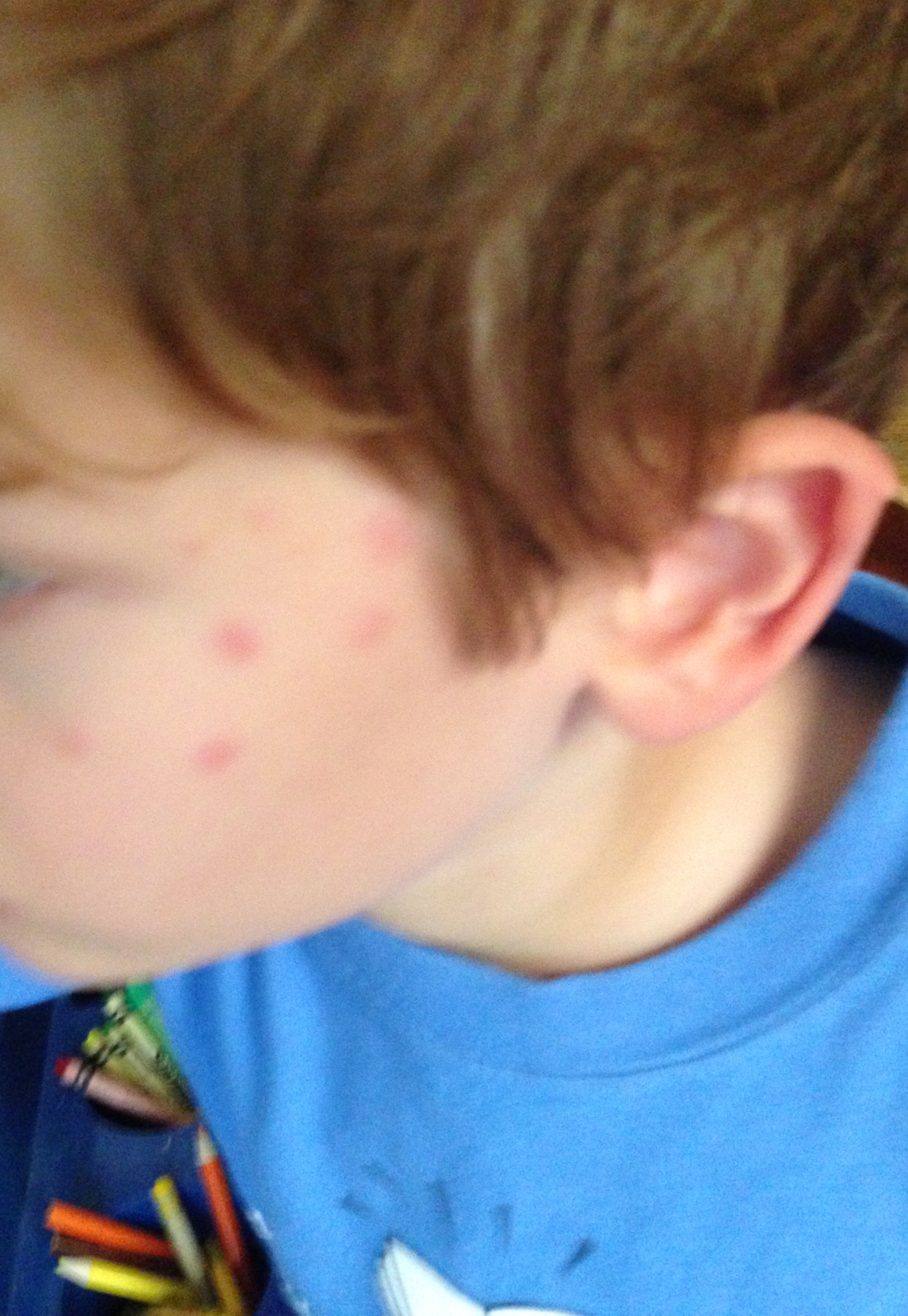
Meanwhile, however, red spots have appeared on Martin’s left temple. They showed up two or three weeks ago, faded, and reappeared more prominently this weekend. And they’re breeding: When the spots emerged a few weeks ago, they were four. This past weekend, they were seven on his face and one on the back of his neck. The spots are neither raised nor itchy. They are not bug bites.

Terrible photography. Sorry. He didn't want to be still.

Terrible photography. Sorry. He didn’t want to be still.

So what the hell are they? Allergies? To what? Are they the result of a Heilkunst clear? Our last clear was PCV7. The skin is the body’s largest drainage organ. Or are the spots from clearing something else? We’re working on Martin’s biofilm now, plus the possibility (awaiting test results) of chronic Lyme, both of which involve antimicrobial drops. Is his body responding with spotty face?

Also happening nowadays: Martin’s ears hurt, and he’s coughing at night. His emotional regulation is terrible. He seems out of it. Where do those facts fit in the puzzle?

I’ve scheduled new allergy testing with Martin’s pediatrician, and I’m corresponding with our other practitioners, trying to figure this out, which leads to the biggest mystery of all: When exactly did I become qualified to make sense of such things?

I’ve never wanted to fight an octopus.

Those Doubts Are Gone. From a Mainstream Perspective, I Get Crazier by the Day

Remember my doubts about Heilkunst homeopathy?

Heilkunst is about supporting the body’s natural healing power, allowing its own return to health. I had to go through the dreadful process of enumerating, in reverse chronological order, the many insults to Martin’s immune system, from medications and illnesses to vaccines to home remodeling while I was pregnant. For eight months we’ve done a “clear” every two or three weeks, working backward through what might be hampering Martin’s recovery.

Immediately after we began the first clear, which addressed coxsackie, Martin vomited and woke the next morning with a mild coxsackie-like rash on his hands. Since then we’ve seen what appear to be “healing reactions” of all sorts. Itchy neck. Inner-ear swelling. Tired allergy eyes. More vomiting. ROOS. Ugh, ROOS.

At the same time, Martin has been getting better and better. Seriously, he’s having a homerun 2015. I’ve been “reasonably convinced” the Heilkunst is doing what it’s supposed to.

Time to scratch the “reasonably.”

Our last three clears have been MMR, the H1N1 vaccine, and antibiotics we used when addressing SIBO. The antibiotics actually should have been addressed much earlier, in terms of chronological order; I realized only recently, from reading comments in an on-line group, that antibiotics need to be cleared.

I had a hunch that H1N1 clear would be a tough one. The H1N1 vaccine—why on earth did I fall prey to the unnecessary frenzy over that illness?—was the only injection from which I saw a noticeable difference in Martin, beyond the fever-crying-and-blues we are supposed to accept in a recently vaccinated child. He received the H1N1 shot in November 2009, when he was almost 17 months old. (According to his medical records, a “second” H1N1 shot was administered in January 2010. I have no recollection of that.) The shot was not a bad one, in terms of Martin crying or acting out. Instead, he became very quiet and withdrawn, and then, the same afternoon, I noticed him engaging in repetitive behaviors: moving toddler chairs into formation, stacking them, moving them. It was the first time I’d ever noticed such behaviors. Do I know that the onset of repetitive behaviors was tied to the H1N1 vaccine, instead of coincidental? No. But the timing raises red flags. Plants a whole row of red flags.

So I went into Martin’s Heilkunst H1N1 clear with trepidation. The clear involves three wafers given over three days, and then a two-or-three-week waiting period while Martin’s system works through the effects of the H1N1 shot.

As to what happened, here is the update I sent to Martin’s Heilkunst practitioner following the H1N1 and MMR clears:

With the H1N1, Martin was crabby for more than a week. He also had trouble sleeping and reverted to some behaviors we haven’t seen in a long time, such as uncontrollable perseveration and also verbal stimming (he says “goo-HEN-duh-may” repeatedly, and tries to get others to say it also, by asking, “What did I just say?” or, “Is ‘goo-HEN-duh-may’ a word?”). One afternoon he was super crabby and tired, and at dinner he said abruptly, “Mommy, I need to throw up.” (I feel bad: I didn’t believe him, because he frequently says that when he just doesn’t want to eat, doesn’t want to go to school, &c.) Then he vomited, twice, all over the dinner table and floor. After I got him cleaned up in a bath, he seemed to be feeling much, much better. He asked if he could have dessert even though he didn’t finish dinner, and then he went to bed and slept more peacefully. No trouble after that.

I waited another week and then did the MMR. Martin did not get as crabby, but one night after I bathed him, I noticed a bright red, raised rash on one half of his backside. By morning the rash was gone. Also, one day later he was covering his ears and saying they hurt. I put some Hyland’s earache drops in them, which seemed to help.

Overall, Martin is doing very well right now, with a big increase in conversation skills and some in attention. Socialization remains tough.

I should add that the rash I saw on Martin while we were clearing MMR was a mild measles-like rash. I know, because I had measles when I was 12. (I lived in a semi-rural area where, as far as I know, vaccination rates were near 100%. I caught measles despite being initially vaccinated, and later hit with a booster shot. I’m resisting the urge to make this post about vaccines.) In regard to looking like measles, Martin’s rash was clear and distinct.

Let’s agree on this: I don’t have my doubts about Heilkunst anymore. These wafers are doing something.

Let’s follow up with this: I don’t know how Heilkunst is working, or exactly what these wafers are up to. I know that the principle is “energy medicine.” Each wafer delivers a minimized, harmless form of what insulted the immune system, to help the body recognize and expel the toxin. But how does the wafer acquire that energy? At AutismOne, out of lingering curiosity, I crashed the Homeopathy Center of Houston panel discussion and asked questions. We don’t use the Homeopathy Center of Houston, buy hey, same idea as Heilkunst, right? Or close? The lovely ladies of Houston explained about dilution and formulas and administration and many other procedures, and my little brain left the room as uncertain as ever. I may be violating my own policy of comprehending any treatment before we begin; in the case of homeopathy, I consulted as many parents as I could find and also searched online for reports of negative or adverse reactions to sequential homeopathy. Having found nothing substantial or substantiated, I proceeded.

My online searches did yield studies (and straight-up arguments) concluding that homeopathy in general is bunk, just so much ineffective snake oil peddled at high prices. I took those accusations under advisement.

And now I feel comfortable saying: They’re wrong.