Prayers Made. Prayers Answered?

This afternoon in Jerusalem I tucked a slip of paper into the Western Wall. Scrawled on the paper was a prayer, for Martin to be healed. I made the same request, albeit in non-written form, at the Church of the Holy Sepulcher, the Chapel of the Ascension, the Church of All Nations, the Garden of Gethsemane, the Chapel of Dominus Flevit, and the Church of the Redeemer, where I attended Sunday worship.

I’m the broken record of the prayer circuit. But hey, Martin’s the one on my mind.

No upsetting messages arrived today from the home-front. Instead, Martin apparently walked on a foot-wide wall yesterday, while looking at his feet (hello, proprioceptive awareness!), ate a big dinner, and then slept 13 hours soundly. From this morning my mother texted a picture of Martin building a three-foot-tall single-column tower of blocks (“Martin’s Eiffel Tower,” she called it), entirely unassisted. Earlier this year Martin had trouble stacking three blocks on top of each other, and possessed neither the focus not the coordination to achieve any more.

That’s the report from 1 January 2012 in Jerusalem. I hope this heralds a good year. A very good year.

More Praise of Friends

I have eleven close girlfriends from my high-school class. “The twelve,” we call ourselves. We’ve had bumps in the road, big ones, and yet 21 years after graduation, we’re more or less intact.

And when it comes to Martin, these friends have joined the struggle in ways I could have not imagined.

It was a high-school girlfriend, an EI practitioner, who first identified Martin’s disorder as autism and got us started in the road to intervention and recovery. It was another, a chef, who recently came to stay two weeks with us when Martin started eating meat, to prepare his special meals. It is others who read this blog, who offer listening ears, who email regularly just to ask how he’s doing.

Now comes yet another debt of gratitude. A high-school friend, who still resides in my hometown, sent a Facebook message, asking after Martin and what she could do to help. I hesitated, then reminded myself that I’ve decided to accept as much help as I can get, and made a request:

“I could use some venison.”

That must have sounded strange to my friend, who knows me as a long-time vegetarian. Probably it sounds strange also to anyone who doesn’t know that, in the semi-rural area where I grew up, people hunt. A lot. Before I became a vegetarian at age 16, I ate venison by the pound. It’s so lean and protein-dense, just what we’re seeking for Martin these days. It’s also difficult to procure, in Manhattan.

My friend responded that getting venison might be tough; the economic climate right now means most folks eat all of what they shoot.

I know, I said. No expectations.

Let me see what I can do, she wrote.

A couple weeks passed. I’d nearly forgotten the request when this friend’s chat box appeared on Facebook again, to say she had venison for me, stored in the freezer on her family’s farm.

As luck would have it, one of my brothers happened to be visiting our hometown last week, and then coming down to New York City on Monday to help my mother with Martin while we travel. I dispatched this brother to meet my friend and retrieve the venison, which now is snug and secure in my freezer.

“Hand-off was a success?” I texted my friend after she met my brother. “You rock so much. Thanks a million.”

“Yup…. No prob. Hope he enjoys. Mainly spiedie meat…hope that’s ok.”

Spiedies are a dish regional to the area where I grew up. They consist of intensely marinated meat skewered alongside vegetables and grilled. I panicked, briefly, my mind on the myriad non-Martin-friendly ingredients that might be in marinade. “Is that the cut, or has it been marinated?”

“Not marinated! I believe it is the cut but not cubed.”

“That is so ultra-perfect I can’t even say,” I texted, relieved and grateful to the point of effusion. “You are the bestest.”

“Nah…just a friend.”

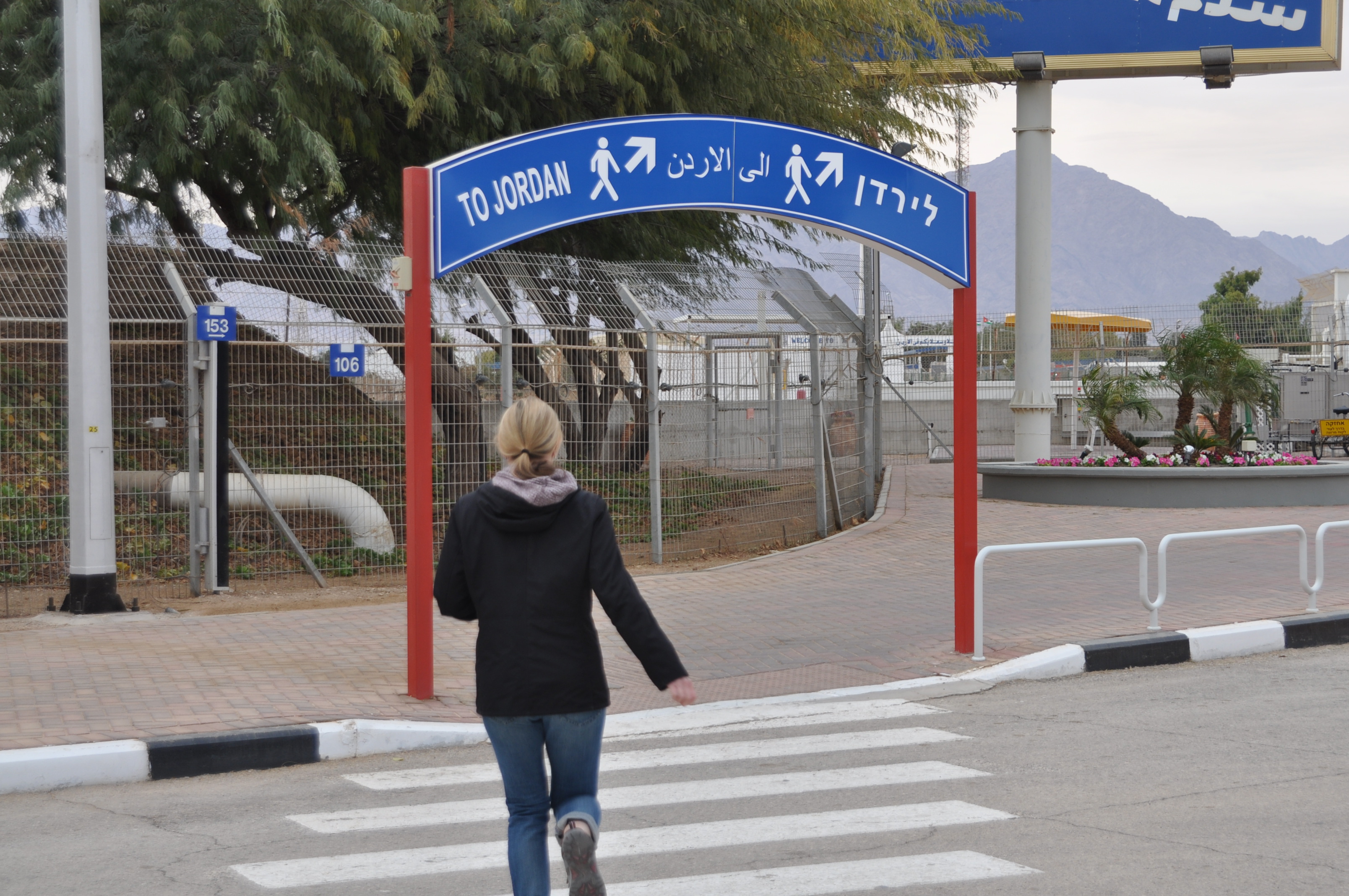
Your blogger, headed from Israel into the Kingdom of Jordan.

Your blogger, descending to the ruins at Petra, Kingdom of Jordan. And thinking about Martin.

The A-ha Moment: Part Two

(This is the second in a series of posts, begun here last month.)

“There’s something we’re missing,” I said to Adrian after I read the article about a six-year-old boy whose autism had disappeared. “There’s something more we can do.”

I was ready to do whatever it took, to make any sacrifice or pay any price, to get back the bright and engaged boy I knew Martin could be. But I had no idea how, or which direction to turn.

After Martin was diagnosed, Adrian and I had got, from friends and family members, recommendations of people we “really should talk to.” I’d never followed up; I tend to be a go-it-alone kind of gal, and didn’t see myself finding solace in an “autism parent support group,” the path I thought I’d be walking if I started reaching out. Now, feeling lost, I decided to exploit some of those contacts.

My first call was to the wife of a once-removed business contact of Adrian. Neither Adrian nor I had ever met this woman, or her husband, who live in another city. I’ll call her Annie.

Annie answered the phone at the time we’d arranged by email, and I explained the situation: Martin’s diagnosis, the behavioral therapy, my frustration about not doing enough.

“I’m glad you contacted me,” Annie responded. “My son is nine years old, and recovered from autism.”

Those words. He’s recovered?

“Yes, completely.”

I grabbed a pen and notepad. “Tell me more?”

Annie, God bless her, spent a full hour on the phone. She had “dropped out of life” for four years, she said, in order to recover her son through every medical, holistic, traditional, and behavioral approach she could find. It had been hard work, especially knowing whom to trust and what to try. In the beginning she’d been told that only behavioral therapy was available. She hadn’t considered biomedical recovery until a friend got her interested in the topic. Once they started biomedical recovery, the difference was amazing. The traditional doctors told her the process would never work. She ignored them. Her only standard became whether a treatment might hurt her son.

(As I’m writing this, from my scrawl on that yellow notepad, ten months after the conversation, I hear in Annie’s words exactly what I would tell a parent if one were to call me today.)

Annie told me about RDI therapy instead of ABA. (She had pulled her son out of traditional one-on-one ABA therapy, a decision I also made some months later.) She told me about the Yasko profile, Generation Rescue, genetic mutations, hormone treatments, available therapies. My head was spinning. The key, Annie concluded, was to find a doctor with strong traditional medical strengths who nonetheless would ride the cutting edge of new treatments. She gave me the name of a doctor halfway across the country, an associate of the excellent Track Two doctor we now use for Martin.

I hung up the phone in a different place than I’d been an hour earlier. I spent the afternoon chasing down websites and phone numbers. I printed pages and pages. By the time Adrian arrived home that evening, I had a full presentation prepared for him.

I began with, “This is what we’re going to do.

Investigative Journalism, Part Two

In yesterday’s post I described three articles that have appeared in the Chicago Tribune. The first, published two years ago, questioned the scientific underpinnings of ASD treatment and profiled the case of an apparently (?) recovered seven-year-old boy whose father contended that the boy would have progressed without, and may have suffered (yet unmanifested) harm from, biomedical interventions. The second and third articles, published last month, reported that this father’s complaint against Dr. Anju Usman, one of the boy’s treating physicians, had led to medical board charges against her. They also provided the detail that the boy’s treatment had been the subject of a divorce proceeding in which his mother, who supported the biomedical interventions, had lost custody.

Today I’m writing about the effect that such an article has on a parent undertaking a recovery journey. Specifically, this parent. Me.

I’ve made no secret that we’ve chosen an arduous path. Treating ASD biomedically means we’re raising Martin inconveniently. We’re navigating 21st-century America without processed or packaged foods, tap water for drinking or cooking, a microwave, grains, sugar, non-organic products, or restaurants. Martin swallows a lot of supplements—I’m not going to claim “six pills at once,” like the father in the Tribune article, but enough—and participates in 16 HANDLE exercises daily. We do RDI. It’s so much that, any moment when I’m not marveling some new achievement, I’m probably contemplating giving up.

Which means that during the past three months I’ve had a lot of time to contemplate giving up.

When I do research about Martin’s treatment, I seek out multiple sources and do my best to weed out bias, hyperbole, and blanket statements. When I speak with Martin’s practitioners, whether Track One or Track Two, I attempt to engage in dialogue: question, answer, challenge.

A mainstream-newspaper “investigation” is a different sort of animal. Because of their stature, we count on the big sources to do our homework for us, to examine every side and summarize fairly. To question, answer, and challenge without our participation. I studied magazine journalism as an undergraduate, and I remember this rule: When you’re going to write a major article, for that moment in time, you must become the world’s leading authority on your topic. In my mind, before the Chicago Tribune reporters sat down to write their original piece, they should have been the world’s leading authorities on biomedical ASD recovery.

And when the world’s leading authorities say a process is “dubious” and “unsupported,” that’s a pretty good reason to quit, right? Especially if the process is taking a toll on you like none you’ve ever known.

I admit that I hesitated, even, before sending last month’s Tribune articles to Adrian. I feared that they might make him want to quit. (A fear unwarranted: I sent them, we discussed, and Adrian remains as dedicated to Martin’s recovery as ever.)

And now I worry that those articles, and the actions of the Illinois medical board, might make other families want to quit. Goodness knows we’ve got the deck stacked against us as it is.

I can’t tell other families whether to continue biomedical recovery or to quit. I would never try. Heck, I don’t even know where my own family’s journey will end.

I can say that I don’t think the Tribune reporters became the world’s leading authorities, or if they did, they failed to demonstrate that. I know at least one family who allowed one of the reporters to meet their fully recovered son, whom Dr. Usman had treated. I saw no mention of any such families in the articles. I saw no investigation into whether (as I thought the articles may have hinted) the father’s complaints simply arose within a divorce context, or were instead prompted by that context. The Tribune presented the incompetent actions of rogue DAN! doctors; it made no mention of the compassion of competent biomedical-recovery practitioners.

All in all, I thought it was lopsided reporting.

But to a parent who’s desperate, and exhausted, lopsided reporting might just suffice to make you throw in the towel.

That, I think, would be a sorry effect.

Investigative Journalism, Part One

[This post has become long, so I’ve decided to break it into two parts, to avoid losing readers halfway. The second part will appear tomorrow.]

Several readers now have asked my opinion on a recent Chicago Tribune article about Dr. Anju Usman.

I have an opinion.

Let me start by saying that, although I know her work by reputation and from speaking with parents whose children recovered under her care, I have never met Dr. Usman. She is not Martin’s excellent Track Two doctor. I lack any particular expertise for interpreting this story. I derive my understanding of the facts from the Tribune (what there is written, and what thence is missing), and have formed my opinion from own experience.

Here is the Tribune saga, based on what I’ve read: Almost two years ago, as part of a series called Dubious Medicine, the newspaper conducted biomedical ASD interventions and published its findings under the title “Risky alternative therapies for autism have little basis in science.” The article highlighted its conclusion up front, namely, that “many of these treatments amount to uncontrolled experiments on vulnerable children. . . . And though some parents fervently believe their children have benefited, the Tribune found a trail of disappointing results from the few clinical trials to evaluate the treatments objectively.”

The role of human-interest centerpiece in the Tribune’s initial story was played by a then-seven-year-old Chicago boy, a years-long patient of Dr. Usman and of Melbourne, Florida’s Dr. Daniel Rossignol. The article begins with the boy’s father, who opposes biomedical intervention, bemoaning his son’s ability to swallow six pills at once. Near the end, however, after its indictment of autism recovery science, the article takes a befuddling turn. The boy at age seven is described as “playful, funny[,] and outgoing”—which to me sounds a lot like “recovered.” The boy’s unnamed mother, according to the Tribune, “declined to be interviewed but [] said in court documents that she believes the boy’s many alternative therapies benefited him [and] argued that her son’s treatment must continue on a regular basis.” The father, by contrast, “said he [thought] his son . . . would have progressed developmentally without any medical treatments” and filed complaints with the state medical boards against Dr. Usman and Dr. Rossignol. He told the Tribune, “I worry very much. There may be latent physical harm. We don’t know.”

Fast-forward to last month. The Tribune ran back-to-back articles on Dr. Usman. The first, “Illinois regulators seek to discipline autism doctor,” reported that this father’s grievances had led to the Illinois Department of Financial and Professional Regulation charging Dr. Usman with “unprofessional, unethical and/or dishonorable conduct” and seeking suspension or revocation of her medical license. It noted as well that the father had in fact sued Drs. Usman and Rossignol, a case that apparently is pending in the Circuit Court of Cook County.

The second article, “Illinois medical board files complaint against star autism doctor,” was similar to the first, with some more detail on that complaint. More interestingly, from my perspective, it included this detail:

The treatments that [the father]’s son received were also the subject of a bitter divorce and custody battle between [the father], who vehemently opposed the therapies, and his wife. She had been a proponent of the therapies for the boy, according to divorce court records. [The father] and his wife divorced. [The father] was awarded residential custody.

If any of the feared “latent physical harm” had evinced itself in the boy, the Tribune makes no mention thereof.

The Tribune articles supply much potential fodder for this blog—like the science underlying autism recovery, and laboratory studies versus field work; how prosecution of heterodoxy curtails the ability to pursue alternative treatments; reporters’ influence on the way we interpret the world. (The also supply much fodder less appropriate for the blog—like the validity of a medical-malpractice lawsuit absent any manifested harm, or the ways a divorcing couple can entrap third-parties into their own anger.) I’m not going to pursue any of those topics.

Instead, tomorrow, I will address the effect that stories like the Tribune’s have on me and, I would guess, others in the thick of a biomedical recovery journey.

It’s Not All About Martin. At Least, Not All the Time

The Giants beat the Bills on Sunday.

I’m a major Bills fan, so that sucks.

But it doesn’t suck as much as it might, because it was a hard-fought game on a sun-shiny 68-degree day, and Adrian and were sitting in MetLife Stadium, cheering. With friends. Without Martin.

Years ago, when we decided to have a child, Adrian and I vowed that we’d never give up being a couple for the sake of being parents. We were both 35 years old when I got pregnant. We had a decent society, some other couples with children, but mostly child-free couples and single persons. Concerts, dinner parties, sporting events, the usual. That’s still pretty much our crowd—the type of people who ask about the kids but really don’t want them lingering at get-togethers.

In fact, I’ve always been uncomfortable hanging out with women who define themselves by motherhood. When Martin was younger, pre-diagnosis, and Samara had a day off, I would take Martin to a neighborhood playground and hover awkwardly while he ran and climbed. I didn’t belong to any of the nanny clusters that congregated there, and the full-time mothers seemed to have a language of their own, organizing “walk-dates” and exchanging tips for rainy-day hotspots. I couldn’t seem to find crowd organized around the principle of “the kids are fine, let’s grab coffee and talk about books and sports.”

When Martin was diagnosed, long before we undertook or even heard of biomedical recovery, Adrian and I made a supplementary promise: that we would never become a family defined by the spectrum. Our friends should think of us as cool folks (okay, maybe that’s a stretch), not folks who have a son with ASD. We have grown-up lives that lovingly encompass but also stretch beyond autism.

So we make every effort to concentrate on our marriage, and even our independent social lives. Once a week Adrian comes home early enough for me to go out to dinner with a girlfriend, or to the Rangers game, or even just to the wine bar on the corner, solo, with the iPad for reading. Those evenings it doesn’t matter whether I haven’t slept more than three hours, or I’ll have to stay up late doing kitchen work afterwards. I go out. And Friday night, every Friday night, Samara works late so Adrian and I can have a date, alone or with friends. We just have to maintain those connections to each other, and to the world.

Right now Adrian is testing my commitment to this practice. For our recent anniversary celebration, he gave me—a vacation. He hasn’t told me where we’re going, only that we leave right after Christmas and I should bring a swimsuit and hiking boots. He’s conspired to have my mother in town, taking care of Martin, while we’re gone.

I need a vacation. I love escaping the City mid-winter. The idea of lying poolside with a fruity cocktail is warming my insides right now. And I know I can count on my mother to follow my instructions regarding Martin.

At the same time, part of me doesn’t want to go. Part of me thinks I can’t go. I don’t believe anyone, his grandmother or otherwise, can do for Martin everything in our day, from supplements to diet to RDI interactions to HANDLE therapy. When I traveled four days to Germany this summer, I cooked all of Martin’s food in advance, and Samara moved into our apartment and teamed up with Adrian to manage the daily routine. That was hard enough. Now Adrian is talking about more than a week away, both of us, no parent at home. Unrealistically, I imagine everything getting messed up, Martin desperate to see us, Martin facing multiple set-backs to delay his recovery.

Then I tell myself to imagine how much more I can do for him once I’m rejuvenated. I try to set aside my fears.

Adrian is right. We need breaks, to forget about parenting and act like the carefree couple who fell goofy in love a decade ago. We can’t let autism recovery run over what Adrian and I have unto ourselves.

Besides, it’s not like there aren’t enough threats to our marriage.

Adrian, for example, prefers the Giants.


Fever Has Its Benefits. Meat I’m Not So Sure About

I’m not sure how this meat thing is working out. In addition to throwing up in the car last Friday, Martin has appeared queasy since we started giving him beef broth. He opens and closes his mouth and licks his upper lip when he eats. He’s sallow, pasty-faced with pinkish circles weighing down his eyes. My poor little guy.

It’s not so bad as all that, you may accuse. Those impressions probably stem from your prejudices against meat in his diet. The vomiting was motion sickness. Adrian drives like a maniac.

Fair enough. But we’ve spotted some less-subjective signs, too. Martin has been sleeping restlessly and waking early. This morning he materialized in our bedroom at 5:54 a.m.; usually we have to toss him like a football just to rouse him at 7:00. And the crabbiness! Dealing with Martin’s tantrums has given me a headache for the past few days.

He seems to be on the constant verge of coming down with something.

To tell the truth, I wish he would. I’m hoping for a fever. Half a dozen times daily I press a hand to his cheek, feeling for warmth. No such luck.

I want a fever because fevers help. I’ve read about several studies, and anecdotal evidence, confirming the “fever effect” in kids on the spectrum: a temperature eases the symptoms of autism. Children become suddenly more verbal and responsive, and they make better eye contact.

At the same time, kids on the spectrum rarely get fevers. Much less often than neurotypicals. In case anyone questions where I got that fact, let me explain my method: One of Martin’s health practitioners once mentioned to me that ASD kids don’t get fevers (at least, not prior to biomedical intervention or detoxification) because their systems are too weak to mount an immuno-response, which is what a fever is. I followed up on her comment with a highly scientific investigation, in which I randomly asked acquaintances whether their ASD children get fevers. Everyone I spoke to responded with some form of, “Funny that you ask! I can’t remember him ever having a fever.”

Martin never got a fever, either. All through infancy and toddlerhood, past his third birthday—nothing. He had occasional colds, and stomach bugs, but no fever. We took this as an indicator of unusually strong health. Only later, after the ASD diagnosis, did we learn that absence of illness and fever could indicate health problems. Later still did we realize that wanted Martin to get a fever, to experience the body’s way of burning off malicious intruders.

We started homotoxicology in early May. We hoped it would lead to a fever for Martin. It didn’t. At least, not for several months. Not till we’d let down our guard.

We were vacationing in rural Maine late in July when a fever, his inaugural fever, struck Martin unexpectedly. It was Saturday evening. We’d lugged Martin’s oils and drops and supplements and special foods from New York to the rental house, but nothing for a fever. No homeopathic remedies. Not even a thermometer to determine how high the mercury rose. Without much else at hand, we comforted Martin with wet cloths draped across his brow.

Around midnight the fever spiked. Martin’s skin sizzled to the touch as he flopped restlessly about the king-size bed where we’d installed him. Adrian and I hatched a panicked plan: Adrian stayed with Martin while I woke my brother Eddie, who was staying with us, to accompany me on a thermometer-seeking expedition. (We focused on finding a thermometer so that, at a minimum, we could know if Martin’s temperature rose so high we needed to visit an emergency room.) Eddie and I located a Wal-Mart on-line that, according to its webpage, stayed open 24 hours. We plugged the address into my GPS and drove almost an hour through the black New England woods, arriving just after 1:00 a.m. to find the Wal-Mart closed. Quite closed. Since midnight. Until 6:00 a.m. So we doubled back into the only town we’d passed and checked every convenience store, grocery, or gas station we could find, to no avail.

We returned to the house around 2:15 a.m., empty-handed. I found Adrian awake and vigilant, watching over a sleeping Martin. The fever had diminished. I climbed into bed with them and dozed off and on until Martin woke around 7:30 Sunday morning, still feverish, whereupon I plopped him into a lukewarm bath, over his protests.

Then I dragged Eddie back out the door, this time to a grocery with pharmacy we’d seen during the night. We bought a thermometer. The children’s fever medications, however, were unsatisfactory. Having never been called upon to use one before, I’d never read their labels or realized how many chemicals and additives they contain. At this stage of the recovery game, I could not imagine giving such a tonic to Martin.

By lucky coincidence, as I stood bemusedly in the grocery-cum-pharmacy, a friend who was joining us in Maine called en route from New York. She and her husband were at a Whole Foods Market. Did we need anything?

“Belladonna!” I replied, referencing a homeopathic antipyretic that we kept stocked at home. “Please. Belladonna.”

The new thermometer showed Martin’s fever to be higher than 102 degrees, though he felt much cooler than he had at midnight. Our friends arrived with the belladonna, two doses of which lowered Martin’s temperature to normal by late afternoon. Everyone relaxed, Eddie went kayaking, and we were back to vacationing again.

Those studies I referenced on the “fever effect” note that the behavioral improvements fade when the fever does. I can well believe that to be the case for dramatic behavioral improvements, like a non-verbal child suddenly speaking, or a nonresponsive child making eye contact. Martin experienced no such major changes while feverish; he was only fussy and miserable. Nevertheless, the fever seemed to bring on subtle advances—increased willingness to hold hands, some expansion of one- or two-word declarations into sentences—that remained with Martin after he felt better. For that reason, based solely on my family’s experience, I believe that suffering a moderate fever helps Martin’s recovery, and I keep hoping that his current queasiness, whether or not related to beef broth, might preface a rising temperature.

Now, if I were to ask my poor brother Eddie his opinion about fevers, I’m certain he’d prefer that Martin refrain from sponsoring any more midnight junkets through the middle of Maine.

As of September 28, a Weekday. And Some Sunshine

On August 5 I posted about my typical weekday. One reader sent this comment, via email:

You are not only an afternoon sous-chef/lawyer, but you have incredible perseverance (re utilizing every minute of the day) and patience. Somehow you maintain confidence it will be okay in the long haul. I got tired just reading it, especially the activities even after Martin went to bed. Someday it will all be all right.

That sounds sad to me. Does it sound sad to you? As if I’m so overwhelmed that I survive only by clinging to confidence in a better future for Martin?

Okay. Fair point—sometimes I am so overwhelmed that I survive only by clinging to confidence in a better future for Martin. It happens.

But I’m determined to stop being such a downer on the blog. If you are a reader acquainted with me off-line, you know that, in person, I am not a walking bummer. To the contrary, I’m quite sunny. (Adrian, the only party besides Martin with 24-hour access to me, might disagree. Fortunately for me, I’ve not yet added a “Husband’s Page” to the blog.) The reason I’m quite sunny is that I have a stable family and a blessed life. What concerns me most is how close my son will come to neurotypicality, and whether we can cover the distance quickly enough to overcome a late start to social interaction. That concern weighs heavily, but it’s not poverty, or terminal illness, or homelessness, or hunger, or unemployment, or abuse. Mine is a concern that, overall, I feel I have the tools to conquer.

Today I am posting optimism and contentment. Martin’s attention is returning, after that bad month we had. Yesterday I phone-conferenced with Martin’s excellent Track Two doctor, who ran some tests regarding his adrenal stress and is preparing appropriate homeopathic relief. Although the “meat thing” has proved difficult for me, Martin seems to be taking to beef broth without issue. Two evenings ago I enjoyed myself thoroughly at a happy hour for parents from Martin’s new special-education preschool.

Furthermore, since Martin started his new school earlier in September, my days have improved, time-wise. A typical weekday now looks like this:

6:40-7:00 a.m. I rise. I feed the cats. I check email and respond to any urgent missives. I prepare Martin’s morning homotoxicology and other drops, which “cook” ten minutes in hot water, to burn off the alcohol in which the active ingredients are suspended. I start Martin’s breakfast, which these days alternates among duck egg with squash fries (weekend treat), muffins with Dr. Cow “cream cheese,” grain-free veggie pancakes, and the occasional bowl of buckwheat or quinoa cereal with nuts. My mother just sent a waffle maker and recipe for almond waffles, so I’m going to add those into the rotation.

7:00-8:10 a.m. Busy time. Adrian won the desirable job of waking Martin (he’s like a sleepy little bunny rabbit in the morning) and the less desirable job of getting Martin onto the potty and then dressed. While they are thus occupied, I finish making Martin’s breakfast. I’m also running up and down the stairs from kitchen to bedrooms, bringing some supplements and maybe doing a HANDLE exercise or two. Adrian brings Martin downstairs by 7:30. I help Martin with breakfast and remaining supplements and oils, while Adrian showers and gets ready for work. I also fix Martin’s lunch during this time, because I like it to be as fresh as possible. His typical school lunch comprises nut butter slathered on homemade crackers (which get soggy if I prepare them the night before), accompanied by a dish like sauerkraut, avocado, pear, or hard-boiled quail eggs. By 8:00 Martin is teeth-brushed and ready. He makes one final visit to the potty with Adrian. At 8:10 precisely they walk out the door together, Adrian wearing a laptop/document backpack and Martin wearing a zebra backpack stocked with school supplies, lunch, and toddler training pants. Adrian puts Martin on the school bus.

8:10-9:00 a.m. Kitchen and me time. I empty the dishwasher, load in any plates lying around, give the kitchen a once-over, and if necessary do basic prep work for dinner. Then I get myself washed and dressed, and walk to the corner coffee shop for a soy latté.

9:00 a.m.-3:15 p.m. Lawyer time. I spend as much of this time working (as a lawyer, my “real job”) as possible. I may also sneak out to the natural foods store or continue dinner prep. Occasionally, daringly, I start a blog post. Samara picks Martin up at school at 2:15. They dawdle, wander here and there, take the subway home, usually arriving around 3:15.

3:15-6:15 p.m. Flex time. I keep doing lawyer work, as necessary. I assist Samara with Martin’s afternoon and evening supplements. I finish preparing dinner. I do HANDLE exercises with Martin. Some days Samara takes Martin to the park or a play date. By the time Samara leaves at 6:15, she has Martin bathed, pajama-clad, and halfway through his dinner.

6:15-7:00 p.m. Sleepy time. Martin keeps a 6:30 bedtime these days. That’s when we head upstairs to read a book, brush teeth, and snuggle. While Martin dozes off I sit in the rocker and check Facebook, read, or play Scrabble on the iPad. Adrian, when he’s home for bedtime, doesn’t hang around while Martin goes to sleep. I can’t leave. I cherish seeing Martin off to rest at day’s end.

7:00-10:00 p.m. More flex time. Some days I need to head back to my desk for more lawyer work. Some days there is laundry accumulated, or a pressing household task. Always there is kitchen work, for Martin’s special diet or for Adrian’s snack when he comes home between 8:00 and 10:00 p.m. My favorite evenings are when Adrian comes early, and I go for a walk or out to meet a friend.

10:00 pm.-? Bedtime and blogging. Sometime after 10:00 I head upstairs to read, talk through the day with Adrian, and blog.

I can manage this schedule, much better than the chaos before Martin began full school days. In fact, Samara now takes one day off per week. I cut work at 1:30 then and pick Martin up at school myself, and the two of us hang out for a couple hours.

Here’s what I still cannot figure out, though: Despite this new schedule, help from my mother on Martin’s food, and what should be more time for me, still I rarely put away the computer or iPad before 1:00 a.m. Honestly, I can’t even tell you what I’m doing all that time. Playing Scrabble, emailing, writing, reading, who knows? My next project—lights out by 11:00 p.m.

The Gentle Approach to ASD Recovery

I referred on Friday to an email that Martin’s HANDLE practitioner sent me, on the topic of gentleness. Here’s part of what she wrote:

I got a little concerned about the September 5th blog entry.  Through all of this, Gentle Enhancement still remains a truth about recovery or healing. That’s the idea that a stressed system doesn’t get stronger. It’s not popular or common sense, but it’s still true and I have learned the truth of it over and over again in my work with clients. . . .

While I think you have mastered Gentle Enhancement when it comes to Martin’s HANDLE program, sometimes homotoxicologists and DAN Doctors need to hear from a parent who understands Gentle Enhancement. Less is more, even if it’s hard to swallow for them, or goes against their training. I encourage you to insist on it, whole-heartedly. He shouldn’t have days where he’s detoxing so much he’s foggy, sick, tired, or can’t sleep. He can’t afford to lose more days neuro-developmentally, and there’s plenty of time to detox as he becomes more relaxed and integrated.

Detoxification occurs naturally for the neurotypical person because we go into “rest and digest mode.” That’s the branch of the autonomic nervous system that’s opposite of “fight or flight” mode. If Martin’s treatments are causing him stress they are doing the opposite of what they are trying to accomplish. . . .  I’m suggesting that the process needs to happen so slowly that you barely notice.  That will truly be the fastest road to recovery.

Upon receiving that email, I decided I would like to post a few words about the gentle approach to treating autism, which reminded me also that I never revealed how Martin’s first round of laser energetic detox (LED) treatments went.

Katie, the HANDLE therapist, is right. Parents who have recovered their children have likewise warned me against moving too quickly, trying to do everything at once. I use the term “treating” autism. I could write more accurately. What we’re really talking about is healing. The goal of approaching Martin’s autism biomedically, as I understand the process, is to help his body heal. We’re healing his gut, driving out yeast and then viruses and pathogens. As his digestion and gut functioning improve, so too will his neuro-functioning, and we can try to guide him back to more typical development. For now, however, his gut troubles have weakened all his systems, and we seek to make them healthy again.

What Katie means is that if we are exasperating or otherwise overtaxing Martin’s systems along the way, his body will snap out of healing mode. I feel like Martin’s excellent Track Two doctor shares this understanding. We spoke by phone last week about Martin’s current “rut,” in which he’s been tired and echolalic, without much attention. The doctor reduced Martin’s supplements and decided to run some tests regarding adrenal stress, to make sure we are not doing too much at once.

The LED, which was the most “radical” of Martin’s treatments so far (Adrian and I did extra research before proceeding), was not harsh. It involved the use of mild lasers attuned to Martin’s vibrations in order to help him expel toxins. Martin enjoyed the process tremendously, because he got to jump on a mini-trampoline to get his blood flowing. We had the LED over two days, and when it was done and he was happy and feeling fine, I thought, “This is it? This is our most radical and controversial treatment?”

The Track One doctors warned me against a biomedical or DAN! approach to Martin’s autism. These same practitioners, however, never warned me against mainstream “treatments” meant to mask autism’s symptoms—treatments such as atypical antipsychotic medications.

I am bewildered by a medical industry that would sooner give brain-altering anti-psychotic medications to a child than encourage neuro-improvement through gut healing. I am bewildered by doctors who warn me against “vitamin overdoses” without once mentioning that a child whose autism remains unresolved may face a lifetime of gut pain, of sensory overload, of frustration.

Martin’s Track Two team has approached his healing slowly, concentrating on the whole child and his overall well-being. I cannot say the same for his Track One team.

On September 5 I referred to ASD recovery as “beat[ing] the daylights out of Martin.” We were doing too much. We’ve scaled back. That’s what gentleness is all about.

Track Two Versus Track One: Those Who Say They Can Help My Son, and Those Who Say There Is No Help for Him

I’ve received inquiries about my use of the terms “Track One” and “Track Two” regarding Martin’s treatment and, especially, his doctors.

As far as I can tell, mainstream medicine maintains an official position that no cure for autism exists. There are behavioral therapies that can help a child on the spectrum cope with his disorder, and there are medications that mask symptoms, but research has found no effective treatment for the root cause, it is said.

After we received Martin’s diagnosis, almost a year ago, Adrian and I took him to what I refer to in this blog as the Big Imposing Hospital, a formidable New York-area institution with a good reputation for treating ASD—although I’m no longer sure what “treating” means in this context; “diagnosing” might be the better word. In any event, we pursued every avenue that the Big Imposing Hospital requested. Under the auspices of the department of developmental neurology, Martin visited (at least once, and sometimes repeatedly) a geneticist; an endochrinologist; an ear, nose, and throat specialist; a gastroenterologist; a nutritionist; a dermatologist; and a child psychiatrist. This was the team I now call “Track One.” Before Martin was diagnosed with autism, when we were trying to get to the bottom of his inability to settle down and sleep, he also saw a specialist in pediatric sleep disorders at the Big Imposing Hospital, who misdiagnosed him with “restless leg syndrome” and prescribed iron supplements that stained his teeth.

As we began to investigate ASD recovery, we found ourselves faced with a choice. On the one hand, we had Track One, an expensive high-profile team at the Big Imposing Hospital telling us that, beyond referrals to behavioral therapy and information for us to understand ASD, they could offer nothing to help our son. On the other hand, we had Track Two, a single doctor and collection of other professionals saying, yes, we have helped children recover, and we’ll do what we can for Martin.

The choice was not as clear as it should have been. I was skeptical. As I’ve mentioned before, in this blog, it’s hard to believe that mainstream medicine could be suppressing the fact that a devastating (yes, devastating) and increasingly common condition is treatable. So I did what a skeptical person does. I asked for references. I talked to other parents. I read whatever articles I could find. And then I compromised between the two positions. Adrian and I decided to pursue Track Two, i.e., biomedical recovery, but not to abandon Track One, i.e., to continue following the recommendations of the Big Imposing Hospital—other than the recommendation not to go anywhere near a Track Two doctor.

Every Big Imposing Hospital doctor we asked told us that seeing a DAN! practitioner would be a waste of time, and potentially harmful to Martin. I took careful notes on what they said could be dangerous: vitamin B overdoses, intravenous ketology, hyperbaric chambers. Once we had started biomedical recovery (and started to see results), I gave the Track One doctors a stock response, along these lines: “My husband and I have spoken with enough families who have recovered their children that we now believe research being done in labs and studies simply has not kept up with what’s going on in the field. We would never expose our son to treatments we believe might harm him, and we research each treatment thoroughly and appropriately before proceeding.”

For the most part, once they saw I was determined, and informed, the Track One doctors stopped arguing against biomedical intervention. Some dropped the subject. Others changed their tone and spoke about “exciting possibilities” or “forging a common path” with DAN! practitioners. One doctor at the Big Imposing Hospital told me, “I’m a scientist. I require results. The results are not there to support autism recovery.” When I offered my position about studies lagging behind field work, this doctor rose from her chair, shut the door to her office, lowered her voice, and said, “Again, I’m a scientist. But I have had enough parents come through here whose children have improved with dietary changes and supplementation that I can no longer honestly say autism recovery is not possible.” Then she opened the door again.

From that moment, I’ve wondered what else mainstream practitioners are hiding, and why. As Martin has made more and more progress with his Track Two team, Track One has faded into the background for us. I’m just not sure what they can offer at this point.

(Moreover, Martin’s excellent Track Two doctor simply seems to care more about him than anyone we met at the Big Imposing Hospital. But that’s a topic for another post.)

On top of all the Track One and Track Two, Martin still sees his regular ol’ pediatrician, who’s been his doctor all along. When I told her that we were pursuing biomedical treatment of his autism (and provided all the details, supplements, and so forth), she said, “I don’t know much about it, only what I’ve heard at conferences, which is that it doesn’t work.”

I started to give my stock response. The pediatrician interrupted me with a smile. “I’ve heard that it doesn’t work,” she said. “But I’m happy to be educated otherwise.”