Understanding

“Martin’s progress has slipped a little.”

That’s a euphemism for reality. It means Martin is having a crap week.

I write a lot about this topic, I know. When Martin suddenly looks less like a kid on the path to recovery, and more like a kid with autism, when he tanks, when it all goes to pot, when dinner and bedtime just are not going to happen without a glass of wine (for me, not for Martin), I blog. I blog because I owe you the whole story, because it’s cathartic, and because misery loves company. (These posts tend to generate more messages than any others. Need to talk? Have at it: findingmykid@yahoo.com. Or use the comments section.)

Martin had been doing so well lately, right up till this weekend. Saturday we invited a local family over to swim. They have two kids, age four and almost-six. I’ve known this family for about a year, from church. I know the mother better than the father. Halfway through the afternoon, the father apologized to me for not realizing that Martin has autism. He was surprised when his wife mentioned, on their way to our house, that Martin follows a special diet to alleviate autism. He’s seen me helping Martin around the other kids at church. He always just assumed that my son was shy, or nervous because he doesn’t know the other kids well.

Apologizing? Because you see Martin every week and didn’t realize he has autism? Thank you, but really, no apology necessary.

Sunday afternoon we went to a birthday party. Martin willingly joined a game of tag with the birthday boy and a few other friends. Sunday evening Martin was disappointed that Adrian couldn’t come out to dinner with us because he had a conference call. The call finished earlier than expected, and Adrian surprised us by showing up during the entrée course. Martin, visibly excited, exclaimed, “Oh, you came! I’m so happy!” A friend, visiting for the weekend, who hasn’t seen us in several months, remarked on Martin’s uptick in verbal skills.

We rocked the weekend. Then all hell broke loose.

Sunday night Martin had trouble getting to sleep. Monday morning he slipped into unfocussed silliness. Monday afternoon, at a playdate, he cried and stomped for 20 minutes when I refused to say we could get a chalkboard at home. (I’m scared of chalkboards. Better just to leave that one alone.) Tuesday we received a note from school that Martin was acting defiant and attention-seeking, and that he had hit a teacher. (We jumped all over that one. Martin spent Tuesday evening writing an apology to his teachers.) The highlight of my Wednesday was Martin throwing himself onto the Stop-N-Shop floor and screaming, “I don’t want to buy any fooooooooood!” (As a sign of how far I’ve come regarding public embarrassment: I spent that minute or so, while he was screaming on the floor, searching my purse for my grocery list. Where is that list? How could I have misplaced it so quickly? Wait, is that my kid terrorizing aisle 24?) Through all these incidents, Martin’s language skills, so strong this summer, failed him. He repeated himself, went rote, even babbled. And yet, except for sleeping, he hasn’t stop talking since Monday morning. Just talking and talking and talking and talking. Point, or no point. Accentuated here and there with loud, forced laughing.

Why? What transforms a close-to-typical-child weekend into a thought-we-were-past-these-symptoms week?

After three-and-a-half years of biomed, I’m finally getting the hang of recognizing the likely causes of backsliding. This week, it seems, we’re dealing with yeast die-off. Several weeks ago I began seeing the harbinger of yet another yeast flare. I’ll spare you the details of that harbinger; suffice to say, it’s poop-related. Candex, an enzymatic formulation, has been controlling Martin’s yeast. Last week, Martin’s biomed doctor and I decided to increase the daily Candex dose, and I started that process Thursday evening.

Increased Candex leads to decreased yeast. Decreased yeast means yeast die-off. That’s a toxin in the system, almost like alcohol. It can make a kid silly, or angry, or irritable. That’s happening to Martin now. In tandem with these behaviors, the aforementioned yeast-flare harbinger (okay, fine: the unusual poop) is fading.

Yesterday morning I signed on to one of my autism-recovery groups and saw this post from a fellow mom:

We’re on week three of nystatin for yeast. These past five days I’m pretty sure we’ve been dealing with die-off. Behavior has been super hyper, nonstop talking/making noise, fake laughing a lot, not listening at all, emotional outbursts, no attention to tasks AT ALL, itching??

Yes. Yes! I cyber-shouted. That’s yeast die-off. I’m right there with you, sister.

Understanding the physical cause of Martin’s, ahem, “slip in progress” helps me see that the behaviors are not within his control, and indeed that my little boy probably feels as agitated, flummoxed, and eager to alleviate this situation as I do. Understanding the physical cause also helps me see that darling, recovering Martin will return.

Soon.
On Monday's playdate, Martin behaving. Didn't last long.

On Monday’s playdate, Martin behaving. Didn’t last long.
What’s Working Now

Are you familiar with miracle products?

I participate in various social media groups for parents with recovering children. Often, I see posts like this:

“We just started this [miracle enzyme, supplement, probiotic, oil, &c.] ten days ago, and I can’t believe the progress! My son is making consistent eye contact, he’s increased his vocabulary, and he finally potty trained! Today I got a note from his preschool teacher saying he is more ‘with it’ and making cognitive leaps. I’m kicking myself that we didn’t try this before now. Anyone having similar results?”

And then, comments like these:

Commenter 1: “Yes, yes, yes! [Miracle product] moved my son from babbling to words!”

Commenter 2: “We added [secondary product] to [miracle product], and the gains were even greater. We’ve been on them both for a month and will be continuing.”

Commenter 3: “This is all amazing! Where can I buy [miracle product]?”

Commenter 4: “[Miracle product] got my daughter into Princeton!”

Posts, and comments, touting a miracle product frustrate me.

Miracle-product proclamations frustrate me because autism varies from kid to kid. The health and immune challenges underlying autistic symptoms include, and exceed, neuroinflammation and other chronic swelling, mitochondrial disorder, genetic mutations, leaky gut, yeast overgrowth, oxidative stress, excess propionic acid. Autism exhibits disparate effects on cerebral function in girls versus boys. “Autism” is not a single malady and is never identical. That miracle product? Shoot a paint ball into a crowd. You’re bound to hit someone and splatter a few others. The rest will probably be left wondering what the fuss is.

I can understand that, if you’re thinking about trying a new product, you may want to post an inquiry about others’ experiences with the product. But given that the underlying disorders are child-specific, and that recovery means finding the right combination of many factors over time, why tout miracles? We parents of children with autism, we tread on hope. We’re easily led. When ten marvels in a row fail to help our kid, we end up embittered and broke.

Recovery from autoimmune disorder is a long, tedious slog without shortcuts. Sure, some families recover their children within a year, those lucky dogs. Most take much longer. Many children never get significantly better. The only miracle in autism is that, given our increasingly toxic world, we’re able to fight the spectrum at all. The amazing supplement, probiotic, or whatever, might indeed have given your kid the week of his life. That’s not a wonder. If you must tout a miracle product, don’t do it after a week, or a month. At least wait a year, then let us know if the developments continued, and speak in measured, child-specific terms.

Dear readers, are you wondering why I’m ranting? That was all an introduction to today’s post, which in comparison to its introduction, may seem brief. The topic is what interventions are working, right now, in combination, for my one kid, with his own particular combination of health challenges.

Following “Hard to Blog an Avalanche,” I received several inquiries about what I think has instigated Martin’s recent growth. Usually, when Martin improves and I’m asked why, I answer, “Don’t know. Obviously, something in the millions of things we’re doing is helping.” This year, I have a better inkling. I have seen five interventions correlate, almost certainly, with better health and/or increased speech:

1. Camel milk. Martin started drinking it this spring, and his language took off. Why? Too long for this post. Check back in a day or so to read “What’s the Deal with Camel Milk?”

2. The GAPS diet. I’ve written a lot about GAPS recently, and I’m also working on a post about how I don’t buy into everything that Dr. Campbell-McBride says. For now, it suffices to say that Martin’s digestion has improved.

3. Candex. We have battled yeast overgrowth, in one form or another, repeatedly since we began this journey. Going off just about every form of sugar helped, but only for a while. Nystatin did nothing positive. Earlier this year, poor Martin’s yeast was so bad that he clawed his skin raw. Finally, his biomed doctor said to try Candex, an enzymatic product. The same night he started Candex, Martin had a foul-smelling BM—yeast, I think, leaving his system. The next day, the skin rash began to clear. Since then, the candida has been under control, so much so that I’ve been able to add a little more fruit into Martin’s diet without worrying about the fructose feeding yeast.

4. Enhansa. Lee Silsby Compounding Pharmacy makes Enhansa, or curcumin, a derivative of turmeric. Martin suffers from chronic inflammation, which places undue pressure on his compromised immune system. Turmeric’s anti-inflammatory properties seem to be relieving that inflammation, even to the point that his face has lost its “puffy” appearance. (The puffiness was visible only to me and others to whom I pointed it out in photographs. Still, it was there, and a symptom of his systemic inflammation.)

5. MitoSpectra. This is a proprietary mitochondrial supplement blend of vitamin C (as ascorbic acid), vitamin E (as d-alpha tocopherol succinate), vitamin B5 (panthothenic acid), L-carnitine, and coenzyme Q10. We have used each of the component supplements before, alone and in combination, and indeed Martin still adds separate sources of vitamin C and L-carnatine. MitoSpectra, however, seems to combine the five supplements in a form and proportions that do well for him: He shows more coordination and energy, and less “floppiness.” At times I wonder whether those improvements are dependent on continued use of MitoSpectra; my hope is that, as his immune system overall continues to heal, his own mitochondria will be able to assume the work MitoSpectra is now doing.

Camel milk, GAPS, Candex, Curcuma, and MitoSpectra. Not a miracle, not any one of them.

Each a step in this tortuous recovery path.

Just maybe a longer stride than I’m used to.

Increased energy, coordination, and willingness to try new things. I'm so into these changes.

Increased energy, coordination, and willingness to try new things. I’m so into these changes.

It’s Hard to Blog an Avalanche

Monday evening Martin and I filling our birdfeeders, in front of the house, when the UPS truck pulled up. My UPS guy and I share a special bond: We’re both New York Rangers fans. We hadn’t talked since June 13, when the Rangers dropped the Stanley Cup finals to the Los Angeles Kings, so we started to chat hockey emotions. Were we heartbroken? Proud? Was this transition season—the Rangers have a new coach—the start of a dynasty? Would we miss Brad Richards?

Martin approached, listened for a second, looked at the UPS guy, and said, “Oh, hi!”

Goodness, I thought. Martin just addressed a stranger, without being prompted. That’s new.

“Hey, little man,” the UPS guy said and patted Martin’s head.

Martin remained while the UPS guy and I finished our conversation. (We will miss Richards! But his time has come!) Then I said to the UPS guy, “All right. Have a good week.”

And Martin said to the UPS guy, “Well, okay, ’bye. See you later.”

Goodness, I thought. Martin just interpreted my social cue and said goodbye, without being prompted. That’s new.

When Martin does something new, and appropriate, and typical, I remind myself to blog. Often I make a note so I’ll remember to write the event. If you’ve been reading this blog a long time, you know about the first time Martin said, “I don’t know,” and the first time Martin interactively shared a toy, and even the first time he understood that my outstretched hand meant I wanted a napkin from him.

The past few weeks have brought so many firsts that blogging them all would be a heavy burden. The firsts are tumbling one atop the other. Thus—

When I brought Martin to playgroup in the City last week, we were late, and his friends were already downstairs. Martin proceeded directly downstairs.

No distraction from the upstairs toys? No direction needed? No dawdling on the steps? That’s a first.

Thursday morning Adrian, fresh from the shower, in a t-shirt and black boxer-briefs, was helping Martin get dressed for school. I overheard this:

“No, Daddy. I don’t want white underwear!”

“What’s wrong with white underwear?”

“I want to wear black underwear, like you. And black socks, too.”

Noticing what Daddy is wearing? Wanting the same for himself? First.

This weekend Martin was in our pool when I asked if he wanted some water. He replied, “No, I’ll have a drink when I’m done swimming.”

Providing more information than I asked for? Thinking ahead? First.

Sunday my brother Eddie was visiting to watch the USAPortugal World Cup match. When Jermaine Jones scored in the 64th minute, tying the game 1-1, Eddie leapt to his feet and whooped. Martin, startled, covered his ears with a pained expression. Then he looked at me, lowered his hands, giggled, and said, “Oh, that scared me!”

Checking my face for reassurance? Immediately recovering from a sensory overload? Laughing at himself? Unsolicited emotion sharing? First, first, first, first.

Seventeen minutes later, Clint Dempsey scored, giving USA a 2-1 lead. Eddie whooped again. Adrian jumped in happiness. I lifted Martin, used my right arm to hold him on my hip, and ran around the family room thrusting my left fist in the air as I shouted, “Yes! Yes! Yes! Yes!”

As I recovered, I realized that Martin, still on my hip, was thrusting his itty fist into the air and shouting, “Yes! Yes! Yes! Yes!”

Independent participation? Imitation just for the heck of it? Not quite a first, but close enough—never before so vivid, or so immediate.

(Better not to ask what happened when Portugal’s Verela scored in the final minute of stoppage, preventing USA from clinching an early second-round berth.)

Monday afternoon Martin and his friend Christopher were in a children’s waiting room, ostensibly overseen by Christopher’s older brother, Benjamin, while I met with Christopher’s mother. When I entered the waiting room, Martin and Christopher were wrestling, gleefully, amidst a pile of toys as Benjamin laughed.

“What on earth are you two doing?” I asked.

Martin looked up from under Christopher and replied, “We’re banging and yelling!”

I assumed Benjamin had accused the younger boys of this. I asked, “Who is banging, and who is yelling?”

Martin said, “I’m banging, and he’s yelling.” Then he returned to struggling with Christopher.

Fully interactive play? Answering questions even while epically distracted? Pretty darn new.

Fifteen minutes later, Martin and I were driving home when he read aloud the name of Steely Dan’s “My Old School” from the radio screen. I took the opportunity for conversation and asked Martin the name of his old school, his preschool. He responded correctly. I followed up by asking which he prefers, his old school or his new school (his kindergarten).

“My new school.”

“Why do you prefer your new school?”

“But because I learn better there.”

Expressing a legitimate preference, and backing it up with a reason? First. Not to mention—I do think he’s learning better in kindergarten. His kindergarten really targets his needs in a way that preschool did not.

On New Year’s Day, I sensed that 2014 would be extraordinary. The banner year may indeed have arrived:

This past month has comprised an avalanche of firsts. I could go on and on. But I will address just one more, the evolution getting on the school bus. In just two weeks, we’ve progressed from me carrying Martin’s backpack and leading him by the hand down the driveway to the bus; to me carrying Martin’s backpack and coaxing him to follow me down the driveway; to me carrying Martin’s backpack and accompanying him as he walks without protest to the school bus; to Martin carrying his own backpack while I follow him; and finally to Martin walking down the driveway, alone, backpack on, and boarding the school bus while I wave from the front step. If I even try to follow Martin, I get a swift, “No, Mommy. You wait here!”

Am I proud? I’m darned proud.

And sorry.

I mean, Martin’s bus driver is also a Rangers fan.

I miss the morning hockey chit-chat.

On another occasion, Martin (right) with Christopher's big brother, Benjamin.

On another occasion, Martin (right) with Christopher’s big brother, Benjamin.

Pull

In the post “What Comes Last,” I noted Martin’s continued difficulties with socializing, especially in group situations, when he just doesn’t seem able to find an entrance.

We were at yet another bouncy-house birthday party last month. Adrian and I were alternating between snapping iPhone pictures and chatting with parents. The kids were running wild. Some were interacting, such as throwing sport balls at each other, on the various apparatuses. Others were jumping and sliding alone. Martin, of course, fell into the latter category.

—Until he bounded up to me, exclaimed, “Mommy, come play with me!”, grabbed my hand, and pulled me toward one of the inflatables.

I went. It was the first time Martin had tried to pull me toward anything, ever.

To be clear: It was only me whom Martin tried to pull into a game, not another kid. Moreover, he hasn’t done so again since.

But it happened. As they say: It’s in there. Martin has the desire, and slowly the skill, to bring others to him. I that sometime in the next six months he will try the hand-pull move again, first with me and then, I hope, with other kids.

A blurry action shot: Adrian and Martin clowning at the birthday party. It's blurry because I was standing in the same bouncy house.

A blurry action shot: Adrian and Martin clowning at the birthday party. It’s blurry because I was standing in the same bouncy house.

What Comes Last

A couple years ago—hard to believe how long we’ve been at this—I lamented to Martin’s (then) biomed doctor that, while Martin’s behavior, sleep, and overall health had improved, I had not seen as much progress in his language. The doctor told me not to worry. “Language,” she said, “often comes last.”

I carried that mantra for a long time: Language comes last. When it took Martin so long to start asking questions, or to use the command form, or to pick up nuances and idioms, I thought, well, language is going to come last.

Or will it?

This year, Martin’s language is much improved. As I’ve written, his speech is not perfect. It often sounds scripted, or rote. Sometimes it seems like he’s exploring a foreign language: Unable to find the easiest or most direct way to express himself, he searches his capabilities and comes up with an unusual (original?) formulation. And his receptive language, his processing delays, still poses challenges; I might be explaining to Martin that we’re going out after lunch, only to have him melt down because he wants lunch, and the “going out” part has registered but not the “first, lunch” part. At his time, he still very much needs the intensive-language-based school program he attends.

That fact notwithstanding, Martin can speak. He speaks in sentences. He asks questions. He orders me around. When he’s not frustrated and mixing up his words, he can express himself, in a manner understood by most anyone who listens with care.

To that extent, language has come.

Language has come, and it did not come last.

Martin’s recovery has two additional, gigantic roadblocks that are not language, though language-related.

First, Martin still can’t “attend.” He doesn’t pay attention. He doesn’t listen. He talks when others are mid-sentence. Unless an activity is one he enjoys (music, eating, drawing), he shows little interest in what others are doing. And even when something does catch his attention, he doesn’t stay with it for long, except for example to stim by hitting one music key repeatedly, or to read his favorite book, The Philharmonic Gets Dressed, over and over.

Martin’s teachers have identified attending as his most significant challenge in the classroom; even with a 3:1 student-teacher ratio, he has trouble following. At home, the nanosecond attention span means it might take Martin 20 minutes to change clothes, because he gets distracted, or succumbs to boredom and starts complaining instead of dressing. It also keeps us from sharing experiences. If I say, “Oh, wow! Look at that bird!”, Martin might glance out the window, then jog away before I can comment on the bird’s color or size, or he might not look at all.

So language didn’t come last, because language has developed more than attention.

Second, Martin still has a lot of trouble socializing.

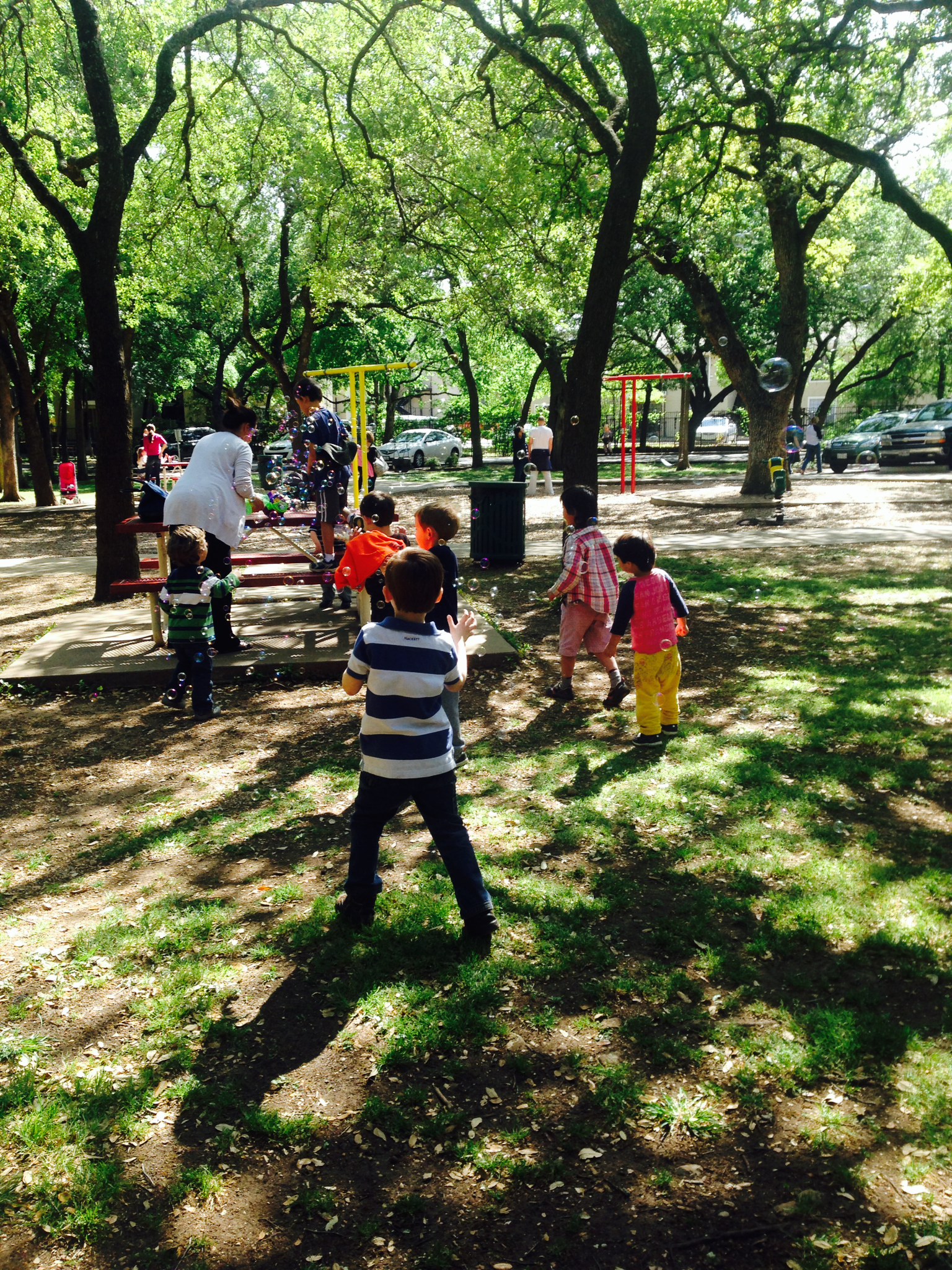
When we were in Austin around Easter, I arranged a playdate with “Stewie,” the six-year-old, typically developing son of a college friend. Martin and Stewie had never met, and Stewie was not informed in advance that Martin has challenges. We met at a crowded playground. The playdate went remarkably well. Although Martin was less interactive than an NT child would have been, he didn’t spend the playdate in his own world. Several times (some with prompting) he went to find and engage Stewie. He and Stewie stood together and gazed at an inchworm hanging on Stewie’s finger. When one family at the playground brought out a bubble pumper, Martin joined the other children, clapping his hands and chasing the bubbles. Stewie never even shot his mom that quizzical look that means, “Is there something different about this kid?”

The experience with Stewie gave me a sort of high. I texted Adrian: “Martin is having a playdate with a typically developing boy, and he’s doing FANTASTIC!”

But of course, in autism recovery, disappointments find a way to deflate any high, and four days after Martin played with Stewie, we had a much less successful playdate back in New York, with four classmates from Martin’s kindergarten. Martin attends a school for children with speech and language delays. About half the kids in his class also have autism or some other social impairment. By coincidence, none of the four boys other than Martin who attended this playdate had any social impairment. They are the social kids.

What happened was typical of what we experience when Martin attempts to play with more than one child at a time: Martin was left out. In a one-on-one situation, a playmate has few options other than to engage Martin. In a multi-kid situation, those without social impairments gravitate to each other, and away from the awkward boy.

Martin’s classmates, at the playground where we met, decided to fight dragons. They scampered about as a group, swinging imaginary axes, wielding nonexistent swords, screaming with excitement at the game they’d created.

Martin climbed on rocks and monkey bars. He went down the slide and wandered across the playground’s bridges. When I suggested that he join his classmates’ game, he approached the crowd and, using the social skills he’s been taught, ask shyly, “What are you doing?”

But the other boys were too boisterous and engaged to hear, and they ignored him.

Martin sat down, alone.

As he and I were walking to the car to return home, I asked, “How was the playdate? Did you have fun?”

My son responded, “No. I would like to do a playdate with only grown-ups.”

The next morning, Martin said he did not want to return to school. Thinking that he was experiencing end-of-spring-vacation blues, I tried cajoling him with his favorite subjects—“Do you think maybe you will have computer class today? What will you make in art class?”—and enumerating his classmates. “Do you think Christopher will be there? Are you looking forward to seeing Jack, and Quinn?”

When I finished my song-and-dance, Martin shook his head and said, “No. My friends at school don’t like me.”

Some defeats just crush your soul, don’t they?

So language didn’t come last, because language has developed more than socialization.

Which begs the question: What’s going to come last?

How will I know when we’ve reached our destination?

Martin, in the blue and white stripes, joins in bubble fun during his playdate with Stewie.

Martin, in the blue and white stripes, joins in bubble fun during his playdate with Stewie.

First of Three Firsts: The Babysitter

These past few weeks have brought a few firsts for Martin. Actually, for me, Martin, and Adrian. Here come three posts on firsts.

Since Martin’s diagnosis three-and-a-half years ago, we have not used any babysitters other than Samara, the nanny who’s cared for Martin since he was a baby; Janine, a special-education graduate student who worked with Martin through Early Intervention and whom we subsequently hired privately; and family members. Having a kid with autism made me skittish to rely on the neighborhood teenagers for babysitting. Having a kid recovering from autism only added complications. Who wants to explain food restrictions, homeopathic drops, and supplements?

Shortly after we moved to our new suburban home, a 14-year-old neighbor named Justin rang our doorbell, introduced himself, and volunteered that he would be happy to babysit anytime. He seemed a respectable and well-spoken young man.

Still, I didn’t go for it.

At least, not until nine months later, when circumstances intervened. Samara needed to return to her country of origin for six weeks. Adrian and I had a Friday evening dinner date in the City, scheduled months earlier, with old friends. Because of a calendar mix-up and (Adrian’s) work travel, we’d had to cancel two dates in a row with this couple, and I was determined not to miss a third. Janine works elsewhere on Fridays.

(Justin, coincidentally, stopped by a second time and offered his services.)

What to do, what to do?

I waited until a Tuesday afternoon when I knew Justin would be at school, then slipped next door to speak with his mother. I presented a brief outline of Martin’s challenges (“speech and language delays, and something like Asperger’s syndrome, depending on which highly paid expert we consult”) and asked whether she thought Justin would be up to the task.

Justin’s mother listened. She posed a few relevant questions. She said, “I think Justin can handle it. And he’s a pretty honest kid. If he’s in over his head, he’ll say something.” Then she asked where Martin goes to kindergarten. When I told her—Martin attends a private institution for children with speech and language delays—she responded, “I know that school. We considered at it for my younger son. He’s speech-delayed.” And what evening did we want Justin to babysit? Friday? Friday would work well. “My husband and I will both be home all night,” she said, “so if Justin needs help, we could come over.”

Oh? Oh? Justin has a younger brother with speech delays? Justin parents will be next door the entire time, ready to spring into action if problems arise?

Even I had to admit that, if we were ever going to use a neighborhood babysitter, this set-up was darn close to perfect.

Arrangements were made. Martin was informed that “Justin the teenager” would “come over to play with him” on Friday. Subsequently Martin was informed that Mommy and Daddy would go out to eat while Justin the teenager was here playing with him. Finally Martin was informed that Justin the teenager would be helping him with bedtime while Mommy and Daddy were out to eat.

To my surprise, Martin appeared unfazed by these revelations. Friday morning, he boarded the school bus with a smile, excited that a teenager was coming to play with him.

I spent all day Friday getting ready for Justin’s 5:00 pm arrival. The house was spotless. All laundry was washed and folded. Martin’s bed had fresh linens. The family room was ordered. (I couldn’t bear to have the neighbors think we’re slobs.) Martin’s dinner, dessert, and evening snack were prepared. Martin arrived home from school at 3:45 pm. Immediately I ushered him to the kitchen table for dinner. I reminded him that Justin was coming, that I was leaving to meet Daddy in the City, and that Justin would help him with bedtime. I added that, while Daddy and I were out, Justin would be in charge. Martin ate his dinner with no objection. By 4:45 pm, dinner, evening supplements, and the essential bedtime supplements—those that I consider non-essential, I decided to skip—were in Martin’s tummy.

Justin arrived. Martin ran away and hid his face, then showed up and waved hello, then fled again. I told Justin the following (note that supplements and recovery protocol never came up):

* Martin has “food allergies,” so please feed him only what I’ve specifically left for him. (Here, Justin conscientiously asked, “Does that extend to scent allergies? Will it be okay if I order dinner delivery?”)

 * Martin should go to bed around 7:30 pm, but it is not the end of the world if he doesn’t, or if he doesn’t go to sleep. (Here, Justin conscientiously asked, “Does he brush his own teeth? Will I need to help him? Does he like to hear a story?”)

* I expect Martin to become upset, maybe throw a tantrum, when I leave. Don’t worry. He’ll calm down.

* We will be home by 11:00, and if when we get home Martin is alive, then we’ll consider the evening a success. The rest is icing on the cake.

At this point, I asked Justin to make sure that he had both my phone number and Adrian’s, and Justin pulled out a mobile phone in a New York Rangers case. When I asked if he is a fan, Justin responded that he babysits because he’s saving up for his own New York Rangers mini-plan, i.e., quarter-season tickets.

Plainly I had selected the world’s best 14-year-old to watch Martin.

It was time for me to leave. I kissed Martin goodbye and waited for him to wage his protest.

Only—he didn’t. He said ’bye and wandered into the family room with Justin.

I headed to Manhattan. I drove, instead of taking the train, just in case some emergency arose and I had to return home quickly. I told our dinner companions that Martin was at home with a teenage babysitter. They asked if I wanted to text Justin to check the situation at home. Adrian saw that I was nervous, and asked if I wanted to text Justin to check on the situation at home.

No, I said. I’m good. I’m going to let this run and see what happens. I left my phone on the table, next to my plate.

Under the table, I fidgeted.

In my head, I prayed.

Superficially, I chatted. And dinner elapsed.

Adrian and I arrived home at 10:40 pm. I entered the house tentatively. Would Justin be crying? Would Martin be running amok? Perhaps something would be on fire? We came in through the garage. I tiptoed into the kitchen and peeked—I’m serious: I peeked, and not without trepidation—into the family room.

Justin was doing some schoolwork he’d brought. He had the Rangers game on the television.

The rest of the house was peaceful.

No screaming. No blood stains, ambulances, or fire trucks.

“It went fine,” Justin reported with a shrug. A shrug! “He’s been sleeping since about 8:30.”

Adrian and I looked at each other. Had it really been that easy?

Apparently it had. I asked Justin how much we owed him, paid, and watched him walk next door.

That was that.

With Samara the nanny still away, Justin has babysat Martin two more evenings. Each visit requires hours of preparation. Supplements and exercises done in advance. Martin pre-fed. The household perfected.

And each hour of preparation has been exquisitely worthwhile, for Adrian and I have finally been able to enjoy what parents of typically developing kids might take for granted: the neighborhood teenage babysitter.

No, that's not Martin. It's just that---well, I do so love the Rangers.

No, that’s not Martin. It’s just that—well, I do so love the Rangers.

New Sleep, No Crutch

“You sure you don’t want to try melatonin again?” asked Martin’s doctor, the one supervising the medical side of his recovery.

“No!” I responded. “No, definitely no. That’s one thing we’ve achieved recently. I don’t want to go backwards.”

The days before Martin’s autism diagnosis were dark times: Martin’s neuro-challenges left him so restless, so lost in spatiality, that he could not fall asleep unless physically restrained. Some nights it sufficed to sit next to the bed and hold his ankles to the mattress, so he couldn’t kick. Some nights we had to kneel over him to straddle his body, too. The worst nights, we had to find a way to still his legs, his torso, and his arms—only to watch his head thrash from side to side. No matter what we did, he needed more than an hour to fall asleep. Sometimes two hours. Or three. Even then, we couldn’t let go, or he’d wake.

Martin’s pediatrician, at a loss as sleepless nights became sleepless months, referred us to the chairperson of the department of pediatric sleep disorders at a prestigious university hospital. That “expert” told us to make “picture charts” to help Martin understand what bedtime meant. She also diagnosed “restless leg syndrome” and told us to put Martin on iron supplements, which stained his teeth purple. It was a garish era for photographs of Martin.

Meanwhile, Adrian and I slept in three-hour shifts, one of us trying to rest while the other pinned Martin.

We received Martin’s autism diagnosis in autumn 2010. Once we learned what was really causing his inability to sleep, we purchased a weighted blanket. That did not help, and later was donated to a special-education preschool classmate. Martin’s sleep situation did not change until we started biomed in February 2011. The difference, as far as I can tell, came through (1) restricting Martin’s diet, and (2) melatonin. Melatonin is a hormone that the body produces naturally for sleep regulation, and it can also be made synthetically in a laboratory. The NIH  states, “Taking melatonin by mouth is helpful for disturbed sleep-wake cycles in children and adolescents with intellectual disabilities, autism, and other central nervous system disorders.

On 31 August 2011, six months into the biomed journey, I posted this:

Almost as soon as we eliminated carbs (and sugar, and starch, and most everything else delectable) from Martin’s diet and added supplements, he began to sleep. As of late March, just for or five weeks into his recovery, Martin was falling asleep in 45 minutes or less and sleeping eleven-to-twelve hours through the night, five or six days a week. We still dealt with night waking one or two days a week, but the compulsive pitching about the bed ceased. Instead, Martin either lay still and chatted to himself or else laughed and acted drunk from his body detoxing.

As of today we more or less count on Martin sleeping through the night. If you’ve been reading this blog regularly, you know that we still have bad nights, and that we sometimes have two or three bad nights in succession, almost always related to Martin lumbering through a detox phase. But by and large, he falls asleep, and he stays asleep.

Until this past October, the sleeping situation, with some variations, remained that way: Martin fell asleep easily, and could be expected to sleep through the night, and when he happened to wake up wouldn’t go down again for three-to-five hours.

Martin takes some prescriptions (among them right now are levocarnatine and compounded piracetem), along with a lot of homeopathic drops and OTC supplements. Whenever possible, I try to eliminate from his daily regimen. So a few months ago, when Martin was on an upswing, I decided to try phasing out melatonin. We’ve made so much progress, I reasoned. Why not investigate whether we’ve resolved some of the issues that made sleep so difficult?

At the time (October), Martin was taking seven drops melatonin before bed. I eliminated one drop every one-to-two weeks. I’d reduce the dose by one drop, endure a few days of Martin taking a hours to fall asleep, wait until he adjusted and fell asleep within 30 minutes, and then reduce by one more drop. By Christmas, I had Martin off melatonin.

Things weren’t perfect. He was taking longer to fall asleep than he had with the melatonin—45 or 60 minutes, instead of 30 or less. But I discovered an unexpected benefit: When Martin woke during the night, he did not stay awake. He fidgeted and called out for me and sought reassurance, and then promptly fell back to sleep. I realized that Martin had been dependent on melatonin to get to sleep. Its absence, at 2:00 or 3:00 am, had prevented him from returning to sleep.

With Martin off melatonin, and capable of getting back to sleep, I’ve been able to attempt something new: nighttime potty training. Until now Adrian and I always left nighttime potty training on a back burner, reasoning that getting up to use the toilet was not worth the hours of wakefulness that would ensue. With that threat gone, we’ve been potty training since the week after Christmas.

As my posts these past few weeks have described, Martin’s been having a tough time. Among other issues, he’s been experiencing evening hyperactivity, and therefore taking hours to fall asleep. That’s why his doctor asked if we’d like to add melatonin again.

The doctor seemed surprised when, in response, I nearly barked my “No!”

Here’s the thing: Melatonin is a crutch. It got us past the long nights while we worked on remedying the underlying causes of Martin’s sleeplessness. Martin no longer needs that crutch. I would rather find and eliminate the cause of the nighttime hyperactivity than use melatonin to mask the hyperactivity’s effects.

The current melatonin situation reflects my overall approach to Martin’s autism. Of course I’m familiar with methylphenidate, amphetamine salts, guanfacine, and so forth—drugs that might improve Martin’s still-abysmal attention span. Maybe one day we’ll turn to such resources (in the end, I remain a pragmatist). But for now, while we have the time and opportunity, I choose to work toward eliminating the cause of his short attention span, instead of using drugs to mask the symptoms.

All Dressed Up

“Martin, why don’t you go get yourself dressed like a big boy? Want to pick out your own clothes and get dressed?” I asked at nine o’clock yesterday morning. We had all slept late, and Martin was running around the house in jungle-print pajamas.

I didn’t believe that he’d actually get himself dressed. Six months ago, I laid pajamas out on his bed and spent 20 minutes trying to get him to take off his clothes and put on the pajamas. I went away to let him concentrate, returned every two minutes to beg or threaten or cajole, even lost patience (not my finest parenting). Martin continually forgot his task. He rambled about nothing, jumped on the bed, played with Curious George. I absolutely could not get him to focus enough even to remove his clothes.

Not too much has changed since then, except that for the last two weeks Martin has responded to every suggestion, however benign, with a resolute “No!”

Nevertheless, this morning I mentioned getting dressed only once before Martin said, “Okay!” and scampered down the hall to his room.

I went to the kitchen, where Adrian was eating breakfast. “I told him to get dressed,” I said. “I’m not hopeful.”

Barely a minute had passed before I heard Martin running down the hall from the bedrooms, yelling, “Mommy! Mommmmm-meeee!

I found him standing in the living room, buck naked except for the blue socks he’d worn to bed. He looked straight at me (score!) and asked, “Mommy, am I still five years old?”

“Yes, you’re still five years old. Now don’t forget to change your socks.”

Martin ran back to his bedroom.

I returned to the kitchen. From afar, I heard a familiar sound. Martin’s bedroom dresser has thick metal handles attached to the drawers with leather loops, and when the handles are dropped, they clunk against the wood. The dresser is the last piece of a heavy German bedroom set that my older brothers once shared. As a kid, from my bed at night, I would hear that clunk and know Rudy and Eddie were getting ready to sleep. Now the sound ties Martin to his uncles.

“He opened the dresser,” I reported to Adrian. “I think he’s getting out clothes.”

After another minute Martin came running down the hall again. I met him in the living room. He was wearing clothes.

“You got dressed!” I exclaimed. “You got dressed! Good work! Go show your daddy!”

Martin went to the kitchen through the family room. I went through the dining room and got there first, which gave me a second to throw my fists in the air, jump up and down, and whisper to Adrian, “First time. First time dressed by himself without a reminder.”

Martin arrived. As Adrian picked him up for a hug, I surveyed Martin’s choices. Navy blue sweatpants with CHICAGO printed on one leg. A white sweatshirt with blue stripes. Adrian set Martin down, then snapped the sweatpants waistband to make a confirmation. “You’ve got underwear,” he said.

“Oh dear,” I added. “Martin, you’re doing so well. But you did forget to change the socks. Go change your socks?”

Back down the hall went Martin.

“Am I pushing my luck?” I asked Adrian.

Moments later Martin sauntered back into the kitchen and said, “Actually,”—that’s a favored word right now, the snarky actually—“I’ve decided to wear my sandals today.”

On his feet were Velcro beach sandals, without socks.

It was 34 degrees out.

“Sure, Martin,” I said, content. “Why don’t you wear those sandals until it’s time for church, and then you can put socks and shoes on at the same time.”

I was happy. Adrian was happy. Martin was happy.

Autism, of course, has its ways of changing any day. At church, after the service but still in the sanctuary, I told Martin that he had enough time to run around in the gymnasium but would have to eat his snack in the car. (We had to get to an Anat Baniel Method therapy appointment.) Martin responded by screaming, repeatedly, interrupting the postlude and eliciting annoyance from fellow parishioners. I picked him up and carried him outside. A complete meltdown ensued.

Last night Adrian tucked Martin into bed at 8:00 pm. Martin, who has recently discovered the joy of exiting his bed and running to the living room, went to sleep at 10:45 pm. Unlike Adrian, I cannot fall asleep while Martin is up and chatting. I got to bed after 11:00 pm and was one unhappy camper when 5:00 am rolled around.

Fortunately, as I may have mentioned, yesterday Martin dressed himself without prompts.

Which reinforces this truth: With every new morning comes fresh hope.

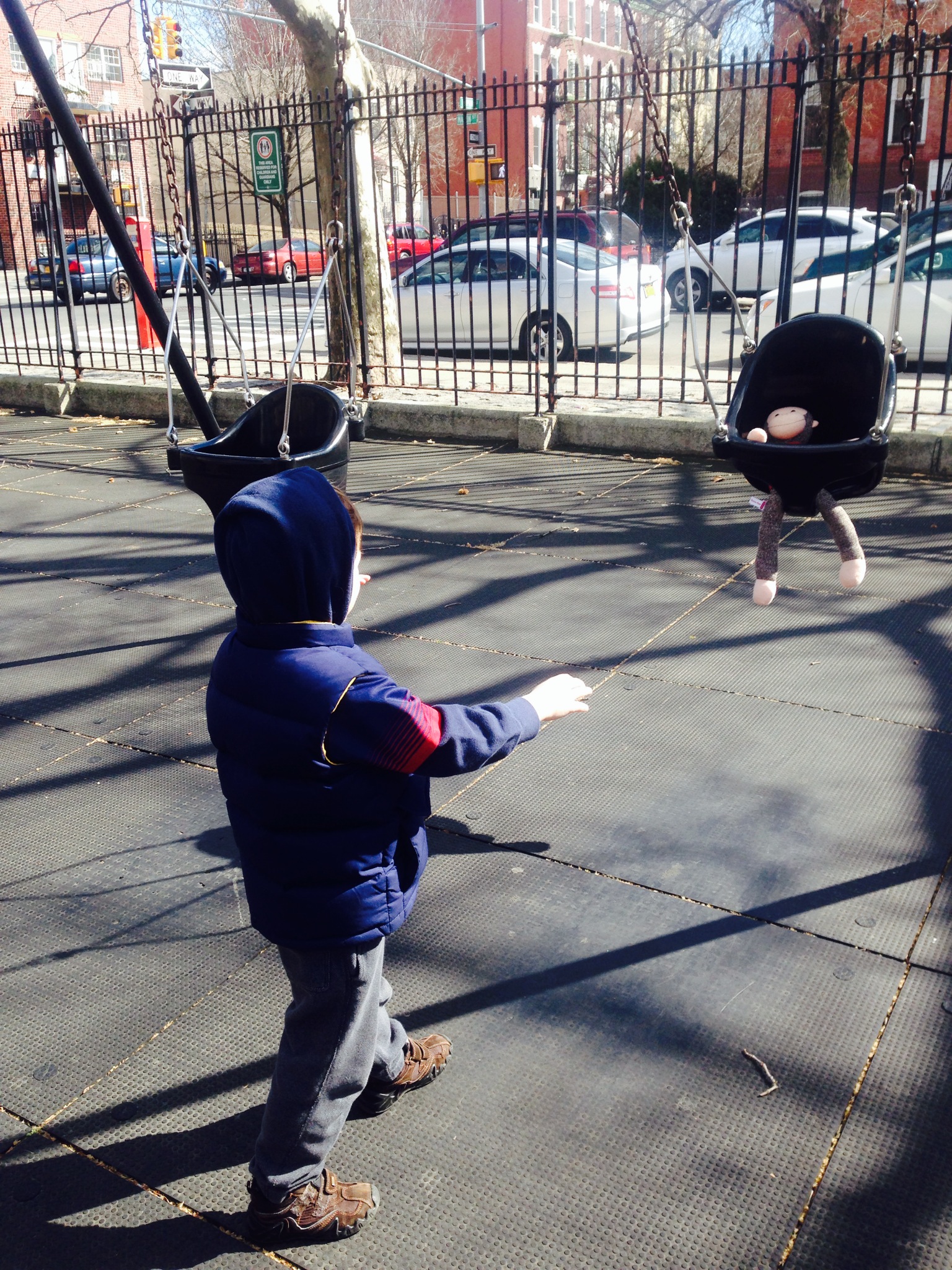
Martin plays this weekend in Bedford-Stuyvesent, Brooklyn. I told him he was too big for these baby swings. He responded by putting his "little brother Curious George" in for a ride.

Martin plays this weekend in Bedford-Stuyvesant, Brooklyn. I told him he was too big for these baby swings. He responded by putting his “little brother Curious George” in for a ride.

Let’s Talk Honestly About Really Crappy Days

Most email traffic that passes through FindingMyKid@yahoo.com congratulates the progress we’ve made with Martin. Some correspondents compliment me (thanks!) for presenting the difficult aspects of recovery, too, instead of pretending every moment is roses and wine. A few parents bemoan their own children’s lack of progress.

I want to speak to the parents who feel like they aren’t making progress. To be honest, despite the progress we’ve made, wine and roses are far, far, far from our everyday reality.  That’s not to say that recovery isn’t the series of joyous breakthroughs I present in this blog. It is rather to admit that these developments punctuate long stretches of “no change” or even apparent regression, which I prefer to call “the reappearance of former symptoms.”

My last couple posts referred to the bad week Martin’s been having. Let’s add some more depth and talk about yesterday morning—

I knew the morning would be tough, because Martin took almost two hours to fall asleep the night before and was bound to be tired. At 5:55 a.m., as usual, I carried Martin from his room to our bed, to wake up with Adrian.

Around 6:35 a.m., as I was putting the final touches on breakfast, I heard yelling, whining, and a scream or two, all from Martin. I found Adrian trying to get Martin dressed. Martin was in a fetal position, refusing to cooperate. He said, “No! I want to stay here today! I don’t want to go to school.” Then, frustrated, he switched to the nonsensical: “I don’t want you! I’m going to sleep at school! I don’t want to come home!”

Adrian waved off my offer to assist. I returned to the kitchen. Ten minutes later, the crying and complaining uninterrupted, Adrian and Martin appeared in the kitchen. Martin was dressed, save for the “crazy socks” he was supposed to wear for Dr. Seuss appreciation week at school. His whine had become, “I don’t want to wear crazy socks. No! No! No! I don’t want breakfast.”

We got him seated at the table. Although he has a chair with footrest that facilitates using his legs and core to sit up straight, Martin slouched. When he saw his breakfast (turkey bacon and vegetables, pretty standard), he lowered his voice to the continuous, slurred word-melding that I detest. “No food oh Mommy oh Mommy oh Mommy Mommy Mommy no no no.” He thrust his fists into his stomach and curved his back, a posture that (I think) indicates stomach pain. When I tried to offer him turkey bacon, he batted my hand and screamed, “Noooooo!” He grabbed his glass of “kombucha with seeds,” pursed his lips on the stainless-steel straw, and changed his whine to, “Drink, only drink no anything else oh Mommy.”

Adrian passed back through the kitchen, kissed us both, wished me good luck, and left for work.

I switched on the kitchen television. Sesame Street. Martin’s a bit beyond that now. Still, I thought the distraction might help. Over the next half hour I managed to get his supplements and most of the bacon (none of the vegetables) into his mouth. In the meantime, he left his chair to bounce up and down, slapped at me, used his fingernail to scratch marks in the wooden tabletop, whined incessantly, dumped fish oil on his school sweater, told me to turn off Sesame Street, cried when I turned off Sesame Street, spilled his drink while refusing to take his mouth off the straw, curled himself into a ball around his Curious George sock puppet and wouldn’t release, threw vitamins on the floor, and ultimately dissolved into a tantrum because he had no time to play before the school bus came.

By sheer force of love, willpower, and coffee, I kept my patience and got him on the bus. (“Martin’s not feeling his best this morning,” I told the matron when I handed him over.) Then I returned to the kitchen to sulk.

That’s right, I sulked. Because when you are working hard to recover your child, a bad morning (bad day, bad week, bad month, bad season) leaves you wallowing in a stew of doubts.

•            What am I doing to my child? Is this worth it? What caused this meltdown? I think the culprit yesterday morning was probably the nystatin we started last week. I think. But really, who the heck knows? And why would it matter? If something—anything—I’ve done has caused Martin to feel like he did yesterday, am I really acting in his best interest?

•            Why have I given up so much to follow to pursue autism recovery? I used to have a career, disposable income, and free time. Now my job is “autism recovery specialist,” our money goes to therapies and supplements, and getting out for an evening requires hours of preparation. Even worse, I’ve met families who claim their children have improved markedly with nothing but traditional therapies like ABA and speech therapy. Why go on?

•            By working toward recovery, by rejecting the idea that Martin is bound to autism for life, am I making each day harder, for all of us? Long ago I wrote a post titled “Failure to Grieve.” To this day, I wonder whether Adrian and I would breathe easier if we just decided, Martin has autism. Let’s help him live with it as best he can.

•            Other than families in the recovery community, almost everyone I know is a subtle naysayer. I never realized exactly how many ways there are to express skepticism: “Is Martin’s doctor a real M.D.?” “Do you have a regular pediatrician supervising all this, too?” “Is that actually a scientifically accepted principle?” “You’re not going to start saying kids shouldn’t get vaccinated, are you?” “Where did you hear about that?” “Have you tried taking all those supplements yourself?” “Poor Martin! What a shame that he can’t eat like other kids.” And those are comments from people who say they support what we are undertaking. When Martin is doing nothing but spitting venom and whining nonsensically, I think, You know, I really do like fitting in with other people. I think I’ll get off the whacky autism recovery path and go back to the mainstream.

So I sulked. I finished my coffee, and I climbed back in bed for an hour.

Then I rose again, made myself a protein shake, and went to CrossFit. Nothing clears my head quite like loud music and exercising to exhaustion. The truth is that mornings like yesterday are so remarkable only because Martin is getting better. With perspective, I remember the early days when we never knew what Martin was going to do next, and he lacked the language to convey his needs. He used to bolt if I wasn’t holding his hand. He used to cry inconsolably if he wanted to take the 2 subway but the 3 came instead. With perspective, I also reckon that, no matter what the ABA-enthusiasts say, no magic autism faerie is ever going to wave her wand and make Martin better without medical intervention. Recovering Martin’s health and opening him up to full participation in our world of opportunity—that’s up to me. It’s going to happen through my perseverance, or it’s not going to happen at all.

Back to wine and roses: To be even more honest, and less metaphorical, the recovery process has increased my dinnertime wine consumption, Adrian is a thoughtful husband who sends me flowers, and indeed most weeks I buy roses or tulips for our kitchen table vase. The path to recovery is hard. Wine and roses may not be everything, but they sure do help get past the stumbles.

For better or for worse, he's my guy.

For better or for worse, he’s my guy.

Smooth(ie)

Breakfast is challenging. Morning is challenging.

I know, I know: Most families with young children probably find it difficult to get them fed, groomed, and out to the school bus on time. Breakfast with Martin presents certain additional factors:

1. Martin doesn’t like his breakfast food options. I’ve given him as many choices as I can, subject to the parameters of what fits his current diet and what I can manage in a smaller window of time. His enthusiasm peaks at “meh.” Certainly nothing gets put in his mouth voluntarily.

2. Martin also needs to take supplements and medications and homeopathic drops (lots of them), which I assemble and administer during the meal, dividing my attention.

3. Mornings, for whatever reason, are Martin’s most distracted time. Often, despite the plate sitting in front of him, he seems to forget even that he’s supposed to be eating. I lob hints and suggestions. (“What’s 9+3, you ask? Try some turkey bacon and we can talk about it.” “Hey Martin, guess what you can use that fork for?”) Occasionally I resort to spooning the food into his mouth. Okay, fine. Often I resort to spooning the food into his mouth.

In order to be ready for the school bus on time, Martin needs to leave the breakfast table and go to the bathroom by 7:25 a.m. He knows this. While asking questions, drawing pictures, and dropping food on his school clothes instead of eating, he counts down the minutes until 7:25. The instant the clock turns, he springs from his chair, remaining food be damned.

If by some miracle Martin finishes his breakfast—or if he manages to bargain me down to some reduced food portion that he’s willing to cram into his mouth in order to escape the table—before 7:25, he’s allowed to go into the family room and play for whatever minutes remain.

One recent morning Martin was drinking a smoothie: coconut kefir, avocado, kiwi, papaya seeds, and strawberries. By 7:18 (the dance is precise) we had finished morning supplements. I headed to the bedrooms for my three minutes of “me time” (pull on jeans, straighten hair, add enough layers to hide pajama top so I can escort him to the school bus). Martin remained at the table, his smoothie glass still half-full.

Typically I would return to the kitchen at 7:21 and devote four minutes to cajoling him to finish breakfast. That morning, however, I returned to the kitchen to find the glass, empty, in the sink waiting to be washed.

“Martin!” I exclaimed. “What happened?”

“I finished my smoothie. I’m playing,” Martin responded from the family room.

I’m no Pollyanna. Quickly I scanned the sink and garbage for evidence that Martin had dumped the smoothie. Nothing. The kid was for real. He’d actually decided just to finish breakfast and go play. I swooned.

And lest you think that’s the only victory of recent days, allow me to say that, this very day, February 21, I asked Martin to get dressed “within five minutes.” After some debate about where he would agree to get dressed—he insisted on standing on my and Adrian’s bed, which apparently offers the best view of our digital clock—Martin completed the task in three minutes flat. Except for his socks. Socks are hard. Also, his underwear and shirt were on backwards, which I considered an improvement, because yesterday his pants were on backwards.

Victories are everywhere.

Martin, assisted by his partner-in-crime, George the Cat, plays in our family room.

Martin, assisted by his partner-in-crime, George the Cat, plays in our family room.