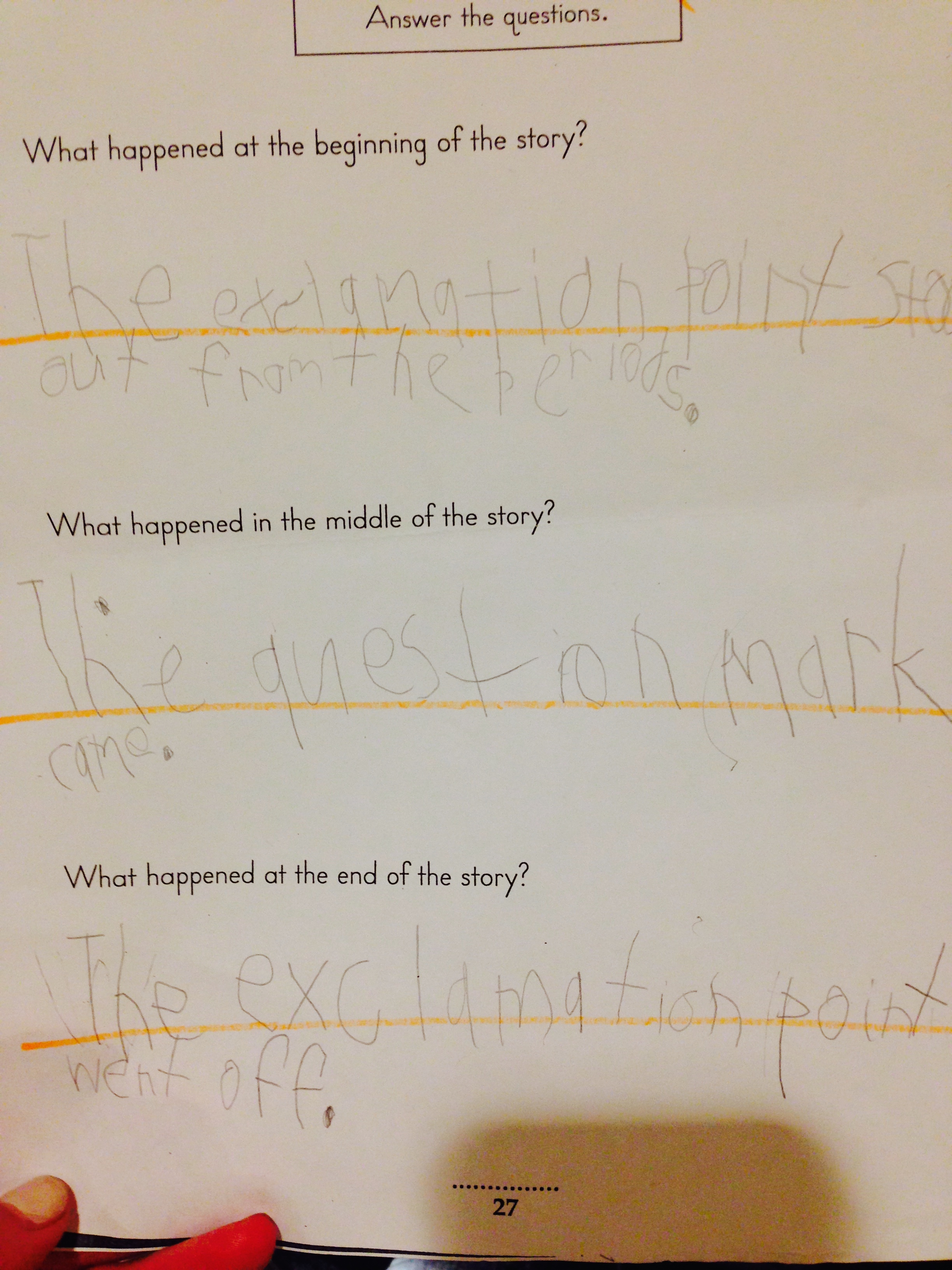
All of a Sudden, a Whole Bunch More Happens

I have a lengthy post prepared on “my beef with the GAPS Diet author.” It’s all ready to go. But—

Shelving that post! At least for today. Because I must, must, must tell you about what else Martin did this weekend.

  • Saturday evening, back at O’Hare to fly home, we saw another family, with a boy about Martin’s age, boarding our flight. The boy was pulling a Cars-themed roller-board. Unprompted, Martin strolled up to the boy and asked, “Did you bring your own suitcase?”
  • Martin didn’t get to bed until almost midnight Saturday night, so I thought that getting up Sunday morning would be a real problem. It was not. When I entered his bedroom to wake him, I reminded him that it was Sunday and he was going to sing with the kids’ chorus at church. He came to life with excitement. “I’m going to sing with the kids’ chorus!” Then he did it. He sang with the kids’ chorus, three songs. He was too excited and bounced around a little. But he sang and clapped and stayed in more or less one spot, without so much as a point or prod from me. I sat in the front pew and recorded the event.
  • Also at church, during kids’ time, Martin sat on my lap in the circle with the other kids. When he got fidgety, I asked, “Would you like to go sit with Vincent?”, meaning another boy across the circle. Martin nodded yes (nodded!) and scooted to Vincent. Then, instead of just sidling up, Martin asked, “Vincent, may I sit next to you?” Vincent paused for a second—a very long second, for me—then he smiled and nodded. They sat together the rest of circle time.
  • Sunday afternoon, we went to visit friends in another town who have a three-year-old, Sebastian. After some initial shyness, and then goofiness, Martin trotted off to Sebastian’s room, and the two boys played together, interactively, for two hours. They sat at a little table and took turns with different objects, and took turns complaining when each thought the other wasn’t sharing. When I called from the kitchen, “Martin, what are you doing in there?”, he answered, “Me and Sebastian are making apple pie,” and then added, “Well, we’re pretending to make apple pie.” Sebastian is, granted, only three. Nevertheless, the interaction was so significant that Adrian said, “What is this? What’s going on? I’ve never seen this before.”
  • Sunday evening we accompanied the same friends to a jack-o’-lantern display. Martin and Sebastian wore their Halloween costumes (an astronaut and a dinosaur, respectively) and chose to hold hands as they walked.

This evening, Tuesday, I had dinner with the parents of another special-needs child. I told them excitedly about the events described above. One of these parents said, “That’s the thing about special needs. What might sound like nothing to another parent is amazing to us.”

Nailed it.

All of a Sudden, It Happens

Martin and I are on a flight to Chicago, to see Dr. Zelinsky. Two things happened in the airport:

First, the metal detector. I have my qualms about the effects of metal detectors, but I let Martin pass through them. It’s a nod to convenience, I suppose. Plus, at least it’s not one of those x-ray body-scan machines. I have even more qualms about them. Passing through the metal detector used to be a challenge for Martin. He might be scared, or refuse. When he agreed to pass through, he rarely succeeded without setting the machine off by touching its sides—either he clumsily bumped them, or his hands naturally flew apart for sensory input and balance. After one or two tries, the TSA agent would let me walk though with Martin, picking him up or holding his arms down and his body steady.

Today as we approached the metal detector, I lined Martin up and said, “Walk though carefully! Don’t touch the sides!” To my surprise, Martin stood ramrod straight, pasted his arms to his hips, and walked directly though the machine. Then he iced the cake: On the other side, instead of wandering away, he stopped and waited for me.

Second, the Windy City. As we sat at our gate, Martin watched the information screen and asked questions. “What does that number mean?” “Is that a picture of our airplane?” At some point, he looked at the destination name and said, “Chicago is the Windy City.” I couldn’t remember ever having told Martin that Chicago is called the Windy City, so I asked, “How do you know that?” Martin replied, “Because my daddy told me.”

What’s the breakdown? On and off for months, I have tried to get Martin to understand the question, “How do you know that?” If we are driving and he says, “That’s a hotel,” I ask, “How do you know that?”, trying to prompt him to say that he saw the sign or read H-O-T-E-L. Instead, he responds, “But-because it is.” If he makes an assertion beyond his experience, like, “All kids except me eat popcorn!”, I say, “How could you know that?” He responds, “But-because they do.”

This morning was no such exercise. I wondered how Martin knew Chicago’s nickname, and I asked without thinking about whether he could answer. His perfect response, missing even his trademark “but-because,” surprised me a second time.

Two big successes inside ten minutes! Still, you know me: I must always temper my enthusiasm. While we were waiting in the jet bridge, another passenger saw our seat numbers and remarked kindly, to Martin, that we were all sitting in the same row. This prompted Martin to ask me whether our row had three seats together, or two. When I told him that our row had three seats together, and that someone would sit next to us, he had a little meltdown and yelled, “I’m not ever going to sit in two seats again! Not ever!” He was crying as we entered the plane.

Did I mention the two successes?

ASD Recovery Recipe: Goldfish Crackers

Martin attends first grade now, in a self-contained special-education school for speech- and language-delayed pupils. The school, which is private, meets Martin’s needs in pretty much every way I can imagine. The curriculum is designed by speech pathologists; the student-teacher ratio is small enough that Martin, despite his attention trouble, has never needed a 1:1 aide to keep up; social skills are integrated into lessons, lunch, and recess; and the class comprises academic high-achievers.

If you put a gun to my head and told me to make a complaint about the school, I would say this: Martin’s teachers use “food reinforcers.” The first week of the term, we parents received a permission form, asking whether our child could eat popcorn, Goldfish® crackers, Skittles®, or M&M’s® as rewards for behavior and hard work. In Martin’s case, of course, the answer was no, no, no, and no. Instead I sent some go raw brand “chocolate super cookies” for the teachers to give Martin.

The go raw cookies have worked well, in terms of rewarding Martin in school. Nevertheless, Martin has become fixated on the treats his classmates receive, specifically, popcorn and Goldfish® crackers. Every day Martin asks me, repeatedly, “Mommy, does popcorn make my belly hurt? Can you make popcorn not make my belly hurt? Mommy, can I have Goldfish crackers? Can you make Goldfish crackers not make my belly hurt?”

Popcorn I can’t do anything about. Organic or otherwise, it’s not GAPS-legal.

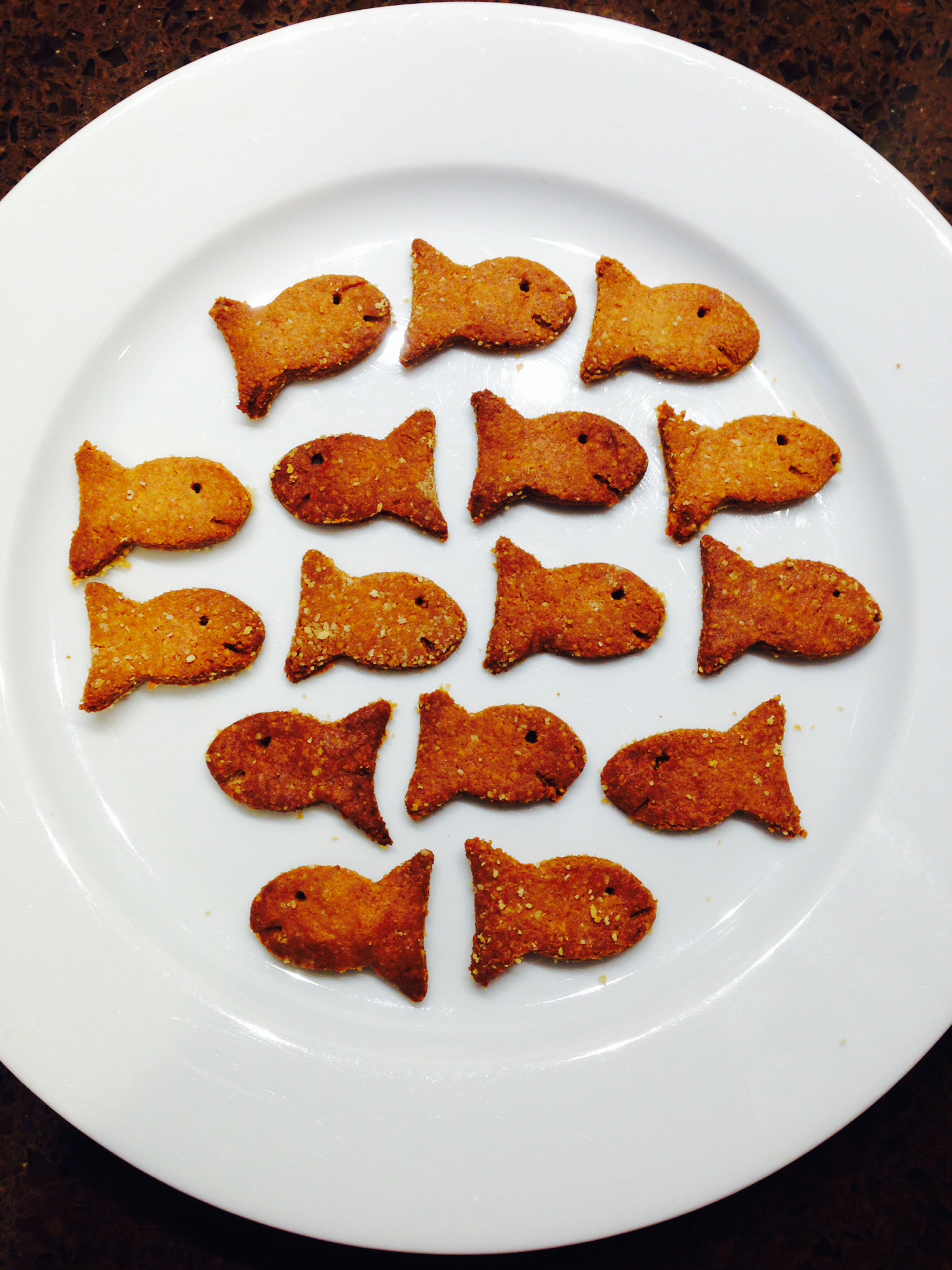
Goldfish crackers? There, I’ve been thinking, I might have a shot. First, I went on-line and ordered a teeny-tiny goldfish-shaped copper cracker cutter. Not kidding. Then, I began searching for a recipe that was, or that I could make, GAPS-legal. This turned out to be much more challenging than procuring a teeny-tiny goldfish-shaped copper cracker cutter. Every GAPS recipe I found included cheese, which Martin cannot have. I struck out also when I Googled Paleo goldfish cracker recipes; by and large, they container butter, or arrowroot powder, or some other ingredient anathema to Martin. I found one recipe ridiculously labeled “gfcf/vegan” when the first ingredient was whole-wheat flour.

At long last, on the delighted momma blog, I found a recipe for “Flourless Cheez-It Crackers” that I could adapt. The ingredients, as listed in the recipe, are almond meal, nutritional yeast, egg, sea salt, coconut oil, and lemon juice. (I had to do a quick search of whether nutritional yeast is GAPS-legal, as I haven’t used it since putting Martin on full GAPS.) I substituted olive oil for the coconut oil, for taste reasons, and increased the nutritional yeast slightly and doubled the sea salt. Here was the recipe, as I prepared it (with 100% props to delighted momma):

  • 2 cups almond meal, which became slightly less when I sifted it for texture
  • ¼ cup plus 2 tsps nutritional yeast
  • 1 tsp sea salt
  • 1 egg
  • 1 tbsp olive oil
  • juice of one fresh lemon

Combine sifted almond meal, nutritional yeast, and salt. In a separate bowl, whisk together egg, oil, and lemon juice. Combine the two bowls and stir well by hand. Roll out the dough on a stainless-steel cookie sheet lined with parchment paper. (I also dusted the parchment paper with more sifted almond meal, to make it easier to move the crackers once cut.) Cut the dough into shapes. Bake at 350 degrees for 15-20 minutes, or until the crackers are dark and crispy.

The delighted momma blogger proclaims, “This was a breeze!” I have to guess that her experience was breezy because she did not take the teeny-tiny goldfish-shaped copper cracker cutter route; she rolled out the dough and cut it into squares. My experience involved rolling and re-rolling dough as I pressed the goldfish shape repeatedly, transferred each cracker on the parchment paper, and then used a toothpick to fashion a fisheye and smile.

Total time investment? More than two hours for two sheets of goldfish.

Worth it? When Martin arrived home from school and saw my second sheetful about the enter the oven, he asked, “What are you doing?” I could see from his face that he knew, full well, what I was doing. I showed him the goldfish that were already baked and offered him one, which he took and ate, as both of us melted with delight. Totally worth it.

Postscript: I can’t send the homemade goldfish to Martin’s school, because the school is nut-free. So if you put another gun to my head and told me to make another complaint about the school, I guess I might say, “I’d sure like to send nuts.”

photo-7

Yeah, That’ll Give Me a Good Night’s Sleep

Yesterday evening, Martin had another real phone conversation with Adrian. “Are you still at the office, Daddy? Are you coming home? When do you think you’ll come? I’m good. I’m drawing pictures with Mommy. Okay. ’Bye.”

Last night, as he was floating to Sleepyville, Adrian mumbled, “These last sixty days or so, it’s so different. He’s like a new kid.”

I’ll take it.

Empowered Moms

These days I don’t feel so empowered, at least not on a macro-scale. I feel good about what I can do, what I am doing, for Martin. I am pleased to see other biomed moms banding together and trying to provoke change—see, e.g., The Thinking Moms Revolution or The Canary Party. I am grateful that other biomed moms create on-line forums and Facebook groups in which I can participate. As for me, my own engagement in collective action is on hold, not really in the realm of “what I think I can handle right now.” I need to recover Martin. Then I’ll change the world.

That all being said, recently I have joined together with two local special-needs moms (not biomed) to get something done. Actually get something done! Last summer, we were lamenting that our kids don’t have much way to make friends, and practice keeping them, here in our small town. When we make play dates for our kids, they engage in parallel play more than interactive play. There are professional resources available, like the play program that Martin attends (and adores) in the City. Unfortunately, those programs draw participants from a wide geographic swath, making after-school or casual get-togethers impracticable for the kids, and the cost excludes many families.

We three moms decided that what our town needs are facilitated social-skills playgroups for special-education students. And then we decided that, if the need is to be filled—we’re on deck. We formed a playgroup of six kids, grades kindergarten-through-second (ours kids plus three more, none in the same school class); hired a facilitator (a master’s student in elementary special education); found a time that works (late Friday afternoon); and got started, rotating each week among the participants’ homes. The facilitator comes prepared with games and exercises designed to foster social skills like sharing, taking turns, greeting, and getting to know each other.

By the fourth meeting Martin had fallen in love with his new playgroup. He calls his fellow participants “my friends from town.” All week he looks forward to Friday. He talks about whose home we’ll be visiting that week; one morning, he even created his own “Friday play date” schedule, listing out each child and checking off the retrospective house. He asks questions about what his “friends from town” do on the other afternoons. He wants to join them.

When the other moms reported similar enthusiasm from their kids, we knew we were onto something. We put together a formal proposal to bring the social-skills playgroup under the auspices of the local special-education parent-teacher association, which would both help defray the facilitator’s fees and also publicize to other parents who might be interested. Then we coordinated with a local Girl Scouts troop whose young women are interested in working with special-needs kids. As part of seeking their Silver Awards, several Scouts are going to come each week and assist our playgroup facilitator with keeping the kids focused.

Getting this project up and running, when so much else is on our shoulders, feels like a big achievement. We were correct that our town needs social-skills playgroups. As of this writing, enough parents have contacted us that we will be able to fill two additional six-member playgroups when we start our spring term next February.

Yay for moms, making stuff happen.

Chatty

Let me begin this post by stating that nothing written here is intended to make fun of Martin. This is a post about language, oral stimming, perseveration, and behaviors that, for the most part, are not within Martin’s control. Although some of the verbal stream I’m conveying may, in retrospect, come across as amusing, when this is happening—when Martin is saying these things, nonstop—nothing sounds funny. When Martin is saying these things, nonstop, I could never laugh because I am too busy trying to keep my head from exploding.

Martin has been talking a blue streak this week. I’ve written about this phenomenon before, when Martin starts speaking and cannot stop. It happens most in the morning. It used to be that Martin would repeat one statement, or one statement and several variations on that statement. As his language and other skills have improved, he’s broadened the repertoire. Now when he can’t stop talking, he cycles through many familiar topics.

During breakfast one morning this week, when Martin and I were alone in the kitchen, I tried to capture his monologue. (I call it a monologue because I seldom interjected. I struggle with deciding to what I should respond, especially when Martin wants attention more than an answer.) Through a combination of recording, scribbling, and recalling after-the-fact, I was able to transcribe the following. This is not verbatim, I’m sure, but it’s close:

When I grow up I am going to live by myself. I don’t want to have any roommates. I am going to be a man who has horns. I am going to have long hair. Mommy, when I grow up I am going to eat peanut butter Lära bars. Do they still play concerts in Central Park? Can we go there? I want to go there. I’m not going to school today. Is it your birthday? Mommy, whose birthday is it? Your brother Rudy and your niece Mandy have the same birthday. How old did Uncle Rudy turn on his birthday? Mommy, Uncle Rudy turned 47 and my cousin Mandy turned six. Mommy, how old are you? You are 42 years old. Do all kids have middle names? Do you have to practice to be a crucifer? I’m going to be a crucifer when I’m in middle school. I’m never going to be a crucifer. I’m never going to school again. You should move out. Go! I’m going to live alone. I want you to be my mommy forever. Is Daddy going to keep going to work? When you were with Miss Cara and Miss Eileen and Miss Tomomi during my play date, what did you do? I want your family to have another baby. Are many of my friends only children? Are all of them? In the eighth picture about the fireplace, are you holding me when I’m a baby? When you were a child, was it allowed for children to ride in the passenger seat? You married your husband in 2005.

Martin said all this, almost without pause, as he was sitting at the kitchen table drinking (or, as it were, not drinking) his bone broth. I’m never quite sure what sets Martin to nonstop talking, or whether a monologue like this is oral stimming, perseveration, attention-seeking behavior, anxiety, or some combination thereof. I’m frustrated when this happens, to be sure. I survive by focusing on Martin’s language skills. Do you remember when I was overjoyed that he managed to say, “I want you to do that again”? Compare that with the perfect sentences structures Martin rattled off this week. Those sentences were perseveration, and he could not slow down, but at least he had the words.

At least he had the words.

Good Medical Care

Without any real statistics to show, I am going to assert that most of us in the biomed community have MAPS doctors for our kids. “MAPS” stands for Medical Academy of Pediatric Special Needs and is the successor term to DAN!, or Defeat Autism Now! MAPS doctors are trained and certified in the treatment of chronic conditions like autism. They help our children with the process of recovering from autism/autoimmune disorder, and with associated issues like epilepsy or food allergies. They’re kind of like general practitioners for children affected by autism.

Then we have other doctors, the host of professionals who accompany childhood, plus (because autism is the symptoms of sickness) assorted specialists. Neurologists, geneticists, ophthalmologists, audiologists, endocrinologists, allergists.

One challenge prevalent for biomed families is finding “other doctors” who respect their MAPS doctors’ efforts. You can imagine the potential conflicts. When we first started biomed, for example, Martin had constant skin rashes, so itchy that he would scratch his legs bloody. We took him to a dermatologist, who diagnosed “sensitive skin” and suggested using Cetaphil “gentle” cleansing and moisturizing products. Our MAPS doctor, recognizing candida overgrowth, asked us to substitute natural products for Cetaphil and work on balancing gut flora to bring yeast under control. (We went with the MAPS suggestion, healing Martin from inside.)

The elephant in a room occupied by both MAPS and non-MAPS physicians is vaccines. MAPS doctors may urge caution when it comes to vaccinating, especially for kids with a history of reactions to vaccines, while non-MAPS doctors may push vaccinations “on schedule” for all kids. Some pediatricians won’t even accept patients whose families feel they cannot vaccinate.

So there are challenges, navigating the biomed path accompanied by non-MAPS healthcare professionals.

When we moved to the suburbs last year, I took the opportunity to find a Martin new pediatrician and dentist. Our practitioners in the City were adequate but traditional. The dentist made me sign forms stating that I had “refused” routine X-rays against her recommendations, and once she applied fluoride to Martin’s teeth even though I had stated at the beginning of our relationship that I didn’t want any fluoride, ever. Our pediatrician was perhaps more conscientious; I had a positive experience when one of her partners took an interest in our biomed approach, and the practice gave us a vaccination exemption of indefinite duration after Martin reacted poorly to the H1N1 shot. Despite those perks, however, the doctors weren’t worth venturing back to the City.

I found a new pediatrician through conversations with other biomed moms. This doctor, though not a MAPS doctor, is knowledgeable about autism recovery. She stocks her office with papers like “The Autism-Gut Connection” and “SIBO Symptoms and Treatments.” I believe she can be a second set of eyes on our biomed protocol, which is a good thing.

The dentist I found on-line. I searched for dentists who have experience working with special-needs kids, and then I followed up with phone calls about whether the doctor minds if we opt out of fluoride treatments. Martin’s first check-up there, six months ago, took place on a weekday morning, when few kids were present. The hygienist wasn’t great with him. When Martin became upset, she tried being noisy and distracting. I had to stop her and explain that, with Martin, the best approach is quiet explanation of what is happening. We were more successful with the rest of the visit. The dentist was able to get a good look at Martin’s teeth despite his protests, and no one gave me any trouble about fluoride.

Unfortunately, both the new pediatrician and the new dentist are far from our home. Last week, as I drove more than 45 minutes for Martin’s next check-up, I questioned whether the dentist was worth the fuss. As Martin’s appointment time passed, and we were still stuck in morning traffic, I thought, No more. This is the last visit to this dentist. Surely I can find someone in our own town who doesn’t push fluoride and is good with special needs.

When we finally arrived, the office was sleepy, with only one other patient waiting. This time I told the hygienist (a different one than last time) up front that Martin responds best to calm words. She understood immediately. When Martin declared that we would get a check-up but would not lie down, the hygienist responded, “Of course not. Here, I will just recline the chair a little bit so you can see the television on the ceiling, if you want.” Martin went for that.

We had a different dentist, too, a man. He began by remarking that he saw on our information card that Martin follows the GAPS diet, and asking how that was working for us. (A dentist! Asking how GAPS is working for us!) I told him, in general terms because Martin was in earshot, about our experience. The dentist responded, “It’s remarkable, isn’t it? My friend with MS made similar dietary changes, and his symptoms have really responded.” Then the hygienist said, “I know someone who has been able to stop taking fibromyalgia medication since she went on a diet like that.” Then both the dentist and the hygienist started discussing their own emphasis on fresh, whole, organic foods.

Martin, meanwhile, behaved like a champion. He let the dentist recline his chair a little more and complete a full examination plus cleaning. He interrupted the procedure only to point to the ceiling television and say, “That’s Nick Jr.!”

When the dentist was finished with Martin, he said, “Martin’s teeth look great. Not having refined sugar is obviously helpful, and you’re doing a solid job with brushing and flossing. As to the fluoride, substituting xylitol is a good choice. More and more of our parents are moving that direction.”

This dentist gives out balloons. Martin requested a yellow balloon.

I, now oblivious to the nearly hour-long drive that had aggravated me, reported to the front desk to schedule our next appointment.

I don’t mind questioning or challenges regarding Martin’s care, as long as the questioner/challenger acts with an open mind, has a stake in Martin’s well-being, and isn’t just playing Devil’s advocate.

But at the same time, it is hard to overstate the relief I feel when everyone is on the same page.

[Note: I know biomed families have mixed feelings about xylitol. I will blog about that at a later date.]

Not Slighted

If Martin and I were slighted last week at piano lesson, this Wednesday we definitely were not.

We arrived one minute late, at 5:31 pm. Jason was talking with the needy mother whose son’s lesson precedes Martin’s. As we entered the lobby, I heard that mother saying, “Yeah, well, okaaaaaay…,” as I know her to do when she wants to ask additional silly questions. Forgive my judgment on her questions; she wasted a significant chunk of Martin’s last lesson pursuing the topic of whether her son should wear earplugs in band practice, and pursuing it with a piano teacher who pretty much made clear, up front, that he has no idea whether her son should wear earplugs during band practice. This week, Jason was having none of that. Before Needy Mom even wrapped her “okaaaaaay,” Jason said, “Great! My next student just arrived, so I’ll see you next week.”

Needy Mom looked a little surprised. She said, “Oh! Okaaaaaay…,” which sounded kind of like, “You say that, but actually I’m not done with you yet,” at which point Jason said, “´Bye, then. Hey, Martin!” and took off after Martin, who was already headed toward the lesson space.

Hurray, I thought. Martin wins.

Thirty minutes later, Jason returned Martin to me. His report? “Martin was a little out of it this week”—that’s true! Martin was super-spacey yesterday!—“so we just worked some more on learning the names of the notes he already plays. Sooner or later, it will sink in.”

Yep. As long as we give Martin his share of every opportunity, eventually it will all sink in.

Focus (Mine)

Underlying yesterday’s post—underlying the decision to pursue audio or vision therapy, underlying the revelation that sensory processing might be what’s holding Martin back most these days—is an important stopover in this recovery journey. Four years ago, the mother who helped me launch our biomed journey cautioned me to be patient and not to throw the kitchen sink at autism. Work through the issues one by one, she advised. That sounded like sage advice, but how was I supposed to figure out where even to start? When Martin was diagnosed, it felt like everything was broken. Martin had no functional language. He couldn’t sleep without assistance. He ran in circles. Often he appeared not to perceive whether Adrian or I was present in the room. He bolted. He wandered off the edge of playground equipment without noticing till he hit the ground.

For a long time, I did throw the kitchen sink at autism. I had that desperation peculiar to (1) the parents of the newly diagnosed and (2) the parents who can’t seem to find anything that improves the autism symptoms. I wanted to do everything and do it now. I thought we had two years to beat autism, three at most. The urgency was overwhelming.

Those times are over. Martin has improved enough that I no longer think, “Where should I even start?” That has been replaced with, “Eye contact is pretty good. Language is really coming along. He sleeps. He’s connected to me and Adrian, and he looks forward to seeing his friends. Handwriting and fine-motor skills are improving. But the attending—that needs work. Action plan!”

We are nowhere near the end of this journey. No matter. What a difference between where we were and where we are.

He reads. He understands. He writes. We're doing pretty well.

He reads. He understands. He writes. We’re doing pretty well.

So Here’s Something New We’re Going to Try

Martin retains significant sensory processing issues. Distant background noises distract him; several times a day, he asks, “Mommy, do you hear a helicopter?” or “Mommy, do you hear that airplane?”, and I do hear the aircraft, but only after I stop my other activities and listen carefully. His eyes, on the other hand, never seem to chase sounds; he hears but doesn’t look. Nor do his eyes guide his hands, at least not well. If I lob a ball to him, the ball bounces off his chest before he brings his arms together to catch, even when his eyes appear to be focused on me or to track the ball. And he’s clumsy. Very clumsy, which I think results from the double-whammy of mitochondrial disorder and sensory processing challenges.

I believe Martin would benefit from audio and/or vision therapy. His HANDLE therapist has been recommending for more than a year that I pursue these therapies, and although I trust her intuition, the time has never seemed quite right until this summer. This summer, after Martin’s language made some real progress, I thought: Well, language is finally getting close, and yet he still has the attention span of a fruit fly. If Martin is going to make significant progress in socializing, or moving toward mainstream school, we’ve got to find a way to make him attend. Getting his senses to cooperate could be a key component. I mean, how can he concentrate if any random stimulus distracts him, or if messages get lost between his eyes and his hands?

I started searching for the right therapist. I did not find him/her. The problem, from my point of view, was that the service providers offered either vision therapy (addressing issues like tracking or overreliance on peripheral vision) or audio therapy (addressing issues like sound distortion and sensitivity). Martin, on the other hand, seems to need help connecting his vision, hearing, and fine motor skills. Integrating.

Six weeks ago I paid a visit to a Central New Jersey mom-friend, whom I’ll call Lakshmi. Lakshmi’s son, Partha, is six years old like Martin, and I’ve known him since he was three, not long after he suffered a regression and lost all language following a vaccination. Partha, I would say, is 90% recovered. Strangers who meet him don’t realize he used to have autism, and he is completing first grade at a mainstream private school with no accommodation other than extra help in handwriting and the speed of his work. Lakshmi has worked miracles repairing the damage Partha suffered.

I was lamenting my fruitless attempts to find a therapy that I believed would address Martin’s integration as much as his vision or hearing. Lakshmi knew just the thing, she said, and described excitedly the improvements in Partha’s attention once they started working with Dr. Deborah Zelinsky, an optometrist who specializes in neural aspects of visual processing. As Lakshmi described the exercises Dr. Zelinsky had done with Partha, and what she had prescribed, I realized I might finally have found the “vision+” therapy I was hunting.

The next day or two I read more about Dr. Zelinsky’s work, including her development of the “Z-Bell test” to measure mismatches between visual and auditory processing, i.e., to figure out why a child might be seeing well and hearing well, but not seeing and hearing well together. Then I phoned and made an initial appointment for Martin. We had to wait a while. Now the appointment is getting close. In less than two weeks, Martin and I will travel to Chicago to meet with Dr. Zelinsky.

I am guardedly optimistic. At some point, once the diet is what it should be and an appropriate educational setting is found and the caregiver takes a few deep breaths, the process of autism recovery becomes a slow assembly line of trying this and trying that to see what sticks.

Soon I’ll find out whether Dr. Zelinsky’s visual processing therapy sticks.