Autism Steals From Everyone

When I was pregnant with Martin, I was in the middle of completing my MFA in writing, and one of my instructors, himself a father, told me this: “You’ll see. When your kid is born, you cats will be just cats. You won’t adore them anymore.”

I’d heard stories of this phenomenon, of the mom who has a baby and then wants to chain the faithful dog outside, or decides that the chattering bird who kept her company all those years wasn’t actually talking. Parents who start a “real” family, only to reject the companions who were family. That wouldn’t be me. My cats had seen me though some tough times, and I intended to return the favor.

“You’re wrong,” I told the writing instructor, and proceeded to bet him a dinner that, six months after Martin was born, I would still be doting on the felines.

I won that bet. When Martin was born, as he grew, when we got the autism diagnosis, and even after we started the all-consuming process of biomed, our cats retained their stature. We have four of them—Levi, Freddie, Edith, and George—all rescued from the street or the pound. Under our protection, they’ve lived luxuriant lives, indoor-only, replete with toys and top-quality food, scratching posts and climbing furniture, cuddling on our bed at night.

Until this summer.

What happened, I still can’t figure out. At the time, I thought it started with Freddie. When we lived in the City, we had some problems with Freddie peeing outside his box. Freddie is a small cat, and nervous. Anything can set him off. We hadn’t had any issues with Freddie in the year since we moved to the suburbs. Then a few months ago, Freddie started peeing outside his box again. And not just a little bit. And not in only one spot, as when we lived in the City. Freddie decided to treat our whole house like a toilet: the bathrooms, the family room and dining room, the throw rugs, Martin’s bed.

Something had to be done. In consultation with the cats’ veterinarian, I experimented. Different kinds of litter. Moving the litter boxes around. Strategically positioning puppy-training pads in areas Freddie hit repeatedly. We made some progress. At least, more often than not Freddie hit a box or a pad, and clean-up was efficient.

Then Levi joined the party. His timing was a wonder. It was a weekday evening, Martin was sleeping, and I had just climbed into bed with Adrian to begin a conversation titled (in my head), “We’ve got to do more to get this Freddie problem under control,” when I heard liquid splashing in our bathroom. I cut the nascent conversation and sprinted to the bathroom to find Levi urinating all over a chair. Levi! Levi, who never in his eleven years had peed anywhere but a litter box! Levi, producing the most dastardly mess.

I swore. I dropped an F-bomb and chased Levi from the bathroom. By the time I had the mess cleaned up—originally, more than a decade ago, I brought the cats to my and Adrian’s relationship, so dealing with their, ahem, issues always seems to fall on my shoulders—Adrian was snoring. Our conversation was postposed until date-night dinner that weekend, by which time Levi had become Troublemaker No. 1. Unlike Freddie, Levi wasn’t just peeing. He was spraying, marking his territory by firing urine directly at walls, doors, furniture, and heating vents. You can clean from dawn till dusk. That smell sticks around.

“I have no idea what’s happened,” I said to Adrian at dinner that weekend. “I don’t know why they’re doing this to us. I think we’ve got to consider the vet’s suggestion, and let them go outside.”

Adrian looked like he couldn’t believe what I was saying. To some extent, neither could I. In the 20 years I’ve hosted cats in my home, I’ve been steadfastly against letting them go outside. To some extent, I was being pragmatic; I’ve lived inside Chicago, New Haven, Dallas, New York City, urban centers inhospitable to feline wandering. But my objection extended beyond simple pragmatism, to generalized affinity for animals. Because of cars, predators, and other dangers, cats allowed to wander have shorter lifespans. Plus, they kill. Inside, my cats kill moths, crickets, flies. Outside, songbirds and mice and squirrels and all sorts of higher orders come into the picture.

As I sat there talking to Adrian, in a restaurant, away (thank goodness) from the cats, I realized something: There is only so much pee I can tolerate. Martin still has trouble at night, and occasional daytime accidents. So I’ve dealt with six years of pee from him already. And there are litter boxes. With four cats, I’m cleaning litter boxes all the time. Now I had pee all over my house. Pee, pee, pee. I was done.

Ever since the Cats Gone Wild! show began, our veterinarian had been advising me to let the cats roam freely. “You don’t live in the city anymore,” she coaxed. “You have more than an acre of property. You live on a dead end with hardly any traffic. Cats allowed outdoors don’t mark inside. They just don’t.”

Adrian and I reached agreement quickly. For the first time since they came to our home, the cats would be allowed outside. I set about taking all responsible precautions, including rabies vaccinations (ugh, let’s not get into vaccinations again!) and flea pills. I asked friends who have outdoor cats, “How do you make sure they come back?” (“They know where the food is,” I was assured.) One Saturday, when we were hanging out on the back deck with friends, we opened the sliding glass doors and left them open. And that was that!

Or so I’d like so say. The truth is that nothing was solved. I came to realize that the originator of the pee problem was neither Freddie nor Levi, but our youngest cat, George. George woke up one morning and inexplicably decided he hated Levi and Freddie. I suppose I saw hints: Instead of four cats sleeping on our bed, there were three, with Georgie elsewhere, and there were hisses and swipes, scratches on Freddie’s nose.

In the face of George’s wrath, Freddie cracked. He started peeing, I think, out of sheer nervousness. Levi started marking in order to warn George off further aggression. Once the cats were outdoors, their true colors became increasingly evident. George strutted around the yard, chasing Levi clear off the property. Freddie kept peeing, too scared to set paw out the door. Levi increased his marking, spraying every ingress Georgie might access, spraying the back patio when he had the chance. When they were all inside, fights broke out.

It was chaos. It was a disaster. I was losing sleep. Imagine this: I have a child with autism, yet what kept me up at night was the fear of who might be peeing where. I woke repeatedly, roaming the house in darkness, looking for signs of trouble.

I’ll skip to where we stand now. As of this writing, Levi and Freddie are living in the basement, and have been for more than a month. Tellingly, they both stopped urinating outside the little box almost as soon as it became clear that they were away from George. And don’t worry too much for them. We have a gigantic unfinished basement. I’ve hauled towels, pillows, and boxes down there to create soft and safe spaces. There are crickets to kill, and—ugh—last week I cleaned up a decapitated mouse. There are ceiling-level windows, under which I’ve placed “cat furniture” so the boys can climb and look out. I moved a chair and table into a quasi-office configuration so that I can spend and hour or two with them each day, working. I’m sitting there right now.

Upstairs, George and Edith are residing, without incident, allowed outside as they want. (I can’t let Levi go outside, because he and George fight. Freddie still lacks wanderlust entirely.)

For now, the problem is solved. The house is clean and fresh. I’m sleeping. Nevertheless, I don’t want Levi and Freddie to live in the basement forever. They don’t deserve it. George started the whole thing. So we’ve come down to this: I’m hiring a cat behaviorist to try to get to the bottom of George’s attitude, of why he started hating Levi and Freddie after years of peaceful coexistence. If the behaviorist can’t help, we will begin trying to re-home Georgie. I will be heartbroken, and I still don’t know if I can do it, but that is the direction we will move.

Why, you might be ask, are you reading all this on an autism recovery blog? What does this have to do with Martin’s journey?

With Martin’s journey, maybe not that much. But it has a lot to do with my journey as I shepherd Martin. There has been too much on my shoulders. I’ve been cleaning and cooking and researching and conducting therapies and finding schools and trying to keep a household together for too long. Too long. These past few months, including two vacations when I took some break from the madness, have prompted reevaluation, as I wrote last week. If in past years I would have indulged the cats their little spats, if I would have lost the sleep to hose down throw rugs at 2:00 a.m., no more. I have autism to deal with, and somewhere under that burden, I have my own life to forge. My cats will always have access to safe and warm spaces, to healthcare, to food, and to company.

Monopolization of my time, or the privilege of ruining my home—those they may have lost. Because autism steals from everyone.

One more thing—I know that, with what I write in this blog, I open myself to ridicule. Deservedly so. As I’ve said before: Homemade probiotic catsup? Camel milk? Spending hours in airport security so supplements don’t get X-rayed? Who does that? And right now you’re probably thinking: A cat behaviorist? Seriously? Who does that?

Think about this: Eleven years ago, when Adrian and I adopted Levi as a kitten, he came with a case of ringworm so pernicious that, after months of unsuccessful treatment, we were forced to take him to a feline dermatologist. Honestly. A feline dermatologist.

So all things considered, Adrian and I might just be getting slightly less crazy.

Vacation Winner

In my postscript to “Recovery to Go,” dated August 19, I wrote that Martin and I were taking two vacations in a row: first visiting Austria and Germany with Adrian, and then renting a cabin in the Adirondacks with my sister and niece. Having confessed that much of our European vacation comprised dragging an unenthusiastic Martin from site to site, I promised to ask Martin which vacation he liked better and post the results here.

This morning I remembered to have that conversation with Martin. We were in the car, on the way to the dentist.

“Martin,” I said, “do you remember that in August we took two vacations?”

“Yes.”

“The first vacation we went to Austria and Germany, and the second vacation we rented a cabin with Aunt Kristie and Cousin Mandy?”

“Yes.”

“Which vacation did you like better?”

“Both!”

“Both? You liked both vacations the same?”

“Yes.”

“Are you sure? Maybe you liked both vacations, but one of them you liked a little bit more? Did you prefer one?”

“I liked the cabin on the lake with Poppa John, Abuela, Aunt Kristie, and Cousin Mandy.”

“You did? Why did you like that vacation?”

“But-because it was my favorite!”

So there you have it. To the extent Martin had a preference, it was the Adirondack cabin.

Hardly clear-cut, though. Hardly.

Slighted?

Wednesday evenings, for more than a year now, Martin has taken piano lessons at a local music school. He started with the school’s music therapist. When the music therapist left for another job, Martin switched to Jason, one of the regular instructors. Jason admitted that he had no experience with autism or teaching special-needs kids, but he agreed to give it his best shot, and Martin seemed to like Jason.

I think Martin likes Jason because Jason is in his young 20s, plays many instruments, and will let Martin experiment with drums and guitars when his piano time is done. Jason is like the cool older brother in whose basement lair the neighborhood kids gather. I guess that effect is not lost on Martin.

Jason has seemed to take to Martin, too. The first few weeks, Jason met me after each lesson with pearls of wisdom like, “Martin has some trouble paying attention,” or, “Martin has a little trouble getting his fingers to cooperate.” (Hey, ya think?) That being said, it wasn’t long before Jason started meeting me with new ideas: “I just figured out that if I stick letter stickers on the keys, he’ll use his fingers individually,” and, “It’s about incentive. I told him he has to play two complete songs before he gets to bang on the drums.” I was giddy when, after several months with Martin, Jason said, “Guess what? I got another student with autism! He’s a lot like Martin, and now I feel like I know how to teach him.”

At 5:30 pm yesterday I had Martin waiting in the lobby when Jason emerged with his 5:00 student, an apparently typically developing boy. I’ll start by saying, because it’s relevant, that this boy’s mother is a talker. She had a series of questions prepared for Jason. He’s started playing French horn in the school band. Is that going to be good, or bad, for piano? Some people say you should wear earplugs when you’re playing in a band. Should he wear earplugs? Do they sell earplugs here? Are they child-sized earplugs? Do you wear earplugs? I’m going to meet with the band leader. What questions should I ask him? Should I have him call you? How many of your students play in school bands?

Jason responded patiently. Too patiently. As the minutes ticked by, 5:34, 5:37, 5:38, I calculated that Martin was missing almost a third of his half-hour lesson while Jason discussed the previous student.

Around 5:35 I remembered that the same scene has played out the last three times I’ve brought Martin to music school. Jason escorts the typically developing boy to the lobby, spends eight or 10 minutes with that boy’s mother, and then takes Martin for 20 or 22 minutes of lesson time.

The past three weeks it hasn’t bothered me, much. I thought, well, she’s a talker, and Jason doesn’t want to be rude. Yesterday, however, as I sat there listening to Jason and the mother, and not-so-discreetly checking my watch, and soothing Martin’s eagerness to get to the piano, I had another feeling. A terrible burden of a feeling:

My son is being slighted in favor of a typically developing child.

Feelings, perceptions, are hard to settle, aren’t they? I don’t know why I felt, so suddenly, that Martin’s disability had anything to do with Jason spending an extra 10 minutes on the previous student. Between 5:35 and 5:39 pm yesterday (I’m guesstimating), the following ideas came into my head:

  • Martin is so difficult to teach that Jason is relieved to spend 20 minutes with him instead of 30;
  • The typically developing boy’s mother sees Martin each week, figures that he has special needs, and therefore doesn’t reckon that usurping his lesson time is any problem;
  • Even though we pay the same fees as every family, I am supposed to feel lucky that the music school accepts Martin as a student, and not expected to complain; and
  • Because Martin doesn’t make progress at the same rate as other pupils, Jason sees his lessons as an amusing diversion, more than a paid undertaking from which Adrian and I hope for results.

Underlying all those thoughts was one thread: No typically developing child would be made to lose 10 minutes of his half-hour lesson, week after week.

I am not a racial minority. Although our family—Adrian, Martin, and I—is Latino, I am of European descent. I have light skin and blonde hair. My first language is English, and I have no accent, not really even any American regional accent. I have no evident disability or physical challenge. I have never known what it is like to navigate the world while facing unequal treatment based on what passers-by (think they) see in me.

My experience with Martin is not comparable to persistent, day-to-day discrimination. Still, yesterday, for whatever reason, I had some inkling of what it must feel like to suspect that people slight you based on perceptions they’ve formed without ever knowing what kind of person you are. Maybe what happened was no such slight. Maybe the typical boy’s mother is always rude. Maybe Jason doesn’t know how to escape her inquisition comfortably. Maybe it was just one of those things that could happen to anyone.

To be sure, having a child with autism makes me sensitive and suspicious. I’ve even accused Adrian. Honestly, I have. Before Martin was born, we agreed that we would raise him bilingual. I would speak only English with him, and Adrian would speak only Spanish. For the first couple years, we stuck by that. When Martin was diagnosed, when he passed 26 months with still no functional language, we consulted several speech therapists, and each told us the same thing: Hearing two languages is not Martin’s problem. His language is delayed for other reasons, and as his brain allows, the English and Spanish will develop at the same rate as if he were monolingual.

Nevertheless, for whatever reason, Adrian stopped speaking Spanish with Martin. He switched to English, and only Samara, Martin’s nanny, keeps up the Spanish. In the darker times, I’ve told Adrian: “You stopped speaking Spanish with Martin because he has autism. You don’t think he’s worth the effort.” On one level, I know that’s not true. I know that Adrian has naturalized, that he’s North American now, that 99% of his life and business is conducted in English, that because he is a professional in an English-dominant field his mother tongue can be a burden, and that it is common for immigrants to assimilate by raising their children to speak English only. I know all that. But the mother of a child with autism has a chip on her shoulder. She just does.

Yesterday, it played out this way: When the typically developing boy’s mother finally shut up [ahem!] and left, and Jason turned to Martin, I said, “Getting a late start today? It’s almost 5:40 already.”

Jason checked his watch and said, “Oh, wow. I’m sorry.”

“It wouldn’t be a problem, but the same thing has happened four weeks now. He’s been missing eight or 10 minutes of every lesson.”

“I’m so sorry! That mom has a million questions every week.”

“I get that, but 5:30 till 6:00 is Martin’s lesson time.”

“Do you want me to keep him late today?”

“No, that’s not it. I just want him to get his whole lesson slot.”

“I’m so sorry. Won’t happen again. I promise.”

At that point, I exited, to walk to the drug store and pick up a few items while Martin had his lesson. In the parking lot, I walked past the other mother and her typically developing son. I considered confronting her, saying something like, “I know you have a lot of questions, but please respect the fact that your son’s allotted lesson time ends at 5:29. I want my son to have his full time.” By that point, however, I’d got myself worked up, too worked up. I feared the message would sound more like, “Listen, it is irrelevant that my son has autism! We pay the same fees you do, and my son is entitled to the same lesson time. I don’t know why you think your kid is so much better!” And so I kept my mouth shut, for which, with 24 hours’ hindsight, I am thankful.

What happened yesterday? Did the other mom figure my son is less worthy? Did Jason slight him? Has he been doing so for weeks?

I don’t know. I’ll see what happens next Wednesday, and I’ll go from there.

Yesterday Morning Totally Eclipsed by This Morning

I’m exhausted today. I went to bed at 11:00 last night, waiting up for Adrian, who had a business dinner. I set my alarm for 4:45 this morning and didn’t make it that long. As often happens when I’m waiting for an early alarm, I slept fitfully and woke throughout the night. Around 4:25 am I gave up, rose, and looked out the window.

Bingo! There it was, through a part in the clouds: the massive full moon, just waiting to be eclipsed.

Martin is a moon fanatic. He refers to his children’s books about the moon as his “research” and studies them thoroughly. He tracks the phases of the moon daily. Through his updates, I always know whether the gibbous moon is waxing, or waning. For week’s he’s been looking forward to this morning’s eclipse.

Because Martin was excited, I was excited. I did some research of my own and discovered that this morning was truly special. The total eclipse of the moon occurred simultaneously with the rising sun, an event called a “selenelion.” During a total lunar eclipse, the sun and earth and moon form a straight line. During this perfect alignment, it should be impossible to observe the rising sun. What we see from earth, however, is refracted by our own atmosphere. We begin to see the sun before it actually clears the horizon, and we continue seeing the moon, in all its eclipsed glory, after it has sunk.

From 4:30 until 5:30 am, while I prepared lunches and set bone broth to simmer, I monitored the moon every 15 minutes, waiting for the best opportunity to wake Martin. Unfortunately, the break in cloud cover was short-lived, and soon I tracked the moon only by the brightest spot amidst the clouds. Around 5:40 am that bright spot began to dip below the tree line surrounding our house, and I decided I’d have to wake Martin.

I expected him to be drowsy, maybe to take a look outside and fall back to sleep. That didn’t happen. As soon as I picked him up and whispered, “I’m going to show you the moon,” he woke fully and exclaimed, “We’re going to see the lunar eclipse!”

Thus commenced perhaps the most connected morning I’ve had with Martin in four years. Martin and I stood on the dark patio and peered through the trees, trying to catch the glow’s shift from white to reddish. Martin did not fret that we could hardly see the show. I Googled photos that others were taking of the moon, and he drew eclipse pictures on his whiteboard. We waited for the moment when the sun would appear to rise before the moon had set. When kept the inside lights dim in order to watch the sky brighten.

At 6:20 I asked Martin to wake Adrian. Martin scampered down the hall, yelling, “Daddy! Daddy! It’s time to get up,” Adrian asked what Martin had been doing so early, and then the two of them started discussing the eclipse. Then Martin ate breakfast in semi-darkness as he watched the sky slowly come to day.

Writing this, I realize that what made the eclipse special was not just the connection to Martin this morning. It was that I, who care nothing for the moon, had figured out how the eclipse would work and had taken the time to prepare our viewing. Through my child, I had become interested in something (besides autism!). Following my child, I had learned something.

Which is part of what parenting is about, right?

Not a Special Moment

This morning I had one of those disappointments to remind me that, no matter how far we’ve come, I still have a son with autism.

Adrian had already left for work, Martin was eating breakfast, and I’d finished giving his supplements early, so I had five minutes to spare. Bouncing around my Facebook feed I saw several references to Alfonso Ribeiro doing “The Carlton” on Dancing the the Stars last night. I’m not a big DWTS watcher, but who could resist traveling back 20 years and watching The Carlton again? Hastily, I used my iPhone to Google.

The dance was as delightful as I’d imagined, and I thought, “I want to share this with Martin.” I brought my iPhone to the breakfast table and restarted the video for him. I said, “This funny dance made me happy.”

What did I expect in return? I don’t know. Maybe a laugh. Maybe a question like, “Who is that man?” so that I could talk about The Fresh Prince. Maybe just a moment, together, when we would share a kibble of amusement. Just a moment.

Instead, Martin retreated to his comfort questions, the topics on which he fixates these days:

– “Are there children in that audience?”

– “Can we go there?”

Ÿ- “Do you have to practice to be in that audience?”

Each of these questions has, somewhere in the past, an origin. For months now, Martin has wanted to attend anything that resembles a concert, however remotely. When a group comes on the car radio, he says, “Mommy, does this group play shows still?” And then, “I want to go there.” He often melts down if we cannot proceed directly to a Crosby, Stills & Nash concert, or if informed that Adele is not currently appearing in our suburb. When Nick Jonas sang God Bless America before the U.S. Open women’s final, which I was watching on television, Martin deemed the event a concert and lost his cool because I didn’t have tickets. As to whether one has to “practice to go there,” last fall Martin and I attended a community event in which a children’s band and chorus performed. Martin became distressed that he could not climb up on stage and perform too. My attempt to explain that concerts are a culmination of much practice became a fixation for Martin. Now, no matter what is denied to him, he blames “practice.” “Mommy, do you have to practice to be a pirate?” “Do you have to practice to eat food that makes your belly hurt?” “Do you have to practice to go to Arkansas and meet the Duggars?”

There was no sweet moment this morning, watching Alfonso Ribeiro dance The Carlton. As soon as the video started, so did Martin:

“Are there children in that audience?”

“Yes, Martin, I assume so. This is taken from a television program that—”

“Can we go there?”

“No. See, this is taped from a televi—”

“I want to go there.” [He was growing distressed.]

“It does look like fun! But it’s not something we can—”

“Mommy, do you have to practice to be in that audience?” [He was beginning to cry.]

“No! You don’t have to practice to be in an audience. You—”

“I’m never going to go there! Never!” [Here ensued a meltdown.]

“Martin, I was hoping to share this with you, but it’s just making you cry.” [I turned off the video. We made it less than 30 seconds.]

I shouldn’t have said that last comment; Martin is sensitive, and I don’t want to induce guilt for behavior he cannot control. But I was frustrated.

We all have our shortcomings.

Terrified at the Philharmonic

In August, when we were vacationing in Austria and Germany, we took Martin to the Vienna Philharmonic. The Philharmonic was playing at the Salzburg Festival. We made a (loooong) day trip from Munich, where we were staying. The Venezuelan Gustavo Dudamel was conducting a program of Richard Strauss and René Staar, and Staar was even in attendance. Adrian, who is crazy about Dudamel, got himself into concert mood by looping Strauss’s “Also Sprach Zarathustra” endlessly in our vacation rental car. The Philharmonic adventure was the splurge of our vacation, a really big deal for us, and it meant the world to Adrian that he could bring Martin along.

We prepped Martin for days. In Martin’s presence I would say casually, “Hey, Daddy [Adrian], when we go to the symphony, can we talk during the music?” Adrian would answer, “Oh, no. Definitely not. During the music we have to be quiet.” Or Adrian would remark, “Hey, Mommy, did you know it is fine to clap at the symphony, but only when everyone else is clapping?” I would return, “I do know that! When Mr. Dudamel comes on stage, I will clap and then be completely quiet until the end of the music, when everyone claps.”

The morning of the performance, I helped Martin dress in a shirt, tie, and sweater vest packed especially for the occasion, and off we sped to Salzburg.

To be honest, I was terrified. We couldn’t have been the only ones who considered the day a splurge (the Salzburg Festival is expensive!), and judging from the number of fuddy-duddies in attendance, a Martin outburst would have made our family very unpopular in the Great Festival Hall. To boot, the performance was being recorded. I assume the sound engineers can edit out something like an autistic six-year-old blurting, “Can a viola play in a reggae band?” I mean, if you buy a live taping, you don’t hear the audience’s coughing or candy wrappers. Then again, we were seated in the second orchestra row, nearly under the tiny microphones suspended from the ceiling. Each time the music fell soft or paused, I tensed. Martin is not good at silence.

Thank goodness we were near the side aisle. In case of emergency, I was poised to scoop Martin into my arms, make for the exit, and keep his mouth covered until we reached the safety of the ladies’ restroom. I would grab my purse on the run, so that I could use my iPhone to keep him busy until the final applause. That was my fallback plan.

I didn’t need it. Martin did swell. Sure, he had trouble sitting still. He sat in his seat, then flopped to the side, then climbed onto Adrian’s lap, fussed, transferred to my lap, stood and bounced, ended the first half reclined with his feet on Adrian and head against my arm. During intermission we snapped photos and discussed the performance so far. Martin said, “When Mr. Dudamel came on the stage, I clapped!”

Minutes after Dudamel’s baton rose on the second half came Martin’s lone outburst. Throughout the concert, when Martin seemed like he might chatter, I’d been covering his mouth lightly with my palm. At once, he blurted, not too loud: “Mommy, if I talk, put your hand over my mouth!” (Which I did.) That was it. That was the worst.

I did not enjoy the concert as much as I would have if Martin had not been present. At no point did I close my eyes and relax into the music. Martin being next to me, on top of me, on top of Adrian, was Damocles’s sword; under those circumstances, how could I find Zarathustra’s wisdom in music? Nevertheless, I’m glad we brought Martin. What an experience! How joyous was I when, as we exited our seats, a older woman some rows behind us spotted Martin and said, “Oh my! Is the little boy still here? He was so quiet, I assumed maybe he’d left at intermission.”

No way! The concert was magnificent, and Martin deserved to hear it live.

The day we saw the Philharmonic was rainy. Martin got a new umbrella!

The day we saw the Philharmonic was rainy. Martin got a new umbrella!

Me in This Equation

The process of recovering a child from autism steals a lot from the primary caregiver. Anyone attempting to recover a child will tell you the same. In my case, I surrendered my law-firm career, most of my time for writing (in the distant past, I wrote fiction, and essays on topics other than autism), and some portion of my social life, and I became a full-time “autism recovery specialist,” i.e., cook, researcher, therapy coordinator, nurse, medi-van driver, HANDLE and RDI provider, statistician/evaluator, proselyte, and housemaid. On top of all that, I have a husband, who is not on the GAPS diet, and who is not recovering from autism, and who nonetheless wants to be fed and, occasionally, conversed with. I am doing everything for Martin, doing some for Adrian, and doing very little for myself.

Well, enough! At least, “kinda sorta enough in a way that doesn’t compromise Martin’s recovery”! In the past few months, I have found that being a full-time autism recovery specialist is getting me down. It is the best job in the world, of course, when Martin is showing rapid progress, as he did this spring. In fact, it is a pretty good job whenever. But I feel like almost everything that has to do with me has been squeezed out of the schedule.

Please, please, please don’t mistake this post for ingratitude. I realize, fully and completely, how lucky I am that Adrian’s income can support our household and Martin’s recovery, without my absolutely needing paid employment. On top of that, we live in an area where therapy options abound, organic food is readily available, and Martin can attend a self-contained school closely fitted to his needs. I am thankful.

Maybe my thankfulness is part of the problem, though. When one voice in my head says, “Hey, wait a second—where do I fit in this equation?”, there is a whole chorus that responds, “Oh, shut up. Don’t you realize how lucky you are?” Then the first voice shirks and whispers, “That’s right! I am lucky. I need to buck up and forget about the ‘me’ here.”

Is this a healthy way to live?

That’s no rhetorical question. I really have pondered it, at length. Less than two years ago, I wrote on this blog that Martin’s autism has caused me, maybe for the first time, to act on my convictions. To do something. If Martin recovers, I wrote, that will be enough for me. I will have achieved. My life will be a success. I ended that post this way:

Not to be fatalistic (just contemplative), I’ve had four decades already. If I can recover my son, I will consider them well-used—even if, in time, this journey comes to seem only a bump in the road.

Lately, I have been wondering whether I need to rethink that sentence. Not the entire post. Just that sentence. I want to recover Martin. I want his recovery more than I ever have wanted anything.

Yet as the weeks and then months and now years of this recovery process have rolled by, and no end has come into sight, I have begun to question whether recovering Martin is enough. The first 38 or 39 years of my life, the years before this recovery path, were spent in preparation for future goals. Since childhood I have wanted to be a writer, with a bent toward writing about religiosity. Because I crave security, I decided that I also would become a lawyer; I seemed pretty good at the skills that go into lawyering, and hey, if there is any profession forever in demand, it’s lawyering. So I worked hard in college and then earned a master’s degree in theology and then went to law school and then clerked for a judge and then joined a law firm and built a litigation practice. Martin entered the world shortly before my 36th birthday, when I was on a break from lawyering in order to complete an MFA degree in writing. When the grueling mommy hours of Martin’s infancy expired, I finally felt ready to stop preparing and start doing. I returned to my law practice, embarked on a major writing project, assembled Martin’s preschool applications (that’s a New York City thing), and looked forward to coasting through the rest of motherhood.

Then autism happened.

What became of the doing? Of the writing and lawyering I had toiled to make possible?

They fell away, tucked behind the relentless routine of autism recovery—the food finding, the cooking, the research, the dread that any moment not spent on Martin is a piece of recovery he’ll lose forever. Or is it? When I started blogging again in January, I said this:

I now understand “the long haul.” I think that, when I started the process of recovering my son, I didn’t really understand how long one might need to haul. . . .

 Fortunately, I no longer fear that some mythical window will close when Martin is five (he’s five now), or seven, or any age. A mother of a recovered 14-year-old told me recently, “Our best year was when he was 12. Twelve years old is when he made the most progress.” Twelve years old is a long, long way off for Martin. If that turns out to be our best year, so be it. We’ll get there.

Now I have realized something more: I can’t turn off the “me” for all the years until Martin is better. For more than three-and-a-half years now, I’ve put everything on hold in order to recover Martin. And I’ve realized I just don’t have it in me to be so selfless for so long.

So I’m making some changes. Not any changes to recovering Martin: We are still doing GAPS diet and biomed and assorted therapies and social-development programs. Instead, the changes are for me. I’ve sorted what I do for Martin into “what must be done by me” and “what can be completed by someone else.” Food control and home-based therapy—those are mine, or at least areas that I must closely oversee. Doctor visits and research into new therapies—mine exclusively. Homework help, laundry, cleaning up after the cooking, chauffeuring—well, those I could reasonably surrender. Very reasonably.

I’m starting to draft real articles about autism recovery for publication not on this blog, publication for which I may need to surrender anonymity. (Writing more. About autism, of course.) I am committing to CrossFit four times per week, not just when I can “manage” it. I am rekindling some of my work with the synod, the governing body that oversees churches in my area. And I have taken a new lawyering job, albeit part time, in a whole different field. (I won’t say too much, except that it’s a field I’ve become interested in because of autism. Of course.) If you’re wondering how all this will be possible, if I don’t give up any aspect of Martin’s recovery process yet still want to sleep, here is the answer: I’m getting a few more hours of childcare per week and three hours of household help daily. No guilt. I’m working again. I can pay.

I’m still an autism recovery specialist.

Just maybe not so full-time.

Martin. And, um, Dora. This kid, Martin. I love him so much.

Martin. And, um, Dora. This kid, Martin. I love him so much.

Recovery To Go

We’re on an airplane. I’ve drafted blog posts on airplanes before. Since his autism diagnosis four years ago, I’ve traveled with Martin from New York to South America (usually to Adrian’s country of origin), California (where my brother lives), Texas (where my parents live), Illinois (often, for doctors). Now we’re on our way to Germany, where I have family, and starting with a side trip to Austria and Slovakia.

“That seems like more trouble than it’s worth,” said a German friend when I told her our plans. “You’ll have to haul his pills everywhere and spend your time finding his special food. Who knows how much he’ll even understand, or remember?”

My friend is right, partly. Everywhere we travel, I tote a massive shoulder bag of supplements, prescriptions, and homeopathic drops. I won’t let the bag be x-rayed, so crossing airport security can be an hour-long exercise. (This trip, it wasn’t. The TSA agent at JFK left all the bottles in the bag, ran a swab or two, asked a few questions, and let me through in less than five minutes. I suspected she must be a mom.) As soon as we arrive in Vienna I will search for organic groceries. We stay in hotels with kitchenettes so that I can cook Martin’s meals and broth. I have organic chicken sausages nestled with an ice block in a cooler-lunchbox that I’ve tucked into Martin’s pajama supply.

Despite my best efforts, Martin will go without some of what he gets in the States. Ashwaganda, for example. The new supply didn’t arrive in time. Or camel milk. I couldn’t find a reliable source for raw camel milk on the go. I didn’t even search that hard. It felt futile. Plus, Martin will have to deal with jet lag, uneven sleep times, unfamiliarity. No way he’s going to be at his best. We’ll lose some recovery ground.

So—why? Why drag Martin across Europe? Why not take an easier vacation, or do a staycation, where I can control Martin’s environment?

I guess it comes down to me and Adrian surviving this autism thing, however long it lasts.

To be sure, there are more kid-friendly vacations. We have lovely beaches and camping venues within driving distance. But I don’t like the beach, and neither does Adrian, although we enjoy hiking, neither of us knows how to camp. For better or worse, we travel more on the “seeing culture” model than on the “relaxing with nature” model. And for better or worse, Martin is our son. Until his independence, the family model is his model.

We could leave Martin home. We’ve done that. Adrian and I went to Israel without him, and to Montreal. On the other hand, we’re a family. I want to share with Martin what I love (hockey!), even if he doesn’t get it yet. Adrian wants to share with Martin what he loves (um… the Vienna Philharmonic, dead composers’ birthplaces, and tragic battlefields, I guess), even if Martin doesn’t get it yet.

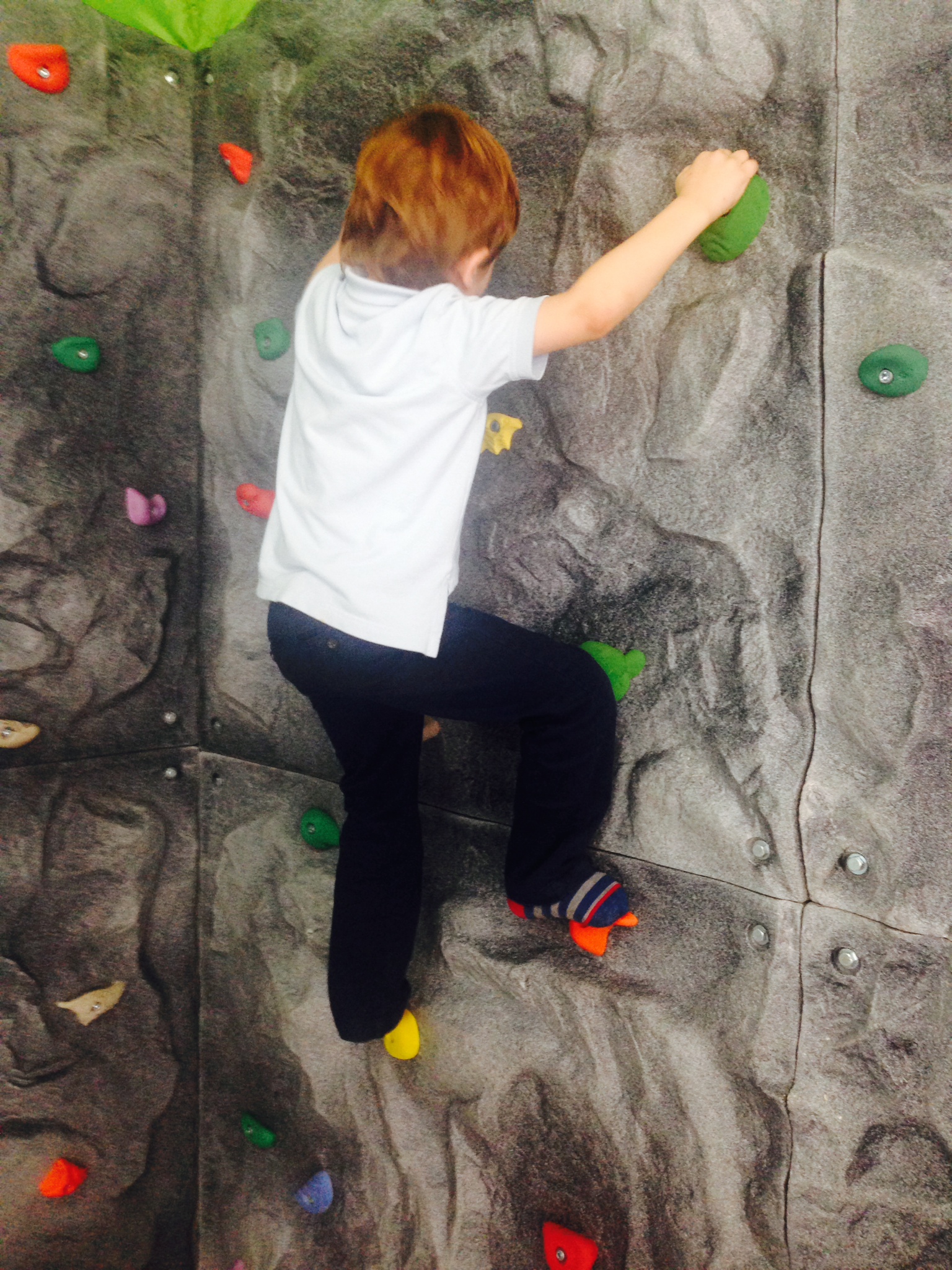
We’re parents, after all, and as parents we want Martin to have the experiences that might stick with any kid. Some, he obviously enjoys. Rock climbing. Concerts. The Lion King. Disneyland. Others, we push the envelope more, like when Adrian and I wedged Martin between us on a jet-ski and gunned it to max speeds. Or roller skating. What a disaster! Martin looked like a Looney Tunes character running. Finding fun is trial-and-error for any family. Autism takes so much from us already. Why should we have to be the only family that doesn’t distress the kid once in a while?

Now we’re on a train, from Vienna to Munich. I wish I could write that Martin is observing the placid Austrian countryside, remarking on the farmhouses and windmills. Alas, he isn’t. He’s wearing earphones and playing Garage Band on his iPad. More honestly still, he’s stimming by playing single notes repeatedly. He had a rough few days in Vienna and Bratislava. He is tired, floppy, whiny, unfocussed, and doing his best to make our lives miserable.

Nice try, Martin! Our lives are not miserable. We had a lovely time sightseeing yesterday in Slovakia, where I learned, from T-shirts, that Slovaks are living under a delusion. Apparently they think Marián Gáborík (I just learned that his name has accents!) is “the King.” I always liked Gáborík, and to be sure, he is “a King,” in the sense that he plays now for the Kings. But he isn’t the King. That’s Henrik Lundqvist. Silly Slovaks. Then we returned to Vienna and had dinner at the Palmenhaus. Without us realizing it, Martin ate a sugary sauce on his fresh-fruit dessert. Ooops! Hyperactivity and stomach distress! Then dinner was so relaxed that Martin didn’t get to bed until 10:30 pm. No wonder he’s a mess today.

Adrian and I liked to travel before Martin was born, we liked to travel before Martin was diagnosed, and we like to travel now. Life goes on, even in autism recovery. ¡Vivan las vacaciones!

Postscript: When we return from Europe, Martin and I are ditching Adrian and heading to the Adirondacks for a week, to share a lake house with my sister and niece. “We’re taking two vacations!” Martin declares; I like him to have time with his cousin, and since he attends year-round school, we have to pack travel into the few weeks he has off. Martin is so much better, these days, at expressing preferences. “What was your favorite part of today?” Adrian asked him after we visited Vienna’s Schönbrunn Palace and its extensive gardens, including a playground. “My favorite part of today was when I played in the sand at the castle playground,” Martin answered. After we leave the Adirondacks, I’ll seek Martin’s opinion on which vacation was better, Europe or the lake. I’ll post the results here.

When in doubt, find a playground. This is Martin just hours after we arrived in Vienna. He doesn't speak German, but it took him no time at all to learn the word

When in doubt, find a playground. This is Martin just hours after we arrived in Vienna. He doesn’t speak German, but it took him no time at all to learn the word “Spielplatz,” which means playground.

Take that, doubters! I snagged all this organic swag, plus some organic chicken, at a Spar grocery store right next to our hotel in Vienna.

Take that, doubters! I snagged all this organic swag, plus some organic chicken, at a Spar grocery store right next to our hotel in Vienna.

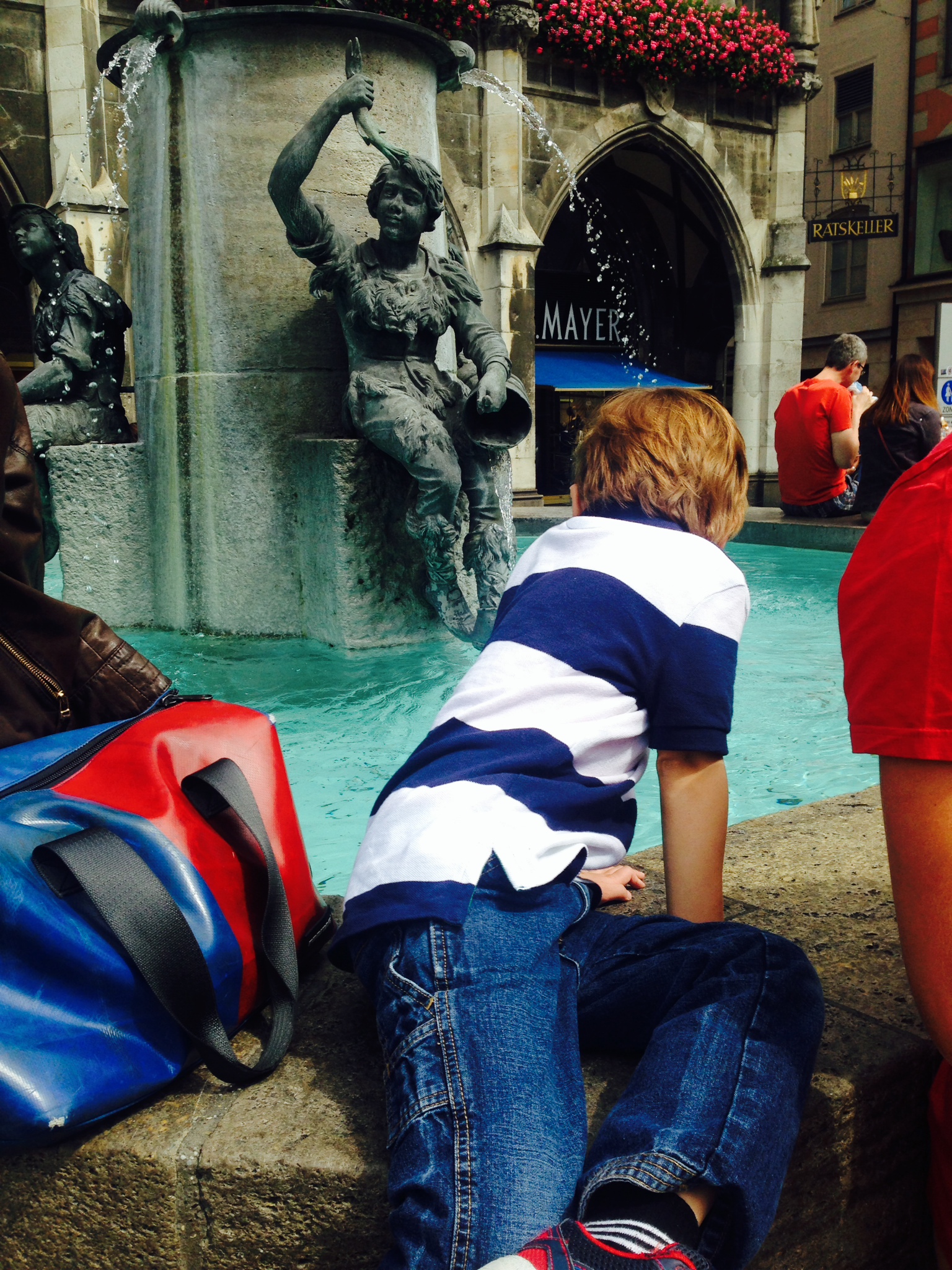
Martin has been feeling better since we arrived in Munich. In this photo, he is checking out a fountain in Marianplatz, in the city center. He just tossed in some Euro coins.

Martin has been feeling better since we arrived in Munich. In this photo, he is checking out a fountain in Marianplatz, in the city center. He just tossed in some Euro coins.

Martin, checking out the English Gardens in Munich. The setting was so photogenic that, a second after this, I handed the camera to a companion and jumped into the picture.

Martin, checking out the English Gardens in Munich. The setting was so photogenic that, a second after this, I handed the camera to a companion and jumped into the picture.

Understanding

“Martin’s progress has slipped a little.”

That’s a euphemism for reality. It means Martin is having a crap week.

I write a lot about this topic, I know. When Martin suddenly looks less like a kid on the path to recovery, and more like a kid with autism, when he tanks, when it all goes to pot, when dinner and bedtime just are not going to happen without a glass of wine (for me, not for Martin), I blog. I blog because I owe you the whole story, because it’s cathartic, and because misery loves company. (These posts tend to generate more messages than any others. Need to talk? Have at it: findingmykid@yahoo.com. Or use the comments section.)

Martin had been doing so well lately, right up till this weekend. Saturday we invited a local family over to swim. They have two kids, age four and almost-six. I’ve known this family for about a year, from church. I know the mother better than the father. Halfway through the afternoon, the father apologized to me for not realizing that Martin has autism. He was surprised when his wife mentioned, on their way to our house, that Martin follows a special diet to alleviate autism. He’s seen me helping Martin around the other kids at church. He always just assumed that my son was shy, or nervous because he doesn’t know the other kids well.

Apologizing? Because you see Martin every week and didn’t realize he has autism? Thank you, but really, no apology necessary.

Sunday afternoon we went to a birthday party. Martin willingly joined a game of tag with the birthday boy and a few other friends. Sunday evening Martin was disappointed that Adrian couldn’t come out to dinner with us because he had a conference call. The call finished earlier than expected, and Adrian surprised us by showing up during the entrée course. Martin, visibly excited, exclaimed, “Oh, you came! I’m so happy!” A friend, visiting for the weekend, who hasn’t seen us in several months, remarked on Martin’s uptick in verbal skills.

We rocked the weekend. Then all hell broke loose.

Sunday night Martin had trouble getting to sleep. Monday morning he slipped into unfocussed silliness. Monday afternoon, at a playdate, he cried and stomped for 20 minutes when I refused to say we could get a chalkboard at home. (I’m scared of chalkboards. Better just to leave that one alone.) Tuesday we received a note from school that Martin was acting defiant and attention-seeking, and that he had hit a teacher. (We jumped all over that one. Martin spent Tuesday evening writing an apology to his teachers.) The highlight of my Wednesday was Martin throwing himself onto the Stop-N-Shop floor and screaming, “I don’t want to buy any fooooooooood!” (As a sign of how far I’ve come regarding public embarrassment: I spent that minute or so, while he was screaming on the floor, searching my purse for my grocery list. Where is that list? How could I have misplaced it so quickly? Wait, is that my kid terrorizing aisle 24?) Through all these incidents, Martin’s language skills, so strong this summer, failed him. He repeated himself, went rote, even babbled. And yet, except for sleeping, he hasn’t stop talking since Monday morning. Just talking and talking and talking and talking. Point, or no point. Accentuated here and there with loud, forced laughing.

Why? What transforms a close-to-typical-child weekend into a thought-we-were-past-these-symptoms week?

After three-and-a-half years of biomed, I’m finally getting the hang of recognizing the likely causes of backsliding. This week, it seems, we’re dealing with yeast die-off. Several weeks ago I began seeing the harbinger of yet another yeast flare. I’ll spare you the details of that harbinger; suffice to say, it’s poop-related. Candex, an enzymatic formulation, has been controlling Martin’s yeast. Last week, Martin’s biomed doctor and I decided to increase the daily Candex dose, and I started that process Thursday evening.

Increased Candex leads to decreased yeast. Decreased yeast means yeast die-off. That’s a toxin in the system, almost like alcohol. It can make a kid silly, or angry, or irritable. That’s happening to Martin now. In tandem with these behaviors, the aforementioned yeast-flare harbinger (okay, fine: the unusual poop) is fading.

Yesterday morning I signed on to one of my autism-recovery groups and saw this post from a fellow mom:

We’re on week three of nystatin for yeast. These past five days I’m pretty sure we’ve been dealing with die-off. Behavior has been super hyper, nonstop talking/making noise, fake laughing a lot, not listening at all, emotional outbursts, no attention to tasks AT ALL, itching??

Yes. Yes! I cyber-shouted. That’s yeast die-off. I’m right there with you, sister.

Understanding the physical cause of Martin’s, ahem, “slip in progress” helps me see that the behaviors are not within his control, and indeed that my little boy probably feels as agitated, flummoxed, and eager to alleviate this situation as I do. Understanding the physical cause also helps me see that darling, recovering Martin will return.

Soon.

On Monday's playdate, Martin behaving. Didn't last long.

On Monday’s playdate, Martin behaving. Didn’t last long.