Compromised

Sunday’s Weekend Edition had an interview with Arianna Huffington about her new book, The Sleep Revolution: Transforming Your Life, One Night at a Time, which reminded me of a post I’ve been meaning to write about sleep.

Or as it were, sleeplessness.

Martin’s early autism was marked by profound inability to sleep. He took an hour or more (sometimes up to three hours) to fall asleep and managed only a few hours before waking again for long stretches, like from 1:00-5:00 am, and then, maybe, sleeping another couple hours. When Martin was awake, I was awake: He yelled and cried, climbed out of crib or bed, and usually needed physical restraint to rest, or for any hope of returning to sleep. (A weighted blanket made no difference.) For more than a year, I survived on as little as two hours’ sleep per night, and considered six hours a luxury. When I did sleep, it was often on Martin’s bedroom floor, or contorted around his body in a single bed, or upright in the chair next to him. I drafted a celebratory post when I could finally lie in my bed even though he was awake, and again the night that I lay awake in bed because I finally wasn’t exhausted.

I’ve said this before, and I believe I will say it many times again: Sleeplessness makes autism so much the worse. Autism is emotional turmoil. Adrian and I have had to fight the system to seek recovery for Martin. I endure constant guilt about whether my own actions contributed to Martin’s condition. I’ve given up on having a second child, and at times I questioned whether my only child would ever live independently. All of that notwithstanding, the single greatest challenge of Martin’s autism, for me, has been sleeplessness. I understand why sleep deprivation is considered a form of torture. When you’ve had only 20 hours’ sleep over an entire week, nothing makes sense. During the most challenging, jittery months, I had to avoid sitting down during the day, because I might fall asleep, wherever I was.

Even when Martin became a better sleeper, I regret to report, I continued to squeak by with too little rest, juggling writing, autism recovery, the bad nights Martin still sometimes had, and as close to a healthy a marriage as I could muster.

Now, three or four years after the Great Sleeplessness, I make an effort to get at least seven hours’ sleep every night, and eight full hours as often as possible. I’m doing pretty well. But I know that my health still shows the effects of having gone so long without sufficient rest. Before Martin developed autism, I caught two colds a year, one in the winter and one in the summer, and other than that rarely was sick. Since the Great Sleeplessness, I’ve endured as many as four major illnesses per year, despite eating a cleaner diet than ever. Nowadays when I feel “something coming on,” I can’t assume that if I take it easy for a few days and lay off the gym, I’ll be fine. “Something coming on” now means that I’m going to be effectively non-functioning. That’s what happened a few months ago, in January: On a Saturday afternoon, I felt vaguely unwell. By midday Sunday, I was coughing uncontrollably. I had to cancel a Monday afternoon flight to California and ask my law partner to cover the mediation I had been scheduled to attend; from Monday afternoon, when Samara arrived (thank goodness, she had been scheduled to come and care for Martin while I was in California) until Thursday, when Samara went home, I stayed in bed. After that, I was able to rise and get through the day, but I remained out of sorts, with a persistent dry cough, more than a week later—at which time a chest x-ray showed I didn’t have pneumonia, and the doctor asked me to please, please consider antibiotics. I suppose I’ve become too reluctant to use pharmaceuticals.

When I was 21 and living in India, I caught dysentery and quickly dropped from 110 pounds (those were the days) to 95 pounds (bad idea!). I’m 5’6″, and it took months for my weight to cross back into triple digits. I also started feeling cold, almost all the time. I wore extra sweaters and slept under piles of quilts. As I recollect, the cold feeling, which was ignited by being underweight, stuck with me four or five years before fading. I’m hoping for something similar now. Constant exhaustion weakened my immune system. Four or five years of taking care of myself—fingers crossed!—should just about alleviate the issue. Check back with me in 2018.

For now, I am done with sleeplessness. I hate sleeplessness. I hate sleeplessness all the more for these points:

  1. Chronic fatigue has imposed a heavy burden on my well-being. If this is what happened to my body, what did sleeplessness do to Martin, who was a growing toddler? Moments like these, I am so very thankful to understand that autism is medical, and to have found biomed as a way to restore Martin’s health, and mine.
  1. For children and adults on the spectrum whose symptoms are more severe than Martin’s, or whose health doesn’t improve with interventions, this kind of sleeplessness may persist for years. Years. And the same can be said for their parents/care-givers. Years. Remember the study that found that mothers of children on the spectrum can suffer damage comparable to combat stress? I think I know a big reason why that happens.

Oh, dear. I feel something coming on again, and this time it’s snark:

Tell me again why “autism is an important part of neurodiversity” and we “shouldn’t be trying to cure autism”?


Contributions

If you read yesterday’s tedious post about a Tuesday morning, you may have asked yourself why I, your blogger, was the parent doing everything. Adrian, who is not only my husband but also Martin’s father, was at home that morning. His role in the story was limited to showing up for toast and coffee, showering, and leaving later than usual in order to drive me to the train station. And goshdarn it, he got to sleep until 6:30.

Autism recovery is long and expensive. You know that. For me, the heartbreaking posts in my on-line biomed groups are the ones like, “I’m trying so hard to help my child, but my husband subverts everything I do,” or, “Before autism, we had a real marriage, but now I’m married to him only because I need the insurance,” or, “I’ve become a single parent, with limited resources. If you had to pick either organic food or supplements, which one would you buy?”

If parents intend to navigate the autism-recovery journey together—or even remain a loving, adult couple in the face of autism—they need to find their way to the same page, i.e., to talk openly and craft a mutually acceptable plan. In our family, by agreement, the division of labor is this:

Me:

Research treatments; schedule all doctors and therapists; plan necessary travel; monitor diet; procure and prepare special food; order and administer supplements etc.; coordinate childcare for when I’m working or otherwise unavailable; oversee detox baths and sauna use; inquire about and visit schools; keep medical and school records; serve as activity chauffeur; monitor home environment; be assumed-on-duty parent at all times except when advance arrangements are made (“Saturday afternoon from 1:00-3:00, I need to edit a brief. Can you take Martin?”).

Adrian:

Earn the money to pay for all this.

Whether this arrangement is fair depends on your viewpoint. I am the parent who had to give up my career in order to handle Martin’s recovery effectively. That being said, I am also the parent lucky and privileged enough to be able to surrender an office job and devote my hours to Martin. I am the parent who gets less sleep in order to juggle all that needs to be done, and who manages the stress of autism/ADHD. That being said, I am also the parent without office and workplace stress, with more freedom in how I organize my time. I am both the parent who has to do most of the day-to-day decision-making and the parent who gets to do most of the day-to-day decision-making. Adrian cannot cook or prepare supplements or measure detox baths; when I must travel alone, Martin’s nanny Samara stays in our home to take care of him. To take care of Martin and Adrian both, really. That being said, Adrian never begrudges my time away from home.

Moreover, whether our arrangement is fair does not matter one iota, because it is the arrangement that works for me and Adrian. The very big decisions, such as whether to undertake chelation, or where Martin should attend school, we make together. I may go so far as to prepare a presentation of alternatives, with supporting information, so that Adrian can help make an informed choice. My being the biomed parent does not negate Adrian’s being an enthusiastic and involved father. Martin is Adrian’s Mini-Me. They dress alike, go to the gym together, rock-climb together, ride bikes together. They get the more typical parent-child relationship. I get the rest of it.

Adrian likes to say that it’s to my credit, not his, that Martin is doing so well. He calls Martin my “masterpiece.”

I respond that I couldn’t manage this process without my partner.

The Bigger Perspective

Martin’s school is a self-contained special-education setting for children with speech and language disorders, including autism. The teachers possess patience and experience in equal measure, the administration is supportive, and I feel fortunate that has been placed there since kindergarten.

Yesterday, when I arrived to pick Martin up for personal training, I ran into the mother of Brian, another boy in Martin’s class. I’ll call the mother Chrissy. This is the third year Brian and Martin have been in the same class, so I know Chrissy well enough. Chrissy was picking up Brian, and as usual, she had her younger son, Aaron, with her. Aaron attends a special-needs preschool in the City, and I know that the family has been looking for a kindergarten spot for him, so I asked how the process is going.

“Good,” Chrissy replied. “I think we are actually going to be able to get a spot for him here.”

“Here? That’s terrific,” I said. “Both boys in the same school—they’ll be able to see each other, act like brothers. You must be happy!”

“Yeah. I’m happy.”

Chrissy didn’t sound happy.

“Not a great thing?” I asked, tentatively.

“I mean—both my kids are going to be here.”

Ah, yes. Of course. Both her kids will be in the superior self-contained special-education setting for children with speech and language disorders, including autism.

Because both her kids have autism.

Because we are losing a generation of boys, and a lot of girls, no one is doing anything about the crisis.

Past Tense

Years ago, when we were only a few months into Martin’s recovery, I was leafing through a magazine I found in our doctor’s waiting room. I don’t remember the publication’s title, or even its purpose; I think it may have been a resource for parents pursuing biomed.

What I do remember were a couple of personal-experience pieces written by typically developing teenagers in support of their ASD siblings. In one, a girl whose brother was already recovered talked about her brother’s autism and how it had led her to advocating on behalf of students with disabilities. Although my memory of the other details is nebulous, I can still recall this phrase: “During the time my family was affected by autism . . . .”

Those words struck me. They were so comforting, how they suggested that there can be an other side to autism, a time when autism is not a daily struggle, when recovery is not the long road (to where?) ahead, but when the reality has become a memory.

I’ve written now and again about autism symptoms that are so far gone that they no longer exist in my daily consciousness.

Martin, for official/school purposes, has lost his autism diagnosis.

We still have work to do. Lots of work. Martin’s executing functioning—meh. As a corollary, Martin’s attention span and ability to plan—ugh. Martin still has a diagnosis. “ADHD,” our new territory.

Yet—.

Last week I attended a conference in California, for the consumer advocacy work I do. I was meeting with the director of a non-profit organization devoted to monitoring toxins in personal-care and household products. She asked how I became involved in representing consumers.

I said, “Through my son. He had autism.”

Attention-Deficit Hyperactivity Disorder (ADHD)

Because we are thinking about changing Martin’s school placement, Adrian and I decided to order a new neuropsychological educational assessment (a “neuropsych”). Martin also had a neuropsych three years ago, before he entered kindergarten, and last year. Those first two neuropsychs were completed by Dr. DS, a practitioner in Manhattan. This time we switched to Dr. PS, a practitioner in a suburb near ours, who knows our local schools and who had never before met Martin. Dr. DS and Dr. PS are mainstream neurodevelopmental psychiatrists, not biomed practitioners. Before Dr. PS started her testing, I enumerated Martin’s issues at this time: paying attention, sitting still, emotional regulation. I did not say “autism,” though she certainly must have seen that word on the previous neuropsychs and the school records I provided.

We had our parent meeting with Dr. PS last week, after she’d had three lengthy testing sessions with Martin. She told us that Martin’s primary trouble lies in executive functioning. She diagnosed him with ADHD, compounded by social/pragmatic language delays.

She didn’t mention “autism.”

Adrian asked, “You’re saying he has attention deficit and hyperactivity?”

Dr. PS answered, “Really, hyperactivity is a minor part. The primary issue is attention deficit, this inability to focus. That stems from the executive functioning and affects his performance in many areas, including school.”

Adrian is Adrian. He likes concrete, definitive responses. He asked, immediately, “Um, why don’t you think Martin has autism?”—not the question I would have posed. I like to leave well enough alone.

Dr. PS said that different practitioners come at executive functioning in different ways. Martin, she said, presents with “a little bit of this, and a little bit of that,” such that, perhaps, a doctor focused on autism might find a mild spectrum disorder. In Dr. PS’s opinion, however, Martin “does not meet the diagnostic criteria for autism spectrum disorder.” He presents much more strongly as a child with attention deficits. True, he retains difficulties with social/pragmatic language, but he is eager to socialize and keenly aware of others. No, she concluded, he doesn’t have autism.

“So,” I said to Adrian as we climbed into bed that night, “we don’t have a son with autism anymore.”

Adrian paused. Then he replied, “I guess we’ve known that for a while.”

I guess we have.

Martin can express himself, now. Martin doesn’t really have repetitive behaviors, anymore. Martin’s perseveration, which once was literal inability to stop speaking, has faded to a penchant for prattling about obscure topics, like marching bands and features of my car’s dashboard. Martin knows exactly what other kids are up to. He won’t let me affix a sport strap to his glasses anymore, because “Zach and John don’t have straps on their glasses.” Martin is awkward, socially, and his attention span has the half-life of hydrogen-7. But “autism”? These days, that seems too harsh.

On the other hand, it feels strange—to say I don’t have a son with autism. We still have a lot of work to do with Martin’s executive functioning, and the spectrum has been a driving component of our life, even of my own identity. We socialize with other autism families. We swap articles about autism. I even pre-board airplanes, on the basis that “my son has autism.” (The pre-boarding will have to stop. I will let airline attendants draw their own inferences, but I won’t lie.) Autism, autism, autism. What do I do now? Find ADHD friends?

Adrian and I have never been public about Martin’s diagnosis. Indeed, we’ve gone to lengths to hide his autism. In part, that’s because “autism” is a scary word. ADHD or ADD, not so scary. People seem to love to self-diagnosis with ADD. Maybe now we can go public with that moniker.

Almost six years ago—the summer that Martin turned two—was when Adrian and I started to realize that Martin had “issues.” Other kids blew out the candles on their birthday cakes. Martin stared into the abyss over his own cake. (We later discovered he lacked the ability to pucker, or to blow.) In the toddler soccer program, when the coach said, “Run and kick a cone,” nine kids ran and kicked a cone. Martin wandered to the next field and tipped over the goal.

By that fall, we were sufficiently concerned to ask a high-school friend of mine, an EI provider, to come take a look at Martin. She did, and she knew immediately that he had autism. The first psychologist, sent by New York City only a couple weeks after my friend saw Martin, said, “It’s autism. You might call it ‘high-functioning autism,’ or, ‘Asperger’s syndrome’.” But though Adrian and I didn’t realize it, Martin was backsliding. He had already lost eye contact and was becoming less responsive every day. By the time the Big Imposing Hospital’s neurodevelopmental team got hold of Martin, several months later, there was no mention of “high-functioning” or “Asperger’s.” They diagnosed Martin with moderate autism and threw in the kitchen sink of co-conditions: delays in every type of communication, low muscle tone and lack of proprioceptive awareness, sleep disorder, possible cognitive impairment, and on, and on, and on.

Let’s call that the low point.

Fortunately, we had already started biomed and the tedious brick-by-brick struggle to free our son from autism.

When he was three, Martin’s special-needs preschool removed him from a self-contained 12-1-1 classroom (12 special-ed students, one teacher, one aide) based on his need for more supervision, and his inability to keep up with the other developmentally delayed three-year-olds. The school placed him instead in an 8-1-2 classroom, in which two other students had 1-on-1 aides (in total, eight special-ed students, one teacher, two classroom aides, and two dedicated aides). Martin was left in that classroom for two years.

When it came time to find a kindergarten—we lived in New York City, where kids don’t just go to the local school, as they might elsewhere—we had Martin’s first neuropsych done. Dr. DS, the Manhattan neurodevelopmental psychologist, confirmed the autism diagnosis as “not a close call.” He told us that our desired elementary school, which has 12-student special-ed classrooms, would not provide enough support for Martin, and would be likely too advanced, academically. He said we were “really looking more at a need for 1-on-1 support” or a six-student ABA classroom.

Forget that, Adrian and I decided. When the desired school, with the 12-student classrooms, accepted Martin, we sent him there. And he excelled.

Two years later, before second grade, it was time for another neuropsych. To get a reasonably comparative assessment, we brought Martin back to Dr. DS.

Dr. DS admitted that he had been mistaken to think Martin wouldn’t make it at our chosen school. In fact, Dr. DS was not so sure Martin still needed all the support the school offered. “I’ve seen some remarkable progress,” Dr. DS said when he presented us with Martin’s report. Martin had moved from the third percentile to the 83rd percentile in receptive language, for example, and though the autism was still prevalent, he had made tremendous gains in other areas, too. What were we doing?

I told Dr. DS about our biomed protocol and nontraditional therapies, like HANDLE and Anat Baniel Method. He listened. At least he appeared to listen. When I finished, Adrian asked Dr. DS what our next steps should be, and Dr. DS said, “Medicate Martin. Now is a good time to start experimenting with medications, so that by the time he reaches third grade, when the curriculum becomes more advanced, you will already know the best combination and dosage of medications, whether it’s depressants, stimulants, or something else.”

Thank you, Dr. DS!

Another year passed, and this time we brought Martin to suburban Dr. PS, who opined that autism spectrum disorder is no longer the correct diagnosis for Martin. She said that her testing revealed an upward trajectory from Dr. DS’s reports. While Martin once had significant delays in all four areas of language, Dr. PS said, he now exhibited delay only in pragmatic/social language. “So looking at his history,” she said, “we can see that Martin was not destined to be a child with receptive or expressive language problems, as those have faded away.”

Destiny? I asked myself. Destiny didn’t resolve Martin’s receptive and expressive language delays. Biomed did.

“What should we be thinking about for next year?” Adrian asked.

Three components, said Dr. PS. First, the choice of school setting. Second, additional therapies and resources. And third, medication. It’s time to start experimenting to find the best medication for Martin’s ADHD.

I’m tempted to write, Thank you, Dr. PS! There’s an addendum, however. I told Dr. PS that we are “hesitant” to medicate Martin because doing so would interfere with our biomed protocol. The progress we’ve made, I explained, has resulted from a restricted diet, supplementation, and constant reevaluation of Martin’s health needs. Dr. PS—remember, she’s a mainstream neurodevelopmental psychiatrist—asked pertinent questions, like what kind of doctor we see and whether the protocol is test-based. (There are charlatans in the autism-recovery universe. I know that.) After I provided sufficient reassurance on those points, Dr. PS said we are probably right not to medicate at this time. If what we are doing biomedically is working, she said, then we should exhaust that route. Experimenting with medication does not have a time limit, and it is okay to start later.

So, actually, really, thank you, Dr. PS. Thank you for listening and reconsidering.

And, for my readers, especially my long-term readers, here’s a special tidbit: Do you remember my lengthy post about Mr. and Mrs. Twice-Exceptional, the Quirky Genius School, and the movie The Imitation Game? You might want to revisit that one.

As she was reviewing Martin’s test scores with us, Dr. PS pointed out a wide discrepancy in the different fields. In many academic areas, including reasoning and some language-based tasks, Martin’s scores were at the top of the bell curve, well above the average range. He uses his formidable intellect and those stand-out skills, Dr. PS said, to compensate for his still subpar executive functioning.

“You see,” Dr. PS told us, “your son is what we refer to as ‘twice-exceptional’.”

Disappointment

I’d like to write a bit on the topic of disappointment, because disappointment is affecting me this week.

To be honest, disappointment is always affecting me, to some degree. When we started recovering Martin, more than five years ago(!), I thought we’d be done by kindergarten. The mother who launched our biomed journey put that notion into my head, I suppose, because she’d recovered her own son in less than three years. Martin is in second grade now, and if you read this blog, you know that he’s not recovered yet. That disappointments me, chronically.

The fact that the pace of Martin’s recovery disappointments me—that compounds the issue, because I feel disappointed in myself. Think about the son I have today: conversant, joking, getting-healthy, almost-non-stimming, diagnosed ADHD/language delay. Compare him with the constantly stimming, perseveration-stuck, limited-speech son I used to have, diagnosed ASD. What kind of person am I, to let disappointment enter my thoughts?

dis•ap•point

v.tr.

1. To fail to satisfy the hope, desire, or expectation of.

2. To frustrate or thwart.

v. intr.

                To cause disappointment.

We are hoping to transfer Martin from his self-contained special-education school to a general-education classroom with an aide. The neurodevelopmental psychiatrist (mainstream) says that Martin is ready. The behaviorist says that Martin could make the leap. Martin’s Sunday-school teacher, who has charge of him along with a dozen typically developing kids one morning per week (and who herself has a son fully recovered from autism), has advocated for general education. Adrian and I, when we see Martin at his best, know that he has outgrown his special-education placement and needs the challenge of general education.

Our zoned elementary school, at Martin’s grade level, has 26-to-28 pupils per class. Even with an aide, that’s too many. Instead, we’ve been combing the local private schools, which average 12-to-15 pupils per class. I’ve met with the admissions directors of more than half a dozen private schools, explaining that we want to transition our son, and that he would likely need assistance, including a classroom aide, for another year or two. One school told me to get lost: They had no provisions to help a child transition to general education, and were not interested in stretching their parameters. Several schools said they had a resource room and/or a special-education teacher on staff and could offer accommodations but would not consider a classroom aide. Two schools, both church-affiliated, said that if Martin was otherwise a good fit, they would consider allowing a classroom aide. One of those two schools currently has two students with classroom aides, and its headmaster is a former special-education teacher. That school soon became my, and Adrian’s, top choice for Martin. When the school agreed to have Martin visit for a day, last week, we were hopeful.

As I wrote above, when we see Martin at his best, Adrian and I know that he has outgrown his special-education placement and needs the challenge of general education. Regrettably, Martin is not always at his best, and for the past month or so, he’s been sensory-seeking, with a diminished attention span. (A limited attention span—an infinitesimal attention span—remains Martin’s greatest challenge. Diminish that? Argh. Martin? Martin? Hello, Martin?) When he visited our top-choice private school last week, Martin was not at his best.

The school promptly turned us down.

What a disappointment.

Disappointment, because although the other church-affiliated school remains in play, our plan to move Martin to general education may be delayed another year. Disappointment, because the school we thought would want our son rejected him. Disappointment, because biomedical recovery is still a fringe movement, so I cannot tell the school, “Two steps forward and one step back. It gets worse before it gets better. The antimicrobials he’s taking for Lyme disease have kicked up a lot. Wait a month or two. He will be a whole different kid.”

The sting of rejection is still fresh, and today Martin’s annual review arrived from his current school. If you have a child with an IEP, you know that annual reviews, and progress reports, and IEP’s themselves, are not drafted to highlight a child’s strengths. They are drafted to justify maintaining services. Martin’s annual review is no exception. He has trouble sitting in his chair properly. He sometimes calls out inappropriately during lessons. (Detoxing. Ever hear of detoxing?) He reacts poorly when he doesn’t earn all his behavior-management tokens. He can’t focus. He needs prompting. He is making progress, but he isn’t ready to leave his supportive setting.

When I was a child, my family had a Magnavox Odyssey2 video game console. (Showing my age with that admission.) I remember a game that scrambled words. I just searched online but found no record of this game. (If you, dear reader, happen to be an Odyssey2 whiz, or just skilled at finding ancient relics online, please email me at FindingMyKid@yahoo.com, or comment on this post, with some evidence that this word game existed.) I loved the Odyssey2 word game. I challenged myself to find words too long to fit on the screen.

I remember distinctly: The longest word my pre-teen mind could conjure was DISAPPOINTMENTS.

Fifteen letters, DISAPPOINTMENTS. Many months passed before I found a better word than DISAPPOINTMENTS.

Today, here, now, I challenge myself to find a better word than “disappointment.”

I challenge myself to find a better emotion than disappointment.

IMG_2084

Martin, next to a good friend of mine, checks out the Long Island Sound.

Body Integrity

Martin’s Lyme treatment makes him sensory-seeking, and I am his target.

He grabs hold and squeezes—puts me in headlocks, wraps his arms around my waste, tugs my arms, hops onto my back and chokes me.

His hands are in my hair—pulling my ponytail, removing the elastic, dividing locks into temporary pigtails, transferring whatever is stuck between his fingers (say, peanut butter, or coconut shreds) to my scalp. I don’t have great hair to begin with. Now it’s a downright disaster.

He headbutts my back, my arms, my torso, even my head when he can. It hurts. Then he rolls his head against me, hard. Back and forth. Back and forth. It is winter, and the air is dry. Sometimes his hair shocks me.

He wipes his nose on me, regardless of whether it needs wiping. I prefer when it doesn’t.

He climbs into my and Adrian’s bed and attempts to burrow. Once he gets part of himself wedged under me, he starts to kick.

He stands atop my feet.

He sits next to me and puts his head in my lap. That is fine, until he starts trying to do a headstand. If I flip him upright, he climbs onto the back of the sofa. From there, he headbutts me. See details, above.

When he does these things, he clenches his jaw, as if he cannot get enough sensory input. Occasionally he raises his arm, tightens the muscles, looks scared and uncertain, and brings his hand down to hit me—not hard, not intentionally, more like a slowed-in-air tap, unable to stop himself. In return, I hug him tightly.

I love my son. I love having him near me. But this is getting old.

IMG_1907

(Martin, on the campus of Stanford University, last weekend. Only ten years till he applies for admission.)

IMG_1923

(Martin, rocking the spectrum at We Rock the Spectrum training facility in Berkeley, California. He rock-climbs much better when wearing sneakers. Also, I forgot to bring his Cal State Golden Bear sweatshirt, so he was wearing Stanford Cardinal red, in Berkeley. Faux pas!)

Moments

The moment in a ski lodge when your ASD son—whose Lyme-disease treatment has rendered him so hyperactive that your brother Eddie just had to eat half his dinner holding a squirming boy on his lap, to prevent that boy from ransacking the restaurant—hits the “Floor 1” button in the elevator, then turns directly to three adult men who’ve entered and inquires, “Are you also going to the first floor?”

The moment in the airport security line when your ASD son—whose Lyme-disease treatment has turned him so inside himself that he doesn’t always realize when you’ve started speaking to him—takes his trombone case off his shoulder and holds it proudly in front of him, hinting for the TSA officer to ask him about the instrument, and then answers her question with, “Yes, I am very good at playing the trombone. I even take lessons, every Friday.”

The moment in a Whole Foods Market café when your ASD son—whose Lyme-disease treatment has left him so anxious that he burst into sobs when he lost sight of you, momentarily, in a trampoline center—finds his way to the napkins and silverware, selects the right quantity of each, returns without delay, and sets the table, without being asked.

The moment in a restaurant when your ASD son—whose Lyme-disease treatment has made him so sensory-seeking that he continually puts you in tight headlocks, whenever he’s not trying to wipe his nose on your sleeve—lets you cut his roast chicken, then says, “Thanks! I was getting frustrated with that.”

The moment in the car, in Northern California, when your ASD son—whose Lyme-disease treatment is causing him to perseverate on marching bands and musical instruments, regardless of what conversation is actually happening—calls from the backseat, “I like Southern California better. Uncle Rudy lives there, it’s warmer, and it borders Mexico,” and follows up with, “Why do you say you like Northern California better, Mommy?”

The moment when the new neuropsychologist evaluating your ASD son—whose Lyme-disease treatment has made him so drunken-silly that he interrupted the neuropsychologist’s testing with a giggle fit, and later became infuriated with a challenging exercise and shut off her computer—tells you, “I definitely see issues here. I would say primarily ADHD, and secondarily speech processing delay,” and never once mentions the A word.

Food Porn, Mardi Gras Edition

Tomorrow is Ash Wednesday, so this must be Fat Tuesday, the culmination of Mardi Gras. Tuesday afternoons Martin attends the kids program at our church. Last week, our pastor announced that he planned to serve king cake today.

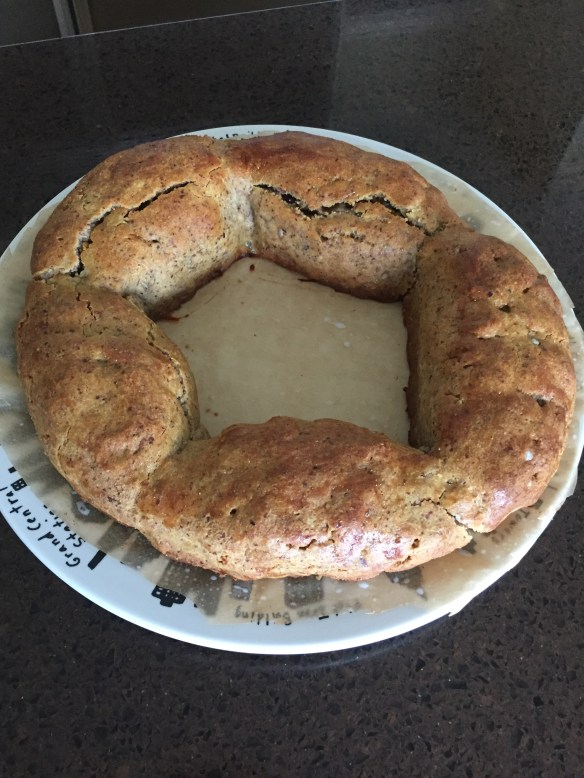
When Samara, who had taken Martin to the kids program, informed me of this king cake development, I was weirded out. This isn’t New Orleans, and my church isn’t Roman Catholic. We are stuffy Northeastern Protestants. The last time I ate a king cake, I was a 22-year-old graduate student dating a Louisianan whose mother FedExed us the delicacy. (I recall that a Jewish friend found the Baby Jesus trinket, which subsequently was stolen by PeeWee the cat, who batted poor Baby Jesus mercilessly about the parquet floor.) On the other hand, Samara—who is not only Roman Catholic and of Latin American origin, but unable to see Martin deprived of anything—jumped all over the king cake idea. By the time I returned home Wednesday evening, from a mediation I was attending in Los Angeles, Samara had downloaded a recipe for “Paleo” king cake, invented her own sweetened cashew cream filling, and spent four hours baking this:

IMG_1587

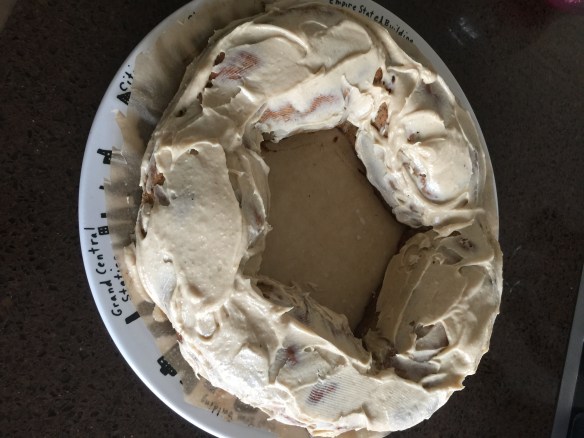
We popped that base in the freezer. Yesterday I moved it to the refrigerator to defrost. This afternoon I created a frosting/glaze. In the Vitamix, I blended 1/4 cup melted coconut oil, 1/4 cup coconut cream, 1/4 cup cashew butter, 1/4 teaspoon sea salt, and 3 tablespoons raw honey. I spread that on the defrosted king cake:

IMG_1590

Next, I used an India Tree decorating set to color four bowls of organic shredded coconut:

FullSizeRender

Finally, I sprinkled the dyed coconut onto the frosted king cake to replicate the traditional multi-colored appearance:

IMG_1591

Martin took the cake to church this afternoon and loved the treat. I’m not sure if I have Samara’s patience to make this every year, but a new tradition just might have been born.

Postscript: Apparently the pastor had trouble finding a local bakery in the business of assembling king cakes this year; by the weekend he had changed course and declared today’s kids program “pancake dinner”—the tradition much more associated with us uptight, Shrove Tuesday types. Of course, the pancakes were not Martin-approved, and the homemade king cake was already in my freezer. So while the rest of the kids had pancakes, Martin ate like a king.

At least he shared.

Easy Peasy, Puddin’ Squeezy

Martin’s school sent home a note to all parents, asking us to make sure our kids keep sneakers in the classroom, to wear to the gymnasium.

I, of course, could not remember whether Martin has sneakers at school.

So I asked him.

And he answered, with a nod.

“You do?” I asked. “Which ones?”

“The blue ones with the yellow swoosh,” he replied.

“Those old ones? Do they still fit?”

“They fit. I tie them myself.”

I used the italics, above, for the benefit of those readers outside the autism community. The others, like parents with a child on the spectrum, know the import of asking my child a question, expecting an answer, and still more, expecting an accurate answer. Once upon a time (for example, last year or any other time in memory), finding out whether Martin had sneakers at school would have required writing a note to his teachers and awaiting their response. Being able to ask him—that’s way more convenient.

Last Saturday, while Adrian was out of town skiing, Martin “took me out” to lunch. We had just settled into our seats when Martin said he had to go to the bathroom. “All right,” I said, “go ahead.” He left the table. He returned five minutes later, his hands still damp from being washed. As far as I can tell, nothing eventful happened between our table and the restroom. Later, I left the table for a minute. I asked Martin to stay put, and gave him my iPhone to amuse himself. He stayed put. When I returned, our waiter said casually, “Your son told me you’re going to the trampoline place this afternoon. Have fun!”, as if my son telling the waiter our plans were an everyday occurrence.

In fact, even though Martin was hyperactive and off balance from his Lyme treatment (again!), the whole weekend that Adrian was away ran smoothly. Friday evening Martin and I went to meet his new trombone teacher. Remember how disappointed Martin was when he didn’t receive a trombone for Christmas? Since then, he’s persistently asked to start trombone lessons. Finally I called music schools—most instructors weren’t willing to work with a child younger than 10—until I found a jazzy older fellow who said something like, sure, we’ll just find an alto trombone so your son’s arms aren’t too short to reach every position on the slide. We ended up buying an alto “pBone,” which is a real instrument whose exterior is plastic instead of brass (with a resulting price decrease!). The teacher-student meeting went well, and since then Martin has started his lessons.

Saturday morning Martin and I attended a student production of Cinderella at a local school, then went out to that lunch, and then met another family for a play date at the trampoline center. For dinner I made a cashew-carrot soup, which Martin ate with a spoon, instead of the stainless-steel straw on which he used to rely. Sunday we went to church—Martin participates in Sunday school with the other kids—and then to his hockey lesson. He chose to spend extra time on the ice after his lesson ended.

Once upon a time I dreaded weekends without Adrian; activities with Martin were a chore, but downtime at home resulted in stimming and meltdowns. Last weekend, the Lyme treatment had Martin at his worst. (Things haven’t improved much; stay tuned.) His worst right now is so much more manageable than his best used to be.

I’m thinking right now about parents of neurotypical kids. For sure, they have their own challenges. That being said—holy cow, parenting a child who can answer questions, complete simple tasks alone, and amuse himself for a few minutes now and again feels almost like doing nothing at all.

Parents of neurotypicals: Is it always like this?

I know that we have travails to come, as Martin continues to recover. At some point, he will transition from special education to general education, and we will have to worry about bullying and self-esteem. As he understands more about what his friends and classmates want, peer pressure will become an issue. And we have travails now. Martin’s continued perseveration, though milder than it used to be, perversely annoys me even more. The uneven temperament that comes with the Lyme treatment is bewildering. Parenting Martin will never be laissez-faire, at least not for me.

But, actually, maybe it kind of will be easy. If raising Martin had been like last weekend all along, I might just have more kids. Lots more.