In the GAPS

As assorted posts have mentioned, two months ago I switched Martin’s diet to GAPS. “GAPS” stands for “Gut and Psychology Syndrome” and is the work of a British doctor and nutritionist, Natasha Campbell-McBride.

Dr. Campbell-McBride’s book, Gut and Psychology Syndrome, sets forth how autism (along with dyspraxia, ADD, schizophrenia, and other apparent brain disorders) is symptomatic of a compromised immune system, linked with an imbalance in gut flora. The author suggests healing the gut with a diet comprising fresh foods prepared at home, without grains or sugars or other carbohydrates, and with plentiful meat and/or fish stock. (I’m simplifying.)

It’s been more than three years since we started eliminating foods from Martin’s diet. Since January 2011, Martin has not eaten gluten, casein, soy, corn, refined sugar, processed food, additives, or conventional/GMO food. We also introduced some foods that Martin, a vegan since birth, had never had before: eggs, ghee, honey, and fish oil. After some months we also added meat, which was especially challenging because I’m vegan and Adrian is pescetarian. Other variations along the way in Martin’s recovery diet have included restricting oxalates, temporarily avoiding foods to which Martin showed sensitivities, and trying to eliminate all sugars for one summer.

As of February 2014, Martin was eating meat, eggs, vegetables (including limited amounts of starchy vegetables like sweet potatoes), fermented vegetables, legumes, gluten-free grains like buckwheat and rice, and very little fruit. In puddings and baked goods he had complex sugars like raw honey or raw agave. With very few exceptions, like rice crackers, everything was organic and homemade.

Which is pretty good.

The thing is—Martin’s gut still didn’t seem to be healing. His bowel movements were light-colored and fluffy or flakey, instead of firm, and he had started complaining of stomach pain. Again. I thought we were done with stomach pain.

I decided to take the diet a step further. In the ASD recovery world, there are several diets that people adhere to. The formulations start with gluten-, casein-, and soy-free and branch out from there. Two of the most popular diets are the Specific Carbohydrate Diet, or SCD, and GAPS, which is an adapted variation of SCD. I didn’t have a scientific basis for choosing between GAPS and SCD. (Science doesn’t like me. Science doesn’t want me to understand it.) Some parents love SCD. Some swear by GAPS. Because I already owned Dr. Campbell-McBride’s book and was more familiar with GAPS, I decided to try that route and hope maybe Martin would clear some hurdles to gut health.

For extreme gut distress (ongoing diarrhea, for example), Dr. Campbell-McBride suggests various stages from an “introduction” (almost only bone broth) to “full GAPS” (all the GAPS-compliant foods, still incorporating ample bone broth). Martin was not experiencing extreme distress, just a lack of overall gut health. Therefore, I skipped the introduction stages and put him directly onto full GAPS.

Switching to GAPS meant three primary changes. First, Martin has to stop eating starchy vegetables, cocoa (temporarily), rice crackers and his few other grains, all sweeteners except raw honey, and some lesser-used foods like arrowroot, cannellini beans, and roasted nuts. (Raw nuts are acceptable.) Second, he gets to add a few more fruits, if yeast is under control. (Last month, after the nystatin debacle, Martin started taking Candex, which has been helping balance yeast without the side effects.) Third, he drinks meat stock with every meal. Most weekdays he takes only meat stock for breakfast. I make stock weekly, rotating among chicken, beef, lamb, and whatever other meat/bones I can get.

Which brings us to the million-dollar question: Is it working?

Two months is too little time to make a long-term prediction. (By way of digression, I’m not sure I’ve ever used “two,” “too,” and “to” in a single sentence before now.) Martin’s gut is improving; he’s stopped thrusting his fists into his abdomen and complaining of stomach pain, and his bowel movements have become firmer. On the other hand, I’m yet to see unusual progress in his behavior. He’s been up and down, the same jaggedly positive trend as ever in his recovery. I call it 100 steps forward, and 99 steps back. I remain hopeful, nonetheless, that sealing his gut will soon lead to more behavioral improvements, because he will be better able to absorb his nutrients, supplements, and so forth.

At this time, the two-month mark, I’m giving a tentative thumbs-up to GAPS.
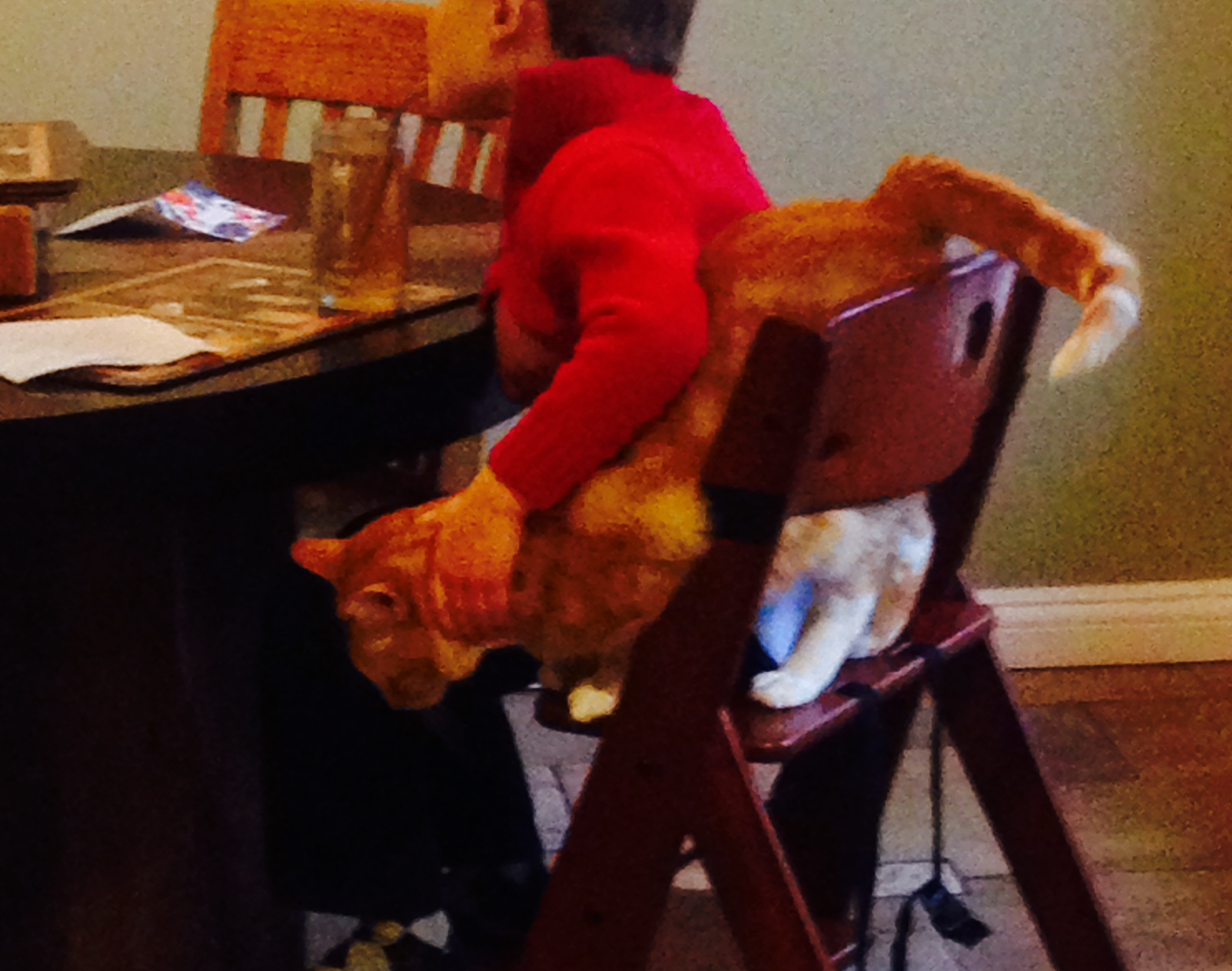
Yes, this is the worst-quality photo ever. Sorry. It's Martin, taking his bone broth for breakfast, "assisted" by our cat George.

Yes, this is the worst-quality photo ever. Sorry. It’s Martin, taking his bone broth for breakfast, “assisted” by our cat George.

Third of Three Firsts: A Nod

The winter seemed eternal this year. Only in mid-April did spring’s first tentative harbingers arrive—daffodil buds, pollen, temperatures in the 60s.

“Martin,” I asked, one of those first warm afternoons, “it’s such a beautiful day. Shall we open the sliding doors and let some air into our family room?”

Martin stopped playing his toy saxophone and looked at me.

As I’ve learned through RDI, I waited five seconds, to give Martin’s mind time to absorb the question, and then said, “What do you think? Shall we let some air in?”

Martin still made no verbal response.

But after another second passed, he looked at me again and nodded. Twice.

Beginning very young, even before his diagnosis, Martin could shake his head no. (He could verbalize “no,” too, when he didn’t want something. Learning to verbalize “yes” when he wanted something, as opposed to repeating the last words he heard, took much longer. I believe that is common in echolalic children.) Nodding, however, never came naturally to Martin. I had to teach him the physical motion; I put my palms over his ears, spread my fingers, and gently maneuvered his head up- and downward. After months of practicing the motion, I could get Martin to nod on his own by requesting, “Can you show me ‘yes’ with your head?”

This time—his nonverbal response to, “What do you think? Shall we let some air in?”—was the first time I’ve witnessed Martin nodding unprompted. The nod was awkward, as they always are. I didn’t care.

I said, “Thank you for answering me with your head, Martin!”

Then I opened the sliding doors, and let the fragrant springtime air drift through our home.

Daffodils (and those pesky dandelions!) bloom in our front garden. I’ll nod to that.

Daffodils (and those pesky dandelions!) bloom in our front garden. I’ll nod to that.

Second of Three Firsts: The Boys’ Bathroom (in a Bouncy-House Place)

Martin and I spent Holy Week/Passover in Texas, visiting my parents. Away from home, Martin had fewer friends and activities to occupy him, so when I wasn’t dumping him on my parents—I mean, letting my mother and stepfather enjoy time with their grandson—I resorted to visiting an “inflatable play zone.”

In lay person’s terms, an “inflatable play zone” might be called a “bouncy-house emporium,” or “hell.” It is a large, undivided space (think high-ceilinged hotel conference room, or big-box store) filled with blow-up castles, mazes, slides, in which kids can jump and climb to exhaustion. In an inflatable play zone, you hear a constant whirr from the machines pumping air, a sound as if you were in an airplane. A gigantic airplane with screaming children in sensory overload. An airplane with nothing to occupy you other than watching the screaming children in sensory overload.

One afternoon Martin and I set out for the “Extreme Fun” bouncy-house place, in north Austin. My parents were due for a few hours’ break, having watched Martin all morning while I enjoyed a massage at the local spa. My brother Rudy, who was visiting Texas from California, at first agreed to accompany us but then mysteriously realized he needed to “work” on “a project for a friend,” so Martin and I were alone.

We reached our destination, disembarked my parents’ Highlander, crossed the parking lot, and discovered a note stating that, after seven years’ business, Extreme Fun had shuttered its doors.

Fancy that.

I brought Martin back to the car and, seeking to prevent a tantrum, launched into my speech about disappointment. “Oh, that’s a disappointment. Let’s think: Should we cry? Should we—”

At this point, ten seconds into the disappointment discourse, Martin cut me off and said:

“Is there another bouncy-house place around here?”

Holy cow, that was a good question. A good, appropriate question, expressed perfectly, without whining or tears. Even the intonation flowed.

A question like that deserves reward. I pulled out my iPhone and searched for another bouncy-house place. After Google Mapping the choices, I restarted the Highlander and drove us half an hour west to the “Hoppin’ House” in Lakeway, Texas.

The Hoppin’ House turned out to be a pleasant facility with eight or ten inflatables and a foam-cube pit. We stayed for more than an hour. At no point was more than one other family present, so Martin had his run of the place.

After a while Martin needed a potty break. The boys’ and girls’ bathrooms, child-size, sat side-by-side. I held Martin’s hand and opened the door to the girls’ room, so I could enter with him.

Martin pulled back. He asked, “Is this the bathroom for little boys?”

He poses that question, or some variety of it, often. I responded, as usual, that it was the bathroom for mommies and their children, and that the other one was for daddies and their children.

Martin pulled back again. He looked at the other door, as if contemplating.

I’d never let Martin use a public restroom alone. He gets so easily distracted. Who knows what might go on once the door shuts? Bathrooms are so germy. He would put his hands on everything. And he doesn’t like to do “stand-up peepees.” He would sit on the toilet, and let me tell you, I can barely manipulate those flimsy seat covers. It ain’t gonna happen for Martin.

Still, there he was, gazing upon the boys’ room. I’d been in the girls’ room earlier. It was tiny; in the same-sized boys’ room, there couldn’t have been more than two stalls, and probably no urinals. (I loathe urinals.) The bathroom had one exit, and we were the only ones in the vicinity, so I could lurk outside the door without feeling foolish.

It was like with Justin, our next-door neighbor, and babysitting: If I was ever going to let Martin use a public restroom alone, this set-up was darn close to perfect.

“Martin,” I asked, “would you like to go in the boys’ room?”

Without hesitation, Martin said yes. He didn’t smile. He looked courageous, determined, as he disappeared inside.

I waited. I don’t know how long I waited. Long enough that I thought Martin should be done peeing. Then I cracked open the door and peered into the bathroom.

Martin, who didn’t notice the intrusion, was washing his hands. At home, he protests against washing his hands, or loses focus and makes faces in the mirror instead, or runs out of the bathroom and claims he must use the kitchen sink. In the public bathroom, he was nothing but business. I watched him rinse those little hands and grab a paper towel to dry.

I shut the door so he wouldn’t know that I’d checked up on him.

Moments later Martin emerged. I exclaimed, “You did it! You went in the bathroom by yourself!” and threw my arms around him while praising the big-boy deed. Martin seemed uninterested in my praise. He said he was thirsty and asked for a bottle of water.

To Martin, I guess, using the boys’ room alone was no big deal.

Check that one off the list.

Martin, climbing above the foam-cube pit. Sorry about the photo quality; I was kind of balancing on the edge of the pit as I snapped pictures.

Martin, climbing above the foam-cube pit. Sorry about the photo quality; I was kind of balancing on the edge of the pit as I snapped pictures.

Martin heading up a slide. Sometimes I want to follow him onto these things. They look fun.

Martin heading up a slide. Sometimes I want to follow him onto these things. They look fun.

First of Three Firsts: The Babysitter

These past few weeks have brought a few firsts for Martin. Actually, for me, Martin, and Adrian. Here come three posts on firsts.

Since Martin’s diagnosis three-and-a-half years ago, we have not used any babysitters other than Samara, the nanny who’s cared for Martin since he was a baby; Janine, a special-education graduate student who worked with Martin through Early Intervention and whom we subsequently hired privately; and family members. Having a kid with autism made me skittish to rely on the neighborhood teenagers for babysitting. Having a kid recovering from autism only added complications. Who wants to explain food restrictions, homeopathic drops, and supplements?

Shortly after we moved to our new suburban home, a 14-year-old neighbor named Justin rang our doorbell, introduced himself, and volunteered that he would be happy to babysit anytime. He seemed a respectable and well-spoken young man.

Still, I didn’t go for it.

At least, not until nine months later, when circumstances intervened. Samara needed to return to her country of origin for six weeks. Adrian and I had a Friday evening dinner date in the City, scheduled months earlier, with old friends. Because of a calendar mix-up and (Adrian’s) work travel, we’d had to cancel two dates in a row with this couple, and I was determined not to miss a third. Janine works elsewhere on Fridays.

(Justin, coincidentally, stopped by a second time and offered his services.)

What to do, what to do?

I waited until a Tuesday afternoon when I knew Justin would be at school, then slipped next door to speak with his mother. I presented a brief outline of Martin’s challenges (“speech and language delays, and something like Asperger’s syndrome, depending on which highly paid expert we consult”) and asked whether she thought Justin would be up to the task.

Justin’s mother listened. She posed a few relevant questions. She said, “I think Justin can handle it. And he’s a pretty honest kid. If he’s in over his head, he’ll say something.” Then she asked where Martin goes to kindergarten. When I told her—Martin attends a private institution for children with speech and language delays—she responded, “I know that school. We considered at it for my younger son. He’s speech-delayed.” And what evening did we want Justin to babysit? Friday? Friday would work well. “My husband and I will both be home all night,” she said, “so if Justin needs help, we could come over.”

Oh? Oh? Justin has a younger brother with speech delays? Justin parents will be next door the entire time, ready to spring into action if problems arise?

Even I had to admit that, if we were ever going to use a neighborhood babysitter, this set-up was darn close to perfect.

Arrangements were made. Martin was informed that “Justin the teenager” would “come over to play with him” on Friday. Subsequently Martin was informed that Mommy and Daddy would go out to eat while Justin the teenager was here playing with him. Finally Martin was informed that Justin the teenager would be helping him with bedtime while Mommy and Daddy were out to eat.

To my surprise, Martin appeared unfazed by these revelations. Friday morning, he boarded the school bus with a smile, excited that a teenager was coming to play with him.

I spent all day Friday getting ready for Justin’s 5:00 pm arrival. The house was spotless. All laundry was washed and folded. Martin’s bed had fresh linens. The family room was ordered. (I couldn’t bear to have the neighbors think we’re slobs.) Martin’s dinner, dessert, and evening snack were prepared. Martin arrived home from school at 3:45 pm. Immediately I ushered him to the kitchen table for dinner. I reminded him that Justin was coming, that I was leaving to meet Daddy in the City, and that Justin would help him with bedtime. I added that, while Daddy and I were out, Justin would be in charge. Martin ate his dinner with no objection. By 4:45 pm, dinner, evening supplements, and the essential bedtime supplements—those that I consider non-essential, I decided to skip—were in Martin’s tummy.

Justin arrived. Martin ran away and hid his face, then showed up and waved hello, then fled again. I told Justin the following (note that supplements and recovery protocol never came up):

* Martin has “food allergies,” so please feed him only what I’ve specifically left for him. (Here, Justin conscientiously asked, “Does that extend to scent allergies? Will it be okay if I order dinner delivery?”)

 * Martin should go to bed around 7:30 pm, but it is not the end of the world if he doesn’t, or if he doesn’t go to sleep. (Here, Justin conscientiously asked, “Does he brush his own teeth? Will I need to help him? Does he like to hear a story?”)

* I expect Martin to become upset, maybe throw a tantrum, when I leave. Don’t worry. He’ll calm down.

* We will be home by 11:00, and if when we get home Martin is alive, then we’ll consider the evening a success. The rest is icing on the cake.

At this point, I asked Justin to make sure that he had both my phone number and Adrian’s, and Justin pulled out a mobile phone in a New York Rangers case. When I asked if he is a fan, Justin responded that he babysits because he’s saving up for his own New York Rangers mini-plan, i.e., quarter-season tickets.

Plainly I had selected the world’s best 14-year-old to watch Martin.

It was time for me to leave. I kissed Martin goodbye and waited for him to wage his protest.

Only—he didn’t. He said ’bye and wandered into the family room with Justin.

I headed to Manhattan. I drove, instead of taking the train, just in case some emergency arose and I had to return home quickly. I told our dinner companions that Martin was at home with a teenage babysitter. They asked if I wanted to text Justin to check the situation at home. Adrian saw that I was nervous, and asked if I wanted to text Justin to check on the situation at home.

No, I said. I’m good. I’m going to let this run and see what happens. I left my phone on the table, next to my plate.

Under the table, I fidgeted.

In my head, I prayed.

Superficially, I chatted. And dinner elapsed.

Adrian and I arrived home at 10:40 pm. I entered the house tentatively. Would Justin be crying? Would Martin be running amok? Perhaps something would be on fire? We came in through the garage. I tiptoed into the kitchen and peeked—I’m serious: I peeked, and not without trepidation—into the family room.

Justin was doing some schoolwork he’d brought. He had the Rangers game on the television.

The rest of the house was peaceful.

No screaming. No blood stains, ambulances, or fire trucks.

“It went fine,” Justin reported with a shrug. A shrug! “He’s been sleeping since about 8:30.”

Adrian and I looked at each other. Had it really been that easy?

Apparently it had. I asked Justin how much we owed him, paid, and watched him walk next door.

That was that.

With Samara the nanny still away, Justin has babysat Martin two more evenings. Each visit requires hours of preparation. Supplements and exercises done in advance. Martin pre-fed. The household perfected.

And each hour of preparation has been exquisitely worthwhile, for Adrian and I have finally been able to enjoy what parents of typically developing kids might take for granted: the neighborhood teenage babysitter.

No, that's not Martin. It's just that---well, I do so love the Rangers.

No, that’s not Martin. It’s just that—well, I do so love the Rangers.

More Civility

Last year I took Martin to a friend’s sixth-birthday party. I talked to the birthday boy’s mom in advance and knew they were serving pizza. For Martin I brought homemade GFCFSF pizza and cookies.

I thought Martin would be happy with those choices. With the pizza, he was. I heated it in the hostess’s oven and served it on a party plate, just like the other kids’ pizza. Unfortunately, the situation went south when cake time rolled around. Martin didn’t want just any treat. He wanted the cake. And when he didn’t get cake, he went into meltdown mode.

I might give in to something like a non-organic apple. But I don’t concede gluten-, dairy-, and sugar-laden cake. I picked up my screaming kid and moved to another room, where I held Martin on my lap and tried to calm him with promises of a special cupcake when we got home. (I would gladly have stopped at blessed Babycakes, which sells cupcakes that are free from gluten, dairy, corn, soy, and refined sugar.)

Martin was having none of my peacemaking. He cried and wheezed, inconsolable. At this point, another mother, whom I never had met, entered the room and asked, “What’s the problem?”

“My son is upset because it isn’t a cake he can eat,” I replied.

The stranger came closer and said, directly into my ear, “Just tell him you’re taking his piece home for him to eat there. By the time you get home, he’ll forget about it.”

I had a child on my lap near hyperventilation. This was not the time to explain that I don’t follow lie-now-and-hope-he-forgets approach to parenting. So I replied, “I wish I could, but he remembers everything.”

This woman was not to be deterred, neither by my blow-off attempt nor by Martin’s tears. “What is he, gluten-free?” she asked. “Why don’t you give him some of the ice cream?”

Her voice was loud so I could hear her over the racket, and her tone was sharp so I would know that she didn’t approve of a gluten-free diet.

“It’s harder than that,” I said, trying to sound sheepish so she would leave and let me return my attention to Martin. “He doesn’t eat gluten or dairy or refined sugar.”

I didn’t bother adding soy, corn, starches, most carbohydrates and fruits, non-organic or processed foods, or preservatives to the list of what Martin doesn’t eat. No matter. Apparently gluten, dairy, and refined sugar were enough to earn this stranger’s condemnation. She said, “Oh my God.” Then she rolled her eyes, turned her back to me, and walked away.

So I got what I wanted: She left us alone, letting me return to comforting Martin.

The rudeness I could have done without. Also, the particular phrase she chose, which is offensive to me.

Most of the children attending the birthday party had special needs. Later, after Martin calmed down, I saw this woman with her son. He wore ankle braces and hearing aids, and he engaged in atypical behaviors. Our conversation had been special-needs-parent-to-special-needs-parent, but it sure didn’t feel that way.

What went wrong at the birthday party? First, it was a terrible time to discuss anything. Martin was in full meltdown mode. The stranger could have said, “You have the most intriguing eyes I’ve ever seen, and I would kill for a figure like yours,” and still I probably would have tried to blow her off. Second, she was plainly unwilling to think outside her own box. Really, I don’t even think she wanted to help. She wanted to judge.

Let’s compare to a conversation in which I found myself a few weeks later. This one happened after a meeting of our district’s special-education PTA, when parents were hanging around to mingle. I ended up talking with a woman who introduced herself as the mother of an 11-year-old with Asperger’s. When she asked about Martin, I said that he has made enough progress that I’m not sure whether to say “autism,” “high-functioning autism,” “Asperger’s,” or something else. She asked about what therapies have helped the most. I replied that we do biomedical and homeopathic interventions, and that those, combined with a restricted diet, seem to have made the difference.

We talked some about Martin’s diet. Then the mother said, “I think a lot of so-called autism remedies are snake oil, people trading on hope and desperation.”

I replied that she has a point. Even after years on the biomedical path, I find it hard to distinguish between legitimate interventions and unsupported promises. I try not to let it get me down. I hire and rely on experienced doctors, and I do as much research as I can manage.

The mother asked, “Do you do the dangerous stuff, like chelation?”

I replied that we haven’t chelated yet but plan to; that from what I know, chelation is safe if done properly; and that, in terms of which interventions have relieved autistic symptoms, chelation rates highest in parental reports.

She said, “I hear what you’re saying. But people who say you can treat autism are the same people who say vaccines cause autism. Do you believe that?”

I replied that I think the strict cause-effect narrative has undermined legitimate debate about vaccines. Everyone knows that vaccines are dangerous for a child with a compromised immune system—that’s why parents are told not to bring a child for shots when she has, for example, a cold or an infection, and why a child undergoing chemotherapy cannot be vaccinated. Autism, I said, is the symptoms of an underlying immune disorder, often with a genetic component. The immune disorder may exist before the symptoms manifest. If a child is asymptomatic, his parents and doctors may not recognize the immuno-problems, and they may therefore go ahead and vaccinate. The vaccine, in turn, causes the already compromised immune system to go haywire, and then the symptoms manifest. In such a scenario, the vaccine didn’t “cause” the autism, but it did exacerbate the pre-existing immune disorder and cause the symptoms (i.e., the autism) to appear.

The Asperger’s mother listened to my entire monologue. When I finished, she boosted my ego a little by saying, “You know, you’re the first person who’s ever told me about a link between autism and vaccines without sounding insane.”

We talked for 20 or 30 minutes, this mother and I. Don’t worry! It wasn’t all me rambling on. She knew tons about navigating the special-education system, and I grilled her for tips. We ended up exchanging numbers and thanking each other for the shared insight.

Did I convince this mother to begin biomed with her 11-year-old? Probably not. Did we have a positive interaction? Definitely. Unlike at the birthday party, the special-education PTA event was the right time to discuss helping our children, and the mother I met was curious and open-minded.

Civility is out there.

Even if it doesn’t always seem that way.

Civility

I know that I should stay off social media, other than maybe the autism-recovery groups I enjoy.

I definitely know that I should refrain from taking the bait when people post uninformed opinions on topics about which I have, well, more informed opinions.

If you read this blog, you probably have thoughts about vaccines. I do. I’ve posted about the link that I think exists between vaccines and the symptoms of autoimmune disorders, symptoms like “autism.” It’s such a controversial topic. I try to read as much about vaccines, on both sides of the issue, as my schedule allows.

Which makes me ripe for a bad Facebook experience. I made the mistake of responding to a post by a guy I knew well in college and now know only through Facebook.

This Facebooker, the guy I know, posted an opinion piece deriding “anti-vaxx” celebrities. (“Anti-vaxx” was used in the posted piece. It’s not my term. I don’t think raising efficacy or complications concerns, or questioning ingredients, is necessarily “anti-” vaccinations). Beneath the link to the opinion piece, the Facebooker said something like, “It is a sad commentary on our society when people are willing to accept celebrity ‘opinion’ over scientific fact.” He then went on to compare “anti-vaxxers” to people who deny evolution or global climate change.

Within the comment thread under his post, the Facebooker asserted, without citation, that “any link between vaccines and autism has been scientifically disproven.”

Best course for me to take in such a situation: turn off Facebook and walk away.

Course I did take, this one time: I commented. I wrote:

“Can you point me to the study that you are referencing? I’m not advocating one way or the other. I am aware of studies suggesting the absence of a link, and of studies noting that vaccinations can cause neuro-disruptions. But I’m not aware of any study that compares autism rates in vaccinated versus unvaccinated populations.”

Then, lest anyone think I have a connection to autism (we’re not public about Martin’s diagnosis), I added:

“I am concerned about this topic because at age 12 I was very sick with measles, despite having been twice vaccinated against it.”

What did I want to achieve by commenting? I don’t know. I was frustrated. The Facebooker’s comment made no sense, empirically or otherwise. We cannot “scientifically disprove” a link between any two occurrences; the most we can do is, while attempting to control for other variables, demonstrate that the occurrences arise no more often in conjunction than they do independently. In the case of autism and vaccines, I know, that rigorous work has not been done. This Facebooker was carelessly spouting an untruth.

In seconds, without thought or ceremony, he responded: “There. Is. No. Fucking. LINK. NONE. STOP.”

And I, shocked, wrote: “Um, okay. That sounds scientific.”

Most of this is likely not verbatim. I recall, exactly, his comment, “There. Is. No. Fucking. LINK. NONE. STOP”—periods, explicative, and all. As for the rest, I am recreating the conversation. Immediately after I wrote, “Um, okay. That sounds scientific,” the Facebooker deleted the link and the comment thread, and replaced it with this status update:

“You’re not going to spoil my happy today. Period.”

Under that “spoil my happy” status came this comment thread:

Random commentator: “Oh, see now… someone’s going to try!”

Facebooker I know: “Already has. Why do you think I posted it? What it comes down to is this. To the world: As much as you are obviously in love with your own opinions, I DON’T CARE!!!!!! You may not care about my opinions either. That’s fine. No skin off my nose. BUT I DON’T CARE!!!!!!!!!”

Random commentator: “Ah, see, I almost had a sarcastic comment for your last post.”

Facebooker I know: “I swear to God, you could post that 1+1=2 and there’s going to be someone who argues with you. Not having it.”

Wow, right? This Facebooker, as I said, is a guy I knew in college. I’ve seen him once since college, when he was in New York a year or two ago, and we had a nice lunch to catch up. No prior animosity. Nothing. That explosive reaction resulted, as far as I know, 100% from my question about “scientific disproof” of a connection between vaccines and autism.

I commented no more. Instead, I took my boldest Facebook action ever. I stopped “following” the guy. I didn’t go so far as to unfriend him. Unfriending just isn’t in my nature. But now that I’ve stopped following him, his posts no longer appear in my news feed.

It’s justified. Around when Demi Moore was separating from Ashton Kutcher, this Facebooker posted a picture purporting to show cellulite on Demi’s legs and chastising her for not spending enough time on a treadmill. As if women don’t have enough trouble with body image! Demi Moore weighs, like, 70 pounds. Then, during the 2012 NFL referee lockout, when the league used less-experienced substitutes, this Facebooker complained about a game by posting something like, “These replacement refs are really ‘special,’ and I don’t mean that in a good way.” You see the problem there: He’s implying that the referees have special needs, which is “bad” and appropriate for ridicule. The way I see it, the vaccine incident was strike three, and this Facebooker is out. Or at least un-followed.

There’s a real shame in this story. In the original “anti-vaxxers” link and comments—the thread that the Facebooker deleted because he was “not having” any “argument”—there was a comment from a third-party who self-identified as a person with autism. She wrote something like, “Even if there were a link between vaccines and autism, people who abstain are suggesting that they would rather lose a child to preventable disease than have a child like me.” I would have appreciated the opportunity to follow up and engage that person further.

No such luck. Some topics, it seems, are just no longer available for discussion.

School Food

In the month since I put Martin on full GAPS diet, I think, the question I have heard most from parents is, “What food do you send for school?”

Martin’s school requires that each parent send lunch and two snacks. This morning, for Martin’s snacks, I packed (1) lime pudding, made from avocado, manuka honey, vanilla extract, and lime juice; and (2) half a pear, sliced and dredged with lemon juice. Last week I posted a picture of a dippin’ plate with carrots, peppers, and pear. The GAPS diet advises that fruit be eaten away from meals, because fruit enzymes work better alone. So, to the extent Martin eats fruit (I try to limit fruit, because he has so much trouble with yeast flares, which can be fed by sugar), I give it as a snack.

For Martin’s lunch, I packed his LunchBots container with (1) chicken breast with Himalayan pink salt; (2) avocado (I do a lot with avocado) mashed with cultured garlic, which you may remember from the “dippin’ plate”; (3) probiotic Zing! salad; and (4) raw cauliflower florets.

photo-20

I have been trouble getting Martin to eat raw vegetables. That’s a shame. Raw veggies are full of good digestive enzymes, and they might help loosen his front-bottom baby teeth, which I want to do because the adult teeth already have broken through behind them. I predicted the LunchBot would come home with the chicken and avocado gone, the Zing! salad mostly eaten, and the cauliflower untouched.

Do I know my son, or what? I was wrong only insofar as he took, maybe, one or two pieces of the cauliflower.

photo-19

Not a total success, but, hey.

Some other lunch combinations are bison jerky with homemade probiotic catsup and sauerkraut; chicken-and-egg bread with spread made from sprouted (i.e., soaked overnight before cooking) lima beans, olive oil, and garlic; or the ever-popular “meat and veggies,” i.e., whatever leftover meat is in my fridge paired with whatever fermented veggies are in my fridge.

Oh, yes. Before anyone writes it as a comment, I will address what all readers must be thinking right now: Martin’s mom has a real Gwyneth Paltrow thing going on here if she thinks any of this is reasonable.

Trust me—I know. I mean, “homemade probiotic catsup”? Who does that?

Autism-recovery folks do, I guess.

Judgments Redux

First an addendum, now a redux. Sorry.

In my defense, this was going to be part of Saturday’s “Judgments” post, but that post was getting way too long.

Judgments” ends this way:

“And so that’s it. I’m way, way beyond throwing stones at how anyone else treats autism.”

Which sounds pretty good, as if I’m all warm and fuzzy and “I’m okay, you’re okay.”

That last line, however, was carefully worded.

Here is a comment, written by an autism parent, in response to the CDC’s new estimate that one in 68 United States children is diagnosed with autism:

I’m kinda pleased…. When autism is more prevalent than ‘normalacy’ autism acceptance will be a whole lot easier! As you know, my son has high functioning autism and I don’t believe he needs to be changed or cured at all. Yeah, he sees the world differently, but different isn’t inherently wrong. I appreciate I can’t speak for all kids, but I love my very individual little boy just as he is 🙂

A mother in an on-line ASD-recovery group cross-posted that comment, from another group, with the identifying information removed.

Warning: I am about to be judgmental.

That “kinda pleased” comment is appalling.

I too “love my very individual little boy just as he is.” Indeed, I cannot conceive of anything Martin could do that would make me stop “loving him just has he is.” This extends even to moral culpability: If Martin recovers from autism, then grows up to be a serial killer, or a rapist, or a child abuser, I will be devastated, I will applaud when he is jailed for life, and I will seek help for his sociopathic tendencies. But I will still love him, even as he is.

Autism has no moral component, except perhaps insofar as manmade environmental factors are contributing to the rise in autism rates. In any event, Martin is not culpable. And if I am willing to get past intentional failings, how could autism ever make me reject “my very individual little boy just as he is”?

Loving a child is easy. Accepting a child is easy. As I have written time and again, there are days when I want to give up biomed, homeopathy, special diets, therapies, and everything else we do for Martin. At the lowest points, I want to say, “Martin has autism. I’m going to leave that as it is, and tell the world to accept autism.” I want to do so because that would be easy.

But I don’t. I don’t give up. My son does need to be cured. I would never say, “I don’t believe he needs to be changed or cured [of autism] at all,” any more than I would say, “We’re going to leave the multiple-personality disorder untreated. I love each of his personalities,” or, “Why eliminate psoriasis? I’m fighting for psoriasis acceptance instead.”

I’m way, way beyond throwing stones at how anyone else treats autism.

As for those who hide behind “acceptance” and “awareness,” who advocate “neurodiversity,” who stand by as autism takes over our children, who choose not to treat the condition at all—

For their approach, I have no patience.

I would never tell a parent who refuses to treat autism that she is selling her child short. Telling her that wouldn’t do anything to change her mind, and it might make her feel bad about herself. Instead, I try to lead by example. If asked, I respond that all kids are different, and that our family follows a special diet and biomedical protocol, and that Martin has made tremendous, if slow, improvement. I answer any questions honestly. I smile.

In my head, though, I’m thinking this:

I feel sorry for your child. Healing an immune system is hard work. Accepting autism is a lot more convenient. For you. Your child will have a more difficult life because you’ve chosen the passive path.

Stones be thrown.

Judgments

Our family is working to alleviate Martin’s autism by healing his immune system, instead of using medication to disguise the health problems. One day, that approach could change, as I mentioned in the post titled “New Sleep, No Crutch”:

Of course I’m familiar with methylphenidate, amphetamine salts, guanfacine, and so forth—drugs that might improve Martin’s still-abysmal attention span. Maybe one day we’ll turn to such resources (in the end, I remain a pragmatist). But for now, while we have the time and opportunity, I choose to work toward eliminating the cause of his short attention span, instead of using drugs to mask the symptoms.

In response, I received this comment from a reader:

As a pharmacist and a mom with a child diagnosed with Asperger’s I think your approach is great. I hesitated giving my own child medication until absolutely necessary. After years of hesitation, finally treating my son’s attention deficit with medication allowed his grades to improve significantly. If you aren’t at the point where that is necessary, by all means use as little drug intervention as possible.

Let’s talk about a topic underlying that comment: judgments.

I went to last year’s Autism One conference with my friend Stacey, who is also working to recover her son. Stacey attended Kerri Rivera’s presentation on her chlorine dioxide (ClO2, or “CD”) parasite protocol. (I was at another, concurrent lecture. Don’t remember which.) After Stacey told me about CD, I looked up some information and talked to many parents who use the protocol. Basically, Rivera uses low-dose oxidation, in the form of chlorine dioxide, to destroy pathogens/parasites and heavy metals.

I told Stacey that CD is not a protocol I would try with Martin, because (1) I have concerns about its long-term health effects, and (2) it requires giving enemas, which I think would violate Martin’s body integrity. (We treat pathogens and parasites through other methods. For example, Martin consumes diatomaceous earth daily, and around each full moon he takes pyrantel and, topically, warmed castor oil. In the past, Martin also has swallowed mebendazole to fight parasites.)

Some weeks later Stacey and I, back in New York, met for lunch. Stacey told me that she had done more research, read Rivera’s book, been in contact with Rivera via email, and ultimately decided to follow the CD protocol with her own son. As Stacey told me this last part—that she had decided to go ahead with CD—she looked away and ducked her head as if she were about to get slugged. Then she added, “I know you’re not keen on CD. I just feel like it will help. Don’t judge me.”

Much later, I had lunch with a friend whose elementary-school daughter has been diagnosed with ADD or similar disorder. My friend wanted to talk about what we do for Martin and whether any of our protocol might help her daughter. I explained what I think are some underlying similarities between ASD and ADD, and what diet and supplements might be able to achieve. She mulled the information, asked a lot of questions.

Fast-forward two months. I was lunching again with the same friend. She said that she and her husband are medicating their daughter to help the ADD. I sensed that she was watching for my reaction. Then she added, “We did try fish oil. It didn’t seem to work.” I realized my friend was afraid that, because we do diet and biomed/homeopathy for Martin, and not medication, I was going to deride her family’s decision to medicate.

My response was the same, to both Stacey and this friend. I said: “Don’t worry. After three years of biomed, I am way, way beyond judging anyone else’s path.”

I, personally, believe that Christianity, and specifically Protestantism, and more specifically the Protestantism most closely associated with the Magisterial Reformation, though tinted with elements of the later Radical Reformation, is the truest faith. That’s why I practice Mostly Magisterial Quasi-Radical Protestant Christianity. It does not mean that I think my friends who are Roman Catholic or Jewish or Muslim or Hindu or nothing at all are “damned” or destined to unfulfilling lives. I think I’m right. They think they’re right. Maybe we’re all right, to whatever degree.

In the world of children with challenges, regardless of what path a family takes, I respect anyone who is (1) trying, and (2) not acting callously. Stacey has looked into the CD protocol and believes it will help her son. My friend reports that a drug targeting ADD has ended the homework battles that were ruining her evenings. The pharmacist who was kind enough to comment on my earlier post hesitated to medicate her son but now finds that doing so has improved his focus and grades.

Plenty of people—I’m pretty sure that, somehow, I run into all such people, all of them in the entire world—are ready to condemn my and my husband’s choices for Martin, from diet to homeopathy to school. I hate that. I hate to be judged.

And so that’s it. I’m way, way beyond throwing stones at how anyone else treats autism.

Martin, out and about. No judgments here.

Martin, out and about. No judgments here.

A Whole Different Animal

Adrian was supervising bath time this weekend when Martin, from the tub, started describing the stuffed animals in his bed: Curious George the monkey, Maisie the tiger, Mitt Romney the elephant, Boo the dog, Godiva the bear and—an aye-be’el.

“An aye-be’el?” Adrian asked. “You have an aye-be’el?”

“Yes,” Martin answered. “An aye-be’el.”

I happened to be passing through the bathroom. Adrian looked at me, as if I should know what Martin was talking about.

So I asked, “What’s an aye-be’el, Martin? Is that an animal?”

“Yes. An aye-be’el is a whole different animal.”

Martin’s kindergarten teachers have said that he often surprises them by being completely on top of a lesson even when he doesn’t seem to be paying attention. Where Martin appears to be directing his focus, in other words, can be deceptive.

The answer came to Adrian suddenly. “Martin, is that something you heard Daddy say? Did you hear Daddy say that an aye-be’el is a whole different animal?”

“Yes.”

“He means an ABL,” Adrian explained to me. “An ABL is a whole different animal. He was playing on the floor when I was making calls earlier.”

Aha! The puzzle came together. ABL stands for asset-based lending. It describes a specific type of credit agreement—a whole different animal when it comes to credit agreements. Adrian, who is a corporate lawyer, had been on the phone all afternoon, negotiating. Martin had entered periodically to stack his blocks on the big rug in Adrian’s home office. He’d probably heard his father say something like, “They want to talk about an ABL? Oh, no. An ABL is a whole different animal.”

Months ago, on a recovery site, I read a father’s post asking how much ASD children, before they recover, are “with it,” i.e., how much the children absorb and will later recall from the time before they are fully communicative. Martin may not be the best example on this, at least not anymore, because these days he’s reasonably far along in his communication skills. Nonetheless, think about the ABL, and then about this: Martin possesses astounding recall of events that transpired years ago. We sometimes have conversations along these lines:

Martin: “We were on this bridge before.”

Me: “I don’t think so, Martin. Maybe this bridge looks like another one we drive over?”

Martin: “We were on this bridge when we went to the lighthouse.”

Me: “Holy cow, you’re right. We went to the lighthouse where you were two years old. Do you remember that?”

Martin: “The lighthouse is red and white.”

We might have been to that lighthouse shortly after Martin’s diagnosis, before biomed, when he still drifted the perimeter of rooms and ignored his own name. But he remembers. It’s all in that head of his.

A close friend of mine was in an elevator with her five-year-old ASD son, who is making wonderful progress but still mostly pre-verbal. (I’ll call him Jason.) They’d had a horrible morning; because of a snowstorm, Jason’s school bus was delayed, they’d had to return to their apartment to call the bus company, Jason had become too warm in his jacket, and finally they were on their way back down to wait again for the bus. Frustrated, Jason acted out in the elevator.

Jason’s mom, my friend, immediately restrained him and prevented the situation from escalating.

The reaction of any decent person who saw this would have been, “Good catch, Jason’s mom! Way to anticipate and be on top of his behavior!”

The reaction of the one man who was in the elevator with them was to look my friend in the eyes, point to Jason, and say, “You need to get that thing under control.”

There are, of course, a thousand tidbits that gall me about what happened to my friend and her son in that elevator.

The most galling is this: Did the ignoramus who made that comment assume that, because Jason has limited speech, he can’t hear and comprehend? Did he think that an intelligent and creative boy doesn’t know what’s being said about him?

(“Ignoramus” was not the first word that came to my mind. You know that.)

Jason probably didn’t look like he was listening, or understanding. Martin probably didn’t look like he was eavesdropping on Adrian’s phone calls, either.

But they were. They always are.