Segregation

I am at the music school, waiting for Martin to emerge from his piano lesson. He gets a private lesson, with a patient instructor who lets Martin move at his own speed, which pretty much amounts to lazy Martin doing not much at all. This waiting room is full of children, coming out of lessons, going in to lessons. The children are noisy. They are chasing each other and playing. Some girls are standing in a little group talking so no one else can hear. And the parents, mostly moms, are talking, too. They’re talking about the music lessons, but also about the elementary school, an upcoming birthday party, and some dispute about electric lines here in town.

As you can tell, I’m not joining in. I’m writing. I enjoy talking to other people, but what do I have in common with these moms? Martin doesn’t go the elementary school here. He doesn’t run with these typically developing kids, isn’t invited to their birthday parties. (Don’t feel bad; Martin goes to plenty of birthday parties. He has two this weekend.) When Martin is done with his lesson, he won’t show interest in these kids. He’ll come only to me. We’ll be the two of us, the Martin-and-Mommy unit.

How much time to I spend self-segregating? I’ve never been a “social” person, never felt like I fit right in. Not anywhere. So I have to ask myself: To what extent does having a child with autism give me an excuse not even to try, an excuse to say, gosh, it would be easy to have a typical child? Then I would talk to the other mothers and make plans. Then I would integrate myself. Then I would be a completely different person from who I actually am, and pretty much always have been.

When Martin was a baby, or a pre-diagnosis toddler, I disliked taking him to the playground. In my experience, the playground had two distinct groups: the mommy group, and the nanny group. Even the children split into these groups: The children who came with their mothers played together while their mothers chatted, and the children who came with their nannies played together while their nannies chatted. And I sat alone, while Martin played alone. I didn’t fit with the nannies. I felt like I didn’t fit with the mommies because they were full-time parents who all seemed to know each other so well. How ever would I break into that group? With one child, many work hours, and a nanny on the payroll, I hardly even felt, at the time, like a mom. I couldn’t sidle into a group of mom pros.

To that extent, my parenting life has constituted a continuous stream of self-segregation. I’ve looked for excuses not to fit in, and I’ve found them.

These days, there is an exception to that trend: among fellow special-needs parents. At Martin’s school, or his play group, at Autism One, during meetings of the special-education association, in on-line recovery discussion groups, I do okay. I feel like a mom, like the other moms, and I’m comfortable. I even introduce myself to strangers and, occasionally, make plans.

Martin’s autism has a dual effect. First, it’s the latest of my reasons I’m not like other moms (which follow my reasons I’m not like other lawyers, and not like other writers, and not like other students, all of which add up to the fact that I’ve never enjoyed going to parties). Second, it’s allowed me to let down my defenses for a change and be just like everyone else.

At least, everyone else who happens to have a special-needs child and involve herself in the same activities I do.

Martin and friend, checking out an art exhibit. He does have friends. Maybe he's better at it than I am.

Martin and friend, checking out an art exhibit. He does have friends. Maybe he’s better at it than I am.

ASD Recovery Recipe: Smoothies

Alert: This isn’t really a recipe. But it is a food post that could be construed as instructional, and it includes a colorful photograph. That’s recipe enough, right?

When we were vacationing in South America a few weeks ago, Martin and I paid several visits to the hippie-van-cum-juice-stand parked on a beach. Although the fruit and vegetables weren’t organic (organics are hard to find, in Adrian’s country of origin), they were fresh, and the lovely couple running the place created sugar-free (not counting the naturally occurring fructose) smoothies that Martin loved. I was inspired to try making smoothies at home.

Until now, I’ve been discouraged in smoothie endeavors because I can’t figure out when I would give one to Martin. He already has so many liquids in his day. Breakfast always includes 12 ounces of bone broth. For school I send a LifeFactory bottle filled with Fiji water and a splash of organic juice, which he drinks throughout the day. After school he takes eight ounces of camel milk with cinnamon. Then with dinner he gets another 12 ounces of bone broth. Whenever he wants it, I give him filtered water. Where would a smoothie fit in all that? As it is, half the day he’s got a straw in his mouth.

I’ve also wondered if the amount of sugar (fructose) is worthwhile, in comparison to a smoothie’s total nutritional profile. I thought about adding protein powder to boost that nutritional profile, but for Martin I shy away from protein powders, because even the best-quality organic ones seem fractured, or processed, or otherwise not complete foods. The South American beach folks, I noticed, were adding cashews or walnuts into smoothies without compromising the fruit flavor. Nuts! That’s like natural protein powder ground into the drink. Inspiration.

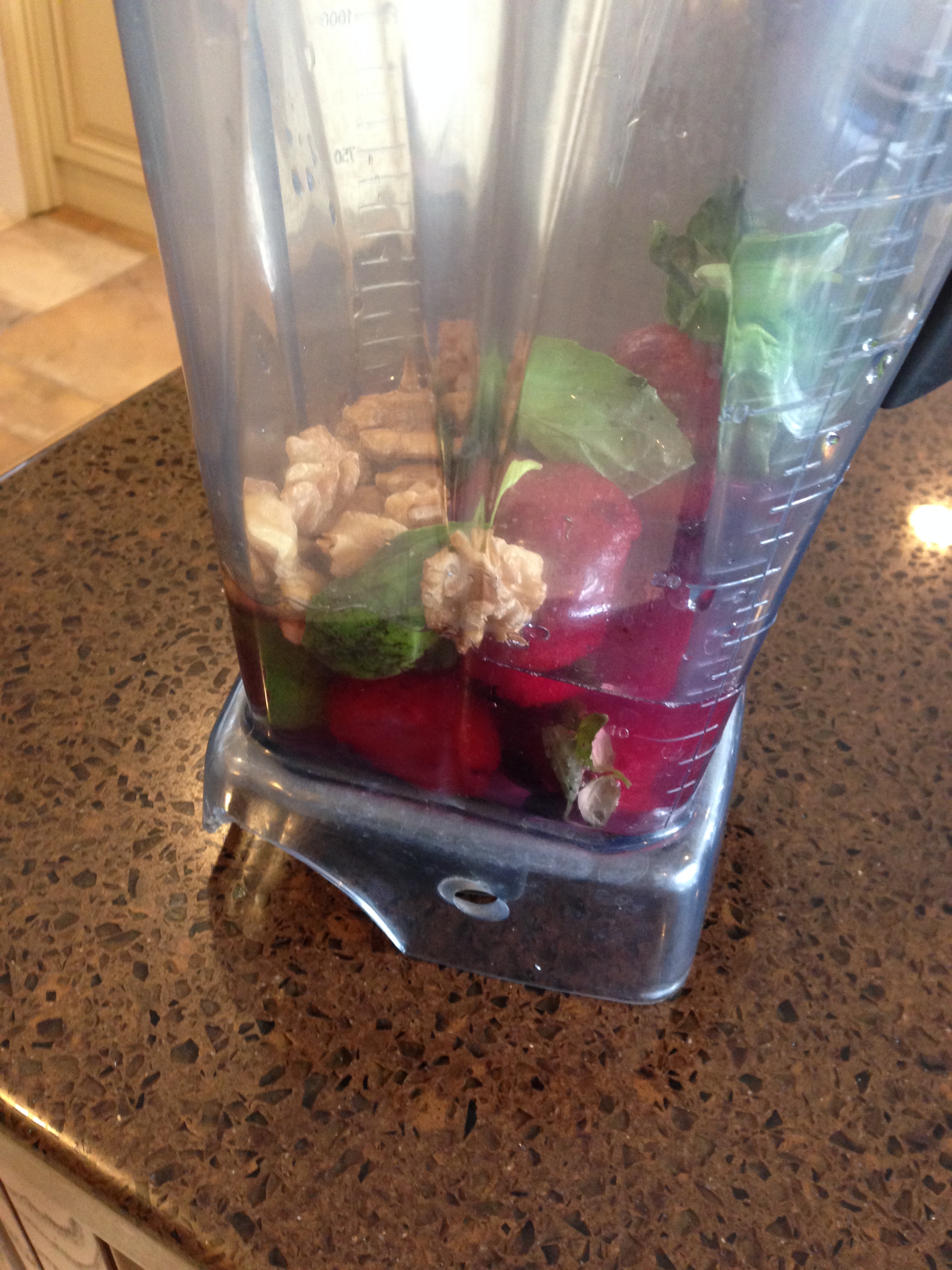
When we got home to New York, I decided to go for it. I found a time: Saturday morning breakfast. True, Martin has soup to drink. But we have a lot more time than a weekday before-school breakfast. Weekends I cook a big breakfast for Adrian and Martin: vegetables, eggs, fruit, avocado, nuts. It seemed like a fine time to add a smoothie. Here’s the concoction I devised:

kombucha, as liquid base

fresh berries

pineapple chunks

pre-sprouted cashews

fresh basil leaves, for the exotic touch.

Big success! Adrian loved it. Martin felt special. Henceforth, weekend mornings are smoothie mornings.

My first smoothie, with the ingredients listed in this post.

My first smoothie, with the ingredients listed in this post.

The second time I made a smoothie: Frozen organic berries, sprouted walnuts, basil, and water.

The second time I made a smoothie: Frozen organic berries, sprouted walnuts, basil, and water.

Adjusting My Attitude

Yesterday morning, I accompanied Martin to the church basement for Sunday school. Sometimes, even still, I do that, if he finishes children’s time at the chancel and looks for me while the kids shuffle together down the aisle. I take his hand, walk with him down the stairs, watch him get settled.

There were extra attendees yesterday, so the Sunday school teacher and another parent added a second low table and asked the older kids to bring chairs. In that commotion, the younger kids, the kids Martin’s age, began filling the chairs as they arrived. Seven-year-old Kara plopped down, grabbed the chair next to her, and called to six-year-old Kasey, “Here! Kasey, sit here!” As a chair arrived to Kara’s other side, she clapped her hands and said, “Derek! Take this one!” Kasey, now seated, joined in and summoned two more friends: “Come sit at this table! Here! Here!” And so it went. The friends rushed for the best seats.

At the original table, which had eight or ten chairs, Martin sat by himself, silent.

I stood in the door for another minute. Eventually, Martin’s table filled, too. The older children, done moving chairs, sat there. Younger children, similarly un-summoned, maybe visiting for the first time, sat there. The leftovers. The left out. Like Martin, they were silent.

Autism is a series of heartbreaks.

Hidden in the heartbreaks are victories. Victories like these: No one had been directly unkind to Martin; no one had said, no, don’t sit with me, I don’t want you here. He hadn’t been included. Nor had he been rejected. (Compare with South America, when the bratty Valentín shouted ¡Cállate! whenever Martin tried to play.) Martin, also, was doing exactly what was expected of him. He had entered the common room, found a chair, and waited for Sunday school to begin. (Compare with months past, when he might have bolted for the piano in the corner, or tried to enter the toy-filled nursery, or insisted that I stay.) Best of all, Martin chose a blue chair, seemingly oblivious to the empty yellow chair right next to him. (Compare to the days when Martin had to sit on a yellow chair, when if all yellow chairs already were occupied, I had to fetch one from another table, when the lack of a yellow seat in the subway meant an ear-shattering meltdown.)

Hey, this my boy. We’ll get there, and we’ll bring the rest of the world along with us.

Regression, Progress, and What Does It Matter?

When Martin was diagnosed, during the time when Adrian and I were learning what autism means, Adrian asked whether I’d ever seen Martin “go backwards,” i.e., lose skills or developments that he once had.

No, I told him. No, I hadn’t seen that. There wasn’t anything that Martin had been able to do and no longer could.

He’d once made eye contact, once been interactive. I didn’t think about that. The changes were so gradual.

That’s good, Adrian replied. He’d read that going backwards was somehow worse than not having progressed in the first instance.

Oh? Well, phew. I haven’t seen Martin go backwards. I guess, on that point, we’re lucky.

Four-and-a-half years change a lot. Today I have a more informed opinion on regressive versus classic (non-regressive) autism. The idea that classic autism is somehow less threatening, wherever Adrian got that idea, must be mainstream. It must come from the school of thought that says autism is untreatable, recovery is not possible, and the best you can do is to teach a child with autism to live with his disorder, and to hope the condition doesn’t become more severe.

A few words about terminology. Regressive autism seems to appear following some insult to the immune system, like a serious illness, a vaccination, or an allergic reaction. In such cases, I believe—and I can’t say often enough that I am a non-scientifically minded lay person treading water in an ocean of evolving knowledge—the child likely has some preexisting immune shortcomings, or a genetic predisposition to these shortcomings, and whatever injury occurs throws the child’s whole system into disarray.

Classic, non-regressive autism is more of a mystery. The classically autistic child, as I generally consider Martin to be, does not acquire skills and them lose them; he simply never meets expected developmental milestones, or at some point stops meeting them. In Martin’s earliest months, we thought he was physiologically advanced. “You should video that,” his first pediatrician said, when I showed her that Martin already could turn over, front-to-back, at 17 days old. “Otherwise no one will believe you.” We marveled at Martin’s extensive vocabulary and his uncanny memory. “That is incredible,” the same pediatrician said at Martin’s 24-month check-up, when she realized that he’d memorized all the characters from the 1995 BBC version of Pride & Prejudice and was repeating their lines (hello, echolalia). But the thousands of words never came together into original sentences. The walking, a bit late at 14 months, never became running or skipping. The interest in videos gave way to obsession with wheels and mechanical parts. Martin stopped meeting expectations.

As it turns out, from everything I understand, and from all the families I’ve met who are on journeys like ours, regressive autism is more readily treatable than classic autism. Take that with a grain of salt, of course; I don’t know any form of autism that is really “readily” treatable, and certainly none that is easily treatable. Still, there appears, at least anecdotally, to be a distinction: Regressed kids, when treated biomedically, recover better.

True confession, and one I’ve made before, on this blog: Sometimes I feel disheartened when I see another family making more rapid progress healing their child than I’m making. What am I missing? I ask. What are they doing that I’m not? Then, where possible, I comfort myself by thinking, well, that boy’s autism was regressive. He was typically developing until age two-and-a-half. That’s why he’s recovering faster than Martin. These thoughts help. A little.

One school of thought holds that all autism is regressive, and the differences arise only based on when the regression occurred. For example, a pregnant mother’s (concurrent or earlier) exposure to certain pollutants or contaminants may crash her fetus’s developing system. In Martin’s case, I believe that the circumstances surrounding his birth—I was pressured to induce labor with Pitocin, leading to an un-planned Caesarian section, and then (healthy) Martin was taken to the NICU against my wishes and pumped with intravenous antibiotics—contributed heavily to the health and neurological problems that later became evidence. The injury, whatever it is, need not result from a lone tipping point, either. Many families report a series of mini-regressions following vaccinations and acetaminophen use.

If all autism is, to whatever extent, regressive, what does it mean that obviously regressive autism, cases in which a family watches language or eye contact or socialization fade rapidly, seems more readily treatable? Does it mean just that it is easier to recover skills if the child had them once? The ability to ride a bicycle or operate a manual automotive transmission, according to conventional wisdom, never disappears once acquired. Research shows that autism does not cause permanent brain injury, and that the brain can return to healthy functioning once the neural misfires and inflammation are eliminated. Perhaps a child who once spoke well can return to full language function faster than a child who never acquired spoken words. Playing catch-up for time lost is easier than starting from scratch.

Maybe all autism is regressive. Maybe there really is a difference between regressive and classic autism. Maybe regressive autism is more readily treatable. Maybe the important factor is the date of immune injury. Maybe the important factor is the extent of genetic predisposition. Maybe this, maybe that. For scientists, these questions matter. For a parent, fuhgeddaboudit. What does it matter, anyway? Keep chipping away at this monster, this autism, however long it takes.

Re the Bed, and What I Wrote

In this blog, I am honest, and for the most part I am forthcoming. There are, however, exceptions. I withhold points that would identify our surroundings, or Martin’s friends, or people about whom I tell stories (unless I have their permission to divulge). I don’t discuss things like IEP meetings or school services, because I wouldn’t want to compromise our relationship with our school district or Martin’s school. Marriage and family life are off-limits except as they pertain directly to Martin’s autism and recovery.

Most importantly, I avoid writing details that I think unnecessarily violate Martin’s privacy. I expect that Martin will one day read these entries, and will know what the world knew about him during this time, and will hold me accountable for the occasions when I’ve said too much. And even if Martin never chooses to read this account of our journey, I know what appears here. Adrian knows what appears here. We have our own thoughts about what information should not be on the internet.

In Friday’s post, I mentioned having to carry Martin to the bathroom at night to prevent him from wetting the bed. I debated, with myself, whether to include that tidbit. It was relevant to the story, and mattered to our vacation: Martin wanted to sleep over at his aunt’s house with his cousins, and I found excuses not to let him, because I didn’t want him to have an accident, which might’ve caused his cousins to make fun of him. This dynamic lingered throughout our stay, as my sisters-in-law kept opining that Martin should sleep over with his cousins. Because my sisters-in-law don’t know that Martin has autism, I was hiding as many of our ongoing challenges as I could.

I’m still wondering whether I made the right choice, when I chose to include bedwetting among the vacation SNAFUs. According to the book I’m now reading about bedwetting, some 10-15% of kids Martin’s age still have trouble, so it’s not like we’re alone. In Martin’s case, there are physiological reasons that might keep him from overcoming the tendency; as I understand it, Martin’s brain stem, which coordinates basic body functions, mirrors his peripheral vision. Just as Martin shut down his overactive peripheral vision, his brain stem lost awareness of non-immediate sensations. Martin doesn’t ever “kind of” have to go to the bathroom. Either he doesn’t think he has to go, or he suddenly realizes that he has to go right now.

At this time, Martin doesn’t have a particularly developed sense of shame when it comes to what other kids might consider embarrassing. He might not even care that I mentioned bedwetting. Like I said, though, I’m not worried about Martin calling up this blog and reading it tonight. I’m worried about middle school, or high school, or college, when he’s farther on the recovery journey and I tell him about this record I’ve made.

Which brings me to the reason for this post:

Readers of the blogosphere, fellow autism parents, world at large—judge me if you want. With this blog, I try to inform, to record, to prove or disprove, maybe even to inspire, a bit. The relationship with you is reciprocal; because I’ve let you into our world, you get to judge me. If you must. I can take it.

But Future Martin is another story. Your judgment, Future Martin, I fear. This post is to tell you that I know I don’t always get this process right, and that I am trying my best.

This Vacation Brought to You by Autism Recovery

I’ve posted sporadically the last few weeks because Martin and I were abroad. Martin had the week off school for Presidents’ Day, so I packed him up for a visit to Adrian’s country of origin, in South America. We flew overnight, Friday to Saturday. We spent Saturday at my mother-in-law’s apartment in the nation’s capital. Sunday morning my mother-in-law, my father-in-law, Martin, and I flew a couple hours farther south, to the small town where my sister-in-law Cecilia lives with her children, Luke and Rosie. You may remember Luke and Rosie from an earlier post; they vacationed with us in Florida after Christmas. Adrian’s other sister, Claudia, also came south, from her summer home, with her three children.

Martin plays in the sunny capital, before we headed farther south.

Martin plays in the sunny capital, before we headed farther south.

Confused? Here’s the cast of vacation characters: me, Martin, my mother-in-law, my father-in-law, my sister-in-law Cecilia, Cecilia’s children (ages 13 and 11), my sister-in-law Claudia, and Claudia’s children (ages 9, 7, and 1).

My mother-in-law, Martin, and I rented a lovely apartment with a well-equipped kitchen where I could prepare stock and breakfasts. Half a mile away, Cecilia allowed everyone else to stay in her three-bedroom home: my father-in-law, Claudia, and five children, including the two who usually reside there. Why did they all go for that arrangement? No idea.

Martin and two Curious George sock puppets check the view from our vacation apartment.

Martin and two Curious George sock puppets check the view from our vacation apartment.

I anticipated challenges on this vacation, and my anticipation was not disappointed. Adrian’s parents know that Martin has autism, but his sisters and their children do not. Adrian has opted not to tell them. He explains that we don’t see his sisters often, and if Martin is going to recover from autism, as we expect he will, then there is no good reason to affix a label that, especially outside the United States, might haunt him long after its applicability. Although I don’t agree with Adrian’s logic or decision, I respect his right to handle his own family. Ergo, mum’s the word.

I could explain away Martin’s ultra-restricted diet with the catch-all “food allergies.” How could I explain his awkward attempts to play? (“Um, he’s nervous because he doesn’t speak much Spanish at home.”) How could I explain his tendency to hide his face when adults speak to him, and in response to any questions only wave backwards? (“He’s so shy! Just wait till he gets used to you.”) What about his appearing, sometimes, out of it? (“Can you imagine? He’s still so tired from the travel.”) How about the fact that he couldn’t spend the night with his cousins, as he wanted to, because I have to carry him, asleep, to the bathroom during the night to make sure he doesn’t wet the bed? I was happy that none of Martin’s South American cousins is exactly his age; the fewer bases for comparison, the better.

If Adrian’s sisters noticed Martin’s challenges—and I assume they did—they kept silent, except once: Cecilia said, “You have so much to do, with Martin.” I responded, “You mean with his food and all the time it takes?” She said, “His food, of course, and also his attention, how you need to watch him all the time.” We were in a crowd, when she said that, and when someone else came by, that conversation fell fallow. I was left wondering whether Martin’s autism will be a fact that everyone knows and no one mentions. Families have those facts.

Martin didn’t “fit right in” with his South American cousins, unfortunately. How could he? For starters, the other cousins live in the same country and see each other often. Martin’s the youngest, save for the one-year-old who doesn’t yet run with the pack in any event. Martin speaks Spanish, but without as much confidence as English, and even his English, while now conversant, remains awkward. And then there’s the autism elephant lurking. I wished I could have told at least Luke and Rosie, the oldest cousins, that Martin has autism. I wanted to see them take ownership of Martin, count him as one of their own and defend him against, for example, the 10-year-old named Valentín who hung around our group and treated Martin poorly. (¡Cállate, cállate!, he complained, pushing Martin away whenever Martin tried to share.) If Luke and Rosie knew why their little cousin is different, I reasoned, they would be more likely to look out for him. We might even have obviated the moment when Martin, in frustration, shut a door on his baby cousin because his seven-year-old cousin said everyone could come into the bedroom except Martin.

Forget all that. Let’s talk about what went right. Over a week-long vacation, Martin had virtually no meltdowns. Not when the horse-riding instructor brought sandwiches for everyone and, because I hadn’t realized we’d be eating, I had nothing for Martin. Not when a neighbor barbecued sausages for the children and, because I couldn’t verify the source or ingredients, Martin had to have a steak instead. Not when we rented bicycle-carts and Martin, as the youngest, had to ride in the front basket seat instead of pedaling. Not when he didn’t get a sleep-over with his cousins. Not even when my mother-in-law was late so I made him walk with me the dusty half-mile to Cecilia’s house.

Totally unrelated to autism. Just a chicken that I saw in someone's yard on my way to my sister-in-law's house and really liked.

Totally unrelated to autism. Just a chicken that I saw in someone’s yard on my way to my sister-in-law’s house and really liked.

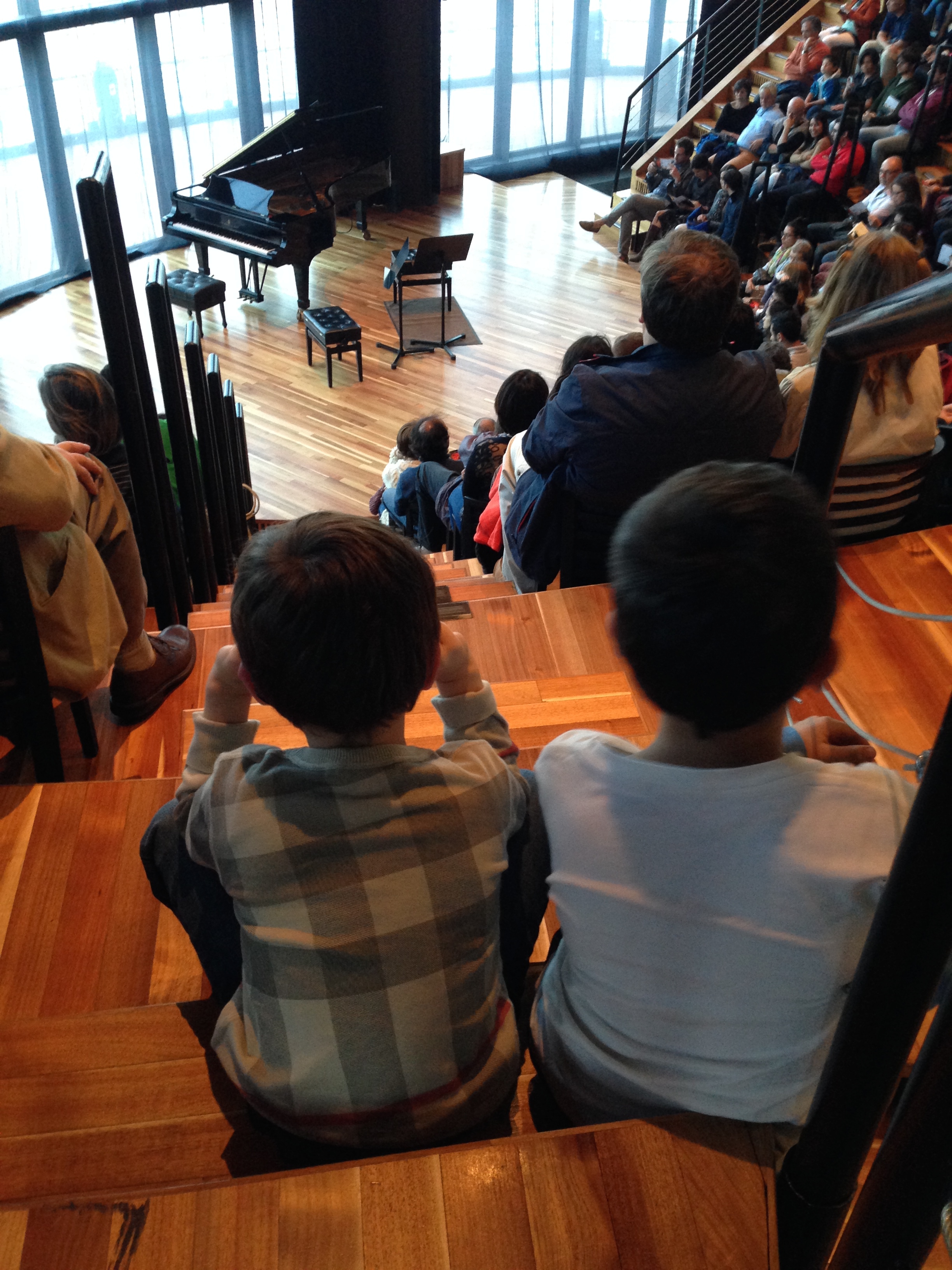
I attended a concert, a German trio, with my sisters-in-law and mother-in-law. Of the cousins, only Martin and nine-year-old Matías opted to come. Martin took his cue from Matías. He mimicked everything Matías did. When Matías rose from his chair and sat on an aisle step instead, so did Martin. When Matías moved back a step, so did Martin. When Matías played with the cable barrier, so did Martin. When Matías inexplicably made a fist and shoved it in his mouth (I’m serious), so did Martin. At intermission, when Matías decided to leave and go find the other cousins in the theatre café, so did Martin. Admittedly, that terrified me. Martin, for an hour, in a food establishment with a dark, railing-less outdoor deck on a lake, attended only by one-to-13-year-old cousins, none of whom knows Martin has autism and might need extra supervision? What could have gone wrong? Everything could have gone wrong, and nothing did. After the concert we reclaimed all kids and went to an Italian restaurant, where Martin ate GAPS-compatible fish with capers, showed off how he could cut the meal himself, and didn’t complain that the other cousins had pizza. That night Martin chatted by phone with Adrian—read that again: Martin chatted by phone with Adrian—and renewed my fears by saying, “In the café, Luke gave me a bar to eat.” A bar? A what? Crap! The next day, however, I learned from my sister-in-law Claudia that she’d slipped Luke a pre-approved fruit-and-nut bar in case Martin wanted something. Good, thoughtful in-laws.

Martin and his cousin Matías prepare to enjoy a concert.

Martin and his cousin Matías prepare to enjoy a concert.

Martin went horseback riding with his cousins. The seven-year-old cousin was able to ride by herself. For Martin, the instructor had to tether Martin’s horse to his; Martin was too distracted to hold the reins and guide his horse. Still, Martin went, and happily. The first expedition, I was looking for some exercise and hiked alongside the riders. The second expedition, I had a massage scheduled and left Martin and the other cousins to ride on their own with the instructor. A couple hours later, in post-massage haze, I was at a café, sipping coffee with Cecilia and my mother-in-law and musing about whether we should go find the children, when the whole gaggle of them entered, with Luke holding Martin’s hand. They’d finished up riding, surmised that we were probably at the café, and come to find us. Martin took no issue with the uncertainty and evolving plans.

Martin riding with cousins and friends. Happy trails.

Martin riding with cousins and friends. Happy trails.

Our vacation site was two hours’ time difference ahead of New York, and South Americans keep late summer hours. We rarely ate dinner before 9:00 or 10:00. Martin hit the sack at midnight or so, and slept peacefully until 10:00 or 11:00 am. He tried new foods. (Among them was horse jerky. My bad. I should have read the label more closely.) When I forgot his swimsuit, he swam in his underwear. He watched television, which we don’t really do at home. He relished drinking fresh juice from a hippie-van-cum-juice-stand parked on the beach. He had a good time. Not an autism-accommodated good time. Just a good time. The kind of good time that might not have been possible if we still dealt with sleeplessness, limited language, meltdowns, and the absence of social interaction.

I’ve been bugging Adrian to ask his sisters, or at least one of them, for impressions on how the week went, and how Martin did. So far, no luck getting him to do so.

The last day, before we started the 16 hours of flights home, I asked Martin what had been his favorite part of vacation. He didn’t even hesitate:

“When I rode horses with my cousins the second time and you didn’t come.”

He wanted to be with his cousins instead of me. One cool thing about being an autism parent is that you can find an achievement in any insult.

P.S. As to Valentín, the 10-year-old who didn’t like Martin and showed it, eventually, when no one else was listening, I told him off. “Valentín, Martin is only six years old. He’s a guest in this country, and he doesn’t speak Spanish well. All he wants is to play with you and his cousins. So enough with the ¡Cállate!, got it?” He got it. Even if Martin’s cousins don’t defend him yet, I can.

Praise Him in the Morning

I have to tell you about church this weekend. I’ve got to tell you about church this weekend.

The children were scheduled to sing “Praise Him in the Morning” during the service. When the children sing, so does Martin. He attends the church’s Tuesday-afternoon Kids’ Klub each week, where the children practice with their music minister. This weekend was already the third or fourth time Martin has sang at church since December. Even in that short space of time, I’ve seen the level of assistance he needs decrease rapidly. Initially, he stood in the nave with the other children but really didn’t sing, and sort of wandered. Now—

Actually, let me start with something else. The children were asked to arrive 20 minutes before the service, for a final rehearsal. We were late and made it to the narthex only five minutes before the service. I told Martin to hurry and shooed him toward the rehearsal room downstairs. He turned back and started to ask me to come. Just at that moment, one of the women who helps with Sunday school was passing. She said, “Oh, are you going to rehearse? Come on. You can come with me.” Martin hesitated only a second before heading downstairs with her. Until recently, Martin never would have done that. He would have insisted that I come, or staged a meltdown if I didn’t.

I entered the sanctuary with my father, who was visiting for the weekend, and chose two seats on the aisle near the back.* Soon the children, about 20 in total, appeared and headed together down the aisle. Martin left the group and came to me with a happy “Mommy!”

“Hi, Sweetie,” I said. “Do you want to sit with me, or with the other children?”

I don’t think Martin had realized the children would be sitting together near the pulpit (they do that only on “performance” Sundays), because when he saw them filling the front pews, he scampered up the aisle to join them. By then most spaces were filled, and I feared Martin might get frustrated and return to me. He didn’t. He bopped around a little and finally made space for himself amongst the older boys.

The service began. I watched Martin, fearful that, out of my reach, he might do something disruptive. Not my Martin! I can’t say he paid any attention to the service—let’s reiterate: he’s six—but he did sit quietly. Only once did he start talking, whereupon the fifth-grader next to him promptly and effectively shushed him. And once he quasi-snuggled the boy to his other side. (We’re having some issues right now with respecting personal space.) That boy was patient, and the incident passed. Through the opening hymn, the prayer, the Kyrie, the first reading, the responsive psalm, the second reading, and the Gospel, Martin behaved.

Finally the children shuffled onto the chancel. First they sat and heard a three-minute lesson from the director of the mission committee. Then they stood to sing. Martin knocked it out of the park. Not only did he stand almost still; for at least 80% of “Praise Him in the Morning,” he sang along.

(Yes, I recorded the performance on my iPhone. Yes, even before the sermon ended, I had sent the file to relatives and friends.)

After their big performance, the children sang a short goodbye song and headed off to Sunday school. There was a substitute teacher, which in the past might have worried Martin. Not this week. He participated fine. When I reclaimed him for the Eucharist, he was wearing his art project around his neck, a medallion on which he’d written, “I am a child of God.”

After the Eucharist, the pastor asked everyone to sit down, because he had many announcements and business matters to review. By then Martin was antsy, so I let him take his snacks from my purse and walk to the gymnasium, where coffee hour is held. That exercise makes me nervous, because coffee hour invariably includes an open table offering goodies not allowed on Martin’s restricted diet. Furthermore, the pastor really did have a lot to talk about, so ten minutes or more passed before I left the sanctuary and found Martin in the gymnasium.

He was sitting at a small table for children, eating a bowl of fruit. We had this conversation:

“Mommy! I went to the food and got myself a bowl and filled it with fruit.”

“You did? All by yourself?”

“Yes, and then I got this spoon and this napkin, and now I’m eating. I did it all by myself.”

“Martin, that’s terrific. And where are the snacks that we brought from home?”

“Here, look! I made my almond bar into a ball and put it with the fruit!”

I was absolutely tickled by Martin’s independence, and by his wise choice: With the food was a cream-filled chocolate cake, which Martin had walked right by to serve himself fresh fruit. I decided to celebrate by offering him a little orange juice. “Sure!” he exclaimed, and then asked if he could pour it by himself, which he did, without spilling a drop.

Who is this boy? Who is this kid who sits with the other children instead of with me, who sings with the chorus, who makes good choices and takes initiative to serve himself? He’s Mr. Independence.

He capped the performance Sunday evening, when we went out to eat. At the particular restaurant, Martin can eat the burger (grass-fed beef, with no additives) or the fish cooked in olive oil. He refused to reveal his choice until the waitress came. After I ordered, Martin asked me, “Is it my turn?” Then he looked directly at the waitress and said, “Um, I would like to order a burger, please.” I was about to begin reciting the additional directions when Martin stopped me and said, by himself, “No bread, no bun, please.” The waitress asked, “Would you like cheese?” Martin replied, “No. I can’t have that.” My job was limited to whispering, to the waitress, “Could you substitute steamed broccoli for the French fries?” And we were done.

I don’t use this term much: It was one heck of an FUA day.

*Informative note: In the suburban church we attend (new since we moved), the younger kids don’t stay for the sermon. After the Gospel reading and a short children’s lesson with the pastor, they proceed to the basement for Sunday school and don’t return until the Eucharist. Until last December, I didn’t stay for the sermon, either. I accompanied Martin to Sunday school, to help him participate and make sure he didn’t monopolize attention. One Sunday in December, the Sunday-school teacher, whose own son is recovered from autism, told me, “You don’t need to be down here anymore. We’re fine.” I expressed skepticism, and she said, “Really. Go upstairs. Sit near the back. I’ll send one of the older kids up if we need you.” I made it about ten minutes before I snuck back down and peeked in the door. They were fine. Martin was playing. No chaos.

Since that Sunday, I walk downstairs with Martin if he wants me to—which happens less and less—and then I return to the sermon. Still, I choose a seat on an aisle, near the back, in case the teacher needs me. Once, an older child came upstairs to ask me whether Martin could eat the gummy snacks they were having. He couldn’t, so I whipped a GAPS-compatible brownie out of my purse. That’s the only time I’ve been needed.

Most Special Guest Post Ever

As you can (ahem!) probably tell, this blog doesn’t get much editing. As to most entries, I draft, read through once, add any links or photos, and post, sans quality check.

Occasionally, however, I request a second opinion before I post, because I’m writing about a friend or relative and want him/her to have the story before the world does, or in order to check whether my words will convey what I want them to. In the entry titled “For Diana,” I wrote to a fellow ASD parent who has commented thoughtfully on my blog over the past two years. The topic of “For Diana” was our disagreement about approaches to treating autism. In that instance, I asked Adrian to read the draft before I posted. I was looking for a gut-check: Was I respectful toward Diana’s position? Did I address her comments without extraneous points? Did I acknowledge my own biases? Adrian did a commendable job. He pointed out one paragraph where my words sounded “snide” (I edited that) and suggested one comment to which I could add more depth (I tried).

And then, to my surprise, he started to add his own thoughts to what I had written. Adrian listens, and responds, when I talk about Martin’s challenges, treatment, and achievements. The “big decisions”—should we try chelation? is HBOT worth the investment? where should we live? where should Martin go to school?—we make together, based on information I assemble for Adrian to review. Beyond those discussions, Adrian rarely volunteers his thoughts about autism, or recovery. Autism recovery is my department. Adrian’s departments are vacation planning, opera excursions, history lessons, and the family economy. Adrian enjoys a probative biography of Nixon; my desk is littered with articles about MTFR mutation. Indeed, if we decide to tell a friend or family member that Martin has autism (we’re guarded, in that regard), I am the one who sits the initiate down for that talk, without Adrian present.

Yet here he was, freely telling me why he thought Diana’s opinion was mistaken. His statements were original, and different, and not echoes of mine.

“You should write that down for my blog,” I said when Adrian finished. “Really. It would mean a lot to add your voice to Martin’s story as it evolves. Otherwise it’s always just me, speaking for both of us.”

“Maybe,” Adrian said. “I guess I could think about it.”

We left the topic at that. I didn’t want to push Adrian. In addition to his autism reluctance, Adrian doesn’t enjoy writing in English, other than technical finance and legal documents. English is not Adrian’s first language, or even his second, and despite his thorough fluency (better grammar than most native speakers, I tell him!), he’s never seemed to gain full confidence.

A month passed. And then almost another month. And then Adrian sent me an email with no re: line and no content other than an attachment titled “martin.docx.”

Here is what he wrote:

I am Martin’s father. My wife, Maria, asked me to write a note for her blog on Martin. The request was made in response to a reader advocating that our approach to Martin’s autism is not worth pursuing. The commentator argued, thoughtfully and politely, that trying to recover a child from autism is tantamount to wanting to “change” the child, while in fact the child was just fine but different. Being “different” would not merit trying to change the child, and could at some point be perceived by the child as a rejection of what he or she is. “I don’t want to return my son to full neurotypicality because I don’t see him as having been in a certain place and then having regressed or changed,” wrote the commentator. “I don’t understand how the language and idea of ‘cure’ and ‘recovery’ is consistent with teaching our kids to love and accept themselves as they are.

The commentator is not alone. Many people in the unwilling community bound by autism argue that there is nothing that requires addressing or treating autism. An autistic person is perfectly healthy and happy, just not neurotypical. It is up to us to accept autistic persons as they are.

Maria and I have a very different attitude towards autism.

To me, autism is a deeply uncomfortable topic. To my wife, it is a topic in which she has simply become an expert. I view autism as a topic that occupies too much space in our lives. Maria sees it more like an important, unavoidable part of our lives. I have been shaken by the existence of autism in our family. She has decided to confront it.

But we both share a commitment to doing everything we reasonably can to bring our son back to neurotypicality.

From my standpoint, this is not about accepting or rejecting one’s child. This has little to do with my personal relationship with my child. This is about the responsibility of a parent to prepare his or her child to live in the actual world.

One of the most critical things a parent has to do is to raise a human being who can, to the greatest extent possible, fend for himself in the real world. My job as a father is not only to love and nurture my child—and, as a result, to be accepting of him—but to prepare him for the world in which he will have to live. Martin will have to live in a world that I will not always be able to shape in a way that works best for him. I may or may not be able to help him and be there for him along the way, and there will certainly be a time when I am no longer going to be able to be there for him at all.

If autism does one thing, it makes a parent realize the thousands of social cues and communication skills that create a successful social interaction.

Martin, for example, insists on yelling “Go away!” to any person who wants to assist him if he happens to be dealing with something by himself. Even among expert professionals (like his teachers), a curt, impolite “Go away!” triggers a shock reaction. Martin is still prone to asking inappropriate questions (“Is that your husband?”, “What year were you born?”, “When did you get into your mommy’s belly?”) of any person he just happens to meet.

But it is not only this kind of obvious behavior that needs to be addressed; it is the more subtle rules of social interaction and communication that make people successful. Understanding, especially what is not being communicated verbally. Listening, to the nuanced messages that adults use all the time. Acting with emotional intelligence. Differencing when one is being attacked or mocked from when one is just being made fun of. Properly interacting with people in positions of superiority or inferiority, and with peers. All of these are the gifts of neurotypicality and of a good and loving education.

Looking at Martin, I see a child who is entitled to be raised in a way that maximizes his ability to navigate the world. That is my responsibility.

There you have it, readers. Adrian is real. He speaks. And you and I, together, have just learned more about his position on recovering Martin than I’ve known in four years—one more way in which keeping this blog has blessed my life.

Adrian messing around, with his niece and Martin on the back.

Adrian messing around, with his niece and Martin on the back.

And on to Career Prospects

My last post discussed talents that Martin might slip away as Martin continues to recover. Let’s add literalism to the list.

“Mommy, how is the time going?” he asks me from the back seat.

“‘How is the time going?’ What does that mean? It’s almost 4:30. Is that what you wanted to know?”

“No, Mommy. I want to know how the time is going.”

I start thinking backwards. Where could Martin be going with this question? We’re running errands together, bound for the pet-supply store and then the grocery. Before that, I picked him up at school, and he asked if we could go to the coffee shop to eat fruit salad. I told him, “We’ll see how the time goes”!

“Martin, I think what you want to ask is whether we’ll have enough time to stop at the coffee shop. I believe we will.”

At dinner, he asks, “If the sign says ‘no walking,’ can a wheelchair still go?”

I begin a lengthy explanation about pedestrian safety applying to all persons, however they move about.

Adrian jumps in and says, “Martin, I do believe you’ll make a fine lawyer one day.”

Once and Twice

When we still lived in the City, I spent several months touring private schools for kids with special needs. Martin was going to be entering kindergarten. Our zoned elementary school had no special education other than an integrated co-taught class, in which a general-education teacher and a special-education teacher worked together to handle more than 25 kids. No way was Martin ready for that. Indeed, New York City’s Department of Education determined that Martin didn’t have sufficient attention-span even to enter its public ASD Nest program, which has integrated co-taught classes of just 12 students. The DOE also has an ASD Horizon program, self-contained (i.e., all-special-education) classes for kids who are deemed ineligible for Nest, but (1) none was taking place anywhere near us, and (2) Horizon utilizes Applied Behavioral Analysis, or ABA. When Martin underwent ABA therapy in Early Intervention, he became frustrated and resistant, and also seemed to think perseveration and repetition are positive habits.

So the public Nest and Horizon programs were ruled out, and the DOE school psychologist overseeing Martin’s case said he didn’t have another appropriate placement to offer. By then we had started looking at the private schools. New York City has dozens of special-education private schools to fill the gaps in what the DOE is able to offer. Most of them won’t accept a child’s application without a parental tour, a neuropsychological assessment of educational needs, a written submission including developmental history, and one or more visits by the child. Looking for the best fit for Martin, I toured 14 schools, with each tour taking between one and three hours. From that, I came up with a list of four schools I thought would be appropriate for Martin, and then I started the applications.

Is there another American city where even special education is hyper-competitive?

During this time, while touring private special-education schools, I was beset by a couple whom I (privately) called “the Twice-Exceptionals.” I suppose I actually saw the Twice-Exceptionals only four or five times. Yet it felt like they were everywhere. You’re about to find out more about me than I should probably reveal. Here goes: The Twice-Exceptionals annoyed me.

The first time we shared a tour, I introduced myself and said I’d seen them around the special-ed preschool that both our sons attended. What did they think of this kindergarten we were visiting?

“It seems nice,” the mother responded, “but we’re pretty sure it isn’t right for [their wonder kid].”

“Is Wonder Kid’s diagnosis not on their ‘accept’ list?” I asked. A lot of the private special-ed schools, especially those that are “state-approved,” have a list of diagnoses that they are authorized to accept. “Speech-language delay” and “learning disability” might be in, for example, while “cognitive impairment” and “emotional disturbance” are out.

Aside: I’ll admit to feeling down on the kindergarten-admissions process when school after school claimed they didn’t accept kids with “autism or other global delay.”

“His diagnosis isn’t the problem. It’s that Wonder Kid is twice-exceptional. We feel like this school wouldn’t be able to handle his academic potential.”

“What does it mean that mean, twice-exceptional?”

“Wonder Kid is on the autism spectrum and also gifted.”

“Oh. Wow! How can you tell something like that already? I feel like our boys are so young.”

“We knew very early,” replied Mrs. Twice-Exceptional. “Wonder Kid started reading before he turned three. He already does math in his head. This morning when he woke up, he said, ‘It’s only 6:34, and I don’t have to get up until 6:40. I’m going to stay in bed for six minutes’.”

“That’s amazing!”

Mr. Twice-Exceptional spoke up: “We’re most interested in the Quirky Genius School that opened last year. It serves twice-exceptional students.” (Obviously, or not so obviously, “Quirky Genius School” is a pseudonym.)

I marveled at the world in which we live. “They have a whole school just for kids who are gifted and also have autism?”

Back to Mrs. Twice-Exceptional: “Yes! We can’t wait to tour the Quirky Genius School next month. We are almost certain that’s going to be the right fit for Wonder Kid. Haven’t you considered the Quirky Genius School for Martin?”

“No. I mean, I’m pretty sure Martin is only once exceptional.” At the time, late 2012—I read back in this blog to confirm—Martin had just started using the command form, and I marveled when he once managed an “I don’t know.” He could read, some. He lacked the language facility to tell me much more about what he knew, and his hand wasn’t steady or strong enough for writing or drawing.

“You never know. He might surprise you,” Mrs. Twice-Exceptional assured me. “You should at least take a look at the Quirky Genius School.”

I’ve always hoped that Adrian and I would make a bright kid. It seems perfectly plausible. I finished first in my college and graduated from an Ivy League law school. Adrian was among the top five students in the best law school in his country of origin. Smart genes! But during the kindergarten tour process, we were still working on getting Martin to sleep through the night and ask questions. “Gifted” felt far off. (Don’t beat me up, readers. Don’t beat me up, Martin, if you read this sometime in the future. I think my kid has a better-than-average chance to be, ahem, “gifted.” It’s just that he’s a work-in-progress, and it’s too early to tell.) “Thanks,” I said to Mrs. Twice-Exceptional. “I will. I’ll look into the Quirky Genius School.”

“Let’s stay in touch!” she exclaimed. She rummaged in her handbag and extracted a business card.

“Oh! I’m sorry,” I said as she handed me the card. “I don’t have a card to give you. I’m not working right now.” Icky. First I had a son only once exceptional, and now I didn’t even have a job.

Mrs. Twice-Exceptional said, “That one’s not my business card. It’s my personal card.”

As that morning’s school tour began, I examined the card. It had big blocks of primary colors, Mrs. Twice-Exceptional’s name and email and phone number, and her title: Wonder Kid’s Mother. That was her title. Mother of a twice-exceptional wonder kid.

I sensed we probably wouldn’t be staying in touch.

But alas, they were unavoidable. At the next kindergarten tour, just a few days later, there they were. Mr. and Mrs. They did all the tours together, a unified front of exceptionalism doubled. Adrian, with his long work hours, toured the two schools Martin’s social worker identified as likely best fits. The other 12 I visited alone.

“Hello again!” Mrs. Twice-Exceptional greeted me. “Did you get a chance to look at the Quirky Genius School?”

“I did,” I said. “I checked the website. It looks like a terrific program. I’m not sure it would be right for Martin, but wow. Looks like exactly what you want for Wonder Kid.”

“It is,” Mr. Twice-Exceptional said. “It really is. We’re just sorry that we have the Quirky Genius School tour scheduled so late. It would be great to find the perfect fit early instead of visiting so many schools.”

Why did I resent this friendly couple? Was it the insistence on “twice-exceptionalism”? Was it their forcing me to declare my own son just once-exceptional? Was it the business card? Both of them showing up at every tour? The fact that the wife followed me throughout one tour to share details of her weight-loss journey? That she informed me that they would leave the City for a suburban district if only their hands weren’t tied by living in a beautiful rent-stabilized apartment?

All I know is that, on each of several kindergarten tours, Mr. and Mrs. Twice-Exceptional inquired with uncomfortable determination whether I was now considering the Quirky Genius School for Martin.

Last weekend Adrian and I saw The Imitation Game. Lovely movie. For the most part, well-scripted and –acted, and a meaningful story. The main character, Alan Turing, is a math and computer-science prodigy who may have been on the autism spectrum. I didn’t know that detail before watching the movie; afterward, I did some research and found conflicting reports on whether Turing was on the spectrum, or just awkward, and if the latter, how awkward. For this post, I’m going to take the Hollywood version and assume that Turing was “twice-exceptional.” As in, wickedly super-twice-exceptional, on brain-power shots.

As the film depicts, and as additional accounts seem to bear out, Alan Turing’s genius and work effort shaped history, shaving some years from World War II and sparing millions of lives. Turing also ended up profoundly unhappy. To be sure, spiteful laws enabling the persecution of homosexuals (as Turing was) contributed to the malaise. So, very possibly, did his social challenges.

Which brings me to consider a hypothetical: Would I rather raise a genius who makes extraordinary, positive gifts to history, yet who himself wallows in despair? Or would I rather raise a man whose contribution to society is limited to taking care of himself and his own, and yet whose existence is marked by love and contentment?

Easy question. For the sake of humanity, I’d rather raise the desperate genius. For the sake of my own son, I’d rather raise the happy, ordinary gent. And my own son trumps society. My family first, then my friends, then my closest neighbors, my society, and the rest. That’s the natural order of things. (I’ve touched on this theme before.) How could I sacrifice my own child’s happiness for anything, even in order to shorten a war?

I’m not faced with that choice, at least not that I know. If Martin is a genius of historical proportion, I haven’t seen it yet. On the other hand, even if Martin is not twice-exceptional, he does have an unusual worldview and some exceptional abilities. He categorizes memories by specific date. “Mommy, on Thursday, September 25, I had lasagna and green smoothie at a restaurant in Manhattan,” he told me, unprovoked, one recent afternoon. “I don’t think that’s quite right, Martin. You had those at PeaceFood Cafe after we went to the children’s museum with Jason and his mommy, so I think it must have been a Saturday or Sunday.” When he insisted on the date, I checked my calendar. Indeed. Thursday, September 25. Rosh Hashanah. Martin didn’t have school, so we made a playdate with Jason. Yesterday, when Martin said, “Mommy, on Tuesday, December 16, did Georgie [one of the cats] sleep on my bed?”, which he meant more as a statement than a question, I responded, “You know, I don’t remember dates that well, but I’m sure it’s possible that Georgie slept on your bed on Tuesday, December 16.”

When Martin turned six-and-a-half, Adrian and I wished him a happy half-birthday. Martin answered, “Oh! I’m 78 months old.” At first, I thought he’d computed the number—(12 x 6) + (12 ÷ 2) = 78—completely in his head. Probably not, though; some weeks earlier, he’d asked me a string of questions on months and years: “How many months are in one year? How many months are in two years?” I reckon he must’ve remembered (his memory is uncanny) that six years have 72 months, then added six, for half of one year’s months. In any event, what an odd response to “It’s your half-birthday! Happy half-birthday!”

Last summer, we were up in the Adirondacks with my sister and her daughter, Mandy, whom based on her initials we sometimes call MC, pronounced “Mick.” The cabin we rented had some basic supplies: paper towels, cooking oil, spices. One morning at breakfast, Martin started asking about the salt and pepper on the table. Would MC take the salt and pepper with her when we left? Did MC bring the salt and pepper from home? Were there salt and pepper for Martin?

“Martin, what do you mean?” I asked. “Why would MC take the salt and pepper home?”

“Because they’re hers,” he replied.

“No. We found them here. They belong to the cabin.”

“Why do they have ‘MC’ on them?”

Because they were McCormick brand salt and pepper, and the containers had little “Mc” logos on them. To an average six-year-old, that might not mean that the condiments belong to Cousin Mandy. The average six-year-old might not even think through the meaning of the salt logo. The average six-year-old is not Martin.

“Will he lose that, as he gets better?” asked my sister that night, tactfully, while we doused the evening campfire. “That different way of looking at things?”

“I don’t know, but I think so. I think he will start to think more typically,” I said. One mother I know told me that her son used to be able to determine, within seconds, the day of the week on which a person was born, just by knowing the year and date. As her son’s coping and social skills improved, his ability to figure birthdays-of-the-week evaporated. (In my goings about the autism community, I’ve met several boys with that skill.) Another mother told me that when various biomed interventions increased her four-year-old’s speaking skills, his precocious reading declined.

I once mentioned this subject to Adrian. I asked whether he thought Martin will lose his super memory or advanced spelling ability, or his compartmentalized way of thinking. I asked whether he thought Martin might, in recovery, become less amazing.

Adrian was silent for a few moments. As between the two of us, I think, Adrian had the higher “traditional” expectations for Martin. Adrian and I come from different socioeconomic backgrounds, indeed different cultures. When we decided to procreate, we weren’t one or the other of us more or less reasonable in our aspirations, but different. I hoped for a well-rounded child who enjoyed sports as well as reading, who made friends and enjoyed their company. Adrian thought more about long-term educational prospects and prestigious careers.

Eventually Adrian replied to my question about unusual thinking versus recovery. He said, “You know what? I’ll settle for happy. I really will.”

The last time I saw the Twice-Exceptionals, other than preschool graduation, was on a kindergarten tour after their much-anticipated visit to the Quirky Genius School. “So how was it?” I asked, feigning enthusiasm. “Are you done? Are you going to apply to other schools, or just Quirky Genius?”

Mrs. Twice-Exceptional said, “We hated it.”

Mr. Twice-Exceptional echoed, “Hated it.”

Mrs. Twice-Exceptional continued, “It was the most disorganized place ever. It’s too new. They have no idea what they’re doing.”

Mr. Twice-Exceptional repeated, “Hated it.”

Their twice-exceptional wonder kid, I heard later, ended up in a public-school ASD Nest program, the very program that had rejected my Martin.

I hope we all get to “happy.”

Martin visiting Stanford University. We are shooting for happy. That doesn't mean the sky isn't the limit.

Martin visiting Stanford University. We are shooting for happy. That doesn’t mean the sky isn’t the limit.