Feel Good

Feel-good stories fly around social media like air hockey pucks around the table. They go viral: click click click click clack clack click click clack kajing! Goal! All over the internet!

A disproportionate number of these feel-goodies, it seems to me, involve ASD, usually children with ASD. The waitress who brought a new hamburger when an autistic girl thought hers was broken. The garbage man who rewarded an autistic boy obsessed with watching the truck collect dumpsters. The young autistic adult who relates to the world through Disney movies. And so on. You’ve seen them, I’m sure.

A partner to the feel-good stories are the empowering badges, which often appear as Facebook statuses. “This is national autism awareness week. Post this for an hour so that everyone knows autism exists.” “I pledge never to bully anyone with autism. If I don’t see this as your status, I’ll assume you don’t care about bullying or autism.” (I’m exaggerating for effect, but not exaggerating that much.)

I have nothing against feel-goodies or empowerment. On the other hand, when these tidbits are shared by persons outside the ASD community, I feel patronized. Most adults have no inkling what it’s like to live with a person with autism, and cannot fathom how it feels to be responsible for the future of a person with autism. From their hideaways in neurotypicality, they have our token children to help them shed a few tears of gratitude. It’s a catharsis.

I would like to say, please, get your catharsis from fiction. Try Shakespeare, or a melodramatic movie. Or read history, long-ago victories and defeats.

Autism isn’t fiction. It isn’t feel-good. It’s our reality, a reality that’s spreading every day. If you want to feel good about an autistic child, forget the heartwarming videos and articles. Start advocating. Start questioning why autism rates are rocketing skyward and we’re not doing anything to stop the epidemic. Remember that the reason you smile at those feel-good stories is that you don’t have to deal with the non-feel-good moments that fill the rest of the time.

Thanks.

Naysaying

In Wednesday’s post I included a reference to the “subtle naysayers.” Those are the people who say they support our journey but who often lob jabs or zingers that suggest otherwise. I gave seven examples of statements (e.g., “Is that actually a scientifically accepted principle?”) that, to me at least, translate as, “I think it’s wonderful that you want to help your son, so I’m going to say that I’m rooting for you! Deep down, though, I don’t really think your process of diet, supplementation, and other interventions can recover your son.”

In case yesterday’s post didn’t make the point, here are some other examples of subtle naysaying: “Of course, you need to leave room for Martin just to be a kid. Balance is key. Don’t go overboard.” “I bet there isn’t another mom doing as much as you do!” “Isn’t chelation dangerous?” “I was reading about a family that stopped all supplementation. Their son did even better without it.” “It’s just so hard to believe that mainstream doctors don’t know about this.” “Can you take a break from the diet over vacation?”

And then there’s my, ahem!, favorite: “It’s so great, what you’re trying to do.” What’s wrong with that statement? The word “trying,” which implies lack of success. True champions say, “It’s so great, what you’re doing,” or, “It’s so great to watch Martin’s progress.” Subtle naysayers refer to how hard I’m trying.

In any event, after I drafted yesterday’s post, I spent some time contemplating—that is, I took a shower and had ten minutes to myself—why the subtle naysayers bother me. I won’t mince words: They do bother me! Here’s the reason:

When Martin has a week like this week has been, then at least a dozen times daily the idea of throwing in the towel drops into my head. Yes, I contemplate quitting the recovery process. I hear the little voice that says it would be easier, so much easier, to live according to the traditional notion that autism is a behavioral or communication disorder and therefore should be treated just with behavior therapies.

And when that little voice in my head is speaking, what I need is to hear a bigger, louder voice—preferably outside my head—reminding me that (1) “autism” is the symptoms of an underlying immune disorder, a medical condition that should be treated like any other need to heal; (2) recovery is bound to be a series of ups and downs, and ultimate success is more likely to come from surviving the downs than celebrating the ups; and (3) although it would be easier, right now, to give up biomedical treatment, leaving Martin untreated would be harder in the long run, for him as well as for me and Adrian.

That bigger, louder voice is never going to come from a subtle naysayer. A subtle naysayer looks for cracks, looks for weaknesses, to insert seeds of doubt and coax me away from the “extremes” of the recovery process. A subtle naysayer might think s/he is being helpful: If I’m sleepless, and alternating hope and desperation, and preoccupied with Martin’s special diet and supplementation and everything else, wouldn’t I be happier with none of that to worry about?

So I can’t turn to a subtle naysayer for help. Not even in a week like this, when I need all the support I can get. Indeed, especially not in a week like this, because when I’m at my lowest is when a naysayer is most likely to strike.

Which leaves me with Adrian, other families in recovery, and the few people outside the recovery community who truly understand.

I wish there were more.

Let’s Talk Honestly About Really Crappy Days

Most email traffic that passes through FindingMyKid@yahoo.com congratulates the progress we’ve made with Martin. Some correspondents compliment me (thanks!) for presenting the difficult aspects of recovery, too, instead of pretending every moment is roses and wine. A few parents bemoan their own children’s lack of progress.

I want to speak to the parents who feel like they aren’t making progress. To be honest, despite the progress we’ve made, wine and roses are far, far, far from our everyday reality.  That’s not to say that recovery isn’t the series of joyous breakthroughs I present in this blog. It is rather to admit that these developments punctuate long stretches of “no change” or even apparent regression, which I prefer to call “the reappearance of former symptoms.”

My last couple posts referred to the bad week Martin’s been having. Let’s add some more depth and talk about yesterday morning—

I knew the morning would be tough, because Martin took almost two hours to fall asleep the night before and was bound to be tired. At 5:55 a.m., as usual, I carried Martin from his room to our bed, to wake up with Adrian.

Around 6:35 a.m., as I was putting the final touches on breakfast, I heard yelling, whining, and a scream or two, all from Martin. I found Adrian trying to get Martin dressed. Martin was in a fetal position, refusing to cooperate. He said, “No! I want to stay here today! I don’t want to go to school.” Then, frustrated, he switched to the nonsensical: “I don’t want you! I’m going to sleep at school! I don’t want to come home!”

Adrian waved off my offer to assist. I returned to the kitchen. Ten minutes later, the crying and complaining uninterrupted, Adrian and Martin appeared in the kitchen. Martin was dressed, save for the “crazy socks” he was supposed to wear for Dr. Seuss appreciation week at school. His whine had become, “I don’t want to wear crazy socks. No! No! No! I don’t want breakfast.”

We got him seated at the table. Although he has a chair with footrest that facilitates using his legs and core to sit up straight, Martin slouched. When he saw his breakfast (turkey bacon and vegetables, pretty standard), he lowered his voice to the continuous, slurred word-melding that I detest. “No food oh Mommy oh Mommy oh Mommy Mommy Mommy no no no.” He thrust his fists into his stomach and curved his back, a posture that (I think) indicates stomach pain. When I tried to offer him turkey bacon, he batted my hand and screamed, “Noooooo!” He grabbed his glass of “kombucha with seeds,” pursed his lips on the stainless-steel straw, and changed his whine to, “Drink, only drink no anything else oh Mommy.”

Adrian passed back through the kitchen, kissed us both, wished me good luck, and left for work.

I switched on the kitchen television. Sesame Street. Martin’s a bit beyond that now. Still, I thought the distraction might help. Over the next half hour I managed to get his supplements and most of the bacon (none of the vegetables) into his mouth. In the meantime, he left his chair to bounce up and down, slapped at me, used his fingernail to scratch marks in the wooden tabletop, whined incessantly, dumped fish oil on his school sweater, told me to turn off Sesame Street, cried when I turned off Sesame Street, spilled his drink while refusing to take his mouth off the straw, curled himself into a ball around his Curious George sock puppet and wouldn’t release, threw vitamins on the floor, and ultimately dissolved into a tantrum because he had no time to play before the school bus came.

By sheer force of love, willpower, and coffee, I kept my patience and got him on the bus. (“Martin’s not feeling his best this morning,” I told the matron when I handed him over.) Then I returned to the kitchen to sulk.

That’s right, I sulked. Because when you are working hard to recover your child, a bad morning (bad day, bad week, bad month, bad season) leaves you wallowing in a stew of doubts.

•            What am I doing to my child? Is this worth it? What caused this meltdown? I think the culprit yesterday morning was probably the nystatin we started last week. I think. But really, who the heck knows? And why would it matter? If something—anything—I’ve done has caused Martin to feel like he did yesterday, am I really acting in his best interest?

•            Why have I given up so much to follow to pursue autism recovery? I used to have a career, disposable income, and free time. Now my job is “autism recovery specialist,” our money goes to therapies and supplements, and getting out for an evening requires hours of preparation. Even worse, I’ve met families who claim their children have improved markedly with nothing but traditional therapies like ABA and speech therapy. Why go on?

•            By working toward recovery, by rejecting the idea that Martin is bound to autism for life, am I making each day harder, for all of us? Long ago I wrote a post titled “Failure to Grieve.” To this day, I wonder whether Adrian and I would breathe easier if we just decided, Martin has autism. Let’s help him live with it as best he can.

•            Other than families in the recovery community, almost everyone I know is a subtle naysayer. I never realized exactly how many ways there are to express skepticism: “Is Martin’s doctor a real M.D.?” “Do you have a regular pediatrician supervising all this, too?” “Is that actually a scientifically accepted principle?” “You’re not going to start saying kids shouldn’t get vaccinated, are you?” “Where did you hear about that?” “Have you tried taking all those supplements yourself?” “Poor Martin! What a shame that he can’t eat like other kids.” And those are comments from people who say they support what we are undertaking. When Martin is doing nothing but spitting venom and whining nonsensically, I think, You know, I really do like fitting in with other people. I think I’ll get off the whacky autism recovery path and go back to the mainstream.

So I sulked. I finished my coffee, and I climbed back in bed for an hour.

Then I rose again, made myself a protein shake, and went to CrossFit. Nothing clears my head quite like loud music and exercising to exhaustion. The truth is that mornings like yesterday are so remarkable only because Martin is getting better. With perspective, I remember the early days when we never knew what Martin was going to do next, and he lacked the language to convey his needs. He used to bolt if I wasn’t holding his hand. He used to cry inconsolably if he wanted to take the 2 subway but the 3 came instead. With perspective, I also reckon that, no matter what the ABA-enthusiasts say, no magic autism faerie is ever going to wave her wand and make Martin better without medical intervention. Recovering Martin’s health and opening him up to full participation in our world of opportunity—that’s up to me. It’s going to happen through my perseverance, or it’s not going to happen at all.

Back to wine and roses: To be even more honest, and less metaphorical, the recovery process has increased my dinnertime wine consumption, Adrian is a thoughtful husband who sends me flowers, and indeed most weeks I buy roses or tulips for our kitchen table vase. The path to recovery is hard. Wine and roses may not be everything, but they sure do help get past the stumbles.
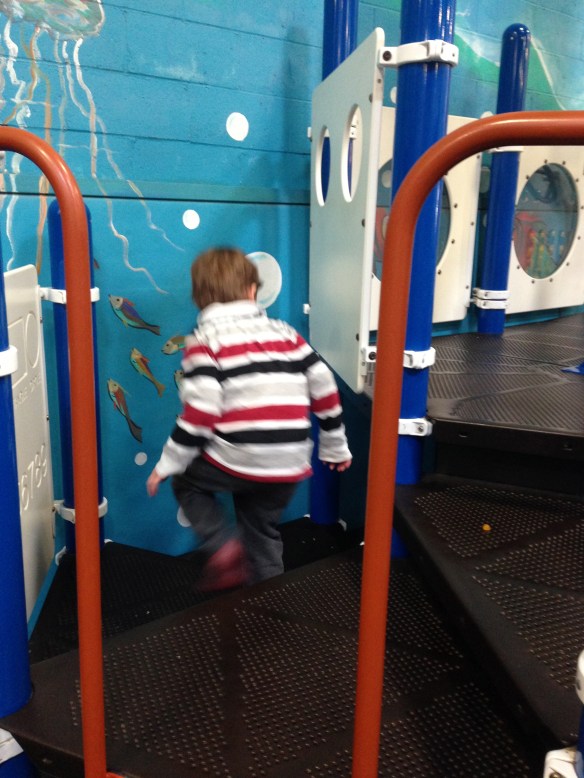
For better or for worse, he's my guy.

For better or for worse, he’s my guy.

Autism-Blind

Martin was ignored yesterday.

The church that we attend now—much more traditional than the young, edgy congregation we left behind in Manhattan—includes a “children’s time” in the service. Children younger than age 10 are invited to gather near the chancel, where the pastor engages them with a few questions and tells a Bible-related story. Martin goes, too. The pastor, to his credit, usually calls Martin by name and addresses him once or twice, even if no response it forthcoming. I can’t say that Martin participates fully in the experience. I can say that he likes being included; he runs forward without hesitation.

Yesterday, the regular pastor was away, so children’s time was headed by a choir member who is also an elementary-school principal. Eight children participated. The principal began by greeting several (not all) of the children other than Martin by name. Then, without making eye contact with Martin or calling his attention in any way, she launched into her lesson. Martin, who is unfocussed and irritable this week (see the reference to nystatin in Saturday’s post), responded by fidgeting, lying on the floor, and turning away from the chancel to face the congregation, wearing a goofy smile. Finally, he stood up and drifted toward the organ, which fascinates him.

The principal probably could have halted 90% of Martin’s behavior by catching his attention and saying, “Martin, let’s sit and listen now,” or even just asking him a question about the Bible lesson.

Instead, she ignored him. Talked to the other children. Pretended like nothing was happening.

From being in the church choir, which sits only a few feet away from the chancel where the children gather, the principal must know that Martin sometimes needs extra help. I suppose that, once she was in charge of the group, she might have thought that I wouldn’t want Martin “called out.” In truth, I’d much rather have him called out briefly by an adult than allowed to call himself out with five minutes of inappropriate behavior. Or maybe she just didn’t know what to do, which would be disappointing in an elementary-school principal. In any event, children’s time was unproductive for Martin and uncomfortable for me.

Which brings me to one of those moments when I realize that Martin’s autism has taught me something without my noticing it.

A dozen years ago, a friend of mine mentioned (I have no recollection of how the subject matter arose) Dwayne “The Rock” Johnson being half-black.

“He is?” I asked. “What’s the other half?”

“Asian Pacific Islander. Why? What did you think he is?”

“I don’t know. A white guy, I guess,” I answered, honestly. “Maybe I never really thought about it.”

My friend, who is African-American, laughed. “I guess it’s good if you’re color-blind,” she said. “But I’m not sure thinking that everyone is ‘a white guy’ is the way to go.”

This morning at church brought that moment to mind. It is tempting to believe that the great equalizer is pretending that we are all the same. We are not the same. A person who is black, who practices Orthodox Judaism, who is male, who has a wife instead of a husband, who is single, who uses a wheelchair, whose English language skills are limited, who lacks formal education, or who [insert any of six billion variations here] does not have the same needs I have. It is not good to be color-blind, or physical-challenge-blind, or hyperactivity-blind, or autism-blind.

When your child has autism, you don’t get to ignore difference. Difference follows you around, speaking too loud and out of turn. It demands your attention. I am far more likely, today, to consider whether any trait, from intelligence to handicap to race, is influencing how an individual perceives his environment. I am far more likely, today, to ask myself what I can do to help.

I no longer act like the best course is pretending we’re all the same.

Lest it seem like church yesterday was a wholly disappointing experience, I am happy to report that other parents in the congregation get it. I was worried about Martin’s antics. As I glanced around I saw no disapprobation, only encouraging expressions ranging from, “Calm down. Martin’s with the other kids and he’s happy,” to, “He might be over there checking out the organ, but, hey, at least he isn’t playing it.”

The principal’s mistake notwithstanding, I think lots of us are marching toward embracing myriad needs.

Otherwise

Are you wondering what Martin said last night?

Last night Martin said, “Otherwise.” He came up with the word. He used it properly and in context.

You’re thrilled? You can’t believe it? Here’s what happened:

Adrian and I put Martin in bed at 8:00 p.m. Martin was all worked up, absolutely could not go to sleep. We are fighting yeast again (Martin versus yeast overgrowth, round IV, get your tickets now) and started nystatin on Friday. Martin’s doctor warned me that we might have a difficult week with yeast die-off; so far, our “difficult week” has entailed diminished attention and focus, fleeting eye contact, and unrelenting hyperactivity. Fabulous.

After an hour of bouncing on his mattress and (needlessly) visiting the potty, Martin started yelling the he wanted to go in “the big bed”—my and Adrian’s bed, where Martin is allowed only in the morning, to wake up. Adrian, exasperated, suggested that we let Martin fall asleep in our bed and then move him back to his room. I agreed but said it had to appear to be Adrian’s idea alone, so Martin wouldn’t start thinking he can bug me for big-bed access.

Adrian called Martin to the family room, where we were watching House of Cards. I hid behind the sofa (Adrian’s idea alone!) and listened. Adrian told Martin that he could take a stuffed animal and climb into our bed, on one condition: that he settle down and go to sleep. Did he understand?

“Yes,” answered Martin. “I will go to sleep. Otherwise I will have to go back to my bed.”

That was it! No prompts, no hearing anyone else say it first, nothing. Martin casually lobbed “otherwise” into the conversation, as if it were an everyday word.

As if he’d never once tested in the bottom third percentile for expressive language skills.

Now, if only he’d settled down and gone to sleep….

Go, Diva!

For the week between Christmas and New Year’s, we rented a condominium in a Florida Keys resort. (That’s the way our family rolls, with Martin’s dietary restrictions—vacationing only where we have a fully equipped kitchen to use and organic groceries nearby.) Martin was allowed to bring two stuffed animals. He chose (1) “Boo,” a preposterous Santa-hat-wearing dog he received for Christmas, and (2) a brown bear that had arrived in a lovely gift basket for the family.

“Martin,” I asked as we drove to LaGuardia, “what is the bear’s name?” Martin sat in his booster seat, clutching both stuffed animals. I figured he should get first crack at naming the bear.

To my surprise, Martin had an immediate response. “Goadie Va,” he said, or something similar. Goat Eva? Go, Diva? Was he talking to me? Am I a diva?

“Goadie Va?” Adrian asked, from the driver’s seat.

“Goadie Va,” Martin replied, with certainty. 

Adrian and I looked at each other. I made a who-the-hell-knows kind of shrug and said, “Okay, the bear’s name is Goadie Va.” No further discussion on the name was had, as our family, Boo and Goadie Va in tow, headed south. 

Behavioral therapy for autism often stresses acting neurotypical and giving a child the tools for participating, even marginally, in a neurotypical-dominant world. Certainly that was my experience with ABA, a technique that only frustrated Martin. Although Martin spent only a couple months in ABA—I found the therapy almost useless (for us), and we abandoned it for RDI—I may have internalized too much of the message that Martin should be instructed to act a certain way. To this day, I find myself saying, “Let’s try that again,” until Martin evinces a satisfactorily neurotypical effort.

“Martin, that man said hi to you. How should you respond? I’m sorry? Let’s try that again.”

“Martin, you walk through the doorway. You don’t flop through it. Let’s stand up and try that again.”

“Martin, you sit at the dinner table. No leaving your seat to jump up and down or touch the clock. Let’s try that again.”

There are approaches to treating ASD premised on the idea of joining an autistic child in his own worldview. The best-known among these approaches is probably The Son-Rise Program®. Son-Rise is not a therapy we’ve tried, so what I know comes from reading and from communicating with families who do participate in the program.

According to the Son-Rise website, “Joining in a child’s repetitive and ritualistic behaviors supplies the key to unlocking the mystery of these behaviors and facilitates eye contact, social development and the inclusion of others in play.” In the midst of my over-used “Let’s try that again” orders, I ponder the Son-Rise argument. Take, for instance, my telling Martin not to run from the family room to the front hall, touch the front door, run back to the family room, fall onto the sofa, and then start over again. Would Martin and I better enjoy our time together if, instead, I ran with him from the family room to the front hall, and touched the front door, and ran back to the family room, and fell onto the sofa, and then started over again, all by his side? Would he trust me more? Would I be more his ally, and less a monotonous dictator?

Martin hauled Boo and Goadie Va all over the Florida Keys, from the Hemingway House to parasailing in Islamorada. He slept with them every night, and provided regular updates on their preferences, such as, “Goadie Va wants to wait in the car. Boo will come in the store.” Never once did he call the bear anything other than Goadie Va. I chalked it up to Martin finding a quirky sound (“Goadie Va. Go, diva!”) and fixating on the sound.

Near the end of our trip, for the first time, I noticed Goadie Va’s right paw. Stitched on the paw pad, clearly and adorably, was the name “Godiva.” Of course, Godiva. Goadie Va had arrived in a Godiva gift basket at Christmas. Martin can read. If a bear has a name stitched on his paw, obviously—duh!—that’s the bear’s name.

I almost never spend time in Martin’s world, almost never try to adopt his black-and-white Weltanschauung. I wonder: In my relentless advocacy for neurotypical behavior, how much am I missing?

Opinion Piece: Crowdsourcing Your Child’s Medical Care Is Not a Good Plan

Before you read the “opinion” section of this post, please peruse these five statements:

1. The internet can be an excellent source of information, advice, and comfort. Most days, I spend several hours collecting ideas and cyber-talking with other parents across the web.

2. I am very, very fortunate that I have money available (including insurance reimbursement) to pay MD’s, ND’s, homeopathic practitioners, and therapists. I recognize, honor, and pray for families who want to treat their children biomedically and/or homeopathically but lack sufficient funding to do so; when we have recovered Martin, I will find some way to provide material assistance to those families.

3. I am not in the business of judging other parents’ choices. I do have an opinion about how to treat ASD in children, and I act upon that opinion by, in consultation and agreement with my husband, treating our son as I see fit. I expect other parents to do the same. Unless you are neglecting your child, or actively attempting to harm him, I respect your choices.

4. Recovery from ASD, asthma, allergies, ADD, and ADHD (et cetera!) remains an emerging science. Laboratory studies have not kept up with what’s going on in the field. Because of that, the trial-and-error and “experimentation” factors may be even more significant in these areas than elsewhere in medicine.

 5. I am not aiming to inject acrimony or discord into the on-line ASD recovery community. This post, like every post on FindingMyKid, is selfish. I’m discussing my son’s progress and expositing my thoughts, in hopes of (1) documenting the recovery process, and (2) fomenting ideas in readers. I think that’s what blogging is about, documenting and fomenting. I hope I don’t lose readers over this post.

End of disclaimers. Beginning of opinion section—

I belong to several Facebook groups dedicating to recovering children. Many parents (or grandparents and other caregivers) write posts among these lines:

•      “My son has this itchy rash over a quarter of his body.” [Insert picture here, usually something that I don’t want to see in my Facebook feed because I have an absurdly low gross-out tolerance. Seriously, if I think of something icky, I can’t eat for hours.] “What could this be? How should I treat it?”

•      “I just received the results of my daughter’s” [insert name of test here, such as 23andMe genetics, Great Plains Labs OAT, or Philippe Auguste toxicity] “results.” [Insert copy of lab results, (not always) with child’s name redacted.] “Can anyone help me interpret these and figure out what supplements to order?”

•      “This week we started” [insert names of supplements, oils, or medications] “, and suddenly my son is melting down every ten minutes, stimming like crazy, and pooping all over the house, even though he’s toilet-trained. What could it be?”

I think these types of posts are a bad idea. Not because the parents/caregivers are reaching out for others’ experiences, but because I suspect many of them are substituting internet wisdom for actual medical advice. Three weeks ago I saw a video post of a child in the throes of an obvious grand mal seizure. The accompanying paragraph stated that the seizures were new, continued that the child had begun experiencing multiple seizures every day, and sought advice on how to handle them. My horrified reaction was, “Are you kidding me? Get off Facebook and get that child to a doctor.” (I did not post my horrified reaction. Should I have?)

It is true that the “medical establishment,” in general, lags behind parental experience when it comes to treating autism. Indeed, if I may speak for the medical establishment, its position still appears to be that there is no treatment for autism. Martin’s former pediatrician, from before we moved, never understood what we were doing with Martin’s autism doctor. When I asked the pediatrician what she knew about biomedical intervention for autism, she replied, “Nothing. Just what I’ve heard secondhand, which is that it doesn’t work.” (Still, she never stood in the way of our biomedical journey. I respect that. Also, one of her practice partners was nothing but interested in what we are doing to recover Martin.)

Facebook parents are great. In some areas, they may know more than doctors. But they are not doctors. And some of them are also misinformed, or downright crazy. (Sorry, readers. Deep down, don’t you know it’s true?) I dedicate a lot of my time to reading books and scientific articles about autism, attending medical conferences, and researching on-line. None of this takes the place of spending four years in medical school, passing medical boards, and completing a residency. None of it gives me a comprehensive perspective on health, or the ability to make competent medical decisions for my child without the assistance of a doctor. Heck, to be honest, I don’t even understand some of what I study about autism. I’m more of a humanities type of gal, one who took “Chemistry for Non-Science Majors” to fulfill her college core requirement.

Which brings me to my point: If you can in any away avoid it, crowdsourcing your child’s medical care is not the best choice. The medical establishment does not represent all doctors. There are credible professionals who both (1) understand immune disorders like autism and how to overcome them, and (2) hold medical degrees. Use Facebook and your other contacts to find one of these professionals. Do your research, read a lot, and bore yourself with medical science with the aim of making sure that you find a professional you can trust. If you need to, try fundraising to cover the costs of the consultation. That can work—I know parents who’ve managed it. Seek a Generation Rescue grant. Go into debt. (It happens. We live in the real world.) Whatever you have to do, try to bring your child to a medical professional at least occasionally. Please.

The benefit of living in 2014 is that, at least in some small measure, and Martin’s former pediatrician notwithstanding, more doctors are starting to get a clue. Parents who recovered their children ten years ago, or even just five years ago, had far fewer choices than we have today. Let’s take advantage of that. We can rely on fellow parents for empathy, guidance, and encouragement. We probably should not count on them to be scientists.

ASD Recovery Recipe: Coconut French Toast Bites

It’s been a while since I posted a recipe. I can’t take full credit for this one; my friend Stacey (she’s busy recovering her awesome six-year-old) gave me the idea of using Julian Bakery Paleo Bread (coconut) for French toast. I came up with the “coconut” and “bites” innovations, after Martin grew tired of regular French toast. (He hates all things breakfast. I think I’ve mentioned that.)

  • 1 slice Julian Bakery Paleo Bread (coconut), or other acceptable GFCF bread with a traditional texture
  • 1 egg
  • ground cinnamon
  • ground cloves
  • unsweetened shredded coconut
  • coconut oil

In a small bowl, whisk the egg until light and foamy. Add cinnamon and cloves to taste.

Cut the bread slice into squares, approximately ½” in length. Err on the small side when cutting, because the egg and coconut and oil will puff ’em up, and you don’t want “bite-size” to become “gag-size.”

Mix the bread squares into the egg. I let them saturate for a few minutes; this morning the bread soaked in egg while I prepared Adrian’s lunch.

photo 1

Meanwhile, heat coconut oil over medium heat.

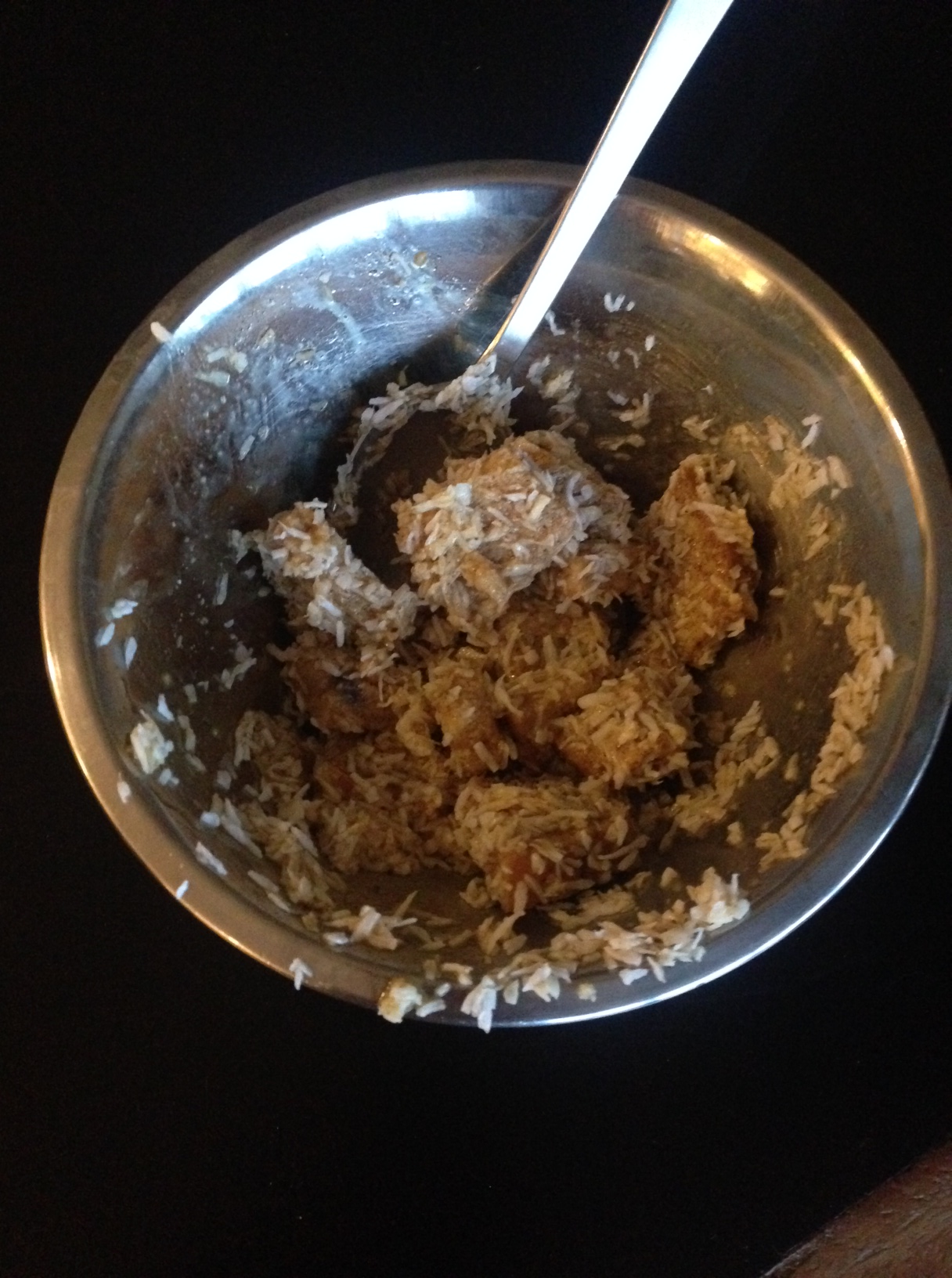
Once the bread is full of egg, add some shredded coconut to the bowl and stir gently until the squares are coated with coconut.

photo 2

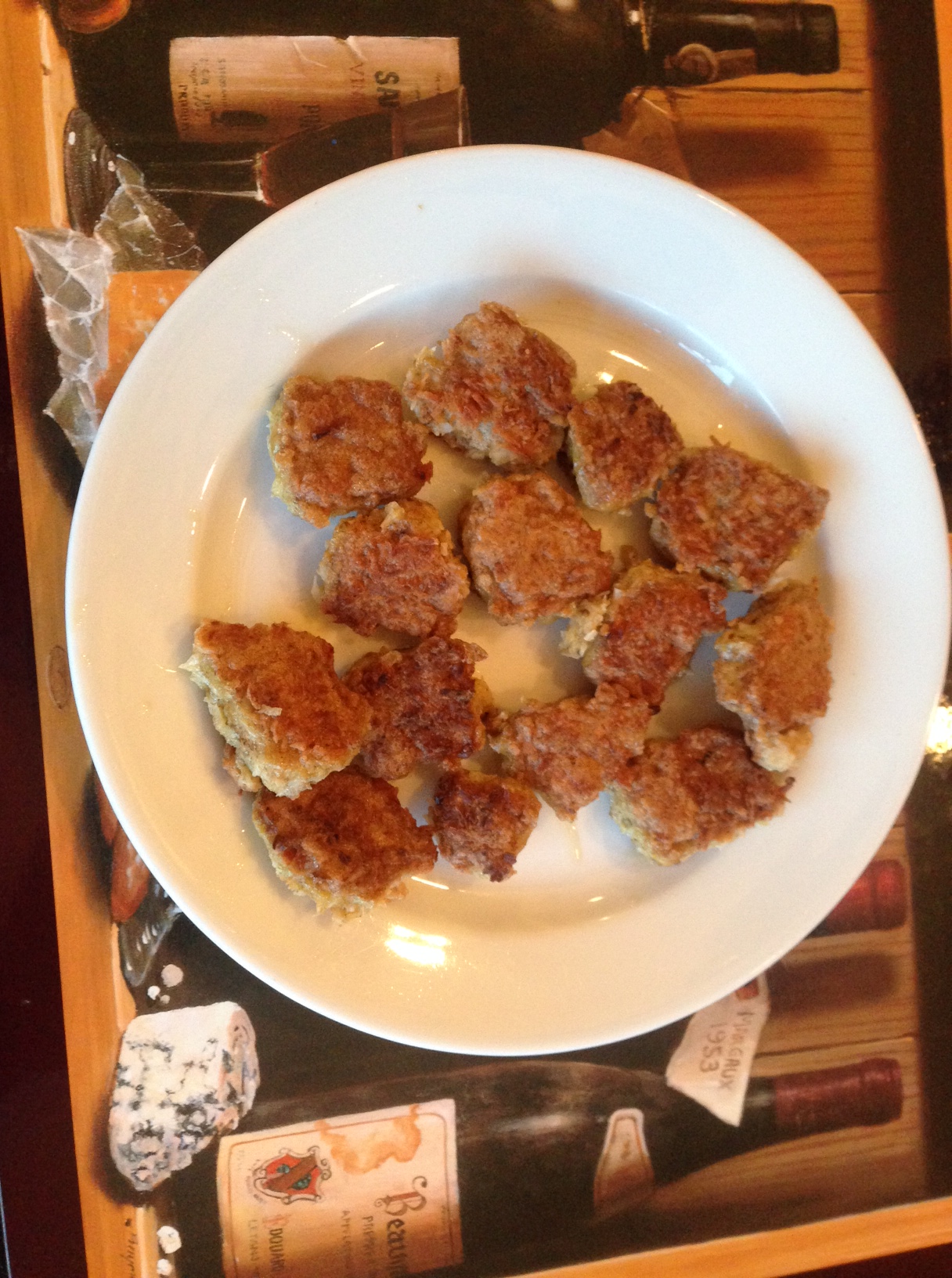
Fry the bites in coconut oil, flipping once.

photo 4

If you need some extra incentive to sweeten these up, try a few drops of a low-glycemic sweetener like coconut nectar or warmed Manuka honey.

photo 5

Idioms All His Own

We had to wait a few years, and now Martin’s speech skills are finally progressing. He has trouble with more complex formulations, such as asking and answering “why” questions, or narrating a string of events, or using “did” plus the infinitive instead of the past form (“He did went.”). Other than that, he can express almost anything.

On the other hand, when I say Martin can express almost anything, there’s a qualifier: “in his own way.”

Sometimes he’s making up words. I go with it and use the correct term in return:

“Martin, I don’t want you writing on these piano keys.”

“No writing?”

“No.”

“No marking?” (He means using a marker to write. That’s close.)

“No.”

“No pencing?”

“Nope, no using a pencil.”

“No craying?”

“Nope, no using a crayon, either.”

Sometimes his formulation leaves me wondering, “What led him to that way of saying it?”:

“Martin, would you stop playing with the telephone?”

He’s in the bedroom, messing around with the bedside phone.

“Okay.”

He keeps playing with the phone.

“Hey, get out of the bedroom.”

“Okay. I’m going to go to the room that’s written here.”

He points to the side of the phone, where “family room” is written on the extensions. Then he zooms away to the family room. Most people would have said, “I’m going to the family room,” right? Martin’s choice works just as well.

He likes to make comparisons. Some are natural and make a lot of sense, as when he asked me, “Am I going to have two [Anat Baniel Method] lessons with Miss Sharon today, just like I had two lessons yesterday with Miss Verena?” Or this morning, when he wanted to go to the basement and play the various musical instruments Adrian has relegated there: “I have many instruments in the basement, like a concert.”

Other comparisons—not so natural. Martin likes to drink a kombucha beverage with chia seeds. This morning I asked what he wanted to drink with his (neverending) breakfast. He responded, “I wanted kombucha with a group of seeds in it. Like a singing group.” Chia seeds like a singing group? Does he really think that, or is he experimenting with uses for the word “group”?

I suppose that, as his language continues to improve, Martin will speak more like other people. I’m trying to write down these little Martin-isms now, while we’ve still got them. They represent one more special mile in the recovery marathon.

Smooth(ie)

Breakfast is challenging. Morning is challenging.

I know, I know: Most families with young children probably find it difficult to get them fed, groomed, and out to the school bus on time. Breakfast with Martin presents certain additional factors:

1. Martin doesn’t like his breakfast food options. I’ve given him as many choices as I can, subject to the parameters of what fits his current diet and what I can manage in a smaller window of time. His enthusiasm peaks at “meh.” Certainly nothing gets put in his mouth voluntarily.

2. Martin also needs to take supplements and medications and homeopathic drops (lots of them), which I assemble and administer during the meal, dividing my attention.

3. Mornings, for whatever reason, are Martin’s most distracted time. Often, despite the plate sitting in front of him, he seems to forget even that he’s supposed to be eating. I lob hints and suggestions. (“What’s 9+3, you ask? Try some turkey bacon and we can talk about it.” “Hey Martin, guess what you can use that fork for?”) Occasionally I resort to spooning the food into his mouth. Okay, fine. Often I resort to spooning the food into his mouth.

In order to be ready for the school bus on time, Martin needs to leave the breakfast table and go to the bathroom by 7:25 a.m. He knows this. While asking questions, drawing pictures, and dropping food on his school clothes instead of eating, he counts down the minutes until 7:25. The instant the clock turns, he springs from his chair, remaining food be damned.

If by some miracle Martin finishes his breakfast—or if he manages to bargain me down to some reduced food portion that he’s willing to cram into his mouth in order to escape the table—before 7:25, he’s allowed to go into the family room and play for whatever minutes remain.

One recent morning Martin was drinking a smoothie: coconut kefir, avocado, kiwi, papaya seeds, and strawberries. By 7:18 (the dance is precise) we had finished morning supplements. I headed to the bedrooms for my three minutes of “me time” (pull on jeans, straighten hair, add enough layers to hide pajama top so I can escort him to the school bus). Martin remained at the table, his smoothie glass still half-full.

Typically I would return to the kitchen at 7:21 and devote four minutes to cajoling him to finish breakfast. That morning, however, I returned to the kitchen to find the glass, empty, in the sink waiting to be washed.

“Martin!” I exclaimed. “What happened?”

“I finished my smoothie. I’m playing,” Martin responded from the family room.

I’m no Pollyanna. Quickly I scanned the sink and garbage for evidence that Martin had dumped the smoothie. Nothing. The kid was for real. He’d actually decided just to finish breakfast and go play. I swooned.

And lest you think that’s the only victory of recent days, allow me to say that, this very day, February 21, I asked Martin to get dressed “within five minutes.” After some debate about where he would agree to get dressed—he insisted on standing on my and Adrian’s bed, which apparently offers the best view of our digital clock—Martin completed the task in three minutes flat. Except for his socks. Socks are hard. Also, his underwear and shirt were on backwards, which I considered an improvement, because yesterday his pants were on backwards.

Victories are everywhere.

Martin, assisted by his partner-in-crime, George the Cat, plays in our family room.

Martin, assisted by his partner-in-crime, George the Cat, plays in our family room.