Mommy, Gone Missing

I’m back from Germany, as of late Wednesday evening.

Just in time to (1) watch the Rangers blow their series against the Devils, shattering dreams of repeating 1994’s Stanley Cup run; (2) get caught, twice, sans umbrella in the thunder and splattering rainstorms passing through New York; (3) waste an afternoon at the Apple StoreGenius Bar” attempting to rectify a software glitch; and (4) spend a pretty decent day with Martin.

He had yesterday off from school, so we made a day of doing exercises and running some errands.

After breakfast—leftover green pudding, which Martin practiced scooping and eating by himself—and HANDLE exercises, we headed out to the Union Square Greenmarket for meat and duck eggs. The trip presented an RDI opportunity: Martin and I discussed which subways we could take, and where we would transfer, and how we would board either the 4 train or the 5 train. (Like many ASD kids in New York City (I’ve discovered, from talking with other parents from his school), Martin memorizes train lines and insists we take a particular train, even if another hits the same stations.) He did swimmingly. On one train he opted to stand and hold a pole, and he kept balance as the car braked and rattled and jerked from station to station. My little straphanger.

At the Greenmarket he was calm, enough, as we visited the farmers I know. He willingly held my hand while walking, and stayed close when I needed both hands for my wallet and insulated food bag. Only when he spotted the Union Square playground did he get fussy and impatient. I bargained another five minutes’ shopping time (“…and then we’ll go to the playground…”), and we hit the playground.

The playground, where we had one of our little miracles.

The playground experience with Martin has evolved. A year ago the process was exhausting; Martin had so little environmental awareness that I had to scamper to position myself below him constantly, in case he failed to realize that the jungle-gym or bridge was ending and launched himself off the end. Sometime during summer 2011 we moved to a new level, wherein I could sit on a bench and watch Martin from afar. Still, I could not let him from my line of sight, insofar as he rarely kept track of me and might wander away.

That’s where I was yesterday—observing Martin from afar—when I saw him glance around (searching for me!); realize he didn’t know where I was; whimper, “Mommy! Mommy!”; and then become agitated when he couldn’t find me.

That’s right. My ASD son, who once upon time bolted every time I released his hand, got upset because he couldn’t see me.

I called, “Martin! Martin! I’m here!”, and waved until we made eye contact.

He smiled. I cried a little.

Soon after that, we left the playground, stopped at the bank, took the subway home, ate lunch, then went back out for organic green juice and to purchase a gift at Jacques Torres. Pretty routine stuff, except when you consider that, when you have a kid on the spectrum, everyone else’s “routine” is a victory.

And there it is. What I saw yesterday for the first time will soon be routine. Martin will keep tabs on me. Not quite like I keep tabs on him, but something more like a preschooler should do.

After all, we’re a team. Martin and I.

I Have None

I’m in Europe, on family business. My mother came to New York City to help Adrian with Martin, and I departed JFK, bound for Heathrow and then Germany.

Saturday, before I left, Martin was symptomatic. I won’t go into the symptoms. By now you know them.

Getting a few days’ distance from Martin usually does me well, in terms of perspective and rejuvenation. Nevertheless, leaving him is heart-wrenching, and I want everything to be perfect. I want him to be having the best day ever, so that I can think, Everything’s under control. I can be away.

Saturday I left thinking, Everything’s a disaster. I have no right to leave when he needs me here. Probably I’m just going to make things worse.

Please don’t look for a point to this post. I have none.

Eating Bon-Bons and Watching Oprah

I am at a conference, the annual meeting of a church governing body I serve as a volunteer. At lunch I sat next to a minister I’d never met, the pastor of a Brooklyn church. We engaged in the idle chatter of New Yorkers. Is Brooklyn part of Long Island? Will the new Barclays Center arena be large enough for the Islanders to consider playing hockey there? Do Upstaters despise City arrogance?

Soon the pastor asked, “So, what do you do?”

“I’m a full-time mom.”

“How many kids do you have?”

“Just one. He’s three years old.”

“Just one? Time for more kids!”

You can guess how I wished to reply. Something along these lines:

“Actually, my son has autism, and we’re trying to recover him, which means that I need to plan and execute eight million RDI and HANDLE exercises, and he can’t eat food with preservatives, or pesticides, or sugar, or starch, or soy, or gluten, or casein, or pretty much anything, so I need six or seven hours a day just to plan, shop for, and cook his meals, and then there’s juggling doctor appointments and administering supplements and making sure we never run out of those supplements, which barely leaves time for finding a special-needs kindergarten, researching new treatments, converting a modern home to organic and chemical-free, and snuggling my son. Usually I do all that on six hours’ sleep, or less. Also, I have a husband, and I like him, and occasionally I want to spend time with him. So, no. No time for more kids.”

Instead, I replied, “We’re pretty happy with just one. He keeps me busy.”

I felt (imagined?) the pastor’s disapproval with that response. I’ve felt it before, from others who don’t know about Martin’s condition or the journey we’re taking. And I understand. They must wonder: With one child who spends six hours a day in school, what do I do with myself?

I shudder to wonder what the disapprovers would think if they knew, in addition, that I have babysitters to help several afternoons per week.

I joke with Adrian about my schedule, about how I spend my day. When he calls from his office, he usually asks, “What are you doing?”

To which I invariably reply, “I’m eating bon-bons and watching Oprah. Why? What are you doing?”

I think I might have got the bon-bons-and-Oprah shtick from Peggy Bundy on Married . . . with Children. (Peggy probably meant it, though.) Now it’s become my and Adrian’s routine to recognize that I’m much busier than I ever was even as a full-time lawyer.

I suppose I could have employed that routine on the pastor at lunch: “I don’t have time for more kids, because I spend it eating bon-bons and watching Oprah.”

Then again, he might have been suspicious. A few weeks ago, Adrian’s secretary asked me, “You know the Oprah show went off the air, right?”

I’d had no idea about that. Is that true?

In any event, since Adrian’s secretary broke the news, I’ve been eating bon-bons and watching a lot of Ellen.”

The Ineffable

Sleeplessness visited Martin again last night, the third time in a week. He was up from 1:00 until 4:30 am.

I’m tired.

Yet I’m not freaking out. To the contrary, I sense that Martin is doing well, that he’s back on the upswing.

I “sense” that he’s back on the upswing. That’s my way of saying I can point to nothing major. Martin has not ceased all echolalia, or started maintaining extended eye contact, or become graceful. In some respects, major signs point downward. Sleeping, for example. I can’t pretend that’s going well. Or keeping things out of his mouth. Objects are still finding his way into Martin’s mouth at an alarming rate. Fingers. Shoelaces. Lotion bottles. George the cat’s ears.

On the other hand, dozens of micro-signs point to improvement. I’ve witnessed the following:

•      Martin ran from the parking lot next to our building to his school bus without turning his head from side-to-side. I cannot remember seeing him run an extended distance looking straight ahead.

•      Martin was tired, so I let him ride to the store in his stroller instead of walking. We stopped at the organic restaurant for green juice. Martin climbed purposefully out of the stroller and mounted the stairs to the restaurant without pause. No dawdling, no tripping, no fussing. He looked like a neurotypical preschooler.

•      Adrian has been traveling this week. Out of the blue, not immediately related to any discussion of Adrian, Martin said, “I want Daddy to come home.” He was not repeating. He was expressing a wish about an absent person.

•      Two weeks ago we visited Martin’s friend Walter at his apartment. Martin observed that Walter still sits in a booster chair. Martin, who for months has ignored his own booster chair, has decided to imitate Walter. Now he’s sitting every home meal in the old booster chair. (He also runs and jumps in every available rain puddle. Thanks, Walter.)

•      Martin has taught himself to buckle the T-formation “seat belt” on that booster chair. That’s initiative and manual dexterity.

These types of developments can be easy to miss. Indeed, they’re nearly ineffable. But they add up.

They add up to a sense that I need not freak out.

Potty Sayer

“I need to sit on the potty,” Martin said.

This was Saturday afternoon. We were just spreading our picnic blanket on a stony beach at Montauk Point State Park, at least a quarter-mile of precarious terrain from the nearest restroom—and we know from past experience that Martin would rather have a potty accident than pee outside.

So if we were the parents of a neurotypical almost-four-year-old, we might have dreaded the words. But we aren’t, and we didn’t. Instead, I told Adrian, “I got this one,” grabbed Martin, and headed around the bluff toward the lighthouse restrooms, scuttling as swiftly as I could over a pile of rocks with a 45-pound preschooler in my arms. I spoke into Martin’s ear: “No pee pees yet! Hold them in. You can make it. Wait for the potty. No pee pees in your pants.” Martin, in return, poked his fingers into my nose and giggled.

We arrived at the restroom to find a line waiting. I raised my voice from a private whisper to a stage whisper—“Hang in there, buddy. Hold it in till we get to the potty”—hoping one of the queued women might take the hint and offer us her place. None did. We waited another several minutes.

Finally I lifted Martin onto a toilet seat, where he deposited his peepees into the bowl and then said, “I’m all done.”

Martin has been potty-trained, more or less, for several months now, with two exceptions. First, he still wears an overnight diaper to bed. That’s for security purposes; most mornings the diaper is dry when Martin wakes. Second, Martin has had trouble learning to tell us when he needs to go. Instead, he says something like, “I’m doing peepees,” or, “I need new pants,” three seconds too late. Up until now we’ve just been sitting him on the potty as often as possible, and he’s done his part by, usually, holding his business until a potty break.

So you may imagine our joy those occasions when Martin not only recognizes in advance that he needs to go but also thinks to inform us. That happened five times this weekend: once at the beach, twice at church, once at home, and—the biggest victory—once in the car, when we were stuck in Sunday-afternoon City traffic and unable to pull over, whereupon we asked him to please “hold it” until we got home and he did, an entire half-hour.

The round-trip from the Montauk beach to the potty and back again took me and Martin at least 20 minutes, delaying our lunch. No matter. When we returned to the picnic blanket, Martin in the same still-dry pants, no accident, Adrian lifted our big boy into the air and shouted,

“Ha ha! Way to go, Martin!”

Yellow Fingers

As I see food, fresh is best for Martin. In most cases—cruciferous vegetables being perhaps the exception—raw foods beat cooked foods. I’ll take just-picked greens and just-killed meats, when available, over frozen. Fresh herbs are more beneficial than dried herbs.

So I was excited when my local natural foods store started carrying fresh organic turmeric root. It looks like ginger root, only more yellow-orange inside and less stringy. I bought a hunk yesterday and brought it home to use in Martin’s green pudding in place of turmeric powder.

The green pudding turned out better than ever, slightly sharper tasting, and I was proud of myself for incorporating a new ingredient.

A few hours later I discovered the downside of handling fresh turmeric. Friday night is date night. I was seated with Adrian in a wine bar, out of my mom clothes, feeling elegant in a smartly fitted dress.

Adrian watched me bring the long-stemmed glass to my lips.

“Yessss?” I drawled, seductively (I thought).

“Ummm—why are your fingers yellow?”

I checked. Despite several sound scrubbings, my fingertips and nails still bore the turmeric stain, a shade that is lovely in fresh root but rather jaundiced on flesh.

“Hey,” I said, “did I tell you how great Martin’s pudding turned out today?”

Failure to Grieve

This week I attended an excellent presentation by Sarah Birnbaum of New York Special Needs Support. The topic was navigating the “Turning Five” process, i.e., getting a child into New York City special education for kindergarten.

It was a tough evening for me, emotionally.

There was a time when I thought that Martin might be ready to join a mainstream classroom as early as kindergarten. (Martin is not yet four years old; he is scheduled to begin kindergarten in autumn 2013.) Although we have made much progress, particularly in healing Martin’s gut and easing atypical movement and behavior, we still have a long way to go in language development and attention. We won’t try to place Martin in any classroom more advanced than his current skill level; because we are committed to lifetime success, we’d rather coddle him for an extra year or two than see him flounder because we shot too high.

So we’re looking at special-education primary schools. And so I related when Sarah said something like (I’m paraphrasing), “You may find it upsetting to visit these schools and fill out applications, because it’s not something you ever envisioned yourself doing, not a place you ever expected your child to be.”

But did I relate in the same way that the other assembled parents did?

I think Sarah meant that it can be hard to accept that your child is not suited for a mainstream classroom. And she is right—perhaps particularly so in the context of parents who do things like attend presentations on kindergarten admissions sixteen months before their children are due to start kindergarten. No one really wants to admit that his or her child has special needs, right?

Therein lies my thought for the day. I’ve read, in multiple sources, that the parent of a child with autism should grieve, i.e., should mourn the loss of the child who was expected, in order to better accept the child who is.

Adrian and I expected a high-achieving child, no doubt about it. From his earliest days, Martin was photographed wearing onesies and caps with the logos of our alma maters. We as parents debated topics like whether to speak to Martin in two languages or three, at what age he should begin music lessons, and whether the risk of concussions meant he should not play hockey. If we had a great fear, it was whether a spot would be available for him at the mainstream private school of our choice.

It’s been two years since we first began to notice signs of autism, and more than eighteen months since the diagnosis. Yet I have not allowed myself to mourn the loss of the child we expected, because I do not believe we’ve lost him. Martin is recovering, however slowly. I refuse to accept that he will face limitations based on autism. I admit that Martin has special needs now, but I do not admit that he’ll have them for long.

I do not grieve.

Nonetheless, as I sat in a presentation on finding the best alternative classroom, I found myself hiding the fact that I wanted to cry, and I wondered:

Can this hope actually make things harder?

My little superstar getting some exercise.

I’ll Have What He’s Having

Well, this was bound to happen sooner or later.

Sunday afternoon Adrian and Martin sat at our kitchen counter, awaiting their respective lunches.

I served Martin’s plate first: cold chai rooibus tea, Raghoo Farms duck breast, and green beans sautéed in the duck fat. Martin picked up his fork to stab some duck.

Adrian’s plate arrived next: filtered water, one ounce of Hemlock Hill cheddar, “exotic rice toast” with Thai red rice and flaxseeds, pecan halves, and a peeled Satsuma orange divided by sections.

Martin took one look at Adrian’s more colorful meal, set down his fork, and said, “I want that.”

“That’s Daddy’s lunch, Sweetheart,” I said. “Your lunch is over here.”

“I want Daddy’s lunch.”

We’ve witnessed harbingers, over the past few weeks, of Martin’s nascent interest in food other than his own: longing stares at the fruit bowl, requests for “cookie crackers with crunchies” (a/k/a flour-free seed crackers, nut butter, and bee pollen) instead of parsley-tarragon-and-quail-egg frittata.  The signs, however, were few and easily covered by distraction, and Martin’s teacher tells us that he still never reaches for his classmate’s lunches.

Sunday was the first time Martin made a direct request for someone else’s food. I’m happy for the developmental milestone—the interest in what others are doing, and the desire to break routine. But the trend, if it continues, will pose new challenges for me. Up until now, Martin has been satisfied with what I put in front of him, and only that.

As for Sunday, it was mustard to the rescue. Martin is in a mustard phase; anything with mustard becomes instantly more appealing. (This includes delights like mustard on turkey bacon or mustard in buckwheat cereal.) After he requested Daddy’s lunch, I slapped my forehead, exclaimed, “Oh my gosh, I forgot the most important part!”, and made a big show of squirting stone-ground mustard onto the duck breast. This demonstration held Martin’s attention while Adrian quietly picked up his own plate and slipped away to his desk to eat, removing the temptation.

One incident managed.

Many more to come.

Darn You Double-Crossing Cruciferous Vegetables

Arugula, broccoli, Brussels sprouts, bok choy, cabbage, cauliflower, chard, collard greens, daikon, kale, kohlrabi, mustard greens, radishes, rutabaga, turnips, and watercress.

Cruciferous vegetables are good for you, right? They’re high in fiber. They’re mineral- and vitamin-rich. They contain isothiocyanates, which help the body fight carcinogens. And for purposes of Martin’s specialized diet, they’re not too starchy or sugary.

Slam-dunk.

But nothing in the world of autism is a slam-dunk, really. I’ve been warned against feeding Martin any raw cruciferous vegetables. That may not seem like a big deal. On the other hand, I love dehydrated kale chips, and Martin used to love them, too—an easy, on-the-go snack available without moderation.

Now he doesn’t get them anymore, at least not often. With the familiar caveat that I am neither a scientist nor a doctor (and I give no medical advice), here’s my understanding of why raw cruciferous vegetables can affect ASD: Thyroid functioning is key to brain function and mental health. Many environmental chemicals, including BPA and flame retardants, are endochrine disruptors, which means that they can interfere with thyroid functioning and thereby hinder the developing brain. Cruciferous vegetables, while unquestionably not the same kind of thyroid criminals as those aforementioned synthetic chemicals, naturally contain chemicals known as goitrogenic isothiocyanates, or simply “goitrogens” (think “goiter”). The goitrogens inhibit the body’s metabolism of iodine, which is crucial to the production of thyroid hormone. Decreased hormone production means poor thyroid functioning. Poor thyroid function has been tied to autism.

This video from The Renegade Health Show explains (if you can tolerate big words, and lots of them) the effects of isothiocyanates on thyroid function. Kevin on the video concludes that only iodine-deficient persons, or those with pre-existing thyroid problems, need to worry about raw cruciferous vegetables. (And even those people may be able to counter the effects of the goitrogens by boosting their iodine intake.)

Most commentators seem to agree that cooking cruciferous vegetables, even lightly, inactivates the goitrogenic effects, which is why this concern applies primarily to raw cruciferous veggies.

So should Martin avoid them entirely?

I agree with Renegade Health’s Kevin that raw cruciferous vegetables pose no risks for the majority of the population. More specifically, I agree that they pose no risks for me; I eat buckets of arugula salad, I dip raw cauliflower in hummus, and I’m pretty sure that my life would be a lesser existence without the Dijon-marinated raw kale at Sacred Chow in the Village.

At the same time, whereas ASD and thyroid complications often travel together, allowing Martin to eat raw cruciferous veggies may well be a sort of danger.

I’ve decided to strike a balance. (I like saying that, because it must often seem like I’m willing to go any extremes, whatever the issue.) To ensure that Martin gets ample iodine, even without dietary supplementation per se, I sprinkle kelp flakes on his food in place of salt. Then I’m careful not to allow him unrestricted access to raw cruciferous veggies. Instead, he gets only the two foods he adores most: kale chips and green vegetable juice. I prepare kale chips no more than a couple times per month. As to the green vegetable juice—which in our case comprises organic green leafy vegetables (for goitrogen purposes, spinach is mildly better than kale or cabbage), cucumber, ginger, celery, lemon, and half an apple—it’s really a double no-no, because of the one-half apple. Nevertheless, I let Martin drink up to 12 ounces once per week.

As a side note, I consider dehydrated kale chips raw because they’ve not been heated to more than 115 degrees Fahrenheit, or 46 degrees Celsius. Definitions of “raw,” for purposes of the raw-food movement (which is not the topic of this post), vary. They include insisting that food be unheated and recommending that it not be heated above human body temperature. I’d love to wade into that debate, and more raw foods in general—but I keep returning to my mantra: There are only so many hours in the day.

And of those hours in this day, I’ve probably just given too many to the topic of goitrogens.

Tanked. Temporarily.

We’re tanked.

This past week Martin has displayed long-forgotten symptoms: clumsiness, running circles around our apartment, low name responsiveness, even some toe-walking. Toe walking! What’s up with that? His attention has gone MIA, and his daytime sleepiness makes me suspect nighttime restlessness. He is inserting into his mouth anything he can get his hands on. And when he can’t get his hands on anything, he simply inserts his hand.

Times like this used to trigger hopelessness in me. All this work, I would think, and we’ve gone nowhere?

I’m more sanguine these days. So we’re tanked—big deal. Paradoxically, Martin’s language has been stronger than ever, notwithstanding the symptomatic behavior. As to that behavior, maybe the blame lies with the onslaught of pollens and other allergens our early spring has brought. Or else residual dust or cement particulates from our recent mini-renovation (we had some work done in the apartment when I took Martin to visit his grandparents over spring break) could be bothering Martin. Most likely, we need to tweak something in his supplementation protocol.

Whatever it is, we’ll figure it out. I know that we’re tanked only temporarily. I’ve seen what Martin can do and know we’ll get back there, and beyond.

Of course, feeling calm overall, on a general basis, does not translate into rationality every minute. This weekend Martin and I were riding a carousel, on horses side-by-side, when I caught him arching his back and stretching his neck to look at the ceiling and even behind him. That’s a sensory stimulant, one that’s been gone more than a year; it used to be hard to take Martin to restaurants, because he would throw his head back so far from the highchair that he blocked aisles, and I fretted about decapitation by waiter or bathroom-bound patron.

On the carousel I was alarmed and disheartened to see the behavior reemerge.

“Martin,” I said, “sit up like a big boy. No throwing your head back.”

Martin complied and straightened his back, but 10 seconds later he leaned back, hands clutching the horse’s pole, and gazed upward.

“Martin, please. Sit up like a big boy.”

Martin complied again, then said, “There are flowers up there.”

“What?” I asked. “Where?”

“Right there!” He threw back his head and pointing to the carousel’s ceiling.

I looked and saw what had caught his eye: lovely flowers hand-stenciled above us.

False alarm. No sensory stimulation. Just Martin appreciating the world around him.

“Martin, those flowers are lovely.”

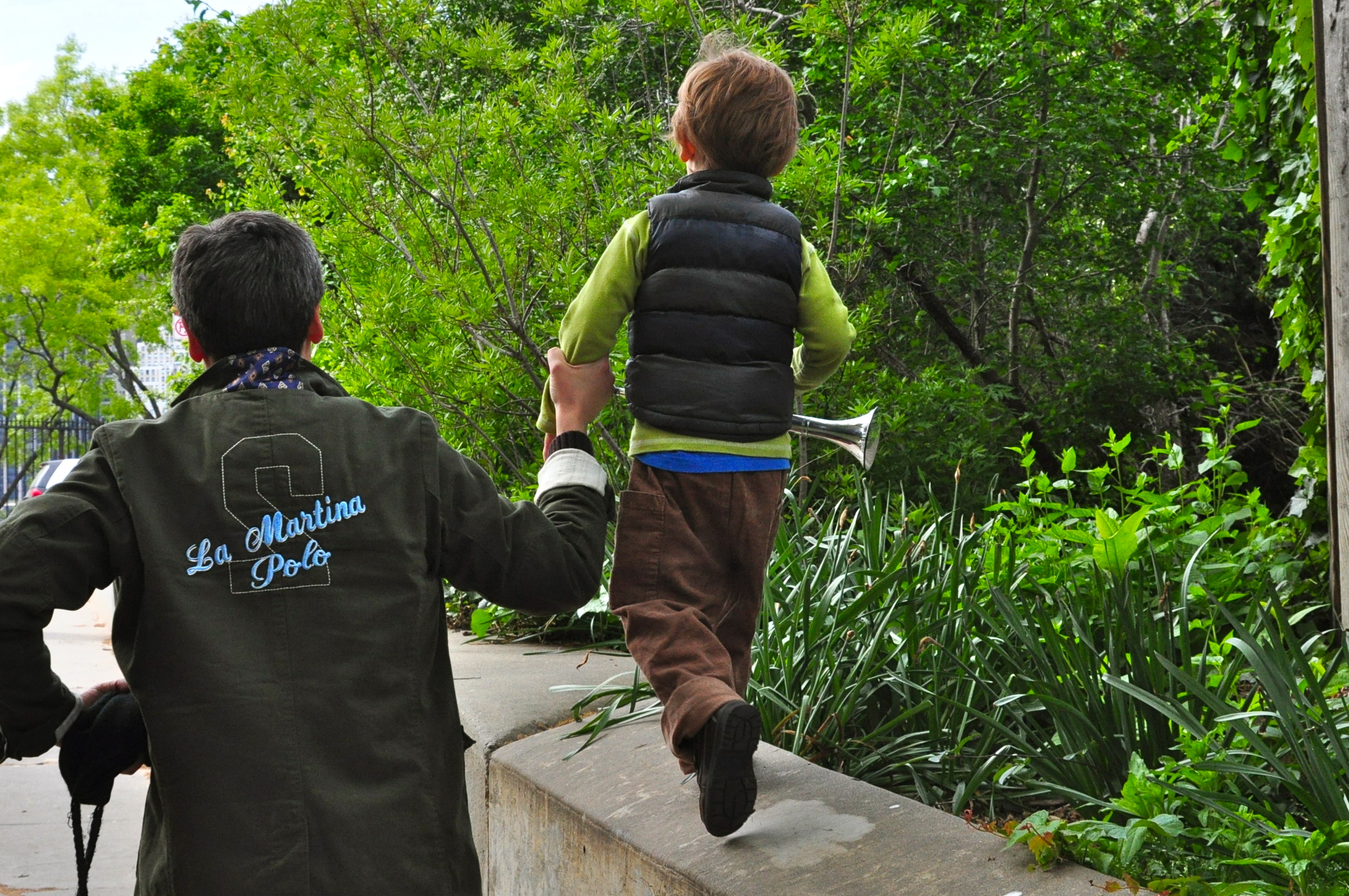
Adrian helps Martin with his balance on a weekend stroll.