Legislative Commentary. Sorry, Not My Usual Thing, But This Deserves an Exception

As promised in yesterday’s post about medical marijuana, and with permission, I’m posting the testimony of my friend Victoria Grancarich. This testimoney will be given before Minnesota lawmakers this September. Victoria’s circumstances are very different from mine, as her son’s place on the spectrum is far from Martin’s. But this epidemic is all one spectrum. We stand in solidarity with each other, and root for what helps any child.

Victoria’s 14-year-old so, Julian, is profoundly affected by autism. Victoria and her husband, John, have truly scoured the ends of the Earth to help Julian and have made progress healing his mind and body. Nevertheless, several years Julian threw himself from a balcony, breaking his back and both his legs. With the onset of puberty, Julian’s self-injurious behavior escalated to the point that he needed constant restraints and protective gear to avoid beating himself into concussions. Victoria and John believe medical cannabis saved their son’s life. As a friend and observer, I agree. In my opinion, to deny marijuana to Julian would be abuse. Yet, this medication was available under Minnesota law only because Julian also suffers from seizures; if he suffered from self-injurious autism but not seizures, the marijuana option would be unavailable. Victoria offers her testimony in an effort to have the law changed and make medical cannabis available to all Minnesotans in need.

My name is Victoria Grancarich. I’m the mother of a 14-year-old boy named Julian. Julian has severe Autism and a seizure disorder. Julian began having seizures in June of 2011. We have tried many medications over the last six years; however, seizures and motor tics continued to be an issue.

Julian had always been a kind and affectionate boy in his younger years. When Julian turned 13, the onset of puberty brought new challenges. In February of 2016 Julian became extremely violent toward both family and school staff. He began raging daily and would physically attack us. It got to the point where we as his family needed to wear protective clothing to avoid being bitten, having our hair pulled, and being kicked and punched. His younger sister could not be in the same room, and she had to spend all of her time at home locked in her room for her own protection.

In August 2016, Julian began to turn the violence on to himself. He began punching himself in the head full force thousands of times per day. He would use his knee to injure his teeth. He would bang his head into walls. We were powerless to stop him. We were trying to protect him using helmets and arm immobilizers, and at times we had to physically restrain him for hours at a time to keep him from harming himself. We believed our son was in terrible pain and was suffering from debilitating headaches. We saw this once vibrant boy lose his will to live. He seemed determined to end his life and came close several times. Between October 2016 and January 2017, Julian was hospitalized three times. He suffered self-inflicted skull fractures and massive tissue damage. He had black eyes and giant hematomas on his skull regularly. The hospital staff offered psychiatric medications as well as gabapentin but nothing could stop the daily rages that lasted every moment that he was awake. I felt certain that if we could not get Julian cannabis that he would find a way to end his life.

Julian qualified for cannabis through the state program because of his seizure disorder. After being sent home from Children’s Hospital in Minneapolis after another life threatening episode of self-injury with no plan in place to heal our son, we felt cannabis was our only hope. The excruciating pain our son was in was getting worse and we knew no pharmaceutical medication could help him. We had tried everything the doctors offered and had absolutely no success.

We enrolled him in the Minnesota Cannabis program in January 2017. Within a week of beginning cannabis therapy Julian was able to go about an hour without harming himself. As the weeks went on and we reached a therapeutic dose Julian’s behaviors began to slowly melt away. By early March he was smiling again. Within six weeks of beginning cannabis Julian was no longer injuring himself or others. He began to take an interest in his life again. He returned to school full time. We were able to remove his helmets and protective gear. By mid-March we were getting smiles and hugs. Julian began to go outdoors again by mid-April. By May Julian began to show interest in using augmentative communication for the first time in his life.

It is now late June. We have not seen one episode of self-injury since early March. Julian has not struck me since February. Julian is enrolled in a day camp for children with special needs where he spends eight hours a day. He is exploring outside and making friends. He is happy and smiling. Julian and his sister have a relationship once again. Julian spends hours in our back yard enjoying bouncing on his trampoline, moving his body and taking in fresh air. He lives safely and happily in our home. He is free from pain. His seizures and motor tics are well managed to the point they are not interfering in his daily life.

Cannabis gave us our beautiful son back. Julian Grancarich is alive and well today because of this miracle medication.
Knife

We knew when we put Martin in public school that socializing would be problem.

It has been.

Academics: Not a problem.

Speech/language: Fading as a problem, except for social/pragmatic usage.

Behavior: Sometimes a problem (the silly, detox-y days), but his teacher handles the behavior masterfully.

Socializing: Problem alert.

Last month, in the post titled, “I’m the Issue,” I wrote about my concerns for Martin’s self-esteem.

At night, when the reading is done and the teeth are brushed and Martin and his stuffed Minions are tucked under organic linens, I sit on his bed to tell him that he’s a great kid and very, very loved. If he’s having anxiety, I make him repeat: “I am safe. My mom is in the house. My dad is in the house. My mom and dad will keep me safe, and I will keep my Minions safe. I can sleep well tonight.” Sometimes we talk about the day he’s had, or the next day he will have.

“Is it okay,” he asked me two weeks ago, during this intimate time, “if people don’t like me?”

I said, “Of course it is. Everyone has some people who don’t like him or her. There are people who don’t like me. There are people who don’t like Daddy. You can’t make everyone like you.”

“But is it okay,” my beautiful eight-year-old son continued, “if no one likes me?”

I am a failure.

Bound To

The autism recovery path is so jagged—so many ups and downs—that the key to longevity is managing my own emotions. Well, one key. Other keys are financial stability, a supportive co-parent, close friends, a cooperative school district, available therapies, access to organic foods, home ownership or other opportunity to create a cleaner living space, and let’s face it, we’re talking about innumerable keys. But certainly managing my own emotions is one. I struggle not to pin my mental state, any given day, to Martin’s transitory condition. Martin has good days and bad days, good weeks and bad weeks, good months and bad months. I don’t mind the elation when Martin feels well and performs well. Giving into despair when he doesn’t is a recipe for driving myself crazy.

That being said, it never ceases to bewilder me when Martin looks near-typical one day and strongly symptomatic the text, without any obvious intervening factor.

Two Fridays ago Martin earned his yellow belt in taekwondo. He didn’t perform exactly as well as the other eight-year-olds being tested but nonetheless paid attention and made the correct moves and legitimately earned the belt. We went out for sushi to celebrate, and Martin went to bed early. He spent that Saturday in New York City with his uncle Eddie. By all reports they enjoyed themselves and Martin’s behavior was stellar. Saturday evening we had dinner at home; Eddie (who eats meat, occasionally) and Martin had organic roast turkey, Brussels sprouts, and brown rice pilaf with vegetables and sprouted pecans. Martin, exhausted from his day, again went to sleep early and without incident. That night he slept 11-and-a-half hours.

Nothing changed.

Nothing, except that Sunday morning Martin was antsy in church. He rocked around during children’s time and, I learned later, disrupted Sunday school with incessant talking. That afternoon he became crabby. Sunday night, alternating between anxiety and cracking himself up, he had trouble falling asleep. I dropped off close to 11:00 pm. He was still awake.

Monday’s school report was—less favorable than one might hope.

Tuesday’s report was—disastrous. After school, Martin looked goofy and distracted at taekwondo class. At church Kids’ Klub, in front of all the children, he called the teacher a “liar” when she misspoke and said “tomorrow” instead of “next week.”

By Wednesday evening, following a trombone lesson that made me ask myself why I’m still paying for trombone lessons, Martin was running back and forth. Remember that? Run from sofa to stairs, stop, turn, space out, then jump and pa-dap-BUMP, run back to sofa, stop, turn, space out, then jump and pa-dap-BUMP, repeat. Classic repetitive behavior. Haven’t seen it in months. Months. Before Wednesday, I would have put “running back and forth” into the “so far gone” bucket.

There were other behaviors too, both at home and at school, that for Martin’s privacy I’d rather not document here.

On Thursday, Martin started to reemerge from the mystery fog. Thursday’s note from school said, “Martin had a better day. :-)” Friday, which was a parent-teacher conference day with no school, Martin had a successful play date with two friends and focused well at taekwondo. Saturday afternoon he worked three hours on a Lego project with Adrian, without complaint. Sunday he hosted a home play date for three friends.

The Friday-Sunday update is based on reports from Adrian and Samara. I was away for the weekend, with six girlfriends from high school. Some of them read this blog. Thanks, ladies. You sustain me.

So why did Martin, without any apparent external stimuli, tank for several days? I don’t know.

And why did Martin’s Wednesday ROOS, combined with a Friday parent-teacher conference about behaviors that are causing fellow students to alienate him, send me into a tailspin, albeit a short-lived tailspin? That I do know, and I’d like to find a way to change the answer.


Expectations

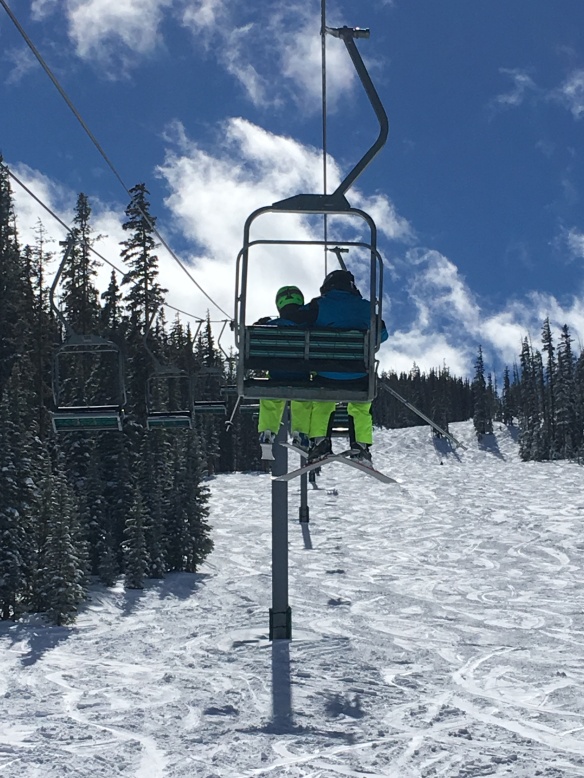
We went skiing again, two weeks ago. I feel so incredibly fortunate to have had two separate ski weeks this year. This time it wasn’t Park City, but Beaver Creek. Adrian has skied Beaver Creek before; for me and Martin, this time was the first.

When we’re at Park City, Martin takes his lessons through the National Ability Center, which you know I love. The instructors are trained and experienced in giving adaptive lessons, they got Martin skiing for the first time, and I’ve seen them perform miracles when it comes to getting more severely affected children and teens sliding down the mountain.

At Beaver Creek, we booked a full week of half-day lessons through the in-house adaptive program. The Beaver Creek adaptive lessons were discounted from standard one-on-one lessons but still quite expensive.

When Martin was doing skating lessons in the hope—ahem, in my hope—that he could play hockey, his instructor was not trained in working with special-needs kids. He was patient, maybe too patient, and no expert at motivating Martin. This may be my own unnecessary fear, but at some point I was unsure whether the instructor even enjoyed working with Martin enough to push him. Martin may not have got as much from those skating lessons as he should have. I’ve had the same feeling about the music lessons—first his piano lessons and now his trombone lessons, both with “regular” instructors. Sometimes those who don’t work regularly with impaired children seem to have pretty low expectations of what they can accomplish.

So I was uneasy Monday morning when I discovered that Martin’s instructor, Steve—Martin was assigned the same guy for the whole week—was not a full-time adaptive instructor and instead taught mostly standard lessons. Steve had called me the night before, to go over the notes in Martin’s file, and asked questions about what to expect. Nevertheless, I feared he might not know how to handle Martin’s shortcomings like attention, coordination, or frustration tolerance. I worried whether he would value Martin’s strengths, like curiosity, and perseverance when motivated.

Those fears were relieved as soon as I retrieved Martin after Monday’s lesson. Martin was a bundle of enthusiasm as he whispered dramatically about the secret path they’d skied through trees and then demonstrated how they howled like wolves in the woods. Steve talked about Martin as if he were any kid: His parallel stance was improving and he wasn’t wedging to slow anymore, but his hockey stop wasn’t 100%, either. They’d crossed several hillsides to work on keeping skis together. When allowed to ski independently Martin was still straight-lining instead of turning. He’s eight, the instructor said. That’s what eight-year-olds do.

I have a long history of bristling when I hear “all kids do that.” On this occasion, it didn’t bother me. To the contrary, by Wednesday, after three lessons, I was convinced that Martin was improving faster with Steve than with any previous instructor, and if Steve was bothered by Martin’s shortcomings, he wasn’t dwelling on them. On Friday, during his final lesson, Martin skied his first black diamond.

The Steve situation, i.e., Martin doing better with a standard instructor than an adaptive instructor, engenders where we are now. Martin has improved again since our post-Christmas dip. At times he seems close to typical. And that raises a whole new crop of problems. Back when I couldn’t get Martin to respond to a question and trembled at the constant meltdowns, taking too long to get ready for taekwondo class would not have bothered me, at least not much. When he couldn’t hold a pencil, or when we still worried about cognitive impairment, I probably would have delighted that he was doing math homework, not fretted that he was dallying.

The expectations of Martin have become higher, and sometimes he rises to the occasion, as he did with Steve. On the other hand, I find more reasons to be frustrated when these expectations aren’t met. Which, when you think about it, is unreasonable indeed.

Here we sit, neither typical nor impaired enough to—to make a big deal out of it? I’m friendly with a taekwondo mother whose son has attention issues. Her son’s issues are slight, and always have been. She’s so skilled at rolling with the punches: accounting for her son’s tardiness, giving him “good attention” reminders, supporting him socially, monitoring his after-school activities to make sure they are meeting his needs. I’m not so good at all that, yet. I’ve spent so many years putting Martin’s shoes on for him and helping him eat that I haven’t developed the skill set to empower his independence.

Time to raise other expectations. Of me.

img_5675

Adrian and Martin, heading up the mountain.

img_5701

Martin, enjoying a fountain view, after a long day of skiing.

I’m the Issue

Back in December, I found myself volunteering at Martin’s class Chanukah party. I read The Runaway Latkes to the class, served latkes—I’d brought Martin’s from home—, and helped Martin’s desk cluster play Chanukah bingo. I also facilitated a dreidl game. Martin played dreidl without incident, but another boy cried or complained every time he had to surrender chips, and finally refused to play any longer, instead yelling, “I’m a sore loser! I’m a sore loser!” I was reminded of when the behaviorist told me, “Martin is not the behavior problem in his classroom.” Overall, the morning went smoothly for Martin, and I felt optimistic.

While I and the other parent volunteers were packing to leave, the teacher called the kids to the rug for another story time. The kids were fussing and settling, and the teacher said above the murmur, “Children! This book is scary! You might want to snuggle up with a good friend!” Everyone squealed and began linking arms into groups of two or three. Tristan immediately grabbed Spencer. Those are two boys I know. Tristan’s mom was born in the same country as Adrian. We have done play dates with Spencer (on a parent-organized, not child-initiated, basis). Martin gravitated to them also, and sat himself very close to Tristan. A second later, Tristan pushed Martin away, and even from the classroom doorway, I heard Martin ask, “Why not? Why can’t I be?” I don’t know exactly what Tristan said to Martin, but given that it followed “. . . snuggle up with a good friend,” I can guess. When I left, Martin was sitting alone, two feet from Tristan and Spencer, listening as the teacher began the scary story.

I worry so much about Martin’s self-esteem. It’s probably what I worry about the most, even more than his attention deficit and immaturity. I wonder how many times per day his self-esteem endures hits like Tristan pushing him away and saying he’s not a friend. The ten or so kids other than Martin at his morning bus stop are all girls, except a boy named Nathan. One of the mothers is pregnant with twins and just found out she’s having a boy and a girl. When she told the bus-stop crowd, Nathan’s mom said, “Oh my gosh, Nathan, are you happy? Finally another boy around the street!” She said this while Martin was standing next to her. Perhaps she confused social challenges with hearing, understanding, inferring.

Seeing the way the world treats Martin has caused me to do some hard reflecting, again, on the way I treat Martin, and how I might also be injuring his self-esteem. Multiple times each day, I become frustrated with Martin for behaviors that are likely outside his control. On any given morning, I might say the following:

-“Martin, why did you spill all the juice? Weren’t you being careful? This is expensive juice.”

-“Martin, I told you to finish eating while I got dressed. You haven’t eaten even one single bite!”

-“Martin, why can’t you just put your shoes on? Feet. Shoes. It isn’t hard.”

-“Martin, we are going to miss the bus! Listen! Pay attention!”

-“Well, that’s it. We’re late. Again.”

Or take this very afternoon, a Monday. I’m going to be honest here, entirely honest, even if doing so brings me to tears while I’m writing: I have been frustrated with Martin since the minute he returned from school. Everything was wrong: Last night I slept only three hours, because I was working on a memo. This afternoon I ended up doing more office tasks than I planned, and my lunch date was more than half an hour late, so I still had to make dinner once Martin was at home. Let me add—Martin had a fantastic weekend. He chatted conversationally, he had no meltdowns, he focused at taekwondo class. So I expected a fantastic today. I knew today would rock. And then it didn’t. Martin cried and complained his way through 40 minutes of homework (worksheets that should have taken no more than 10 minutes), and he still wasn’t done, not even close, when I called him to get ready for taekwondo. I reserved 20 minutes to get us out the door. Twenty minutes to put on a taekwondo uniform and sneakers. And yet we were late. Like junk expands to fill a basement, Martin’s needs expand to overflow whatever time he’s allotted.

My role in all this? I’ve spent the entire afternoon being unreasonable. I’ve told Martin to stop complaining, I’ve grown frustrated, I’ve blamed him for our lateness. I’ve told him to act like an eight-year-old instead of a baby. Once or twice I’ve raised my voice. Constantly I’ve thought, “I would like a glass of wine,” and responded to myself, “A glass of wine will not solve anything,” and then argued with myself, “I think it would.”

My attitude, this afternoon and many mornings, is problematic for two reasons. First, it is unfair unfair to Martin. It’s not that Martin “isn’t being careful”—it’s that his ADHD and lingering coordination issues make him clumsy and distracted. It’s not that Martin “isn’t hurrying”—he lacks the ability to focus. It’s not that Martin is “ignoring me”—listening and paying attention go to the very heart of his disorder. To be sure, some of his conduct may be behavioral. But most of it is not, and it upsets him to be reminded of his shortcomings.

Second, my attitude pretends like I’m not the issue.

If Martin is spilling juice, I am the issue. The juice should be in a safer spot, and in a spill-proof cup.

If Martin isn’t finishing breakfast while I’m getting dressed, I am the issue. I need to get dressed before Martin eats so that I can supervise him.

If we are not getting out of the house on time, I am the issue. If 20 minutes is insufficient time to prepare, then somehow I need (1) to find more time and (2) to organize so that I have nothing to do except shepherd Martin’s preparation. One might argue that Martin needs to be developing more independence; clearly, however, the “independent Martin” strategy is failing at this time. Maybe I can leave one, and only one, task for solo performance: teeth brushing, or bag packing, or sneaker tying. For now, I need to “scaffold” massively (think “build extrastructure”) and withdraw support as Martin’s attending improves.

The truth is—and I think most biomed parents will agree with this—it is very frustrating to spend almost every waking moment working toward recovery and still get hit with waves of perseveration. Still never get out of the house on time. Still wonder why the child never listens. Still endure moments of hopelessness.

But that truth doesn’t excuse me from acting like the grown-up in this relationship.

Epilogue

I wrote this post yesterday, Monday. When Adrian arrived home, I said, “It’s been an afternoon. Will you pour me a glass of white wine?” He noted that the only white wine in the house was a bottle of questionable quality that the pool company had dropped off before Christmas. I told him to proceed. I drank two glasses. I woke at 3:30 am with a headache. I took ibuprofen and went back to sleep, propped on pillows, then managed to oversleep until 6:00 am.

Despite being rushed, I worked swiftly and organized the morning well. Martin cooperated more than yesterday. I was so proud of us when we were ready for the school bus three minutes early.

After Martin departed, I realized I’d forgotten his after-breakfast supplements.

He arrived home with a report saying he’d needed an unusual amount of prompting during the school day, and had refused to participate in Valentine’s activities. Now he’s in taekwondo again, and instead of participating, he’s jumping.

Still, the grown-up in the relationship feels okay. Must be a sleep thing.

img_5483

Martin, at Chicago’s Adler Planetarium. He’s not the issue.

Opposite Direction

We had that one golden week, immediately after I switched Martin to low-salicylate diet.

The next week wasn’t so good.

This week isn’t so good.

You know what I mean by “not so good”: lots of silliness, little concentration, some meltdowns.

We are still doing low-sal.

I can’t identify any environmental changes since golden week.

What is different is that we are, again, increasing the anti-microbials in Martin’s protocol, trying to reach what his doctor considers full dose.

Martin’s system is sensitive and reactive. I begin to doubt whether we will ever make it to full dose.

I’m going to try an experiment, this week: I’m going to reference Martin’s protocol sheets (I print them at home and keep them all, of course) from our ski week and from the golden week. Whatever dose of each antimicrobial Martin had those weeks, he shall have this week.

I’m writing this at Martin’s taekwondo class. I’m watching him focus on nothing. I’m looking at a kid with half the attention span he had two weeks ago.

And so for a little while, I don’t care whether we are working to reach full dose of antimicrobials.

I just want another golden week.

I’m Ignoring Politics by Writing a Wistful Post Instead

Last weekend we went skiing at Jiminy Peak with Martin’s friend Bobby, his neurotypical brother Adam, and their parents. Martin and Bobby took their ski lessons with Stride Adaptive Sports, a terrific organization similar to the National Ability Center, our Utah mainstay.

Monday morning (no school, for Dr. Martin Luther King, Jr. Day), I retrieved Martin after his lesson and chatted with the instructor.

“Your son is an absolute pleasure to work with,” the instructor said. “He’s so talkative. He could be a New York City tour guide!”

That cuts both ways. Martin is obsessed with trains and landmarks, and the location of both. “Mommy, the Chrysler Building is north of the Empire State Building. The Empire State Building is on the same road as the entrance to the Queens-Midtown tunnel. The bottom of Central Park is where Midtown becomes Uptown.”

I said, “Thank you. We’ve worked really hard on his speech and language.”

“Saturday, I had two lessons with boys who were basically non-verbal.” The instructor shook his head. “I just couldn’t break through to them.”

It’s hard to convey the tone the instructor used when he said he “couldn’t break though to them.” He wasn’t speaking scornfully, or with pity, or even with sadness. It was more like he was disappointed in himself, and wished the situation had been otherwise.

I started to say, “I understand.”

But I stopped myself.

Because I can’t understand. Not any of this mess.

The Facts of Life

If you’re my age (sorry!) and grew up in the States, you probably know the tune to these lyrics:

You take the good, you take the bad

You take them both and there you have

The facts of life, the facts of life.

 There’s a time you got to go and show

You’re growin’ now you know about

The facts of life, the facts of life.

When the world never seems

To be livin’ up to your dreams

And suddenly you’re finding out

The facts of life are all about you.

How long have you been reading this blog? If it’s a while, then you’ve experienced the good and the bad. You know that, over six years, Martin has moved from virtually no functional language or eye contact to a kid whose social awkwardness is primarily the inability to shut up. Early on, he was removed from a twelve-student, two-instructor preschool class because he wasn’t up to the task. Now he’s in a 22-student, one-teacher mainstream classroom, albeit with an aide. You also know that the path has been beset with obstacles: frustration, setbacks, inexplicable ROOS.

After we switched to a low-salicylate diet, Martin soared. Every day last week, we received a “best ever”-type report from school. His meltdowns reduced by 90%, I estimate. Though he continued perseverating/obsessing about New York City landmarks and trains (not unusual for kids with spectrum challenges), he was able to snap out of it when requested. Over the weekend, we went skiing with friends. Martin played with their typically developing, seven-year-old son, and his ski instructors referred to working with him as “a joy.”

. . . Which brings us to yesterday, Wednesday. No stellar report came from school. The across-the-board 5’s from his Friday report gave way to a crop of more-usual 2’s and 3’s. Martin came off the bus happy but talking nonsense (“Blurb the dinosaur is on the bus and he might eat us! Look out, it’s a birdjay!”). He spent his trombone lesson dancing about and lying on the floor, challenging even his patient instructor. Then he conducted a 90-minute tantrum based on my refusal to give him an iPad until his math homework was done. (Once he decided to stop crying and do the math ditto, he completed it in approximately 45 seconds. Forty-five tear-filled seconds.) He woke during the night, for three hours. This morning his behaviorist reported that he seemed “off” and “someplace else,” that he was acting goofy, that his fingers were in his nose, or in his pants.

PANDAS flare? I don’t think of Martin as a PANDAS kid, but—. Parasite activity? The full moon was last week, not this week. Detoxing? Increasing MC-Bar-1™ too quickly? Mold exposure? Dietary infraction? Mast cell party? I’ve also been unfocused and “off” this week. Adrian says he has, too. After a terrible report on Martin’s day, his behaviorist followed up with this text: “That said, I’ve been bombarded with phone calls this week. Everyone off.” So who the hell knows?

I texted back: “On a positive note, we have seen a real decrease in meltdowns. I hope that is carrying over to school.”

She replied: “No meltdowns reported or documented.”

I said: “I’m going to hang onto the positive, in that case.”

You take the good, you take the bad

You take them both and there you have

The facts of life, the facts of life.

All That Could Be

A former work colleague, now a friend, messaged me the piece on a Rhodes Scholar with autism. This friend has a brother with autism and a son with severe anxiety troubles, and she knows that Martin has autism. (She may or may not know that, really, Martin had autism.) About the Rhodes Scholar, she wrote simply: “Love this.”

I responded:

I love it, too. But I also don’t love it.

A story like this is terrific because it reminds people that ability does not depend upon behavioral factors, and that awkwardness or perseveration are often just covers for awesomeness! Also, it’s a powerful message to go out and achieve, without excuses.

On the other hand, celebratory and feel-good stories tend to normalize autism in a way that I find unproductive. This is what feeds the “neurodiversity” movement, the idea that neurological variations just happen, and we need to stop trying to “correct” neurodivergent behavior. It’s like, If you can be autistic and a Rhodes Scholar, why would you not want to be autistic?

I don’t support neurodiversity or the feel-good approach to autism. What’s also going on in this story is that a mother had to sacrifice her own career (in toto) and personal success in order to give her son this opportunity. And that this young man, an Oxford-bound college graduate, cannot live independently and perhaps never will. And that he needs a service dog to assist with interactions, and that it’s unclear whether he’ll achieve the depth of interpersonal relationships that lead to marriage and the sustenance of enduring friendships.

I guess that seems like a pretty bleak view. My view of persons on the autism spectrum is blindingly bright. They achieve so much despite struggling with issues that the neurotypical cannot, truly (I include myself), fathom. My view of autism itself, however, is negative. “Autism” is the symptoms of underlying health and immune disorders that can, and should, be treated. In terms of the young man profiled in this story, I would suppose that autism may have given him the (perseverative/obsessive) focus to acquire vast amounts of facts/knowledge. But that amazing brain of his would have been present and functional even without the autism—and perhaps he could have become an independent Rhodes Scholar who will miss his family and girlfriend and football buddies during his years in England. And perhaps his mother could be practicing medicine and available to help others, free from the monopoly of her son’s needs.

I am 100% sure this is more than you wanted to hear this morning! It’s a topic I feel so strongly about that sometimes I can’t help myself. The way I look at it is this: Autism was never an essential part of my son, and it’s not an essential part of anyone on the spectrum. It’s an imposed condition that can be alleviated or eradicated through the right biomedical treatment (though not always, not by a long shot). My son is witty and charming. He’s going to go to Princeton or maybe Yale, and he could well end up a Rhodesie, if he doesn’t decide the Marshall Scholarship or a Fulbright is a better fit. I’d prefer if he does all that without the burden of autism.

Does that make sense? Honestly, it’s hard for me to write about these things because I worry about offending others who are touched by autism, which as time goes by is more and more of us. I’ve got a “love the sinner, hate the sin” relationship with autism, albeit in foggier terms. I admire the person—and could do well enough without the autism.

I sent the message off with trepidation, almost chagrin. I like this friend. She’s never been anything but kind, and I feared insulting her. It is so tricky, to discuss recovery with an autism family member who’s not pursuing biomed. I would never want to suggest that anyone else is providing inadequately, or has to be doing biomed, or anything similar. We all do what we can.

I hope she responds well.

Three Drugs, Maximum Dose

I play in a softball league for local women. We have four teams, comprising mostly moms in their 30s and 40s. It’s fun.

At one practice, a few of us were discussing Martin’s move from a private self-contained, special-education setting into our local school. (I’m so anxious. I raise the topic with anyone who knows anything.) I said that my son—no one on the team knows Martin—has ADHD and language delays.

Someone asked whether we’d considered the district’s own self-contained, special-education classroom for Martin. I said that we’d observed that classroom and liked the teacher but (1) we didn’t see any advantage to moving from one self-contained setting to another, and (2) our district representative wasn’t sure Martin would fit well with the students in the self-contained classroom. I worded the second point carefully, so as not to suggest that the class was behind schedule, or that Martin was “better” than its students, in case any mom present had a child in that classroom.

And indeed, one mom did have a child in the district’s self-contained classroom. She started talking about her son. She said that they’d considered trying to switch him to general education with an aide (that’s what we’re doing for Martin) but felt that the move from a 12-student-or-fewer classroom to a 20-student-or-more classroom would be too much for him to handle.

We have the same concern for Martin, I told her. I’m wondering how this year is going to go.

“I’m sure it will be fine,” she replied. “It wouldn’t work for my son. My son’s ADD is so bad.”

I’ve seen this woman’s son. He comes to watch our practices and games. To me, he looks absolutely typical.

I said, “Academically, attention is our main concern, too. Martin has so much trouble paying attention.”

“Not like my son,” she said. “Seriously, once my son even had an autism diagnosis. Now he’s on absolutely the highest dose of every medication he takes.” She named three pharmaceuticals, none of which I recognized. “For every one, he’s got the highest dose they allow. Based on his body weight, they won’t even let him take more. That’s how much he needs, just to pay attention.”

As she spoke, I grew uncomfortable. First, the way she said “autism diagnosis” conveyed, “You can’t even believe how bad his condition is.” I abhor “autism” being used as a synonym for “territory you don’t want to be anywhere near.” Last year I helped a special-education acquaintance request a neurodevelopmental psychiatric evaluation for her son. When I asked later how it went, she (despite knowing Martin’s then-diagnosis) replied that she hadn’t completed the exam because, after only the first session, the doctor said her son didn’t have autism. “That’s really what I needed to know,” that mother told me. “I mean, thank God, at least he doesn’t have autism.”

Second, as I’ve written before, I can’t say that we will never allow Martin to use a pharmaceutical to address his poor attention span. For example, if we get to middle school and a pharmaceutical can make the difference between fully mainstream and still being pulled from the classroom, maybe we will try the pharmaceutical. (Maybe.) That being said, the thought of an eight-year-old child, like softball mom’s son, taking a variety of drugs to alter his brain chemistry turns my stomach—especially because the family doesn’t seem to be making any attempt to address overall health. Every time I see the boy, he has goldfish crackers or an ice-cream cone or an artificially flavored popsicle or even a soda pop in his hands.

Third, softball mom’s comments were tinged with—I don’t know—pride, or bragging. She sounded like we were trying to outdo each other: My son has so little attention span that he needs three drugs, maximum dose. Can you top that? I suspect that, if we ever compared our children, I could top even three drugs, maximum dose. But who on earth would want to play such a game?

Sitting quietly and typing my blog, I can expound the three reasons her comments disquieted me, and come up with the kind of helpful response I could have given, something like, “I’d really like to hear more about your experience with the self-contained classroom. Can I give you my number so maybe we could grab coffee?” or maybe even, “We’re always looking for new friends. Do you think your son would like to do a play date sometime?”

On the softball field, however, I panicked, confounded as usual, nothing productive to offer. I said only, “Wow, it sounds like you’ve really got your hands full!” and hoped she would change the subject.

For ahen these situations arise, I’ve got to find some middle path that is neither my opening monologue to the biomed revolution nor a throw-away comment to move the conversation along. Regardung my veganism, I’m able to thread the needle; I respond honestly but non-graphically to any questions (no one wants to hear about factory farming at the dinner table) without pushing an agenda. What is the biomed equivalent? How do I gently suggest that a non-pharmaceutical option is available, without affronting or appearing judgmental?

Suggestions welcome.