And “Better” Means?

On our last trip to California, I was cuddling my friend Melanie’s three-month-old daughter (her first baby) when Melanie gestured toward Martin and asked, “What would you say has been your favorite age?”

Melanie knows Martin is recovering from autism, so I could answer: “It’s weird for me. My parenting journey hasn’t been traditional. Every day he can relate in ways he couldn’t before, and can communicate more, and can have more conversations, and play more games, so I would say each age he hits is my new favorite age.”

Later, reflecting, I questioned the implication of my response. If I enjoy parenting more—to be honest: if I enjoy our whole relationship more—as Martin inches toward recovery, does that mean that I value neurotypicality more than appreciating Martin wherever he is on the journey? Does my focus on his future take away from our today? If we had never discovered biomed, if Martin still lacked functional language and threw constant fits, would I resent parenting my own child?

Years ago, I described my own failure to “grieve.” Autism parents are often told to let go of the children they thought they had (i.e., the neurotypical children with standard futures) in order to embrace the child they do have (i.e., the children with autism and divergent futures). As soon as I realized that recovery is possible, I set aside the grieving process in favor of fighting. Throughout that fight, I’ve maintained that I’m not trying to change who my son is, only to dig his true nature out from under all that autism. I’ve also maintained that I love Martin fully and completely, with or without autism, whatever his future holds, however we have to parent him. All that is true.

But something else is also true, and I reckon it may be the most controversial declaration I’ve made on this blog. At least, judging from my impulse to go hide under a blanket and pretend no one will ever read this, it is my most controversial declaration. Here goes: I think it is better to have the chance to live without autism. Whatever unusual ways of seeing the world autism can bring, neurotypicality is generally preferable. We humans become fulfilled unto ourselves by relating to others, whether through physical affection, cyberspace communications, books, poems, common goals. Autism hindered Martin’s ability to relate to me, and mine to relate to him. That is why his life and mine, our common and intertwined life, is getting better as his autism fades.

To anyone living with autism and offended by this post, I apologize. This is my opinion, and based on my experience with my son. Any opinion is subject to change, and I freely admit that participating in a recovery journey may be usurping joy I would otherwise find day-to-day if I were to accept Martin’s autism as who he is, instead of what burdens him.

Maybe I’m saying I know why I’m Finding My Kid. I’m Finding My Kid to make life better.

I’ve built walls,

A fortress deep and mighty

That none may penetrate.

I have no need of friendship; friendship causes pain.

It’s laughter and it’s loving I disdain.

I am a rock,

I am an island.

—Paul Simon

Recognized, and Happy for It

My law school roommate lives an hour or two away. As the crow flies, her home is probably 40 miles or so from mine, but New York City lies between us, with all the convoluted traffic conjuring the metropolis requires. She and I meet occasionally for lunch, in Manhattan, but it’s rare that we bring our families together.

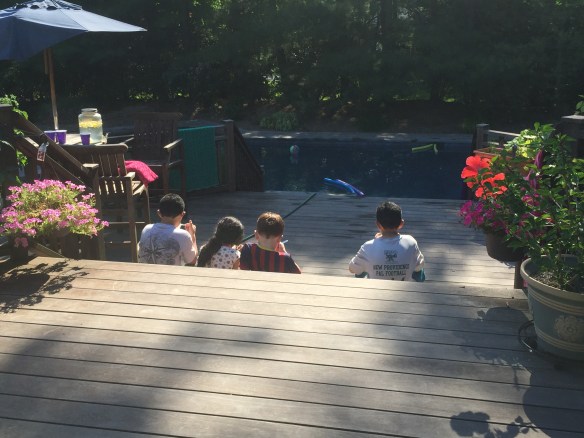
This Saturday she and her husband came over with their three kids, a girl about Martin’s age and two older boys. We barbecued and swam. The kids played. They stayed about five hours.

That evening, I received this email from my erstwhile roommate:

It has been a few years since I last saw Martin (or should I still call him Tin Tin?), so I didn’t know what to expect. I didn’t know if he would still be the little boy I remember from a few years back or if he would be completely different. Well, he is still the cute and sweet little boy I remember but he has also grown into a wonderful young man, so friendly, courteous, and fun! If I did not know from your blog posts that he has struggled with language and communication, I would not have guessed it. Martin was such a gracious host to my kids (who are not the most friendly outgoing type) and was actively engaging them. (He was asking Nathaniel if he preferred to be called “Nathaniel” or “Nate.” He was also calling to Mieko to come swim.) He was so expressive and easy-going and super nice to be around!

I know that today was just one day in his life and there must be other days when things are not so great. I can’t help but to think of all those sleepless nights, all the cooking and food shopping, traveling to doctors and therapists, and the worries and heartaches you endured. But I think you have soooo much to be proud of!!! Your unwavering faith in your child and your strength to guide him, even in the face of uncertainty, have made a world of difference.

Congratulations on achieving an important milestone! I am sure that the next chapter in his life will be an exciting and rewarding experience with new friends and new achievements.

The “important milestone” to which she refers is Martin’s upcoming switch from self-contained special education to general education.

I’m grateful and fortunate to report that I often receive compliments about Martin. This wasn’t even the first very cool email I’ve received from my law-school roommate.

The email quoted above, however, is different, and blog-worthy. In it, a parent of typically developing kids recognizes not only Martin’s growth but also the struggle it has taken to achieve that growth. This was so meaningful to me. Biomed parents know what happens behind the scenes. Biomed parents understand why I had to give up my former career, and they are sure I’ve cleaned poop smears, endured consecutive days without sleep, and snuck into bathrooms to cry. Parents of neurotypical kids, on the other hand, no matter how supportive, tend to overlook what autism recovery actually entails.

Before our guests left yesterday, my former roommate also said that I looked healthy. She said I seemed less exhausted and less burdened than I have since Martin was diagnosed.

When I asked later whether I could reproduce her email here, with the identifying information changed, she replied, “Sure, go ahead and use it on your blog. And you can remove any identifying information such as how beautiful and charming I am.”

Nice try. I will spite her by reporting to my entire (vast, vast) readership that my law-school roommate is beautiful and charming.

Which I suspect you already guessed.

IMG_3496

Martin enjoying homemade ice cream on our back deck, with the children of my law-school roommate.

Del Sur V: Manifesto

“Do you know?—maybe it’s possible that he never had autism?”

These words were spoken innocently, by a sympathetic party, and (I suspect) without forethought. It was late evening in South America. Martin was asleep. My mother-in-law and I sat in her kitchen, chatting, I with a glass of white wine, she with her pisco sour. We were discussing Martin and his progress; I mentioned that his official diagnosis had changed from ASD to ADHD with social/pragmatic language delay. My mother-in-law responded, “Do you know?—maybe it’s possible that he never had autism?”

My mother-in-law supports everything we do for Martin, and does her best to accommodate; we arrived from New York to find her fridge stocked with organic produce (still hard to procure in her area) and a cow knuckle and vegetables simmering on her stove, for Martin’s broth. That being said, I’m not sure she fully understands biomed, or our start point and desired endpoint. This is no criticism of my mother-in-law. I’m not convinced that anyone outside the thick of recovering a child understands autism or what healing requires. I’m not even convinced that I understand autism or what healing requires; I’m just a few paces farther down that road than others are.

Still, when my mother-in-law offhandedly suggested that maybe Martin never had autism, I bristled. I bristled because I think I will hear that suggestion a lot, as Martin continues to become more typical. Already I hear hints. A friend who has a mostly nonverbal seven-year-old and does not do biomed remarked recently about how “maturity” is resolving a lot of Martin’s issues. The friend meant no harm; in her mind, biomed doesn’t work, so she needs something else to explain Martin’s emergence from autism. (I didn’t pursue the issue further. I’m cautious, with other autism parents. We’re all doing what we think we can.) And remember the neurodevelopmental psychiatrist’s words? According to her, Martin developed functional language because he was “not destined to be a child with receptive or expressive language problems.” It’s not biomedical interventions. It’s destiny!

I know, from other blogs and on-line communities, that parents who manage to recover their kids from autism face skepticism that their children ever had autism. You may ask, why should they care? The opinion of naysayers doesn’t affect their children’s recovery. Why should I care if another autism parent wants to chalk Martin’s ongoing recovery up to “maturity,” or a doctor implicates destiny over hard work?

Well, I care, we care, everyone should care, because denying biomed has far greater implications than just adhering to ingrained misconceptions about autism.

It is possible to recover from autism. Not to learn to live with autism’s symptoms, which is what behavioral therapies teach, but to eradicate autism by treating the disorder’s underlying medical causes. I know this to be true, because my son is recovering from autism. I’m not deluded. I have the blood work and urinalysis evincing his medical issues. I have the series of neurodevelopmental psychiatric reports describing his detachment, his lack of language, his emotional instability. I witnessed too well his lethargy and physical discomfort. I endured his sleeplessness. I have watched, over five years, as his medical issues alleviated and the autism symptoms improved in tandem.

Every case of autism is different. Yet there are commonalities. The presence of autism points to an immune disorder rooted in the gut, where 70% of the immune system resides. A healthy gut biome has plenty of good bacteria to keep germs and infections at bay. When something depletes the good bacteria—say, antibiotics, or glyphosate—the bad guys start to party. Any further insult, like insufficient vaccine absorption or exposure to environmental toxins, can cause the whole immune system to jump its rails. When you’ve got no properly functioning immune system, you can find yourself with a host of secondary problems, like neuroinflammation, excess propionic acid, a struggling thyroid, glutathione depletion and methylation troubles, opportunistic infections, an inability to secrete heavy metals. And then? Neuron misfires. The endgame that manifests in autism.

Autism rates are on the rise. Stunningly. Think of those graphs that represent worldwide human population: Autism’s growth is similarly exponential, even according to conservative CDC figures. The epidemic is not the result of greater awareness, or expanded diagnoses; if it were, we would expect to see most cases clustered at the mild, almost debatable, end of the spectrum, where the merely “quirky” kids reside. Instead, new autism diagnoses litter the entire spectrum. Non-verbal, acutely affected autism is on the rise just like Asperger’s. Those who deny the rising autism rates are the willful ignoramuses and the irrational optimists. I am out of patience for either.

We don’t know, yet, what “causes” autism, though every day we learn more about factors that may contribute to the development of autism. I mentioned a few above: overuse of antibiotics, unsafe vaccinations, pesticides. Activists speculate about the role of pollution, about electromagnetic fields, about C-section births (or not) and the newborn’s chance to benefit from the vaginal biome. Genetics also play a role, such as the MTHFR mutation or UBE3A mutation.

(Note this: Accepting that genetics play a role in development of autism is not saying that we “can’t do anything about” the autism epidemic. The genetic predisposition to autism has probably been around many generations; only now do new environmental triggers spur the subsequent development of the disorder. Plus, more and more we have to speak not of genetics proper, but of epigenetics, mutations with the capacity to arise or dissipate between generations, or even within a single generation.)

Which brings me to many people’s resistance to accepting the notion of biomed. If we accept that we can reverse autism by resolving the factors that caused it in the first instance—then we admit that something is causing autism. Based on the exploding autism numbers, whatever is causing autism is getting worse. In an over-hygienic world devoted to unlimited consumption, exploitation of animals and the environment, a pill for every ailment, and the temple of convenience, we are doing something wrong. Disastrously wrong. In that regard, progress has stopped. Unless we change course, each successive generation will pay a higher bill for our abandonment of what is natural.

Unfortunately, almost no one seems to want to change course. So people deny that autism is on the rise, or that autism has causes, or that autism can be treated.

This is why I bristle to hear that maybe my son never had autism, or that he’s moving off the autism spectrum because of something other than biomed. It is also why I do not support the “neurodiversity” movement. Don’t get me wrong: I support the goal of inclusion and accommodation for persons living with autism. Did someone insult or exclude your family member with autism? Call me. I will gladly rush over and go Brooklyn on the jerk. But do not hand me acceptance of autism itself as a policy for dealing with skyrocketing autism rates. Do not tell me that autism is “just how some people are” and should not be addressed, because I will respond that schizophrenia and depression—other disorders with medical underpinnings—are also “just how some people are,” and give lie to how misguided neurodiversity is. People with autism should be accepted. Autism itself can, and should, be fought.

We can learn to live with just about anything. City dwellers learn to live with constant light and noise pollution. Our world may be on the verge of learning to live with catastrophic climate change. This ability to adapt does not mean that we should fail to recognize and correct our own mistakes.

My son had autism. My son still has ADHD. One day my son will be neurotypical. Treating his disorder biomedically has made this progress possible.

Full stop.

Del Sur III: Someone Has Got Him

My grandmother spent the last 45 years of her life in the United States, and yet some part of her never left Germany. Her kitchen represented Germany circa 1947, eternally enshrined in Southern Florida. She shunned modern appliances and scrubbed the bare counters spotless. An ode to beer, carved in the old German lettering, hung above the table where she sat to smoke, drink strong coffee, and work her crossword puzzles (in German, natch).

Allow me to add that my grandmother was also glamorous, and one of the worst cooks I’ve ever encountered. No dowdy Hausfrau here.

Adrian, my husband, moved to the United States in 1999 and nationalized in 2009, and he too keeps one foot in his country of origin. Throughout each day, WhatsApp messages zip among him and his schoolmates. I stock our pantry (and wine cabinet) with homeland products. He even likes to have his suits sewn by his hometown tailor and shoes made by his preferred cobbler. During my our recent visit to South America, my mother-in-law asked me to drive across the city with her to pick up Adrian’s new loafers and boots.

“I don’t know,” I replied. “Martin will be bored, spending that much time in the car.”

“Martin? He doesn’t have to come. He can go to the playground with his cousins.”

The cousins in town that week ranged from 10 to three years old. I asked, “Will someone go with them?”

“Of course,” my mother-in-law said. “Don’t worry about it. Someone’s got him.”

Soon three cousins appeared in the apartment with their mother (my sister-in-law Claudia), gathered Martin, and left. My mother-in-law and I headed to the cobbler, a trip that took more than 90 minutes with traffic. Then my mother-in-law wanted to stop at the supermarket, and we ended up shopping an hour as she showed me the newest organic and gluten-free options. Just as I began to worry about Martin, I received an email from Claudia titled, “There are five!”, with no more explanation than a photo of Martin, his three cousins, and another kid I didn’t recognize, whom evidently the crowd had picked up along the way. Okay. No rush. My mother-in-law and I sauntered home three hours after I’d watched Martin whisked out of the apartment. We found my brother-in-law (the beloved bachelor uncle, Pancho) waiting. Pancho reported that Claudia was summoning him to the park to help her haul five kids home. I went along and found Martin. All was well.

The next day, Pancho (remember the “beloved” reference) sent me to a spa for an aromatherapy massage. When I asked what Martin would do while I was gone, the answer was again, “Don’t worry about it. Someone’s got him.” A couple hours later, relaxed and aromatherapied, I walked to Claudia’s apartment. I found Martin coloring with a cousin and discovered that the “someone” watching the children was Anna, a young German musician. Claudia’s husband is the director of the capital city’s philharmonic orchestra, and musicians from around the world seem to move through their home. I’m never quite sure how these arrangements work. In any event, Martin was fine. Anna assured me there’d been no trouble, and that for a snack Martin had eaten the special bar my mother-in-law sent. Okay.

At home, my childcare is regimented, and paid. Tuesday afternoons, a special-education teacher helps Martin participate in church Kids’ Club, and I have a couple hours free. Wednesdays and Thursdays, when I work in the City, Samara meets Martin at his school bus, makes dinner, handles supplements and any after-school activities, and puts him to bed. All other times, unless by arrangement Adrian or a babysitter is on duty, Martin is my responsibility. Someone has not got him. I’ve got him.

The two instances described above were not the only two when, during our recent South American week, I did something other than supervise my son. I went out for Thai food with Pancho and Claudia; Martin slept, and my mother-in-law was around in case he woke. I shored up a fee agreement for work; Martin played video games at Chuck E. Cheese—yes, that monstrosity has expanded into South America—with my father-in-law and some cousins so distant I’m not sure I could correctly identify their parents. I lingered over brunch with the adults; Martin was somewhere, with someone.

For any parent, residing with no family in the area is challenging. For the parent of a child with autism, who almost by definition requires more attention than a typical child, and in some cases requires unremitting attention, independence from family is downright burdensome.

Then again, how many parents with ASD children cannot even take advantage of whatever support system they do possess? When Martin was a bolter, I could not have allowed a German musician to supervise him and three other children. When Martin lacked proprioceptive awareness, and had no perception of where the jungle gym ended, I could not have sent him to the playground without one-on-one surveillance. When Martin needed physical restraint to sleep, my 67-year-old mother-in-law being in the apartment would not have given me assurance that I could leave. Adrian and I, moreover, enjoy the advantage of both our families supporting our biomed approach; we do not need to worry about well-meaning relatives slipping Martin sugar-filled cupcakes or cotton candy so that he can “be like other kids.”

I have newfound respect for my grandmother’s lingering attachment to Mainz, her ancestral home, and for Adrian’s hybrid North/South American lifestyle. There exists a comfort zone within a known culture and extended family—something they both lost, and something even I lost when, at 17, I left forever the rural Upstate county where I was born. As the number of children with autism skyrockets, I can only imagine our collective Sehnsucht will expand in tandem.

Meanwhile, I’m trying to find a way to grow the “someone’s got him” model here at home, with the resources available. I’m typing this post on a commuter train, on my way home from work. I just texted Samara to check in. Samara replied that she’s making dinner and Martin is “over at his girlfriends’ house,” meaning the twin girls who live across the street. First I panicked: Is Martin being a bother to our neighbors? What if someone feeds him an off-diet snack? Should I ask Samara to stop making dinner and be with Martin? Then I reasoned: The girls have been inviting Martin to their house, and their mother told me how pleased she is that everyone is playing together. Their mother also knows that Martin can’t have gluten, dairy, or soy, and that we avoid refined sugar. Plus, Martin polices his own food these days. Martin is fine playing at our neighbors’ house.

This week we have friends from Germany staying with us, including a ten-year-old boy, Leo, and his aunt, Heike. Sunday evening, 6:00 pm, Leo was bored and asked Heike to take him and Martin to the playground. I hesitated; the playground is a 20-minute walk away, we hadn’t eaten dinner yet, and on school nights Martin usually goes to bed by 7:45 pm. But how often does Martin get a special evening trip to the playground? He dropped his iPad and ran for the door as soon as he heard Spielplatz—playground—the only German word he recognizes. I started to give directions. Martin proclaimed, “I know the way! I will lead them!”, and off they went, Heike on foot, Martin on scooter, Leo on Martin’s bicycle.

I poured myself a glass of wine, and handed a second glass to Adrian, and said dinner would be late.

“Why? Where’s Martin?”

“Don’t worry,” I said. “Heike’s got him.”

dekoschilder57

How Can You Just Leave Me?

Forever and a day have passed since I last posted a quote. Today I’m thinking about the lyric to which I clung when Martin was first diagnosed:

How can you just leave me standing

Alone in a world that’s so cold?

When you realize your child has autism and might never have a conversation with you, might never again spontaneously acknowledge your presence, it does not matter if you have a supportive co-parent, an extended family, a pastor to call on, friends who step up. None of that matters, because when you call your child’s name and get nothing, nothing, in response, you are standing alone, and the world is a place colder than you ever imagined.

Nor did it matter that “When Doves Cry” is a love song, not a parenting riff. I am grateful to the man who asked, “How can you just leave me standing / Alone in a world that’s so cold?”, because his words explained my own emotions. From alone in a cold world, I plotted Martin’s (and my) return to society, our escape from autism.

Prince lost two children, one to Pfeiffer syndrome and a second to miscarriage. I suppose we’ve surrendered them all to a place that isn’t so cold. In this life, things are much harder than in the afterworld. In this life, you’re on your own.

Contributions

If you read yesterday’s tedious post about a Tuesday morning, you may have asked yourself why I, your blogger, was the parent doing everything. Adrian, who is not only my husband but also Martin’s father, was at home that morning. His role in the story was limited to showing up for toast and coffee, showering, and leaving later than usual in order to drive me to the train station. And goshdarn it, he got to sleep until 6:30.

Autism recovery is long and expensive. You know that. For me, the heartbreaking posts in my on-line biomed groups are the ones like, “I’m trying so hard to help my child, but my husband subverts everything I do,” or, “Before autism, we had a real marriage, but now I’m married to him only because I need the insurance,” or, “I’ve become a single parent, with limited resources. If you had to pick either organic food or supplements, which one would you buy?”

If parents intend to navigate the autism-recovery journey together—or even remain a loving, adult couple in the face of autism—they need to find their way to the same page, i.e., to talk openly and craft a mutually acceptable plan. In our family, by agreement, the division of labor is this:

Me:

Research treatments; schedule all doctors and therapists; plan necessary travel; monitor diet; procure and prepare special food; order and administer supplements etc.; coordinate childcare for when I’m working or otherwise unavailable; oversee detox baths and sauna use; inquire about and visit schools; keep medical and school records; serve as activity chauffeur; monitor home environment; be assumed-on-duty parent at all times except when advance arrangements are made (“Saturday afternoon from 1:00-3:00, I need to edit a brief. Can you take Martin?”).

Adrian:

Earn the money to pay for all this.

Whether this arrangement is fair depends on your viewpoint. I am the parent who had to give up my career in order to handle Martin’s recovery effectively. That being said, I am also the parent lucky and privileged enough to be able to surrender an office job and devote my hours to Martin. I am the parent who gets less sleep in order to juggle all that needs to be done, and who manages the stress of autism/ADHD. That being said, I am also the parent without office and workplace stress, with more freedom in how I organize my time. I am both the parent who has to do most of the day-to-day decision-making and the parent who gets to do most of the day-to-day decision-making. Adrian cannot cook or prepare supplements or measure detox baths; when I must travel alone, Martin’s nanny Samara stays in our home to take care of him. To take care of Martin and Adrian both, really. That being said, Adrian never begrudges my time away from home.

Moreover, whether our arrangement is fair does not matter one iota, because it is the arrangement that works for me and Adrian. The very big decisions, such as whether to undertake chelation, or where Martin should attend school, we make together. I may go so far as to prepare a presentation of alternatives, with supporting information, so that Adrian can help make an informed choice. My being the biomed parent does not negate Adrian’s being an enthusiastic and involved father. Martin is Adrian’s Mini-Me. They dress alike, go to the gym together, rock-climb together, ride bikes together. They get the more typical parent-child relationship. I get the rest of it.

Adrian likes to say that it’s to my credit, not his, that Martin is doing so well. He calls Martin my “masterpiece.”

I respond that I couldn’t manage this process without my partner.

The Bigger Perspective

Martin’s school is a self-contained special-education setting for children with speech and language disorders, including autism. The teachers possess patience and experience in equal measure, the administration is supportive, and I feel fortunate that has been placed there since kindergarten.

Yesterday, when I arrived to pick Martin up for personal training, I ran into the mother of Brian, another boy in Martin’s class. I’ll call the mother Chrissy. This is the third year Brian and Martin have been in the same class, so I know Chrissy well enough. Chrissy was picking up Brian, and as usual, she had her younger son, Aaron, with her. Aaron attends a special-needs preschool in the City, and I know that the family has been looking for a kindergarten spot for him, so I asked how the process is going.

“Good,” Chrissy replied. “I think we are actually going to be able to get a spot for him here.”

“Here? That’s terrific,” I said. “Both boys in the same school—they’ll be able to see each other, act like brothers. You must be happy!”

“Yeah. I’m happy.”

Chrissy didn’t sound happy.

“Not a great thing?” I asked, tentatively.

“I mean—both my kids are going to be here.”

Ah, yes. Of course. Both her kids will be in the superior self-contained special-education setting for children with speech and language disorders, including autism.

Because both her kids have autism.

Because we are losing a generation of boys, and a lot of girls, no one is doing anything about the crisis.

Past Tense

Years ago, when we were only a few months into Martin’s recovery, I was leafing through a magazine I found in our doctor’s waiting room. I don’t remember the publication’s title, or even its purpose; I think it may have been a resource for parents pursuing biomed.

What I do remember were a couple of personal-experience pieces written by typically developing teenagers in support of their ASD siblings. In one, a girl whose brother was already recovered talked about her brother’s autism and how it had led her to advocating on behalf of students with disabilities. Although my memory of the other details is nebulous, I can still recall this phrase: “During the time my family was affected by autism . . . .”

Those words struck me. They were so comforting, how they suggested that there can be an other side to autism, a time when autism is not a daily struggle, when recovery is not the long road (to where?) ahead, but when the reality has become a memory.

I’ve written now and again about autism symptoms that are so far gone that they no longer exist in my daily consciousness.

Martin, for official/school purposes, has lost his autism diagnosis.

We still have work to do. Lots of work. Martin’s executing functioning—meh. As a corollary, Martin’s attention span and ability to plan—ugh. Martin still has a diagnosis. “ADHD,” our new territory.

Yet—.

Last week I attended a conference in California, for the consumer advocacy work I do. I was meeting with the director of a non-profit organization devoted to monitoring toxins in personal-care and household products. She asked how I became involved in representing consumers.

I said, “Through my son. He had autism.”

Attention-Deficit Hyperactivity Disorder (ADHD)

Because we are thinking about changing Martin’s school placement, Adrian and I decided to order a new neuropsychological educational assessment (a “neuropsych”). Martin also had a neuropsych three years ago, before he entered kindergarten, and last year. Those first two neuropsychs were completed by Dr. DS, a practitioner in Manhattan. This time we switched to Dr. PS, a practitioner in a suburb near ours, who knows our local schools and who had never before met Martin. Dr. DS and Dr. PS are mainstream neurodevelopmental psychiatrists, not biomed practitioners. Before Dr. PS started her testing, I enumerated Martin’s issues at this time: paying attention, sitting still, emotional regulation. I did not say “autism,” though she certainly must have seen that word on the previous neuropsychs and the school records I provided.

We had our parent meeting with Dr. PS last week, after she’d had three lengthy testing sessions with Martin. She told us that Martin’s primary trouble lies in executive functioning. She diagnosed him with ADHD, compounded by social/pragmatic language delays.

She didn’t mention “autism.”

Adrian asked, “You’re saying he has attention deficit and hyperactivity?”

Dr. PS answered, “Really, hyperactivity is a minor part. The primary issue is attention deficit, this inability to focus. That stems from the executive functioning and affects his performance in many areas, including school.”

Adrian is Adrian. He likes concrete, definitive responses. He asked, immediately, “Um, why don’t you think Martin has autism?”—not the question I would have posed. I like to leave well enough alone.

Dr. PS said that different practitioners come at executive functioning in different ways. Martin, she said, presents with “a little bit of this, and a little bit of that,” such that, perhaps, a doctor focused on autism might find a mild spectrum disorder. In Dr. PS’s opinion, however, Martin “does not meet the diagnostic criteria for autism spectrum disorder.” He presents much more strongly as a child with attention deficits. True, he retains difficulties with social/pragmatic language, but he is eager to socialize and keenly aware of others. No, she concluded, he doesn’t have autism.

“So,” I said to Adrian as we climbed into bed that night, “we don’t have a son with autism anymore.”

Adrian paused. Then he replied, “I guess we’ve known that for a while.”

I guess we have.

Martin can express himself, now. Martin doesn’t really have repetitive behaviors, anymore. Martin’s perseveration, which once was literal inability to stop speaking, has faded to a penchant for prattling about obscure topics, like marching bands and features of my car’s dashboard. Martin knows exactly what other kids are up to. He won’t let me affix a sport strap to his glasses anymore, because “Zach and John don’t have straps on their glasses.” Martin is awkward, socially, and his attention span has the half-life of hydrogen-7. But “autism”? These days, that seems too harsh.

On the other hand, it feels strange—to say I don’t have a son with autism. We still have a lot of work to do with Martin’s executive functioning, and the spectrum has been a driving component of our life, even of my own identity. We socialize with other autism families. We swap articles about autism. I even pre-board airplanes, on the basis that “my son has autism.” (The pre-boarding will have to stop. I will let airline attendants draw their own inferences, but I won’t lie.) Autism, autism, autism. What do I do now? Find ADHD friends?

Adrian and I have never been public about Martin’s diagnosis. Indeed, we’ve gone to lengths to hide his autism. In part, that’s because “autism” is a scary word. ADHD or ADD, not so scary. People seem to love to self-diagnosis with ADD. Maybe now we can go public with that moniker.

Almost six years ago—the summer that Martin turned two—was when Adrian and I started to realize that Martin had “issues.” Other kids blew out the candles on their birthday cakes. Martin stared into the abyss over his own cake. (We later discovered he lacked the ability to pucker, or to blow.) In the toddler soccer program, when the coach said, “Run and kick a cone,” nine kids ran and kicked a cone. Martin wandered to the next field and tipped over the goal.

By that fall, we were sufficiently concerned to ask a high-school friend of mine, an EI provider, to come take a look at Martin. She did, and she knew immediately that he had autism. The first psychologist, sent by New York City only a couple weeks after my friend saw Martin, said, “It’s autism. You might call it ‘high-functioning autism,’ or, ‘Asperger’s syndrome’.” But though Adrian and I didn’t realize it, Martin was backsliding. He had already lost eye contact and was becoming less responsive every day. By the time the Big Imposing Hospital’s neurodevelopmental team got hold of Martin, several months later, there was no mention of “high-functioning” or “Asperger’s.” They diagnosed Martin with moderate autism and threw in the kitchen sink of co-conditions: delays in every type of communication, low muscle tone and lack of proprioceptive awareness, sleep disorder, possible cognitive impairment, and on, and on, and on.

Let’s call that the low point.

Fortunately, we had already started biomed and the tedious brick-by-brick struggle to free our son from autism.

When he was three, Martin’s special-needs preschool removed him from a self-contained 12-1-1 classroom (12 special-ed students, one teacher, one aide) based on his need for more supervision, and his inability to keep up with the other developmentally delayed three-year-olds. The school placed him instead in an 8-1-2 classroom, in which two other students had 1-on-1 aides (in total, eight special-ed students, one teacher, two classroom aides, and two dedicated aides). Martin was left in that classroom for two years.

When it came time to find a kindergarten—we lived in New York City, where kids don’t just go to the local school, as they might elsewhere—we had Martin’s first neuropsych done. Dr. DS, the Manhattan neurodevelopmental psychologist, confirmed the autism diagnosis as “not a close call.” He told us that our desired elementary school, which has 12-student special-ed classrooms, would not provide enough support for Martin, and would be likely too advanced, academically. He said we were “really looking more at a need for 1-on-1 support” or a six-student ABA classroom.

Forget that, Adrian and I decided. When the desired school, with the 12-student classrooms, accepted Martin, we sent him there. And he excelled.

Two years later, before second grade, it was time for another neuropsych. To get a reasonably comparative assessment, we brought Martin back to Dr. DS.

Dr. DS admitted that he had been mistaken to think Martin wouldn’t make it at our chosen school. In fact, Dr. DS was not so sure Martin still needed all the support the school offered. “I’ve seen some remarkable progress,” Dr. DS said when he presented us with Martin’s report. Martin had moved from the third percentile to the 83rd percentile in receptive language, for example, and though the autism was still prevalent, he had made tremendous gains in other areas, too. What were we doing?

I told Dr. DS about our biomed protocol and nontraditional therapies, like HANDLE and Anat Baniel Method. He listened. At least he appeared to listen. When I finished, Adrian asked Dr. DS what our next steps should be, and Dr. DS said, “Medicate Martin. Now is a good time to start experimenting with medications, so that by the time he reaches third grade, when the curriculum becomes more advanced, you will already know the best combination and dosage of medications, whether it’s depressants, stimulants, or something else.”

Thank you, Dr. DS!

Another year passed, and this time we brought Martin to suburban Dr. PS, who opined that autism spectrum disorder is no longer the correct diagnosis for Martin. She said that her testing revealed an upward trajectory from Dr. DS’s reports. While Martin once had significant delays in all four areas of language, Dr. PS said, he now exhibited delay only in pragmatic/social language. “So looking at his history,” she said, “we can see that Martin was not destined to be a child with receptive or expressive language problems, as those have faded away.”

Destiny? I asked myself. Destiny didn’t resolve Martin’s receptive and expressive language delays. Biomed did.

“What should we be thinking about for next year?” Adrian asked.

Three components, said Dr. PS. First, the choice of school setting. Second, additional therapies and resources. And third, medication. It’s time to start experimenting to find the best medication for Martin’s ADHD.

I’m tempted to write, Thank you, Dr. PS! There’s an addendum, however. I told Dr. PS that we are “hesitant” to medicate Martin because doing so would interfere with our biomed protocol. The progress we’ve made, I explained, has resulted from a restricted diet, supplementation, and constant reevaluation of Martin’s health needs. Dr. PS—remember, she’s a mainstream neurodevelopmental psychiatrist—asked pertinent questions, like what kind of doctor we see and whether the protocol is test-based. (There are charlatans in the autism-recovery universe. I know that.) After I provided sufficient reassurance on those points, Dr. PS said we are probably right not to medicate at this time. If what we are doing biomedically is working, she said, then we should exhaust that route. Experimenting with medication does not have a time limit, and it is okay to start later.

So, actually, really, thank you, Dr. PS. Thank you for listening and reconsidering.

And, for my readers, especially my long-term readers, here’s a special tidbit: Do you remember my lengthy post about Mr. and Mrs. Twice-Exceptional, the Quirky Genius School, and the movie The Imitation Game? You might want to revisit that one.

As she was reviewing Martin’s test scores with us, Dr. PS pointed out a wide discrepancy in the different fields. In many academic areas, including reasoning and some language-based tasks, Martin’s scores were at the top of the bell curve, well above the average range. He uses his formidable intellect and those stand-out skills, Dr. PS said, to compensate for his still subpar executive functioning.

“You see,” Dr. PS told us, “your son is what we refer to as ‘twice-exceptional’.”

Disappointment

I’d like to write a bit on the topic of disappointment, because disappointment is affecting me this week.

To be honest, disappointment is always affecting me, to some degree. When we started recovering Martin, more than five years ago(!), I thought we’d be done by kindergarten. The mother who launched our biomed journey put that notion into my head, I suppose, because she’d recovered her own son in less than three years. Martin is in second grade now, and if you read this blog, you know that he’s not recovered yet. That disappointments me, chronically.

The fact that the pace of Martin’s recovery disappointments me—that compounds the issue, because I feel disappointed in myself. Think about the son I have today: conversant, joking, getting-healthy, almost-non-stimming, diagnosed ADHD/language delay. Compare him with the constantly stimming, perseveration-stuck, limited-speech son I used to have, diagnosed ASD. What kind of person am I, to let disappointment enter my thoughts?

dis•ap•point

v.tr.

1. To fail to satisfy the hope, desire, or expectation of.

2. To frustrate or thwart.

v. intr.

                To cause disappointment.

We are hoping to transfer Martin from his self-contained special-education school to a general-education classroom with an aide. The neurodevelopmental psychiatrist (mainstream) says that Martin is ready. The behaviorist says that Martin could make the leap. Martin’s Sunday-school teacher, who has charge of him along with a dozen typically developing kids one morning per week (and who herself has a son fully recovered from autism), has advocated for general education. Adrian and I, when we see Martin at his best, know that he has outgrown his special-education placement and needs the challenge of general education.

Our zoned elementary school, at Martin’s grade level, has 26-to-28 pupils per class. Even with an aide, that’s too many. Instead, we’ve been combing the local private schools, which average 12-to-15 pupils per class. I’ve met with the admissions directors of more than half a dozen private schools, explaining that we want to transition our son, and that he would likely need assistance, including a classroom aide, for another year or two. One school told me to get lost: They had no provisions to help a child transition to general education, and were not interested in stretching their parameters. Several schools said they had a resource room and/or a special-education teacher on staff and could offer accommodations but would not consider a classroom aide. Two schools, both church-affiliated, said that if Martin was otherwise a good fit, they would consider allowing a classroom aide. One of those two schools currently has two students with classroom aides, and its headmaster is a former special-education teacher. That school soon became my, and Adrian’s, top choice for Martin. When the school agreed to have Martin visit for a day, last week, we were hopeful.

As I wrote above, when we see Martin at his best, Adrian and I know that he has outgrown his special-education placement and needs the challenge of general education. Regrettably, Martin is not always at his best, and for the past month or so, he’s been sensory-seeking, with a diminished attention span. (A limited attention span—an infinitesimal attention span—remains Martin’s greatest challenge. Diminish that? Argh. Martin? Martin? Hello, Martin?) When he visited our top-choice private school last week, Martin was not at his best.

The school promptly turned us down.

What a disappointment.

Disappointment, because although the other church-affiliated school remains in play, our plan to move Martin to general education may be delayed another year. Disappointment, because the school we thought would want our son rejected him. Disappointment, because biomedical recovery is still a fringe movement, so I cannot tell the school, “Two steps forward and one step back. It gets worse before it gets better. The antimicrobials he’s taking for Lyme disease have kicked up a lot. Wait a month or two. He will be a whole different kid.”

The sting of rejection is still fresh, and today Martin’s annual review arrived from his current school. If you have a child with an IEP, you know that annual reviews, and progress reports, and IEP’s themselves, are not drafted to highlight a child’s strengths. They are drafted to justify maintaining services. Martin’s annual review is no exception. He has trouble sitting in his chair properly. He sometimes calls out inappropriately during lessons. (Detoxing. Ever hear of detoxing?) He reacts poorly when he doesn’t earn all his behavior-management tokens. He can’t focus. He needs prompting. He is making progress, but he isn’t ready to leave his supportive setting.

When I was a child, my family had a Magnavox Odyssey2 video game console. (Showing my age with that admission.) I remember a game that scrambled words. I just searched online but found no record of this game. (If you, dear reader, happen to be an Odyssey2 whiz, or just skilled at finding ancient relics online, please email me at FindingMyKid@yahoo.com, or comment on this post, with some evidence that this word game existed.) I loved the Odyssey2 word game. I challenged myself to find words too long to fit on the screen.

I remember distinctly: The longest word my pre-teen mind could conjure was DISAPPOINTMENTS.

Fifteen letters, DISAPPOINTMENTS. Many months passed before I found a better word than DISAPPOINTMENTS.

Today, here, now, I challenge myself to find a better word than “disappointment.”

I challenge myself to find a better emotion than disappointment.

IMG_2084

Martin, next to a good friend of mine, checks out the Long Island Sound.