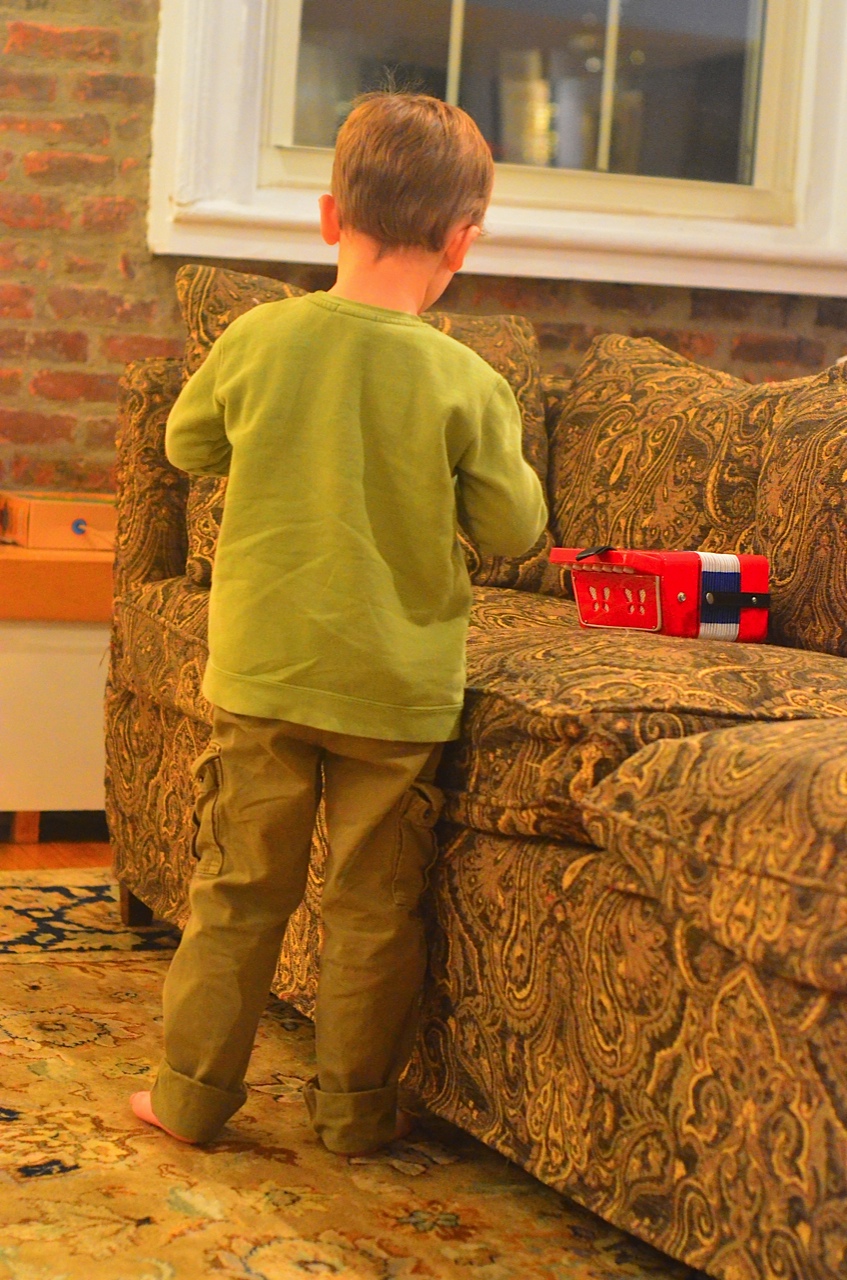
Go, Diva!

For the week between Christmas and New Year’s, we rented a condominium in a Florida Keys resort. (That’s the way our family rolls, with Martin’s dietary restrictions—vacationing only where we have a fully equipped kitchen to use and organic groceries nearby.) Martin was allowed to bring two stuffed animals. He chose (1) “Boo,” a preposterous Santa-hat-wearing dog he received for Christmas, and (2) a brown bear that had arrived in a lovely gift basket for the family.

“Martin,” I asked as we drove to LaGuardia, “what is the bear’s name?” Martin sat in his booster seat, clutching both stuffed animals. I figured he should get first crack at naming the bear.

To my surprise, Martin had an immediate response. “Goadie Va,” he said, or something similar. Goat Eva? Go, Diva? Was he talking to me? Am I a diva?

“Goadie Va?” Adrian asked, from the driver’s seat.

“Goadie Va,” Martin replied, with certainty. 

Adrian and I looked at each other. I made a who-the-hell-knows kind of shrug and said, “Okay, the bear’s name is Goadie Va.” No further discussion on the name was had, as our family, Boo and Goadie Va in tow, headed south. 

Behavioral therapy for autism often stresses acting neurotypical and giving a child the tools for participating, even marginally, in a neurotypical-dominant world. Certainly that was my experience with ABA, a technique that only frustrated Martin. Although Martin spent only a couple months in ABA—I found the therapy almost useless (for us), and we abandoned it for RDI—I may have internalized too much of the message that Martin should be instructed to act a certain way. To this day, I find myself saying, “Let’s try that again,” until Martin evinces a satisfactorily neurotypical effort.

“Martin, that man said hi to you. How should you respond? I’m sorry? Let’s try that again.”

“Martin, you walk through the doorway. You don’t flop through it. Let’s stand up and try that again.”

“Martin, you sit at the dinner table. No leaving your seat to jump up and down or touch the clock. Let’s try that again.”

There are approaches to treating ASD premised on the idea of joining an autistic child in his own worldview. The best-known among these approaches is probably The Son-Rise Program®. Son-Rise is not a therapy we’ve tried, so what I know comes from reading and from communicating with families who do participate in the program.

According to the Son-Rise website, “Joining in a child’s repetitive and ritualistic behaviors supplies the key to unlocking the mystery of these behaviors and facilitates eye contact, social development and the inclusion of others in play.” In the midst of my over-used “Let’s try that again” orders, I ponder the Son-Rise argument. Take, for instance, my telling Martin not to run from the family room to the front hall, touch the front door, run back to the family room, fall onto the sofa, and then start over again. Would Martin and I better enjoy our time together if, instead, I ran with him from the family room to the front hall, and touched the front door, and ran back to the family room, and fell onto the sofa, and then started over again, all by his side? Would he trust me more? Would I be more his ally, and less a monotonous dictator?

Martin hauled Boo and Goadie Va all over the Florida Keys, from the Hemingway House to parasailing in Islamorada. He slept with them every night, and provided regular updates on their preferences, such as, “Goadie Va wants to wait in the car. Boo will come in the store.” Never once did he call the bear anything other than Goadie Va. I chalked it up to Martin finding a quirky sound (“Goadie Va. Go, diva!”) and fixating on the sound.

Near the end of our trip, for the first time, I noticed Goadie Va’s right paw. Stitched on the paw pad, clearly and adorably, was the name “Godiva.” Of course, Godiva. Goadie Va had arrived in a Godiva gift basket at Christmas. Martin can read. If a bear has a name stitched on his paw, obviously—duh!—that’s the bear’s name.

I almost never spend time in Martin’s world, almost never try to adopt his black-and-white Weltanschauung. I wonder: In my relentless advocacy for neurotypical behavior, how much am I missing?

Opinion Piece: Crowdsourcing Your Child’s Medical Care Is Not a Good Plan

Before you read the “opinion” section of this post, please peruse these five statements:

1. The internet can be an excellent source of information, advice, and comfort. Most days, I spend several hours collecting ideas and cyber-talking with other parents across the web.

2. I am very, very fortunate that I have money available (including insurance reimbursement) to pay MD’s, ND’s, homeopathic practitioners, and therapists. I recognize, honor, and pray for families who want to treat their children biomedically and/or homeopathically but lack sufficient funding to do so; when we have recovered Martin, I will find some way to provide material assistance to those families.

3. I am not in the business of judging other parents’ choices. I do have an opinion about how to treat ASD in children, and I act upon that opinion by, in consultation and agreement with my husband, treating our son as I see fit. I expect other parents to do the same. Unless you are neglecting your child, or actively attempting to harm him, I respect your choices.

4. Recovery from ASD, asthma, allergies, ADD, and ADHD (et cetera!) remains an emerging science. Laboratory studies have not kept up with what’s going on in the field. Because of that, the trial-and-error and “experimentation” factors may be even more significant in these areas than elsewhere in medicine.

 5. I am not aiming to inject acrimony or discord into the on-line ASD recovery community. This post, like every post on FindingMyKid, is selfish. I’m discussing my son’s progress and expositing my thoughts, in hopes of (1) documenting the recovery process, and (2) fomenting ideas in readers. I think that’s what blogging is about, documenting and fomenting. I hope I don’t lose readers over this post.

End of disclaimers. Beginning of opinion section—

I belong to several Facebook groups dedicating to recovering children. Many parents (or grandparents and other caregivers) write posts among these lines:

•      “My son has this itchy rash over a quarter of his body.” [Insert picture here, usually something that I don’t want to see in my Facebook feed because I have an absurdly low gross-out tolerance. Seriously, if I think of something icky, I can’t eat for hours.] “What could this be? How should I treat it?”

•      “I just received the results of my daughter’s” [insert name of test here, such as 23andMe genetics, Great Plains Labs OAT, or Philippe Auguste toxicity] “results.” [Insert copy of lab results, (not always) with child’s name redacted.] “Can anyone help me interpret these and figure out what supplements to order?”

•      “This week we started” [insert names of supplements, oils, or medications] “, and suddenly my son is melting down every ten minutes, stimming like crazy, and pooping all over the house, even though he’s toilet-trained. What could it be?”

I think these types of posts are a bad idea. Not because the parents/caregivers are reaching out for others’ experiences, but because I suspect many of them are substituting internet wisdom for actual medical advice. Three weeks ago I saw a video post of a child in the throes of an obvious grand mal seizure. The accompanying paragraph stated that the seizures were new, continued that the child had begun experiencing multiple seizures every day, and sought advice on how to handle them. My horrified reaction was, “Are you kidding me? Get off Facebook and get that child to a doctor.” (I did not post my horrified reaction. Should I have?)

It is true that the “medical establishment,” in general, lags behind parental experience when it comes to treating autism. Indeed, if I may speak for the medical establishment, its position still appears to be that there is no treatment for autism. Martin’s former pediatrician, from before we moved, never understood what we were doing with Martin’s autism doctor. When I asked the pediatrician what she knew about biomedical intervention for autism, she replied, “Nothing. Just what I’ve heard secondhand, which is that it doesn’t work.” (Still, she never stood in the way of our biomedical journey. I respect that. Also, one of her practice partners was nothing but interested in what we are doing to recover Martin.)

Facebook parents are great. In some areas, they may know more than doctors. But they are not doctors. And some of them are also misinformed, or downright crazy. (Sorry, readers. Deep down, don’t you know it’s true?) I dedicate a lot of my time to reading books and scientific articles about autism, attending medical conferences, and researching on-line. None of this takes the place of spending four years in medical school, passing medical boards, and completing a residency. None of it gives me a comprehensive perspective on health, or the ability to make competent medical decisions for my child without the assistance of a doctor. Heck, to be honest, I don’t even understand some of what I study about autism. I’m more of a humanities type of gal, one who took “Chemistry for Non-Science Majors” to fulfill her college core requirement.

Which brings me to my point: If you can in any away avoid it, crowdsourcing your child’s medical care is not the best choice. The medical establishment does not represent all doctors. There are credible professionals who both (1) understand immune disorders like autism and how to overcome them, and (2) hold medical degrees. Use Facebook and your other contacts to find one of these professionals. Do your research, read a lot, and bore yourself with medical science with the aim of making sure that you find a professional you can trust. If you need to, try fundraising to cover the costs of the consultation. That can work—I know parents who’ve managed it. Seek a Generation Rescue grant. Go into debt. (It happens. We live in the real world.) Whatever you have to do, try to bring your child to a medical professional at least occasionally. Please.

The benefit of living in 2014 is that, at least in some small measure, and Martin’s former pediatrician notwithstanding, more doctors are starting to get a clue. Parents who recovered their children ten years ago, or even just five years ago, had far fewer choices than we have today. Let’s take advantage of that. We can rely on fellow parents for empathy, guidance, and encouragement. We probably should not count on them to be scientists.

Why, Hello Again

How does one restart blogging?

I’ve been thinking about that. Mostly while lying awake at night and also wondering why the [redacted] I’m not blogging. But still.

And ta-da!: The plan I’ve conjured, the blogging redux after seasons of silence:

An update.

I’ll offer my readers—in the event I retain any—tidbits about where we stand now, and then, my blog restarted, I’ll pretend like I never was away.

1. We’ve left the City for the suburbs. New York, New York, no more. We moved June 4 to a ranch house, situated on 1.15 acres in a town where many of our neighbors prefer another NHL team to the New York Rangers. An autism diagnosis was one thing. This kind of upheaval—it’s disconcerting, to say the least.

2. Martin attends kindergarten at a private school for children with learning differences. His class has twelve pupils and multiple instructors. Adrian and I feel extremely lucky that Martin has the chance to attend such a school, never more so than this past weekend, when we attended one classmate’s birthday party and watched Martin frolic with his new best friends.

3. Martin receives traditional occupational, physical, and speech therapy at his school. Saturday mornings I drive him into the City for two sessions of Anat Baniel Method (ABM) therapy. We continue working with a HANDLE therapist, and doing home-based exercises activities on the RDI approach. One evening per week Martin takes piano and drum lessons (the latter by his own initiative) with a certified music therapist.

4. We have not yet recovered Martin. We have, however, made progress, and a good deal of it:

•            Though he retains some patterns, Martin’s speech is rarely rote anymore. He has some quirks, such as substituting “but because” for “because” and adding “for” where it doesn’t belong, as in, “Can I have a piece of paper for to draw a picture on it?” Nonetheless, he can express his wishes, wants, and needs verbally, and well.

•            Martin can engage in conversation of six or more exchanges, so long as he is answering the questions (not asking them, which is a level higher). Here is an exemplar talk, which we had when he arrived home one day last week:

“How was school today?”

“It was good.”

“Did anything special happen?”

“We had a surprise reader!”

“Oh, yeah! Who was the surprise reader?”

“It was Quinn’s family.”

“Quinn’s family? His whole family came, not just his mommy or daddy?”

“His whole family came.”

“Wow! What was the book about?”

“It was about snowmen.”

“Did you like it?”

“Yes. I liked it. We made snowmen!”

Note that Martin, who once just “said things,” was speaking accurately. I confirmed later that Quinn’s mother, father, and older sister had all come to do the surprise reading, that they’d read a book about snowmen, and that they’d helped the class with a snowman-making craft project.

•            Lethargy is a thing of the past, and Martin’s “floppiness”—his tendency to fall onto anything within reach—diminishes every day. His core strength has improved, insofar as he is as likely to sit up as to slouch. His manual dexterity is such that he grips a pen appropriately for writing and drawing, he can manipulate small items like pills, and he uses his hands independently for drumming. (That last achievement might not pertain to dexterity per se.)

•            Martin takes a keen interest in his peers: what they eat, how they play, the structure of their families, where they live. He requests play dates. What he still lacks is a solid understanding of how to interact with friends. We’re working on that.

We vacationed recently at a resort area. When Martin was having trouble engaging any other child there, I would approach the child’s parent and say something like, “I think my son would like to play with yours. My son has Asperger’s, and he’s never quite sure how to go about making new friends.” “Aperger’s” sounds much less scary than that other A word, I think it’s pretty accurate for where Martin is now, and the parents I approached responded uniformly positively. Martin made a couple of “vacation friends” that way.

5. Martin still exhibits “autism” behaviors. He perseverates. A lot. This has been an issue forever. Right now he prattles endlessly about traffic lights, hair length, the time, and the moon. He also has three prominent stims (self-stimulatory behaviors), which become more pronounced when he’s tired or detoxing. The stims are running back and forth, making a slurp! sound by sucking air through his lips, and carrying or playing musical instruments. And of course, Martin can be rigid. He wants to wear his blue vest every day, drive one particular route home, read Pete the Cat or Knuffle Bunny books every night.

6. I now understand “the long haul.” I think that, when I started the process of recovering my son, I didn’t really comprehend what how long one might need to haul. The mother who introduced me to biomedical intervention had largely recovered her son within two years, and was done with the process entirely within three years. I failed to grasp that her family’s timing was exceptional. I thought that by kindergarten we’d be done.

My family has been at this three years now, chipping away at the underlying health issues that exhibit themselves as “autism” in Martin. My son has made staggering process. If we never achieve anything more, I will know that our time and money have been well spent. Still, he is not recovered, and much work remains. Fortunately, I no longer fear that some mythical window will close while Martin is five (he’s five now), or seven, or any age. A mother of a recovered 14-year-old told me recently, “Our best year was when he was 12. Twelve years old is when he made the most progress.” Twelve years old is a long, long way off for Martin. If that turns out to be our best year, so be it. We’ll get there.

7. This year, 2014, is going to be extraordinary. Don’t ask me how I know. I can say this: I woke on January 1 with that feeling, and it has not left me. Martin will hit new milestones, and so will I. This past weekend I met with an old friend from law school. My friend used to work in venture capital but for the last year or two has been searching for a new path, something more creative. I told him that I haven’t been doing much writing, or much of anything else, because I’ve been so focused on Martin’s needs. Without warning, he turned to me and vocalized something I already knew: “2014 is going to be a banner year. For you, for your son, for me. I think this is our year.”

See you soon.

Notes on a Wednesday

Wednesdays, of late, are exhausting days for me and Martin. He plays hooky from school. We start the morning by driving more than 50 miles to Wilton, Connecticut to visit Martin’s new homeopath and, if it’s an appointment week, his biomedical doctor.

(Note to careful readers: We switched biomedical doctors five months ago, because Martin’s former practitioner moved to the West Coast.)

From Wilton, when our appointments are through, we get back in the car and drive more than 60 miles, back into New York State, across Westchester County and across the Tappen Zee Bridge and Rockland County, at last dropping into New Jersey at Ringwood, where Martin participates in hippotherapy. We eat lunch in the car: a sandwich for me, and Dr. Cow tree nut cheese with rice crackers for Martin. Then, while Martin spends an hour riding horses, I hike to a tiny farm and buy eggs.

Around 3:15 pm Martin and I get back into the car to drive 45 miles home. (Are you keeping track of all these miles?) Although it is the shortest leg of our journey, this takes the longest, anywhere from 90 to 150 minutes, depending on traffic getting back into and through the City.

Last Wednesday, on the morning drive to Wilton, I spent 20 minutes on the phone—hands-free Bluetooth, of course! I respect all traffic laws—trying to negotiate a good deal on the purchase of an infrared sauna. (More on that in a future post.) Martin was supposed to be practicing “being quiet while Mommy’s on the phone.” Instead, he grew increasingly agitated until he was sobbing while repeating, “You’re going to get off the phone! No more phone! You’re done with the phone.” I apologized to the sauna representative and finally, when I could barely hear him over Martin’s shrieking, aborted the call. Meltdown.

So that sucked. But three very cool things that did not suck at all also happened last Wednesday:

The update for Daddy: At the office of the homeopath—“Miss Lauren,” as Martin calls her—is a pile of toys. I was talking with Lauren when Martin appeared with a toy mobile phone in this hand and said, “Mommy, I’ve got a phone.” I replied, “Oh? Would you please call Daddy and let him know we got here okay?” Without further prompting, Martin nodded, hit a few buttons on the toy phone, held it to his ear and said, “Hello, Adrian? But because we’re at Miss Lauren’s. Okay. ’Bye.” (Martin is in a phase wherein he calls Adrian by his first name instead of Daddy or Papá. “But because” is a verbal tic that Martin has.) Comprehending my request? Pretending? Following a direction? Yes, yes, and yes, thank you.

The hippotherapy superstar: Martin does hippotherapy with a speech-language pathologist. Hippotherapy requires body awareness, multisensory activity, and concentration. Martin’s performance varies widely from week to week. (Martin’s performance on just about anything can vary widely from week to week, day to day, or even hour to hour. That’s the nature of the biomedical beast.) Last Wednesday, when I came to claim Martin after his riding lesson, his speech pathologist said, “He was awesome today. Awesome. Can you bring this version of the kid every week?”

The gesture of support: Do you remember my post from last Tuesday, about the best ways to be supportive of a family wading through autism recovery? It ended with these lines:

That’s all we really want, any of us, right?

A little faith, and a cookie.

When Martin and I arrived home from our three-state extravaganza last Wednesday—one day after I posted about how to be supportive—I found a package waiting for me. Inside was a card quoting those two lines. Under them, handwritten by the friend who sent this card, were the words: “Some of us need a whole box of cookies. Prayers to you and your family. Always.” Enclosed with the card? Yep. A box of cookies.

I’ve been reading the Thinking Moms’ Revolution new book of essays. In one piece, the mother of a boy on the spectrum is asking, “Why did this happen to my baby? What did I do wrong? Is God mad at me?” Her mother, the boy’s grandmother, intervenes and points out that, if things had been different, she would not be asking, “Why did God give me a healthy child?”, so she doesn’t get to ask “Why?” now.

Sage advice, right? What happened to my son—the Pitocin, the C-section, the antibiotics, the vaccines, whatever combination caused this autism—happened. But it doesn’t mean my life doesn’t rock steady.

It doesn’t mean I don’t live in a world of blessings.

The Wanaque Resevoir in Ringwood, New Jersey, where I hike while Martin rides horses. I took this picture with my iPhone a couple weeks ago. Life is good.

The Monksville Resevoir in Ringwood, New Jersey, where I hike while Martin rides horses. I took this picture with my iPhone a couple weeks ago. Life is good.

Support. The Supportive Kind

Friends who know I have a son with autism mean well, but sometimes, even in their effort to be supportive, they say the wrong thing.

Here is the statement I hate most:

“All kids do that.”

Now, if you’re a friend of mine, and you’ve ever said about Martin, “All kids do that,” please do not worry. I know your heart is in the right place. I know you want to help. And this post is not directed at you, or at anyone in particular. Believe me, I’ve heard, “All kids do that,” from almost everyone within the limited circle that knows about Martin’s diagnosis.

I know from reading other blogs that I’m not the only parent who detests “All kids do that.” When someone says, “All kids do that,” then regardless of what that person means to convey, I hear one of two things:

1.      “I know Martin has autism and all, but don’t you think you’re going overboard? Maybe you’re a little hysterical about the whole thing, or you like to complain?”

2.      “I have absolutely no inkling about the realities of your daily life with Martin.”

Yes, I know that even neurotypical kids “have a favorite color.” On the other hand, if you board a subway and find that all the yellow seats are taken, can you expect your neurotypical kid to panic and run out the closing subway doors, without a care whether you are following? If your kid says the moon on his pajama top is yellow, and you suggest it might look more blue, do you assume bedtime will be delayed an hour while he howls inconsolably? Have you ever had to purchase napkins in different colors so that your family could practice sharing the yellows without a meltdown?

And I know that even neurotypical kids “tend to repeat themselves.” On the other hand, unless you live with autism, I am guessing that your kid has never lost awareness and stared into the distance, uttering some combination of words scores of times. I am guessing that your kid does not continue repeating even when he’s alone in a room, his words like a proverbial tree falling in the woods, and then falling again, and then again, and again. I am guessing that your kid’s brain does not get stuck in a groove so deep that he becomes physically unable to cease perseverating. There are times when Martin’s need to repeat himself—“Our President’s name is Obama. O-B-A-M-A. The last letter is A. Obama is the President. Do you know how to spell that? The last letter is A. Our President’s name is Obama. Do you know what our President’s name is? It’s Obama.”—reaches such intensity that, if I were to duct-tape shut his mouth, his arm or leg would have to flail in compensation until he could speak again.

(Don’t panic, dear readers. I’ve never tried any such thing. I just know it’s true.)

“All kids” do a lot of things. But they don’t do them like a kid on the spectrum does.

So what does help? What should someone say, if not “All kids do that”?

A friend of mine (let’s call him Ted) once lost several family members in a house fire. Ted and I lived more than a thousand miles apart at the time, so I wasn’t present for the immediate aftermath or the funeral. A few weeks later, when it was time for me to call, I asked another friend, Deb, what I should say to Ted. Deb is a minister, she’s wise, and her own father had died recently. She counseled (I’m paraphrasing):

“Say you’re sorry about the loss, and then talk about anything else. Follow his lead. When you’re grieving, distraction is a blessing.”

I called Ted and said I was so sorry for his loss and wished we lived closer together. He responded by asking how I was doing, and the conversation moved naturally to catching up on each other’s latest activities. We talked jobs, law (two attorneys, boring!), mutual acquaintances. Once, after a pause in the conversation, Ted said, “You know, they were so close to the door when they collapsed. It was the smoke. They almost made it out,” and I knew that Deb had been right. Ted’s mind was so consumed with loss that the twenty minutes we’d just spent talking about other topics were like a vacation for him. And immediately after saying, “They almost made it out,” Ted asked if I’d seen some movie over the summer. The house fire did not come up again.

When you encounter me, know that for at least 23 of the preceding 24 hours, I have had almost nothing on my mind except autism and recovery. I’ve been giving pills, cooking special foods, corresponding with parents on-line, reading about the latest treatments, cleaning air purifiers, mixing clay baths, filtering water, completing HANDLE exercises and concocting RDI games, fighting for a special-education placement, juggling therapy appointments, navigating social-work bureaucracy, keeping Martin’s doctor up to date, and worrying about what vaccinations are doing to our children.

You can ask me how Martin is doing. I will respond, “We have our ups and downs,” maybe add one or two recent achievements, and then move on. Here are suggested topics I would probably rather discuss than Martin’s autism:

•            How are the Rangers play-off chances looking? Will Lundqvist win the Vezina a second time?

•            Why is it still winter at the end of April?

•            Is the new Jackie Robinson movie melodramatic? Does melodrama ruin a good story? Did it ruin Argo?

•            Who is going to be the next mayor of New York City?

•            WNYC reported that 70% of home sales in Brownstone Brooklyn are all-cash deals right now. Seriously, 70%?

•            Is it okay to put a cat on Prozac?

You get the idea. There are a million things to talk about that are not autism.

And if you really, really want to talk about autism, say you support us. Adrian’s mother once set the gold standard in that regard. Adrian was visiting his country of origin and staying in the family home. One evening he and his parents and siblings crowded around a computer to Skype with me and Martin back here in the States. As it happened, that day Martin was at his worst. He would not sit with me or look at the computer. He failed to respond to any questions, or even acknowledge his father and grandparents and aunts and uncle on the screen. After 30 seconds I gave up and released Martin, who jogged around the room, yelling gibberish.

It was a painful moment for me, and though he didn’t say anything, I could tell it was painful for Adrian, too.

Evidently, so could Adrian’s mother.

After we finished with Skype, Adrian went out to dinner with friends. When he returned to the family home that evening, everyone else was in bed. On the kitchen counter was a note from his mother. Loosely translated:

“Martin will get better. I believe in what you’re doing. Love from Mamá.”

Next to the note was a plate with a cookie.

That’s all we really want, any of us, right?

A little faith, and a cookie.

Joyriding

A few weeks ago we enjoyed a vacation on Kiawah Island, and I spent three hours bicycling the streets with Martin and his stuffed panda bear in a cart attached to my bicycle.

Every fellow cyclist and pedestrian greeted us. “Good morning!” “Why, hello!” “Happy New Year!” “Some kind of fine weather today, isn’t it?” Even the drivers waved from the luxury cars that drifted by, obedient to the posted speed limits. I hardly bothered removing my smile between encounters.

This is the good life, I thought. The whole scene—planned community, bicycle paths, golf courses, herons, salt marshes, palmettos, beach, fine houses neatly kept—felt Disney, if not Stepford, and I devoured the insouciance. It’s invigorating, to be carefree once in a while.

“Well, look at this guy,” an older woman said, fawning over Martin when I stopped to check my map. “He’s got the best seat in the house.”

“He does,” I said. “He’s just zooming along while I do all the work.”

I mounted the bicycle again and pedaled away. I was happy that the woman had admired Martin.

In a moment, I wondered, Would she have acted the same if she knew the kid in my cart has autism?

And, Would any of this be different if the kid in my cart didn’t have autism? Does it always have to matter?

In 2008 I attended a fundraiser for Extraordinary Lutheran Ministries, a group that facilitates ministry calls for openly gay (including non-celibate) clergy. Under the ELCA’s policy at that time, gay and lesbian clergy could serve only if they practiced celibacy; like everyone else at the fundraiser, I opposed that policy and favored allowing non-celibate homosexual clergy to serve just like non-celibate heterosexual clergy.

The ELM representative who attended, I remember, said something like this (I’m paraphrasing wildly, on several years’ sketchy memory): “The church policy might seem like the biggest obstacle in the world, right now. But it isn’t. The policy is like this cell phone.” Here she held up her mobile phone, then balanced it unsteadily on its side atop an end-table. “We can just knock it down.” She tipped over the phone. “We can just knock over that policy and move on.”

That’s the way autism recovery feels. Some days, ASD is the biggest obstacle in the world, this lurking beast that colors even a halcyon Kiawah bike ride. Other days, especially when Martin is showing growth, ASD is that mobile phone teetering on an end-table. It’s changeable.

In 2009, the year after that fundraiser, a Churchwide Assembly amended the ELCA’s clergy guidelines to remove the requirement of homosexual celibacy. ELCA churches now can issue calls to gay and lesbian clergy in committed same-sex relationships.

Which is to say, we knocked it over and moved on. And maybe it really doesn’t matter if the kid in my bicycle cart has autism.

Newtown

Here are some things I’ve heard about Newtown—I guess we just say Newtown now—that may or may not be true. I heard that the shooter had autism, or some form of ASD. I heard that his mother tussled with the school district about his special education. I heard that she encouraged her son to “fit in.”

I thought, How terrible. How could the mother of a child with special needs tell him to do precisely that of which he is incapable—to fit in?

I thought, I would never do that to Martin. He is who he is. I will not chisel away his self-esteem by telling him to be like other kids, when he can’t.

As a child, I was boyish. There was no dress-up or experimentation with make-up for me. I had short hair; I preferred jeans to skirts or dresses or even slacks; I played sports and climbed trees; I didn’t mind when strangers mistook me for a boy, which they often did. Like other boyish girls, I faced persistent pressure to change, mostly from adult females, well meaning or otherwise. (“I can’t believe you’re not getting this right,” the art teacher chided, when used too little adhesive on my papier-mâché project. “You’re just always so messy.”) The effect was that I didn’t like myself. I believed that I should be girlish, but I wasn’t. That just wasn’t me. And so who I was—wasn’t right.

I’ve been determined not to tell Martin that he isn’t right. Martin should fit in with other kids only as much as he wants to or is ready for. That’s an easy call.

Still, Newtown and the rumors surrounding it got me thinking: Are there other instances when I tell Martin to do what he’s not (yet?) capable of?

There are. About fifty million per day.

“Martin, pay attention.”

“Martin, stop dawdling.”

“Martin, look at me.”

“Martin, no repeating. Say it only once.”

“Martin, eat.”

“Martin, hurry up.”

“Martin, walk like a big boy.”

“Martin, just go to the front hall and put the shoes on.”

The hard part is figuring out when Martin is just playing me. Example: Bedtime. Martin insists that I do his bedtime routine: potty, supplements, teeth brushing, reading, tuck-in. He’ll agree to take his bath for someone else (say, Adrian or Samara), but bedtime is all Mommy. In fact, Martin is so fixated on bedtime with me that perseverates on continual reassurance. Within five minutes of waking each morning, he has said, “Sleepy-time with Mommy!” at least once. He says it throughout breakfast and while he gets ready for school. It’s one of the first statements I hear when I pick him up from school: “Sleepy-time with you, Mommy!” Anytime that he senses I am about to leave, even if only to go to the bathroom, he becomes agitated and says, “Sleepy-time with you! Sleepy-time with you!”

On vacation last week, Adrian and I went out to dinner and left Martin with my parents. As soon as Martin realized that Adrian and I were leaving, he began to scream and cry. “I want to go to dinner, too. Sleepy-time with you, Mommy! Sleepy-time with Mommy!” He threw himself dramatically to the floor, grabbed Adrian’s foot with his right hand and my foot with his left hand. “You’re not going to go out! You’re going to stay here!”

We left.

Within five minutes I received a text message from my mother: “Everything fine here. Martin calm.” When we returned home later, I learned that Martin had done his entire bedtime routine and gone to sleep without complaint.

On the one hand, I know that Martin’s ASD and accompanying fixations make him cling to routines, and I need to indulge that. On the other hand, Martin wants me to indulge him, and he exploits my willingness to do so. When it comes to keeping pace and hurrying up, Martin is a heckuva lot more cooperative if he’s excited about where we’re going. Getting from our apartment to the school bus? It’s a ten-minute process. Getting from our apartment to the playground? He’s moving faster than I am. Am I wrong to tell him to hurry up and focus for the school bus? Same with meals. If the plate is beef bites with fermented cauliflower, I have to repeat some variation of, “Maybe you could take a bite?” at least two dozen times, or even just spoon it into him myself. A bowl of gluten-free oats with butternut squash and coconut oil goes down his throat like bathwater through the drain. Am I wrong to tell him to hurry up and focus on eating the beef?

One of my first reactions to Newtown was, “Thank God the shooter killed his mother first. It was an act of mercy; how could she have gone on?”

Looking back, I think that reaction—it was a gut reaction, and I am not saying that the Newtown shooter’s mother had anything to do with what happened on December 14; I know almost nothing about the circumstances—was my conscience expressing the responsibility I feel for Martin’s future. However far biomedical recovery takes us, I am the one who has to help Martin learn to live in the world and still love himself.

Holy crap.

Martin checking out a holiday train display.

Martin checking out a holiday train display.

securedownload

Because They Know

If you’ve been reading this blog for a while, you know about my love-hate relationship with social media. Something about operating on-line makes people thoughtless. Combine that with my hyper-sensitivity on autism and child issues—the result is potential meltdown every time I log on.

One particularly problematic area for me is constant Facebook updates about amazing children, written in some superficially deprecating fashion. “No other kid in Caleb’s figure-skating lessons can even axel. Can’t believe I can’t afford anything better for a kid who already lands a lutz!” Or: “I really love Woody’s new teacher. Look at this certificate she made him for getting the highest reading scores in the class.” Or: “Clementine is district chess champion. I feel a little less like I’m depriving her by not being a soccer mom.”

I get bitter.

Strangely, it is only the amazing-kid updates of distant friends that bother me. I like reading when my close friends—the kind of friends I visit, and telephone—post about their children.

I’ve come up with two reasons for the difference.

First: My close friends don’t do the superficially self-deprecating thing. They just brag. I’m not sure why that’s less offensive, but it is.

Second: They know about Martin.

When it comes to social media, I’m constrained, because we’ve chosen to keep Martin’s autism confidential. Adrian and I are careful not to post anything that makes our son appear atypically developing. We share the one picture in ten in which Martin actually looks at the camera. We write the cute things he says only when they sound like what any four-year-old might say, or else we edit to keep the gist while fixing the words. Of Martin’s true successes, I cannot boast on-line. “Martin chased a boy at the playground for, like, at least five seconds before he lost interest!” “Martin had a four-exchange conversation with his babysitter!” “In the midst of bolting down the sidewalk this afternoon, Martin turned around to see if I was following him!”

My close friends know about these successes, even if I can’t share them publicly, because they know about Martin. Last Memorial Day, as we do annually, Adrian and Martin and I got together with some of my closest girlfriends from high school. This year six families attended the gathering. The other children, all older than Martin and all typically developing, played with him as if he were their own little brother; they were patient, occasionally teasing, responsibly keeping him from trouble. From the parents I heard nothing but swooning. Martin was talking so much more than the previous year. Martin’s eye contact had improved. Martin had better command of his movement.

No strange looks to endure. Nothing to cover. Only compliments.

I felt like a million bucks.

When Martin and I visit his doctor in Chicago, we follow a two-day pattern. On day one, we fly from LaGuardia to O’Hare, rent a car, see the doctor, buy groceries at a Whole Foods Market, and check into a hotel “suite” with kitchenette, where I prepare Martin’s dinner. On day two, Martin and I eat breakfast at the hotel, return to the doctor’s office if any follow-up is necessary, then spend the afternoon at a friend’s home in Elmhurst, not far from the airport, and finally catch an evening flight back to LaGuardia. The Elmhurst friend is a high-school classmate, with a toddler of her own, and a most considerate hostess who prepares some fantastic vegan lunch for me while I co-opt half her kitchen to cook for Martin.

Several months ago, I awoke sick on day two of a Chicago trip. My head was pounding, and I was nauseated. A hot shower didn’t help. Nor coffee. Nor dry toast that I ate with my head resting in my palm. And poor Martin—I had no one to help out, and with no energy or patience, I was content just to get him and our things moved somehow to the rental car.

Almost the moment that I settled onto my friend’s sofa in Elmhurst, my situation began to change. My shoulders relaxed. The headache evaporated. It had been tension, of course. I’d gone to bed with a slight cramp in my neck, and made myself sick by worrying all night about what I would do if I got sick and had no one to help with Martin. Once we arrived in Elmhurst, I knew that if necessary I could say, “I need to crash in your bed for the rest of the day. Here are Martin’s pills and food. Good luck.” And my friend would have replied, “See you tonight. Yell if you need anything.” There was no longer any need to worry, and I felt better.

That’s the way it works, with friends who know about Martin’s autism. They’ve got my back. They procure food for Martin, cook for him, ask about his needs, encourage his friendships, celebrate his successes. And so I do the same for them. It’s like we’re one big family, sharing kids. I want to hear about their amazing kids, because those kids are mine, too.

I can’t take that feeling to social networking in general.

I suppose this blog is my brag book, instead. My anonymous brag book.

Sorry about that, readers.

Not the best-quality picture! Martin was so determined to flush this airport toilet with his foot that he climbed onto the fixture to manage it. I hardly had time to whip out my smart phone and capture the moment.

Not the best-quality picture! Martin was so determined to flush this airport toilet with his foot that he climbed onto the fixture to manage it. I hardly had time to whip out my smart phone and capture the moment.

Suspension

We’re in the process of finding a kindergarten for Martin. I’m touring schools, asking questions, completing neuropsychological examinations, filling out applications.

It’s an awkward process, for two reasons.

First, we can’t predict where Martin will be in a year. He’s made so many advances recently, accelerating over the last two months since we began Anat Baniel Method therapy. Right now we’re searching private, special-education schools, either specifically for children on the autism spectrum or for children with various special educational needs. I’m having trouble discerning what support Martin will need ten months from now—what size his class should be, with how many teachers, and what type of peers. Adrian and I want Martin to receive as much help as necessary, for as long as necessary. On the other hand, we want him to have the benefit of peers functioning about where he is, linguistically and socially. Hello, moving target.

Second, Adrian and I aren’t sure where our family will be in a year, geographically speaking. The suburbs have moved from a knee-jerk no to a real possibility, for reasons I’ll explain in a later post. At the same time, we feel that the very best schools for kids on the spectrum are in the City. The whole situation is a chicken-egg dilemma: Where he gets into school influences where we want to live, and where we want to live influences where we want him to get into school. What a mess.

We’re in suspension. Our life is in suspension.

The kindergarten-admissions process is a microcosm of our lives. We have no idea where Martin is headed, long-term. We believe he will recover from autism. We don’t know when, and there are no guarantees.

We’re trying to plan a future like driving through a foggy valley, with no idea what we’ll find when the fog lifts.

Wondering Where Recovery Lies

Martin and I are at LaGuardia, on a flight delay. Fog. We’ve survived a hurricane ripping through New York and an unseasonable Nor’Easter dumping snow onto our neighbors’ powerless, unheated homes. Here at LaGuardia, however, it’s “patchy fog” that ruins the day.

I just spoke with the staff at Martin’s doctor’s office. That’s where we’re trying to fly—to his doctor’s office. We’re lucky; they’re going to rearrange some scheduling to accommodate our 90-minute delay. Let us hope it’s 90 minutes only.

I want to make it to the appointment, because medically speaking, Martin is not doing well. (Again.) Since our last appointment, eight weeks ago, he evened out, then looked good, then slipped. For the last three weeks he’s been plagued by a yeast imbalance. (Again.) Since beginning biomedical intervention almost two years ago, we’ve got yeast under control three times, only to have it strike back three times. Right now Martin’s skin is leathery and covered with scratches. He itches. He can’t resist clawing at his arms and legs. And with yeast come symptoms: distraction, irritability, toe-walking, skipping. I dread the pa-dap-BUMP sound that means Martin has lost attention, jumped into the air, and is about to start running laps. I hear pa-dap-BUMP a dozen times a day.

Still, outside the biomedical realm, Martin is making some progress. Last month he began Anat Baniel Method (ABM) therapy. Within a week we saw verbal progress: He started using the command form. He said, “Mommy, come play with me,” at the playground. I thought that might be a fluke, until he called, “Mommy, come here,” from the bathroom and then said, “Turn it off please,” when I ran the Vitamix during breakfast. Previously Martin could not use the command form; he either used an affirmation (“You’re going to come here”) or expressed a desire (“I want you to come here”). I was on cloud nine with the new verbal ability, until Martin barked, “Make me a snack!”

We’ve made some RDI progress, too. We’ve been working on pacing and facial referencing. Two days ago Martin asked for his drumsticks. I said, “I think I saw them on the chair.” Martin walked to a chair in our living room, didn’t see the drumsticks, then turned back to me, looking for more information. (Ding! Ding! Ding! RDI success!) I said, “No, one of those chairs,” and thrust my chin toward the sitting room. Martin got the idea but missed the exact location; instead of the sitting room, he headed for the dining table. (Our loft has an open floor plan. These areas all sort of merge.) Then he turned back to me again. (Ka-BOOM!) I said, “The chair over there with the doll on it,” and there he headed, to find his drumsticks.

So it’s a mixed bag, these days. Since we started biomedical intervention, I’ve lived with the assumption that the key to Martin’s recovery lies in healing the immune issues that underlie the disorder. These days, when the biomedical aspects are getting us nowhere—unless “Symptomatic Itchy-ville” counts as a place—but behavioral and physical therapies are showing some results, I question my assumption.

I’ll post again after today’s medical appointment.

If we make it.

Stuck at LaGuardia. Not much to do.