Good Medical Care

Without any real statistics to show, I am going to assert that most of us in the biomed community have MAPS doctors for our kids. “MAPS” stands for Medical Academy of Pediatric Special Needs and is the successor term to DAN!, or Defeat Autism Now! MAPS doctors are trained and certified in the treatment of chronic conditions like autism. They help our children with the process of recovering from autism/autoimmune disorder, and with associated issues like epilepsy or food allergies. They’re kind of like general practitioners for children affected by autism.

Then we have other doctors, the host of professionals who accompany childhood, plus (because autism is the symptoms of sickness) assorted specialists. Neurologists, geneticists, ophthalmologists, audiologists, endocrinologists, allergists.

One challenge prevalent for biomed families is finding “other doctors” who respect their MAPS doctors’ efforts. You can imagine the potential conflicts. When we first started biomed, for example, Martin had constant skin rashes, so itchy that he would scratch his legs bloody. We took him to a dermatologist, who diagnosed “sensitive skin” and suggested using Cetaphil “gentle” cleansing and moisturizing products. Our MAPS doctor, recognizing candida overgrowth, asked us to substitute natural products for Cetaphil and work on balancing gut flora to bring yeast under control. (We went with the MAPS suggestion, healing Martin from inside.)

The elephant in a room occupied by both MAPS and non-MAPS physicians is vaccines. MAPS doctors may urge caution when it comes to vaccinating, especially for kids with a history of reactions to vaccines, while non-MAPS doctors may push vaccinations “on schedule” for all kids. Some pediatricians won’t even accept patients whose families feel they cannot vaccinate.

So there are challenges, navigating the biomed path accompanied by non-MAPS healthcare professionals.

When we moved to the suburbs last year, I took the opportunity to find a Martin new pediatrician and dentist. Our practitioners in the City were adequate but traditional. The dentist made me sign forms stating that I had “refused” routine X-rays against her recommendations, and once she applied fluoride to Martin’s teeth even though I had stated at the beginning of our relationship that I didn’t want any fluoride, ever. Our pediatrician was perhaps more conscientious; I had a positive experience when one of her partners took an interest in our biomed approach, and the practice gave us a vaccination exemption of indefinite duration after Martin reacted poorly to the H1N1 shot. Despite those perks, however, the doctors weren’t worth venturing back to the City.

I found a new pediatrician through conversations with other biomed moms. This doctor, though not a MAPS doctor, is knowledgeable about autism recovery. She stocks her office with papers like “The Autism-Gut Connection” and “SIBO Symptoms and Treatments.” I believe she can be a second set of eyes on our biomed protocol, which is a good thing.

The dentist I found on-line. I searched for dentists who have experience working with special-needs kids, and then I followed up with phone calls about whether the doctor minds if we opt out of fluoride treatments. Martin’s first check-up there, six months ago, took place on a weekday morning, when few kids were present. The hygienist wasn’t great with him. When Martin became upset, she tried being noisy and distracting. I had to stop her and explain that, with Martin, the best approach is quiet explanation of what is happening. We were more successful with the rest of the visit. The dentist was able to get a good look at Martin’s teeth despite his protests, and no one gave me any trouble about fluoride.

Unfortunately, both the new pediatrician and the new dentist are far from our home. Last week, as I drove more than 45 minutes for Martin’s next check-up, I questioned whether the dentist was worth the fuss. As Martin’s appointment time passed, and we were still stuck in morning traffic, I thought, No more. This is the last visit to this dentist. Surely I can find someone in our own town who doesn’t push fluoride and is good with special needs.

When we finally arrived, the office was sleepy, with only one other patient waiting. This time I told the hygienist (a different one than last time) up front that Martin responds best to calm words. She understood immediately. When Martin declared that we would get a check-up but would not lie down, the hygienist responded, “Of course not. Here, I will just recline the chair a little bit so you can see the television on the ceiling, if you want.” Martin went for that.

We had a different dentist, too, a man. He began by remarking that he saw on our information card that Martin follows the GAPS diet, and asking how that was working for us. (A dentist! Asking how GAPS is working for us!) I told him, in general terms because Martin was in earshot, about our experience. The dentist responded, “It’s remarkable, isn’t it? My friend with MS made similar dietary changes, and his symptoms have really responded.” Then the hygienist said, “I know someone who has been able to stop taking fibromyalgia medication since she went on a diet like that.” Then both the dentist and the hygienist started discussing their own emphasis on fresh, whole, organic foods.

Martin, meanwhile, behaved like a champion. He let the dentist recline his chair a little more and complete a full examination plus cleaning. He interrupted the procedure only to point to the ceiling television and say, “That’s Nick Jr.!”

When the dentist was finished with Martin, he said, “Martin’s teeth look great. Not having refined sugar is obviously helpful, and you’re doing a solid job with brushing and flossing. As to the fluoride, substituting xylitol is a good choice. More and more of our parents are moving that direction.”

This dentist gives out balloons. Martin requested a yellow balloon.

I, now oblivious to the nearly hour-long drive that had aggravated me, reported to the front desk to schedule our next appointment.

I don’t mind questioning or challenges regarding Martin’s care, as long as the questioner/challenger acts with an open mind, has a stake in Martin’s well-being, and isn’t just playing Devil’s advocate.

But at the same time, it is hard to overstate the relief I feel when everyone is on the same page.

[Note: I know biomed families have mixed feelings about xylitol. I will blog about that at a later date.]

What’s Working Now

Are you familiar with miracle products?

I participate in various social media groups for parents with recovering children. Often, I see posts like this:

“We just started this [miracle enzyme, supplement, probiotic, oil, &c.] ten days ago, and I can’t believe the progress! My son is making consistent eye contact, he’s increased his vocabulary, and he finally potty trained! Today I got a note from his preschool teacher saying he is more ‘with it’ and making cognitive leaps. I’m kicking myself that we didn’t try this before now. Anyone having similar results?”

And then, comments like these:

Commenter 1: “Yes, yes, yes! [Miracle product] moved my son from babbling to words!”

Commenter 2: “We added [secondary product] to [miracle product], and the gains were even greater. We’ve been on them both for a month and will be continuing.”

Commenter 3: “This is all amazing! Where can I buy [miracle product]?”

Commenter 4: “[Miracle product] got my daughter into Princeton!”

Posts, and comments, touting a miracle product frustrate me.

Miracle-product proclamations frustrate me because autism varies from kid to kid. The health and immune challenges underlying autistic symptoms include, and exceed, neuroinflammation and other chronic swelling, mitochondrial disorder, genetic mutations, leaky gut, yeast overgrowth, oxidative stress, excess propionic acid. Autism exhibits disparate effects on cerebral function in girls versus boys. “Autism” is not a single malady and is never identical. That miracle product? Shoot a paint ball into a crowd. You’re bound to hit someone and splatter a few others. The rest will probably be left wondering what the fuss is.

I can understand that, if you’re thinking about trying a new product, you may want to post an inquiry about others’ experiences with the product. But given that the underlying disorders are child-specific, and that recovery means finding the right combination of many factors over time, why tout miracles? We parents of children with autism, we tread on hope. We’re easily led. When ten marvels in a row fail to help our kid, we end up embittered and broke.

Recovery from autoimmune disorder is a long, tedious slog without shortcuts. Sure, some families recover their children within a year, those lucky dogs. Most take much longer. Many children never get significantly better. The only miracle in autism is that, given our increasingly toxic world, we’re able to fight the spectrum at all. The amazing supplement, probiotic, or whatever, might indeed have given your kid the week of his life. That’s not a wonder. If you must tout a miracle product, don’t do it after a week, or a month. At least wait a year, then let us know if the developments continued, and speak in measured, child-specific terms.

Dear readers, are you wondering why I’m ranting? That was all an introduction to today’s post, which in comparison to its introduction, may seem brief. The topic is what interventions are working, right now, in combination, for my one kid, with his own particular combination of health challenges.

Following “Hard to Blog an Avalanche,” I received several inquiries about what I think has instigated Martin’s recent growth. Usually, when Martin improves and I’m asked why, I answer, “Don’t know. Obviously, something in the millions of things we’re doing is helping.” This year, I have a better inkling. I have seen five interventions correlate, almost certainly, with better health and/or increased speech:

1. Camel milk. Martin started drinking it this spring, and his language took off. Why? Too long for this post. Check back in a day or so to read “What’s the Deal with Camel Milk?”

2. The GAPS diet. I’ve written a lot about GAPS recently, and I’m also working on a post about how I don’t buy into everything that Dr. Campbell-McBride says. For now, it suffices to say that Martin’s digestion has improved.

3. Candex. We have battled yeast overgrowth, in one form or another, repeatedly since we began this journey. Going off just about every form of sugar helped, but only for a while. Nystatin did nothing positive. Earlier this year, poor Martin’s yeast was so bad that he clawed his skin raw. Finally, his biomed doctor said to try Candex, an enzymatic product. The same night he started Candex, Martin had a foul-smelling BM—yeast, I think, leaving his system. The next day, the skin rash began to clear. Since then, the candida has been under control, so much so that I’ve been able to add a little more fruit into Martin’s diet without worrying about the fructose feeding yeast.

4. Enhansa. Lee Silsby Compounding Pharmacy makes Enhansa, or curcumin, a derivative of turmeric. Martin suffers from chronic inflammation, which places undue pressure on his compromised immune system. Turmeric’s anti-inflammatory properties seem to be relieving that inflammation, even to the point that his face has lost its “puffy” appearance. (The puffiness was visible only to me and others to whom I pointed it out in photographs. Still, it was there, and a symptom of his systemic inflammation.)

5. MitoSpectra. This is a proprietary mitochondrial supplement blend of vitamin C (as ascorbic acid), vitamin E (as d-alpha tocopherol succinate), vitamin B5 (panthothenic acid), L-carnitine, and coenzyme Q10. We have used each of the component supplements before, alone and in combination, and indeed Martin still adds separate sources of vitamin C and L-carnatine. MitoSpectra, however, seems to combine the five supplements in a form and proportions that do well for him: He shows more coordination and energy, and less “floppiness.” At times I wonder whether those improvements are dependent on continued use of MitoSpectra; my hope is that, as his immune system overall continues to heal, his own mitochondria will be able to assume the work MitoSpectra is now doing.

Camel milk, GAPS, Candex, Curcuma, and MitoSpectra. Not a miracle, not any one of them.

Each a step in this tortuous recovery path.

Just maybe a longer stride than I’m used to.

Increased energy, coordination, and willingness to try new things. I'm so into these changes.

Increased energy, coordination, and willingness to try new things. I’m so into these changes.

In the GAPS

As assorted posts have mentioned, two months ago I switched Martin’s diet to GAPS. “GAPS” stands for “Gut and Psychology Syndrome” and is the work of a British doctor and nutritionist, Natasha Campbell-McBride.

Dr. Campbell-McBride’s book, Gut and Psychology Syndrome, sets forth how autism (along with dyspraxia, ADD, schizophrenia, and other apparent brain disorders) is symptomatic of a compromised immune system, linked with an imbalance in gut flora. The author suggests healing the gut with a diet comprising fresh foods prepared at home, without grains or sugars or other carbohydrates, and with plentiful meat and/or fish stock. (I’m simplifying.)

It’s been more than three years since we started eliminating foods from Martin’s diet. Since January 2011, Martin has not eaten gluten, casein, soy, corn, refined sugar, processed food, additives, or conventional/GMO food. We also introduced some foods that Martin, a vegan since birth, had never had before: eggs, ghee, honey, and fish oil. After some months we also added meat, which was especially challenging because I’m vegan and Adrian is pescetarian. Other variations along the way in Martin’s recovery diet have included restricting oxalates, temporarily avoiding foods to which Martin showed sensitivities, and trying to eliminate all sugars for one summer.

As of February 2014, Martin was eating meat, eggs, vegetables (including limited amounts of starchy vegetables like sweet potatoes), fermented vegetables, legumes, gluten-free grains like buckwheat and rice, and very little fruit. In puddings and baked goods he had complex sugars like raw honey or raw agave. With very few exceptions, like rice crackers, everything was organic and homemade.

Which is pretty good.

The thing is—Martin’s gut still didn’t seem to be healing. His bowel movements were light-colored and fluffy or flakey, instead of firm, and he had started complaining of stomach pain. Again. I thought we were done with stomach pain.

I decided to take the diet a step further. In the ASD recovery world, there are several diets that people adhere to. The formulations start with gluten-, casein-, and soy-free and branch out from there. Two of the most popular diets are the Specific Carbohydrate Diet, or SCD, and GAPS, which is an adapted variation of SCD. I didn’t have a scientific basis for choosing between GAPS and SCD. (Science doesn’t like me. Science doesn’t want me to understand it.) Some parents love SCD. Some swear by GAPS. Because I already owned Dr. Campbell-McBride’s book and was more familiar with GAPS, I decided to try that route and hope maybe Martin would clear some hurdles to gut health.

For extreme gut distress (ongoing diarrhea, for example), Dr. Campbell-McBride suggests various stages from an “introduction” (almost only bone broth) to “full GAPS” (all the GAPS-compliant foods, still incorporating ample bone broth). Martin was not experiencing extreme distress, just a lack of overall gut health. Therefore, I skipped the introduction stages and put him directly onto full GAPS.

Switching to GAPS meant three primary changes. First, Martin has to stop eating starchy vegetables, cocoa (temporarily), rice crackers and his few other grains, all sweeteners except raw honey, and some lesser-used foods like arrowroot, cannellini beans, and roasted nuts. (Raw nuts are acceptable.) Second, he gets to add a few more fruits, if yeast is under control. (Last month, after the nystatin debacle, Martin started taking Candex, which has been helping balance yeast without the side effects.) Third, he drinks meat stock with every meal. Most weekdays he takes only meat stock for breakfast. I make stock weekly, rotating among chicken, beef, lamb, and whatever other meat/bones I can get.

Which brings us to the million-dollar question: Is it working?

Two months is too little time to make a long-term prediction. (By way of digression, I’m not sure I’ve ever used “two,” “too,” and “to” in a single sentence before now.) Martin’s gut is improving; he’s stopped thrusting his fists into his abdomen and complaining of stomach pain, and his bowel movements have become firmer. On the other hand, I’m yet to see unusual progress in his behavior. He’s been up and down, the same jaggedly positive trend as ever in his recovery. I call it 100 steps forward, and 99 steps back. I remain hopeful, nonetheless, that sealing his gut will soon lead to more behavioral improvements, because he will be better able to absorb his nutrients, supplements, and so forth.

At this time, the two-month mark, I’m giving a tentative thumbs-up to GAPS.

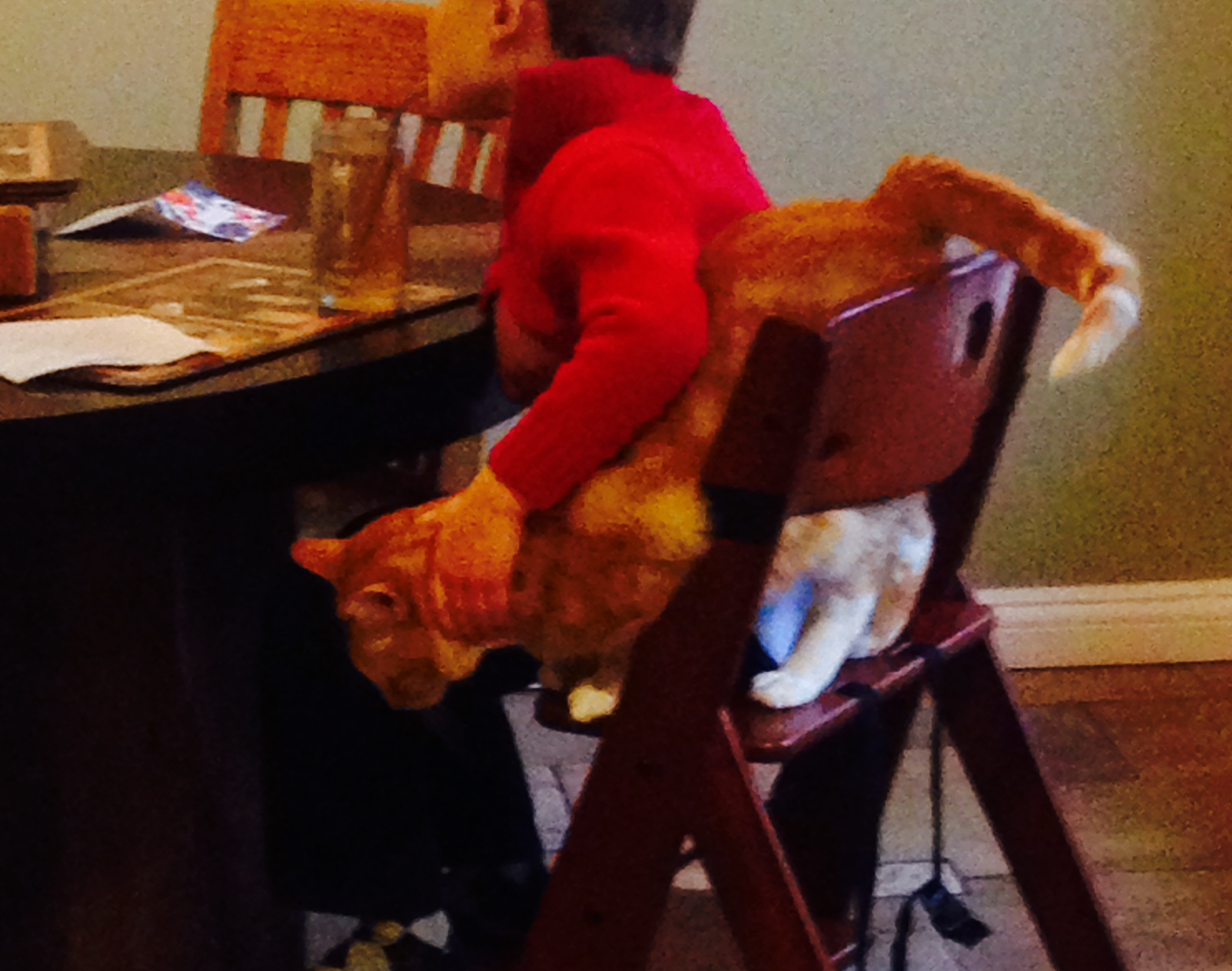
Yes, this is the worst-quality photo ever. Sorry. It's Martin, taking his bone broth for breakfast, "assisted" by our cat George.

Yes, this is the worst-quality photo ever. Sorry. It’s Martin, taking his bone broth for breakfast, “assisted” by our cat George.

School Food

In the month since I put Martin on full GAPS diet, I think, the question I have heard most from parents is, “What food do you send for school?”

Martin’s school requires that each parent send lunch and two snacks. This morning, for Martin’s snacks, I packed (1) lime pudding, made from avocado, manuka honey, vanilla extract, and lime juice; and (2) half a pear, sliced and dredged with lemon juice. Last week I posted a picture of a dippin’ plate with carrots, peppers, and pear. The GAPS diet advises that fruit be eaten away from meals, because fruit enzymes work better alone. So, to the extent Martin eats fruit (I try to limit fruit, because he has so much trouble with yeast flares, which can be fed by sugar), I give it as a snack.

For Martin’s lunch, I packed his LunchBots container with (1) chicken breast with Himalayan pink salt; (2) avocado (I do a lot with avocado) mashed with cultured garlic, which you may remember from the “dippin’ plate”; (3) probiotic Zing! salad; and (4) raw cauliflower florets.

photo-20

I have been trouble getting Martin to eat raw vegetables. That’s a shame. Raw veggies are full of good digestive enzymes, and they might help loosen his front-bottom baby teeth, which I want to do because the adult teeth already have broken through behind them. I predicted the LunchBot would come home with the chicken and avocado gone, the Zing! salad mostly eaten, and the cauliflower untouched.

Do I know my son, or what? I was wrong only insofar as he took, maybe, one or two pieces of the cauliflower.

photo-19

Not a total success, but, hey.

Some other lunch combinations are bison jerky with homemade probiotic catsup and sauerkraut; chicken-and-egg bread with spread made from sprouted (i.e., soaked overnight before cooking) lima beans, olive oil, and garlic; or the ever-popular “meat and veggies,” i.e., whatever leftover meat is in my fridge paired with whatever fermented veggies are in my fridge.

Oh, yes. Before anyone writes it as a comment, I will address what all readers must be thinking right now: Martin’s mom has a real Gwyneth Paltrow thing going on here if she thinks any of this is reasonable.

Trust me—I know. I mean, “homemade probiotic catsup”? Who does that?

Autism-recovery folks do, I guess.

Addendum

I’m not much for addenda (except insofar as FindingMyKid.com, by the nature of blogging, is one long series of addenda to its “About” page and initial post). Nevertheless, I simply must add four notes to Saturday’s crappy-to-happy post.

1. I wrote, “It may go without saying that we ended up in a rush to get to [Martin’s] afternoon social program at the JCC, and that I left the kitchen a disaster, and that I didn’t get a chance to feed myself much, and that I was feeling worse by the minute.”

We were rushing to get to the JCC by 2:00 pm. We left home ten minutes late, and then I had to take Martin to the restroom to change into new pants. It was after 2:15 pm when I finally dropped him in the correct room. Still, only one other child had arrived, out of the dozen or so who usually attend. “Small group today?” I asked an instructor. “I don’t think so,” she replied. “They’ll be trickling in.” Relieved that we weren’t the only tardy family, I headed to the library to write.

I posted “From Crappy to Happy” at 4:55 pm, just in time to pick Martin up from the three-hour session. As I arrived at the door, an instructor was saying, “Okay, everyone get your coats.” Still—yes, that’s the second “still” in as many paragraphs, by design—she looked surprised to see me. One girl from the group asked, “Is Martin going home with you?” No other parents had arrived yet. The staff seemed to scramble to gather Martin’s belongings, and one had to chase us down the hall because they’d forgotten to include his art project.

Did any of this strike me as odd? No. I suppose I was spending too much time in my own head, trying to keep a good attitude, planning our evening, debating whether to insist that Martin use the bathroom before we left.

He was getting settled in his car booster seat when I saw the rest of his group, wearing their coats, walking along the parking lot to the outdoor playground.

Because the program meets from 2:30-5:30 pm, not 2:00-5:00 pm.

Because, after more than six months at the JCC, I had the times wrong.

Because we never had been late in the first instance.

I said, “It looks like your friends are going to spend some time at the playground. Would you like to join them?” Martin said yes. I felt pretty dopey as I walked him to the playground and explained my confusion.

2. The first time I picked Martin up, while the staff were scrambling to gather Martin’s belongings, the head instructor told me that Martin had had his best afternoon ever. He had talked and talked, been engaged, and participated in every activity. When I dropped him off (early!), I had explained that, although his swim trunks and towel were in his backpack, he’d been sick all week and should be excused from swimming if he didn’t want to get in the pool. Martin almost never wants to get in the pool, so I expected him to take the excuse and run. Nope. The instructor said that as soon as Martin saw the others getting ready, he asked to get into his swim trunks, too. Not only that, he showed off for the staff, with some trick the instructor called a “froggy move.”

Saturday evening, while Martin was in the bathtub, I asked whether he could show me and Adrian the “froggy move” he’d done in the pool. Without hesitating, Martin shifted so his feet were flat on the bathtub bottom, maneuvered himself into a squat position, and grabbed his knees. “This,” he said earnestly, “is how a froggy looks in the water.”

3. I wrote, “In the end, [Martin] ate the dippin’ plate. The GAPS diet isn’t easy, especially when it comes to packing for school. If Martin accepts a dippin’ plate once or twice more at home, I’ll give it a go for school lunch.”

Sunday afternoon, Martin ate another dippin’ plate, albeit with a little assistance. So that’s what he took for school lunch today: carrots and yellow bell peppers (included because yellow is his favorite color), dip made from avocado and fermented garlic, and a side of pear. (GAPS diet says to do fruit alone, not with a meal. Cut me some slack. I had to fill that last compartment in the lunch container, and rice crackers are out for now.) The dippin’ plate doesn’t really have protein, so he had a protein-heavy breakfast of bone broth and chicken-and-egg bread with ghee, and I sent some sunbutter treats for his morning snack. Here’s hoping the lunch container comes back empty.

4. On the way home from the JCC, late Saturday afternoon, Martin and I heard both My Sweet Lord and Heart of Gold on satellite radio. For me at least, that combination effects at least a 27.5309% improvement in mood.

Saturday turned out quite well.

Martin's school lunch today: a dippin' plate with carrots, yellow bell pepper, avocado-and-fermented-garlic dip, and pear.

Martin’s school lunch today: a dippin’ plate with carrots, yellow bell pepper, avocado-and-fermented-garlic dip, and pear.

Spoiled Husband

Last weekend we braved the Memorial Day congestion and traveled to my hometown, where we met my father for Sunday breakfast at an IHOP. (City dwellers, wandering in the wilderness, end up at IHOPs, apparently.) Adrian searched the menu for a healthy option, and settled on a spinach-and-mushroom omelet with Swiss cheese and hollandaise sauce—which he requested without the Swiss cheese or hollandaise sauce.

“I don’t know about these eggs,” Adrian said after a few bites. “They don’t taste like the ones you get.”

“You mean the IHOP didn’t go into Amish country to procure free-range green eggs with feathers still stuck to them?” I asked. “No, probably not.”

“And there’s something different about the oil. It’s heavy.”

“When I cook your omelets at home I spritz the pan with organic avocado oil, cold-pressed and unrefined. Most likely it’s not in use here.”

Adrian put down his fork. “Well, I don’t like it. The whole things tastes fried.”

My husband, food snob?

I admit that Adrian’s always been a wine snob; seven years ago he insisted that our wedding guests be served only bottles from two South American vineyards he selected. Nonetheless, I remember a time when he took a cheddar-tuna melt on white bread for culinary triumph. How did we move from there to a palate that distinguishes egg quality on first sample?

Martin, of course. Because of Martin’s needs our kitchen has been stripped of artificial ingredients and stocked with farm-fresh produce and other organics. It’s made us healthier as a family, and apparently Adrian’s got used to tasting quality.

If Adrian’s recent IHOP experience is indicative, a taste for quality might keep us all healthier even after Martin’s special diet ends.

I’ll Have What He’s Having

Well, this was bound to happen sooner or later.

Sunday afternoon Adrian and Martin sat at our kitchen counter, awaiting their respective lunches.

I served Martin’s plate first: cold chai rooibus tea, Raghoo Farms duck breast, and green beans sautéed in the duck fat. Martin picked up his fork to stab some duck.

Adrian’s plate arrived next: filtered water, one ounce of Hemlock Hill cheddar, “exotic rice toast” with Thai red rice and flaxseeds, pecan halves, and a peeled Satsuma orange divided by sections.

Martin took one look at Adrian’s more colorful meal, set down his fork, and said, “I want that.”

“That’s Daddy’s lunch, Sweetheart,” I said. “Your lunch is over here.”

“I want Daddy’s lunch.”

We’ve witnessed harbingers, over the past few weeks, of Martin’s nascent interest in food other than his own: longing stares at the fruit bowl, requests for “cookie crackers with crunchies” (a/k/a flour-free seed crackers, nut butter, and bee pollen) instead of parsley-tarragon-and-quail-egg frittata.  The signs, however, were few and easily covered by distraction, and Martin’s teacher tells us that he still never reaches for his classmate’s lunches.

Sunday was the first time Martin made a direct request for someone else’s food. I’m happy for the developmental milestone—the interest in what others are doing, and the desire to break routine. But the trend, if it continues, will pose new challenges for me. Up until now, Martin has been satisfied with what I put in front of him, and only that.

As for Sunday, it was mustard to the rescue. Martin is in a mustard phase; anything with mustard becomes instantly more appealing. (This includes delights like mustard on turkey bacon or mustard in buckwheat cereal.) After he requested Daddy’s lunch, I slapped my forehead, exclaimed, “Oh my gosh, I forgot the most important part!”, and made a big show of squirting stone-ground mustard onto the duck breast. This demonstration held Martin’s attention while Adrian quietly picked up his own plate and slipped away to his desk to eat, removing the temptation.

One incident managed.

Many more to come.

Darn You Double-Crossing Cruciferous Vegetables

Arugula, broccoli, Brussels sprouts, bok choy, cabbage, cauliflower, chard, collard greens, daikon, kale, kohlrabi, mustard greens, radishes, rutabaga, turnips, and watercress.

Cruciferous vegetables are good for you, right? They’re high in fiber. They’re mineral- and vitamin-rich. They contain isothiocyanates, which help the body fight carcinogens. And for purposes of Martin’s specialized diet, they’re not too starchy or sugary.

Slam-dunk.

But nothing in the world of autism is a slam-dunk, really. I’ve been warned against feeding Martin any raw cruciferous vegetables. That may not seem like a big deal. On the other hand, I love dehydrated kale chips, and Martin used to love them, too—an easy, on-the-go snack available without moderation.

Now he doesn’t get them anymore, at least not often. With the familiar caveat that I am neither a scientist nor a doctor (and I give no medical advice), here’s my understanding of why raw cruciferous vegetables can affect ASD: Thyroid functioning is key to brain function and mental health. Many environmental chemicals, including BPA and flame retardants, are endochrine disruptors, which means that they can interfere with thyroid functioning and thereby hinder the developing brain. Cruciferous vegetables, while unquestionably not the same kind of thyroid criminals as those aforementioned synthetic chemicals, naturally contain chemicals known as goitrogenic isothiocyanates, or simply “goitrogens” (think “goiter”). The goitrogens inhibit the body’s metabolism of iodine, which is crucial to the production of thyroid hormone. Decreased hormone production means poor thyroid functioning. Poor thyroid function has been tied to autism.

This video from The Renegade Health Show explains (if you can tolerate big words, and lots of them) the effects of isothiocyanates on thyroid function. Kevin on the video concludes that only iodine-deficient persons, or those with pre-existing thyroid problems, need to worry about raw cruciferous vegetables. (And even those people may be able to counter the effects of the goitrogens by boosting their iodine intake.)

Most commentators seem to agree that cooking cruciferous vegetables, even lightly, inactivates the goitrogenic effects, which is why this concern applies primarily to raw cruciferous veggies.

So should Martin avoid them entirely?

I agree with Renegade Health’s Kevin that raw cruciferous vegetables pose no risks for the majority of the population. More specifically, I agree that they pose no risks for me; I eat buckets of arugula salad, I dip raw cauliflower in hummus, and I’m pretty sure that my life would be a lesser existence without the Dijon-marinated raw kale at Sacred Chow in the Village.

At the same time, whereas ASD and thyroid complications often travel together, allowing Martin to eat raw cruciferous veggies may well be a sort of danger.

I’ve decided to strike a balance. (I like saying that, because it must often seem like I’m willing to go any extremes, whatever the issue.) To ensure that Martin gets ample iodine, even without dietary supplementation per se, I sprinkle kelp flakes on his food in place of salt. Then I’m careful not to allow him unrestricted access to raw cruciferous veggies. Instead, he gets only the two foods he adores most: kale chips and green vegetable juice. I prepare kale chips no more than a couple times per month. As to the green vegetable juice—which in our case comprises organic green leafy vegetables (for goitrogen purposes, spinach is mildly better than kale or cabbage), cucumber, ginger, celery, lemon, and half an apple—it’s really a double no-no, because of the one-half apple. Nevertheless, I let Martin drink up to 12 ounces once per week.

As a side note, I consider dehydrated kale chips raw because they’ve not been heated to more than 115 degrees Fahrenheit, or 46 degrees Celsius. Definitions of “raw,” for purposes of the raw-food movement (which is not the topic of this post), vary. They include insisting that food be unheated and recommending that it not be heated above human body temperature. I’d love to wade into that debate, and more raw foods in general—but I keep returning to my mantra: There are only so many hours in the day.

And of those hours in this day, I’ve probably just given too many to the topic of goitrogens.

My New Relationship with Food, and the Kitchen-Jar Rule

Martin’s dietary needs are leading me to a new relationship with food.

That’s a whopper (excuse the pun?) of a cliché, right?—a “new relationship with food.” Sorry. I’m not coming up with a better way to phrase this phenomenon.

I’m not an unhealthy eater. I wasn’t an unhealthy eater before this chapter, and I’m not now. I’m vegan. I watch my fats and proteins and vitamins. I love to cook and have always done plenty of it, whenever my schedule permits.

Yet until we undertook biomedical intervention and radicalized Martin’s diet, I put relatively little thought into additives, colors, and processed food versus natural. For example, I prefer to make hummus at home, because I can control the amount of tahini (just a dollop) that I add as opposed to lemon juice (plenty) and garlic (vampires refuse even to enter my neighborhood). But from a nutrition perspective, I gave little weight to the difference between (1) blender-whirring raw materials into hummus and (2) buying hummus preserved with potassium sorbate. (Wikipedia: “Potassium sorbate is the potassium salt of sorbic acid, chemical formula C6H7KO2. Its primary use is as a food preservative (E number 202).”) Nor did I consider the benefits of fresh-squeezed lemon juice over made-from-concentrate lemon juice purchased in a green-tinted plastic bottle that also contains sodium benzoate, sodium metabisulfite, and sodium sulfite.

Martin’s diet, along with its other restrictions, excludes additives and preservatives—or as I like to call them, non-food items in food. That means just about any processed food is off-limits. Even when it comes to meat: The meat we purchase must come from animals who ate unprocessed (minimally processed, at most) grains grown without pesticides.

The fact that Martin, who is so sensitive, has responded so well to the removal of non-food items from his diet got me questioning whether fresher and more natural foods would not benefit the whole family. Neither Adrian nor I suffer neurological impairment or, to my knowledge, complications with digestion or nutrient absorption. Therefore, we probably would not experience dramatic changes like Martin’s. On the other hand, what if reducing our intake of non-food items makes us sleep (a little) better, and feel (a little) more energetic, and concentrate (a little) steadier, and possess (a little) sunnier outlook? Might we not end up (a lot) healthier?

Now that I’m no longer employed, I’ve been implementing this like crazy. No more casual eating on the run. On weekday mornings, Adrian and Martin get up at 7:00 a.m. and leave home together at 8:05 a.m. to meet the school bus, after which Adrian heads to work. I, on the other hand, rise at 5:45 a.m. I cook the boys’ breakfasts; organize Martin’s supplements; prepare Martin’s lunch, beverage, and school bag; and also assemble lunch, one protein snack, and two fiber snacks for Adrian to carry to the office. (If the 5:45 a.m. thing is killing me, then at 8:06 a.m. I hop back into bed for an hour.) During the week, no food enters my guys that I have not made myself, except for Martin’s snacks and crackers baked by my mother.

My new standard for the grocery store is the “jar in my kitchen” rule. Mostly I buy fresh vegetables and bulk dried beans, i.e., unpackaged raw ingredients. (No meat or eggs at the grocery store; those I find at the farms or farmers’ markets.) As to anything I want that comes in a package, I search the label for ingredients I could not imagine keeping in a jar in my kitchen. The more ingredients I would not keep in a jar in my kitchen, the less willing I am to purchase. For example, this week I picked up the following packaged items:

•            Shim’on Ariche harissa. Ingredients: hot red peppers, garlic, water, salt. Unfortunately not organic. Still, all kitchen-jar approved.

•            Imagine creamy tomato soup. Ingredients: filtered water, organic tomatoes, organic onions, organic rice syrup, organic celery, sea salt, organic expeller pressed canola oil and/or safflower oil and/or sunflower oil, organic spices, organic garlic powder. The reference to unspecified spices gives me some pause. Homemade tomato soup would be preferable, but alas, a day has only so many hours for the kitchen. Overall, the Imagine soup is kitchen-jar approved

•            Orgran toasted buckwheat crispibread. Ingredients: buckwheat, rice, salt. Easy call.

•            NaSoya Nayonaise (vegan mayonnaise). Ingredients: soymilk, soybean and/or sunflour oil, cane syrup, vinegar, salt, mustard, apple cider vinegar, lemon juice, guar gum, xanthan gum, and sodium alginate. Caution! I was okay with everything until guar gum, xanthan gum, and sodium alginate. Not kitchen-jar approved. But in the end, I did buy the Nayonaise. I wanted it for a creamy salad, i.e., as a minor ingredient in a dish headlined by red bell pepper, pear, apple, daikon, onion, carrot, celery, and turnip. Not perfect, but some allowances must be made for tastiness.

My kitchen-jar rule is made easier by some unusual ingredients in my kitchen. Rice syrup, for instance. Though it’s not approved for Martin, it makes a gentle sweetener for my grown-up baked goods. Or lecithin. Lecithin pops up in many packaged food, and as it so happens, I do keep a jar of lecithin in my kitchen. It’s Love Raw Foods sunflower lecithin, a supplement we use for Martin, from Blue Mountain Organics.

In summary, I have Martin eating 98% fresh, 100% natural, and 99% organic. For me and Adrian, probably 80% fresh, 99% natural, and 80% organic (taking into account our weekend tendency to eat at restaurants).

There’s still the issue of our four cats. Currently, they eat Nature’s Variety canned food and dry food. I wish I could do better for them. When I was in graduate school, and had grad-student amounts of time on my hands, I made cat food at home. William the cat, who has long since died, was particularly fond of a garbanzo-based concoction I used to make with Harbingers of a New Age supplements.

Maybe someday I’ll manage a triumphant return to homemade cat food. Maybe when Martin is recovered.

Until then, alas, I repeat: A day has only so many hours for the kitchen.

George the cat, Martin’s best friend. Actually, the only of our four cats who tolerates Martin.

Reinforcements Arrive

Last night, for dinner, Martin ate ginger-spiced beef with squash and broccoli sprouts, wrapped in steamed Napa cabbage and topped with coconut-cilantro sauce.

This morning, for breakfast, he enjoyed beef-vegetable-and-duck-egg hash.

Have I miraculously learned to cook meat-based delicacies?

No. The limits of my skill remain roasting a duck.

Instead, Martin’s personal chef has arrived.

If I have to have a son with autism, Providence has intervened to give me as much help as possible. Martin’s ASD was discovered early because an old friend is an early-intervention practitioner who was willing to travel to New York City and observe him. When our family decided to undertake a biomedical recovery process, all the pieces fell into place to allow a full, comprehensive approach. My mother is retired and loves to bake Martin’s special crackers, muffins, and cookies.

Now that we’ve decided to feed Martin meat products, and I’ve admitted that I know nothing about preparing and cooking meats, another old friend has stepped in—a chef! My high-school friend Coleen is a chef at a private club that closes for several months during the winter. After reading my sad attempts to conjure meat dishes, Coleen contacted me and volunteered spend some of that off-time with us, cooking for Martin and teaching me to do the same. She arrived on Wednesday, for two weeks, and has taken over my kitchen already. She’s in there now, putting together Martin’s dinner. Even Adrian came home to a fresh, gourmet meal yesterday. The boys don’t know what’s hit them.

I’ve admitted that I am a Type-A personality. In many respects, Martin’s ASD (and especially the recovery process) has led me to buckle down and seize control of everything—food, environment, sleep, travel, clothing, medical care, vaccinations.

On the other hand, I’ve also taken actions that come less naturally to me. I’ve started listening to more non-mainstream sources. I’ve done limited on-line networking. Most prominently, I’ve stopped trying to travel this road alone, and I’ve accepted help. I’m happy to have it.

I’m going to wander into the kitchen and see what’s cooking.