ASD Recovery Recipe: “Catsup”

I thought I’d become pretty thoughtful and creative about substituting ingredients and devising ASD-friendly versions of foods Martin used to eat. Having a real chef in the house has opened my eyes to how much more I still can do. Martin has always loved catsup. Most catsup recipes call for tomatoes, brown sugar, molasses, onion, and garlic—none of which appears on Martin’s acceptable-ingredients list right now. Must that stop Martin from enjoying catsup? Not while his “Aunt Coleen” is visiting. For the last several days Martin has been happily dipping his squash or sweet-potato “French fries” into “catsup.” Here is the recipe Coleen created and prepared for him:

1 cup butternut squash, peeled and cubed
1/2 cup sweet potato, peeled and cubed
2 tsp fresh ginger, peeled
1 tbsp bee pollen
1/4 tsp grated cloves
1/4 tsp allspice
1/8 tsp mild curry powder
1/8 tsp ground oregano
1/2 tsp salt
2 tbsps raw agave nectar
1 tbsp apple cider vinegar

Boil squash, sweet potato, ginger, and bee pollen in just enough filtered water to cover, until tender. Do not drain. Add the remaining ingredients and purée with an immersion blender. Adjust cider vinegar as necessary.

Reinforcements Arrive

Last night, for dinner, Martin ate ginger-spiced beef with squash and broccoli sprouts, wrapped in steamed Napa cabbage and topped with coconut-cilantro sauce.

This morning, for breakfast, he enjoyed beef-vegetable-and-duck-egg hash.

Have I miraculously learned to cook meat-based delicacies?

No. The limits of my skill remain roasting a duck.

Instead, Martin’s personal chef has arrived.

If I have to have a son with autism, Providence has intervened to give me as much help as possible. Martin’s ASD was discovered early because an old friend is an early-intervention practitioner who was willing to travel to New York City and observe him. When our family decided to undertake a biomedical recovery process, all the pieces fell into place to allow a full, comprehensive approach. My mother is retired and loves to bake Martin’s special crackers, muffins, and cookies.

Now that we’ve decided to feed Martin meat products, and I’ve admitted that I know nothing about preparing and cooking meats, another old friend has stepped in—a chef! My high-school friend Coleen is a chef at a private club that closes for several months during the winter. After reading my sad attempts to conjure meat dishes, Coleen contacted me and volunteered spend some of that off-time with us, cooking for Martin and teaching me to do the same. She arrived on Wednesday, for two weeks, and has taken over my kitchen already. She’s in there now, putting together Martin’s dinner. Even Adrian came home to a fresh, gourmet meal yesterday. The boys don’t know what’s hit them.

I’ve admitted that I am a Type-A personality. In many respects, Martin’s ASD (and especially the recovery process) has led me to buckle down and seize control of everything—food, environment, sleep, travel, clothing, medical care, vaccinations.

On the other hand, I’ve also taken actions that come less naturally to me. I’ve started listening to more non-mainstream sources. I’ve done limited on-line networking. Most prominently, I’ve stopped trying to travel this road alone, and I’ve accepted help. I’m happy to have it.

I’m going to wander into the kitchen and see what’s cooking.

Burgers

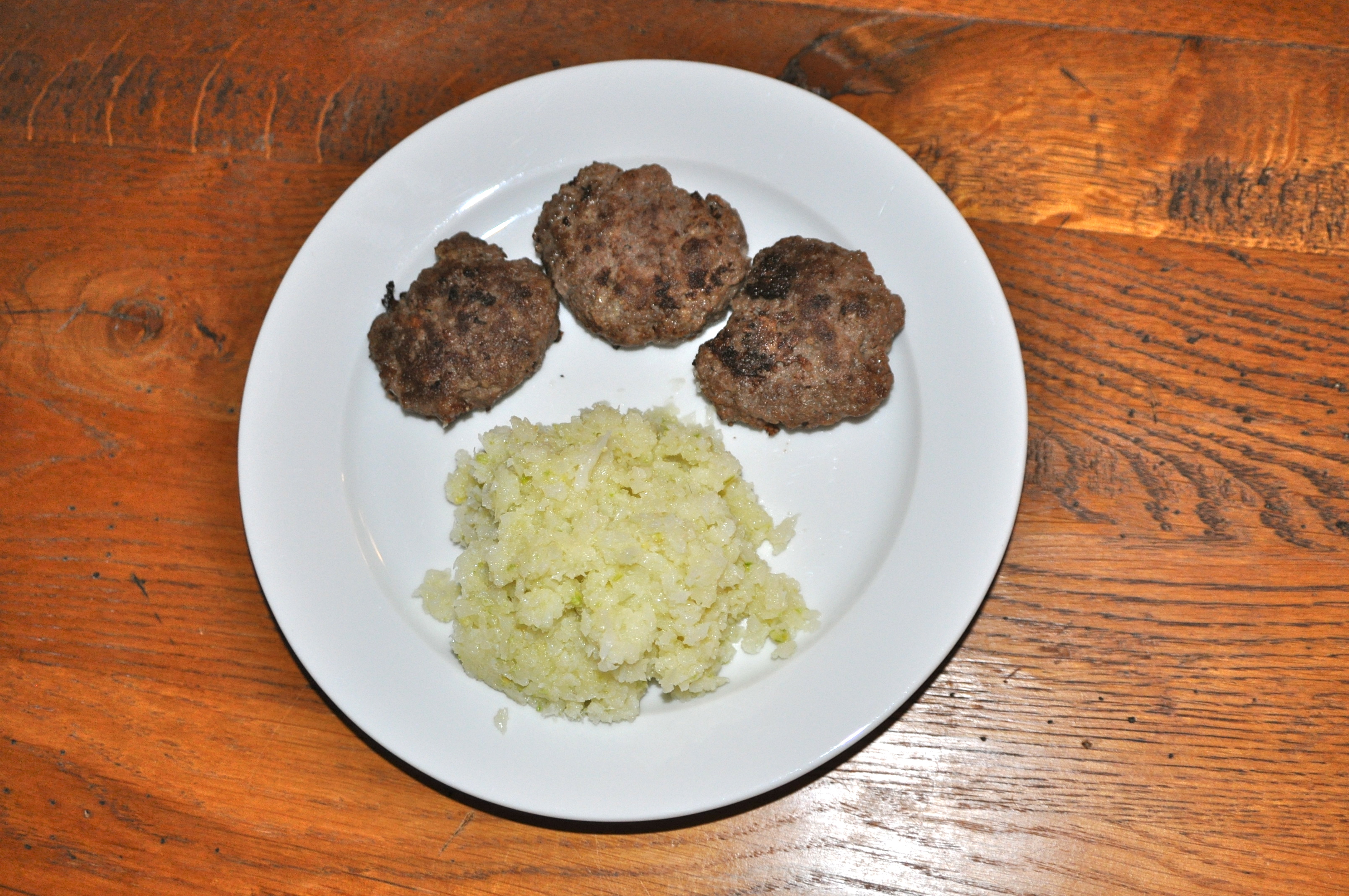
I made hamburgers. I browsed a few recipes on-line and read about adding ingredients like eggs, Worcestershire sauce, breadcrumbs, and onion powder.

I went with quail eggs, sunflour, coconut aminos, and a dash of white pepper. I fried the hamburgers in macadamia oil and served them with mashed cauliflower for dinner.

This weekend Martin ate the leftover hamburgers as breakfast, accompanied by sweet-potato French fries. Adrian asked, “Will he be having a Coke with his burger and fries?”

How did they taste—any good? I wish I knew, but I’m not about to try one. Martin ate them without complaint.

Such an obliging boy, my Martin.

Bison Stew. I Have No Idea What the Heck I’m Doing

I made bison stew in the slow cooker. It’s photogenic. On the other hand, I think I must’ve let it stew too long. The meat is tough and the vegetables are falling apart. Made poor Martin eat it, anyway; don’t want to waste any meat. Anyone with advice on the proper way to cook meat stew—seriously, I Googled “How much water do I add to stew?”—please feel free to reply to this post or email findingmykid@yahoo.com and fill me in.

Turkey Necks Have Vertebrae. This Is News

I am learning so much.

Today I learned that turkey necks separate easily at the vertebrae when cooked.

You, perhaps, already knew that turkey necks separate easily at the vertebrae when cooked.

I did not.

I suppose I never considered the issue. Never had occasion to.

Martin has become an eager drinker of the meat broth that is supposed to be so beneficial to him. He’s slurping several cups a day. Today I dragged out the super-sized slow cooker—as opposed to the regular-sized slow cooker for daily use (sigh)—and brewed my third batch of broth. The first two batches were beef-based. This time turkey’s number was up.

If animals have to perish for Martin’s recovery, I want to make sure, at least, that we exploit as much of each animal as possible. At the same time, I’ve been informed that nontraditional body parts make good broth. So during the week I visited a farmer and purchased a bag of fresh turkey necks.

(Discussing turkey sections with the farmer was one in a series of adventuresome conversations I’ve been having, right up to the limits of my own tolerance. I discussed methods of execution with a guy who kills ducks once a week. I interrogated a bison rancher about why his bison are transported to slaughter at another site. I got a five-minute lesson in cooking emu eggs, from an emu—shepard? rancher? farmer? What do you call a person who raises emus?)

I thawed the turkey necks overnight in the refrigerator, but they were still quite frozen this morning, so I plopped them into the slow cooker to let them thaw as the filtered water heated. After an hour I fished a neck from amidst the rosemary, cilantro, tarragon, celery, seaweed, broccoli stalks, and carrots. I set the neck on the cutting board I’ve reserved for meat and started chopping away, to no avail.

Now, I’ve seen plenty of (live) turkeys. I know that they can twist and fold their necks all sorts of directions. Had I been thinking clearly, I would have realized that the ability to shift the neck implicates the presence of vertebrae. I was not thinking clearly. I was thinking, “There’s a turkey neck on my counter.” I made a few more attempts at hacking, trying not to touch the flesh, then returned the turkey neck to the slow cooker. The illogical idea running through my mind was that a turkey neck must be one solid bone.

Yeah, I know.

A few hours later I wielded metal tongs to pull the by-now-tender meat from the necks as they bobbed around the slow cooker. To my surprise, the necks broke easily into pieces. Half-inch-long pieces. With a triangular bone inside each.

Oh, hey! Vertebrae! That makes sense.

Something about the presence of meat in my kitchen apparently makes me dense. Next time I’m using turkey necks, I’ll be better-informed.

Now, emu eggs. Lesson or no, that’s an escapade I’m not quite ready to undertake.

Kitchen News: An Update on the Hunt for a Food Processor with Glass Bowl

I amaze myself. I’m anxious to replace my food processor, which has a plastic (and, by now, cracking) bowl, because I think high velocity, blades, and heat are a recipe for chemicals from plastic to get into Martin’s food. What my anxiousness means in practice is that I’ve just managed to kill an entire morning searching for a food processor with a glass or stainless-steel bowl, with marginal success.

Between being on hold and actually conversing with a representative, I spent half an hour on the phone with Robot Coupe. That company sells numerous commercial models with stainless steel bowls (though the feed shoots, pushers, and blade components may contain plastic). The only models possibly appropriate for home use, according to the representative, are the R100, which has a plastic bowl, and possibly the R2N Ultra, which has a metal bowl (some other parts plastic), weighs 36 pounds, and sells for more than $2,300.

Another option is an Electolux, the Dito Dean MUGXU, with 3.2-quart stainless-steel bowl, a commercial model nonetheless small enough for countertop use. But at 35 pounds (how can I store that?) and more than $1,000, well . . . .

I’m hatching a new plan.

I use the food processor primarily for puréeing and for getting rid of chunks in soup. My first thought was to get a glass container for my Vitamix, which resembles an extra-powerful blender capable of puréeing. Unfortunately, a call to Vitamix got me the bad news that, although the company has glass containers in the R&D department right now, none are expected to be available for at least a year. In the past, Vitamix manufactured stainless-steel containers, but those would not be compatable with my more recent model.

So for the time being I’m going to invest in a new stainless-steel immersion blender. I already have a KitchenAid blender with a glass jar, though it does have some plastic around the blade that comes in contact with food. I hope to use those two appliances to work around the food processor as much as possible.

For tomorrow evening I have broccoli-and-greens purée on Martin’s menu. Time to blend in batches and hope for the best.

ASD Recovery Cooking: Science Experiments in the Kitchen

Running with an idea I found in the GAPS book, I decided to start fermenting beans before Martin eats them, to improve digestability. Last weekend I soaked navy beans for 18 hours in double-purified water (I use Aquasana and Berkey filters), drained them, and rinsed with more double-purified water. Then I put the beans into a lead-free glass jar, covered them with double-purified water, and added a small amount of GI ProHealth non-dairy yogurt starter.

I sealed the jar, with the intention of leaving it sealed until this coming weekend, for a total seven days. Alas, the best-laid plans must wander astray. This afternoon, Samara, thinking the jar contained beans for fake hummus, popped it open, peered inside, and said, “Ugh, I don’t think these beans are good anymore.” I don’t know what effect, if any, the jar being opened will have on the fermentation process. I resealed it and now await the exciting outcome on Saturday. In the event that the experiment fails, I will try again next week—affixing a Do not open until Saturday! note to the jar.

ASD Recovery Recipe: Duck Nuggets

I said that I would not be posting any meat-based recipes. I hereby renege. Two nights ago I made my first meat recipe other than broth. Martin ate the food, without complaint. It hasn’t made him sick, yet. I consider this a giant success. So without further ado, here is my new recipe for recovery-beneficial duck nuggets. (If your child does not have chicken sensitivities, I have to imagine this works just as well for chicken.)

duck meat (I used the breast)
one duck egg
enough sunflour to coat
additional seasonings

Trim most of the fat from the duck and slice it into bite-sized pieces. Understanding duck to be somewhat tougher than chicken, I made the pieces small enough for Martin to pop into his mouth whole, instead of having to bite off chunks. Beat the egg. Brush each duck piece with beaten egg. Place in a bowl with enough sunflour to coat, plus spices of your choice. (I went with a dash of white pepper, plus some cumin for flair.) Stir well, until each piece is coated. Fry in oil of choice. (Sesame provides nice flavor; just make sure it complements your spices.)

I used duck egg when I made this, but because I was making such a small portion (Martin being the only human in our home who eats meat) I ended up with some beaten egg left over. Next time I may try beating a couple little quail eggs instead, to exercise more control over the amount of egg.

In the event you don’t have sunflour, and your child is okay with limited gluten-free grains, I think that crushed rice crackers or organic rice cereal might work well in place of the sunflourEdward & Sons brown rice snaps (unsalted plain) would be a good choice. Erewhon makes a gluten-free rice cereal, but if you are limiting carbs and sweeteners, note that the Erewhon product contains brown rice syrup.

What to do with the trimmed-off duck fat? The next night I fried turnip and squash in the fat and served those veggies with rice. I’m determined not to waste any animal parts.

ASD Recovery Recipe: Almond Waffles

As I mentioned in a recent post, my mother sent a waffle maker and her recipe for grain-free waffles. Martin ate these the last time we visited my parents and loved them. So I decided to disobey my own rule against non-stick surfaces (chemicals = bad) and make Martin a waffle breakfast this morning. He’s one happy camper!

1 cup almond flour
2 tbsps honey
1 tsp vanilla
1/4 tsp salt
1/4 tsp baking soda
4 eggs (my mother recommended 4 hen eggs or 3 duck; I ended up using 4 duck eggs, because they were small, as far as duck eggs go)

I started by brushing a thin layer of coconut oil onto the waffle maker.  Next I mixed the first five ingredients well, to a pebbly consistency. Separately, I hand whisked the eggs. Finally I mixed the eggs into the other ingredients and stirred until smooth. For the first batch I poured too much batter into the waffle maker, and it overflowed. My technique improved with the second batch. You really don’t need to put in much more than 1/2-3/4 cup batter for an 8-inch waffle maker.

According to my mother, this same recipe makes good pancakes, to that would be a way to avoid the non-stick surface.

A Little Bit Here, a Little Bit There

Pretty good week, this last one. Pretty crap day, today. Martin unresponsive, lacking attention, and throwing tantrums instead of transitioning. Tired and not himself. Mildly ill, even. Yesterday he threw up in the car, a special surprise that may have been tied to his beginning to eat meat products. (Since we started with the beef broth Martin has, now and again, after meals, appeared nauseated.)

Still, even on this crap day, some skills shined. Martin’s language, when he chose to use it, was appropriate and expressive. Also, we went shopping around Union Square, and three times (that I remember) he intentionally caught the eye of a salesperson and said, “Hi!”

I think in those terms, now. What worked today? What didn’t? I scrawl my observations into the daily log I keep for Martin.

I’ve tried to apply the same thinking to Martin’s recovery, on a meta-level. Which treatment or therapy is working? Which is not as helpful? Those, however, are much tougher questions.

The truth is, I see Martin making progress (two steps forward, one step back, usually), but it can be tough to discern the individual catalyst of progress like saying hi or trying to catch a stranger’s eye. Most likely, I suppose, every such advance results from some combination of the treatments we undertake.

As I have described previously, we see Track One doctors, who as far as I can tell have evaluated Martin but done nothing to help him. Apart from Track One doctors, this is Team Martin:

Track Two doctor. Martin’s excellent Track Two physician is riding the edge of autism recovery. I like to call her “post-DAN!” because she is so on top of treatments beyond the standard DAN! protocol. She oversees every facet of Martin’s biomedical recovery.

Home consultant. I’m new to this world of autism recovery. Questions come up on a day-to-day basis. Kathleen Reily answers them. She also helps me, for example, plan Martin’s diet, find local practitioners, and research kitchen products (water filter, lead-free glass, cutting boards not treated chemically, &c.). If I’m the coach of Team Martin, Kathleen is the manager.

Homotoxicologist. A big part of recovery lies in driving toxins and pathogens from the body. Martin’s homotoxicologist, Mary Coyle, works that angle, in coordination with his Track Two doctor.

Cranio-sacral therapist. I drive Martin all the way to Pleasantville, in Westchester, to see Diane Diamond. She helps figure out what’s not functioning well in Martin’s body and makes appropriate adjustments. She once told me, based solely on putting her hands on Martin, “I’m sensing some bile blockage. He’s not processing all this fat in his diet.” A week later, a urinalysis confirmed her assessment medically.

HANDLE therapist. We visit Katie Penque every four-to-six weeks. She observes Martin, interviews me and Adrian, evaluates how Martin’s current HANDLE exercises are working, and suggests and helps us learn new exercises. Katie and Martin’s Track Two doctor are also the proponents-in-chief for the “less is more” approach to recovery.

RDI consultant. RDI incorporates a variety of games and routines, but really it is a therapy that becomes part of daily life. Allison Zevallos helps us make that happen. She makes a home visit every month or so. In between those visits, Adrian emails her videos of Martin in action, which she reviews for a weekly phone consultation with both of us.

CPSE preschool. Martin attends a top-notch preschool for children with learning delays and developmental disabilities. Adrian and I are profoundly grateful for this service, which is provided through the Department of Education’s Committee on Special Preschool Education. Martin spends more than five hours per weekday at his CPSE school.

Speech therapist. Martin’s preschool provides him a bilingual speech therapist, in accordance with his individualized education plan, or IEP. She works to unlock language skills like pronoun use and asking questions, which Martin’s ASD has hidden.

Physical therapist and occupational therapist. Martin also sees these two professionals at his preschool. Together they assist him with gross and fine motor skills, practical life lessons like watching where he’s walking and being aware of the world around him, and performing everyday tasks.

So what among all this is facilitating Martin’s progress? Adrian and I credit HANDLE therapy for helping Martin develop better control over his body and lose some of the jerkiness that characterized his earlier movement. His physical therapy likely augments HANDLE in that regard. We credit RDI with helping Martin (this is an emerging skill, coming about slowly) learn to read faces and expressions and to better pace himself with others, so that he can undertake activities like holding my hand as we walk together. His occupational therapy likely augments RDI in that regard. It’s all puzzle pieces, coming together.

I consider the biomedical process—the restricted diet, the supplements, the detoxification—to be the sticky backing that holds those puzzle pieces in place. It was the biomedical process that got Martin sleeping and rested, eased his gut pain, and reduced the lethargy that used to characterize his days. Without that foundation, the pieces would probably still jiggle around, unable to interlock fully. Without the stronger body biomedical recovery is giving us, the therapies could have less effect.

A little bit here, a little bit there. I don’t want to spend too much time figuring out what progress comes from where, so long as we’re moving in the right direction.