New Year!: We Got Up Late Because Martin Had a Tough Night

Happy New Year!

Adrian and I didn’t make it till midnight, New Year’s Eve. Didn’t even try. We were in bed by 9:00 pm, in a vacation house in Park City, Utah. On New Year’s Eve, our family (1) got up late because Martin had a tough night, (2) skied, (3) met one of Adrian’s colleagues for a drink, and (4) zipped by a Whole Foods Market. From each of those four activities gives me a heading for a “Martin right now” mini-essay. I’ll post them in four installments.

New Year! (1) We got up late because Martin had a tough night.

Martin is in treatment for Lyme disease. His LLMD wants to treat with antibiotics. His MAPS doctor, on the other hand, prefers to treat Lyme anti-microbially, which she says is as effective as antibiotics without the potential negative effects for gut bacteria. The LLMD and MAPS doctors have talked to each other. For now, the LLMD is letting the MAPS doctor “quarterback”—that’s the LLMD’s word, so catchy—Martin’s Lyme treatment, and we’re going with the anti-microbials.

I think they must be working, because while Martin’s cognitive and physical functioning are smooth, his adrenal levels seem maxed out. He is full of anxiety, looking for excuses to melt down. New Year’s Day, Adrian was listening to a Frank Sinatra song when Martin started crying because he remembered that the song was recorded before his parents were born. Honestly. Martin was playing a video game, heard the song, and burst into tears. The only reason he gave was the date that Frank Sinatra recorded “I’ve Got You Under My Skin,” and it took several minutes of comforting to soothe him. If that’s not adrenal stress, I don’t know what is.

Autism and even, to some extent, healing cause stress. Sometimes the process of getting better means that Martin’s body hardly knows itself, or what is coming next. The body can react by producing excess adrenal hormones, like dehydroepiandrosterone (DHEA) and cortisol. The hormones cause meltdowns. The overall stress diverts blood flow away from the gut, affecting nutrient absorption, which pressures the pancreas to keep up with digestive enzymes. The stress also stimulates the liver to increase glucose production to feed the muscles—and I think you know what mayhem excess glucose can wreck in an ASD kid.

Martin is also exhibiting increased OCD symptoms, which for him accompany adrenal stress. His current obsession is making sure he sees a digital clock anytime the digits are all the same, i.e., at 1:11, 2:22, 3:33, 4:44, 5:55, and 11:11.

These factors—adrenal stress and compulsions—have affected Martin’s sleep, too. In “Curse the Night,” I described how Martin couldn’t sleep Christmas Eve because of his anxiety that Santa Claus might not come. In the night between December 30 and New Year’s Eve, Martin woke from a nightmare: I think it was about skiing (see next post), because he woke exclaiming, “No, no, not so fast!” He stayed awake from 2:30 am until after 5:00 am, declaring himself simply unable to sleep, asking for me to be with him, and worrying about the time—“It’s 3:12! It’s not 3:33 yet!”—until finally I hid the clock.

Night waking has been so rare this past year that nowadays it really throws me for a loop. I just don’t have the stamina to get by without sleep anymore. I dozed off, lying on the sofa, until Adrian’s alarm sounded at 6:00 am, our usual waking time for skiing. Then I told Adrian that Martin had been up for hours and was now asleep, set my alarm for 8:00 am to call his ski instructors and say he’d be late for his 9:00 am lesson, and crawled back into bed for a couple hours. We let Martin sleep until after 9:00 am, then ate a big breakfast and finally reached his lesson at 11:00 am.

Martin remained high-strung all day, and does still as of this writing.

(I will provide more information on the Lyme disease in a subsequent post. I am almost as excited about writing that as I was for the recent informative post about mitochondrial support.)

The Way He Talks Now—It’s Just Really Cute

Yesterday in the car, during a Bon Jovi song on the ’80s on 8 station—

Martin: “Apparently we’re going to hear some Phil Collins soon.”

Apparently”?

Me: “How do you know that?”

Martin: “The announcer just said it, on the radio.”

I’d heard, vaguely, the announcer say something before Bon Jovi.

Me: “Oh, really? I guess you were listening better than I was.”

Martin: “I guess I was.”

I once had a child whose only language was echolalia, who could not independently string two or three words together. Can you imagine the joy in a moment like this?

Two songs later: Phil Collins.

Clapping. Whispering. Not Simultaneously

I planned to write an informative blog post about the role of mitochondrial support, and how going back on MitoSpectra has helped Martin since last week. But now I’m excited by events at church and want to write about them instead. That other, more informative post will just have to wait. Sorry not sorry.

At children’s time this Sunday—after the Gospel, before the choir anthem—the kids were invited to come sit in the front pew, which was empty, because, well, it’s church. Martin dawdled, of course, and by the time he arrived, the other kids had packed the pew. Martin exclaimed, “I don’t fit!” The congregation laughed. We got him seated. The substitute pastor gave a talk that was too long for little kids, and kind of boring. Still, other than making some funny noises with his mouth, which is a stim he has when his adrenals are stressed (I think), Martin did okay, looking around and enjoying the front pew. Then, after the too-long talk, the substitute pastor asked the kids to stay put for the choir anthem. I got worried; music excites Martin, and I thought he might call out.

He didn’t. He listened as the choir sang “Soon and Very Soon,” a song he knows. It was the Andraé Crouch version, in a setting by Jack Schrader, and in the last stanza the choir began a slow clap. For me (I was tragically born without a sense of rhythm), it wasn’t an intuitive clap: not every beat, hard to hit just right.

Martin began to clap. Not to clap randomly—he started to clap along with the choir, exactly right, exactly keeping time with their slow, challenging clap. I was blown away. It’s long been a challenge to get Martin to keep time with anyone, whether walking, or talking, or running, or playing. Evidently, not anymore. Only one or two other kids clapped, so Martin had to watch the choir and take their cues. He succeeded.

That was enough to make my day. Later in the service, however, Martin delivered even more. His next feat came after communion. He’d already gone downstairs to Sunday school and come back up, carrying a picture. He’d drawn a marching band (that’s a favorite motif) passing in front of the church, and he wanted to point out the details. “This is a trombone, and look, here is the pastor watching them.” The time that Martin picked for his exposition was also announcement time, when the substitute pastor was recognizing birthdays and reminding everyone about the men’s breakfast group and charity gift drive, so I put my index finger to my lips and shhh!ed Martin.

Martin kept talking (predictable) but switched to a whisper. Martin has never whispered unprompted before, and he’s never been able to sustain a whisper more than a few words. Now he switched to a whisper and kept it going, sentence after sentence. The drummer was carrying his drum set, he showed me, and there was a tuba player, and here were all the people standing on the sidewalk applauding. Whisper, whisper, whisper. I didn’t try to shush him again. I ignored the church announcements and whispered back. We whispered an entire conversation.

Before the final song, Martin asked to take his snack and go to the common room, where we have coffee hour. I let him. After a minute he jogged back into the sanctuary. The choir was exiting, down the center aisle. Martin stood just inside the doorway, across the sanctuary from where I was, and caught my eye. I motioned for him to come to me. In days past, Martin would have ignored that and called to me from across the sanctuary, regardless of what was going on. This week, instead of calling out, he came. He jogged, ducking around the choir robes, to my seat and asked quietly, “Um, may I please start eating my snack?” I figured that an adult must have seen him in the common room and, knowing he follows a restricted diet, told him to go ask his mom whether it was okay to eat the snack. (Understanding and conscientious parents? Very patient parishioners? We are so blessed.) “Yes,” I said. “Go ahead.” And he disappeared again.

Later, when I had made my own way to coffee hour, I was approached by a woman I don’t know. She introduced herself and said she’s been coordinating the Christmas pageant this year. (Martin has been cast as “Shepherd No. 2.” He has two lines, which he has memorized.) “I just wanted to tell you,” the woman said, “your son is a joy. He is an absolute joy to work with.”

Boo-yah. Can you see why I decided to leave mitochondrial support for tomorrow?

Facepalm

Last weekend at church, an older woman asked whether I know anything about selective mutism. Actually, she first asked me whether I know anything about “selection mutation.” Getting to the actual inquiry took some clarification.

“Not too much,” I replied. “Some. From what I understand it’s a type of anxiety disorder.”

The woman said her granddaughter, in Maine, has selective mutism, and she worries that her daughter isn’t doing enough to treat the condition. Is it like autism? she asked. Martin is making so much progress. Can selective mutism be treated like we treat Martin’s autism?

I answered, “From what I know, many of the disorders we think of as behavioral or psychological have a health component, at least when there isn’t an obvious other cause like abuse or overwhelming life circumstances.” Actually, I probably didn’t say it that pretty, but I made the point. “So I would guess you might be able treat selective mutism biomedically.”

“I knew it!” the woman said. “I knew there must be a medication she could be taking!”

Completely not what I meant, I said, as kindly as I could, and then explained some of the fundamentals of our biomedical approach: the restricted diet, everything organic and homemade; the supplementation; the antimicrobial herbs; the homeopathy; neuroplasticity and home-based therapies.

Though I kept the discussion as simple as possible, the woman’s attention waned with each word I spoke. There were no follow-up questions.

That’s the way we’re headed, as a society: Isn’t there a pill to remedy this? Isn’t there a shot to prevent that?

Easy fixes.

I’m Going to Need to Explain It Better

Well, this was bound to happen, sooner or later.

Over Thanksgiving, I brought Martin supplements as he was playing in his bedroom. He swallowed them without liquid, as he does for all pills other than Li-Zyme Forte, which he calls his “hard-to-swallow pill.” I don’t usually deliver supplements to Martin’s bedroom; we do them in the kitchen, preferably with meals. On this occasion, with my family visiting for the holiday, I was trying to get a jump on the evening protocol and make dinner a more normalized affair.

Without looking at me, still drawing a picture on his easel, Martin asked, “Why do you give me these pills?”

Ooooo. Okay. I said, “Remember when we talked about your tummy having troubles, and how when your tummy has troubles, it can make it hard to pay attention?”

“Sure.”

“These pills are meant to help your tummy work a little better.”

“Do my friends take pills?”

“I’m not sure about all your friends. Bobby does, and so do Z and Jackson.” Those are friends whose families treat their autism and other challenges biomedically.

“Some of my friends take pills, but not all of my friends?”

“I think that sounds right.”

“Okay,” Martin said. “I’m drawing a picture of the Beatles.”

“I like it,” I said, relieved that he’d changed the topic.

The conversation left me with two take-aways:

  1. Martin is bound to ask the questions again, and probably won’t let me off so easy. I’m going to have to think carefully about how to respond.
  1. One of these days, I’m going to get hit with the bomb. Martin is going to ask, “Do I have autism?” We came close once already. We were out to dinner with friends when Martin, who took especial interest in street signs around the time, asked, “Mommy, what’s a ‘Child With Autism Area’?” I responded that a sign like that means that drivers should be extra careful because a child who lives nearby might not realize how dangerous it is to be in the street. Then Martin asked what autism is. As Andrés and our dinner guests listened in silence, I responded, “Autism is a condition that can make it difficult to pay attention to what’s going on around them, or difficult to talk to other people.” I waited, mildly panicked, for Martin to ask whether he has autism. But he didn’t. He changed the topic. Bomb dodged.

Guessing Game

Drafted in the morning, on the train, on my way to work:

Let’s conduct an experiment: How well do I understand Martin’s health these days? Can I predict what his super-knowledgable biomed doctor will say?

Martin is in a difficult place right now and has been for a month, ever since we last visited his biomed doctor in California, which was one month ago. Especially at bedtime, but also in spurts throughout the day, he’s beset by so much hyperactivity as to be nearly uncontrollable. The agitation and need for movement are affecting his ability to fall asleep; until nearly 10 o’clock yesterday evening, he was kicking his feet in bed, calling out, springing up to jog down the hall and return to bed. Daytimes, I’ve observed him engaging in his lone remaining repetitive behavior, which is to skip three steps pad-a-bump, run across the room, turn, stop and think (or ponder, or get lost in his own self for a few seconds), and repeat: pad-a-bump, run, turn, stop. Tuesday he did this even in our local coffee shop, pad-a-bump from the cash register to the front door, pad-a-bump back to the cash register. He’s giggly. He’s interrupting and talking over others, without regard for his surroundings. He has some increased sensitivity to sound. He’s so itchy.

Yet, as is often the case, the symptomatic behaviors seem superficial, and perhaps there is a deeper level of healing going on. He is more conversational than ever, answering questions and telling me what happens at school with minimal perseveration. His handwriting has improved dramatically; instead of gargantuan, unsteady strokes, he’s penning tight letters that actually fit on the paper lines. He’s attempting to make jokes, albeit nonsensical, unfunny ones. “I think Daddy’s going to take his hair off his head. Isn’t that funny? I’m just kidding.” He’s bargaining. “Santa Claus knows I didn’t finish my soup? That’s okay. I think Santa looks at the whole year, and I’ve had more good days than bad.” (What does he want from Santa Claus, you ask? Adele tickets. Martin has selected the most phenomenally in-demand tickets on earth and decided that’s what he wants for Christmas.)

Except for the itchiness, which predated our last visit to California, the hyperactivity, repetitive behaviors, and other symptoms began, as near as I can reckon, right when we returned from that trip, one month ago. The sequence was like this: Thursday afternoon we flew from New York to California. The flight was delayed, and Martin wasn’t in bed until 11:00 pm PST, or 2:00 am EST. He managed to sleep until 9:00 am PST, or noon EST. We spent Friday afternoon at the doctor’s and, as part of that appointment, Martin had an LED treatment. Friday evening we met friends (a father and his son, Martin’s age) for dinner, which went well. Martin fell asleep around 10:00 pm PST Friday night and slept well. Saturday was a packed day. We went out to breakfast, and then to see my friend’s new house, and then we drove inland an hour, to spend the afternoon with the same friend’s mother and to visit George the cat, who now resides on the West Coast. It was 6:30 pm when Martin and I returned to our hotel.

That night, Saturday night, our placid California weekend went awry. Martin knew we had to get up early (3:45 am) to drive 40 minutes to the airport, return our rental car, and catch the 7:00 am flight to New York. He was excited about getting up so early. Too excited. He went to bed giddy around 8:00 pm and—I don’t have a better way to put this—worked himself into a frenzy, calling out, laughing, asking whether it was time to get up. Around 9:30 pm, anxiety took over. Mommy! Mommy! Something is wrong! Mommy! I don’t know what’s going on. Mommy, where are you? [I was in the same hotel suite, using my iPad, where he could hear me and see the light I was using.] Mommy, help! Help me! His agitation mushroomed until he was sobbing and even shrieking. In an effort to calm him, I said, unthinkingly, “Martin, you have to stop. You have to stop screaming. We are in a hotel. Someone could think I’m hurting you and call the police!” That foolish statement became a target for his previously unspecific anxiety. Are the police coming? Are the police here? Will the police take me away? No! No! Mommy, tell the police not to come! I don’t want the police to come!

My poor little man was terrified and out of control. At last I took him to my bed, climbed in, and squeezed him until he began to calm. Once the sobbing reduced to whimpers, I released him and rubbed his head instead. Within two minutes from that point, he was sound asleep and I had quiet time to wonder what the hell had just happened.

When I woke Martin at 3:45 am, after just five hours’ sleep, he sprang from bed, evidently cheerful to be getting up at such a special time. I saw no trace of anxiety or giddiness. That day, Sunday, as we traveled home, he seemed restless and uncomfortable, which I chalked up to lack of sleep, but otherwise unremarkable. Sunday evening, however, he became hyperactive and had trouble getting to sleep.

Since that Sunday evening, we’ve endured the hyperactivity, some inappropriate laughing, continued itchiness, and lack of focus. Charcoal tablets help, but not always. We’ve started a new protocol of supplements, antimicrobials, homeopathic remedies, and yeast fighters; I’ve introduced the new elements slowly, and haven’t tied a specific reaction to any. Last week for Heilkunst we cleared a DTaP vaccine, again without a specific reaction, only the same hyperactivity. The hyperactivity is uniformly worst at bedtime, and Martin continues having trouble getting to sleep. He’s woken early a few times but generally sleeps through the night.

So what is going on here?

I have scheduled a short call with the doctor this afternoon. I’m going to write what I think is happening, and then, after I speak with the doctor, I will give her thoughts. I’m eager to see whether we agree.

My own theories: First, I think yeast is at work. I said, even before we went to California, that I believed Martin was suffering a yeast flare. The poor kid is so itchy. He’s scratched his legs and belly bloody. He’s giggly and “drunk.” Second, I wonder whether the LED he had in California might have kicked up some toxins that Martin is having trouble clearing. Maybe?

Drafted the next day, after I spoke with the doctor:

The doctor disagreed with my guesses. While yeast might be a subsidiary issue, she said, Martin’s hyperactivity makes it unlikely that yeast is the primary issue. Hyperactivity has not been a hallmark of Martin’s previous yeast flares, she pointed out. As to the LED, she said that any effects would have emerged during the 25 hours immediately following the treatment. Saturday night, when Martin experienced the anxiety attack that launched this hyperactive period, some 30 hours already had passed.

She admitted that it’s tough to know exactly what’s going on. Her theory: Banderol and borrelogen, the antimicrobials that Martin has been taking in incrementally increasing doses to treat chronic Lyme, are too strong. His sensitive system needs time to adjust. She reminded me that, when we used banderol three years ago, as well as when we used the antimicrobial takuna, we had to increase the dose extremely slowly—sometimes by not more than one additional drop per week. This go-round I’ve been building banderol and borrelogen by about a drop per day each. She asked me to hold the antimicrobials for 48 hours (or four doses, as we dose them twice daily) and she if Martin’s hyperactivity decreases.

I was going to post this blog entry after taking to the doctor. Now I feel like it’s worth waiting another couple days to announce the results of our 48-hour experiment.

Drafted two-and-a-half days after I spoke with the doctor:

Better. Around 6:20 am I messaged the doctor:

I think you nailed the issue. Since we spoke on Thursday, I have withheld banderol and borrelogen (so five doses withheld so far: Thursday evening, Friday morning and evening, Saturday morning and evening). We have seen a perceptible, marked decrease in Martin’s hyperactivity, and Friday night he was able to go right to sleep for the first time in weeks. Yesterday afternoon I took Martin into the infrared sauna for a detox cycle. Going in the sauna really, really agitated him. For an hour or so, the hyperactivity was back, full-force, and then we had some emotional dysregulation. On the other hand, last night Martin went right to sleep again, his pre-bedtime meltdown notwithstanding. What do you suggest? BTW, we have continued during this time with four drops Clovanol daily. Thank you!

Pretty intense, right? And I didn’t even tell her that he had flat-out refused to watch Pride and Prejudice with me on the sauna video screen. “Turn it away from me!” he said. “I don’t want to see it!” That evening, I messaged the doctor again:

An additional note: Today (Sunday) the hyperactivity was back up again, though not as bad as before. We haven’t restarted banderol or borrelogen. Today Martin also was “floppy” (this could be the lack of MitoSpectra) and emotionally volatile—he had a meltdown over where we chose to have Sunday dinner, and was not able to recover for quite some time. He’s in bed now, making noise instead of going to sleep. I’m wondering if yesterday’s sauna has lingering effects.

She responded by advising me to continue holding banderol and to restart borrelogen from one drop per day, or even one drop every other day, and build even more slowly than before. She also suggested that I keep Martin out of the infrared sauna for a while, as it may be too intense and also stirring up metals. Regarding the floppiness, she advised putting Martin back on mitochondrial support immediately, and said that might also help him better handle the antimicrobial herbs.

Drafted four days after I spoke with the doctor:

Hyperactivity is reduced again. Unfortunately, emotional dysregulation is taking hyperactivity’s place. (That’s a kind way to say that Martin is moving less but melting down more.) Also, Martin is distracted. This could be simply a result of the changes in his antimicrobials, and the fact that his new MitoSpectra hasn’t yet arrived. Here’s hoping that he evens out soon.

Note for careful readers:

Are you wondering why Martin has been off MitoSpectra? I knew it. You are very careful readers. The last two bottles of MitoSpectra I purchased went bad; the pills changed color and developed a fishy smell. I became nervous about continuing to use the product. But I do like MitroSpectra and believe it’s been helpful to Martin. After talking with a representative of the company, I’ve decided to give I decided to give it another shot. Help us, MitroSpectra!

I Feel Ya. No, I Don’t. I Get That. No, I Don’t

The day after Thanksgiving, my stepfather and brother and husband—a/k/a Grandpa and Uncle Rudy and Daddy—took Martin to see The Good Dinosaur. Martin, who had seen the movie promoted on Disney Channel and been asking to go, came home all smiles from the theatre.

“Hi, Martin!” I greeted him. “How was the movie?”

“It was good!” he said.

“Did you enjoy yourself?”

“Yes.”

“What was your favorite part of the movie?” I asked.

Martin didn’t hesitate. “My favorite part was when the dinosaur boy’s dad died,” he said, laughing.

“When his dad died? Wasn’t that very sad?”

“Yes!” Martin said, still laughing. “It was sad!”

Confronted with what must have been a tear-jerking scene for the other movie patrons, Martin seemed unable to suppress his glee.

Last month I lost a friend. We weren’t close; we’d known each other in junior high school, and reconnected a few years ago via Facebook, and discovered that we shared interests in fitness, real food, and faith. By the time we reconnected, Jenny was already fighting her second bout with breast cancer. I knew that she was in and out of chemotherapy and making frequent doctor visits. Yet, to me, her cancer never seemed present or imminent, because I never saw her in person and because her Facebook posts were always upbeat.

One night, just before I went to bed (alone; Adrian was away on business), I checked Facebook and saw that another user had just tagged Jenny in a post something like, “Pray for Jenny. She’s gone into the hospital and isn’t doing well.” I prayed for Jenny that night. I didn’t worry too much. She’d been in the hospital before and gone home quickly. Besides, her status updates that week had been banal: She loved her new juicer. She was considering seeing a doctor a few towns away and wondered whether anyone would like to share the ride. Everyday stuff.

Jenny must have been on my mind overnight, because when I woke around 5:30 a.m. I checked Facebook again immediately. During the early morning hours, a different user had posted, on Jenny’s wall, something like, “Jenny’s been taken off the ventilator. Her husband asks for prayers that she passes in peace and they can grieve.”

Only days earlier, on-line, Jenny had seemed vibrant and untroubled. I decided that “taken off the ventilator” must mean that the doctors wanted to give her the chance to pull through on her own, and she would.

At 7:15 a.m., Jenny’s aunt posted something like, “R.I.P. my beautiful niece. You fought hard.” By that time, Martin was seated at the table eating breakfast, so I set down my iPhone, left the kitchen, and started to speak with Jenny, in case she could listen. I’m glad we found each other through Facebook, and I’m sorry I didn’t realize how advanced your cancer was. I wish I’d realized. I would have said more to you. I would have talked about sleeping over at your house in seventh grade, and some of the crazy afternoons we had in your family’s swimming pool. Remember?

When I returned to the kitchen to finish giving Martin his supplements, I was crying. He noticed (that’s encouraging) and asked me why.

“I just lost a friend. My friend died. My friend died, and it’s making me very, very sad that I won’t see her again, or talk to her.”

“Oh,” Martin said. Then he smiled, giggled, and said, “Your friend died!”

“That’s not a funny thing. It’s something that’s making me sad.”

Martin said, “Okay,” and kept giggling.

It was, fair to say, one of our more—ahem—challenging moments. I stood in the kitchen, still crying, and my son had no response other than to laugh at my grief.

Here’s one whopper of a reason I stick with biomed, with trying to heal Martin from the inside out: You can teach a lot of things. You can teach eye contact. You can teach small talk and germane responses. You can even teach how to mimic emotion. But you can’t teach empathy.

At least not any way that I know how.

The Beast

I regret to report that Martin seems to be having a mild yeast flare.

For the first three years of Martin’s recovery journey, candida—yeast—was my constant foe. Before we started biomed, before I understood Martin’s health issues, Martin itched constantly. Self-inflicted scratches marred his legs and backside. The fancy dermatologist diagnosed “sensitive skin” and advised us to use Cetaphil or CeraVe products (!), which helped nothing. Once I realized that Martin’s constant itching and some of his bowel issues were connected to candida imbalance, we started to tackle the issue with diet and supplements, and we made progress. Nevertheless, yeast is tricky. If you get it under control in one form, it doesn’t wait long to rear its ugly head in another form. We clashed again and again, yeast and I.

Two years ago Martin started taking Candex. We’ve had the most luck with that product, and we haven’t really had a major yeast battle since.

And now—he’s itching his legs again, and asking me to rub cream on them. He has those stupid scratches. I snuck into his bathroom and witnessed a “fluffy” poop. (Sorry to throw that in unannounced! It was quite shocking to me at the time, so I decided to go for effect in my reporting of the incident.) Plus, he’s silly. So silly. Inappropriately laughing. Cracking himself up. Disrupting his school class. Silly, sill, silly. The situation isn’t out of control, but it sure isn’t great.

Is this a yeast flare? If so, what could be the culprit behind this yeast flare?

Possibility: Having been so many months without substantial candida troubles, I’ve loosened up Martin’s diet to allow more sugars. He’s eating daily fruit, including homemade vegetable-fruit juices, and scattered starches (potato) and carbs (quinoa, brown rice). (Wait, did you think I meant refined sugars? Oh, you made a funny! Martin never gets refined sugars.) Those foods feed yeast. I may need to tighten the diet back up.

Possibility: Especially as he’s working through his past immune insults, Martin gets healing reactions. His recent allergic attacks, for example, may be related to clearing vaccines. (The cats are another story.) Vaccines—indeed, any injections, as I understand the process—are notorious provokers of something like allergic reactions. Clearing vaccines, moreover, can cause silliness and inappropriate laughter. Maybe, in this kerfuffle as Martin’s body heals itself, it (1) loses track of yeast, and (2) compounds the problem with symptoms that mimic a yeast flare.

I don’t know if this really is a yeast flare. The symptoms are there, but symptoms can be deceptive. (Like, for example, the symptoms we call “autism” can be deceptive.) I hate the thought of having to conquer this beast yet again.

Eons ago, in college, my friends and I used to drink dollar pitchers of Milwaukee’s Best at happy hour. We called that cheap beer “the beast.” That beast—that yeast, that hops, that barley—was so much better than this.

This isn't the beast! This is the cutest little man ever. Martin, at play, Mountain View, California.

This isn’t the beast! This is the cutest little man ever. Martin, at play, Mountain View, California.

Never Gonna

I am a parent, obviously. I hope I am a good parent. I have a son, and I adore him. I try to help him. He seems to be doing well. That’s enough of parenting, right?

I was in Manhattan and walked by a playground full of preschoolers and kindergartners, and even some babies and toddlers. The kids were chasing each other and calling out, climbing, jumping. Some adults were interacting with kids. Others sat on benches and chatted. It all looked so normal. So typical.

In a moment I felt the full impact of our decision—Adrian’s decision, and mine—to have only one child. Martin is seven years old now. Every day he’s closer to recovery. Every day he’s more like typical children. Nevertheless, even if he were to shed every last vestige of autism this very day, I will never have the experience of parenting a typical preschooler or kindergartner. I will never know the experience of those playgrounders. My experience of typicality will begin only with an older child.

What are the analogies to this situation? Adopting an older child? Certainly not. I’ve had a child for seven years. I’ve been parenting all this time, just a different type of parenting. Have a child who transitions gender? Maybe sorta like that. First you have one type of kid, and then another, but the child stays the same and you love that child either way.

Let’s face it: I will never have a toddler help me make Rice Krispie treats like in Kellogg’s commercials.

I will never get to be the mom who Pinterests craft projects with her preschooler. (Not that such an outcome was ever likely. I am who I am.)

I will never put a kindergartner on the bus, first day of school, and wonder whether he is going to make friends or like his teacher. Two years ago, I put my kindergartner on the bus, first day of school, and wondered whether his teachers would understand the importance of restricting foods not on his “acceptable” list.

And what of Martin, who has been deprived of typical preschool, of typical kindergarten, of typical grade school so far? He will never have those experiences, either. Years from now, when his friends ask, “Remember in second grade when we were all into Captain America? Remember peanut-butter-and-jelly sandwiches?”, what will Martin say?

I am a parent. I hope I am a good parent. I have a son, and I adore him. I try to help him. He seems to be doing well. That’s enough of parenting, right?

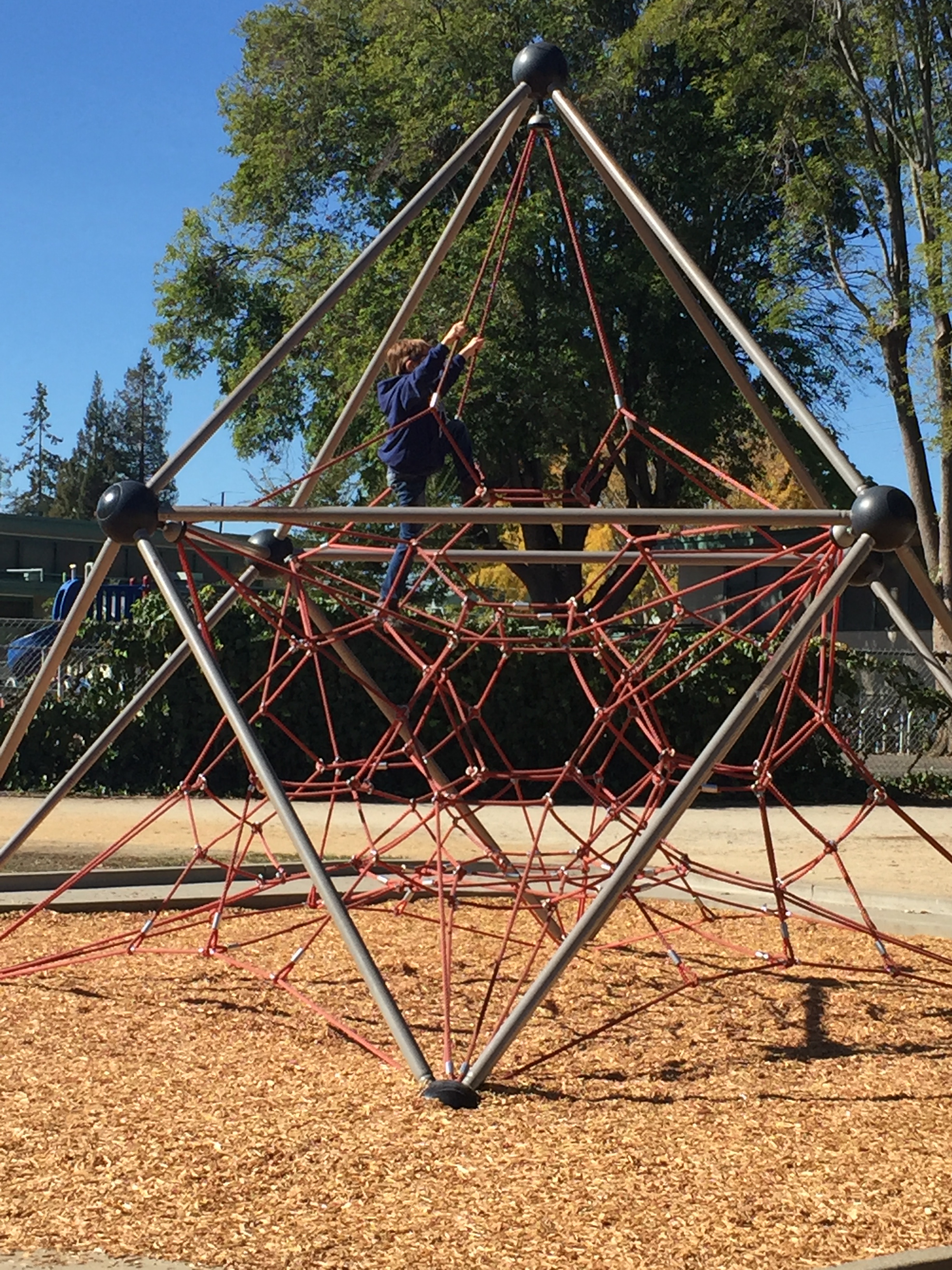
In the blue, at the top. That's my kid.

In the blue, at the top. That’s my kid.

A&A Part IV: Anything But That

This blog has played host to some difficult posts. Difficult for me to write, I mean. “And Now, Martin Does the Rejecting,” wherein I described the City Kids Club kicking Martin out of its Twos Club. That was a tough one. “Let’s Talk Honestly About Really Crappy Days,” wherein I described a truly dreadful morning in our household. Not so easy to own. The recent “Why Can’t We All Cross the Finish Line, the Nonexistent Finish Line, Together?”, wherein I admitted to wondering whether Martin should find a higher-functioning best friend. You get the point.

This post, this one I’m writing now, tops them all. This post feels impossible to write. It combines just about every way in which autism has beaten me down: the degradation of my own identity, the ethical compromises, the rearrangement of dreams. The situation in which I find myself today—it’s not me. At least not a me I thought I’d ever be.

I’m on a plane back to New York, from Texas, where I’ve just abandoned one of our three cats, Levi.

Maybe “abandoned” is too strong. I flew with Levi to Texas in order to deliver him, personally, with boxes full of supplies, to a new home: a mother and two kids (ages 11 and 7), who are welcoming him with joy, and who intend to house him forever. They’ve had cats in the past, and now they have Levi. They are friends of one of my close girlfriends. They will let us visit Levi whenever we are in town at my parents’ home. It’s a close to perfect as I could hope for.

Still, it feels a lot like I’ve just abandoned Levi.

I’ve had cats, between one and four cats at a time, since 1994, when I adopted Tiny Rachel. As of next week, when Freddy and Edith move together to their new home, I will have no feline companions. I will have given them up.

After Martin started wheezing, we had an allergist run a blood test and a skin-patch test. The skin-patch test involved a dozen allergens being pushed into Martin’s forearms, and then he and I waiting 15 minutes to see if any reaction developed.

A reaction developed. Not after 15 minutes. Immediately. One allergen among the dozen swelled Martin’s skin into an angry red bump. I looked at the chart of allergen placements to see what was causing the reaction.

“Cat.”

Cat. Martin was testing allergic to cats. Severely allergic. I could see the reaction with my own two eyes—two eyes that begin to fill with tears. Martin is allergic to cats. We’ve had cats since before Martin was born, obviously. Martin has never lived in a home without cats.

How? I asked the doctor. How could this be? Before this summer, Martin hasn’t had allergic reactions. The asthma is brand new. How, when we’ve had cats his whole life, could they now be contributing to allergies and asthma?

The allergist, whom I could call a traditionalist, came up with two possibilities. First, animals living in a home are known to reduce the incidence of childhood allergies. Maybe, by having cats since Martin was born, we diminished what otherwise would have been a more severe allergy, and also staved its onset. Second, given that both my older brothers and my mother are allergic, Martin has a genetic predisposition to cat allergies (which we have always known). Maybe Martin just developed his allergy later.

I am not a traditionalist, and so to the allergist’s possibilities I added a third: Maybe Martin has always had this allergy, and until now his immune system was not healthy enough to mount the proper response. Maybe, in all the work that we have done to heal his gut, we have fostered Martin’s allergic response. The cat allergy is a bad thing. Martin’s ability to mount a proper response for the first time, if that’s what’s going on, would be a good thing. Immune systems are supposed to respond.

The very night Martin visited the allergist, Adrian and I went out to dinner (without Martin), I told him the test results, and we decided that we had to rehome Levi, Freddy, and Edith. The other options were unacceptable. We couldn’t have the cats live in the basement; the basement’s ventilation and duct system carries airborne allergens to the rest of the house, too. We couldn’t make the cats into outdoor-and-garage pets; they are essentially lap cats who seek and want constant human interaction. We couldn’t keep the status quo; Martin is rubbing watery eyes, coughing through the night, wheezing after exercise.

That being said, Adrian and I both believe that we have a lifelong obligation to our companion animals. There was no discussion of taking the animals to a shelter or moving them immediately to suboptimal homes. Levi, who enjoys spending time outside and doesn’t respond well to other cats, especially male cats, needs a home where he can safely go outside, and preferably be the only cat. As to Freddie and Edith, we adopted them together because they were bonded to each other. They’ve been with us almost eight years, and nothing has changed. They are best friends, reliant on each other. They must remain together.

We got lucky. I sent a message to friends and family members, nationwide, who know how we’ve struggled with Martin’s health. They spread the message wider. Within a week, the Texas family had come forward with an offer to adopt Levi. Within three weeks, we had found a lovely woman who has taken in many older cats over the years. She drove 90 minutes to our house to meet Freddie and Edith, and then decided she would like them to join her family. We aren’t out of the woods yet. Before we can declare the adoptions a success, we still need to see each cat flourish in his or her new home. But so far, so good.

So far, so good when it comes to finding suitable homes, that is. When it comes to my emotions—so far, not so good. The worst, for me, right now, is my old pal guilt. I feel guilty toward the cats. I love them, and they are my responsibility. The first night, when I told Adrian that Martin is allergic, he looked plain defeated as he asked, “Why? Why now? George is gone. Our house is under control. Everyone is happy. How could this happen now?” I feel guilty toward Martin, too. How long has this allergy been an issue? How did we not realize it? By having cats in our home, have we been unwittingly hampering Martin’s recovery? Precipitating further immune troubles?

There’s fear, also. I dread receiving a phone call that one of the cats, traumatized by changing homes and families, has developed a behavior problem or run away. I dread hearing that one of the adoptive parents has decided not to keep a cat and surrendered him or her to a shelter, or to someone I don’t know. Is this likely? No, of course it isn’t. We have found “cat people” to adopt our cats. We’ve asked them to agree that, if ever they can no longer care for the cats, they call us to come get them back. They have assured us that, in the unlikely event they can no longer care for the cats, they will indeed call us to come get them back. They are going to provide updates and let us visit the cats. Nevertheless, once the cats leave my home, I am no longer in control of their welfare. Therein arises my fear.

There’s hope. I hope that figuring out this impediment to Martin’s well-being, and removing it, may hasten the remainder of his recovery.

There is a pesky emotion that I don’t want to admit. Every once in a while I sense a flash of something like relief, a feeling that fewer worries in my home (yes, I worry about cats; I worry about everyone in my home) will improve my well-being.

And then I cycle back to guilt, this time guilt for having felt something like relief.

I have to leave this post now.

Update: I drafted this post 10 days ago. I have already received several updates from Levi’s new family, pictures with captions like “snuggling inside on a rainy day.” That helps. Yesterday, November 1, Freddie and Edith moved to their new home, together. This morning I overslept, because Edith did not wake me to give her breakfast. Despite the good news from Texas, I feel devastated.

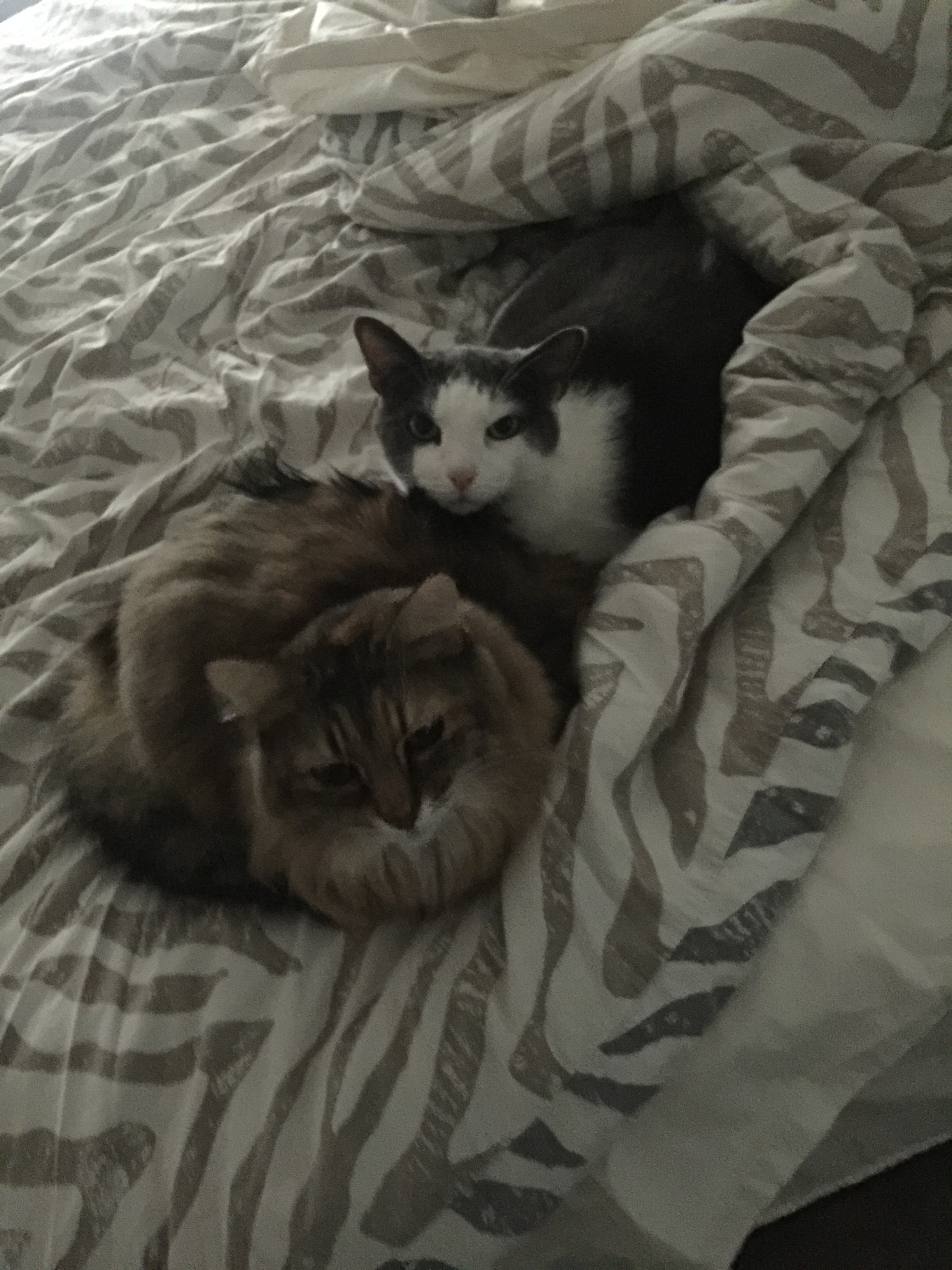
Freddie and Edith.

Freddie and Edith.