The Conversationalist

Yesterday, Martin held this conversation with his behaviorist, “Miss Debbie”:

Martin:           “Miss Debbie, on New Year’s Eve, did you watch the big ball in Times Square drop from the sky to the ground while all the people counted, ‘Ten, nine, eight, seven, six, five, four, three, two, one, zero!’?”

Debbie:           “Yes, I did watch that.”

Martin:           “Were you in Times Square?”

Debbie:           “No, I watched it on television from my bed, at home.”

Martin:           “Did Rose [Debbie’s daughter] watch the big ball in Times Square drop from the sky, too?”

Debbie:           “She did.”

Martin:           “Did Rose get in your bed with you to watch?”

Debbie:           “Yes, she did. We set a special alarm to wake us up just before midnight if we fell asleep too early.”

Martin:           “Did you and Rose fall asleep?”

Debbie:           “Yes, we did, but the alarm woke us up and we saw it. Did you watch the big ball drop?”

Martin:           “No.”

Debbie:           “Were you already sleeping?”

Martin:           “Yes, Miss Debbie. I was sleeping.”

Seriously! Read that exchange again! Note how Martin listened to Debbie’s answers and incorporated the information into his later questions. Note how Martin responded accurately when Debbie addressed him. True, Martin was discussing the Times Square ball, one of his current, ahem, “interests” (i.e., perseveration subjects), and a few times his cadence was awkward. But not long ago I was ecstatic at a two-exchange conversation, directed by someone else. Yesterday were six or seven exchanges, on topic, initiated by Martin.

That’s how far we have come.

ASD Recovery Recipe: Egg Poppers

What to do for quick breakfast before school when a bowl of cereal or a frozen waffle is not an option? That’s a question I get from a lot of parents who are trying to manage a restricted diet.

For some time, Martin consumed only bone broth for weekday breakfast. He was okay with that, and so was I. Bone broth is filling and has protein. As long as I sent a substantive morning snack to school, he was fine until lunchtime.

The past few months, Martin has wanted solid food for breakfast. He will eat turkey bacon, but I’ve taken that off the breakfast list; I have Martin down to one meat meal per day, and right now the meat meal is school lunch. For breakfast, I look for non-meat items, preferably that I can prepare in advance.

Along come egg poppers, which my mother made Martin Thanksgiving week when I was sick. Martin doesn’t like to eat eggs scrambled, boiled, or fried. For whatever reason, when I cook the eggs into these “poppers,” he’s game. The poppers have other advantages, too. I can make them in advance in reheat them in the oven while he’s waking, and like meatballs, the poppers are a convenient place to pack vegetables.

Here’s the procedure:

Spray a stainless-steel muffin tray, liberally, with olive oil. Preheat the oven to 350 degrees.

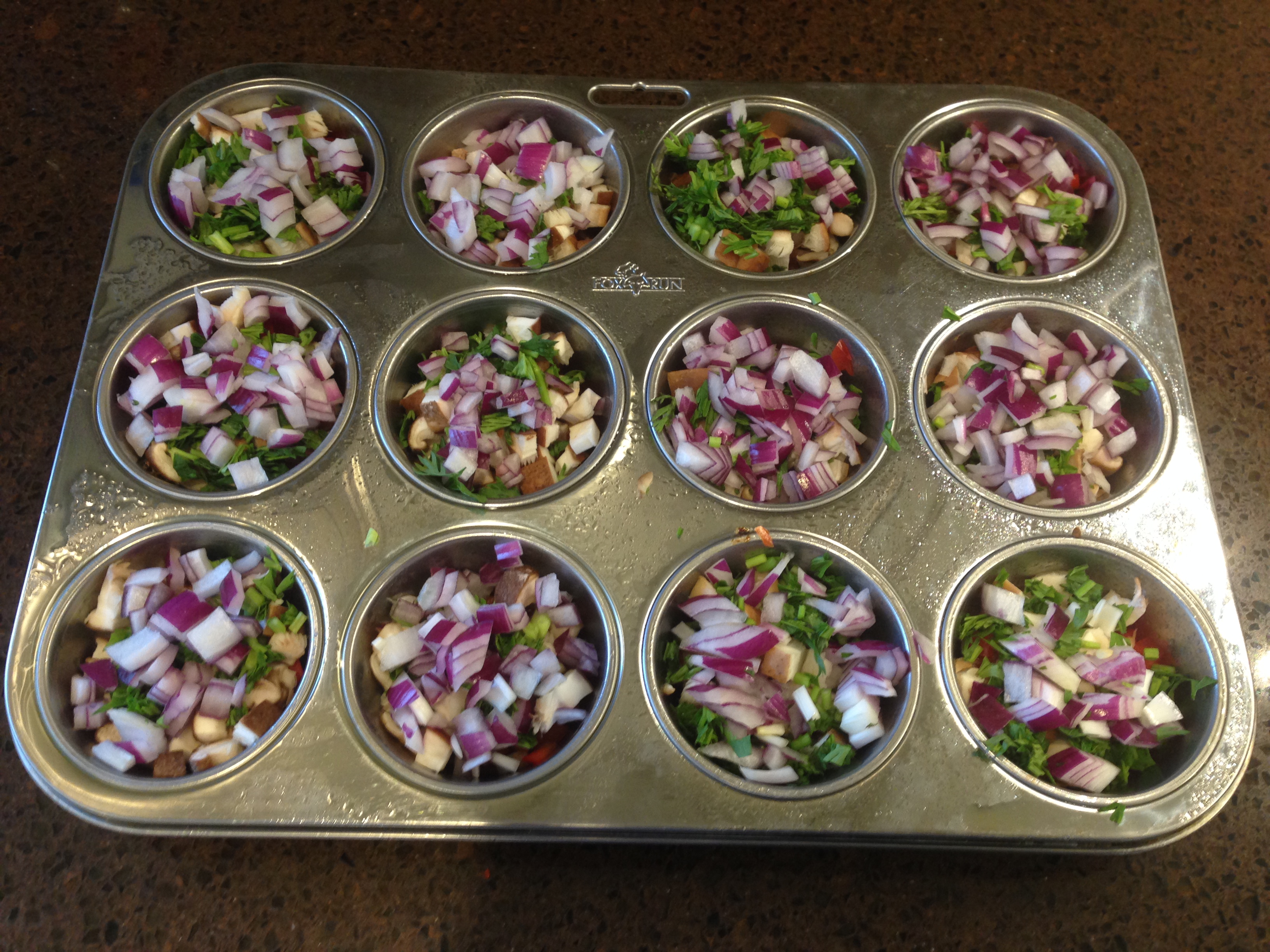
Chop vegetables. Chop whatever you have that might work well with eggs. In my experience, including at least some onion makes the poppers more appealing. Mince everything well; tiny pieces help the poppers hold together.

Fill the muffin tray with a mix of vegetables. I have found that, if you don’t pack the vegetables, you can fill the cups almost full without the finished poppers falling apart. In this example, I started with red bell peppers and then added shiitake mushrooms.

photo 1photo 2

Next came carrot greens. My chef friend turned me onto cooking with the greens from fresh carrots. They’re delicious. On top of the greens I added red onion.

photo 3photo 1

Usually I would have stopped there. In this example, not yet. I have added limited portions of quinoa to Martin’s GAPS diet. That’s been a challenge, because Martin doesn’t like quinoa, much. It happened that, the night before I made these egg poppers, I had served quinoa with scallions, parsley, and white mulberries. I decided to pile some of the leftover quinoa on top of the veggies. My filled cups looked like this:

photo 2

Once your cups are ready, whisk ten eggs with a half-cup of camel milk (or whatever milk your family uses), add salt and pepper, and pour this mixture over the vegetables.

photo 3photo 1

You’re ready to bake. Put the whole tray in the oven. Keep an eye on the poppers. After fifteen minutes or so, they will “poof” into domes. Let them cook for another five minutes or so after poofing. That’s it.

photo 2photo 3

In these pictures, I made a dozen poppers, because I served them also to Martin’s cousins, who have been visiting. Martin eats only one per morning, along with two zucchini muffins or slices of banana bread (recipe coming), so when I’m cooking just for Martin, I make only a few poppers, which I store in a sealed container in the refrigerator until ready to heart.

Mistake, I Think

In December, the following happened:

Adrian and Martin and I were at the reception following the church children’s pageant (in which Martin sang!). By now Martin and I have attended our new suburban church for 18 months. He goes to Sunday school and, with the help of a facilitator, participates in a 90-minute “Kids’ Klub” each Tuesday. He is reasonably well known, to both adult and youth parishioners.

At the reception Adrian and I socialized while Martin wandered, playing mostly alone and munching the snacks I’d brought for him. I looked for Martin often, because these days he thinks it is funny to try to sneak non-GAPS-compliant food. (When he finds me milling around the Sunday refreshments, keeping watch, he says, “Mommy, just go talk to your grown-up friends. I’m fine.”) In one such glance I saw Aiden, a seven-year-old, approach Martin with a big, soft, definitely gluten-and-sugar-and-dairy-laden cookie. Aiden broke off a cookie chunk and said, “Hi, Martin. Have some of my cookie!” Martin seemed interested, but he hesitated and looked around for my assurance.

So what did I do?

Here are the relevant factors:

  1. I was thrilled that Aiden had approached Martin, spoken to Martin like he would speak to any kid, and kindly offered to share his cookie. Thrilled.
  1. I wanted, so badly, for Martin to take that cookie. I wanted him to have a typical-kid moment, and a meaningful interaction with Aiden. Maybe they could be friends.
  1. I wasn’t that worried about the cookie. It would be an infraction, to be sure. It would set back our efforts to heal Martin’s gut, and it might cause some crazy behavior. But we would get past it. (See infra.)
  1. What worried me more was that Martin would get the impression that, on a special occasion, it is okay to take a cookie chunk, or whatever else is offered. Martin already has declared that he is allowed to drink apple juice from a box at birthday parties (effin’ birthday parties!), because once, in the throes of his disappointment, I relented and allowed a juice box. Give him an inch…!

So what did I do? What did I do?

I intervened.

I said, “Martin has food allergies! He can’t have the cookie. But thank you, Aiden! Thank you so much for sharing. What a great choice!” Aiden looked surprised. Then he left Martin alone. In a lame attempt to salvage the moment, I told Martin, “I’m so happy that you checked with me. Would you like an orange? I can peel you one.”

Inside, I felt icky. I felt like I made a mistake.

Did I? I think I probably did. I should have let Martin and Aiden share. I could have talked later with Martin about this “exception” and about how to respond when offered food in the future. I could have asked him to track how his tummy and mind felt. I could have created a hands-on lesson or done role-play. I could have ignored, i.e., pretended that I didn’t see Martin looking for my assurance, and allowed him to do what he wanted, and only later “noticed” what had happened, so that at least the cookie-share wasn’t officially mommy-sanctioned.

I could have, should have, blah, blah, blah. Whatever I could or could not have done, what I did do in the moment was deprive Martin of a typical-kid interaction and of maybe (dare I hope?) the path to a new friendship.

The teachable moment, it seems, was mine alone.

P.S. As long as I’m confessing mistakes, and along the theme of “we would have got past it,” I think I’ll subjoin this little divulgence: We have been taking Martin to children’s (“family”) movies. A lot of the time, Adrian takes Martin, and I get a pass, because try as I might, I just don’t enjoy feature-length animation. (Leave me alone. My oldest brother, Rudy, is an animator. He’s asked me all the pertinent questions. No, I didn’t like Aladdin. Nor Toy Story. Nor Cars. Nor even Fantasia, too much, at least not when sober.)

One recent movie I did attend, because it was live-action, was Alexander and the Terrible, Horrible, No-Good, Very Bad Day. In the theater I purchased a Diet Coke®. I know I should be healthier, and I have done really well curbing my Diet Coke habit, but occasionally, for whatever reason, I still drink a Diet Coke. Attending a matinee showing of Alexander and the Terrible, Horrible, No-Good, Very Bad Day, on a rainy afternoon, when every kid in our suburb seems to be at the movies, qualifies as such a reason. Halfway through the movie, I went to the restroom. I returned to find Adrian, with an are-you-kidding-me? look on his face, restraining Martin on his lap. Apparently, when I left, Martin picked up my Diet Coke and drank most of it. That’s right. My GAPS-diet son, who has consumed neither processed foods nor refined sugar in four years, went to town on motor oil and aspartame. Just one more endorsement on my application for autism-recovery mother of the year.

Mommy Sticks

My family jokes that Martin is “momnmy-centric.” Very mommy-centric.

If I am in the vicinity, Martin is all about me. An interaction with another adult might transpire this way:

Adult, to Martin: “Martin, what did you do at school today?”

Martin, to me: “Mommy, did I go to school last Thursday?”

Me: “Martin, [other adult] asked you a question.”

Martin, to me: “We went to gym class.”

Me: “Can you tell that to [other adult]?”

Martin, to me: “No.”

Mommy-centric Martin needs to talk with me constantly, regardless of whether others are present. One particularly annoying derivative of constant talking is Martin’s anxious reliance on saying, “Mommy.” He might attach “Mommy” to continuous questions, related or unrelated, as in—

“Mommy, is today Friday? Mommy, is Freddie in the basement? Mommy, what am I having for dinner? Mommy? Mommy, is Daddy in the office? How do we spell ‘course’? Are we going on vacation next year, Mommy? Mommy, can you talk to me? Mommy?”

Other times there isn’t so much as even a question with the “Mommy.” He just calls “Mommy!” because he wants to know I’m present, or because he’s nervous, or because someone else has spoken to him, or because he needs to be talking but has nothing to say, or because—. If Martin is eating breakfast and I exit the kitchen, “Mommy!”, yelled from the table, will follow me down the hall. If Martin is playing and I go to the bathroom, I can expect at least four or five “Mommy!” cries before I reemerge. If I plead, “Martin, can you please stop saying ‘Mommy’ for a few minutes?”, he responds with something like, “I’m not going to talk at all. That’s it. I’m not going to talk at all! Mommy, should I not talk at all? Mommy?”

The habit is annoying, to be sure. Even more problematic, other children have started to notice and use it as a reason to tease Martin. At a birthday party not long ago (effin’ birthday parties!), Martin called to me non-stop from the table where the children sat to eat. By the time the pizza was cleared and cake arrived, a couple girls near Martin were mockingly yelling, “Mommy-mommy-mommy-mommy-mommy!” Martin’s cousins Luke and Rosie, who are visiting right now, say, “Oh, mommy-mommy” whenever Martin is absent and we mention his name.

Some behaviors demand radical solutions. Introducing: mommy sticks.

Each morning, since Sunday, I place a glass on the kitchen counter and fill it with 25 pipe cleaners, which I call mommy sticks. When Martin says “Mommy,” I remove one pipe cleaner. If, at bedtime, one or more sticks remain in the glass, Martin wins a surprise. Nothing major. An Angry Birds pencil. Stickers. A coin-sized plastic car. The prize isn’t that important; Martin likes to win, so incentive-based systems work well.

I don’t distinguish among uses of “Mommy.” It might, for example, be completely legitimate for Martin to yell, “Mommy! I think the stove is on fire,” or, “Mommy! Is the cat supposed to be eating off my dinner plate?” Still, doing so would cost him a mommy stick, just as much as randomly calling “Mommy” to the wind. My goal is to get Martin to think about why he’s saying “Mommy,” and whether doing so is worth a mommy stick, instead of vocalizing by habit.

So far, I’m giving two thumbs up to mommy sticks. Four days in a row, Martin has won the prize, and Adrian and I have noticed a marked decrease in “Mommy!” floating around the house. Yesterday, Martin snidely tempted fate; when he saw about a dozen sticks left, he looked directly at me and said, “Mommy. Mommy. Mommy, Mommy, Mommy.” I extracted five pipe cleaners. Still he met his goal. That moment notwithstanding, I hope the system continues to function.

And I wish all behaviors could be addressed this easily.

Oranges, bananas, apples, avocados, onions, and mommy sticks. That's the kitchen counter in our ASD household.

Oranges, bananas, apples, avocados, onions, and mommy sticks. That’s the kitchen counter in our ASD household.

Birthday Parties and Swimming Pools

Birthday parties and swimming pools. I hate them.

I suppose that sounds harsh. Who hates birthday parties and swimming pools?

The problem with birthday parties and swimming pools is that they expose Martin’s remaining social weaknesses.

Case in point No. 1:

In December, two boys from Martin’s class held a joint birthday party at a Chuck E. Cheese. If you’re an American parent, you’ve probably experienced a Chuck E. Cheese birthday party. Video games. Pizza. Noise and flashing lights. Giant automated rodents manipulating musical instruments.

(Digression. More than three decades ago, I had my ninth birthday party at a Chuck E. Cheese. It may be the fog of time to blame, but I remember the place very differently than today’s Chuck E. Cheese. In my memory, Chuck E. Cheese is dimly lit, with more stages and Skee-Ball, fewer arcade consoles, and—could this be pure imagination?—physical play like a ball pit. Also, a candy counter with mammoth speckled gobstoppers. The candy counter was out front, before the entrance turnstile, and I used to duck into Chuck E. Cheese just to pay 50¢ for a gobstopper so big that I had to extract it from my mouth, repeatedly, until I sucked it down to a manageable size.)

I have written before about Martin’s difficulties when we attend class play dates. Half the boys in his self-contained special-ed class have speech/language delays but no social impairments. The class breaks roughly into three groups: the boys who instigate some imaginary game or roughhousing and play together, the boys who play alone and seem uninterested in joining the others, and—Martin. Martin, who wants to participate in cooperative play yet still doesn’t quite grasp the “how,” or have the confidence, to make others include him. Martin, gazing through the window, never beckoned to enter.

Chuck E. Cheese in December was a disaster. The flashiness overwhelmed Martin, and he couldn’t, or didn’t want to, understand any of the video games. I managed to sit him in front of me on a fake jet ski and run a virtual course for a few minutes, until he (quickly) bored. Soon he went instead to fixate on the mechanical mouse band. He ran hither and fro in front of the stage, occasionally tried to climb aboard, refused to venture back to the game section, where his classmates played.

Late in the party, after the pizza, and Martin’s special GFCFSF pizza, I was happy to find Martin and Jack, one of the more social boys, together in a walk-in video console, all smiles, pretending to play the game. I asked, “What are you two doing?” Jack answered, “We’re shooting aliens!” At that moment, Benjamin, another social boy, appeared. He pointed to Martin and said, “You go home!” Then he yanked Jack’s arm and said, “Jack, come play with me!” Jack obliged, exited the video console, and scampered away with Benjamin.

Martin stopped smiling. He looked at the empty space beside him, and said, “Mommy, I’m ready to go home.”

Yeah. Unstructured group play dates suck. Birthday parties suck double.

Case in point No. 2:

Last week, we were vacationing in Florida with my father-in-law; Adrian’s 13-year-old nephew, Luke; and Adrian’s 11-year-old niece, Rosie. For two days of our trip, we were joined also by another couple and their almost-three-year-old son, Marty. (Pardon the confusion. Their son happens to have the same name as the alias I chose for Martin in this blog. Not my fault. I started the blog before they named their son.)

Luke and Rosie, who see us infrequently and (by Adrian’s choice) have never been told that Martin has autism, showed their cousin due attention, amusing him, sharing iPad games, keeping an eye on him near water. If Luke and Rosie perceived Martin’s differences, they may have chalked them up to the language barrier; neither Luke nor Rosie speaks English, and although Martin undoubtedly understood his cousins, these days he refuses to speak Spanish with anyone except Samara. For the most part, Adrian and I were pleased with the children’s interactions. Rosie even had Martin sleeping in her bed at night.

When almost-three-year-old Marty arrived, however, The Martin Show was over. Once an adorable, lightweight—pick him up! carry him around! push him on a swing!—preschooler is on the scene, who wants to hang around with an awkward, sometimes stand-offish first grader? Luke and Rosie turned their attention elsewhere, and Martin was left to his iPad.

One morning, while the rest of the adults went parasailing, I took Luke, Rosie, Martin, and Marty to the resort’s splash pool. Little Marty was in high spirits as Luke and Rosie sprayed him with water, helped him through tunnels, and solicited giggles. Martin, my Martin, responded by focusing entirely on me, asking just-to-be-talking questions. “Mommy, are we in Florida?” “Mommy, did your cat named Billy die in 2002?” “Mommy, are you looking at me?” I told Rosie that I thought Martin might be feeling lonely. Rosie sweetly approached Martin, took his hand, and asked whether he wanted to climb into the model pirate ship. Martin said, “Go away.”

Martin also complained, to me, that he wanted to leave the splash pool and go to the nearby swimming pool. No one else wanted to leave the splash pool, and whereas I couldn’t let either Martin or Marty out of my sight, I told Martin he’d have to wait. He waited, kvetched, begged. At last I told everyone to move to the swimming pool, hoping Martin might re-engage.

Another disaster. I’d forgot the way Martin generally behaves in a crowded swimming pool. He likes swimming these days, I think because of the sensory aspects. Those same sensory aspects seem to prompt him to turn almost entirely inward. He bounces around the pool steps, half-floating, tunes out other children, and if he speaks, directs the comments only to me. He had followed this pattern for three days already at the resort. I’m not sure why I thought it would change now, and it didn’t.

Luke and Rosie, for their part, took over the complaining, because they wanted to take Marty back to the splash pool. So after 15 minutes of Luke, Rosie, and Marty ignoring Martin in the swimming pool, and Martin ignoring them, I moved everyone back to the splash pool. Martin isolated himself again, this time with the added unhappiness of having had to accede to others’ wishes.

Golden. Martin competing with other children sucks. Swimming pools double suck.

I’m going to put birthday parties and swimming pools out of my mind. Instead, I will imagine fluffy kittens chasing butterflies through a meadow.

It’s not denial. It’s survival.

Martin and Marty at the splash pool, occasionally aware of each other.

Martin and Marty at the splash pool, occasionally aware of each other.

In a nice moment without other kids around, Rosie escorting Martin to the children's area.

In a nice moment without other kids around, Rosie escorting Martin to the children’s area.

Unexceptional

We’re vacationing in the paradisiacal Florida Keys, these land slivers with Atlantic to the east and Gulf to the west. I’m writing on our villa’s back deck, just before dawn. My feet are up, and just beyond my toes lie a narrow boardwalk and harbor access. I can barely discern the shadows of a dozen boats docked nearby, and only by the occasional honk of waterfowl breaks the crepuscular still.

Perfect, right?

No. So far, four days in, it hasn’t been much of a vacation for me or for Martin. Just like on Christmas day, he’s been sick, sick, sick. Last Friday, the day after Christmas, he remained sick but appeared to be on the mend. Friday night wasn’t great; the coughing and runny nose kept him up. Saturday morning, though, he sprang from bed and danced about, singing that we were going to Florida, and so we decided that he was well enough to get on the airplane. Indeed, Saturday ran smoothly. The biggest challenge came when we stopped at a friend’s house in Miami. Adrian’s father and niece and nephew, who are joining us on this trip, were already at the friend’s house, swimming. Martin had a monumental meltdown when Adrian said he couldn’t swim.

Saturday night Martin fell asleep with one of his cousins. Before midnight I carried him from that bed because his coughing and fretting were keeping her awake. Martin spent the rest of the night in my and Adrian’s bed, his coughing and fretting keeping us awake. Sunday, Martin participated in vacation activities listlessly until finally, before dinner, he fell asleep on the sofa and we moved him back to my and Adrian’s bed. Monday, Adrian took his father and niece and nephew to Key West. Although I love Key West, I stayed behind with Martin and spent the day coordinating. I spoke repeatedly with his pediatrician and his MAPS doctor back home, communicated on-line with his homeopath, did some research of my own, found a pediatrician here to visit, went to a pharmacy for prescription medication, went to a health-food store for holistic remedies, returned to the pharmacy for a different prescription, and all the while pampered Martin.

The verdict? Martin has a bad cold and middle-ear infections on both side. His chest, thank goodness, is clear.

Last night, Tuesday night, Martin slept through the night, albeit tossing about. I was not so lucky. In the course of nursing Martin, I picked up his bad cold, and despite multiple doses of “nighttime” cold syrup, I spent the night awake, clearing my nose. Around 5:30 am, worried that I would wake Adrian and Martin (who is still bedding with us), I gave up and came out here to write.

What this whole saga stirs in me is the thought of how non-traditional my parenting experience has been. Readers who’ve been with this blog a long time know that Martin didn’t used to get sick. From age one until age three-and-a-half, there was virtually no illness. No stuffy noses. No stomach bugs. No ear aches. No fevers. When he finally did get a fever, eight months or so after we started biomed, we weren’t even sure what to do.

Times are changing. If I’m remembering correctly, this is the fourth time Martin’s been sick, and the second ear infection he’s had, in 2014. The first time he had an ear infection—“Any idea why my son might be waking with his hand over his ear and howling?” I asked an on-line parenting forum (duh!)—Adrian said, “Poor little guy. I used to get ear infections all the time. They’re so painful.” That’s right. Young kids get ear infections. They get stuffy noses. They need fevers. Their illnesses are supposed to disrupt plans, even vacations, from time to time, right? That’s how an immune system develops. Martin’s inability, all that time, to mount an immune response, was atypical.

My only child has an autism spectrum disorder. So many facets of traditional American parenting don’t apply to me. Martin doesn’t attend the local school, or the local day camp. He doesn’t play on the soccer team, or beg to go to Chuck E. Cheese’s, or want a video-game console for Christmas. He doesn’t eat French fries or junk food. He doesn’t, or didn’t, even get sick. Sometimes I find few points of connection between me and parents of NT six-year-olds, and even as Martin becomes more typical, there are facets of childhood we have lost irretrievably.

Perhaps the flipside is joy in unexpected places. How many parents can be happy when a fever gets in the way of vacation? Or when their kids act naturally bratty? Our culture is built upon the drive for exceptionalism. I’ve spent my life trying to be exceptional. Having an exceptional parenting journey thrust upon me has done a lot to temper that drive. Today, in many ways, I’m fighting for an unexceptional life.

Strange, this path.

To Martin, on Christmas

Martin, my love, my bunny rabbit, happy Christmas.

It’s been nearly four years since we began biomedical interventions to help you regain your health. If you read this one day, I thought you might like to know how Christmas 2014 looked.

This was the first season that you took an interest in Santa. Daddy and I have never done much to talk up Santa at home, so I’m not sure where you caught the faith. But you did. Since mid-December you’ve implored me to text Santa your holiday wishes, continuously, as they sprang from your head. I had to change Daddy’s contact information in my iPhone to “Santa Claus,” because with each outgoing text you inspected the screen to confirm that Santa would receive the message:

Santa Claus, Martin wants me to tell you that he did very well and played games today.

He would like you to bring him a Knuffle Bunny for Christmas.

Santa, Martin would also like Rudolph.

And a golf club and a golf ball.

And a calendar for January.

Santa, Martin finished all his soup!

I may never erase those text messages.

You approved the idea of lighting a fire to warm up the chimney for Santa, and you agreed that we should leave him a snack. I have to apologize: I forgot to leave a snack last night. This morning, when I saw you headed toward the family room, I grabbed a clean plate and a couple orange rinds from the counter, beat you to the fireplace, and claimed they were evidence of a snack consumed by Santa. Forgive me that! Know that I tried to hum your Santa vibe 100%, until you asked, “Will Santa come into my bedroom and give me kisses?” That was creepy.

You received pretty standard kid-presents. A lot of books. That Knuffle Bunny you asked for, along with a stuffed Paddington. A solar-system wall chart for your bedroom. Daddy bought you a fancy sweater; he’s that way. A family friend gave you a telescope! We can’t wait to assemble that.

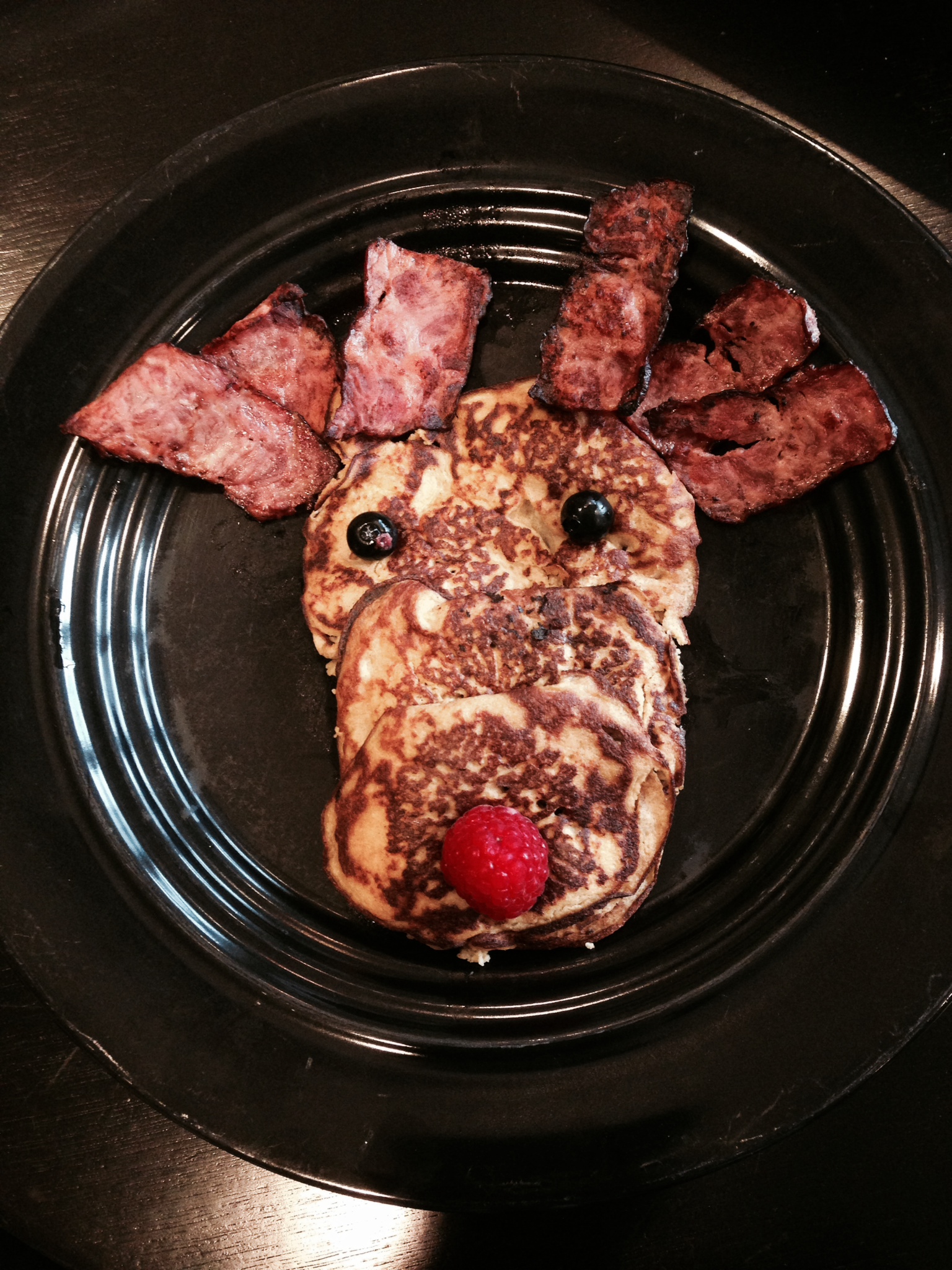
I was a disappointed that you didn’t show much enthusiasm opening presents, or for the Rudolf-the-red-nosed-reindeer breakfast I made you. That being said, it didn’t take long to track the pathology of your indifference. Halfway through breakfast, you asked to “take a break” on the couch. Soon after that, you developed a fever, and snot streamed over your mouth and chin. You were sick, sick, sick. You are sick, sick, sick, with a fever and everything. That might not excite all parents. For us, remember that we passed years wherein your body never managed the healing reaction of a fever. In 2014 we’ve welcomed three or four fevers.

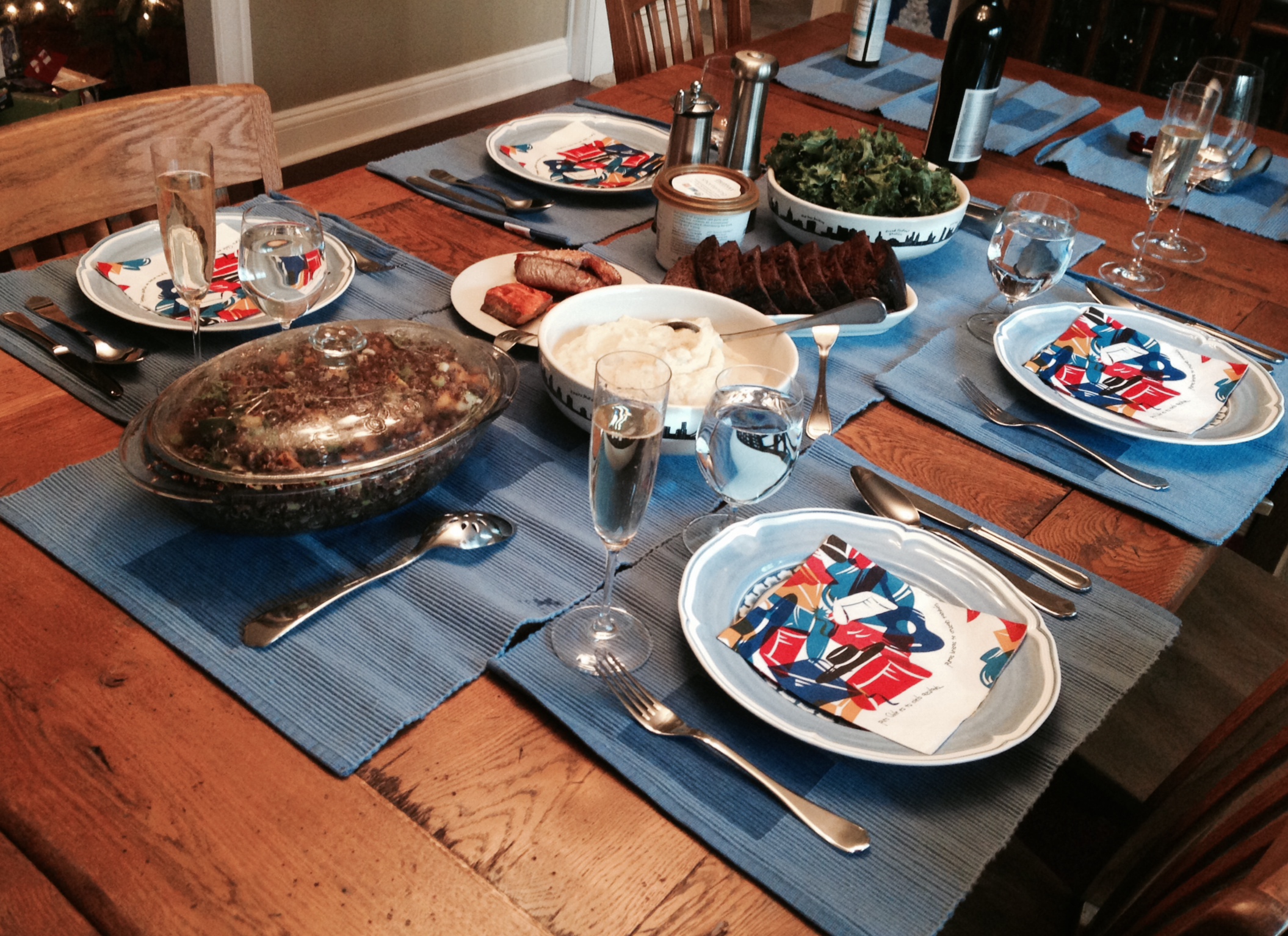
Our friend Edwina came for Christmas supper. I made everyone’s meal GAPS-compatible (with the addition of quinoa): deviled eggs and peanuts as hors d’oeuvres, then quinoa-vegetable stuffing, kale salad with cranberries and homemade dressing, salmon, mashed cauliflower, hazelnut-zucchini bread, and chocolate-avocado pudding, berries, chocolate chunks, and my own meringue cookies for dessert. A fat lot of good all that effort did: You weren’t well enough even to come to the table, let alone eat. At least Daddy and Edwina enjoyed the food.

The feast we had without you.

The feast we had without you.

We used “FaceTime” to talk with your family in South America and across the United States. Your sickly participation, though lethargic, was good-natured. Throughout the day I texted your U.S. grandparents and your uncles bulletins on your condition. I was worried that, having slept so much of the afternoon on the couch, you might not be able to fall asleep tonight. Your Uncle Rudy, from California, told the whole family that he was sure you would fall asleep fine. It’s nearly midnight now, and you’re still awake. Plainly, your Uncle Rudy is not a reliable predictor of these things.

You were supposed to go to the local Jewish Community Center tomorrow (Friday), for an all-day social program. That would have given me a lot of time to prepare to leave 7:00 am Saturday for Florida. Unless you make a miraculous recovery over the next eight hours, I’ll keep you home tomorrow; Saturday morning—please may you feel better by then—we’ll embark less than ready. Don’t feel bad. It’s not the first time I’ve scrambled to get it together for vacation. It won’t be the last.

Martin, my love, my bunny rabbit, may you cherish these days. Happy Christmas.

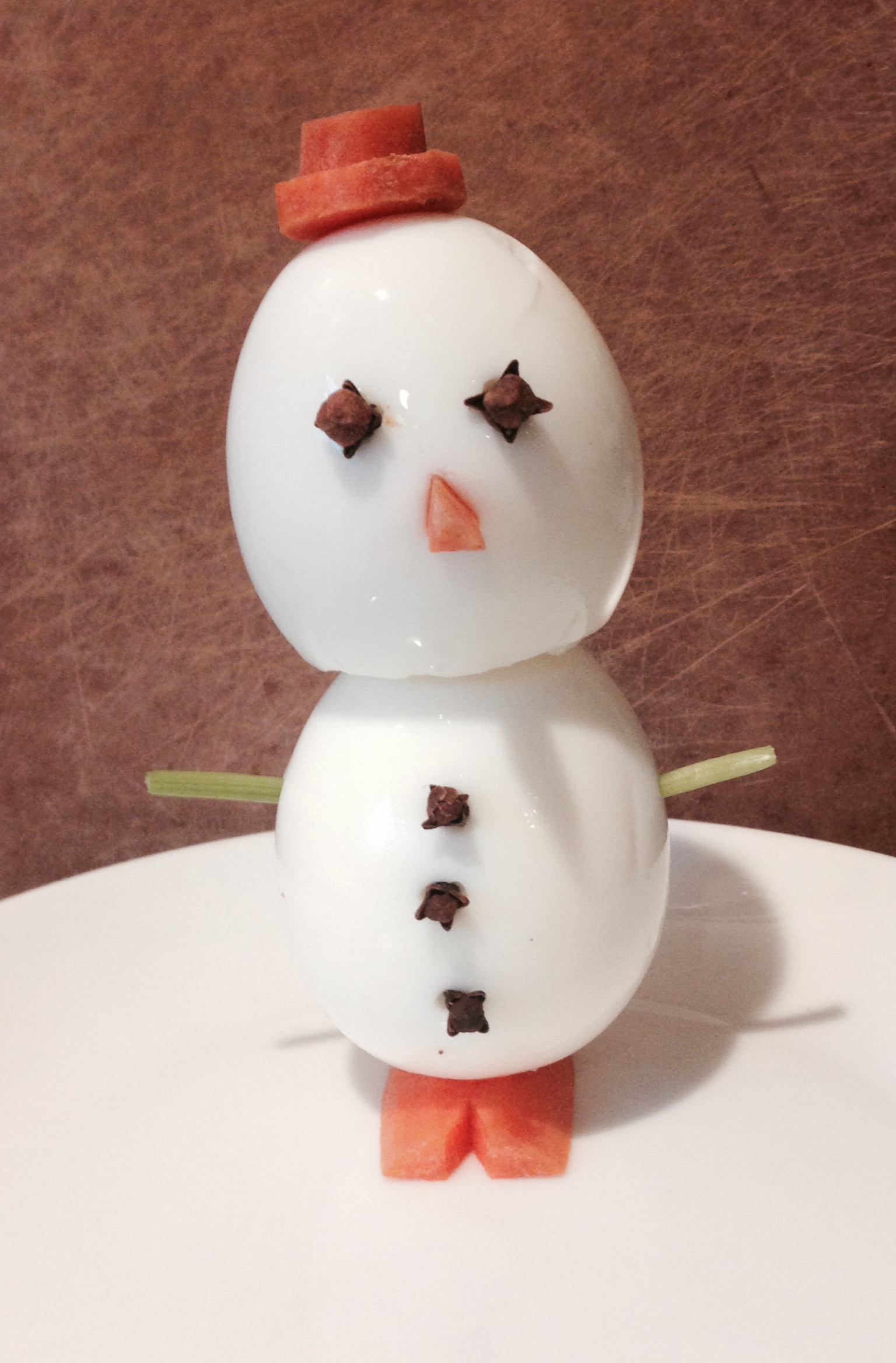
The breakfast I made you yesterday. You complained about eating eggs.

The breakfast I made you this morning. By then you weren't hungry because you were getting sick.

The breakfast I made you this morning. By then you weren’t hungry because you were getting sick.

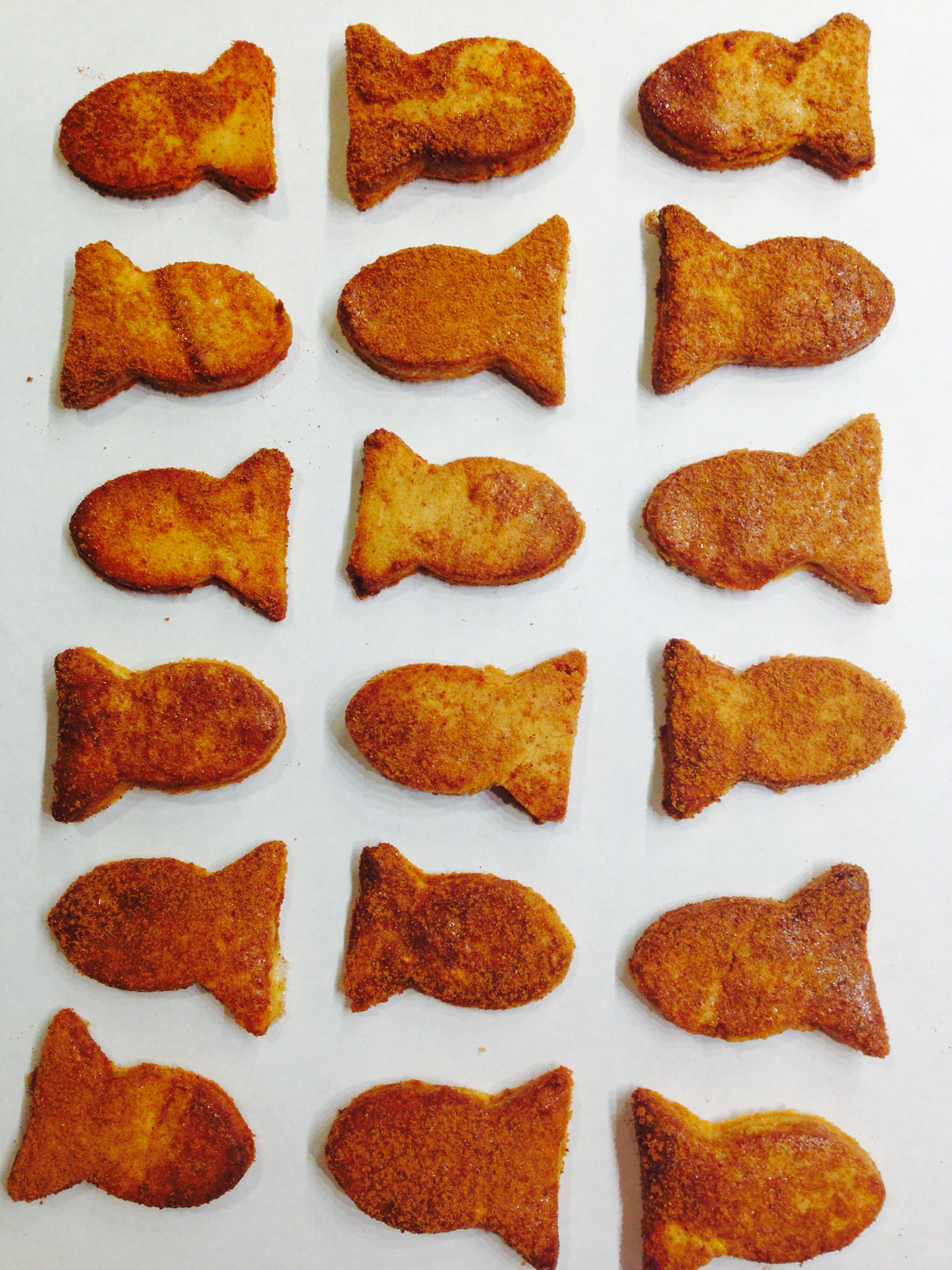
ASD Recovery Recipe: Holiday Cookies, or “Get Off the Freakin’ Goldfish Already”

Readers, are you sick to death of reading my goldfish creations? Are you bored of stories about GAPS almond-flour goldfish, or goldfish made with macadamias that are soaked, and dried, and pulverized?

I can imagine. I’m a tad sick of goldfish myself.

Here’s the thing: Martin will never get sick of goldfish. Like, never, ever. Our local supermarket has a Goldfish® holiday pop-up display right inside the front door. The kids at Martin’s school get Goldfish® as food rewards. The kids at our church share Goldfish® at coffee hour. One elementary-school parishioner has been spotted (by—you guessed it! —Martin) toting a giant carton of Goldfish® around the church gym, scooping out handfuls to cram into his mouth. It’s like my six-year-old is perpetually swimming in a sea of Goldfish® that only he can’t catch.

And so he fixates on goldfish crackers.

And so I spend whole afternoons in the kitchen, fulfilling his goldfish dreams.

Today brought an unintentional goldfish adventure. In a lovely little Facebook group called “Fun Food on a Special Diet,” someone posted a recipe for “holiday roll-out cookies” that turned out to be GAPS-compatible. With memories of mixing and refrigerating sugar-cookie dough from my Grandma Gennie’s recipe, then rolling it out, cutting, baking, decorating, I decided to attempt sugar(-like) Christmas cookies for Martin.

Here is the recipe I used:

½ cup ghee

1 egg

¼ cup raw honey

¾ cup coconut flour (more as necessary)

1 teaspoon baking soda

1 teaspoon lemon zest

Combine the ghee and honey and beat until smooth. Beat in egg. Combine the coconut flour, baking soda, and lemon zest, then beat ¼ cup at a time into the batter. Cover with plastic wrap and refrigerate 30 minutes. Or use my lazy method: Pop the dough into a Ziploc®, smooth out air, and seal the bag before refrigerating.

After 30 minutes or more, place the dough on a parchment paper dusted with more coconut flour, add another layer of parchment paper on top, and roll out to about 3/16” thickness. (The original recipe called for ¼”; I went thinner, though not as thin as 1/8”.) Use cookie cutters to create festive holiday shapes. If you want, brush the top with egg white to create a shine. Transfer to a parchment-paper-lined cookie sheet and bake 10 minutes at 350 degrees.

I suppose you’re wondering how this turned into a goldfish adventure? I got too ambitious with my cookie cutters, that’s how. Instead of traditional shapes like the Christmas tree and snowman I had as a kid, I picked up a set that involve cutting a circle and then stamping a design into the circle with a separate disk. The GAPS dough did cut conveniently into circles that I could transfer to the cookie sheet. On the other hand, the circles were too sticky to release the molded disk, even when I dusted it with coconut flour. That left me with boring circle cookies. How Christmassy are boring circles? I suppose I could have decorated them as ornaments, but as far as decorating goes, I didn’t have many ideas beyond softening up some coconut manna and trying to color it naturally to create icing.

When in doubt, goldfish the recipe. (That’s correct. I made “goldfish” into a verb. Deal with it.) I whipped out my tiny, copper goldfish cookie cutter and went to town. Then I dredged each goldfish in egg white, which I had sitting on the counter because I’d just used the yolks for homemade mayonnaise so that I can devil some eggs for Christmas Day because my son’s autism has magically transformed me into Martha Stewart. Once the goldfish were shiny from their egg-white baths, I sprinkled them liberally with cinnamon and baked.

The result? Cinnamon holiday goldfish cookies. At least that’s the story I’m going with.

The bonus? These goldfish don’t contain nuts, so I’m allowed to send them to school with Martin for a snack.

Autism Recovery Martha parties onward.

photo-18

ASD Recovery Recipes: Snack Tray, and a Bonus for Cara

In this post are recipes for homemade marshmallows, Grinch holiday fruit treats, mint-chocolate candies, berry gummies, and raw almond macaroons.

Martin’s super-tremendous play group rotates among the houses of the six participating kids. The host usually provides snacks. When we’re at someone else’s house, I let Martin have whatever fresh fruit might be available and also bring a just-in-case treat from his snack drawer. When we are hosting, I try to serve snacks that (1) Martin can eat, and (2) the other children, who do not follow special diets, also will enjoy. That’s not easy. Most kids don’t seem to be into homemade treats (Martin also prefers store-bought, packaged foods), and if something comes in a wrapper, they expect refined sugar, not date-sweetened nut bars or sesame seaweed.

Last Friday, for the adults (the parents who hang around, in a separate room, while the kids play), I served fruit and arugula-cabbage chips. I’d bought the chips originally for Martin’s snack drawer. He didn’t like them. I loved them, and last Friday so did the other parents. Perhaps arugula-cabbage chips are a more “refined” taste. In any event, if Martin had wandered by the grown-up table and helped himself to chips, we would have been fine.

For the kids I put together this tray:

photo-17

Pictured are Grinch fruits on toothpicks, mint-chocolate snowflakes, and gummy dinosaurs.

Marshmallows (and the Grinch)

The Grinch is a concoction I’ve seen floating around the Web, on a few sites. It was pretty straightforward to make—green grape, banana slice, strawberry, secured with a toothpick—until the pom-pom atop the hat. Each pom-pom is supposed to be a mini-marshmallow. I couldn’t find any commercial marshmallows that were GAPS-compatible, so I set out to make my own. I found a recipe on Food.com and modified it to come up with this:

1 tablespoon gelatin

¼ cup cold water

1 cup coconut crystals

another ¼ cup cold water

1/8 teaspoon Celtic salt

1 teaspoon vanilla extract

Coat the inside of a small glass loaf pan with a thin layer coconut oil and powder it with coconut flour.

Dissolve the gelatin in the first ¼ cup of cold water and set aside.

In a small saucepan, mix the coconut crystals with the second ¼ cup cold water and stir this over medium heat until the crystals dissolve. Then add the gelatin mixture and bring the whole thing to a boil.

Transfer to a mixing bowl and allow to cool slightly, then add the salt and vanilla and beat ten minutes or more, until doubled in size. Pour into the loaf pan and refrigerate until you can touch the surface without the marshmallow sticking to your finger. Cut into pieces.

At this point, the original recipe instructs to coat the marshmallow pieces in powdered sugar. I wasn’t about to do that. On the other hand, I did have to take some action before I made these bits into pom-poms; because I used coconut crystals as my sweetener instead of refined sugar, my marshmallows came out tan. Pom-poms are supposed to be white! I decided to roll them in unsweetened dehydrated coconut flakes. Not perfect. Close enough.

Mint-Chocolate Candies

The mint-chocolate snowflakes were the biggest hit, though in retrospect, I should have chosen smaller candy molds. They are too a rich candy for thick portions. I used a recipe I picked up at a Generation Rescue cooking presentation at Autism One two years ago (as very slightly modified):

3 cups shredded coconut

¾ cup honey

1/3 cup raw cacao or carob powder

3/2 teaspoons vanilla extract

1 teaspoon peppermint extract

½ cup finely chopped nuts

Blend the coconut in a high-speed blender until creamy. (I think many people would do this in a Vitamix. I love my Vitamix, but I don’t like to do too much for Martin with it, because the vessel is plastic. For this recipe I use my 14-year-old KitchenAid glass blender instead.) If necessary, add a teaspoon or two of coconut oil to facilitate the blending. Set aside.

Bring the honey to a very low boil and stir for a few minutes. Remove from heat and stir in the coconut cream and the remaining ingredients.

Quickly, before the mixture cools, pour into silicone candy molds. Refrigerate until solid.

The original recipe calls for pouring the mixture into an 8×8 pan and slicing when cooled. I have done that, too, using a glass pan. The candy molds are more trouble but add cuteness to the yumminess.

Gummy Creatures

The gummy creatures were the easiest to make. I got the recipe from the same Generation Rescue presentation as the mint-chocolate candies. To make berry gummies, cook fresh (or even frozen, though I’ve had better success with fresh) berries over low heat until they are fragrant and soft, not boiling. Allow them to cool slightly and transfer to a blender. With the blender running, add pure gelatin in a 4:1 berries:gelatin ratio; for example, if you have one cup of berries, add ¼ cup of gelatin. Immediately pour the mixture into silicone candy molds, wiping away any extra. Refrigerate until they pop easily from the molds. Store in refrigerator.

Raw Almond Macaroons

As I am pounding out multiple recipes in a single post, I am going to add one more, for Cara. She’s a mom whose son participates in Martin’s playgroup. Cara complains that I send treats for her three boys and then, when she asks for the recipes, never deliver. Cara has been waiting a while for this one, and in about ten minutes I am going to text her and insist that she read this post, so without further ado, here is the recipe for raw almond macaroons. All measurements are approximate and subject to change based on what’s in my kitchen at the moment of preparation.

2 cups almond flour

½-1 cup coconut oil

½ cup raw honey

½ cup shredded coconut (unsweetened), plus more for rolling

2 teaspoons vanilla extract

½-1 teaspoon Celtic salt

Mix all ingredients. Form into balls approximately one inch in diameter. If the dough is too crumbly, add more coconut oil or, if it can stand to be sweeter, add more honey. If the dough is too oily, add more almond flour. Roll each ball in more shredded coconut. You’re done! To maintain shape and freshness, these are best stored in the refrigerator.

Epilogue

About those marshmallows: After I finished making them, I thought, well, that was a lot of work for just the little Grinch toppers. Maybe I should have bought whatever best-quality organic marshmallows I could find and allowed Martin the tiny infraction of one or two. As it turned out, I needn’t have worried about any infraction. I forgot that Martin—he who once upon a time schemed to get his hands on bananas and ordered strawberries for dessert—recently announced that he no longer likes bananas or strawberries. He refused to touch any Grinch. And the other kids, the ones without dietary restrictions, looked at my tan marshmallows with coconut coating with suspicion and skepticism.

Second Epilogue

The woman who helps me with housekeeping has a daughter with food allergies and a son with social challenges, and as a result she is cautious with their food. During the week she happened to lament, casually, that she couldn’t find any acceptable marshmallows for their hot chocolate. “Did you say, ‘marshmallows’?,” I asked. I yanked my half-pan of leftover Grinch marshmallow from the fridge and cut a bunch of mini-chunks. She sampled one, proclaimed it delicious, and promised to report on whether her kids go for brown marshmallows. We’ll see.

For Diana

Last week, in response to my “Journey” post, I received this comment:

I read your blog from time to time. We have had a few exchanges, where I argued against the idea of “recovery” and said we just need to support our kids to be successful. You said you thought that was mincing words and we both want the same things. I’m really glad to read that Martin is doing well and progressing. I’m sad to hear you are still trying to “recover” him. Some day he may read what you have written. And he will want to tell you that he wasn’t lost, just different. Keep helping him, of course, but maybe this holiday season there is a moment to see that he is not lost? It is a big job, I know, but it is tough on a kid when “fixing” him becomes his mother’s project. That is a lot to put on you both. I wish you well.

The comment comes from a woman I’ll call “Diana.” I don’t know her, except insofar as she is also a lawyer in the New York City area (that’s what I am), and insofar as she has a son with Asperger Syndrome, who I believe must be 10 or 11 years old now. Diana and I exchanged some comments on this blog in April and May 2012, and again in January 2013; we were respectful of each other’s positions on handling autism, and as is evident in the comment I’ve pasted above, she continues to be positive and respectful. I appreciate that, and I thought that, rather than tuck my response into the less-read comments, I would post it front and center.

Diana, this is for you—

Two and a half years ago, you wrote to me skeptical of the concept of ASD recovery. About your son, you said, “I want him to be proud of who he is and how he is. It is a hard balancing act, because I also want to improve his social skills and give him the most options, so to some extent I am working always to decrease how his ASD presents.” When I engaged you in discussion, you elaborated:

I do remain skeptical of recovery as a concept, but how to approach treatment is up to each parent and there are no clear answers. But the larger question, I guess, is that I don’t want to return my son to full neurotypicality because I don’t see him as having been in a certain place and then having regressed or changed. I don’t perceive an assault on who he is by ASD.

Eight months after that comment, in response to a post I wrote about Adam Lanza, the Newtown gunman, you said this:

. . . I don’t understand how the language and idea of ‘cure’ and ‘recovery’ is consistent with teaching our kids to love and accept themselves as they are. I don’t doubt your sincerity. But for me, I want to help my kid but not cure him. I really think autism is a big part of who he is. For me, lots of therapies are great and work well—but they are seeking to assist and not to fundamentally alter my kid. I like my son autistic and I like other family members of mine autistic. I would encourage you to check out grasp.org and watch the video there—it is a very smart introduction to how functioning autistic adults feel about this question. If we want our kids to be happy adults, I think we need to listen to these adult voices first and foremost. My hopes are the same as yours and I know we are all just trying to do the best by our kids.

We are all trying to do the best by our kids. I believe that, and I appreciate your recognizing and acknowledging it. Still, to be honest, I don’t think, at least not now, that we are undertaking the same goal and just mincing words. Our hopes are not the same: You hope to raise an autistic son whose behaviors are typical enough that he can function in society. I hope to raise a son who has no trouble functioning in society because he is typical.

Autism spectrum disorders do not just happen. They are not random behavioral conditions. Autism is not an individualized Weltanschauung, like the way my brother Eddie is super laid-back and my friend Stacey is Type A. Autism spectrum disorders are the manifest symptoms of health problems, most usually compromised immune function. We continue to debate the extent to which these health issues result more from genetics (MTHFR mutations, &c.), or more from environmental triggers (vaccines, GMO’s, toxins like synthetic chemicals, &c.). What is no longer up for debate, unless you ignore all current science, is that if your child has an autism spectrum disorder, he has some combination of underlying conditions affecting his health, and those conditions are resulting in neural misfires.

Your approach—and I invite correction if I am wrong—seems to leave the health conditions that result in Asperger’s uninvestigated and untreated. Instead, you rely on behavioral therapies “to improve his social skills and give him the most options,” because you are “working always to decrease how his ASD presents.”

You “remain skeptical of recovery as a concept.” I will say that I, personally, within my own circle, know three boys, ages 19, 15, and 12, who have recovered from autism. These are not children whom I have “heard of” or “read about.” They are boys whom I know. I can, and do, talk to them and their parents. Each of the three was diagnosed with autism, from mild to moderate, at age two. They recovered fully, by their parents’ estimation, at ages 8, 12, and six. They are not “quirky.” They no longer have rough edges or trouble with social skills. They are, for every purpose I can see, restored to typical neurofunctioning. They reached this point because their families treated their underlying health conditions, as I am doing with Martin. I know that every child is a puzzle, that not every child who is treated biomedically will recover (at least not with what we know today), and that Martin’s “autism” symptoms may, to whatever extent, persist his whole life. But if you need to know what “recovery as a concept” means, it means this: restoring a child’s immune function and overall health, which in turn alleviates autistic behaviors symptomatic of compromised health.

You “like [your] son autistic and … like other family members of [yours] autistic.” I adore my child. I will adore him whoever he is and however he behaves, a fact that I impart to him daily. But I do not “like” his being autistic, because his being autistic means his health is compromised. If I were to learn today that no biomedical intervention would ever change Martin’s behavior in any way, I would still continue with his special diet and homeopathy and supplements because I want to restore his health. I cannot think of another condition that I would leave untreated, so why would I stop treating his gut-flora imbalance, candida overgrowth, or mitochondrial processing disorder?

You encourage me to consider the experience of autistic adults when determining what course to pursue with Martin. I do. I have read at length about how demoralizing traditional behavioral therapies can be for persons with autism, about how ABA can frustrate and even humiliate its subjects. (Not all ABA. Some practitioners who begin with ABA and find their way to a gentle approach.) I referred above to a 15-year-old I know who reached recovery around age 12. His mother reduced his behavioral therapies after he protested, “Mom, they want to change everything about me!” By contrast, the family continued and even increased biomedical treatment, which by the end of his recovery process, the boy was requesting because of the way it made him feel better.

When Martin asks about why he cannot eat Goldfish® crackers, I explain, “Oh my goodness! If you eat those crackers, you will get those funny poopies, and the ingredients will make it hard to pay attention in school. Remember how that happens sometimes?” The culprits in this equation are the processed crackers, and how they affect Martin inside. When your son asks why you want to “improve his social skills” and “decrease how his ASD presents,” how can you respond? Is the culprit crackers and firm bowel movements, or does the culprit seem like him?

Martin does not know he has autism. He has never heard that diagnosis. He knows that he eats a restricted diet because some foods “hurt his belly” or “make his tummy do funny things.” He knows that the drops and supplements he takes are like Mommy’s vitamins and probiotics, a good idea for almost anyone. We don’t do traditional behavioral therapies. I have found that most traditional therapies—ABA, speech, even to some extent occupational and physical therapy—come with the theme, “Don’t [sit, rock, behave, chant, stim, &c.] that way. That is unacceptable. Try to fit in.” I don’t want Martin to hear that he needs “some work around the edges” (your phrase, from a comment on 23 April 2012). Martin’s behavior isn’t what needs work. His behavior naturally adjusts as his health improves.

(Note: Martin receives traditional OT and PT at school, because they are on his IEP. In that regard, I am grateful that he attends a self-contained special education school, where every student participates in OT and PT, so that they seem like a standard part of the curriculum rather than something directed at changing Martin.)

At your request, I checked out grasp.org; it presents testimonies similar to others I have read, from autistic teens and adults. In return, let me point you toward stories like What Is My Mother Doing to Me?, which was written by a 14-year-old in gratitude for his recovery. I hope that Martin will not have to tell anyone what it is like to be an autistic adult, because he will never know. And if he reaches neurotypicality, I don’t think either of us will regret the result. As I have written before, in all my experience communicating and working with other ASD families, I am yet to hear from anyone who regained his/her health biomedically and subsequently says, “I wish we hadn’t done this. I prefer being autistic to being neurotypical.” (My sample size is not restricted to the three aforementioned recovered boys whom I know personally. I know of dozens of recovered persons, on-line or otherwise.)

You seem to worry that Martin will one day read what I write on my blog. To that I say, he’d better. In part, I write this blog for Martin. I don’t think he is “lost” or that his personhood needs “fixing.” I’m not sure why you use those words. Two weeks ago, when I got socked with a virus and ended up in the hospital, I wasn’t “lost” (except maybe insofar as I passed in and out of consciousness…!). My immune system needed help fighting a health condition, and when I received that help, I recovered. My son’s immune system needs help. I’m struggling to give him that help. I look forward to the day when he understands what I’ve written here, when he receives confirmation that he is so precious and so loved that Adrian and I would scour every corner of God’s green earth to give him every advantage we can.

So that’s it. Your and my disagreement lies in whether it is preferable to treat the health conditions that underlie autism, and let the behavior do as it will, or whether it is preferable to leave the health problems untreated and try to “smooth” the resulting behavior. I’ve phrased the question in a biased way, of course. I’ve done so because I believe it is preferable to treat “autism” biomedically. You take a different approach, and that is fine. We’re cool. I don’t have all the answers.

I do hope you’ll stick with the blog, though, and continue to comment. I feel invested in your son and your journey. I pray that it leads you both to a place of contentment.

Martin in action at the trampoline gymnasium. Not lost. Just getting healthier.

Martin in action at the trampoline gymnasium. Not lost. Just getting healthier.