Just Had to Get That Out

Some themes get old on Finding My Kid. If you’re a regular reader, you can probably name a few: sleeplessness, detox and die-off, food, the New York Rangers. These are the light motifs that underlie our journey. They are the stuff of my day-to-day.

I have to add another theme to the list: skepticism and rebuke. At least, skepticism and rebuke as pertain to Heilkunst. Recall that we started Heilkunst late in 2014, and that it’s a method of sequential homeopathy designed to help the immune system clear various insults it has suffered. I went into the process with doubts. Then the first clear Martin received (for coxsackie) made him puke and also produced a light coxsackie rash, and I started to see the light. Later, when we cleared the H1N1 and MMR vaccines, plus antibiotics we’d previously used to treat SIBO, Martin’s reactions and improvements were so dramatic that I became “non-skeptical.”

At least for a time. But there were no dramatic improvements for a while, and I grew complacent, and complacency, evidently, reopens the door to doubt. I asked myself: Is Martin still benefiting from Heilkunst?

If you happen to write fiction, you’re probably familiar with Chekov’s gun, which is the rule that a story (or play, or scene, or essay) should be free from extraneous detail. I poked around and found that the gun is usually attributed to a letter Chekov wrote in 1889 to playwright Aleksandr Semenovich Lazarev: “One must not put a loaded rifle on the stage if no one is thinking of firing it.”

Writing rules are meant to be broken, but I will respect the gun—which is to say: I raise my Heilkunst doubts because I intend to erase those doubts.

It isn’t supposed to be all about me. Is it?

To this day, I carry guilt about Martin’s birth. I won’t describe all the circumstances again, except this brief enumeration: In the 42nd week, against my better judgment, I allowed induction by Pitocin, which led to Martin getting “stuck” sideways, which led to continual drops in his heart rate, which led to an unplanned C-section, which upset me so much that I got a fever, which (“maternal fever”) caused the hospital to place my healthy baby in the NICU and pump him with intravenous antibiotics, in an incubator away from skin-to-skin contact.

Here’s a portion of the story I haven’t shared before on this blog: After Martin was taken, I was wheeled into a “recovery room” and told to sleep. Even then, my instinct told me that something was wrong. I needed to get to my child, and so, fresh off a surgical table, I pulled myself from the hospital bed and tried to find Martin. I made it only a few paces before blood collected around my feet and I slipped. A nurse entered and found me on the floor, a mess, trying to rise again. The nurse insisted that I get back into bed. I said, “No. My child. I have to get to my child.” Finally, I agreed to lie on the bed on the condition that she find Adrian: “Get my husband! Go get my husband!”

She left the room. Somehow, Adrian and my mother appeared in the recovery room with Starbucks drinks. (It was early morning.) Though even I didn’t know why, the sight of Adrian and my mother smiling with Starbucks drinks in their hands enraged me. When our child needed us, they’d gone to Starbucks. I told Adrian to go to Martin, to find Martin and protect him. Adrian said Martin was fine, that the doctors were taking care of him, and that I needed to go to sleep. I said Martin needed to be with me, and that Adrian needed to find Martin immediately.

I don’t know what happened after then. I have no more recollection. My next memory is being wheeled into my own hospital room. I may have fallen asleep, or fainted, or become delirious (if I wasn’t already). Or maybe I’ve blocked the memory. In any event, what remained was the impression that Martin was in danger, and I was at fault, and Adrian was at fault, and nonsensically even my mother was at fault. Three years later, when I began to understand what antibiotics do to the gut biome, and the gut biome’s connection to autism, I wanted nothing more than return to the day before Martin’s birth and refuse the Pitocin, and refuse to surrender him to the NICU.

Please don’t chime in and point out that my guilt is unjustified, or that it is ridiculous to be angry with Adrian and my mother for getting Starbucks. I know that most first-time parents have neither the foresight nor the wherewithal to realize how destructive our medical birth culture can be. I know all that. Yet, when Martin was five, I attended a wedding and was seated next to the bride’s brother-in-law, who was holding a six-week-old baby and also full of bravado. “They tried to put her in the NICU,” he declared, after describing some minor complications. “They said they’d call family services if I didn’t let her go. So I said, ‘Go ahead and call family services. My lawyer will be here long before they will.’ They gave up and left us alone. Ha! I know my rights!” His performance upset me enough that Adrian and I had to leave the wedding early.

Two months ago, the envelopes with Martin’s latest two Heilkunst clears arrived by mail. When I had talked with the homeopath, he mentioned which clears were coming, but I hadn’t paid much attention and wasn’t thinking about that when I tore open the big envelope to extract the smaller envelopes with remedies.

As soon as I touched the remedy envelopes, my hands began to shake and I started crying. I had to catch my breath. Unsure what was happening, I set the whole packet down and took a minute to compose myself. Sometimes I experience generalized feelings of unease and have to pause to remember what’s got me anxious—an unaccomplished work project, an upset friend, a fight over a bill, whatever. The feeling that overtook me when I was opening the remedies, however, overran generalized unease or emptiness. It was an immediate affront, and I couldn’t connect it to anything happening in my life.

At length, confused, I retrieved the first remedy envelope and noticed what was inside: the first of several clears related to Martin’s birth trauma and NICU experience.

I have no explanation for this event other than to believe whatever energy was in those envelopes—homeopathy is energetic medicine—provoked a reaction in me, from the spot of my regret.

Just had to get that out.

Along with the clears every few weeks, Martin also takes daily Heilkunst drops. One dropper helps with Lyme disease, and the other is a drainage dropper that helps him move stuff through his system generally.

About a month ago, his drainage dropper became contaminated and I had to order a new one. I could have replaced the drainage dropper with a “paper remedy,” which is where you write the particular remedy on a piece of paper and keep it near the recipient. Believe it or not, however, some aspects of homeopathy, like paper remedies, still seem too far out there even for me. So I ordered a new drainage dropper, which had to be sent from Canada and then reconstituted upon receipt, and a lot was going on, and yadda yadda yadda, Martin went a couple few without his drainage dropper.

Martin’s final week without the drainage dropper was dreadful. He was defiant, resistant, downright crabby. His teachers reported silly and unfocused behavior. His personal trainer said he seemed “out of it.” He demanded constant attention. He couldn’t fall asleep. I had an extra glass or two of wine. (Food for thought on that topic, see this opinion piece.) I connected none of this to homeopathy.

Sunday, the end of that week, was no exception. Martin vacillated between wanting to accompany me to church and wanting to go with Adrian to the gym. Actually, he spent more time complaining about both choices. He wanted to stay home and use his iPad. He wanted to stay home alone. He complained about lunch. He complained when Adrian “made” him go swimming. He whined so much about the notion of going out to dinner that we decided to eat on our back deck instead. (We don’t usually yield to whining. A great blizzard can snap even the most stalwart bough.)

Meanwhile, I finally got my act together and prepared the new drainage dropper, which had arrived at least a week earlier and sat on the counter. Mid-afternoon, Martin had his first drainage drop in several weeks.

He ate dinner without incident, other than grumbling about what I’d prepared. He was two bites into dessert (chocolate quinoa cake, leftover from entertaining Saturday guests) when he said, “My tummy hurts.”

“Why don’t you go to the bathroom?” I asked.

He went in the house.

He didn’t return.

Five minutes later I found him sitting on the toilet, hunched over. “My tummy hurts,” he said.

“Did you go to the bathroom?” I asked.

“I can’t.”

“Let’s see if a warm bath helps.” I ran a warm bath with Epsom salt and baking soda and helped Martin into the tub.

I’m going to yadda yadda some more details here. I’ll report the highlights: a bathtub of water, Epsom salt, baking soda, and puke; Adrian yelling, “Get him to the hardwood!” as Martin started to puke on the family room rug; me grabbing the countertop compost bin to catch more puke.

When Pukefest concluded, Martin said simply, “I need to go to bed.” Within two minutes, he was asleep, at least an hour earlier than usual.

When it comes to Martin, I’m prone to overreacting. Once the house had been scrubbed clean, I proceeded directly to Google to review the signs of delayed drowning, because Martin had spent the afternoon in the pool and now was unwell. Excessive tiredness was on the list. Vomiting, maybe. Martin had none of the other symptoms of delayed drowning, and he’d identified a tummy ache, not any pain in his lungs or chest. None of that stopped me from waking every hour during the night to check on Martin to make sure he was breathing well and not foaming at the mouth. And so I can tell you this: That night, Martin slept. For thirteen hours he barely stirred.

When he woke, at 8:00 Monday morning, Martin was utterly buoyant. He bounded into the kitchen and said, “It’s already 8:00! I slept late!” I replied, “That’s no problem. I will drive you to school after you eat breakfast.” (Martin attends summer school, for which I usually wake him by 6:45.) I steeled myself for protest; Martin will exploit any excuse to get out of school. The protest wasn’t forthcoming. Instead, he said, “Sounds good! I’m going to get dressed.” For breakfast, he ate eggs and veggies in a tortilla. When I picked him up from school, his teachers said he’d had a “fantastic” day. His personal trainer reported “big improvement.” He ate dinner without a whimper. He went to bed and slept soundly again.

Coincidence? Or just undesirable stuff—who knows what?—building up without his dropper?

Once upon a time, I would have said the former.

P.S. According to Wikipedia, Aleksandr Semenovich Lazarev was a pseudonym of A.S. Gruzinsky. Other than that, I can’t find out much about him. Poor Lazarev/Gruzinsky appears to be remembered only for Chekov’s gun.

IMG_3972Martin prepares to take a swim lesson.

Cherry-Lime Soda

Martin and I were in the car. He complained he was thirsty, so I offered him a sip of my cherry-lime kombucha “soda.”

Martin examined the label, then handed back the bottle and said, “I can’t drink soda. It has refined sugar.”

“It’s okay,” I said. “It’s not real soda. It’s kombucha.”

He took the bottle again, shook his head, and said, “It says ‘cherry-lime soda.’ I’m not having any.”

I’m telling that anecdote for two reasons. First, I have read about kids who police their own food, who attend birthday parties and turn down cake and pizza. I envied the parents who could trust their kids with food choices. Now it seems I have cultivated such a kid. Martin told me recently that an assistant teacher had tried to give him a “fruit snack”—one of those corn-syrup-and-artificial-color bombs disguised as a fruit product. “I said no!” he declared, with glee. “I said I can’t have that!” Evidently he found it funny that the offer had been made at all.

Second, “cherry-lime” is a cheap way to introduce my long-promised post about Lyme disease. (Get it? Lime-Lyme? What? You’d forgotten how I promised a post about Lyme?) Lyme disease is playing a major role in our lives right now. We are fighting Martin’s Lyme disease with antimicrobial herbs, which sound innocent but provoke reactions strong, and immediate, enough for me to trace them to particular doses. On days when I want Martin to perform—say, when he’s visiting a school or completing a neuropsychiatric evaluation—I withhold or delay antimicrobials, in an effort to “even out” his behavior. It’s all so—

You’ve been on my mind.

Let’s start at the beginning. Some time ago I received this text from my mother: “I am just catching up on your blog.”—hurrah!—“Martin seems to be getting treatment for Lyme disease a lot. Does he actually have it?” Fair question. Absent an acute infection or reaction, Lyme disease is notoriously hard to diagnose. Indeed, controversy surrounds Lyme diagnosis. Some doctors, especially Lyme-literate doctors, or “LLMD’s,” have been accused of profiting by over-diagnosis and treatment. Conversely, some commentators argue that Lyme disease is at epidemic levels, wildly under-diagnosed, and mistaken for myriad other ailments. Clinical practitioners, including Doctor William Lee Cowden, who has worked extensively with Lyme disease, report Lyme prevalence levels even greater than 50% in children who present with autism. Lyme disease is a controversial topic.

I spent my childhood in Upstate New York and now live in Downstate New York, two areas where Lyme disease is widespread. In 1993, while staying in a rural area outside Berlin, Germany, I found a tick embedded in my arm, a known transmission method for Lyme and related diseases. A distant uncle of mine was hospitalized repeatedly for Lyme-related illnesses; I have a friend who lost his sister to a manifestation of Lyme disease; and my child had autism. Lyme has been on my mind for a long time.

In November 2012, Martin showed positive for Borrelia burgdorferi, the causative agent of Lyme disease, in IgG/IgM ELISA testing,. That result was bolstered by evidence of protein bands on IgG and IgM Western Blot tests. Although Lyme disease testing is not entirely reliable, Martin’s integrative physician, whom I’ll call “Dr. S,” found the evidence strong enough to recommend an extended course of antimicrobials as treatment for Lyme disease. The antimicrobials certainly seemed to affect him. For example, Dr. S recommended that I increase takuna by a few drops per day over two weeks, until Martin reached a maximum dose of 30 drops twice per day. Instead of two weeks, it took three months to reach 30 drops twice per day, because Martin reacted so strongly to each increase: crazy laughter, hyperactivity, sleeplessness.

Not long thereafter, we switched physicians because Dr. S moved to California. The new doctor, after running her own testing, said she saw no evidence of lingering Lyme infection and took Martin off the antimicrobial protocol. At the time, I was not Lyme-informed enough to know that (1) takuna and other herbs driving Martin bonkers probably meant Lyme was present and being addressed, or (2) that treating Lyme this way requires a commitment much longer than the six months we’d done the protocol.

Round two, we won’t give up.

We spent two years with the doctor who took Martin off his first Lyme protocol. February 2015, we switched back to Dr. S (all the way in California!), who took a deep breath and started trying to deal with the many issues Martin presented at the moment; the continued Lyme possibility was on the list but not at the top.

July 2015, something bit Martin on his foot, and he developed what might, or might not, have been a bull’s-eye rash. Lyme shot back up the list. With Dr. S’s approval, I took Martin to visit an LLMD in New York. That doctor had us send a blood sample to Galaxy Diagnostics in North Carolina for a “Bartonella ePCR™ Single Blood Draw” test. (If you’ve ever been present for drawing blood from Martin, you’d understand why the “Triple-Draw” test wasn’t for us.) Galaxy cultured the sample in a proprietary “Bartonella alpha Proteobacteria Growth Medium” before subjecting it to Polymerase Chain Reaction (PCR) testing. (If you’d said any of this to me before I became a biomed parent, I would have rolled my eyes.) After several weeks, the culture came back positive. Martin’s blood sample grew bartonella, a co-infection to Lyme spirochete. (The ticks that transmit bartonella also transmit Lyme, and the co-infections can be transmitted in the same bite.) Galaxy’s was the best test we could find, evidently the most definitive, and we got our answer: If bartonella flourishes when Martin’s blood is cultured, then Martin has Lyme disease.

The New York LLMD’s protocol, in such circumstances, is to put the infected patient on an extended course of antibiotics. I objected, explaining that for Martin an extended course of antibiotics could be destructive. I believe that Martin’s autism originated, in part, when he was taken from me at birth, placed in a NICU, and pumped with intravenous antibiotics. Antibiotics can kill healthy gut bacteria and thereby weaken the immune system. We have worked for years to restore Martin’s gut health and digestive functioning; I don’t want antibiotics to risk or compromise that progress. The LLMD listened to my reasoning and asked for my permission to contact Dr. S to discuss a treatment protocol.

Martin is fortunate to have these doctors. The LLMD and Dr. S ended up coordinating a phone meeting to discuss treating Martin’s Lyme disease with more natural antimicrobials versus pharmaceutical antibiotics. (Some studies demonstrate that herbal antimicrobials, or an antimicrobial/antibiotic combination, can be equally effective to pharmaceutical antibiotics alone.) In the end, Dr. S’s position carried the day, and she and the LLMD agreed on a protocol utilizing tangarana, samento, and other natural antimicrobials.

We’ve been actively targeting Lyme disease again since last October. When Dr. S adds an antimicrobial to Martin’s protocol—she substitutes the varieties in and out, to prevent the Lyme from becoming resistant—we begin a process of building to the recommended dose, sometimes as slowly as adding two drops per week. Usually, I can track the effects: When the antimicrobial stirs up too much, Martin becomes hyperactive, irritable, and unfocussed, and we need to increase more slowly.

As with nearly all facets of recovery, we see slow, steady improvement as Martin’s Lyme disease resolves. For example, Martin is holding his longest-ever independent phone conversations with Adrian, and finally eking some progress in reading comprehension. We also have tough days. This spring was a season of meltdowns and oppositional behavior. Even now, Martin is doing a lot of opposite-talking. I’m never going to use my iPad again! Never! I don’t want any dessert! Take it away! I don’t want to ride my bicycle anymore! Throw it away! He is also asking questions just to contradict the response. Do I have hockey practice today? “Yes.” No! No! No, I do not have hockey practice today. He’s not sleeping well. He’s anxious. With patience, and as much composure as I can muster, we are muddling through.

We plan to pull back, for a few months, on treating Lyme aggressively, when Martin begins his new school. That adjustment will be tough enough without die-off behavior.

Sometimes, when when ROOS strikes, the length of Martin’s recovery feels overwhelming. His autism diagnosis is gone, but he still has such trouble with attending and maintaining attention, and he is goofy and immature. Lyme disease, parasites, and the ever-present threat of candida overgrowth—will we ever finally reach the end of these issues, or will my son’s health always be an issue to “manage”?

This is our new world, right? Chronic illness for everyone.

IMG_3464Martin in our pool. The lazy days of summer drag on.

IMG_3810Sunset over the docks in our little suburb. Bring on the autumn.

He Prefers History Books, and Biographies

In addition to anonymous on-line readers, I know that these people, at least, follow Finding My Kid:

Ÿ         > high-school classmates,

Ÿ         > my mom,

Ÿ         >  members of our local special-needs community,

Ÿ         > families who use the same doctors and practitioners we use,

Ÿ          > neighbors from our former residence in the City,

Ÿ          > Adrian’s secretary,

Ÿ          > some person who likes to Tweet at me that children can’t recover from autism.

I know that this person, at least, does not follow Finding My Kid:

Ÿ          > my husband, Adrian.

In the past, I’ve been peeved by Adrian’s indifference toward my blog. I ask, “Hey, did you read my post about [whatever I think I’ve written well]?” and Adrian responds, “No. Do you want me to?” I say, “My post about [something that inexplicably comes up in many search engines] has got more hits than usual. Did you like it?” and Adrian responds, “I’m sure I would like it.”

My friend Veronica has a 14-year-old son who is not yet verbal, and occasionally violent. Veronica posts on Facebook daily about her family’s ASD struggles. Last week Veronica asked me why Adrian had “unfriended” her. I called Adrian and inquired. “It’s too much,” he said. “Facebook is my happy place. I want everyone’s life on Facebook to be perfect. I can’t stand reading about autism all the time.”

I’ve realized that probably also explains why Adrian doesn’t read Finding My Kid. By necessity, Adrian lives autism recovery. Martin’s challenges are Adrian’s daily reality. My thoughts on recovery are Adrian’s nighttime pillow talk. (Sad, right?) I am communicative enough at home that Adrian doesn’t need to peruse blog musings to know my thoughts. Also, I run Martin’s autism recovery show, so Adrian doesn’t need to read widely to educate himself on therapies or diets. The reasons that people might follow my blog—wondering how to make recovery work, day-to-day, or searching for treatments, or seeking inspiration, for example—really don’t apply to Adrian. He gets enough autism. Why, when he’s away from Martin, would he want to interject more autism into his day?

Back to Facebook and Veronica: I must teach Adrian how to “unfollow” instead of unfriending, so he doesn’t hurt any feelings. I would write those instructions here, but I’m sure he won’t be reading this.

I Want to Lick You

A provocative title for a blog post, right?

Don’t get too excited. The post isn’t nearly as provocative as the title. It’s about people perceiving Martin as weird.

Especially when Martin is detoxing, or when a treatment has “stirred up” viruses or parasites or metals, &c., he engages in strange behaviors. Last week Martin accompanied me to an AT&T store. While I sat talking with an agent, Martin rolled on a padded bench, threw himself on the floor, and tried to bury his face in my lap. In an instant of distraction, I felt something wet and realized Martin had lifted my shirt and licked my back. Hoping the agent hadn’t noticed, I pulled my shirt down and whispered, “Martin, don’t do that!”

Martin shouted, “I want to lick you!”

When Martin was younger and more impaired, situations like “I want to lick you!” were easier to endure. Back then, I think people recognized that something was going on with Martin, which made odd behaviors understandable. Plus, the smaller the child, the crazier the utterances, right?

Now, Martin is eight years old, and appears maybe a bit older—physically, he favors my six-foot-three-inch brother, Eddie—and responds to questions and speaks in sentences. Relatively few people, I imagine, realize on first acquaintance that something is going on, so now it is all the more unsettling when detox behavior prompts him to broadcast, in public, “I want to lick you!”

Adrian and I are shopping for a new SUV. My darling husband is highfalutin, so we are test-driving luxury models. Monday Martin accompanied us on one such expedition. Monday also was Martin’s worst day in ages; his teacher reported that Martin laughed inappropriately throughout the day and repeatedly disrupted class, his personal trainer said Martin was too distracted to participate in the exercises, and Martin staged a mini-meltdown when told that we’d be going car shopping instead of home to watch television. Still, it didn’t seem like that bad of an idea to take him along.

Until Adrian and I, with a saleswoman by our side, turned around to find Martin, all 65 pounds of him, half-laughing and half-crying, sprawled across the hood of an $85,000 Porsche.

As the Dead tell us, every silver lining has that touch of gray.

Quote of the Day: Carry On

[Drafted yesterday, a workday.]

Remember when I used to post occasional quotes? I barely remember. This morning, for the first time in a while, I need a quote to get through the day. Actually, two quotes: one from fun., and one from Hillary Clinton, the Democratic nominee for President.

I’m tired. Martin hasn’t been sleeping well. This week I took him overnight to Chicago, for an eye appointment. I’m so busy at work. And I’m kind of a politics junkie, so (yes, my own fault), I’ve been staying up too late watching the Republican and Democratic conventions.

This morning Martin woke at 4:22 am. That was five hours after I’d gone to sleep. I had also been up at 2:45 am, because Adrian had a stomachache. Martin did not return to sleep after 4:22 am. In addition, Martin was an out-of-control nightmare this morning. He actually did not seem to have control over himself. He was so hyperactive he couldn’t sit for breakfast. His volume control malfunctioned, and he screamed words he meant to speak. He had a meltdown when I made him stop watching Mickey Mouse Clubhouse long enough to go to the bathroom. He had a meltdown when I refused to let him stay home from school. (His asserted ground to skip school was that he got car sick in a shuttle bus yesterday. Which he did not. I was the one who got car sick. Furthermore, I did not get to stay home today. I am writing this post on my commuter train, office-bound.) When the school bus arrived, he shouted at me, “Now I’m never going to see you again! So long! It was nice knowing you!”

Whee!

So where to go today?

You swore and said we are not

We are not shining stars

This I know

I never said we are

Though I’ve never been through hell like that

I’ve closed enough windows to know you can never look back

If you’re lost and alone

Or you’re sinking like a stone

Carry on

May your past be the sound of your feet upon the ground

Carry on

fun., “Carry On

This morning is done. We survived. My take-away is the sound of my feet upon the ground, because as Martin screamed and cried, I held my chin high and carried on.

But I’m here to tell you tonight—progress is possible. I know because I’ve seen it in the lives of people across America who get knocked down and get right back up.

                        —Hillary Clinton, DNC Nomination Acceptance Speech, 28 July 2016

The quote seems banal, as I’m writing it here. Still, it spoke to me. The conventions: They get me all “rah rah, America!” and thinking about how lucky I am, and how many struggle more than I do. The talk of getting knocked down and right back up, combined with “progress,” reminded me that even if we’ve come far, there is work left to be done, and I’d better pick myself up and do it. Rah rah, me!

And let me close with perspective: If this night and morning have been hard for me, what have they been for dear Martin? He is the one whose body is fighting Lyme disease. He must be wondering why he flew out of control this morning. He will be cranky all day. He will not feel well, and he will not know why, and yet he will carry on.

Three Drugs, Maximum Dose

I play in a softball league for local women. We have four teams, comprising mostly moms in their 30s and 40s. It’s fun.

At one practice, a few of us were discussing Martin’s move from a private self-contained, special-education setting into our local school. (I’m so anxious. I raise the topic with anyone who knows anything.) I said that my son—no one on the team knows Martin—has ADHD and language delays.

Someone asked whether we’d considered the district’s own self-contained, special-education classroom for Martin. I said that we’d observed that classroom and liked the teacher but (1) we didn’t see any advantage to moving from one self-contained setting to another, and (2) our district representative wasn’t sure Martin would fit well with the students in the self-contained classroom. I worded the second point carefully, so as not to suggest that the class was behind schedule, or that Martin was “better” than its students, in case any mom present had a child in that classroom.

And indeed, one mom did have a child in the district’s self-contained classroom. She started talking about her son. She said that they’d considered trying to switch him to general education with an aide (that’s what we’re doing for Martin) but felt that the move from a 12-student-or-fewer classroom to a 20-student-or-more classroom would be too much for him to handle.

We have the same concern for Martin, I told her. I’m wondering how this year is going to go.

“I’m sure it will be fine,” she replied. “It wouldn’t work for my son. My son’s ADD is so bad.”

I’ve seen this woman’s son. He comes to watch our practices and games. To me, he looks absolutely typical.

I said, “Academically, attention is our main concern, too. Martin has so much trouble paying attention.”

“Not like my son,” she said. “Seriously, once my son even had an autism diagnosis. Now he’s on absolutely the highest dose of every medication he takes.” She named three pharmaceuticals, none of which I recognized. “For every one, he’s got the highest dose they allow. Based on his body weight, they won’t even let him take more. That’s how much he needs, just to pay attention.”

As she spoke, I grew uncomfortable. First, the way she said “autism diagnosis” conveyed, “You can’t even believe how bad his condition is.” I abhor “autism” being used as a synonym for “territory you don’t want to be anywhere near.” Last year I helped a special-education acquaintance request a neurodevelopmental psychiatric evaluation for her son. When I asked later how it went, she (despite knowing Martin’s then-diagnosis) replied that she hadn’t completed the exam because, after only the first session, the doctor said her son didn’t have autism. “That’s really what I needed to know,” that mother told me. “I mean, thank God, at least he doesn’t have autism.”

Second, as I’ve written before, I can’t say that we will never allow Martin to use a pharmaceutical to address his poor attention span. For example, if we get to middle school and a pharmaceutical can make the difference between fully mainstream and still being pulled from the classroom, maybe we will try the pharmaceutical. (Maybe.) That being said, the thought of an eight-year-old child, like softball mom’s son, taking a variety of drugs to alter his brain chemistry turns my stomach—especially because the family doesn’t seem to be making any attempt to address overall health. Every time I see the boy, he has goldfish crackers or an ice-cream cone or an artificially flavored popsicle or even a soda pop in his hands.

Third, softball mom’s comments were tinged with—I don’t know—pride, or bragging. She sounded like we were trying to outdo each other: My son has so little attention span that he needs three drugs, maximum dose. Can you top that? I suspect that, if we ever compared our children, I could top even three drugs, maximum dose. But who on earth would want to play such a game?

Sitting quietly and typing my blog, I can expound the three reasons her comments disquieted me, and come up with the kind of helpful response I could have given, something like, “I’d really like to hear more about your experience with the self-contained classroom. Can I give you my number so maybe we could grab coffee?” or maybe even, “We’re always looking for new friends. Do you think your son would like to do a play date sometime?”

On the softball field, however, I panicked, confounded as usual, nothing productive to offer. I said only, “Wow, it sounds like you’ve really got your hands full!” and hoped she would change the subject.

For ahen these situations arise, I’ve got to find some middle path that is neither my opening monologue to the biomed revolution nor a throw-away comment to move the conversation along. Regardung my veganism, I’m able to thread the needle; I respond honestly but non-graphically to any questions (no one wants to hear about factory farming at the dinner table) without pushing an agenda. What is the biomed equivalent? How do I gently suggest that a non-pharmaceutical option is available, without affronting or appearing judgmental?

Suggestions welcome.

The Never-Ending Story

Even now, even with all the progress we’ve made, even with Martin’s upcoming transfer to general education, even with me being able to work part-time outside the home, even when friends and family pin accolades on Martin and acclaim how far he’s come, even with the confidence that he will be able to love independently—

Even now, there are times when I fear my son’s illness still could get the better of me.

For more than a month, Martin has been sleeping poorly. Not as poorly as in the bad old days, when he needed physical restraint to fall asleep and rarely managed more than a few hours consecutively. But his silliness and hyperactivity (reactions to his Lyme protocol?) often steal two hours or more before he can settle, and his anxiety (protocol, combined with life changes like a new school?) disturbs his sleep. The day after such nights, he’s tired, which leads to more silliness and hyperactivity and anxiety, which lead to more sleepless bedtimes, and so goes the cycle.

It’s 5:04 a.m. I’ve been awake since 3:22 a.m., and so has Martin. Initially I hoped he would go to the bathroom and back to bed. Instead, he giggled and complained and snuck into my and Adrian’s room. At one point I found him curled up on the throw rug next to our bed; when confronted, he declared himself unable to rest anywhere else. Fifteen minutes ago, I gave him activated charcoal, to absorb whatever might be causing this vigil. Five minutes ago, I shut the master bedroom door (I’ve moved to the kitchen, to write) so that maybe Adrian can be the family member who gets to sleep till dawn.

Today, beginning in half an hour, I need to make breakfast and Martin’s lunch and handle morning supplements; drive Martin to a doctor appointment for his medical exemption for vaccines; drop him at school; edit a complaint and a legal memo; coordinate drafts of joint prosecution agreements; lead a call with several attorneys; schedule three separate home repairs; continue working through my checklist of activities to prepare Martin for his new school; repair Martin’s trombone before his music instructor arrives; conjure a grain-free organic dinner; help Martin with homework and exercises; repeat the increasingly futile bedtime routine; and use the after-bedtime slot to make Adrian’s lunch and Martin’s “goldfish” snacks.

Though I no longer handle sleeplessness well, I will do all this on less than five hours’ sleep, and then I will hope for a better night, because tomorrow I need to take Martin to Chicago for an optometrist appointment.

These are the times when I trip into a pile of doubt and fear, and when I wonder about just giving up. These are the times when I have to remind myself how much better I have life than other moms with ASD kids. These are the times when I dig deep for every morsel of scrappy resourcefulness I have.

It’s past dawn now, and Martin is in the family room, insisting that daylight means he can get up and watch television.

I’m going to go take care of the trombone. I’m from rural Upstate, so by my reckoning duct tape and ingenuity ought to do the trick.

I Am That Person. I Am That Mom

Social media. Ah, social media.

I made my first post about my uneasy relationship with social media five years ago, explaining why I blog anonymously. Two years ago, I posted again, bemoaning the lack of civility on-line, even among acquaintances.

I love Facebook, for the connections to old friends and my autism recovery groups. I also recognize the wisdom of keeping my mouth shut on controversial topics: Social media rarely allow for productive and thought-provoking exchange; users prefer to post dumbed-down memes and wait for comments that support their opinion.

What I need to get past, these days, is feeling personally attacked by others’ posts. Take, for example, this sketch that appeared recently on my Facebook wall:

IMG_3702

The implication? That a mother whose child eats only organic, homemade food doesn’t “live[] in the real world.” But I live in the real world. And my child eats only organic, homemade food, except for a few commercial, raw snacks and occasional meals at pre-approved restaurants.

Or how about this post?:

FullSizeRender

Indeed! It’s me! I eat seedless (organic!) grapes and complain that GMOs are unnatural! I know the difference between selective breeding and genetic modification. Selective breeding is vertical genetic transmutation within a given species. Genetic modification is transmutation of genes horizontally, across species. Totally different.

I don’t respond. Why waste thoughtfulness?

I’m sure you can imagine how I felt when a friend posted a link to an article purportedly tying a measles outbreak to “anti-vaxx” parents and asked, “Who are these medieval people???”

Me again! Not only as the parent of an immune-compromised child, but also as an attorney, I have concerns about the current vaccination regime. We’ve exempted these potent pharmaceuticals from the usual liability schemaand the safety assessment protocol lends itself to manipulation as vaccine after vaccine after vaccine is pushed onto the recommended schedule. At the same time, legislatures are seeking to move these injections from “recommended” to mandatory, i.e., to restrict even exemptions that are based on valid health concerns. The whole pharma-driven plan invites rising vaccine injury rates, and I hope to witness more Constitutionally based challenges.


The list of Facebook zingers is long. I resist the urge to respond, “I’m glad you asked. I am that person.” I resist because I will end up only frustrated, and because fighting those virtual battles can sap energy from the real task at hand, Martin’s recovery.

But as usual, I am conflicted. Many of these types of Facebook “status updates” come from acquaintances who, I think, respect me and/or my professional competence. They come from law school classmates and from co-workers, from the siblings of childhood friends and from distant relatives. If I were to argue almost any valid opinion face-to-face, they would probably take note. I might even sway them.

If I am a person who may have influence over pro-vaccine, organic-bashing lovers of genetic modification, maybe I have a responsibility to speak. Or maybe—if I speak against pro-vaccine, organic-bashing lovers of genetic modification, I will lose whatever influence I have to command.

A conundrum.

A conundrum not limited to Facebook. An older relative, for no apparent reason other than knocking a chip from my shoulder, told me he was getting a Zostavax shot against shingles. I suggested that he might want to weigh the side effects, and that Zostavax is counter-indicated for people who’ve been treated for cancer (as he has). He blew off my concerns (which was likely his intent from the moment he brought up vaccination out of the blue). He said: “I believe in science.”

Science? What did you read before reaching this decision? I can show you the studies I’ve reviewed. I understand your concerns about shingles. On the other hand . . . wait. You haven’t done any research whatsoever? You saw a commercial that said a shot would protect you, so you’re going for it, no more information necessary? Good call.

Waste of breath.

When I started this blog years ago, Martin’s biomed doctor said, approvingly: “We have parents telling everyone they know that recovery is possible, and no one listens. You’re an Ivy-League-educated lawyer who can write, and a stickler for facts. Maybe they’ll listen to you.”

Maybe they won’t.

In my blog, I speak freely, When it comes to social medial, I’m better off trying to find points of agreement. Let’s go back to “Deborah,” who “loses her s**t daily & knows every honest mother does too”:

At least I can admit that I’m an “honest mother.”

Hubby Eats

Managing Martin’s recovery has taught me more than ever about nutrition.

I love my husband, Adrian, and would like to keep him healthy.

I’m kind of a control freak.

These facts were bound to collide at some point. That’s why, except when we go out for dinner or he has a business event, I now prepare every bite of food Adrian eats.

Years ago, Adrian skipped breakfast and, during the work week, bought whatever for lunch. When he decided to manage his diet better to lose a few pounds, he still skipped breakfast but I started sending lunch to the office with him. In the beginning, I sent a sandwich of cheese, fake meat (usually processed soy), greens, and mustard or vegan mayonnaise on whole-wheat bread; two fresh fruits; and two protein snacks like nuts, or veggies and hummus, or (more) cheese and crackers.

As time went on, the bread became sprouted-seed gluten-free, the fake meat became less processed and more lentil-mushroomy, and the cheese and hummus became organic.

Then the sandwiches and fake meat disappeared altogether. Then I insisted on adding breakfast at home. Then an insulated container of lentils snuck into every lunch, to make sure Adrian had enough to tide him over even when he works late (which he usually does). Then I tried to eliminate cheese snacks. That last effort, the cheese, was unsuccessful, although I did manage to switch him to raw-milk cheese, usually purchased directly from a local farm.

As of 2016, Adrian’s weekday menu is as follows:

Breakfast. Smoothie made from plant-based protein powder, nut milk, peanut butter, and frozen berries.

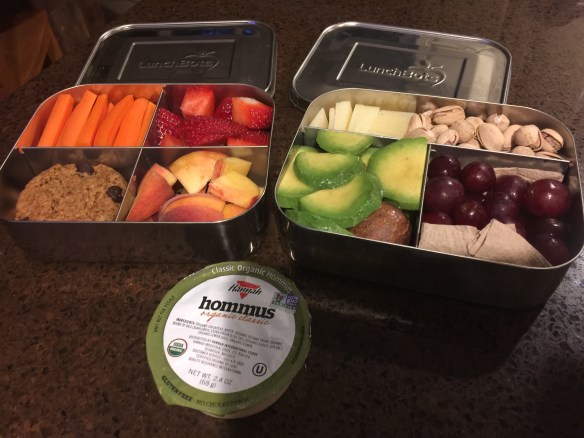
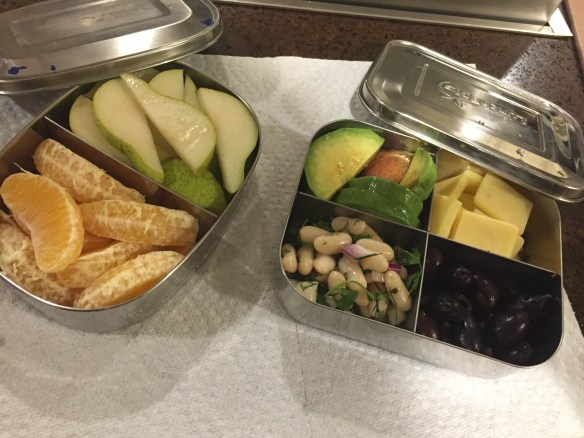
Lunch and snacks. Two bento-style boxes (I use LunchBots) containing avocado (South American by origin, Adrian craves avocado daily), fruits, nuts, cheese, olives, and/or raw veggies, accompanied by a hummus cup or baggie of rice crackers and a container of lentils or legumes.

Dinner: Whatever Martin is eating. Last night, dinner was white beans with home-grown-basil pesto and arugula salad from my garden. Tonight, Samara is preparing her special lentils with onion, garlic, and carrots; Adrian never minds lentils twice in one day. Tomorrow evening, Adrian and Martin will eat fish and fermented kale. In the event Adrian, a pescatarian, cannot eat what Martin is having (say, meatballs), I make him a “hearty salad,” which comprises fresh greens, berries, nuts, and seeds, dressed with olive oil and chickpea miso.

All the food is organic, except the nut milk, because sometimes I buy a brand that is only GMO-free, and the fish, which is wild-caught. Weekends, I make a full breakfast for Adrian and Martin, and we often eat dinner at a restaurant.

Adrian is a corporate attorney at a white-shoe law firm in Manhattan. Last month a visiting friend was ribbing Adrian, asking if he is the only firm partner who brings homemade lunch every day. Adrian laughed and said he didn’t care. “I like my lunch. My lunch is tasty.”

Now, if I could only get my own diet into such good shape.

IMG_3689

Lunch and snacks for Adrian’s day: carrots, strawberries, TigerNut flour cookies, peaches, cheese, pistachios, avocado (coated with lemon juice), grapes, hummus.

IMG_3177

Lentils, heated, being loaded into an insulated container to accompany Adrian’s lunch and snacks.

IMG_3176

More bento boxes, with oranges, pears, avocado, cheese, cold bean salad, and olives.

And “Better” Means?

On our last trip to California, I was cuddling my friend Melanie’s three-month-old daughter (her first baby) when Melanie gestured toward Martin and asked, “What would you say has been your favorite age?”

Melanie knows Martin is recovering from autism, so I could answer: “It’s weird for me. My parenting journey hasn’t been traditional. Every day he can relate in ways he couldn’t before, and can communicate more, and can have more conversations, and play more games, so I would say each age he hits is my new favorite age.”

Later, reflecting, I questioned the implication of my response. If I enjoy parenting more—to be honest: if I enjoy our whole relationship more—as Martin inches toward recovery, does that mean that I value neurotypicality more than appreciating Martin wherever he is on the journey? Does my focus on his future take away from our today? If we had never discovered biomed, if Martin still lacked functional language and threw constant fits, would I resent parenting my own child?

Years ago, I described my own failure to “grieve.” Autism parents are often told to let go of the children they thought they had (i.e., the neurotypical children with standard futures) in order to embrace the child they do have (i.e., the children with autism and divergent futures). As soon as I realized that recovery is possible, I set aside the grieving process in favor of fighting. Throughout that fight, I’ve maintained that I’m not trying to change who my son is, only to dig his true nature out from under all that autism. I’ve also maintained that I love Martin fully and completely, with or without autism, whatever his future holds, however we have to parent him. All that is true.

But something else is also true, and I reckon it may be the most controversial declaration I’ve made on this blog. At least, judging from my impulse to go hide under a blanket and pretend no one will ever read this, it is my most controversial declaration. Here goes: I think it is better to have the chance to live without autism. Whatever unusual ways of seeing the world autism can bring, neurotypicality is generally preferable. We humans become fulfilled unto ourselves by relating to others, whether through physical affection, cyberspace communications, books, poems, common goals. Autism hindered Martin’s ability to relate to me, and mine to relate to him. That is why his life and mine, our common and intertwined life, is getting better as his autism fades.

To anyone living with autism and offended by this post, I apologize. This is my opinion, and based on my experience with my son. Any opinion is subject to change, and I freely admit that participating in a recovery journey may be usurping joy I would otherwise find day-to-day if I were to accept Martin’s autism as who he is, instead of what burdens him.

Maybe I’m saying I know why I’m Finding My Kid. I’m Finding My Kid to make life better.

I’ve built walls,

A fortress deep and mighty

That none may penetrate.

I have no need of friendship; friendship causes pain.

It’s laughter and it’s loving I disdain.

I am a rock,

I am an island.

—Paul Simon