What’s Working Now

Are you familiar with miracle products?

I participate in various social media groups for parents with recovering children. Often, I see posts like this:

“We just started this [miracle enzyme, supplement, probiotic, oil, &c.] ten days ago, and I can’t believe the progress! My son is making consistent eye contact, he’s increased his vocabulary, and he finally potty trained! Today I got a note from his preschool teacher saying he is more ‘with it’ and making cognitive leaps. I’m kicking myself that we didn’t try this before now. Anyone having similar results?”

And then, comments like these:

Commenter 1: “Yes, yes, yes! [Miracle product] moved my son from babbling to words!”

Commenter 2: “We added [secondary product] to [miracle product], and the gains were even greater. We’ve been on them both for a month and will be continuing.”

Commenter 3: “This is all amazing! Where can I buy [miracle product]?”

Commenter 4: “[Miracle product] got my daughter into Princeton!”

Posts, and comments, touting a miracle product frustrate me.

Miracle-product proclamations frustrate me because autism varies from kid to kid. The health and immune challenges underlying autistic symptoms include, and exceed, neuroinflammation and other chronic swelling, mitochondrial disorder, genetic mutations, leaky gut, yeast overgrowth, oxidative stress, excess propionic acid. Autism exhibits disparate effects on cerebral function in girls versus boys. “Autism” is not a single malady and is never identical. That miracle product? Shoot a paint ball into a crowd. You’re bound to hit someone and splatter a few others. The rest will probably be left wondering what the fuss is.

I can understand that, if you’re thinking about trying a new product, you may want to post an inquiry about others’ experiences with the product. But given that the underlying disorders are child-specific, and that recovery means finding the right combination of many factors over time, why tout miracles? We parents of children with autism, we tread on hope. We’re easily led. When ten marvels in a row fail to help our kid, we end up embittered and broke.

Recovery from autoimmune disorder is a long, tedious slog without shortcuts. Sure, some families recover their children within a year, those lucky dogs. Most take much longer. Many children never get significantly better. The only miracle in autism is that, given our increasingly toxic world, we’re able to fight the spectrum at all. The amazing supplement, probiotic, or whatever, might indeed have given your kid the week of his life. That’s not a wonder. If you must tout a miracle product, don’t do it after a week, or a month. At least wait a year, then let us know if the developments continued, and speak in measured, child-specific terms.

Dear readers, are you wondering why I’m ranting? That was all an introduction to today’s post, which in comparison to its introduction, may seem brief. The topic is what interventions are working, right now, in combination, for my one kid, with his own particular combination of health challenges.

Following “Hard to Blog an Avalanche,” I received several inquiries about what I think has instigated Martin’s recent growth. Usually, when Martin improves and I’m asked why, I answer, “Don’t know. Obviously, something in the millions of things we’re doing is helping.” This year, I have a better inkling. I have seen five interventions correlate, almost certainly, with better health and/or increased speech:

1. Camel milk. Martin started drinking it this spring, and his language took off. Why? Too long for this post. Check back in a day or so to read “What’s the Deal with Camel Milk?”

2. The GAPS diet. I’ve written a lot about GAPS recently, and I’m also working on a post about how I don’t buy into everything that Dr. Campbell-McBride says. For now, it suffices to say that Martin’s digestion has improved.

3. Candex. We have battled yeast overgrowth, in one form or another, repeatedly since we began this journey. Going off just about every form of sugar helped, but only for a while. Nystatin did nothing positive. Earlier this year, poor Martin’s yeast was so bad that he clawed his skin raw. Finally, his biomed doctor said to try Candex, an enzymatic product. The same night he started Candex, Martin had a foul-smelling BM—yeast, I think, leaving his system. The next day, the skin rash began to clear. Since then, the candida has been under control, so much so that I’ve been able to add a little more fruit into Martin’s diet without worrying about the fructose feeding yeast.

4. Enhansa. Lee Silsby Compounding Pharmacy makes Enhansa, or curcumin, a derivative of turmeric. Martin suffers from chronic inflammation, which places undue pressure on his compromised immune system. Turmeric’s anti-inflammatory properties seem to be relieving that inflammation, even to the point that his face has lost its “puffy” appearance. (The puffiness was visible only to me and others to whom I pointed it out in photographs. Still, it was there, and a symptom of his systemic inflammation.)

5. MitoSpectra. This is a proprietary mitochondrial supplement blend of vitamin C (as ascorbic acid), vitamin E (as d-alpha tocopherol succinate), vitamin B5 (panthothenic acid), L-carnitine, and coenzyme Q10. We have used each of the component supplements before, alone and in combination, and indeed Martin still adds separate sources of vitamin C and L-carnatine. MitoSpectra, however, seems to combine the five supplements in a form and proportions that do well for him: He shows more coordination and energy, and less “floppiness.” At times I wonder whether those improvements are dependent on continued use of MitoSpectra; my hope is that, as his immune system overall continues to heal, his own mitochondria will be able to assume the work MitoSpectra is now doing.

Camel milk, GAPS, Candex, Curcuma, and MitoSpectra. Not a miracle, not any one of them.

Each a step in this tortuous recovery path.

Just maybe a longer stride than I’m used to.
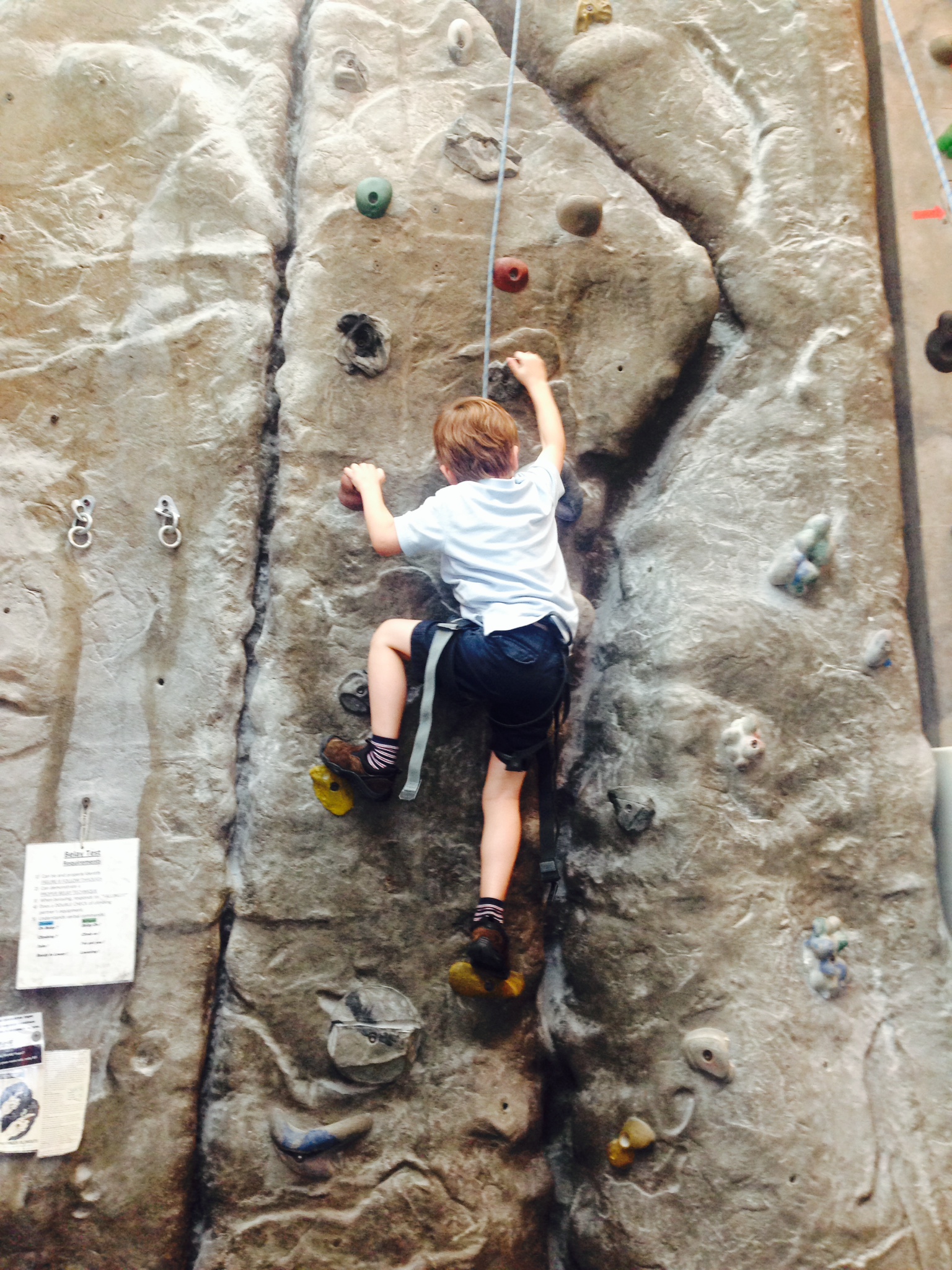
Increased energy, coordination, and willingness to try new things. I'm so into these changes.

Increased energy, coordination, and willingness to try new things. I’m so into these changes.

It’s Hard to Blog an Avalanche

Monday evening Martin and I filling our birdfeeders, in front of the house, when the UPS truck pulled up. My UPS guy and I share a special bond: We’re both New York Rangers fans. We hadn’t talked since June 13, when the Rangers dropped the Stanley Cup finals to the Los Angeles Kings, so we started to chat hockey emotions. Were we heartbroken? Proud? Was this transition season—the Rangers have a new coach—the start of a dynasty? Would we miss Brad Richards?

Martin approached, listened for a second, looked at the UPS guy, and said, “Oh, hi!”

Goodness, I thought. Martin just addressed a stranger, without being prompted. That’s new.

“Hey, little man,” the UPS guy said and patted Martin’s head.

Martin remained while the UPS guy and I finished our conversation. (We will miss Richards! But his time has come!) Then I said to the UPS guy, “All right. Have a good week.”

And Martin said to the UPS guy, “Well, okay, ’bye. See you later.”

Goodness, I thought. Martin just interpreted my social cue and said goodbye, without being prompted. That’s new.

When Martin does something new, and appropriate, and typical, I remind myself to blog. Often I make a note so I’ll remember to write the event. If you’ve been reading this blog a long time, you know about the first time Martin said, “I don’t know,” and the first time Martin interactively shared a toy, and even the first time he understood that my outstretched hand meant I wanted a napkin from him.

The past few weeks have brought so many firsts that blogging them all would be a heavy burden. The firsts are tumbling one atop the other. Thus—

When I brought Martin to playgroup in the City last week, we were late, and his friends were already downstairs. Martin proceeded directly downstairs.

No distraction from the upstairs toys? No direction needed? No dawdling on the steps? That’s a first.

Thursday morning Adrian, fresh from the shower, in a t-shirt and black boxer-briefs, was helping Martin get dressed for school. I overheard this:

“No, Daddy. I don’t want white underwear!”

“What’s wrong with white underwear?”

“I want to wear black underwear, like you. And black socks, too.”

Noticing what Daddy is wearing? Wanting the same for himself? First.

This weekend Martin was in our pool when I asked if he wanted some water. He replied, “No, I’ll have a drink when I’m done swimming.”

Providing more information than I asked for? Thinking ahead? First.

Sunday my brother Eddie was visiting to watch the USAPortugal World Cup match. When Jermaine Jones scored in the 64th minute, tying the game 1-1, Eddie leapt to his feet and whooped. Martin, startled, covered his ears with a pained expression. Then he looked at me, lowered his hands, giggled, and said, “Oh, that scared me!”

Checking my face for reassurance? Immediately recovering from a sensory overload? Laughing at himself? Unsolicited emotion sharing? First, first, first, first.

Seventeen minutes later, Clint Dempsey scored, giving USA a 2-1 lead. Eddie whooped again. Adrian jumped in happiness. I lifted Martin, used my right arm to hold him on my hip, and ran around the family room thrusting my left fist in the air as I shouted, “Yes! Yes! Yes! Yes!”

As I recovered, I realized that Martin, still on my hip, was thrusting his itty fist into the air and shouting, “Yes! Yes! Yes! Yes!”

Independent participation? Imitation just for the heck of it? Not quite a first, but close enough—never before so vivid, or so immediate.

(Better not to ask what happened when Portugal’s Verela scored in the final minute of stoppage, preventing USA from clinching an early second-round berth.)

Monday afternoon Martin and his friend Christopher were in a children’s waiting room, ostensibly overseen by Christopher’s older brother, Benjamin, while I met with Christopher’s mother. When I entered the waiting room, Martin and Christopher were wrestling, gleefully, amidst a pile of toys as Benjamin laughed.

“What on earth are you two doing?” I asked.

Martin looked up from under Christopher and replied, “We’re banging and yelling!”

I assumed Benjamin had accused the younger boys of this. I asked, “Who is banging, and who is yelling?”

Martin said, “I’m banging, and he’s yelling.” Then he returned to struggling with Christopher.

Fully interactive play? Answering questions even while epically distracted? Pretty darn new.

Fifteen minutes later, Martin and I were driving home when he read aloud the name of Steely Dan’s “My Old School” from the radio screen. I took the opportunity for conversation and asked Martin the name of his old school, his preschool. He responded correctly. I followed up by asking which he prefers, his old school or his new school (his kindergarten).

“My new school.”

“Why do you prefer your new school?”

“But because I learn better there.”

Expressing a legitimate preference, and backing it up with a reason? First. Not to mention—I do think he’s learning better in kindergarten. His kindergarten really targets his needs in a way that preschool did not.

On New Year’s Day, I sensed that 2014 would be extraordinary. The banner year may indeed have arrived:

This past month has comprised an avalanche of firsts. I could go on and on. But I will address just one more, the evolution getting on the school bus. In just two weeks, we’ve progressed from me carrying Martin’s backpack and leading him by the hand down the driveway to the bus; to me carrying Martin’s backpack and coaxing him to follow me down the driveway; to me carrying Martin’s backpack and accompanying him as he walks without protest to the school bus; to Martin carrying his own backpack while I follow him; and finally to Martin walking down the driveway, alone, backpack on, and boarding the school bus while I wave from the front step. If I even try to follow Martin, I get a swift, “No, Mommy. You wait here!”

Am I proud? I’m darned proud.

And sorry.

I mean, Martin’s bus driver is also a Rangers fan.

I miss the morning hockey chit-chat.

On another occasion, Martin (right) with Christopher's big brother, Benjamin.

On another occasion, Martin (right) with Christopher’s big brother, Benjamin.

Civility

I know that I should stay off social media, other than maybe the autism-recovery groups I enjoy.

I definitely know that I should refrain from taking the bait when people post uninformed opinions on topics about which I have, well, more informed opinions.

If you read this blog, you probably have thoughts about vaccines. I do. I’ve posted about the link that I think exists between vaccines and the symptoms of autoimmune disorders, symptoms like “autism.” It’s such a controversial topic. I try to read as much about vaccines, on both sides of the issue, as my schedule allows.

Which makes me ripe for a bad Facebook experience. I made the mistake of responding to a post by a guy I knew well in college and now know only through Facebook.

This Facebooker, the guy I know, posted an opinion piece deriding “anti-vaxx” celebrities. (“Anti-vaxx” was used in the posted piece. It’s not my term. I don’t think raising efficacy or complications concerns, or questioning ingredients, is necessarily “anti-” vaccinations). Beneath the link to the opinion piece, the Facebooker said something like, “It is a sad commentary on our society when people are willing to accept celebrity ‘opinion’ over scientific fact.” He then went on to compare “anti-vaxxers” to people who deny evolution or global climate change.

Within the comment thread under his post, the Facebooker asserted, without citation, that “any link between vaccines and autism has been scientifically disproven.”

Best course for me to take in such a situation: turn off Facebook and walk away.

Course I did take, this one time: I commented. I wrote:

“Can you point me to the study that you are referencing? I’m not advocating one way or the other. I am aware of studies suggesting the absence of a link, and of studies noting that vaccinations can cause neuro-disruptions. But I’m not aware of any study that compares autism rates in vaccinated versus unvaccinated populations.”

Then, lest anyone think I have a connection to autism (we’re not public about Martin’s diagnosis), I added:

“I am concerned about this topic because at age 12 I was very sick with measles, despite having been twice vaccinated against it.”

What did I want to achieve by commenting? I don’t know. I was frustrated. The Facebooker’s comment made no sense, empirically or otherwise. We cannot “scientifically disprove” a link between any two occurrences; the most we can do is, while attempting to control for other variables, demonstrate that the occurrences arise no more often in conjunction than they do independently. In the case of autism and vaccines, I know, that rigorous work has not been done. This Facebooker was carelessly spouting an untruth.

In seconds, without thought or ceremony, he responded: “There. Is. No. Fucking. LINK. NONE. STOP.”

And I, shocked, wrote: “Um, okay. That sounds scientific.”

Most of this is likely not verbatim. I recall, exactly, his comment, “There. Is. No. Fucking. LINK. NONE. STOP”—periods, explicative, and all. As for the rest, I am recreating the conversation. Immediately after I wrote, “Um, okay. That sounds scientific,” the Facebooker deleted the link and the comment thread, and replaced it with this status update:

“You’re not going to spoil my happy today. Period.”

Under that “spoil my happy” status came this comment thread:

Random commentator: “Oh, see now… someone’s going to try!”

Facebooker I know: “Already has. Why do you think I posted it? What it comes down to is this. To the world: As much as you are obviously in love with your own opinions, I DON’T CARE!!!!!! You may not care about my opinions either. That’s fine. No skin off my nose. BUT I DON’T CARE!!!!!!!!!”

Random commentator: “Ah, see, I almost had a sarcastic comment for your last post.”

Facebooker I know: “I swear to God, you could post that 1+1=2 and there’s going to be someone who argues with you. Not having it.”

Wow, right? This Facebooker, as I said, is a guy I knew in college. I’ve seen him once since college, when he was in New York a year or two ago, and we had a nice lunch to catch up. No prior animosity. Nothing. That explosive reaction resulted, as far as I know, 100% from my question about “scientific disproof” of a connection between vaccines and autism.

I commented no more. Instead, I took my boldest Facebook action ever. I stopped “following” the guy. I didn’t go so far as to unfriend him. Unfriending just isn’t in my nature. But now that I’ve stopped following him, his posts no longer appear in my news feed.

It’s justified. Around when Demi Moore was separating from Ashton Kutcher, this Facebooker posted a picture purporting to show cellulite on Demi’s legs and chastising her for not spending enough time on a treadmill. As if women don’t have enough trouble with body image! Demi Moore weighs, like, 70 pounds. Then, during the 2012 NFL referee lockout, when the league used less-experienced substitutes, this Facebooker complained about a game by posting something like, “These replacement refs are really ‘special,’ and I don’t mean that in a good way.” You see the problem there: He’s implying that the referees have special needs, which is “bad” and appropriate for ridicule. The way I see it, the vaccine incident was strike three, and this Facebooker is out. Or at least un-followed.

There’s a real shame in this story. In the original “anti-vaxxers” link and comments—the thread that the Facebooker deleted because he was “not having” any “argument”—there was a comment from a third-party who self-identified as a person with autism. She wrote something like, “Even if there were a link between vaccines and autism, people who abstain are suggesting that they would rather lose a child to preventable disease than have a child like me.” I would have appreciated the opportunity to follow up and engage that person further.

No such luck. Some topics, it seems, are just no longer available for discussion.

Judgments Redux

First an addendum, now a redux. Sorry.

In my defense, this was going to be part of Saturday’s “Judgments” post, but that post was getting way too long.

Judgments” ends this way:

“And so that’s it. I’m way, way beyond throwing stones at how anyone else treats autism.”

Which sounds pretty good, as if I’m all warm and fuzzy and “I’m okay, you’re okay.”

That last line, however, was carefully worded.

Here is a comment, written by an autism parent, in response to the CDC’s new estimate that one in 68 United States children is diagnosed with autism:

I’m kinda pleased…. When autism is more prevalent than ‘normalacy’ autism acceptance will be a whole lot easier! As you know, my son has high functioning autism and I don’t believe he needs to be changed or cured at all. Yeah, he sees the world differently, but different isn’t inherently wrong. I appreciate I can’t speak for all kids, but I love my very individual little boy just as he is 🙂

A mother in an on-line ASD-recovery group cross-posted that comment, from another group, with the identifying information removed.

Warning: I am about to be judgmental.

That “kinda pleased” comment is appalling.

I too “love my very individual little boy just as he is.” Indeed, I cannot conceive of anything Martin could do that would make me stop “loving him just has he is.” This extends even to moral culpability: If Martin recovers from autism, then grows up to be a serial killer, or a rapist, or a child abuser, I will be devastated, I will applaud when he is jailed for life, and I will seek help for his sociopathic tendencies. But I will still love him, even as he is.

Autism has no moral component, except perhaps insofar as manmade environmental factors are contributing to the rise in autism rates. In any event, Martin is not culpable. And if I am willing to get past intentional failings, how could autism ever make me reject “my very individual little boy just as he is”?

Loving a child is easy. Accepting a child is easy. As I have written time and again, there are days when I want to give up biomed, homeopathy, special diets, therapies, and everything else we do for Martin. At the lowest points, I want to say, “Martin has autism. I’m going to leave that as it is, and tell the world to accept autism.” I want to do so because that would be easy.

But I don’t. I don’t give up. My son does need to be cured. I would never say, “I don’t believe he needs to be changed or cured [of autism] at all,” any more than I would say, “We’re going to leave the multiple-personality disorder untreated. I love each of his personalities,” or, “Why eliminate psoriasis? I’m fighting for psoriasis acceptance instead.”

I’m way, way beyond throwing stones at how anyone else treats autism.

As for those who hide behind “acceptance” and “awareness,” who advocate “neurodiversity,” who stand by as autism takes over our children, who choose not to treat the condition at all—

For their approach, I have no patience.

I would never tell a parent who refuses to treat autism that she is selling her child short. Telling her that wouldn’t do anything to change her mind, and it might make her feel bad about herself. Instead, I try to lead by example. If asked, I respond that all kids are different, and that our family follows a special diet and biomedical protocol, and that Martin has made tremendous, if slow, improvement. I answer any questions honestly. I smile.

In my head, though, I’m thinking this:

I feel sorry for your child. Healing an immune system is hard work. Accepting autism is a lot more convenient. For you. Your child will have a more difficult life because you’ve chosen the passive path.

Stones be thrown.

Judgments

Our family is working to alleviate Martin’s autism by healing his immune system, instead of using medication to disguise the health problems. One day, that approach could change, as I mentioned in the post titled “New Sleep, No Crutch”:

Of course I’m familiar with methylphenidate, amphetamine salts, guanfacine, and so forth—drugs that might improve Martin’s still-abysmal attention span. Maybe one day we’ll turn to such resources (in the end, I remain a pragmatist). But for now, while we have the time and opportunity, I choose to work toward eliminating the cause of his short attention span, instead of using drugs to mask the symptoms.

In response, I received this comment from a reader:

As a pharmacist and a mom with a child diagnosed with Asperger’s I think your approach is great. I hesitated giving my own child medication until absolutely necessary. After years of hesitation, finally treating my son’s attention deficit with medication allowed his grades to improve significantly. If you aren’t at the point where that is necessary, by all means use as little drug intervention as possible.

Let’s talk about a topic underlying that comment: judgments.

I went to last year’s Autism One conference with my friend Stacey, who is also working to recover her son. Stacey attended Kerri Rivera’s presentation on her chlorine dioxide (ClO2, or “CD”) parasite protocol. (I was at another, concurrent lecture. Don’t remember which.) After Stacey told me about CD, I looked up some information and talked to many parents who use the protocol. Basically, Rivera uses low-dose oxidation, in the form of chlorine dioxide, to destroy pathogens/parasites and heavy metals.

I told Stacey that CD is not a protocol I would try with Martin, because (1) I have concerns about its long-term health effects, and (2) it requires giving enemas, which I think would violate Martin’s body integrity. (We treat pathogens and parasites through other methods. For example, Martin consumes diatomaceous earth daily, and around each full moon he takes pyrantel and, topically, warmed castor oil. In the past, Martin also has swallowed mebendazole to fight parasites.)

Some weeks later Stacey and I, back in New York, met for lunch. Stacey told me that she had done more research, read Rivera’s book, been in contact with Rivera via email, and ultimately decided to follow the CD protocol with her own son. As Stacey told me this last part—that she had decided to go ahead with CD—she looked away and ducked her head as if she were about to get slugged. Then she added, “I know you’re not keen on CD. I just feel like it will help. Don’t judge me.”

Much later, I had lunch with a friend whose elementary-school daughter has been diagnosed with ADD or similar disorder. My friend wanted to talk about what we do for Martin and whether any of our protocol might help her daughter. I explained what I think are some underlying similarities between ASD and ADD, and what diet and supplements might be able to achieve. She mulled the information, asked a lot of questions.

Fast-forward two months. I was lunching again with the same friend. She said that she and her husband are medicating their daughter to help the ADD. I sensed that she was watching for my reaction. Then she added, “We did try fish oil. It didn’t seem to work.” I realized my friend was afraid that, because we do diet and biomed/homeopathy for Martin, and not medication, I was going to deride her family’s decision to medicate.

My response was the same, to both Stacey and this friend. I said: “Don’t worry. After three years of biomed, I am way, way beyond judging anyone else’s path.”

I, personally, believe that Christianity, and specifically Protestantism, and more specifically the Protestantism most closely associated with the Magisterial Reformation, though tinted with elements of the later Radical Reformation, is the truest faith. That’s why I practice Mostly Magisterial Quasi-Radical Protestant Christianity. It does not mean that I think my friends who are Roman Catholic or Jewish or Muslim or Hindu or nothing at all are “damned” or destined to unfulfilling lives. I think I’m right. They think they’re right. Maybe we’re all right, to whatever degree.

In the world of children with challenges, regardless of what path a family takes, I respect anyone who is (1) trying, and (2) not acting callously. Stacey has looked into the CD protocol and believes it will help her son. My friend reports that a drug targeting ADD has ended the homework battles that were ruining her evenings. The pharmacist who was kind enough to comment on my earlier post hesitated to medicate her son but now finds that doing so has improved his focus and grades.

Plenty of people—I’m pretty sure that, somehow, I run into all such people, all of them in the entire world—are ready to condemn my and my husband’s choices for Martin, from diet to homeopathy to school. I hate that. I hate to be judged.

And so that’s it. I’m way, way beyond throwing stones at how anyone else treats autism.

Martin, out and about. No judgments here.

Martin, out and about. No judgments here.

Addendum

I’m not much for addenda (except insofar as FindingMyKid.com, by the nature of blogging, is one long series of addenda to its “About” page and initial post). Nevertheless, I simply must add four notes to Saturday’s crappy-to-happy post.

1. I wrote, “It may go without saying that we ended up in a rush to get to [Martin’s] afternoon social program at the JCC, and that I left the kitchen a disaster, and that I didn’t get a chance to feed myself much, and that I was feeling worse by the minute.”

We were rushing to get to the JCC by 2:00 pm. We left home ten minutes late, and then I had to take Martin to the restroom to change into new pants. It was after 2:15 pm when I finally dropped him in the correct room. Still, only one other child had arrived, out of the dozen or so who usually attend. “Small group today?” I asked an instructor. “I don’t think so,” she replied. “They’ll be trickling in.” Relieved that we weren’t the only tardy family, I headed to the library to write.

I posted “From Crappy to Happy” at 4:55 pm, just in time to pick Martin up from the three-hour session. As I arrived at the door, an instructor was saying, “Okay, everyone get your coats.” Still—yes, that’s the second “still” in as many paragraphs, by design—she looked surprised to see me. One girl from the group asked, “Is Martin going home with you?” No other parents had arrived yet. The staff seemed to scramble to gather Martin’s belongings, and one had to chase us down the hall because they’d forgotten to include his art project.

Did any of this strike me as odd? No. I suppose I was spending too much time in my own head, trying to keep a good attitude, planning our evening, debating whether to insist that Martin use the bathroom before we left.

He was getting settled in his car booster seat when I saw the rest of his group, wearing their coats, walking along the parking lot to the outdoor playground.

Because the program meets from 2:30-5:30 pm, not 2:00-5:00 pm.

Because, after more than six months at the JCC, I had the times wrong.

Because we never had been late in the first instance.

I said, “It looks like your friends are going to spend some time at the playground. Would you like to join them?” Martin said yes. I felt pretty dopey as I walked him to the playground and explained my confusion.

2. The first time I picked Martin up, while the staff were scrambling to gather Martin’s belongings, the head instructor told me that Martin had had his best afternoon ever. He had talked and talked, been engaged, and participated in every activity. When I dropped him off (early!), I had explained that, although his swim trunks and towel were in his backpack, he’d been sick all week and should be excused from swimming if he didn’t want to get in the pool. Martin almost never wants to get in the pool, so I expected him to take the excuse and run. Nope. The instructor said that as soon as Martin saw the others getting ready, he asked to get into his swim trunks, too. Not only that, he showed off for the staff, with some trick the instructor called a “froggy move.”

Saturday evening, while Martin was in the bathtub, I asked whether he could show me and Adrian the “froggy move” he’d done in the pool. Without hesitating, Martin shifted so his feet were flat on the bathtub bottom, maneuvered himself into a squat position, and grabbed his knees. “This,” he said earnestly, “is how a froggy looks in the water.”

3. I wrote, “In the end, [Martin] ate the dippin’ plate. The GAPS diet isn’t easy, especially when it comes to packing for school. If Martin accepts a dippin’ plate once or twice more at home, I’ll give it a go for school lunch.”

Sunday afternoon, Martin ate another dippin’ plate, albeit with a little assistance. So that’s what he took for school lunch today: carrots and yellow bell peppers (included because yellow is his favorite color), dip made from avocado and fermented garlic, and a side of pear. (GAPS diet says to do fruit alone, not with a meal. Cut me some slack. I had to fill that last compartment in the lunch container, and rice crackers are out for now.) The dippin’ plate doesn’t really have protein, so he had a protein-heavy breakfast of bone broth and chicken-and-egg bread with ghee, and I sent some sunbutter treats for his morning snack. Here’s hoping the lunch container comes back empty.

4. On the way home from the JCC, late Saturday afternoon, Martin and I heard both My Sweet Lord and Heart of Gold on satellite radio. For me at least, that combination effects at least a 27.5309% improvement in mood.

Saturday turned out quite well.

Martin's school lunch today: a dippin' plate with carrots, yellow bell pepper, avocado-and-fermented-garlic dip, and pear.

Martin’s school lunch today: a dippin’ plate with carrots, yellow bell pepper, avocado-and-fermented-garlic dip, and pear.

Link of the Day

Through the community that is Autism Parenting in the New York City Area (“APNYCA.” I just coined the acronym. You saw it here first.), I know a mother who is a recent and enthusiastic arrival in biomed. She’s started a blog and posted about her son’s experience with hippotherapy. I’ve seen the progress her Jaeden is making, and I like the forum she’s creating. Full Spectrum Essentials—it’s worth a look.

Diagnosis

Last year Adrian read Andrew Solomon’s Far From the Tree: Parents, Children, and the Search for Identity, a book about children who are profoundly “different” from their parents. Solomon profiles families affected by mental illness, Down syndrome, deafness, dwarfism, gender identity, autism, along with parents whose children were conceived in rape or grew up to commit mass murder.

Andrew Solomon also has an article titled “The Reckoning” in this week’s New Yorker, based on interviews he conducted with Peter Lanza, the estranged father of Adam Lanza.

Adam Lanza was the 20-year-old man who, on 14 December 2012, killed his mother, then 20 young children and six teachers at Sandy Hook Elementary School in Newtown, Connecticut, and then himself. I blogged here about the fact that Adam was diagnosed with Asperger’s Syndrome.

On NPR’s Fresh Air program this week, host Terry Gross interviewed Andrew Solomon about “The Reckoning.” Solomon made a point that also appears in the article, a point about diagnosis: According to Peter Lanza, receiving a diagnosis—Asperger’s Syndrome, now regarded as high-functioning autism—enabled him and his ex-wife, Nancy (Adam’s mother), to ignore signs of more troubling developments in their son. As Adam became isolated, and prone to obsessive-compulsive behaviors, and fascinated with violence, including violence against children, his parents attributed the oddities to Asperger’s. Adam has Asperger’s Syndrome, they thought. Asperger’s makes him behave strangely.

I didn’t think, in the weeks after 14 December 2012, and I don’t think now, that Adam Lanza’s parents were culpable in what happened at Sandy Hook. That’s a ridiculous notion. They talked. They tried. They sought the advice of specialists. Nancy Lanza appeared to believe, genuinely, that coddling Adam and his increasingly disturbing whims was the best means of supporting her son. The burden we place on parents today is too great even without attributing to them their children’s reprehensible violence.

Without in any way blaming Peter or Nancy Lanza, I appreciate Peter Lanza’s recognition (and Andrew Solomon’s explanation) that a diagnosis is broad and easy to hide behind.

To that substantive point, I will add one more: A diagnosis of autism, while it may be comforting, is largely meaningless.

Martin does not “have autism.” Martin has a variety of conditions, linked by autoimmune disorder, that result in symptoms labeled as autism.

It is minimally probative when doctors label symptoms as disease. Suppose that a man goes to the doctor and is diagnosed with “wheezing.” Suppose that the doctor tells this man that many helpful therapies exist to alleviate wheezing, including throat lozenges, tea with honey, breathing exercises, and even CPAP masks. Suppose the doctor suggests that the man eliminate smoking from his routine, because smoking is known to exacerbate wheezing. Suppose the doctor goes so far as to prescribe a drug that relaxes the airwaves, so that the man can walk about with his wheezing less evident.

Would you think the doctor had been thorough? That he had done his job?

Or would you fault the doctor for addressing the symptoms but failing to diagnose lung cancer, the disease that caused the wheezing?

When Martin was diagnosed with PDD-NOS, and then with autism, I cried. A lot. Even Adrian cried. Autism is treated like a death sentence. Parents are coached to grieve for the child who once was but will not be again.

I wonder now what the days surrounding Martin’s diagnosis would have been like if the team of “experts” we paid had said something like this:

Your son has a complicated autoimmune disorder. His gut, where most of the immune system subsists, doesn’t have the right balance of beneficial flora, and therefore he can’t digest nutrients properly or respond to intruders like parasites, harmful germs, unchecked proprionic acid. On a related note, your son has a mitochondrial processing disorder, which is causing low muscle tone and lethargy. Several genetic abnormalities are contributing to the injuries. The totality of these disorders is resulting in systemic inflammation as a subpar immune response, and that inflammation, which persists even in the brain, is causing “misfires” within the neural synapses. These misfires result in the symptoms you’re witnessing: repetitive behaviors, lack of eye contact, social awkwardness, inattention, drifting, and speech skills that lag behind your son’s cognitive ability.

I imagine that, if three years ago we had been told all that, we would have cried less and got to work sooner. We would have asked questions like how to re-balance the gut flora, how to resolve the mitochondrial processing failures, and whether the genetic abnormalities can be addressed.

(We might also have asked how this autoimmune disorder arose, and whether it had anything to do with the hospital threatening us, placing our healthy son in the NICU, and pumping him full of antibiotics, after the unplanned C-section robbed him of the protective effects of his mother’s vaginal microbes. That’s a topic for another post.)

I won’t deny that I take comfort in the existence of an “autism community.” (Solomon makes the point that Adam Lanza rejected his Asperger’s diagnosis, and refused to consider himself part of the Asperger’s community.) I do, however, argue that the autism diagnosis is an impediment to recovery. “Autism” sounds impossibly untreatable. The health conditions underlying autism? Not so untreatable. Those we can roll up our sleeves and tackle.

Andrew Solomon, who is public about his own battle with depression, lamented in the Fresh Air interview that Adam Lanza’s depression might have been treatable, had it been recognized as depression instead of hidden within Asperger’s. I ask: Would the depression have been hidden if Adam’s parents had realized that Asperger’s Syndrome is a symptom of an underlying condition? Or might they have suspected that the depression arose, in whatever measure, from the same underlying condition? Might they have had the tools to roll up their sleeves with more success?

Adrian reports that he found Far From the Tree (emotionally) difficult. He put it down for a while after reading that courts tend to issue mild sentences for parents who kill their special-needs children. Some forms of filicide, it appears, are considered forgivable. Would the filicide be so forgivable if those parents had children with diabetes or leukemia or renal failure or any other condition that, with medical and dietary and lifestyle attention, might be kept at bay?

Autism is the symptoms of a treatable medical problem. Diagnosis matters.

Naysaying

In Wednesday’s post I included a reference to the “subtle naysayers.” Those are the people who say they support our journey but who often lob jabs or zingers that suggest otherwise. I gave seven examples of statements (e.g., “Is that actually a scientifically accepted principle?”) that, to me at least, translate as, “I think it’s wonderful that you want to help your son, so I’m going to say that I’m rooting for you! Deep down, though, I don’t really think your process of diet, supplementation, and other interventions can recover your son.”

In case yesterday’s post didn’t make the point, here are some other examples of subtle naysaying: “Of course, you need to leave room for Martin just to be a kid. Balance is key. Don’t go overboard.” “I bet there isn’t another mom doing as much as you do!” “Isn’t chelation dangerous?” “I was reading about a family that stopped all supplementation. Their son did even better without it.” “It’s just so hard to believe that mainstream doctors don’t know about this.” “Can you take a break from the diet over vacation?”

And then there’s my, ahem!, favorite: “It’s so great, what you’re trying to do.” What’s wrong with that statement? The word “trying,” which implies lack of success. True champions say, “It’s so great, what you’re doing,” or, “It’s so great to watch Martin’s progress.” Subtle naysayers refer to how hard I’m trying.

In any event, after I drafted yesterday’s post, I spent some time contemplating—that is, I took a shower and had ten minutes to myself—why the subtle naysayers bother me. I won’t mince words: They do bother me! Here’s the reason:

When Martin has a week like this week has been, then at least a dozen times daily the idea of throwing in the towel drops into my head. Yes, I contemplate quitting the recovery process. I hear the little voice that says it would be easier, so much easier, to live according to the traditional notion that autism is a behavioral or communication disorder and therefore should be treated just with behavior therapies.

And when that little voice in my head is speaking, what I need is to hear a bigger, louder voice—preferably outside my head—reminding me that (1) “autism” is the symptoms of an underlying immune disorder, a medical condition that should be treated like any other need to heal; (2) recovery is bound to be a series of ups and downs, and ultimate success is more likely to come from surviving the downs than celebrating the ups; and (3) although it would be easier, right now, to give up biomedical treatment, leaving Martin untreated would be harder in the long run, for him as well as for me and Adrian.

That bigger, louder voice is never going to come from a subtle naysayer. A subtle naysayer looks for cracks, looks for weaknesses, to insert seeds of doubt and coax me away from the “extremes” of the recovery process. A subtle naysayer might think s/he is being helpful: If I’m sleepless, and alternating hope and desperation, and preoccupied with Martin’s special diet and supplementation and everything else, wouldn’t I be happier with none of that to worry about?

So I can’t turn to a subtle naysayer for help. Not even in a week like this, when I need all the support I can get. Indeed, especially not in a week like this, because when I’m at my lowest is when a naysayer is most likely to strike.

Which leaves me with Adrian, other families in recovery, and the few people outside the recovery community who truly understand.

I wish there were more.

Let’s Talk Honestly About Really Crappy Days

Most email traffic that passes through FindingMyKid@yahoo.com congratulates the progress we’ve made with Martin. Some correspondents compliment me (thanks!) for presenting the difficult aspects of recovery, too, instead of pretending every moment is roses and wine. A few parents bemoan their own children’s lack of progress.

I want to speak to the parents who feel like they aren’t making progress. To be honest, despite the progress we’ve made, wine and roses are far, far, far from our everyday reality.  That’s not to say that recovery isn’t the series of joyous breakthroughs I present in this blog. It is rather to admit that these developments punctuate long stretches of “no change” or even apparent regression, which I prefer to call “the reappearance of former symptoms.”

My last couple posts referred to the bad week Martin’s been having. Let’s add some more depth and talk about yesterday morning—

I knew the morning would be tough, because Martin took almost two hours to fall asleep the night before and was bound to be tired. At 5:55 a.m., as usual, I carried Martin from his room to our bed, to wake up with Adrian.

Around 6:35 a.m., as I was putting the final touches on breakfast, I heard yelling, whining, and a scream or two, all from Martin. I found Adrian trying to get Martin dressed. Martin was in a fetal position, refusing to cooperate. He said, “No! I want to stay here today! I don’t want to go to school.” Then, frustrated, he switched to the nonsensical: “I don’t want you! I’m going to sleep at school! I don’t want to come home!”

Adrian waved off my offer to assist. I returned to the kitchen. Ten minutes later, the crying and complaining uninterrupted, Adrian and Martin appeared in the kitchen. Martin was dressed, save for the “crazy socks” he was supposed to wear for Dr. Seuss appreciation week at school. His whine had become, “I don’t want to wear crazy socks. No! No! No! I don’t want breakfast.”

We got him seated at the table. Although he has a chair with footrest that facilitates using his legs and core to sit up straight, Martin slouched. When he saw his breakfast (turkey bacon and vegetables, pretty standard), he lowered his voice to the continuous, slurred word-melding that I detest. “No food oh Mommy oh Mommy oh Mommy Mommy Mommy no no no.” He thrust his fists into his stomach and curved his back, a posture that (I think) indicates stomach pain. When I tried to offer him turkey bacon, he batted my hand and screamed, “Noooooo!” He grabbed his glass of “kombucha with seeds,” pursed his lips on the stainless-steel straw, and changed his whine to, “Drink, only drink no anything else oh Mommy.”

Adrian passed back through the kitchen, kissed us both, wished me good luck, and left for work.

I switched on the kitchen television. Sesame Street. Martin’s a bit beyond that now. Still, I thought the distraction might help. Over the next half hour I managed to get his supplements and most of the bacon (none of the vegetables) into his mouth. In the meantime, he left his chair to bounce up and down, slapped at me, used his fingernail to scratch marks in the wooden tabletop, whined incessantly, dumped fish oil on his school sweater, told me to turn off Sesame Street, cried when I turned off Sesame Street, spilled his drink while refusing to take his mouth off the straw, curled himself into a ball around his Curious George sock puppet and wouldn’t release, threw vitamins on the floor, and ultimately dissolved into a tantrum because he had no time to play before the school bus came.

By sheer force of love, willpower, and coffee, I kept my patience and got him on the bus. (“Martin’s not feeling his best this morning,” I told the matron when I handed him over.) Then I returned to the kitchen to sulk.

That’s right, I sulked. Because when you are working hard to recover your child, a bad morning (bad day, bad week, bad month, bad season) leaves you wallowing in a stew of doubts.

•            What am I doing to my child? Is this worth it? What caused this meltdown? I think the culprit yesterday morning was probably the nystatin we started last week. I think. But really, who the heck knows? And why would it matter? If something—anything—I’ve done has caused Martin to feel like he did yesterday, am I really acting in his best interest?

•            Why have I given up so much to follow to pursue autism recovery? I used to have a career, disposable income, and free time. Now my job is “autism recovery specialist,” our money goes to therapies and supplements, and getting out for an evening requires hours of preparation. Even worse, I’ve met families who claim their children have improved markedly with nothing but traditional therapies like ABA and speech therapy. Why go on?

•            By working toward recovery, by rejecting the idea that Martin is bound to autism for life, am I making each day harder, for all of us? Long ago I wrote a post titled “Failure to Grieve.” To this day, I wonder whether Adrian and I would breathe easier if we just decided, Martin has autism. Let’s help him live with it as best he can.

•            Other than families in the recovery community, almost everyone I know is a subtle naysayer. I never realized exactly how many ways there are to express skepticism: “Is Martin’s doctor a real M.D.?” “Do you have a regular pediatrician supervising all this, too?” “Is that actually a scientifically accepted principle?” “You’re not going to start saying kids shouldn’t get vaccinated, are you?” “Where did you hear about that?” “Have you tried taking all those supplements yourself?” “Poor Martin! What a shame that he can’t eat like other kids.” And those are comments from people who say they support what we are undertaking. When Martin is doing nothing but spitting venom and whining nonsensically, I think, You know, I really do like fitting in with other people. I think I’ll get off the whacky autism recovery path and go back to the mainstream.

So I sulked. I finished my coffee, and I climbed back in bed for an hour.

Then I rose again, made myself a protein shake, and went to CrossFit. Nothing clears my head quite like loud music and exercising to exhaustion. The truth is that mornings like yesterday are so remarkable only because Martin is getting better. With perspective, I remember the early days when we never knew what Martin was going to do next, and he lacked the language to convey his needs. He used to bolt if I wasn’t holding his hand. He used to cry inconsolably if he wanted to take the 2 subway but the 3 came instead. With perspective, I also reckon that, no matter what the ABA-enthusiasts say, no magic autism faerie is ever going to wave her wand and make Martin better without medical intervention. Recovering Martin’s health and opening him up to full participation in our world of opportunity—that’s up to me. It’s going to happen through my perseverance, or it’s not going to happen at all.

Back to wine and roses: To be even more honest, and less metaphorical, the recovery process has increased my dinnertime wine consumption, Adrian is a thoughtful husband who sends me flowers, and indeed most weeks I buy roses or tulips for our kitchen table vase. The path to recovery is hard. Wine and roses may not be everything, but they sure do help get past the stumbles.

For better or for worse, he's my guy.

For better or for worse, he’s my guy.