Yesterday Morning Totally Eclipsed by This Morning

I’m exhausted today. I went to bed at 11:00 last night, waiting up for Adrian, who had a business dinner. I set my alarm for 4:45 this morning and didn’t make it that long. As often happens when I’m waiting for an early alarm, I slept fitfully and woke throughout the night. Around 4:25 am I gave up, rose, and looked out the window.

Bingo! There it was, through a part in the clouds: the massive full moon, just waiting to be eclipsed.

Martin is a moon fanatic. He refers to his children’s books about the moon as his “research” and studies them thoroughly. He tracks the phases of the moon daily. Through his updates, I always know whether the gibbous moon is waxing, or waning. For week’s he’s been looking forward to this morning’s eclipse.

Because Martin was excited, I was excited. I did some research of my own and discovered that this morning was truly special. The total eclipse of the moon occurred simultaneously with the rising sun, an event called a “selenelion.” During a total lunar eclipse, the sun and earth and moon form a straight line. During this perfect alignment, it should be impossible to observe the rising sun. What we see from earth, however, is refracted by our own atmosphere. We begin to see the sun before it actually clears the horizon, and we continue seeing the moon, in all its eclipsed glory, after it has sunk.

From 4:30 until 5:30 am, while I prepared lunches and set bone broth to simmer, I monitored the moon every 15 minutes, waiting for the best opportunity to wake Martin. Unfortunately, the break in cloud cover was short-lived, and soon I tracked the moon only by the brightest spot amidst the clouds. Around 5:40 am that bright spot began to dip below the tree line surrounding our house, and I decided I’d have to wake Martin.

I expected him to be drowsy, maybe to take a look outside and fall back to sleep. That didn’t happen. As soon as I picked him up and whispered, “I’m going to show you the moon,” he woke fully and exclaimed, “We’re going to see the lunar eclipse!”

Thus commenced perhaps the most connected morning I’ve had with Martin in four years. Martin and I stood on the dark patio and peered through the trees, trying to catch the glow’s shift from white to reddish. Martin did not fret that we could hardly see the show. I Googled photos that others were taking of the moon, and he drew eclipse pictures on his whiteboard. We waited for the moment when the sun would appear to rise before the moon had set. When kept the inside lights dim in order to watch the sky brighten.

At 6:20 I asked Martin to wake Adrian. Martin scampered down the hall, yelling, “Daddy! Daddy! It’s time to get up,” Adrian asked what Martin had been doing so early, and then the two of them started discussing the eclipse. Then Martin ate breakfast in semi-darkness as he watched the sky slowly come to day.

Writing this, I realize that what made the eclipse special was not just the connection to Martin this morning. It was that I, who care nothing for the moon, had figured out how the eclipse would work and had taken the time to prepare our viewing. Through my child, I had become interested in something (besides autism!). Following my child, I had learned something.

Which is part of what parenting is about, right?

Understanding

“Martin’s progress has slipped a little.”

That’s a euphemism for reality. It means Martin is having a crap week.

I write a lot about this topic, I know. When Martin suddenly looks less like a kid on the path to recovery, and more like a kid with autism, when he tanks, when it all goes to pot, when dinner and bedtime just are not going to happen without a glass of wine (for me, not for Martin), I blog. I blog because I owe you the whole story, because it’s cathartic, and because misery loves company. (These posts tend to generate more messages than any others. Need to talk? Have at it: findingmykid@yahoo.com. Or use the comments section.)

Martin had been doing so well lately, right up till this weekend. Saturday we invited a local family over to swim. They have two kids, age four and almost-six. I’ve known this family for about a year, from church. I know the mother better than the father. Halfway through the afternoon, the father apologized to me for not realizing that Martin has autism. He was surprised when his wife mentioned, on their way to our house, that Martin follows a special diet to alleviate autism. He’s seen me helping Martin around the other kids at church. He always just assumed that my son was shy, or nervous because he doesn’t know the other kids well.

Apologizing? Because you see Martin every week and didn’t realize he has autism? Thank you, but really, no apology necessary.

Sunday afternoon we went to a birthday party. Martin willingly joined a game of tag with the birthday boy and a few other friends. Sunday evening Martin was disappointed that Adrian couldn’t come out to dinner with us because he had a conference call. The call finished earlier than expected, and Adrian surprised us by showing up during the entrée course. Martin, visibly excited, exclaimed, “Oh, you came! I’m so happy!” A friend, visiting for the weekend, who hasn’t seen us in several months, remarked on Martin’s uptick in verbal skills.

We rocked the weekend. Then all hell broke loose.

Sunday night Martin had trouble getting to sleep. Monday morning he slipped into unfocussed silliness. Monday afternoon, at a playdate, he cried and stomped for 20 minutes when I refused to say we could get a chalkboard at home. (I’m scared of chalkboards. Better just to leave that one alone.) Tuesday we received a note from school that Martin was acting defiant and attention-seeking, and that he had hit a teacher. (We jumped all over that one. Martin spent Tuesday evening writing an apology to his teachers.) The highlight of my Wednesday was Martin throwing himself onto the Stop-N-Shop floor and screaming, “I don’t want to buy any fooooooooood!” (As a sign of how far I’ve come regarding public embarrassment: I spent that minute or so, while he was screaming on the floor, searching my purse for my grocery list. Where is that list? How could I have misplaced it so quickly? Wait, is that my kid terrorizing aisle 24?) Through all these incidents, Martin’s language skills, so strong this summer, failed him. He repeated himself, went rote, even babbled. And yet, except for sleeping, he hasn’t stop talking since Monday morning. Just talking and talking and talking and talking. Point, or no point. Accentuated here and there with loud, forced laughing.

Why? What transforms a close-to-typical-child weekend into a thought-we-were-past-these-symptoms week?

After three-and-a-half years of biomed, I’m finally getting the hang of recognizing the likely causes of backsliding. This week, it seems, we’re dealing with yeast die-off. Several weeks ago I began seeing the harbinger of yet another yeast flare. I’ll spare you the details of that harbinger; suffice to say, it’s poop-related. Candex, an enzymatic formulation, has been controlling Martin’s yeast. Last week, Martin’s biomed doctor and I decided to increase the daily Candex dose, and I started that process Thursday evening.

Increased Candex leads to decreased yeast. Decreased yeast means yeast die-off. That’s a toxin in the system, almost like alcohol. It can make a kid silly, or angry, or irritable. That’s happening to Martin now. In tandem with these behaviors, the aforementioned yeast-flare harbinger (okay, fine: the unusual poop) is fading.

Yesterday morning I signed on to one of my autism-recovery groups and saw this post from a fellow mom:

We’re on week three of nystatin for yeast. These past five days I’m pretty sure we’ve been dealing with die-off. Behavior has been super hyper, nonstop talking/making noise, fake laughing a lot, not listening at all, emotional outbursts, no attention to tasks AT ALL, itching??

Yes. Yes! I cyber-shouted. That’s yeast die-off. I’m right there with you, sister.

Understanding the physical cause of Martin’s, ahem, “slip in progress” helps me see that the behaviors are not within his control, and indeed that my little boy probably feels as agitated, flummoxed, and eager to alleviate this situation as I do. Understanding the physical cause also helps me see that darling, recovering Martin will return.

Soon.

On Monday's playdate, Martin behaving. Didn't last long.

On Monday’s playdate, Martin behaving. Didn’t last long.

What’s Working Now

Are you familiar with miracle products?

I participate in various social media groups for parents with recovering children. Often, I see posts like this:

“We just started this [miracle enzyme, supplement, probiotic, oil, &c.] ten days ago, and I can’t believe the progress! My son is making consistent eye contact, he’s increased his vocabulary, and he finally potty trained! Today I got a note from his preschool teacher saying he is more ‘with it’ and making cognitive leaps. I’m kicking myself that we didn’t try this before now. Anyone having similar results?”

And then, comments like these:

Commenter 1: “Yes, yes, yes! [Miracle product] moved my son from babbling to words!”

Commenter 2: “We added [secondary product] to [miracle product], and the gains were even greater. We’ve been on them both for a month and will be continuing.”

Commenter 3: “This is all amazing! Where can I buy [miracle product]?”

Commenter 4: “[Miracle product] got my daughter into Princeton!”

Posts, and comments, touting a miracle product frustrate me.

Miracle-product proclamations frustrate me because autism varies from kid to kid. The health and immune challenges underlying autistic symptoms include, and exceed, neuroinflammation and other chronic swelling, mitochondrial disorder, genetic mutations, leaky gut, yeast overgrowth, oxidative stress, excess propionic acid. Autism exhibits disparate effects on cerebral function in girls versus boys. “Autism” is not a single malady and is never identical. That miracle product? Shoot a paint ball into a crowd. You’re bound to hit someone and splatter a few others. The rest will probably be left wondering what the fuss is.

I can understand that, if you’re thinking about trying a new product, you may want to post an inquiry about others’ experiences with the product. But given that the underlying disorders are child-specific, and that recovery means finding the right combination of many factors over time, why tout miracles? We parents of children with autism, we tread on hope. We’re easily led. When ten marvels in a row fail to help our kid, we end up embittered and broke.

Recovery from autoimmune disorder is a long, tedious slog without shortcuts. Sure, some families recover their children within a year, those lucky dogs. Most take much longer. Many children never get significantly better. The only miracle in autism is that, given our increasingly toxic world, we’re able to fight the spectrum at all. The amazing supplement, probiotic, or whatever, might indeed have given your kid the week of his life. That’s not a wonder. If you must tout a miracle product, don’t do it after a week, or a month. At least wait a year, then let us know if the developments continued, and speak in measured, child-specific terms.

Dear readers, are you wondering why I’m ranting? That was all an introduction to today’s post, which in comparison to its introduction, may seem brief. The topic is what interventions are working, right now, in combination, for my one kid, with his own particular combination of health challenges.

Following “Hard to Blog an Avalanche,” I received several inquiries about what I think has instigated Martin’s recent growth. Usually, when Martin improves and I’m asked why, I answer, “Don’t know. Obviously, something in the millions of things we’re doing is helping.” This year, I have a better inkling. I have seen five interventions correlate, almost certainly, with better health and/or increased speech:

1. Camel milk. Martin started drinking it this spring, and his language took off. Why? Too long for this post. Check back in a day or so to read “What’s the Deal with Camel Milk?”

2. The GAPS diet. I’ve written a lot about GAPS recently, and I’m also working on a post about how I don’t buy into everything that Dr. Campbell-McBride says. For now, it suffices to say that Martin’s digestion has improved.

3. Candex. We have battled yeast overgrowth, in one form or another, repeatedly since we began this journey. Going off just about every form of sugar helped, but only for a while. Nystatin did nothing positive. Earlier this year, poor Martin’s yeast was so bad that he clawed his skin raw. Finally, his biomed doctor said to try Candex, an enzymatic product. The same night he started Candex, Martin had a foul-smelling BM—yeast, I think, leaving his system. The next day, the skin rash began to clear. Since then, the candida has been under control, so much so that I’ve been able to add a little more fruit into Martin’s diet without worrying about the fructose feeding yeast.

4. Enhansa. Lee Silsby Compounding Pharmacy makes Enhansa, or curcumin, a derivative of turmeric. Martin suffers from chronic inflammation, which places undue pressure on his compromised immune system. Turmeric’s anti-inflammatory properties seem to be relieving that inflammation, even to the point that his face has lost its “puffy” appearance. (The puffiness was visible only to me and others to whom I pointed it out in photographs. Still, it was there, and a symptom of his systemic inflammation.)

5. MitoSpectra. This is a proprietary mitochondrial supplement blend of vitamin C (as ascorbic acid), vitamin E (as d-alpha tocopherol succinate), vitamin B5 (panthothenic acid), L-carnitine, and coenzyme Q10. We have used each of the component supplements before, alone and in combination, and indeed Martin still adds separate sources of vitamin C and L-carnatine. MitoSpectra, however, seems to combine the five supplements in a form and proportions that do well for him: He shows more coordination and energy, and less “floppiness.” At times I wonder whether those improvements are dependent on continued use of MitoSpectra; my hope is that, as his immune system overall continues to heal, his own mitochondria will be able to assume the work MitoSpectra is now doing.

Camel milk, GAPS, Candex, Curcuma, and MitoSpectra. Not a miracle, not any one of them.

Each a step in this tortuous recovery path.

Just maybe a longer stride than I’m used to.

Increased energy, coordination, and willingness to try new things. I'm so into these changes.

Increased energy, coordination, and willingness to try new things. I’m so into these changes.

It’s Hard to Blog an Avalanche

Monday evening Martin and I filling our birdfeeders, in front of the house, when the UPS truck pulled up. My UPS guy and I share a special bond: We’re both New York Rangers fans. We hadn’t talked since June 13, when the Rangers dropped the Stanley Cup finals to the Los Angeles Kings, so we started to chat hockey emotions. Were we heartbroken? Proud? Was this transition season—the Rangers have a new coach—the start of a dynasty? Would we miss Brad Richards?

Martin approached, listened for a second, looked at the UPS guy, and said, “Oh, hi!”

Goodness, I thought. Martin just addressed a stranger, without being prompted. That’s new.

“Hey, little man,” the UPS guy said and patted Martin’s head.

Martin remained while the UPS guy and I finished our conversation. (We will miss Richards! But his time has come!) Then I said to the UPS guy, “All right. Have a good week.”

And Martin said to the UPS guy, “Well, okay, ’bye. See you later.”

Goodness, I thought. Martin just interpreted my social cue and said goodbye, without being prompted. That’s new.

When Martin does something new, and appropriate, and typical, I remind myself to blog. Often I make a note so I’ll remember to write the event. If you’ve been reading this blog a long time, you know about the first time Martin said, “I don’t know,” and the first time Martin interactively shared a toy, and even the first time he understood that my outstretched hand meant I wanted a napkin from him.

The past few weeks have brought so many firsts that blogging them all would be a heavy burden. The firsts are tumbling one atop the other. Thus—

When I brought Martin to playgroup in the City last week, we were late, and his friends were already downstairs. Martin proceeded directly downstairs.

No distraction from the upstairs toys? No direction needed? No dawdling on the steps? That’s a first.

Thursday morning Adrian, fresh from the shower, in a t-shirt and black boxer-briefs, was helping Martin get dressed for school. I overheard this:

“No, Daddy. I don’t want white underwear!”

“What’s wrong with white underwear?”

“I want to wear black underwear, like you. And black socks, too.”

Noticing what Daddy is wearing? Wanting the same for himself? First.

This weekend Martin was in our pool when I asked if he wanted some water. He replied, “No, I’ll have a drink when I’m done swimming.”

Providing more information than I asked for? Thinking ahead? First.

Sunday my brother Eddie was visiting to watch the USAPortugal World Cup match. When Jermaine Jones scored in the 64th minute, tying the game 1-1, Eddie leapt to his feet and whooped. Martin, startled, covered his ears with a pained expression. Then he looked at me, lowered his hands, giggled, and said, “Oh, that scared me!”

Checking my face for reassurance? Immediately recovering from a sensory overload? Laughing at himself? Unsolicited emotion sharing? First, first, first, first.

Seventeen minutes later, Clint Dempsey scored, giving USA a 2-1 lead. Eddie whooped again. Adrian jumped in happiness. I lifted Martin, used my right arm to hold him on my hip, and ran around the family room thrusting my left fist in the air as I shouted, “Yes! Yes! Yes! Yes!”

As I recovered, I realized that Martin, still on my hip, was thrusting his itty fist into the air and shouting, “Yes! Yes! Yes! Yes!”

Independent participation? Imitation just for the heck of it? Not quite a first, but close enough—never before so vivid, or so immediate.

(Better not to ask what happened when Portugal’s Verela scored in the final minute of stoppage, preventing USA from clinching an early second-round berth.)

Monday afternoon Martin and his friend Christopher were in a children’s waiting room, ostensibly overseen by Christopher’s older brother, Benjamin, while I met with Christopher’s mother. When I entered the waiting room, Martin and Christopher were wrestling, gleefully, amidst a pile of toys as Benjamin laughed.

“What on earth are you two doing?” I asked.

Martin looked up from under Christopher and replied, “We’re banging and yelling!”

I assumed Benjamin had accused the younger boys of this. I asked, “Who is banging, and who is yelling?”

Martin said, “I’m banging, and he’s yelling.” Then he returned to struggling with Christopher.

Fully interactive play? Answering questions even while epically distracted? Pretty darn new.

Fifteen minutes later, Martin and I were driving home when he read aloud the name of Steely Dan’s “My Old School” from the radio screen. I took the opportunity for conversation and asked Martin the name of his old school, his preschool. He responded correctly. I followed up by asking which he prefers, his old school or his new school (his kindergarten).

“My new school.”

“Why do you prefer your new school?”

“But because I learn better there.”

Expressing a legitimate preference, and backing it up with a reason? First. Not to mention—I do think he’s learning better in kindergarten. His kindergarten really targets his needs in a way that preschool did not.

On New Year’s Day, I sensed that 2014 would be extraordinary. The banner year may indeed have arrived:

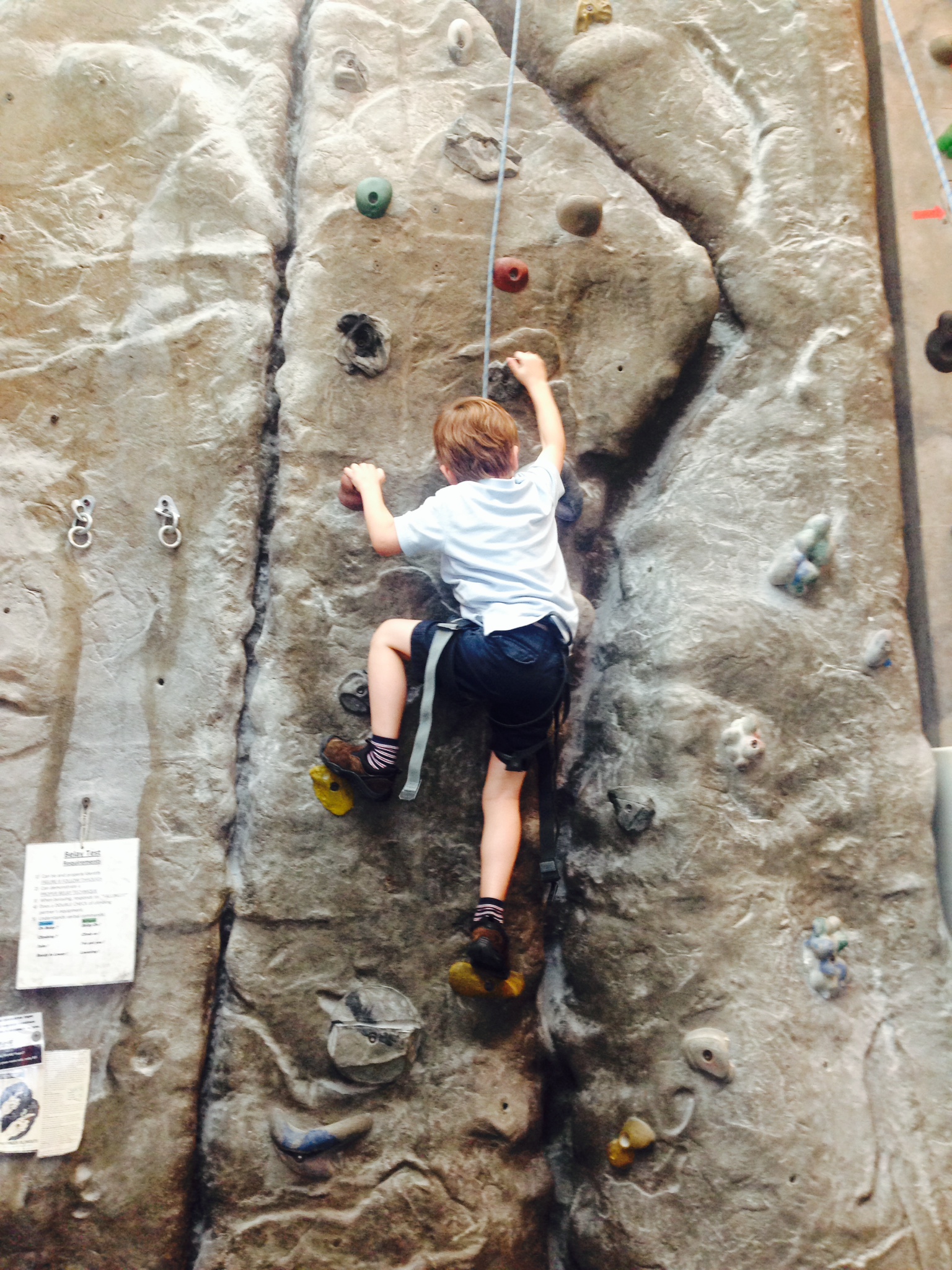
This past month has comprised an avalanche of firsts. I could go on and on. But I will address just one more, the evolution getting on the school bus. In just two weeks, we’ve progressed from me carrying Martin’s backpack and leading him by the hand down the driveway to the bus; to me carrying Martin’s backpack and coaxing him to follow me down the driveway; to me carrying Martin’s backpack and accompanying him as he walks without protest to the school bus; to Martin carrying his own backpack while I follow him; and finally to Martin walking down the driveway, alone, backpack on, and boarding the school bus while I wave from the front step. If I even try to follow Martin, I get a swift, “No, Mommy. You wait here!”

Am I proud? I’m darned proud.

And sorry.

I mean, Martin’s bus driver is also a Rangers fan.

I miss the morning hockey chit-chat.

On another occasion, Martin (right) with Christopher's big brother, Benjamin.

On another occasion, Martin (right) with Christopher’s big brother, Benjamin.

Third of Three Firsts: A Nod

The winter seemed eternal this year. Only in mid-April did spring’s first tentative harbingers arrive—daffodil buds, pollen, temperatures in the 60s.

“Martin,” I asked, one of those first warm afternoons, “it’s such a beautiful day. Shall we open the sliding doors and let some air into our family room?”

Martin stopped playing his toy saxophone and looked at me.

As I’ve learned through RDI, I waited five seconds, to give Martin’s mind time to absorb the question, and then said, “What do you think? Shall we let some air in?”

Martin still made no verbal response.

But after another second passed, he looked at me again and nodded. Twice.

Beginning very young, even before his diagnosis, Martin could shake his head no. (He could verbalize “no,” too, when he didn’t want something. Learning to verbalize “yes” when he wanted something, as opposed to repeating the last words he heard, took much longer. I believe that is common in echolalic children.) Nodding, however, never came naturally to Martin. I had to teach him the physical motion; I put my palms over his ears, spread my fingers, and gently maneuvered his head up- and downward. After months of practicing the motion, I could get Martin to nod on his own by requesting, “Can you show me ‘yes’ with your head?”

This time—his nonverbal response to, “What do you think? Shall we let some air in?”—was the first time I’ve witnessed Martin nodding unprompted. The nod was awkward, as they always are. I didn’t care.

I said, “Thank you for answering me with your head, Martin!”

Then I opened the sliding doors, and let the fragrant springtime air drift through our home.

Daffodils (and those pesky dandelions!) bloom in our front garden. I’ll nod to that.

Daffodils (and those pesky dandelions!) bloom in our front garden. I’ll nod to that.

Second of Three Firsts: The Boys’ Bathroom (in a Bouncy-House Place)

Martin and I spent Holy Week/Passover in Texas, visiting my parents. Away from home, Martin had fewer friends and activities to occupy him, so when I wasn’t dumping him on my parents—I mean, letting my mother and stepfather enjoy time with their grandson—I resorted to visiting an “inflatable play zone.”

In lay person’s terms, an “inflatable play zone” might be called a “bouncy-house emporium,” or “hell.” It is a large, undivided space (think high-ceilinged hotel conference room, or big-box store) filled with blow-up castles, mazes, slides, in which kids can jump and climb to exhaustion. In an inflatable play zone, you hear a constant whirr from the machines pumping air, a sound as if you were in an airplane. A gigantic airplane with screaming children in sensory overload. An airplane with nothing to occupy you other than watching the screaming children in sensory overload.

One afternoon Martin and I set out for the “Extreme Fun” bouncy-house place, in north Austin. My parents were due for a few hours’ break, having watched Martin all morning while I enjoyed a massage at the local spa. My brother Rudy, who was visiting Texas from California, at first agreed to accompany us but then mysteriously realized he needed to “work” on “a project for a friend,” so Martin and I were alone.

We reached our destination, disembarked my parents’ Highlander, crossed the parking lot, and discovered a note stating that, after seven years’ business, Extreme Fun had shuttered its doors.

Fancy that.

I brought Martin back to the car and, seeking to prevent a tantrum, launched into my speech about disappointment. “Oh, that’s a disappointment. Let’s think: Should we cry? Should we—”

At this point, ten seconds into the disappointment discourse, Martin cut me off and said:

“Is there another bouncy-house place around here?”

Holy cow, that was a good question. A good, appropriate question, expressed perfectly, without whining or tears. Even the intonation flowed.

A question like that deserves reward. I pulled out my iPhone and searched for another bouncy-house place. After Google Mapping the choices, I restarted the Highlander and drove us half an hour west to the “Hoppin’ House” in Lakeway, Texas.

The Hoppin’ House turned out to be a pleasant facility with eight or ten inflatables and a foam-cube pit. We stayed for more than an hour. At no point was more than one other family present, so Martin had his run of the place.

After a while Martin needed a potty break. The boys’ and girls’ bathrooms, child-size, sat side-by-side. I held Martin’s hand and opened the door to the girls’ room, so I could enter with him.

Martin pulled back. He asked, “Is this the bathroom for little boys?”

He poses that question, or some variety of it, often. I responded, as usual, that it was the bathroom for mommies and their children, and that the other one was for daddies and their children.

Martin pulled back again. He looked at the other door, as if contemplating.

I’d never let Martin use a public restroom alone. He gets so easily distracted. Who knows what might go on once the door shuts? Bathrooms are so germy. He would put his hands on everything. And he doesn’t like to do “stand-up peepees.” He would sit on the toilet, and let me tell you, I can barely manipulate those flimsy seat covers. It ain’t gonna happen for Martin.

Still, there he was, gazing upon the boys’ room. I’d been in the girls’ room earlier. It was tiny; in the same-sized boys’ room, there couldn’t have been more than two stalls, and probably no urinals. (I loathe urinals.) The bathroom had one exit, and we were the only ones in the vicinity, so I could lurk outside the door without feeling foolish.

It was like with Justin, our next-door neighbor, and babysitting: If I was ever going to let Martin use a public restroom alone, this set-up was darn close to perfect.

“Martin,” I asked, “would you like to go in the boys’ room?”

Without hesitation, Martin said yes. He didn’t smile. He looked courageous, determined, as he disappeared inside.

I waited. I don’t know how long I waited. Long enough that I thought Martin should be done peeing. Then I cracked open the door and peered into the bathroom.

Martin, who didn’t notice the intrusion, was washing his hands. At home, he protests against washing his hands, or loses focus and makes faces in the mirror instead, or runs out of the bathroom and claims he must use the kitchen sink. In the public bathroom, he was nothing but business. I watched him rinse those little hands and grab a paper towel to dry.

I shut the door so he wouldn’t know that I’d checked up on him.

Moments later Martin emerged. I exclaimed, “You did it! You went in the bathroom by yourself!” and threw my arms around him while praising the big-boy deed. Martin seemed uninterested in my praise. He said he was thirsty and asked for a bottle of water.

To Martin, I guess, using the boys’ room alone was no big deal.

Check that one off the list.

Martin, climbing above the foam-cube pit. Sorry about the photo quality; I was kind of balancing on the edge of the pit as I snapped pictures.

Martin, climbing above the foam-cube pit. Sorry about the photo quality; I was kind of balancing on the edge of the pit as I snapped pictures.

Martin heading up a slide. Sometimes I want to follow him onto these things. They look fun.

Martin heading up a slide. Sometimes I want to follow him onto these things. They look fun.

Judgments Redux

First an addendum, now a redux. Sorry.

In my defense, this was going to be part of Saturday’s “Judgments” post, but that post was getting way too long.

Judgments” ends this way:

“And so that’s it. I’m way, way beyond throwing stones at how anyone else treats autism.”

Which sounds pretty good, as if I’m all warm and fuzzy and “I’m okay, you’re okay.”

That last line, however, was carefully worded.

Here is a comment, written by an autism parent, in response to the CDC’s new estimate that one in 68 United States children is diagnosed with autism:

I’m kinda pleased…. When autism is more prevalent than ‘normalacy’ autism acceptance will be a whole lot easier! As you know, my son has high functioning autism and I don’t believe he needs to be changed or cured at all. Yeah, he sees the world differently, but different isn’t inherently wrong. I appreciate I can’t speak for all kids, but I love my very individual little boy just as he is 🙂

A mother in an on-line ASD-recovery group cross-posted that comment, from another group, with the identifying information removed.

Warning: I am about to be judgmental.

That “kinda pleased” comment is appalling.

I too “love my very individual little boy just as he is.” Indeed, I cannot conceive of anything Martin could do that would make me stop “loving him just has he is.” This extends even to moral culpability: If Martin recovers from autism, then grows up to be a serial killer, or a rapist, or a child abuser, I will be devastated, I will applaud when he is jailed for life, and I will seek help for his sociopathic tendencies. But I will still love him, even as he is.

Autism has no moral component, except perhaps insofar as manmade environmental factors are contributing to the rise in autism rates. In any event, Martin is not culpable. And if I am willing to get past intentional failings, how could autism ever make me reject “my very individual little boy just as he is”?

Loving a child is easy. Accepting a child is easy. As I have written time and again, there are days when I want to give up biomed, homeopathy, special diets, therapies, and everything else we do for Martin. At the lowest points, I want to say, “Martin has autism. I’m going to leave that as it is, and tell the world to accept autism.” I want to do so because that would be easy.

But I don’t. I don’t give up. My son does need to be cured. I would never say, “I don’t believe he needs to be changed or cured [of autism] at all,” any more than I would say, “We’re going to leave the multiple-personality disorder untreated. I love each of his personalities,” or, “Why eliminate psoriasis? I’m fighting for psoriasis acceptance instead.”

I’m way, way beyond throwing stones at how anyone else treats autism.

As for those who hide behind “acceptance” and “awareness,” who advocate “neurodiversity,” who stand by as autism takes over our children, who choose not to treat the condition at all—

For their approach, I have no patience.

I would never tell a parent who refuses to treat autism that she is selling her child short. Telling her that wouldn’t do anything to change her mind, and it might make her feel bad about herself. Instead, I try to lead by example. If asked, I respond that all kids are different, and that our family follows a special diet and biomedical protocol, and that Martin has made tremendous, if slow, improvement. I answer any questions honestly. I smile.

In my head, though, I’m thinking this:

I feel sorry for your child. Healing an immune system is hard work. Accepting autism is a lot more convenient. For you. Your child will have a more difficult life because you’ve chosen the passive path.

Stones be thrown.

Addendum

I’m not much for addenda (except insofar as FindingMyKid.com, by the nature of blogging, is one long series of addenda to its “About” page and initial post). Nevertheless, I simply must add four notes to Saturday’s crappy-to-happy post.

1. I wrote, “It may go without saying that we ended up in a rush to get to [Martin’s] afternoon social program at the JCC, and that I left the kitchen a disaster, and that I didn’t get a chance to feed myself much, and that I was feeling worse by the minute.”

We were rushing to get to the JCC by 2:00 pm. We left home ten minutes late, and then I had to take Martin to the restroom to change into new pants. It was after 2:15 pm when I finally dropped him in the correct room. Still, only one other child had arrived, out of the dozen or so who usually attend. “Small group today?” I asked an instructor. “I don’t think so,” she replied. “They’ll be trickling in.” Relieved that we weren’t the only tardy family, I headed to the library to write.

I posted “From Crappy to Happy” at 4:55 pm, just in time to pick Martin up from the three-hour session. As I arrived at the door, an instructor was saying, “Okay, everyone get your coats.” Still—yes, that’s the second “still” in as many paragraphs, by design—she looked surprised to see me. One girl from the group asked, “Is Martin going home with you?” No other parents had arrived yet. The staff seemed to scramble to gather Martin’s belongings, and one had to chase us down the hall because they’d forgotten to include his art project.

Did any of this strike me as odd? No. I suppose I was spending too much time in my own head, trying to keep a good attitude, planning our evening, debating whether to insist that Martin use the bathroom before we left.

He was getting settled in his car booster seat when I saw the rest of his group, wearing their coats, walking along the parking lot to the outdoor playground.

Because the program meets from 2:30-5:30 pm, not 2:00-5:00 pm.

Because, after more than six months at the JCC, I had the times wrong.

Because we never had been late in the first instance.

I said, “It looks like your friends are going to spend some time at the playground. Would you like to join them?” Martin said yes. I felt pretty dopey as I walked him to the playground and explained my confusion.

2. The first time I picked Martin up, while the staff were scrambling to gather Martin’s belongings, the head instructor told me that Martin had had his best afternoon ever. He had talked and talked, been engaged, and participated in every activity. When I dropped him off (early!), I had explained that, although his swim trunks and towel were in his backpack, he’d been sick all week and should be excused from swimming if he didn’t want to get in the pool. Martin almost never wants to get in the pool, so I expected him to take the excuse and run. Nope. The instructor said that as soon as Martin saw the others getting ready, he asked to get into his swim trunks, too. Not only that, he showed off for the staff, with some trick the instructor called a “froggy move.”

Saturday evening, while Martin was in the bathtub, I asked whether he could show me and Adrian the “froggy move” he’d done in the pool. Without hesitating, Martin shifted so his feet were flat on the bathtub bottom, maneuvered himself into a squat position, and grabbed his knees. “This,” he said earnestly, “is how a froggy looks in the water.”

3. I wrote, “In the end, [Martin] ate the dippin’ plate. The GAPS diet isn’t easy, especially when it comes to packing for school. If Martin accepts a dippin’ plate once or twice more at home, I’ll give it a go for school lunch.”

Sunday afternoon, Martin ate another dippin’ plate, albeit with a little assistance. So that’s what he took for school lunch today: carrots and yellow bell peppers (included because yellow is his favorite color), dip made from avocado and fermented garlic, and a side of pear. (GAPS diet says to do fruit alone, not with a meal. Cut me some slack. I had to fill that last compartment in the lunch container, and rice crackers are out for now.) The dippin’ plate doesn’t really have protein, so he had a protein-heavy breakfast of bone broth and chicken-and-egg bread with ghee, and I sent some sunbutter treats for his morning snack. Here’s hoping the lunch container comes back empty.

4. On the way home from the JCC, late Saturday afternoon, Martin and I heard both My Sweet Lord and Heart of Gold on satellite radio. For me at least, that combination effects at least a 27.5309% improvement in mood.

Saturday turned out quite well.

Martin's school lunch today: a dippin' plate with carrots, yellow bell pepper, avocado-and-fermented-garlic dip, and pear.

Martin’s school lunch today: a dippin’ plate with carrots, yellow bell pepper, avocado-and-fermented-garlic dip, and pear.

From Crappy to Happy

Remember the post about really crappy days?

Today is a really crappy day!

Stick with me, though. This isn’t going to be an unhappy post. I’ve been doing too much frustration posting lately, like when I used to do too much middle-of-the-night posting. It’s just not healthy. So today, in this post, I’m going to write myself back to happy.

First: the background. A couple weeks ago, Martin wasn’t himself. If you read this blog regularly, you know that. Here’s an excerpt of an email I sent Martin’s biomed doctor March 13:

Most nights he’s taking two hours or more to fall asleep, and waking two or three times between midnight and 5:00 a.m. He is tired all the time. He’s also “floppy” again. He is extremely hyperactive; charcoal tablets, salt/baking soda baths, and clay baths haven’t helped. His teachers have been telling me that he’s inattentive in class and not responding to his name. He had a pee accident at school this week. Sunday afternoon he had a meltdown so severe that my husband was unable to get him out of the car.

We’ve been on nystatin two weeks, and the yeast hasn’t responded, as far as I can tell. Martin remains itchy.

In general, I have an unhappy kid right now, and I feel horrible about it. Obviously, we need to make changes.

Things have got better since I sent that email. I took Martin off nystatin, switched him to full GAPS diet (more on that in a later post), and on the advice of his homeopath, increased some of his “support” drops (Inflamma-Tone and Liver-Tone, among others). He took a turn for the better, in terms of increased awareness, and some reduction in time to fall asleep, and less itchiness.

This past Tuesday afternoon, he got sick. The school nurse called me to retrieve him, and I ended up having to keep him home the rest of the week. If you’re wondering why I haven’t posted much this week, try being housebound with Martin. While sick, Martin had good language and connection, but he slept poorly and was crabby.

Second: this day. Adrian’s alarm woke us at 7:00. Adrian and I got home last night at 11:00 pm from the City. I had to feed the cats and strain Martin’s chicken broth, so it was 12:15 am when I got to bed and 12:40 when I got to sleep. Martin woke three times between then and 7:00 am. He was never up long. Still, each time I had to get up, tuck him back in, and then get myself back to sleep. Figuring 30 minutes for those diversions, I got just under six hours’ sleep, interrupted. This was after a week when I was exhausted from his night waking and unable to nap because he was home with me.

Martin was still sleeping at 7:00 am. I would have preferred to get at least 30-to-45 more minutes myself. Not possible: Adrian had scheduled an early gym visit, because his trainer had something else to do later today. So up we were. I had Adrian fed and out the door before Martin left his bed.

I tried to convince Martin to dress himself. He did, eventually, but required 15 minutes of crying and whining to reach that point, and even then didn’t make it to the socks. He declared breakfast—chicken broth, salmon sausage, and a bit of banana—to be “all things I like!” Still, he dawdled. We ended up rushing to get out the door for his 10:00 am special-ed reading program at the public library. Amidst the hurry, Martin had a meltdown because it was too warm to wear his heavy knit “dog” hat.

We drove to the library. Martin had another meltdown because I said, as I do whenever Curious George comes along, that Curious George had to wait in the car. I delivered Martin, still teary-eyed, to the reading program. Then I walked to FedEx to ship my kid’s stool samples to a lab (biomed parents know that ritual) and proceeded to a coffee shop, where I sat alone, missing the easy camaraderie of the parents from Martin’s old Saturday-morning playgroup in the City.

When I returned to retrieve Martin, he had a meltdown because I hadn’t brought Curious George into the library with me. I suggested that we go to the car, where Curious George was waiting. Martin screamed. In the library. My suggestion, it turns out, was wholly unacceptable because Martin wanted Curious George to “play with him” in the library.

By the time we got home, I could feel myself coming down with whatever’s had Martin sick this week. I told Adrian I needed to lie down for 20 minutes. I climbed in bed and shut my eyes. Within five minutes I opened them again. Martin was running around the house yelling, “Mommy! Mommmm-eeeeee!” I could hear Adrian in his home office, on a call. Not wanting his call disturbed, I said, “Martin, I’m in the bedroom.” Martin ran into the bedroom and jumped on me. I got up. I took ibuprofen for my head, which ached.

For lunch I prepared raw carrots and broccoli florets with avocado-and-fermented-garlic dip. I called Adrian from his home office to come eat with Martin. Because the meal, which I named “dippin’ plate,” was new, I wanted Martin to see that Adrian was eating the same. Martin, however, claimed he needed the potty. He disappeared for 10 minutes, during which Adrian finished his own dippin’ plate and returned to his home office. So much for eating what Daddy is eating.

After I finally got Martin back to the table, he left repeatedly, running to our bedroom, the farthest point in the house, and laughing. It may go without saying that we ended up in a rush to get to his afternoon social program at the JCC, and that I left the kitchen a disaster, and that I didn’t get a chance to feed myself much, and that I was feeling worse by the minute.

When Martin and I finally were at the door, ready to leave, Adrian showed up. He asked, “Why do you seem grouchy today?”

On the way to the JCC, Martin peed himself and lied about it.

Which brings us to this moment. I’m in the JCC library, blogging while Martin enjoys his social program.

Third: the happy. Let’s review this day—

Martin took 15 minutes of crying and whining to get dressed. This was partly my fault. I broke routine by asking him to dress himself as soon as he woke, before he even went to the bathroom or ran around. And yet he still got managed the task. As a bonus, when I asked him to pull his arms inside his shirt, he looked down and said, “Oh, it’s on backwards,” and then cooperated fully.

I’m tired from a long week with Martin at home, plus I’m starting to get his illness. Having unexpected sick days is a hassle. The other days, however, Martin gets to attend a fantastic kindergarten. Adrian and I could hardly be more satisfied with Martin’s special-needs school and his academic progress. I make this point because I’ve seen from autism parenting forums how many families need to consider homeschooling because they have no appropriate placement. We are lucky

Speaking of Martin’s (and now my…?) illness, Martin had a fever! It was the second time he’s had a fever since we moved last summer. Fever is good. Fever is healing. Fever indicates that Martin’s immune system is responding appropriately to illness. That’s progress.

Martin had repeated meltdowns today. There’s a pretty good explanation: He too is tired, and not feeling so hot. (Lest you think I’m dragging a sick kid around town, it was Martin who insisted that he felt better and could go to the library this morning.) Plus, the meltdowns didn’t last long. When he wanted the dog hat, we talked, and he agreed to get Curious George instead. When he screamed in the library, I asked, “Remember last week when you screamed at church and we had to leave?” He took the hint and calmed himself down in exchange for extra playtime at the library. I offered five minutes playtime. He bargained me up to seven minutes. That works.

Martin didn’t eat with Adrian, and then ran away from the table. Each time, I kept my cool. I went to the bedroom where he’d run, took his upper arm, and walked him back to the table without a word. After a couple tries and not getting the attention he wanted, Martin settled down. In the end, he ate the dippin’ plate. The GAPS diet isn’t easy, especially when it comes to packing for school. If Martin accepts a dippin’ plate once or twice more at home, I’ll give it a go for school lunch. Hurray for new stuff.

Martin peed on the way to the JCC. My fault. In our rush to leave home, I didn’t have him sit on the potty. I figured he had just gone during lunch, and I didn’t want to be later than we already were. In the car I could tell he needed to go. When I asked him, he said he could hold it till we got to the JCC. That never works. At least I had spare pants and underwear in his backpack, so the afternoon wasn’t ruined.

I’m getting sick. But the ibuprofen has kicked in.

One of my March Madness brackets is doing fantastic in Adrian’s office pool, with all 16 of its Sweet picks intact. My favorite team plays tonight.

My son is recovering.

And now I’ve written myself happy again.
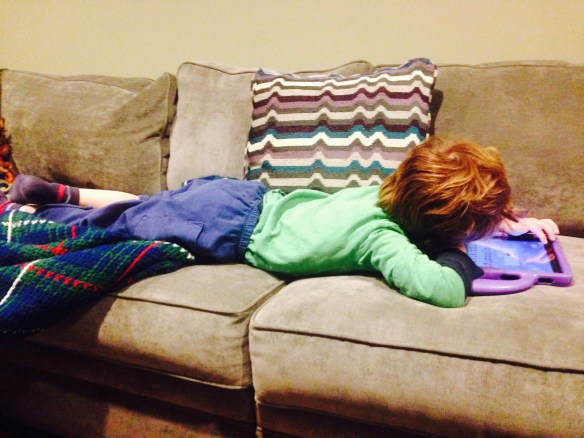
Martin, sick but managing his iPad.

Martin, sick but managing his iPad.

Curious George lending Martin a hand to recover from illness.

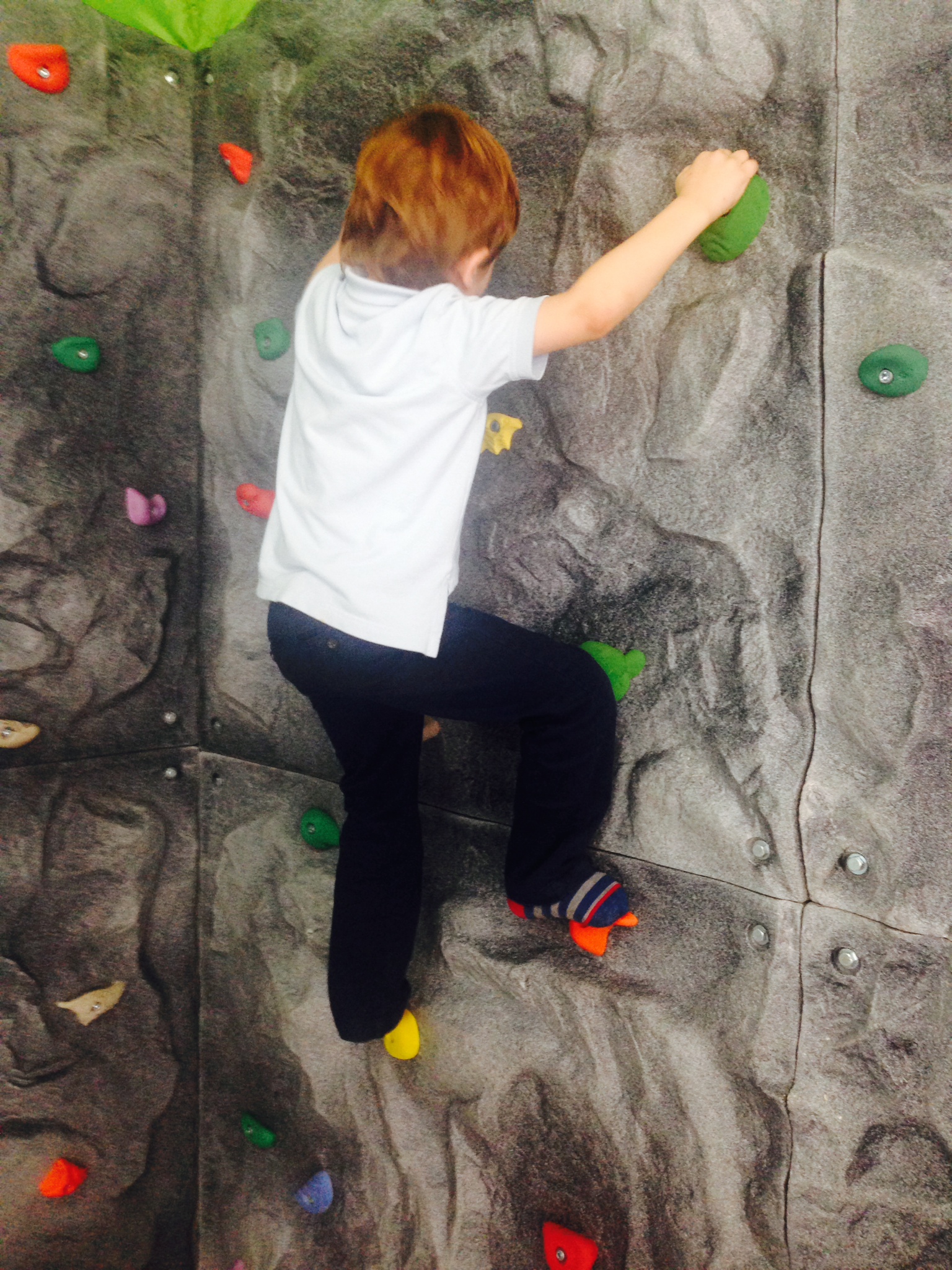
Curious George lending Martin a hand to recover from illness.
 

All Dressed Up

“Martin, why don’t you go get yourself dressed like a big boy? Want to pick out your own clothes and get dressed?” I asked at nine o’clock yesterday morning. We had all slept late, and Martin was running around the house in jungle-print pajamas.

I didn’t believe that he’d actually get himself dressed. Six months ago, I laid pajamas out on his bed and spent 20 minutes trying to get him to take off his clothes and put on the pajamas. I went away to let him concentrate, returned every two minutes to beg or threaten or cajole, even lost patience (not my finest parenting). Martin continually forgot his task. He rambled about nothing, jumped on the bed, played with Curious George. I absolutely could not get him to focus enough even to remove his clothes.

Not too much has changed since then, except that for the last two weeks Martin has responded to every suggestion, however benign, with a resolute “No!”

Nevertheless, this morning I mentioned getting dressed only once before Martin said, “Okay!” and scampered down the hall to his room.

I went to the kitchen, where Adrian was eating breakfast. “I told him to get dressed,” I said. “I’m not hopeful.”

Barely a minute had passed before I heard Martin running down the hall from the bedrooms, yelling, “Mommy! Mommmmm-meeee!

I found him standing in the living room, buck naked except for the blue socks he’d worn to bed. He looked straight at me (score!) and asked, “Mommy, am I still five years old?”

“Yes, you’re still five years old. Now don’t forget to change your socks.”

Martin ran back to his bedroom.

I returned to the kitchen. From afar, I heard a familiar sound. Martin’s bedroom dresser has thick metal handles attached to the drawers with leather loops, and when the handles are dropped, they clunk against the wood. The dresser is the last piece of a heavy German bedroom set that my older brothers once shared. As a kid, from my bed at night, I would hear that clunk and know Rudy and Eddie were getting ready to sleep. Now the sound ties Martin to his uncles.

“He opened the dresser,” I reported to Adrian. “I think he’s getting out clothes.”

After another minute Martin came running down the hall again. I met him in the living room. He was wearing clothes.

“You got dressed!” I exclaimed. “You got dressed! Good work! Go show your daddy!”

Martin went to the kitchen through the family room. I went through the dining room and got there first, which gave me a second to throw my fists in the air, jump up and down, and whisper to Adrian, “First time. First time dressed by himself without a reminder.”

Martin arrived. As Adrian picked him up for a hug, I surveyed Martin’s choices. Navy blue sweatpants with CHICAGO printed on one leg. A white sweatshirt with blue stripes. Adrian set Martin down, then snapped the sweatpants waistband to make a confirmation. “You’ve got underwear,” he said.

“Oh dear,” I added. “Martin, you’re doing so well. But you did forget to change the socks. Go change your socks?”

Back down the hall went Martin.

“Am I pushing my luck?” I asked Adrian.

Moments later Martin sauntered back into the kitchen and said, “Actually,”—that’s a favored word right now, the snarky actually—“I’ve decided to wear my sandals today.”

On his feet were Velcro beach sandals, without socks.

It was 34 degrees out.

“Sure, Martin,” I said, content. “Why don’t you wear those sandals until it’s time for church, and then you can put socks and shoes on at the same time.”

I was happy. Adrian was happy. Martin was happy.

Autism, of course, has its ways of changing any day. At church, after the service but still in the sanctuary, I told Martin that he had enough time to run around in the gymnasium but would have to eat his snack in the car. (We had to get to an Anat Baniel Method therapy appointment.) Martin responded by screaming, repeatedly, interrupting the postlude and eliciting annoyance from fellow parishioners. I picked him up and carried him outside. A complete meltdown ensued.

Last night Adrian tucked Martin into bed at 8:00 pm. Martin, who has recently discovered the joy of exiting his bed and running to the living room, went to sleep at 10:45 pm. Unlike Adrian, I cannot fall asleep while Martin is up and chatting. I got to bed after 11:00 pm and was one unhappy camper when 5:00 am rolled around.

Fortunately, as I may have mentioned, yesterday Martin dressed himself without prompts.

Which reinforces this truth: With every new morning comes fresh hope.

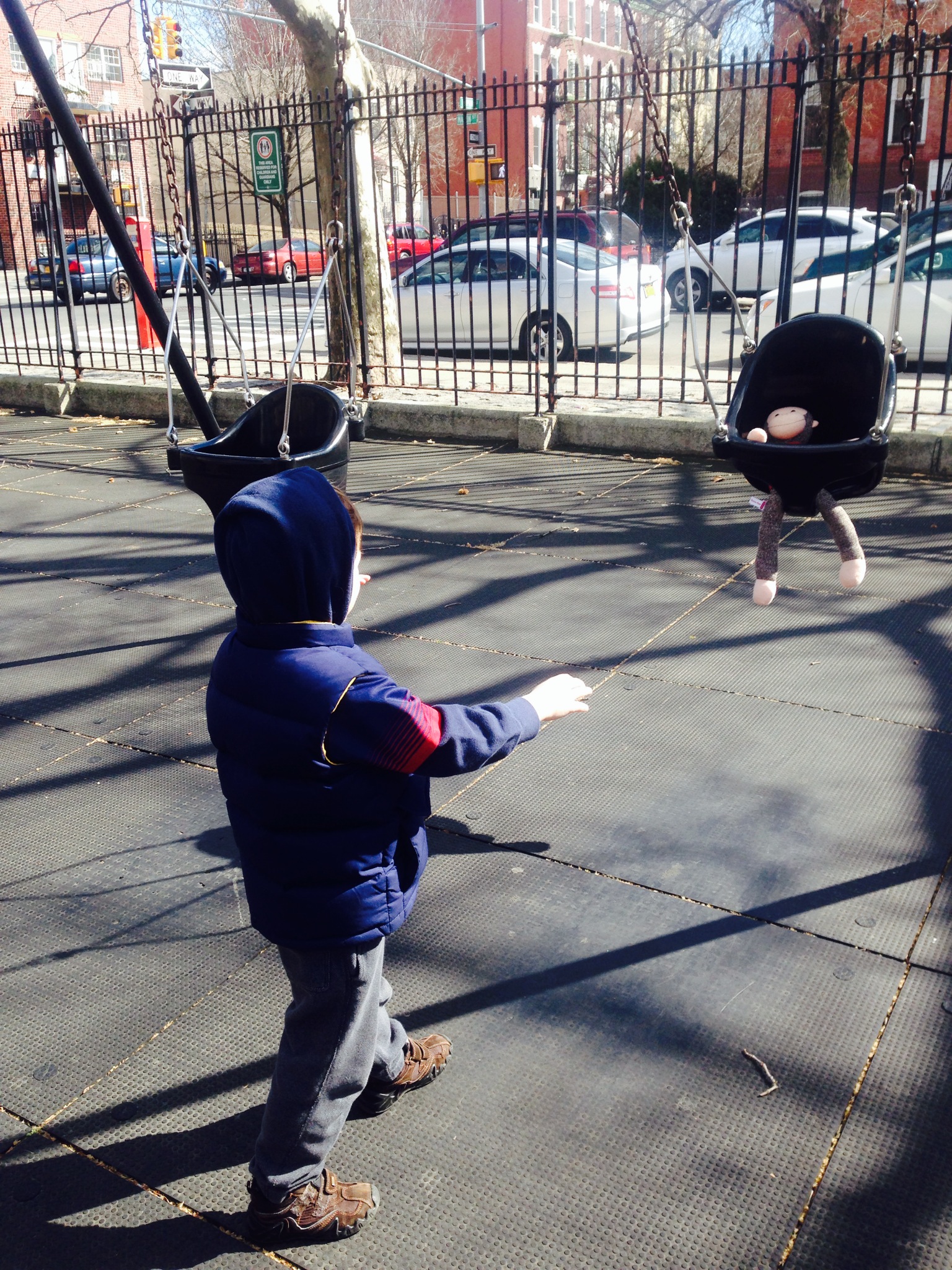
Martin plays this weekend in Bedford-Stuyvesent, Brooklyn. I told him he was too big for these baby swings. He responded by putting his "little brother Curious George" in for a ride.

Martin plays this weekend in Bedford-Stuyvesant, Brooklyn. I told him he was too big for these baby swings. He responded by putting his “little brother Curious George” in for a ride.