Interactive Play. Interactive Play That I Didn’t See

I did not witness the event described herein. Samara did. And I was so excited that, when she finished telling me, I made her narrate the entire tale, again, to my mother and Adrian, via speaker-phone. The hearsay version follows—

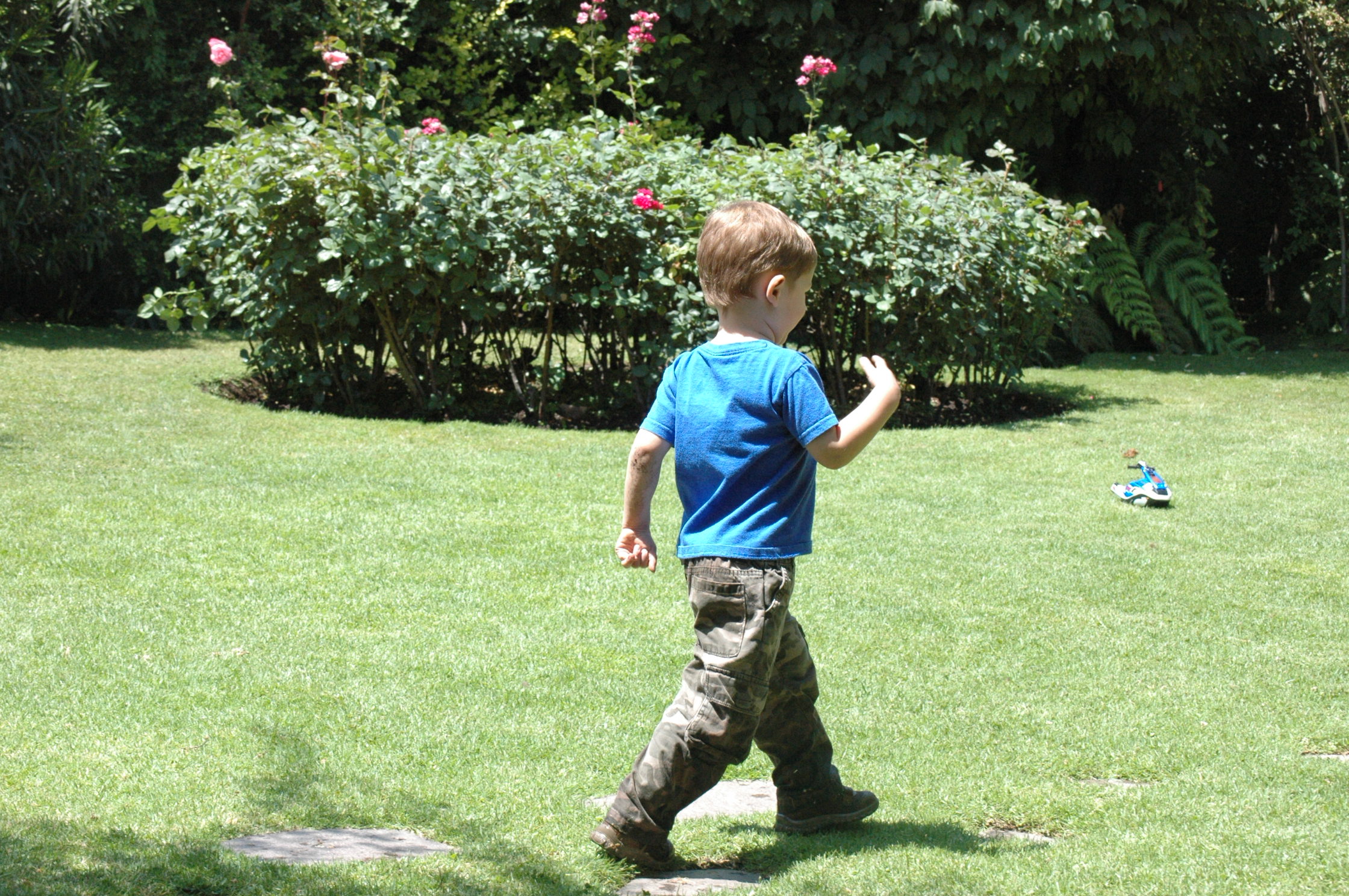
The setting was a 67-degree New York City afternoon, yesterday. Samara took Martin—he was exhausted from the overnight flight home, yet alert and adventurous—to play at a park with a substantial sandbox. Martin managed to get hold of the only on-site bucket and shovel. He had filled the bucket with sand and was using the shovel to scoop it out when another boy, perhaps four years old, approached and wanted the bucket.

Martin’s usual response to such a situation has been to abandon the toy to the child who demands it, and perhaps to start crying. Yesterday, instead, Martin engaged in some sort of wordless negotiation with the older boy, which resulted in the two of them sitting down, the bucket between them. The older boy cupped his hands to dump sand into the bucket; Martin used the shovel to scoop it out the other side. According to Samara, the two preschoolers cooperated this way for some ten minutes.

Non-verbal communication.

Interactive play.

Joint attention.

That’s my boy.

Symptom Check, 26 November 2011

Autism is defined by symptoms, and I observe Martin’s daily, so it seems reasonable to share regular updates on where Martin’s symptoms stand. Here is the status check, for Saturday, 26 November 2011.

Sleeping: No issues. We’ve been traveling more than a week. Martin has taken advantage of every hour of rest we’ve afforded him. A couple nights, when we were on a plane or rising early to catch a plane, he did not get nearly enough sleep. Our fault. Other than that, he’s been going down for twelve hours. He has appeared tired/fatigued during the day, which may be attributable to heat (it must be 87 degrees in Buenos Aires today), pollen (falling like raindrops from the blooming trees), or general over-excitement.

Attention: Not great. Name responsiveness is low. It’s been tough to get him to focus, or even to look at the camera for pictures. Granted, he’s been photographed eight million times in the last week and may be growing tired of it, but he usually does better.

Mood: Also not great. Cranky. Clingy. Doing a lot of complaining that he wants to “go back to the hotel” or “go back to New York.” I don’t blame him; traveling makes me cranky, too. And the appeals for hotel or home seem to be obvious responses to unfamiliar situations, and what Martin must perceive as chaos around him. Plus, his bad mood has resulted in some solid sentences, like, “I want to get in the airplane and go back to New York.”

Language: So-so. On the one hand, pronouns continue to be an issue. Lots of echolalia and its corollary, using “you” instead of “I”—such as “You want more water” when he means “I want more water.” On the other hand, we’ve been getting some unexpectedly original sentences. In addition to the aforementioned pleas to go home, there were “I see mountains through the window”; “There’s a flag on the boat”; and “That’s one sailboat. That’s two sailboats.”

Self-stimming: Today he’s been thrusting his jaw forward, some. Also he’s been tilting his head back to stare at the ceiling and tensing his facial features. But overall we’ve seen relatively little self-stimming this week.

Physicality: Of late, I think we’ve made the most progress in physicality. Martin appears more aware of his body. He’s now telling us when he’s hungry (although he doesn’t generally use the word “hungry”; in its place he says, “You [I] want to eat”). He’s doing a little better at keeping his “toddler training pant” dry, so long as we remember to sit him on the potty often. He’s steady on his feet and pacing himself well when holding hands with me or Adrian. When he walks or runs alone, there is some disorganization, but less than previously; in terms of movement, he looks more like a neurotypical kid.

Breakthroughs: Two points to note. First, for months, we’ve been working with Martin on learning to pucker and blow. He can blow a pinwheel now, though only in short bursts, and not a deep, extended exhale. This morning he discovered blowing bubbles with his straw in his beverage. Hurray for Martin! And what a pain for me and Adrian! All he’s wanted to do today is blow bubbles; I’m not sure he’s actually drunk an ounce.

Second (caution! graphic scatological content to follow:), after lunch today I sat Martin on the potty, where he “did his poopies.” When he had concluded (or so I thought), we had this exchange:

Me: “Are you all done?”
Martin: “No.”
Me: “Do you have more poopies?”
Martin: “Yes.”
Me: “Well, go ahead.”

Indeed, we had this exchange six consecutive times, and each time Martin in fact did have another bowel movement. We must have been in the bathroom fifteen minutes. Finally I asked again, “Are you all done?”, and he said, “Yes,” and climbed down from the potty. This may not sound like anything worth writing home about—or in my case, worth subjecting my blog readers to—but it really speaks to the improving body awareness. Good work, Martin.

Travelogue

Traveling is no good for Martin’s recovery. I have to admit that. In the seven days we’ve been traveling, I’ve not once managed to complete all 16 daily HANDLE exercises, and RDI has fallen by the wayside. I’m out of fiber powder and two of his supplements. I brought only one magnesium variety and realize now he should be taking two.

We have limited access to freshly prepared organic foods that meet Martin’s dietary requirements. We’re in Argentina now; Martin is lunching on barbequed grass-fed beef, which is superficially acceptable, but the chef cannot verify whether the cows were hormone-free, or the origin of the animal’s feed, such as whether it was grown with pesticides. These are inquiries to which, in New York, I could chase down answers.

And then Martin is overwhelmed. We’ve broken his routine, thrust him from one unfamiliar situation to the next, presented new face after new face and directed him to say hello.

We’re weathering the attendant minor freak-outs okay, but I’m not going to look for any progress from this week. We may even regress, a bit.

I’ve been contemplating what that means. I want to accomplish Martin’s recovery as quickly as possible, in a trajectory as straight as possible. Gallivanting around Latin America is hindering those aims.

On the other hand, my primary goal is and must remain Martin’s ultimate recovery, however long that takes and however jagged the process. What we do in these years—whether we’re talking 12 months, or 120—will affect the entire future course of Martin’s life. Recovery. Now, or later.

I’ve posted on the value of undertaking Martin-free activities. I believe that travel falls into this category. It is not reasonable to expect Adrian to pass X years without bringing his son back home to show him off. It is not reasonable for Martin to wait until he’s closer to neurotypical before he can play with his cousins. It’s not reasonable for our family to confine itself to the tri-state area when we want to head out and play.

So we’re managing diet and supplements and exercises as best we can, minimizing stress where feasible, and more or less writing off the week, recovery-wise.

Except for this: Enjoyment. Stamina. For me and Adrian, a little recovery of our own.

That also assists in the greater good.

¡Hola! I’m Doing Well

As I mentioned, we’re vacationing in Adrian’s country of origin. Martin performed at the top of his game our first day here: fully attentive, interacting with his cousins, chatting with adults. Since then, I think, the change in routine, air thick with pollen (to which Martin appears sensitive), and general chaos of travel have taken their toll, and he’s faded a bit. So I was particularly pleased with this interaction at a museum today. I’ve highlighted the best parts in italics:

Adrian, who has been carrying Martin on his shoulders, plops him onto a bench, next to another boy, perhaps four years old.

The boy greets the three of us: “¡Hola!”

“Hola,” Adrian responds. “¿Cómo estás tú?”

“Bien,” says the boy.

“Martín,” Adrian prompts, “¿le puedes decir ‘hola’ al niño?”

Martin looks at the boy and says, “¡Hola!”

“¿Qué es eso?” the boy asks, motioning toward a toy in Martin’s hand.

Martin comprehends the question immediately and responds correctly, “Un avión.”

“¡Mira!” the boy says, turning toward a video screen showing footage of a military exercise. “Son soldados.”

Martin makes no verbal response but likewise directs his attention to the video screen. They watch together for a few seconds, and then the boy wanders back to his parents.

Adrian and I are left beaming.

Score: one more near-typical interaction.

The A-ha Moment: Part Two

(This is the second in a series of posts, begun here last month.)

“There’s something we’re missing,” I said to Adrian after I read the article about a six-year-old boy whose autism had disappeared. “There’s something more we can do.”

I was ready to do whatever it took, to make any sacrifice or pay any price, to get back the bright and engaged boy I knew Martin could be. But I had no idea how, or which direction to turn.

After Martin was diagnosed, Adrian and I had got, from friends and family members, recommendations of people we “really should talk to.” I’d never followed up; I tend to be a go-it-alone kind of gal, and didn’t see myself finding solace in an “autism parent support group,” the path I thought I’d be walking if I started reaching out. Now, feeling lost, I decided to exploit some of those contacts.

My first call was to the wife of a once-removed business contact of Adrian. Neither Adrian nor I had ever met this woman, or her husband, who live in another city. I’ll call her Annie.

Annie answered the phone at the time we’d arranged by email, and I explained the situation: Martin’s diagnosis, the behavioral therapy, my frustration about not doing enough.

“I’m glad you contacted me,” Annie responded. “My son is nine years old, and recovered from autism.”

Those words. He’s recovered?

“Yes, completely.”

I grabbed a pen and notepad. “Tell me more?”

Annie, God bless her, spent a full hour on the phone. She had “dropped out of life” for four years, she said, in order to recover her son through every medical, holistic, traditional, and behavioral approach she could find. It had been hard work, especially knowing whom to trust and what to try. In the beginning she’d been told that only behavioral therapy was available. She hadn’t considered biomedical recovery until a friend got her interested in the topic. Once they started biomedical recovery, the difference was amazing. The traditional doctors told her the process would never work. She ignored them. Her only standard became whether a treatment might hurt her son.

(As I’m writing this, from my scrawl on that yellow notepad, ten months after the conversation, I hear in Annie’s words exactly what I would tell a parent if one were to call me today.)

Annie told me about RDI therapy instead of ABA. (She had pulled her son out of traditional one-on-one ABA therapy, a decision I also made some months later.) She told me about the Yasko profile, Generation Rescue, genetic mutations, hormone treatments, available therapies. My head was spinning. The key, Annie concluded, was to find a doctor with strong traditional medical strengths who nonetheless would ride the cutting edge of new treatments. She gave me the name of a doctor halfway across the country, an associate of the excellent Track Two doctor we now use for Martin.

I hung up the phone in a different place than I’d been an hour earlier. I spent the afternoon chasing down websites and phone numbers. I printed pages and pages. By the time Adrian arrived home that evening, I had a full presentation prepared for him.

I began with, “This is what we’re going to do.

Developments in the Physical World

Saturday morning, 2:00 a.m. Or 4:00 a.m.? Depends on the time zone we’re traversing, I suppose. I’m up all night again—this time for no reason worse than my own inability to sleep on an airplane. We’re flying for a nine-day visit to South America, including Adrian’s country of origin. I can barely see the laptop screen; it is tilted down because the seat in front of me is reclined, and it is set askance to point to glow away from Martin’s face. He’s slumbering with his head rested against my hip, his feet two seats away in Adrian’s lap.

It’s very uncomfortable, typing this way. I’m leaned so far into the aisle that anyone shuffling toward the bathroom knocks my shoulder.

Seems as good a time as any for a blog post.

The last few days have brought Martin some improvements, physically speaking.

Most prominently, he has stopped scratching. For several weeks he was clawing at his skin like a madman. His preschool sent notes about visits to the nurse for “self-inflicted scratches.” I’m not sure what caused him to feel so itchy. Most likely the yeast overgrowth, or secreting some toxins through the skin. I trimmed his fingernails extra-short, tucked in his shirt when possible. It was ugly. But as of yesterday we were down to only the occasional light scratch, the kind to be expected as the New York air turns winter-dry. The scabby welts crisscrossing his belly and thighs are healing.

The lethargy has faded, too. Martin’s lethargy is distinguishable from simple end-of-day tiredness (i.e., crabbiness) or had-a-bad-night exhaustion (also crabbiness, combined with hyperactivity and self-stimming). When Martin is lethargic, he shows interest in playing or interacting, then ends up lying on the floor or even atop our coffee table, fiddling with a toy. He also sits in W formation, as if he were sitting on his knees, except with feet and ankles splayed to his sides. I’ve tried sitting that way, as compared to on my knees or legs outstretched. The W takes less energy. It’s laziest. I guess that’s why it’s Martin’s go-to sitting position in times of lethargy.  I’ve witnessed only one W since Wednesday.

He’s thrusting his lower jaw forward less. That’s a habit that comes and goes. Possible sources include adrenal stress, self-stimming, or inflammation, either systemic or specific to the TMJ. Whatever the cause was, the behavior has disappeared again. Scrunching his features and squinting his eyes appears to be on the way out, as well. And he’s “big-boy walking,” heel-to-toe instead of tippy-toe.

I’m pleased with these developments. At the same time, I don’t want to sound the bugle too loudly, because Martin’s attention and language are still lagging where they were this summer. My hope is that the physical changes herald other, non-physical changes to come, that they signify a nascent shift back toward where we were—and then onto new achievements beyond.

Three Highlights Bringing Joy

When things are not going well—and I have admitted that they’re not, at this time—I tend to overlook everyday successes that I otherwise might highlight. Martin has brought joy to me and Adrian in these recent incidents:

Hangin’ with the pastor’s son. My church pastor has an 11-year-old son named Joey. Martin clearly admires the older boy (which is a little victory in itself). When we spend time with their family socially, Martin tags after Joey, in a Martin sort of way: like a cat, acknowledging the subject only occasionally, yet appearing constantly in his vicinity. And Joey returns the affection, mussing Martin’s hair to say hi, paying at least middle-school-level attention to not clocking Martin with a soccer ball.

Last Sunday in church Joey sat three seats away from us, in the same row, separated from Martin by only a young woman, a school teacher with a pleasingly high tolerance for boyishness. Throughout the service I noticed Martin sneaking glances at Joey. During the passing of the peace Joey hugged Martin, then high-fived him, which involved grasping Martin’s wrist and physically bringing the younger boy’s hand to his own. Joey must have considered it a teaching moment, since Martin failed to catch the cue when Joey merely raised his own hand in the air.

The closing hymn, to Martin’s disappointment, was not “This Little Light of Mine.” (Earlier in the service, he had insisted, “We’re going to sing, ‘I’m gonna let it shine’!”) I wanted to give him some treat in its stead, so I asked, “Would you like to go stand with Joey?” Although I had phrased my permission as a question, Martin understood. He pushed past the schoolteacher and planted himself next to Joey, who was signing. As soon as he noticed Martin, Joey rested his hand on the shoulder of his admirer. Martin wrapped his toddler arm around Joey’s waist, and together they swayed to the music. Despite the age difference and Martin’s limitations (which Joey hardly seems to notice), they looked like any couple of boyhood friends.

When the pastoral procession retreated and the congregation turned to face the door, I saw that Adrian, who does not attend church, had slipped into the back row to wait for us. He, too, was observing Martin and Joey. After another moment Adrian caught my eye with a look that said, “This is good.”

Expressing a preference. Martin’s expresses opinions, of course: “want” and “don’t want,” “yes” and “no,” “more” and “done.” He doesn’t do much choosing among non-binary options, however, unless a questioner enumerates a list. That is, he can answer, “Shall we go to the park, the carousel, or the wine bar?”, but walking out the front door, destination unknown, he won’t say, “I’d like to go to the carousel.”

Tuesday morning Adrian was dressing Martin for school. When he pulled Martin’s Bert-and-Ernie t-shirt from its hanger, he and Martin had a conversation along these lines:

Martin: “No!”

Adrian: “You don’t want to wear Bert and Ernie?”

Martin: “I want guitars.”

Martin’s t-shirt with guitars was not visible. Adrian sorted the hangers and pulled it out.

“Was this the one you wanted?”

“Yes.”

We had not even known Martin realizes he has choices when getting dressed. Moreover, (1) Adrian did not present Martin with options; (2) the guitar shirt was hidden, meaning that Martin remembered and decided he wanted to wear it; and (3) Martin instigated the conversation and made a meaningful selection beyond I don’t like what you’re doing.

Martin has not yet repeated this feat. Wednesday he wore Bert and Ernie without complaint. Still, it’s another first.

The wrong idea, well expressed. We have four cats. Only one, George, will give Martin the time of day; the other three scatter like he’s lobbing grenades. (I don’t blame them. By the end of this anecdote, you won’t either.) George craves attention so much that he seeks even Martin’s rough touch.

One afternoon this week Martin and George were playing on the living room floor. The interaction went well, at first: Martin dragged his fist neck-to-tail along George’s arching back. George tipped to the side, purring, and let Martin manhandle his ribs. Then Martin switched from petting to hitting—George, God love him, refrained from scratching or nipping—and I reminded him, “Martin, be gentle with George. Remember: Gentle.” I covered Martin’s hand with mine and stroked George’s soft fur.

Martin perked up, the way he does when he has a new idea. He tugged his hand from mind, sprang to his feet, and said, “I want to sit on George!

Before I could catch him, Martin plopped atop George, who promptly wriggled free and fled.

“Martin, sweetie, we do not sit on George.” I held Martin’s chin and guided his face toward mine, as I do when his attention is vital. “No sit on George. No.

I paused and awaited a response while Martin processed.

“No sit on George,” he replied at last. I let him go.

I was concerned for George. Not that concerned. He’s sturdy, and swift, and has claws.

More than that, I was pleased. “I want to sit on George.” Such a properly articulated notion, and appropriate—well, appropriate to the situation, if not for the well-being of our household companion animals.

This Again

Months have passed since I had to write a post like this one. I had hoped to be done with them forever.

It’s 4:58 a.m., Monday. I haven’t slept yet. I’ve dozed, a few minutes at a time, mostly on Martin’s bedroom floor. One of these catnaps cut circulation to my left arm, and I snapped awake with stinging-nettle pain from shoulder to fingertips. I mean, hey, it’s a floor.

Now I’ve given up trying to sleep. I’m sitting in a chair next to Martin’s bed, using my right hand to restrain his ankles and my left hand to tap on an iPad I’ve shielded from his view. I’m right-handed. Typing with my left is taking forever.

Granted, at this moment I have no shortage of time.

Martin was exhausted yesterday. (Seems strange to call Sunday “yesterday,” because for me it’s one continuous day.) In addition to recent lethargy, he’s been foggy and tired since our Thursday visit to his Track Two doctor; we hit some delays, resulting in Martin’s being awake until 11:00 p.m., and then again from 1:30-2:15 a.m., and he hasn’t got back on track yet. He went to sleep last night by 7:30 p.m., with a sitter. Adrian and I were dining with friends. We arrived home at 10:45 p.m. Martin woke at 11:30 p.m., before Adrian and I could get to bed. We took turns sitting with Martin for an hour, then left him alone to find his own way back to sleep.

No such luck.

He spoke, called to us, and griped from his bed, keeping me from any meaningful rest. At 2:35 a.m. he appeared in my and Adrian’s room, demanding attention. I led him back to bed and camped out on his floor, hoping my presence would help. It hasn’t. Martin has alternated chatting (“the Empire State Building,” “bunny rabbit,” “Mommy is sleeping on the floor!”) and singing (the Battle Hymn of the Republic, scattered Johnny Cash lyrics), in constant motion—legs a-kickin’, tiny hands tapping the headboard.

Now it’s 5:40 a.m. (I told you this typing was taking forever), so Martin’s been awake more than six hours. He doesn’t mind my restraining his ankles. Nor does it seem to be helping. He’s downright jolly, wide awake.

He’ll have to stay home with me today; I can’t dispatch him to school on four or five hours’ sleep. Yesterday, Sunday, I was tired enough to feel confused and mildly depressed. I’m not looking forward to a Monday on no sleep, unable to touch accumulated office work and rearranging all plans to entertain a crabby boy.

I think he’s beginning to nod off, at long last. His breathing has regularized, his sing-song faded. Still, I feel his ankles bounce under my right hand. Martin is simply unable to settle. Even as he dozes, his mind sends energy jolts.

What is perhaps most frustrating is that sleep—Martin’s sleep—was both our clearest indicator of progress and the biggest single lifestyle improvement for our family. When he sleeps, we sleep, at least a little more.

If we lose the sleeping, I don’t know what I’ll do.

Not Going So Well

Promises do nothing for me.

I don’t believe anyone who assures me s/he can achieve a particular goal with Martin. I’ve admitted that I’m a skeptic. Hearing that a treatment definitely will help Martin, or that Martin certainly will recover, increases that skepticism. Team Martin has no room for promisors.

This week we visited Martin’s excellent Track Two doctor, and—though I of course prefer upbeat news—it was not unwelcome when she admitted that Martin seems less physically healthy, and more autistic, than he did during our August visit. Indeed, her words confirmed my own observations (as I’ve written); any other assessment would have left me suspicious. She even pointed out some symptoms I’d not yet noticed, such as visual self-stimming.

I have nothing against reality. I can’t hope to coordinate Martin’s recovery if I don’t see the bad and the ugly infringing the good.

Here’s an uncensored account of where we stand: According to the doctor, Martin exhibits less “spark” than over the summer. His eye contact has faded along with his name responsiveness. His belly, which had flattened, is distended again. What I thought were self-inflicted scratches resulting from yeasty itchiness (which also is present) instead appears to be a rash, possibly from exuding toxins/pathogens through the skin. He is self-stimming more, his muscle tone has slackened, and he’s again cycling in and out of lethargy.

Yeah.

I’m relieved to report that the doctor’s evaluation included an action plan along with the bummer news. We got the yeast under control earlier this year; we may have taken Martin off the yeast-fighters too early. He’s going back on them now. For the next few months, we’re going to concentrate on annihilating yeast overgrowth again, and on starting bio-film work. Martin’s tests have revealed bajillions of pathogens in his gut. They’re suspected to be hiding in and below bio-film, the pissant little bastards. I wish I had a teeny-tiny Lilliputian-to-a-Lilliputian Glock with which I could take out yeast flora and gut pathogens. Alas, instead I have the likes of Yeast Aid and saccharomyces boulardii.

So that’s where we stand, warts and all.

Am I discouraged? Daily. Am I encouraged? With every glimpse of where we can get to.

However infrequent, right now, those glimpses may be.

Friendships

When Martin has a good day, I allow myself some daydreaming about life once he recovers.

So far, today has not been great. But yesterday was pretty good, and I did some daydreaming. I asked myself this: What is my No. 1 goal? If I could pick one facet of recovery wherein we succeed without qualification, what would it be?

Easy answer: friendships.

In post after post, I’ve extolled my husband, Adrian. We are (quoting a pal) the Disturbingly Happy Couple, co-participants in a head-butting, growling, grappling marriage of equal parts challenge and laughter. Without Adrian, I would, no doubt, lack the strength to recover Martin.

But there is another achievement of my adult life that I value just as much as my marriage: the ability to build and maintain friendships.

I didn’t have close friends growing up. That is to say, until I was in my 20’s I kept myself apart from others. I can perceive now that I had too little self-esteem as a young person, and that I masked that shortcoming with too much self-confidence—meaning that I ignored the needs of my peers and expected them to care for mine, without reciprocity. I had acquaintances, and “friends” in the sense of people with whom I interacted socially, but I never opened up to anyone. And if anyone tried to open up to me, I shut down.

As an adult, fortunately, I got better at internalizing humility in a way that led to more genuine relationships. It was a painstaking process, learning to unlock feelings and to expose my own weaknesses, and especially, to empathize. Inviting others out “just to talk.” Listening. Returning phone calls, writing thank-you notes, keeping track of what was going on in homes besides my own.

Closer friendships—I realize that this probably isn’t news to anyone but me—improved my life immeasurably. Today I marvel at the bone-headedness of self-isolation.

Adrian and I do RDI therapy with Martin. Last spring we watched a five-hour video explaining how RDI works. The first couple hours made for pretty awful viewing; a doctor enumerated the neurological bases for autism, and how those behaviors manifest themselves behaviorally. Dismal statistics appeared on-screen, noting that even the highest-functioning ASD adults, traditionally treated, do not live independently or enjoy significant peer relationships. Then the doctor appeared and reiterated that, unless their course of development is altered, high-functioning children with autism will not learn to make and keep friends. They will never have significant peer relationships.

I was mortified.

Another parent once told me, about her eleven-year-old son on the spectrum, “He doesn’t have friends except for one. But if he doesn’t care, why should I?”

I think she must be wrong. I think her son must care.

Martin will care if he has friends. And so will I, always.