Guessing Game

Drafted in the morning, on the train, on my way to work:

Let’s conduct an experiment: How well do I understand Martin’s health these days? Can I predict what his super-knowledgable biomed doctor will say?

Martin is in a difficult place right now and has been for a month, ever since we last visited his biomed doctor in California, which was one month ago. Especially at bedtime, but also in spurts throughout the day, he’s beset by so much hyperactivity as to be nearly uncontrollable. The agitation and need for movement are affecting his ability to fall asleep; until nearly 10 o’clock yesterday evening, he was kicking his feet in bed, calling out, springing up to jog down the hall and return to bed. Daytimes, I’ve observed him engaging in his lone remaining repetitive behavior, which is to skip three steps pad-a-bump, run across the room, turn, stop and think (or ponder, or get lost in his own self for a few seconds), and repeat: pad-a-bump, run, turn, stop. Tuesday he did this even in our local coffee shop, pad-a-bump from the cash register to the front door, pad-a-bump back to the cash register. He’s giggly. He’s interrupting and talking over others, without regard for his surroundings. He has some increased sensitivity to sound. He’s so itchy.

Yet, as is often the case, the symptomatic behaviors seem superficial, and perhaps there is a deeper level of healing going on. He is more conversational than ever, answering questions and telling me what happens at school with minimal perseveration. His handwriting has improved dramatically; instead of gargantuan, unsteady strokes, he’s penning tight letters that actually fit on the paper lines. He’s attempting to make jokes, albeit nonsensical, unfunny ones. “I think Daddy’s going to take his hair off his head. Isn’t that funny? I’m just kidding.” He’s bargaining. “Santa Claus knows I didn’t finish my soup? That’s okay. I think Santa looks at the whole year, and I’ve had more good days than bad.” (What does he want from Santa Claus, you ask? Adele tickets. Martin has selected the most phenomenally in-demand tickets on earth and decided that’s what he wants for Christmas.)

Except for the itchiness, which predated our last visit to California, the hyperactivity, repetitive behaviors, and other symptoms began, as near as I can reckon, right when we returned from that trip, one month ago. The sequence was like this: Thursday afternoon we flew from New York to California. The flight was delayed, and Martin wasn’t in bed until 11:00 pm PST, or 2:00 am EST. He managed to sleep until 9:00 am PST, or noon EST. We spent Friday afternoon at the doctor’s and, as part of that appointment, Martin had an LED treatment. Friday evening we met friends (a father and his son, Martin’s age) for dinner, which went well. Martin fell asleep around 10:00 pm PST Friday night and slept well. Saturday was a packed day. We went out to breakfast, and then to see my friend’s new house, and then we drove inland an hour, to spend the afternoon with the same friend’s mother and to visit George the cat, who now resides on the West Coast. It was 6:30 pm when Martin and I returned to our hotel.

That night, Saturday night, our placid California weekend went awry. Martin knew we had to get up early (3:45 am) to drive 40 minutes to the airport, return our rental car, and catch the 7:00 am flight to New York. He was excited about getting up so early. Too excited. He went to bed giddy around 8:00 pm and—I don’t have a better way to put this—worked himself into a frenzy, calling out, laughing, asking whether it was time to get up. Around 9:30 pm, anxiety took over. Mommy! Mommy! Something is wrong! Mommy! I don’t know what’s going on. Mommy, where are you? [I was in the same hotel suite, using my iPad, where he could hear me and see the light I was using.] Mommy, help! Help me! His agitation mushroomed until he was sobbing and even shrieking. In an effort to calm him, I said, unthinkingly, “Martin, you have to stop. You have to stop screaming. We are in a hotel. Someone could think I’m hurting you and call the police!” That foolish statement became a target for his previously unspecific anxiety. Are the police coming? Are the police here? Will the police take me away? No! No! Mommy, tell the police not to come! I don’t want the police to come!

My poor little man was terrified and out of control. At last I took him to my bed, climbed in, and squeezed him until he began to calm. Once the sobbing reduced to whimpers, I released him and rubbed his head instead. Within two minutes from that point, he was sound asleep and I had quiet time to wonder what the hell had just happened.

When I woke Martin at 3:45 am, after just five hours’ sleep, he sprang from bed, evidently cheerful to be getting up at such a special time. I saw no trace of anxiety or giddiness. That day, Sunday, as we traveled home, he seemed restless and uncomfortable, which I chalked up to lack of sleep, but otherwise unremarkable. Sunday evening, however, he became hyperactive and had trouble getting to sleep.

Since that Sunday evening, we’ve endured the hyperactivity, some inappropriate laughing, continued itchiness, and lack of focus. Charcoal tablets help, but not always. We’ve started a new protocol of supplements, antimicrobials, homeopathic remedies, and yeast fighters; I’ve introduced the new elements slowly, and haven’t tied a specific reaction to any. Last week for Heilkunst we cleared a DTaP vaccine, again without a specific reaction, only the same hyperactivity. The hyperactivity is uniformly worst at bedtime, and Martin continues having trouble getting to sleep. He’s woken early a few times but generally sleeps through the night.

So what is going on here?

I have scheduled a short call with the doctor this afternoon. I’m going to write what I think is happening, and then, after I speak with the doctor, I will give her thoughts. I’m eager to see whether we agree.

My own theories: First, I think yeast is at work. I said, even before we went to California, that I believed Martin was suffering a yeast flare. The poor kid is so itchy. He’s scratched his legs and belly bloody. He’s giggly and “drunk.” Second, I wonder whether the LED he had in California might have kicked up some toxins that Martin is having trouble clearing. Maybe?

Drafted the next day, after I spoke with the doctor:

The doctor disagreed with my guesses. While yeast might be a subsidiary issue, she said, Martin’s hyperactivity makes it unlikely that yeast is the primary issue. Hyperactivity has not been a hallmark of Martin’s previous yeast flares, she pointed out. As to the LED, she said that any effects would have emerged during the 25 hours immediately following the treatment. Saturday night, when Martin experienced the anxiety attack that launched this hyperactive period, some 30 hours already had passed.

She admitted that it’s tough to know exactly what’s going on. Her theory: Banderol and borrelogen, the antimicrobials that Martin has been taking in incrementally increasing doses to treat chronic Lyme, are too strong. His sensitive system needs time to adjust. She reminded me that, when we used banderol three years ago, as well as when we used the antimicrobial takuna, we had to increase the dose extremely slowly—sometimes by not more than one additional drop per week. This go-round I’ve been building banderol and borrelogen by about a drop per day each. She asked me to hold the antimicrobials for 48 hours (or four doses, as we dose them twice daily) and she if Martin’s hyperactivity decreases.

I was going to post this blog entry after taking to the doctor. Now I feel like it’s worth waiting another couple days to announce the results of our 48-hour experiment.

Drafted two-and-a-half days after I spoke with the doctor:

Better. Around 6:20 am I messaged the doctor:

I think you nailed the issue. Since we spoke on Thursday, I have withheld banderol and borrelogen (so five doses withheld so far: Thursday evening, Friday morning and evening, Saturday morning and evening). We have seen a perceptible, marked decrease in Martin’s hyperactivity, and Friday night he was able to go right to sleep for the first time in weeks. Yesterday afternoon I took Martin into the infrared sauna for a detox cycle. Going in the sauna really, really agitated him. For an hour or so, the hyperactivity was back, full-force, and then we had some emotional dysregulation. On the other hand, last night Martin went right to sleep again, his pre-bedtime meltdown notwithstanding. What do you suggest? BTW, we have continued during this time with four drops Clovanol daily. Thank you!

Pretty intense, right? And I didn’t even tell her that he had flat-out refused to watch Pride and Prejudice with me on the sauna video screen. “Turn it away from me!” he said. “I don’t want to see it!” That evening, I messaged the doctor again:

An additional note: Today (Sunday) the hyperactivity was back up again, though not as bad as before. We haven’t restarted banderol or borrelogen. Today Martin also was “floppy” (this could be the lack of MitoSpectra) and emotionally volatile—he had a meltdown over where we chose to have Sunday dinner, and was not able to recover for quite some time. He’s in bed now, making noise instead of going to sleep. I’m wondering if yesterday’s sauna has lingering effects.

She responded by advising me to continue holding banderol and to restart borrelogen from one drop per day, or even one drop every other day, and build even more slowly than before. She also suggested that I keep Martin out of the infrared sauna for a while, as it may be too intense and also stirring up metals. Regarding the floppiness, she advised putting Martin back on mitochondrial support immediately, and said that might also help him better handle the antimicrobial herbs.

Drafted four days after I spoke with the doctor:

Hyperactivity is reduced again. Unfortunately, emotional dysregulation is taking hyperactivity’s place. (That’s a kind way to say that Martin is moving less but melting down more.) Also, Martin is distracted. This could be simply a result of the changes in his antimicrobials, and the fact that his new MitoSpectra hasn’t yet arrived. Here’s hoping that he evens out soon.

Note for careful readers:

Are you wondering why Martin has been off MitoSpectra? I knew it. You are very careful readers. The last two bottles of MitoSpectra I purchased went bad; the pills changed color and developed a fishy smell. I became nervous about continuing to use the product. But I do like MitroSpectra and believe it’s been helpful to Martin. After talking with a representative of the company, I’ve decided to give I decided to give it another shot. Help us, MitroSpectra!

I Feel Ya. No, I Don’t. I Get That. No, I Don’t

The day after Thanksgiving, my stepfather and brother and husband—a/k/a Grandpa and Uncle Rudy and Daddy—took Martin to see The Good Dinosaur. Martin, who had seen the movie promoted on Disney Channel and been asking to go, came home all smiles from the theatre.

“Hi, Martin!” I greeted him. “How was the movie?”

“It was good!” he said.

“Did you enjoy yourself?”

“Yes.”

“What was your favorite part of the movie?” I asked.

Martin didn’t hesitate. “My favorite part was when the dinosaur boy’s dad died,” he said, laughing.

“When his dad died? Wasn’t that very sad?”

“Yes!” Martin said, still laughing. “It was sad!”

Confronted with what must have been a tear-jerking scene for the other movie patrons, Martin seemed unable to suppress his glee.

Last month I lost a friend. We weren’t close; we’d known each other in junior high school, and reconnected a few years ago via Facebook, and discovered that we shared interests in fitness, real food, and faith. By the time we reconnected, Jenny was already fighting her second bout with breast cancer. I knew that she was in and out of chemotherapy and making frequent doctor visits. Yet, to me, her cancer never seemed present or imminent, because I never saw her in person and because her Facebook posts were always upbeat.

One night, just before I went to bed (alone; Adrian was away on business), I checked Facebook and saw that another user had just tagged Jenny in a post something like, “Pray for Jenny. She’s gone into the hospital and isn’t doing well.” I prayed for Jenny that night. I didn’t worry too much. She’d been in the hospital before and gone home quickly. Besides, her status updates that week had been banal: She loved her new juicer. She was considering seeing a doctor a few towns away and wondered whether anyone would like to share the ride. Everyday stuff.

Jenny must have been on my mind overnight, because when I woke around 5:30 a.m. I checked Facebook again immediately. During the early morning hours, a different user had posted, on Jenny’s wall, something like, “Jenny’s been taken off the ventilator. Her husband asks for prayers that she passes in peace and they can grieve.”

Only days earlier, on-line, Jenny had seemed vibrant and untroubled. I decided that “taken off the ventilator” must mean that the doctors wanted to give her the chance to pull through on her own, and she would.

At 7:15 a.m., Jenny’s aunt posted something like, “R.I.P. my beautiful niece. You fought hard.” By that time, Martin was seated at the table eating breakfast, so I set down my iPhone, left the kitchen, and started to speak with Jenny, in case she could listen. I’m glad we found each other through Facebook, and I’m sorry I didn’t realize how advanced your cancer was. I wish I’d realized. I would have said more to you. I would have talked about sleeping over at your house in seventh grade, and some of the crazy afternoons we had in your family’s swimming pool. Remember?

When I returned to the kitchen to finish giving Martin his supplements, I was crying. He noticed (that’s encouraging) and asked me why.

“I just lost a friend. My friend died. My friend died, and it’s making me very, very sad that I won’t see her again, or talk to her.”

“Oh,” Martin said. Then he smiled, giggled, and said, “Your friend died!”

“That’s not a funny thing. It’s something that’s making me sad.”

Martin said, “Okay,” and kept giggling.

It was, fair to say, one of our more—ahem—challenging moments. I stood in the kitchen, still crying, and my son had no response other than to laugh at my grief.

Here’s one whopper of a reason I stick with biomed, with trying to heal Martin from the inside out: You can teach a lot of things. You can teach eye contact. You can teach small talk and germane responses. You can even teach how to mimic emotion. But you can’t teach empathy.

At least not any way that I know how.

Last

Martin attends our church’s Tuesday after-school program for kindergarten-through-fifth graders. Because the program is volunteer-run, and because I want Martin to participate as fully as possible, I send an aide with him. The aide, Janine, is a special-education professional whose assignment is to ensure that Martin is included, to help Martin with any projects or activities that might otherwise overwhelm him, and to back off whenever Martin is able to handle the situation unassisted. I would accompany Martin myself, except that my presence is nothing but a distraction. When Mommy is in the room, I’m afraid, Martin has eyes for nothing else. Besides, who wants to play with the kid whose mother is hovering behind?

I can’t say that Martin loves going to the Tuesday program. He tries to get out of it whenever possible. (“I’m so tired!” “I don’t feel well!” “Oh, I just want to do my homework.”) Compare that with Sunday mornings, when Martin eagerly accompanies me to church and participates in children’s Sunday school. I don’t know what accounts for the contrasting attitudes. It could be that Tuesday afternoons he is exhausted from school and wants time alone, or that the Sunday school teacher (Sundays he has no aide) lets him get away with only minimal participation. It could be that he doesn’t like having an aide, although he’s never asked to attend Tuesday alone, only to skip the event altogether.

I wrote that verbose introduction to establish that although I am not present at the Tuesday after-school program, I know a lot (through Janine) about what happens there. (Perhaps I got distracted from that point.) Often Janine’s report is super: Martin was asked to light the candles and did so without help; Martin sang along in choir practice; Martin played tag properly in gym; Martin raised his hand and answered questions after storytime. Some weeks Janine’s report is tougher to swallow, such as the two occasions on which no one wanted to hold Martin’s hand during the prayer circle. (He was in the grip of allergies and probably using his hand as a tissue.)

This Tuesday, Janine said that the gym teacher, who usually has the kids count off or otherwise randomly divides them for sports and games, decided to appoint two team captains and let them pick teams. Remember those days from grade-school gym class? Two kids stand up front, pointing to the best athletes first. The chosen teammates join their captains, relieved. I remember well. I was usually the first girl chosen, and I liked that. I also understood why the teachers stopped the process when half or two-thirds of the kids had been picked, and just split the left-overs between the teams. This Tuesday, at the church, the gym teacher didn’t do that. He let the picking go on and on, right down to the very last kid, on and on until only one kid was un-picked, until there was only one kid standing alone, unwanted by either team.

I’m sure you know who that kid was. Take any group of typically developing grade schoolers, mix in one kid with autism, and see who gets picked last.

Martin did not show any overt reaction, Janine reports, but it is always hard to tell what he’s internalizing.

I hate when things like this happen. I hate the insensitivity of an adult who would let that happen. (Next Tuesday I will show up at the church a few minutes before the program begins and explain to the gym teacher, in kind and polite words, the effect of his decision on my son.) I hate wondering how much Martin’s self-esteem suffers from his difference, and the irony that our efforts have improved his awareness enough to know that he’s being left out, but not enough to know how to fit in. I hate wondering whether Martin will ever be fully included.

I also hate dealing with these questions at this time, because Adrian and I are facing a difficult decision. Since kindergarten (he’s in second grade now), Martin has attended a wonderful self-contained special-education school. His class has twelve students, each with autism or some other type of disorder that affects the ability to communicate. The pupils are bright, and they soldier on under the “common core” standards now stamped onto our public schools as widely as vaccination requirements. Adrian and I have realized, however, that Martin is perhaps not being challenged academically; his homework packet takes him no more than ten minutes to complete, and about eight of those minutes are dedicated to arguing with me over whether he can illustrate the homework because he’s bored. Adrian and I have wanted to believe that, even if Martin isn’t challenged academically, at least he has social role models; half the kids in his class have language challenges but no particular social impairments. On the other hand, over the past year, Martin has made enough progress, socially, that he is nearing the level of those social-top-tier classmates. So now what? What is the next level that Martin can reach, if he remains in his self-contained special-education school?

For that reason, we are considering attempting to find a private school, with small general-education classes, that would be willing to let Martin come to school with an aide, at least for the first year or two. Martin might not be ready, yet, to make the jump to general education. Moreover, it would be a one-way street; if we pull Martin from his current school, we will likely lose his placement there, and have no option to re-enroll him. On the other hand, we know that elementary curriculum (public school, or private) becomes advances rapidly in third grade, requiring more drawing conclusions and making inferences. If there is a “best” time to more Martin out of special education, we may be approaching it.

Then I remember what I hate. Even if Martin isn’t challenged in his current environment, at least he’s safe. At least he’s neither bullied nor left standing, alone, when the teams are picked. At least his self-esteem—maybe his most fragile attribute—is padded and protected.

To leap, or to stay safe? Even on that everyday question, autism leaves its mark.

IMG_1054

The Beast

I regret to report that Martin seems to be having a mild yeast flare.

For the first three years of Martin’s recovery journey, candida—yeast—was my constant foe. Before we started biomed, before I understood Martin’s health issues, Martin itched constantly. Self-inflicted scratches marred his legs and backside. The fancy dermatologist diagnosed “sensitive skin” and advised us to use Cetaphil or CeraVe products (!), which helped nothing. Once I realized that Martin’s constant itching and some of his bowel issues were connected to candida imbalance, we started to tackle the issue with diet and supplements, and we made progress. Nevertheless, yeast is tricky. If you get it under control in one form, it doesn’t wait long to rear its ugly head in another form. We clashed again and again, yeast and I.

Two years ago Martin started taking Candex. We’ve had the most luck with that product, and we haven’t really had a major yeast battle since.

And now—he’s itching his legs again, and asking me to rub cream on them. He has those stupid scratches. I snuck into his bathroom and witnessed a “fluffy” poop. (Sorry to throw that in unannounced! It was quite shocking to me at the time, so I decided to go for effect in my reporting of the incident.) Plus, he’s silly. So silly. Inappropriately laughing. Cracking himself up. Disrupting his school class. Silly, sill, silly. The situation isn’t out of control, but it sure isn’t great.

Is this a yeast flare? If so, what could be the culprit behind this yeast flare?

Possibility: Having been so many months without substantial candida troubles, I’ve loosened up Martin’s diet to allow more sugars. He’s eating daily fruit, including homemade vegetable-fruit juices, and scattered starches (potato) and carbs (quinoa, brown rice). (Wait, did you think I meant refined sugars? Oh, you made a funny! Martin never gets refined sugars.) Those foods feed yeast. I may need to tighten the diet back up.

Possibility: Especially as he’s working through his past immune insults, Martin gets healing reactions. His recent allergic attacks, for example, may be related to clearing vaccines. (The cats are another story.) Vaccines—indeed, any injections, as I understand the process—are notorious provokers of something like allergic reactions. Clearing vaccines, moreover, can cause silliness and inappropriate laughter. Maybe, in this kerfuffle as Martin’s body heals itself, it (1) loses track of yeast, and (2) compounds the problem with symptoms that mimic a yeast flare.

I don’t know if this really is a yeast flare. The symptoms are there, but symptoms can be deceptive. (Like, for example, the symptoms we call “autism” can be deceptive.) I hate the thought of having to conquer this beast yet again.

Eons ago, in college, my friends and I used to drink dollar pitchers of Milwaukee’s Best at happy hour. We called that cheap beer “the beast.” That beast—that yeast, that hops, that barley—was so much better than this.

This isn't the beast! This is the cutest little man ever. Martin, at play, Mountain View, California.

This isn’t the beast! This is the cutest little man ever. Martin, at play, Mountain View, California.

Never Gonna

I am a parent, obviously. I hope I am a good parent. I have a son, and I adore him. I try to help him. He seems to be doing well. That’s enough of parenting, right?

I was in Manhattan and walked by a playground full of preschoolers and kindergartners, and even some babies and toddlers. The kids were chasing each other and calling out, climbing, jumping. Some adults were interacting with kids. Others sat on benches and chatted. It all looked so normal. So typical.

In a moment I felt the full impact of our decision—Adrian’s decision, and mine—to have only one child. Martin is seven years old now. Every day he’s closer to recovery. Every day he’s more like typical children. Nevertheless, even if he were to shed every last vestige of autism this very day, I will never have the experience of parenting a typical preschooler or kindergartner. I will never know the experience of those playgrounders. My experience of typicality will begin only with an older child.

What are the analogies to this situation? Adopting an older child? Certainly not. I’ve had a child for seven years. I’ve been parenting all this time, just a different type of parenting. Have a child who transitions gender? Maybe sorta like that. First you have one type of kid, and then another, but the child stays the same and you love that child either way.

Let’s face it: I will never have a toddler help me make Rice Krispie treats like in Kellogg’s commercials.

I will never get to be the mom who Pinterests craft projects with her preschooler. (Not that such an outcome was ever likely. I am who I am.)

I will never put a kindergartner on the bus, first day of school, and wonder whether he is going to make friends or like his teacher. Two years ago, I put my kindergartner on the bus, first day of school, and wondered whether his teachers would understand the importance of restricting foods not on his “acceptable” list.

And what of Martin, who has been deprived of typical preschool, of typical kindergarten, of typical grade school so far? He will never have those experiences, either. Years from now, when his friends ask, “Remember in second grade when we were all into Captain America? Remember peanut-butter-and-jelly sandwiches?”, what will Martin say?

I am a parent. I hope I am a good parent. I have a son, and I adore him. I try to help him. He seems to be doing well. That’s enough of parenting, right?

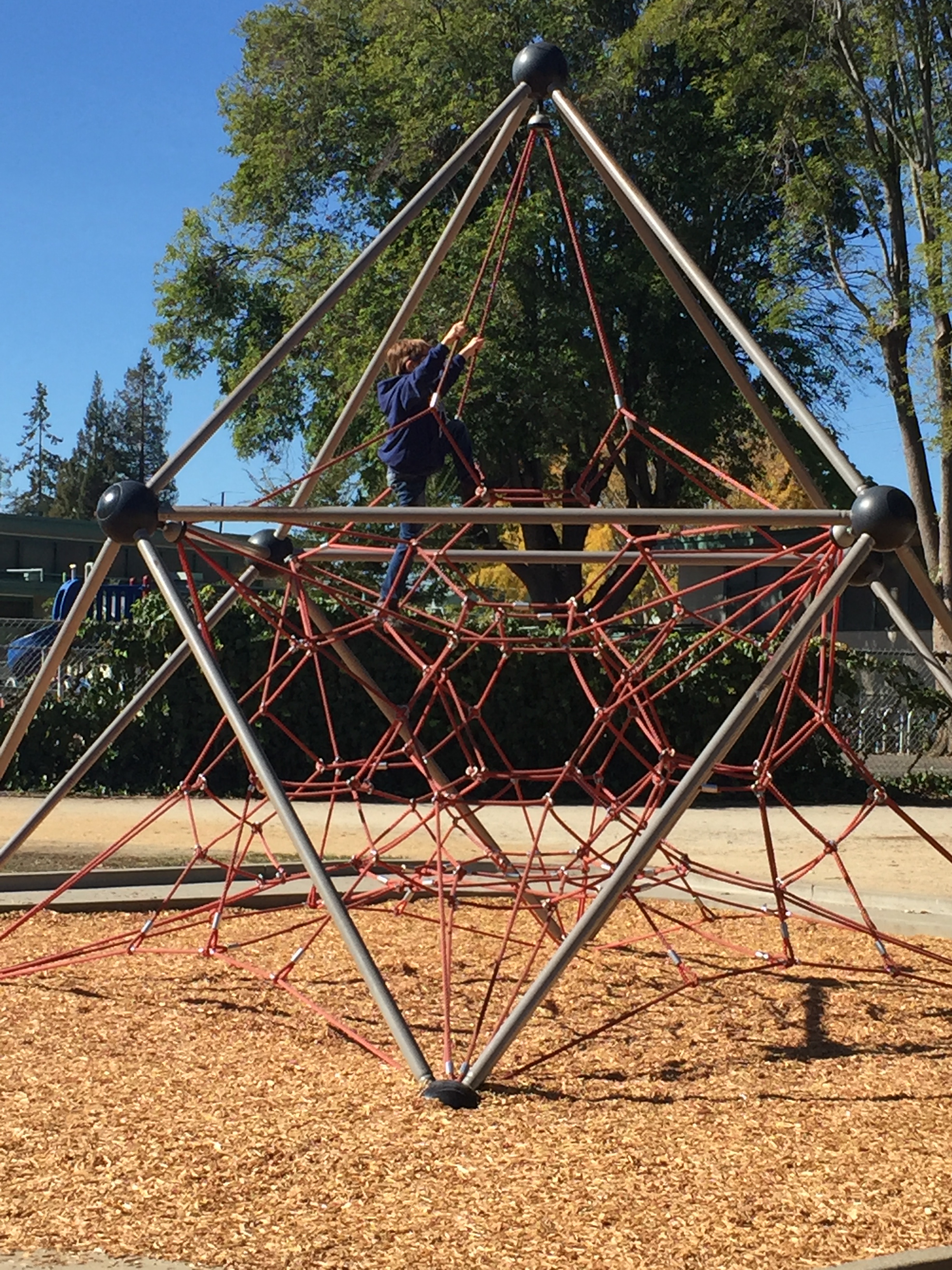
In the blue, at the top. That's my kid.

In the blue, at the top. That’s my kid.

A&A Part IV: Anything But That

This blog has played host to some difficult posts. Difficult for me to write, I mean. “And Now, Martin Does the Rejecting,” wherein I described the City Kids Club kicking Martin out of its Twos Club. That was a tough one. “Let’s Talk Honestly About Really Crappy Days,” wherein I described a truly dreadful morning in our household. Not so easy to own. The recent “Why Can’t We All Cross the Finish Line, the Nonexistent Finish Line, Together?”, wherein I admitted to wondering whether Martin should find a higher-functioning best friend. You get the point.

This post, this one I’m writing now, tops them all. This post feels impossible to write. It combines just about every way in which autism has beaten me down: the degradation of my own identity, the ethical compromises, the rearrangement of dreams. The situation in which I find myself today—it’s not me. At least not a me I thought I’d ever be.

I’m on a plane back to New York, from Texas, where I’ve just abandoned one of our three cats, Levi.

Maybe “abandoned” is too strong. I flew with Levi to Texas in order to deliver him, personally, with boxes full of supplies, to a new home: a mother and two kids (ages 11 and 7), who are welcoming him with joy, and who intend to house him forever. They’ve had cats in the past, and now they have Levi. They are friends of one of my close girlfriends. They will let us visit Levi whenever we are in town at my parents’ home. It’s a close to perfect as I could hope for.

Still, it feels a lot like I’ve just abandoned Levi.

I’ve had cats, between one and four cats at a time, since 1994, when I adopted Tiny Rachel. As of next week, when Freddy and Edith move together to their new home, I will have no feline companions. I will have given them up.

After Martin started wheezing, we had an allergist run a blood test and a skin-patch test. The skin-patch test involved a dozen allergens being pushed into Martin’s forearms, and then he and I waiting 15 minutes to see if any reaction developed.

A reaction developed. Not after 15 minutes. Immediately. One allergen among the dozen swelled Martin’s skin into an angry red bump. I looked at the chart of allergen placements to see what was causing the reaction.

“Cat.”

Cat. Martin was testing allergic to cats. Severely allergic. I could see the reaction with my own two eyes—two eyes that begin to fill with tears. Martin is allergic to cats. We’ve had cats since before Martin was born, obviously. Martin has never lived in a home without cats.

How? I asked the doctor. How could this be? Before this summer, Martin hasn’t had allergic reactions. The asthma is brand new. How, when we’ve had cats his whole life, could they now be contributing to allergies and asthma?

The allergist, whom I could call a traditionalist, came up with two possibilities. First, animals living in a home are known to reduce the incidence of childhood allergies. Maybe, by having cats since Martin was born, we diminished what otherwise would have been a more severe allergy, and also staved its onset. Second, given that both my older brothers and my mother are allergic, Martin has a genetic predisposition to cat allergies (which we have always known). Maybe Martin just developed his allergy later.

I am not a traditionalist, and so to the allergist’s possibilities I added a third: Maybe Martin has always had this allergy, and until now his immune system was not healthy enough to mount the proper response. Maybe, in all the work that we have done to heal his gut, we have fostered Martin’s allergic response. The cat allergy is a bad thing. Martin’s ability to mount a proper response for the first time, if that’s what’s going on, would be a good thing. Immune systems are supposed to respond.

The very night Martin visited the allergist, Adrian and I went out to dinner (without Martin), I told him the test results, and we decided that we had to rehome Levi, Freddy, and Edith. The other options were unacceptable. We couldn’t have the cats live in the basement; the basement’s ventilation and duct system carries airborne allergens to the rest of the house, too. We couldn’t make the cats into outdoor-and-garage pets; they are essentially lap cats who seek and want constant human interaction. We couldn’t keep the status quo; Martin is rubbing watery eyes, coughing through the night, wheezing after exercise.

That being said, Adrian and I both believe that we have a lifelong obligation to our companion animals. There was no discussion of taking the animals to a shelter or moving them immediately to suboptimal homes. Levi, who enjoys spending time outside and doesn’t respond well to other cats, especially male cats, needs a home where he can safely go outside, and preferably be the only cat. As to Freddie and Edith, we adopted them together because they were bonded to each other. They’ve been with us almost eight years, and nothing has changed. They are best friends, reliant on each other. They must remain together.

We got lucky. I sent a message to friends and family members, nationwide, who know how we’ve struggled with Martin’s health. They spread the message wider. Within a week, the Texas family had come forward with an offer to adopt Levi. Within three weeks, we had found a lovely woman who has taken in many older cats over the years. She drove 90 minutes to our house to meet Freddie and Edith, and then decided she would like them to join her family. We aren’t out of the woods yet. Before we can declare the adoptions a success, we still need to see each cat flourish in his or her new home. But so far, so good.

So far, so good when it comes to finding suitable homes, that is. When it comes to my emotions—so far, not so good. The worst, for me, right now, is my old pal guilt. I feel guilty toward the cats. I love them, and they are my responsibility. The first night, when I told Adrian that Martin is allergic, he looked plain defeated as he asked, “Why? Why now? George is gone. Our house is under control. Everyone is happy. How could this happen now?” I feel guilty toward Martin, too. How long has this allergy been an issue? How did we not realize it? By having cats in our home, have we been unwittingly hampering Martin’s recovery? Precipitating further immune troubles?

There’s fear, also. I dread receiving a phone call that one of the cats, traumatized by changing homes and families, has developed a behavior problem or run away. I dread hearing that one of the adoptive parents has decided not to keep a cat and surrendered him or her to a shelter, or to someone I don’t know. Is this likely? No, of course it isn’t. We have found “cat people” to adopt our cats. We’ve asked them to agree that, if ever they can no longer care for the cats, they call us to come get them back. They have assured us that, in the unlikely event they can no longer care for the cats, they will indeed call us to come get them back. They are going to provide updates and let us visit the cats. Nevertheless, once the cats leave my home, I am no longer in control of their welfare. Therein arises my fear.

There’s hope. I hope that figuring out this impediment to Martin’s well-being, and removing it, may hasten the remainder of his recovery.

There is a pesky emotion that I don’t want to admit. Every once in a while I sense a flash of something like relief, a feeling that fewer worries in my home (yes, I worry about cats; I worry about everyone in my home) will improve my well-being.

And then I cycle back to guilt, this time guilt for having felt something like relief.

I have to leave this post now.

Update: I drafted this post 10 days ago. I have already received several updates from Levi’s new family, pictures with captions like “snuggling inside on a rainy day.” That helps. Yesterday, November 1, Freddie and Edith moved to their new home, together. This morning I overslept, because Edith did not wake me to give her breakfast. Despite the good news from Texas, I feel devastated.

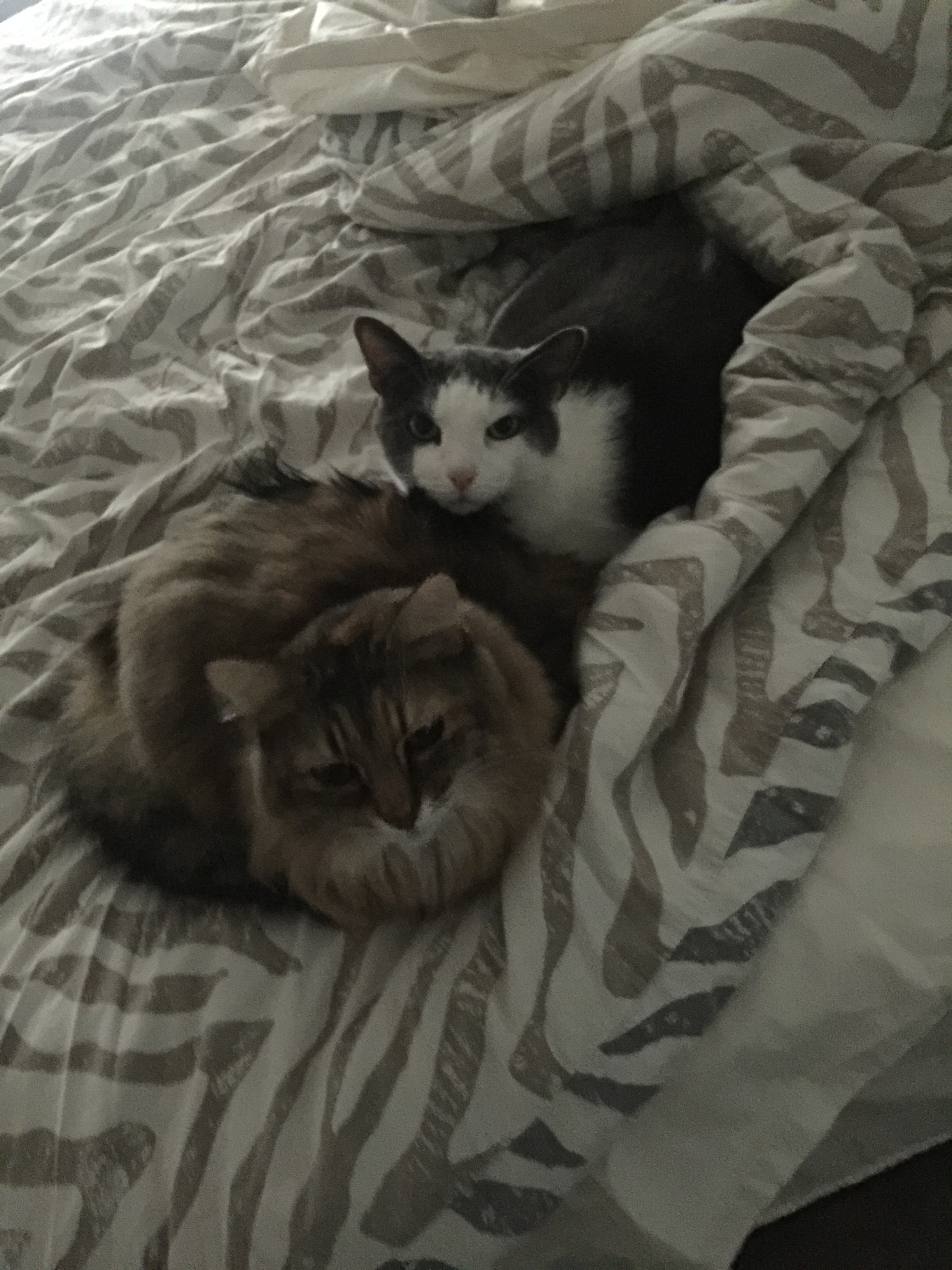
Freddie and Edith.

Freddie and Edith.

A&A Part III: Mold, or How Far Do We Go?

We had the whole house checked, top to bottom, for issues and possible allergens after Martin started having these reactions. Overall, our house is doing pretty well. Mold in the air is low. Mold in dust samples (dust? what dust?) is normal-to-low. Mycotoxin sample shows barely perceptible positive for tricothecenes. Total VOC air sample is ideal, and mold VOC air sample is low.

The consultant did notice “some mold on the floor joists in the basement,” which he speculates is leftover from before we bought the house. It does not appear to be affected air quality or spreading.

So here’s the question: How far do we go? Before we moved into the house, a couple years ago, we had basement mold remediated. That mold had a clear source; the previous owner had left a ground-level basement window open during Superstorm Sandy—evidently she thought the basement would be better with “circulation”—and water poured through the window, leaving ickiness in its wake. Remediating that mess was like those scenes at the end of E.T.: The Extra-Terrestrial. You know, when scientists and government officials are obscured in protective gear, and plastic sheets cover everything. That was how our house looked, to annihilate the Sandy mold. You can imagine the cost.

Do we do that again now, to go after some petty bit in floor joists not affecting air quality? Not at this moment, no. I’m going to put that mold onto the “monitor” list instead. Autism recovery, however you approach it, can be a highway to the poorhouse. Chasing after a bit of mold, right now, seems like a voluntary move into the fast lane on that highway.

Martin, as Donald Duck, trick-or-treating with friend.

Martin, as Donald Duck, trick-or-treating with friend.

Hot Summer in the… in the… Suburbs

Autumn temperatures have descended upon New York. Finally. Summertime is better now that we live outside the City, but even so, I’m no fan. I don’t like heat. I don’t like air conditioning. I don’t like feeling pressure to fill long evenings. I don’t like the months without the New York Rangers, although the near back-to-back scheduling of the French Open and Wimbledon, followed later by the U.S. Open, eases my Rangers-related anxiety.

Let’s celebrate the opening of hockey season with a look back at what Adrian is calling the “summer of changes”:

  • At the beginning of summer, Martin liked to spend time in our pool but refused to jump in, put his head under water, or do any actual swimming. He insisted on wearing a full life vest, and he panicked if approached, because he feared someone might try to dunk him.

During an August visit to Texas, he spent hours lounging in my parents’ pool with Grandpa. I’m not sure exactly what changed, but one day Martin and Grandpa were dipping their heads under water together. Soon thereafter, Martin was going under water alone (and, in Martin fashion, demanding applause when he surfaced). He was also, with Grandpa’s help, pushing off the poolside and making rudimentary attempts at swimming.

Back home, Martin’s cousin Mandy, who can already turn somersaults and do handstands under water, came to stay with us for a few days. Martin hates to be outdone by Mandy. He started going deeper under water, sometimes headfirst, and kicking his way back to the surface. After Mandy left, we had a visit from a 10-year-old family friend who is afraid to jump in the water. Martin seized the chance to outdo an older child and made his first voluntary, if hesitant, leap into our pool. The very same afternoon, Martin was allowing Adrian to toss him—“one, two, three!”—from the deck into the pool, plunging under water, swimming five or six feet before surfacing, and immediately demanding, “Do it again, Daddy! Throw me in the pool again!”

  • The theme of Martin not wanting his head under water has been constant for years, since before we knew he had autism. When he was a baby, Martin and I took a “Mommy & Me” swim class. The exercises included tipping baby backwards until he was floating on his back and, with the instructor’s help, having baby dog paddle a short distance to his mommy. The tipping exercise terrified baby Martin; as soon as the back of his head touched the water’s surface, he would scream. (“Don’t worry,” said the instructor. “Some kids just take longer to enjoy the sensation.”) The dog paddling never worked, either; Martin panicked when released into the water and flailed instead of making the paddling motions.

Later, through HANDLE therapy and Anat Baniel Method, I learned about Martin’s primitive reflexes and why they might not have developed properly. Those infantile pool shortcomings were warning signs.

Until this summer, Martin retained the fear of lying on his back in water, including in the bathtub, where he would insist on sitting up or, at most, lying on his side with his head propped on a crooked elbow. Not long after he started swimming under water, I found him lying on his back in the bathtub, his head submerged up to his ears. “What are you doing there, Martin?” I asked. He lifted his ears out of the water and responded, “Oh, I’m just relaxing, Mommy.”

  • Of course, a kid who doesn’t like his head under water doesn’t like to shower. We have a full-spectrum infrared sauna at home. A key part of the sauna routine is showering upon exiting, to prevent the skin from reabsorbing toxins that may have been excreted through sweat. Until this summer, the shower was such a chore that I dreaded using the sauna with Martin. As Martin’s pool confidence increased, Adrian started dragging him into the shower after swimming (which I didn’t love, because I prefer to give Martin an Epsom-salt-and-baking-soda bath to detox after swimming, but sometimes you have to let father and son have their time). Showering got easier and easier, and correspondingly so did using the sauna. It’s a kind of trade-off: fewer detox baths for more sauna time.
  • Early in the springtime, we bought Martin a new bicycle. He’d grown so much over the winter that his old bicycle, which had training wheels, looked like a circus toy underneath him. We decided to be bold and optimistic with the new bicycle and not pay to have training wheels installed. For a few months it seemed like maybe we’d been too bold and optimistic. Adrian and I made almost no progress trying to teach Martin to ride. It was frustrating. By mid-July, we were ready to throw in the towel.

Martin participates in a terrific sports-and-training program for special-needs kids, which focuses on playground skills like shooting baskets and playing kickball. When I found out that that the head trainer was also running a bicycle-riding clinic, I signed Martin up immediately. The professionals possess magic skills that Adrian and I lack; within the first hour-long lesson, they had Martin up and riding. It took a few more lessons before Martin could push himself off and pedal together, or stop without tipping over the bicycle, and it took practice with Adrian before he could successfully use the hand brake to slow himself down instead of stopping suddenly. As of today, Martin still can’t stand up and pedal, as to power himself uphill. But that will come. Meanwhile, he rides four- and even six-mile journeys with Adrian.

Monday evening, as we pulled in the garage, late for dinner, with homework yet to be done, Martin said, “I’m just going to do some bicycling riding now.” I couldn’t allow that. But it was nice that he wanted to.

  • Shoe tying. This is another area where Martin didn’t want to be outdone by Cousin Mandy, and where we sought professional assistance. Cousin Mandy can tie her shoes already. During a car trip together in August, she decided to try teaching Martin. That didn’t go well. Eventually tears were involved. Nonetheless, it put the idea in Martin’s head, and after Mandy was gone, he asked me to help him learn. I tried. I failed. (It’s a good thing I don’t homeschool. One day Martin will agree.) The first week of school, I wrote a note to Martin’s occupational therapist listing shoe tying as one of our goals for the year. You guessed it: Within a week, the OT had him tying his shoes. Within two weeks, he’d mastered the double knot. Now Martin is concerned with learning to tighten laces sequentially and also tie “big laces,” because he wants to be able to—lace up his hockey skates.
  • That’s right. Martin is learning to play ice hockey. We had planned to try him this fall in a Mites league, or even down one age group on a Mini-Mites team. But he had no skating experience, and many of the kids on those teams have already been skating since age two or three, and suiting up for hockey for at least a full season, if not two. Adrian and I weren’t even sure whether Martin would like playing hockey. We didn’t want to frustrate him on the ice with kids much, much more skilled than he is. So instead we signed him up for private lessons. He loves the skating so much that now he wants to take an extra lesson each week, in order to reach stick-handling skills sooner.

I doubt that Martin is destined for hockey greatness. I was satisfactorily athletic as a child, competing in swimming, soccer, softball. Adrian, by his own reporting, was an utter flop at everything except skiing. We are hardly the type of world-class athletes that tend to produce other world-class athletes, and Martin is getting a later start, both in age and skill development, than most players.

Nevertheless, please take a minute to contemplate what it means to me to see my son on skates. If you read this blog, you know I love hockey. When Martin, my only child, was diagnosed at age two with mild-to-moderate autism, my dreams of raising a hockey player flickered, and maybe fizzled. Five years later, with the help of biomed and therapies, Martin is tying skates, wearing hockey gear, and getting ready to start learning stick-handling skills. Yes, he is.

Having a summer of changes is a beautiful thing, because “change” is not usually a development that sits well with a child on the spectrum.

And now, the summer of changes has drawn closed. Halloween is nearly upon us. Martin wants to be Donald Duck this year, which is a real problem; the duckier costumes are made for infants, small children, and (not sure what this is about) adults. Apparently no one between age five and age 18 is supposed to be Donald Duck. For my tall seven-year-old, I’ve had to resort to a “pajama costume.”

Maybe next year we’ll have the “autumn of more-grown-up costume ideas.”

classic_cartoon_style_clip_art_image_of_donald_duck_0

A&A Part II: Formaldehyde

When we moved to the suburbs, June 4, 2013, we bought Martin a new bedframe, a twin-size rally car frame. Because of wheels, bumper, and built-in shelf, it occupied more space than the plain, unfinished hardwood frame he’d had previously. In the City, his bedroom was too small for a fancy rally frame; the suburbs have some advantages.

We did not, however, replace Martin’s mattress, which was an expensive organic mattress that I’d ordered two years earlier from California. A bedframe is one thing. An organic mattress does not get replaced so willy-nilly.

Martin never adored the rally bed, even though he and Adrian had picked it out together on-line. I think the metal headboard and side rails were cumbersome. Martin still tends to toss and turn at night, and to throw his limbs over the bedside. I would hear him at night, banging his arms and head on metal. Plus, the metal was cold. I didn’t love the rally bed, either. At the time, I still had to pick Martin up, out of bed, while he was sleeping, to take him to the bathroom or help him wake up. As he grew bigger, it was hard to lift him over the rails without straining my back.

What I did know was that the rally bed was safe. I’d researched the materials of which the frame was made, and the manufacturing processes, and I felt comfortable that they posed no particular dangers.

This June, 2015, Martin decided to break up with his rally car bed. The end of their two-year relationship came suddenly. Martin, for a couple weeks, had been having trouble falling asleep. One night, after an hour or two of talking to his stuffed animals, giggling, dancing down the hall to the potty, and calling for drinks of water, Martin asked to sleep in the queen-size bed in the guest room. I can’t remember whether I acted out of frustration, or exasperation, or hope, or some combination; in any event, I let him climb into the guest bed, and he was asleep within minutes.

The next night, the same scenario replayed. Martin stayed awake, busy as a bee, until finally he finagled permission to move to the queen-size bed in the guest room. The night after that, he skipped the rally bed altogether and asked to do bedtime in the guest room. He also stopped having trouble falling asleep. I don’t know why. Maybe the “trouble” was intentional, a ploy to try a different bed. The explanation he gave was, “Now that I’m almost seven, it’s just easier to sleep in a big bed.” That’s exactly what he said: “It’s just easier.” The little cad.

After Martin had been sleeping, without issue, in the guest room for more than a week, Adrian and I devised a plan. I didn’t want Martin to continue sleeping in the guest room. Unlike his bedroom, the guest room isn’t coated in EMF-blocking paint, isn’t right next to my and Adrian’s room, and doesn’t have his name on the wall in wooden block letters. On the other hand, Martin wanted a bigger bed and seemed to be sleeping better in a bigger bed. His own bedroom, though bigger than his City bedroom, is not wide enough to accommodate a queen-size bed. Adrian and I decided the solution was to offer Martin a double bed for his upcoming seventh birthday, and to bill the gift as a “big-boy bed.” In fact, we would give his bedroom a mini-makeover, changing the Curious George theme to an outer-space theme, because he’s into planets and moons.

(Actually, we offered Martin a list of new room themes to choose: music, outer space, books and writing, Big Hero 6, sports generally, or the New York Rangers. I was pulling for the Rangers. I was silently willing him to choose the Rangers. But it wasn’t meant to be. Martin likes planets.)

A big-boy double bed needs a big-boy double-size mattress, and for Martin it has to be an organic mattress. To make our big-boy-bed plan work, I would have to bite the bullet and shell out a lot of money for a new organic mattress. I found an organic mattress showroom not too far from us, drove there one morning, asked questions, compared choices, and ordered a satisfactory option. I also purchased a waterproof organic mattress cover, for the various mishaps that can occur in a seven-year-old’s bed. Then I set about procuring two double-size organic cotton sheet sets.

By the time all that was totaled, I was not in the mood to spend more money, and I suppose I let down my guard. I ordered an inexpensive bedframe, with storage drawers underneath, from wayfair.com. It arrived quickly, and with Samara’s help, I spent three days assembling the thing. (Adrian has myriad talents. The use of tools and hardware is not one of them.) The new organic mattress came just in time for Martin’s birthday. I filled the bed’s drawers with Martin’s stuffed animals, covered the mattress in organic sheets, switched the Curious George wall decals for outer-space wall decals, and hung up posters of the planets and moons. Martin loved his birthday gift. He immediately moved from the guest room back into his own outer-space room, into his new big-boy bed. That was at the end of June.

Martin’s allergy troubles began in earnest over the summer. As part of our search for answers, I asked our environmental consultant to check for mold, mildew, or other triggers to which Martin might be responding. Almost immediately, he found elevated levels of formaldehyde in Martin’s bedroom. Formaldehyde! It seemed to emanate from—did you guess this?—the cheap bedframe I’d bought online after spending so much on the organic mattress and linens. Martin has been exposed to formaldehyde. Way to go, me. Worse still, the consultant theorizes that the expensive mattress may have absorbed enough formaldehyde from the frame to pose an ongoing problem.

As soon as my parents, who are visiting from Texas, depart, Martin is moving back into the guest room and I’m throwing away—yes, throwing away, because although my first choice is to donate, I refuse to pass an unsafe product to any child—the bedframe. The double-size organic mattress will move to the basement in the hopes that it can air our enough to be safe again. (We have a well-ventilated basement with windows.) This time I will do my research and spend the money on a truly safe wooden bedframe, then have the organic mattress retested and hope it has become salvageable.

Remember the organic twin-size mattress that we brought with us from the City, the one that was on the rally bed? I didn’t have the heart to let that mattress go. It was too expensive. In my office I have a daybed with a trundle. I moved the twin-size organic mattress onto the trundle frame, under the main bed, thinking that we might one day put it to another use. Then my cats discovered that they could crawl underneath the daybed cover, onto the trundle mattress, and be tucked into their own flat cave between the trundle and the main bedframe. Before I even pinpointed to where the cats were disappearing hours at a time, they had left so much fur on the twin-size organic mattress that I wonder whether it will ever be suitable for humans again.

Way to go, me.

Martin doodled this on a homework sheet. I can't be sure, but I'm hoping it's some sort of representation of Henrik Lundqvist.

Martin doodled this on a homework sheet. I can’t be sure, but I’m hoping it’s some sort of representation of Henrik Lundqvist.

A&A Part I: The Issue

A couple months ago I wrote about mysterious allergic reactions Martin was having: puffy watery eyes, runny nose, and (later) spots on his face. We suspected maybe a food was the culprit and also started searching for environmental culprits. We also started treating for chronic Lyme disease. The spots have not recurred.

We have, however, had more sneezing and watery eyes. Then, last month, yet another symptom arose. My mother-and-law and I took a day trip with Martin to “Fun4All,” an indoor playscape way out on Long Island. We sat in the snack-bar area while he climbed, bounced, and looked for a friend. Every so often Martin appeared at our table, drank some water, and scampered off. I noticed he was sweatier than usual, and breathing heavily. I was happy that he was exercising so much.

After 90 minutes, Martin was too sweaty, and breathing too hard, and his eyes were watering, and he was coughing. I asked if he wanted leave, and he said he did. Whatever reaction he was having was severe enough that I started looking for triggers. I’d noticed a kind of chemically smell, so I took a picture of a sign posted in the restroom, which said that Fun4All is cleaned with “Simple Green D Pro 5,” a “one-step cleaner, disinfectant, virucide, fungicide, sanitizer, mildewstat & deodorizer” that is “hospital grade.” (In my world, that sounds scary. Very scary.)

We exited Fun4All. In the parking lot, I realized that Martin was wheezing. He was having a full asthma attack, like the attacks that strike my older brothers, who are asthmatic. I used my iPhone’s voice-memo feature to record Martin’s labored breathing, so I could share it with his pediatrician. Then I loaded him into the car and gave him a bottle of water. The wheezing faded within twenty minutes.

That was the first asthma incident. In the four weeks since, Martin has experienced half a dozen more, each time after exercising: ice skating lessons, bicycle riding, playground. He’s also coughed, a lot, had a generally runny nose, and breathed heavily at night.

The search for answers entered high gear. I contacted our environmental consultant to retest our house for mold and mildew, which we also had done before we bought the house. I talked to Martin’s autism specialist (his biomed doctor), who advised me to bring Martin to his pediatrician for traditional allergy testing. The pediatrician also sent us to a traditional allergy/asthma specialist, to evaluate the results of the pediatrician’s tests and to conduct additional tests. I requested a phone consultation with Martin’s homeopath.

Soon we were armed with an albuterol inhaler as well as a nebulizer for bronchodilators. (I don’t like to use pharmaceuticals with Martin, or with myself for that matter, but when it comes to breathing, I am not willing to mess around.) We also found, I hope, some answers.

This is the first of four posts on A&A, allergies and asthma. The next three will cover the potential triggers we’ve discovered. I hope that, in a few months, I will be able to write a post about resolving the Martin’s A&A.

I’m not happy about any of this. We’ve been fighting autism for years now. I don’t need any more A’s on my plate.

IMG_0428