Legislative Commentary. Sorry, Not My Usual Thing, But This Deserves an Exception

As promised in yesterday’s post about medical marijuana, and with permission, I’m posting the testimony of my friend Victoria Grancarich. This testimoney will be given before Minnesota lawmakers this September. Victoria’s circumstances are very different from mine, as her son’s place on the spectrum is far from Martin’s. But this epidemic is all one spectrum. We stand in solidarity with each other, and root for what helps any child.

Victoria’s 14-year-old so, Julian, is profoundly affected by autism. Victoria and her husband, John, have truly scoured the ends of the Earth to help Julian and have made progress healing his mind and body. Nevertheless, several years Julian threw himself from a balcony, breaking his back and both his legs. With the onset of puberty, Julian’s self-injurious behavior escalated to the point that he needed constant restraints and protective gear to avoid beating himself into concussions. Victoria and John believe medical cannabis saved their son’s life. As a friend and observer, I agree. In my opinion, to deny marijuana to Julian would be abuse. Yet, this medication was available under Minnesota law only because Julian also suffers from seizures; if he suffered from self-injurious autism but not seizures, the marijuana option would be unavailable. Victoria offers her testimony in an effort to have the law changed and make medical cannabis available to all Minnesotans in need.

My name is Victoria Grancarich. I’m the mother of a 14-year-old boy named Julian. Julian has severe Autism and a seizure disorder. Julian began having seizures in June of 2011. We have tried many medications over the last six years; however, seizures and motor tics continued to be an issue.

Julian had always been a kind and affectionate boy in his younger years. When Julian turned 13, the onset of puberty brought new challenges. In February of 2016 Julian became extremely violent toward both family and school staff. He began raging daily and would physically attack us. It got to the point where we as his family needed to wear protective clothing to avoid being bitten, having our hair pulled, and being kicked and punched. His younger sister could not be in the same room, and she had to spend all of her time at home locked in her room for her own protection.

In August 2016, Julian began to turn the violence on to himself. He began punching himself in the head full force thousands of times per day. He would use his knee to injure his teeth. He would bang his head into walls. We were powerless to stop him. We were trying to protect him using helmets and arm immobilizers, and at times we had to physically restrain him for hours at a time to keep him from harming himself. We believed our son was in terrible pain and was suffering from debilitating headaches. We saw this once vibrant boy lose his will to live. He seemed determined to end his life and came close several times. Between October 2016 and January 2017, Julian was hospitalized three times. He suffered self-inflicted skull fractures and massive tissue damage. He had black eyes and giant hematomas on his skull regularly. The hospital staff offered psychiatric medications as well as gabapentin but nothing could stop the daily rages that lasted every moment that he was awake. I felt certain that if we could not get Julian cannabis that he would find a way to end his life.

Julian qualified for cannabis through the state program because of his seizure disorder. After being sent home from Children’s Hospital in Minneapolis after another life threatening episode of self-injury with no plan in place to heal our son, we felt cannabis was our only hope. The excruciating pain our son was in was getting worse and we knew no pharmaceutical medication could help him. We had tried everything the doctors offered and had absolutely no success.

We enrolled him in the Minnesota Cannabis program in January 2017. Within a week of beginning cannabis therapy Julian was able to go about an hour without harming himself. As the weeks went on and we reached a therapeutic dose Julian’s behaviors began to slowly melt away. By early March he was smiling again. Within six weeks of beginning cannabis Julian was no longer injuring himself or others. He began to take an interest in his life again. He returned to school full time. We were able to remove his helmets and protective gear. By mid-March we were getting smiles and hugs. Julian began to go outdoors again by mid-April. By May Julian began to show interest in using augmentative communication for the first time in his life.

It is now late June. We have not seen one episode of self-injury since early March. Julian has not struck me since February. Julian is enrolled in a day camp for children with special needs where he spends eight hours a day. He is exploring outside and making friends. He is happy and smiling. Julian and his sister have a relationship once again. Julian spends hours in our back yard enjoying bouncing on his trampoline, moving his body and taking in fresh air. He lives safely and happily in our home. He is free from pain. His seizures and motor tics are well managed to the point they are not interfering in his daily life.

Cannabis gave us our beautiful son back. Julian Grancarich is alive and well today because of this miracle medication.

I Didn’t Wait for a Prescription When I Was a Teenager, So What Makes Me Concerned Now?

Happy Fourth of July! I’m going to spare you another painful post about school and bullying, at least for today.

You’re welcome.

Instead, let’s talk about cannabis. Medical marijuana.

According to governing.com, “[t]wenty-six states and the District of Columbia currently have laws broadly legalizing marijuana in some form,” and once the measures that recently passed in Arkansas, Florida, and North Dakota take effect, the total will be 29 states. “Some medical marijuana laws are broader than others, with types of medical conditions that allow for treatment varying from state to state.” Additional states (Alabama and Mississippi, for example) have passed laws allowing for marijuana possession in the narrow circumstance of an enumerated rare illness.

Recreational marijuana is legal in eight states. That’s not the topic of this post.

Medical marijuana is approved to treat “autism”—or at least some symptoms thereof, in a physician’s discretion—in only five states and the District of Columbia.

I’ll jump in here to say that medical marijuana should be approved in every state to treat (at least) profound autism, as at least one high-profile case in Texas demonstrates. On a personal note, make sure to tune to this blog tomorrow, for my friend Victoria’s testimony before the Minnesota legislature on what medical cannabis has done for her son, Julian.

In my State, New York, eligibility for medical marijuana rests upon diagnosis with “one or more of the following severe debilitating or life[-]threatening conditions: cancer, HIV infection or AIDS, amyotrophic lateral sclerosis (ALS), Parkinson’s disease, multiple sclerosis, spinal cord injury with spasticity, epilepsy, inflammatory bowel disease, neuropathy, Huntington’s disease[,] or chronic pain (as defined by 10 NYCRR § 1004.2(a)(8)(xi)). The severe debilitating or life[-]threatening condition must also be accompanied by one or more of the following associated or complicating conditions: cachexia or wasting syndrome, severe or chronic pain, severe nausea, seizures, or severe or persistent muscle spasms.”

I love the drafting! “[C]hronic pain . . . must also be accompanied by . . . severe or chronic pain,” and “spinal cord injury with spasticity . . . must also be accompanied by . . . severe or persistent muscle spasms.”

For almost a year, I’ve been carrying (but not using) a prescription for medical marijuana for Martin. The prescription was written by Martin’s New York autism physician, not by his California doctor. (And don’t confuse the New York autism physician with Martin’s regular pediatrician. We have a whole medical team.) The prescription is based upon Martin’s irritable bowel disease, which is a qualifying condition, along with the complicating condition of chronic pain. So Martin qualifies for medical marijuana in New York, no doubt. At the time the doctor wrote that prescription, he suggested that medical marijuana could also help Martin with sleeping, attention, and anxiety. Martin was having trouble sleeping again during that particular stretch, an issue that resolved on its own during the intervening months. His attention also has improved this year. His anxiety—well, keep reading.

When, several months ago, I mentioned the prescription to Martin’s California doctor, whom I consider his “primary” doctor for autism recovery, she balked, albeit gently. Martin neither suffers from seizures nor engages in self-injurious behavior, the two autism-related symptoms medical marijuana may help most. Without a clear-cut need, why not err on the side of safety, given the dearth of research available on how cannabis affects the developing brain? I investigated and found that she was correct about the lack of applicable studies. Most research about brain development focuses on recreational marijuana use (of high-THC product) by teenagers; my own search yielded almost nothing about the downsides of medical marijuana in childhood (and I know there must be downsides, regardless of dispute from advocates). With inadequate reassurances, and given that Martin’s sleep and attention are pretty strong these days, I tuck the prescription away again.

But lo! The anxiety. Martin’s anxiety level is so high. (Bad pun for a pot post? Let’s call his anxiety level “Everest-like” instead.) Martin seems to walk the Earth searching for reasons to lose his cool. Two weeks ago, we were Upstate, whence I hail, and Martin had the opportunity to play with same-age cousins he rarely sees. Martin was having a decent morning, acting sociable, until the moment his cousins arrived, whereupon he left reality and switched to talking nonsense (“There are vampires in New York! They are moving to the capital building, to live in the rotunda!”)—eliminating any hope for productive interaction with the cousins. It was plainly his anxiety, up to no good.

And the meltdowns. On the last day of school we invited friends and classmates (both challenged and typically developing) to a pool party. I grilled burgers, beef for the guests and boar for Martin. I had a variety of burger buns on hand for the kids’ diets and allergies. I had no bun for Martin’s burger, because he has never had, or requested, a bun. This time, he did request a bun, and became agitated when I wasn’t able to produce one for him. I wanted to avoid a meltdown, especially in front of the typical classmates, so I let Martin eat an Udi’s® Gluten Free Classic Hamburger Bun. (According to the listed ingredients, these rolls contain resistant corn starch, cultured corn syrup solids, maltodextrin. I never would have given one to Martin under ordinary circumstances.) About ten minutes later, Martin was screaming and clawing at his torso. He’d had some sort of allergic reaction, to something. I pulled off his swim shirt and saw his midsection covered in red welts, with bumps emerging before my eyes. I shoved a spoonful of dye-free Benadryl into his mouth a tried to calm him.

Too late. Martin had slid into his perseverative place, impenetrable by reason or consolation. Awash in tears, he struggled to speak. What brought him there was not, as you might expect, the allergy (terrifying as it had been for me). Instead, Martin had connected the rash with the burger bun and guessed that he would never again receive such a bun. I had no idea whether Martin was reacting to the Udi’s roll; it could as likely have been residue from the beef burgers, or given that he was affected almost exclusively from waist to chest, some contaminant on his swim shirt or something he’d got into around the pool. Martin, however, was not to be dissuaded: The bun was at fault, and now he was never going to get a bun again, never, ever, and Mommy? Can I have another bun? Can you go to the store right now? But never, ever, never again. I hustled the nonsense and tears and screaming into our kitchen, away from the gawking of Martin’s guests.

This is the kind of rigidity that Martin’s anxiety imposes: If I have not foreseen every contingency, including the possibility that he might demand a burger bun for the first time, we risk a setback. If Martin faces any new situation, like meeting cousins, anxiety consumes every social skill he’s developed.

It’s come to the point where I see anxiety hampering Martin’s recovery. His anxiety wrecks havoc with his peers, who respond by alienating him, which further exacerbates the anxiety. The same spiral happens at home. I’m constantly on edge, for fear of provoking a meltdown, and I’m certain Martin perceives that tension, which then prevents him from relaxing. Who could regain health under such circumstances?

You might say I’m approaching desperation. I know that the long-term solution to anxiety is to alleviate its underlying cause, whatever that may be. (I suspect, with little basis other than mommy intuition, that it’s related to the heavy-metal burden we continue treating. Heavy metals can lead to brain inflammation. Cannabis can reduce brain inflammation. Martin’s California doctor thinks the cause is more likely babesia.) But I’m having trouble looking long-term. Martin needs help now.

I’ve been researching. (Remember, I don’t science well.) I’ve learned that the human body produces endocannabinoids, which act as neuromodulators for various cognitive and physical processes, including the regulation of anxiety-dependent behavior.

The cannabis flower secretes compounds known as cannabinoids. Examples include THC (tetrahydracannibinol), which is mostly responsible for marijuana’s psychoactive effects; CBN (cannabinol); CBG (cannabigerol); and CBD (cannabidiol). (Cannabis secretes dozens and dozens of distinct cannabinoids.) Cannabinoids mimic the effect of natural endocannabinoids in our system; they bind to receptor sites usually available to endocannabinoids. THC generally binds to receptors in the brain called CB-1 receptors, while other cannabinoids generally bind to receptors in cells of the immune system called CB-2 receptors. CB-1 receptors affect anxiety and arousal during novel situations. CB-2 receptors affect inflammatory response. Cannabis products can be manipulated to adjust the content of the cannabinoids to address specific concerns.

The endocannabinoid system has been implicated in behaviors associated with autism, such as emotional response, behavioral reactivity to context, and deficits in social interaction; “it can be hypothesized that alterations in this endogenous circuitry [of the endocannabinoid system] may contribute to the autistic phenotype.”

My research also piqued my interest in low-dose nicotine theory, which has shown some success in treating ADHD. That investigation is ongoing.

I’ve been making inquiries with trusted friends in the autism-recovery community. My friend N— noted that she has been administering CBD to her son to help with communication and rigidity, but to little or no effect. I have also given CBD oil to Martin, both the HempMeds® brand and the Plus CBD Oil™ brand (because no THC is present, CBD oil does not usually require a prescription), and have seen nothing from the CBD alone. N— noted that according to the latest research she’s seen, alleviating most autism symptoms requires at least some THC to be present. I think that is correct, and the alternative we are considering currently is using a prescription that would contain some amount of THC: low THC and high CBD.

My friend D—, whose son suffers from both autism and epilepsy along with other medical complications, stressed the importance of careful observation and moving quickly to adjust the cannabinoid ratio (e.g., THC:CBD:CNG) in the hemp product when necessary. D— raved about the difference medical marijuana has made for her son, who has progressed from as many as a dozen major seizures per day to only a few seizures per week. On the other hand, D— was distressed when the THC ratio in her son’s product was increased too much and the nine-year-old seemed “high” before developing a case of the munchies. They quickly reverted to a prior formula.

With my friend R—, I had a lengthy pros-and-cons conversation by text message. For me, the highlight was realizing this, late in the days-long exchange:

My text: “Talked with N—, talked a LOT with Adrian. I think we are going to give mm a shot. I really feel like the anxiety us starting to impede Martin’s recovery. But I’m agonizing over this one. So scared of the effects on cognitive development.”

R—’s text: “I think if you give it a shot for a trial, maybe couple weeks, you aren’t going to do much if any damage.”

My text: “My real worry is that it will work, and we’ll go long-term.”

See how that works? I mean that medical marijuana is intended to be a bridge measure, to alleviate Martin’s anxiety while we work on eliminating the causes of that anxiety. I’m worried that if the bridge measure is successful, we might make it a very long bridge indeed, the attendant consequences be damned.

Last week Martin and I visited his California doctor, and I raised the topic of medical marijuana again, this time more intensely, given Martin’s continuing trouble with anxiety and my own increased facility with the topic.

“You’re looking for my blessing?” Dr. C— asked.

“Not your blessing,” I responded. “This decision I actually think Adrian and I have to make, as parents. But I’d like confirmation that bridging with medical cannabis won’t interfere with any of your protocol for Martin.”

“It won’t.”

With that, the balance tipped. In September, as Martin enters third grade, if nothing has changed with his anxiety, we will likely test low-THC medical-grade cannabis, at least short-term. Having put so much time into research and finally reached a decision, I’d like to get started immediately. But I’m drafting this post from a plane to Nicaragua—I keep thinking I need to tell you about that!—and won’t return home until September. However the laws are evolving in the States, I’m not foolhardy enough to carry marijuana abroad, not in any form.

Ultimately, I know that medical marijuana will not heal Martin. My interest in its use is solely as a bridge measure, to boost the real recovery process.

Have I mentioned that Martin is currently obsessed with bridges?

I Mean, I Just, It’s—Well, It’s a Lot

You may have noticed I just took a couple months off from Finding My Kid.

I mean, I’ve still been finding my kid. I just haven’t been blogging about the process.

These last couple months have been some of the toughest of Martin’s recovery so far. We have arrived at a time when Martin perceives what other kids think of him, and wants to make friends and influence his own popularity, but lacks the tools to achieve those goals. Martin has social awareness without corresponding social facility.

The situation is crushing.

Since my last post, the classroom improved—at least by Martin’s own reporting, which grows more detailed by the day. “I saw a fifth-grader named Cody in the hall who I know from taekwondo, and I said ‘hi’ to him and he said ‘hi’ back, but then on the playground there was a third-grader named Alice who used to be on my bus and didn’t say ‘hi’ to me.” Since Martin spoke up for himself, his classmates have begun to show him more courtesy, and attempt to include him more, even if Martin doesn’t always reciprocate. Some days Martin even exclaims, “Oh, everyone was so nice today!”

Other days, when I retrieve him after school (he’s a “walker” now), he looks downright dejected. Or we will stay after school, on the playground, and I watch other kids reject him.

And he still seems haunted by the bus experience. Two months have passed, yet he still tells us how unkind the kids were, cries at night, and seeks assurance that no one from the bus will be invited to his birthday party. He worries that kids from the bus might be in his classroom next year.

Most problematic now is the playground, at recess with the entire second grade, not just Martin’s class. Martin reports that even the kids who are being much kinder in class do not want to include him on playground. These dispatches come daily: who wanted to play with him or didn’t, who told him to go away, who refused to answer when Martin asked a question.

We’re working with the school. The principal has agreed to pay for a presenter to come next year and speak to the entire third grade about differences and inclusion. (I wish now that we had thought to do this when Martin moved into public school last September.) She also substituted a fun-loving young TA for Martin’s regular one-on-one aide (a protective grandmotherly type) during recess, to organize games in which Martin can participate.

Martin’s teacher helps, too. A classmate named Ethan announced, repeatedly, delightedly, that he planned to invite every boy in class except Martin to his birthday party. The teacher pulled Ethan and Martin aside, where Ethan admitted saying that everyone except Martin would be invited, and explained that Martin had been annoying him by getting in his face before school. Martin said that he understood that getting in Ethan’s face might be annoying, and that he would try to do better with that. All in all, a decent resolution was reached—though I certainly don’t anticipate receiving a birthday-party invitation. Martin’s teacher also has given the principal input on what teacher Martin should have next year, and which boys should (and which should not) be in his class.

I will admit that I’ve gone so far as to consider changing Martin’s school again. Right now, that plan is in abeyance. Adrian wants Martin to stay put, Martin says he wants to stay put, and I have to admit the benefits of having Martin in the local public elementary. He finally feels integrated in the community: He sees the overlap between church and school and play group and taekwondo and even the local supermarket. We’ll see, though. If third grade begins with bullying, a change may be in order.

Action Plan

If last Thursday’s post worried you—and judging from the number of emails and texts I received, Friday’s post worried a lot of you—take heart. The events I described took place more than a month ago, and we’re still sallying forth.

That night, the night of Martin’s big disclosure, Martin cried some more in bed. Of the situation at school and on his bus, he said, “This has got to get better. Can you make this better?” We reassured him, repeated that he was brave and that we were proud of him for telling us what’s happening so that we can look for ways to help.

Once Martin fell asleep, Adrian and I convened for discussion. As upset as we were, we had to recognize that the dinnertime conversation was the most meaningful Martin had ever conducted. Adrian too had noticed the consistent eye contact and Martin’s determination to express himself, including how he’d pushed Adrian away instead of accepting a hug that might have ended the dialogue. Never before had Martin told us about social challenges, at least not directly.

Indeed, we saw progress. Martin wanted to play with other kids. Martin realized when he was rejected. Martin asked for help to remedy the situation.

But those positive aspects notwithstanding, we needed to take action. Immediately, I emailed the school principal and Martin’s teacher:

Principal C (also copying Teacher N to keep her in the loop)—

My husband and I need your help. We know Martin has a great team at school, especially Teacher N, and that you will be able to assist us in dealing with this situation.

We are having something of a crisis this evening with Martin. This afternoon he got off the bus looking very dejected. At the time, he would not tell me what was wrong. But he broke down during dinner tonight and said that all of the kids on front of the bus today (where he was sitting) pointed at him and said, “Stupid! Stupid! Martin is so stupid!” We asked him if this has happened before, and he told us that the kids on the bus have been calling him “weird” and “stupid” for some weeks now.

He went on to say that his classmates have been telling him that he is “unfriendly” or “weird,” and on some occasions have told him that no one likes him. He gave a lot of specific names of kids who say these things to him and, unfortunately, was not able to come up with one name of a kid who is currently being friendly to him. (We realize that Martin’s behaviorist has not been in the classroom that much this year, and that perhaps she is the one who should be catching these things.)

A lot came out this evening, and Martin cried the whole time. He said that no one will play with him on the playground, and will talk to him only to say they don’t want to play with him.

We told Martin that he is right to share these feelings with us, and that we will do everything we can to make it better. Before he went to bed, he asked, “Will there ever be a time when it is not like this?,” and then he asked us please to make it better as soon as we can.

Principal C, may I come and visit with you tomorrow (Wednesday) in order to talk this through and think about some strategies we can come up with to help the situation? I will stay home from work in order to do so. I have never seen Martin looking so down and so upset. He believes that he is completely friendless, and I think his self-esteem must be suffering.

As of tomorrow (Wednesday), he will be a walker, every day. I will deliver him to school and pick him up in the afternoons in order to prevent a repeat of what happened on the bus today.

We have been so happy Martin’s experience at school. I look forward to working with you to resolve this issue and help Martin move forward.

Thank you,

Martin’s Mom

Within ten minutes, the principal emailed back, inviting me to meet her the following morning, which I did, at 10:30 am. Remarkably, by the time I sat down in the principal’s office, the following events had occurred, which I relay second- or third-hand:

Martin, having been chauffeured to school by me, walked into his classroom and announced (to the teacher? to nearby students? to the wind? some details aren’t clear) that he was no longer going to be riding the school bus because the kids on the school bus are unkind to him. The teacher, aware of the situation from my email, asked, “Martin, is this something you want to discuss now?” Martin, apparently, said yes and proceeded to stand in front of the class and describe what the kids on the school bus had been saying about him, and that what they said wasn’t true, and that those kids just did not know him well enough.

Then, when Martin was done excoriating the bus riders, he continued speaking and addressed grievances with his classmates (none of whom ride the same bus). He repeated: “You say I’m unfriendly, but that’s not true. I’m trying to be friendly.” The teacher asked Martin how this made him feel. He said it made him feel bad, and sad, and not part of the class.

Once Martin’s diatribe was drawing to a close, the teacher asked Martin and his aide to go to the art room and retrieve some markers. “Class,” she asked those who remained, “did you have any idea Martin felt this way?” The kids shook their heads. One or two of the girls were crying.

An hour later, the principal passed Martin’s class as they walked to the music room. Martin signaled the principal and said, “I want to tell you what’s been happening,” and proceeded to speak once more about the bus.

I was happy to hear, from the principal, generalized agreement that we have a problem. She confirmed with my decision to take Martin off the school bus, saying we should focus our efforts on the classroom and the playground. As first steps, the principal committed (1) to see that the behaviorist visits Martin’s classroom more consistently (this has been an issue); (2) to check in with the teacher about any additional supports that might help; and (3) to increase playground supervision (from a distance, of course). Longer term, we agreed to convene a team meeting, which I would do through the school psychologist.

I left the principal’s office feeling troubled still but buoyed by her stated commitment to helping.

Coming next: How did that work out? Has school got better?

Polar Bear Under Siege

Studies have found widely varying rates of other psychiatric problems among people with autism, depending on the population studied and the methods used. Those co-occurring conditions include: depression (affecting 2 to 30 percent), ADHD (affecting 29 to 83 percent), OCD (1.8 to 81 percent), and other anxiety disorders (2.9 to 35 percent).

Look at the foregoing paragraph. Again, please. Now keep those statistics, disparate and divergent as they are, in mind as you read this post and the two or three posts that will follow.

Martin is in a general-education classroom for the first time. The other pupils don’t like him. We know.

Remember when I forecasted that language would come last? I was wrong. Aside from a lingering habit of pronouncing “th” as “f,” Martin’s phonology is solid. Semantically and syntactically, Martin comprehends and expresses himself at or above an age-appropriate level. His language is caught up, except for social/pragmatic language. What actually come last, it turns out, are social skills.

Adrian and I have been worrying about how the gap in social performance is affecting Martin’s self-esteem. Last month, we decided to have Martin start seeing a psychologist, to help him deal with feelings of rejection. I made the relevant inquiries with parents in town, and we were able to find a local practitioner who has significant experience with social anxiety and ASD/ADHD. Adrian and I met her first. We charted Martin’s course from birth (and outrageous unnecessary NICU) to present. We said Martin acts upbeat but we know he’s masking other emotions. I told her about the night Martin asked me whether it’s okay if no one likes him. The conversation with the psychologist made us sad, both me and Adrian. I’m pretty sure, because later I asked Adrian, “Did that conversation make you sad?”, and he replied, “That conversation made me sad.”

Martin visited the psychologist for the first time on a Monday evening. I brought him, and worked in the waiting area while he and the therapist met. At the end of the session, the doctor invited me in and showed me what Martin had created: A castle scene in which a hapless polar bear was beset by a crowd including dragons, knights, and several kitty-cats. The doctor made several statement/questions like, “The horse is the leader, and the unicorn is following, and the polar bear wants to go back inside?” Martin agreed with her. I surmised that her comments were made, at least partly, for my benefit, but if I was supposed to be following along, the doctor had wildly overestimated my powers of intuition.

The whole shebang, to me, seemed like get-to-know-you play, but—something happened. The psychologist unleashed a force. What it was, I don’t know. (Relatedly, who the hell was the polar bear supposed to be?) The next day, Tuesday, this ensued:

I met Martin at the school bus stop at 2:45 pm. He exited the bus and walked directly to me, without engaging other kids. That was usual. He also looked depressed. Really, really in the dumps. He stared at his feet as he walked. I asked, “Are you okay? Did something happen?” He replied, “Oh no, I’m fine,” and followed up with, “I had an excellent day at school. Let’s go home.” On the brief trip from the bus stop to the house, I asked a few more times whether he was upset. Martin continued to deny that anything had happened. I took him to taekwondo and to church Kids’ Klub. No mention of anything.

Adrian arrived home in time for dinner, so we three ate together. Adrian finished first, and then left the table to take a business call.

Martin asked, “Do you and Daddy think I’m weird?”

I replied, “I guess everyone is ‘weird,’ in some ways. We all do things in our own way, and that can seem weird to other people. What makes you ask?”

“Do you and Daddy think I’m stupid?”

“Good heavens, no! What makes you ask that question?”

Martin started to cry. He said, “The kids on the bus think I’m stupid.”

And then—whether because the psychologist unlocked a vault within Martin, or otherwise—stuff got real. Through his tears, Martin described his current social situation:

  • The kids in his class call him weird and unfriendly.
  • No one will play with him at recess.
    • Robert, whom Martin knows from church, was playing a game with friends. Martin asked Robert if he could join. Robert said no.
    • Kids run away when they see him coming.
    • A second-grader from another class seemed like he was going to accept Martin’s invitation to play, until one of Martin’s classmates ran over and said, “Don’t play with him! He’s the weird kid!”
  • Some weeks ago, when Martin got in trouble for telling a girl he was going to “kill” her (at the time, he provided no explanation why), it was because the girl had just said, “Martin, no one likes you.”
  • Even the young parishioners at church Kids’ Klub refuse to play with him.
  • As bad as all that is, the school bus is still worse. Every day the kids make fun of him, for months now. Even the kids he knows from bus stop participate in the bullying. The twins across the street participate. Kids from other classes and grades participate. The only kids who don’t tease him are kindergartner Marcus, third-grader Alice, and fifth-grader Stephanie. The only kid who ever will step in to stop the bullying is Stephanie.
  • This very afternoon, before Martin alit the bus looking so dejected, the kids had invented a chant: “Stu-pid! Stu-pid! Martin is so stu-pid!

Never before had Martin said any of this directly. As realities were pouring out, Adrian realized from his office what was going on and returned to the kitchen. He found me squatting next to Martin’s chair, with my hand on his arm, withholding my own tears as I tried to reassure and let him continue. Martin held court for more than 15 minutes. Twice Adrian tried to hug Martin, but Martin resisted, pushing Adrian away gently because he wanted to keep talking. The conversation was extraordinary. Martin held eye contact, consistently. He spoke clearly. He answered my questions: No, his aide didn’t hear mean things kids said; no, the bus driver never intervened; no, Stephanie hadn’t been able to stop the stu-pid! chant because she wasn’t on the bus this afternoon. Martin also expressed a shocking degree of self-realization and profundity. “They say I’m unfriendly,” he said, “but it’s not true. It’s just that I’m still learning how to be friendly.” “I know those kids are wrong. They just don’t know me well enough.” “The twins were nice when I first met them, and then they turned mean on the bus.”

Finally, as I listened to what Martin has been enduring, I lost my own composure. At that moment Adrian scooped up Martin and carried him from the kitchen, telling him how brave he was to trust Mom and Dad with these stories and how proud we were. He took Martin to the bathroom and ran a warm bath. I remained in the kitchen, crying.

With Martin calmer and soaking in the tub, Adrian came back and hugged me.

I said, “We’ve got to do something.”

Exceedingly Difficult

I’m typing with my left hand. With only my left hand. It’s slow-going. I am right-handed, dominantly, not ambidextrously one bit.

My hair looks awful today. I managed to wash and condition (in a 20-minute shower, wasting water), but drying with one hand was hopeless. Hold the hair dryer, blow, drop the dryer, brush, retrieve the dryer, blow.

I can barely prepare food, because I can’t hold a knife to chop. Adrian had to buy his lunch yesterday and today, other than his lentils. Instead of mincing vegetables into meatballs, I made Martin’s lunches from buffalo chorizo, which contains high-sal ingredients. Martin had an anxiety-ridden day. I blame myself.

You guessed it: I broke my right wrist. I was playing tag on ice skates with Martin. Despite his protests and refusal to play hockey, Martin is still a better skater than I am, and with a lower center of gravity, and he was wearing hockey skates, while I had ancient rented figure skates. In retrospect, challenging him to a game of tag was—well, you can choose the right word.

I have to wear a bulky cast for six weeks, and the orthopedic surgeon is banning contact sports and weights for three months. B’bye, spring softball season. My personal trainer is designing some “cardio and legs” program to replace my lifting routine. I’m glad ski season is winding down.

I will try to keep blogging. But I’m still not sure even how I will feed Martin, so I can’t make promises.

IMG_5934

This is my arm! Why is the cast orange? Well, I do love Syracuse University.

Back Off, Maddow

Most weeknights, if I’m in the kitchen (and most weeknights, I am), I watch The Rachel Maddow Show, unless the New York Rangers are playing, whereupon I toggle between hockey and opinion. Watching TRMS, a liberal-leaning program, doesn’t signal my politics; I don’t always agree with Maddow on the issues. Instead, I find her a stickler for facts who bestows a clever touch even on obscure political events. And in any event, my politics don’t belong on FindingMyKid, which is “a parent’s real-time blog of autism recovery,” not “a parent’s thoughts on politics.”

Last month, Maddow did a segment on Betsy DeVos, the then-nominee for secretary of education. I don’t consider it political to say that I think DeVos was a deplorable choice; as a lawyer and special-needs parent, I believe the secretary of education must know the law, especially the law concerning special education. DeVos’s inability to articulate the meaning and enforcement requirements of the IDEA should have disqualified her. Instead of leading the segment by discussing DeVos directly, Maddow led by making fun of Neurocore, a Michigan-based biofeedback company. DeVos is an investor in Neurocore, and Maddow is not the first to report that DeVos does not plan to divest her interest in the company. Unlike other pundits, however, Maddow ranted hardest against Neurocore itself: its religiously rooted beginnings, its cost, and its methods, which she called “having children watch a movie and then interrupting them,” or something similar (I don’t have a transcript).

“I’m sure there are people who swear by this method,” Maddow said—as if she were speaking directly to the blogger behind FindingMyKid, who was thinking, “Hey, Rachel, don’t knock it till you’ve tried it.”

When it comes to reports on vaccines and the CDC’s vaccination schedules, I am used to listening/reading with a grain of salt. Actually, I just pour buckets of salt on the whole story. Mornings, I listen to NPR, whose coverage of vaccine issues I have found (perhaps) especially awful. Recently I’ve been hearing that Morning Edition is “brought to me by America’s Biopharmeceutical Companies.” Natch? But when it comes to other topics outside the mainstream—i.e., not vaccines—I still challenge myself. You might have read in a comment to the post “Opposite Direction” that we are trying the ionic footbath for Martin. (Follow-up post coming.) Before I commenced that new treatment, I re-read the criticisms and praise of ionic footbaths, and re-watched the videos purporting to debunk their efficacy, and spoke with Martin’s MAPS physician, and asked myself those two familiar questions: Is there any chance this will help Martin? Is there any chance this will hurt Martin? Ionic footbaths aren’t hurting him. As I will write soon, I’m not sure they’re helping, either. They certainly aren’t the panacea articulated by the commentator on the “Opposite Direction” post.

Neurofeedback, like ionic footbaths, is outside the mainstream. I do neurofeedback with Martin, not Neurocore, but Braincore. It’s expensive ($3,000 for 30 sessions, initially) and cumbersome (thrice-weekly visits to a center). Martin loves going, because he gets to watch and re-watch his favorite movies, like Hotel Transylvania 2, Despicable Me, and Zootopia. I, on the other hand, wish Martin were not re-watching movies. Is all this worthwhile, or as Rachel Maddow implied, just ridiculous?

The premise behind neurofeedback is that the brain can be monitored via its electrical activity (electroencephalogram, or eeg) and trained to work more efficiently. Martin wears electrodes on his head, which measure his brainwave frequencies by computer. While wearing the electrodes, Martin watches a movie, with the sound played through earphones. When the computer reads less regulated brain function, the movie dims and volume fades. When the brain function better regulates, the movie brightens and volume gets louder. Martin thereby trains his brain to work more efficiently—for his own enjoyment, or so it seems to him.

Seems promising. Indeed, in October 2012 the American Academy of Pediatrics rated neurofeedback a level-1 evidence-based intervention for attention and hyperactivity. (It can also be used to treat traumatic brain injury or and a variety of other conditions, such as PTSD.) But that doesn’t mean the treatment is free from criticism, Maddow-generated or otherwise. Most criticism seems to focus on a lack of comprehensive evaluation. As with so much that a biomed family does, sometimes what’s going on in the lab doesn’t keep up with what’s happening in the field, so here we land, again: Might the treatment help? Is there any possibility it will hurt Martin? Neurofeedback clears that standard, easily.

We’ve been doing neurofeedback for several months now. The next logical step is to check the pudding: Any proof in there?

The answer is—

I dunno.

Sorry if that’s another letdown. Martin is up and down, as usual. More up than down. Something must be causing the ups. Maybe the ionic footbaths. Maybe all the skiing. Maybe his supplements and antimicrobials, along with a small amount of (oral EDTA) chelation, are doing their job and helping his body shed immune impediments.

Or it could as well be the neurofeedback.

IMG_5919

Knife

We knew when we put Martin in public school that socializing would be problem.

It has been.

Academics: Not a problem.

Speech/language: Fading as a problem, except for social/pragmatic usage.

Behavior: Sometimes a problem (the silly, detox-y days), but his teacher handles the behavior masterfully.

Socializing: Problem alert.

Last month, in the post titled, “I’m the Issue,” I wrote about my concerns for Martin’s self-esteem.

At night, when the reading is done and the teeth are brushed and Martin and his stuffed Minions are tucked under organic linens, I sit on his bed to tell him that he’s a great kid and very, very loved. If he’s having anxiety, I make him repeat: “I am safe. My mom is in the house. My dad is in the house. My mom and dad will keep me safe, and I will keep my Minions safe. I can sleep well tonight.” Sometimes we talk about the day he’s had, or the next day he will have.

“Is it okay,” he asked me two weeks ago, during this intimate time, “if people don’t like me?”

I said, “Of course it is. Everyone has some people who don’t like him or her. There are people who don’t like me. There are people who don’t like Daddy. You can’t make everyone like you.”

“But is it okay,” my beautiful eight-year-old son continued, “if no one likes me?”

I am a failure.

Feeding Them Both

Forgive me another post on food. I don’t usually hit food twice in a row—I’ll make this one quick.

Many are the challenges to feeding a three-member family when the child is mostly Paleo/low-sal/meaty, the mother is vegan, and the father is primarily pescatarian and prefers salads.

The vegan, who prepares the food, comes last. I’ll pretty much forage the (vegan) scraps of what the other two eat, so let’s take me out of the equation.

Sometimes I can feed Martin and Adrian the same meal, as with the “anything” pasta. Other times, I make a main course for Martin and repurpose it into a salad dish for Adrian. I’ve got quite adept at this repurposing. Add sliced avocado, maybe some fruit and nuts, and voila!, fancy salad.

Yesterday I made the promised white-bean skordalia. (Remember? The cannellini beans I forgot to soak?) For Martin, I scooped a heap of skordalia onto a plate and inserted two dozen raw carrot sticks, which poked out in all directions. I called this creation (which I forgot to photograph) a “moon flower.” Martin removed and ate the carrot sticks, then finished the skordalia with a spoon.

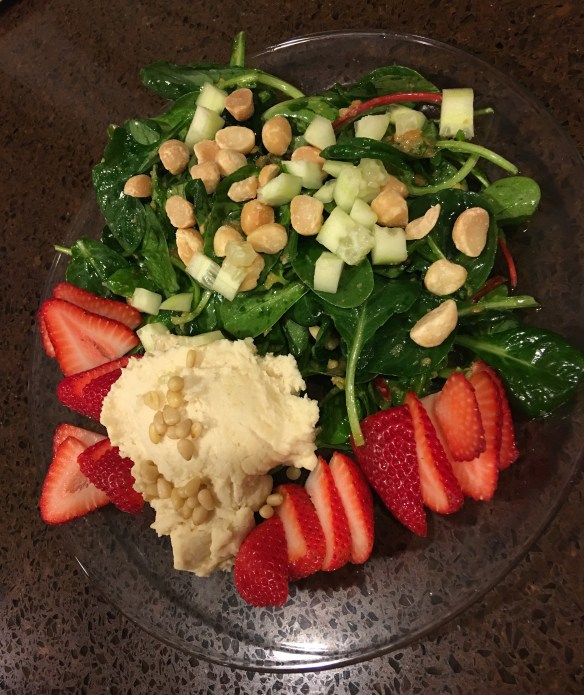
For Adrian, I made the skordalia the major protein in a salad, with pine nuts for flair. I added mixed greens with his favorite dressing—olive oil mixed with chickpea miso—and macadamia nuts and diced cucumber on top. I had fresh strawberries, so I finished dressing the plate with fresh strawberries.

Happy kid. Happy husband.

FullSizeRender 9

ASD Recovery Recipe: Anything Pasta

So I’ve discovered that I can make a decent pasta meal out of anything “vegetable” in my refrigerator. Like, virtually anything.

Last night I planned to make white bean skordalia. By the time I discovered that I forgot to advance-soak the cannellini beans, I had only minutes to devise another dinner. I surveyed the kitchen and assembled these ingredients:

->Carrots, with their green tops. I always cook the carrot greens. Once when I was checking out, the supermarket cashier casually snapped off the carrot greens and tossed them in a garbage bin. I promptly commenced a lengthy oration on the benefits of carrot greens.

->Red onions.

->Garlic.

->Celery.

->Toasted onion salt. With Martin’s current low-salicylate diet limiting spices so much, I’ve been trying to get creative with salt.

->Pine nuts. I avoid the pine nuts from China. I’m not anti-China, but I am concerned with shortcomings in China’s food-safety schema.

->Green lentil pasta.

I prepped the carrots (greens and all) and celery in a vinegar bath, then cut them into pieces and put them in my food processor. October 13, 2011, I wrote a post titled, “Kitchen News: An Update on the Hunt for a Food Processor With Glass Bowl,” which (based on total unique views) is the most popular post ever to grace this blog. Five-and-a-half years later, I am still without a glass food processor. I processed the carrots and celery almost to a paste. Then I chopped the onions and garlic roughly and added them to the food processor.

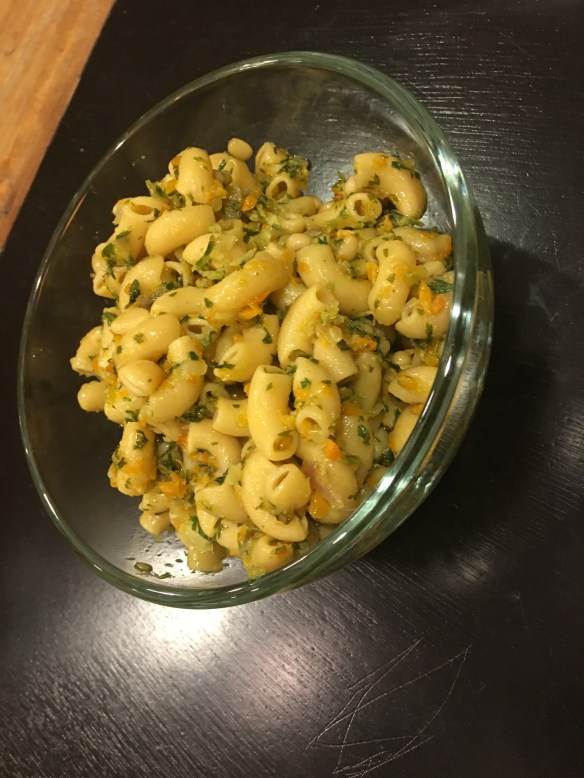
While the pasta was cooking, I heated a generous amount of oil and fried the finely minced vegetables. When they were almost done, I added onion salt and a scoop of pine nuts.

FullSizeRender 8

Finally I drenched the cooked pasta in cold water to prevent mushiness and added it to the veggie pan.

IMG_5891

The resulting dinner was pasta coated in lovely crunchy-garlicky bits. Martin said, “Oh yes, this is delicious!” and Adrian ate every last bit from the pan.

IMG_5893

Must remember—“night in a pinch” will henceforth be known as “garlic pasta dinner.”